Cybersecurity Saturday

Cybersecurity Saturday

Happy first day of Spring. Bloomberg reports that

As the U.S. reels from major cyber-attacks by suspected Russian and Chinese hackers, officials are looking to implement new technologies that would allow the federal government to respond more effectively.

The National Security Agency and the Department of Homeland Security believe they have part of the answer within the Domain Name System, or DNS, often referred to as the phone book of the internet. They are encouraging government agencies and high-risk companies to embrace a system known as Protective DNS, in which a private security firm would monitor and filter web traffic.

The payoff could be enormous, officials say. PDNS blocked connections to malicious websites millions of times in a recent test involving five U.S. defense contractors. After it was installed in the U.K., the system blocked nearly 60 million connections to suspect sites in 2018 alone, including 450,000 related to the infamous WannaCry strain of ransomware, according to a report issued by the National Cyber Security Centre.

Here’s a link to the NSA / CISA’s March 4, 2021 cybersecurity information sheet, “Selecting a Protective DNS Service.” This publication details the benefits of using a Protective Domain Name System (PDNS), which criteria to consider when selecting a PDNS provider, and how to effectively implement PDNS.”

Bankinfosecurity.com adds

In light of the SolarWinds supply chain attack and the ongoing hacking of unpatched Microsoft Exchange on-premises email servers, organizations need to rethink how they use threat intelligence to block malicious domains and other malicious activity, says Oliver Tavakoli, CTO at security firm Vectra AI. PDNS services can play an important role, he says.

“Having PDNS in place allows for quick leverage of threat intel to actively block access, and it also allows relatively easy retrospective analysis to see if the organization was affected,” Tavakoli says.

Adopting PDNS services and improving security of the aging DNS protocol can help reduce common internet security problems, says Roger Grimes, data-driven defense evangelist at the security firm KnowBe4.

“A far more safe and secure internet can easily be designed. It would not take magic. It would take a few dozen people who control the internet’s future sitting in a room, designing a few global services, like Protective DNS, but on a global level, and agreeing on a few dozen values in a few database tables, and we could do it,” Grimes says. He notes, however that “it’s hard to get people in your own family to agree on something, much less all of the people in the world.”

On March 17, the FBI’s Internet Crime Complaint Center released its annual report.

The 2020 Internet Crime Report includes information from 791,790 complaints of suspected internet crime—an increase of more than 300,000 complaints from 2019—and reported losses exceeding $4.2 billion. State-specific statistics have also been released and can be found within the 2020 Internet Crime Reportand in the accompanying 2020 State Reports.

The top three crimes reported by victims in 2020 were phishing scams, non-payment/non-delivery scams, and extortion. Victims lost the most money to business email compromise scams, romance and confidence schemes, and investment fraud. Notably, 2020 saw the emergence of scams exploiting the COVID-19 pandemic. The IC3 received over 28,500 complaints related to COVID-19, with fraudsters targeting both businesses and individuals.

TechRepublic adds that “A report released Wednesday [March 17] by Unit 42, the threat intelligence team at Palo Alto Networks, looks at how ransomware has evolved and provides advice on how to protect your organization. To create its “2021 Ransomware Threat Report,” Unit 42 worked with Palo Alto Networks’ Crypsis incident response team to analyze ransomware based on their collective data across the U.S., Canada and Europe.”

Finally, Cyberscoops offers an interesting perspective on the recent Verkada security camera breach.

Friday Stats and More

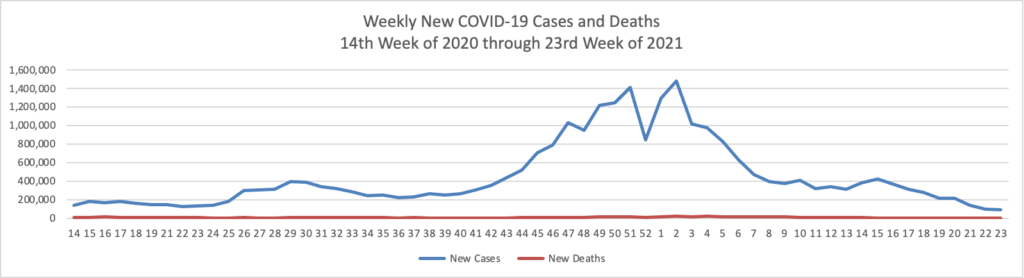
Based on the Centers for Disease Control’s COVID-19 Data Tracker website, here is the FEHBlog’s chart of new weekly COVID-19 cases and deaths over the 14th week of 2020 through 11th week of this year (beginning April 2, 2020, and ending March 17, 2021; using Thursday as the first day of the week in order to facilitate this weekly update):

and here is the CDC’s latest overall weekly hospitalization rate chart for COVID-19:

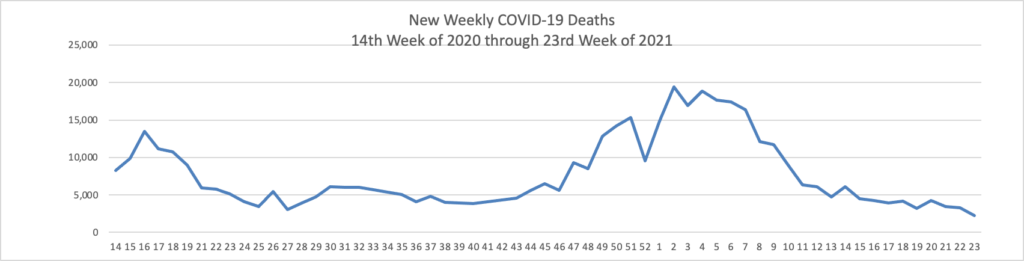
The FEHBlog has noticed that the new cases and deaths chart shows a flat line for new weekly deaths  because new cases greatly exceed new deaths. Accordingly here is a chart of new COVID-19 deaths over the period April 2, 2020 through March 17, 2021):

These charts are moving in the right direction, fingers crossed. Here is a COVID-19 vaccinations chart for the past three months which also uses Thursday as the first day of the week:

As of today just over 67% (2/3s) of the U.S. population over 65 and 30% of the vaccination eligible U.S. population has received at least one dose of a COVID-19 vaccination. 2.5 million doses were administered yesterday.

Nevertheless,. the Wall Street Journal reports today that

Federal officials this week warned that the U.S. may be on track for another surge in Covid-19 cases, trailing Europe by a few weeks in a pattern that has been seen throughout the pandemic.

European countries now implementing new lockdowns amid a resurgence in infections each took an upward trend after disregarding known mitigation strategies, said Centers for Disease Control and Prevention head Dr. Rochelle Walensky, noting it was a warning sign for the U.S.

France on Friday imposed a monthlong lockdown in Paris and other parts of the country. Italy earlier this week implemented new restrictions.

The U.S. in general has followed the European Union by a few weeks in the dynamics of the outbreak, Dr. Anthony Fauci said this week. In Europe, cases came down, plateaued and then countries pulled back on mitigation methods and had a rebound in cases, he said in a conversation with The Wall Street Journal.

“They are in the process of a rebound now, which is really something we absolutely want to avoid,” Dr. Fauci said. He added that given the current level of community infection in the U.S., it is risky to pull back on all the preventive modalities.

The U.S. pace of COVID-19 vaccination is much quicker than Europe’s. Yet, the Journal article concludes as follows:

The majority of Americans who have been fully vaccinated are ages 50 and up, according to CDC data.

But with the U.S. choosing to prioritize a limited number of vaccines for older or vulnerable adults—who are at greater risk for serious complications and death from Covid-19—it means that those who are perhaps more likely to move about the community are going to be vaccinated later, according to both Dr. [Emily] Martin and Dr. {Yonatan] Grad.

“It makes sense, if your goal is to reduce deaths, to focus on vaccinating those at highest risk of dying if infected,” Dr. Grad said, adding, “there are some contexts where you would want to vaccinate those who are at highest risk of transmitting to get cases down, in order to reduce deaths.”

The FEHBlog assumes that those other contexts which Dr. Grad has in mind involve situations where the risk of rapid death from the disease is low. Before long the U.S. will be adequately vaccinated from the aged to the younger groups.

Thursday Miscellany

Photo by Juliane Liebermann on Unsplash

In the wake of yesterday’s announcement that Amazon is breaking into the employer sponsored plan telehealth market, there was plenty of news today about telehealth.

STAT News reports that

“The market for virtual care is still massively underpenetrated,” wrote Cowen analysts Charles Rhyee, Calvin Sternick, James Auh, and Gwen Shi in a research note Wednesday. While Teladoc expects to provide 10 million visits in the U.S. in 2021, each year the country sees roughly 850 million outpatient visits, plus 300 million additional visits specific to mental health, according to the Cowen analysts. “This is not a zero sum game by any stretch,” they added.

Med City News effectively seconds this point of view as follows:

Amazon will need to build out relationships with health plans and health systems, so it can have a referral network for patients who need to see a specialist.   Teladoc, for example, says it has partnerships with more than 50 health plans and 600 health systems, perhaps implying that it’s not going to be that easy.

“New entrants to virtual care will continue to confront many of the challenges Teladoc Health has overcome over the past decade as we have built worldwide capabilities to deliver, enable and empower whole-person virtual care,” a Teladoc spokesperson wrote in an email.

While that may well be true, what Teladoc and Amwell encountered and overcame was low utilization — something that Amazon won’t have to contend with given that Covid-19 has ramped up utilization and adoption sky-high.

It will be interesting to see the jockeying for market share, but no matter which company wins, telehealth has already come out on top.

In that regard, Healthcare Dive reports that “Virtual behavioral health visits surged in the first half of 2020 as the COVID-19 pandemic exacerbated mental health needs, according to a new analysis by Milliman and Well Being Trust.”

Healthcare IT News cautions us that “Telehealth experienced sudden and massive growth starting a year ago, but it didn’t happen everywhere. A new report from the RAND Corporation suggests that the biggest upticks in virtual care availability occurred in more affluent and metropolitan communities, and that telemedicine services were mostly enjoyed by patients with private insurance.”

Healthcare Dive offers an interview with Health Affairs editor in chief Alan Weil that features a discussion of telehealth.

In healthcare equity news

  • Health Payer Intelligence reports that “Blue Shield of California has enhanced its provider network to expand COVID-19 vaccine access in underserved communities.”
  • Fierce Healthcare reports that

The Blue Cross Blue Shield Association (BCBSA) is teaming with Feeding America for COVID-19 vaccine outreach in vulnerable communities.

Clinical information and educational materials highlighting the safety and efficacy of the vaccines will be made available at Feeding America’s 200 food banks, which reach 40 million people. BCBSA will provide physical handouts as well as social media posts with information from the Centers for Disease Control and Prevention and its own clinicians.

The materials will be available in both English and Spanish, BCBSA said, and aim to “dispel common myths” that may prevent people from getting vaccinated.

In other healthcare industry news

  • Healthcare Dive reports that the Senate confirmed the President’s nomination of Xavier Becerra to be Health and Human Services Secretary by a 50-49 vote. “Becerra has the support of payer and provider groups including the American Hospital Association and American Medical Association.”
  • Also coming out of Congress,

Senators Dianne Feinstein (D-Calif.) and Chuck Grassley (R-Iowa) and Representatives Scott Peters (D-Calif.) and John Curtis (R-Utah) today introduced the Methamphetamine Response Act, a bill declaring methamphetamine an emerging drug threat which would require the Office of National Drug Control Policy (ONDCP) to develop, implement and make public a national plan to prevent methamphetamine addiction and overdoses from becoming a crisis.

 “In a single year we’ve seen psychostimulant-related overdose deaths, which include meth, spike by 42 percent,” said Feinstein. “The meth available on our streets is pure, potent and cheap and law enforcement is seizing more of the drug than ever. Two of the largest seizures on record occurred in California last year and in just a five month period, U.S. Customs and Border Protection seized more than 75,000 pounds of methamphetamine. Clearly we are in the midst of a meth crisis and we must implement a national, comprehensive plan to address this threat before it claims even more American lives.”

No bueno.

In further celebration of Patient Safety Awareness Week and because the FEHBlog believes that communication plays an important role in patient safety here’s an AHRQ article on using better communication to improve drug safety / avoid medication errors.

Midweek Update

Photo by Manasvita S on Unsplash

Happy St. Patricks Day to all.

Congress in a recent appropriations law sought a report from the National Academy for Public Administration on the Trump Administration’s proposal to break up the Office of Personnel Management. The Federal Times reports that “A better federal workforce policy will require the Office of Personnel Management to become a more independent and authoritative agency, rather than being broken apart into other departments, a long-awaited National Academy for Public Administration study determined March 17. ”

“We strongly recommend that a central personnel agency continue to exist, and that organization is an independent, enterprise-wide human capital agency and a steward of the merit system principles,” said Terry Gerton, president and CEO of NAPA, said at a press briefing on the report. “But that organization, OPM as we know it today, really needs to build its staff capacity, encourage innovation and adopt a more data-driven, accountable and forward-looking capital management approach.”

In other federal agency news, the Federal News Network informs us that

The IRS is moving this year’s April 15 tax filing season deadline back to May 17, citing ongoing challenges from the COVID-19 pandemic. IRS Commissioner Chuck Rettig said in a statement Wednesday that the new deadline would give the public more time to take stock of their finances, while also giving agency employees more time to implement new responsibilities under the American Rescue Plan.

The Department of Health and Human Services announced today that the agency

will invest $10 billion from the American Rescue Plan to ramp up screening testing to help schools reopen, $2.25 billion to scale up testing in underserved populations, and provide new guidance on asymptomatic screening testing in schools, workplaces, and congregate settings. These measures are part of President Biden’s strategy to increase COVID-19 testing nationwide as vaccinations increase.

“COVID-19 testing is critical to saving lives and restoring economic activity,” said HHS Acting Secretary Norris Cochran. “As part of the Biden Administration’s National Strategy, HHS will continue to expand our capacity to get testing to the individuals and the places that need it most, so we can prevent transmission of the virus and defeat the pandemic.”

The U.S. Preventive Services Task Force announced yesterday a proposed B grade recommendation “on screening for prediabetes and type 2 diabetes. The Task Force recommends screening adults between ages 35 to 70 years old who are overweight or obese for prediabetes and diabetes.” The current minimum age for this screening recommendation is 40 years old. NBC News reports that

We know the rates of prediabetes and diabetes are increasing in people who are younger,” said Dr. Chien-Wen Tseng, a task force member and a professor of family medicine at the University of Hawaii’s John A. Burns School of Medicine. “Our main reason for dropping the age is to match the screening with where the problem is: If diabetes and prediabetes are occurring at a younger age, then we should be screening at a younger age.”

The Affordable Care Act requires health plans to cover USPSTF A and B recommended preventive services without member cost sharing when an eligible member receives the service in-network. If the USPSTF finalizes this recommendation later in 2021, then the ACA health plan coverage mandate for this screening would expand to people in the age 35 to 40 age group in 2023. Here is a link to background on the USPSTF’s sixteen members.

In other health industry news —

Healthcare Dive reports that

Amazon is expanding its virtual care pilot program, Amazon Care, to employees and outside companies nationwide beginning this summer in a major evolution of its telehealth initiative, as the COVID-19 pandemic continues to drive unprecedented demand for virtual care.

Amazon will also offer its on-demand primary care service to other Washington state-based companies and plans to expand its in-person service to Washington, D.C., Baltimore and other cities in the following months, the e-commerce behemoth announced Wednesday.

Employee Benefit News offers a Chief Financial Offer’s advice on health savings account funding.

Tuesday Tidbits

Photo by Patrick Fore on Unsplash

Fortune offers an insightful story about CVS Health’s CEO Karen Lynch.

Smart Brief discusses news from last week’s AHIP National Policy Conference.

The Society for Human Resource Management offers a helpful list of American Rescue Plan Act provisions impacting employers.

Medscape encouragingly reports that

Vaccination of about 88% of Americans who received the first dose of Pfizer/BioNTech or Moderna’s COVID-19 vaccines was complete, a study of over 12 million people by the U.S. Centers for Disease Control and Prevention (CDC) showed. * * * According to the analysis, about 3% of people in the United States who received the first dose of either vaccine did not get the second dose needed to complete vaccination. The agency said 8.6% had not received the second dose, but were still within the allowable interval to receive it.

As of today, 64.6% of the U.S. population over age 65 has received at least one dose of the COVID-19 vaccine and 36.6% of that group (including the FEHBlog) are fully vaccinated.

Healthcare Dive informs us that “Independent primary care docs more financially stable, but fed up with vaccine exclusion.” The FEHBlog heard today that vaccine distribution will open to more sites of care, including physician offices, once the Food and Drug Administration gives full marketing approval to the COVID-19 vaccines. The FEHBlog, however, could not find a projected date for that action, but he will keep looking.

Healthcare Dive also reports that “Virtual care company Doctor on Demand and clinical navigator Grand Rounds have announced plans to merge, creating a multibillion-dollar digital health firm.” The companies’ joint press release explains

The new company will combine Grand Rounds’ data-driven clinical navigation platform and patient advocacy tools with Doctor On Demand’s preeminent virtual care offering to provide an unparalleled member experience. It will accelerate the adoption of virtual care in key areas including primary care, specialty care, chronic condition management, and behavioral health. Owen Tripp, CEO of Grand Rounds, will serve as the CEO of the expanded business. Both companies will continue to operate under their existing brands for the time being.

“No one has done this before, combining navigation and virtual care delivery. We think it’s the future,” said Owen Tripp, co-founder and CEO of Grand Rounds. “People make unguided healthcare decisions every day, often with higher costs and worse outcomes. Now, with Doctor On Demand, we’ll offer them coordinated support on all fronts—physical, behavioral, financial, administrative—and we’ll do it for everything from acute issues to life-long health. This is truly complete care, and it’s what we all need.”

“We’re building a next-generation virtual care company with a nationwide practice of diverse, dedicated providers and a multidisciplinary care team,” said Hill Ferguson, CEO of Doctor On Demand. “By fully integrating medical and behavioral healthcare with clinical navigation, we’re impacting healthcare where it actually happens—between a patient and their provider—and ensuring that experience is seamless, personalized, and can follow the patient wherever they go.”

In continuing recognition of Patient Safety Awareness Week, here are links to the Agency for Healthcare Research and Quality’s blog post on accelerating progress in patient safety and an AHRQ article on the importance of good communication skills to achieving patient safety.

Monday Roundup

Photo by Sven Read on Unsplash

“The ides of March are come.
Soothsayer: Ay, Caesar; but not gone.” Wm. Shakespeare

From the COVID-19 vaccine front —

The Centers for Medicare and Medicaid Services (“CMS”) announced today that

Effective for COVID-19 vaccines administered on or after March 15, 2021, the national average payment rate for physicians, hospitals, pharmacies and many other immunizers will be $40 to administer each dose of a COVID-19 vaccine. This represents an increase from approximately $28 to $40 for the administration of single-dose vaccines, and an increase from approximately $45 to $80 for the administration of COVID-19 vaccines requiring two doses. The exact payment rate for administration of each dose of a COVID-19 vaccine will depend on the type of entity that furnishes the service and will be geographically adjusted based on where the service is furnished.  

CMS, along with the Departments of Labor and Treasury, is requiring that most private health plans and issuers cover the COVID-19 vaccine and its administration, both in-network and out-of-network, with no cost sharing during the public health emergency (PHE). Current regulations provide that out-of-network rates must be reasonable, as compared to prevailing market rates, and reference the Medicare reimbursement rates as a potential guideline for insurance companies. In light of CMS’s increased Medicare payment rates, CMS will expect commercial carriers to continue to ensure that their rates are reasonable in comparison to prevailing market rates.

Medscape reports that “AstraZeneca Plc is preparing to file for U.S. emergency use authorization (EUA) for its COVID-19 vaccine later this month or early April after accumulating enough data to judge the inoculation’s efficacy, sources with knowledge of the ongoing clinical trial told Reuters on Friday.” STAT News in its article titled the “Curious Case of the AstraZeneca’s COVID-19 vaccine” concludes

The U.S. study, started last September and including 30,000 patients, is, like the studies for the Moderna and Johnson & Johnson vaccines, being run with the U.S. National Institutes of Health. It’s the best hope for settling any questions or concerns about the AstraZeneca vaccine once and for all.

STAT News also informs us that Biden Administration is about to embark on a $1.5 billion public relations campaign to convince Americans to receive the COVID-19 vaccine. “Much of the project’s funding comes from the sweeping $1.9 trillion Covid-19 relief bill Biden signed last week. The administration has also already pledged over $500 million in additional funds to address vaccine uptake, health literacy, and equity in the vaccine distribution, including $250 million to fund local health literacy projects and another $255 million for the CDC to fund local government efforts to focus on equity and confidence in underserved communities.”

The Federal Times reports that “Washington, D.C. Mayor Muriel Bowser released an updated vaccination timeline March 15 that outlines when, among other essential professions, federal government and Postal Service employees can expect to become eligible for a COVID-19 vaccine. * * * Just under seven percent of federal employees are located in Washington, D.C.”

Also, Fierce Healthcare offers UnitedHealthcare scientist and Healthcare Dive offers hospital executive reflections on the first anniversary of the great hunkering down.

The HHS Office of Inspector General has unveiled a new website about the agency’s oversight of COVID-19 response and recovery. The website calls attention to the agency’s updated list of COVID-19 scams.

During this Patient Safety Awareness Week, HHS’s Agency for Healthcare Research and Quality calls attention to its Chartbook on Patient Safety. “This Patient Safety chartbook is part of a family of documents and tools that support the National Healthcare Quality and Disparities Report (QDR). The QDR includes annual reports to Congress mandated in the Healthcare Research and Quality Act of 1999 (P.L. 106-129). This chartbook includes a summary of trends across measures of patient safety from the QDR and figures illustrating select measures of patient safety.”

Weekend update

Photo by Thought Catalog on Unsplash

Both Houses of Congress remain in session this coming week for floor voting and committee business.

Bloomberg reports that

New U.S. Covid-19 cases declined by almost 100,000 last week to the fewest since early October, while an average of 1,326 people died of the disease each day, data compiled by Johns Hopkins University and Bloomberg show. The week’s death toll of 9,284 was the lowest since mid-November. U.S. immunization has expanded amid a growing supply of vaccines and a drive by President Joe Biden’s administration to help roll them out. The U.S. vaccination rate over the last week was about 2.5 million doses per day * * *.

Here’s a link to the CDC’s website on demographic characteristics of Americans who have received the COVID-19 vaccination(s).

HHS’s Agency for Healthcare Research and Quality is holding its annual Patient Safety Awareness Week from March 14 to March 20.

From the FEHB front

  • FedWeek recently informed us about how getting married affects federal employee benefits.
  • FedSmith and Govexec each discuss planning for coordination of benefits with FEHB and Medicare in retirement.

Cybersecurity Saturday

The Senate Homeland Security and Governmental Affairs Committee will be holding a hearing on “Understanding and Responding to the SolarWinds Supply Chain Attack: The Federal Perspective” on Thursday March 18.

Speaking of which, Bleeping Computer reports that as of March 11, 2021 “CISA officials said that, so far, there is no evidence of US federal civilian agencies compromised during ongoing attacks targeting Microsoft Exchange servers. This statement is based on information collected by federal agencies following an emergency directive issued by the US Cybersecurity and Infrastructure Security Agency (CISA) one week ago.”

Following up on this story, Cyberscoop reports that

Suspected Chinese government-linked hackers were the first to allegedly exploit the Microsoft vulnerabilities. As soon as the company released a fix for the bugs, though, taking the issue public, a range of other hacking groups also appeared to try leveraging the flaws. At least ten different advanced threat groups are working to exploit the vulnerabilities now, according to ESET research, while other hackers have stolen email data and others have tried to generate financial revenue.

But with such a large list of victims — 30,000 organizations in the U.S. alone, according to some estimates — and so many attackers trying to leverage the flaws, there is little hope for cybersecurity professionals and affected entities to keep up with the sheer volume of exploits and attackers pummeling them, analysts say. In addition to patching the holes in Microsoft technology, organizations should also be working to evict hackers from their networks, and remain on alert for data theft, credential theft and other potentially damaging follow-up attacks. Security analysts also are warning that the flaws could open the pathway for ransomware attacks, meaning that if organizations fail to act now, it could cost them later.

Here is a link to the latest CISA remedial guidance on the Microsoft vulnerabilities.

Cyberscoop adds that

Over the last several days, Allison Nixon, the chief research officer at cybersecurity consulting firm Unit 221B, rounded up her team to develop a website that would help alert organizations if they’ve been comprised.

The Unit 221B website is designed so users can search to see if they are using compromised Exchange servers with Outlook Web Access (OWA) enabled. Users can go to the site, which launched Tuesday, directly from their Exchange server, which will allow Unit 221B to check their IP address against their victim list. Victims will then be alerted if they are compromised and if the attackers loaded webshells, a malicious tool used to establish a foothold inside targets, Nixon says.

Creating a data backup is one of the most crucial steps that organizations can take right now to protect themselves, Nixon said. Organizations that don’t make a backup of their servers but that do get hit with a ransomware attack, in which hackers lock up their machines and extort them for money, run the risk of losing their businesses entirely, Nixon warned. “It doesn’t matter if they don’t have a regular backup program, or they don’t have a fancy IT team — they just need to take a copy of their servers … put it on a hard drive, put it it in a safe: A one-time thing this week,” Nixon said. 

In federal personnel news, Nextgov informs us that the U.S. Office of Personnel Managements chief information officer (CIO) Clare Martorana has been named the federal government’s CIO. Congratulations to her. OPM Principal Deputy CIO Guy Cavallo will serve as acting CIO until a permanent replacement is named, an OPM spokesperson told Nextgov.

Friday Stats and More

Based on the Centers for Disease Control’s COVID-19 Data Tracker website, here is the FEHBlog’s chart of new weekly COVID-19 cases and deaths over the 14th week of 2020 through 10th week of this year (beginning April 2, 2020, and ending March 10, 2021; using Thursday as the first day of the week in order to facilitate this weekly update:

and here is the CDC’s latest overall weekly hospitalization rate chart for COVID-19:

The FEHBlog has noticed that the new cases and deaths chart shows a flat line for new weekly deaths  because new cases greatly exceed new deaths. Accordingly here is a chart of new COVID-19 deaths over the period (April 2, 2020, through March 10, 2021):

Finally here is a COVID-19 vaccinations chart over the 51st week of 2020 through the 10th week of 2021 (December 24, 2021 through March 10, 2021) which also uses Thursday as the first day of the week:

As of today, over 100 million COVID-19 vaccinations have been administered in the U.S. and just over one quarter of the eligible U.S. population has received at lease one dose of those vaccinations. And that’s before the supply problem is completed resolved. In that regard, the Department of Health and Human Services today expanded the class of medical professionals who can administer the COVID-19 vaccine.

Fortune Magazine’s editor Alan Murray conversed with Pfizer’s CEO Albert Bourla. Here are the highlights of that interview:

I asked Bourla to reflect on the anniversary. His response:

“I think it is very impressive that a year from a major disaster for humanity, we are emerging with a sense of liberation.  To see the Israeli ministry of health with their data so revealing of what a vaccine can do for societythat is the best demonstration of the power of science and the power of human ingenuity.”

If you missed it, the Israeli news is here. What it shows is that the vaccine is highly effective in preventing “symptomatic” as well as “asymptomatic” infections—meaning it is highly unlikely a vaccinated person can be infected or spread infection.

I asked Bourla many of the questions people have been asking me:

Can I travel without risk, now that I’ve been vaccinated? 

“Our data demonstrate efficacy from the seventh day. Everybody else demonstrated efficacy from 14 days. You are very reduced risk. Nothing is 100% in biology.”

Can I spread the disease to others?

“The Israeli minister said they saw 94% protection from asymptomatic disease. This is extremely, extremely good news.”

Is there evidence suggesting one of the new variants is not susceptible to the vaccine?

“With everything we see and know right now, we believe the current vaccine is effective against all three variantsSouth African, Brazilian and U.K. With the U.K., we have clinical evidence.”

Will I have to get a booster?

“I think there is a very high chance that everybody will be getting a booster annually…There are scenarios where you might need one sooner.”

In other COVID-19 news:

People who have recovered from a COVID-19 diagnosis face potentially new diagnoses for neurological, behavioral health and cardiovascular conditions, new data from Cigna show. Cigna researchers analyzed (PDF) claims data on 150,000 commercial plan members and their family members between April and June 2020 and found that 5.8% reported neurological conditions post-COVID. In addition, 5.1% reported heart conditions such as heart failure or coronary artery disease, and 5% reported mental health disorders following a COVID-19 diagnosis, the study found.

  • The American Medical Association announced that “America’s physicians, pharmacists and nurses are urging their colleagues and other key health care stakeholders to intensify efforts to collect information on race and ethnicity when administering COVID-19 vaccines. “Race and ethnicity data provides critical information to clinicians, health care organizations, public health agencies and policymakers, allowing them to equitably allocate resources across all communities, evaluate health outcomes and improve quality of care and delivery of public health services,” says the open letter, sent by the AMA, American Pharmacists Association (APhA) and the American Nurses Association (ANA).

Agreed but be sure to share the information with health plans too.

Thursday Miscellany

Photo by Juliane Liebermann on Unsplash

The President signed the American Rescue Plan (H.R. 1319) into law today.

Mercer provides a useful overview of the provisions of the law affecting employers. The COBRA subsidy discussed in the article does not apply to the temporary continuation coverage applicable to federal and postal employees. The COBRA subsidy in any event is only available to employees who lost health coverage due to involuntary termination of employment or reduction in hours.

On the bright side, the new law “increases the income exclusion for employer-provided dependent care assistance programs — for example, employee pretax contributions to dependent care FSAs — from $5,000 to $10,500 (and from $2,500 to $5,250 for a married individual filing a separate return) for 2021.” The FEHBlog expects that OPM will adopt this FSA change because the dependent care FSA is fully funded by the employee with no insurance risk to the employer.

Katie Keith in Health Affairs digs into the law’s financial support for the Affordable Care Act marketplace and its beneficiaries.

From the COVID front —

  • The White House has announced that the Biden administration will seek to “make every adult in the U.S. eligible for vaccination no later than May 1.” This fact sheet explains that steps that will be taken to make good on that plan.  The FEHBlog believes that this is an achievable goal.
  • David Leonhardt in the New York Times offers an interesting take on herd immunity from COVID-19. He explains that

Herd immunity is more like a light dimmer. The more people develop immunity — either from having been infected or from being vaccinated — the less easily the virus will spread.

Nearly 30 percent of Americans have now had the virus, according to Youyang Gu, a data scientist. (That includes many people who have never taken a Covid test.) About 18 percent have received at least one vaccine shot. There is some overlap between these two groups, which means that about 40 percent of Americans now have some protection from Covid.

Had these people been exposed to the virus a year ago, they could have become infected — and then spread Covid to others. Today, many are protected.

What’s more Mr. Leonhardt’s first dose of vaccination figure (18%) reflects the total U.S. population. However the vaccines generally are available only to people over 18 years of age. The Centers for Disease Control reports today that 25.1% of that population has received at least one dose of a COVID-19 vaccine. The FEHBlog nearly fell off his share today when he noticed a new statistic on the CDC site showing that 62.4% of the U.S. population over age 65 has received at least one dose of a COVID-19 vaccine. That’s great news.

In legislative / regulatory news —

  • Healthcare Dive reports that Xavier Becerra will soon receive a Senate floor vote on his nomination to serve as Secretary of Health and Human Services.
  • Govexec reports that “Postmaster General Louis DeJoy will soon request a $40 billion investment into the cash-strapped U.S. Postal Service for organizational and workforce improvements, saying the money will help address longstanding challenges the mailing agency faces.  The funds would go toward infrastructure updates such as larger facilities and new package sortation equipment, DeJoy told a panel of the House Appropriations Committee on Thursday [March 11], and reducing turnover in the USPS workforce.”
  • Healthcare Dive also discusses hospital pricing information that has been gleaned from the online reports required by the federal government’s hospital pricing transparency rule. It’s not pretty.