The Wall Street Journal reports that the SolarWinds hackers are back at it.
Microsoft Corp. said [in a blog post] hackers, linked by U.S. authorities to Russia’s Foreign Intelligence Service, installed malicious information-stealing software on one of its systems and used information gleaned there to attack its customers. * * *
Most of the attacks were unsuccessful, but three of Microsoft’s customers were compromised during the campaign, the company said. “We have confirmed that two of the compromises were unrelated to the support agent issue, and are continuing to investigate the third instance,” a Microsoft spokesman said.
Microsoft identified the hackers behind the break-in as Nobelium, the same group associated with the sophisticated hack at Austin, Texas-based software maker SolarWinds Corp. U.S. authorities have said this group is part of Russia’s Foreign Intelligence Service, known as the SVR. Russia has denied involvement in the SolarWinds hack. A Russian embassy representative didn’t immediately return a message seeking comment on Microsoft’s blog post.
“This should concern all of us,” said Sherri Davidoff, chief executive of the security consulting firm LMG Security LLC. “Hackers made it past the defenses of one of the world’s most sophisticated technology suppliers, whose software underlies our entire economy.”
ZDNet explains in an illuminating article about where we stand in ransomware struggle
Regularly updating backups – and storing them offline – also provides another means of lessening the severity of ransomware attacks, because even in the event of the network being encrypted, it’s possible to restore it without paying cyber criminals, which cuts off their main means of income.
Nonetheless, the rise of double extortion attacks has added an extra layer of complexity to this issue because if the organisation doesn’t pay a ransom, they’re faced with the prospect of potentially sensitive information about employees and customers being leaked.
“Do you have a plan if if your information starts leaking out?,” says Hultquist. “Those pieces need to be in place now, not when it hits the fan”
While Phoenix NAP Global IT Services describes the 18 best practices to deter ransomware, The Wall Street Journal adds that “companies [now] stress-test systems by emulating successful cyberattacks.” Zurich Insurance via the Financial Times explains “Given that cyber exposures are now seen as inevitable, it only makes sense for businesses to invest in resilience. The fundamentals of resilience are protecting profitability through business continuity and incident response planning. The best way to assess that resilience is to see how quickly and effectively your business can react to any given scenario. That’s what cyber risks stress tests are all about.” The article goes on to break down one of these tests for the reader.
As alway’s here’s a link to the Bleeping Computer’s The Week in Ransomware.
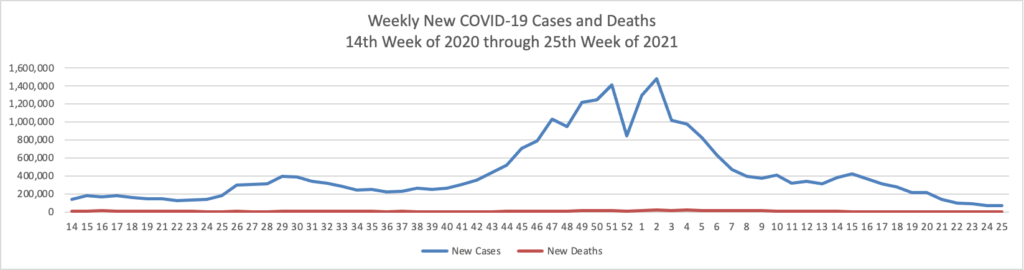
Based on the Centers for Disease Control’s COVID-19 Data Tracker website, here is the FEHBlog’s chart of new weekly COVID-19 cases and deaths over the 14th week of 2020 through 25th week of this year (beginning April 2, 2020, and ending June 23, 2021; using Thursday as the first day of the week in order to facilitate this weekly update):
According to the Centers for Disease Control (“CDC”),
The current 7-day moving average of daily new cases (11,343) decreased 4.4% compared with the previous 7-day moving average (11,867). Compared with the highest peak on January 10, 2021 (252,166), the current 7-day average decreased 95.5%. A total of 33,409,895 COVID-19 cases have been reported as of June 23.
Here is the CDC’s latest overall weekly hospitalization rate chart for COVID-19 which also has been steadily decreasing:
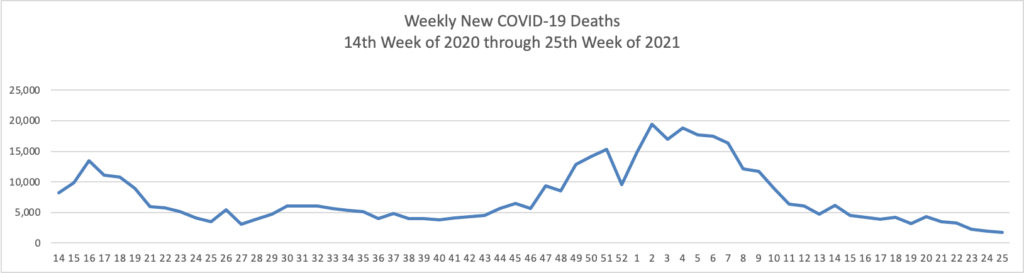
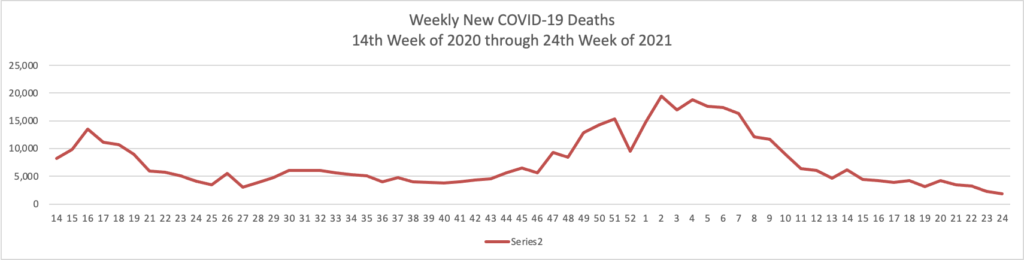
The FEHBlog has noticed that the new cases and deaths chart shows a flat line for new weekly deaths because new cases significantly exceed new deaths. Accordingly here is a chart of new COVID-19 deaths over the period (April 2, 2020, through June 23, 2021):
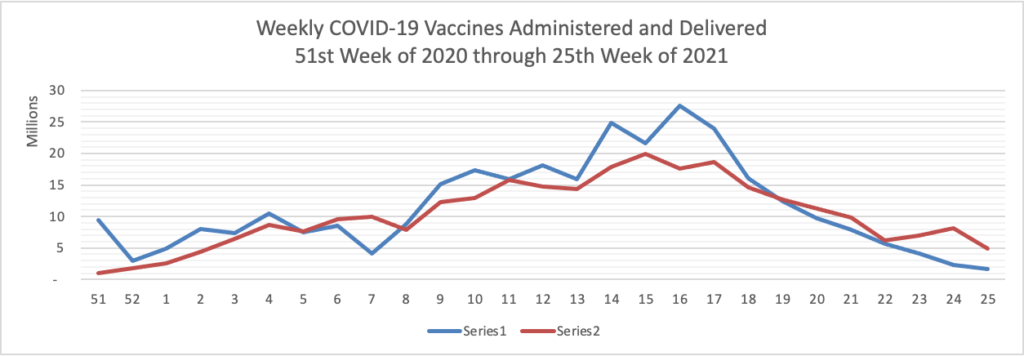
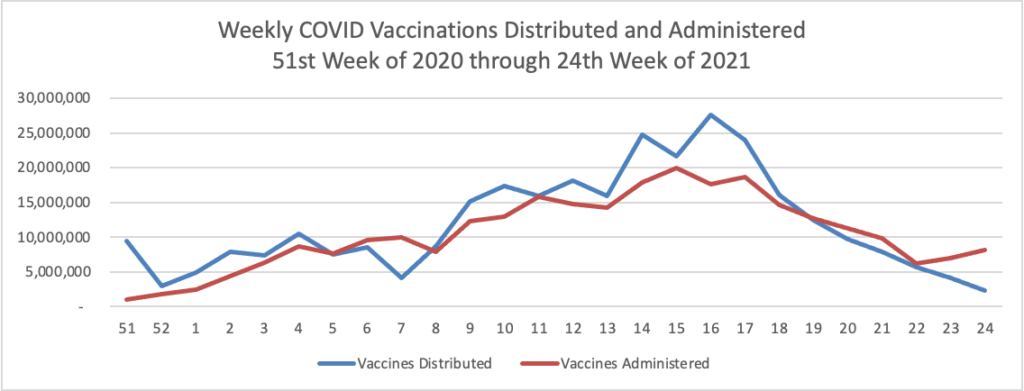
Finally here is a COVID-19 vaccinations chart over the period December 17, 2020, through June 23, 2021, which also uses Thursday as the first day of the week:
As of today, according to the Centers for Disease Control, over 150 million Americans are fully vaccinated. The vaccination campaign has lead to the low levels of new cases and deaths in our country. The Associated Press observes:
Nearly all COVID-19 deaths in the U.S. now are in people who weren’t vaccinated, a staggering demonstration of how effective the shots have been and an indication that deaths per day — now down to under 300 — could be practically zero if everyone eligible got the vaccine.
An Associated Press analysis of available government data from May shows that “breakthrough” infections in fully vaccinated people accounted for fewer than 1,200 of more than 853,000 COVID-19 hospitalizations. That’s about 0.1%.
And only about 150 of the more than 18,000 COVID-19 deaths in May were in fully vaccinated people. That translates to about 0.8%, or five deaths per day on average.
Currently, several variants are found around the world, including in the United States. On June 15, 2021, the B.1.617.2 (Delta)* variant was classified as a VOC because it spreads from person to person more easily than other variants and may cause more severe disease. B.1.617.2 has been reported in 77 countries and in the United Kingdom has become the main variant in COVID-19 cases. In the United States, the proportion** of B.1.617.2 for the 2-week period ending June 19, 2021, is predicted to increase to 20.6% nationally and be higher in regions 2, 6, 7, 8, and 9.
The more a virus circulates in a population, the more opportunities it has to transform itself and can reduce the effectiveness of our vaccines. Recent studies have shown that the vaccines available in the United States are effective against variants currently circulating, including B.1.617.2. Vaccines interrupt the ability of the virus that causes COVID-19 to move between people and mutate, so it is important for everyone to get vaccinated as soon as they’re eligible. If you have questions or concerns about vaccines, please contact your healthcare professional, state or local health department, or local pharmacist or visit the CDC website. To find a place in your community to get a vaccine, visit Vaccines.gov or your local public health department website.
In the More department
The American Managed Care Journal reports that AHIP hosted a small group of U.S. Senators at a recent conference where the Senators offered their thoughts on future federal healthcare legislation.
Tammy Flanagan in Govexec discusses NARFE’s legislative conference on pending legislation in Congress affecting federal employees, annuitants and their benefit programs, including the Postal Reform Act.
Healthcare Dive informs us that “The Biden administration’s top health policy official on Thursday [June 24] reiterated his support for expanded telehealth access after the COVID-19 national emergency expires, as Congress considers a slate of bills that would permanently nix regulatory barriers to virtual care. “We are absolutely supportive of efforts to give us the authority to utilize telehealth in greater ways,” HHS Secretary Xavier Becerra said at a virtual event on digital health hosted by The Washington Post. Becerra also stressed that, though affordable telehealth should be available to all, HHS would be doubling down in making sure there’s accountability for quality of care. “We’re going to be doing a lot of bird-dogging, a lot of oversight,” he said.”
Fierce Healthcare reports on the winners of the IBM XPrize competition to create artificial intelligence tools to tackle global problems. For example, “An Israeli startup that uses artificial intelligence and other tech tools to wipe out malaria took the top prize in IBM Watson’s AI competition, nabbing $3 million to expand its operations. ZzappMalaria, a subsidiary of Sight Diagnostics, developed an AI-powered mobile app and dashboard to tackle malaria on the eradication level, specifically in developing countries.” Very 21st Century.
OPM Headquarters a/k/a the Theodore Roosevelt Building
OPM’s new Director Kiran Ahuja was sworn in today. Here is a link to the OPM press release on the festivities.
Health Payer Intelligence informs us that “The Alliance of Community Health Plans (ACHP) has proposed a number of recommendations to improve the Federal Employees Health Benefits (FEHB) program’s plan comparison tool in order to boost quality and enrollment, according to a recent issue brief.” ACHP’s action is timely because OPM has been focusing attention on the plan comparison tool in consultation with interested carriers and presumably other stakeholders.
According to a Committee press release, “The House Appropriations Subcommittee on Financial Services and General Government today approved by voice vote its fiscal year 2022 bill. [This is the bill that funds OPM and the FEHB.] For fiscal year 2022, the draft bill includes $29.1 billion in funding, an increase of $4.8 billion over 2021.”
Sen. Chuck Grassley (R-Iowa) today joined Senate Majority Whip Dick Durbin (D-Ill.) Sen. Angus King (I-Maine) to introduce the Drug-price Transparency for Competition (DTC) Act, a bill that would require price disclosures on advertisements for prescription drugs, in order to empower patients and reduce spending on medications. Last week, the Government Accountability Office (GAO) released a report – requested by Durbin and Grassley – which found direct-to-consumer (DTC) advertisements of prescription drugs contribute to an enormous amount of Medicare costs. Specifically, the DTC Act would require DTC advertisements for prescription drugs and biological products to include a disclosure of the list price, so that patients can make informed choices when inundated with drug commercials.
Speaking of drug prices, let’s take a look at recent news on the new Alzheimer’s Disease drug, Aduhelm.
Yesterday, Biogen issued a bulleted defense of its pricing, which is $56,000 annually per patient. STAT News points out “For families and physicians grappling with the historic approval this month of the controversial Alzheimer’s drug Aduhelm, there’s no shortage of unanswered questions. But a critical one has largely been overlooked: Once patients start taking the medication, how will they know when it’s time to stop? “We don’t have any guidance on how long to give this medication to someone who doesn’t experience adverse events,” said William Mantyh, a behavioral neurologist at M Health Fairview University of Minnesota Medical Center. “With a drug like aducanumab where the upfront demonstrated efficacy is up in the air, it really makes it hard for a clinician to figure out when to stop the drug based on a patient’s clinical symptoms.”
Axios interviewed AHIP CEO Matt Eyles on Aduhelm pricing. In response to an Axios question on acceptable pricing, Mr. Eyles responded that “The best information we have is what [the Institute for Clinical and Economic Review] puts out.” ICER stated on June 7 that “At the ICER public meeting on aducanumab on July 15, 2021, we will tackle important questions [about Aduhem] with all stakeholders at the table. We will also address the question of fair pricing for a drug that now seems likely to become one of the top selling drugs in the history of the United States. ICER’s preliminary draft report calculated a fair annual price to lie between $2,500-$8,300. Even in our most optimistic cost-effectiveness scenario — which ignores the contradictions within the two pivotal trials and presumes that only the positive trial captures the true benefits of treatment — aducanumab’s health gains would support an annual price between $11,100-$23,100. The list price of $56,000 per year announced today by the drug maker far exceeds even this optimistic scenario. Our report notes that only a hypothetical drug that halts dementia entirely would merit this pricing level. The evidence on aducanumab suggests that, at best, the drug is not nearly this effective. Nonetheless, even at the lower range of the estimated number of eligible patients, at this price the drug maker would stand to receive well in excess of $50 billion per year even while waiting for evidence to confirm that patients receive actual benefits from treatment.
The Wall Street Journal reports that “Eli Lilly & Co. plans to submit its Alzheimer’s drug for market clearance under an expedited review this year, in a sign that regulators are encouraging development of treatments for the disease after a recent approval. Lilly said Thursday that the U.S. Food and Drug Administration had designated the company’s experimental Alzheimer’s drug, called donanemab, for the agency’s accelerated approval process. The FDA decision comes after the agency cleared Biogen Inc.’s Aduhelm, the first Alzheimer’s therapy to receive approval in nearly two decades but one that has drawn criticism from doctors and researchers skeptical the drug works. * * * Donanemab performed better in a trial than Biogen’s drug did in its trials, and health insurers and patients would probably prefer it over Aduhelm, J.P. Morgan analyst Chris Schott said in a note to investors.“Donanemab’s approval would be a major blow to Aduhelm’s commercial prospects,” Brian Skorney, a Robert W. Baird & Co. analyst, said in a research note. “We think it would make zero sense for FDA to approve Aduhelm, but not donanemab.” Ah, competition.
In other drug pricing news, Fierce Healthcare tells us that
Cigna is launching a new program that aims to incentivize eligible members to switch to biosimilar drugs.
Under the new Shared Savings Program, members will be offered a one-time $500 debit card for healthcare services or medications if they make the decision to switch to a biosimilar, according to an announcement provided first to Fierce Healthcare.
The program will be made available first to [approximately 7,000] eligible patients taking Remicade, a brand-name biologic that treats a number of inflammatory conditions such as Crohn’s disease and psoriasis. Remicade infusion costs can vary, but Cigna claims data suggest the average regimen costs $30,000 per year, with expenses growing depending on the site of administration.
Two biosimilars for the drug, Avsola and Inflectra, will be moved to the insurer’s preferred tier in July. Eligible customers and their providers will be notified by Cigna about their eligibility to participate in the Shared Savings Program in the coming weeks, the insurer said.
In COVID-19 news —
Fierce Biotech reports that “The FDA green-lit its first antibody test that doesn’t use blood samples to check for evidence of a COVID-19 infection and instead relies on simple, painless mouth swabs. Developed by Diabetomics, the rapid, lateral-flow diagnostic received an agency emergency authorization allowing it to be used at the point of care for adults and children. Designed to deliver a result within 15 minutes, the CovAb test also does not require any additional hardware or instruments. When administered at least 15 days after the onset of symptoms, when the body’s antibody response reaches higher levels, the test demonstrated a false-negative rate of less than 3% and a false-positive rate of nearly 1%, according to the company.”
The New York Times reports that the Baltimore Maryland factory that had been producing the single dose Johnson & Johnson COVID-19 vaccine remains shuttered which Congress investigates its owner Emergent Biosolutions.
The NIH Director’s blog informs us about new NIH research on how Immunity generated from COVID-19 vaccines differs from an Infection. “The good news so far is that, unlike the situation for the common cold, we have now developed multiple COVID-19 vaccines. The evidence continues to suggest that acquired immunity from vaccines still offers substantial protection against the new variants now circulating around the globe. The hope is that acquired immunity from the vaccines will indeed produce long-lasting protection against SARS-CoV-2 and bring an end to the pandemic. These new findings point encouragingly in that direction. They also serve as an important reminder to roll up your sleeve for the vaccine if you haven’t already done so, whether or not you’ve had COVID-19. Our best hope of winning this contest with the virus is to get as many people immunized now as possible. That will save lives, and reduce the likelihood of even more variants appearing that might evade protection from the current vaccines.” Amen to that.
In a bit of Thursday miscellany
Patient Engagement reports that “Optum is bringing healthcare right into Utah’s backyard, rolling out a new Optum Mobile Health Clinic to improve care access for individuals in Optum Care Network Utah. The mobile health clinic, a 45-foot-long vehicle with two private exam rooms, a waiting room, and an imaging lab, is set to address the leading care access barriers experienced by Utahns.” Well done.
A friend of the FEHBlog called his attention to the NIH report on an engaging study suggesting scientists may need to rethink which genes control aging.
In anticipation of tomorrow morning’s markup session, the House Appropriations Committee today released the draft Fiscal Year 2022 financial services and general government appropriations bill. Of note,
Office of Personnel Management (OPM) – The bill includes $372 million, an increase of $42 million above the FY 2021 enacted level, for OPM to manage and provide guidance on Federal human resources and administer Federal retirement and health benefit programs.
[The bill] eliminates provisions preventing the FEHBP from covering abortion services [subject to limited exceptions, e.g. life of the mother is endangered by continuing the pregnancy].
Govexec.com adds that “the bill makes no mention of a pay raise for federal employees, effectively endorsing [President] Biden’s plan to give feds an average 2.7% pay raise next year. It remains unclear how the White House would divvy up the 2.7% between an across-the-board increase to basic pay and an average increase in locality pay, although traditionally 0.5% has been reserved for locality pay increases.
From the COVID-19 front, the American Hospital Association informs us
The AHA today joined the Department of Health and Human Services, Centers for Disease Control and Prevention, and other national health care and public health organizations in encouraging COVID-19 vaccination for everyone age 12 and older who is eligible. “Today, the CDC Advisory Committee on Immunization Practices (ACIP) met to discuss the latest data on reports of mild cases of inflammation of the heart muscle and surrounding tissue called myocarditis and pericarditis following COVID-19 vaccination among younger people,” the statement notes. “The facts are clear: this is an extremely rare side effect, and only an exceedingly small number of people will experience it after vaccination. Importantly, for the young people who do, most cases are mild, and individuals recover often on their own or with minimal treatment. In addition, we know that myocarditis and pericarditis are much more common if you get COVID-19, and the risks to the heart from COVID-19 infection can be more severe.”
Separately, the Food and Drug Administration today told ACIP that it was moving quickly to adjust the language on its emergency use authorization fact sheets for the Pfizer and Moderna COVID-19 vaccines to note a likely association in rare cases of myocarditis and pericarditis in vaccine recipients.
CDC Director Rochelle Walensky said Wednesday that mRNA vaccines have been successful in preventing severe illness and death among young people. For every million second doses of an mRNA vaccine administered to those 18-to-24-year-olds, the CDC projects 26,000 cases of Covid and 1,657 hospitalizations are prevented, while only 49 to 61 cases of myocarditis may develop. Speaking at the Milken Institute Future of Health Summit, Walensky added that the data presented at the advisory committee meeting still “overwhelmingly demonstrate that the benefits of vaccination far outweigh the risks.”
The Society for Human Resource Management offers advice on confronting COVID-19 vaccination misinformation in the workplace.
From the prescription drug front, Fierce Healthcare reports that employer groups are asking Congress to look into Biogen’s pricing of its new Alzheimer’s drug at $56,000 per course of treatment and the CVS Health continues to remove hyperinflationary drugs from its formularies in order to control drug spending.
Posaconazole, an antifungal medication, is priced at $4,500 for a 30-day supply—while an alternative, fluconazole, costs less than $14. This is an example of a growing trend: medications, including many generics, with “hyperinflated” prices, experts at CVS Caremark say. The pharmacy benefit manager giant culled 72 such drugs from its formulary in 2020 alone, leading to savings of $1.2 billion compared to 2018.
From the price transparency world, RevCycle Intelligence tells us that “The majority of the top 100 hospitals by gross revenue are using a price estimator tool to comply with a landmark hospital price transparency rule from HHS, according to a recent study.”
Finally, CIGNA has added a telemental service called Brightside to its behavioral health network. According to the provider’s press release,
Brightside, a mental health telemedicine platform that offers access to high-quality anxiety and depression care from anywhere, today announced that it has joined the national behavioral health network for Cigna Corporation, a global health service company. Cigna’s 14 million behavioral health customers can now access Brightside’s evidence-based and data-driven approach to treating anxiety and depression through their commercial health care plans.” * * * “The pandemic has shined a light on the need for broader, more convenient access to mental health care. Cigna is committed to providing our customers with the behavioral health care they need, when and where they need it – and that is what Brightside will help us offer,” said Dr. Doug Nemecek, Cigna’s chief medical officer for behavioral health. “By increasing access through virtual care, customers can talk to a psychiatrist or therapist from the comfort and privacy of their homes. This is another demonstration of our commitment to provide timely and convenient access to depression and anxiety care for Cigna members.
The FEHBlog appreciates such services because in contrast to in person care where the mental health providers are typically out of network, telemental providers in a spoke and hub arrangement like this one are always in-network, thereby creating savings for the plan and the member.
OPM Headquarters a/k/a the Theodore Roosevelt Building
The Senate narrowly confirmed Kiran Ahuja to be Office of Personnel Management Director this afternoon. Here’s the Senate play by play from the Senate Press Gallery website.
1:37 p.m. Cloture was invoked on the Ahuja nomination, 51-50. Vice President Harris broke the tie.
2:26 p.m. Senator Peters spoke in support of the Ahuja nomination.
2:30 p.m. The Senate began a vote on confirmation of Executive Calendar #107 Kiran Arjandas Ahuja to be Director of the Office of Personnel Management for a term of four years.
3:26 p.m. By a vote of 51-50, the Senate confirmed Executive Calendar #107 Kiran Arjandas Ahuja to be Director of the Office of Personnel Management for a term of 4 years. The Vice President cast the tie breaking vote.
The Senate Health Education Labor and Pensions Committee held a hearing on COVID-19 vaccination efforts today. Here is a link to the Sen. Patty Murray’s (D Wash) statement on the hearing. Sen. Murray is the Committee chair.
In this regard, the Wall Street Journal reports that
The White House said the U.S. will fall short of President Biden’s goal for 70% of the adult population to receive at least one coronavirus vaccine dose by July 4.
Mr. Biden had set the goal in early May, with an aim for a return to normalcy to mark the Independence Day holiday. White House Covid-19 coordinator Jeffrey Zients said Tuesday the target had been met for those age 30 and over but not for the overall eligible population.
Mr. Zients said it would take a few extra weeks to reach the president’s target and cited a reluctance to get the vaccine among people between the ages of 18 and 26 as one of the challenges facing the country.
“The reality is many younger Americans have felt like Covid-19 is not something that impacts them and they have been less eager to get the shot,” Mr. Zients said.
On Thursday, June 24, at 10 am, the Financial Services and General Government Subcommittee of the House Appropriations Committee will markup the fiscal year 2022 appropriations bill that includes OPM and FEHB appropriations. Here’s a link to a Fedweek article on the markup.
STAT News offers a couple of sobering articles, one on antibiotic resistance and the other on health equity concerns
According to a new STAT Report an estimated 700,000 people die annually from antimicrobial resistance, a number that could rise to 10 million by 2050, according to a World Health Organization report issued in 2019. In the U.S. alone, there are more than 2.8 million antibiotic-resistant infections and 35,000 deaths from those infections each year, according to data from the Centers for Disease Control and Prevention. A number of issues have fueled resistance and stunted development of new antibiotics. And while there are various efforts underway to address those challenges, creating incentives to change the trajectory of antibiotic resistance takes commitment and imagination. There are several experiments under way that aim to spur development of new products while still ensuring profit. In the U.K. and Sweden, pilot programs are testing a pull incentive, which involves a subscription-style business model in which a government offers upfront payments to drug makers in exchange for unlimited access to their antibiotics. The idea is to enable drug companies to recover their costs and make an appropriate profit without having to sell large volumes of antibiotics. Last week, U.S. lawmakers re-introduced legislation to create a similar mechanism.
[Researchers have identified]232 counties in the mainland U.S. where men aged 49 and under are at unusually high risk of dying from colorectal cancer, according to a study published last year in the American Journal of Cancer Research. The researchers also found that compared with white men, Black men in these hot spots who have colorectal cancer are more likely to be diagnosed with advanced stages of the disease and less likely to survive it. * * * [S]ince the 1990s, even as colorectal cancer rates have declined for people 50 and older, they have more than doubled among American adults under 50, according to the National Cancer Institute. By 2030, predicts a study published in April, colorectal cancer will be the leading cause of cancer-related deaths in people aged 20 to 49. The reason behind the rise remains a mystery. “We don’t know where this is coming from,” said Charles R. Rogers, an assistant professor of public health at the University of Utah School of Medicine and lead author of the hot spots study. “Just like we don’t really know why Black people have the highest chance of getting and dying from it.” The article explains how researches like Professor Rogers are shedding light on the cause of this inequity by studying the hot spots, among other things.
In brighter Tuesday Tidbits
The Patient Centered Outcomes Research Institute funded by health plan premiums is seeking public comment on its national health priorities. The public comment period runs from June 28 through August 27.
Fierce Healthcare reports that “Five Blues plans are teaming up to invest in a new pharmacy solutions venture called Evio. Blue Cross Blue Shield of Massachusetts, Blue Cross Blue Shield of Michigan, Blue Shield of California, Highmark Health and Independence Blue Cross are backing Evio, according to an announcement released Tuesday. The new company aims to establish outcomes-based arrangements with drugmakers, especially for high-cost therapies. In addition, Evio aims to collect and provide real-world evidence for medications to ensure the right product is getting to the right patient.” Makes sense to the FEHBlog.
Fierce Healthcare also informs us that “Amazon Web Services wants to help incubate early-stage digital health companies that can collaborate with the tech giant’s healthcare customers and partners. Amazon’s cloud division launched a healthcare accelerator to boost startups’ growth in cloud technologies and enable early-stage companies to tap into AWS’ technical and commercial expertise. The program will focus on technologies such as remote patient monitoring, data analytics, patient engagement, voice technology and virtual care, according to a blog post from Sandy Carter, vice president of worldwide public sector partners and programs at AWS.”
The International Foundation of Employee Benefit Plans informs us that
The Department of Labor’s (DOL) Employee Benefits Security Administration along with the Office of Personnel Management, Internal Revenue Service, Department of the Treasury, Centers for Medicare & Medicaid Services, and Department of Health and Human Services (collectively, The Departments) issued an information collection related to certain reporting requirements under section 204 of Title II of Division BB of the Consolidated Appropriations Act, 2021 (CAA) that are applicable to group health plans and health insurance issuers offering group or individual health insurance coverage.
In addition, the Departments and OPM are also seeking input about whether the requirements apply to Federal Employees Health Benefits carriers, including whether or not they are also health insurance issuers.
Here’s the FEHBlog’s input on that last point. Congress extended specific provisions of Division BB of the Consolidated Appropriations Act, 2021 to the FEHB Program when it created a new Section 8902(p) of the FEHB Act. Today’s notice concedes that Section 204 was not among those provisions in Section 8902(p). Regulations are intended to implement and interpret statutory law, and in the case of the FEHBP there is no statute to implement here. What’s more carriers already are obligated to report aggregated prescription benefit data to OPM. In other words, the regulatory field is occupied as far as the FEHB Program is concerned. The public comment deadline on this information collection notice is July 23, 2021.
The American Hospital Association gleefully reports
Nearly 100 bipartisan House members led by Reps. Thomas Suozzi, D-N.Y., and Brad Wenstrup, R-Ohio, urge the departments of Health and Human Services, Labor and the Treasury [in a June 17, 2021 letter] to ensure their rulemaking for the No Surprises Act reflects congressional intent for a balanced process to settle payment disputes between health plans and providers. The lawmakers also emphasized the need to provide sufficient time for public comments and evaluation through proposed notice and comment rulemaking.
The FEHBlog wonders what caused Congress to fire this shot across the regulator’s bow. The statutory deadline for these rules is October 1, 2021, thereby creating an all too brief three month long implementation period for providers, payers, lawyers and arbitrators. This should be interesting.
To show that the FEHBlog is not entirely cranky as he writes this post, CVS Health announced today
Over the last year, Aetna, a CVS Health® company, has been implementing a comprehensive strategy to reduce suicide attempts 20 percent among Aetna members by the year 2025. With the right intervention and support, resources and management of suicidal thoughts, suicide is known to be preventable. In fact, 90 percent of people who die by suicide have a potentially treatable mental health condition.
This month, Aetna is launching its latest initiative — the development of a specialty provider network with a sole focus on suicide prevention in collaboration with Psych Hub, the world’s most comprehensive platform for mental health education. The joint effort will further arm Aetna practitioners with no-cost, evidence-based instruction, tools, and resources to identify and treat those at risk of suicide.
After more than a year of obsessively tracking Covid-19 case numbers, epidemiologists are starting to shift focus to other measures as the next stage of the pandemic emerges.
With rich countries vaccinating growing proportions of their vulnerable populations, the link between infection numbers and deaths appears to be diminishing. Now, in some places the focus is on learning to live with the virus — and on the data that matter most to avoid fresh lockdowns.
“It’s possible we’ll get to a stage of only monitoring hospitalizations,” said Jennifer Nuzzo, an epidemiologist at Johns Hopkins University’s Coronavirus Resource Center, which has built one of the most comprehensive platforms to track the virus and its impact.
The Wall Street Journal provides an overview of the COVID-19 variant called Delta.
The latest data from The Centers for Disease Control and Prevention estimates the Delta variant makes up 9.9% of reported U.S. Covid-19 cases, while Alpha stands at 65.5%. * * *
Scientists are still studying the virus and their early conclusions aren’t definitive. But British scientists, who have probably done the most work on the variant, estimate it is from 40% to as much as 80% more infectious than the so-called Alpha variant, or B.1.1.7, which was first identified in England last year, is now prevalent in the U.S. and is itself more contagious than the version of the virus that emerged in China in 2019.
An analysis of more than 14,000 Delta cases by England’s public-health agency found a double dose of the shot developed by Pfizer Inc. and BioNTech SE reduces the risk of hospitalization after infection with Delta by 96%. Two doses of the vaccine developed by the University of Oxford and AstraZeneca reduce the risk by 92%, Public Health England said.
Very few of those hospitalized in the U.K. have been fully vaccinated, with the new cases mostly among younger people who aren’t yet vaccinated. There is no evidence that young adults and children are more at risk proportionately from this variant than other age groups, and the increased transmission mostly reflects the fact that they haven’t been immunized, scientists say.
In other news that caught the FEHBlog’s eye this Monday —
The FEHBlog enjoys following the healthcare efforts of business giants like Amazon, Apple, and Walmart. ZdNet reports on Microsoft’s new healthcare strategy.
Brentwood, Tenn.-based LifePoint Health [a large regional health system that owns over 80 hospitals] will acquire Louisville-based Kindred Healthcare LLC, a specialty hospital company, for undisclosed terms, according to a news release Monday. The deal is scheduled to close by the end of the year. The announcement comes weeks after Louisville-based Humana Inc. said it would absorb the remainder of the former Kindred’s home health and hospice business. In the news release, LifePoint said it plans to continue Kindred’s strategy of growing by establishing joint ventures and partnerships with hospitals. * * * LifePoint said it plans to invest $1.5 billion in its business following the deal.
At the time of wrapping up this post on Monday evening, the Senate had not yet taken up Kiran Ahuja’s nomination to be OPM Director. The FEHBlog will keep an eye on this matter. [Tuesday morning supplement — The Senate Press Gallery Calendar informs us that
The Senate on Tuesday morning at 11:45 am will hold two votes:
Confirmation of the Fonzone nomination.
Motion to invoke cloture on Kiran Ahuja to be Director of the Office of Personnel Management.
The Senate will recess following the cloture vote on the Ahuja nomination until 2:15 p.m.
Thanks to Alexandr Hovhannisyan for sharing their work on Unsplash.
Happy Fathers’ Day and First Day of Summer.
Both Houses of Congress remain in session for Committee business and floor voting this week. Among the scheduled hearings for this week, the Senate Health Education Labor and Pensions Committee will hold a hearing on Tuesday morning to “examine vaccines, focusing on America’s shot at ending the COVID-19 pandemic.”
Speaking of which, Kaiser Health News reports on a June 10, 2021, FDA advisory committee meeting on pediatric COVID-19 vaccines. Here’s a link to the FDA’s briefing document.
Amy Howe who writes on the U.S. Supreme Court discusses the decisions that the Court is expected to issue over the remainder of this month and possibly early July. There are many interesting issues at stake but none of them relate to the FEHB Program.
STAT News offers an encouraging op-ed from two physicians who think that the pandemic has caused people to be more engaged with their healthcare. Hope springs eternal.
The Senate on Thursday confirmed Chris Inglis as the new White House cyber czar, a role it enacted into law late last year.
The new role will play a key part in coordinating the government response to major hacks and other cybersecurity threats. Inglis takes on the position as the U.S. has dealt with an onslaught of cybersecurity incidents, including ransomware attacks on Colonial Pipeline and meat supplier JBS. The national cyber director will also lead the implementation of cyber policy and strategy, including efforts mandated by the Biden administration to improve federal cybersecurity.
The private sector in the U.S. must do more to defend against cyberattacks, lawmakers from both major parties stressed Thursday as several senators introduced legislation designed to target hackers. The ransomware incident that brought operations at Colonial Pipeline Co. to a standstill for six days starting May 7, and resulted in fuel shortages across Southeastern states, shows that cybersecurity efforts must improve, said Sen. Sheldon Whitehouse (D., R.I.). “Partly, it’s the national cybersecurity establishment that needs to step up its game. And partly, it’s the corporate community that has been caught with its figurative trousers down,” Mr. Whitehouse said, speaking at a press conference Thursday with Sens. Lindsey Graham (R., S.C.) and Richard Blumenthal (D., Conn.)
* * *
Christopher Roberti, senior vice president for cyber, intelligence and supply chain security policy at the U.S. Chamber of Commerce, which says it is the world’s largest business association, said companies don’t stand a chance against determined nation-state attacks regardless of cybersecurity investments. Partnerships between the government and the private sector are essential, he said. “Businesses must take necessary steps to ensure their cyber defenses are robust and up to date, and the U.S. government must act decisively against cyber criminals to deter future attacks. Each has a role to play and both need to work closely to do more,” Mr. Roberti said.
Federal News Network offers an interesting interview with Chris Golden, director of Information Security at Horizon Blue Cross Blue Shield of New Jersey and a founding member of the Defense Department’s Cybersecurity Maturity Model Certification accreditation program. Of note
Tom Temin [FNN]: And then there’s also hints that the CMMC program could spread to the civilian agencies, and therefore some unknown number of additional or marginal numbers of companies added into the mix. So then you’ve got more scaling issues.
Chris Golden: You’ve already seen Department of Homeland Security and the General Services Administration (GSA) put in what I would call contingency CMMC clauses in their contracts, they basically say, “Hey, we may change this contract to include a CMMC requirement. We’ll let you know after you sign” – it kind of thing. So these other government agencies are leaning in that direction, I think it’s probably going to be pretty obvious that most of them will go there. And eventually, it’ll be a whole of government approach. And then I think you’ll start seeing it go to people that don’t do any contracting with the government, right? Once the regulators start looking at and going, hey, in healthcare let’s say – that’s the area I work in – maybe a regulator says, “Well, maybe I’ll take a SOC 2 type 2 audit this year, but next year, maybe the CMMC thing is what I really need? Maybe that’s a better approach to managing risk?” And so once you see that happen, you’ll see sort of grow and balloon, and then we haven’t even talked internationally as our international partners, who do participate in the supply chain and will have to be CMMC-assessed but how do they fit into this sort of big puzzle as it sort of goes global? So yeah, there’s a potential here for a huge ballooning of this thing.
It would not be a true Cybersecurity Saturday post without a link to Bleeping Computers “This Week in Ransomware” post:
Compared to the last few weeks, it has been a relatively quiet week with no ransomware attacks causing widespread disruption.
Finally, President Biden met with Russian President Putin to discuss the recent cyberattacks. Whether something changes from that meeting is too soon to tell.
Also here’s a link to a nifty article with cybersecurity tips. Tech Republic informs us about a “new IBM global report examining consumer behaviors finds an average of 15 new online accounts were created and 82% are reusing the same credentials some of the time.”
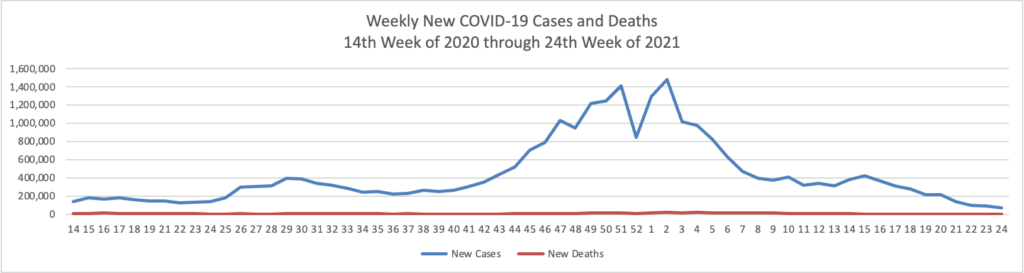
Based on the Centers for Disease Control’s COVID-19 Data Tracker website, here is the FEHBlog’s chart of new weekly COVID-19 cases and deaths over the 14th week of 2020 through 24th week of this year (beginning April 2, 2020, and ending June 16, 2021; using Thursday as the first day of the week in order to facilitate this weekly update):
and here is the CDC’s latest overall weekly hospitalization rate chart for COVID-19:
The FEHBlog has noticed that the new cases and deaths chart shows a flat line for new weekly deaths because new cases materially exceed new deaths. Accordingly here is a chart of new COVID-19 deaths over the period (April 2, 2020, through June 16, 2021):
Finally here is a COVID-19 vaccinations chart over the period December 17, 2020, through June 16, 2021 (six months) which also uses Thursday as the first day of the week:
President Joe Biden urged unvaccinated Americans to get inoculated from coronavirus, warning that the highly transmissible delta variant of the virus could cause more deaths. “Even while we are making incredible progress [as reflected above], it remains a serious and deadly threat,” Biden said Friday during a White House event to celebrate 300 million doses of vaccine administered during the first 150 days of his administration.“The data is clear: If you are unvaccinated, you’re at risk of getting seriously ill, or dying, or spreading it.” A large swath of Americans — particularly in the politically conservative South — have declined shots despite warnings from health authorities that the virus remains a threat.”
in other COVID-19 news
Medscape informs us that “While the investigation into cases of myocarditis possibly associated with COVID vaccines proceeds, the American Heart Association (AHA)/American Stroke Association (ASA) continue to urge everyone who is eligible for the vaccine to get it without delay. ‘We remain confident that the benefits of vaccination far exceed the very unusual risks,’ the leadership of the AHA/ASA said in a statement issued June 12. ‘The risks of COVID-19 infection include its potentially fatal consequences and the potential long-term health effects that are still revealing themselves, including lingering consequences affecting the heart, brain, vascular system, and other organs after infection,’ they point out. Late last week, the Centers for Disease Control and Prevention (CDC) alerted healthcare providers that the COVID-19 Vaccine Safety Technical Work Group (VaST) of the Advisory Committee on Immunization Practices (ACIP) will meet June 18 to review cases of myocarditis reported in adolescents and young adults after they received a COVID-19 vaccine manufactured by Pfizer–BioNTech or Moderna.
MedPage Today reports that “During the American Medical Association (AMA) House of Delegates annual meeting, members debated whether natural immunity or previous infection with SARS-CoV-2 was sufficient for the merit of immunity credentials.” The House of Delegate voted against treating natural immunity as equivalent to vaccination. “Multiple delegates pointed out that using natural immunity in lieu of vaccination would pit the AMA’s recommendations against those of the CDC.” Nevertheless as the Mayo Clinic points out, natural immunity helps us achieve some level of herd immunity. It needs to be considered with vaccinations for that purpose.
If you want more details on yesterday’s Affordable Care Act decision from the U.S. Supreme Court, check out Prof. Katie Keith’s post in the Health Affairs blog.
Beckers Hospital News lists seven Fortune 500 health insurers by membership. Health Payer Intelligence discusses the latest sustainability report from the company that tops this list, UnitedHealth Group.
On this Juneteenth holiday, Fierce Health tells us about how “healthcare executives call on President Biden to take ‘innovative, bold’ steps to tackle health equity using AI, big data.”
“It’s not a lack of data—we have so much data in this country now, in our healthcare systems and our EHRs and our patient registration systems,” Cole said. “The data is there but the analytics capability of that—what to do with that data—is something that we’re continuing to work on every day.”
Cole and John Lumpkin, M.D., president of the Blue Cross and Blue Shield of North Carolina Foundation, said both of their organizations have been reworking their collection and organization of race, ethnicity, gender identity and other related data tied to health inequity—a change that “should be a very simple thing to do” but requires an internal data system overhaul, Lumpkin said.
Still, executives said the finish line of those efforts is worthwhile. Incorporating SDOH data can yield substantial health and costs benefits at the individual and population levels, they said.
The Wall Street Journal reports on the rising fortunes of the country’s major pharmacy chains, CVS Health and Walgreens.
In health system merger news —
Healthcare Dive informs us that “Beaumont Health and Spectrum Health are looking to merge in a deal that would result in Michigan’s biggest health system with 22 hospitals and 64,000 employees across the state, with combined annual revenue of almost $13 billion. Executives of the two systems announced Thursday they have signed a letter of intent to explore creating a joint health system. The deal would include Spectrum’s Michigan-based health insurance plan, Priority Health, which has 1.2 million customers.”
Fierce Healthcare reports that “Southern health systems Ochsner Health and Rush Health Systems have announced plans for a merger they expect to be completed about halfway through 2022. The deal follows a 2019 strategic partnership between the two nonprofit providers and comes hot on the heels of Louisiana-based Ochsner’s merger with Lafayette General Health, which closed in October 2020 and grew the system to 35 hospitals. Rush, which has seven hospitals and more than 30 clinics in eastern Mississippi and western Alabama, will be rebranded as Ochsner Rush Health should the merger receive regulatory approval.”
Healthcare Dive also tells us that “Tenet, a major U.S. health system, has agreed to sell five hospitals in the Miami-Dade area for $1.1 billion to Steward Health Care System, a physician-owned hospital operator and health network. The deal also includes the hospitals’ associated physician practices. Dallas-based Steward has agreed to continue using Tenet’s revenue cycle management firm, Conifer Health Solutions, following the completion of the deal, which is expected to close in the third quarter. Further underscoring Tenet’s strategic focus, the sale will not include Tenet’s ambulatory surgery centers in Florida. Tenet will hold onto those assets as its ambulatory business becomes a bigger focus for the legacy hospital operator.”
At long last, the U.S. Supreme Court issued its opinion today in the third case reaching the Court on the issue of the constitutionality of the Affordable Care Act (“ACA”). In an opinion written by Justice Breyer and joined by the Chief Justice and four other Justices, the Court ruled in short as follows:
As originally enacted in 2010, the Patient Protection and Affordable Care Act required most Americans to obtain minimum essential health insurance coverage. The Act also imposed a monetary penalty, scaled according to in- come, upon individuals who failed to do so. In 2017, Con- gress effectively nullified the penalty by setting its amount at $0. See Tax Cuts and Jobs Act of 2017, Pub. L. 115–97, §11081, 131 Stat. 2092 (codified in 26 U. S. C. §5000A(c)).
Texas and 17 other States brought this lawsuit against the United States and federal officials. They were later joined by two individuals (Neill Hurley and John Nantz). The plaintiffs claim that without the penalty the Act’s minimum essential coverage requirement is unconstitutional. Specifically, they say neither the Commerce Clause nor the Tax Clause (nor any other enumerated power) grants Congress the power to enact it. See U. S. Const., Art. I, §8. They also argue that the minimum essential coverage re- quirement is not severable from the rest of the Act. Hence, they believe the Act as a whole is invalid. * * *
[W]e conclude that the plaintiffs in this suit failed to show a concrete, particularized injury fairly traceable to the defendants’ conduct in enforcing the specific statutory provision they attack as unconstitutional. They have failed to show that they have standing to attack as unconstitutional the Act’s minimum essential coverage provision. Therefore, we reverse the Fifth Circuit’s judgment in respect to standing, vacate the judgment, and remand the case with instructions to dismiss.
Justice Thomas filed a concurring opinion, and Justice Alito, joined by Justice Gorsuch, filed a dissenting opinion. The FEHBlog confidently can state that he predicted this favorable outcome for the ACA. It always has been clear to the FEHBlog that the Supreme Court took the case to kill the lawsuit, not the law.
The Senate will take up Kiran Ahuja’s nomination to be OPM Director when it resumes floor business on Monday June 21. If Ms. Ahuja’s nomination is not confirmed next week, the Senate will be away from our Nation’s capital for two weeks for the Independence Day holiday.
Reg Jones’ latest column in FedWeek concerns federal employee survivor benefits in the case of a post-retirement marriage.
In federal employment news, Federal News Network reports that President Joe Biden signed the Juneteenth National Independence Day Act this afternoon, establishing June 19 as a federal holiday. Most federal employees will have tomorrow, June 18 off for observance as June 19 falls on a Saturday this year, the Office of Personnel Management said. * * * Nearly every state already recognizes Juneteenth as a holiday, but it now becomes the first federal holiday created since Martin Luther King Jr. Day was established in 1983.”
In COVID-19 news and this should come as no surprise, Medscape informs us that “More than half of unvaccinated Americans would prefer to get a COVID-19 vaccination at their doctors’ office, according to the results of a new national survey. * * * The preference to be vaccinated in a medical office was three to five times higher among unvaccinated Americans than were other strategies such as vaccinations at retail pharmacies or drug stores, community health centers, public health clinics, drive-up clinics, and large public vaccination sites.” As of today, 65% of Americans over age 18, and 87% of Americans over age 65, have had at least one dose of a COVID-19 vaccination.
In a burst of closing miscellany —
Kaiser Health News tells us that ” The pandemic-caused recession and a federal requirement that states keep Medicaid beneficiaries enrolled until the national emergency ends swelled the pool of people in the program by more than 9 million over the past year, according to a report released Thursday. The latest figures show Medicaid enrollment grew from 71.3 million in February 2020, when the pandemic was beginning in the U.S., to 80.5 million in January, according to a KFF analysis of federal data.”
Health Payer Intelligence informs us that “Medicare Advantage plans may better address racial care disparities than fee-for-service Medicare, according to the second in a series of reports that ATI Advisory has prepared for Better Medicare Alliance (BMA) in 2021. “With over 26.5 million beneficiaries enrolled in Medicare Advantage today, this report shows that minority beneficiaries are a driving force behind these enrollment gains; turning to Medicare Advantage to meet their health and social needs. When policymakers stand up for Medicare Advantage, they stand up for these seniors, too,” Allyson Y. Schwartz, president and chief executive officer of the Better Medicare Alliance, said in the press release. Around half of all Black Medicare beneficiaries and 53 percent of Latinx Medicare beneficiaries are in a Medicare Advantage plan, the report found. In contrast, only 34 percent of White beneficiaries and 31 percent of those who identified as “Other” races were enrolled in a Medicare Advantage plan.”
STAT News reports that “ovarian cancer, which kills about 15,000 Americans every year, has historically been one of the thornier cancers to treat. Only in the last few years has a new class of potent drugs, called PARP inhibitors, started to change that. But even with these promising new treatments, too often, tenacious tumors come roaring back. So there’s a need for yet newer drugs that can overcome any resistance the cancer evolves. According to research published Thursday, scientists might have found one. And it’s not actually a new drug at all. In fact, it’s been sitting, retired, in a drug library for decades. “While evaluating mechanisms of PARP inhibitor resistance over the last few years we came across this drug, novobiocin, which curiously enough, is an antibiotic,” said Alan D’Andrea, director of the Susan F. Smith Center for Women’s Cancers at the Dana-Farber Cancer Institute and co-author of the new study.” Encouraging.
“The U.S. Food and Drug Administration today approved a nasal antihistamine for nonprescription use through a process called a partial prescription to nonprescription switch. The FDA approved Astepro (azelastine hydrochloride nasal spray, 0.15%) for seasonal and perennial allergic rhinitis—commonly known as allergies—for adults and children six years of age and older. ‘Seasonal and perennial allergies affect millions of Americans every year, causing them to experience symptoms of nasal congestion, runny nose, sneezing and more,” said Theresa M. Michele, M.D., director of the office of nonprescription drugs in the FDA’s Center for Drug Evaluation and Research. “Today’s approval provides individuals an option for a safe and effective nasal antihistamine without requiring the assistance of a healthcare provider.’”
We use cookies on our website to give you the most relevant experience by remembering your preferences and repeat visits. By clicking “Accept”, you consent to the use of ALL the cookies.
This website uses cookies to improve your experience while you navigate through the website. Out of these, the cookies that are categorized as necessary are stored on your browser as they are essential for the working of basic functionalities of the website. We also use third-party cookies that help us analyze and understand how you use this website. These cookies will be stored in your browser only with your consent. You also have the option to opt-out of these cookies. But opting out of some of these cookies may affect your browsing experience.
Necessary cookies are absolutely essential for the website to function properly. These cookies ensure basic functionalities and security features of the website, anonymously.
Cookie
Duration
Description
cookielawinfo-checbox-analytics
11 months
This cookie is set by GDPR Cookie Consent plugin. The cookie is used to store the user consent for the cookies in the category "Analytics".
cookielawinfo-checbox-functional
11 months
The cookie is set by GDPR cookie consent to record the user consent for the cookies in the category "Functional".
cookielawinfo-checbox-others
11 months
This cookie is set by GDPR Cookie Consent plugin. The cookie is used to store the user consent for the cookies in the category "Other.
cookielawinfo-checkbox-necessary
11 months
This cookie is set by GDPR Cookie Consent plugin. The cookies is used to store the user consent for the cookies in the category "Necessary".
cookielawinfo-checkbox-performance
11 months
This cookie is set by GDPR Cookie Consent plugin. The cookie is used to store the user consent for the cookies in the category "Performance".
viewed_cookie_policy
11 months
The cookie is set by the GDPR Cookie Consent plugin and is used to store whether or not user has consented to the use of cookies. It does not store any personal data.
Functional cookies help to perform certain functionalities like sharing the content of the website on social media platforms, collect feedbacks, and other third-party features.
Performance cookies are used to understand and analyze the key performance indexes of the website which helps in delivering a better user experience for the visitors.
Analytical cookies are used to understand how visitors interact with the website. These cookies help provide information on metrics the number of visitors, bounce rate, traffic source, etc.
Advertisement cookies are used to provide visitors with relevant ads and marketing campaigns. These cookies track visitors across websites and collect information to provide customized ads.