Happy Hannukah

Happy Hannukah

Hanukkah greeting template. Nine candles and wishing. Hand drawn sketch illustration. White, yellow and blue colors

The eight day long Jewish holiday of Hannukah begins tonight. Best wishes to those who are celebrating this holiday.

This evening. STAT News reports

A panel of outside experts on Thursday recommended the Food and Drug Administration issue an emergency use authorization to the Covid-19 vaccine being developed by Pfizer and BioNTech, a vaccine that appeared to be highly efficacious in a Phase 3 clinical trial.

The 17-4 vote came after a long day in which members of the Vaccines and Related Biological Products Advisory Committee, or VRBPAC, discussed a wide range of issues related to the vaccine, including concerns about vaccinating people with severe allergies and 16- and 17-year-olds, as well as issues regarding vaccination during pregnancy or lactation.

Although the FDA does not have to follow the panel’s recommendation, it is widely expected to do so. The rollout of Covid-19 vaccine could then begin in the United States in a matter of days.

The FEHBlog watched on You Tube a good chunk of the discussion preceding the vote. The FEHBlog was surprised that the motion presented to the Committee would extend the emergency use authorization to 16 and 17 year olds. He thought that the the minimum age would be 18 years old, and the committee members who voted against the bill were pediatricians concerned about the 16 to 17 year olds. Another member who was not a physician argued that the emergency use authorization use authorization should be limited to health care workers and nursing home residents, the initial phases approved by the CDC’s Advisory Committee on Immunization Practices. In any event, the FEHBlog was pleased by the decisive vote. At the close of the virtual committee meeting the Chairman reminded the members that they would be meeting next Thursday December 17 to consider an emergency use authorization for the Modern vaccine.

Speaking of voting, the Senate did not take up today the one week long extension of continuing resolution funding the federal government or the FY 2021 national defense authorization act which the House approved yesterday. The Senate needs to act on the continuing resolution tomorrow. The Wall Street Journal reports that negotiations over another COVID-19 relief bill continue.

A friend of the FEHBlog called to his attention the Department of Health and Human Services website on combatting the COVID-19 virus. It’s quite comprehensive.

In other news today, the HHS Office for Civil Rights, which enforces the HIPAA Privacy and Security Rules, proposed changes to the Privacy Rule.

The proposed changes to the HIPAA Privacy Rule include strengthening individuals’ rights to access their own health information, including electronic information; improving information sharing for care coordination and case management for individuals; facilitating greater family and caregiver involvement in the care of individuals experiencing emergencies or health crises; enhancing flexibilities for disclosures in emergency or threatening circumstances, such as the Opioid and COVID-19 public health emergencies; and reducing administrative burdens on HIPAA covered health care providers and health plans, while continuing to protect individuals’ health information privacy interests.

A friend of the FEHBlog shared this HHS fact sheet on this proposed rule. The proposal has a 60 day comment deadline which will end during the Biden Administration.

HHS’s Centers for Medicare and Medicaid Services proposed new rules to crack down on prior authorization practice by Medicaid, CHIP, and QHP marketplace plans. (Medicare does not permit prior authorization.)

The rule would require payers in Medicaid, CHIP and QHP programs to build application programming interfaces (APIs) to support data exchange and prior authorization. APIs allow two systems, or a payer’s system and a third-party app, to communicate and share data electronically  Payers would be required to implement and maintain these APIs using the Health Level 7 (HL7) Fast Healthcare Interoperability Resources (FHIR) standard. 

Building on that foundational policy, this rule would require impacted payers to implement and maintain a FHIR-based API to exchange patient data as patients move from one payer to another. In this way, patients who would otherwise not have access to their historic health information would be able to bring their information with them when they move from one payer to another, and would not lose that information simply because they changed payers.  

These proposed changes would also allow payers, providers and patients to have access to more information including pending and active prior authorization decisions, potentially allowing for fewer repeat prior authorizations, reducing burden and cost, and ensuring patients have better continuity of care.

The proposals are expected to take effect in January 2023. Good ideas. The pubic comment period ends on January 4, 2021, but the final rule no doubt will be in the hands of the Biden administration. The American Medical Association must be happy though.

In Govexec, benefits consultant Tammy Flanagan discusses FEHBP options for annuitants with primary Medicare A and B coverage. The FEHBlog is always impressed by the creative benefit designs that FEHB plan carriers offer members.

Tuesday Tidbits

Photo by Patrick Fore on Unsplash

The Wall Street Journal reports tonight that

The Trump administration made a $916 billion coronavirus relief offer to Democrats, opening yet another front in the multi-track effort to reach an agreement in talks that rank-and-file lawmakers have been leading in the final weeks of the year. The proposal, announced in a brief statement by Treasury Secretary Steven Mnuchin, came after Democrats rejected an effort by Senate Majority Leader Mitch McConnell (R., Ky.) to narrow the scope of a coronavirus relief bill by excluding aid for hard-hit state and local governments prioritized by Democrats and liability protections sought by Republicans. 

The President’s proposal reportedly includes $600 per person direct payments. The FEHBlog will be surprised if the COVID-19 relief bill negotiations are unsuccessful, but it would be hardly be the first time that Congress surprises the FEHBlog.

Also according the Wall Street Journal, the House of Representatives tonight passed the FY 2021 National Defense Authorization Act by a veto proof 335-78 margin. As the FEHBlog noted last week this bill includes goodies for federal employees. Federal News Network identifies policy winners and losers in this must pass bill which now goes over to the Senate.

Federal News Network columnist Mike Causey touts the FEHBlog’s personal favorite health plan design the high deductible health plan with health savings account (“HSA”). Mr. Causey aptly describes the HSA as a “Roth IRA on steroids” because and HSA is triple tax favored — tax exempt on the way in and out and grows tax free while in the account. The Federal Benefits Open Season ends on Monday December 14.

Fierce Healthcare informs us that

The FDA has released its internal review documents ahead of the closely watched COVID-19 vaccine advisory committee meeting scheduled for Thursday [December 10] —and they bode well for Pfizer and partner BioNTech’s prospects for securing a quick emergency use authorization (EUA). The FDA meeting briefing, published (PDF) on Tuesday, confirmed the efficacy and safety profile of Pfizer and BioNTech’s BNT162b2, reiterating that the shot was 95% effective at preventing COVID-19 after two doses with no serious safety concerns.

The Moderna vaccines turn before this panel occurs one week later on December 17.

Healthcare Dive reminds us that

Hospitals are readying for Jan. 1, [2021] when they expect they will have to publicly disclose the negotiated prices they reach with insurers for services performed inside their facilities — barring any intervention from a federal appeals court. [Such intervention in the FEHBlog’s humble opinion, is highly unlikely.]

The policy requires hospitals to share two streams of information. First, hospitals will have to share a machine-readable format of its negotiated prices with every insurer and every insurance product — a sizable pool of information. 

Then they will also have to prepare a list of 300 “shoppable services.” A total knee replacement would be a good example. It’s a procedure a consumer likely has time to plan and prepare for, unlike an emergency surgery due to an accident or failing health. The idea is to provide the price information so consumers can shop around for the best deal. 

The FEHBlog attended the second day of the American Bar Association’s Washington Health Law Summit (“WLS”). It’s worth noting that every panelist (six or seven in total) who has opined on the outcome of the Supreme Court’s California v. Texas case on the ACA’s constitutionality shares the FEHBlog’s opinion that the Supreme Court will preserve the ACA expect perhaps for the individual mandate which Congress effectively repealed in 2017.

The FEHBlog listened to three hours of discussion about behavioral telehealth and artificial intelligence during the WLS. It turns out that two types of healthcare AI exist admin AI and operational AI. AI can be assistive to the user’s decision making or can yield autonomous decisions. The Food and Drug Administration oversees the AI devices and the operational devices typically are used with imaging procedures. The FDA has approved two autonomous operational AI devices. The radiologists however has doubts about those devices.

The most interesting thing that the FEHBlog heard during this discussion was a remark from a Doctors on Demand speaker that telehealth companies are facing challenges in filling provider slots for psychiatrists and psychologists because of the enormous demand for mental health telemedicine. That’s a good thing. He noted that the explosion in telehealth use in 2020 is principally due to the government permitting a doctor or psychiatrist licensed in state A to treat a telehealth patient in state B.

The other speakers added that healthcare providers were quick to pick up on telehealth due to the licensing flexibilities and Medicare equivalent payments. They expressed their understanding that telehealth changes the personal dynamics between doctors and patients. Patients feels more in charge in a tele heath setting than they do in the office setting, and providers get social determinants of health data from seeing where the patient lives.

Monday Roundup

Photo by Sven Read on Unsplash

Bloomberg reports that “[COVID-19 relief bill] talks over the weekend and on Monday have not made enough progress to release final details yet, according to congressional aides.” “Senate Republican leaders made clear Monday evening that the package must have liability reforms [to protect businesses from COVID-19 lawsuits] that [Senate Majority Leader Mitch] McConnell supports in order for Republicans to consider any state and local aid [which is a Democrat priority]. Accordingly as Forbes reports, “The House [of Representatives] will vote on a one-week stopgap spending bill Wednesday, pushing back a looming December 11 government shutdown deadline to give lawmakers more time to come to an agreement on a new coronavirus relief package.”

The FEHBlog is attending the American Bar Association’s virtual Washington Health Law Summit (“WLS”) which runs from today through Wednesday. (Ermer & Suter is a bronze sponsor.) He heard one of the speakers tout the Health Care Cost Institutes’s Healthy Marketplace Index.

Using nearly 2.5 billion commercial claims from 2013 to 2017, HCCI tracks drivers of health care spending across 124 U.S. cities through the Healthy Marketplace Index (HMI) project. Our full report presents an interactive exploration of each HMI metric and a deep dive into each metro area. Collectively, they comparing how spending drivers varied across and even within cities, as well as over time

HMI is easy to navigate, and the information is on point but somewhat dated. Not bad for free though.

TechRepublic courageously offers seven predictions for how technology will shape healthcare next year. One of the predictions is continued demand for telehealth. One of the WLS speakers sagely commented about the public health importance of mental health services provided by telehealth She noted that while four out of five doctors in medical / surgical practices join health plan networks, only one out of five psychiatrists and psychologists join those networks. Telemedicine makes the in-network psychiatrists and psychologists more widely available. That’s an important consideration.

Another WLS speaker predicted that Congress will pass a big infrastructure bill next year that will include healthcare priorities such as expanding reliable internet access in rural areas of the country in order to facilitate telehealth there.

Fierce Healthcare reports that

While the continued climb of COVID-19 cases in the U.S. is pushing many Americans’ resiliency to the limits, there are signs that some are adapting to the challenging circumstances, a new study from Cigna shows.

Daniel Ober, M.D., chief medical officer for Cigna Global Health Benefits, told Fierce Healthcare that because the U.S. never really entered a lull in the pandemic that allowed it to reopen the way some other regions did, many Americans have “adapted somewhat” to life under COVID-19. For example, people who are unwilling to wear masks in public, as is recommended by experts, are largely an exception to the rule, not the norm, he said. “We’re adapting to this new normal and will continue to do so,” he said.

It’s nice to read encouraging news on this first Monday in a while without big COVID-19 vaccine news. The FDA committee considers the Pfizer BioNTech application for emergency use authorization of its COVID-19 vaccine on Thursday.

Weekend update

Photo by Clarisse Meyer on Unsplash

Congress is in session this week for committee business and floor voting. The big item is the omnibus spending bill which is expected to include the bipartisan COVID-19 relief package. The legislative language for this bill should be released tomorrow if everything remains on track. An omnibus or short term spending measure must be passed by 11:59 pm on December 11. The FEHBlog thought that both Houses of Congress were set to adjourn this week but it turns out that the Senate is scheduled to continue working through December 18.

The Federal Employee Benefits Open Season continues through next Monday December 14, while the Medicare Open Season ends tomorrow December 7. Let’s not forget that December 6 though 12 is the Centers for Disease Control’s (“CDC”) National Flu Vaccination Week.

The press is reporting tonight that President-elect Biden intends to appoint California Attorney General Xaxier Becerra to be his Secretary of Health and Human Services, which is a very powerful position when it comes to healthcare in the U.S. Speaking of healthcare leaders, Fierce Healthcare identifies six health plan executives to watch in 2021.

The CDC released updated COVID-19 protection guidance on Friday.

Summary
What is already known about this topic?

The United States is experiencing high levels of SARS-CoV-2 transmission.

What is added by this report?

COVID-19 pandemic control requires a multipronged application of evidence-based strategies while improving health equity: universal face mask use, physical distancing, avoiding nonessential indoor spaces, increasing testing, prompt quarantine of exposed persons, safeguarding those at increased risk for severe illness or death, protecting essential workers, postponing travel, enhancing ventilation and hand hygiene, and achieving widespread COVID-19 vaccination coverage.

What are the implications for public health practice?

These combined strategies will protect health care, essential businesses, and schools, bridging to a future with high community coverage of effective vaccines and safe return to more activities in a range of settings.

The figure shows icons describing ways to slow COVID-19 spread and speed up economic recovery.

The FEHBlog ran across a Bloomberg report which adds

Harvard disease expert Willam Hanage says that the science to date points to the primary risk coming from what he calls the three C’s — close contact, closed spaces and crowds. He says in Japan, where they’ve had few Covid-19 deaths, people are advised to avoid these — not just to wear masks in these situations but to limit them or avoid them altogether.

FINAL. Avoid the 3 Cs Poster

In much better but nevertheless thought provoking news, the Wall Street Journal reports that

Drug development for sickle-cell disease, largely overlooked for decades, is becoming a crowded field: Two papers published Saturday in the New England Journal of Medicine report promising results from studies of experimental therapies, including Crispr gene editing, for the disease.

In addition, Beam Therapeutics Inc. on Saturday presented lab and mouse data at the American Society of Hematology annual meeting to support the safety of another approach to using Crispr gene editing for sickle-cell disease. The company said it hopes to open a trial next year.

More than a dozen companies are competing to develop experimental treatments for sickle-cell disease, an inherited form of anemia that affects 100,000 mainly Black Americans.

The article points that Crispr gene editing is an expensive technology. “What good are new therapies for a disease if many patients suffering with it are unable, or choose not, to access them?” That is an issue for health plans to contemplate now, in the FEHBlog’s opinion.

The FEHBlog took a look at the CDC’s Center for National Health Statistics website today, and he ran across these interesting recent reports

The FEHBlog was surprised by the facts that “Prepregnancy obesity [measured as body mass index of 30 or higher] in the United States rose from 26.1% in 2016 to 29.0% in 2019 and increased steadily for non-Hispanic white, non-Hispanic black, and Hispanic women” and that “In 2019, more than one in four children had one or more visits to an urgent care center or retail health clinic (26.4%) in the past 12 months.” These reports further find that college educated women are less likely to be obese and that insured children are more likely to us retail health clinics.

The prepregnancy obesity report led the FEHBlog to consult OPM’s available statistics on federal employee demographics which date back to 2017. Roughly 52% of federal employees have at least college degree. The FEHBlog also found a May 2020 Pew Research report on Postal Service employee demographics which does discuss Postal employee education levels but does point out that

  • About six-in-ten of the agency’s employees – including mail carriers, postal clerks, and mail sorters and processors – are non-Hispanic white (57%), compared with 78% of the overall U.S. workforce. Around a quarter (23%) of Postal Service workers are black, 11% are Hispanic and 7% are Asian. In contrast, black Americans make up 13% of the national workforce, Hispanics 17% and Asian Americans 6%.
  • In 18 states and the District of Columbia, women make up half or more of Postal Service employees. In D.C., 74% of Postal Service workers are women, and women account for around six-in-ten postal workers in Idaho, Alabama and South Dakota. Nationally, slightly fewer than half of postal workers are women (45%), in line with the U.S. workforce.
  • The Postal Service, as of 2018, employs more than 100,000 military veterans, who make up 16% of its workers nationally. Veterans account for just 5.8% of all employed Americans, according to data for 2019.

The percentage of women Postal employees basically aligns with the percentage of women federal employees. However, the percentage of military veteran Postal Service employees is nearly double the percentage of military veteran federal employees. (The FEHBlog also found this recent, helpful Congressional Research Service report on “Federal Workforce Statistics Sources: OPM and OMB.”)

The FEHBlog points this out because as the COVID-19 public health emergency has ably illustrated race, ethnicity, age and gender, among other demographic factors, impact healthcare and while OPM provides age and gender information to FEHB plans, the agency does not provide race or ethnicity date to those FEHB plans.

Finally the Salt Lake City [UT] Tribune reports that

More than a week after Sanford Health parted ways with its longtime CEO, the health system announced that it has indefinitely suspended merger talks with Utah-based Intermountain Healthcare. Sanford Health and Intermountain Healthcare made the announcement Friday [December 4], saying that with the leadership change, Sanford decided to put merger talks on hold while other organizational needs are addressed.

Intermountain offers an FEHB plan under the SelectHealth name.

Thursday Miscellany

Photo by Juliane Liebermann on Unsplash

The Wall Street Journal reports that Senate minority leader Chuck Schumer and House Speaker Nancy Pelosi have expressed their support for the $980 million bi-partisan COVID-19 relief bill.

[Further] Senators said Thursday that they were trying to work out the details of a rough agreement the bipartisan group of nine senators and members of the Problem Solvers Caucus, a group of 50 centrist House lawmakers, had unveiled earlier this week.  * * * The bipartisan proposal, which would run through March 2021, includes $160 billion in state and local funding and would provide a short-term suspension of liability lawsuits related to Covid-19 at the state or federal level, giving states time to put in place their own protections. Lawmakers said the details of both contentious issues were being worked out before Monday [December 7], when the group hopes to release legislative text. * * * The bipartisan proposal also includes $288 billion for small-business relief, including for the Paycheck Protection Program, $16 billion for the distribution of a coronavirus vaccine, $82 billion for schools, $25 billion for rental assistance and $180 billion for additional unemployment insurance, including $300 a week through March, aides said. In addition, the plan would give $17 billion to airlines.

From the COVID-19 vaccine front

The co-leader of the US government’s Operation Warp Speed coronavirus vaccine initiative on Wednesday outlined the most ambitious timeline yet for vaccinating the most vulnerable Americans against COVID-19.

Moncef Slaoui, Warp Speed’s chief advisor, predicted that 100 million Americans would be immunized by the end of February.

Twenty million Americans should be vaccinated in December, followed by 30 million more in January and 50 million more in February, the former pharmaceutical executive said in a press briefing.

By then, “we will have potentially immunized 100 million people, which is really more or less the size of the significant at-risk population: the elderly, the healthcare workers, the first-line workers, people with comorbidities,” Slaoui said.

As of last year 255 million Americans were over age 18 which is the minimum age to receive the Pfizer – BioNTech and Moderna COVID-19 vaccines. (The total U.S. population is around 330 million currently.) Moderna has started a study of its COVID-19 vaccine on younger people aged 12 to 17.

  • CNN reports on the government’s plan to track COVID-19 immunizations and ensure that people who receive the first dose also get the second.
  • The New York Times offers an online tool to help you figure where is your place in line to receive the COVID-19 vaccine once they receive FDA emergency use authorization. Here’s the answer that the FEHBlog received:

Based on your risk profile, we believe you’re in line behind 118.5 million people across the United States. When it comes to Maryland, we think you’re behind 2.2 million others who are at higher risk in your state. And in Montgomery County, you’re behind 304,800 others.

In other COVID-19 news, Beckers Payer Issues reports that large health plans generally are tying their COVID-19 benefit flexibilities to the end date of the COVID-19 public health emergency which conforms to the FFCRA and CARES Act requirement. The current end date is January 21, but it is a safe bet that the Department of Health and Human Services extends that end date for another 90 days early next month.

There has been a lot of action at the Department of Health and Human Services (“HHS”):

  • Today, HHS “issued a fourth amendment to the Declaration under the Public Readiness and Emergency Preparedness Act (PREP Act) to increase access to critical countermeasures against COVID-19.” Principally, the amendment permits telehealth providers of care with prescription authority who are licensed in State A to prescribe COVID-19 testing and other COVID-19 counter measures for patients contacting them from State B. HHS initiated this change because “While many states have decided to permit healthcare personnel in other states to provide telehealth services to patients within their borders, not all states have done so.”
  • Also HHS “released an important HHS Action Plan and announced a partnership to reduce maternal deaths and disparities that put women at risk prior to, during, and following pregnancy. The U.S. Surgeon General Jerome M. Adams issued a complementary Call to Action to Improve Maternal Health outlining the critical roles everyone can play to improve maternal health.” Bravo.
  • Health Payer Intelligence explains that

CMS has introduced a new Medicare value-based contracting model that encourages greater care coordination and requires participants to take full risk for Medicare fee-for-service beneficiaries based on region.

The Geographic Direct Contracting Model uses outcomes-based payment models to address care quality, healthcare spending, care coordination, clinical management, and program integrity in targeted regions.

“Within each region, organizations with experience in risk-sharing arrangements and population health will partner with health care providers and community organizations to better coordinate care,” the press release explained.

Beneficiaries will not have to switch providers or payers. They will continue to have their Original Medicare benefits as well as their enhanced benefits and they may receive reduced cost-sharing for Medicare Part A and Part B, including Part B premium subsidies.

Finally Healthcare Dive explains that in HHS’s CY 2021 Medicare Hospital Outpatient Prospective Payment System and Ambulatory Surgical Center Payment System Final Rule 

CMS is eliminating the inpatient-only list that requires roughly 1,700 medical procedures to occur inside a hospital for Medicare members. The inpatient-only list will be completely phased out by 2024, according to the outpatient payment final rule released Wednesday. The hospital lobby balked at the change, contending the list is there to protect patients as the list of procedures can be complex and need hospital resources.

Ultimately, the list expands the options of where certain surgeries can be performed and may ultimately reduce out-of-pocket expenses for Medicare members as surgeries performed in an outpatient setting, such as an ambulatory surgery center, can be less costly, CMS said.

Also, the agency is moving forward with reimbursement cuts for 340B-acquired drugs, a hit to some hospitals. Meanwhile, the rule also loosens restrictions on some physician-owned facilities, also drawing ire from the hospital lobby.

Isn’t wild that in 2020 Medicare still requires 1700 surgeries to be performed on an inpatient basis. The FEHBlog hopes that the Biden Administration’s HHS continues the Trump Administration’s practice of re-evaluating and when appropriate long term practices that have outlived their value.

Happy Thanksgiving

Even in this difficult year, we Americans can still enjoy our great holiday Thanksgiving. The Wall Street Journal discusses a study of how to cope with the COVID-19 great hunkering down — the results tie in with traditional Thanksgiving activities

“[M]usic [parades], exercise [touch football] and entertainment [NFL football and movies] were the most potent stress relievers for the greatest number of people. But of those three activities, music—singing, dancing, playing an instrument, or just listening to a favorite playlist—was the only one that led to a reduction of depression symptoms. A fifth of all the participants reported it as the most effective way to reduce their pandemic-induced blues. Music’s palliative effects were particularly potent for people who were highly sensitive to rewards.  * * * [Needless to say] Cooking, baking and eating also helped tamp down the blues. 

Health Payer Intelligence reports, and the FEHBlog could not agree more strongly that

Employers are gravitating toward integrated health care benefits to improve member engagement and patient experience as well as lower healthcare spending, according to a report commissioned by Anthem.

Integrated health care interweaves pharmacy, ancillary, supplemental health, and other benefits data into the employer’s health plan to facilitate smoother communication between employees’ providers.

Provider collaboration is key to this strategy. Three key methods for facilitating provider collaboration included connecting all providers through an [electronic medical record] EMR, establishing automatic reminders about extra dental cleanings, and sending health-related reminders to employees. Employers also leveraged AI and apps to connect employees to their benefits.

That’s a very interesting use of EMRs to help close gaps in care.

The Internal Revenue Service has announced that the Affordable Care Act’s Patient Centered Outcomes Research Institute (“PCORI”) fee “for policy years and plan years that end on or after October 1, 2020, and before October 1, 2021, is $2.66” per covered health plan life (/ bellybutton). The PCORI fee payment is due at the end of July. The adjusted fee is 12 cents higher than the fee paid in July 2020.

Tuesday Tidbits

Photo by Patrick Fore on Unsplash

On the COVID-19 vaccination front —

  • It turns out that, according to Precision Vaccinations, the Food and Drug Administration’s “Advisory Committee on Immunization Practices (ACIP) held an out-of-schedule, emergency meeting to discuss various issues related to experimental COVID-19 vaccine candidates.” Rather than tackle the Pfizer / BioNTech vaccine emergency use authorization request the Committee primarily considered vaccination allocation issues. “During the ACIP’s Phase 1a proposed allocation plan, healthcare workers and those seniors living in Long-Term Care Facilities (LTCF), and those working for these facilities, would be the 1# priority group for vaccinations. As of November 6, 2020, LTCF residents and staff accounted for 6 percent of COVID-19 cases and 39 percent of related fatalities in the USA.”
  • STAT News adds that “Essential workers are likely to move ahead of adults 65 and older and people with high-risk medical conditions when the Centers for Disease Control and Prevention signs off on Covid-19 vaccine priority lists, coming after health care workers and people living in long-term care facilities, a meeting of an expert advisory panel made clear Monday. * * * Essential workers include people who work in meat packing plants and other food processing facilities, in municipal wastewater management operations, and in transport. It also includes police and firefighters and, in the current iteration of the ACIP’s plan, teachers. The CDC estimates there are roughly 87 million people in jobs designated as essential services.”
  • Fierce Healthcare reports that “The U.S. federal government aims to distribute 6.4 million doses of a COVID-19 vaccine to states 24 hours after it gets emergency approval, and officials are in the midst of dry runs to prepare for the shipments, officials said Tuesday. The White House’s Operation Warp Speed, a joint initiative between the departments of Health and Human Services (HHS) and Defense that aims to distribute the vaccine, gave an update to reporters Tuesday on the initial allocations of a vaccine. The update comes as emergency approval from the Food and Drug Administration (FDA) could come in the middle of December.”

MHealthIntelligence.com provides a helpful overview of the Stark, Anti-kickback Act changes rule.

According to Carrie Nixon, co-founder and managing partner of Nixon Gwilt Law, the  OIG’s Final Rule “gives healthcare providers and digital health companies more flexibility to enter into new business arrangements that incentivize care coordination and patient engagement as a means of improving outcomes and reducing the overall cost of care.”

“These new protections allow players in the digital health space – including Remote Patient Monitoring companies, telehealth companies, and healthcare predictive analytics platforms – to take on an unprecedented role in helping healthcare providers move the needle on patient outcomes and costs by providing in-kind and even monetary remuneration to these providers in the form of free or reduced cost items/services or shared savings arrangements,” she summarized in a recent article on her law firm’s website.

Deregulation is a very good thing. The FEHBlog prays that the Biden Administration does not back away from it.

The FEHBlog found OPM’s Fiscal Year 2020 Financial Report on its website today. Here’s a link.

Monday Roundup

Photo by Sven Read on Unsplash

Another Monday, another COVID-19 vaccine — the newest from Oxford University (UK) and Astrazeneca. The Times of London reports that

Oxford University scientists said this morning that they had created “a vaccine for the world” as trial results showed that their Covid-19 jab worked well enough to apply immediately for regulatory approval.

The vaccine involves two injections, administered at least a month apart, and the results suggest that using a lower first dose could boost efficacy to 90 per cent. However, that finding relied on limited data and may be amended.

Overall, a trial involving 24,000 people suggested that the vaccine was about 70 per cent effective.

It prevented severe disease and the need to be admitted to hospital, and there are promising early signs that it might also block transmission of the virus. No dangerous side-effects were reported, and the British medical regulator has begun to review safety and efficacy data.

Britain has ordered 100 million doses, and Astrazeneca, the drug company that is working with Oxford, said this morning that four million of those would be ready to be sent to care homes, GP clinics and other vaccination centres by the end of the year.

The Oxford vaccine can be stored in a normal fridge, making it easier to handle than Pfizer’s competing inoculation, which must be stored at about minus 70C. It is also considerably cheaper, costing a few pounds per dose. It is possible that the first doses could be administered before Christmas.

The FEHBlog heard on Fox Business this morning that a separate phase three trial for the Oxford vaccine is ongoing in our country. Oxford and Astrazeneca will present an emergency use authorization request to our Food and Drug Administration (“FDA”) based on that as yet uncompleted trial. The trial referenced in the Times of London article was conducted in the United Kingdom and Brazil. The FDA does not require that the phase three trials be conducted in the U.S. For example, the agency approved the Ebola vaccine based on a phase three trial conducted in Africa, but of course there’s no problem finding COVID-19 patients here.

Reuters reports that the FDA’s Vaccines and Related Biological Products Advisory Committee will meet on December 10 to review the Pfizer / BioNTech emergency use application for its COVID-19 vaccine. The FDA is not bound by the Committee’s recommendation. Here is a link to the full FDA press release.

A friend of the FEHBlog recommended the 20 minute long Journal podcast interview with the founder of BioNTech Dr. Ugur Sahin. The FEHBlog found that podcast fascinating listening.

Govexec.com reports that “The departments of Defense and State, as well as the Veterans Affairs Department’s Veterans Health Administration, the Bureau of Prisons and Indian Health Service, will all receive a direct allocation of vaccines from the Centers for Disease Control and Prevention. The plan was spelled out in a COVID-19 Vaccination Program Interim Playbook, which was first reported by CNBC.” 

Following up on the major Health and Human Services rule makings on Fridays here are article with industry reaction:

  • As the FEHBlog expected, Fierce Healthcare reports that “A hurried final rule aimed at tying drug prices to those paid by foreign countries could lead to providers paying more for drugs than what they will get reimbursed by Medicare, according to several providers and experts.” It really makes you wonder why the American Medical Association’s House of Delegates conditionally endorsed adding a public option to the ACA marketplace earlier this month.
  • Fierce Healthcare further informs us that “CMS’ Stark, anti-kickback updates draw praise from hospitals, concern from physician groups.”
  • Health Payer Intelligence discusses the Medicare rule restricting the use of prescription drug rebates in Medicare Part D effective January 1, 2022. The FEHBlog cannot understand why if drug manufacturers want to end the rebate practices, it does not assure (with an enforcement mechanism) the health insurance industry and the government that the price reductions will balance out the lost rebates.

Friday Stats and More

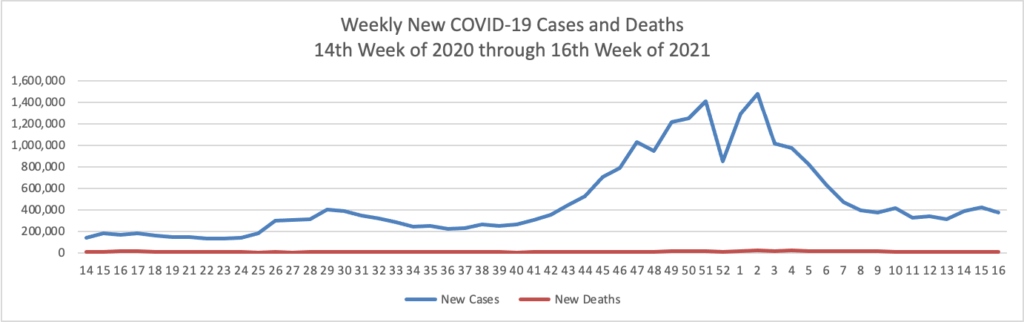
Based on the CDC’s COVID-19 Data Tracker website, here is the FEHBlog’s chart of new weekly COVID-19 cases and deaths over the 20th through 46th weeks of this year (beginning May 14 and ending November 18, roughly six months; using Thursday as the first day of the week in order to facilitate this weekly update):

The upward surge in COVID-19 cases is reflected the CDC’s latest overall weekly hospitalization rate chart for COVID-19 (disregards the dip at the right side of the chart):

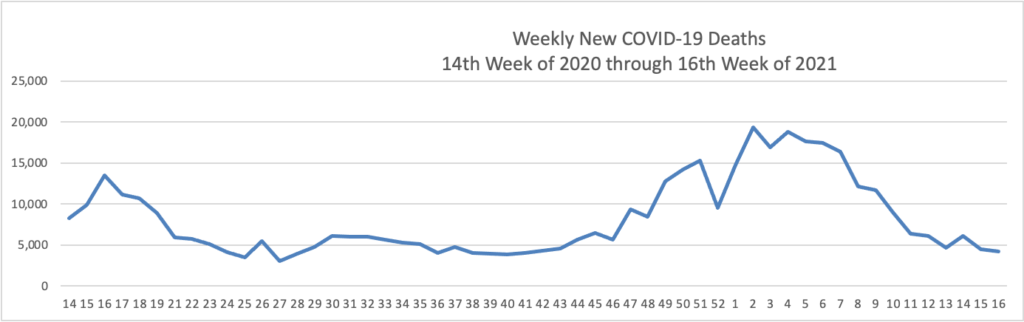
The FEHBlog has noted that the new cases and deaths chart shows a flat line for new weekly deaths  because new cases greatly exceed new deaths. Accordingly here is a chart of new COVID-19 deaths over the same six month long period (May 14 through November 18) (the dip at the tail of this chart is accurate information).

Meanwhile the CDC’s weekly flu surveillance report continues to inform us that “Seasonal influenza activity in the United States remains lower than usual for this time of year.” Better one epidemic than two.

On the bright side, according to the Wall Street Journal, Pfizer and BioNTech did file an emergency use authorization request for their COVID-19 vaccine today.

Now it will be up to the U.S. Food and Drug Administration to decide whether the two-shot vaccine works safely enough to roll out to millions of people.

It is unclear how long the agency will take to review the vaccine, which Pfizer and BioNTech just days earlier said was 95% effective and well-tolerated in a 44,000-subject trial.

Given the urgency, the FDA is expected to move quickly. The timing of the filing is in line with industry and government officials’ projections for authorization and distribution to begin next month. Pfizer said the filing could allow for distribution to begin the middle to end of December.

The Health and Human Services Department (“HHS”) released a string of final rules today affecting Medicare prescription drug plans and both hurting and helping the finances of doctors participating in Medicare and certain other federal health programs (but thankfully not the FEHBP). As the saying goes, he who lives by the sword can die the sword.

  • HHS issued a final rule generally barring the use of prescription drug rebates in the Medicare Part D program effective January 1, 2022.
  • HHS issued another final rule that implements, effective January 1, 2021, a pilot program”, known as the Most Favored Nation (MFN) Model, [that] will test [for seven years] an innovative way for Medicare to pay no more for high cost, physician-administered Medicare Part B drugs than the lowest price charged in other similar countries.”
  • Finally. HHS issued a final rule which loosens up on self-referral a/k/a Stark Act rules that inhibit the entrepreneurial spirit of doctors participating in Medicare. The purposes of the change is to facilitate value based pricing and coordinated care. Doctors should like this one but the FEHBlog wonders whether the AMA will think that it goes far enough.

Of course, we also will have to wait to see the incoming Biden Administration’s reaction to these rules.

Healthcare Dive discusses conflicting viewpoints on AHIP’s position which the FEHBlog shares that the COVID-19 relief law Wild West approach to health plan coverage of out-of-network COVID-19 leads to price gouging. Only Congress can fix this problem.

Speaking of Congress, Govexex.com reports that

Congressional leaders have voiced early speculation in recent days that lawmakers will be able to set line-by-line funding levels for agencies throughout government before the end of the year without the need for another stopgap measure. 

Top negotiators in the House and Senate met on Thursday to discuss a potential compromise for the rest of fiscal 2021 appropriations. On Friday, House Speaker Nancy Pelosi, D-Calif., was the most recent leader to cautiously express optimism that Congress can pass a full-year, omnibus spending bill before the current continuing resolution expires Dec. 11. 

“The anticipation was that it was really about the omnibus,” Pelosi said of the meeting. “You have to remember, we have to have an omnibus bill. We must keep government open.” She added it was a “very important responsibility” during the lame duck session of the 116th Congress. “We don’t want another continuing resolution. I don’t think they do either.”

Finally, the FEHBlog was impressed by Humana CEO Bruce Broussard’s call for health system interoperability without further delay. Mr. Broussard is Board Chair of America’s Health Insurance Plans for 2021. Here’s a snippet.

Change requires reforming the incentive structure to encourage and require vendors to create and sell systems that can talk to each other. Health care systems, hospitals, and physician practices — guided or encouraged by the market and the federal government — should choose interoperable systems. Public and private payers should implement value-based payment models that reward the purchase and use of interoperable systems. It’s also up to the federal government to implement and enforce standards for EHR vendors that promote interoperability while simultaneously strengthening the protection of personal health information.

If industry and government don’t lead the charge to make America’s health care system interoperable, consumers will bear the challenge of piecing together their own health data across the system — a dangerous prospect that could hinder patient care in the midst of a global pandemic. The free flow of protected data across the health care system ensures that treatment decisions are informed safely and effectively by the most current information available and tailored to the individual. A clinician with complete information at her fingertips can easily see the full picture and manage her patient’s care from the hospital to the pharmacy to long-term follow-up care.

This pandemic will eventually end. But the need for interoperability will remain urgent as we seek long-term solutions to bring down costs, improve care delivery, and increase efficiency in our health care system.

There’s no time like the present.

Happy National Rural Health Day

Photo by Tomasz Filipek on Unsplash

It is National Rural Health Day which HHS’s Health Resources and Services Administration is proud to celebrate.

The Defense Department reports on yesterday’s Operation Warp Speed press conference. The Wall Street Journal adds that

Initially, people will be vaccinated at hospitals and large medical centers because supplies will be limited, said Marion Whicker, deputy chief of supply, production and distribution at Operation Warp Speed, the federal initiative to speed development of Covid-19 drugs and vaccines. “When you see vaccines start to equal or exceed demand is when you’ll see it out of the pharmacies,” said Ms. Whicker.

According to Endpoint News, “BioNTech CEO Ugur Sahin told CNN Wednesday that they and Pfizer plan to file for an emergency use authorization for their jointly developed vaccine on Friday [/ tomorrow].

The Wall Street Journal further reports on the COVID-19 front that

U.S. hospitals say they are facing the pandemic’s largest surge armed with treatment improvements that allow them to save lives, care for more patients and accelerate the recovery of coronavirus sufferers.

HCA Healthcare Inc., one of the nation’s largest hospital chains with 186 hospitals, has more intensive-care capacity as the sickest patients recover more quickly. At the Mayo Clinic’s hospital in Rochester, Minn., coronavirus patients now stay a median of five days, half as long as in March. The time Covid-19 patients spend at Advocate Aurora Health’s 26 Midwestern hospitals has fallen 25% on average since May.

The shift could be a result of several factors and more study is needed, said doctors and researchers. But the results are consistent with anecdotal reports from doctors saying that new tools and a better understanding of how Covid-19 attacks the body are helping to improve medical outcomes.

Also HHS announced today launching

a pilot program with five states to use portable, cartridge-based COVID-19 molecular test kits that provide rapid results. The pilot program will assess how to best integrate diagnostic technology developed by Cue Health, Inc., into strategies for disease surveillance and infection control in institutions such as nursing homes.

Used successfully as the primary molecular point-of-care (POC) test to control the spread of COVID-19 within in the National Basketball Association “bubble,” as well as by leading healthcare providers in the U.S., the nasal swab POC test generates results in about 20 minutes. Currently, molecular COVID-19 tests provided by HHS must be sent to a laboratory for interpretation, which can take two to three days.

The Centers for Disease Control and the American Medical Association, the American Hospital Association and the American Nursing Association are encouraging Americans to curb holiday travel and scale back holiday gatherings due to the recent surge in COVID-19 cases. That’s a useful message for health plans circulate to members and employees.

Following up on this week’s launch of Amazon’s online Pharmacy, the Drug Channels blog comments that

This announcement is much less disruptive than it appears to be. Amazon is copying the GoodRx discount card model—including GoodRx’s partnership with Express Scripts. At the same time, Amazon is launching a mail pharmacy that will accept insurance and be in PBM pharmacy networks. Amazon’s actions are another negative headwind for retail pharmacies, but not a fatal blow to the system. Perhaps Amazon will one day become a true disrupter. For now, Amazon is choosing to join the drug channel, not fundamentally change it.

Healthcare Dive lets us in other expert insights on this development.

In other prescription drug coverage news, the Wall Street Journal reports this evening that

The Trump administration is planning on Friday [/ tomorrow] to roll out two final rules aimed at lowering drug prices—one curbing rebates paid to middlemen in Medicare and another pegging the prices of certain prescription drugs in the U.S. to their prices in other developed countries, according to a person familiar with the planning. The plans, slated to be announced in the White House Rose Garden, have been a signature pledge of President Trump’s since his 2016 election campaign. Both rules are expected to be final, meaning they have completed the required public comment period and can take effect immediately.

“Immediately” in this setting would not prevent the incoming Biden Administration from putting the brakes on the iniative without trouble, in the FEHBlog’s opinion.

In other news —

  • According to a press release, “The Sequoia Project, a non-profit and trusted advocate for nationwide health information exchange, patient identity management experts collaborated with the Blue Cross Blue Shield Association (BCBSA) to apply A Framework for Cross-Organizational Patient Identity Management for the payer community and develop person matching strategies. Today, The Sequoia Project published Person Matching for Greater Interoperability: A Case Study for Payers which demonstrates high matching accuracy rates, and provides actionable insights for improving person identity matching across the payer community, a critical component of successful health information exchange and interoperability.” Helpful.
  • According to Fierce Healthcare, “While insurers are set to weather COVID-19’s financial storm, an inability to keep up with how the pandemic is changing healthcare will be credit-negative in the long term, according to a new report from Moody’s Investors Service. The coronavirus pandemic has put a spotlight on chronic conditions, the need for continued investment in telehealth and virtual care and the drive toward value-based care, according to the report. Health plans that are able to adapt to these changing trends are far better positioned for long-term success, Moody’s said.”