Thanks to Aaron Burden for sharing their work on Unsplash.
Fedweek reminds us that “With just about a third of federal employees having also served in [the U.S. military], today is an especially important day in our community. Thanks for your service.
Healthcare Dive cumulates its reporting on health insurer third quarter 2020 financial results.
In the third quarter, insurers saw a slight dampening from the record-high profits [which of course are constrained by the ACA MLR and OPM’s even stricter FEHB MLR] recorded in the previous quarter as medical utilization rebounded to about 95% of normal volumes for most major payers.
They warned, however, that tailwinds may not last as people seek previously deferred care in the fourth quarter and into next year. Another widespread halting of elective procedures is unlikely as providers have learned more about safely carrying out routine care despite COVID-19 surges.
But novel coronavirus case rates and hospitalizations have reached record levels nationwide this week and it’s unclear how safe people will feel returning to hospitals and doctor’s offices for non-emergent treatments.
Hospitals across the nation face an even bigger capacity problem from the resurgent spread of Covid-19 than they did during the virus’s earlier surges this year, pandemic preparedness experts said, as the number of U.S. hospitalizations reached a new high.
The number of hospitalized Covid-19 patients Tuesday reached 61,964, according to the Covid Tracking Project, passing the prior record of nearly 60,000 in April as the virus surged in the northeast. Hospitalizations hit a nearly identical peak again in late July, as the pandemic’s grip spread across the South and West.
Epidemiologists said the record is likely to be swiftly replaced by another as Covid-19 cases soar nationally. “We already know this is going to go far north,” said Michael Osterholm, director of the Center for Infectious Disease Research and Policy at the University of Minnesota.
Health IT giant Epic has rolled out a new tool for hospitals that helps predict patients’ likelihood of testing positive for COVID-19. The COVID-19 risk prediction model was designed by Cleveland Clinic researchers and was developed and tested using clinical data from more than 11,000 patients. The model uses information from patients’ comprehensive health records combined with patient-entered information in Epic’s patient-facing app, MyChart, to show an individual’s likelihood of testing positive for COVID-19.
OPM has issued guidance on removing ineligible family members from coverage under the FEHB program, stressing that under its rules, either an employing agency, OPM or an FEHB carrier may “request proof of family member eligibility from an employee at any time for existing enrollments.”
In a pair of similar messages to agencies and to carriers, OPM set the process for requesting proof of family member’s eligibility for existing enrollments, what documents may be used as proof, what actions can be taken based on the response, and the process for reconsidering a decision to remove someone from coverage. Carriers are to inform employing offices in order to avoid duplicate requests for verification, it added, and carriers are to be “judicious in exercising this authority.”
Honestly, it is the employer’s responsibility to police its eligibility rolls. Around five years ago, OPM added a provision to the FEHBP standard contract requiring carriers to pay the freight for an OPM contractor to audit eligibility rolls for ineligible family members. However, OPM has not implemented this clause to date.
The FEHBlog spent two hours this morning listening to the oral argument in the latest Affordable Care Act (“ACA”) constitutionality case to reach the U.S. Supreme Court, California v. Texas (No. 19-840). This activity resulted in the FEHBlog learning a new word hortatory and receiving confirmation that his hunch is correct, to wit, There is no chance that the Supreme Court will disrupt the ACA status quo as a result of this case. Indeed the Supreme Court clearly took the case to preserve, not disrupt, the status quo. If you are interested, Amy Howe from the SCOTUSblog has written a legal analysis of the oral argument.
Following up on yesterday’s good news about Pfizer’s COVID-19 vaccine, the Wall Street Journal informs us that
In Kalamazoo, Mich., Pfizer has turned a stretch of land the size of a football field into a staging ground outfitted with 350 large freezers, ready to take delivery of millions of doses of Covid-19 vaccine before they can be shipped around the world.
To make sure its Covid-19 vaccine doses arrive at hospitals and clinics frozen and potent, Pfizer created its own container to ship them. The temperature-controlled container can store between 1,000 and 5,000 doses for 10 days at minus 70 degrees Celsius before requiring re-icing.
From that site, and another in Puurs, Belgium, the pharmaceutical giant said it wants to deliver up to 100 million doses this year and another 1.3 billion in 2021.
One person needs two doses of the vaccine in order to be protected, again assuming that the phase III study of the vaccine remains on its currently successful course.
U.S. health officials on Monday authorized use of the first treatment for people with earlier-stage Covid-19 who aren’t hospitalized, filling a gap in treatment.
The U.S. Food and Drug Administration said Eli Lilly LLY 2.97% & Co.’s antibody drug should be used for patients ages 12 and up with mild to moderate Covid-19, based on a study showing it helped improve symptoms and kept many patients out of the hospital.
The drug is named bamlanivimab [and it is infused into the patient]. Lilly said it will begin shipping the drug immediately to AmerisourceBergen Corp. ABC 3.59% , a national drug distributor, to distribute it as directed by a federal allocation program [which is described in this HHS announcement issued today].
The Journal also discusses ongoing U.S. problems with COVID-19 testing
The U.S. is running more Covid-19 tests each day than at any other point during the pandemic, but the increased testing doesn’t fully explain recent case surges across the nation, data show. Altogether, testing data suggest Covid-19 diagnostic tests are still severely underused in the U.S. And inconsistencies in data collection and reporting systems are hampering efforts to understand and contain the virus’s spread as the holidays approach, public health and testing executives say.
Because the FEHBP covers a large cadre of senior citizens, it is worth pointing out this AHRQ funded report finding that
Healthcare costs for seniors who needed emergency services after a fall averaged $26,143 in the year following the event, according to an AHRQ-funded study published in The Journal of the American Geriatrics Society. Those costs significantly exceeded the average $8,642 in healthcare costs in the year prior to the event
Federal employees would not receive an across-the-board increase in pay next year under provisions outlined in a series of fiscal year 2021 funding bills released by the Senate Appropriations Committee Nov. 10. Unlike FY2021 funding passed in the House earlier this year — which simply did not include any provision addressing federal pay — the Senate bill actively sets 2021 pay levels at the same rate as 2020. That difference would override any planned pay increase out of the White House, which was set at 1 percent in President Donald Trump’s February budget proposal.
The Senate is pushing through these measures in order to create a baseline for negotiating an omnibus continuing resolution with the House, which has completed its appropriations bills work, before the current continuing resolution expires on December 11.
Federal News Network reports on the Biden Administration’s transition team. Of note,
Kiran Ahuja, a former chief of staff at the agency, will lead the OPM team. Ahuja served at OPM during the aftermath of the agency’s cybersecurity breaches. Prior to her OPM service, she led the Obama administration’s White House Initiative on Asian Americans and Pacific Islanders. Today, she’s the CEO of Philanthropy Northwest, a non-profit organization. The rest of the team is filled with OPM alums who served at the agency as senior advisors during the Obama administration.
The House and the Senate are resuming some Committee work this coming week. The Senate may be conducting floor votes but the House will not resume floor voting until next week. Wednesday November 11 is a federal holiday for Veterans’ Day.
Tuesday morning will feature the oral argument in the latest Affordable Care Act constitutionality case, California v. Texas (No. 19-840). The argument will proceed as follows beginning at 10 am:
30 minutes for California, et al.,
10 minutes for the U.S. House of Representatives,
20 minutes for the Solicitor General, and
20 minutes for Texas, et al.
Of course, the FEHBlog will be listening to the oral argument and he will report his observations on Tuesday. The FEHBlog enjoys the live audio version of the Supreme Court’s oral arguments because the Justices ask questions in order of seniority following the Chief Justice. If you want to listen in too, here’s a link to C-SPAN website which will send you a reminder if you share your email address.
The Centers for Medicare and Medicaid Services did fix their broken link to the 2021 Medicare premium and cost-sharing changes fact sheet over the weekend. Here’s an active link for your information.
Of course, the Federal Benefits Open Season begins tomorrow and runs through December 14. Good luck to all.
Kaiser Permanente released its third quarter 2020 financial results last Friday.
“Although the pandemic continues to have an impact on Kaiser Permanente, during the third quarter we safely resumed in-person preventive and elective care, started to address the backlog of deferred procedures that were put on hold due to COVID-19, and continued to leverage and grow virtual care for members’ safety and convenience,” said executive vice president and chief financial officer Kathy Lancaster.
NPR Shots offers a useful overview of COVID-19 cases and deaths similar to the CDC and it offers a preview of the Biden Administration’s approach to the pandemic.
On Monday, I will name a group of leading scientists and experts as transition advisers to help take the Biden-Harris COVID plan and convert it into an action blueprint that starts on Jan. 20, 2021,” Mr Biden said last night in a public address.
A Biden spokesperson told NBC’s Meet The Press Sunday that the coronavirus task force will be led by former Surgeon General Dr. Vivek Murthy and Dr. David Kessler, who led the Food and Drug Administration during the 1990s.
“We have to function as one nation. That means having a national plan,” Dr. Murthy, a key adviser to the Biden campaign, told NPR recently.
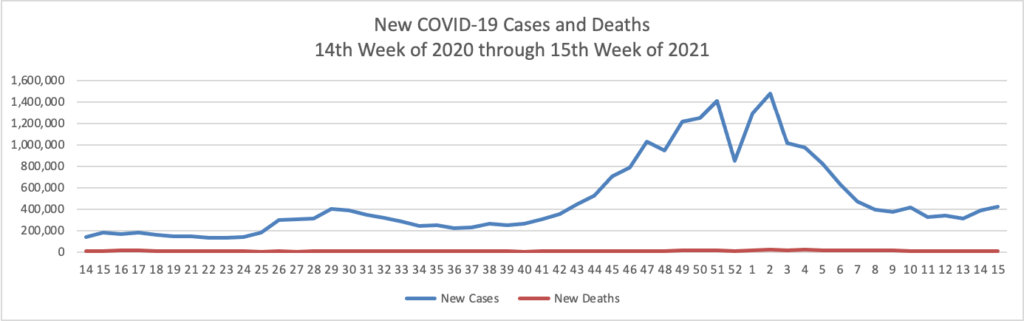
Based on the CDC’s Cases in the U.S. website, here is the FEHBlog’s chart of new weekly COVID-19 cases and deaths over the 20th through 44th weeks of this year (beginning May 14 and ending November 4; using Thursday as the first day of the week in order to facilitate this weekly update):
and here is the CDC’s latest overall weekly hospitalization rate chart for COVID-19:
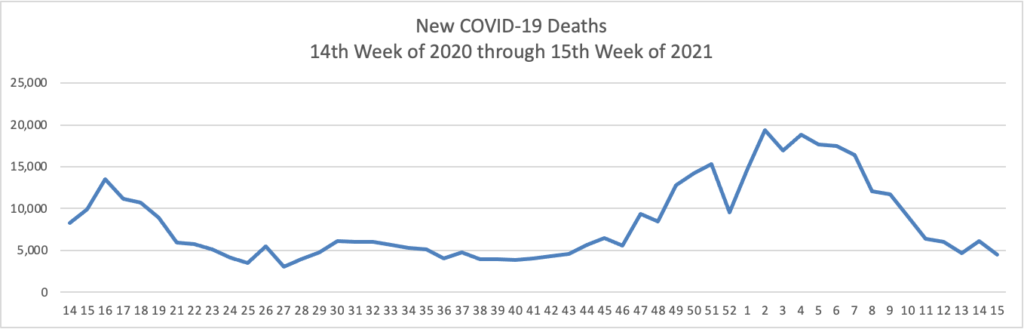
The FEHBlog has noted that the new cases and deaths chart shows a flat line for new weekly deaths because new cases greatly exceed new deaths. Accordingly here is a chart of new COVID-19 deaths over the same period (May 14 through November 4).
On the flip side, also according to the CDC, “seasonal influenza activity in the United States remains low.”
Fierce Biotech discusses the progress of a Humanigen investigation new drug called lenzilumab which is undergoing a phase 3 trial.
If the trial succeeds, lenzilumab could emerge as part of the arsenal for treating some of the sickest COVID-19 patients. Lenzilumab may stop cytokine storms, the severe hyperimmune responses that drive organ damage in some COVID-19 patients. Currently, physicians treat such severe patients with steroids and Gilead’s remdesivir, but there remains a need for more efficacious therapies.
The chances of anti-SARS-CoV-2 antibodies meeting that need have diminished in recent weeks as prospects in development at Eli Lilly and Regeneron have failed in severe COVID-19 patients. Efforts to use existing drugs, notably anti-IL-6 antibodies such as Sanofi’s Kevzara, to stop cytokine storms in COVID-19 patients have also failed.
In other investigational drug news, the Boston Globe reports that
Biogen Inc.’s experimental Alzheimer’s disease therapy [mentioned in the FEHBlog earlier this week] failed to gain support from a panel of US Food and Drug Administration advisers on Friday, putting the drug at a crossroads as the agency weighs approval.
The outside experts voted 8 to 1, with 2 undecided, that data from a single clinical trial with positive results was insufficient to show Biogen’s drug works. The vote contradicts a report FDA reviewers prepared ahead of the meeting that supported the efficacy of the drug, called aducanumab, though there was dissent in the agency. * * *
The advisory committee’s recommendations aren’t binding. The FDA often calls on panels of experts, including researchers, medical professionals and patient representatives, when it is considering whether to approve a new drug. Wall Street analysts said the FDA seemed set on viewing the drug positively.
“This will be a test for the FDA on what happens when the FDA is on one extreme and the panel is seemingly on the other, with science and evidence or the lack thereof being at the core of discussion,” Mizuho analyst Salim Syed said in an email to Bloomberg News.
At long last (given the fact that the Medicare Open Season stated on October 15), the Centers for Medicare and Medicaid Services this afternoon announced Medicare Part B premiums and Parts A and B cost sharing changes for 2021:
The standard monthly premium for Medicare Part B enrollees will be $148.50 in 2021, an increase of $3.90 from $144.60 in 2020. The fact sheet that would show income adjusted premiums for high earners was unavailable online this evening. Check again here on Sunday.
The Medicare Part A inpatient deductible that beneficiaries will pay when admitted to the hospital is $1,484 in 2021, an increase of $76 from $1,408 in 2020.
The annual deductible for Medicare Part B beneficiaries is $203 in 2021, an increase of $5 from $198 in 2020.
CVS Health not only announced third quarter earnings today; it also disclosed that its current CEO Larry Merlo is retiring and Karen Lynch, who currently heads the Aetna business unit, will replace him. Congratulations to both of them. Healthcare Dive adds
CVS’ medical loss ratio was 84%. That’s compared to just 70.3% in the second quarter as consumers deferred non-essential care amid COVID-19.
CVS has now administered more than 6 million COVID-19 diagnostic tests across 4,000 testing sites, representing 70% of all testing done in retail settings, Merlo said.
Health Payer Intelligence discusses how “Blue Cross and Blue Shield of Illinois (BCBSIL) has partnered with hospitals across the state in a new program that seeks to pursue health equity by focusing on mitigating health disparities for racial and ethnic minorities.” Well done.
The Acting OPM Director Michael Rigas and the Secretary of Health and Human Services Alex Azar have issued a memorandum and resource document encouraging federal employees to get their flu vaccination. According to the memo –
“By getting an annual flu vaccine, employees can reduce the spread of flu and reduce stress on the healthcare system, as well as keep our entire federal workforce – and country – healthier and stronger during COVID-19. For these reasons, the U.S. Department of Health and Human Services and Office of Personnel Management urge every federal employee to do their part to fight flu and get vaccinated and to encourage family members, friends, and coworkers to as well.
“It is also a good time to make sure you, and others close to you, are up-to-date on other recommended vaccinations, so ask your health care provider about other vaccines you need. All vaccines recommended by the Centers for Disease Control and Prevention, such as flu vaccines, are covered at no cost to Federal Employees Health Benefits (FEHB) plan members. Most FEHB plans also cover vaccines at pharmacies and retail stores, in addition to doctor’s offices and clinics, with no co-pays when in-network.”
CNBC reports that prescription drug manufacturer Biogen is drawing stock market attention due to positive Food and Drug Administration staff reaction to the study results of its Alzheimers Disease treatment aducanumab. “Patients [in a study] receiving the highest dose of aducanumab experienced a significant reduction in the progression of cognitive and functional impairments.”
The Cambridge, Massachusetts-based company’s drug targets a “sticky” compound in the brain known as beta-amyloid, which is hypothesized to play a role in the devastating disease. A panel of outside experts is expected to meet Friday to recommend the drug’s approval to the FDA. The FDA’s final decision on Biogen’s drug is expected by March 2021.
Health Payer Intelligence discusses a study on Medicare spending for beneficiaries with diabetes 2 and multiple chronic diseases. A takeaway from the study is that
Medicare spending among beneficiaries 65 years and older with type 2 diabetes is greatly affected by the presence of multiple chronic conditions. The presence of multiple chronic conditions increases the odds of any payments being made for services, as well as the mean spending in multiple service categories. However, patient characteristics, especially race, are also associated with variation in total spending for services.
Minority beneficiaries have lower odds of any spending, possibly due to not seeking care, but when services are provided, spending is higher, on average, compared with White beneficiaries.
Total spending for minority beneficiaries with multiple chronic conditions is higher compared with their White counterparts with the same combinations of disease.
Health systems, insurance systems, and the public health infrastructure can use these results to inform outreach programs and policy initiatives to make preventive care more accessible for racial and ethnic minorities.
As further evidence of American medical ingenuity, Healthcare Dive reports that
A new study in JAMA Network Open provides a potential roadmap to hospitals that may be leery to shut down elective surgical procedures while trying to deal with a spike in coronavirus patients. The key is the use of predictive modeling in developing a clinical decision support tool. Although such tools are abundant in healthcare, few are used to determine how likely a patient is to use certain hospital resources.
According to the study, such a tool is able to separate out elective surgical cases based on length of hospital stay, intensive care length of stay, whether or not a ventilator is required and discharge to a skilled nursing facility. A patient’s age is the biggest factor in most of those determinations, followed by the number of previous inpatient and outpatient visits made by those patients.
“This work shows the importance of a learning healthcare environment in surgical care, using quantitative modeling to guide decision-making,” the study concluded. Along the same lines, Banner Health in Arizona has been using artificial intelligence to continue performing elective procedures during the pandemic.
Thanks to Aaron Burden for sharing their work on Unsplash.
Happy Election Day!
The FEHBlog enjoyed reading this American Medical Association article about the five things that doctors should tell their patients about the COVID-19 vaccines currently under development. This could be good information for health plans to share with their members.
Nearly half the nation’s hospitals, many of which are still wrestling with the financial fallout of the unexpected coronavirus, will get lower payments for all Medicare patients because of their history of readmitting patients, federal records show.
The penalties are the ninth annual round of the Hospital Readmissions Reduction Program created as part of the Affordable Care Act’s broader effort to improve quality and lower costs. The latest penalties are calculated using each hospital case history between July 2016 and June 2019, so the flood of coronavirus patients who have swamped hospitals this year were not included.
The number and severity of penalties were comparable to those of recent years, although the number of hospitals receiving the maximum penalty of 3% dropped from 56 to 39.
Beckers Hospital Review provides a list of those 39 hospitals here.
Humana bested Wall Street expectations as it gained more members during the third quarter, generated higher revenue and beat earnings estimates, according to its quarterly results released Tuesday morning.
The payer’s medical utilization continued to trend slightly below pre-COVID levels during the third quarter, though still well above the severe dip in March and April. The lower levels of utilization were partially offset by higher COVID-19 testing and treatment costs as cases began to tick back up.
Executives warned during Tuesday’s call with investors that they expect a loss in the fourth quarter due to a number of issues, including COVID-19 testing and treatment and rebounding utilization.
It’s the last bullet that caught the FEHBlog’s attention.
Finally, Kaiser Health News offers a nice story about seniors forming friendship pods to ward off the loneliness of the great hunkering down.
Today’s big news is that the ACA regulators (the Departments of Health and Human Services (“HHS”), Labor, and Treasury) finalized a lengthy pricing transparency rule for payers, including ERISA and FEHBP group health plans (see footnote 233). The related fact sheet explains
This final rule includes two approaches to make health care price information accessible to consumers and other stakeholders, allowing for easy comparison-shopping.
First, most non-grandfathered group health plans and health insurance issuers offering non-grandfathered health insurance coverage in the individual and group markets will be required to make available to participants, beneficiaries and enrollees (or their authorized representative) personalized out-of-pocket cost information, and the underlying negotiated rates, for all covered health care items and services, including prescription drugs, through an internet-based self-service tool and in paper form upon request. For the first time, most consumers will be able to get real-time and accurate estimates of their cost-sharing liability for health care items and services from different providers in real time, allowing them to both understand how costs for covered health care items and services are determined by their plan, and also shop and compare health care costs before receiving care. An initial list of 500 shoppable services as determined by the Departments will be required to be available via the internet based self-service tool for plan years that begin on or after January 1, 2023. The remainder of all items and services will be required for these self-service tools for plan years that begin on or after January 1, 2024.
Second, most non-grandfathered group health plans or health insurance issuers offering non-grandfathered health insurance coverage in the individual and group markets will be required to make available to the public, including stakeholders such as consumers, researchers, employers, and third-party developers, three separate machine-readable files that include detailed pricing information. The first file will show negotiated rates for all covered items and services between the plan or issuer and in-network providers. The second file will show both the historical payments to, and billed charges from, out-of-network providers. Historical payments must have a minimum of twenty entries in order to protect consumer privacy. And finally, the third file will detail the in-network negotiated rates and historical net prices for all covered prescription drugs by plan or issuer at the pharmacy location level. Plans and issuers will display these data files in a standardized format and will provide monthly updates. This data will provide opportunities for detailed research studies, data analysis, and offer third party developers and innovators the ability to create private sector solutions to help drive additional price comparison and consumerism in the health care market. These files are required to be made public for plan years that begin on or after January 1, 2022.
The final rule also provides some medical loss ratio relief to compliant health insurance issuers as explained in the fact sheet. Here is AHIP’s reaction to the final rule.
Also today HHS issued an interim final rule with a comment period that “extends the compliance dates and timeframes necessary to meet certain requirements related to information blocking and Conditions and Maintenance of Certification (CoC/MoC) requirements. Released to the public on March 9, 2020, ONC’s Cures Act Final Rule established exceptions to the 21st Century Cures Act’s information blocking provision and adopted new health information technology (health IT) certification requirements to enhance patients’ smartphone access to their health information at no cost through the use of application programming interfaces (APIs).” The rule had been scheduled to take effect beginning next week.
Fierce Healthcare reports that “Regeneron’s anti-SARS-CoV-2 antibody cocktail has significantly reduced medical visits in ambulatory COVID-19 patients. The phase 2/3 clinical trial linked REGN-COV2 to a 57% decline in medical visits associated with COVID-19 in the 29 days after treatment.”
HealthPartners, a Minneapolis health insurer that participates in the FEHBP, offers a helpful, complete explanation of the benefits of wearing masks to prevent COVID-19. “At its core, wearing a mask is an act of kindness and neighborliness. It’s one of the simplest good deeds you can do these days, and a great way to be a force of positivity for the people in your life.”
The financial crisis for hospitals and physician practices caused by the COVID pandemic is a “clarion call” for the healthcare industry to move from a fee-for-service payment model to value, said Kevin Mahoney, chief executive officer of the University of Pennsylvania Health System (Penn Medicine).
“The hospital sector has taken a giant hit. We keep hearing about ‘the new normal.’ The lesson that we learned is that there is nothing new or normal about a pandemic, there’s just been an acceleration of trends,” Mahoney said during a recent virtual event hosted by the University of Pennsylvania. “It has laid bare how dependent hospitals are on commercially-insured, elective procedures, and without them, we don’t make money.”
The FEHBlog’s youngest son is a research coordinator for Penn Medicine. The FEHBlog seconds his boss’s sentiments.
Call to Action to Control Hypertension (Call to Action) seeks to avert the negative health effects of hypertension by identifying evidence-based interventions that can be implemented, adapted, and expanded in diverse settings across the United States.
The Call to Action outlines three goals to improve hypertension control across the United States, and each goal is supported by strategies to achieve success:
Goal 1. Make hypertension control a national priority. Goal 2. Ensure that the places where people live, learn, work, and play support hypertension control. Goal 3. Optimize patient care for hypertension.
Following up on yesterday’s post about mandatory of coverage of COVID-19 vaccines with no member cost sharing once available, the FEHBlog wants to add that the same rule applies to Medicare. CMS “estimates the overall cost of providing the vaccine to every senior on Medicare would be around $2.6 billion, which would be covered by the federal government. CMS will also cover the vaccine for any uninsured individuals by using money from a $175 billion provider relief fund passed as part of the CARES Act.” It appears however that the vaccine would be administered through the Part D program. That would not be much help to FEHB plans as most FEHB members with primary Medicare coverage does not carry Medicare Part D.
The Health and Human Services Department, the Cybersecurity and Infrastructure Security Agency and the FBI warn hospitals face an imminent threat from cybercriminals that encrypt and hold their data hostage—and some health care facilities are already dealing with the fallout.
The agencies collectively issued an advisory Wednesday detailing the tactics, techniques and procedures reportedly used against at least five hospitals already this week. The advisory includes recommendations for mitigating what observers are referring to as the most serious cyber threat the U.S. has seen to date, being perpetrated by an especially ruthless group of criminals.
“CISA, FBI, and HHS have credible information of an increased and imminent cybercrime threat to U.S. hospitals and healthcare providers,” reads the advisory.
The Affordable Care Act regulators (the Departments of Health and Human Services, Labor and Treasury) issued an interim final rule with an opportunity to comment (“IFC”) on coverage of COVID-19 preventive services. This rule focuses on coverage of COVID-19 vaccinations. The fact sheet explains with respect to private plans, including FEHB plans, that
the Departments [have] amend[ed] existing regulations to implement the unique requirements related to rapid coverage of qualifying coronavirus preventive services. This coverage is required to be provided within 15 business days after the date on which the United States Preventive Services Task Force or the Advisory Committee on Immunization Practices (ACIP) of the Centers for Disease Control and Prevention (CDC) makes an applicable recommendation relating to a qualifying coronavirus preventive service.
Specifically, plans and issuers must cover COVID-19 immunizations that have in effect a recommendation of ACIP with respect to the individual involved, even if not listed for routine use on the Immunization Schedules of the CDC. This IFC also provides that during the public health emergency for COVID-19, plans and issuers must cover without cost sharing qualifying coronavirus preventive services, regardless of whether an in-network or out-of-network provider delivers such services. The IFC also affirms that plans and issuers subject to section 2713 of the Public Health Service Act must cover without cost sharing items and services that are integral to the furnishing of recommended preventive services, including the administration of COVID-19 immunizations.
When the coronavirus vaccine arrives on the market, demand will far exceed supply. During those first few months, state and county public health officials will face tough questions about who should be first in line to get one of the limited vaccine doses. The Vaccine Allocation Planner for Covid-19, a new tool released Wednesday, aims to help make those decisions with data.
Jointly developed by Ariadne Labs, a project run out of Brigham and Women’s Hospital and the Harvard T.H. Chan School of Public Health, and the Surgo Foundation, a nonprofit at the intersection of behavioral and data science, the tool allows policymakers to look at region-specific data. They can estimate the size of high-risk populations, consider factors like particular community’s vulnerabilities, and run scenarios based on an estimated number of vaccine doses available.
The New York Times maintains a COVID-19 vaccine tracker here
Anthem beat Wall Street’s third-quarter expectations on earnings and reported revenue of $31.2 billion, up 16.8% from the year prior, in results released Wednesday morning. Expenses, however, were up more than 22% year over year, leaving profit to plummet roughly 80%. Total medical membership jumped 4%, attributed to increases in Medicare and Medicaid rolls. Anthem CEO Gail Boudreaux said on the earnings call the overall membership trends are outpacing internal expectations. The payer also reported a $594 million payment in Q3 toward a federal antitrust settlement reached with Blue Cross Blue Shield plans that is still awaiting approval by a judge. Other terms include nixing the “best efforts” rule that required member plans to generate at least two-thirds of their annual revenue from Blues brands and allowing employers to request a second bid from a non-local Blues plan, Boudreaux said, adding “we don’t see this changing our strategy.”
There is a clear overlap between specialties that are using telemedicine the most, and those specialties that manage chronic illnesses, such as endocrinology and rheumatology. Treating long-term chronic conditions like diabetes and arthritis require frequent patient visits, but they don’t always need to be in-person. For patients that require long-term care, telemedicine tools can reduce taxing trips to hospitals or clinics.
Doximity is a professional network for physicians.
Medpage Today lets us know that
Screening for colorectal cancer (CRC) should begin at age 45 for all average-risk adults in the United States, the U.S. Preventive Services Task Force (USPSTF) recommends in a guideline draft. Screening should continue at recommended intervals until age 75, the draft states. For patients ages 76 to 85, the decision to continue screening should be based on an individualized assessment of the benefits and harms associated with screening.
Currently FEHB plans are required to cover CRC screening with no member cost sharing for members beginning at age 50. If this guideline is finalized in 2020, the no cost sharing coverage requirement would drop to age 45 on January 1, 2022 pursuant to the Affordable Care Act’s requirements.
Here is a list of all of the USPSTF Grade A and B preventive service for adults recommendations which are eligible for cost free coverage starting in the plan year that begins on or after exactly one year from the issue date. FEHB plan years follow the calendar year, but not all health plans do.
Federal News Network called the FEHBlog’s attention to the fact that the OPM Inspector General has released his annual report on top management challenges that OPM faces, a number of which as always concern the FEHBP.
The IRS yesterday released a boatload of 2021 tax information —
Rev. Proc. 2020-45 provides inflation-adjusted items for 2021. Of note the Society for Human Resource Management points out that
For 2021, the dollar limit for employee contributions to health flexible spending accounts (health FSAs), made pretax through salary reductions, remains unchanged at $2,750, the IRS announced on Oct. 27 when it issued Revenue Procedure 2020-45.
The limit also applies to limited-purpose FSAs that are restricted to dental and vision care services, which can be used in tandem with health savings accounts (HSAs).
For health FSA plans that permit the carryover of unused amounts, the maximum carryover amount for 2021 is $550, an increase of $50 from the original 2020 carryover limit.
IRS Notice 2020-79 provides inflation-adjustments “affecting dollar limitations for 401(k), pension plans and other retirement-related items for tax year 2021. The contribution limit for employees who participate in 401(k), 403(b), most 457 plans, and the federal government’s Thrift Savings Plan remains unchanged at $19,500.”
Eli Lilly announced it will halt its ACTIV-3 trial evaluating the antibody bamlanivimab in combination with remdesivir for people hospitalized with COVID-19, after new evidence regarding efficacy emerged. The new data from the National Institutes of Health suggest that the experimental neutralizing antibody therapy does not offer significant clinical benefit for people with more advanced COVID-19 illness, according to a company statement. Eli Lilly also announced it plans to continue its other trials evaluating the antibody, including those assessing a potential role in treating people in the earlier stages of COVID-19.
A friend of the FEHBlog called his attention to this interesting NCQA publication on social determinants of health. Check it out.
Health Affairs provides a useful perspective on low value care in the age of COVID-19. In short,
There is the chance to use surveys or qualitative methods to compare the diverse harms experienced by patients who did and did not receive a low-value service because of the COVID-19 pandemic. It will be important to examine harms both across and within potentially high-risk or vulnerable subpopulations, as the distribution of harms may differ by demographics, social determinants, and presence of comorbid illnesses.
And to close the loop, the Senate confirmed Judge Amy Coney Barrett to be an Associate Justice of the U.S. Supreme Court last evening, and Justice Barrett was sworn in soon thereafter. The Senate has joined the House of Representatives on the campaign trail.
Healthcare Dive reports that Utah-based “Intermountain Healthcare and South Dakota-based Sanford Health announced Monday that the two had signed a letter of intent to merge. Together the two will operate 70 hospitals — many of which will be located in rural communities across the country — and 435 clinics and insure 1.1 million people.” Intermountain participates in the FEHB under the name of its affiliate SelectHealth.
The Labor Department’s Employee Benefit Security Administration (“EBSA”) released its 2020 edition of its federal mental health and substance use disorder parity self compliance tool for health plans. The first edition was released in April 2018. What’s more on Thursday October 29 at 2 pm ET EBSA will hold a free compliance assistance webcast on this complicated law.
Here’s a link to OPM’s third quarter 2020 report on the development of its Master Enrollment Index for the FEHBP.
The Centers for Medicare and Medicaid Services posted information today about the ACA federal marketplace open enrollment period which begins on Saturday November 1 and ends on December 15, 2020.
Over the weekend, the FEHBlog read in the Wall Street Journal’s Numbers column about COVID-19 mortality predictions. The author explains that
Now, as many as 50 different research groups make predictions, but one of the most accurate assembles all of the individual models, calculates the median value and looks no more than four weeks into the future.
The ensemble forecast was founded by the Reich Lab at the University of Massachusetts, Amherst, in collaboration with the Centers for Disease Control and Prevention and is based in part on models previously developed to forecast influenza and other infectious diseases.
In the next four weeks, it predicts the total number of deaths attributed to the new coronavirus will surpass 240,000—adding roughly 17,000 deaths to the current tally.
Such projections help policy makers and health-care officials decide how to manage resources and implement or relax interventions intended to curb the spread of the disease.
A Covid-19 vaccine being developed by the University of Oxford and AstraZeneca AZN 2.06% PLC showed a promising immune response and low levels of adverse reactions in the elderly and older adults, according to an interim analysis that the drugmaker said was encouraging.
The vaccine, now in late-stage human trials aimed at showing its efficacy and safety, is a front-runner in the global sprint for a shot to protect lives and jump-start economies hobbled by the pandemic. Trials in the U.K. could produce results before year-end, fueling hopes among scientists and government leaders that a vaccine might be available for high-risk groups here by early 2021.
Fierce Healthcare informs us that “CVS views its pharmacists as playing a key role in assuaging fears, CEO Larry Merlo said Friday. Merlo, speaking at an event hosted by The Washington Post, said that pharmacists “are among the most trusted professionals” in the industry and as such will be able to educate patients about the safety and efficacy of the vaccine.”
Fierce Healthcare also recognizes “ten women who have risen to the challenges posed by COVID, as well as played a role in positioning their respective companies to be where they are today.” For example, Anthem Blue Cross’ Liz Kwo M.D. is scaling digital products to improve outcomes. Bravo to all of the winners.
We use cookies on our website to give you the most relevant experience by remembering your preferences and repeat visits. By clicking “Accept”, you consent to the use of ALL the cookies.
This website uses cookies to improve your experience while you navigate through the website. Out of these, the cookies that are categorized as necessary are stored on your browser as they are essential for the working of basic functionalities of the website. We also use third-party cookies that help us analyze and understand how you use this website. These cookies will be stored in your browser only with your consent. You also have the option to opt-out of these cookies. But opting out of some of these cookies may affect your browsing experience.
Necessary cookies are absolutely essential for the website to function properly. These cookies ensure basic functionalities and security features of the website, anonymously.
Cookie
Duration
Description
cookielawinfo-checbox-analytics
11 months
This cookie is set by GDPR Cookie Consent plugin. The cookie is used to store the user consent for the cookies in the category "Analytics".
cookielawinfo-checbox-functional
11 months
The cookie is set by GDPR cookie consent to record the user consent for the cookies in the category "Functional".
cookielawinfo-checbox-others
11 months
This cookie is set by GDPR Cookie Consent plugin. The cookie is used to store the user consent for the cookies in the category "Other.
cookielawinfo-checkbox-necessary
11 months
This cookie is set by GDPR Cookie Consent plugin. The cookies is used to store the user consent for the cookies in the category "Necessary".
cookielawinfo-checkbox-performance
11 months
This cookie is set by GDPR Cookie Consent plugin. The cookie is used to store the user consent for the cookies in the category "Performance".
viewed_cookie_policy
11 months
The cookie is set by the GDPR Cookie Consent plugin and is used to store whether or not user has consented to the use of cookies. It does not store any personal data.
Functional cookies help to perform certain functionalities like sharing the content of the website on social media platforms, collect feedbacks, and other third-party features.
Performance cookies are used to understand and analyze the key performance indexes of the website which helps in delivering a better user experience for the visitors.
Analytical cookies are used to understand how visitors interact with the website. These cookies help provide information on metrics the number of visitors, bounce rate, traffic source, etc.
Advertisement cookies are used to provide visitors with relevant ads and marketing campaigns. These cookies track visitors across websites and collect information to provide customized ads.