Weekend update

Weekend update

Thanks to Alexandr Hovhannisyan for sharing their work on Unsplash.

The House of Representatives will be conducting Committee business this week and is not expected to resume floor voting until June 14. The Senate will be conducting Committee business and floor voting this week. Tomorrow the Senate will begin the voting process for confirmed President Biden’s nominee for Centers for Medicare and Medicaid Services Administrator, Chiquita Brooks-LaSure.

The Supreme Court will hold another opinion day tomorrow which may be the occasion for the release of the California v. Texas Affordable Care Act constitutionality decision. Lexology discusses the fallout from the Surpreme Court’s December 2020 opinion in Rutledge v. PCMA narrowing the scope of ERISA preemption with respect to prescription benefit manager law. State legislatures have jumped on the opportunity created by the Rutledge opinion.

In 2021 alone, at least eight states have enacted some sort of PBM reform legislation, including Alabama, Arizona, Arkansas, Mississippi, New York, North Dakota, West Virginia and Wisconsin. PBM reform regulation has passed both the state house and senate in Texas and is on its way to the governor. These bills run the gamut of regulating the PBM industry, from prohibiting PBMs from charging pharmacies fees during and after the claims adjudication process, prohibiting PBMs from reimbursing their own affiliated pharmacies at a higher level than independent pharmacies to banning PBM discrimination against pharmacies participating in the Federal 340B medication discount program. This trend is likely to continue with almost 100 bills introduced across 39 states similarly aimed at regulating the PBM industry

Cost curve up. ERISA decisions like this one impact FEHB preemption because courts have interpreted the two preemption laws as generally analogous in scope.

In other news and opinions:

  • Medpage Today offers an op-ed about the importance of primary care. The FEHBlog agrees that “Patients need support for mental and physical health all in one place” and accordingly health plans should encourage the use of primary care.
  • Fierce Healthcare reports that “There was a significant increase in pharmacy fraud and abuse under the pandemic, analysts at OptumRx say. The pharmacy benefit manager giant recovered $300 million in fraud, waste and abuse spend in 2020 and documented the largest ever increase in fraudulent claims, which were up 300% compared to 2019. In addition, Optum’s investigative audits led to an increase of 135% in fraud recoveries last year from 2019. The average audit recovery per case was also 70% higher in 2020 than in 2019, Optum found. Optum found the fraudulent behavior concentrated among independent pharmacies and rarely found similar activity among retail chains, [Optum analysts] said. Due to the findings, the PBM axed 112 pharmacies from its network.
  • Kaiser Health News informs us that “Colorado health officials so abhor the high costs associated with free-standing emergency rooms they’re offering to pay hospitals to shut the facilities down. The state wants hospitals to convert them to other purposes, such as providing primary care or mental health services. At least 500 free-standing ERs have set up in more than 20 states in the past decade. Colorado has 44, 34 owned by hospitals. The trend began a decade ago with hopes these stand-alone facilities would fill a need for ER care when no hospital was nearby and reduce congestion at hospital ERs. But that rarely happened. Instead, these emergency rooms — not physically connected to hospitals — generally set up in affluent suburban communities, often near hospitals that compete with the free-standing ERs’ owners. And they largely treated patients who did not need emergency care, but still billed them and their insurers at expensive ER rates, several studies have found.” Good luck Colorado as this approach also may reduce surprise billing issues.

Friday Stats and More

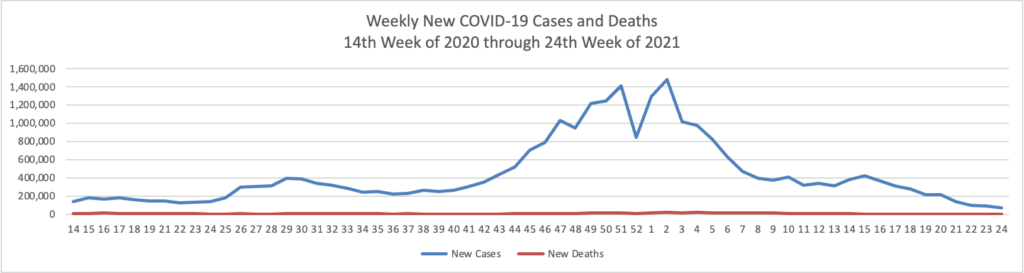
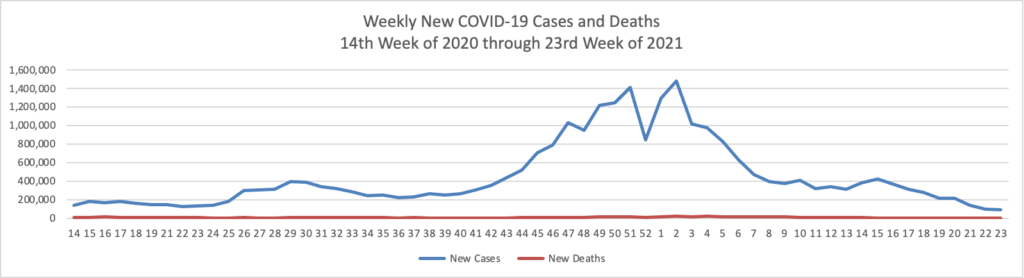
Based on the Centers for Disease Control’s COVID-19 Data Tracker website, here is the FEHBlog’s chart of new weekly COVID-19 cases and deaths over the 14th week of 2020 through 20th week of this year (beginning April 2, 2020, and ending May 19, 2021; using Thursday as the first day of the week in order to facilitate this weekly update):

and here is the CDC’s latest overall weekly hospitalization rate chart for COVID-19:

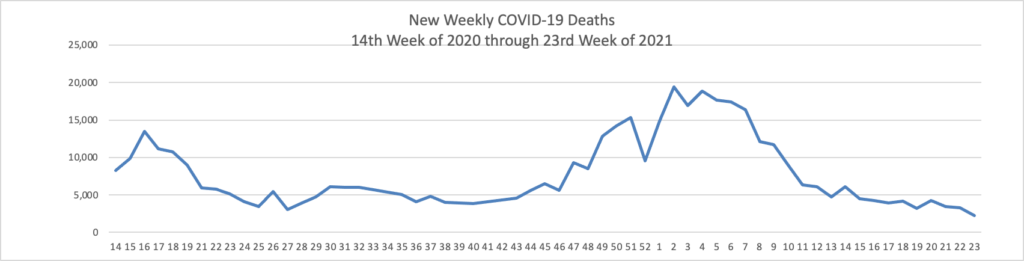
The FEHBlog has noticed that the new cases and deaths chart shows a flat line for new weekly deaths  because new cases greatly exceed new deaths. Accordingly here is a chart of new weekly COVID-19 deaths over the period April 2, 2020, through May 19, 2021:

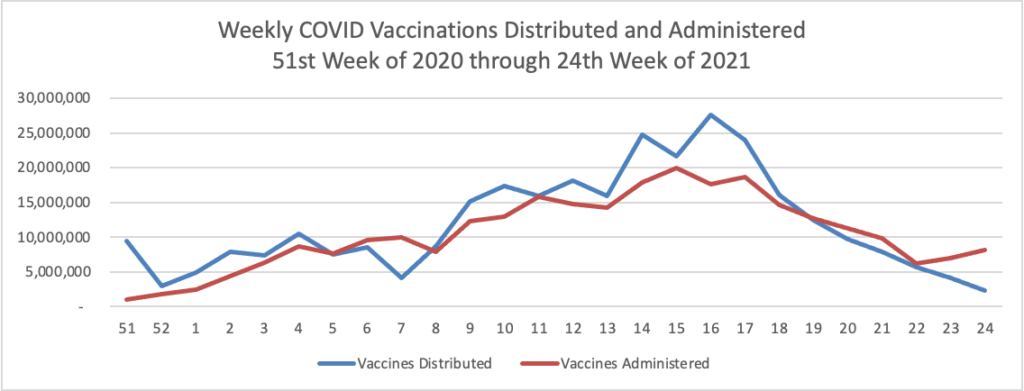
Finally here is a COVID-19 vaccinations chart over the period December 17, 2020, through May 19, 2021, which also uses Thursday as the first day of the week:

With respect to COVID-19 vaccinations, Medscape reports that

The COVID-19 vaccines authorized for use in the United States and Europe offer protection against the four main coronavirus variants known to exist, a World Health Organization official says. “All COVID-19 virus variants that have emerged so far do respond to the available approved vaccines,” WHO European Regional Director Hans Kluge said Thursday at a news conference.

In sum, from the COVID-19 stats front, the Centers for Disease Control states

COVID-19 caseshospitalizations, and deaths are going down, and the number of people vaccinated continues to go up, providing a sense of optimism as summer approaches. As of May 20, 48.4% of the U.S. population ages 18 years and older is fully vaccinated, and 60.5% have received at least one dose of a COVID-19 vaccine. Additionally, as of last week, millions more are now eligible to receive a COVID-19 vaccine. These trends and new CDC evidence-based guidance on masking provide encouragement that we are making progress toward returning to a sense of normalcy.

As you look ahead to summer, consider how COVID-19 is spreading in your community when choosing activities. Outdoor activities and visits are safer than those indoors, but fully vaccinated people can participate in most indoor activities without much risk. If you are not yet vaccinated, you should continue to practice prevention strategies such as wearing a well-fitted mask, practicing physical distancing, avoiding crowds, and washing your hands. 

In the “and more” category

Health Affairs discusses five keys to realizing health equity in U.S. health plans. To wit

“The five major priorities (and the achievements that will result from these priorities) for health equity leadership in health plans are:

  • Prioritizing Prevention and Wellness: Benefits and care delivery redesign
  • Prioritizing Communities: Engagement and investments
  • Prioritizing Innovation: Population and digital health
  • Prioritizing Education, Research, and Workforce Development: Academic-community collaborations
  • Prioritizing Action and Accountability: Data-driven improvement.”

mHealth Intelligence reports that “GAO tells Congress to wait on expanding telehealth coverage past the pandemic.
A new report and testimony from the Government Accountability Office says the full effect of CMS waivers on telehealth coverage during the pandemic isn’t yet known, and more study is needed. That conclusion won’t make the American Medical Association happy.

Reuters informs us that “CVS Health Corp., best known for its national chain of drugstores, said on Thursday it had started offering clinical trial services to support drug developers with tasks like patient enrollment. CVS said it had already collaborated with drug developers to help facilitate clinical trials for investigational COVID-19 vaccines and treatments, which the new business will now expand.”

Speaking of clinical investigations, Medscape reports that

The novel Galleri blood test (GRAIL, Inc.), which claims to detect up to 50 different cancers from single blood draw, is about to make its clinical debut in the United States. However, an expert cautions that this test should be considered as being under clinical investigation. Providence Health System, based in Renton, Washington, will be the first health system in the US to offer access to the Galleri test, where it will be available as a complement to recommended single-cancer screening tests.

On its website, GRAIL notes that the Galleri blood test is recommended for use in adults with an elevated risk for cancer, such as those aged 50 or older. It is intended to detect cancer signals and to predict where in the body the cancer signal is located. However, it does not detect all cancers and should be used in addition to routine cancer screening tests recommended by a healthcare provider. It is “intended to be used in addition to, and not replace, other cancer screening tests,” [GRAIL’s Leslie] Strope emphasized.

The FEHBlog strongly recommends this week’s episode of the Econtalk podcast (three strong weekly episodes in a row) in which

Podcaster and author Julia Galef talks about her book The Scout Mindset with EconTalk host Russ Roberts. Galef urges us to be more rational–to be open-minded about what we might discover about the world–rather than simply defend what we already believe, which she calls the soldier mindset. The conversation is a wide-ranging discussion of our biases and the challenges of viewing the world objectively.

Weekend update

FEHBlog opening note — The FEHBlog goofed by posting this May 7 COVID-19 charts in the May 14 Friday Stats and More post. The FEHBlog corrected his error on Saturday after the Friday post email went out. You can check out the website if you want to see the May 14 charts which are encouraging. In contrast, check out the Wall Street Journal’s charts on the COVID-19 situation in India which is still struggling with virus. Whereas 37% of the U.S. population is fully vaccinated, less than 5% of the much larger and younger Indian population has reached that status. In this regard, the Rome (N.Y.) Sentinel offers an Excellus Blue Cross consulting pharmacist’s valuable guidance on why people in the age 18 to 34 bracket should received the COVID vaccination.

Q: Katie [Abbott, Pharm.D.], you are in that age group. Why did you choose to get vaccinated? 

I trust the science behind the vaccines and believe they will help bring us back to how life was before the pandemic.

Q: Some, or most cases of COVID-19 in younger people are not severe. Why would a younger person get vaccinated if younger people aren’t really dying from COVID-19?

The younger population may not be seeing as many severe cases or deaths, but they are still at high risk of long COVID. Long COVID is when those who have recovered from COVID-19 experience lasting effects, including a range of symptoms such as fatigue, brain fog, chest pain, shortness of breath, cough, joint or muscle pain, depression, anxiety, and so much more. Long COVID can develop weeks or months after infection. It can happen to anyone who has had COVID, even if they had mild or no symptoms. Getting the vaccine remains a safe way to protect yourself, along with your community, family members, and those who cannot be vaccinated.

Returning to the regular weekend update, both Congress will be in session this week for Committee work and House and Senate floor votes. The House Oversight and Reform Committee will hold its third recent hearing on prescription drug costs on Tuesday morning. It’s worth noting that although the House Oversight and Reform Committee approved the Postal Reform bill (HR 3076) last week, the House Energy and Commerce and Ways and Means Committees also have jurisdiction over the bill. So we don’t know right now, when the bill may reach the House floor.

In OPM news, the Federal Times reports that

In anticipation of more employees returning to the office and in the spirit of May’s Mental Health Awareness Month, the Office of Personnel Management issued a tip sheet for agency human resource staff to better support employees at a vulnerable time. * * * In addition to communicating with employees about the usual resources available to them – such as the Employee Assistance Program and mental health treatments offered through Federal Employee Health Benefit plans – OPM encouraged agency work-life coordinators and HR professionals to be as communicative as possible about office safety procedures and available work schedule adjustments to ease any potential employee anxiety.

In other healthcare news,

  • mHealth Intelligence discusses the work of University of West Virginia researchers who are seeking to determine the best mix of in-person and virtual care. “With telehealth use skyrocketing over the past year and a half due to the coronavirus pandemic, some have wondered if there’s a limit to its effectiveness. Is there a certain number of virtual visits that a patient – especially one with a chronic condition – should get, after which the technology outlasts its value? The answer, according the researchers at the University of West Virginia, is … uncertain.” While that outcome is surprising to the FEHBlog, the researchers have gone back to the drawing board.
  • Fierce Healthcare reports that “GoodRx, a telehealth and drug-pricing comparison software company, acquired competitor RxSaver for $50 million in cash. The company closed the deal in late April, GoodRx reported during its first-quarter 2021 earnings call Thursday. RxSaver, which was owned by Vericast Corp., the payment and marketing company controlled by billionaire Ronald Perelman, operates a price comparison platform to provide discount offerings through partnerships with pharmacy benefit managers (PBMs). The acquisition will expand GoodRx’s business capabilities and consumer reach, particularly with respect to its prescription offering, the company said in its first-quarter 2021 earnings report.”
  • Health Payer Intelligence informs us that ” To help combat racial care disparities in communities of color, Blue Shield of California (Blue Shield) provided $300,000 to 12 different nonprofit organizations in California that promote the mental health and well-being of youths in their communities.   This act supports the health equity strategy of Blue Cross Blue Shield Association (BCBSA), Blue Shield’s parent company, as it seeks to improve racial care disparities by collaborating with local community leaders. By contributing $25,000 to each organization, Blue Shield is providing opportunities for youths of color that can improve their mental health.”
  •  Healthcare Dive reports that “Piedmont Healthcare signed a non-binding letter of intent to acquire Augusta, Georgia-based University Health Care System, which operates three hospitals as well as skilled nursing facilities and urgent care clinics along Georgia’s eastern border with South Carolina. * * * Just last week, the 11-hospital system announced plans to buy four additional hospitals from HCA Healthcare for $950 million. The sale is expected to close in the third quarter of this year. The hospitals in the HCA deal circle the outskirts of the Atlanta region. * * * Altogether, the two most recent deals would give Piedmont a total of 18 hospitals in Georgia, in addition to more ancillary services.” Healthcare Dive adds that the two deals are likely to face regulatory scrutiny.

Midweek Update

Tomorrow morning the House Oversight and Reform Committee will mark up its bipartisan Postal Reform Act (H.R. 3076) and the Postal Improvement Act (HR 3077). H.R. 3076 would eliminate the Postal Service’s unique obligation to pre-fund the cost of FEHB coverage for its annuitants. It also would create a subprogram with the FEHB for postal service employees and annuitants that would be fully integrated with Medicare Parts A (hospital), B (professional services) and D (prescription drugs) for annuitants over age 65.

Existing FEHB plans largely receive the financial benefit of Medicare Parts A and B integration, but OPM does not permit FEHB plans to offer Medicare Part D integration known as EGWPs. The FEHBlog expects H.R. 3076’s mandatory use of Part D EGWPs in the subprogram will unleash a gusher of new benefit savings for subprogram plans. Fingers crossed that successful adoption of Part D EGWPs in this subprogram leads OPM to allow carriers to add them in existing FEHB too. However, as currently drafted, the subprogram would launch on January 1, 2023, which is aggressive timing in the FEHBlog’s view.

Today according to the Wall Street Journal

The Centers for Disease Control and Prevention recommended that 12- to 15-year-olds receive the Covid-19 vaccine from Pfizer Inc. and BioNTech SE, expanding the nation’s vaccination campaign

The CDC took the step after its vaccination advisory panel voted to recommend the shot at a meeting Wednesday after reviewing clinical trial data and other relevant information. The vote by the Advisory Committee on Immunization Practices, or ACIP, was 14-0, with one voting member recusing. * * *

Covid-19 cases are rising in adolescents, and as older Americans have gotten vaccinated, adolescents make up an increasing proportion of the overall U.S. case count, Sara Oliver, a CDC medical officer, said. Adolescents accounted for 9% of reported cases in April, a larger proportion than cases involving people 65 years and older as more adults have been vaccinated, she said.

According to the CARES Act of 2020, health plans, including FEHB plans, must begin to cover the Pfizer vaccine without member cost sharing for this age group no later than fifteen days from today, May 27, 2021. According to the Journal, “Pfizer anticipates asking the FDA in September to authorize its vaccine’s use in children 2 to 11 years old should ongoing studies prove positive. The company said It plans to make a similar request for children 6 months to 2 years of age in the fourth quarter.”

In Biden Administration news, the American Hospital Association reports that

Health and Human Services Secretary Xavier Becerra today swore in Andrea Palm as deputy secretary. Confirmed by the Senate yesterday, Palm previously served as secretary-designee of Wisconsin’s Department of Health Services and in several leadership roles at HHS during the Obama-Biden administration.  
“My focus will be on improving the lives and livelihoods of the American people: tackling the COVID-19 pandemic, efficiently and equitably distributing vaccines, expanding access to affordable health care, addressing the epidemic of substance use disorders, and improving mental health care,” she said. 
Biden’s nominee to serve as Centers for Medicare and Medicaid Services administrator, Chiquita Brooks-LaSure, today moved one-step closer to confirmation with the Senate voting 51-48 to discharge the nomination. The Senate could hold a final vote on her confirmation next week.  

STAT News informs us

  • “Telehealth companies, flush with cash after the Covid-19 pandemic spiked both demand and investment, are now embarking on massive lobbying efforts to secure their interests on Capitol Hill. The goal is clear: Lawmakers are weighing whether to permanently loosen regulations that were temporarily eased during the pandemic. Among other changes, providers have been allowed to practice in states where they are not licensed, and Medicare has been permitted to pay providers the same for virtual visits as in-person ones. Lobbyists for the rapidly growing industry are determined to keep those changes intact.” Watch for this result the big infrastructure bill.
  • Amazon’s objectives for its nascent pharmacy business are straightforward: “better selection, better convenience, and better prices,” according to TJ Parker, the vice president of pharmacy at the company.“ It really is the Amazon playbook,” he said during a Wednesday panel at STAT’s Health Tech Summit. * * * “Customers really want more Amazon and less pharmacy and so our work from here is to make pharmacy truly as seamless to us as amazon.com [is] for other categories,” Parker said. Among Amazon’s latest offerings: a new price-comparison tool for medications, which launched Tuesday. Now, when someone searches for a prescription drug on Amazon, Amazon Pharmacy’s price for a drug is listed alongside the cost for Prime members at other pharmacies like CVS, Walgreens, Walmart, and Costco.” Watch out GoodRx.

On a related note, the Drug Channels blog assesses how Cigna’s growing pharmacy platform expands its channel power.

Last week, Cigna released its earnings for the first quarter of 2021. I was struck by how quickly Cigna’s Express Scripts PBM business has increased revenues and prescriptions from its retail pharmacy network. Our second chart below highlights this growth. The businesses in Cigna’s Evernorth segment—especially Express Scripts, Ascent Health Services, and InsideRx—are already providing rebate negotiation, network management, and/or a sourcing platform for Prime Therapeutics, Kroger, Humana, GoodRx, and Amazon.”

Monday Roundup

Photo by Sven Read on Unsplash

In a move hinted at in yesterday’s Weekend Update, the Office of Personnel Management today released government wide results from the 2020 Federal Employee Viewpoint Survey.

As shown in the 2020 OPM FEVS results, the federal workforce adapted quickly to the challenges presented by the pandemic. Together with their managers and policy makers, employees found creative solutions and leveraged workplace flexibilities – including the widespread adoption of telework — to continue to support their agency’s mission while balancing personal responsibilities. Results demonstrate that federal workers derive great satisfaction and meaning from successfully doing their jobs through even the most disruptive of circumstances.

Medscape reports on a recent Health Affairs reports on last year’s dip in healthcare services stemming from the great hunkering down.

Since last spring, utilization of healthcare services has largely rebounded, and [study coauthor Kevin] Callison [, PhD, assistant professor in the Department of Health Policy and Management at the Tulane School of Public Health and Tropical Medicine] speculated that involuntary delays in care have diminished greatly. He attributed that partly to improved treatment of COVID-19, the restored capacity of many healthcare facilities, and the expiration of orders to delay or cancel elective procedures. Also, he noted, people have become more comfortable with seeing physicians in person, which has partly explained the increase in ambulatory visits. Nevertheless, he added, “we’re not seeing a rebound above pre-pandemic levels to make up for that lost care.”

Healthcare Dive informs us that primary care “practices are financially stabilizing more than a year after the pandemic began. However, primary care practices are facing enormous challenges in the near term, including pent-up demand for medical and mental health services and a growing feeling of exhaustion among physicians.” Also those practice now are playing a much larger role in COVID-19 vaccination administration.

The Primary Care Collaborative surveyed more than 650 primary care physicians, nurse practitioners and pharmacists in 48 states, the District of Columbia and Guam. Altogether, nearly four out of 10 practices are administering the COVID-19 vaccines, “a marked increase” compared to just a few weeks prior, while 47% are partnering with local vaccination administration sites. “Primary care is now beginning to be leveraged to target the vaccine to hard-to-reach populations,” the survey’s authors concluded.

The International Foundation of Employee Benefits Plan discusses its “a webcast on legal considerations for employers regarding employee vaccinations.” Check it out.

Last week the FEHBlog called attention to National Prescription Drug Take Back Day, which was held on April 24. The Drug Enforcement Administration points out today that there are many convenient drug disposal sites open year round in our country.

Midweek update

Today was the second day of the OPM AHIP FEHB Carrier Conference. One of the sessions concerned COVID-19 vaccination outreach to socially disadvantaged communities. The FEHBlog learned that Kaiser Permanente, which is the third largest FEHB plan carrier, has released a COVID-19 vaccination equity tookit and that Geisinger, a Pennsylanvia based FEHB plan carrier, has produced a Neighborly website chock full of community resources. A speaker referenced this New York Times article on the following topic: “Half of American adults have received at least one shot of the coronavirus vaccine. Now comes the hard part: persuading the other half to get it.”

In COVID-19 vaccine news from outside the carrier conference

  • The Society for Human Resource Management reports that “To encourage more widespread vaccinations, President Joe Biden has announced a paid leave tax credit to employers that provide full pay for any employee who takes time off to get a COVID-19 vaccination. The tax credit is available to organizations with fewer than 500 employees, and it also provides full pay for employees who take time to recover from the vaccination. The credit covers up to $511 per day for each vaccinated employee, and is funded by the American Rescue Plan.” The FEHBlog will post the implementing IRS notice tomorrow.
  • Fierce Pharma reports that “AstraZeneca is still planning to apply for emergency use authorization of its shot in the U.S., a company spokesman confirmed. * * * If going down that road yields an endorsement from the U.S., it could help boost the damaged reputation of the shot. Much of the world, especially poorer nations, are in dire need of vaccines and global demand is expected to extend into the next few years at least. In addition, the shot has a key advantage over its mRNA rivals––its lower price, which makes it particularly attractive to developing nations.”
  • Govexec reports that “State Department Spokesperson Ned Price said on Tuesday that the department had delivered vaccines to all of its posts abroad, as of Sunday.“ and “The Defense Department said on Tuesday it expects to start receiving 390,000 vaccine doses weekly, which is up from an average of 155,500 per week. “[Eighty-three] percent of vaccines received by the Defense Department have been administered, exceeding the U.S. average of 78%, and more than 28% of our total force is now vaccinated,” Pentagon Press Secretary John Kirby said during a briefing on Monday. 

There was a lot of carrier conference discussion about expensive yet curative cell and gene therapies. The FEHBlog ran across this recent MIT report on that topic.

Also the FEHBlog was overjoyed to hear from an OPM speaker that with any luck laterthis decade OPM will begin providing carriers with HIPAA 820 standard transactions that will allow them to reconcile premiums to headcount. The FEHBlog has been advocating this logical step for quite a while.

In other healthcare news —

  • Healthcare Dive informs us about Elizabeth Fowler’s first public address since taking the reins of the CMS Center for Medicare and Medicaid Innovation earlier this year. “‘In my view, we’re at a really critical juncture in the path to value-based care,’ Fowler said at the National Association of Accountable Care Organizations’ spring conference on Tuesday, asking stakeholders for patience as CMMI reviews paused models and outlines a path forward.”
  • Saturday is the Drug Enforcement Administration’s spring edition of National Prescription Drug Take Back Day. “National Prescription Drug Take Back Day is a safe, convenient, and responsible way to dispose of unused or expired prescription drugs at locations in communities throughout the country. The October 2020 Take Back Day brought in 985,392 pounds (492.7 tons) of medication. This is the largest amount ever collected in the program’s ten years!” You can find your nearest collection site here.

Monday Roundup

Photo by Sven Read on Unsplash

Mondays have tended to be good news days for COVID-19 vaccines. As of today, over 50% of Americans over age 18 have received at least one dose of a COVID-19 vaccine.

Fierce Healthcare reports that

“CVS Pharmacy has begun stocking its virtual and in-store shelves nationwide with rapid tests for COVID-19—which can be purchased without a prescription and used by anyone regardless of whether or not they are showing symptoms—including three FDA-authorized diagnostics and sample collection kits produced by LabCorp, Ellume and Abbott.”

“Even as vaccines become more widely available, COVID-19 testing remains a critical tool to keep our communities safe,” Walgreens President John Standley said in a statement. Walgreens currently offers on-site testing at more than 5,500 of its pharmacies and plans to expand to 6,000 drive-thru sites by May, using Abbott’s ID NOW portable testing machines.

In addition, earlier this month CVS began offering COVID-19 antibody testing for $38 at 1,100 in-house clinics, using fingerstick blood samples to determine previous infections.

The U.S. Office of Personnel Management announced today that the agency

will allow [FSAFEDS] flexibilities permitted under the Consolidated Appropriations Act 2021 and the American Rescue Plan Act including allowing full carryover for a health care flexible spending account (HCFSA) and Limited Expense FSA (LEX FSA); extending the grace period for a dependent care flexible spending account (DCFSA); and permitting care for dependents through age 14 for 2020 and 2021 under a DCFSA. In addition, OPM is working with our FSAFEDS contractor, Health Equity, to offer a Special Enrollment/Election Period (SEP) in the near future.  This SEP will allow participants to increase or decrease their current elections for their DCFSA and/or their HCFSA.  In addition, the SEP will allow those who did not re-enroll for 2021 during Open Season in the Fall, the opportunity to enroll in a DCFSA and/or HCFSA for 2021.  Finally, OPM will allow DCFSA participants to increase their election during the Special Election Period to the new IRS maximum of $10,500 for 2021. 

All good news.

What’s more, the Wall Street Journal reported in its Saturday essay about the U.S. airline safety revolution.

Over the past 12 years, U.S. airlines have accomplished an astonishing feat: carrying more than eight billion passengers without a fatal crash.

Such numbers were once unimaginable, even among the most optimistic safety experts. But now, pilots for domestic carriers can expect to go through an entire career without experiencing a single engine malfunction or failure. Official statistics show that in recent years, the riskiest part of any airline trip in the U.S. is when aircraft wheels are on the ground, on runways or taxiways.

The achievements stem from a sweeping safety reassessment—a virtual revolution in thinking—sparked by a small band of senior federal regulators, top industry executives and pilots-union leaders after a series of high-profile fatal crashes in the mid-1990s. To combat common industry hazards, they teamed up to launch voluntary incident reporting programs with carriers sharing data and no punishment for airlines or aviators when mistakes were uncovered.

One wonders whether this successful strategy may be transferable to other pressing safety issues, such as patient safety. In this regard, a friend of the FEHBlog suggested check this Washington Post opinion piece written by a group of psychologists titled “We instinctively add on new features and fixes. Why don’t we subtract instead?
‘Less is more’ is a hard insight to act on, it turns out.” How true.

In other healthcare news —

  • The Kaiser Family Foundation informs us that

a relatively small number and share of drugs accounted for a disproportionate share of Medicare Part B and Part D prescription drug spending in 2019 (Figure 1).

— The 250 top-selling drugs in Medicare Part D with one manufacturer and no generic or biosimilar competition (7% of all Part D covered drugs) accounted for 60% of net total Part D spending.

— The top 50 drugs covered under Medicare Part B (8.5% of all Part B covered drugs) accounted for 80% of total Part B drug spending.

Some recent proposals to lower prescription drug prices have limited the number of drugs subject to price negotiation and international reference pricing. This analysis shows that Medicare Part D and Part B spending is highly concentrated among a relatively small share of covered drugs, mainly those without generic or biosimilar competitors. Focusing drug price negotiation or reference pricing on a subset of drugs that account for a disproportionate share of spending would be an efficient use of administrative resources . . . .

  • Employee Benefits News tells us

New research from Voya shows employees have a bias against HDHPs and the reason for that is as simple as marketing.

“One of the really interesting findings that we saw from the research about why there is that bias comes down to branding, pure and simple,” says Nate Black, vice president of consumer driven health for Voya Financial. “When we replaced the high deductible health plan name and called it something more generic, the share of people choosing high deductible health plans doubled. So just the name itself can have a really significant impact on how people think about what plan they should choose.”

Sixty-three percent of the people surveyed by Voya said they would choose the plan with the lowest deductible. As part of the study Voya designed an experiment asking participants to choose between a PPO and an HDHP. The experiment was set up in a way that the HDHP was always the optimal financial choice, despite this, 65% of those surveyed still chose the PPO plan.

Communicating the long term value of plans connected with health savings accounts is quite important.

  • Here’s a link to the CDC’s website on the Johnson & Johnson vaccine pause which explains

If you received the vaccine more than three weeks ago, the risk of developing a blood clot is likely very low at this time.

If you received the vaccine within the last three weeks, your risk of developing a blood clot is also very low and that risk will decrease over time.

Contact your healthcare provider and seek medical treatment urgently if you develop any of the following symptoms: severe headache, backache, new neurologic symptoms, severe abdominal pain, shortness of breath, leg swelling, tiny red spots on the skin (petechiae), or new or easy bruising.

If you experience any adverse events after vaccination, report them to v-safe and the Vaccine Adverse Event Reporting System

The FEHBlog enrolled in v-safe after his first Pfizer vaccination and the CDC has continued to inobtrusively check in weekly. The FEHBlog is happy to help out.

Friday Stats and More

Based on the Centers for Disease Control’s COVID-19 Data Tracker website, here is the FEHBlog’s chart of new weekly COVID-19 cases and deaths over the 14th week of 2020 through 15th week of this year (beginning April 2, 2020, and ending April 14, 2021; using Thursday as the first day of the week in order to facilitate this weekly update):

and here is the CDC’s latest overall weekly hospitalization rate chart for COVID-19:

The FEHBlog has noticed that the new cases and deaths chart shows a flat line for new weekly deaths  because new cases greatly exceed new deaths. Accordingly here is a chart of new COVID-19 deaths over the period (April 2, 2020, through April 14, 2021):

Finally here is a COVID-19 vaccinations chart over the period December 17, 2020, through April 14, 2021 which also uses Thursday as the first day of the week:

It’s looking reasonably good. According to the CDC, as of today, 49.6% of the U.S. population over age 18, and 80.4% of the U.S. population over age 65, have had at least one dose of the vaccines. 31.1% of the over age 18 population and 64.6% of the over age 65 population are fully vaccinated. Over 200 million doses of the vaccines have been administered in the U.S.

The CDC has announced that “a virtual emergency meeting will be held to discuss Janssen (Johnson & Johnson) COVID-19 vaccine on [Friday] April 23, 2021, 11:00 a.m. to 5:00 p.m. ET” to discuss the ongoing FDA/CDC recommended pause in administration of that vaccine in the U.S. The Wall Street Journal reports that

Johnson & Johnson said Friday there wasn’t enough evidence to establish that the company’s Covid-19 vaccine causes the rare blood-clotting condition that prompted U.S. health officials this week to recommend a pause in its use.

The New England Journal of Medicine published online a letter from three J&J employees involved in vaccine development and epidemiology saying, “At this time, evidence is insufficient to establish a causal relationship between these events” and J&J’s vaccine.

And now for more —

  • Beckers ASC Review informs us that Optum “announced plans to add 10,000 physicians in 2021 earlier this year, and Wyatt Decker, CEO of OptumHealth, said Optum is on track to exceed that number [this week]. Optum now has 56,000 affiliated, contracted and employed physicians.” Wow.
  • The Food and Drug Administration announced its marketing approval for “Opdivo (nivolumab), in combination with certain types of chemotherapy, for the initial treatment of patients with advanced or metastatic gastric cancer, gastroesophageal junction cancer and esophageal adenocarcinoma. This is the first FDA-approved immunotherapy for the first-line treatment of gastric cancer. ‘Today’s approval is the first treatment in more than a decade to show a survival benefit for patients with advanced or metastatic gastric cancer who are being treated for the first time,’ said Richard Pazdur, M.D., director of the FDA’s Oncology Center of Excellence and acting director of the Office of Oncologic Diseases in the FDA’s Center for Drug Evaluation and Research. ‘The FDA is committed to bringing new safe and effective treatment options like Opdivo to patients with advanced cancer.’”
  • Fierce Healthcare reports that “Despite the challenges in 2020, physicians’ salaries have rebounded, along with hours working and with only a slight dip in patient volume, according to the Medscape Physician Compensation Report 2021. Based on responses from more than 18,000 U.S. physicians across 29 specialties, the survey—conducted Oct. 6, 2020, to Feb. 11, 2021—found that average salaries for primary care physicians held steady at $242,000 from $243,000 the previous year. Similarly, specialists’ average salaries dropped $2,000 to $344,000.”
  • Fierce Healthcare also reports

Ride-sharing company Lyft is letting patients schedule nonemergency medical transport (NEMT) on health organization’s dime with the launch of Lyft Pass for Healthcare. The latest healthcare offering falls in line with the initial Lyft Pass service launched in July 2020, which allows business organizations to monitor and cover the cost of employees’ transportation. Now, the company is extending those capabilities to healthcare organizations—commercial health plans as well as Medicare or Medicaid—and their members.

Through the app, users who need a ride to their medical appointments, vaccinations, prescription pickups or other destinations request a ride. This process is similar to ordering a pickup as a consumer, except that patients will need to select an in-app branded Lyft Pass provided via phone number, access code or a direct link. Healthcare organizations sponsoring the pass, meanwhile, are able to customize the program’s budgets, approved locations and scheduling windows. The organizations are able to monitor usage and manage spend while allowing members to be more autonomous with their NEMT scheduling.

Midweek Update

Bloomberg reports that

A Centers for Disease Control and Prevention panel ended discussion about the Johnson & Johnson vaccine without taking a vote, leaving it unclear how long the distribution of the shot will remain paused in the U.S. Some panel members advocated for a monthlong pause, while others were concerned about the effects of not having the J&J vaccine available, especially to the communities it was being targeted toward. As a result, distribution of the vaccine will remain halted at least until the panel meets next, perhaps in a week to 10 days.

The Wall Street Journal adds

The six cases [which resulted in the pause] exceed the background rate for the rare brain blood-clotting condition alone in women of this age group, said Tom Shimabukuro, a vaccine safety expert at the CDC who presented data on the cases. The illness the six women developed—cerebral venous sinus thrombosis, or CVST, combined with a low-platelet count—is even more rare, he said. 

The CDC issued an alert to healthcare providers Tuesday warning them to screen for the blood-clotting condition among patients who recently received the J&J vaccine and have severe headache or abdominal pain, shortness of breath, backache, leg swelling, new neurological symptoms or new or easy bruising. The condition requires a unique treatment, and healthcare providers shouldn’t give these patients the standard treatment, which involves using the anticoagulant heparin, the agency also warned. 

Notwithstanding yesterday’s supply disruption, 2.5 doses of the COVID-19 vaccines were administered yesterday according to the CDC. 47.6% of the U.S. population over age 18, and 79.6% of the U.S. population over age 65, have had at least one dose of the vaccines. 29.6% of the over age 18 population and 63% of the over 65 population are fully vaccinated.

On the artificial intelligence front, STAT News informs us that

Mayo Clinic [along with business partners] is forming a pair of companies to collect and analyze data from remote monitoring devices and diagnostic tools, a move that comes as part of a broader bid to harness patient data to deliver continuous care guided by artificial intelligence. The ultimate goal of the companies is to deliver more precise physiological information to patients and doctors around the clock, allowing them to make faster decisions to head off disease and deliver care without the usual morass of extra office visits and trips to the pharmacy.

Here’s hoping plus a link to the Mayo Clinic’s press release.

In other healthcare news, the Mayo Clinic also reminds us that “One in 5 Americans has a sexually transmitted infection,according to the Centers for Disease Control and Prevention (CDC). During Sexually Transmitted Diseases Awareness Week, April 12–17, the CDC encourages discussion, testing and help to remove the stigma surrounding sexually transmitted infections and diseases.”

The International Foundation of Employee Benefit Plans lets us know that

The number of organizations offering fertility benefits has increased over the past five years. According to the International Foundation of Employee Benefit Plans (Employee Benefits Survey: 2020 Results), 30% of U.S. organizations offer fertility benefits. Overall,

  • 24% cover fertility medications (8% covered in 2016, 14% in 2018)
  • 24% cover in vitro fertilization (IVF) treatments (13% in 2016, 17% in 2018)
  • 14% cover visits with counselors (e.g., geneticists, surrogacy, etc.) (4% in 2016, 8% in 2018)
  • 12% cover genetic testing to determine infertility issues (up slightly from 11% in 2018)
  • 11% cover non-IVF fertility treatments (6% in 2016, 11% in 2018).

In 2016, only 2% of organizations covered egg harvesting/freezing services. That jumped to 6% in 2018 and even higher in 2020, with 10% reporting that they cover the benefit.

Fierce Healthcare reports

As growing numbers of specialty drugs come through the development pipeline, employers are finding new strategies to manage the associated costs, a new report from Willis Towers Watson shows. Katie Asch, senior director and U.S. consulting pharmacy practice lead at WTW, told Fierce Healthcare that two-thirds of new drug approvals are for specialty drug products. In addition, these products are gaining approval for additional indications, Asch said. * * *

The WTW analysis groups potential solutions in financial and clinical responses, with financial options focusing on costs directly and clinical solutions focusing on utilization. For instance, utilization management tools like prior authorization can ensure patients are taking drugs appropriately, while copay assistance programs can manage individual costs.

In addition, according to the report, employers are finding ways to deploy multiple solutions in tandem. The insurer may offer a stop-loss program that can work well in tandem with advanced strategies for chronic care management, for example. “We’re seeing plans focus a bit more attention there if they have already pulled all the levers,” she said.

The report also highlights some drug products that are expected to get the Food and Drug Administration’s OK in the coming months. Ponesimod, a therapy for multiple sclerosis, is expected to be approved around March 18 and would cost between $60,000 and $80,000 per year.

The Pause plus Tuesday Tidbits

Photo by Patrick Fore on Unsplash

Here is a link to the joint Food and Drug Administration / Centers for Disease Control statement on the recommended pause in administration of the Johnson and Johnson single dose COVID-19 vaccine that the agencies issued this morning. Becker’s Hospital Review reports that pharmacies and State governments administering the vaccine have implemented this recommendation.

Next steps —

CDC will convene a meeting of the Advisory Committee on Immunization Practices (ACIP) on Wednesday to further review these cases and assess their potential significance. FDA will review that analysis as it also investigates these [six] cases. Until that process is complete, we are recommending a pause in the use of this vaccine out of an abundance of caution. This is important, in part, to ensure that the health care provider community is aware of the potential for these adverse events and can plan for proper recognition and management due to the unique treatment required with this type of blood clot.

STAT News adds

Experts applauded the decision as the right thing to do.

“The pause is a prudent step to take, because when very serious adverse events occur that are also very rare, what matters most is ‘very serious,’” said John Moore, an immunologist at Weill Cornell Medicine. “Not only are individual members of the public at some risk, but so is the wider confidence in the Covid-19 vaccines.”

“It’s a reasonable but unproven assumption that the J&J and AstraZeneca vaccine safety concerns are linked by being related to an immune response against an adenovirus component,” he said. “So, FDA and scientists need time to better understand what is going on, which means a pause is the right course of action.”

And now for the tidbits

  • Modern Healthcare reports that the House today joined the Senate in delaying otherwise required 2% cuts in Medicare payments for the remainder of 2021. The means that CMS will be giving the Medicare Administrative Contracts its approval to resume paying Medicare claims once the President signs the bill into law.
  • Healthcare Dive reports that “Salt Lake City-based Intermountain [which sponsors an FEHB HMO] is acquiring air ambulance company Classic Air Medical in a bid to better coordinate virtual and physical care for rural patients. Snapping up Classic, which operates aircraft in eight western states and has a significant overlap with Intermountain’s telehealth footprint, is meant to make it easier to transport high-need patients to the closest medical facility equipped for their needs, the nonprofit system said in a Monday statement.”
  • The Department of Health and Human Services “have published several new resources to help states, vaccination providers, and others leading COVID-19 response activities improve access to vaccines for people with disabilities and older adults. These resources clarify legal requirements, illustrate some of the barriers to vaccine access faced by people with disabilities and older people, and provide strategies – and examples of how the aging and disability network can help employ them – to ensure accessibility.”
  • FedSmith explains “the Difference Between Postponed and Deferred FERS Retirement While postponed and deferred retirement sound similar, there are big differences for FERS federal employees who retire early with these options.” You only receive lifetime FEHB coverage in retirement with a postponed FERS retirement.
  • The trade association of prescription drug manufacturers Phrma has launched a new public relations campaign about its patient centered agenda while the Campaign for Sustainable Rx Prices “launched [its own] campaign Tuesday encouraging policymakers to act on campaign promises to hold Big Pharma accountable and lower prescription drug prices.” And so it goes.