Friday Stats and More

Friday Stats and More

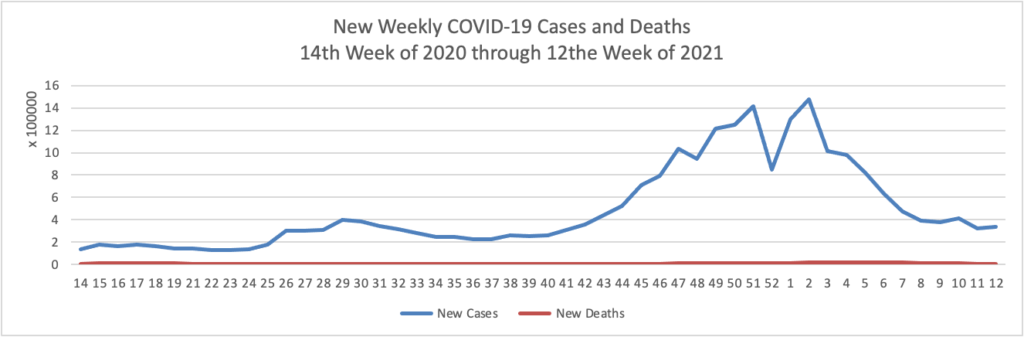
Based on the Centers for Disease Control’s COVID-19 Data Tracker website, here is the FEHBlog’s chart of new weekly COVID-19 cases and deaths over the 14th week of 2020 through 12th week of this year (beginning April 2, 2020, and ending March 24, 2021; using Thursday as the first day of the week in order to facilitate this weekly update):

and here is the CDC’s latest overall weekly hospitalization rate chart for COVID-19:

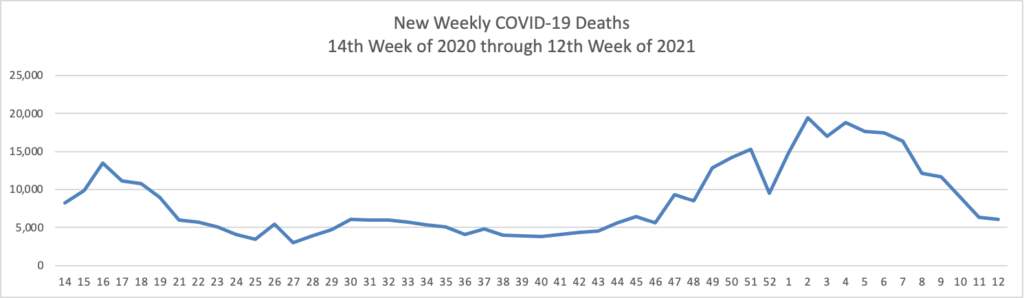
The FEHBlog has noticed that the new cases and deaths chart shows a flat line for new weekly deaths  because new cases greatly exceed new deaths. Accordingly here is a chart of new COVID-19 deaths over the period (April 2, 2020, through March 24, 2021):

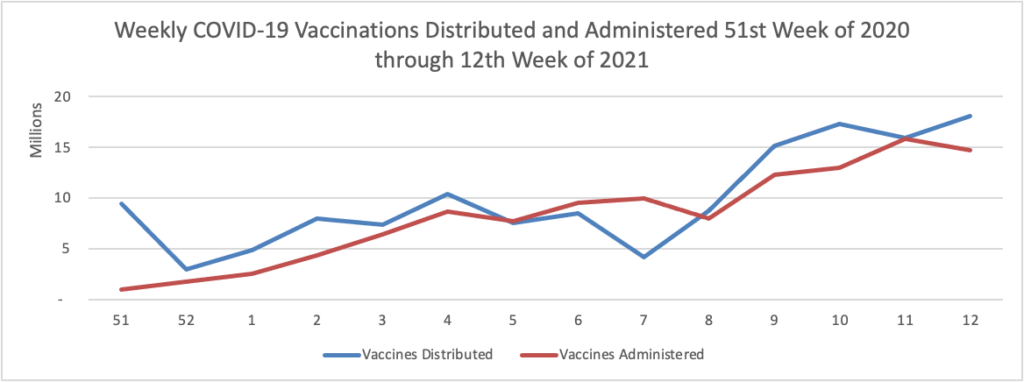
Finally here is a COVID-19 vaccinations chart for the past three months which also uses Thursday as the first day of the week:

The charts continue to look pretty good. As of today 34.6% of the U.S. population over 18 years old has received at least one dose of the COVID-19 vaccine and 46% of the U.S. population over 65 years old is fully vaccinated.

STAT News reports that

Pfizer and BioNTech said Thursday they are beginning a study aimed at showing their Covid-19 vaccine can be used in children as young as 6 months.

The study follows the launch of a separate and ongoing trial in children ages 12 to 15, which was fully enrolled in January. That study could lead to results by the end of the first half of the year, depending on the data, and then to an emergency use authorization. That will depend on the Food and Drug Administration and the Centers for Disease Control and Prevention. The vaccine already has an EUA for people 16 and older.

“The FDA, if it sees fit to do this, could, grant an EUA and get them into children in that age group by the fall, provided the CDC also agrees and that that should be the vaccine they receive,” said William Gruber, Pfizer’s senior vice president of vaccine clinical research and development.

Moderna began a similar study of their vaccine on children from age 6 months to 12 years old on March 16.

STAT News also offers “A user’s guide: How to talk to those hesitant about the Covid-19 vaccine.” Here’s one good idea:

Have a conversation

Don’t lecture your family and friends, and don’t assume you know what their concerns are. Make sure to listen.

“Try to address their concerns, not what you assume are their concerns,” said Jorge Moreno, an internist and assistant professor at the Yale University School of Medicine. While you may be thinking people are ensnared in the darkest of conspiracy theories, many may have concerns that are much simpler to address. For Moreno, who even had to convince his mother the vaccine was safe, many questions he’s received have centered around side effects, and whether they might make people too sick to work. A Carnegie Mellon University survey released this week showed 70% of vaccine-hesitant people were concerned about side effects.

“Let people know it’s OK to have questions and that having concerns is legitimate,” added Reed Tuckson, the former public health commissioner for Washington, D.C., and a founding member of the Black Coalition Against Covid, which co-developed a campaign called “The Conversation” to provide Black families credible vaccine information. “Letting people have a safe space to have this conversation is essential,” he said. “Wagging your finger against someone is not very useful.”

From the tax front:

  • The Internal Revenue Service recently announced that “amounts paid for personal protection equipment, such as masks, hand sanitizer and sanitizing wipes, for the primary purpose of preventing the spread of the Coronavirus Disease 2019 (COVID-19 PPE) are treated as amounts paid for medical care under § 213(d) of the Internal Revenue Code (Code). * * * Group health plans, including health FSAs and HRAs, under the terms of which expenses for COVID-19 PPE may not be reimbursed, may be amended pursuant to this announcement to provide for reimbursements of expenses for COVID-19 PPE incurred for any period beginning on or after January 1, 2020, and such an amendment will not be treated as causing a failure of any reimbursement to be excludable from income under § 105(b) or as causing a § 125 cafeteria plan to fail to meet the requirements of § 125.”
  • What’s more, Spotlight on Benefits explains how the IRS has clarified Pandemic-Related Relief for Dependent Care FSAs.

In healthcare business news, Healthcare Dive explains why being a hospital chief financial officer is a particularly tough job during the pandemic. Also Fierce Healthcare discusses a CIGNA telehealth study finding that

while virtual visits for other types of services declined after the initial COVID-19 spike, virtual visits for behavioral health remained in high demand. In April 2020, virtual visits made up about 50% of claims for non-behavioral health services and declined over the course of the year to account for nearly 25% today.

“Virtual behavioral health care is not only a way to access mental health services in the wake of social distancing, but it also allows us the option to pursue treatment in the privacy and comfort of our own homes,” Lustig said.

By contrast, in April, 66% of office visits for behavioral health were conducted virtually, and it’s remained largely flat since.

Behavioral telehealth users also reported higher productivity at work, according to the survey. These patients reported a 45% decrease in sick days, compared to a 28% decrease in miss workdays among patients who did not use telehealth.

That’s good news for the spoke and hub telehealth companies and for health plans and consumers because the spoke and hub telehealth network therapists are in-network.

Midweek Update

Photo by Manasvita S on Unsplash

Happy St. Patricks Day to all.

Congress in a recent appropriations law sought a report from the National Academy for Public Administration on the Trump Administration’s proposal to break up the Office of Personnel Management. The Federal Times reports that “A better federal workforce policy will require the Office of Personnel Management to become a more independent and authoritative agency, rather than being broken apart into other departments, a long-awaited National Academy for Public Administration study determined March 17. ”

“We strongly recommend that a central personnel agency continue to exist, and that organization is an independent, enterprise-wide human capital agency and a steward of the merit system principles,” said Terry Gerton, president and CEO of NAPA, said at a press briefing on the report. “But that organization, OPM as we know it today, really needs to build its staff capacity, encourage innovation and adopt a more data-driven, accountable and forward-looking capital management approach.”

In other federal agency news, the Federal News Network informs us that

The IRS is moving this year’s April 15 tax filing season deadline back to May 17, citing ongoing challenges from the COVID-19 pandemic. IRS Commissioner Chuck Rettig said in a statement Wednesday that the new deadline would give the public more time to take stock of their finances, while also giving agency employees more time to implement new responsibilities under the American Rescue Plan.

The Department of Health and Human Services announced today that the agency

will invest $10 billion from the American Rescue Plan to ramp up screening testing to help schools reopen, $2.25 billion to scale up testing in underserved populations, and provide new guidance on asymptomatic screening testing in schools, workplaces, and congregate settings. These measures are part of President Biden’s strategy to increase COVID-19 testing nationwide as vaccinations increase.

“COVID-19 testing is critical to saving lives and restoring economic activity,” said HHS Acting Secretary Norris Cochran. “As part of the Biden Administration’s National Strategy, HHS will continue to expand our capacity to get testing to the individuals and the places that need it most, so we can prevent transmission of the virus and defeat the pandemic.”

The U.S. Preventive Services Task Force announced yesterday a proposed B grade recommendation “on screening for prediabetes and type 2 diabetes. The Task Force recommends screening adults between ages 35 to 70 years old who are overweight or obese for prediabetes and diabetes.” The current minimum age for this screening recommendation is 40 years old. NBC News reports that

We know the rates of prediabetes and diabetes are increasing in people who are younger,” said Dr. Chien-Wen Tseng, a task force member and a professor of family medicine at the University of Hawaii’s John A. Burns School of Medicine. “Our main reason for dropping the age is to match the screening with where the problem is: If diabetes and prediabetes are occurring at a younger age, then we should be screening at a younger age.”

The Affordable Care Act requires health plans to cover USPSTF A and B recommended preventive services without member cost sharing when an eligible member receives the service in-network. If the USPSTF finalizes this recommendation later in 2021, then the ACA health plan coverage mandate for this screening would expand to people in the age 35 to 40 age group in 2023. Here is a link to background on the USPSTF’s sixteen members.

In other health industry news —

Healthcare Dive reports that

Amazon is expanding its virtual care pilot program, Amazon Care, to employees and outside companies nationwide beginning this summer in a major evolution of its telehealth initiative, as the COVID-19 pandemic continues to drive unprecedented demand for virtual care.

Amazon will also offer its on-demand primary care service to other Washington state-based companies and plans to expand its in-person service to Washington, D.C., Baltimore and other cities in the following months, the e-commerce behemoth announced Wednesday.

Employee Benefit News offers a Chief Financial Offer’s advice on health savings account funding.

Weekend update

Both Houses of Congress will be engaged in committee work and floor voting this coming week, the last full workweek before Thanksgiving week. CNET provides an update on the likelihood of Congress passing another COVID relief bill during this lame duck session. The most pressing lame duck session legislative action is addressing federal government funding which expires after December 11 absent Congressional action. Currently the last day for House voting in 2020 is December 10.

Following up on Friday’s COVID-19 stats discussion, Govexec.com provides estimates of COVID-19 cases afflicting federal employees and military members.

More than 100,000 federal personnel have now tested positive for COVID-19, nearly triple the total in mid-July. Almost 3% of government workers across the military and civilian agencies have now contracted the virus. About 50,000 civilian workers have tested positive, in addition to more than 62,000 members of the Armed Forces.

Earlier today the Centers for Disease Control reported that just under 10.85 million Americans have contracted COVID-19 this year. The current U.S. population is roughly 331 million people. Consequently, the federal employee COVID-19 contraction rate aligns with the total U.S. rate (3.27%). That’s good news in the FEHBlog’s opinion, considering the fact that a sizable percentage of federal employees and military members have contact with the public as part of their responsibilities.

As we enter the second week of the Federal Benefits Open Season, the FEHBlog deems it appropriate to call attention to this helpful Wall Street Journal article titled “It’s Open-Enrollment Season. Is an HSA Still Right for You?” Helpful tidbit from the article:

Roy Ramthun, a consultant who specializes in high-deductible plans and HSAs, recommends conducting a “worst-case-scenario” analysis. This shows which plan would be most cost-effective in the event an employee spends so much he or she hits the plan’s out-of-pocket spending limit. (After that, the plan becomes responsible for 100% of expenses for the rest of the year.)

Assume Ms. [Employee’s]’s family continues to stick largely with doctors and hospitals that take their insurance on an “in-network” basis. The high-deductible plan could make them responsible for $8,000 in out-of-pocket spending—a number that includes the plan’s $4,000 deductible. Some of the blow would be offset by the $5,500 Ms. [Employee] stands to save in premiums and employer contributions.

In contrast, the annual out-of-pocket maximum with the conventional plan is even higher, at $9,000, providing less protection against high medical bills. As a result, the high-deductible plan is the mathematical winner in this scenario, as well. (Mr. Ramthun recommends repeating this exercise using the two plans’ out-of-network spending limits.)

These numbers by the way are not derived from FEHB plans.

Friday Stats and More

Based on the CDC’s Cases in the U.S. website, here is the FEHBlog’s chart of new weekly COVID-19 cases and deaths over the 20th through 32nd weeks of this year (beginning May 14 and ending August 12; using Thursday as the first day of the week in order to facilitate this weekly update):

and here is the CDC’s latest overall weekly hospitalization rate chart for COVID-19:

Beckers Hospital Review reports that

The U.S. government is working with commercial health insurers to make future COVID-19 vaccines free of charge with no copay, an HHS official told The Wall Street Journal.

Paul Mango, deputy chief of staff for policy at HHS, said government health insurance programs such as Medicare and Medicaid will cover the cost of administering COVID-19 vaccines, and a federal fund created by the CARES Act will provide the shots free for uninsured people.

A collaboration between the federal government and the healthcare industry will handle the distribution of the vaccines, and the government will announce distributor contracts soon, Mr. Mango told the Journal.

Indeed, the Wall Street Journal reports this afternoon that

McKesson Corp., MCK 4.26% one of the world’s largest drug wholesalers and the biggest vaccine middleman in the U.S., will be a main distributor of Covid-19 vaccines nationwide should the shots prove to work safely, federal health officials said. The U.S. Centers for Disease Control and Prevention is exercising an option in an existing 2016 contract with McKesson for the distribution of a vaccine in the event of a pandemic, the U.S. Health and Human Services Department said Friday.

A friend of the FEHBlog shared this link to an interesting Harvard Business Review article from July 24 discussing the following three scenarios in which the COVID-19 emergency may play out.

1.A dream case in which everything goes as well as could reasonably be expected.
2.A catastrophic case in which everything goes badly.
3.A middle case in which some things go well, but others don’t.

It strikes that FEHBlog that we have been in the midst of scenario three since March. The FEHBlog does not think it can get worse, while he thinks that it may get better.

The FEHBlog was pleased to run across these DOL Office of Federal Contractor Compliance Program’s FAQs on its recent final rule exempting TRICARE but not FEHBP providers from its affirmative action rules.

If my company participates in the Federal Employees Health Benefits Program (FEHBP), are we covered under the amended regulations?

OFCCP did not adopt any regulatory changes related to FEHBP providers. OFCCP plans to issue sub-regulatory guidance to address concerns regarding FEHBP providers.

That’s a clearer update than what the FEHBlog noticed in the preamble to the final rule. The TRICARE exemption likely will not be useful to providers unless the FEHBP also is exempted, in the FEHBlog’s opinion.

The Congressional Research Service has updated its helpful report on Health Savings Accounts (HSAs). CRS reports that for tax year 2017 the IRS processed 11 million tax returns showing employer or employee contributions to HSAs.

Thursday Miscellany

In accordance with law, the Internal Revenue Service released today 2021 inflation adjustments to health savings account contribution limits and minimum deductibles for related high deductible health plans as described in Section 223 of the Internal Revenue Code. Only high deductible benefit plan participants may contribute to health savings accounts.

According to Fierce Healthcare, CVS Health today announced a major expansion of their drive up COVID0-19 testing sites.

Starting Friday, the retail and pharmacy giant will open nearly 300 additional test sites across 14 states for a total of nearly 350 available test sites in Arizona, California, Connecticut, Florida, Georgia, Illinois, Indiana, Louisiana, Maryland, Massachusetts, New Jersey, New York, Pennsylvania and Texas.The company said it plans to establish up to 1,000 locations across the country by the end of May with the goal of processing up to 1.5 million tests per month.

Finally, there will be a drive up testing site located in Montgomery County, MD, where the FEHBlog lives.

Healthcare Dive wrote a follow up report on the Commonwealth Fund study mentioned in yesterday’s post.

Telehealth visits that exploded in recent months are starting to plateau and in some cases decline in popularity as doctor’s offices reschedule backlogged patients for more in-person appointments, according new data from The Commonwealth Fund. Telemedicine visits accounted for about 14% of all total visits the week of April 19, according to the report, but that number dropped to 13% the next week and 12% the week after that. Telehealth visits held at 12% for the first two weeks of May.

In this regard, a Health Affairs Blog article discusses how primary care can be rejuvenated in the wake of the COVID-19 emergency. The number one suggestion is

Ending the hegemony of the face-to-face visit and rebalancing the appointment template toward 50 percent distance visits are likely to improve patient access while reducing work and burnout.

Studies are mixed but suggest that e-visits and phone visits reduce the number of face-to-face visits and take less time for clinicians and staff. When the Kaiser Permanente system in Hawaii massively changed its primary care model in 2004—with e-visits and phone visits increasing sixfold and eightfold, respectively—office visits decreased 26.2 percent.

Multiple studies demonstrate that these visits can provide high-quality care for a large number of medical conditions. 

It should be easier for the physician community to redirect patient care in this manner.

Midweek Update

Yesterday, the Internal Revenue Service created in view of the COVID-19 emergency new flexibilities for flexible spending account (FSA) holders, health savings account (“HSA”holders and cafeteria plan members by

  • extending claims periods for taxpayers to apply unused amounts remaining in a health FSA or dependent care assistance program for expenses incurred for those same qualified benefits through December 31, 2020.
  • expanding the ability of taxpayers to make mid-year elections for health coverage, health FSAs, and dependent care assistance programs, allowing them to respond to changes in needs as a result of the COVID-19 pandemic.
  • applying earlier relief for high deductible health plans to cover expenses related to COVID-19, and a temporary exemption for telehealth services retroactively to The notice increases the limit for unused health FSA carryover amounts from $500, to a maximum of $550, as adjusted annually for inflation.January 1, 2020.

The IRS also increased “the limit for unused health FSA carryover amounts from $500, to a maximum of $550, as adjusted annually for inflation.”

The Board of Directors of America’s Health Insurance Plans issued a statement on “Safely Re-Opening America’s Health Care System and Resuming Needed Procedures and Treatments, Routine Care, and Preventive Services” in the wake of the COVID-19 emergency. The statement encourages continued use of telehealth and sensible applic ation / waivers of health plan prior authorization requirements.

HHS’s Agency for Healthcare Research and Quality has created its own COVID-19 resources webpage. Among other things the site “provides links to research funding opportunities, AHRQ Views blog posts about the Agency’s COVID-19 activities, and examples of new AHRQ-funded research findings.”

Benefits Pro reports that “A Social Security policy analyst for the advocacy group The Senior Citizens League is estimating the cost-of-living adjustment for 2021 will be zero based on consumer price index data through April and the continued impact of COVID-19 on the economy.” A zero COLA, which occurred in 2009, 2010, and 2015, will trigger the protection of Medicare Part B premium hold harmless clause for certain but not all federal annuitants.

Midweek update

Healthcare Dive reports that health plans, health care providers, and the Chamber of Commerce have sent Congress a joint health care wish list for the fourth COVID-19 relief bill.

Becker’s Hospital Review provides an updated list of state by state peak dates for COVID-19 hospital resources from IMHE. According to the chart virtually all of the State have hit their peak by today.

Health Payer Intelligence discusses Oscar Health’s population health oriented approach to connecting with its plan members during the COVID-19 emergency. On a related note, Fierce Healthcare summarizes the steps that the country’s tech giants, Apple, Amazon, and Alphabet/Google, have taken in response to the COVID-19 emergency.

Employee Benefit News provides useful COVID-19 emergency tips for sponsors and holders of health savings accounts.

MedCity News reports good news on the cancer detection front:

A test designed for early detection of cancers from a blood sample was able to more than double the number of cancers picked up through screening, including seven cancers that currently do not have any standard-of-care screening methods, according to a new study.

The study, sponsored by Cambridge, Massachusetts-based Thrive Earlier Detection and carried out by Johns Hopkins University and Geisinger Health, was presented Tuesday at the American Association for Cancer Research’s [virtual] annual meeting.

Bravo.