The Pause plus Tuesday Tidbits

The Pause plus Tuesday Tidbits

Photo by Patrick Fore on Unsplash

Here is a link to the joint Food and Drug Administration / Centers for Disease Control statement on the recommended pause in administration of the Johnson and Johnson single dose COVID-19 vaccine that the agencies issued this morning. Becker’s Hospital Review reports that pharmacies and State governments administering the vaccine have implemented this recommendation.

Next steps —

CDC will convene a meeting of the Advisory Committee on Immunization Practices (ACIP) on Wednesday to further review these cases and assess their potential significance. FDA will review that analysis as it also investigates these [six] cases. Until that process is complete, we are recommending a pause in the use of this vaccine out of an abundance of caution. This is important, in part, to ensure that the health care provider community is aware of the potential for these adverse events and can plan for proper recognition and management due to the unique treatment required with this type of blood clot.

STAT News adds

Experts applauded the decision as the right thing to do.

“The pause is a prudent step to take, because when very serious adverse events occur that are also very rare, what matters most is ‘very serious,’” said John Moore, an immunologist at Weill Cornell Medicine. “Not only are individual members of the public at some risk, but so is the wider confidence in the Covid-19 vaccines.”

“It’s a reasonable but unproven assumption that the J&J and AstraZeneca vaccine safety concerns are linked by being related to an immune response against an adenovirus component,” he said. “So, FDA and scientists need time to better understand what is going on, which means a pause is the right course of action.”

And now for the tidbits

  • Modern Healthcare reports that the House today joined the Senate in delaying otherwise required 2% cuts in Medicare payments for the remainder of 2021. The means that CMS will be giving the Medicare Administrative Contracts its approval to resume paying Medicare claims once the President signs the bill into law.
  • Healthcare Dive reports that “Salt Lake City-based Intermountain [which sponsors an FEHB HMO] is acquiring air ambulance company Classic Air Medical in a bid to better coordinate virtual and physical care for rural patients. Snapping up Classic, which operates aircraft in eight western states and has a significant overlap with Intermountain’s telehealth footprint, is meant to make it easier to transport high-need patients to the closest medical facility equipped for their needs, the nonprofit system said in a Monday statement.”
  • The Department of Health and Human Services “have published several new resources to help states, vaccination providers, and others leading COVID-19 response activities improve access to vaccines for people with disabilities and older adults. These resources clarify legal requirements, illustrate some of the barriers to vaccine access faced by people with disabilities and older people, and provide strategies – and examples of how the aging and disability network can help employ them – to ensure accessibility.”
  • FedSmith explains “the Difference Between Postponed and Deferred FERS Retirement While postponed and deferred retirement sound similar, there are big differences for FERS federal employees who retire early with these options.” You only receive lifetime FEHB coverage in retirement with a postponed FERS retirement.
  • The trade association of prescription drug manufacturers Phrma has launched a new public relations campaign about its patient centered agenda while the Campaign for Sustainable Rx Prices “launched [its own] campaign Tuesday encouraging policymakers to act on campaign promises to hold Big Pharma accountable and lower prescription drug prices.” And so it goes.

Monday Roundup

Photo by Sven Read on Unsplash

Bloomberg reports that

The Covid-19 variant that’s become the dominant strain in the U.S isn’t as deadly as earlier research indicated, although it’s confirmed to be faster-spreading than other versions, according to a study.

Among 339 patients with the coronavirus, 36% of those infected with the B.1.1.7 strain that arose in the U.K. became severely ill or died, according to research published Monday in the Lancet Infectious Diseases journal, compared with 38% of those who had non-B.1.1.7 infections.

“We’re not saying it’s nothing, but it’s not worse in terms of outcome in our study, in our setting,” said Eleni Nastouli, a co-author of the study and an associate professor at University College London. She noted that the study differed from some earlier research, looking at patients in hospitals, rather than in the community, and making precise identifications of variants with whole-genome sequencing.

Earlier data released by a U.K. advisory group and cited by the U.S. Centers for Disease Control and Prevention indicated that B.1.1.7 might be as much as a third more deadly than other variants of the virus. 

FLASH: Bloomberg reports Tuesday morning that

U.S. health officials recommended a pause in the use of Johnson & Johnson’s Covid-19 vaccine on concerns about rare and severe blood clotting side effects. A type of brain blood clot called cerebral venous sinus thrombosis was seen in combination with low levels of blood platelets in six women between the ages of 18 and 48, the U.S. Centers for Disease Control and Prevention and Food and Drug Administration said Tuesday in a joint statement. As of April 12, more than 6.8 million doses of the vaccine have been administered, the agencies said.

If you had to pause one of the vaccines this would be the week to pause the Johnson & Johnson vaccine due to the manufacturing / distribution problems. Fingers crossed for a short pause.

The Department of Health and Human Services today

marked Black Maternal Health Week by announcing actions to expand access to continuous health care coverage and access to preventative care in rural areas to improve maternal health outcomes. HHS Secretary Xavier Becerra announced that Illinois is the first state to provide continuity of full Medicaid benefit coverage for mothers by offering extended eligibility for a woman during the entire first year after delivery. A new data brief shows that more than half of pregnant women in Medicaid experienced a coverage gap in the first 6 months post-partum and disruptions in Medicaid coverage often lead to periods of uninsurance, delayed care, and less preventive care. The American Rescue Plan provides an easier pathway for states to extend Medicaid postpartum coverage from 60 days to 12 months.

Secretary Becerra also announced a Notice of Funding Opportunity (NOFO) that will make $12 million available over four years for the Rural Maternity and Obstetrics Management Strategies (RMOMS) program that will allow awardees to test models to address unmet needs for their target population. For the first time, applicants are required to focus on populations that have historically suffered from poorer health outcomes, health disparities, and other inequities.

For more information on the fourth Black Maternal Health Week, check out the Black Mamas Matter Alliance’s website.

From the prescription drug front —

  • Cigna’s Evernorth unit, which includes the Express Scripts PBM, has released its 2020 Drug Trends report. The report’s by the numbers webpage is quite illuminating.
  • STAT News informs us that

Patrizia Cavazzoni has been named the permanent leader of the Food and Drug Administration’s Center for Drug Evaluation and Research, the agency’s acting commissioner, Janet Woodcock, announced Monday morning. The position of CDER director is one of the most influential at the sprawling agency. Cavazzoni, who is in her late 50s, was handpicked by Woodcock to join the agency in 2018 and has been leading the drug center in an acting role since last spring. Cavazzoni is known as a problem-solver who has taken on some of the FDA’s most pressing problems, former top FDA officials told STAT last year.

From the healthcare technology front —

Healthcare Dive lets us know that

Microsoft is acquiring clinical documentation and artificial intelligence company Nuance Communications for $19.7 billion, two years after first inking an R&D partnership with the speech-to-text market leader. The Redmond, Washington-based tech giant said Monday it has entered into a definitive agreement to acquire Nuance for $56 a share — a hefty price tag, representing a 23% premium on the closing price on Friday. Nuance develops conversational artificial intelligence and cloud-based ambient clinical intelligence for doctor’s offices and hospitals.

Jingle bells to Nuance Communications. Healthcare AI is obviously a big deal.

  • Becker’s Hospital Review reports that “Google is in the early stages of a new project that aims to explore and develop a new consumer-facing health records tool for Android users, according to an April 9 STAT report. * * * The project could support the development of a medical records tool similar to Apple’s Health Records app, according to the report.”

Finally here’s an interesting smoking cessation twist from Healio:

A parental smoking intervention was effective and “inexpensive” to implement in pediatric primary care practices, with costs per quit that were comparable to other interventions, according to researchers. * * * “The impetus for screening parents for tobacco use in the pediatric setting is to protect children from exposure to secondhand smoke,” Douglas E. Levy, PhD, MPH, associate professor of medicine at Harvard Medical School and associate investigator at the Mongan Institute Health Policy Center at Massachusetts General Hospital, told Healio Primary Care. “Parents may be more receptive to smoking cessation messages when the recommendation comes from pediatric health care providers because the benefits are framed in terms of protecting their child’s health.”

Weekend update

Congress returns to committee work and floor voting this week. On Wednesday, the Senate Homeland Security and Governmental Affairs Committee will hold a business meeting concerning the nomination of Jason S. Miller, of Maryland, to be Deputy Director for Management, Office of Management and Budget. On Thursday, the Senate Finance Committee with hold a confirmation hearing for Andrea J. Palm, of Wisconsin, to be Deputy Secretary, and Chiquita Brooks-LaSure, of Virginia, to be Administrator of the Centers for Medicare and Medicaid Service, both of the Department of Health and Human Services.

On the COVID-19 front —

  • The Center for Disease Control announced that 4.6 million COVID-19 vaccinations were administered on April 10. As of Saturday, 46% of the U.S. population over age 18 has received at least one dose of the COVID-19 vaccine and 28% of that population are fully vaccination. 78.5% of the U.S. population over age 65 have received at least one dose and 61% of that population are fully vaccinated. A Bloomberg columnist adds that

Consider one of the most at-risk populations, people over 65. As of March, they accounted for most Covid-19 deaths — about 430,000, compared with just 104,000 for people under 65. Now, though, about 55% of older folks are vaccinated, and 75% have received at least one dose — which suggests that about 65% are probably protected from death by Covid. So if the past year of cases were replayed, the U.S. would see 65% — or 280,000 — fewer deaths among the elderly, and the total death count would be cut by more than half.

New cases will probably be even less deadly. For one, the vaccination campaign has targeted the most vulnerable among the elderly — people in nursing homes and other group living arrangements — so the distribution of those who get sick will also be skewed younger and healthier now. Also, younger people — and particularly those with underlying health conditions — have been taking up the vaccine more and more. Given these trends, the mortality rate per confirmed case is likely to be a lot less than half of what it used to be.

Bravo.

There’s a late entrant into the COVID-19 vaccine race: The United States Army. And it hopes its own variety of COVID shot can protect against emerging variant strains of coronavirus, a threat which may loom large going forward and is feeding a resurgence of cases in certain regions.

On Tuesday, Army doctors began human clinical trials of the somewhat complicatedly dubbed the spike ferritin nanoparticle (SpFN) COVID vaccine candidate at the Walter Reed Army Institute of Research (WRAIR), which is housed under the Army’s medical research arm. 

Officials said that the technology behind this particular vaccine could be more effective at protecting against new strains of coronavirus, although existing COVID vaccines such as Pfizer/BioNTech’s have demonstrated efficacy against certain newer strains.

Fingers crossed.

What’s wrong with offering more good news? The AP reports that

The number of U.S. suicides fell nearly 6% last year amid the coronavirus pandemic — the largest annual decline in at least four decades, according to preliminary government data. Death certificates are still coming in and the count could rise. But officials expect a substantial decline will endure, despite worries that COVID-19 could lead to more suicides.

The number of suicides dropped by 1% in 2019 so this will be the second year in a row. The FEHBlog hope this drop is attributable to greater acceptance of mental illness, e.g., no more stigmatizing, and the major uptick in virtual mental healthcare stemming from the pandemic. Nevertheless, health plans and healthcare providers should promote the national suicide prevention lifeline. tel:1-800-273-8255.

If you have access to STAT News check out this article by Bryan Vartabedian, MD, about the portrait in the header of this post.

I couldn’t escape the painting’s draw, though I couldn’t put my finger on what I found so compelling about the image this time around.

Then it hit me. It was the intensity of the doctor’s gaze and his posture. What caught me this time was his presence. This doctor was all in.

Presence is the mindfulness that one individual brings to an encounter with another. It’s a defining element of human connection. In medicine, it’s what happens when a clinician’s connection is untrammeled by a screen or other competing inputs. It’s the focus of mind, spirit, and intent around a moment in time that’s about another person and his or her most pressing problem. Presence, be it in a clinic exam room or with a friend over coffee, is a uniquely human gift.

The good doctor suggests that the use of artificial intelligence will enable doctors to return to applying this human gift to patients. Hope springs eternally.

Friday Stats and More

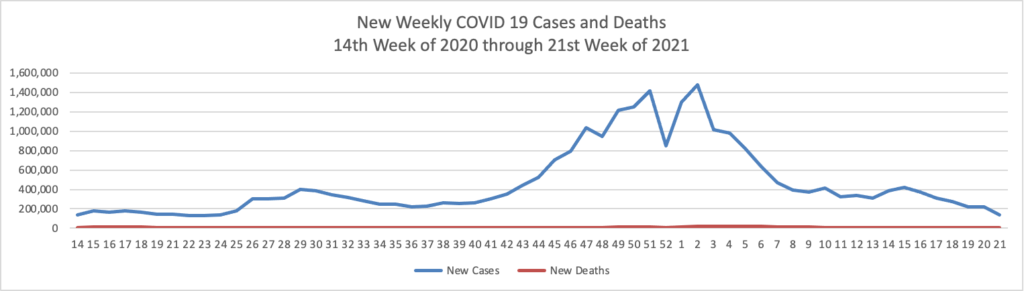
Based on the Centers for Disease Control’s COVID-19 Data Tracker website, here is the FEHBlog’s chart of new weekly COVID-19 cases and deaths over the 14th week of 2020 through 9th week of this year (beginning April 2, 2020, and ending April 7, 2021; using Thursday as the first day of the week in order to facilitate this weekly update):

and here is the CDC’s latest overall weekly hospitalization rate chart for COVID-19:

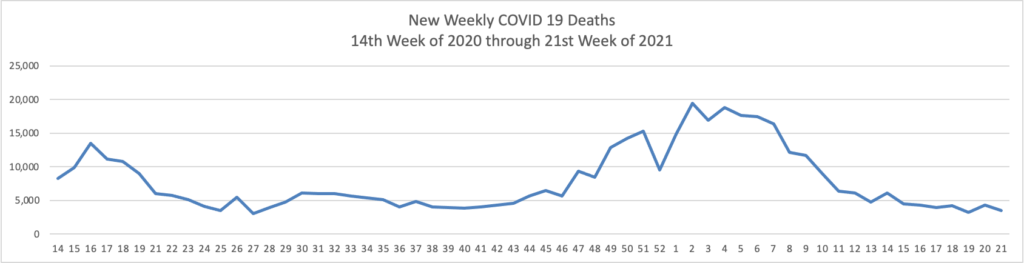
The FEHBlog has noticed that the new cases and deaths chart shows a flat line for new weekly deaths  because new cases greatly exceed new deaths. Accordingly here is a chart of new COVID-19 deaths over the period (April 2, 2020, through April 7, 2021):

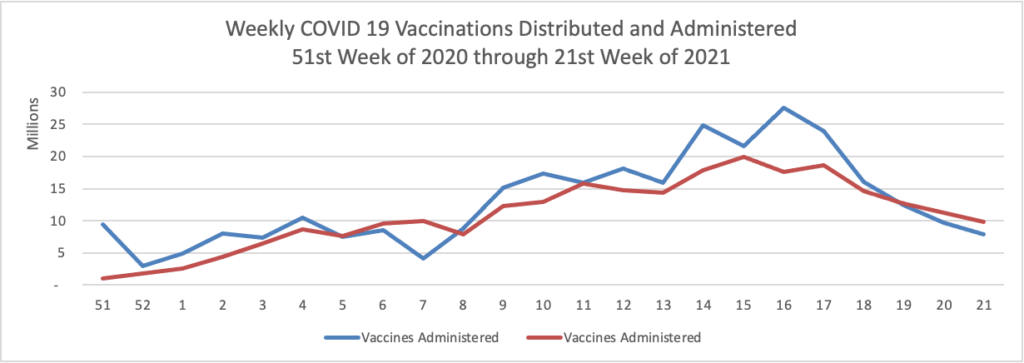
Finally here is a COVID-19 vaccinations chart over the period December 17, 2020, through April 7, 2021 which also uses Thursday as the first day of the week:

That is quite a sharp increase in distributed doses of the COVID-19 vaccine.

Bloomberg reports that

The U.S. recorded 4 million vaccine doses on Friday, returning the pace of inoculations almost to the level before a post holiday lull, according to the Bloomberg Vaccine Tracker. It was the third straight day of increases, with the seven-day average now at 3.03 million doses a day. So far, 179 million doses have been administered. At this pace, it’s estimated to take another 3 months to cover 75% of the population.

Pfizer and BioNTech announced today that they have “requested amendments to the U.S. Emergency Use Authorization (EUA) of the Pfizer-BioNTech [2 dose mRNA] Vaccine (BNT162b2) to expand the use in adolescents 12 to 15 years of age.” That’s a good sign for an in-person teaching in high schools next year.

Bloomberg also reports this evening that

The U.S. Centers for Disease Control is working with health departments in four states to evaluate symptoms experienced after Johnson & Johnson vaccinations but has “not found any reason for concern,” a spokeswoman said in a statement.

“Many people don’t have any side effects after Covid-19 vaccines, but some people will have pain or swelling at the injection site or fever, chills, or a headache,” spokeswoman Kristen Nordlund said. “These typically don’t last long and are signs that your body is building protection.”

She said the states are Colorado, North Carolina, Georgia and Iowa. The symptoms include “dizziness, light headedness, feeling faint, rapid breathing, and sweating.” She said the CDC “is aware of other instances of these symptoms occurring with the other Covid-19 vaccines.”

The Wall Street Journal cautions that “Deliveries of Johnson & Johnson’s JNJ -1.06% Covid-19 vaccine doses throughout the U.S. are expected to plunge by more than 80% next week, according to state officials and federal data, as J&J grapples with manufacturing challenges.”

Whither the emergency use application for the other adenovirus based COVID-19 from AstraZeneca/Oxford University?

Under the and More subheading —

  • Yesterday the CDC Director Rochelle Walensky issued a statement on her “Commitment to Addressing Racism as an Obstacle to Health Equity.” “To build a healthier America for all, we must confront the systems and policies that have resulted in the generational injustice that has given rise to racial and ethnic health inequities. We at CDC want to lead in this effort—both in the work we do on behalf of the nation’s health and the work we do internally as an organization.” Well said.
  • The Biden Administration released an abbreviated version of its Fiscal Year 2022 federal budget today.

The Office of Management and Budget (OMB) today submitted to Congress President Biden’s discretionary funding request for Fiscal Year 2022. As Congress prepares to begin the annual appropriations process, the request lays out the President’s discretionary funding recommendations across a wide range of policy areas and outlines a strategy for reinvesting in the foundations of our country’s resilience and strength. The request — which represents only one element of the Administration’s broader agenda — includes key investments in K-12 education, medical research, housing, civil rights, and other priorities that are vital to our future. Later this spring, the Administration will release the President’s Budget, which will present a unified, comprehensive plan to address the overlapping challenges we face in a fiscally and economically responsible way.

The Wall Street Journal adds that “The preliminary plan released Friday by the White House would raise discretionary spending by 8.4%, or $118 billion, from the $1.4 trillion authorized last year, excluding emergency measures to combat the Covid-19 pandemic. Discretionary spending is the part of the budget that Congress shapes through the appropriations process.”

  • Yesterday, the FEHBlog discussed the Center for Medicare and Medicaid Service’s proposal rule for the Fiscal Year 2022 Medicare prospective payment and quality system for psychiatric hospitals. Becker’s Hospital CFO Report informs us that in addition CMS issued three other pricing rules for rehabilitation hospitals, hospices, and skilled nursing facilities.
  • Finally, Fierce Healthcare reports that

While hospitals post a mixed record on complying with a major price transparency rule [that took effect on January 1, 2021],the Biden administration has not announced how they are going to keep facilities in line.

Several studies and analyses have shown that larger health systems have not done a good job fully complying with the rule to post payer-negotiated rates online. The results come as the Centers for Medicare & Medicaid Services (CMS) has not announced major enforcement actions against hospitals not meeting the controversial rule’s requirements.

“So far with the current administration, we haven’t seen the agency put out any information on the auditing process or changes to the reporting requirements or changes to the penalties for noncompliance,” said Caitlin Sheetz, director and head of analytics for consulting firm ADVI, in an interview with Fierce Healthcare. “Unless that changes, I don’t think we are going to see large shifts in hospital behavior.”

Thursday Miscellany

Photo by Juliane Liebermann on Unsplash

Yesterday, the Office of Personnel Management issued its technical guidance supporting the call letter for 2022 benefit and rate proposals which are due by May 31, 2021. The guidance provides insight into the call letter’s priorities.

The FEHBlog’s priority is supporting the COVID-19 vaccination effort. STAT News reports that

Useful Covid-19 information isn’t reaching the Instagram generation [Z]. There’s almost no messaging specifically tailored to them from federal or state public health officials. There’s hardly anything official on Tik Tok. And even the limited efforts to reach them where they are — like Instagram’s links to its “Covid-19 information center”— aren’t working. * * * Numerous public health officials told STAT that the issue of growing vaccine reluctance among young people can be solved with a coordinated campaign of reliable, useful information that makes it both easy and enticing for young people to get vaccinated, even if they may not personally benefit much. Those same officials acknowledged, however, that much of the groundwork for messaging to young people is yet to be done.

Recognizing a problem is the first step toward solving it.

Govexec.com informs us that

FEMA has sent about 3,000 employees to vaccination sites and is fully running 30 mass vaccination centers. It declined to say how many volunteers it was seeking from other agencies. The emergency response agency is standing up community vaccination centers fully run and staffed by federal employees, providing funding and staffing to state-run sites and deploying mobile vaccination centers.

Thanks Feds.

The Centers for Medicare and Medicaid Services announced yesterday a proposed rule “that would update Medicare payment policies and rates for the Inpatient Psychiatric Facility Prospective Payment System (IPF PPS) for Fiscal Year (FY) 2022 and propose changes to the IPF Quality Reporting (IPFQR) Program. * * * Total estimated payments to IPFs are estimated to increase by 2.3% or $90 million in FY 2022 relative to IPF payments in FY 2021.  For FY 2022, CMS is proposing to update the IPF PPS payment rates by 2.1% based on the proposed IPF market basket update of 2.3%, less a 0.2 percentage point productivity adjustment.”

Fierce Healthcare alerts us that “Drugs for inflammatory autoimmune conditions account for a growing chunk of pharmacy spend, according to new data from Prime Therapeutics. The pharmacy benefit manager studied (PDF) data on its 15 million commercially insured members in 2019 and 2020 and found that fewer than 1% of members had an inflammatory autoimmune condition such as psoriasis, rheumatoid arthritis, ulcerative colitis or Crohn’s disease. However, drugs treating these conditions accounted for nearly 20% of drug spend in the medical and pharmacy benefit, Prime Therapeutics found.” Wow.

Healthcare Dive reports that

  • While urgent care centers do keep some lower-acuity patients from visiting costly emergency departments, their presence is not associated with a drop in total healthcare costs, according to a report in Health Affairs.
  • Using commercial claims and enrollment data from 2008 to 2019, researchers found an increase of 1,000 lower-acuity urgent care visits resulted in 27 fewer lower-acuity ER visits. The entry of a high-volume urgent care center into a ZIP code was associated with a 31% drop in emergency visits.
  • However, while ER trips were far more costly ($1,716 vs. $178), each $1,646 ER visit was offset by $6,327 more in urgent care costs because the number of urgent care visits per enrollee required to reduce one ER visit was 37.

Hmmm.

Health Payer Intelligence discusses a three ways for employers to fund their employee health benefit plans — insured, self-funded and an approach (with which the FEHBlog was not familiar) level funding.

In the level-funded model, the employer pays the insurer each month to cover expected healthcare expenditures, the Society for Human Resource Management (SHRM) website explains. The funds go towards claim payments, stop-loss insurance premiums, and administrative costs.

If this sounds familiar that is because this model borrows from both the fully-insured and self-insured models.

However, the distinction is that in a level-funded health plan, the insurer will return to the employer any funds that remain at the end of the year, if the volume of medical claims is not as high as anticipated. Alternatively, if the volume of medical claims exceeds the projected cost, employers will face a higher stop-loss insurance premium.

Although this is the general template for a level-funded plan, contracts may include various specifications, the SHRM site says. For example, some insurers may require that their company retain a certain percentage of the savings or that these funds roll over to be spent on medical claims in the subsequent year.

In this model, insurers—specifically larger insurers—may have cemented their level-funded plan offerings or they may work with employers to tailor the funding plan to fit the business’s needs.

Level-funded plans cater to smaller firms that want a self-insured health plan but may not be able to afford the high cost of medical claims and stop-loss insurance.

You do learn something new everyday.

Midweek Update

Photo by Manasvita S on Unsplash

Bloomberg reports today that

The B.1.1.7 variant of the coronavirus, first found in the U.K., has overtaken the initial form of the virus in the U.S. and is now the country’s most common strain, the head of the Centers for Disease Control and Prevention said Wednesday. CDC Director Rochelle Walensky said at a briefing that the version had overtaken other mutations that have emerged, as well as the initial version of the virus in the U.S.

The Centers for Disease control has identified the B.1.1.7 variant as a “variant of concern” which means

A variant for which there is evidence of an increase in transmissibility, more severe disease (increased hospitalizations or deaths), significant reduction in neutralization by antibodies generated during previous infection or vaccination, reduced effectiveness of treatments or vaccines, or diagnostic detection failures.

Here is the CDC’s breakdown on the B.1.1.7. variant:

Name
(Pango lineage)
Spike Protein SubstitutionsName
(Nextstraina)
First DetectedBEI Reference IsolatebKnown Attributes
B.1.1.7Δ69/70
Δ144Y
(E484K*)
(S494P*)
N501Y
A570D
D614G
P681H
20I/501Y.V1United KingdomNR-54000external icon~50% increased transmission 5

Likely increased severity based on hospitalizations and case fatality rates 6
Minimal impact on neutralization by EUA monoclonal antibody therapeutics 7, 14
Minimal impact on neutralization by convalescent and post-vaccination sera 8,9,10,11,12,13,19

WebMD adds that “Of the three “variants of concern” recognized by the World Health Organization and the CDC, studies have shown that the mRNA vaccines created by Pfizer/BioNTech and Moderna, as well as the Novavax vaccine, remain highly effective against the B.1.1.7 variant, which was first recognized in the United Kingdom. * * * Johnson & Johnson, Moderna, and Pfizer are all exploring options to make their vaccines more effective against the variants [of concern].”

The Wall Street Journal offers a helpful tip — “Pharmacies and health officials are making a plea to Americans who received their Covid-19 vaccines: Cancel the other shots you booked.” That is sensible advice.

The Department of Health and Human Service reports today that “more than half a million consumers have already signed up for health insurance through HealthCare.gov as a result of the Biden Administration’s Special Enrollment Period (SEP) for the COVID-19 Public Health Emergency. * * * Today’s report from the Centers for Medicare & Medicaid Services (CMS), which covers plan selections from February 15 to March 31, also shows gains in enrollment among historically uninsured communities, including Black consumers and Americans near the poverty level. Of applicants who identified a race, 17% identified as Black – compared to about 11% in both 2020 and 2019 during the same time period. Among consumers requesting financial assistance, 41% report being at or slightly above the federal poverty level, compared to 38% in 2020 and 33% in 2019.” The SEP continues until August 15, 2021. Will / can HHS make the open enrollment permanent?

In other heathcare / healthcare business news:

  • Healthcare Dive reports “UnitedHealth Group has named longtime executive Brian Thompson as the new chief executive officer of its health benefits business, UnitedHealthcare, the biggest private payer in the U.S.”
  • The CDC discusses the “Surprising Link Between Chronic Kidney Disease, Diabetes, and Heart Disease.”

Risk factors for each condition are similar and include high blood sugar, high blood pressure, family history, obesity, unhealthy diet, and physical inactivity.

High blood sugar can slowly damage the kidneys, and, over time, they can stop filtering blood as well as they should, leading to CKD. Approximately 1 in 3 adults with diabetes has CKD.

When the kidneys don’t work well, more stress is put on the heart. When someone has CKD, their heart needs to pump harder to get blood to the kidneys. This can lead to heart disease, the leading cause of death in the United States. Change in blood pressure is also a CKD complication that can lead to heart disease. Luckily, preventing or managing one condition can help you prevent and manage the others and lower the risk for more complications [as explained in the article].

  • The Labor Department today issued FAQs and model forms to help ERISA governed plans implement the free COBRA continuation coverage available from April 1 through September 30, 2021, for COBRA-eligible folks who lost their ERISA coverage due to an involuntary termination or reduction in hours. This offer does not extend to FEHB enrollees who are covered under a different continuation of coverage program colloquially known as TCC>
  • Fedweek offers Reg Jone’s column on benefits available on the death of a current federal employee. These are very valuable rights that protect the employee’s family.

Tuesday’s Tidbits

Photo by Patrick Fore on Unsplash

Bloomberg reports that “President Joe Biden said [today] he wants all American adults eligible for a coronavirus vaccine by April 19, two weeks earlier than his previous goal. All but two states are already set to meet that goal, with Oregon and Hawaii having planned to open up vaccines to all non-minors on May 1.”

Yesterday, the Centers for Disease Control (“CDC”) released a report finding that “The principal mode by which people are infected with SARS-CoV-2 (the virus that causes COVID-19) is through exposure to respiratory droplets carrying infectious virus. It is possible for people to be infected through contact with contaminated surfaces or objects (fomites), but the risk is generally considered to be low.” As this BBC News article illustrates, last Spring we were quite worried about contracting COVID-19 from contaminated surfaces. In any event, thank heavens that we have the vaccines.

Federal News Network reports that front line federal employee access to the COVID-19 vaccine depends upon their employing agency.

If you are a federal employee working in the field, like Food and Drug Administration inspectors, Forest Service rangers or Custom and Border Protection officers, getting a COVID-19 vaccine from your agency isn’t a sure thing.

The Department of Homeland Security is making an all-out effort to vaccinate all 300,000 employees.

Other agencies like the Agriculture Department or the IRS are asking employees to take a path through their state and local governments.

This inconsistent application of agency support for “frontline” workers to receive one of the three inoculations has the potential to create a have and have nots among agencies.

Hopefully as the COVID-19 vaccine supply continues to expand and access restrictions are removed, these unfortunate quirks in the process will be ironed out quickly.

In other healthcare related tidbits

  • On April 12, the CDC will be sponsoring its decennial meeting on healthcare associated infections.
  • The Food and Drug Administration released a COVID-19 update today. The FEHBlog wonders when the FDA will take up granting full marketing approval for the Pfizer and Moderna vaccines and when AstraZeneca will file an emergency use authorization with the FDA for its COVID-19 vaccine. Those steps take us closer to ironing out the process quirks.
  • MedPage Today reports that

A personalized, hands-on care strategy for patients struggling with addiction was effective at reducing hospital readmission, a randomized trial found. In a comparison of hospitalized adults with substance use disorder involving opioids, cocaine, or alcohol, those who received Navigation Services to Avoid Rehospitalization (NavSTAR) care saw far better outcomes than those who simply received treatment as usual, according to Jan Gryczynski, PhD, of the Friends Research Institute in Baltimore, and colleagues.

  • Health Payer Intelligence informs us that

A digital therapeutic weight loss program led to major medical cost savings, according to a Rally Health Inc. study that points to wellness programs as cost-effective strategies to tackle the obesity epidemic. The study published in Obesity examined program data over a three-year period to analyze medical cost trends for those participating in Rally Health’s Real Appeal weight loss intervention program.

Researchers compared medical costs for a group of participants in the digital therapeutic wellness program with costs for a control group of non-participants. The control group was selected to match the intervention group in terms of health risk, baseline medical costs, age, gender, geographic region, and chronic conditions.

The study found that the wellness programming resulted in significant weight loss. There was an average weight loss of 3 percent for 4,790 program participants who attended at least one session over a 52-week period. In addition to providing positive member outcomes, the wellness program lowered medical expenditures significantly. Costs for the intervention cohort were 12 percent less than costs for the control group. What’s more, the savings of the wellness program cohort were 2.3 times more than program costs, marking significant return on investment.

  • Adam Fein reports in his Drug Channels blog that

The drug channel is consolidating, both vertically and horizontally. For evidence, look no further than Drug Channels Institute’s estimates of pharmacy benefit manager (PBM) market share, which are shown in the chart below. For 2020, DCI estimates that the three biggest PBMs [CVS Health (including Caremark and Aetna), the Express Scripts business of Cigna, and the OptumRx business of UnitedHealth Group] accounted for more than three-quarters of total equivalent prescription claims. * * * This concentration helps plan sponsors and payers, which can maximize their negotiating leverage by combining their prescription volumes within a small number of PBMs. 

Monday Roundup

Photo by Sven Read on Unsplash

The Wall Street Journal offers an interesting story about how many patients with long or long haul COVID-19 (about 10% of total case) wind up receiving cognitive rehabilitation.

Cognitive problems are some of the most persistent and common long-term symptoms that people struggle with months after getting Covid. Patients report short-term memory problems, slow processing speeds, poor word recall and difficulty multitasking. To help them, doctors at medical centers including Mayo Clinic, Yale and Johns Hopkins are starting to refer some patients to cognitive rehabilitation more typically used for patients with concussions and other traumatic brain injuries. 

AHIP presents an interview with Kim Lauersdorf, Vice President of Marketing at EmblemHealth, about crafting communications about vaccinations, including the COVID-19 vaccines.

What should health care organizations take away from the study, what are some next steps to help drive vaccine adoption and acceptance?

Lauersdorf: As health care professionals, we need to accept responsibility when communicating to our base and know that if we are not intentional of the language we use, the voices we amplify, and the methodologies we use to get our messages out, we will perpetuate greater health disparity.

First, it’s clear that terminology matters. The widely used term “shot”, for example, evokes significant negative connotations across all populations, but specifically in low-income, younger, and Black communities. Clinically, it evokes needles, injection, and pain. Non-clinically, it evokes violence. Continued usage of the term will drive continued disparity in vaccine adoption.

Second, we must amplify trusted voices. People, across the board, trust their primary care providers above all other messengers. To take this even further, people have more trust in primary care providers who look like them or come from their same communities.

In addition, word of mouth—especially from trusted sources—is as important today as it ever was. Even more so, as we are each dealing with a worldwide crisis, coupled with a large scale, new, possible way out of it. We have to understand that this is all new territory that this generation has never experienced before. That too fosters hesitation.

Third, we must use multiple channels to get our messages out. While there has been an increase in digital health adoption, as seen through rising telehealth usage, we have to know that many of our communities still don’t have reliable Internet access or access to certain technology. We have to get our message to all of those we serve to ensure vaccine adoption doesn’t perpetuate existing health disparities.

The American Hospital Association reports on five takeaways from a maternal / mental healthcare conference. Here’s one of them:

Technology alone will not be enough.

The COVID-19 pandemic has proven how crucial technology is for health care delivery. Telehealth improves access to OB/GYNs, doulas, lactation consultants and specialists. Remote patient monitoring, chat and text-based navigation services, and apps have provided additional ways to support and coordinate care. 

Yet, speakers acknowledged technology alone will not be enough. Melissa Hanna, founder and CEO of Mahmee, which delivers data-driven care coordination and personalized support to new moms, shared “technology will not be the end all be all solution” to our challenges in maternal health. She also shared, “this is always going to be about care, and it’s plenty of people working together to center the experiences of mothers, and be there in a proactive way to guide, support and advocate.” 

We have seen firsthand that a combined approach of offering health care services through technology and human connection can drive better outcomes for mothers. Mayo Clinic developed the OB Nest program to optimize prenatal care for low-risk expectant mothers. The program uses a combination of in-person and telehealth prenatal visits, home monitoring, and a social media community that allows patients to share their experiences with other mothers. It also has dedicated nurses that help with patient education and serve as a resource for mothers throughout the program. This combination has provided pregnant moms with more autonomy in their prenatal care. 
 

In other benefit news

  • Fierce Healthcare reports that Verizon has jumped into the telehealth market with an offering directed at providers of care.

Many hospitals and health clinics have adopted video conferencing services during the pandemic for providing patient care. BlueJeans Telehealth, which launched Monday, was designed from the ground up for healthcare organizations to simplify the virtual experience and offer greater access to care, Verizon executives said in a press release.

  • Employee Benefit News informs us that

Benefitfocus, a cloud-based software solutions provider for healthcare and benefits administration, published a report on the current state of employee benefits. The research provides insight into employee enrollment behavior for the last four years, and takes a closer look at how 2020 impacted employee benefits.

The EBN article offers an interview with Benefitfocus’s director of consumer advocacy.

Finally former NTEU President Robert Tobias presents in Govexec.com his thoughts on the National Academy of Public Administration’s recent report on the future of OPM.

Weekend update

Photo by Michele Orallo on Unsplash

Happy Easter!

Congress remains on State/district work breaks for the coming week.

As of the beginning of this week, according the CDC’s website, 75.4% of the U.S population over age 65 and 40.2% of the U.S. population over age 18 has received at least one dose of the COVID-19 vaccine. 54.5% of the over age 65 population and 23.2% of the over 18 age population have been fully vaccinated.

That’s progress. Here are a couple of interesting angles on the vaccine distribution process:

  • The Wall Street Journal reports that “Johnson & Johnson’s Covid-19 vaccine has found a niche among organizations that work with the homeless, who say the one-dose shot is better-suited for a population that can be difficult to reach twice.”

[H]ealthcare workers say they have been surprised to find many homeless people specifically requesting the J&J vaccine, which is branded as Janssen, a unit of J&J. Some of them point out that the shot was still effective even though it was tested after Covid-19 variants entered the mix. Others say they are worried about getting a vaccine once, let alone twice, given the potential side effects.

“If you’re in a shelter, or don’t have a home, those side effects are different than if you can stay at home,” said Bobby Watts, chief executive of the National Health Care for the Homeless Council, which supports hundreds of providers that cater to the homeless.

  • Health Payer Intelligence informs us that “To ensure COVID-19 vaccine access for homebound individuals, the Commonwealth of Massachusetts has partnered with the Commonwealth Care Alliance (CCA), a health plan that says it has proven best practices for vaccinating this population.” “The Commonwealth defines a “homebound” individual as anyone who needs assistance from two or more people to leave home. In Massachusetts, there are about 20,000 individuals who meet this definition.”

As one of the first healthcare organizations in the country to vaccinate homebound individuals, CCA has also been part of the national discussion around strategies to ensure COVID-19 vaccine access for this population. Last month, CCA joined AHIP in briefing the White House, promoting the prioritization of homebound individuals in COVID-19 vaccine delivery efforts and underlining CCA’s best practices in this endeavor.

Speaking of AHIP, the organization on Friday announced

AHIP’s new SEP landing page also features other important resources to help guide consumers through the SEP, including fast facts, an educational blog, a link to a Get Covered Connector tool offered by Young Invincibles, and a link to a Health Insurance Marketplace Calculator provided by the Kaiser Family Foundation.

“Health insurance coverage is an important way to protect your health and financial stability, especially during the COVID-19 pandemic,” said Matt Eyles, president and CEO of AHIP.  “Health insurance available through the individual marketplaces cover products and services such as COVID-19 care and vaccines, mental health care and support, $0 copay preventive care, regular doctor visits and prescription medications to keep you healthy, and much more.”

In other COVID-19 news, Kaiser Health News provides details on over-the-counter COVID-19 testing kits.

Even with vaccines, epidemiologists say, rapid tests are desperately needed because more testing, along with mask-wearing and physical distancing, will get people back in offices and classrooms and help catch cases that go undetected. * * *

[M]any experts support the widespread distribution of cheap, rapid tests, even if they aren’t as sensitive as lab-run alternatives, and see a demand. In Germany, the supermarket chain Aldi began selling rapid tests in early March, roughly $30 for a five-pack, and sold out within hours. One recent study found that if a pack of tests was mailed to every household in the U.S. — even assuming that up to 75% would go into the garbage — they would save thousands of lives and avert millions of infections. “Don’t let perfect be the enemy of good,” said study co-author and Yale University professor A. David Paltiel. “This doesn’t have to work perfectly to make a huge difference.”

The Federal News Network shares opinions that it obtained from former OPM officials on the recent National Academy of Public Administration report on the agency.

Janice Lachance, the Clinton-era OPM director, sees the budget as a good starting point for the Biden administration and the new director. The president nominated Kiran Ahuja, a former chief of staff for the agency, for the role.

“The new director has a tremendous opportunity to go in there, do a very effective assessment of the situation and make a reasonable request that covers all of the things that need to be done — and that we want to do,” said Lachance, who currently serves as an executive vice president for the American Geophysical Union. “The NAPA report is very aspirational. What is it going to take to get OPM from where it is today to this desired state that’s articulated in the NAPA report over how many years?”

The new director, Lachance added, will need to make the case why an empowered OPM will help resolve the federal government’s talent problems.

Friday Stats and More

Based on the Centers for Disease Control’s COVID-19 Data Tracker website, here is the FEHBlog’s chart of new weekly COVID-19 cases and deaths over the 14th week of 2020 through 13th week of this year (beginning April 2, 2020, and ending March 31, 2021; using Thursday as the first day of the week in order to facilitate this weekly update):

and here is the CDC’s latest overall weekly hospitalization rate chart for COVID-19:

The FEHBlog has noticed that the new cases and deaths chart shows a flat line for new weekly deaths  because new cases greatly exceed new deaths. Accordingly here is a chart of new COVID-19 deaths over the one year period (April 2, 2020 through March 31, 2021):

Finally here is a COVID-19 vaccinations chart over the period December 17, 2020, through March 31, 2021, which also uses Thursday as the first day of the week:

Bloomberg reported this afternoon that

More than 101 million people in the U.S. have received a first dose of a Covid-19 vaccine, or about 31% of the population.

Less than four months into the U.S. vaccination effort, coverage is best in people 65 years or older, with 74% of the group getting at least one dose and 54% completing vaccination, according to figures published by the Centers for Disease Control and Prevention and compiled by the Bloomberg Vaccine Tracker.

On Friday, the U.S. set a one-day record for vaccine doses reported administered, adding almost 4 million. On average, the U.S. is administering close to 3 million shots a day as of Friday’s update, also a record.

In other COVID-19 vaccination news

  • Fierce Pharm reports that Johnson & Johnson which offers a one dose vaccine has joined the two dose vaccine manufacturers Pfizer and Moderna in its vaccine on adolescents aged 12-17.
  • The Society for Human Resource Management informs us that

The following measures may increase vaccine acceptance in the workforce, according to the CDC:

1. Train interested staff to become COVID-19 vaccination ambassadors who will speak confidently and honestly, relaying personal stories about the vaccine to fellow co-workers and addressing any of their concerns.

2. Employ all available communication tools when promoting the COVID-19 vaccine to staff, including social media, internal communication channels, and posters or signs around the workplace.

3. Hold a virtual town hall where leadership, respected local medical experts and staff share their COVID-19 vaccine experiences and other vaccine facts and answer audience questions. Use experts to communicate to staff when talking about the COVID-19 vaccine. Ensure the experts present facts about the vaccine, including the risks.

4. Consider giving employees paid time off to get the vaccine and offering paid sick leave for employees who have adverse reactions.

5. Have workplace leadership take the COVID-19 vaccine, capture their experience using video or photo, and share the experience with staff.

  • In this regard, Govexec.com reports that

Next week, the Health and Human Services Department plans to open a vaccination site for federal employees in the National Capital Region.

A source familiar with the plans told Government Executive on Friday that the site will be in Gaithersburg, Maryland. “The site will provide COVID vaccinations to federal, essential, critical infrastructure workers,” said the source. Federal agencies will determine eligibility based on “job duties and [the Cybersecurity and Infrastructure Security Agency’s] guidance on the essential, critical infrastructure workforce,” which includes 24 agencies.  

The source was unsure at the moment on how many vaccine doses will be available or how many employees will be able to receive them. Employees will be notified starting Friday, April 2, the source said.

In health benefits news —

  • The Labor Department’s Employee Benefits Security Administration released ACA FAQ 45 today. FAQ 45 provides compliance guidance on Section 203 of Division BB of the Consolidated Appropriates Act 2021. Section 203 requires health plans, including FEHB plans, to prepare and keep current written analyses demonstrating compliance with the non-quantitative treatment limitations requirements of the federal mental health parity law and implementing regulations.
  • Fierce Healthcare explains how Optumcare successfully expanded the use of at home colon cancer screenings during the pandemic.

OptumCare used data analytics to flag the patients at risk for colon cancer and then reached out to them about the home test kits. While the kits included an information letter to describe the process, the clinical team also followed up four times by phone to check in with them.

If the testing results were positive or abnormal, the patient’s physician or care team would reach out directly to explain what the results meant and schedule them for future appointments to ensure care was coordinated throughout the process.

Frank said OptumCare saw a 5% higher return rate under the expanded program than in previous years, and the increased engagement drove interest in expanding other home health options such as home testing for blood glucose among diabetic patients.

  • Fierce Healthcare also informs us that

The American Medical Association innovation subsidiary Health2047 has spun off a company that uses personalized medicine to fight obesity. Phenomix Sciences is a phenotype testing company that carries out the AMA’s mission to confront chronic diseases such as obesity.

Phenomix uses a blood test called MyPhenome that it has licensed from the Mayo Clinic to allow doctors to prescribe individualized therapies. MyPhenome measures DNA as well as a person’s metabolites and hormones. These biomarkers make up a person’s phenotype, according to Phenomix.

The company’s blood-based test uses phenotype-driven multi-omics technology to predict responses to obesity interventions that the Food and Drug Administration (FDA) has approved. A multi-omics test is important because testing for obesity involves multiple factors, including genetics, metabolomics and environmental aspects, according to Phenomix CEO Mark Bagnall.

Because patients respond differently to obesity treatment, the Phenomix founders turned to AI to personalize this treatment. AI can personalize a multi-omics obesity test and analyze single-nucleotide polymorphisms, metabolites and hormones that correspond with a certain obesity phenotype, according to Bagnall.

AI can help identify a specific obesity phenotype so patients can receive the right treatment.

“[We] demonstrated in several clinical studies that knowing a patient’s phenotype doubles the likelihood of weight loss and doubles the amount of weight lost,” Bagnall said.