Midweek Update

Midweek Update

Photo by Piron Guillaume on Unsplash

The Hill reports that “New coronavirus cases in the U.S. have fallen to pre-Thanksgiving levels, the head of the Centers for Disease Control and Prevention (CDC) said Wednesday, and infection rates are continuing to decline. ‘We now appear to be in a consistent downward trajectory’ for both cases and hospital admissions, CDC Director Rochelle Walensky told reporters during a White House COVID-19 briefing.” * * * Walensky cautioned Americans not to let their guard down, especially as variants that likely have increased transmissibility continue to multiply.”

Roll Call informs us that “The Senate broke out of limbo Wednesday, adopting a power-sharing resolution that allows for committees to organize and Democrats to take the [committee] gavels after a month of tenuous and divided control. Majority Leader Charles E. Schumer brought the resolution to the floor Wednesday evening and it was adopted by unanimous consent.”

From the fourth quarter 2020 earnings front, Healthcare Dive lets us know that

  • An uptick in COVID-19 testing and treatment led Humana to report a loss for the fourth quarter of 2020 of $2.07 per share and a pre-tax loss of $458 million, a large swing from a pre-tax income of $593 million during the prior-year period. Analysts had expected an adjusted loss of $2.37 per share, but Humana slightly beat expectations with an adjusted loss of $2.30 per share. The payer said the increase in COVID-19 care experienced during the last two months of the quarter was coupled with a decline in non-COVID-19 utilization after largely returning to normal levels. The decline was about 15% below the normal baseline, executives said during Wednesday’s call with investors. Still, Humana remained in the black for the full year of 2020. It posted pre-tax income of $4.6 billion for the full year, a 33% increase compared with 2019.

and

  • HCA Healthcare beat Wall Street expectations on both earnings and revenue in the fourth quarter of 2020, as high-acuity patients and cost controls made up for a slow recovery in volume during the strongest surge in COVID-19 patients to date. [From HCA’s website: HCA Healthcare is comprised of more than 180 hospitals and 2,000+ sites of care in 21 states and the United Kingdom.] Revenue of $14.3 billion was up almost 6% year over year, while net income of $1.4 billion was up 33% year over year for the for-profit system, according to financial results released Tuesday. HCA released full-year guidance for 2021, and expects to bring in revenue between $53.5 billion and $55.5 billion this year, and adjusted earnings per share of $12.10 to $13.10. HCA stock was up slightly in early morning trading following the release.

In healthcare news

  • The Government Accountability Office recently released a report on public impact of rural hospital closings.

Rural hospitals provide essential health care to rural communities. Yet, over 100 rural hospitals closed from January 2013-February 2020. When rural hospitals closed, people living in areas that received health care from them had to travel farther to get the same health care services—about 20 miles farther for common services like inpatient care. People had to travel even farther—about 40 miles—for less common services like alcohol or drug abuse treatment. Before rural hospitals closed, counties where these hospitals were located had fewer doctors than counties without any closures. The number of doctors further decreased when hospitals closed.

Heal, a company that offers both telemedicine and doctor house calls, has expanded its service to Illinois, Louisiana, North Carolina and South Carolina. In addition to large cities such as Chicago, Heal is targeting rural or low-income areas such as Lafayette, Louisiana, noted Nick Desai, co-founder and CEO of Heal.

“When you look at specific areas where we are expanding, for example, Lafayette, Louisiana, many of these patients do not have other options when it comes to quality healthcare,” Desai told Fierce Healthcare. “That’s why we want to bring Heal to areas like this, ultimately elevating quality of care for patients that might be struggling to pinpoint the right solutions.”

  • The Healthcare Transformation Taskforce calls our attention to the Maternal Health Hub website which The Commonwealth Fund supports and the Task Force manages. Check it out.


Tuesday Tidbits

Photo by Patrick Fore on Unsplash

President Biden announced that his Administration is increasing the weekly COVID-19 vaccine supply released to States, etc., and starting on February 11 to supply partner pharmacies with vaccine to administer the vaccine to customers.

The Society for Human Resource Management brings us to date on OSHA efforts to implement one of the President’s executive orders by issuing “worker safety guidance for coronavirus protection programs on Jan. 29, requiring greater input from employees and enhanced mask protections.”

The Hill provides us with the latest on efforts to pass a sixth COVID-19 relief bill in Congress. Govexec reports that a bicameral, bipartisan push is underway inn Congress to repeal the Postal Service’s unique obligation to refund its employees FEHB coverage in retirement.

In other interesting healthcare news

  • Becker’s Payer Issues reports that “Cigna will no longer require prior authorization for some CT scans of the heart, according to an updated precertification list. The change is effective Feb. 1. * * * In addition, Cigna removed prior authorization for fractional flow reserve-computed tomography. For coverage under the policy, patients must have stable chest pain and an intermediate risk of coronary artery disease. “The favorable policy update shows that Cigna recognizes the use of CTA and FFR-CT as a front-line test which can lead to improved patient outcomes,” Dustin Thomas, MD, chair of the society’s advocacy committee, said in a news release.”
  • Access Management Intelligence informs us that “Ascent Health Services (Ascent Health) is a pharmaceutical group purchasing organization that is part of Evernorth, a subsidiary of Cigna Corporation. Humana has agreed to join Ascent Health in a move that the health insurer says will help drive down its drug costs for its [1.3 million] commercial members. Beginning April 1, Humana will join Ascent Health to give it access to greater discounts from drug makers. Ascent Health manages commercial rebates, the payments that drug makers make to health plans. The agreement covers drug contracting and negotiations for Humana’s commercial business.

Monday Roundup

Photo by Sven Read on Unsplash

Good news on the COVID-19 front —

Bloomberg’s headline story this evening is that

More Americans have received at least one dose of a Covid-19 vaccine than have tested positive for the virus, an early but hopeful milestone in the race to end the pandemic.

As of Monday afternoon, 26.5 million Americans had received one or both doses of the current vaccines, according to data gathered by the Bloomberg Vaccine Tracker. Since the first U.S. patient tested positive outside of Seattle a year ago, 26.2 million people in the country have tested positive for the disease, and 441,000 have died, according to data from Johns Hopkins University.

The U.S. has been administering shots at a faster daily rate than any country in the world, giving about 1.35 million doses a day, according to data gathered by Bloomberg. While the rollout stumbled in its early days, in the six weeks since the first shots went into arms almost 7.8% of Americans have gotten one or more doses, and 1.8% are fully vaccinated.

“It’s worth noting that today, for the first time, the data said that more people were vaccinated than were reported as newly diagnosed cases,” said Paula Cannon, a professor of microbiology at the University of Southern California’s Keck School of Medicine. “That’s worth celebrating. I’m all for that win.

A New York Times columnist earlier today explained

Right now, public discussion of the vaccines is full of warnings about their limitations: They’re not 100 percent effective. Even vaccinated people may be able to spread the virus. And people shouldn’t change their behavior once they get their shots.

These warnings have a basis in truth, just as it’s true that masks are imperfect. But the sum total of the warnings is misleading, as I heard from multiple doctors and epidemiologists last week.

“It’s driving me a little bit crazy,” Dr. Ashish Jha, dean of the Brown School of Public Health, told me.

“We’re underselling the vaccine,” Dr. Aaron Richterman, an infectious-disease specialist at the University of Pennsylvania, said.

“It’s going to save your life — that’s where the emphasis has to be right now,” Dr. Peter Hotez of the Baylor College of Medicine said.

The Moderna and Pfizer vaccines are “essentially 100 percent effective against serious disease,” Dr. Paul Offit, the director of the Vaccine Education Center at Children’s Hospital of Philadelphia, said. “It’s ridiculously encouraging.”

Let’s go.

On the COVID-19 testing front, the Wall Street Journal reports that

The Biden administration said it has reached a $230 million deal with Australian diagnostics company Ellume USA LLC to produce at-home, over-the-counter Covid-19 tests. 

The Food and Drug Administration previously authorized the test. So far, the FDA has cleared three Covid-19 tests that can be processed entirely at home, but Ellume’s is the only one that doesn’t require a prescription. None are widely available at this point. 

The company is expected to produce 19 million tests a month by the end of the year, Andy Slavitt, senior adviser to the White House Covid-19 response team, said Monday. Based on the agreement, 8.5 million tests will be guaranteed to the U.S. government. 

Smart move.

In other news —

  • Roll Call brings us up to date on the COVID-19 relief bill developments on Capitol Hill.
  • Katie Keith helpfully updates us on Affordable Care Act litigation in the Health Affairs blog.
  • Dispatch Health and Humana announced ” an [interesting] agreement to provide Humana members with access to an advanced level of care in the home – to help enhance patients’ experience and health outcomes. These services will be available in Denver, Colo., and Tacoma, Wash., with expansion to additional markets in Texas, Arizona and Nevada planned for later this year. The agreement will provide members living with multiple chronic conditions – such as cellulitis, kidney and urinary tract infections, chronic obstructive pulmonary disease, heart failure and many others – an opportunity to be treated safely at home and thereby avoid hospital visits. Last November, the U.S. Centers for Medicare & Medicaid Services announced a waiver program to allow qualified health care providers to offer acute, hospital-level care in the home. The Dispatch-Humana agreement is believed to be the country’s first program to provide hospital-level care involving a national payer.

In pharmacy C-suite news —

  • Healthcare Dive reports that “Karen Lynch has officially stepped into the CEO role at CVS Health [on February 1, 2021]. Lynch previously served as president of the Aetna business, and was a key figure in directing CVS Health’s COVID-19 response.”
  • AP reported last week that “Walgreens has tapped Starbucks executive Roz Brewer as its new CEO, which will make her the only Black woman leading a Fortune 500 company. Starbucks announced Tuesday January 26 that Brewer was departing after a little more than three years as its chief operating officer. Walgreens later confirmed that Brewer will take over as its CEO on March 15.

Good luck.

Weekend Update

Photo by Clarisse Meyer on Unsplash

Congress continues it floor and committee work this coming week. Committees are in engaged in organizational meetings on both sides of Congress. Senate Committees principally will be engaged in holding hearings on Presidential cabinet nomination.

The House Oversight and Reform Committee, whose jurisdiction includes the FEHBP, holds its organizational meeting tomorrow at 2 pm. The Chair will continue to be Rep. Carolyn Maloney (D NY) and the Ranking Member will be Rep. James Comer (R KY). The party ratio will be 25 Democrats and 20 Republicans.

Meanwhile, Bloomberg reports that

Joe Biden’s presidency began at a choreographed sprint, with a series of executive actions to erase Donald Trump’s legacy and reset the nation’s course. But as his first full week in office came to a close, the new president was discovering the limits of his power.

His administration’s efforts to bolster vaccine production ran into the same hurdles that plagued the Trump administration — bottlenecks both at factories and in clinics — and Biden’s advisers had to clean up after the president said any American would be able to get inoculated by the spring. * * *

[FEHBlog note — Per the CDC’s Vaccinations site, on average 1.3 million doses of COVID-19 vaccine were administered on Friday and Saturday.]

He’s meanwhile encountering familiar roadblocks in Congress, where just four of his cabinet nominees have been confirmed 12 days into his presidency, and he’s found no traction among congressional Republicans for another big stimulus bill. * * *

Ten GOP senators wrote to Biden on Sunday with an alternative proposal for a slimmed-down stimulus bill. The White House says it will review the offer. A smaller plan that passed with bipartisan support would leave Democrats free to pursue more contentious elements using a partisan budget tool.

The Wall Street Journal adds

The offer is the first Republicans have forwarded since Mr. Biden proposed the $1.9 trillion plan, which Republicans have said is too costly and includes unneeded initiatives, and tests whether the Biden administration and Democrats in Congress will seek compromise or try to pass the relief package themselves. Democratic leaders have said they plan to begin a legislative process that would bypass the need for Republican support this week, with the first step coming as soon as Monday.

FEHBlog Public Service Announcement: The Centers for Disease Control on Saturday implemented one of the President’s executive orders by requiring

the wearing of masks by all travelers into, within, or out of the United States, e.g., on airplanes, ships, ferries, trains, subways, buses, taxis, and ride-shares. The mask requirement also applies to travelers in U.S. transportation hubs such as airports and seaports; train, bus, and subway stations; and any other areas that provide transportation.  Transportation operators must require all persons onboard to wear masks when boarding, disembarking, and for the duration of travel. Operators of transportation hubs must require all persons to wear a mask when entering or on the premises of a transportation hub.

This order will be effective on February 2, 2021. For more information on the Order or to view frequently asked questions, visit: https://www.cdc.gov/quarantine/masks/mask-travel-guidance.html

Monday Roundup

Photo by Sven Read on Unsplash

The FEHBlog ran across this Health and Human Services letter to U.S. Governors thanks to the American Hospital Association’s daily email. It states in pertinent part

We are writing to you today to share more details regarding the public health emergency (PHE) for COVID-19, as declared by the Secretary of Health and Human Services (HHS) under section 319 of the Public Health Service Act (42 U.S.C. §247d). The current public health emergency was renewed effective January 21, 2021, and will be in effect for 90 days. To assure you of our commitment to the ongoing response, we have determined that the PHE will likely remain in place for the entirety of 2021, and when a decision is made to terminate the declaration or let it expire, HHS will provide states with 60 days’ notice prior to termination.

All right then.

FCW reports that President Biden “announced a raft of senior officials to help lead the Office of Personnel Management on Jan. 25. The positions are for appointments that don’t require Senate confirmation.” Consequently the lengthy list does not include the OPM Director and Deputy Director nominees. The acting Director remains Chief Management Officer Kathleen McGettigan.

The Washington Post reports that 50-50 Senate Minority Leader Mitch McConnell is ready to approve the “clean” power sharing agreement offered by Senate Majority Leader Chuck Schumer. Why? Two Democratic Senators strongly voiced opposition to repealing the legislative filibuster.

On the COVID-19 vaccination front

  • President Biden answering press questions yesterday (more detail at the link and the FEHBlog points this out because for what it’s worth it’s his sense too.)

Q   [Josh from Bloomberg] Well, my question was at what date — or, roughly, when do you think anyone who wants [a COVID-19 vaccination] would be able to get it?  Summer? 

THE PRESIDENT:  Oh, I — no, I think it’ll be this spring.  I think we’ll be able to do that this spring.  And — but it’s going to be a logistical challenge that exceeds anything we’ve ever tried in this country, but I think we can do that.

I feel confident that, by summer, we’re going to be well on our way to heading toward herd immunity and increasing the access for people who aren’t on the first — aren’t on the list, all the way going down to children and how we deal with that.  But I feel good about where we’re going, and I think we can get it done. 

  • Govexec.com reports on efforts by the Department of Veterans Affairs and the Postal Service to arrange for vaccinating their essential workforce members.
  • Stat News informs us that “Moderna is studying adding booster doses to its vaccine regimen after finding its Covid-19 vaccine was less potent against a coronavirus variant that was first identified in South Africa, the company said Monday. * * * Nevertheless, [b]oth the Moderna vaccine and the immunization from Pfizer-BioNTech produce such powerful levels of immune protection — generating higher levels of antibodies on average than people who recover from a Covid-19 infection have — that they should be able to withstand some drop in their potency without really losing their ability to guard people from getting sick.”
  • NPR News discloses that “Merck is halting development of its two COVID-19 vaccine candidates, saying that while the drugs seemed to be safe, they didn’t generate enough of an immune response to effectively protect people against the coronavirus. * * * While Merck is shelving both of its vaccine candidates, the company says it will keep working on two therapeutic drugs, including one that aims to protect the body’s respiratory system from the coronavirus’s ravaging effects. Last month, the company signed a deal with the U.S. government agreeing to supply up to 100,000 doses of one of those drugs for about $356 million.

In other healthcare news —

  • Fierce Healthcare reports that Consulting firm ADVI Health reviewed the websites for 20 (PDF) of the largest hospitals in terms of bed size and found that the largest hospitals all posted some type of pricing information online [in response to a federal transparency rule that took effect on January 1, 2021]. But many of the hospitals did not provide healthcare common procedural codes for the services, according to the analysis, which did not list the hospitals. “Many institutions didn’t use the codes, which makes it difficult to make comparisons across facilities,” said Caitlin Sheetz, lead author of the analysis and head of analytics for ADVI.”
  • Fierce Healthcare updates us on that Blue Cross’s new high performance network. “BCBSA said 45 companies have signed on to offer the Blue HPN plan to employees, reaching 55 markets and 340,000 potential members. The plan is the only HPN available in the 10 largest U.S. cities, BCBSA said. Jennifer Atkins, vice president of global network solutions at BCBSA, told Fierce Healthcare that even in its early days, Blue HPN has found success in lowering costs for employers. The HPN plan saved 11% in the total cost of care compared to a traditional PPO, she said.”
  • Fierce Healthcare also informs us that non-profit “Civica Rx announced a plan to build a major manufacturing facility to produce sterile injectable drugs for hospitals, a major step for the organization comprised of health systems such as Mayo and Intermountain. The $124.5 million project is planned for Petersburg, Virginia — just south of Richmond — and is expected to potentially create more than 180 jobs. The 120,000-square-foot manufacturing facility aims to address a major source of shortages for hospitals. Sterile injectable drugs have been a major source of shortages in recent years due in part to fewer companies making the products, according to the Food and Drug Administration.”

Weekend update

Photo by JOSHUA COLEMAN on Unsplash

Both Houses of Congress are engaged in committee and floor business this coming week. The Senate is focused on confirming the President’s cabinet nominations.

Politico reports

As Senate Majority Leader Chuck Schumer and Senate Minority Leader Mitch McConnell negotiate a power sharing agreement for a 50-50 Senate, committee assignments are still up in the air. That means that Republicans like [Sen. Ron] Johnson [R Wisc] are, for now, holding hearings and markups for President Joe Biden’s Cabinet nominees, even though Democrats are in charge of the Senate floor. 

Johnson, who will eventually hand over the top GOP slot to Sen. Rob Portman (R-Ohio), said that his committee will hold a meeting next week on Biden’s pick to lead the Department of Homeland Security, Alejandro Mayorkas. Mayorkas is facing resistance from Republicans and could be stuck in committee if he doesn’t receive enough GOP support.

The Hill reports that President Biden has released a topical daily schedule for the coming week which is full of new Executive Orders. January 28 will be Healthcare Day:

Biden on Thursday will take the highly anticipated action among pro-choice advocates of rescinding the so-called Mexico City policy, which bans the use of U.S. funding for foreign organizations that provide or promote abortions.

The policy, described as a “global gag rule” by reproductive health advocates, was first instated by then-President Reagan, and has been repeatedly rescinded by Democratic presidents and reinstated by Republican presidents in the years since.

Biden will also order a review of the Trump administration’s controversial changes to the Title X family planning program, which required family planning providers participating in the program to stop providing or promoting abortions to remain eligible for funding. 

The president is also slated to sign an executive order aimed at strengthening Medicaid and initiating an open enrollment period under the Affordable Care Act.

Fierce Healthcare reports that “Micky Tripathi, Ph.D., a recognized name in the health tech world, has been tapped as the new national coordinator for health IT under President Joe Biden’s administration. * * * Tripathi will replace the outgoing Don Rucker, M.D., who held the position since April 2017. The Office of the National Coordinator for Health Information Technology (ONC) provides counsel for the development and implementation of a national health information technology framework. * * * An expert on interoperability, privacy, and technology standards, Tripathi most recently served as chief strategy officer at Arcadia Analytics, a population health management solutions company. 

On the COVID-19 vaccination front:

  • The Wall Street Journal offers a very informative article with advice from doctors about what to expect when you have an appointment to receive the COVID-19 vaccine. This is understandably of the Journal’s top five articles.
  • America’s Health Insurance Plans has created a robust website about the COVID-19 vaccines.
  • According to the CDC’s Vaccinations data website, over 4.3 million doses of COVID-19 vaccines were administered in the U.S. on Friday and Saturday.

On the reports front —

Happy Martin Luther King, Jr. Day

The FEHBlog hopes that everyone is having an enjoyable, contemplative holiday.

Both Houses of Congress are back at legislative grindstone this week. Here is a link to the brief Committee schedule. CNN reports

The top two Senate leaders are nearing a power-sharing agreement to hash out how the evenly divided chamber will operate, with Democrats in charge of setting the schedule but both parties likely to hold an equal number of seats on Senate committees, according to sources familiar with the talks.

The negotiations between Democratic Leader Chuck Schumer and Republican Leader Mitch McConnell have been built largely around how the Senate operated the last time the body was split 50-50: When George W. Bush initially became president in 2001. Final details are still being sorted out between the two leaders, sources said.

Similar to those rules, set in January 2001, Schumer and McConnell aides are discussing allowing bills and nominations to advance to the Senate floor even if they are tied during committee votes, something that could become common given that each party is expected to have the same number of seats on committees. Democrats will hold the chairmanships of the committees, giving them power to set the agenda, and Schumer will be granted the title of majority leader since Vice President-elect Kamala Harris will cast tiebreaking votes on the floor.

The Senate ultimately must approve these rules.

The FEHBlog noticed today that on January 13, 2021, the President signed into law the bill (H.R. 1418), now Pub. Law No. 116-327, that exposes health and dental insurers to federal antitrust liability.

On the COVID-19 front, NBC News discusses the new COVID-19 mutations that have cropped up in our country.

Dr. Dan Jones, vice chair of the division of molecular pathology at Ohio State University Wexner Medical Center, told NBC News that vaccination is key to both stop the spread of variants, as well as reduce the odds of new variants emerging.

“The larger your pool of [susceptible] patients, the more possibility for a mutation to survive and emerge,” he said. “It has to pass from person to person, so if you’re not getting a lot of infection in the population [because of vaccination], then even an important mutation may just peter out, because the person who was infected doesn’t transmit the virus to anyone else.”

Even “having an optimally fit, pathogenic change in the virus doesn’t do any good if it keeps meeting a wall of vaccinated people,” Jones added.

Well put, Dr. Jones.

Saturday Stats and More

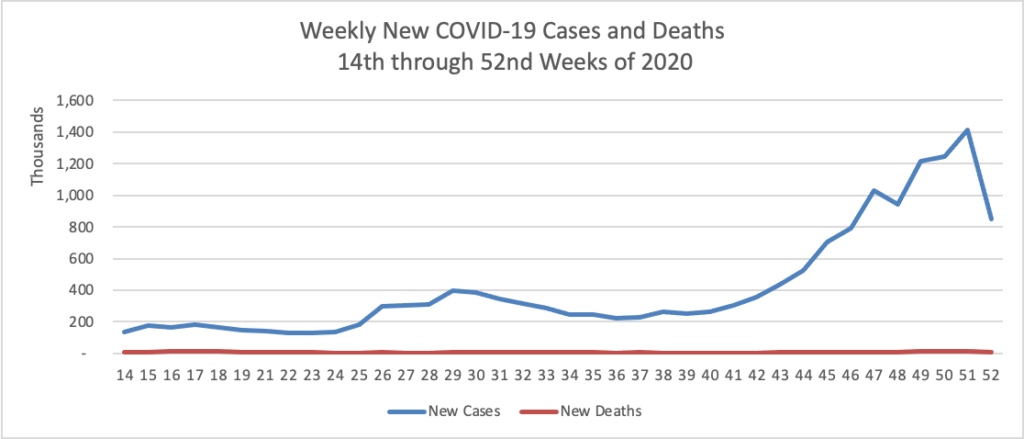
Based on the CDC’s Cases in the U.S. website, here is the FEHBlog’s chart of new weekly COVID-19 cases and deaths over the 14th through 52nd weeks of this year (beginning April 2 and ending December 30; using Thursday as the first day of the week in order to facilitate this weekly update):

and here is the CDC’s latest overall weekly hospitalization rate chart for COVID-19:

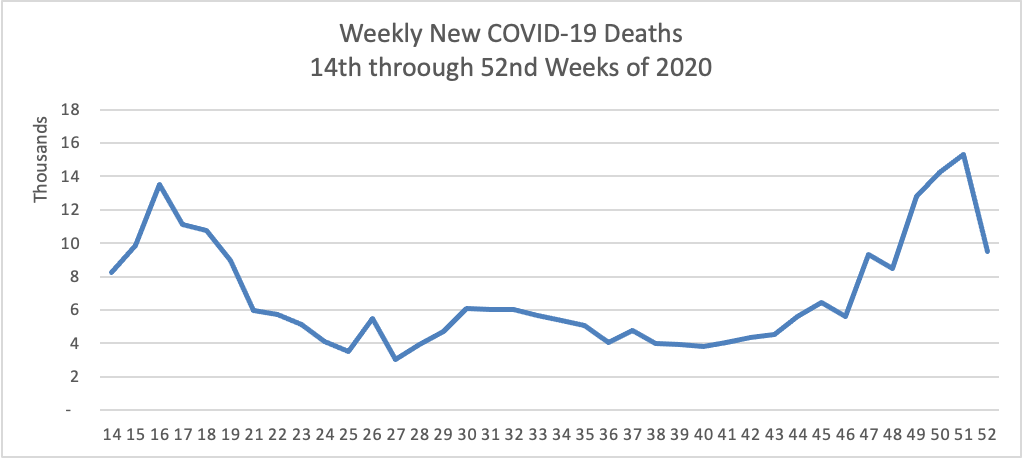
The FEHBlog has noted that the new cases and deaths chart shows a flat line for new weekly deaths  because new cases greatly exceed new deaths. Accordingly here is a chart of new COVID-19 deaths over the period (April 2 through December 30):

The CDC’s COVID-19 Vaccine tracker has not been updated since last Wednesday morning At that time roughly 2.8 million initial doses had been administered. The American Hospital Association and the American Medical Association have posted helpful information about the currently available COVID-19 vaccines. The Food and Drug Administration offers a comprehensive year end report.

The CDC’s FluView continues to report that “Seasonal influenza activity in the United States remains lower than usual for this time of year.”

The FEHBlog took a look at a couple of the hospital chain websites and could not find the price information required by the HHS hospital price transparency rule. However, FEP Blue, the largest FEHB plan, announced the availability of their FEP Cost Advisor Tool.

Today is the last day of the 116th Congress. The Wall Street Journal informs us that among the provisions in the Consolidated Appropriations Act, 2021, is the following

Flexible spending accounts. Many workers with FSAs that allow them to use pretax dollars to pay for unreimbursed health expenses (like glasses) or dependent-care expenses (like summer camp) didn’t use all the money in their 2020 accounts because of the pandemic. The IRS had limited ability to ease FSA rules, but Congress has now done so. 

Participants in such plans can carry over unused funds from 2020 to 2021 and 2021 to 2022, or for up to 12 months for companies with fiscal years. For dependent-care accounts, the law extends the age limit from 12 to 13 for some carried-over funds. For workers to take advantage of these changes, company plans must often opt into the new rules.

OPM typically does adopt such changes for FSAFeds.

Federal News Network reports that yesterday the Senate joined the House of Representatives in overriding the President’s veto of the FY 2021 National Defense Authorization Act. The Senate did not join the House in approving a $2000 direct stipend COVID relief proposal.

Federal News Network also reports that

With hours to spare before the new year, President Donald Trump signed an executive order Thursday night implementing a federal pay raise for civilian employees and military members in 2021. Civilian employees will receive a 1% across-the-board federal pay raise in 2021. There are no additional locality pay adjustments this year.

Midweek update

Photo by Manasvita S on Unsplash

Per the Office of Personnel Management, “The effective date of the Open Season change is the first day of the first full pay period in January. For annuitants this date will always be January 1.” It turns out that Sunday January 3, 2021, is the first day of the first full pay period in January 2021. How convenient.

The Consolidated Appropriations Act, 2021, does include the three standard FEHBP appropriations provisions — a prohibition on applying full Cost Accounting Standards coverage to FEHB contracts (Sec. 611), an abortion coverage restriction (Secs. 613, 614), and a limited contraceptive coverage mandate (Sec. 726) which the Affordable Care Act has overridden. What’s more this new law extends the option of FEHBP and FEGLI coverage to 120 tribal grant schools thereby filling a coverage gap erroneously created by the Affordable Care Act. This option is exercised by the tribal employers who must make the minimum federal civil servant government contribution toward the benefit coverage.

For the past 20 years or so, the FEHBP has offered plan members transitional care protection pursuant to President Clinton’s Bill of Consumer Rights which states in pertinent part as follows:

Consumers who are undergoing a course of treatment for a chronic or disabling condition (or who are in the second or third trimester of a pregnancy) at the time they involuntarily change health plans or at a time when a provider is terminated by a plan for other than cause should be able to continue seeing their current specialty providers for up to 90 days (or through completion of postpartum care) to allow for transition of care.

FEHB plan carriers intending to terminate a network provider for cause generally could comply with this requirement by giving affected members 90 days advance notice of the change.

It turns out that Section 113 Division BB of the Consolidated Appropriations Act, 2021, includes an Affordable Care Act amendment ensuring continuity of care. The requirements of this new law bear similarities to the FEHBP’s transitional care protections. However, as always, the devil is in the details. For example, the new law’s transitional care provisions apply to any provider contract termination, including passive non-renewals, whether triggered by the provider or the payer, with the limited exception of payer termination for fraud or failure to meet applicable quality standards. FEHB plans and OPM have a year to sort out the details before the new requirements take effect on January 1, 2022.

In other news —

The Senate moved forward today on overriding President’s veto of the FY 2021 National Defense Authorization Act but not on the $2000 COVID-19 relief direct stipend per the Wall Street Journal:

Moving through the procedural steps for overriding Mr. Trump’s veto of the National Defense Authorization Act could take up much of the Senate’s time before Sunday. Sen. Bernie Sanders (I., Vt.), in a push for a stand-alone vote on increasing the size of the direct checks, has stopped Mr. McConnell from fast-tracking votes on the NDAA override. As a result, the final vote on the NDAA may not take place until Saturday due to a series of procedural steps.

The Senate took one of those steps late Wednesday, voting 80-12 to move forward with the bill, in another show of broad, bipartisan support for the legislation Mr. Trump vetoed.

Bleeping Computer updated us on how the federal government is addressing the SolarWinds backdoor hack.

The Cybersecurity and Infrastructure Security Agency (CISA) has ordered all US federal agencies to update the SolarWinds Orion platform to the latest version by the end of business hours on December 31, 2020. CISA’s Supplemental Guidance to Emergency Directive 21-01 demands this from all agencies using Orion versions unaffected in the SolarWinds supply chain attack.

Tuesday Tidbits

Photo by Patrick Fore on Unsplash

The U.S. Court of Appeals for the District of Columbia Circuit issued an opinion today affirming a district court holding that the Trump Administration’s hospital price transparency rule is lawful. The rule takes effect on Friday January 1. Needless to say the Court also denied the appellant American Hospital Association’s motion for an emergency stay of the rule.

On a similar note, one of the transparency provisions included in the Consolidated Appropriations Act, 2021, amendments to the Affordable Care Act (Section 114 of Division BB) states:

‘‘A group health plan or a health insurance issuer offering group or individual health insurance coverage shall offer price comparison guidance by telephone and make available on the Internet website of the plan or issuer a price comparison tool that (to the extent practicable) allows an individual enrolled under such plan or coverage, with respect to such plan year, such geographic region, and participating providers with respect to such plan or coverage, to compare the amount of cost-sharing that the individual would be responsible for paying under such plan or coverage with respect to the furnishing of a specific item or service by any such provider.’’’

This new requirement, which applies to FEHB plans, takes effect with the first plan year beginning on or after January 1, 2022. The recently finalized Trump Administration’s payer transparency rule kicks in a year later. We will have to see how the Biden Administration handle this.

As the FEHBlog just picked up a couple of delicious Christmas cookies, it is time to consider the joint HHS and Department of Agriculture Dietary Guidelines for Americans 2020-2025 released today. The announcement described the publication as “the nation’s trusted resource for evidence-based nutrition guidance. The guidelines are designed for use by healthcare professionals and policy makers for outreach to the general public and provide the nutritional foundation for federal nutrition programs. The dietary guidelines should not be considered clinical guidelines for the treatment of disease.” The announcement notes that

Steeped in scientific evidence, the key recommendations look similar to those of the past and address two topics that garnered much attention throughout the development of the guidelines – added sugars and alcoholic beverages. Dietary Guidelines for Americans, 2020-2025 carried forward the committee’s emphasis on limiting these dietary components, but did not include changes to quantitative recommendations, as there was not a preponderance of evidence in the material the committee reviewed to support specific changes, as required by law. As in previous editions, limited intake of these two food components is encouraged. In fact, this sentiment remains prominent throughout the policy document and complements 

For consumers, USDA’s MyPlate translates and packages these principles of dietary guidance for Americans in a way that is handy and accessible. To share these messages broadly, USDA offers the Start Simple with MyPlate campaign and a new MyPlate websiteto help individuals, families, and communities make healthy food choices that are easy, accessible, and affordable, in addition to helping prevent chronic disease. For more information, please visit www.myplate.gov.

Funny, the FEHBlog no longer sees Christmas cookies on his plate.

P.S. The Senate did not vote on the stipend increase or the NDAA veto today per the Wall Street Journal. This session of Congress ends on Saturday.