Midweek Update

Midweek Update

Photo by Manasvita S on Unsplash

The Federal Times, Govexec, and Federal News Network each report on today’s Postal reform legislation hearing before the House Oversight and Reform Committee. The draft proposed legislation, among other things, would create a Postal Service Health Benefits Program (“PSHBP”) within the FEHBP effective January 1, 2023. FEHB plans covering at least 1500 Postal employees and annuitants in 2022 would be eligible to offer coverage in the PSHBP.

Postal employees first becoming eligible for the FEHB in 2023 or later years must enroll in a PSHBP participating plan. If a Postal employee or annuitant is enrolled in 2022 in a FEHB plan that does not join the PSHBP in 2023, that Postal employee or annuitant may continue to participate in the plan outside the PSHBP. However, a Postal employee or annuitant must follow his or her plan into the PSHBP if that plan joins the PSHBP. (Presumably that employee or annuitant could choose another PSHBP participating plan in that event.)

If a Postal employee or annuitant enrolled in a plan outside the PSHBP decides to changes plans he or she can only choose a PSHBP plan. Also once the PSHBP is up and running, a Postal Service employee enrolled in a plan outside the PSHBP would be required to transfer to the PSHBP upon retirement. Federal News Network indicated that NARFE finds this approach allows acceptable freedom of choice to current annuitants.

Future PSHBP annuitants, e.g., Postal employees who retire on or after January 1, 2023) would be required to pick up Medicare Part B with a limited exception for economic hardship. The PSHBP plan would offer a Medicare Part D EGWP prescription drug coverage to their annuitant members, a big benefit savings. The bill also would relieve the Postal Service of the ability to prefund their employees’ coverage in the FEHBP as annuitants.

Per Govexec

Oversight Committee Chairwoman Carolyn Maloney, D-N.Y., made clear her primary focus was on shepherding her reform legislation through Congress and to Biden’s desk. 

“We will not be delayed or deterred from our north star,” Maloney said. “We need to pass meaningful reforms, and hopefully bipartisan reforms, to put the Postal Service on more sustainable and financially firm footing for years to come.”

Speaking of federal retirement (the Postal Service operates under the federal retirement program too), Fedweek offers a helpful Reg Jones column on “the main retirement-related question regarding the Federal Employees Health Benefits (FEHB) program—carrying coverage into retirement.”

On the COVID-19 front

  • Bloomberg reports that “The shot made by Pfizer Inc. and BioNTech SE was overwhelmingly effective against the virus in a[n Israeli] study, prompting experts to say that immunizations can end the pandemic. Johnson & Johnson’s Covid-19 vaccine is safe and effective, U.S. regulators said, a milestone toward giving Americans the first shot to work in a single dose.” The FDA advisory committee with consider the Johnson & Johnson emergency use application for its COVID-19 vaccine on Friday February 26.
  • Fierce Healthcare informs us that “There’s no question outpatient visits plummeted in the earliest days of the pandemic as providers scrambled to move care to virtual settings. But as the year—and the roller coaster of COVID-19 cases nationwide it brought—went on, it turned out outpatient visits overall were down but still relatively stable, a Harvard University analysis published by The Commonwealth Fund found.”

From Capitol Hill, the Wall Street Journal reports that Office of Management and Budget Director nominee Neera “Tanden’s nomination appears to be in peril, after two Senate committees delayed confirmation votes that had been scheduled for Wednesday morning.” Also the House Rules Committee has scheduled a hearing on Friday morning to consider the $1.9 trillion COVID-19 relief bill which is the last step before the bill reaches the House floor.


President nominates an OPM Director

OPM Headquarters a/k/a the Theodore Roosevelt Building

The Federal Times, Govexec, and Federal News Network all report on today’s announcement that the President is nominating Kiran Ahuja to be OPM Director. Ms. Ahuja led the President’s transition review team lead for the agency. “Ahuja has over 20 years of public service and philanthropy experience. She’s currently the CEO of Philanthropy Northwest, and she spent several years as a career civil rights attorney at the Justice Department.” Her nomination is subject to Senate confirmation. In due course, the President also is expected to nominate an OPM Deputy Director and an OPM Inspector General.

Healthcare Dive reports on the first confirmation hearing for the President’s nominee for Secretary of Health and Human Services, Xavier Becerra. Mr. Becerra “told senators on the health committee Tuesday morning he would continue work he did as California attorney general to combat anticompetitive practices in healthcare and go after providers that ‘unfairly jack up prices on patients.'” According to the report, Mr. “Becerra will be back in the hot seat Wednesday for his second confirmation hearing, this one in front of the Senate Finance Committee. That will be the committee voting on whether to send his nomination to the full Senate for a vote.”

Tomorrow, the Senate Homeland Security and Governmental Affairs Committee at 10 am and the Senate Budget Committee at noon each will hold a business meeting on whether to advance to the Senate floor the President’s nomination of Neera Tanden to be Director of the Office of Management and Budget.

Tomorrow at 10 AM, the House Oversight and Reform Committee will hold a hearing on “Legislative Proposals to Put the Postal Service on Sustainable Financial Footing.” The Committee Staff explains in a memorandum,

the Committee will hold a hybrid hearing to review legislative proposals to place the Postal Service on a more sustainable financial footing. The Committee will consider a discussion draft that includes several provisions to relieve the financial burdens under which the Postal Service is currently operating and to enhance transparency regarding performance. That draft is being circulated with this memo. The discussion draft includes provisions on Medicare integration [for Postal annuitants participating along with Postal employees in a separate program within the FEHB] , repealing a requirement for the Postal Service to pre-fund retiree health care, and service performance standards.”

Earlier today, the Oversight and Investigations Subcommittee of the House Energy and Commerce Committee held a hearing on the availability of COVID-19 vaccinations. The hearing featured testimony from executives at the companies manufacturing those vaccines. Fierce Healthcare reports that “Pfizer, Moderna and Johnson & Johnson execs say [at the hearing] they’re working all the angles on increasing COVID-19 vaccine production and expect to amp up weekly deliveries by tens of millions by the end of March.”  

In that regard, a friend of the FEHBlog pointed him to this NIH Director’s blog entry released today

For the millions of Americans now eligible to receive the Pfizer or Moderna COVID-19 vaccines, it’s recommended that everyone get two shots. The first dose of these mRNA vaccines trains the immune system to recognize and attack the spike protein on the surface of SARS-CoV-2, the virus that causes COVID-19. The second dose, administered a few weeks later, boosts antibody levels to afford even better protection. People who’ve recovered from COVID-19 also should definitely get vaccinated to maximize protection against possible re-infection. But, because they already have some natural immunity, would just one shot do the trick? Or do they still need two?

A small, NIH-supported study, published as a pre-print on medRxiv, offers some early data on this important question [1]. The findings show that immune response to the first vaccine dose in a person who’s already had COVID-19 is equal to, or in some cases better, than the response to the second dose in a person who hasn’t had COVID-19. While much more research is needed—and I am definitely not suggesting a change in the current recommendations right now—the results raise the possibility that one dose might be enough for someone who’s been infected with SARS-CoV-2 and already generated antibodies against the virus.

Encouraging news.

Monday Roundup

Photo by Sven Read on Unsplash

The Wall Street Journal reports from Capitol Hill that

The House Budget Committee approved the $1.9 trillion coronavirus relief package Monday, setting up a vote in the full House later this week.

The Budget Committee on Monday officially fused together different portions of the legislation that had advanced earlier this month in nine different House committees. A full House vote is expected Friday or Saturday.

The bill moving through the House would provide $400-a-week unemployment benefits through Aug. 29, send $1,400 per-person payments to most households, provide billions in funding for schools and vaccine distribution, expand the child tax credit, broaden child-care assistance and bolster tax credits for health insurance. It would also increase the federal minimum wage to $15 an hour over four years, a point of division among Democrats.

From the COVID-19 front:

  • The Hill reports that “Johnson & Johnson said Monday [February 22] that it plans to have enough doses of its vaccine for more than 20 million Americans by the end of March if its vaccine is authorized by the Food and Drug Administration.”
  • The Wall Street Journal informs us that

The Food and Drug Administration said Monday it will quickly analyze any vaccine booster shots against Covid-19 variants such as those from South Africa and the U.K., and won’t require further large clinical trials of the new shots’ effectiveness.

The agency issued new guidance for vaccine manufacturers as it looks to establish speedier procedures to deal with virus mutations that could worsen the pandemic. Acting FDA Commissioner Janet Woodcock said in a statement the agency is seeking ‘efficient ways to modify medical products that either are in the pipeline or have been authorized for emergency use to address emerging variants.’”

  • Federal News Network points out that federal agencies have been issuing new COVID-19 safety plans for employees and visitors. Here is a link to OPM’s plan.

Healthcare Dive informs us that “The Biden administration [officially] nominated Chiquita Brooks-LaSure as CMS administrator Friday [February 19]. A press release touted her more than 20 years of experience in health policy and previous work guiding the ACA through passage and implementation.” This position requires Senate confirmation. The White House sent her nomination to the Senate today.

Health Payer Intelligence discusses a Health Action Council and UnitedHealth Group report about the following five conditions other than COVID-19 that fuel costs for employer sponsored health plans: (1) asthsma, (2) diabetes, (3) hypertension, (4) back disorders, and (5) mental health / substance use. Check it out.

Earlier this month, the Health Care Cost Institute announced

the launch of its new health care claims dataset for research. The new dataset is more than 25% larger than the original HCCI dataset, containing more than 1 billion claims per year for more than 55 million people who receive health care coverage from their employers. Researchers will initially have access to data from 2012 to 2018, with 2019 and 2020 information being added as soon as possible. The data is sourced from Aetna/CVS, Humana, Kaiser Permanente and more than 30 non-profit health plans included in the Blue Health Intelligence® national dataset , enabling researchers to conduct analysis at the national, state, and sub-state level. HCCI’s patient-, provider-, and payer-deidentified dataset contains comprehensive diagnostic, procedure, site of care and cost information, including payments made by insurers as well as what patients pay out of pocket. 

“This rich new claims data enables the critical research and reporting that will be needed in the coming years, to understand the impact of the COVID-19 pandemic and other challenges facing the health care system as the US approaches spending 20% of GDP on health care,” said Niall Brennan, President and CEO of HCCI. “HCCI is a critical national resource for researchers, policymakers, employers, journalists, and the public to understand trends in health care access, spending and utilization.”

Good luck.

Weekend update

Photo by JOSHUA COLEMAN on Unsplash

Both the House of Representatives and the Senate are attending to committee and floor business this coming week. The House is expected to vote on the $1.9 trillion COVID-19 relief budget reconciliation bill this week. The Hill provides access to the text of the “mammoth” legislation here.

From the COVID-19 front —

  • On Friday February 26, “[t]he [Food and Drug Administration’s (FDA) Vaccines and Related Biological Products Advisory] committee will meet in open session to discuss [emergency use authorization] EUA of the [single dose] Janssen Biotech Inc. [a/k/a Johnson & Johnson] COVID-19 Vaccine for active immunization to prevent COVID-19 caused by SARS-CoV-2 in individuals 18 years and older.” This committee’s meetings on the Pfizer and Moderna vaccines were held on Thursdays, and the FDA EUA approval was issued within 48 hours after those meetings. The only turmoil was in the Pfizer hearing because Pfizer sought and received EUA for people beginning at age 16. That was a helpful move in terms of getting colleges back open in the fall.
  • Medicity News reports that the FDA late last week approved consumer purchase of the Everywell COVID-19 test without a prescription. “Users swab their nose and send in the sample, which is then processed at one of Everlywell’s partner labs. It takes one to two days to get results from the rt-PCR test. If users have a positive or an undetermined result, they’re contacted by a clinician. On Everlywell’s website, tests are priced at $109 — generally more costly than most antigen test alternatives. The company also plans to partner with retailers to sell it over the counter.”
  • NPR Shots now offers a website for COVID-19 vaccine hunters.
  • The Kaiser Family Foundation offers a COVID-19 vaccine site that covers a number of significant topics, including vaccine hesitancy, distribution, and messaging.

In other healthcare news, Kaiser Health News reports that

The federal government has penalized 774 hospitals for having the highest rates of patient infections or other potentially avoidable medical complications. Those hospitals, which include some of the nation’s marquee medical centers, will lose 1% of their Medicare payments over 12 months.

The penalties, based on patients who stayed in the hospitals anytime between mid-2017 and 2019, before the pandemic, are not related to covid-19. They were levied under a program created by the Affordable Care Act that uses the threat of losing Medicare money to motivate hospitals to protect patients from harm. * * *

“The all-or-none penalty is unlike any other in Medicare’s programs,” said Dr. Karl Bilimoria, vice president for quality at Northwestern Medicine, whose flagship Northwestern Memorial Hospital in Chicago was penalized this year. He said Northwestern takes the penalty seriously because of the amount of money at stake, “but, at the same time, we know that we will have some trouble with some of the measures because we do a really good job identifying” complications.

Other renowned hospitals penalized this year include Ronald Reagan UCLA Medical Center and Cedars-Sinai Medical Center in Los Angeles; UCSF Medical Center in San Francisco; Beth Israel Deaconess Medical Center and Tufts Medical Center in Boston; NewYork-Presbyterian Hospital in New York; UPMC Presbyterian Shadyside in Pittsburgh; and Vanderbilt University Medical Center in Nashville, Tennessee.

There were 2,430 hospitals not penalized because their patient complication rates were not among the top quarter. An additional 2,057 hospitals were automatically excluded from the program, either because they solely served children, veterans or psychiatric patients, or because they have special status as a “critical access hospital” for lack of nearby alternatives for people needing inpatient care.

Weekend update

Photo by JOSHUA COLEMAN on Unsplash

Happy Valentines Day.

In the coming week, the Senate is on a State work period and the House of Representatives remains engaged in committee work. Fierce Healthcare reports that last Thursday

The House Ways and Means Committee voted 24-18 along party lines Thursday to approve a section of a $1.9 trillion COVID-19 relief package that includes the [two year long Affordable Care Act] subsidy boost. * * * [Also [t]he House Energy and Commerce Committee released legislation aimed at expanding Medicaid coverage and eligibility. * * * The legislation now moves to the House Budget Committee, which will roll it into the final package and send to the House floor [later this month].

On the COVID-19 vaccination front —

Students as young as first grade [age 6] might be able to get vaccinated against COVID-19 by September, White House chief medical adviser Dr. Anthony Fauci predicted in an interview published by ProPublica on Thursday.

Fauci cited clinical trials now underway in the U.S. from vaccine developers Pfizer and Moderna to test the safety and efficacy of the doses in children. He had said previously that the Food and Drug Administration might allow for vaccinations in American children “by the time we get to the late spring and early summer.” 

  • The Wall Street Journal reports that

Walmart Inc., the U.S.’s largest retailer and private employer, is set to become one of the biggest distributors of the Covid-19 vaccine as the federal government enlists retail pharmacies to accelerate what has been a choppy rollout.

Last week, 21 retail chains and pharmacy networks started administering those doses, including CVS, Walgreens, Kroger and grocers in all 50 states. The government initially plans to give around a million doses a week directly to pharmacies. Around 200,000 of those are going to Walmart, a spokeswoman said.

That is in part because out of the roughly 5,000 U.S. stores under the company’s Walmart and Sam’s Club banners, about 4,000 are located in what the federal government defines as medically underserved areas.

  • The Washington Post informs us about volunteer COVID-19 vaccine hunter who are helping the elderly get their protection. Bravo.
  • According to the CDC’s COVID-19 vaccine tracker, over six million doses COVID-19 vaccines were administered from February 11 through February 13. 38,292,270 Americans have receive their first dose and another 14,077,440 have received both doses of either the Pfizer or the Moderna vaccine. We are likely only two weeks away from the single dose Johnson & Johnson vaccine joining this portfolio.

Midweek update

Photo by Manasvita S on Unsplash

From Capitol Hill —

  • Katie Keith helpfully provides more detail on the healthcare provisions found in the draft House of Representative’s COVID-19 relief budget reconciliation bill.
  • Govexec.com reports on the federal employee related provisions of the same draft bill.
  • FedSmith informs that “Some Members of Congress are asking the Office of Personnel Management to give federal employees administrative leave for any time they spend getting vaccinated for COVID-19. The letter was sent to OPM by Reps. Don Beyer (D-VA), Eleanor Holmes Norton (D-DC), Gerald E. Connolly (D-VA), Anthony Brown (D-MD), Jamie Raskin (D-MD), David Trone (D-MD), and Jennifer Wexton (D-VA). They state in the letter that mandating that federal agencies provide administrative leave to federal employees is necessary to fight the pandemic. “…it is imperative that the federal government take every possible step to encourage federal employees to receive the vaccine, including providing them with the administrative time to do so,” reads the letter.”
  • Politico reports on Office of Management and Budget Director nominee’s confirmation hearing this morning before the Senate Budget Committee.
  • The Brookings Institute released a report with recommendations on making Capitol Hill a better place to the work. This recommendation caught the FEHBlog’s eye:

Since 2014, members and certain congressional staff have been required to use Washington, D.C.’s small-business marketplace established by the Affordable Care Act to obtain insurance, rather than having their health benefits provided via the Federal Employees Health Benefits Program that insures other federal employees. As the HSCMC’s final report noted, “The transition to the D.C. exchange has been particularly challenging for some district-based staff as finding local health providers who accept patients covered by the D.C. exchange is difficult.” The HSCMC recommended that Congress eliminate this setup, allowing both D.C.- and district-based staff to either enroll in standard federal health plans or to use their relevant local marketplace to purchase coverage.

OPM could implement the “local marketplace” fix via regulation. An interim regulation would be nice as the federal ACA marketplace is about to reopen for three months.

While on the topic of the Affordable Care Act, the Biden Administration’s Justice Department filed a very sensible letter today with the U.S. Supreme Court regarding the California v. Texas case concerning the ACA’s constitutionality. It states that it is now the Justice Department’s position that zeroing out the individual mandate did not render the ACA unconstitutional. “[T]he 2017 amendment preserved the choice between lawful options and simply eliminated any financial or negative legal consequence from choosing not to enroll in health coverage.” How true.

From the COVID-19 front —

  • MedCity News reports that “An Eli Lilly therapy comprised of two antibodies given together has been awarded FDA emergency authorization for treating Covid-19, providing yet another option for patients diagnosed with the disease. The decision comes two weeks after Indianapolis-based Lilly reported clinical trial data showing that given together, the antibodies bamlanivimab and etesevimab reduced Covid-19 patients’ risk of hospitalization and death by 70 percent. The FDA authorization, issued late Tuesday, covers adults and children 12 and older with mild-to-moderate Covid-19 whose cases are at high risk of progressing to severe disease. The authorization also includes patients 65 and older who have certain chronic medical conditions.

New data from the Blue Cross and Blue Shield Association (BCBSA) take a look at just how much COVID-19 cases are costing insurers.

BCBSA studied more than 90,000 confirmed cases of the novel coronavirus pulled from a diverse selection of its membership. The group found COVID-19 cases treated in an outpatient setting cost between $500 and $1,000 per member on average, with the average age of patients seeking such care being 34.

When members were hospitalized with the virus, however, costs were 45 times higher than for cases treated on an outpatient basis. For members who needed a stay in the intensive care unit, costs jumped another 2.5 times compared to other hospitalizations, BCBSA found. The average age for members hospitalized with COVID-19, including in the ICU, was 54, according to the analysis.

  • The Wall Street Journal tonight adds more detail to yesterday’s report on the World Health Organization of the spread of COVID-19 in China.

About 90 people were hospitalized with Covid-19-like symptoms in central China in the two months before the disease was first identified in Wuhan in late 2019, according to World Health Organization investigators, who said they pressed Beijing to allow further testing to determine whether the new virus was spreading earlier than previously known. * * * If the 90 cases included Covid-19 infections, it could help explain suspected coronavirus cases that researchers believe occurred in Europe and possibly the U.S. in November and December 2019. * * * The U.S. said Tuesday it saw no potential origin other than in China and wanted to examine the underlying data from the WHO’s four-week mission.

Finally, Health Payer Intelligence provides its perspective on fourth quarter financial reports from health insurers. “Payers anticipate that increased membership, lower utilization, potentially a higher federal medical assistance percentage, and other factors could offset healthcare spending as it returns to normal levels.”

Tuesday Tidbits

The Wall Street Journal reports tonight that

The most severe surge of the Covid-19 pandemic in the U.S. has weakened significantly, according to key metrics, though public-health experts and epidemiologists urge caution, given the spread of highly contagious new variants.

Newly reported cases have dropped 56% over the past month, based on a seven-day average, marking a significantly steeper fall than the U.S. saw after the spring and summer surges. Hospitalizations have declined 38% since Jan 6. The seven-day average of Covid-19 tests returning positive fell over the past week to 6.93%, the lowest since Oct. 31.

“The concern right now is that while we’re seeing a decline in cases from the holiday surges, as we identify more transmission of the variants within the U.S., this could lead to another surge,” said Saskia Popescu, an assistant professor at the Schar School of Policy and Government at George Mason University.

The American Medical Association reports

[A]s part of its “Understanding Coronavirus in America” study, researchers from the University of Southern California Center for Economic and Social Research recently analyzed data from 6,000 members drawn from its “Understanding America Study.” Data was collected between March 10, 2020, and Jan. 6, 2021, and found that 83% of adults surveyed view wearing a mask as an effective way to stay safe from COVID-19, but that their behavior is inconsistent.

The analysis found:

Two-thirds reported being within less than six feet of someone outside their household in early December, but only half mostly or always wore a mask while doing so.
White people were the least likely to consistently wear a mask when in close contact with people from other households, with 46% reporting wearing a mask compared to 67% of black people, 63% of Latinos and 65% of people of other races.
In rural areas, 42% reported always wearing a mask or wearing one most of the time when they were with people outside of their household. In suburban areas, the number jumped to 52% and it was highest in urban areas at 57%.
Among the 81% who said they went grocery shopping in early December, 90% reported wearing a mask.

This is why the vaccination campaign is so important.

On the Capitol Hill front

  • The Hill explains Sen. Ron Wyden’s plans as the new Chair of the Senate Finance Committee. The Senator has been a critic of high prescription drug prices.
  • The Hill also reports the House of Representatives is developing a COVID-19 relief budget reconciliation bill that would increase and expand the availability of Affordable Care Act subsidies as well as offer 85% subsidies for employer sponsored plan continuation coverage, i.e., COBRA and TCC, during 2021 and 2022.

On the Biden Administration transition front —

  • NPR discusses Office of Management and Budget Director nominee * Neera Tanden’s confirmation hearing before the Senate Homeland Security and Governmental Affairs Committee today. Ms Tanden has a second confirmation hearing scheduled before the Senate Budget Committee tomorrow morning.
  • Federal News Network informs us that President “Biden recently appointed Pam Coleman as OMB’s new associate director for performance management, the agency’s point person on federal workforce issues. * * * Coleman comes from the New Mexico state government, where she led the personnel office for the last two years. Coleman had multiple roles in the Obama administration, including as a leadership development team lead in the White House Presidential Personnel Office and as a liaison to DHS. The OMB associate director for performance management is usually the agency’s go-to on everything from federal pay and benefits to hiring and labor relations. Biden hasn’t yet nominated a new director for the Office of Personnel Management.”
  • STAT News compares the two leading contenders for Food and Drug Administration Dr. Janet Woodcock, the current acting commissioner, “and Josh Sharfstein, a vice dean at the Johns Hopkins Bloomberg School of Public Health who served as the FDA’s second-in-command during the Obama administration.” Dr. Woodcock is an FDA vet while Dean Sharfstein would be “only the second FDA commissioner in modern history to serve as a local public health official. While most FDA commissioners typically come from backgrounds in academic medicine or from other federal agencies, and thus tend to focus primarily on the regulation of drugs, Sharfstein has been far more outspoken about the FDA’s lesser known responsibilities, like regulating cigarettes and food.”

In other tidbits —

  • Beckers Hospital Review lists the HealthGrades top fifty U.S. hospitals for January 2021.
  • Govexec reports on the Postal Service’s latest quarterly financial report and a looming Postal Board of Governors power shift from Republicans to Democrats.
  • The Society for Human Resource Management seeks to keep us up to date on “evolving COVID-19 testing and safety guidelines [for employers] as the pandemic persists.”

Weekend Update

Image result for super bowl

Happy Super Sunday LV!

The House of Representatives is engaged in committee work. The Senate is engaged in floor and committee work. The Wall Street Journal reports that

Senate Democrats said they expect a short impeachment trial starting this week for former President Donald Trump as they also seek to push ahead with the Biden administration’s proposed $1.9-trillion economic-relief bill.

The two events, combined with continuing hearings and votes on President Biden’s cabinet nominees, presage competing priorities as the new Democratic majority—which is reliant on Vice President Kamala Harris to break tied votes—is still figuring out key details on the trial process and on what provisions to include in the bill.

The Senate Homeland Security and Governmental Affairs is holding a confirmation hearing for Office and Management and Budget Director nominee Neera Tanden on Tuesday morning. The Senate Health Education Labor and Pension Committee is holding a confirmation hearing for the President’s Education Secretary and Labor Secretary nominees on Thursday morning.

On the COVID-19 front

  • The Wall Street Journal’s lead article this afternoon reports that

Vaccination drives hold out the promise of curbing Covid-19, but governments and businesses are increasingly accepting what epidemiologists have long warned: The pathogen will circulate for years, or even decades, leaving society to coexist with Covid-19 much as it does with other endemic diseases like flu, measles, and HIV. The ease with which the coronavirus spreads, the emergence of new strains and poor access to vaccines in large parts of the world mean Covid-19 could shift from a pandemic disease to an endemic one, implying lasting modifications to personal and societal behavior, epidemiologists say.

That’s not a shocker in the FEHBlog’s book. An endemic status would be a vast improvement over what we have faced for the past year.

  • Speaking of which, NPR Shots offers the latest advice on upgrading your COVID-19 masks.

“A cloth mask might be 50% effective at blocking viruses and aerosols,” says Linsey Marr, a researcher at Virginia Tech who studies airborne virus transmission. “We’re at the point now … that we need better than 50%.” When you’re outdoors, where fresh air can quickly disperse virus droplets and smaller particles, a cloth mask is still fine, Marr says. But infectious particles can accumulate indoors, and that’s when you want a better mask. “I am now wearing my best mask to the grocery store. I wasn’t before,” Marr says.

The article explains what Ms. Marr means.

Scientists probing the origins of the coronavirus are wrapping up a lengthy investigation in China and have found “important clues” about a Wuhan seafood market’s role in the outbreak. Peter Daszak, a New York-based zoologist assisting the World Health Organization-sponsored mission, said he anticipates the main findings will be released before his planned [Wednesday] Feb. 10 departure.  * * * “It’s the beginning of hopefully a really deep understanding of what happened so we can stop the next one,” he said over Zoom late Friday. “That’s what this is all about — trying to understand why these things emerge so we don’t continually have global economic crashes and horrific mortality while we wait for vaccines. It’s just not a tenable future.”

In miscellaneous healthcare news —

As every financial professional worth their salt knows, HSAs are a unicorn in the tax world. The accounts are funded with pretax income, grow tax-free and are not taxed when used for eligible expenses — the “triple tax” benefits for which they are so renowned. They represent one of the most efficient ways to squirrel away money for retirement. But they are also kneecapped by their pairing with high-deductible health plans, which are not always optimal for people who regularly anticipate big medical bills.

And while more people have opened HSAs, largely as more employers have opted for high-deductible plans, they are used more like checking accounts than as the long-term saving and investing vehicles they were designed to be.

The pandemic also appears to be having some consequences for HSA use, with those affected by job loss depleting their accounts and those who have remained employed being able to save more than ever, financial advisers say.

The FEHBlog believes that health plans should educate members about getting the most out of their HSA arrangements.

  • A friend of the FEHBlog pointed out that on February 5, the Food and Drug Administration “authorized marketing of a new prescription only device [know as eXciteOSA] intended to reduce snoring and mild obstructive sleep apnea. Unlike devices used while patients sleep, this is the first device used while awake that is intended to improve tongue muscle function, which in time can help prevent the tongue from collapsing backwards and obstructing the airway during sleep.”

Friday Stats and More

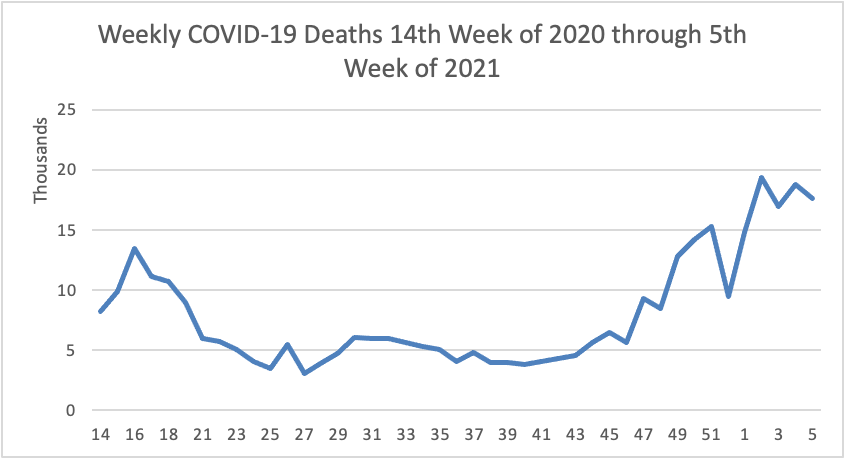
Based on the Centers for Disease Control’s COVID Data Tracker website, here is the FEHBlog’s weekly chart of new COVID-19 cases and deaths over the 14th week of 2020 through 5th week of this year (beginning April 2, 2020 and ending February 3, 2021; using Thursday as the first day of the week in order to facilitate this weekly update):

and here is the CDC’s latest overall weekly hospitalization rate chart for COVID-19:

The FEHBlog has noticed that the new cases and deaths chart shows a flat line for new weekly deaths because new cases greatly exceed new deaths. Accordingly here is a weekly chart of new COVID-19 deaths over the same period April 2, 2021 through February 3, 2021:

COVID-19 cases and hospitalizations are dropping, but deaths are not as yet. because deaths are considered to be a lagging indicator. The chart does point to the importance of vaccinating the elderly as soon as possible.

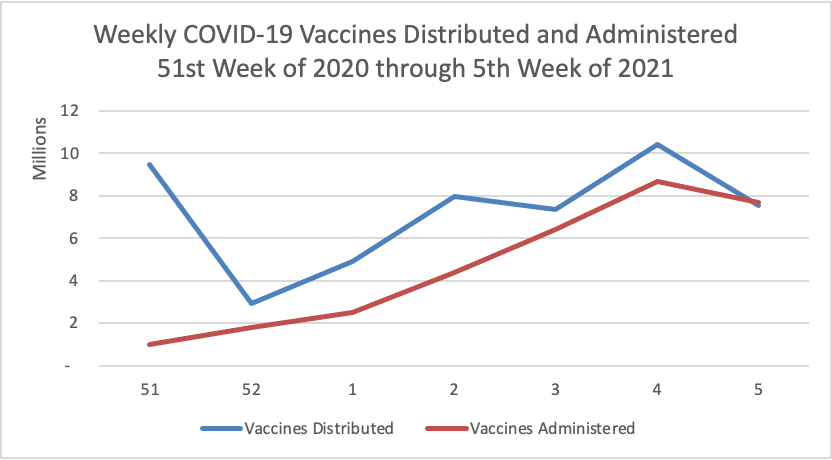
Here is a COVID-19 vaccinations chart for the past month which also uses Thursday as the first day of the week:

The CDC’s Fluview informs us that “Seasonal influenza activity in the United States remains lower than usual for this time of year.” Moreover, “46%: That’s how much U.S. sales of over-the-counter cold, flu, and cough medicine declined in the five week period ending Dec 26, 2020 from the same period last year, according to data from Nielsen, reported by Bloomberg.” These statistics suggest that Americans generally are following the social distancing and masking rules. Nevertheless the CDC recommends how to celebrate Super Sunday safely.

In Capitol Hill news, the Senate last night approved the Democrat’s budget resolution with Vice President Harris breaking the 50-50 vote from the Senators. The Wall Street Journal reports that today

The House approved a budget bill advancing President Biden’s $1.9 trillion relief plan, as Mr. Biden met with top House Democrats and lawmakers dived into crafting the details of the relief package.  The 219-209 vote marked a further step under budget reconciliation, a process that would allow Democrats to pass the relief package without Republican support in the Senate. Now, Democrats will turn to ironing out the details of the package over several weeks, including deciding who will be eligible for $1,400 direct payments and whether or not to raise the minimum wage to $15 an hour. 

The Journal also reports that a New York State court has ordered local authorities to certify the election of Republican Claudia Tenney in the last undecided U.S. House of Representatives race from the 2020 election. “Ms. Tenney is the second New York Republican to unseat an incumbent Democrat in 2020. She will be the 212th GOP House lawmaker, bringing the margin of Democratic control in the House to nine members.”

In healthcare news

  • The American Health Association reminds us that this February commemorates the 57th Heart Month.

Heart disease continues to be the greatest health threat to Americans and is still the leading cause of death worldwide, according to the AHA’s Heart Disease and Stroke Statistics – 2021 Update. The update, published in the association’s flagship journal Circulation, reports that nearly 18.6 million people across the globe died of cardiovascular disease in 2019, the latest year for which worldwide statistics are calculated. That’s a 17.1% increase over the past decade. And 523.2 million cases of cardiovascular disease were reported in 2019, a 26.6% increase over 2010.

During American Heart Month, the AHA and other organizations reinforce the importance of heart health, the need for more research and efforts to ensure that millions of people live longer and healthier. In most cases, heart disease is preventable when people adopt a healthy lifestyle, which includes not smoking, maintaining a healthy weight, controlling blood sugar and cholesterol, treating high blood pressure, getting at least 150 minutes of moderate-intensity physical activity a week and getting regular checkups. 

  • Health Payer Intelligence informs us that

Blue Cross and Blue Shield of North Carolina (Blue Cross NC) has introduced a value-based care program that focuses on improving health outcomes for members with kidney disease through coordinated and patient-centered care. The initiative, launched on January 1, is the newest feature in the industry-leading Blue Premier value-based care model. Eligible Blue Cross NC members can enroll in the Blue Premier Advanced Kidney Care program at no additional cost.

Thursday Miscellany

Photo by Juliane Liebermann on Unsplash

From the COVID-19 front —

  • Politico reports that “Johnson & Johnson filed Thursday for emergency use authorization [“EUA”] of its single-dose coronavirus vaccine, readying for a pivotal third option in the battle to immunize hundreds of millions of Americans.” This is the single dose vaccine that can be stored in regular pharmacy refrigerators. Following the same pattern as the first two EUA applications for COVID-19 vaccines, the Food and Drug Administration has set an advisory committee hearing on the Johnson & Johnson EUA for February 26. This indicates that the FDA will approve the application on February 28 / this month. That is very good news.
  • Healthcare coaching service TrestleTree has made available its useful “State-by-State COVID-19 Vaccination Access Guide.” Muchos gracias.
  • The American Hospital Association (AHA), American Medical Association (AMA), and American Nurses Association (ANA) released a [joint] public service announcement (PSA) today urging the American public to get the COVID-19 vaccination when it is their turn. 
  • Reuters reports that “Almost all people previously infected with COVID-19 have high levels of antibodies for at least six months that are likely to protect them from reinfection with the disease, results of a major UK study showed on Wednesday. Scientists said the study, which measured levels of previous COVID-19 infection in populations across Britain, as well as how long antibodies persisted in those infected, should provide some reassurance that swift cases of reinfection will be rare.”

From Capitol Hill, CBS News informs us that “The Senate is expected to vote on a budget resolution sometime before the weekend, an important step to passing President Biden’s $1.9 trillion COVID-19 relief proposal through the process of reconciliation, which allows legislation to pass with only a simple majority instead of the typical 60-vote threshold.  But before there can be a final vote on the resolution, Republicans are forcing Democrats to go on the record with a series of votes on a slew of amendments in a politically painful process known as a “vote-a-rama.” Bloomberg adds that this afternoon, “[t]he Senate backed by 99-1 a non-binding call to oppose stimulus checks going to “upper-income taxpayers” — one of a series of messaging votes the chamber is taking in a complex process of preparing President Joe Biden’s $1.9 trillion Covid-19 relief plan for passage through Congress.”

Health Payer Intelligence tells us about health plan trade association efforts to convince the Biden Administration to undo certain Trump Administration actions.

In healthcare corporate news, Healthcare Dive reports

  • Cigna’s net income for the fourth quarter of 2020 was $4.1 billion, a huge increase from the $977 million in the fourth quarter of 2019, partly because of the $6.2 billion sale of its life insurance business, which was completed on Dec. 31. The payer’s medical cost ratio in the fourth quarter was 85.8%, up from 82.3% the prior year because of COVID-19 treatment and testing costs and above Wall Street expectations. In a call with investors Thursday morning, CFO Brian Evanko said deferred care increased in the latter part of the quarter but was outweighed by COVID-19 costs.

and

  • UnitedHealth CEO Dave Wichmann is retiring and will be replaced as chief executive by Andrew Witty, currently the CEO of health services unit Optum. Witty will continue running Optum and become CEO immediately, with Wichmann assisting in a transition period through March, UnitedHealth announced Thursday. Dirk McMahon, CEO of payer business UnitedHealthcare, will become president and chief operating officer, and joins CFO John Rex to round out the Minnetonka, Minnesota-based healthcare behemoth’s C-suite.

From the opioid front

  • The Wall Street Journal reports that “State attorneys general intensified pressure on drug companies to settle claims over the opioid crisis, following consulting firm McKinsey & Co.’s agreement to pay nearly $600 million over its advice to pharmaceutical companies to rev up sales. * * * States have been negotiating since 2019 with the nation’s three largest drug distributors, McKesson Corp. , AmerisourceBergen Corp. , Cardinal Health Inc., as well as drugmaker Johnson & Johnson. The companies have publicly disclosed that they have set aside a collective $26 billion for the deal, most of it to be paid over 18 years, but no final agreement has been reached. In news conferences Thursday, attorneys general said they hoped the McKinsey deal would provide momentum for a bigger settlement, if others facing litigation follow the consulting company’s lead.”
  • Late last month, the Bloomberg School of Public Health announced that “A coalition of 31 professional and advocacy organizations has released a set of principles aimed at guiding state and local spending of the forthcoming opioid litigation settlement funds. The coalition, coordinated by faculty at the Johns Hopkins Bloomberg School of Public Health, is urging state and local officials to avoid the mistakes of the 1998 tobacco settlement and use the expected settlement funds to support evidence-based strategies that save lives. The need for evidence-based funding strategies is especially urgent now, as deaths due to opioid drug overdoses have significantly increased since the COVID-19 pandemic began, with some states reporting increases of 30%.”
  • The Health and Human Services Office of Inspector General today released a report on opioid use in Medicare Part D during the first phase of the COVID-19 public health emergency. “As the pandemic took hold, about 5,000 Medicare beneficiaries per month suffered an opioid overdose during the first 8 months of 2020.”