From Capitol Hill, Roll Call discusses the Senate Parliamentarian’s role in refereeing budget reconciliation bills like the Build Back Better Act.
Senate committees have been updating the House-passed $2.2 trillion climate and social spending package text to ensure it complies with budget reconciliation rules, but most have yet to begin the formal review process with the Senate parliamentarian known as “the Byrd bath.”
Majority Leader Charles E. Schumer sent a “Dear Colleague” letter on Monday reiterating his goal to pass the legislation in the Senate before Christmas. But the update he provided on the procedural steps needed to get there suggests senators will be lucky if they can meet that deadline.
Schumer said Senate committees are continuing informal conversations with Senate Parliamentarian Elizabeth MacDonough about their pieces of the package and “making necessary technical and ‘Byrd proofing’ edits to the House bill.” The Byrd rule requires any policy changes made through reconciliation to have more than a “merely incidental” impact on the budget, among other restrictions.
From the COVID vaccine front, Medscape informs us that
Adolescents and adults younger than age 21 who develop myocarditis after mRNA COVID-19 vaccination frequently have abnormal findings on cardiac MRI(cMRI) but most have a mild clinical course with rapid resolution of symptoms, a new study concludes.
“This study supports what we’ve been seeing. People identified and treated early and appropriately for the rare complication of COVID-19 vaccine-related myocarditis typically experienced only mild cases and short recovery times,” American Heart Association (AHA) President Donald M. Lloyd-Jones, MD, said in a podcast.
“Overwhelmingly, the data continue to indicate the benefits of COVID-19 vaccine far outweigh any very rare risks of adverse events from the vaccine, including myocarditis,” Lloyd-Jones added.
The U.S. Food and Drug Administration on Friday authorized the use of Eli Lilly’s COVID-19 dual-antibody therapy in treating mild to moderate symptoms in all children, including newborns, who are at risk of severe illness.
The therapy, bamlanivimab plus etesevimab, was previously authorized for children aged 12 years and older and weighed at least 88 pounds.
“Children under one year of age, who are exposed to the virus that causes COVID-19, may be at particularly high risk for severe COVID-19 and this authorization addresses the medical needs of this vulnerable population,” said Patrizia Cavazzoni, director of the FDA’s Center for Drug Evaluation and Research.
The FDA authorization also allows the administration of the therapy as a preventive measure in children who are exposed to the virus.
Per STAT News
People who received the Pfizer (PFE)-BioNTech (BNTX) vaccines may get as much benefit from a Johnson & Johnson (JNJ) booster shot as a Pfizer one, The New York Times explains, citing the findings of a small study released on Sunday. Researchers at Beth Israel Deaconess Medical Center in Boston studied 65 people who had received two shots of the Pfizer vaccine. Six months after the second dose, the researchers gave 24 of the volunteers a third dose of the Pfizer vaccine and gave 41 the Johnson & Johnson shot. The study was funded in part by Johnson & Johnson and has not yet been published in a scientific journal.
As of today according to the Centers for Disease Control, 60% of the U.S. population is fully vaccinated and 25% of the U.S. population over age 18 has had a booster.
From the Delta variant testing front
The American Medical Association reviews the different COVID tests that are available in our country. The article warns that the at home tests must be performed correctly. This will be useful information to share with health plan members.
A friend of the FEHBlog pointed out this HHS website that lists low or or no COVID cost testing facilities in each of the states and DC. Another friend of the FEHBlog informed him that local public libraries in the Washington DC area offer at home rapid COVID tests like Binax to their visitors at no cost. The FEHBlog learned long ago that when a health plan is asked to provide a service or supply that it typically does not cover, like over the counter drugs or tests, you typically can find a government resource to fill the gap. To soften the financial blow of the the President’s unexpected mandate that health plans cover the cost of at home rapid COVID tests, health plans also should consider educating members about community resources.
Speaking of which, Health Payer Intelligence reports on payer efforts to fund various community resources to address the social determinants of health, a thoughtful idea particularly at the holiday season.
Hanukkah greeting template. Nine candles and wishing. Hand drawn sketch illustration. White, yellow and blue colors
The House and the Senate will be holding Committee business and floor votes this week. Yesterday when writing up Cybersecurity Saturday, the FEHBlog could not find any fresh news on the National Defense Authorization Act (“”NDAA”) vote. The NDAA often includes federal procurement law changes and this year may include cyberbreach and cyber-ransom payment notice requirements.
Congress is expected to focus this week on the defense policy bill known as the National Defense Authorization Act, or NDAA, which was held up in the Senate last week over provisions regarding Russia and China. Instead of the Senate passing its own bill, a compromise bill—negotiated by leadership in the House and Senate—is expected to come to the House for a vote as early as this week.
The Journal further reports that Congressional leadership is working on the debt ceiling issue which may come to a head mid-month and hoping to bring the Build Back Better multi-trillion dollar budget reconciliation bill to a vote before Christmas.
The House of Representatives’ Postal Reform bill (H.R. 3076) would create a new Postal Service Service Health Benefits Program within the FEHB Program. The PSHBP would be tightly integrated with Medicare with respect to annuitant coverage. For that reason, the bill initially was referred to the House Oversight and Reform, Energy and Commerce, and Ways and Means Committees.
A friend of the FEHBlog called to his attention the fact that last Friday December 3, the Energy and Commerce and Ways and Means Committee were granted an extension for further consideration of the bill ending not later than Jan. 21, 2022. Of course, the Oversight and Reform Committee approved a substitute bill for House floor voting on May 13.
The ongoing Federal Employee Benefits Open Season ends on a week from tomorrow December 13, a few day following the end of Medicare Open Enrollment period which ends this week on December 7.
From the Delta variant front —
Today’s Washington Post has an interesting article on early analyses of the Omicron variant. The Post notes that
The omicron variant is likely to have picked up genetic material from another virus that causes the common cold in humans, according to a new preliminary study, prompting one of its authors to suggest omicron could have greater transmissibility but lower virulence than other variants of the coronavirus.FAQ: What to know about the omicron variant of the coronavirus
Researchers from Nference, a Cambridge, Mass.-based firm that analyzes biomedical information, sequenced omicron and found a snippet of genetic code that is also present in a virus that can bring about a cold. They say this particular mutation could have occurred in a host simultaneously infected by SARS-CoV-2, also known as the novel coronavirus, and the HCoV-229E coronavirus, which can cause the common cold. The shared genetic code with HCoV-229E has not been detected in other novel coronavirus variants, the scientists said.
The study is in preprint and has not been peer-reviewed.
National Public Radio offers conservative yet sensible guidance filled with expert opinions on how to navigate the holiday season without contracting COVID. For example,
The good news is, you don’t have to hibernate like it’s 2020. Experts note we’re in a much different place than we were last winter, with COVID-19 vaccines and boosters now widely available. There’s good hope that the current vaccines offer protectionagainst severe disease with omicron.
That said, if this pandemic has taught us anything, it’s that when you don’t know what you’re dealing with, “we should invoke the precautionary principle,” says Dr. Abraar Karan, an infectious disease physician at Stanford University.
In other words, don’t panic, but do be thoughtful about what risks you want to take.
In the FEHBlog’s opinion, that’s sound approach to living one’s life.
From the Capitol Hill front, Bank Info Security reviews the cybersecurity and breach notice measures found in the National Defense Authorization Act for the current government fiscal year. Defense One reports that the Senate at this point is not expected to pass its version of the bill until next month.
From the administrative front, Cyberscoop reports that
The Cybersecurity and Infrastructure Security Agency on Wednesday [December 1] named members to a new [Congressionally mandated] cyber advisory panel that will make recommendations on subjects ranging from battling misinformation to gaining aid from the hacker community on national cyber defense.
Among the 23 members selected are leaders from social media, cybersecurity companies, major technology firms and critical infrastructure sectors such as finance and energy. It includes officials from Johnson & Johnson and Walmart, as well as a longtime cybersecurity journalist and the mayor of Austin, Texas. * * *
Bylaws for the committee published in July said it would address subjects like critical infrastructure protection, information sharing, risk management and public-private partnerships. Wednesday’s announcement added potential subjects like the cyber workforce and disinformation. Its first meeting is Dec. 10.
The Cybersecurity and Infrastructure Security Agency at the Department of Homeland Security is putting the final touches on several guidance documents to help ease the transition to a zero trust cybersecurity environment.
The entire goal of this effort to move security away from the network and to the data and application layers.
John Simms, the deputy branch chief of the Cybersecurity Assurance Branch in CISA, said the documents and other efforts are helping agencies shift their cyber thinking away from the network and closer to the data.
On Thursday December 2, the Government Accountability Office issued a report in connection with GAO testimony before Congress “on the need for the federal government to develop and execute a comprehensive national cyber strategy, and to strengthen the role that it plays in protecting the cybersecurity of critical infrastructure. Ensuring the cybersecurity of the nation is on our High Risk List, and we have urged federal agencies to act on it.”
The HHS Office of Information Security released a presentation on December 2 about the risks that the cybercriminal group FIN12 posts to the healthcare sector.
Health IT Security reports about new Healthcare ISAC guidance to help CISOs navigate interoperability, patient access, and identity-centric data sharing under the 21st Century Cures Act. New interoperability mandates under the Cures Act require healthcare organizations to implement APIs to promote the digitization of electronic health information (EHI). “While APIs are the ‘door’ to enabling interoperability of EHR between healthcare organizations, strong identity solutions are the ‘key’ that keeps EHI secure,” the guide explained. OPM is eager for FEHB plans to offer these APIs to their members.
Here is a link to Bleeping Computer’s The Week in Ransomware.
The biggest news over the past two weeks is the unsealing of a United States’ Complaint for Forfeiture detailing how the FBI seized 39.89138522 bitcoins from an Exodus wallet belonging to an REvil affiliate. Based on the email listed in the court document, it is believed that the affiliate is one known as ‘Lalartu.’
Cyber criminals are using online adverts for fake versions of popular software to trick users into downloading three forms of malware – including a malicious browser extension with the same capabilites as trojan malware – that provide attackers with usernames and passwords, as well as backdoor remote access to infected Windows PCs.
The attacks, which distribute two forms of seemingly undocumented custom-developed malware, have been detailed by cybersecurity researchers at Cisco Talos who’ve named the campaign ‘magnat’. It appears the campaign has been operating in some capacity since 2018 and the malware has been in continuous development.
Over half of the victims are in Canada, but there have also been victims around the world, including in the United States, Europe, Australia and Nigeria.
In closing, an expert in Security Week offers his four cybersecurity predictions for 2022.
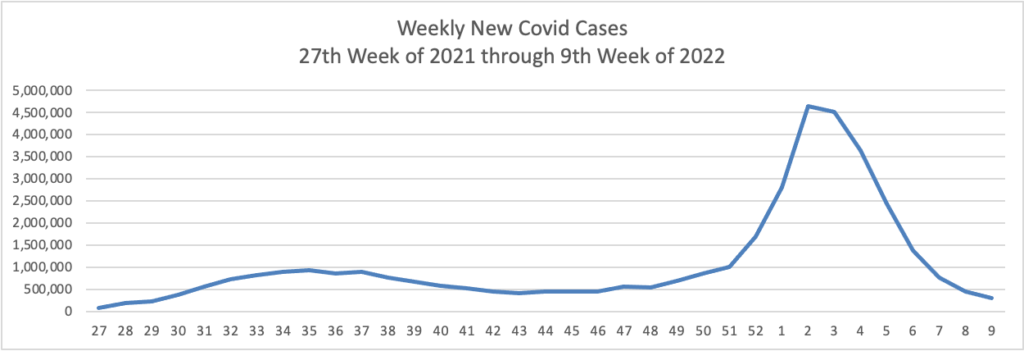
Based on the Centers for Disease Control’s COVID Data Tracker and using Thursday as the first day of the week, here is the FEHBlog’s weekly chart of new COVID cases for this year.
The new Omicron variant was identified in more than a dozen people in at least nine states, early evidence of its presence across the U.S.
While some of the people in the U.S. who have contracted the Omicron variant of the coronavirus that causes Covid-19 had recently traveled to southern Africa, where it was first identified last week, at least two states reported community spread of the new variant. States to report Omicron cases span the country from Hawaii to California and New York.
“It’s certainly spreading in the U.S.,” said Samuel Scarpino, managing director of pathogen surveillance at the Rockefeller Foundation.
The Delta variant begs to note add “all of the other cases are mine.”
Here is a link to the CDC’s chart of new COVID hospitalizations which continues to trend up.
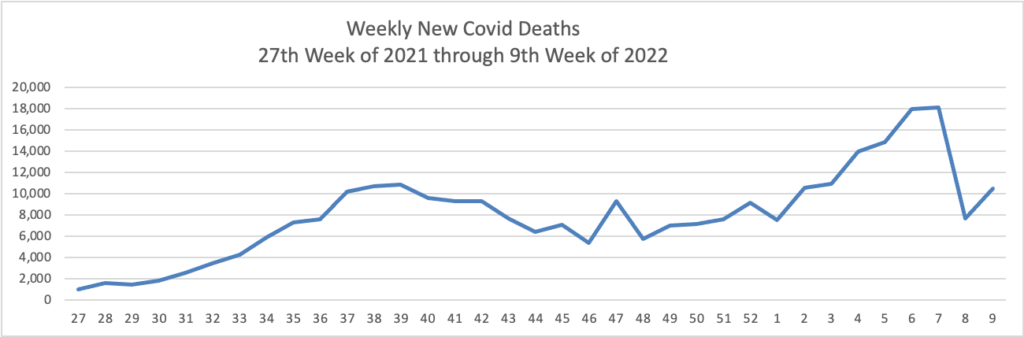
Here is the FEHBlog weekly chart of new COVID deaths for 2021
Oddly the number of deaths popped up last week.
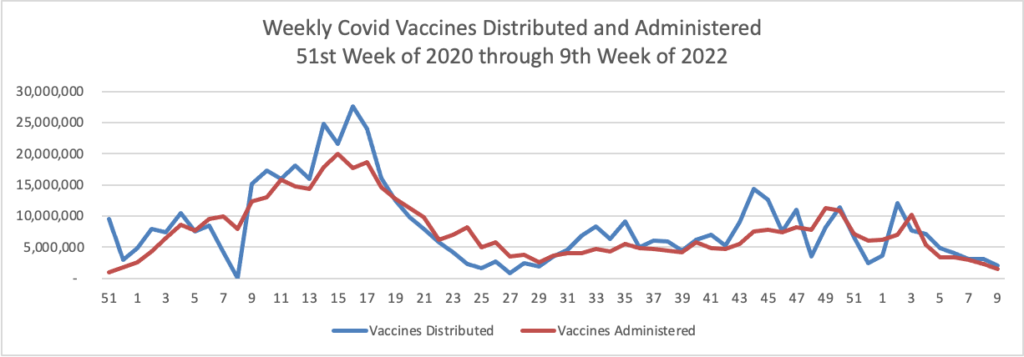
Here’s the FEHBlog’s weekly new COVID vaccinations delivered and administered during the last two weeks of 2020 and this year.
In this regard, the Wall Street Journal reports that
The U.S. has plenty of Covid-19 vaccines but retail pharmacies are struggling to quickly administer them in some places.
Vaccine seekers in some states face waits of days or weeks for doses as local health officials hustle to improve access to meet surging demand. CVS Health Corp. Walgreens Boots Alliance Inc. and Walmart Inc., which are facing staffing shortages, now say they may not be able to accommodate people without appointments.
An average of 1.4 million doses were administered daily in the U.S. in the week ended Thursday, a 22% increase from the previous week, which included Thanksgiving, according to the Centers for Disease Control and Prevention.
(The FEHBlog’s chart does not show a sharp increase because the government was not reporting vaccination statistics over the four day Thanksgiving weekend.)
Here is a link to the CDC’s weekly interpretation of its COVID statistics.
The Society for Human Resource Management discusses the impact of Omicron and the President’s COVID awareness program on employers.
From the influenza front, the CDC reports that “Seasonal influenza activity in the United States remains low, but in recent weeks, the number of influenza virus detections reported by clinical and public health laboratories has increased, and the percent of outpatient visits for respiratory illness has trendedupward.” Next week is National Flu Vaccination Week.
From the Capitol Hill front, Federal News Network informs us that as expected,
President Joe Biden signed a continuing resolution Friday to keep funding federal government operations for another three months [precisely February 18, 2022], avoiding a government shutdown.
The passed the Senate late last night by a margin of 69-28, while the House had approved the same measure earlier in the day on a party line vote, with only one Republican voting in favor.
Federal News Network reports at length about the House Oversight and Reform Committee vote approving an Committee leadership sponsored bill to strengthen OPM (H.R. 6066). The article notes that today OPM Director Kiran Ahuja “spoke at a virtual discussion hosted by NAPA. She reiterated that rebuilding the agency is one of her top priorities. In the last year, OPM has hired about 340 new employees, Ahuja said.”
From the pharmacy / PBM front —
Forbes interviews Walgreens CEO Roz Brewer about her primary care oriented strategy for the large pharmacy chain.
Express Scripts has launched a new solution that aims to integrate prescription discount card pricing into members’ existing benefits.
Through the new Right Price offering, a member who is eligible for savings through a discount card will automatically see those savings applied at the pharmacy counter. Matt Perlberg, senior vice president of supply chain at Express Scripts, told Fierce Healthcare that the pharmacy benefit manager most often sees these discounts come into play for members who have yet to meet their deductible.
For about 2% of claims, members who are purchasing generic drugs but have not yet met the deductible may find these coupon cards lead to a lower price than their drug benefits, Perlberg said.
In other strategy news, Beckers Payer Issues reports that
UnitedHealth Group CEO Andrew Witty said during a Forbes Annual Healthcare Summit discussion he is exploring how the company’s payer and provider branches can work together more closely.
The initiative aims to provide government and employer customers with more comprehensive offerings, Mr. Witty said Dec. 2, according to Forbes.
Mr. Witty pointed to developing mental health strategies as one avenue for combined growth.
From the Capitol Hill front, Roll Call reports that
The Senate looks set to clear a House-passed a temporary spending bill Thursday night that would keep the lights on at federal agencies through Feb. 18, buying 11 more weeks to try to resolve partisan disputes over funding levels and policy riders that have stalled progress on fiscal 2022 appropriations.
The stopgap measure passed the House on a 221-212 vote earlier in the evening. The Senate timeline cleared up once it became apparent a group of GOP conservatives would get an up-or-down vote on an amendment to bar funding to implement a new private sector vaccine mandate.
“I think we’re gonna get our amendment at a 50-vote threshold,” Sen. Roger Marshall, R-Kan., told reporters after the House vote.
A Senate GOP leadership aide said the vote would occur in that chamber Thursday evening. With three absences on the Republican side, senators expected Marshall’s amendment to be defeated, which would set up a vote on clearing the stopgap bill for President Joe Biden’s signature ahead of a midnight Friday deadline to avert a partial government shutdown.
So as the FEHBlog expect, no government shutdown which is good news.
Health officials on Thursday reported the country’s second Covid-19 infection from the Omicron variant in a Minnesota resident who notably did not travel internationally recently, unlike the first case.
The case in Minnesota is an adult male who had been vaccinated and, in early November, received a booster shot. He lives in Hennepin County, which includes Minneapolis, state health officials said. He developed mild symptoms on Nov. 22, was tested on Nov. 24, and no longer has symptoms.
The man had been in New York City in the days leading up to feeling sick and attended the Anime NYC 2021 convention at the Javits Center from Nov. 19 to Nov. 21. Minnesota health officials are collaborating with New York City authorities and the Centers for Disease Control and Prevention on their case investigation.
Bloomberg adds
In some of the first data to come back on the omicron variant of the coronavirus, researchers in South Africa, where it was first identified, say the mutation is spreading faster than the delta strain. There also seems to be a greater risk of reinfection—where previously infected people get the virus again. Three times higher, in fact. But scientists also said hospitalizations in South Africa remain muted, a sign that may be attributable in part to vaccinations. Shabir Madhi, a vaccinologist at the University of the Witwatersrand, said he’s “optimistic that in this resurgence, while the total number of cases will probably be greater, hospitalizations and deaths will be lower.” —David E. Rovella
Early laboratory studies suggest that a Covid-19 antibody treatment developed byGlaxoSmithKlineGSK 0.24% PLC and Vir Biotechnology Inc. VIR -2.19% is effective against the Omicron variant, the companies said, setting it apart from similar therapies that appear to work less well against the highly mutated strain.
The companies said Thursday that they had tested the drug, called sotrovimab, against certain individual mutations found in Omicron, which has now been detected in at least 24 countries, including the U.S. Glaxo and Vir said the findings were preliminary and they would need to test the treatment against the whole of the mutated spike protein found in the variant to confirm the result. The companies published the preliminary research, which hasn’t yet been peer reviewed.
From the White House, the President announced a bevy of new COVID control measures today. Of particular interest to health plans is the following one:
Providing health plan coverage of no-cost rapid, over-the-counter (OTC) COVID-19 tests: To expand access and affordability of at-home COVID-19 tests, the Departments of Health and Human Services, Labor and the Treasury will issue guidance by January 15th to clarify that individuals who purchase OTC COVID-19 diagnostic tests will be able to seek reimbursement from their group health plan or health insurance issuer and have insurance cover the cost during the public health emergency. Workplace screening would remain consistent with current guidance.
That workplace guidance currently requires the employer to fund the cost of testing, e.g., in programs that require vaccinations or weekly testing / masking. However, I think that once this Pandora’s box is open, employers will be telling their employees to pick up a test at the local pharmacy if they need to be tested. What’s stopping them? Healthcare Dive explains that the mandate will remove the market incentive currently on manufacturers to lower costs.
The plan is a potential boon for medtech companies that produce at-home tests. With insurers on the hook for payment, it may drive up demand, particularly among those who were sensitive to prices before.Abbott, BD and Quidel are big players in the at-home testing space.
Furthermore the FEHBlog doesn’t see the sense in taking this step before the Food and Drug Administration give emergency use authorization to Merck and Pfizer COVID pills to treat COVID at its onset.
From the COVID vaccine mandate front, Beckers Hospital Review reports that
HHS is appealing a federal court’s decision to temporarily block the start of its vaccination mandate for healthcare workers, according to Bloomberg Law.
U.S. District Judge Terry Doughty in Louisiana granted a preliminary injunction Nov. 30 halting the vaccination rule for healthcare workers until legal challenges are resolved. * * *
HHS Secretary Xavier Becerra and other defendants filed an appeal Dec. 1. The U.S. Court of Appeals for the 5th Circuit will hear the appeal.
CVS Health and Microsoft are forming a strategic alliance to co-develop products around the areas of personalized care and digital health, the two companies announced Thursday.
CVS said it plans to use Microsoft’s computing capabilities to deliver more customized health recommendations when and where consumers need them as the retail pharmacy giant continues to focus on digitally enabled and consumer-centric health services. The two will also look for new ways to leverage technology and machine learning to automate CVS operations and reduce waste.
CVS Pharmacy is expanding an in-app feature for visually impaired patients, which reads prescription information out loud, to all of its nearly 10,000 U.S. locations.
The solution, called Spoken Rx, was designed in collaboration with the American Council of the Blind. Patients enrolled in the program can scan the labels on their prescription containers and have their information, including the medication’s name and directions for use, read out loud to them in either English or Spanish.
* * * The feature is free to all patients who enroll. CVS can provide a standalone speaker device to read prescription labels if the patient doesn’t have a smartphone.
CVS also offers ScripTalk on its website, which allows patients who get their medications delivered to their homes to have their prescriptions read aloud through the separate ScripTalk app. The pharmacy giant first made the service available in 2014.
The company has options for braille and large-print prescription labels through their online pharmacy too.
From Capitol Hill, The Wall Street Journal reports that
Lawmakers worked Wednesday to reach an agreement on a short-term spending patch to avoid a potential partial government shutdown this weekend, with Democrats and Republicans still haggling over the details of the funding extension.
Party leaders had initially hoped to release an agreement earlier this week. Democrats have eyed a spending patch that would last until mid-or-late-January, while Republicans have pushed for a longer extension.
With just days until the government runs out of current funding at 12:01 a.m. on Saturday, Dec. 4, lawmakers will need to act quickly to pass the eventual agreement through the House and Senate. Meeting that tight timeline would require unanimous consent in the Senate to waive some of the chamber’s procedural hurdles, and any individual senator can slow down the process.
The article points out that Congressional leadership from both parties expects a continuing resolution to pass without a government shutdown. Of course we know from past experience that because the funding runs out on a Saturday, Congress has some additional time to complete work on the continuing resolution over the weekend if necessary.
From the Delta variant front the Centers for Disease Control announced today that
The California and San Francisco Departments of Public Health have confirmed that a recent case of COVID-19 among an individual in California was caused by the Omicron variant (B.1.1.529). The individual was a traveler who returned from South Africa on November 22, 2021. The individual had mild symptoms that are improving, is self-quarantining and has been since testing positive. All close contacts have been contacted and have tested negative.
The FEHBlog senses that Delta variant is becoming jealous over the attention that the Omicron varian is receiving.
From the Delta variant vaccine mandate front, the Society for Human Resource Management tells us that
Consultancy Willis Towers Watson conducted a survey of large U.S. companies from Nov. 12-18 and asked if they currently require employees to be vaccinated against COVID-19 or plan to do so; 543 companies responded to the survey. Respondents indicated that they:
— Currently require vaccinations (18 percent).
— Will require vaccinations only if OSHA’s ETS takes effect (32 percent).
— Plan to mandate vaccinations regardless of the ETS status (7 percent).
Few employers (3 percent) with vaccination mandates have reported a spike in resignations, although nearly 1 in 3 (31 percent) of those planning mandates were very concerned that this could contribute to employees leaving their organizations. On the other hand, nearly half of employers (48 percent) believe vaccine mandates could help recruit and retain employees.
In addition to vaccine mandates, many large employers have taken or plan to take the following actions to protect employees who are returning to the workplace, saying that they will:
— Offer COVID-19 testing (84 percent), most on a weekly basis (80 percent).
— Require unvaccinated employees to pay for testing unless prohibited by state law (25 percent).
— Require or plan to require masks to be worn indoors (90 percent).
Hospitals saw operating margins continue to erode in October, declining 12% from September under the weight of rising labor costs, according to a national median of more than 900 health systems calculated by Kaufman Hall. It was the second consecutive monthly drop and comes as facilities are preparing for the fast-spreading omicron variant of the coronavirus.
Although expenses remained highly elevated, patient days and average length of stay fell for the first time in months in October, likely reflecting lower hospitalization rates as the pressure of treating large numbers of COVID cases began to ease, Kaufman Hall said in its latest report.
At the same time, operating room minutes rose 6.8% from September, pointing to renewed patient interest in elective procedures.
Despite the threat of daily fines, hospitals have so far been slow to publish their prices online in accordance with a new federal regulation.
Radiology services look to be no exception, with new study data now suggesting roughly two-thirds of U.S. hospitals have not published commercial negotiated prices for at least one of the 13 radiology services designated as a common shoppable service by the Centers for Medicare & Medicaid Services (CMS). Hospitals are required to publish these prices in compliance with CMS’ Hospital Price Transparency final rule.
Further, the hospitals that did share their radiology service commercial negotiated prices appear to be all over the map, often setting price tags that varied by hundreds or thousands of dollars for certain imaging services.
The analysis—published in Radiology by Michigan State University and Johns Hopkins researchers—found than a mean 2,053 out of 5,700 hospitals (36%) had reported a price for one of these services as of Sept. 6.
From the telehealth front, Healthcare Dive informs us that
When U.S. patients envision their future medical care, the majority see telehealth playing a role. But when presented with the choice between an in-person or video visit for nonemergent care, most prefer a traditional in-office visit, according to new research analyzing consumer telehealth preferences.
The survey conducted by the nonprofit Rand Corporation published in JAMA on Wednesday found those who leaned toward in-person care were more willing to pay for their preferred visit modality, while those who preferred video visits were more sensitive to out-of-pocket costs.
Of the respondents who had used telehealth at least once since last March, only 2.3% said they were unwilling to use telehealth in the future, suggesting the method’s continued importance in hybrid models of care even after the pandemic — though it’s unlikely to be most patients’ first choice, researchers said.
In other news —
Drug Channels offers its take on CVS Health’s recent announcement to right size its number of retail pharmacies (a roughly 10% reduction) and add even more healthcare focus to the remaining locations.
Today “the Centers for Medicare & Medicaid Services (CMS) issued a Request for Information (RFI) to solicit stakeholder and public feedback that will be used to inform potential changes and future rulemaking to improve the organ transplantation system and seek to enhance the quality of life of those living with organ failure.”
Becker’s Hospital Review discusses and provides interesting executive interview on how healthcare providers and health plans are seeking to improve and expand mental healthcare.
This week’s Econtalk episode on our sense of hearing is outstanding. Check it out.
From the Delta variant vaccination and treatment front, AHIP informs us that
The Food and Drug Administration’s (FDA) Antimicrobial Drugs Advisory Committee (AMDAC) held a meeting to discuss the safety and efficacy of the COVID-19 antiviral treatment molnupiravir, developed by Merck and Ridgeback Biotherapeutics. The oral treatment is the first COVID-19 therapy that could be taken outside a clinical setting. The Committee reviewed data by Merck and the FDA on molnupiravir’s toxicity, efficacy, and safety, and discussed concerns over treatment of pregnant persons and the potential effects of viral mutation and evolution. Initial data from Merck showed that molnupiravir reduced the hospitalization risk among high-risk patients by 48%, however data released November 26 suggests the reduction in hospitalizations may be closer to 30%.
The Committee voted 13-10 that the potential benefits of molnupiravir outweigh the known and potential risks when used for the treatment of mild-moderate COVID-19 in adult patients who are within 5 days of symptom onset and are at high risk of severe COVID-19, including hospitalization or death. Given concerns about the potential harmful effects on fetal development, Committee members further stressed the need for pregnancy testing prior to taking molnupiravir.
The FDA will review AMDAC’s conclusions and formally decide whether or not to grant emergency use authorization (EUA) to molnupiravir in the coming weeks.
Acting Food and Drug Commissioner Dr. Janet Woodcock announced
The [Food and Drug Administration] is working as quickly as possible to evaluate the potential impact of this variant on the currently available diagnostics, therapeutics and vaccines. We are closely monitoring the situation and are committed to communicating with the public as we learn more.
Historically, the work to obtain the genetic information and patient samples for variants and then perform the testing needed to evaluate their impact takes time. However, we expect the vast majority of this work to be completed in the coming weeks.
The emergence of a new COVID-19 variant, named Omicron (B.1.1.529), is putting pressure on diagnostics manufacturers who test for the presence of SARS-CoV-2 to ensure its results are not impacted. Thermo Fisher Scientific, Qiagen and Lucira Health were quick to claim their tests can detect the emerging variant.
The Omicron variant of the Covid-19 virus could lead to more infections among vaccinated people, according to several scientists, but some said there were reasons to believe the shots would protect against severe disease.
While the new variant might evade the antibodies generated in reaction to the vaccines, the virus will likely remain vulnerable to immune cells that destroy it once it enters the body, said Ugur Sahin, co-founder of BioNTech SE, which sells a Covid-19 shot with partner Pfizer Inc.
“Our message is: Don’t freak out, the plan remains the same: Speed up the administration of a third booster shot,” Dr. Sahin said in an interview Tuesday.
In that regard, Govexec.com notes that “Pfizer/BioNTech are expected to apply for approval for their booster shots for 16 and 17 year olds and the FDA “could authorize extra shots within roughly a week,” The New York Times reported on Monday.”
In COVID vaccine mandate legal news, the FEHBlog was quite surprised to read in Govexec that
On Tuesday, a federal judge temporarily blocked the COVID-19 vaccine mandate for federal contractors in three states.
U.S. District Judge Gregory Van Tatenhove, who serves in the U.S. District Court for the Eastern District of Kentucky, issued a preliminary injunction for the vaccine mandate for federal contractors and subcontractors in all covered contracts in Kentucky, Ohio and Tennessee. Following President Biden’s issuance of the executive order on the mandate on September 9, there have been numerous legal challenges.
“This is not a case about whether vaccines are effective. They are. Nor is this a case about whether the government, at some level, and in some circumstances, can require citizens to obtain vaccines. It can,” wrote Van Tatenhove. “The question presented here is narrow. Can the president use congressionally delegated authority to manage the federal procurement of goods and services to impose vaccines on the employees of federal contractors and subcontractors? In all likelihood, the answer to that question is ‘no.’”
A federal judge issued a preliminary injunction on Tuesday to halt the start of President Biden’s national vaccine mandate for health care workers, which had been set to begin next week.
The injunction, written by Judge Terry A. Doughty, effectively expanded a separate order issued on Monday by a federal court in Missouri. The earlier one had applied only to 10 states that joined in a lawsuit against the president’s decision to require all health workers in hospitals and nursing homes to receive at least their first shot by Dec. 6 and to be fully vaccinated by Jan. 4.
“There is no question that mandating a vaccine to 10.3 million health care workers is something that should be done by Congress, not a government agency,” Judge Doughty of U.S. District Court for the Western District of Louisiana wrote. He added: “It is not clear that even an act of Congress mandating a vaccine would be constitutional.”
The plaintiffs, he added, also have an “interest in protecting its citizens from being required to submit to vaccinations” and to prevent the loss of jobs and tax revenue that may result from the mandate.
It looks like the vaccine mandates are creating more work Judicial Panel on Multidistrict Litgation.
From the HIV front —
The National Institutes of Health tells us that “Among people with HIV worldwide who are receiving antiretroviral therapy (ART), adults are getting closer to the global target of 95% achieving viral suppression, but progress among children and adolescents is lagging and long-term viral suppression among all groups remains a challenge. These findings of a study funded by the National Institutes of Health suggest that substantial efforts are needed to help people with HIV durably suppress the virus. The findings were published today in the journal The Lancet HIV.”
The Centers for Disease Control informs us that “Improving access to and use of HIV services for [men having sex with men] MSM, particularly Black MSM, Hispanic/Latino MSM, and younger MSM, is essential to ending the HIV epidemic in the United States.”
Here is a link to the CDC’s website on HIV treatment.
From the tidbits department —
Fierce Healthcare calls to our attention the fact that
The Business Group on Health has identified several trends in health and wellness to keep an eye on next year, which they say highlight the sense of “collective urgency” employers and their workforces feel.
For example, the organization echoed an ongoing industry trend: virtual care isn’t going away following a massive increase in use during the pandemic. However, the Business Group argues that taking full advantage of its strengths will require integration with in-person offerings.
The Society for Human Resource Management, having lost respect for the Delta variant, discusses how the Omicron variant may impact the workplace.
AHRQ tells us that “Patients with retail medications to treat opioid use disorders spent on average 3.4 times more for out-of-pocket prescriptions than the rest of the U.S. population, according to an AHRQ-study published in the Journal of Substance Abuse and Treatment.” No bueno.
Also “AHRQ has released an updated Chartbook on Rural Healthcare that shows that people in rural areas face difficulty getting timely, high-quality, affordable healthcare.
HHS’s Office for Civil Rights which enforces the HIPAA Privacy and Security Rules now has settled in OCR’s favor 25 complaints against healthcare providers for allegedly violating HIPAA’s individual right to access medical records.
From the Capitol Hill front, the Hill reports that Senate continues to squabble over the must pass National Defense Authorization Act for the current federal fiscal year. Meanwhile Roll Call informs us that
Democrats and Republicans on Monday haggled over details of a stopgap spending bill that appears likely to run into late January at a minimum, with Republicans still trying to extend the duration into February or March.
Sources said House Appropriations Chair Rosa DeLauro, D-Conn., wants to file the temporary spending bill Tuesday with a goal of passing it in the House on Wednesday. That would presumably give the Senate enough time to clear it for President Joe Biden’s signature before the current stopgap funding law expires Friday.
Extending the continuing resolution into late January would represent a compromise between DeLauro, who previously was pushing for a shorter two-week CR, and senators from both parties who say more time is needed to wrap up work on fiscal 2022 appropriations bills.
Negotiations were ongoing, however, with Republicans arguing for more time. Senate Appropriations ranking member Richard C. Shelby told reporters Monday night that he prefers a stopgap through February or March. “I think it gives us more time to seriously sit down,” the Alabama Republican said.
From the Delta variant front, David Leonhard sagely writes in this New York Time column this morning
The public reaction to new Covid-19 variants has followed a familiar cycle. People tend to assume the worst about two different questions — whether the variant leads to faster transmission of the Covid virus and whether it causes more severe illness among infected people.
The first of those worries came true with the Alpha and Delta variants: Alpha was more contagious than the original version of the virus, and Delta was even more contagious than Alpha. But the second of the worries has largely not been borne out: With both Alpha and Delta, the percentage of Covid cases that led to hospitalization or death held fairly steady.
This pattern isn’t surprising, scientists say. Viruses often evolve in ways that help them flourish. Becoming more contagious allows a virus to do so; becoming more severe has the potential to do the opposite, because more of a virus’s hosts can die before they infect others.
It is too soon to know whether the Omicron variant will fit the pattern. But the very early evidence suggests that it may. Unfortunately, Omicron seems likely to be more contagious than Delta, including among vaccinated people. Fortunately, the evidence so far does not indicate that Omicron is causing more severe illness * * * .
The Centers for Disease Control and Prevention [(CDC) today] broadened its recommendation for COVID-19 booster shots to include all adults because of the new Omicron variant. The agency had previously approved boosters for all adults, but only recommended them for those 50 years and older or living in long-term care settings.
“Everyone ages 18 and older should get a booster shot either when they are six months after their initial Pfizer or Moderna series or two months after their initial J&J vaccine,” CDC Director Dr. Rochelle Walensky said in a statement.
Facing a coronavirus variant that experts fear could more easily evade vaccine protection, drugmakers raced last week to set in place plans to respond to omicron, the latest threat in the nearly two-year-old COVID-19 pandemic.
BioNTech, which partnered with Pfizer to develop one of the world’s most effective coronavirus vaccines, is already working on a version of its shot tailored to omicron and expects adapting it could take as little as six weeks. Moderna and Johnson & Johnson, makers of two other vaccines for COVID-19, both said they would advance omicron-specific candidates, as did Maryland-based Novavax, which aims to soon ask for U.S. approval of its shot.
On a related note, last Wednesday, the CDC released a health alert about increasing seasonal flu activity especially among young adults and in college and university settings.
On the Delta variant vaccine mandate front, the Biden Administration came to its senses today by announcing per Govexec that “it would delay until 2022 [a/k/a post holiday season] issuing suspensions and other serious penalties related to noncompliance with its mandate that the federal workforce be vaccinated against COVID-19.”
The White House Safer Federal Workforce Task Force updated guidance on its website to reflect the change, encouraging agencies to issue a letter of reprimand prior to more serious sanctions against noncompliant employees, as well as allowing for multiple rounds of suspensions before agencies move to fire them.
“Agencies may consider the length of the education and counseling period or following an initial brief suspension (14 days or less) with a longer second suspension (15 days or more), rather than moving from a first suspension to proposal of removal,” the task force wrote. “That said, consistency across government in enforcement of this government-wide vaccine policy is desired, and the executive order does not permit exceptions from the vaccination requirement except as required by law.”
A federal judge on Monday blocked in 10 states a Biden administration vaccine requirement, finding the agency that issued the rule mandating healthcare workers get vaccinated against the coronavirus likely exceeded its authority.
The ruling by U.S. District Judge Matthew Schelp in St. Louis prevents the U.S. Centers for Medicare and Medicaid Services (CMS) from enforcing its vaccine mandate for healthcare workers until the court can hear legal challenges brought by the 10 states. * * *
“Congress did not clearly authorize CMS to enact this politically and economically vast, federalism-altering, and boundary-pushing mandate, which Supreme Court precedent requires,” [Judge Schelp] wrote.
[Judge] Schelp’s ruling applied in the 10 states that brought the case: Missouri, Nebraska, Arkansas, Kansas, Iowa, Wyoming, Alaska, South Dakota, North Dakota and New Hampshire.
A Washington Post article reminded the FEHBlog of this New York Times squib posted on November 21
In Suffolk County, [on Long Island] Odette R. Hall, the chief medical examiner, is using the new mass spectrometer to dig through deaths, to figure out whether fentanyl or its analogues were to blame — or, she fears, whatever novel drug is coming next.
“Whatever is happening on the street,” Dr. Hall said, “is always going to be a step ahead.”
Forensic analysts have identified a new and highly potent family of synthetic opioids in the District’s illicit drug supply, a worrisome discovery in a city already struggling with a wave of fatal overdoses that shows no signs of abating. The opioids, found on used syringes examined by scientists at the D.C. Department of Forensic Sciences in September and October, are called protonitazene and isotonitazene, respectively. Experts estimate that each is at least several times more powerful than fentanyl, the synthetic opioid that has displaced heroin in many parts of the United States and is now responsible for the majority of the country’s drug overdoses, including those in the nation’s capital. * * *
It is unknown whether fentanyl testing strips — which alert users to the possibly higher potency of their drugs — pick up the presence of the nitazene family of substances. And more of the overdose antidote naloxone, commonly known as Narcan, may be needed to revive someone who has used the new drugs.
“For us, it is concerning,” [D.C. Public Health Lab chemist Alexandra] Evans said. “Naloxone should work, but because of the potency additional doses might be required.”
Hanukkah greeting template. Nine candles and wishing. Hand drawn sketch illustration. White, yellow and blue colors
Congress returns from the holiday weekend tomorrow for Committee business and floor voting. The Wall Street Journal reports that
Democrats will sort through a heavy pile of to-do items when they return to Washington, including ironing out disagreements over their Build Back Better bill, keeping the government funded and boosting the debt limit before the U.S. runs out of money to pay its obligations.
The party’s $2 trillion education, healthcare and climate package, which passed the House before the Thanksgiving recess, now heads to the 50-50 Senate, where Senate Majority Leader Chuck Schumer (D., N.Y.) is hoping to approve the legislation before Christmas.
Senate Democrats need to reach unanimous agreement on the policy proposals and work through expected procedural challenges, both of which could mean changes to the package. * * *
Republicans blocked an attempt to vote on a bipartisan slate of 20 amendments to the National Defense Authorization Act, a $777.9 billion annual defense-policy bill, before leaving for Thanksgiving break. Democrats set up a procedural vote Monday at a 60-vote threshold on a substitute bill that has GOP amendments. If 60 senators agree to move forward, final passage could happen soon.
Meanwhile, funding for current government programs runs out after Friday, Dec. 3, giving lawmakers just days to pass legislation preventing a government shutdown. Some Democrats have pushed for a very short-term extension of government funding, possibly through Dec. 17, while Republicans are seeking an extension that lasts into 2022.
Some Republicans have signaled that they would accept holding funding for existing government programs flat for the fiscal year, which would preserve funding levels negotiated under the Trump administration. Democrats want to increase funding levels.
Prof. Katie Keith, writing in the Health Affairs blog, provides an overview of the healthcare provisions found in the version of the Democrat’s $2 trillion social and climate oriented budget reconciliation bill, a/k/a the Build Back Better bill which is now pending before the Senate as noted by the Wall Street Journal above. Two of the bill’s provisions would impact group health plans, presumably including FEHB plans:
“Beginning with the 2023 plan year, group health plans and insurers offering individual or group health insurance coverage would be required to cover certain insulin products on a pre-deductible basis and with limited cost sharing. Cost sharing would be capped at $35 or 25 percent of the negotiated price, whichever is lower, for a 30-day supply of insulin. Any associated out-of-pocket costs would be counted towards a consumer’s annual deductible and out-of-pocket maximum. CBO estimates that these new requirements will cost, on average, $2 billion annually. * * * The legislation would define both “insulin” and “selected insulin products” and makes clear that plans and insurers could charge higher cost sharing for products that do not meet these definitions. Higher cost sharing could also apply if a consumer receives the selected insulin products from an out-of-network provider.”
The Wall Street Journal adds that “[The Senate Majority Leader] Mr. Schumer said at a press conference in New York last weekend that the insulin cap could face procedural problems.”
The other Build Back Better bill’s provision affecting group health plans would require insurers and prescription benefit managers to semi-annually report to employers and other plan sponsors on prescription drug spending in their health plans.
The report would reflect information on dispensed drugs, utilization, costs, out-of-pocket spending, drug manufacturer copay assistance, and compensation paid to brokers and other consultants, among many other data elements laid out in the law. The law would impose civil monetary penalties for violating these requirements, and insurers and PBMs could not enter into contracts with gag clauses that prevent these disclosures.
Group health plans, insurers, and PBMs could restrict public access to cost data but would have to disclose reported information to federal officials. Federal agencies would also be required to develop separate, more limited reporting requirements. This requirement would go into effect for plan years that begin on or after January 1, 2023.
This reporting requirement seems to duplicate Section 204 of the No Surprises Act. Speaking of unnecessary complexity, health plan expert Robert Moffitt reminds us in the Hill that Congress has not yet bothered to repeal the dormant MultiState Plan Program provisions in the Affordable Care Act.
As explained in this KFF article, the Build Back Better bill also would allow the federal government authority to negotiate certain drug prices for the Medicare program, and moreover Section 8926 of the Build Back Better bill (HR 5376) would require FEHB plans to participate in this “fair price negotiation program.”
From the Delta variant front, we learned on Friday that the Delta variant has a new competition named the Omicron variant. The Wall Street Journal explains that
The WHO designated the strain a “variant of concern,” formally alerting health authorities around the world to the extra risks it appears to carry. To qualify as a variant of concern, a new virus strain has to be proved to be more contagious, lead to more serious illness or decrease the effectiveness of public-health measures, Covid-19 tests, treatments or vaccines.
Other variants of concern include the Delta variant, which is now dominant world-wide, and the Alpha variant, which drove a deadly wave of infections across Europe and the U.S. last winter and spring.
“Right now there are many studies that are underway,” Maria Van Kerkhove, the World Health Organization’s technical lead on Covid-19, said Friday. “There is a lot of work that is ongoing in South Africa and in other countries to better characterize the variant itself, in terms of transmissibility, in terms of severity, and any impact on our countermeasures, like the use of diagnostics, therapeutics, or vaccines. So far, there is little information, but those studies are underway, so we need researchers to have the time to carry them out.”
She added: “It will take days to weeks for some of these studies to be undertaken.” * * *
For now, perhaps the most pressing questions about Omicron are: Is it more transmissible than even the Delta variant, and if so, how much? And to what extent can it evade immune protection generated by earlier infections or vaccines?
On the transmissibility question, experts will watch closely to see how Omicron continues to play out in South Africa and elsewhere. * * *
With new variants, vaccines can lose a step at blocking infections — particularly if the antibodies they elicit aren’t able to recognize the virus as well — but still largely maintain their ability to guard against severe disease and death because of the broader immune response, including T cells. This has happened already to varying degrees with other variants, to the greatest extent with the Beta variant and even to some extent with Delta. It’s also possible that if there’s a greater degree of immune escape, a higher percentage of breakthrough cases will lead to serious outcomes. That wouldn’t point to complete vaccine failure — but it would point to reduction in vaccine effectiveness.
The obesity rate among emerging adults — who researchers defined as individuals aged 18 to 25 years — increased more than 26 percentage points over a 42-year span, National Health and Nutrition Examination Survey data show. * * * *
“Emerging adulthood may be a key period for preventing and treating obesity given that habits formed during this period often persist through the remainder of the life course,” Ellison-Barnes and colleagues wrote. “There is an urgent need for research on risk factors contributing to obesity during this developmental stage to inform the design of interventions as well as policies aimed at prevention.”
The Federal Employee Benefits Open Season ends two weeks from tomorrow, December 13, 2021.
Precision Vaccinations reminds us that an FDA advisory committee will meet on Tuesday November 30 to “discuss Emergency Use Authorization (EUA) 000108, submitted by Merck & Co. Inc., for emergency use of molnupiravir oral capsules for treatment of mild to moderate COVID-19 in adults who are at risk for progressing to severe COVID-19 and/or hospitalization.” The New York Times adds that
In briefing documents posted to the F.D.A.’s website on Friday, agency reviewers did not take a position on whether the drug should be authorized, though they found that the clinical trial data did not show any major safety concerns and that the drug was effective in preventing severe disease. * * *
Merck’s initial estimate that the drug reduced hospitalization and death by 50 percent came from an early look at results from 775 study participants. The updated figure announced on Friday came from more than 1,400. In the final analysis, the participants who received molnupiravir had a 6.8 percent risk of being hospitalized, and one patient died. Those who received a placebo had a 9.7 percent risk of being hospitalized, and nine died.
Dr. David Boulware, an infectious disease researcher at the University of Minnesota, said he expected the drug would still receive emergency authorization. If the expert committee endorses it and the F.D.A. heeds the recommendation, the treatment could be authorized in the United States as soon as next week.
“The reduction in hospitalization is a little bit less, but there is still a big mortality benefit if you start early,” he said.
The FEHBlog hopes that his readers enjoyed the 400th Thanksgiving holiday.
Congress will be in session for the next two weeks. Cyberscoop brings us up to date on the legislative effort to include a data breach and ransomware reporting provision in the must pass National Defense Authorization Act bill for the current federal fiscal year.
As we enter our country’s major holiday season, Tech Republic reports that “An alert issued Monday [November 22] by the Cybersecurity and Infrastructure Security Agency [CISA] and the FBI urged organizations to be on guard for ransomware attacks that take advantage of worker downtime during Thanksgiving [etc.].”
In the alert, CISA stressed that neither it nor the FBI have identified any specific threats that might occur on or around Thanksgiving. But with or without advanced warning, organizations need to be prepared for attacks designed to take advantage of the holiday.
ISACA offers an expert column on using zero trust and XDR to stop ransomware. The FEHBlog has linked to several columns on zero trust but he had not heard of XDR. It turns out that
XDR brings together information about possible attack elements (e.g., indicators of compromise [IoCs]) with logs of network traffic, quirky endpoint behavior, cloud and Software-as a-Service (SaaS) service requests, and server events for analysis. The power of XDR is that it goes beyond security information and event management (SIEM) which aggregates log data to include correlation, analysis and machine learning (ML)-augmented modelling. This forms the basis for an effective response.
By deploying an XDR solution (which can detect many attack elements) with a zero trust-enabled architecture (which hardens infrastructure against malicious attacks), one can substantially improve survivability against ransomware. So, deploy an IAM tool. Use multifactor authentication (MFA), at least for high-privilege accounts. Segment the network. And put an XDR tool in place for the security operations center (SOC). You will have a much calmer, more predictable, less eventful day-to-day work experience.
Because Bleeping Computer’s The Week in Ramsomware was not published Thanksgiving week, here is a Health IT Security overview of cybersecurity issues affecting the healthcare sector.
We use cookies on our website to give you the most relevant experience by remembering your preferences and repeat visits. By clicking “Accept”, you consent to the use of ALL the cookies.
This website uses cookies to improve your experience while you navigate through the website. Out of these, the cookies that are categorized as necessary are stored on your browser as they are essential for the working of basic functionalities of the website. We also use third-party cookies that help us analyze and understand how you use this website. These cookies will be stored in your browser only with your consent. You also have the option to opt-out of these cookies. But opting out of some of these cookies may affect your browsing experience.
Necessary cookies are absolutely essential for the website to function properly. These cookies ensure basic functionalities and security features of the website, anonymously.
Cookie
Duration
Description
cookielawinfo-checbox-analytics
11 months
This cookie is set by GDPR Cookie Consent plugin. The cookie is used to store the user consent for the cookies in the category "Analytics".
cookielawinfo-checbox-functional
11 months
The cookie is set by GDPR cookie consent to record the user consent for the cookies in the category "Functional".
cookielawinfo-checbox-others
11 months
This cookie is set by GDPR Cookie Consent plugin. The cookie is used to store the user consent for the cookies in the category "Other.
cookielawinfo-checkbox-necessary
11 months
This cookie is set by GDPR Cookie Consent plugin. The cookies is used to store the user consent for the cookies in the category "Necessary".
cookielawinfo-checkbox-performance
11 months
This cookie is set by GDPR Cookie Consent plugin. The cookie is used to store the user consent for the cookies in the category "Performance".
viewed_cookie_policy
11 months
The cookie is set by the GDPR Cookie Consent plugin and is used to store whether or not user has consented to the use of cookies. It does not store any personal data.
Functional cookies help to perform certain functionalities like sharing the content of the website on social media platforms, collect feedbacks, and other third-party features.
Performance cookies are used to understand and analyze the key performance indexes of the website which helps in delivering a better user experience for the visitors.
Analytical cookies are used to understand how visitors interact with the website. These cookies help provide information on metrics the number of visitors, bounce rate, traffic source, etc.
Advertisement cookies are used to provide visitors with relevant ads and marketing campaigns. These cookies track visitors across websites and collect information to provide customized ads.