Midweek Update

Midweek Update

Photo by Manasvita S on Unsplash

Bloomberg reports that Johnson & Johnson now expects to receive Food and Drug Administration emergency use authorization for its single dose COVID-19 vaccination in late February or early March 2021 which is later than initially anticipated.

J&J’s vaccine offers advantages in ease of distribution and administration [over the currently authorized Pfizer and Moderna vaccines]. Health systems have been navigating relatively complex two-shot campaigns for vaccines from Pfizer and Moderna. J&J’s shot will likely protect people with a single dose, and can be stored at refrigerator temperatures for three months; the Pfizer and Moderna vaccines must be frozen. Speaking Wednesday at a JPMorgan Healthcare Conference event, [Moncef] Slaoui said he expects the J&J shot to have 80% to 85% efficacy, surpassing the objective the company outlined in its clinical trial design.

Speaking of the virtual annual JPMorgan Healthcare Conference, the National Law Review reports on Day 1 of the conference here and Day 2 of the conference there. Take a gander at this interesting tidbit from Day 1

[Blue Shield of California CEO] Paul Markovich spoke to the need for real-time quality information that can result in real-time feedback and incentivization to physicians and other providers, rather than the costly and slow HEDIS pursuits we see today.  One health plan noted that it spends about $500 million a year going into physician offices looking at medical records for HEDIS pursuits, but the information is totally “in the rearview mirror” as it is too old when finally received and digested to allow for real-time treatment changes, improvement or planning.  Markovich suggested four initiatives (including the above, pay for value and shared decision making through better, more open data access) that he thought could save $100 billion per year for the country.  Markovich stressed that all of these four initiatives required a digital ecosystem and asked for help and partnership in creating one. He also noted that the State of California is close to creating a digital mandate and statewide health information exchange that could be the launching point for this exciting vision of data sharing and a digital ecosystem where the electronic health record is the beginning, but not the end of the healthcare data journey.

Health Payer Intelligence informs us that

The tension between payers and pharmaceutical companies over drug pricing has carried into 2021, as evidenced by a press release from America’s Health Insurance Plans (AHIP) criticizing pharmaceutical companies for January 2021 drug pricing increases.

“Americans are being hurt by out-of-control drug prices, which are set and fully controlled by Big Pharma alone,” Matt Eyles, president and chief executive officer of AHIP, said in a related blog post.

“The incoming Biden-Harris administration should focus on bipartisan, workable solutions to protect patients, taxpayers, and all Americans from higher drug prices, especially in the midst of the ongoing COVID-19 crisis.”

Meanwhile STAT News reports that

In an unexpected move, the high-profile billionaire [Mark Cuban] has launched the Mark Cuban Cost Plus Drug Company, which its website says is “dedicated to producing low-cost versions of high-cost generic drugs” and claims that everyone will get the same low price for every drug it makes.

As part of its mission, the company pledged to provide “radical transparency” about its manufacturing, distribution, and marketing costs. The plan is to add a flat 15% margin to wholesale prices to ensure profitability, but Cuban also promised there will be no hidden costs, no middlemen, and no rebates available only to insurers.

“This is our first step towards taking on the pricing of generic drugs,” Cuban tweeted in announcing the company, which will start by producing a medicine to treat parasites, but plans to introduce more than 100 other medicines by the end of 2021. There are also plans to build a factory in Dallas by next year, according to its web site.

The article reminds us that

[In 2018] several large hospital systems form[ed] Civica Rx, a nonprofit that contracts with manufacturers to ensure sufficient supplies to hospitals across the U.S. The idea is to entice companies, which make injectable and infused medicines but have a minimum amount of sales, to ramp up investment in production. The Civica network, which began with $100 million in capital and loans from three philanthropic organizations, now has more than 50 health systems that represent more than 1,200 hospitals and over 30% of all licensed U.S. hospital beds. The nonprofit is also teaming with the Blue Cross Blue Shield Association and 18 of its health plans to supply copycat medicines and combat rising prices.

Bleeping Computer provides us with an update on the SolarWinds backdoor hack, including an explanation of how the hack was implemented and the hacker’s various malware strains.

A week ago, the FBI, CISA, and the NSA also disclosed in a joint statement that a Russian-backed Advanced Persistent Threat (APT) group is likely behind the SolarWinds hack.

“The U.S. government and many private-sector experts have stated the belief that a foreign nation-state conducted this intrusive operation as part of a widespread attack against America’s cyberinfrastructure,” SolarWinds CEO Sudhakar Ramakrishna said today.

“To date, our investigations have not independently verified the identity of the perpetrators.”

Tuesday Tidbits

Photo by Patrick Fore on Unsplash

Good news. The Wall Street Journal reports

The Trump administration is releasing second doses of coronavirus vaccines that were reserved for booster shots and is urging states to give the vaccine to anyone age 65 and older, as well as to people with pre-existing health conditions, a shift in strategy that vastly expands the pool of those eligible for shots while presenting another hurdle for the logistics of administering the vaccine at state and local levels.

Starting in two weeks, doses will be allocated based on the pace that states say they are administering the vaccine, as well as the size of a state’s population of people age 65 and older. 

Health and Human Services Secretary Alex Azar announced the plan on ABC’s “Good Morning America” on Tuesday. “We now believe that our manufacturing is predictable enough that we can ensure second doses are available to people from ongoing production. So everything is now available to our states and our health-care providers,” he said.

The government had been allocating about half of newly available doses from Pfizer Inc. and Moderna Inc. to states since the vaccine rollout began last month. Federal officials said there is enough supply to ensure booster shots will be available and that they won’t extend the current recommended dosing schedules.

Drug makers expect to be able to produce enough vaccine doses to accommodate the new plans, vaccine manufacturers and supply-chain experts say.

The Journal also explains that while scientists are confident that the COVID-19 vaccines will protect you from contracting the disease, they don’t know yet whether they will prevent you from spreading the disease asymptomatically.

“Most vaccines prevent disease as opposed to preventing infection,” says Anna Durbin, a professor of international health at Johns Hopkins Bloomberg School of Public Health who is working on the AstraZeneca Covid-19 vaccine trial and previously worked on the Pfizer vaccine trial. She believes Covid vaccine studies will eventually show a reduction in asymptomatic transmission but not a complete elimination.

Even if vaccines don’t prevent transmission completely, they can still help populations achieve herd immunity if enough people take them, says Arnold Monto, an epidemiology professor at the University of Michigan School of Public Health who chairs the U.S. Food and Drug Administration’s Vaccines and Related Biological Products Advisory Committee. “We can still accomplish a lot even if it is demonstrated that there is still some asymptomatic infection occurring post-vaccination,” says Dr. Monto.

STAT News reports that the Pharmaceutical Care Management Association (“PCMA”) has asked the federal district court in DC to block a Trump Administration rule preventing the use of prescription drug manufacturer rebates in the Medicare Part D program. PCMA contends that the CMS rule impermissibly conflicts with a statutory exemption permitting the use of such rebates in Medicare Part D. Of course.

The Biden administration, which is set to take office on Jan. 20, could also choose not to defend the rebate policy in court, thus mooting the lawsuit.

Biden has not yet taken a position on eliminating drug rebates, but a number of prominent Democrats, including House Speaker Nancy Pelosi have spoken out against the policy as a ndout to the pharmaceutical industry.

Studies —

The death rate from cancer in the U.S. dropped 2.4% from 2017 to 2018, the biggest single-year decline on record and a sign of the impact of new treatments on lung cancer especially, the American Cancer Society said.

It was the second year in a row with a record-setting drop, and the progress continues gains that have been made for more than a quarter-century, the cancer society said in a report published Tuesday. The researchers analyzed cancer mortality data from 1930 to 2018, before the start of the Covid-19 pandemic.

Overall, the cancer mortality rate has fallen 31% since its peak in 1991, according to the report, which was published online in the journal CA: A Cancer Journal for Clinicians. The latest decline left the mortality rate at 149 deaths for every 100,000 people in the general population in 2018, according to the American Cancer Society.

Use of telehealth jumped sharply during the first months of the coronavirus pandemic shutdown, with the approach being used more often for behavioral health services than for medical care, according to a new RAND Corporation study.

Between mid-March and early May 2020, telehealth was used by more than 40% of patients with a chronic physical health condition and by more than 50% of those with a behavioral health condition, according to findings published in the Journal of General Internal Medicine.

Overall, almost half of the people who were undergoing treatment when the pandemic shutdown began reported using some form of telemedicine.

Researchers found that the use of telehealth for behavioral health conditions was lower among women and among people over the age of 60. Use of telehealth also was lower among non-Hispanic whites relative to non-Hispanic Blacks, and was lower among those with less than a high school education relative to those with a college degree.

Thursday Miscellany

Photo by Juliane Liebermann on Unsplash

In the wake of the Democrat victories in the Georgia Senate elections, Katie Keith in the Health Affairs blog provides her insightful thoughts on what a Democratic Congress means for the Affordable Care Act.

The Robert Wood Johnson Foundation offers for our consideration five experts reflecting on the health equity implications of the COVID-19 public health emergency.

When Medicare pricing changes the healthcare industry takes notice.

  • The American Hospital Association reports today that ” The Centers for Medicare & Medicaid Services has recalculated the Medicare [Part B] Physician Fee Schedule payment rates and conversion factor for calendar year 2021 to reflect changes effective Dec. 27 under the Consolidated Appropriations Act. The new conversion factor is $34.89, which is 3.3% less than the CY 2020 conversion factor of $36.09 but more than the $32.26 conversion factor finalized in the PFS final rule, which would have represented a 10.2% net decrease in PFS payments for CY 2021. This change affects what FEHB plans pay for Medicare prime annuitants. Also where an annuitant over 65 does not pick up Medicare Part B, fee for service FEHB plans pay for doctors services using Medicare Part B payment rates.
  • Beckers Payer Issues reports that “A change in how Medicare pays laboratories for COVID-19 diagnostic tests took effect Jan. 1 * * * Medicare lowered the base payment for COVID-19 tests that use high-throughput technology to $75. Labs can get an additional $25 if they provide results in two days or less.” Medicare testing rates are sound benchmark for out-of-network COVID-19 labs which fail to comply with internet price post requirements.

The Centers for Disease Control yesterday issued an initial report concerning allergic reactions to the COVID-19 vaccines. Here’s the report’s summary:

What is already known about this topic?

Anaphylaxis is a severe, life-threatening allergic reaction that occurs rarely after vaccination.

What is added by this report?

During December 14–23, 2020, monitoring by the Vaccine Adverse Event Reporting System detected 21 cases of anaphylaxis after administration of a reported 1,893,360 first doses of the Pfizer-BioNTech COVID-19 vaccine (11.1 cases per million doses); 71% of these occurred within 15 minutes of vaccination.

What are the implications for public health practice?

Locations administering COVID-19 vaccines should adhere to CDC guidance for use of COVID-19 vaccines, including screening recipients for contraindications and precautions, having the necessary supplies available to manage anaphylaxis, implementing the recommended postvaccination observation periods, and immediately treating suspected cases of anaphylaxis with intramuscular injection of epinephrine.

The Department of Health and Human Services announced today

a national plan to address the serious, preventable public health threat caused by viral hepatitis in the United States. The Viral Hepatitis National Strategic Plan for the United States: A Roadmap to Elimination 2021–2025 sets national goals, objectives, and strategies to respond to viral hepatitis epidemics. Building on three prior National Viral Hepatitis Action Plans over the last 10 years, the Viral Hepatitis National Strategic Plan is the first to aim for elimination of viral hepatitis as a public health threat in the United States by 2030.  This plan serves as a roadmap for stakeholders at all levels and across many sectors, both public and private, to guide development of policies, initiatives, and actions for viral hepatitis prevention, screening, care, treatment, and cure.  

Federal News Network reports that

Federal payroll providers and agencies are beginning to detail exactly how and when federal employees and servicemembers will repay the Social Security taxes that were deferred from their paychecks during the last four months of 2020. The latest omnibus spending package, which the president signed into law last week, allows those subject to the president’s payroll tax deferral to repay the deferred taxes — worth 6.2% of their income — throughout the entire year of 2021, rather than the first four months of the year.

The article provides examples but generally the services are collecting in equal installments over the course of 2021.

Midweek Update

Photo by Michele Orallo on Unsplash

On Monday of this week, the FEHBlog carefully was reading through Division BB of the Consolidated Appropriations Act 2021, Pub. L. No.  116-260, and he discovered to his great surprise that the new law adds a new subsection 8902(p) to the FEHB Act. Division BB, Section 102(d)(1) found at page 1616 of the enrolled bill version of H.R. 133.

The FEHBlog was surprised because Division BB like virtually every federal healthcare mandate for the past 25 to 30 years has taken the shortcut of reaching all health plans and providers by amending the Public Health Service Act (“PHSA”), ERISA, and the Internal Revenue. However, in two laws passed in 2020, the CARES Act and Division BB, Congress expressly has amended the FEHB Act too.

This new FEHBA Section 8902(p) applies the No Surprises Act and a patient rights provision (Public Health Service Act (“PHSA”) Section 2799A-1,-2, -7)) contractually to FEHB plan carriers and statutorily to the health care providers who serve FEHB plan members. This means that several of the Division BB provisions about which the FEHBlog has expressed concern, e.g. the continuity of care provision (PHSA Section 2799A-3) and the provider directory provision (PHSA Section 2799A-5) do not apply to FEHB plans. You may recall that the FEHBlog expressed concern about the continuity of care provision because the FEHBP has offered transitional care to it members for over 20 years. Why upset the apple cart?

In any event, the No Surprises law will be a real bear to implement and administer. What’s more, Becker’s Hospital News reports that “The arbitration system implemented by New Jersey in 2018 to resolve surprise billing disputes between insurers and out-of-network providers is advantageous to hospitals and other providers, according to a study published Jan. 5 in Health Affairs.

1. The authors found that providers won 59 percent of arbitration decisions, and health plans won in 41 percent of decisions in the study period.

2. The average arbitration awards were considerably higher than typical in-network payment amounts. The average award was $7,222. This payment award is nine times higher than the median in-network price for the rendered service.

The FEHBlog was intrigued to read this morning about Optum’s acquisition of one of the largest healthcare clearinghouses in the country, Change Healthcare. Assuming timely shareholder and regulatory approvals, the deal is expected to close in the second half of this year. Interestingly, “Neil de Crescenzo, President and CEO of Change Healthcare * * * will serve as OptumInsight’s chief executive officer, leading the combined organization.”

Becker’s Hospital Review lists fourteen health systems with strong balance sheets. Becker’s cautions that “This is not an exhaustive list. Hospital and health system names were compiled from credit rating reports and are listed in alphabetical order.” Nevertheless it’s worth a gander.

The Department of Health and Human Services announced today the launch of

the HPV VAX NOW campaign with the long-term goal of increasing human papillomavirus (HPV) vaccination rates among young adults ages 18–26. The campaign will specifically target young adults and healthcare providers in Mississippi, South Carolina, and Texas — states with some of the lowest HPV vaccination rates in the country.

Currently, fewer than half of young adults in the United States have received one or more doses of the HPV vaccine, and only 22% have completed the vaccine series. According to the Centers for Disease Control and Prevention (CDC), HPV causes nearly 36,000 cases of cancer in men and women each year in the U.S.  

HPV VAX NOW aligns with the OASH immunization “Catch-up to Get Ahead” campaign as part of HHS’ efforts to improve vaccination uptake in the United States. “With the increased awareness of vaccination opportunities that HHS has prioritized during the COVID pandemic, now is an important time for young adults to complete their HPV vaccine series.” said Dorothy Fink, M.D., Deputy Assistant Secretary for Women’s Health.

The HPV VAX NOW campaign is launching during Cervical Cancer Awareness Month, bringing attention to one of the six cancers and pre-cancerous cervical lesions that the HPV vaccine prevents.

The federal government’s Cybersecurity and Infrastructure Security Agency released a joint statement yesterday from the FBI, CISA, the Office of the National Intelligence Director and the National Security Agency about the status of their work on investigating and remediating the SolarWinds backdoor hack. The statement explains each agency’s role in this work.

Tuesday Tidbits

Photo by Patrick Fore on Unsplash

STAT News reports that “Nancy Messonnier, a top federal health official involved in the distribution of Covid-19 vaccines, predicted on Tuesday [in an interview with STAT] that delays in the administration of the shots would improve soon.” (On the bright side, the CDC has begun to update its COVID-19 vaccinations site daily. Around 275,000 initial doses were administered yesterday.) Furthermore

During the discussion Tuesday, Messonnier said she hoped the supply of vaccine would expand greatly in the spring, a time when the shots could be made more widely available to the general public, not just people with certain jobs or health conditions. But making the vaccine is only one step: successfully inoculating the vast majority of the population will require major efforts to educate the public, to build out accessible sites where people can easily get vaccinated, and to ensure individual people show up when it’s their turn to get the shot.

Health Payer Intelligence updates on how three large payers “extended temporary COVID-19 benefits in 2021.” Technically the COVID-19 public health emergency period expires on January 21, 2021, but unquestionably the federal government will extend that period for another 90 days before then.

Under the Affordable Care Act, effective January 1, U.S. Preventive Services Task Force A and B recommendations made two years earlier become eligible for health plan in-network coverage with no member cost-sharing. If you pick out from the USPSTF list those recommendations that received an A or B grade in 2019, you will find ten recommendations that are eligible for “no additional cost” coverage in 2021. Fierce Healthcare provides insights into how health plan members can take advantage of one of those 2019 recommendations -“The USPSTF recommends that clinicians offer preexposure prophylaxis (PrEP) with effective antiretroviral therapy to persons who are at high risk of HIV acquisition.”

On the OPM front, Federal News Network lets us know that

Federal employees who forfeited vacation time in excess of the usual annual leave carryover limit at the end of 2020 may be able to get some of those days back for use later this year, thanks to a policy in the new annual defense authorization law. The Office of Personnel Management on Tuesday issued detailed guidance covering the new annual leave policy and instructed agencies to implement it.

On the mergers and acquisitions front —

  • Fierce Healthcare reports that “Harvard Pilgrim Health Care and Tufts Health Plan officially combined Jan. 1. The deal, announced in August 2019, comes about a decade after the organizations attempted to merge in 2011. * * * The combined Massachusetts organization will serve 2.4 million members. Both the Tufts and Harvard Pilgrim brands will be in the market for a period of time, the organizations said.”
  • Healthcare Dive reports that health insurer “Centene has entered into a definitive agreement to acquire Phoenix, Arizona-based Magellan Health for $2.2 billion, or $95 per share, the payer said Monday. Magellan will operate independently under the Centene umbrella. Executives said the combination will result in one of the nation’s largest behavioral health platforms as the two will provide behavioral services to about 41 million members in the U.S. The deal also boosts Centene’s already established footprint in government sponsored health plans with the addition of 5.5 million lives and another 2.2 million to add to its pharmacy benefit management platform.

Monday Roundup

Photo by Sven Read on Unsplash

Govexec.com provides an update on COVID-19 vaccine administration by federal agencies to their employees. A friend of the FEHBlog asked him today whether he knew how long it took for a COVID-19 to provide protection following the injection. Good question. The New York Times reported last week that “The protective effects of vaccines are known to take at least a couple of weeks to kick in.” To wit,

Data from Pfizer’s clinical trials suggests the vaccine might start safeguarding its recipients from disease around one or two weeks after the first injection. A second jab of mRNA, delivered three weeks after the first, helps immune cells commit the virus’s most prominent features to memory, clinching the protective process.

Biopharma Dive reports that “AbbVie raised the list prices of many of its drugs on Jan. 1, while Biogen hiked the price tag of its old multiple sclerosis treatment Tysabri, part of broad, sector-wide increases typically taken at the start of a new year. The hikes could feature in calls for drug pricing legislation as a new Congress and new administration begin work.” Timing is everything.

Here a few loose ends that have been tied up.

  • According to Healthcare Dive, “Haven, the high-profile, secretive venture to lower healthcare costs backed by Amazon, J.P. Morgan and Berkshire Hathaway, is suspending operations in February after three years, the company announced Monday. Haven caused waves when launched in 2018, with a lineup of notable hires from within the healthcare industry. However, the nonprofit, independent company is now closing with little concrete to show, hinting at the difficulty of reforming the complex insurance system and curbing rising costs in the deeply entrenched healthcare industry. Haven said in a statement on its website that Amazon, J.P. Morgan and Berkshire Hathaway would use the information it gained moving forward and continue working to create programs addressing the health needs of their combined 1.2 million employees. Shares of major U.S. insurers got a bump in Monday trading following the news, with UnitedHealthcare and Humana each climbing more than 2% since noon.”
  • According to Fierce Healthcare, “New York Life completed its acquisition of Cigna’s group life, accident and disability insurance businesses in a deal valued at $6.3 billion.” Cigna like CVS Health / Aetna has decided to focus its attention on healthcare.
  • Congress.gov reported today that the Senate has returned to the President his nomination of Craig Leen to be OPM Inspector General because the Senate failed to act on the nomination during the 116th Congress. The President may renew the nomination for the 117th Congress.

Thinking about the OPM Inspector General caused the FEHBlog to check to see whether the latest OPM Inspector General semi-annual report to Congress (period ended September 30, 2020) is online and by golly it has been posted right here. The lead article in the report discusses the impact of the COVID-19 public health emergency on the FEHBP. The management response to the Inspector General’s report is available here.

Saturday Stats and More

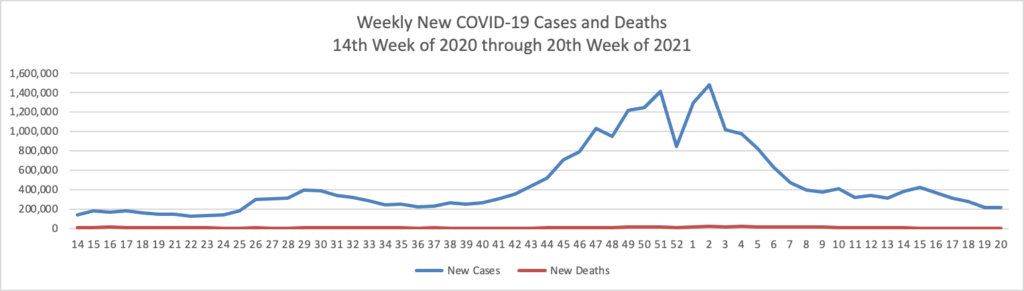
Based on the CDC’s Cases in the U.S. website, here is the FEHBlog’s chart of new weekly COVID-19 cases and deaths over the 14th through 52nd weeks of this year (beginning April 2 and ending December 30; using Thursday as the first day of the week in order to facilitate this weekly update):

and here is the CDC’s latest overall weekly hospitalization rate chart for COVID-19:

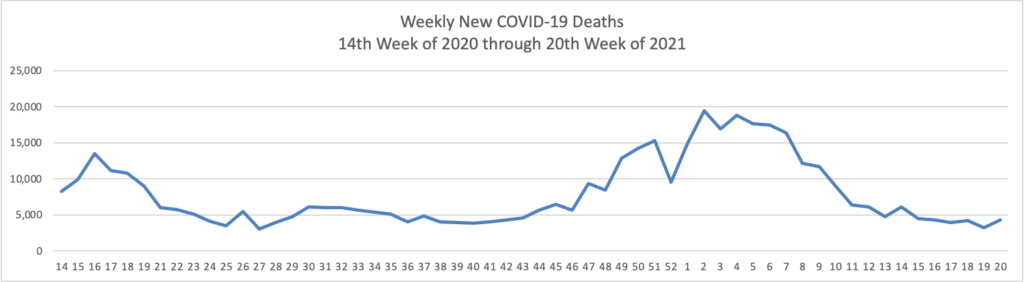
The FEHBlog has noted that the new cases and deaths chart shows a flat line for new weekly deaths  because new cases greatly exceed new deaths. Accordingly here is a chart of new COVID-19 deaths over the period (April 2 through December 30):

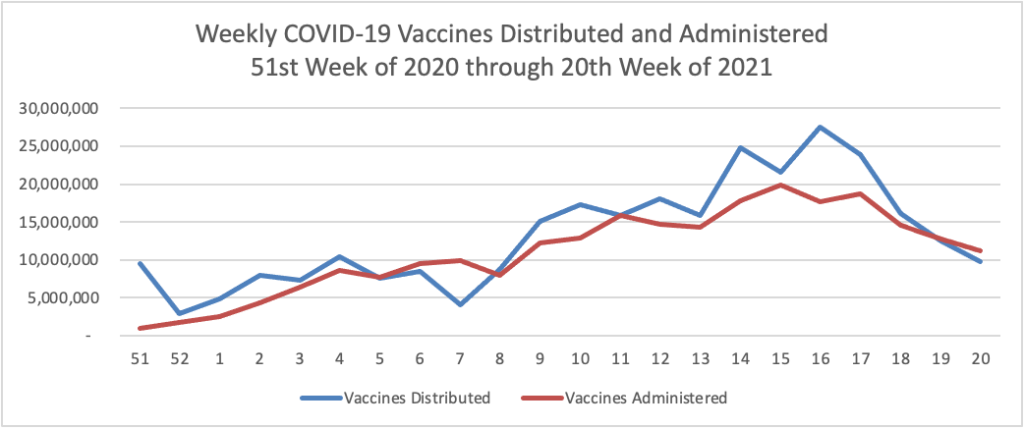
The CDC’s COVID-19 Vaccine tracker has not been updated since last Wednesday morning At that time roughly 2.8 million initial doses had been administered. The American Hospital Association and the American Medical Association have posted helpful information about the currently available COVID-19 vaccines. The Food and Drug Administration offers a comprehensive year end report.

The CDC’s FluView continues to report that “Seasonal influenza activity in the United States remains lower than usual for this time of year.”

The FEHBlog took a look at a couple of the hospital chain websites and could not find the price information required by the HHS hospital price transparency rule. However, FEP Blue, the largest FEHB plan, announced the availability of their FEP Cost Advisor Tool.

Today is the last day of the 116th Congress. The Wall Street Journal informs us that among the provisions in the Consolidated Appropriations Act, 2021, is the following

Flexible spending accounts. Many workers with FSAs that allow them to use pretax dollars to pay for unreimbursed health expenses (like glasses) or dependent-care expenses (like summer camp) didn’t use all the money in their 2020 accounts because of the pandemic. The IRS had limited ability to ease FSA rules, but Congress has now done so. 

Participants in such plans can carry over unused funds from 2020 to 2021 and 2021 to 2022, or for up to 12 months for companies with fiscal years. For dependent-care accounts, the law extends the age limit from 12 to 13 for some carried-over funds. For workers to take advantage of these changes, company plans must often opt into the new rules.

OPM typically does adopt such changes for FSAFeds.

Federal News Network reports that yesterday the Senate joined the House of Representatives in overriding the President’s veto of the FY 2021 National Defense Authorization Act. The Senate did not join the House in approving a $2000 direct stipend COVID relief proposal.

Federal News Network also reports that

With hours to spare before the new year, President Donald Trump signed an executive order Thursday night implementing a federal pay raise for civilian employees and military members in 2021. Civilian employees will receive a 1% across-the-board federal pay raise in 2021. There are no additional locality pay adjustments this year.

Happy New Year

The FEHBlog wishes all of his readers a Happy New Year.

The Wall Street Journal reports that in the wake of the December 29 D.C. Circuit opinion upholding the Trump Administration’s hospital price transparency rule,

The nation’s largest hospital chains, including publicly traded giants HCA Healthcare Inc., Universal Health Services Inc. and Community Health Systems Inc., and national nonprofit chains CommonSpirit Health and Ascension, said they planned to comply with new requirements to post pricing. Tenet Healthcare Corp. declined to comment.

“Ascension supports price transparency of our hospital services for the benefit of consumer choice and access to care for those we serve,” said Nick Ragone, a spokesman for the St. Louis-based chain.

As of Jan. 1, hospitals will be required to publish the prices negotiated privately with each payer for 300 common services for easy use by consumers, and make public the same information for all their procedures in a format that can be read and analyzed by computers.

The FEHBlog will be back on January 2 for Saturday Stats and More. Enjoy.

Midweek update

Photo by Manasvita S on Unsplash

Per the Office of Personnel Management, “The effective date of the Open Season change is the first day of the first full pay period in January. For annuitants this date will always be January 1.” It turns out that Sunday January 3, 2021, is the first day of the first full pay period in January 2021. How convenient.

The Consolidated Appropriations Act, 2021, does include the three standard FEHBP appropriations provisions — a prohibition on applying full Cost Accounting Standards coverage to FEHB contracts (Sec. 611), an abortion coverage restriction (Secs. 613, 614), and a limited contraceptive coverage mandate (Sec. 726) which the Affordable Care Act has overridden. What’s more this new law extends the option of FEHBP and FEGLI coverage to 120 tribal grant schools thereby filling a coverage gap erroneously created by the Affordable Care Act. This option is exercised by the tribal employers who must make the minimum federal civil servant government contribution toward the benefit coverage.

For the past 20 years or so, the FEHBP has offered plan members transitional care protection pursuant to President Clinton’s Bill of Consumer Rights which states in pertinent part as follows:

Consumers who are undergoing a course of treatment for a chronic or disabling condition (or who are in the second or third trimester of a pregnancy) at the time they involuntarily change health plans or at a time when a provider is terminated by a plan for other than cause should be able to continue seeing their current specialty providers for up to 90 days (or through completion of postpartum care) to allow for transition of care.

FEHB plan carriers intending to terminate a network provider for cause generally could comply with this requirement by giving affected members 90 days advance notice of the change.

It turns out that Section 113 Division BB of the Consolidated Appropriations Act, 2021, includes an Affordable Care Act amendment ensuring continuity of care. The requirements of this new law bear similarities to the FEHBP’s transitional care protections. However, as always, the devil is in the details. For example, the new law’s transitional care provisions apply to any provider contract termination, including passive non-renewals, whether triggered by the provider or the payer, with the limited exception of payer termination for fraud or failure to meet applicable quality standards. FEHB plans and OPM have a year to sort out the details before the new requirements take effect on January 1, 2022.

In other news —

The Senate moved forward today on overriding President’s veto of the FY 2021 National Defense Authorization Act but not on the $2000 COVID-19 relief direct stipend per the Wall Street Journal:

Moving through the procedural steps for overriding Mr. Trump’s veto of the National Defense Authorization Act could take up much of the Senate’s time before Sunday. Sen. Bernie Sanders (I., Vt.), in a push for a stand-alone vote on increasing the size of the direct checks, has stopped Mr. McConnell from fast-tracking votes on the NDAA override. As a result, the final vote on the NDAA may not take place until Saturday due to a series of procedural steps.

The Senate took one of those steps late Wednesday, voting 80-12 to move forward with the bill, in another show of broad, bipartisan support for the legislation Mr. Trump vetoed.

Bleeping Computer updated us on how the federal government is addressing the SolarWinds backdoor hack.

The Cybersecurity and Infrastructure Security Agency (CISA) has ordered all US federal agencies to update the SolarWinds Orion platform to the latest version by the end of business hours on December 31, 2020. CISA’s Supplemental Guidance to Emergency Directive 21-01 demands this from all agencies using Orion versions unaffected in the SolarWinds supply chain attack.

Tuesday Tidbits

Photo by Patrick Fore on Unsplash

The U.S. Court of Appeals for the District of Columbia Circuit issued an opinion today affirming a district court holding that the Trump Administration’s hospital price transparency rule is lawful. The rule takes effect on Friday January 1. Needless to say the Court also denied the appellant American Hospital Association’s motion for an emergency stay of the rule.

On a similar note, one of the transparency provisions included in the Consolidated Appropriations Act, 2021, amendments to the Affordable Care Act (Section 114 of Division BB) states:

‘‘A group health plan or a health insurance issuer offering group or individual health insurance coverage shall offer price comparison guidance by telephone and make available on the Internet website of the plan or issuer a price comparison tool that (to the extent practicable) allows an individual enrolled under such plan or coverage, with respect to such plan year, such geographic region, and participating providers with respect to such plan or coverage, to compare the amount of cost-sharing that the individual would be responsible for paying under such plan or coverage with respect to the furnishing of a specific item or service by any such provider.’’’

This new requirement, which applies to FEHB plans, takes effect with the first plan year beginning on or after January 1, 2022. The recently finalized Trump Administration’s payer transparency rule kicks in a year later. We will have to see how the Biden Administration handle this.

As the FEHBlog just picked up a couple of delicious Christmas cookies, it is time to consider the joint HHS and Department of Agriculture Dietary Guidelines for Americans 2020-2025 released today. The announcement described the publication as “the nation’s trusted resource for evidence-based nutrition guidance. The guidelines are designed for use by healthcare professionals and policy makers for outreach to the general public and provide the nutritional foundation for federal nutrition programs. The dietary guidelines should not be considered clinical guidelines for the treatment of disease.” The announcement notes that

Steeped in scientific evidence, the key recommendations look similar to those of the past and address two topics that garnered much attention throughout the development of the guidelines – added sugars and alcoholic beverages. Dietary Guidelines for Americans, 2020-2025 carried forward the committee’s emphasis on limiting these dietary components, but did not include changes to quantitative recommendations, as there was not a preponderance of evidence in the material the committee reviewed to support specific changes, as required by law. As in previous editions, limited intake of these two food components is encouraged. In fact, this sentiment remains prominent throughout the policy document and complements 

For consumers, USDA’s MyPlate translates and packages these principles of dietary guidance for Americans in a way that is handy and accessible. To share these messages broadly, USDA offers the Start Simple with MyPlate campaign and a new MyPlate websiteto help individuals, families, and communities make healthy food choices that are easy, accessible, and affordable, in addition to helping prevent chronic disease. For more information, please visit www.myplate.gov.

Funny, the FEHBlog no longer sees Christmas cookies on his plate.

P.S. The Senate did not vote on the stipend increase or the NDAA veto today per the Wall Street Journal. This session of Congress ends on Saturday.