Thursday Miscellany

Thursday Miscellany

Photo by Juliane Liebermann on Unsplash

As the FEHBlog mentioned on Sunday, today was healthcare day at the White House. Here are links to the President’s executive order intended to strengthen Medicaid and the Affordable Care Act and the related fact sheet. Health Payer Intelligence explains that

In response to the executive order, the Department of Health and Human Services (HHS) will open a special enrollment period on the federal health insurance marketplace platform. The special enrollment period will last from February 15, 2021 through May 15, 2021.

This move will give the uninsured or underinsured individuals more time to enroll on the Affordable Care Act marketplace. Not only will it open up the federally-facilitated marketplace, but this executive order will also allow state-based marketplaces on the federal platform to have a special enrollment period.

“The President will also direct federal agencies to reconsider rules and other policies that limit Americans’ access to health care, and consider actions that will protect and strengthen that access,” said the fact sheet.

The Wall Street Journal adds “Mr. Biden’s sweeping call to review decisions that could limit access to health care marks the start of a tougher battle that is likely to spur political conflict between his administration and Republicans.”

The FEHBlog did watch the Washington Post’s online Prognosis 2021 today. Dr. Vivek Murthy, the President’s nominee for Surgeon General, commented that the President’s goal of 100,000,000 doses of COVID-19 vaccine in his first 100 days in office / April 30, 2021 is a floor not a ceiling. The ultimate goal of achieving herd immunity “goes beyond” April 30. On January 26 and 27, over 2.65 million doses were administered according to the CDC. Progress is being made.

Prognosis 2021 also featured BCBSA CEO Kim Keck, who discussed the Affordable Care Act. She accurately quipped that the Affordable Care Act should be known as the Access to Care Act as we are still waiting for a law that would reduce healthcare costs.

Prognosis 2021 also included an interview with U.S. Senator and Doctor Bill Cassidy (R La.). He touted the recently enacted No Surprises Act intended to protect patients against out of network surprise billing in emergency care, air ambulance and ancillary care at in-network hospital situations. While this law will be a heavy lift to implement, the FEHBlog does expect it to be effective. Video highlights of Prognosis 2021 are available here.

Speaking of healthcare costs Healthcare Dive reports that “U.S. hospitals lost more than $20 billion from suspending elective surgeries over three months at the beginning of the COVID-19 pandemic’s onset in this country, according to an article published recently in the Annals of Surgery.” Holy smoke.

Patient safety advocate the Leapfrog Group announced

Recognizing Excellence in Diagnosis, a new national initiative to publicly report and recognize hospitals for preventing patient harm due to diagnostic errors. Developed in collaboration with The Society to Improve Diagnosis in Medicine (SIDM) and key experts, the project is funded with a two-year grant of $1.2 million by the Gordon and Betty Moore Foundation. * * *

Joining Leapfrog in leading this effort is SIDM, a nationally recognized organization focused on catalyzing efforts to improve diagnostic quality and safety, as well as convener of the Coalition to Improve Diagnosis, of which Leapfrog is a member. SIDM will develop resources to guide health systems and clinicians on improving diagnostic safety. * * *

Recognizing Excellence in Diagnosis will be conducted over two years. As a first step, the initiative will convene an advisory group of Leapfrog and SIDM representatives, patient and payor stakeholders, and experts in diagnosis and performance analysis. With guidance from the advisory group, the project will identify best practices in diagnosis and put together a roadmap for hospitals and health systems to achieve excellence. SIDM will facilitate the development of training and educational materials to support hospitals and health systems in their adoption of the best practices. In year two, Leapfrog will pilot test a national survey, similar to the annual Leapfrog Hospital Survey, to collect data from up to 100 hospitals and health systems on their adoption of identified best practices. A national report will be issued on the current status of diagnostic safety, best practices for achieving excellence, and strategies for payors and patients to incentivize improvement.

Good luck with this initiative.

Midweek Update

Photo by Manasvita S on Unsplash

A friend of the FEHBlog asked the FEHBlog to share the slide deck from this morning’s White House press briefing on COVID-19. It is chock-a-block full of useful data. Please check it out.

Fierce Pharma reports that following similar news from Moderna:

Pfizer and partner BioNTech are developing booster shots so that their COVID-19 vaccine Comirnaty can protect against new, highly contagious variants, Pfizer CEO Albert Bourla said Tuesday, according to Bloomberg.“Every time a new variant comes up we should be able to test whether or not [our vaccine] is effective,” Bourla was quoted as saying. “Once we discover something that it is not as effective, we will very, very quickly be able to produce a booster dose that will be a small variation to the current vaccine.”

That is the beauty of these mRNA vaccines.

From the complimentary webinar front —

  • The Blue Cross Blue Shield Association and the Washington Post are presenting Prognosis 2021 on Thursday January 28 at noon ET. You can register here.
  • The National Committee for Quality Assurance is discussing the Future of Health Care / Its Presidential Pitch on Tuesday February 9 at 1 pm ET. You can register here.
  • Both webinars are an hour long and the FEHBlog has registered for both of them.

The FEHBlog noticed that Modern Healthcare is tracking the Biden Administration’s regulatory freeze actions on Trump Administration “midnight” healthcare regulations. Here is a list of the frozen Trump Administration rules:

Cutting 340B drug discounts –HHS in December finalized a rule forcing community health centers to pass 340B drug discounts along to their patients, a move the Trump administration hoped would lower out-of-pocket drug costs. It faced staunch opposition from providers and patient advocates, who worried it could hamper access to care and cut already razor-thin operating margins for community health centers.

Status: On pause, Jan. 21. The rule was slated to take effect Jan. 22, but the Biden administration delayed until March 22. The rule could be withdrawn before then.

Covering dialysis treatments — The Trump administration wanted to permanently require dialysis centers to tell patients about their coverage options and premium assistance programs. It was an updated version of an Obama-era rule, which went into effect in January 2017.

Status: On pause, Jan. 26

Increasing oversight on accreditation organizations — CMS has long worried about accrediting organizations’ potential conflicts of interest, as many sell consulting services. The Trump administration was working on a rule to address them.

Status: On pause, Jan. 26

Revising Social Security and Medicare Part A relationship — Under the current rules, a person age 65 or older automatically applies for Part A coverage when they file to collect Social Security benefits. The Trump administration was working on a proposal to allow seniors to collect Social Security retirement benefits if they chose not to accept Medicare coverage for inpatient services.

Status: On pause, Jan. 26

No action has been taken on several other rules, including the prior authorization rule, the international drug pricing rule and the drug rebate restriction rule, none of which apply to the FEHBP. Needless to say industry groups are demanding action.

Healthcare Dive informs us about Blue Cross licensee Anthem’s fourth quarter 2020 earnings announcement —

  • Health insurer Anthem’s profits fell 41% in the fourth quarter of last year, due to a resurgence in care that patients put off earlier in 2020 amid the coronavirus pandemic.
  • Net income dropped to $551 million, compared to $934 million in the fourth quarter of 2019, though revenues were up 16% to $31.5 billion on higher premiums and investment income, beating Wall Street expectations.
  • Enrollment also strengthened in the fourth quarter, following quarter-over-quarter declines in the second and third quarters during the first surge of COVID-19 and subsequent economic recession.

Tuesday Tidbits

Photo by Patrick Fore on Unsplash

The Wall Street Journal has performed a tremendous public service by publishing a state-by-state guide to obtaining a COVID-19 vaccination. The information is current as of yesterday and will be updated weekly.

STAT News reports that Regeneron and Eli Lilly are pleased with progress being made in their respective trials of monoclonal antibody cocktails to treat COVID-19. “George Yancopoulos, Regeneron’s chief scientific officer, said in a statement that even with vaccines available, the antibody will be able help break the chain of infection, and may prove useful for individuals who are immunocompromised or unable to be vaccinated.”

Employee Benefits News offers an interesting story about how employers are confronting the opioid public health emergency.

Health Payer Intelligence discusses Blue Shield of California’s efforts to consolidate and simplify medical billing. What’s more,

[Blue Shield of California] aim[s] to achieve real-time claims settlement. In 2020, Blue Shield of California shortened its claim settlement timeframe from a maximum of 30 days down to six days, but in 2021 the company plans to reduce that timeframe further.

“For us, ‘real-time’ claims settlement means anywhere from three to nine seconds,” [Shayna] Schulz[, senior vice president of transformation and operations at Blue Shield of California] explained.

“We have a proof of concept that we’ve already done where we’ve been able to process one claim—but it starts with one—in nine seconds. We’re highly optimistic that we can rapidly scale this in 2022. And that’s going to be a game-changer for many hospitals.”

Indeed.

Because the FEHBlog cannot forget the SolarWinds backdoor hack, Cyber Scoop lets us know that

Email security firm Mimecast on Tuesday confirmed that the hackers behind the SolarWinds espionage campaign compromised a software certificate the firm uses to secure connections to Microsoft cloud services. The revelation underscores how deeply embedded the suspected Russian hackers have been in major technology companies as part of a campaign that has also breached multiple U.S. federal agencies. * * * Mimecast is one of many big tech firms to be implicated in the hacking campaign, which has also exploited bugged software made by SolarWinds, a Texas-based federal contractor. The attackers have viewed Microsoft’s source code and stolen the red-team tools that security firm FireEye uses to test clients’ defenses.

Finally, STAT News published today the story written by one of its star reporters Sharon Begley about lung cancer contracted by never-smokers.

Cigarette smoking is still the single greatest cause of lung cancer, which is why screening recommendations apply only to current and former smokers and why 84% of U.S. women and 90% of U.S. men with a new diagnosis of lung cancer have ever smoked, according to a study published in December in JAMA Oncology. Still, 12% of U.S. lung cancer patients are never-smokers.

Scientists disagree on whether the absolute number of such patients is increasing, but the proportion who are never-smokers clearly is. Doctors and public health experts have been slow to recognize this trend, however, and now there is growing pressure to understand how never-smokers’ disease differs from that of smokers, and to review whether screening guidelines need revision.

“Since the early 2000s, we have seen what I think is truly an epidemiological shift in lung cancer,” said surgeon Andrew Kaufman of Mount Sinai Hospital in New York, whose program for never-smokers has treated some 3,800 patients in 10 years. “If lung cancer in never-smokers were a separate entity, it would be in the top 10 cancers in the U.S.” for both incidence and mortality.

Ms. Begley was a never-smoker who succumbed to lung cancer on January 16, 2021. RIP.

Monday Roundup

Photo by Sven Read on Unsplash

The FEHBlog ran across this Health and Human Services letter to U.S. Governors thanks to the American Hospital Association’s daily email. It states in pertinent part

We are writing to you today to share more details regarding the public health emergency (PHE) for COVID-19, as declared by the Secretary of Health and Human Services (HHS) under section 319 of the Public Health Service Act (42 U.S.C. §247d). The current public health emergency was renewed effective January 21, 2021, and will be in effect for 90 days. To assure you of our commitment to the ongoing response, we have determined that the PHE will likely remain in place for the entirety of 2021, and when a decision is made to terminate the declaration or let it expire, HHS will provide states with 60 days’ notice prior to termination.

All right then.

FCW reports that President Biden “announced a raft of senior officials to help lead the Office of Personnel Management on Jan. 25. The positions are for appointments that don’t require Senate confirmation.” Consequently the lengthy list does not include the OPM Director and Deputy Director nominees. The acting Director remains Chief Management Officer Kathleen McGettigan.

The Washington Post reports that 50-50 Senate Minority Leader Mitch McConnell is ready to approve the “clean” power sharing agreement offered by Senate Majority Leader Chuck Schumer. Why? Two Democratic Senators strongly voiced opposition to repealing the legislative filibuster.

On the COVID-19 vaccination front

  • President Biden answering press questions yesterday (more detail at the link and the FEHBlog points this out because for what it’s worth it’s his sense too.)

Q   [Josh from Bloomberg] Well, my question was at what date — or, roughly, when do you think anyone who wants [a COVID-19 vaccination] would be able to get it?  Summer? 

THE PRESIDENT:  Oh, I — no, I think it’ll be this spring.  I think we’ll be able to do that this spring.  And — but it’s going to be a logistical challenge that exceeds anything we’ve ever tried in this country, but I think we can do that.

I feel confident that, by summer, we’re going to be well on our way to heading toward herd immunity and increasing the access for people who aren’t on the first — aren’t on the list, all the way going down to children and how we deal with that.  But I feel good about where we’re going, and I think we can get it done. 

  • Govexec.com reports on efforts by the Department of Veterans Affairs and the Postal Service to arrange for vaccinating their essential workforce members.
  • Stat News informs us that “Moderna is studying adding booster doses to its vaccine regimen after finding its Covid-19 vaccine was less potent against a coronavirus variant that was first identified in South Africa, the company said Monday. * * * Nevertheless, [b]oth the Moderna vaccine and the immunization from Pfizer-BioNTech produce such powerful levels of immune protection — generating higher levels of antibodies on average than people who recover from a Covid-19 infection have — that they should be able to withstand some drop in their potency without really losing their ability to guard people from getting sick.”
  • NPR News discloses that “Merck is halting development of its two COVID-19 vaccine candidates, saying that while the drugs seemed to be safe, they didn’t generate enough of an immune response to effectively protect people against the coronavirus. * * * While Merck is shelving both of its vaccine candidates, the company says it will keep working on two therapeutic drugs, including one that aims to protect the body’s respiratory system from the coronavirus’s ravaging effects. Last month, the company signed a deal with the U.S. government agreeing to supply up to 100,000 doses of one of those drugs for about $356 million.

In other healthcare news —

  • Fierce Healthcare reports that Consulting firm ADVI Health reviewed the websites for 20 (PDF) of the largest hospitals in terms of bed size and found that the largest hospitals all posted some type of pricing information online [in response to a federal transparency rule that took effect on January 1, 2021]. But many of the hospitals did not provide healthcare common procedural codes for the services, according to the analysis, which did not list the hospitals. “Many institutions didn’t use the codes, which makes it difficult to make comparisons across facilities,” said Caitlin Sheetz, lead author of the analysis and head of analytics for ADVI.”
  • Fierce Healthcare updates us on that Blue Cross’s new high performance network. “BCBSA said 45 companies have signed on to offer the Blue HPN plan to employees, reaching 55 markets and 340,000 potential members. The plan is the only HPN available in the 10 largest U.S. cities, BCBSA said. Jennifer Atkins, vice president of global network solutions at BCBSA, told Fierce Healthcare that even in its early days, Blue HPN has found success in lowering costs for employers. The HPN plan saved 11% in the total cost of care compared to a traditional PPO, she said.”
  • Fierce Healthcare also informs us that non-profit “Civica Rx announced a plan to build a major manufacturing facility to produce sterile injectable drugs for hospitals, a major step for the organization comprised of health systems such as Mayo and Intermountain. The $124.5 million project is planned for Petersburg, Virginia — just south of Richmond — and is expected to potentially create more than 180 jobs. The 120,000-square-foot manufacturing facility aims to address a major source of shortages for hospitals. Sterile injectable drugs have been a major source of shortages in recent years due in part to fewer companies making the products, according to the Food and Drug Administration.”

Weekend update

Photo by JOSHUA COLEMAN on Unsplash

Both Houses of Congress are engaged in committee and floor business this coming week. The Senate is focused on confirming the President’s cabinet nominations.

Politico reports

As Senate Majority Leader Chuck Schumer and Senate Minority Leader Mitch McConnell negotiate a power sharing agreement for a 50-50 Senate, committee assignments are still up in the air. That means that Republicans like [Sen. Ron] Johnson [R Wisc] are, for now, holding hearings and markups for President Joe Biden’s Cabinet nominees, even though Democrats are in charge of the Senate floor. 

Johnson, who will eventually hand over the top GOP slot to Sen. Rob Portman (R-Ohio), said that his committee will hold a meeting next week on Biden’s pick to lead the Department of Homeland Security, Alejandro Mayorkas. Mayorkas is facing resistance from Republicans and could be stuck in committee if he doesn’t receive enough GOP support.

The Hill reports that President Biden has released a topical daily schedule for the coming week which is full of new Executive Orders. January 28 will be Healthcare Day:

Biden on Thursday will take the highly anticipated action among pro-choice advocates of rescinding the so-called Mexico City policy, which bans the use of U.S. funding for foreign organizations that provide or promote abortions.

The policy, described as a “global gag rule” by reproductive health advocates, was first instated by then-President Reagan, and has been repeatedly rescinded by Democratic presidents and reinstated by Republican presidents in the years since.

Biden will also order a review of the Trump administration’s controversial changes to the Title X family planning program, which required family planning providers participating in the program to stop providing or promoting abortions to remain eligible for funding. 

The president is also slated to sign an executive order aimed at strengthening Medicaid and initiating an open enrollment period under the Affordable Care Act.

Fierce Healthcare reports that “Micky Tripathi, Ph.D., a recognized name in the health tech world, has been tapped as the new national coordinator for health IT under President Joe Biden’s administration. * * * Tripathi will replace the outgoing Don Rucker, M.D., who held the position since April 2017. The Office of the National Coordinator for Health Information Technology (ONC) provides counsel for the development and implementation of a national health information technology framework. * * * An expert on interoperability, privacy, and technology standards, Tripathi most recently served as chief strategy officer at Arcadia Analytics, a population health management solutions company. 

On the COVID-19 vaccination front:

  • The Wall Street Journal offers a very informative article with advice from doctors about what to expect when you have an appointment to receive the COVID-19 vaccine. This is understandably of the Journal’s top five articles.
  • America’s Health Insurance Plans has created a robust website about the COVID-19 vaccines.
  • According to the CDC’s Vaccinations data website, over 4.3 million doses of COVID-19 vaccines were administered in the U.S. on Friday and Saturday.

On the reports front —

Thursday Miscellany

Photo by JOSHUA COLEMAN on Unsplash

President Biden has issued a blizzard of executive orders over the last day and a half. The Hill summarizes them in this article, and for more details you can find the text of each order on Whitehouse.gov.

STAT News reports that

The Biden administration is willing to consider almost anything to boost the nation’s dwindling supply of Covid-19 vaccines.

A new strategy document released Thursday, totaling nearly 200 pages, offers the first clear list of the options President Biden has before him, though it doesn’t specifically say he’ll actually take all of the steps. On the list are some controversial ideas, like cutting the amount of vaccine being administered to each American. He’s also made it clear he wants to utilize the Defense Production Act to ramp up production of key supplies, and some more straightforward options like buying more doses.

Governors and mayors around the country have complained in recent weeks that they do not have enough vaccines to meet current demand. Biden, too, has acknowledged that the supply of physical vaccines is not where it needs to be to vaccinate a majority of Americans. Already, the Trump administration stopped holding vials in reserve, in hopes of releasing more vaccines to the public.

As of today, the CDC reports that nearly 38 million doses of the two dose vaccines have been distributed and around 17.5 million have been administered. 2.1 million of those doses have been administered at long term care facilities.

In that regard, the AP reports that

Drugmaker Eli Lilly said Thursday its antibody drug can prevent COVID-19 illness in residents and staff of nursing homes and other long-term care locations.

It’s the first major study to show such a treatment may prevent illness in a group that has been devastated by the pandemic. 

Residents and staff who got the drug had up to a 57% lower risk of getting COVID-19 compared to others at the same facility who got a placebo, the drugmaker said. Among nursing home residents only, the risk was reduced by up to 80%.

The study involved more than 1,000 residents and staff at nursing homes and other long-term care locations like assisted living homes. The vast majority tested negative at the start of the study. Some were assigned to get the drug, called bamlanivimab and which is given through an IV, and others got placebo infusions.

Also on the prescription drug front, STAT News informs us that

The Food and Drug Administration has approved a monthly injectable medication, a regimen designed to rival pills that must be taken daily.

The newly approved medicine, which is called Cabenuva, represents a significant advance in treating what continues to be a highly infectious disease. In 2018, for instance, there were approximately 36,400 newly infected patients living with HIV in the U.S., according to the Centers for Disease Control and Prevention. About 1.7 million people worldwide became newly infected in 2019, according to UNAIDS.

Although several medicines exist for treating HIV, ViiV Healthcare is banking on the improved convenience of getting a monthly shot, even if it must be administered by a health care provider. The company, which is largely controlled by GlaxoSmithKline (GSK), gathered data showing nine of 10 patients in pivotal studies claimed to prefer the shot over taking pills each day.

The Wall Street Journal reports on a phenomenon that has attracted the FEHBlog’s attention — the low levels of flu infections this winter across the Northern Hemisphere, including the U.S.

The WHO says the measures people and governments are taking to prevent the spread of Covid-19, such as wearing masks and limiting public gatherings, have probably helped keep the flu in check. Increased flu vaccination rates may also be contributing, it says.

Another hypothesis holds that the broad spread of SARS-CoV-2, the virus that causes Covid-19, in countries like the U.S. may play a role in blocking the flu by lifting people’s immunity against other viruses. One study in the spring of 2020 in New York City found that people testing positive for SARS-CoV-2 were far less likely to be carrying other common viruses such as influenza viruses. Still, research into that hypothesis is just beginning.

What is clear is the historically low number of people with the flu.

The FEHBlog also ran across another interesting Cyberscoop article with more of the backstory on the SolarWinds backdoor hack as uncovered by Microsoft.

Attackers behind an espionage campaign that exploited software built by the federal contractor SolarWinds separated their most prized hacking tool from other malicious code on victim networks to avoid detection, Microsoft said Wednesday.

The findings make clear that, while the hackers have relied on a variety of tools in their spying, the tampered SolarWinds software functioned as the cornerstone of an operation that Microsoft described as “one of the most sophisticated and protracted” of the decade. Multiple U.S. federal agencies focused on national security have been breached in the campaign, which U.S. officials have linked to Russia. * * *

After the SolarWinds trojan was delivered to organizations, the attackers spent about a month pinpointing victims, according to Microsoft. As early as May 2020, the hackers were doing the “real hands-on-keyboard activity” of moving through victim networks for valuable data, Microsoft said.

The hackers were meticulous in covering their tracks. They prepared unique malicious code implants for each victim machine, according to Microsoft, and changed timestamps of the digital clues they left behind to complicate the recovery process for organizations. Microsoft called the former technique an “incredible effort normally not seen with other adversaries and done to prevent full identification of all compromised assets.”

Happy Inauguration Day

Mount Rushmore

Joe Biden and Kamala Harris were sworn in as President and Vice President this morning. Good luck to them both on this National Day of Unity.

The President issued fifteen executive orders today. Among the new requirements are the following per the Wall Street Journal

  • The 100-day [COVID-19] mask mandate applies on federal property and on airlines, trains and transit systems traveling between states, though Mr. Biden will direct the government to work with state and local authorities on similar steps.
  • [The establishment of] an office of White House Covid-19 response, headed by Jeffrey Zients, Mr. Biden’s coronavirus czar, which will work with federal agencies and report directly to the president. Goals include securing more protective equipment for workers, increasing testing and vaccinations and reopening schools.
  • Mr. Biden also called for extending the federal eviction moratorium until at least March 31 and the pause on interest and principal payments for direct federal loans until at least Sept. 30.

The President’s chief of staff imposed a regulatory freeze pending review and approval by Biden Administration officials. This order applies, for example, the proposed HIPAA Privacy Rule amendments discussed in yesterday’s post as well as the HHS and CMS rule makings discussed earlier this month. That’s a sensible action.

Govexec.com reports that Kathleen McGettigan is replacing Michael Rigas, who resigned, as acting OPM Director. Ms. McGettigan, who is OPM’s Chief Management Officer, previously served in this position during other transition periods. Govexec.com adds that President “Biden has yet to name a nominee for OPM director.”

In other developments today

  • STAT News reports that “Amazon has reached out to President Joe Biden to offer logistical and technical support for his goal of vaccinating 100 million Americans within his first 100 days in office.”
  • Healthcare Dive informs us that “UnitedHealth Group beat Wall Street expectations for both earnings and revenue in fourth-quarter financial results released Wednesday, as care consumption and prescriptions returned to more normal levels despite fears of renewed deferrals as COVID-19 cases surge.”
  • The Health Affairs Blog identifies five healthcare trends to watch this year.

Tuesday Tidbits

Photo by Patrick Fore on Unsplash

Surprise! The FEHBlog mentioned the other day that he considered the Trump Administration’s proposed HIPAA Privacy Rule amendments to be a dead letter because they had not been scheduled to be published in the Federal Register today, the last day of the Trump Administration’s Federal Register. Well, as it turns out, that proposed rule showed up in the Federal Register public inspection list today with a Federal Register publication date of Thursday January 21. In any event. as the FEHBlog mentioned, the Biden Administration will be decide the fate of this rule making, which for what it’s worth the FEHBlog considers to be a helpful improvement.

Also today, OPM released a preview of the 2020 Federal Employee Viewpoint Survey results. “A preview of the governmentwide results are heartening,” said Acting Director Michael Rigas. “Through the toughest times, employees have been resilient and motivated while supervisors and senior leaders alike have served employees well by embracing their roles to keep employees safe and informed.”  Well done, OPM and federal agency employers and employes.

The FEHBlog is a fan of new health plan designs. Fierce Healthcare reports that

UnitedHealthcare is launching a new, virtual primary care option as part of an effort to expand access to local clinicians in its employer-sponsored plans.

Virtual primary care will be available to members in certain employer plans across 11 states, UnitedHealthcare said in an announcement. The insurer expects to expand the offering to additional states over the course of the year.

The goal, UnitedHealth said, is to make it easier for patients to establish and maintain an ongoing relationship with a primary care provider.

“The UnitedHealthcare Virtual Primary Care service and updated policy help expand the use of virtual care from delivering care to people who are sick, to now also focusing on preventing and detecting disease before it starts and, if needed, helping people more conveniently manage certain chronic conditions,” said Anne Docimo, M.D., chief medical officer at UnitedHealthcare,” in a statement.

Creative.

In another creative move, Fierce Healthcare calls our attention to the following:

As healthcare continues to evolve, legacy players are aiming to be the first to gain access to the latest innovations.

At Anthem, that effort has meant launching its own Digital Incubator, which pairs financial backing with mentorship and opportunities for partnerships with universities and corporations.

“Essentially, we are looking to get access to cutting-edge healthcare products,” said Kate Merton, staff vice president and head of Anthem Digital Incubator, in an interview with Fierce Healthcare. “We work with our entrepreneurs early in the cycle to make sure they’re developed with the mindset of the payer, of the consumer and the provider all in one.”

ADI offers a number of pathways for innovators to take and operates in both digital and physical platforms, with its first incubation space opening in Palo Alto, California.

On the mental healthcare front —

  • IFEBP informs us that the Department of Labor’s Employees Benefit Security Administration, which enforces ERISA, “released the Fiscal Year (FY) 2020 Mental Health Parity and Addiction Equity Act (MHPAEA) fact sheet on investigations.”
  • “The U.S. Department of Health and Human Services (HHS) and the Office of the Surgeon General (OSG)—in collaboration with the National Action Alliance for Suicide Prevention (Action Alliance)—released The Surgeon General’s Call to Action to Implement the National Strategy for Suicide Prevention. This new report outlines the actions that communities and individuals can take to reduce the rates of suicide and help improve resilience.”

Catchup Sunday

Happy Martin Luther King, Jr. Day weekend.

HHS issued several final rules on Thursday and Friday last week, none of which apply directly to the FEHBP:

  • The Centers for Medicare and Medicaid Services (CMS”) issued a final rule intended to streamline health plan prior authorization request to providers. America’s Health Insurance Plans, the health insurer trade association, was unimpressed. This rule applies to HHS’s own programs, e.g., Medicare, Medicaid, CHIP, the Qualified Health Plans in the ACA marketplace.
  • CMS also a final Calendar Year (CY) 2022 Medicare Advantage and Part D Rate Announcement, finalizing Medicare Advantage (MA) and Part D payment methodologies for CY 2022. Here’s a link to the fact sheet.
  • HHS also issued part of the final CY 2022 Notice of Benefit and Payments Parameters required by the Affordable Care Act. Katie Keith outlines the notice on the Health Affairs blog, noting

On January 14, 2021, the Centers for Medicare and Medicaid Services (CMS) released its final 2022 Notice of Benefit and Payment Parameters rule, joined in part by the Treasury Department. Historically, the “payment notice” adopts major changes for the next plan year in areas such as the exchanges and the risk adjustment program. Here, however, the final 2022 payment notice adopts only a subset of the policies considered in the proposed 2022 payment notice. This subset of policies includes the most controversial changes that had been included in the proposed rule. The final rule was accompanied by a fact sheet and a press release.

  • A friend of the FEHBlog called to his attention the fact that the Trump Administration HHS never published its proposed HIPAA privacy rule changes, announced December 10, 2020, in the Federal Register. (The HIPAA Privacy Rule does apply to the FEHBP.) What’s more the rule making cannot be found on the Federal Register’s latest public inspection list. The Biden Administration HHS will now have the opportunity to reconsider these “final actions” as well as what to do if anything with the proposed privacy rule changes.

The FEHBlog noticed that on January 7, 2021, the HHS Secretary extended the opioid crisis public health emergency another 90 days into April 2021.

Healthcare Dive informs us that

  • The Federal Trade Commission sent orders to six health insurance companies to obtain patient-level claims data for inpatient, outpatient, and physician services from 2015 to 2020, the agency said Thursday.
  • The FTC wants to figure out how hospitals’ acquisitions of physician practices has affected competition.  
  • The agency sent orders to some of the nation’s largest insurance companies, including UnitedHealthcare, Anthem, Aetna, Cigna, Florida Blue and Health Care Service Corporation.

Federal government personnel moves:

  • The Boston Globe reports that “President-elect Joe Biden on Friday nominated Eric Lander, a pioneer in the study of the human genome and the founding director of the Broad Institute of MIT and Harvard, to be his chief science adviser in a newly created Cabinet position. If confirmed by the Senate, Lander will be the first science adviser to serve in a presidential Cabinet * * *.
  • Medical Design and Resourcing reports that Food and Drug Administration (“FDA”) “veteran Dr. Janet Woodcock has been tapped as interim FDA commissioner by the Biden administration, according to published reports.” Dr. Woodcock currently serves as the FDA’s Director of the Center for Drug Evaluation and Research.
  • Bloomberg Law reports that Dr. “Francis S. Collins will stay on as NIH director under the Biden administration, making him one of the few biomedical agency directors to span three presidents.”
  • Govexec.com reports that “President-elect Joe Biden has named Jason Miller as his government management czar, tapping a former Obama administration economic adviser for the key role in setting the president’s management and federal workforce agenda. * * * Should Miller be confirmed by the Senate, he would serve under OMB Director-designate Neera Tanden if she is confirmed and replace Michael Rigas, who is serving in the OMB management role—and that of Office of Personnel Management director—in an acting capacity. The last Senate-confirmed official to hold the management position was Margaret Weichert, a Trump nominee who served concurrently as acting OPM director. Biden has yet to name a head of OPM.”
  • The Washington Post and the Partnership for Public Service offer a Biden Administration political appointee tracker.

As this is the FEHBlog, it is worth noting that Federal News Network has reported on the OPM’s Inspector General’s report on the impact of COVID-19 on the FEHBP. The OIG’s analysis was found in its September 2020 semi-annual report to Congress. Federal News Network queries “What about 2022, or future years for that matter, when FEHB enrollees flock back to their doctor’s offices again for those checkups and preventative procedures they’ve been putting off?”

Bear in mind that all health U.S. plans including FEHB plans experienced a V shaped drop in claims at the height of the great hunkering down last Spring. Many preventive tests are not required annually. The FEHBlog got his routine physical last summer by a combination of a holding a televisit with the doctor and giving blood etc. at the doctor’s office. Furthermore, prescription drug claims have held steady throughout the pandemic and flu cases remain “unusually low” during this winter. We will get through this together. When we reach the new normal, the healthcare sky will not fall in, at least in the FEHBlog’s view.

Friday Stats and More

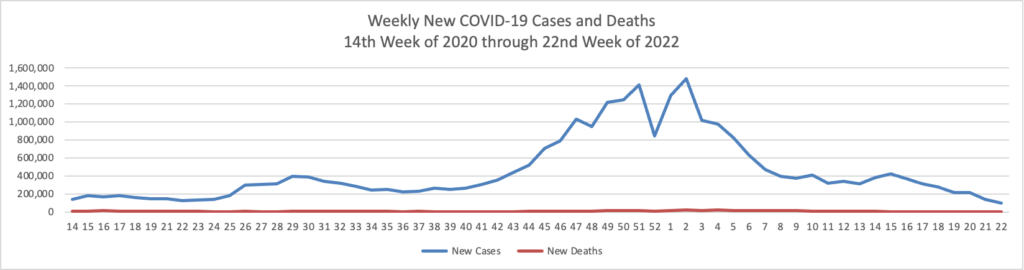
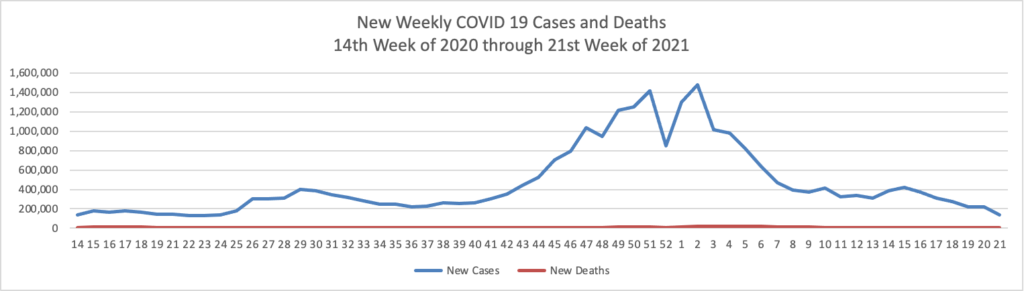
Based on the CDC’s COVID Data Tracker website, here is the FEHBlog’s chart of new weekly COVID-19 cases and deaths over the 14th week of 2020 through the second week of this year (beginning April 2, 2020 and January 13, 2021; using Thursday as the first day of the week in order to facilitate this weekly update):

and here is the CDC’s latest overall weekly hospitalization rate chart for COVID-19:

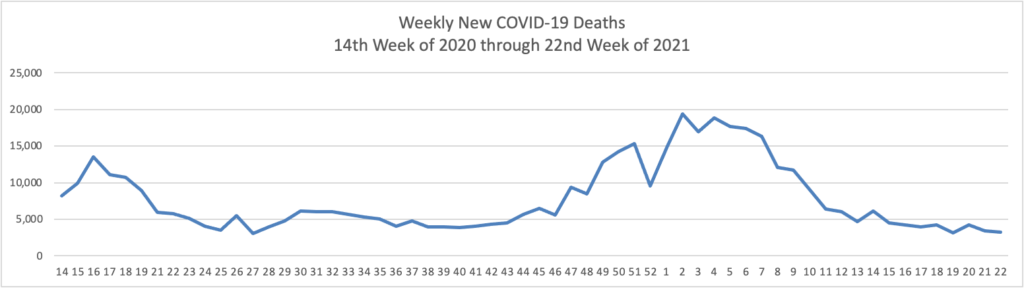
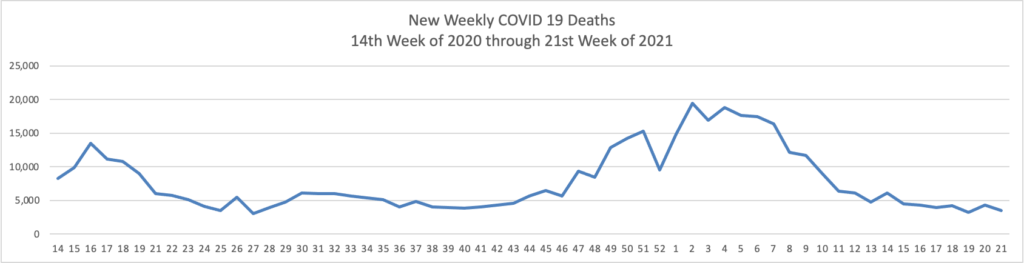
The FEHBlog has noted that the new cases and deaths chart shows a flat line for new weekly deaths  because new cases greatly exceed new deaths. Accordingly here is a chart of new COVID-19 deaths over the same period April 2, 2020 through January 13, 2021:

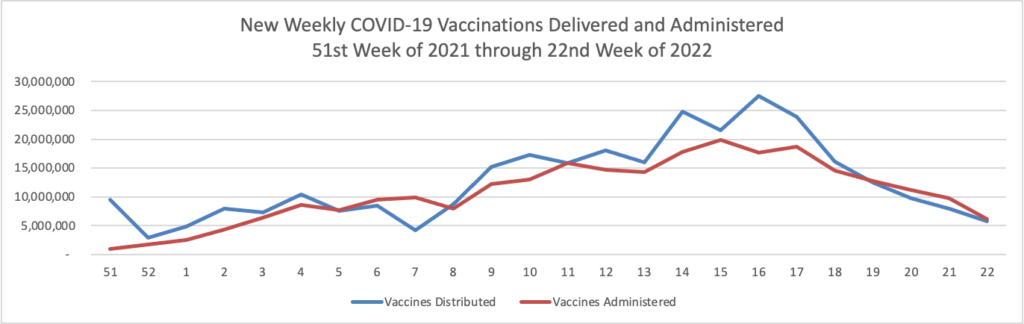
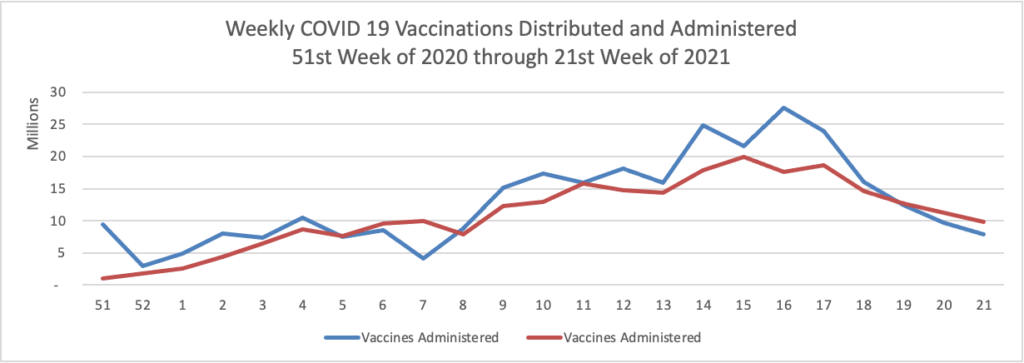
Finally here is a COVID-19 vaccinations chart for the past month which also uses Thursday as the first day of the week:

The CDC reports that as of today at 9 am roughly 10.6 million American have received one dose of either the Pfizer or Moderna vaccine and 1.6 million American have received both doses. 1.1 million doses of the vaccines were administered yesterday in total.

President-elect Biden announced additional members of his COVID-19 response team today, including

David Kessler, Chief Science Officer of COVID Response
David A. Kessler, M.D., who serves as a co-chair of the COVID-19 Task Force for President-elect Joe Biden, was the Commissioner of the Food and Drug Administration from 1990 to 1997, under Presidents George H. W. Bush and Bill Clinton. 

Per the American Hospital Association, this role will assume the responsibilities of the current head of Operation Warp Speed.” Beckers Hospital Review informed us on January 13 that “Moncef Slaoui, PhD, chief advisor of Operation Warp Speed, submitted his resignation at the request of President-elect Joe Biden’s team, although he’ll stay on for another month to oversee the transition to the new administration, CNBC reported Jan. 12. To close the loop NPR reports that the Biden Administration plans to retire the Operation Warp Speed moniker.

Also on the COVID-19 vaccine front, the Wall Street Journal reports tonight that

If manufacturing projections previously put forth by companies hold up, Mr. Biden’s pledge to administer 100 million doses of Covid-19 vaccines during the first 100 days of his presidency should be possible, according to manufacturing and supply chain experts. But efforts to significantly ramp up vaccines and curtail spread of the virus will depend on state partnerships and public buy-in for some public health measures. * * *

The success of the vaccination push rests in part on available supplies and the ability of a workforce to provide shots. Mr. Biden’s plan seeks to address both challenges through the expanded use of the Defense Production Act and a call for letting more people, including retired medical professionals, administer vaccines with training. He would also expand the use of pharmacies to provide vaccines.

The federally backed community vaccination centers would involve the Federal Emergency Management Agency, the National Guard and state and local teams. The administration would use federal resources and its emergency contracting authority to help launch the centers.