Monday Roundup

Monday Roundup

Photo by Sven Read on Unsplash

The Wall Street Journal offers an interesting story about how many patients with long or long haul COVID-19 (about 10% of total case) wind up receiving cognitive rehabilitation.

Cognitive problems are some of the most persistent and common long-term symptoms that people struggle with months after getting Covid. Patients report short-term memory problems, slow processing speeds, poor word recall and difficulty multitasking. To help them, doctors at medical centers including Mayo Clinic, Yale and Johns Hopkins are starting to refer some patients to cognitive rehabilitation more typically used for patients with concussions and other traumatic brain injuries. 

AHIP presents an interview with Kim Lauersdorf, Vice President of Marketing at EmblemHealth, about crafting communications about vaccinations, including the COVID-19 vaccines.

“What should health care organizations take away from the study, what are some next steps to help drive vaccine adoption and acceptance?“

Lauersdorf: As health care professionals, we need to accept responsibility when communicating to our base and know that if we are not intentional of the language we use, the voices we amplify, and the methodologies we use to get our messages out, we will perpetuate greater health disparity.

First, it’s clear that terminology matters. The widely used term “shot”, for example, evokes significant negative connotations across all populations, but specifically in low-income, younger, and Black communities. Clinically, it evokes needles, injection, and pain. Non-clinically, it evokes violence. Continued usage of the term will drive continued disparity in vaccine adoption.

Second, we must amplify trusted voices. People, across the board, trust their primary care providers above all other messengers. To take this even further, people have more trust in primary care providers who look like them or come from their same communities.

In addition, word of mouth—especially from trusted sources—is as important today as it ever was. Even more so, as we are each dealing with a worldwide crisis, coupled with a large scale, new, possible way out of it. We have to understand that this is all new territory that this generation has never experienced before. That too fosters hesitation.

Third, we must use multiple channels to get our messages out. While there has been an increase in digital health adoption, as seen through rising telehealth usage, we have to know that many of our communities still don’t have reliable Internet access or access to certain technology. We have to get our message to all of those we serve to ensure vaccine adoption doesn’t perpetuate existing health disparities.

The American Hospital Association reports on five takeaways from a maternal / mental healthcare conference. Here’s one of them:

Technology alone will not be enough.

The COVID-19 pandemic has proven how crucial technology is for health care delivery. Telehealth improves access to OB/GYNs, doulas, lactation consultants and specialists. Remote patient monitoring, chat and text-based navigation services, and apps have provided additional ways to support and coordinate care. 

Yet, speakers acknowledged technology alone will not be enough. Melissa Hanna, founder and CEO of Mahmee, which delivers data-driven care coordination and personalized support to new moms, shared “technology will not be the end all be all solution” to our challenges in maternal health. She also shared, “this is always going to be about care, and it’s plenty of people working together to center the experiences of mothers, and be there in a proactive way to guide, support and advocate.” 

We have seen firsthand that a combined approach of offering health care services through technology and human connection can drive better outcomes for mothers. Mayo Clinic developed the OB Nest program to optimize prenatal care for low-risk expectant mothers. The program uses a combination of in-person and telehealth prenatal visits, home monitoring, and a social media community that allows patients to share their experiences with other mothers. It also has dedicated nurses that help with patient education and serve as a resource for mothers throughout the program. This combination has provided pregnant moms with more autonomy in their prenatal care. 
 

In other benefit news

  • Fierce Healthcare reports that Verizon has jumped into the telehealth market with an offering directed at providers of care.

Many hospitals and health clinics have adopted video conferencing services during the pandemic for providing patient care. BlueJeans Telehealth, which launched Monday, was designed from the ground up for healthcare organizations to simplify the virtual experience and offer greater access to care, Verizon executives said in a press release.

  • Employee Benefit News informs us that

Benefitfocus, a cloud-based software solutions provider for healthcare and benefits administration, published a report on the current state of employee benefits. The research provides insight into employee enrollment behavior for the last four years, and takes a closer look at how 2020 impacted employee benefits.

The EBN article offers an interview with Benefitfocus’s director of consumer advocacy.

Finally former NTEU President Robert Tobias presents in Govexec.com his thoughts on the National Academy of Public Administration’s recent report on the future of OPM.

Friday Stats and More

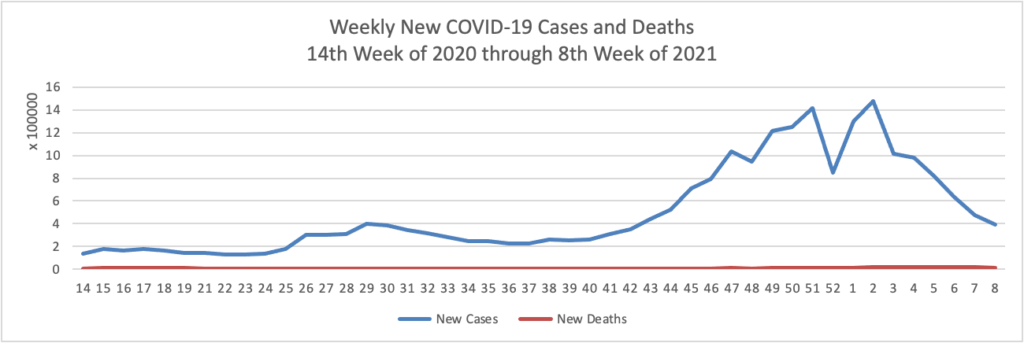
Based on the Centers for Disease Control’s COVID-19 Data Tracker website, here is the FEHBlog’s chart of new weekly COVID-19 cases and deaths over the 14th week of 2020 through 12th week of this year (beginning April 2, 2020, and ending March 24, 2021; using Thursday as the first day of the week in order to facilitate this weekly update):

and here is the CDC’s latest overall weekly hospitalization rate chart for COVID-19:

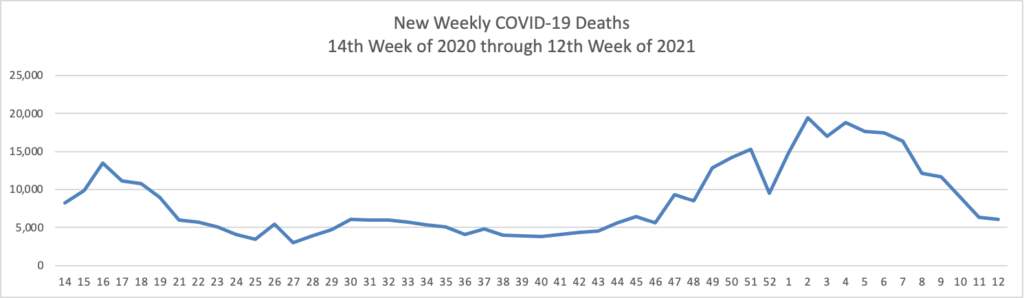
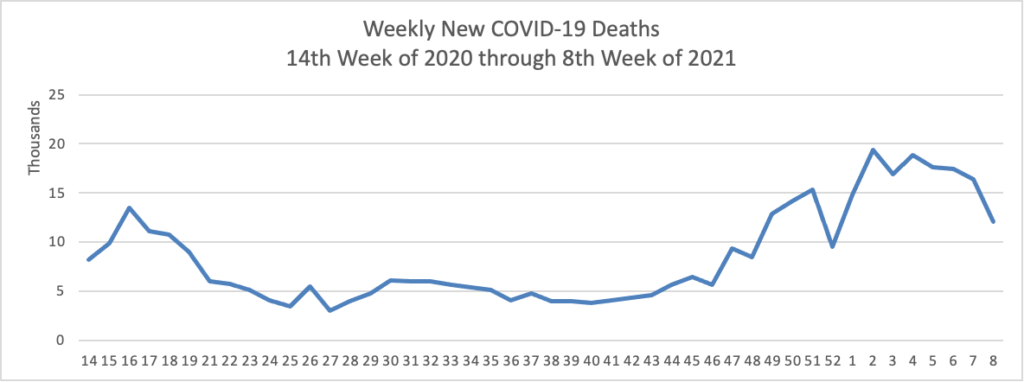
The FEHBlog has noticed that the new cases and deaths chart shows a flat line for new weekly deaths  because new cases greatly exceed new deaths. Accordingly here is a chart of new COVID-19 deaths over the period (April 2, 2020, through March 24, 2021):

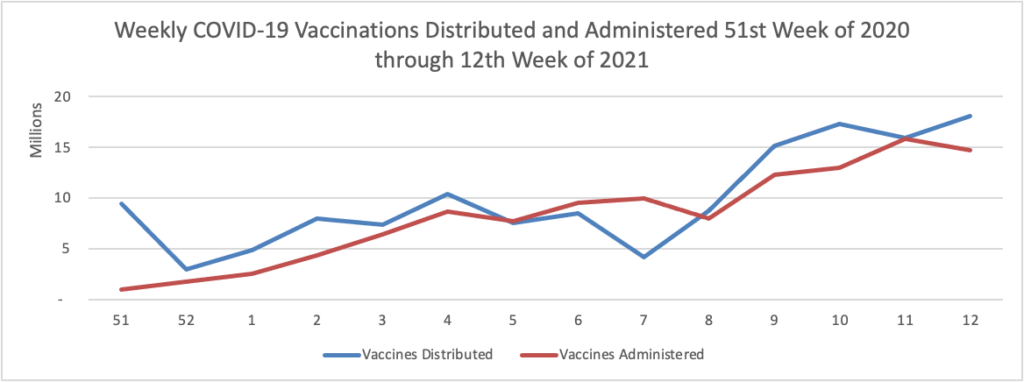
Finally here is a COVID-19 vaccinations chart for the past three months which also uses Thursday as the first day of the week:

The charts continue to look pretty good. As of today 34.6% of the U.S. population over 18 years old has received at least one dose of the COVID-19 vaccine and 46% of the U.S. population over 65 years old is fully vaccinated.

STAT News reports that

Pfizer and BioNTech said Thursday they are beginning a study aimed at showing their Covid-19 vaccine can be used in children as young as 6 months.

The study follows the launch of a separate and ongoing trial in children ages 12 to 15, which was fully enrolled in January. That study could lead to results by the end of the first half of the year, depending on the data, and then to an emergency use authorization. That will depend on the Food and Drug Administration and the Centers for Disease Control and Prevention. The vaccine already has an EUA for people 16 and older.

“The FDA, if it sees fit to do this, could, grant an EUA and get them into children in that age group by the fall, provided the CDC also agrees and that that should be the vaccine they receive,” said William Gruber, Pfizer’s senior vice president of vaccine clinical research and development.

Moderna began a similar study of their vaccine on children from age 6 months to 12 years old on March 16.

STAT News also offers “A user’s guide: How to talk to those hesitant about the Covid-19 vaccine.” Here’s one good idea:

Have a conversation

Don’t lecture your family and friends, and don’t assume you know what their concerns are. Make sure to listen.

“Try to address their concerns, not what you assume are their concerns,” said Jorge Moreno, an internist and assistant professor at the Yale University School of Medicine. While you may be thinking people are ensnared in the darkest of conspiracy theories, many may have concerns that are much simpler to address. For Moreno, who even had to convince his mother the vaccine was safe, many questions he’s received have centered around side effects, and whether they might make people too sick to work. A Carnegie Mellon University survey released this week showed 70% of vaccine-hesitant people were concerned about side effects.

“Let people know it’s OK to have questions and that having concerns is legitimate,” added Reed Tuckson, the former public health commissioner for Washington, D.C., and a founding member of the Black Coalition Against Covid, which co-developed a campaign called “The Conversation” to provide Black families credible vaccine information. “Letting people have a safe space to have this conversation is essential,” he said. “Wagging your finger against someone is not very useful.”

From the tax front:

  • The Internal Revenue Service recently announced that “amounts paid for personal protection equipment, such as masks, hand sanitizer and sanitizing wipes, for the primary purpose of preventing the spread of the Coronavirus Disease 2019 (COVID-19 PPE) are treated as amounts paid for medical care under § 213(d) of the Internal Revenue Code (Code). * * * Group health plans, including health FSAs and HRAs, under the terms of which expenses for COVID-19 PPE may not be reimbursed, may be amended pursuant to this announcement to provide for reimbursements of expenses for COVID-19 PPE incurred for any period beginning on or after January 1, 2020, and such an amendment will not be treated as causing a failure of any reimbursement to be excludable from income under § 105(b) or as causing a § 125 cafeteria plan to fail to meet the requirements of § 125.”
  • What’s more, Spotlight on Benefits explains how the IRS has clarified Pandemic-Related Relief for Dependent Care FSAs.

In healthcare business news, Healthcare Dive explains why being a hospital chief financial officer is a particularly tough job during the pandemic. Also Fierce Healthcare discusses a CIGNA telehealth study finding that

while virtual visits for other types of services declined after the initial COVID-19 spike, virtual visits for behavioral health remained in high demand. In April 2020, virtual visits made up about 50% of claims for non-behavioral health services and declined over the course of the year to account for nearly 25% today.

“Virtual behavioral health care is not only a way to access mental health services in the wake of social distancing, but it also allows us the option to pursue treatment in the privacy and comfort of our own homes,” Lustig said.

By contrast, in April, 66% of office visits for behavioral health were conducted virtually, and it’s remained largely flat since.

Behavioral telehealth users also reported higher productivity at work, according to the survey. These patients reported a 45% decrease in sick days, compared to a 28% decrease in miss workdays among patients who did not use telehealth.

That’s good news for the spoke and hub telehealth companies and for health plans and consumers because the spoke and hub telehealth network therapists are in-network.

Midweek update

Photo by Manasvita S on Unsplash

From Capitol Hill, STAT News reports that Senate leaders have reached an agreement to extend a Medicare pay bump for health care providers through 2021, a major lobbying win for hospitals.”

The Wall Street Journal reports two Senate confirmations in healthcare positions:

The Senate [today] confirmed Dr. Rachel Levine as assistant health secretary, making her the first openly transgender federal official approved by the Senate.

The vote was 52 to 48, largely along party lines, with GOP Sens. Lisa Murkowski of Alaska and Susan Collins of Maine joining all 50 Democrats.

The pediatrician and former Pennsylvania secretary of health helped steer the state’s response to Covid-19. She has also worked to increase awareness of equity issues that the LGBT community faces and is a professor of pediatrics and psychiatry at Penn State College of Medicine. 

and

Yesterday, the Senate approved Vivek Murthy, President Biden’s pick for surgeon general, by a 57-to-43 vote, marking his second stint in the post, which he held from 2014 through 2017. Dr. Murthy, who was co-chairman of Mr. Biden’s Covid-19 advisory board, has said he would use his position to provide science-based guidelines for ending the coronavirus pandemic.

From the COVID vaccine front, Medscape informs us that

White House officials said at a briefing Wednesday they are still anticipating updated vaccine data from AstraZeneca, after federal officials called Tuesday’s release of interim phase 3 data from the company “outdated information.”

“Right now, AstraZeneca is getting back with the Data and Safety Monitoring Board and will likely come out with an updated statement,” said Anthony Fauci, MD, a top COVID-19 official and chief of the National Institute of Allergy and Infectious Diseases, the agency that complained to the pharmaceutical company that their current information was “incomplete.”

Andy Slavitt, senior White House adviser for COVID-19 response, added: “Our takeaway is the importance of transparency and trust…. I would urge us not to focus on the process of the last couple days, but instead to focus on what really matters, which is what happens when these applications for these candidates are submitted to the FDA.”

FLASH — The Washington Post reported at 10:30 pm Wednesday night that

An updated company analysis of the coronavirus vaccine developed by AstraZeneca and the University of Oxford showed that the two-shot regimen was robustly effective — 76 percent at preventing symptomatic illness — according to a news release from the drugmaker late Wednesday.

The finding, only slightly lower than results announced days earlier, underscores that the vaccine being widely used by many countries appears to be a powerful tool to help end the pandemic. No severe cases of illness were reported in study volunteers who received the vaccine. Among people 65 and older, the vaccine was 85 percent effective, the company reported.

Yesterday, the FEHBlog watched a Wall Street Journal interview with Mr. Slavitt as part of the WSJ’s Health Forum. The FEHBlog really enjoyed this WSJ video featuring reporter Joanna Stern with a COVID vaccine hunter from New Jersey. It’s certainly worth five and half minutes of your day.

HR Dive reports that

Employers should offer paid sick leave to employees with “signs and symptoms” following COVID-19 vaccination, according to guidance updated March 16 by the Centers for Disease Control and Prevention.

Employers should consider on-site vaccination programs if they have a large workforce with predictable schedules and enough space to run a clinic that meets social distancing requirements, CDC said. Employers that choose to offer vaccinations should record each offer and employees’ decisions. Employers should consider off-site vaccination if they are a small- or medium-sized organization lacking the resources to host a vaccination clinic, it said.

The agency also said that whether an employer may require COVID-19 vaccinations is a matter of state or other applicable law but noted that exemptions may apply: Medical exemptions for people who are at risk for an adverse reaction because of an allergy to one of the components used in the vaccine or a medical condition; and religious exemptions for people who reject being vaccinated because of their religious beliefs.

In healthcare business news, Fierce Healthcare lets us know that

Uber is ramping up its prescription delivery business by teaming up with software company ScriptDrop. The ride-share giant will be the default delivery service for ScriptDrop pharmacies in 37 states and will eventually expand to others.

ScriptDrop works with some of the top grocery chains, pharmacy chains and health systems in the U.S., including Albertsons, Jewel-Osco, Safeway and Vons. Through the tie-up with Uber, those pharmacies will be able to leverage the company’s technology to deliver more prescriptions to more customers.

From the report front, the FEHBlog noticed

Finally March 22 to 28, 2021, is National Drug and Alcohol Facts Week. “Held since 2010, NDAFW brings teens and scientific experts together to discuss the scientific facts about drugs, as well as their potential health effects on teen bodies and brains. ”

Thursday Miscellany

Photo by Juliane Liebermann on Unsplash

In the wake of yesterday’s announcement that Amazon is breaking into the employer sponsored plan telehealth market, there was plenty of news today about telehealth.

STAT News reports that

“The market for virtual care is still massively underpenetrated,” wrote Cowen analysts Charles Rhyee, Calvin Sternick, James Auh, and Gwen Shi in a research note Wednesday. While Teladoc expects to provide 10 million visits in the U.S. in 2021, each year the country sees roughly 850 million outpatient visits, plus 300 million additional visits specific to mental health, according to the Cowen analysts. “This is not a zero sum game by any stretch,” they added.

Med City News effectively seconds this point of view as follows:

Amazon will need to build out relationships with health plans and health systems, so it can have a referral network for patients who need to see a specialist.   Teladoc, for example, says it has partnerships with more than 50 health plans and 600 health systems, perhaps implying that it’s not going to be that easy.

“New entrants to virtual care will continue to confront many of the challenges Teladoc Health has overcome over the past decade as we have built worldwide capabilities to deliver, enable and empower whole-person virtual care,” a Teladoc spokesperson wrote in an email.

While that may well be true, what Teladoc and Amwell encountered and overcame was low utilization — something that Amazon won’t have to contend with given that Covid-19 has ramped up utilization and adoption sky-high.

It will be interesting to see the jockeying for market share, but no matter which company wins, telehealth has already come out on top.

In that regard, Healthcare Dive reports that “Virtual behavioral health visits surged in the first half of 2020 as the COVID-19 pandemic exacerbated mental health needs, according to a new analysis by Milliman and Well Being Trust.”

Healthcare IT News cautions us that “Telehealth experienced sudden and massive growth starting a year ago, but it didn’t happen everywhere. A new report from the RAND Corporation suggests that the biggest upticks in virtual care availability occurred in more affluent and metropolitan communities, and that telemedicine services were mostly enjoyed by patients with private insurance.”

Healthcare Dive offers an interview with Health Affairs editor in chief Alan Weil that features a discussion of telehealth.

In healthcare equity news

  • Health Payer Intelligence reports that “Blue Shield of California has enhanced its provider network to expand COVID-19 vaccine access in underserved communities.”
  • Fierce Healthcare reports that

The Blue Cross Blue Shield Association (BCBSA) is teaming with Feeding America for COVID-19 vaccine outreach in vulnerable communities.

Clinical information and educational materials highlighting the safety and efficacy of the vaccines will be made available at Feeding America’s 200 food banks, which reach 40 million people. BCBSA will provide physical handouts as well as social media posts with information from the Centers for Disease Control and Prevention and its own clinicians.

The materials will be available in both English and Spanish, BCBSA said, and aim to “dispel common myths” that may prevent people from getting vaccinated.

In other healthcare industry news

  • Healthcare Dive reports that the Senate confirmed the President’s nomination of Xavier Becerra to be Health and Human Services Secretary by a 50-49 vote. “Becerra has the support of payer and provider groups including the American Hospital Association and American Medical Association.”
  • Also coming out of Congress,

Senators Dianne Feinstein (D-Calif.) and Chuck Grassley (R-Iowa) and Representatives Scott Peters (D-Calif.) and John Curtis (R-Utah) today introduced the Methamphetamine Response Act, a bill declaring methamphetamine an emerging drug threat which would require the Office of National Drug Control Policy (ONDCP) to develop, implement and make public a national plan to prevent methamphetamine addiction and overdoses from becoming a crisis.

 “In a single year we’ve seen psychostimulant-related overdose deaths, which include meth, spike by 42 percent,” said Feinstein. “The meth available on our streets is pure, potent and cheap and law enforcement is seizing more of the drug than ever. Two of the largest seizures on record occurred in California last year and in just a five month period, U.S. Customs and Border Protection seized more than 75,000 pounds of methamphetamine. Clearly we are in the midst of a meth crisis and we must implement a national, comprehensive plan to address this threat before it claims even more American lives.”

No bueno.

In further celebration of Patient Safety Awareness Week and because the FEHBlog believes that communication plays an important role in patient safety here’s an AHRQ article on using better communication to improve drug safety / avoid medication errors.

Midweek Update

Photo by Manasvita S on Unsplash

Happy St. Patricks Day to all.

Congress in a recent appropriations law sought a report from the National Academy for Public Administration on the Trump Administration’s proposal to break up the Office of Personnel Management. The Federal Times reports that “A better federal workforce policy will require the Office of Personnel Management to become a more independent and authoritative agency, rather than being broken apart into other departments, a long-awaited National Academy for Public Administration study determined March 17. ”

“We strongly recommend that a central personnel agency continue to exist, and that organization is an independent, enterprise-wide human capital agency and a steward of the merit system principles,” said Terry Gerton, president and CEO of NAPA, said at a press briefing on the report. “But that organization, OPM as we know it today, really needs to build its staff capacity, encourage innovation and adopt a more data-driven, accountable and forward-looking capital management approach.”

In other federal agency news, the Federal News Network informs us that

The IRS is moving this year’s April 15 tax filing season deadline back to May 17, citing ongoing challenges from the COVID-19 pandemic. IRS Commissioner Chuck Rettig said in a statement Wednesday that the new deadline would give the public more time to take stock of their finances, while also giving agency employees more time to implement new responsibilities under the American Rescue Plan.

The Department of Health and Human Services announced today that the agency

will invest $10 billion from the American Rescue Plan to ramp up screening testing to help schools reopen, $2.25 billion to scale up testing in underserved populations, and provide new guidance on asymptomatic screening testing in schools, workplaces, and congregate settings. These measures are part of President Biden’s strategy to increase COVID-19 testing nationwide as vaccinations increase.

“COVID-19 testing is critical to saving lives and restoring economic activity,” said HHS Acting Secretary Norris Cochran. “As part of the Biden Administration’s National Strategy, HHS will continue to expand our capacity to get testing to the individuals and the places that need it most, so we can prevent transmission of the virus and defeat the pandemic.”

The U.S. Preventive Services Task Force announced yesterday a proposed B grade recommendation “on screening for prediabetes and type 2 diabetes. The Task Force recommends screening adults between ages 35 to 70 years old who are overweight or obese for prediabetes and diabetes.” The current minimum age for this screening recommendation is 40 years old. NBC News reports that

We know the rates of prediabetes and diabetes are increasing in people who are younger,” said Dr. Chien-Wen Tseng, a task force member and a professor of family medicine at the University of Hawaii’s John A. Burns School of Medicine. “Our main reason for dropping the age is to match the screening with where the problem is: If diabetes and prediabetes are occurring at a younger age, then we should be screening at a younger age.”

The Affordable Care Act requires health plans to cover USPSTF A and B recommended preventive services without member cost sharing when an eligible member receives the service in-network. If the USPSTF finalizes this recommendation later in 2021, then the ACA health plan coverage mandate for this screening would expand to people in the age 35 to 40 age group in 2023. Here is a link to background on the USPSTF’s sixteen members.

In other health industry news —

Healthcare Dive reports that

Amazon is expanding its virtual care pilot program, Amazon Care, to employees and outside companies nationwide beginning this summer in a major evolution of its telehealth initiative, as the COVID-19 pandemic continues to drive unprecedented demand for virtual care.

Amazon will also offer its on-demand primary care service to other Washington state-based companies and plans to expand its in-person service to Washington, D.C., Baltimore and other cities in the following months, the e-commerce behemoth announced Wednesday.

Employee Benefit News offers a Chief Financial Offer’s advice on health savings account funding.

Monday Roundup

Photo by Sven Read on Unsplash

The Wall Street Journal reports that

The House [of Representatives] looked on track to pass the latest version of the $1.9 trillion coronavirus relief package later this week, as liberal Democrats swallowed their frustration with the Senate’s changes and prepared to approve the bill for a second time.

The House is expected to narrowly pass the bill Tuesday or Wednesday, sending it to the White House for President Biden’s signature. House Majority Leader Steny Hoyer (D., Md.) had initially said the House would take its first procedural vote on the bill Monday, but processing the bill’s Senate paperwork pushed the vote slightly later in the week, aides said. 

In COVID-19 news

  • The Centers for Disease Control today released guidance for those who are fully vaccinated against the disease (meaning two weeks after the final dose).
  • The Biden Administration announced “an effort to invest $250 million to encourage COVID-19 safety and vaccination among underserved populations. The U.S. Department of Health and Human Services (HHS) Office of Minority Health (OMH) will offer the funding as health literacy grants to localities, who will partner with community-based organizations, to reach racial and ethnic minority, rural and other vulnerable populations. The new initiative – Advancing Health Literacy to Enhance Equitable Community Responses to COVID-19 – is expected to fund approximately 30 projects in urban communities and 43 projects in rural communities for two years. “
  • The Food and Drug Administration has given emergency use authorization for “the Cue COVID-19 Test for Home and Over The Counter (OTC) Use. The product is a molecular nucleic acid amplification test (NAAT) that is intended to detect genetic material from SARS-CoV-2 virus present in the nostrils. The test is the first molecular test authorized for at-home use without a prescription.” Here’s a link to the Cue Health website.

In other healthcare news —

  • Healthcare Dive reports that “for the first time since Fair Health started tracking monthly telehealth claims, COVID-19 became one of the top five diagnoses in the U.S. in December as cases surged, the nonprofit said in a report released Thursday. Overall, telehealth claim lines increased 2,817% year over year, rising from just 0.22% of all medical claim lines in December 2019 to 6.51% in December 2020. Mental health conditions continue to be the No. 1 telehealth diagnosis nationwide.” It’s the last sentence that caught the FEHBlog’s attention.
  • Benefits Pro writes about the important role that employers and their health plans can help in reducing employee obesity issues. “’Overweight and obesity, which require a comprehensive approach, are top health concerns for employers around the world,’ said Ellen Kelsay, president and CEO of Business Group on Health. ‘Employers play a major part in offering quality health care, understanding obesity’s inextricable link to mental health, lessening the stigma surrounding it and addressing some of the social determinants of health.’ By 2025, one in five adults worldwide will be affected by obesity, according to the organization’s new report, ‘The Global Landscape for Overweight and Obesity: A Guide for Employers.’ As overweight and obesity rates surge worldwide, large employers are positioned to address the chronic medical conditions on multiple fronts, the report said.”
  • The New York Times reports that “When the pandemic struck last year, many Americans rushed to stock up on alcohol, causing retail sales of wine, beer and liquor to surge across the country. But the uptick in sales was a worrying sign for health experts focused on cancer prevention. In recent years, a growing number of medical and public health groups have introduced public awareness campaigns warning people to drink with caution, noting that alcohol is the third leading preventable cause of cancer, behind tobacco and obesity. * * * [Consumer S]urveys continue to show that most people remain unaware of the risks. When the American Institute for Cancer Research surveyed Americans two years ago to gauge their awareness of different cancer risk factors, the results were striking: fewer than half were aware of the alcohol-cancer link.”

Tuesday Tidbits

Photo by Patrick Fore on Unsplash

The Wall Street Journal reports this evening that “President Biden said the U.S. would have enough Covid-19 vaccines for all American adults by the end of May, two months earlier than he had previously said, after regulators authorized the one-shot Johnson & Johnson vaccine and Merck & Co. agreed to help produce it.” That is very encouraging news.

Politico reports that the President has agreed to comply with Neera Tanden’s request that he withdraw her nomination as Office of Management and Budget Director. “Biden’s statement indicated that he expects Tanden to serve in another role in his administration.”

And here are some tidbits for you —

  • The House Energy and Commerce Committee held a future of telehealth hearing today. “It is critical to the health, safety and equitable access of our patients to ensure we can continue to provide telehealth services after the end of the public health emergency,” said Megan Mahoney, M.D., chief of staff at Stanford Health Care, who testified at the hearing.
  • Medpage Today reports that ” Insufficient evidence exists to support any strategy where patients either delay their second dose or only receive one dose of COVID-19 mRNA vaccines [Pfizer and Moderna], even if they have been previously infected with the virus, CDC staff told the agency’s Advisory Committee on Immunization Practices (ACIP) at its Monday meeting. And ACIP committee members seemed to agree * * *.”
  • Fierce Pharma reports on two recent Food and Drug Administration emergency use authorizations of at home COVID-19 tests.
  • A friend of the FEHBlog pointed him to this STAT News article written by HHS Office of Inspector General Officials discussing the “importance of adding patients’ diagnoses to their prescriptions.” For example, [d]iagnosis information on prescriptions could help pharmacists identify safety issues,” and electronic prescription systems can accommodate diagnosis information.
  • CMS, which enforces the HIPAA electronic transaction rules, issued a factsheet on savings available to healthcare providers who use those electronic transactions. “According to data from the 2020 CAQH Index, 16% of medical plans and 36% of dental plans do not fully use electronic HIPAA standard transactions to conduct eligibility and benefits inquiries and responses. The CAQH Index estimates that medical and dental providers could save approximately $7 billion per year by completing eligibility and benefits checks using the HIPAA standard.” Health plans should share this information with their recalcitrant network providers.
  • Healthcare Dive informs us about four healthcare anti-trust issues to watch in 2021.
  • Health Payer Intelligence reports that “Blue Cross and Blue Shield of Illinois (BCBSIL) is tackling maternal care disparities in its state by financially supporting community-based interventions that focus on increasing education among new mothers and providing in-person and digital support. ‘By taking a holistic approach to supporting prenatal care that considers the social and economic factors impacting the health of mothers and newborns, we are working to help create an environment that fosters access to affordable benefits, equitable care delivery and wherever possible, better health outcomes,’ said Anita Stewart, MD, medical director at BCBSIL.” Well done.

Friday Stats and More

Based on the Centers for Disease Control’s COVID-19 Data Tracker website, here is the FEHBlog’s chart of new weekly COVID-19 cases and deaths over the 14th week of 2020 through 8th week of this year (beginning April 2, 2020, and ending February 24, 2021; using Thursday as the first day of the week in order to facilitate this weekly update):

and here is the CDC’s latest overall weekly hospitalization rate chart for COVID-19:

In this regard, Bloomberg reports that

Covid-19 hospital admissions plummeted 72% in a month in the U.S. as the virus ebbed and the vaccination push accelerated.

Americans 85 years old and over saw the most pronounced drop, down 81% from January to February, according to the U.S. Centers for Disease Control and Prevention, which monitors the data through its Covid-19-Associated Hospitalization Surveillance Network.

The rate was 23.4 hospitalizations per 100,000 residents 85 and over for the week of Feb. 7-13, the latest data available. That was down from 120.3 per 100,000 four weeks earlier. The overall rate across age groups was 4.6, down from 16.7.

The FEHBlog has noticed that the new cases and deaths chart shows a flat line for new weekly deaths because new cases greatly exceed new deaths. Accordingly here is a chart of new COVID-19 deaths over the period (April 2, 2020, through February 24, 2021):

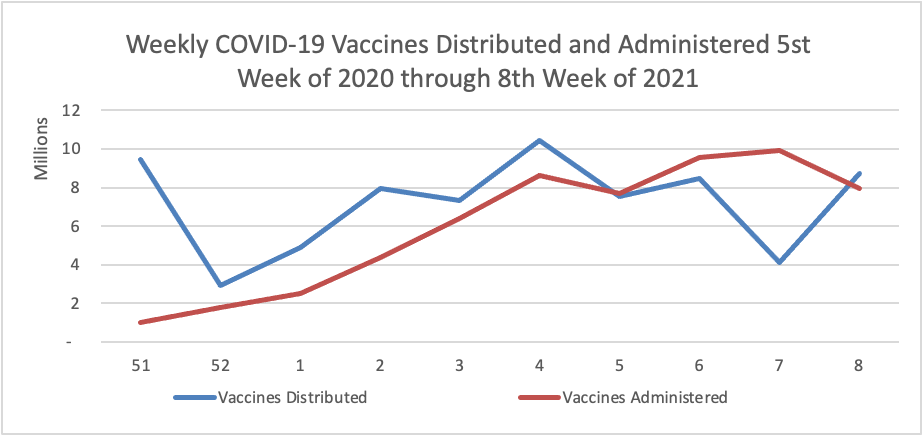
Finally here is a COVID-19 vaccinations chart for past ten weeks which also uses Thursday as the first day of the week:

In other COVID-19 vaccination news

  • The Wall Street Journal reports that

Johnson & Johnson’s JNJ -2.64% single-dose Covid-19 vaccine worked safely and should be authorized for use in the U.S., a panel of experts advised federal health regulators Friday.  The advisory committee’s unanimous vote in support of the vaccine’s authorization is the last step before the U.S. Food and Drug Administration issues a decision, which is expected Saturday. 

Yippee!

  • Reuters reports that “The U.S. Food and Drug Administration on Thursday approved storage and transportation of COVID-19 vaccine developed by Pfizer Inc and German partner BioNTech SE at standard freezer temperatures for up to two weeks instead of ultra-cold conditions. * * * “Alternative temperature for transportation and storage will help ease the burden of procuring ultra-low cold storage equipment for vaccination sites and should help to get vaccine to more sites,” Peter Marks, director of the FDA’s Center for Biologics Evaluation and Research, said.

In other COVID-19 news

  • The AP informs us that “February is usually the peak of flu season, with doctors’ offices and hospitals packed with suffering patients. But not this year. Flu has virtually disappeared from the U.S., with reports coming in at far lower levels than anything seen in decades.” It’s a silver lining in the COVID-19 cloud.  
  • The Centers for Medicare and Medicaid Service released updated guidance today for health plans, including FEHB plans, on coverage of COVID-19 testing and vaccinations.
  • Bloomberg reports that

States should maintain Covid-19 restrictions such as mask wearing and capacity limitations as case numbers halt their decline, the head of the U.S. Centers for Disease Control and Prevention said Friday, citing the circulation of new variants and infection rates that remain alarmingly high.

CDC Director Rochelle Walensky issued a sobering warning during a press briefing Friday, where she said the more contagious B.1.1.7 variant, first found in the U.K., now accounts for an estimated 10% of current U.S. cases, and that variants in California and New York also appear to spread more easily.

“Things are tenuous — now is not the time to relax restrictions,” Walensky said. “The latest data suggest that these declines may be stalling, potentially leveling off at still a very high number. We at the CDC consider this a very concerning shift in the trajectory.”

  • STAT News punctured a CDC recent statistic as follows:

The Centers for Disease Control and Prevention made headlines last week when it announced that Covid-19 had reduced the average life expectancy of Americans in 2020 by a full year. The news seemed to starkly illustrate the devastation wrought by our nation’s worst public health crisis in 100 years.

But there was a problem. The pandemic’s appalling toll could not have reduced life span by nearly that much. My own estimate is that when Covid-19’s ravages in 2020 are averaged across the country’s entire population, we each lost about five days of life.

The CDC’s mistake? It calculated life expectancy using an assumption that is assuredly wrong, which yielded a statistic that was certain to be misunderstood. * * * The CDC’s report boils down to a finding that bears no relation to any realistic scenario. Running the 2020 gauntlet for an entire life results in living one year less on average than running that same gauntlet in 2019.

In other healthcare news, Fierce Healthcare informs us that

Cigna will acquire telehealth platform MDLive, the insurer announced Friday morning.

Cigna has been a longtime partner of and investor in MDLive and will fold it into its Evernorth subsidiary, which houses its health services business. The deal is expected to close in the second quarter of 2021, pending regulatory approvals.

Cigna said that it expects to deliver $20 in earnings per share this year, including impacts of the acquisition, and will present additional details about the deal at its investor day on March 8.

Finally, the FEHBlog has been continuing to review the draft Postal Service bill creating a Postal Service Health Benefits Program. He has updated Wednesday’s post on the topic and he wishes to point out an important clarification on how the bill would treat Postal Service annuitants. Per the Committee staff memorandum:

The bill would require future retirees to enroll in Medicare in order to participate in the Postal Employee Benefits Program (similar to the Federal Employee Health Benefit Program but established as a separate risk pool). However, the bill includes several exceptions:

  • Residents of foreign countries and others without access to Medicare providers would not automatically be enrolled in Medicare; and
  • Retirees who do not have the requisite 40 quarters of creditable service would not be automatically enrolled in Medicare. This would include many Civil Service Retirement System (CSRS) retirees.
  • In addition, current retirees would be granted a three-month grace period from the Medicare penalty for late enrollment but would not be required to enroll.

This helps explain why NARFE is willing to support the bill.

Thursday Miscellany

Photo by Juliane Liebermann on Unsplash

The American Hospital Association informs us that “President Biden yesterday [February 24] continued the national emergency for the COVID-19 pandemic [indefinitely] beyond March 1. The renewed national emergency, along with the recently renewed public health emergency, allow the Department of Health and Human Services to continue Section 1135 waivers and other flexibilities to ensure sufficient health care services and items to respond to the pandemic.” In the FEHBlog’s opinion, this action also applies to the Labor Department’s May 4, 2020, extension of various deadlines applicable to ERISA-governed health plans and their members.

From Capitol Hill Reuters reports on the evenly divided Senate’s measured reaction to the House of Representatives COVID-19 relief budget reconciliation bill which is expected to pass the House on party lines tomorrow. Politico reports this evening that

The Senate parliamentarian ruled Thursday that Democrats would be deemed out of order if they include a $15 minimum wage hike in their coronavirus relief package, a major blow to Senate Budget Committee Chair Bernie Sanders (I-Vt.) and progressives. The parliamentarian’s ruling means that any senator could raise a point order against the minimum wage increase, which would force the provision to be axed from the bill. House Democrats still plan to pass the minimum wage hike on their version of the Covid bill on Friday, but the Senate decision means the party needs to find an alternative route to increasing the minimum wage, a key campaign promise.

Healthcare Dive reports that Xavier Becerra favorably weathered his two Senate confirmation hearings this week.

“If I was a betting man, I’d bet that you’ve got the votes to be approved,” Sen. Bill Cassidy, R-La., said Wednesday at the Senate Finance Committee hearing. In both hearings he distanced himself from previous endorsements of “Medicare for All,” in several rounds of questioning from Republicans seeking to tie him to the policy idea. The former House lawmaker noted that President Joe Biden has no intention of pursuing such a policy and said he stands ready to build on the Affordable Care Act, including with a public option. * * * At the finance panel, Becerra also voiced support for continuing to expand reimbursement of telehealth services beyond the COVID-19 pandemic. “I don’t think we’re going back to the old days when it comes to telehealth,” he said.

In that regard, according to Fierce Healthcare, Teladoc reported its fourth quarter 2020 earnings today:

Teladoc’s 2020 revenue reached $1.1 billion as virtual care visits continued to soar. The telehealth giant reported it delivered 10.6 million virtual visits last year, up 156% from 2019. The company’s U.S. paid membership hit 51.8 million, up about 41% from 36.7 million users in 2019. Teladoc, one of the nation’s top telehealth providers, reported 3 million total virtual visits during the fourth quarter, up 139% from 1.2 million visits in the fourth quarter of 2019.

The FEHBlog firmly believes that our country’ patent laws lie at the root of soaring prices for specialty drugs. He therefore was pleased to read today this STAT News article reporting that

 [A] U.S. appeals court [for the Federal Circuit] recently restricted wide-ranging patent claims for antibody treatments, a ruling legal experts say may force [specialty drug]/biologics makers to re-examine patent protections for their products.

In this instance, Amgen (AMGN) and Sanofi (SNY) were battling over the market for injectable cholesterol-lowering medicines called PCSK9 inhibitors. For the past several years, the companies have been locked in patent disputes, but earlier this month the appeals court decided that two Amgen patents for its Repatha cholesterol medication were invalid.

In the process, the ruling is raising questions about the sort of patent claims that companies can make about monoclonal antibodies, which is the type of medicine that was at issue in this case. The upshot is that, because of the way Amgen went about asserting claims in its patents, companies will have to be more careful about crafting their patents and can also expect more legal challenges.

“I think this is a huge deal,” said Jacob Sherkow, a law professor at the University of Illinois at Urbana-Champaign who specializes in patents and life sciences. “A huge swath of antibody patents out there is just like Amgen’s patents. So if those are not valid under this new standard [issued by the appeals court], then one can think the other patents are also likely not to be valid.”

Tuesday Tidbits

Photo by Patrick Fore on Unsplash

Good news. The Wall Street Journal reports

The Trump administration is releasing second doses of coronavirus vaccines that were reserved for booster shots and is urging states to give the vaccine to anyone age 65 and older, as well as to people with pre-existing health conditions, a shift in strategy that vastly expands the pool of those eligible for shots while presenting another hurdle for the logistics of administering the vaccine at state and local levels.

Starting in two weeks, doses will be allocated based on the pace that states say they are administering the vaccine, as well as the size of a state’s population of people age 65 and older. 

Health and Human Services Secretary Alex Azar announced the plan on ABC’s “Good Morning America” on Tuesday. “We now believe that our manufacturing is predictable enough that we can ensure second doses are available to people from ongoing production. So everything is now available to our states and our health-care providers,” he said.

The government had been allocating about half of newly available doses from Pfizer Inc. and Moderna Inc. to states since the vaccine rollout began last month. Federal officials said there is enough supply to ensure booster shots will be available and that they won’t extend the current recommended dosing schedules.

Drug makers expect to be able to produce enough vaccine doses to accommodate the new plans, vaccine manufacturers and supply-chain experts say.

The Journal also explains that while scientists are confident that the COVID-19 vaccines will protect you from contracting the disease, they don’t know yet whether they will prevent you from spreading the disease asymptomatically.

“Most vaccines prevent disease as opposed to preventing infection,” says Anna Durbin, a professor of international health at Johns Hopkins Bloomberg School of Public Health who is working on the AstraZeneca Covid-19 vaccine trial and previously worked on the Pfizer vaccine trial. She believes Covid vaccine studies will eventually show a reduction in asymptomatic transmission but not a complete elimination.

Even if vaccines don’t prevent transmission completely, they can still help populations achieve herd immunity if enough people take them, says Arnold Monto, an epidemiology professor at the University of Michigan School of Public Health who chairs the U.S. Food and Drug Administration’s Vaccines and Related Biological Products Advisory Committee. “We can still accomplish a lot even if it is demonstrated that there is still some asymptomatic infection occurring post-vaccination,” says Dr. Monto.

STAT News reports that the Pharmaceutical Care Management Association (“PCMA”) has asked the federal district court in DC to block a Trump Administration rule preventing the use of prescription drug manufacturer rebates in the Medicare Part D program. PCMA contends that the CMS rule impermissibly conflicts with a statutory exemption permitting the use of such rebates in Medicare Part D. Of course.

The Biden administration, which is set to take office on Jan. 20, could also choose not to defend the rebate policy in court, thus mooting the lawsuit.

Biden has not yet taken a position on eliminating drug rebates, but a number of prominent Democrats, including House Speaker Nancy Pelosi have spoken out against the policy as a ndout to the pharmaceutical industry.

Studies —

The death rate from cancer in the U.S. dropped 2.4% from 2017 to 2018, the biggest single-year decline on record and a sign of the impact of new treatments on lung cancer especially, the American Cancer Society said.

It was the second year in a row with a record-setting drop, and the progress continues gains that have been made for more than a quarter-century, the cancer society said in a report published Tuesday. The researchers analyzed cancer mortality data from 1930 to 2018, before the start of the Covid-19 pandemic.

Overall, the cancer mortality rate has fallen 31% since its peak in 1991, according to the report, which was published online in the journal CA: A Cancer Journal for Clinicians. The latest decline left the mortality rate at 149 deaths for every 100,000 people in the general population in 2018, according to the American Cancer Society.

Use of telehealth jumped sharply during the first months of the coronavirus pandemic shutdown, with the approach being used more often for behavioral health services than for medical care, according to a new RAND Corporation study.

Between mid-March and early May 2020, telehealth was used by more than 40% of patients with a chronic physical health condition and by more than 50% of those with a behavioral health condition, according to findings published in the Journal of General Internal Medicine.

Overall, almost half of the people who were undergoing treatment when the pandemic shutdown began reported using some form of telemedicine.

Researchers found that the use of telehealth for behavioral health conditions was lower among women and among people over the age of 60. Use of telehealth also was lower among non-Hispanic whites relative to non-Hispanic Blacks, and was lower among those with less than a high school education relative to those with a college degree.