Monday Roundup

Monday Roundup

Photo by Sven Read on Unsplash

Becker’s Health IT offers 20 bold health IT predictions for the next five years. Here are the FEHBlog’s favorites:

1. Joel Klein, MD. Senior Vice President and CIO of University of Maryland Medical System (Baltimore): I think at least half of all healthcare in America will be virtual within five years. There are two barriers:

• Payers. They might pay less but if they pay enough, it will be enough. If we can figure out how to solve emergency department visits with widespread, cost effective on-demand care, that will make a difference.
• ‘But I want to see my doctor.’ That might be true for some things, but the convenience factor (especially for tertiary care… especially for millennials…) once you really start doing it overwhelms most of the physical presence upsides.

Edward Lee, MD. CIO of The Permanente Federation (Oakland, Calif.): In five years, physicians will no longer need to manually document their notes into the EHR. Instead, artificial intelligence will capture all the pertinent information from the patient-physician encounter. This will enable physicians to spend quality time with their patients instead of worrying about writing their notes or placing orders in a computer system. Joy and meaning for physicians will increase, physician burnout will decrease, and above all, patient care will improve.

Michael Pfeffer, MD. Assistant Vice Chancellor and CIO of UCLA Health: Health IT will enable each patient to have a unified, interactive view of their health information regardless of place of care or type of clinical data (i.e. phenotypic, genomic, imaging). AI-based apps will help make sense of their data, taking into account social determinants of health and potential health disparities to improve health equity and health literacy. This intelligence will be paired with personal health preferences and data on health provider quality, access, pricing and satisfaction to help patients make truly informed decisions about their care.

Fierce Biotech reports that “Just under a week after it stopped its key phase 3 pandemic vaccine test [due to a safety concern], AstraZeneca and the University of Oxford have been given the green light to restart in the U.K.” What’s more

While AZ and Oxford have been highlighted as [COVID-19 vaccine] race leaders, so too have Pfizer and BioNTech, which said they now want to boost their phase 2/3 trial for one of their five mRNA vaccines, BNT162b2, from around 30,000 to 44,000.

Also over the weekend, the companies said they have asked the FDA for the extra participants in order to include a broader patient population and with plans to include adolescents as young as 16 and people with chronic, stable HIV (human immunodeficiency viruses), hepatitis C or hepatitis B infection to “provide additional safety and efficacy data.”

It said it’s on track to hit its original target of 30,000 patients this week; despite wanting more people, Pfizer said in a statement that it was still on course to deliver data by the end of next month.

CVS Health announced last week that in response to demand created by children returning to school, it has made “children age 12 years and older eligible for testing at the more than 2,000 test sites located at select CVS Pharmacy drive-thru testing locations, starting last Friday, September 11.”

In other news

  • The Washington Post reports that commuting in the Washington DC metropolitan area may not be back to normal until next summer.

Some 430 employers representing about 275,000 workers in the greater-Washington region — stretching from Baltimore to Richmond — participated in the survey conducted Aug. 10 to 28. Their responses offer a snapshot of what companies are thinking as they weigh resuming in-office operations.
A clear majority of Washington-area employers said they are adopting a phased approach to returning to the office, although many said they remain uncertain about the timing of that return. A third of the region’s employers said they don’t know whether they will have their workers back on site by next summer.

  • Govexec.com reports that “The Office of Personnel Management issued a proposed rule [today] that would enable federal agencies to appoint employees in STEM jobs, or positions on temporary or new projects or organizations, for a decade. OPM said the change would give agencies more flexibility when tackling long-term science, technology, engineering and mathematics projects and other non-permanent work. Current regulations require agencies to get special permission from OPM to keep any term employee on staff for longer than four years.” The public comment deadline is November 10, 2020.
  • The House Oversight and Reform subcommittee on government operations held a postal update hearing today. It turns out that the subcommittee’s objective was to be to call the Postmaster General’s qualifications into question. A bipartisan Postal Service Board of Governors selects the Postmaster General, rather than following the usual Presidential appointment followed by Senate confirmation route.

Midweek update

Section 1557 is the individual non-discrimination provision of the Affordable Care Act. In June 2020, the Department of Health and Human Services issued a final rule making numerous changes to the Obama Administration’s rule. Both rule makings sparked lawsuits challenging their legality.

Last time around, the lead case, Franciscan Alliance v. HHS, was filed in the Northern District of Texas. That case is still pending on appeal before the U.S. Court of Appeals for the Fifth Circuit.

This time around, the lead case, Whitman-Walker Clinic v. HHS, was filed in Washington, D.C. Roughly one month following oral argument in the case, U.S. District Judge James Boasberg this afternoon denied the plaintiffs’ motion for a preliminary injunction against enforcement of HHS’s revised Section 1557 rule with two exceptions:

  • The Court preliminarily enjoined the revised rule’s repeal of the sex discrimination definition found in the replaced Obama Administration rule. That definition afforded express protection to transgendered people.
  • The Court also preliminarily enjoined the revised rule’s religious organization exception to the law’s sex discrimination restrictions.

Here is a link to the lengthy yet illuminating opinion and the implementing order. The decision called to the FEHBlog’s attention another interesting civil rights provision of the ACA — Section 1554. This provision places limits on the HHS Secretary’s broad reaching regulatory powers under the ACA.

Judge Boasberg’s decision expands on the Brooklyn federal court decision issued August 17, 2020, that stayed enforcement of the sex discrimination definition repeal. While the federal government has not appealed the Brooklyn decision, the plaintiffs in the FEHBlog’s opinion are likely to appeal the denial of their preliminary injunction motion in the Whitman-Walker Clinic case. And so it goes.

The Centers for Medicare and Medicaid today released its final Medicare Part A inpatient prospective payment system rule for the government fiscal year beginning October 1, 2020.

The increase in operating payment rates for general acute care hospitals paid under the IPPS that successfully participate in the Hospital Inpatient Quality Reporting (IQR) Program and are meaningful electronic health record (EHR) users is approximately 2.9 percent. This reflects the projected hospital market basket update of 2.4 percent and a 0.0 percentage point productivity adjustment. This also reflects a +0.5 percentage point adjustment required by legislation.

Hospitals may be subject to other payment adjustments under the IPPS, including:

— Penalties for excess readmissions, which reflect an adjustment to a hospital’s performance relative to other hospitals with a similar proportion of patients who are dually eligible for Medicare and full-benefit Medicaid
— Penalty (1 percent) for worst-performing quartile under the Hospital-Acquired Condition Reduction Program
— Upward and downward adjustments under the Hospital Value-Based Purchasing Program

Medicare is one complicated program. Medicare is relevant to the FEHBP because the program impact the prices that FEHB plans pay for patient care and there is a large cadre of annuitant enrollees with Medicare Part A coverage.

In other healthcare related news —

  • Reuters reports that “President Donald Trump said on Tuesday he planned to meet with pharmaceutical companies this week regarding his so-called most- favored-nation executive order aimed at lowering drug prices paid by the U.S. federal government.”
  • STAT News reports that

A new analysis of several studies in which [inexpensive] steroid drugs were used to treat severely ill Covid-19 patients found the drugs significantly helped reduce patient deaths, bolstering earlier, preliminary evidence for the benefit of these medications. In multiple studies involving a total of 1,700 patients, a number of corticosteroids—anti-inflammatory drugs that can damp the effects of an overactive immune system—helped reduce deaths from Covid-19 by about a third, compared with patients who didn’t receive steroids, according to the analysis published Wednesday in the Journal of the American Medical Association.

  • HHS’s Office for Civil Rights, which enforces the HIPAA Privacy and Security Rules, has created a consolidate website regarding HIPAA and Health Apps. The site includes links to generally helpful technical information on cloud computing and HIPAA and HIPAA and health IT. Check it out.

Monday Roundup

The Wall Street Journal provides a roundup on the status of the front runners in the race for a safe and effective COVID-19 vaccine. “Nine of these have advanced into Phase 3, which tests whether the dose that would be given to the public works safely.” The Phase 3 candidates fall into one of the following three vaccine approaches

Genetic-code vaccines deliver specific genetic instructions teaching the body’s cells to make a protein from the targeted virus, which in turn induces an immune response. One type incorporates a synthetic, engineered version of messenger RNA, or mRNA. These are molecules in the body that ferry DNA instructions for making immune-inducing proteins. Other gene-based vaccines use DNA itself.

A virus-based vaccine uses a killed or weakened form of the targeted virus to induce an immune response.

Viral vector vaccines use a modified virus different from the targeted virus to serve as a carrier of the vaccine teaching the body’s cells to make a protein from the targeted virus.

Candidates at the Phase 2 trial level are also using a protein-based approach that “incorporates a protein from the virus, or something resembling it, that will trigger an immune response.” The more, the merrier, right?

With respect to other COVID-19 ramifications:

  • Healthcare Dive discusses CDC surveys on the estimated 40% of Americans experienced a reduction in access to healthcare during the great hunkering down while Fierce Healthcare discusses how hospital systems are reacting to the drop.
  • The Healthcare Dive article also points out a “”separate CDC RANDS survey found that nearly 37% of people said their provider now offers a form of telehealth, compared to about 14% who said it was offered before the pandemic” while Health Payer Intelligence discusses what it takes to for health plans to build upon the uptick in virtual care.

In other healthcare news:

  • Fierce Healthcare reports on a new Aetna plan design for mid-sized and large employers in the Kansas City metropolitan area. “While the PPO plan will offer access to many regional providers, CVS’ HealthHubs and MinuteClinics are deeply embedded in the plan design, Aetna said.”
  • The Health Care Cost Institute released a study of its voluminous health plan claims data finding that “commercial [health plan] prices paid for the average professional service were 122% of what would have been paid under the Medicare Physician-Fee-Schedule.” The report looks at this comparison from several different angles.
  • Drug Channel analyzes GoodRx’s decision to make public stock offering. GoodRx offers prescription drug savings to consumers.

In follow up news:

  • Federal News Network reports on another National Finance Center announcement hitting the brakes on its earlier announced plan to implement the President’s August 8 executive order permitting employers to defer payroll taxes for certain employees as early as the first paycheck in September.
  • A Delaware Chancery Court judge, according to Fierce Healthcare, has decided that neither Anthem nor Cigna should receive damages as a result of the 2017 breakup of their planned merger. Hopefully that’s the end of this saga.

Tuesday Tidbits

The FEHBlog noted in the latest Weekend Update that the President had allowed pharmaceutical manufacturers until August 24 to present alternative to the President’s plan to tie American drug pricing to foreign benchmarks via executive order. As of August 22, the President was waiting for such a proposal. and according to STAT News today

The pharmaceutical industry is weighing two drug pricing policies that it could offer as a trade to President Trump, in exchange for his dropping a different proposal that drug makers detest, according to three drug industry lobbyists and a summary of the potential changes obtained by STAT.

In the meantime, the White House has not taken any action to implement this executive order.

On the COVID-19 front —

  • The Boston Globe reports that “An international meeting of Biogen leaders at a Boston hotel in February led to roughly 20,000 cases of COVID-19 in four Massachusetts counties by early May, far more than the 99 previously identified, according to three scientists involved in a new study.” Wow. That was a super spreader event for sure.
  • STAT News discusses “four scenarios on how we might develop immunity to Covid-19.” Interesting read.

Also other news from New England, Healthcare Dive informs us that

Google is investing $100 million in “Amwell, one of the biggest telehealth companies in the country, in a concurrent private placement with Amwell’s initial public offering, the two companies announced Monday. As part of the multiyear partnership, Amwell will become Google Cloud’s preferred telehealth platform and Amwell will migrate its video capabilities over to Google Cloud.”

Amwell is headquartered in Boston, Massachusetts.

Via AHRQ.gov, the FEHBlog ran across this recent study of “National Inpatient Hospital Costs: The Most Expensive Conditions by Payer, 2017.” Here are the highlights:

In 2017, aggregate hospital costs for 35.8 million hospital stays totaled $434.2 billion.

The five most expensive inpatient conditions were septicemia, osteoarthritis, liveborn (newborn) infants, acute myocardial infarction, and heart failure. The 20 most expensive conditions accounted for slightly less than half of aggregate hospital costs.

The share of aggregate inpatient hospital costs by primary expected payer was 66 percent for Medicare and Medicaid combined, 27 percent for private insurance, and 3 percent for self-pay/no charge stays.

Septicemia ranked among the three most costly conditions in the hospital for all four expected payer groups

Conditions related to pregnancy and childbirth accounted for 4 of the top 20 most expensive conditions expected to be paid by Medicaid.

Medicaid was the only expected payer for which 3 of the top 20 most expensive conditions were related to mental and substance use disorders.

Finally, yesterday, the U.S. Supreme Court allocated oral argument time in Texas v. California case (No. 19-840) which raises the constitutionality of the Affordable Care Act for the third time before the Court.

The motions of the Solicitor General for divided argument and of the U.S. House of Representatives for enlargement of time for oral argument and for divided argument are granted, and the time is allotted as follows: 30 minutes for California, et al., 10 minutes for the U.S. House of Representatives, 20 minutes for the Solicitor General, and 20 minutes for Texas, et al. The motion of Ohio and Montana for leave to participate in oral argument as amici curiae, for enlargement of time for oral argument, and for divided argument is denied.

Weekend update

Yesterday, the House passed H.R. 8015 by a 257-150 vote. This bill would require a roll back of certain management changes at the Postal Service and provide the Postal Services with a $25 billion grant. The New York Times reports that

Senator Mitch McConnell of Kentucky, the majority leader, said plainly on Saturday that he did not plan to bring up a stand-alone bill in the Senate when lawmakers are at a stalemate over broader coronavirus relief legislation.

“The facts show the U.S.P.S. is equipped to handle this election, and if a real need arises, Congress will meet it,” he said in a statement. “The Senate will absolutely not pass stand-alone legislation for the Postal Service while American families continue to go without more relief.”

We shall see whether this House action leads to further talks between the House leadership and the White House.

No legislative action is scheduled to occur in either House of Congress this coming week, but some committee activity is scheduled. For example, the Postmaster General, among others, will testify before the House Oversight and Reform Committee tomorrow morning at 10 a.m. ET.

Forbes reminds us that tomorrow is the deadline for the prescription drug industry to provide feedback to the White House on its most favored nation drug pricing order.

President Trump postponed moving ahead with the executive order on drug pricing until Monday, August 24th, giving time to pharmaceutical manufacturers to come up with an alternative pricing proposal. In this respect, the executive order appears to be a one-month ultimatum to establish a bargaining position. If the Trump Administration isn’t satisfied with the alternative plan, it says it would push forward with the executive order. However, as of Saturday, August 22nd, drug makers have yet to offer an alternative pricing plan, and there’s no indication that the Trump Administration will reveal precise details of the executive order, let alone implement it in the next 48 hours. If the Trump Administration were to go ahead with, say, the IPI pilot program, it would likely face strong legal challenges.

Let’s face it in order to maintain the decreasing number of COVID-19 cases pending Food and Drug Administration (“FDA”) approval of a COVID-19 vaccine, we need (1) to maintain public health protections like social distancing, mask wearing, and avoiding super spreader events, (2) to be able to practically use a reliable, inexpensive COVID-19 test like the Yale saliva test, and (3)trust in medical researchers to bring more COVID-19 treatments on line.

With regard to the third point

Covid-19 clinical trials are now under way for 10 new monoclonal antibodies, known as mAbs in industry jargon, according to the Antibody Society, a professional association of researchers.

The most advanced are already in mid- and late-stage studies in newly diagnosed as well as hospitalized patients, and in people who haven’t yet been infected. If they clear testing, the drugs might be available as soon as early in the fourth quarter, according to Geoffrey Porges, an SVB Leerink LLC analyst.

In August, late-stage studies were launched evaluating Lilly’s lead antibody in hospitalized and nonhospitalized patients, and these could be completed before the end of the year, depending on how quickly patients are enrolled.

Regeneron expects to have the first data from its study of a monoclonal antibody in hospitalized and nonhospitalized patients by the end of September. The company could seek an emergency authorization based on the data if there is a strong indication the drug is blocking the virus.

  • The Wall Street Journal also reports this evening that that FDA ultimately gave emergency use authorization to convalescent plasma therapy treatment for hospitalized patients from COVID-19. This therapy also relies on antibodies. “For Covid-19 patients and the doctors who treat them, the designation opens up the possibility for faster and easier access to a promising treatment, while studies and clinical trials continue to explore who is helped and how much.”
  • Two former FDA commissioners, Doctors Scott Gottlieb and Mark McClellan offered an opinion piece published in the Wall Street Journal. They observe that

The development of drugs to treat Covid-19 is moving at a remarkable pace. The use of steroids is a major advance that is reducing the risk of death in hospitalized patients. Novel drugs, including manufactured antibodies that mimic the body’s immune response to the virus [referring to the monoclonal antibodies], are in late-stage development and could be available by the fall. There are about 750 drugs in screening studies (Phase II) or in large, definitive clinical trials (Phase III).

The challenge is to develop evidence as quickly as possible without compromising standards. Anytime there’s an unmet medical need, the tendency is to blame the Food and Drug Administration’s regulatory process. But if we don’t know what works, and what doesn’t, we’ll waste time and money on treatments that won’t help and may harm. Even if a vaccine is discovered and approved, the pandemic won’t end unless most Americans get vaccinated, which will require confidence in the product’s safety and efficacy.

Heartily agreed.

The FEHBlog ran across this interesting Health Payer Intelligence story about how Blue Cross and Blue Shield of Kansas City has created a social needs referral network.

The social needs referral network is a collection of community-based organizations that have partnered with Blue KC and that target social determinants of health needs in the Kansas City area. When Blue KC employees and provider partners come across a patient with a social determinants of health barrier, they can refer patients to these organizations.

In the spring of 2020, Blue KC launched an electronic platform to unify organization efforts, streamline social determinants of health screening data, and help Blue KC employees and provider partners more easily identify nearby community-based organizations that can meet particular patient needs.

Creative move.

Thursday Miscellany

The Wall Street Journal reports that “Around the country, medical centers have begun setting up clinics focused on evaluating and treating Covid-19 patients reporting symptoms that last weeks or months after their initial illness or diagnosis. But the clinics are relatively new and hospitals are still adding resources, so wait lists can stretch months at the ones that exist so far.”

Healthcare Dive informs us that

Rideshare giant Uber is entering the prescription drug delivery business through a new partnership with on-demand prescription platform NimbleRx, the two companies announced Thursday. The partnership is currently live in Seattle and Dallas, with plans to expand to other parts of the country in the coming months, per a release. Nimble and Uber have completed more than 15,000 deliveries since the pilot launched earlier this summer.

Digital delivery marketplace Nimble, based in Redwood City, Calif., is used by more than 700 pharmacies in 34 states, giving the new partnership significant room to scale. Through an integration with Uber Direct, Uber’s delivery platform, the rideshare behemoth’s fleet of drivers will now be another delivery option for consumers.

It’s a crowded space: Retail pharmacy giants CVS Health and Walgreens have invested heavily in prescription home delivery following Amazon’s acquisition of online pharmacy Pillpack two years ago. Established players and startups alike are vying for a cut of runaway drug spending, while pitching better medication maintenance

CVS Health / Caremark and Express Scripts, among other PBMs, offer programs to allow health plan members to receive mail order pharmacy pricing on 90 day maintenance prescriptions at the pharmacy.

The Centers for Disease Control today released “Prevention and Control of Seasonal Influenza with Vaccines: Recommendations of the Advisory Committee on Immunization Practices — United States, 2020–21 Influenza Season.”

Routine annual influenza vaccination of all persons aged ≥6 months who do not have contraindications continues to be recommended. No preferential recommendation is made for one influenza vaccine product over another for persons for whom more than one licensed, recommended, and appropriate product is available.

Balancing considerations regarding the unpredictability of timing of onset of the influenza season and concerns that vaccine-induced immunity might wane over the course of a season, vaccination is recommended to be offered by the end of October [2020].

Efforts should be structured to optimize vaccination coverage before influenza activity in the community begins. Vaccination should continue to be offered as long as influenza viruses are circulating and unexpired vaccine is available.

In the same vein, the Department of Health and Human Services (“HHS”) announced yesterday the issuance of a “third amendment to the Declaration under the Public Readiness and Emergency Preparedness Act (PREP Act) to increase access to lifesaving childhood vaccines and decrease the risk of vaccine-preventable disease outbreaks as children across the United States return to daycare, preschool and school. ‘Today’s action means easier access to lifesaving vaccines for our children, as we seek to ensure immunization rates remain high during the COVID-19 pandemic,’ said HHS Secretary Alex Azar. The amendment authorizes State-licensed pharmacists (and pharmacy interns acting under their supervision to administer vaccines, if the pharmacy intern is licensed or registered by his or her State board of pharmacy) to order and administer vaccines to individuals ages three through 18 years, subject to several requirements” described in the announcement. Pharmacies have become a convenient administration point for many vaccinations, such as the flu vaccine.

Health Payer Intelligence reminds us that “Although the interoperability rule will not be implemented until mid-2021, payers can be aware of what to expect regarding how this rule will change their processes, as outlined in a recent AHIP brief.” The rule generally applies to plans regulated by HHS. While FEHB plans are not subject to the rule, they can benefit from riding in the slip stream by benefitting from interoperability innovations, such as HL7’s FHIR API standard.

Thursday Miscellany

The FEHBlog generally writes his posts at home in the evening, and he has been noting when it has been raining in Bethesda as it has been quite a rainy summer. This evening features blue skies (although it did rain this morning.)

On the COVID-19 front, the Department of Health and Human Services announced today

combined investments of $6.5 million in two commercial diagnostic laboratories to expand capacity to conduct up to 4 million additional SARS-CoV-2 per month. SARS-CoV-2 is the virus that causes COVID-19. The investments in Aegis Sciences Corporation and in Sonic Healthcare USA will provide critical laboratory equipment supplied by Beckman Coulter Life Sciences and Thermo Fisher Scientific and increase staffing and infrastructure to allow the U.S. to perform an additional 1 million tests each week by early October.

The American Hospital Association, the American College of Surgeons, and other major provider organizations have updated their roadmap for performing essential surgeries during the COVID-19 emergency. This may be helpful to health plan utilization review units.

A Wall Street Journal op-ed piece points out that

More than 500 clinical trials are under way world-wide in the race to find an effective treatment for Covid-19. Everybody wants it; nobody has it—yet. But one of the most promising therapies for Covid-19 patients uses “medicinal signaling cells,” or MSCs, which are found on blood vessels throughout the body.

In preliminary studies, these cells cut the death rate significantly, particularly in the sickest patients. With a powerful 1-2-3 punch, these cells eliminate the virus, calm the immune overreaction known as a cytokine storm, and repair damaged lung tissue—a combination offered by no other drug. This type of regenerative medicine could be as revolutionary as Jonas Salk’s polio vaccine.

Here’s a link to a STAT News report on newly released information on a study of convalescent plasma to treat COVID-19. Something has to pay off soon, right?

In general prescription drug news, GoodRx lists the twenty most expensive medicines in the U.S. The list identifies the manufacturer assistance program associated with each drug.

In other healthcare news —

  • Becker’s Hospital Review reports that UnitedHealthcare is resuming its COVID-19 delay effort to stop sending paper benefit checks to network providers. UHC plans to rely entirely on electronic payments. Smart move.
  • The Affordable Care Act provided government funding to create new CO-OP health plans. The FEHBlog criticized the decision as unnecessary. At on point there were 23 CO-OP plans and OPM was enlisting them for their ACA create Multi-State Program (“MSP”). ThinkAdvisor informs us that the New Mexico Co-op plan is shutting down at the end of this year which will leave three Co-ops operating in Maine and the Midwest. The MSP similarly failed because it was over-complicated and unnecessary.

Midweek Update

It’s another rainy night in Bethesda.

Fierce Pharma reports that “the U.S. has ordered 800 million doses [of various COVID-19 vaccines currently in phase 3 testing] for a country with a population of about 330 million, likely under the assumption that some vaccines won’t make it through clinical testing. The government is “assembling a broad portfolio of vaccines to increase the odds that we will have at least one safe, effective vaccine as soon as the end of this year,” HHS secretary Alex Azar said in a statement.”

The Wall Street Journal informs us that

Doctors, nursing homes and federal officials are scrambling to get rapid-response Covid-19 antigen testing supplies from the two companies that secured emergency approval to produce them, as cases continue to rise in the U.S.

Rapid-response antigen tests make up a small but growing area of Covid-19 testing in the U.S. and are seen as helpful in tamping down outbreaks because they offer faster results than many molecular tests that must be sent to labs for processing. The tests search for virus proteins while other tests look for the virus’s genetic material.

Quidel Corp. QDEL 4.36% and Becton Dickinson & Co., the only companies that so far have federal emergency authorization to supply such diagnostic tests, also make machines that process them. The boxlike test-analyzers, which before the pandemic processed tests for ailments such as the flu, are found in doctors’ offices and nursing homes, allowing facilities to avoid shipping samples to commercial labs for processing. They can deliver results in about 15 minutes and process dozens of samples an hour.

Quidel is struggling to produce enough analyzers to meet demand, while Becton Dickinson’s challenge is making enough tests, the companies say. * * *

Public health officials have raised some concerns that rapid antigen tests deliver false-negative results at a higher rate than other tests. But federal officials have said that, as these tests become more widespread, they appear equal in sensitivity to the more broadly used polymerase chain reaction diagnostic tests.

Perhaps Kodak can help (FEHBlog humor).

Fierce Healthcare lets us know that “According to the J.D. Power 2020 U.S. Pharmacy study, the expansion of pharmacy companies into the primary care realm has driven ‘significant increases in both satisfaction and consumer spending.'” On a related note, Forbes reports that “CVS Health is back on track with the rollout its new health hub concept to 1,500 stores across the U.S. within the next two years despite the continuing spread of the coronavirus strain Covid-19. CVS Health currently has 205 HealthHubs opened in 22 states. “CVS HealthHubs dedicate more than 20% of the store to health services that include new durable medical equipment, supplies and various new product and service combinations. CVS is adding thousands of new personal care items as well as additional services at its MinuteClinics in the HealthHub stores.”

The Centers for Medicare and Medicaid Services announced today its proposed national coverage decision that would allow local Medicare administrative contractors to make the initial decision on whether to cover an artificial heart or a ventricular assist device for Medicare beneficiaries with end stage heart disease. Currently the devices are treated as experimental treatments that CMS can cover on an exception basis. The CMS announcement explains that 6.5 million Americans “are living with heart failure.” A CMS decision whether or not to finalize the proposal will be made within 60 days following the end of the 30 day public comment period which began today.

Earlier this week the Centers for Disease Control announced their “Hear Her” campaign to reduce maternal mortality.

Over 700 women die each year in this country from problems related to pregnancy or delivery complications. Every death is a tragedy, especially when we know that two thirds of pregnancy-related deaths could be prevented. As many as 50,000 women experience severe, unexpected health problems related to pregnancy that may have long-term health consequences.

CDC’s Division of Reproductive Health is committed to healthy pregnancies and deliveries for every woman. The Hear Her campaign supports CDC’s efforts to prevent pregnancy-related deaths by sharing potentially life-saving messages about urgent warning signs.

Women know their own bodies better than anyone and can often tell when something does not feel right. The campaign seeks to encourage partners, friends, family, coworkers, and providers—anyone who supports pregnant and postpartum women—to really listen when she tells you something doesn’t feel right. Acting quickly could help save her life.

How true. This campaign deserves support from health plans as well as healthcare providers.

Tuesday Tidbits

The U.S. Office of Personnel Management today announced the companies that were awarded FEDVIP contracts for a seven year term beginning January 1, 2021. OPM added two new dental carriers — UnitedHealthCare (nationwide) and HealthPartners (regional) for a total of twelve dental carriers. OPM added one new vision carrier — MetLife (all vision plans are nationwide) — for a total of five vision carriers beginning next year.

The Centers for Medicare and Medicaid Services announced an initiative to “transform rural health.” Healthcare Dive explains

CMS’s new payment model for rural hospitals and accountable care organizations that will use upfront and capitated payments. Participating facilities will be able to waive cost-sharing for Medicare Part B services, provide transportation for beneficiaries and expand telehealth services, among other flexibilities.

The Community Health Access and Rural Transformation model has two tracks, one of which is focused on ACOs. In the other track, $75 million will be provided to lead organizations in 15 rural communities, which will be announced early next year with a planned start of the model next summer.

The lead organizations, which can be state Medicaid agencies, local health departments or academic medical centers, among others, will receive $2 million after being accepted and another $3 million in upfront funding as the model progresses.

Fierce Healthcare discusses Teladoc’s acquisition of Livongo which was announced Wednesday August 5. “The combination of two of the largest publicly-traded virtual care companies announced Wednesday will create a health technology giant just as the demand for virtual care soars.” However,

Both companies’ stock dropped Wednesday after news of the deal broke. Teladoc’s stock was down 15% and Livongo’s stock also fell by 14%. As of Thursday, both companies’ stock was still trading lower.

Analysts say the total deal price of $158.99 per share represents a 10% premium over Livongo stock’s record closing price of $144.53 as of Aug. 5, leading to the market pushback on the high valuation.

The Drug Channels blog offers its useful annual update “on pricing at five of the largest pharmaceutical manufacturers—Eli Lilly, Janssen, Merck, Novartis, and Sanofi.” Drug Channels finds that

Average discounts from [prescription drug manufacturer] list prices have been deepening.Merck’s average discount rate went from -41% in 2016 to -44% in 2019, while Lilly’s rate went from -50% to -57%. We estimate that in 2019, the total value of gross-to-net reductions for brand-name drugs was $175 billion. That figure has doubled over the past six years.

In other encouraging news, STAT News tells us about an experimental drug to treat coronaviruses like COVID-19.

A research team at the University of California, San Francisco, has synthesized a molecule that they say is among the most potent anti-coronavirus compounds tested in a lab to date. Called nanobodies because they are about a quarter of the size of antibodies found in people and most other animals, these molecules can nestle into the nooks and crannies of proteins to block viruses from attaching to and infecting cells.
The lab-made one created by the UCSF team is so stable it can be converted into a dry powder and aerosolized, meaning it would be much easier to administer than Covid-19 treatments being developed using human monoclonal antibodies. While the work is still very preliminary, the goal is to deliver the synthetic nanobody via simple inhaled sprays to the nose or lungs, allowing it to potentially be self-administered and used prophylactically against Covid-19 — if it’s shown safe and effective in both animal tests and clinical trials.

Let’s go. This my friends is the difference between 1918 and 2020. We must have faith in medical research.

Finally the FEHBlog’s favorite podcast EconTalk provided a timely insight into Shakespeare’s Romeo and Juliet in this week’s episode. Journalist and author Ben Cohen talked about his book, The Hot Hand, with EconTalk host Russ Roberts. The Hot Hand concerns streaks. and Shakespeare wrote three of his most popular plays, including Romeo and Juliet, from 1605-1606 when London was suffering from the plague. What’s more,

The reason why Romeo doesn’t know that Juliet has taken this potion and that she is simply sleeping and not actually dead is because this whole harebrained scheme had not been explained to him because he never gets the [explantory] letter [that a messenger was tasked to bring him].

So, if you think about it, it’s really a bonkers plot line. The flyer says, ‘I will–Juliet, take this sleeping potion, it will knock you out. Your family will think you’re dead. When they think you’re dead, Romeo is going to come back and he’s going to sweep you away and take you and live happily ever after.’

Now, this is the stuff that like you wouldn’t even see on a reality show or some terrible soap opera now. And yet, it’s our most famous love story.

And so, why does it fall apart? She takes the sleeping potion, right? She gets knocked out. Her family thinks she’s dead. Romeo comes back and sees her in the open crypt. All of the crazy stuff [Romeo and then Juliet committing suicide] actually turns out–where the whole scheme falls apart–is simply on getting a letter to Romeo. And it falls apart because the plague is sweeping through and the messenger gets stuck in quarantine.

So, all of this is the plague.

Now that’s a 1605 twist that rings true nearly 400 years later.

Friday Stats and More

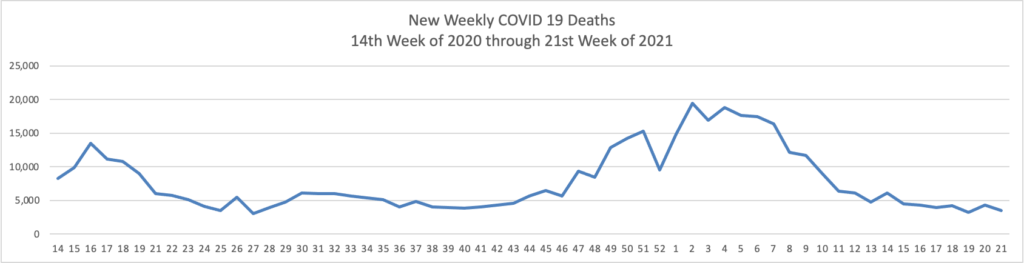
This chart is based on the Centers for Disease Control’s Cases in the U.S. website for the week ending May 20th through the week ending July 23, which was a doozy in terms of new cases.

Here’s the CDC’s COVID-19 Hospitalizations Chart, which has been fairly stable since May:

The Wall Street Journal reports that

President Trump signed executive orders Friday aimed at reducing drug prices. The moves revived a signature part of his health-policy agenda before the 2020 election after his earlier efforts to combat rising prescription costs stalled.

One of the executive orders focuses on pegging the cost of drugs in the U.S. to lower drug prices overseas, and another concerns speeding imports of drugs from Canada. The pharmaceutical industry and some Republicans have criticized the first order, saying it amounts to price controls, while opponents of the second initiative say it raises questions about product safety.

Another would require community health centers to pass on negotiated discounts on insulin and epinephrine-injector devices to consumers. And a fourth would attempt to undercut “middlemen” whom Mr. Trump described as profiting from deals with drugmakers and don’t pass along discounts to consumers.

The moves are unlikely to result in immediate changes. The White House said they represent the administration’s policy and begin a rule-making process. That process can be arduous and face legal challenges.

The links inside the quote are to the Executive Orders themselves (The text of the first referenced Order on the use of international price indexing is not on whitehouse.gov yet).

Health Payer Intelligence informs us that “Over half of the public rate filings from payers on the individual and small group health insurance market are proposing 2021 premium rates changes between a two percent decrease and a six percent increase, according to Kaiser Family Foundation.” For more details, check out the KFF report.