Monday Roundup

Monday Roundup

Photo by Sven Read on Unsplash

Another Monday, another COVID-19 vaccine — the newest from Oxford University (UK) and Astrazeneca. The Times of London reports that

Oxford University scientists said this morning that they had created “a vaccine for the world” as trial results showed that their Covid-19 jab worked well enough to apply immediately for regulatory approval.

The vaccine involves two injections, administered at least a month apart, and the results suggest that using a lower first dose could boost efficacy to 90 per cent. However, that finding relied on limited data and may be amended.

Overall, a trial involving 24,000 people suggested that the vaccine was about 70 per cent effective.

It prevented severe disease and the need to be admitted to hospital, and there are promising early signs that it might also block transmission of the virus. No dangerous side-effects were reported, and the British medical regulator has begun to review safety and efficacy data.

Britain has ordered 100 million doses, and Astrazeneca, the drug company that is working with Oxford, said this morning that four million of those would be ready to be sent to care homes, GP clinics and other vaccination centres by the end of the year.

The Oxford vaccine can be stored in a normal fridge, making it easier to handle than Pfizer’s competing inoculation, which must be stored at about minus 70C. It is also considerably cheaper, costing a few pounds per dose. It is possible that the first doses could be administered before Christmas.

The FEHBlog heard on Fox Business this morning that a separate phase three trial for the Oxford vaccine is ongoing in our country. Oxford and Astrazeneca will present an emergency use authorization request to our Food and Drug Administration (“FDA”) based on that as yet uncompleted trial. The trial referenced in the Times of London article was conducted in the United Kingdom and Brazil. The FDA does not require that the phase three trials be conducted in the U.S. For example, the agency approved the Ebola vaccine based on a phase three trial conducted in Africa, but of course there’s no problem finding COVID-19 patients here.

Reuters reports that the FDA’s Vaccines and Related Biological Products Advisory Committee will meet on December 10 to review the Pfizer / BioNTech emergency use application for its COVID-19 vaccine. The FDA is not bound by the Committee’s recommendation. Here is a link to the full FDA press release.

A friend of the FEHBlog recommended the 20 minute long Journal podcast interview with the founder of BioNTech Dr. Ugur Sahin. The FEHBlog found that podcast fascinating listening.

Govexec.com reports that “The departments of Defense and State, as well as the Veterans Affairs Department’s Veterans Health Administration, the Bureau of Prisons and Indian Health Service, will all receive a direct allocation of vaccines from the Centers for Disease Control and Prevention. The plan was spelled out in a COVID-19 Vaccination Program Interim Playbook, which was first reported by CNBC.” 

Following up on the major Health and Human Services rule makings on Fridays here are article with industry reaction:

  • As the FEHBlog expected, Fierce Healthcare reports that “A hurried final rule aimed at tying drug prices to those paid by foreign countries could lead to providers paying more for drugs than what they will get reimbursed by Medicare, according to several providers and experts.” It really makes you wonder why the American Medical Association’s House of Delegates conditionally endorsed adding a public option to the ACA marketplace earlier this month.
  • Fierce Healthcare further informs us that “CMS’ Stark, anti-kickback updates draw praise from hospitals, concern from physician groups.”
  • Health Payer Intelligence discusses the Medicare rule restricting the use of prescription drug rebates in Medicare Part D effective January 1, 2022. The FEHBlog cannot understand why if drug manufacturers want to end the rebate practices, it does not assure (with an enforcement mechanism) the health insurance industry and the government that the price reductions will balance out the lost rebates.

Friday Stats and More

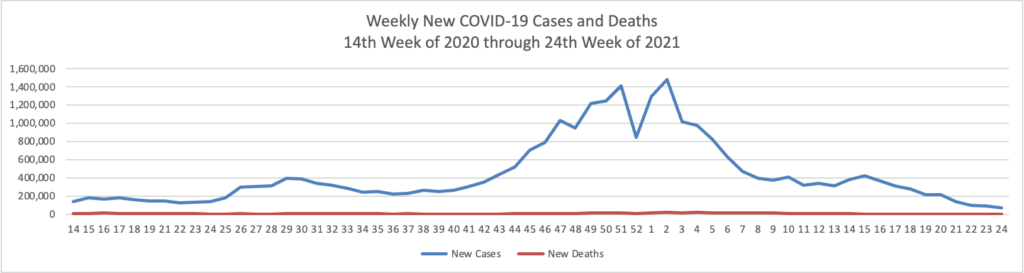
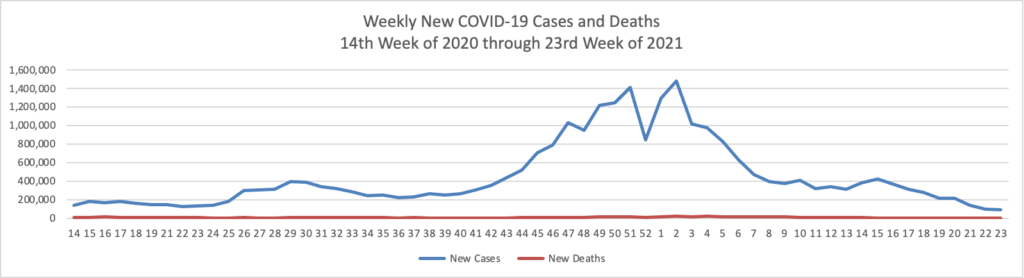
Based on the CDC’s COVID-19 Data Tracker website, here is the FEHBlog’s chart of new weekly COVID-19 cases and deaths over the 20th through 46th weeks of this year (beginning May 14 and ending November 18, roughly six months; using Thursday as the first day of the week in order to facilitate this weekly update):

The upward surge in COVID-19 cases is reflected the CDC’s latest overall weekly hospitalization rate chart for COVID-19 (disregards the dip at the right side of the chart):

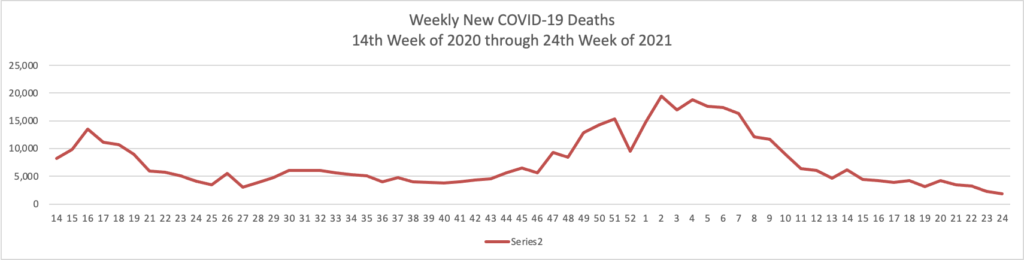
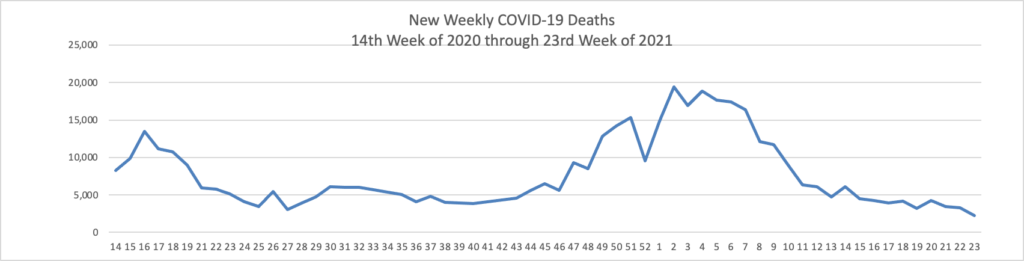
The FEHBlog has noted that the new cases and deaths chart shows a flat line for new weekly deaths  because new cases greatly exceed new deaths. Accordingly here is a chart of new COVID-19 deaths over the same six month long period (May 14 through November 18) (the dip at the tail of this chart is accurate information).

Meanwhile the CDC’s weekly flu surveillance report continues to inform us that “Seasonal influenza activity in the United States remains lower than usual for this time of year.” Better one epidemic than two.

On the bright side, according to the Wall Street Journal, Pfizer and BioNTech did file an emergency use authorization request for their COVID-19 vaccine today.

Now it will be up to the U.S. Food and Drug Administration to decide whether the two-shot vaccine works safely enough to roll out to millions of people.

It is unclear how long the agency will take to review the vaccine, which Pfizer and BioNTech just days earlier said was 95% effective and well-tolerated in a 44,000-subject trial.

Given the urgency, the FDA is expected to move quickly. The timing of the filing is in line with industry and government officials’ projections for authorization and distribution to begin next month. Pfizer said the filing could allow for distribution to begin the middle to end of December.

The Health and Human Services Department (“HHS”) released a string of final rules today affecting Medicare prescription drug plans and both hurting and helping the finances of doctors participating in Medicare and certain other federal health programs (but thankfully not the FEHBP). As the saying goes, he who lives by the sword can die the sword.

  • HHS issued a final rule generally barring the use of prescription drug rebates in the Medicare Part D program effective January 1, 2022.
  • HHS issued another final rule that implements, effective January 1, 2021, a pilot program”, known as the Most Favored Nation (MFN) Model, [that] will test [for seven years] an innovative way for Medicare to pay no more for high cost, physician-administered Medicare Part B drugs than the lowest price charged in other similar countries.”
  • Finally. HHS issued a final rule which loosens up on self-referral a/k/a Stark Act rules that inhibit the entrepreneurial spirit of doctors participating in Medicare. The purposes of the change is to facilitate value based pricing and coordinated care. Doctors should like this one but the FEHBlog wonders whether the AMA will think that it goes far enough.

Of course, we also will have to wait to see the incoming Biden Administration’s reaction to these rules.

Healthcare Dive discusses conflicting viewpoints on AHIP’s position which the FEHBlog shares that the COVID-19 relief law Wild West approach to health plan coverage of out-of-network COVID-19 leads to price gouging. Only Congress can fix this problem.

Speaking of Congress, Govexex.com reports that

Congressional leaders have voiced early speculation in recent days that lawmakers will be able to set line-by-line funding levels for agencies throughout government before the end of the year without the need for another stopgap measure. 

Top negotiators in the House and Senate met on Thursday to discuss a potential compromise for the rest of fiscal 2021 appropriations. On Friday, House Speaker Nancy Pelosi, D-Calif., was the most recent leader to cautiously express optimism that Congress can pass a full-year, omnibus spending bill before the current continuing resolution expires Dec. 11. 

“The anticipation was that it was really about the omnibus,” Pelosi said of the meeting. “You have to remember, we have to have an omnibus bill. We must keep government open.” She added it was a “very important responsibility” during the lame duck session of the 116th Congress. “We don’t want another continuing resolution. I don’t think they do either.”

Finally, the FEHBlog was impressed by Humana CEO Bruce Broussard’s call for health system interoperability without further delay. Mr. Broussard is Board Chair of America’s Health Insurance Plans for 2021. Here’s a snippet.

Change requires reforming the incentive structure to encourage and require vendors to create and sell systems that can talk to each other. Health care systems, hospitals, and physician practices — guided or encouraged by the market and the federal government — should choose interoperable systems. Public and private payers should implement value-based payment models that reward the purchase and use of interoperable systems. It’s also up to the federal government to implement and enforce standards for EHR vendors that promote interoperability while simultaneously strengthening the protection of personal health information.

If industry and government don’t lead the charge to make America’s health care system interoperable, consumers will bear the challenge of piecing together their own health data across the system — a dangerous prospect that could hinder patient care in the midst of a global pandemic. The free flow of protected data across the health care system ensures that treatment decisions are informed safely and effectively by the most current information available and tailored to the individual. A clinician with complete information at her fingertips can easily see the full picture and manage her patient’s care from the hospital to the pharmacy to long-term follow-up care.

This pandemic will eventually end. But the need for interoperability will remain urgent as we seek long-term solutions to bring down costs, improve care delivery, and increase efficiency in our health care system.

There’s no time like the present.

Happy National Rural Health Day

Photo by Tomasz Filipek on Unsplash

It is National Rural Health Day which HHS’s Health Resources and Services Administration is proud to celebrate.

The Defense Department reports on yesterday’s Operation Warp Speed press conference. The Wall Street Journal adds that

Initially, people will be vaccinated at hospitals and large medical centers because supplies will be limited, said Marion Whicker, deputy chief of supply, production and distribution at Operation Warp Speed, the federal initiative to speed development of Covid-19 drugs and vaccines. “When you see vaccines start to equal or exceed demand is when you’ll see it out of the pharmacies,” said Ms. Whicker.

According to Endpoint News, “BioNTech CEO Ugur Sahin told CNN Wednesday that they and Pfizer plan to file for an emergency use authorization for their jointly developed vaccine on Friday [/ tomorrow].

The Wall Street Journal further reports on the COVID-19 front that

U.S. hospitals say they are facing the pandemic’s largest surge armed with treatment improvements that allow them to save lives, care for more patients and accelerate the recovery of coronavirus sufferers.

HCA Healthcare Inc., one of the nation’s largest hospital chains with 186 hospitals, has more intensive-care capacity as the sickest patients recover more quickly. At the Mayo Clinic’s hospital in Rochester, Minn., coronavirus patients now stay a median of five days, half as long as in March. The time Covid-19 patients spend at Advocate Aurora Health’s 26 Midwestern hospitals has fallen 25% on average since May.

The shift could be a result of several factors and more study is needed, said doctors and researchers. But the results are consistent with anecdotal reports from doctors saying that new tools and a better understanding of how Covid-19 attacks the body are helping to improve medical outcomes.

Also HHS announced today launching

a pilot program with five states to use portable, cartridge-based COVID-19 molecular test kits that provide rapid results. The pilot program will assess how to best integrate diagnostic technology developed by Cue Health, Inc., into strategies for disease surveillance and infection control in institutions such as nursing homes.

Used successfully as the primary molecular point-of-care (POC) test to control the spread of COVID-19 within in the National Basketball Association “bubble,” as well as by leading healthcare providers in the U.S., the nasal swab POC test generates results in about 20 minutes. Currently, molecular COVID-19 tests provided by HHS must be sent to a laboratory for interpretation, which can take two to three days.

The Centers for Disease Control and the American Medical Association, the American Hospital Association and the American Nursing Association are encouraging Americans to curb holiday travel and scale back holiday gatherings due to the recent surge in COVID-19 cases. That’s a useful message for health plans circulate to members and employees.

Following up on this week’s launch of Amazon’s online Pharmacy, the Drug Channels blog comments that

This announcement is much less disruptive than it appears to be. Amazon is copying the GoodRx discount card model—including GoodRx’s partnership with Express Scripts. At the same time, Amazon is launching a mail pharmacy that will accept insurance and be in PBM pharmacy networks. Amazon’s actions are another negative headwind for retail pharmacies, but not a fatal blow to the system. Perhaps Amazon will one day become a true disrupter. For now, Amazon is choosing to join the drug channel, not fundamentally change it.

Healthcare Dive lets us in other expert insights on this development.

In other prescription drug coverage news, the Wall Street Journal reports this evening that

The Trump administration is planning on Friday [/ tomorrow] to roll out two final rules aimed at lowering drug prices—one curbing rebates paid to middlemen in Medicare and another pegging the prices of certain prescription drugs in the U.S. to their prices in other developed countries, according to a person familiar with the planning. The plans, slated to be announced in the White House Rose Garden, have been a signature pledge of President Trump’s since his 2016 election campaign. Both rules are expected to be final, meaning they have completed the required public comment period and can take effect immediately.

“Immediately” in this setting would not prevent the incoming Biden Administration from putting the brakes on the iniative without trouble, in the FEHBlog’s opinion.

In other news —

  • According to a press release, “The Sequoia Project, a non-profit and trusted advocate for nationwide health information exchange, patient identity management experts collaborated with the Blue Cross Blue Shield Association (BCBSA) to apply A Framework for Cross-Organizational Patient Identity Management for the payer community and develop person matching strategies. Today, The Sequoia Project published Person Matching for Greater Interoperability: A Case Study for Payers which demonstrates high matching accuracy rates, and provides actionable insights for improving person identity matching across the payer community, a critical component of successful health information exchange and interoperability.” Helpful.
  • According to Fierce Healthcare, “While insurers are set to weather COVID-19’s financial storm, an inability to keep up with how the pandemic is changing healthcare will be credit-negative in the long term, according to a new report from Moody’s Investors Service. The coronavirus pandemic has put a spotlight on chronic conditions, the need for continued investment in telehealth and virtual care and the drive toward value-based care, according to the report. Health plans that are able to adapt to these changing trends are far better positioned for long-term success, Moody’s said.”

Tuesday Tidbits

Photo by Patrick Fore on Unsplash

The Boston Globe reports today that

Dr. Anthony Fauci, the nation’s top infectious disease expert, said Tuesday that as many as 20 million people could get coronavirus vaccinations around the end of the year.

He said that by that time there could be as many as 25 million doses of vaccine available from Pfizer and 15 million doses available from Moderna. The vaccination takes two shots so that would mean 20 million people could get protection.

He said it could happen by the end of December, or early January if the timeline slips a bit. “That’s what we’re anticipating and hoping,” he said in an interview at the 2020 STAT Summit.

The Wall Street Journal adds that

The strong early results for two leading Covid-19 vaccines have implications that go far beyond the current pandemic: They suggest the time has come for a gene-based technology that could provide new treatments for cancer, heart disease and other infectious diseases.

The [previously] unproven technology, named messenger RNA after the molecular couriers that deliver genetic instructions, has long eluded researchers. An mRNA vaccine has never been cleared by regulators. It is now the basis for Covid-19 vaccines from Moderna Inc.  and Pfizer Inc. and its partner BioNTech SE. * * *

The mRNA vaccines’ early success [with COVID-19] “gives us some encouragement for the technology for other vaccine targets in the future,” said Dr. Mark Mulligan, director of the Vaccine Center at NYU Langone Health. 

One of the advantages of mRNA vaccines, [Biotech co-founder] Dr. [Ugur] Sahin said, is that they can be quickly adjusted so vaccines can better respond to an eventual decline in immunity or virus mutations, which could render other vaccines less effective. Dr. Sahin said that regulator authorization [of the Pfizer and Moderna COVID-19 vaccines] could potentially lead to a “whole new category of medicines.”

Hope springs eternal.

Healthcare Dive informs us that “After years of speculation, Amazon finally announced Tuesday that it will sell and deliver prescription drugs on its online platform, Amazon Pharmacy.” Moreover —

Here’s a key distinction in how Amazon Pharmacy will operate: “Before checking out customers can compare their insurance co-pay, the price without insurance, or the available savings with the new Prime prescription savings benefit to choose their lowest price option,” Amazon said.

A previously vexing problem for patients was that sometimes prescription drugs would be cheaper using cash, or without using insurance coverage. But pharmacists were sometimes barred from alerting patients to the discrepancy due to “gag clauses.” In 2018, Congress passed a bill to ban gag clauses in certain plans.

Amazon Pharmacy shoppers will be able to input their insurance information and their clinicians will be able to send prescription information directly to the Amazon Pharmacy.

Speaking of market disruption, Plan Sponsor advises us about the growing popularity of “individual coverage health reimbursement arrangements (ICHRAs) to provide their workers with tax-preferred funds to pay for the cost of health insurance coverage that workers purchase in the individual market [/ the ACA marketplace].” This is the one major Trump Administration reform to the Affordable Care Act that did not attract opposition, in court or elsewhere, because it unquestionably strengthened the ACA marketplace.

On the healthcare studies front –

  • The National Library of Medicine informs us about the susbtantial patient safety benefits of including the patient’s photograph in the top line of their electronic health record when used at healthcare facilities, particularly emergency rooms
  • The National Institutes of Health announced $21 million of funding into research examining racial and ethnic disparities in pregnancy-related complications and deaths.

According to the Centers for Disease Control and Prevention, approximately 700 women die each year in the United States from pregnancy-related complications.

Research will include original, innovative, and multidisciplinary efforts to advance the understanding, prevention, and reduction of pregnancy-related complications and deaths among disproportionately affected women. This includes women from racial and ethnic minority groups, women with underprivileged socioeconomic status, and those living in underserved rural settings.

The racial disparities in pregnancy-related mortality are stark: respectively, African American and American Indian/Alaska Native women are 3.2 and 2.3 times more likely to die from pregnancy-related causes than are white women. In the case of African American women, the disparity increases with age. Black women under 20 are 1.5 times more likely to die from pregnancy-related causes than are white women in the same age group, but black women ages 30-34 are 4.3 times more likely to die from pregnancy-related causes than are white women ages 30-34. Approximately two thirds of pregnancy-related deaths are preventable, underscoring the need for more research to improve the maternal health outcomes for women before, during, and after delivery.

In addition to maternal deaths, over 25,000 women each year experience severe maternal morbidity(link is external) (SMM), requiring unexpected short- or long-term life-saving healthcare interventions. Like maternal mortality, SMM has a high rate of preventability. All racial and ethnic minority populations have higher rates of SMM than do white women.

Thursday Miscellany

Photo by Juliane Liebermann on Unsplash

OPM has posted an announcement about the beginning of the Federal Benefits Open Season which kicked off last Monday and the NIH Director Dr. Francis Collins offers guidance on how to celebrate the upcoming holidays with exposing yourself to COVID-19.

To illustrate that the Pfizer COVID-19 game in town vaccine is not the only game, Fierce Healthcare offers articles on two candidate which offer greater pre-administration stability, one by CureVac and the other by Johnson & Johnson.

Leaning on its years of experience, the drugmaker is well on its way to producing 1 billion doses of its COVID-19 vaccine in 2021 and is looking ahead to 2022, said Paul Lefebvre, VP of strategic initiatives and COVID-19 vaccine supply chain at J&J’s Janssen unit, in an interview. 

J&J’s shot could have a storage and distribution edge over the likes of those from Pfizer and BioNTech, Lefebvre thinks. 

“In our plans, we will bring our product at -20° C into the J&J warehouses around the world,” he said.

J&J’s shot is expected to remain stable for up to two years at that temperature, about -4° Fahrenheit. Once it goes out to distributors and customers, it can be kept stable at 2 to 8° Celcius (a range of about 35.6° to 46.4° Fahrenheit) for up to three months, not much colder than your average refrigerator, Lefebvre said. 

As previously noted, the COVID vaccine manufacturers will seek emergency use authorization (“EUA”) from the Food and Drug Administration follow the completion of the phase III trial. Phrma, the drug manufacturer trade association, provides readers with an understanding of FDA EUA.

The FDA may issue an EUA, when, among other things, the agency determines that based on all of the available scientific evidence, the known and potential benefits of the vaccine outweigh the known and potential risks. To underscore this, FDA Commissioner Stephen Hahn has said repeatedly in recent weeks and months that the agency would only consider an EUA if it felt the risks associated with the vaccine were “much lower than the risks of not having a vaccine and the potential benefit of having a vaccine.”

The agency has further taken steps to ensure the robust vaccine candidate review process by engaging the Vaccines & Related Biological Products Advisory Committee (VRBPAC) to discuss the development and potential authorization of vaccines to prevent COVID-19 after issuing guidance on FDA’s recommendations for an EUA submission for a COVID-19 vaccine.­

The Department of Health and Human Services announced today its partnerships with chain and independent pharmacies to administer the COVID vaccines as the vaccines received EUA and are made available to the public under the government allocation plan, which kicks off with first responders.

In prescription drug benefit news,

  • Drug Channels is offering its “annual deep dive into employer-sponsored coverage for prescription drugs,” and
  • Good Rx unveils the 2021 changes in popular CVS Health and Express Script formularies.

Finally, the FEHBlog wants to call attention to Katie Keith’s excellent analysis of last Tuesday’s Supreme Court argument in the California v. Texas case. Although Ms. Keith does not project an outcome, the FEHBlog is comfortable stating that the Supreme Court will preserve the Affordable Care Act for the third time, except perhaps for the zeroed out individual shared responsibility provision, which already is a dead letter.

Friday Stats and More

Based on the CDC’s Cases in the U.S. website, here is the FEHBlog’s chart of new weekly COVID-19 cases and deaths over the 20th through 44th weeks of this year (beginning May 14 and ending November 4; using Thursday as the first day of the week in order to facilitate this weekly update):

and here is the CDC’s latest overall weekly hospitalization rate chart for COVID-19:

The FEHBlog has noted that the new cases and deaths chart shows a flat line for new weekly deaths  because new cases greatly exceed new deaths. Accordingly here is a chart of new COVID-19 deaths over the same period (May 14 through November 4).

On the flip side, also according to the CDC, “seasonal influenza activity in the United States remains low.”

Fierce Biotech discusses the progress of a Humanigen investigation new drug called lenzilumab which is undergoing a phase 3 trial.

If the trial succeeds, lenzilumab could emerge as part of the arsenal for treating some of the sickest COVID-19 patients. Lenzilumab may stop cytokine storms, the severe hyperimmune responses that drive organ damage in some COVID-19 patients. Currently, physicians treat such severe patients with steroids and Gilead’s remdesivir, but there remains a need for more efficacious therapies. 

The chances of anti-SARS-CoV-2 antibodies meeting that need have diminished in recent weeks as prospects in development at Eli Lilly and Regeneron have failed in severe COVID-19 patients. Efforts to use existing drugs, notably anti-IL-6 antibodies such as Sanofi’s Kevzara, to stop cytokine storms in COVID-19 patients have also failed. 

In other investigational drug news, the Boston Globe reports that

Biogen Inc.’s experimental Alzheimer’s disease therapy [mentioned in the FEHBlog earlier this week] failed to gain support from a panel of US Food and Drug Administration advisers on Friday, putting the drug at a crossroads as the agency weighs approval.

The outside experts voted 8 to 1, with 2 undecided, that data from a single clinical trial with positive results was insufficient to show Biogen’s drug works. The vote contradicts a report FDA reviewers prepared ahead of the meeting that supported the efficacy of the drug, called aducanumab, though there was dissent in the agency. * * *

The advisory committee’s recommendations aren’t binding. The FDA often calls on panels of experts, including researchers, medical professionals and patient representatives, when it is considering whether to approve a new drug. Wall Street analysts said the FDA seemed set on viewing the drug positively.

“This will be a test for the FDA on what happens when the FDA is on one extreme and the panel is seemingly on the other, with science and evidence or the lack thereof being at the core of discussion,” Mizuho analyst Salim Syed said in an email to Bloomberg News.

At long last (given the fact that the Medicare Open Season stated on October 15), the Centers for Medicare and Medicaid Services this afternoon announced Medicare Part B premiums and Parts A and B cost sharing changes for 2021:

  • The standard monthly premium for Medicare Part B enrollees will be $148.50 in 2021, an increase of $3.90 from $144.60 in 2020.  The fact sheet that would show income adjusted premiums for high earners was unavailable online this evening. Check again here on Sunday.
  • The Medicare Part A inpatient deductible that beneficiaries will pay when admitted to the hospital is $1,484 in 2021, an increase of $76 from $1,408 in 2020. 
  • The annual deductible for Medicare Part B beneficiaries is $203 in 2021, an increase of $5 from $198 in 2020.

CVS Health not only announced third quarter earnings today; it also disclosed that its current CEO Larry Merlo is retiring and Karen Lynch, who currently heads the Aetna business unit, will replace him. Congratulations to both of them. Healthcare Dive adds

CVS’ medical loss ratio was 84%. That’s compared to just 70.3% in the second quarter as consumers deferred non-essential care amid COVID-19.

CVS has now administered more than 6 million COVID-19 diagnostic tests across 4,000 testing sites, representing 70% of all testing done in retail settings, Merlo said.

Health Payer Intelligence discusses how “Blue Cross and Blue Shield of Illinois (BCBSIL) has partnered with hospitals across the state in a new program that seeks to pursue health equity by focusing on mitigating health disparities for racial and ethnic minorities.” Well done.

Midweek Update

Photo by Manasvita S on Unsplash

The Acting OPM Director Michael Rigas and the Secretary of Health and Human Services Alex Azar have issued a memorandum and resource document encouraging federal employees to get their flu vaccination. According to the memo –

“By getting an annual flu vaccine, employees can reduce the spread of flu and reduce stress on the healthcare system, as well as keep our entire federal workforce – and country – healthier and stronger during COVID-19. For these reasons, the U.S. Department of Health and Human Services and Office of Personnel Management urge every federal employee to do their part to fight flu and get vaccinated and to encourage family members, friends, and coworkers to as well.

“It is also a good time to make sure you, and others close to you, are up-to-date on other recommended vaccinations, so ask your health care provider about other vaccines you need. All vaccines recommended by the Centers for Disease Control and Prevention, such as flu vaccines, are covered at no cost to Federal Employees Health Benefits (FEHB) plan members. Most FEHB plans also cover vaccines at pharmacies and retail stores, in addition to doctor’s offices and clinics, with no co-pays when in-network.”

CNBC reports that prescription drug manufacturer Biogen is drawing stock market attention due to positive Food and Drug Administration staff reaction to the study results of its Alzheimers Disease treatment aducanumab. “Patients [in a study] receiving the highest dose of aducanumab experienced a significant reduction in the progression of cognitive and functional impairments.”

The Cambridge, Massachusetts-based company’s drug targets a “sticky” compound in the brain known as beta-amyloid, which is hypothesized to play a role in the devastating disease. A panel of outside experts is expected to meet Friday to recommend the drug’s approval to the FDA. The FDA’s final decision on Biogen’s drug is expected by March 2021.

Health Payer Intelligence discusses a study on Medicare spending for beneficiaries with diabetes 2 and multiple chronic diseases. A takeaway from the study is that

Medicare spending among beneficiaries 65 years and older with type 2 diabetes is greatly affected by the presence of multiple chronic conditions. The presence of multiple chronic conditions increases the odds of any payments being made for services, as well as the mean spending in multiple service categories. However, patient characteristics, especially race, are also associated with variation in total spending for services.

Minority beneficiaries have lower odds of any spending, possibly due to not seeking care, but when services are provided, spending is higher, on average, compared with White beneficiaries.

Total spending for minority beneficiaries with multiple chronic conditions is higher compared with their White counterparts with the same combinations of disease.

Health systems, insurance systems, and the public health infrastructure can use these results to inform outreach programs and policy initiatives to make preventive care more accessible for racial and ethnic minorities.

As further evidence of American medical ingenuity, Healthcare Dive reports that

A new study in JAMA Network Open provides a potential roadmap to hospitals that may be leery to shut down elective surgical procedures while trying to deal with a spike in coronavirus patients. The key is the use of predictive modeling in developing a clinical decision support tool. Although such tools are abundant in healthcare, few are used to determine how likely a patient is to use certain hospital resources.

According to the study, such a tool is able to separate out elective surgical cases based on length of hospital stay, intensive care length of stay, whether or not a ventilator is required and discharge to a skilled nursing facility. A patient’s age is the biggest factor in most of those determinations, followed by the number of previous inpatient and outpatient visits made by those patients.

“This work shows the importance of a learning healthcare environment in surgical care, using quantitative modeling to guide decision-making,” the study concluded. Along the same lines, Banner Health in Arizona has been using artificial intelligence to continue performing elective procedures during the pandemic.

Monday Roundup

Photo by Sven Read on Unsplash

Healthcare Dive reports that Utah-based “Intermountain Healthcare and South Dakota-based Sanford Health announced Monday that the two had signed a letter of intent to merge. Together the two will operate 70 hospitals — many of which will be located in rural communities across the country — and 435 clinics and insure 1.1 million people.” Intermountain participates in the FEHB under the name of its affiliate SelectHealth.

The Labor Department’s Employee Benefit Security Administration (“EBSA”) released its 2020 edition of its federal mental health and substance use disorder parity self compliance tool for health plans. The first edition was released in April 2018. What’s more on Thursday October 29 at 2 pm ET EBSA will hold a free compliance assistance webcast on this complicated law.

Here’s a link to OPM’s third quarter 2020 report on the development of its Master Enrollment Index for the FEHBP.

The Centers for Medicare and Medicaid Services posted information today about the ACA federal marketplace open enrollment period which begins on Saturday November 1 and ends on December 15, 2020.

Over the weekend, the FEHBlog read in the Wall Street Journal’s Numbers column about COVID-19 mortality predictions. The author explains that

Now, as many as 50 different research groups make predictions, but one of the most accurate assembles all of the individual models, calculates the median value and looks no more than four weeks into the future.

The ensemble forecast was founded by the Reich Lab at the University of Massachusetts, Amherst, in collaboration with the Centers for Disease Control and Prevention and is based in part on models previously developed to forecast influenza and other infectious diseases.

In the next four weeks, it predicts the total number of deaths attributed to the new coronavirus will surpass 240,000—adding roughly 17,000 deaths to the current tally.

Such projections help policy makers and health-care officials decide how to manage resources and implement or relax interventions intended to curb the spread of the disease.

On the brighter side —

  • The Wall Street Journal reports that

A Covid-19 vaccine being developed by the University of Oxford and AstraZeneca AZN 2.06% PLC showed a promising immune response and low levels of adverse reactions in the elderly and older adults, according to an interim analysis that the drugmaker said was encouraging.

The vaccine, now in late-stage human trials aimed at showing its efficacy and safety, is a front-runner in the global sprint for a shot to protect lives and jump-start economies hobbled by the pandemic. Trials in the U.K. could produce results before year-end, fueling hopes among scientists and government leaders that a vaccine might be available for high-risk groups here by early 2021.

  • Fierce Healthcare informs us that “CVS views its pharmacists as playing a key role in assuaging fears, CEO Larry Merlo said Friday. Merlo, speaking at an event hosted by The Washington Post, said that pharmacists “are among the most trusted professionals” in the industry and as such will be able to educate patients about the safety and efficacy of the vaccine.”
  • Fierce Healthcare also recognizes “ten women who have risen to the challenges posed by COVID, as well as played a role in positioning their respective companies to be where they are today.” For example, Anthem Blue Cross’ Liz Kwo M.D. is scaling digital products to improve outcomes. Bravo to all of the winners.

Friday Stats and More

Based on the CDC’s Cases in the U.S. website, here is the FEHBlog’s chart of new weekly COVID-19 cases and deaths over the 20th through 38th weeks of this year (beginning May 14 and ending September 23; using Thursday as the first day of the week in order to facilitate this weekly update):

and here is the CDC’s latest overall weekly hospitalization rate chart for COVID-19:

For context take a look at this USA Today article on the three leading causes of death in the United States over the past 85 years (ending in 2018). COVID-19 will be taking over at least the spot for the third leading cause of death, which is currently held by accidental injuries.

In other news —

  • Forbes offers an update on Rite-Aid pharmacies and its prescription benefit manager. “Rite Aid said it will fully transition the PBM to Elixir in December and is “committed to becoming a dominant mid-market PBM, Rite Aid chief executive office Heyward Donigan said Thursday on the company’s second quarter earnings call.”
  • Benefits Pro (registration required) discusses the critical importance of educating employees about the advantages of health savings accounts. “Employers and financial advisors should discuss HSAs in the context of emergency savings and retirement planning, not just health care elections during annual enrollment.” The FEHBlog misses his ability to contribute to an HSA, an ability that he lost when he became Medicare eligible last year.
  • The Federal Times notes that Congress appears to be successfully convincing the Trump Administration to allow affected federal employees to opt out of the currently mandatory payroll tax deferral program. The article erroneously states that “The private sector does have the choice of whether to opt into the program, but feds and military members were automatically included.” Just like in the federal sector, it is the employer who makes the primary decision to participate in the payroll deferral program. It’s also the employer’s choice to allow employees to opt out of payroll deferral.
  • HHS’s Office for Civil Rights, which enforces the HIPAA Privacy and Security Rules took a big scalp today. “Premera Blue Cross (PBC) has agreed to pay $6.85 million to the Office for Civil Rights (OCR) at the U.S. Department of Health and Human Services (HHS) and to implement a corrective action plan to settle potential violations of the Health Insurance Portability and Accountability Act (HIPAA) Privacy and Security Rules related to a breach affecting over 10.4 million people. This resolution represents the second-largest payment to resolve a HIPAA investigation in OCR history. PBC operates in Washington and Alaska, and is the largest health plan in the Pacific Northwest, serving more than two million people.” The breach dates from the bad old days of 2014-15 when Anthem and OPM announced massive data breaches due to cyberattacker gaining deep access to company information systems.
  • ZDnet reports on recent cyberattack on an unidentified federal agency system. It’s worth reading because

[While] The name of the hacked federal agency, the date of the intrusion, or any details about the intruder, such as an industry codename or state affiliation, were not disclosed, CISA officially publish[ed] an in-depth incident response (IR) report detailing the intruder’s every step. The report, which ZDNet analyzed today, reveals how the intruder gained access to the federal agency’s internal networks through different channels, such as leveraging compromised credentials for Microsoft Office 365 (O365) accounts, domain administrator accounts, and credentials for the agency’s Pulse Secure VPN server.

Midweek Update

Photo by Manasvita S on Unsplash

Roll Call informs us that the House of Representatives pass the compromise Fiscal Year 2021 continuing resolution (H.R. 8337) by a wide margin. The bill heads onto the Senate which is expected also to pass the bill before the end of the current fiscal year next Wednesday September 30.

In COVID-19 news —

Johnson & Johnson (J&J) has begun a 60,000-subject phase 3 assessment of its COVID-19 vaccine. The trial will enroll participants in the U.S. and other countries with a high incidence of COVID-19 with a view to generating data to support emergency use authorization early next year. * * * Unlike its rivals, J&J is evaluating the safety and efficacy of a single dose of a COVID-19 vaccine. If the one-dose regimen is successful, J&J could eliminate the logistical complexity and dropouts associated with trying to get people to return for a second shot. A one-shot regimen would also enable J&J to vaccinate 1 billion people each year. Few manufacturers of two-dose regimens can match that figure. * * *

In disclosing the start of the phase 3, J&J also called out the storage requirements of its vaccine. The candidate is expected to be stable for two years at -20°C and for upward of three months in the 2°C to 8°C range used to store many biologics. J&J said the candidate is “compatible with standard vaccine distribution channels and would not require new infrastructure to get it to the people who need it.” Pfizer’s mRNA vaccine must be kept at -70⁰C and be used within 24 hours of being thawed. Other COVID-19 vaccines have storage requirements more comparable to those of J&J’s shot.

Good news.

  • Fierce Healthcare reports that Walmart plans to use drones to deliver self-administered COVID-19 tests to single family homes within a one miles radius of one of their “pilot” stores. The recipient will need to mail the nasal sample to a lab. The gold standard will be self administered tests that can read out at home like a pregnancy test, but they are getting closer.

Fierce Healthcare also calls our attention to the fact that Optum’s latest quarterly drug pipeline report explains how health plans can prepare to cover “chimeric antigen receptor T-cell (CAR-T) therapies coming to market. CAR-T treatments for cancer are costly but are proliferating as they offer a potentially curative treatment for the disease. Through CAR-T therapy, a patient’s cells are modified in a lab and then reintroduced to the body to attack the cancer.”

The Health and Human Services Office for Civil Rights, which enforces the HIPAA Privacy and Security Rules, took another HIPAA business associate scalp today.

CHSPSC LLC, (“CHSPSC”) has agreed to pay $2,300,000 to the Office for Civil Rights (OCR) at the U.S. Department of Health and Human Services (HHS) and to adopt a corrective action plan to settle potential violations of the Health Insurance Portability and Accountability Act (HIPAA) Privacy and Security Rules related to a breach affecting over six million people. CHSPSC provides a variety of business associate services, including IT and health information management, to hospitals and physician clinics indirectly owned by Community Health Systems, Inc., in Franklin, Tennessee.