Weekend Update

Weekend Update

The House and the Senate are resuming some Committee work this coming week. The Senate may be conducting floor votes but the House will not resume floor voting until next week. Wednesday November 11 is a federal holiday for Veterans’ Day.

Tuesday morning will feature the oral argument in the latest Affordable Care Act constitutionality case, California v. Texas (No. 19-840). The argument will proceed as follows beginning at 10 am:

  • 30 minutes for California, et al.,
  • 10 minutes for the U.S. House of Representatives,
  • 20 minutes for the Solicitor General, and
  • 20 minutes for Texas, et al. 

Of course, the FEHBlog will be listening to the oral argument and he will report his observations on Tuesday. The FEHBlog enjoys the live audio version of the Supreme Court’s oral arguments because the Justices ask questions in order of seniority following the Chief Justice. If you want to listen in too, here’s a link to C-SPAN website which will send you a reminder if you share your email address.

The Centers for Medicare and Medicaid Services did fix their broken link to the 2021 Medicare premium and cost-sharing changes fact sheet over the weekend. Here’s an active link for your information.

Of course, the Federal Benefits Open Season begins tomorrow and runs through December 14. Good luck to all.

Kaiser Permanente released its third quarter 2020 financial results last Friday.

“Although the pandemic continues to have an impact on Kaiser Permanente, during the third quarter we safely resumed in-person preventive and elective care, started to address the backlog of deferred procedures that were put on hold due to COVID-19, and continued to leverage and grow virtual care for members’ safety and convenience,” said executive vice president and chief financial officer Kathy Lancaster.

NPR Shots offers a useful overview of COVID-19 cases and deaths similar to the CDC and it offers a preview of the Biden Administration’s approach to the pandemic.

On Monday, I will name a group of leading scientists and experts as transition advisers to help take the Biden-Harris COVID plan and convert it into an action blueprint that starts on Jan. 20, 2021,” Mr Biden said last night in a public address.

A Biden spokesperson told NBC’s Meet The Press Sunday that the coronavirus task force will be led by former Surgeon General Dr. Vivek Murthy and Dr. David Kessler, who led the Food and Drug Administration during the 1990s.

“We have to function as one nation. That means having a national plan,” Dr. Murthy, a key adviser to the Biden campaign, told NPR recently.

Thursday Miscellany

Photo by Juliane Liebermann on Unsplash

Not without cause, Katie Keith in the Health Affairs blog provides her thoughts on how Biden’s election will impact the Affordable Care Act “in what otherwise appears to be a status quo election.” Compare your thoughts with hers. Remember that the ACA puts a lot authority in the hands of the Secretary of Health and Human Services often together with the Labor and Treasury Secretaries.

On the COVID-19 front, Healthcare Dive reminds us, not surprisingly, that

Patients overwhelmingly turned to telehealth visits early in the COVID-19 pandemic but skipped out on diagnostic procedures and other preventive and elective care that can only be done in-person, according to a study published Thursday [today] in JAMA Network Open. The number of mammograms and colonoscopies performed in March and April dropped more than 65% compared to the year prior, according to the analysis of more than 5 million commercially insured patients. Overall, healthcare utilization dropped 23% in March and 52% in April. * * *

Researchers looked at insurance claims data from 2018 to 2020 from about 200 employers. Beyond major declines for mammograms and colonoscopies, they found other procedures like musculoskeletal surgery, cataract surgery and MRIs all dropped by 45% or more.

In-person visits to manage chronic conditions dropped too, including blood sugar tests for patients with diabetes, which fell more than 50% in March and April. Chemotherapy treatments dropped 4%. And among children under 2 years old, vaccinations dropped 22%.

Utilization did increase in the third quarter. Fierce Healthcare reports that

Major insurer Cigna reported a rebound in healthcare utilization in the third quarter from massive declines in the second quarter due to COVID-19. Cigna, which posted a $1.39 billion profit in the third quarter, said that healthcare use remains slightly below average when not taking into account costs for COVID-19. The insurer’s performance in the quarter was bolstered by its newly rebranded Evernorth subsidiary.  Cigna executives said that utilization was 95% below normal levels without factoring COVID-19 costs. 

Nevertheless, given the current upswing in COVID-19 cases, it’s unlikely that a lot of catch up preventive care will happen this year. It is incumbent on health plans to help members catch up, in the FEHBlog’s opinion.

In sobering news, the Robert Wood Johnson Foundation helps us look at the impact of COVID-19 on households across our country.

Finally, FedWeek offers upcoming Open Season advice to federal employees and annuitants

Midweek Update

Photo by Manasvita S on Unsplash

The Acting OPM Director Michael Rigas and the Secretary of Health and Human Services Alex Azar have issued a memorandum and resource document encouraging federal employees to get their flu vaccination. According to the memo –

“By getting an annual flu vaccine, employees can reduce the spread of flu and reduce stress on the healthcare system, as well as keep our entire federal workforce – and country – healthier and stronger during COVID-19. For these reasons, the U.S. Department of Health and Human Services and Office of Personnel Management urge every federal employee to do their part to fight flu and get vaccinated and to encourage family members, friends, and coworkers to as well.

“It is also a good time to make sure you, and others close to you, are up-to-date on other recommended vaccinations, so ask your health care provider about other vaccines you need. All vaccines recommended by the Centers for Disease Control and Prevention, such as flu vaccines, are covered at no cost to Federal Employees Health Benefits (FEHB) plan members. Most FEHB plans also cover vaccines at pharmacies and retail stores, in addition to doctor’s offices and clinics, with no co-pays when in-network.”

CNBC reports that prescription drug manufacturer Biogen is drawing stock market attention due to positive Food and Drug Administration staff reaction to the study results of its Alzheimers Disease treatment aducanumab. “Patients [in a study] receiving the highest dose of aducanumab experienced a significant reduction in the progression of cognitive and functional impairments.”

The Cambridge, Massachusetts-based company’s drug targets a “sticky” compound in the brain known as beta-amyloid, which is hypothesized to play a role in the devastating disease. A panel of outside experts is expected to meet Friday to recommend the drug’s approval to the FDA. The FDA’s final decision on Biogen’s drug is expected by March 2021.

Health Payer Intelligence discusses a study on Medicare spending for beneficiaries with diabetes 2 and multiple chronic diseases. A takeaway from the study is that

Medicare spending among beneficiaries 65 years and older with type 2 diabetes is greatly affected by the presence of multiple chronic conditions. The presence of multiple chronic conditions increases the odds of any payments being made for services, as well as the mean spending in multiple service categories. However, patient characteristics, especially race, are also associated with variation in total spending for services.

Minority beneficiaries have lower odds of any spending, possibly due to not seeking care, but when services are provided, spending is higher, on average, compared with White beneficiaries.

Total spending for minority beneficiaries with multiple chronic conditions is higher compared with their White counterparts with the same combinations of disease.

Health systems, insurance systems, and the public health infrastructure can use these results to inform outreach programs and policy initiatives to make preventive care more accessible for racial and ethnic minorities.

As further evidence of American medical ingenuity, Healthcare Dive reports that

A new study in JAMA Network Open provides a potential roadmap to hospitals that may be leery to shut down elective surgical procedures while trying to deal with a spike in coronavirus patients. The key is the use of predictive modeling in developing a clinical decision support tool. Although such tools are abundant in healthcare, few are used to determine how likely a patient is to use certain hospital resources.

According to the study, such a tool is able to separate out elective surgical cases based on length of hospital stay, intensive care length of stay, whether or not a ventilator is required and discharge to a skilled nursing facility. A patient’s age is the biggest factor in most of those determinations, followed by the number of previous inpatient and outpatient visits made by those patients.

“This work shows the importance of a learning healthcare environment in surgical care, using quantitative modeling to guide decision-making,” the study concluded. Along the same lines, Banner Health in Arizona has been using artificial intelligence to continue performing elective procedures during the pandemic.

Monday Roundup

Photo by Sven Read on Unsplash

Well, the 2020 Federal Benefits Open Season starts next Monday, November 9. The FEHBlog has noticed that OPM has launched its Open Season 2020 website and Fedsmith.com has made available the FEHBlog favorite annual benefits administration letter, the description of significant FEHBP changes for 2021. There are a lot of interesting HMO plan changes to review.

The FEHBlog was looking for information about the virtual health fairs that OPM and FedPoint are sponsoring this year for federal employees and annuitants. It turns out that FedPoint is new name for Long Term Care Partners. FedPoint p/k/a LTCP administers the Federal Long Term Care Insurance Program. The company’s press release explains

FedPoint, which has more than 400 full-time employees and many part-time and contracted employees around the country, is a division of John Hancock Life & Health Insurance Company. The new name was chosen in part to reflect the platforms and service centers the company builds and manages, which function as key points where multiple stakeholders converge, interact, and transact business. Perhaps the most notable example is BENEFEDS, a proprietary online platform and call center built under the auspices of the U.S. Office of Personnel Management (OPM). Through BENEFEDS the company handles enrollment, billing, and customer support functions for enrollees in the large Federal Employees Dental and Vision Insurance Program (FEDVIP).

BENFEDS offers a website with information about 2020 Open Season virtual information offerings for FEDVIP and FEHBP customers. (BENFEDS understandably focuses on FEDVIP but if you click on any of the registration tabs you see that the information concerns the FEHBP, FEDVIP, and FSAFeds. NARFE’s Federal Benefits Institute also offers useful benefit webinars for active and retired Feds.

As tomorrow is the big day, the Centers for Disease Control is offering advice to voters on how to control the risk of contracting COVID-19 at polling places. The FEHBlog voted at a Montgomery County, Maryland, early voting center last Thursday and he found the process to be a well-oiled machine. Kudos.

Friday Stats and More

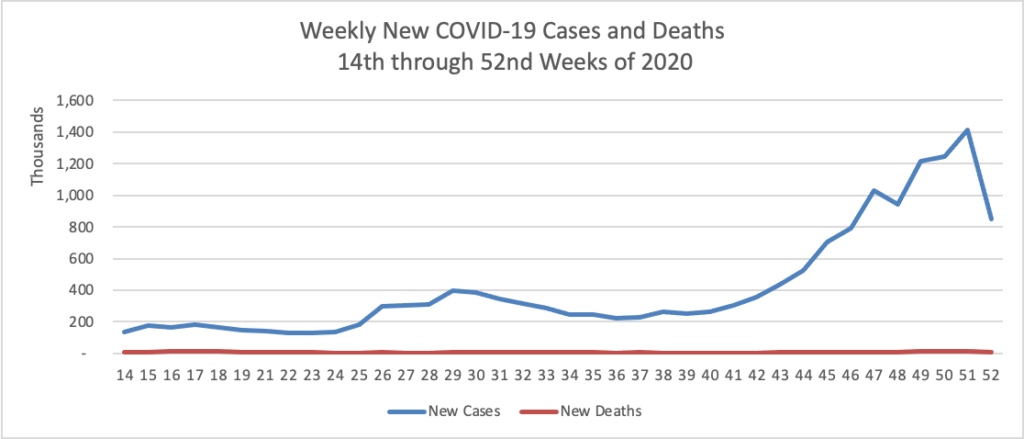
Based on the CDC’s Cases in the U.S. website, here is the FEHBlog’s chart of new weekly COVID-19 cases and deaths over the 20th through 43rd weeks of this year (beginning May 14 and ending October 28; using Thursday as the first day of the week in order to facilitate this weekly update):

By golly that’s a wavelike graph of new cases but bear in mind that new weekly cases have been over 200,000 since late June.

Here is the CDC’s latest overall weekly hospitalization rate chart for COVID-19:

Although hot spots for hospitalizations continue to occur around the country, the overall hospitalization rate is trending down even while new cases jump.

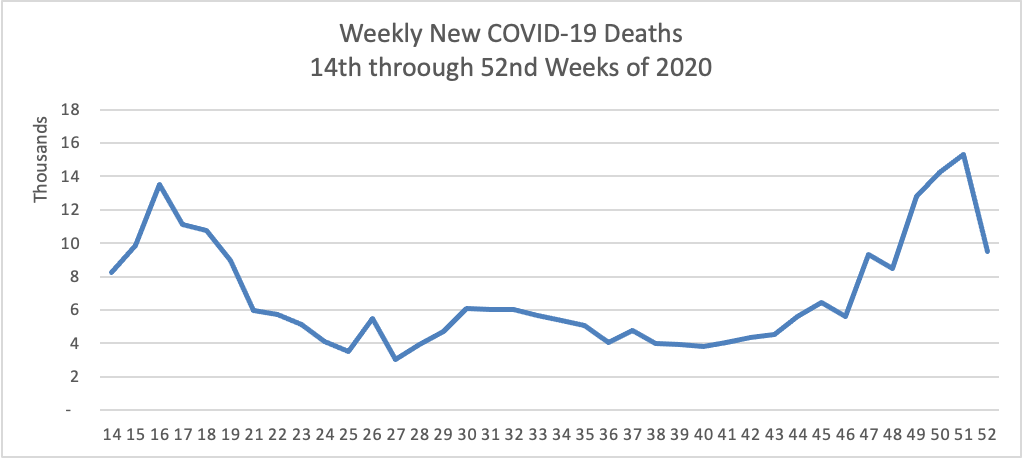
The FEHBlog has noted that the new cases and deaths chart shows a flat line for new weekly deaths because new cases greatly exceed new deaths. Accordingly here is a chart of new COVID-19 deaths over the same period (May 14 through October 28).

In this regard, Medscape reports that

new study conducted by researchers at Imperial College London found the COVID-19 infection fatality ratio is about 1.15% of infected people in high-income nations [e.g. the U.S.] and 0.23% in low-income nations.

The infection fatality ratio (IFR) represents the proportion of deaths among all infected individuals. It is “a key statistic for estimating the burden of COVID-19 and has been continuously debated throughout the current pandemic,” the Imperial College London said in a news release.

For context here are stats that the FEHBlog captured for the 2019-2020 flu season in the U.S.

CDC Fluview 28-Mar
Flu Deaths24000
Flu Cases39,000,000
Deaths over total cases0.06%

The CDC’s latest Fluview surveillance report indicates that seasonal flu activity in the United States remains low.

In other telehealth news, Healthcare Dive reports

  • “Teladoc has completed its $18.5 billion acquisition of Livongo following overwhelming shareholder approval, the virtual care giant announced Friday. Under the terms of the merger, Livongo shareholders will receive 0.5920 times shares of Teladoc, plus cash of $11.33 for each Livongo share. Teladoc shareholders will own about 58% of the combined company, and Livongo shareholders about 42%.” The merged company will continue to use the Teladoc name and its Purchase NY headquarters. Now that the merger has closed, “several of Livongo’s top executives, including CEO Zane Burke and President Jennifer Schneider, will depart the company, along with Livongo’s CFO and SVP of Business Development. The combined company’s board will consist of eight directors from Teladoc, including CEO Jason Gorevic, and five from Livongo, including founder Glen Tullman.”
  • More generally, “telehealth claim lines increased 3,552% in August this year compared to last, according to new data from Fair Health’s monthly tracker. Virtual care volume was relatively flat compared to July, following two months of declines, hinting at the staying power of telehealth even as COVID-19 cases fluctuate nationwide. Telehealth rose from just 0.17% of all medical claim lines in August last year to 6.07% this year. That’s compared to 6% in July this year.”

Federal News Network informs us that

The Office of Personnel Management has told its workforce it’s no longer actively pursuing the administration’s proposed merger with the General Services Administration.

In an email to staff, which covered everything from flu shots for employees to the status of reopening agency facilities, acting OPM Director Michael Rigas said Thursday he wanted to provide an update about the administration’s proposed GSA merger.

“As Congress has not acted on the administration’s legislative proposal, we are no longer devoting time and energy to the merger and are focused on ensuring OPM can function as a standalone personnel agency for the federal government,” Rigas said in the email, which Federal News Network obtained. “We are also conducting an independent analysis of the agency to help inform how OPM can best carry out its mission and meet the needs of the American people.”

A senior OPM official told Federal News Network the agency was looking at other options, especially now that the governmentwide security clearance business had moved to the Defense Department.

Tuesday Tidbits

Photo by Patrick Fore on Unsplash

Federal News Network called the FEHBlog’s attention to the fact that the OPM Inspector General has released his annual report on top management challenges that OPM faces, a number of which as always concern the FEHBP.

The IRS yesterday released a boatload of 2021 tax information —

  • Rev. Proc. 2020-45 provides inflation-adjusted items for 2021. Of note the Society for Human Resource Management points out that

For 2021, the dollar limit for employee contributions to health flexible spending accounts (health FSAs), made pretax through salary reductions, remains unchanged at $2,750, the IRS announced on Oct. 27 when it issued Revenue Procedure 2020-45.

The limit also applies to limited-purpose FSAs that are restricted to dental and vision care services, which can be used in tandem with health savings accounts (HSAs).

For health FSA plans that permit the carryover of unused amounts, the maximum carryover amount for 2021 is $550, an increase of $50 from the original 2020 carryover limit.

  • IRS Notice 2020-79 provides inflation-adjustments “affecting dollar limitations for 401(k), pension plans and other retirement-related items for tax year 2021. The contribution limit for employees who participate in 401(k), 403(b), most 457 plans, and the federal government’s Thrift Savings Plan remains unchanged at $19,500.”

Medscape reports that

Eli Lilly announced it will halt its ACTIV-3 trial evaluating the antibody bamlanivimab in combination with remdesivir for people hospitalized with COVID-19, after new evidence regarding efficacy emerged. The new data from the National Institutes of Health suggest that the experimental neutralizing antibody therapy does not offer significant clinical benefit for people with more advanced COVID-19 illness, according to a company statement. Eli Lilly also announced it plans to continue its other trials evaluating the antibody, including those assessing a potential role in treating people in the earlier stages of COVID-19.

A friend of the FEHBlog called his attention to this interesting NCQA publication on social determinants of health. Check it out.

Health Affairs provides a useful perspective on low value care in the age of COVID-19. In short,

There is the chance to use surveys or qualitative methods to compare the diverse harms experienced by patients who did and did not receive a low-value service because of the COVID-19 pandemic. It will be important to examine harms both across and within potentially high-risk or vulnerable subpopulations, as the distribution of harms may differ by demographics, social determinants, and presence of comorbid illnesses.

And to close the loop, the Senate confirmed Judge Amy Coney Barrett to be an Associate Justice of the U.S. Supreme Court last evening, and Justice Barrett was sworn in soon thereafter. The Senate has joined the House of Representatives on the campaign trail.

Monday Roundup

Photo by Sven Read on Unsplash

Healthcare Dive reports that Utah-based “Intermountain Healthcare and South Dakota-based Sanford Health announced Monday that the two had signed a letter of intent to merge. Together the two will operate 70 hospitals — many of which will be located in rural communities across the country — and 435 clinics and insure 1.1 million people.” Intermountain participates in the FEHB under the name of its affiliate SelectHealth.

The Labor Department’s Employee Benefit Security Administration (“EBSA”) released its 2020 edition of its federal mental health and substance use disorder parity self compliance tool for health plans. The first edition was released in April 2018. What’s more on Thursday October 29 at 2 pm ET EBSA will hold a free compliance assistance webcast on this complicated law.

Here’s a link to OPM’s third quarter 2020 report on the development of its Master Enrollment Index for the FEHBP.

The Centers for Medicare and Medicaid Services posted information today about the ACA federal marketplace open enrollment period which begins on Saturday November 1 and ends on December 15, 2020.

Over the weekend, the FEHBlog read in the Wall Street Journal’s Numbers column about COVID-19 mortality predictions. The author explains that

Now, as many as 50 different research groups make predictions, but one of the most accurate assembles all of the individual models, calculates the median value and looks no more than four weeks into the future.

The ensemble forecast was founded by the Reich Lab at the University of Massachusetts, Amherst, in collaboration with the Centers for Disease Control and Prevention and is based in part on models previously developed to forecast influenza and other infectious diseases.

In the next four weeks, it predicts the total number of deaths attributed to the new coronavirus will surpass 240,000—adding roughly 17,000 deaths to the current tally.

Such projections help policy makers and health-care officials decide how to manage resources and implement or relax interventions intended to curb the spread of the disease.

On the brighter side —

  • The Wall Street Journal reports that

A Covid-19 vaccine being developed by the University of Oxford and AstraZeneca AZN 2.06% PLC showed a promising immune response and low levels of adverse reactions in the elderly and older adults, according to an interim analysis that the drugmaker said was encouraging.

The vaccine, now in late-stage human trials aimed at showing its efficacy and safety, is a front-runner in the global sprint for a shot to protect lives and jump-start economies hobbled by the pandemic. Trials in the U.K. could produce results before year-end, fueling hopes among scientists and government leaders that a vaccine might be available for high-risk groups here by early 2021.

  • Fierce Healthcare informs us that “CVS views its pharmacists as playing a key role in assuaging fears, CEO Larry Merlo said Friday. Merlo, speaking at an event hosted by The Washington Post, said that pharmacists “are among the most trusted professionals” in the industry and as such will be able to educate patients about the safety and efficacy of the vaccine.”
  • Fierce Healthcare also recognizes “ten women who have risen to the challenges posed by COVID, as well as played a role in positioning their respective companies to be where they are today.” For example, Anthem Blue Cross’ Liz Kwo M.D. is scaling digital products to improve outcomes. Bravo to all of the winners.

Tuesday Tidbits

Photo by Patrick Fore on Unsplash

The Hill reports “progress but not breakthroughs” as yet in the negotiation to achieve bipartisan agreement on a pre-election COVID-19 relief bill. The Speaker has agreed to continue negotiations past the 48 hour deadline that she set over the week. So both sides have set and withdrawn deadlines. That may be the clearest sign that progress is being made.

Federal News Network takes a deeper dive into last week’s FEHBP Open Season announcement from OPM. To recap “non-postal FEHBP participants will pay in 2021.

  • Self-only coverage: $4.67 more per biweekly pay period,
  • Self-plus-one coverage: $10.90 more per biweekly pay period,
  • Family coverage: $10.94 more per biweekly pay period.

It is interesting that the two other than self only options increased at the same level. This illustrates the small family size in the FEHBP. Furthermore,

[OPM Acting Director for Healthcare and Insurance Laurie] Bodenheimer described the premium rates OPM announced Wednesday as a “snapshot in time.” “These numbers are based on premiums for next year, along with what plans people are enrolled in right now,” she said. “It’s well known that during the open season people do choose different plans and coverage based on benefits or premiums or whatever is important to them. The end result is often that the overall premium increase is less than what we’re announcing today.”

That, my friend, is the benefit of FEHBP competition. The FEHBP/FEDVIP/FSAFeds Open Season runs from November 9 through December 14.

The open season for the Affordable Care Act’s marketplace begins on November 1. HHS released yesterday

a report showing the trend of lower premiums and increased issuer participation for HealthCare.gov will continue for 2021 year. The average premium for the second lowest cost silver plan (also called the benchmark plan) dropped by 2% for the 2021 coverage year and, when looking at states that are using HealthCare.gov in both 2020 and 2021, 22 more issuers will offer coverage in 2021, for a total of 181 issuers delivering more choice and competition for consumers.

The FEHBlog is happy to see that marketplace continues to mature and improve without the individual mandate.

On the COVID 19 front —

  • Healthcare Dive reports “About 20% of hospital executives surveyed by Kaufman Hall recently said they were ‘extremely concerned’ about their financial viability until an effective vaccine or treatment is available.”
  • A friend of the FEHBlog pointed out this helpful New York Times COVID-19 vaccination tracker.
  • NIH Director Dr. Francis Collins reports in his Director’s Blog that “findings [from two new studies] show that people who survive a COVID-19 infection continue to produce protective antibodies against key parts of the virus for at least three to four months after developing their first symptoms. In contrast, some other antibody types decline more quickly. The findings offer hope that people infected with the virus will have some lasting antibody protection against re-infection, though for how long still remains to be determined.”
  • NPR informs us that “Two new peer-reviewed studies are showing a sharp drop in mortality among hospitalized COVID-19 patients. The drop is seen in all groups, including older patients and those with underlying conditions, suggesting that physicians are getting better at helping patients survive their illness.” That has been the FEHBlog’s operating assumption. The principal researcher remarks that “”I do think this is good news, “but it does not make the coronavirus a benign illness.” No doubt about that.

Friday Stats and More

Note to readers — The FEHBlog learned this morning that the 2021 Nationwide / FFS Plan Premium chart did not open properly. The FEHBlog apologizes. Here is the proper link to that report. Now onto Friday Stats and More —

Based on the CDC’s Cases in the U.S. website, here is the FEHBlog’s chart of new weekly COVID-19 cases and deaths over the 20th through 41st weeks of this year (beginning May 14 and ending October 15 / five months; using Thursday as the first day of the week in order to facilitate this weekly update):

As you can see there has been uptick in cases over the last month or so.

Here is the CDC’s latest overall weekly hospitalization rate chart for COVID-19:

The hospitalization rate has been fairly steady for the past two months.

Because the new deaths line in the chart above is flat because new cases greatly exceed new deaths, here is a chart of new COVID-19 deaths over the same period (May 14 through October 14 (five months).

COVID-19 weekly deaths also have plateaued around 4,000 over the past month. The CDC advises in this week’s COVID-19 surveillance report that

Nationally, weekly COVID-19-associated hospitalization rates reported through COVID-NET have remained steady for all age groups in recent weeks; however, rates have increased in 7 of 14 COVID-NET sites during this time period. Based on death certificate data, the percentage of deaths attributed to pneumonia, influenza, or COVID-19 (PIC) for week 41 was 7.2% and, while declining, remains above the epidemic threshold. Hospitalization and mortality data for the most recent weeks may change as additional data are reported.

Meanwhile the CDC’s last flu surveillance report states simply that “Seasonal influenza activity in the United States remains low.”

The Wall Street Journal reports that Pfizer “Chief Executive Albert Bourla said Friday the company could start to see from a large study whether the [COVID-19] vaccine works by the end of this month and would have data on its safety by the third week of November. If the preliminary results indicate the vaccine can work safely, Pfizer could ask U.S. health regulators to permit use by late November, Mr. Bourla said.” That’s encouraging.

Govexec informs us that “The Trump administration has put together a set of recommendations that agencies throughout government can use when bringing employees back to their offices, contracting with a private sector firm to compile the suggestions.”

Following up on yesterday’s report on the plans that are displaying their 2021 benefit and premium changes on their websites — you can add GEHA to that growing list. Blue Cross FEP also added to its website an explanation of how it plans to conduct a virtual Open Season in 2020.