Midweek Update

Midweek Update

OPM announced today that the next Federal Benefits Open Season will be held from November 14 through December 12, 2022. The announcement tells us that OPM expects to post 2023 FEHB and FEDVIP premiums on its website in “late September.”

From the Omicron and siblings front, the Wall Street Journal offers a helpful set of FAQs on the new bivalent mRNA boosters that are currently rolling out for administration.

From the monkeypox front, the Food and Drug Administration announced action to expand testing for the disease.

From the public health front, McKinsey and Company released its

United States of Health Dashboard. [McKinsey describes the tool as] an easy-to-use data visualization tool that enables users to explore the impact of disease and ill health within individual states, the dashboard is informed by key metrics encompassing maternal and neonatal health, behavioral health, communicable disease, chronic disease, and environmental health. It measures the total loss of healthy years of life, assuming full health (also known as “the burden of disease”), that affect a state’s population over the course of one year.

The dashboard is designed to help current and newly tapped state leaders, public-health agencies, and other stakeholders identify the highest-priority areas for investment by offering insights into key questions such as: How do behavioral health challenges affect a state’s population? How well is chronic disease managed and infectious disease controlled? How do mothers and their newborn infants fare? How well are health risks in the environment managed? And which populations are most significantly impacted by these metrics?

For example, here is a link to the Texas dashboard.

In other public health news, the American Hospital Association informs us

September is Suicide Prevention Awareness Month, with National Suicide Prevention Week running Sept. 4-10. In recognition of the effort to reduce the occurrence of suicide and destigmatize the conversation around it, AHA is proud to highlight resources available to our members and the public at large.

HR Director offers an interesting article about how HR professionals can approach this issue.

In the roughly dozen years since [he dealth with an employee suicide], [Matthew] Burr has advised every one of his clients (which include schools, financial firms and manufacturers, among other companies) to establish an EAP. Aside from a couple smaller companies, which have anywhere from five to 10 employees, every client has taken his advice. They were truly grateful to have done so ahead of the COVID-19 pandemic, so their employees had support systems already in place during the unprecedented time.

From the U.S. healthcare business front

  • Healthcare Dive reports that Walmart and UnitedHealthcare have teamed up to offer a Medicare Advantage plan under a ten-year-long contract. “Ultimately, the goal is to serve hundreds of thousands of seniors and Medicare beneficiaries in value-based arrangements through multiple Medicare Advantage plans.
  • Beckers Hospital Review tells us “Cost Plus Drug Co. founder Mark Cuban expects his online pharmacy to soon grow past 1 million customers, the billionaire of Shark Tank fame said Sept. 6 during Vox‘s Code Conference.  ‘By the time I get back, we should, hopefully, be past a million patients in seven months,’ Mr. Cuban told Vox‘s Recode, referring to the late-January launch of Cost Plus Drug Co., according to CNET.”
  • Reuters reports, not surprisingly, that “CVS Health Corp’s (CVS.N) plan to buy healthcare services company Signify Health for about $8 billion will face a tough U.S. antitrust review even though the two companies do not compete directly in any markets, three experts said Tuesday.”

From the Rx coverage, BioPharma Dive discusses the near term future of biosimilar drugs.

From the health savings account front, Voya Financial discusses “five HSA funding strategies companies [or FEHB plans’ can employ to help boost employee saving.”

Tuesday Tidbits

Photo by Patrick Fore on Unsplash

The Wall Street Journal reports

A federal judge approved Blue Cross Blue Shield companies’ settlement of a sweeping antitrust suit filed on behalf of their customers, with the insurers agreeing to pay $2.67 billion and change certain practices that allegedly limited competition. * * *

Under the settlement, the Blue insurers would drop a Blue Cross Blue Shield Association rule that limits the share of each company’s total national revenue that can come from business that isn’t under Blue brands.

That change could increase competition among the companies if they choose to expand their non-Blue lines of business in one another’s geographies, insurance experts said.

The settlement would also loosen a rule that had limited the Blue insurers’ ability to compete with one another for the business of large national employers. Under the changes, certain national employers would be able to also request a bid from a second Blue insurer of their choice, setting up competition between the two Blues.

However, the settlement stops short of unwinding the Blues’ licensing setup that grants exclusive geographic branding rights to companies—the main original focus of the litigation. * * *

A spokeswoman for the Blue Cross Blue Shield Association said it was pleased with the approval, and is committed to finalizing and implementing the agreement.

The settlement should be implemented beginning in 30 days. There are limited appeal rights for class members. The Journal adds, “The Blue insurers still face a second, parallel antitrust suit filed on behalf of doctors, hospitals and other healthcare providers.”

From the Omicron and siblings front, the New York Times offers advice on how to manage Omicron BA.5 symptoms, including sore throats, from home.

From the monkeypox front, Becker’s Hospital Review provides a state-by-state breakdown of U.S. monkeypox cases and offers physician perspectives on the monkeypox cases that they are treating. “‘The biggest misconception is that this is always a mild disease,’ Jason Zucker, MD, an infectious diseases specialist at NewYork-Presbyterian/Columbia University Irving Medical Center in New York City, said during an Aug. 5 call with reporters.”

Govexec reports that the FDA implemented its plan to significantly extend the supply of the preferred monkeypox vaccine. Bloomberg Prognosis provides more medical details on this development.

From the Rx coverage front, Fierce Healthcare discusses Optum’s latest drug development pipeline report and STAT News reports

For only the second time, Pfizer is offering a warranty for a medicine that will cover the cost for any patient or health plan if the medication fails to work, a move that expands an effort to appease concerns about high drug costs.

The newest warranty program began last month and covers Panzyga, which was approved last year in the U.S. to treat a rare neurological disorder called chronic inflammatory demyelinating polyneuropathy, or CIPD. Patients can get repaid for four treatments — up to $16,500 each, or a maximum of $50,000 — if use is discontinued for clinical reasons. And insurers can also get reimbursed for their own outlays.

Unlike the first warranty program — which Pfizer began a year ago for its Xalkori lung cancer treatment — this newest warranty is only available to patients who are covered by commercial insurance or pay cash, not government health care programs.  The Xalkori program is available to patients who are covered by commercial insurance or those who pay cash but are also covered by Medicare.

And how about an Rx coverage tidbit? Bayer tells us with understandable pride

This year, acetylsalicylic acid (ASA), the active ingredient that brought Aspirin to fame, celebrates its 125th anniversary. On August 10, 1897, Dr. Felix Hoffmann discovered the ideal formula for acetylsalicylic acid when he synthesized the first chemically pure and stable form of acetylsalicylic acid. * * *

Hoffmann’s breakthrough was entered in the trademark register of the Imperial Patent Office in Berlin in 1899 and received a patent in the USA the following year, and scientists continue to conduct research even to this day on Aspirin, other potential areas of application, and dosage forms. In 1969, the round tablet made its way to the moon with the astronauts in the Apollo 11 capsule.

From the U.S. healthcare business front, MedCity News examines CVS Health’s expansion into the primary and homecare markets.

From the plan design front,

  • AHRQ’s Medical Expenditure Panel released a survey on trends in health insurance at private employers, 2008 – 2021.
  • The International Foundation of Employee Benefit Plans offers four steps for evaluating your plan’s diabetes coverage.
  • The Congressional Research Service updated its health savings account report.

From the telehealth and fraud, waste and abuse fronts

Healthcare Dive informs us

More patients turned to telehealth to see a doctor in May than April, in step with an increase in COVID-19 cases reported to the Centers for Disease Control and Prevention, according to Fair Health’s latest monthly tracker of private insurance claim lines.

Virtual visits rose 10.2% in May, accounting for 5.4% of all medical claim lines in the month, compared to 4.9% in April, Fair Health said Monday. It was the second straight month that telehealth’s share of claims grew.

COVID-19 made the list of top five telehealth diagnoses in every region of the country in May, holding in the No. 2 spot in the Northeast while climbing to second place in the Midwest and West and third place in the South.

STAT News delves into how telehealth fraud concerns could impact the industry’s future.

In Postal Service news, Federal News Network reports that USPS is eyeing mail price increases for January 2023.

USPS Chief Financial Officer Joe Corbett said the agency remains “in a financial hole,” and that more progress under the 10-year reform plan is needed.

“While we have accomplished a tremendous amount executing on the [Delivering for America] plan, we still have a lot of work to do. We need to continue executing the management initiatives in our Delivering for America plan to fill this hole and return to Postal Service to continuous self-sustaining financial health,” Corbett said.

[Postmaster General] DeJoy said USPS contributions to the retirement health care plan for its employees, under Postal Service Reform Act, will resume in 2026, and will grow to about $6.7 billion a year.

“We will not be able to make these payments unless we timely engage and accomplish all our initiatives, and we are trying to do just that,” DeJoy said.

Midweek update

Photo by Michele Orallo on Unsplash

From Capitol Hill, Medtech Dive reports

The Senate Committee on Health, Education, Labor and Pensions voted Tuesday to send a bill to the Senate that would reauthorize the Food and Drug Administration to collect user fees from device- and drug-makers for the next five years. 

A provision would require the FDA to finalize guidance that would create a category of over-the-counter hearing aids within a month of the bill’s passage. The FDA last issued a proposed guidance in October.

Committee Ranking Member Sen. Richard Burr, R-N.C., questioned on Tuesday whether the FDA should have that expanded authority, despite co-sponsoring legislation that would change how diagnostic tests are regulated, including laboratory-developed tests.

Fierce Healthcare adds

The American Hospital Association (AHA) penned a last-ditch letter to congressional leaders pleading for Medicare sequester cuts slated to take effect July 1 to be halted in light of the financial strain many of the nation’s hospitals are expected to face throughout 2022.

Congress had initially paused the 2% payment cut as part of the CARES Act when the COVID-19 pandemic began to threaten providers’ bottom lines. Sequestration cuts were continually punted downfield until last December, when a bill was signed to resume a 1% cut in April and the full 2% in July.

With half a month to go, AHA Executive Vice President Stacey Hughes warned majority and minority leaders Tuesday that financial relief from the pending cut is necessary for hospitals “to maintain access to care for the patients and communities they serve.”

From the Supreme Court, the American Hospital Association gleefully informs us

The U.S. Supreme Court today ruled unanimously in favor of the AHA and others, reversing a 2020 [U.S.] court of appeals decision upholding the authority of the Department of Health and Human Services to significantly cut payments to certain hospitals that participate in the 340B Drug Pricing Program, and thereby threatening access to care for patients.

The Supreme Court held that “HHS’s 2018 and 2019 reimbursement rates for 340B hospitals were contrary to the statute and unlawful.” Noting that “340B hospitals perform valuable services for low-income and rural communities but have to rely on limited federal funding for support,” the Supreme Court observed that “this case has immense economic consequences, about $1.6 billion annually.”

Despite those serious practical impacts, the Supreme Court concluded that “[u]nder the text and structure of the statute,” the case is “straightforward” as a matter of law: “Because HHS did not conduct a survey of hospitals’ acquisition costs, HHS acted unlawfully by reducing the reimbursement rates for 340B hospitals.”

From the Omicron and siblings front —

The Wall Street Journal reports

Health experts advising U.S. health regulators backed giving Covid-19 vaccines from Pfizer Inc. and BioNTech SE and from Moderna Inc. to children as young as 6 months old

The panel voted 21 to 0 in a pair of votes on Wednesday in support of expanding access to the vaccines.

The positive recommendations will likely lead soon to expanding the U.S. Covid-19 vaccination campaign to the 19.6 million children from 6 months to under 5 years of age, one of the last groups of people in the U.S. waiting for shots.

The Food and Drug Administration, which doesn’t have to follow the panel’s recommendations but usually does, is expected to authorize the shots within days. Vaccinations could begin as early as June 21, according to the Biden administration.

and

Moderna Inc. is planning to test its Covid-19 vaccine in babies 3 months to 6 months old, the youngest age group studied to date.

The Cambridge, Mass., company said Wednesday it is in the final stages of planning the study, to be called BabyCove and expected to begin enrolling as many as 700 babies in September.

BabyCove would be the first study of Moderna’s vaccine in infants younger than 6 months.

STAT News adds

Pfizer said Tuesday that a much-watched study of its antiviral Paxlovid in patients who have Covid but don’t have risk factors for severe disease failed to show a benefit in speeding alleviation of Covid symptoms, but did seem to prevent doctor’s visits and hospitalizations.

Additionally, because of the small number of hospitalizations overall in the study, it failed to produce a statistically significant finding on whether patients who had previously been vaccinated against Covid were hospitalized less often if they received Paxlovid.

The data in no way invalidate earlier results that show that Paxlovid prevents hospitalizations and saves lives in patients at high risk of severe Covid. But the results, published in a press release, are likely to take time for experts to digest and understand.

From the unusual viruses front, the American Hospital Association explains

The Centers for Disease Control and Prevention yesterday [June 14] updated its guidance to help clinicians evaluate and test patients with relevant history, signs and symptoms for monkeypox. Over 1,800 monkeypox or orthopoxvirus cases have been reported globally this year, including 72 in the United States. According to CDC, the virus does not spread easily between people without close contact, so the risk to the general population remains low.

The World Health Organization plans to change monkeypox’s name next week.

From the healthcare business front

Anthem will officially become Elevance Health on June 28, and, as part of its corporate rebrand, it’s also launching new brands for two of its subsidiaries.

The insurer will consolidate its healthcare services businesses under one umbrella, called Carelon. Carelon is a combination of the word “care” with the suffix “lon,” which means full or complete, representing the company’s ambition to offer an end-to-end care experience.

Carelon will include Anthem’s in-house pharmacy benefit manager Ingenio Rx as well as recent acquisitions such as Beacon Health Options, a behavioral health provider, and myNEXUS, a home healthcare company. Carelon will serve 1 in 3 people in the U.S., according to the announcement.

and

Humana is moving its pharmacy brands under the CenterWell umbrella.

Humana Pharmacy and Humana Specialty Pharmacy will now operate as CenterWell Pharmacy and CenterWell Specialty Pharmacy, respectively, the insurer announced. Enclara Pharmacia and Humana Pharmacy Solutions, the company’s pharmacy benefit management arm, will maintain their original branding.

“The CenterWell brand symbolizes our ongoing and strong commitment to keeping members, customers and patients at the center of everything we do,” said Scott Greenwell, Humana Pharmacy Solutions president, in a statement.

  • Morning Consult discusses how CVS Health and Walgreens retained “high customer trust” in 2021.

From the benefit design front, Employee Benefits News offers the case for health savings accounts. The FEHBlog is already sold.

Friday Stats and More

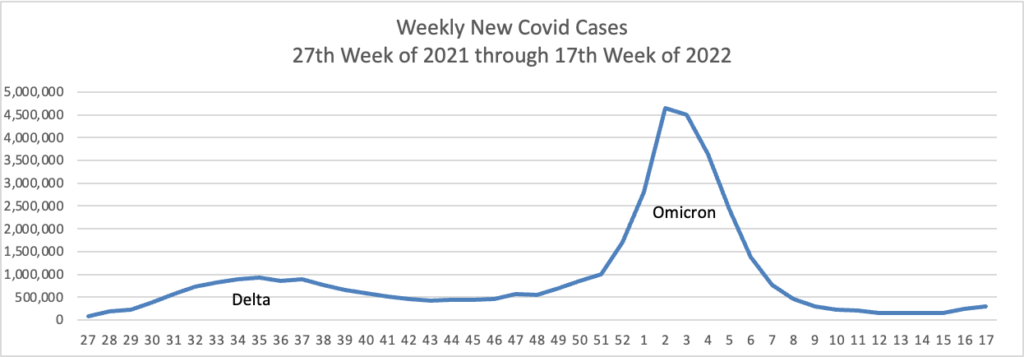
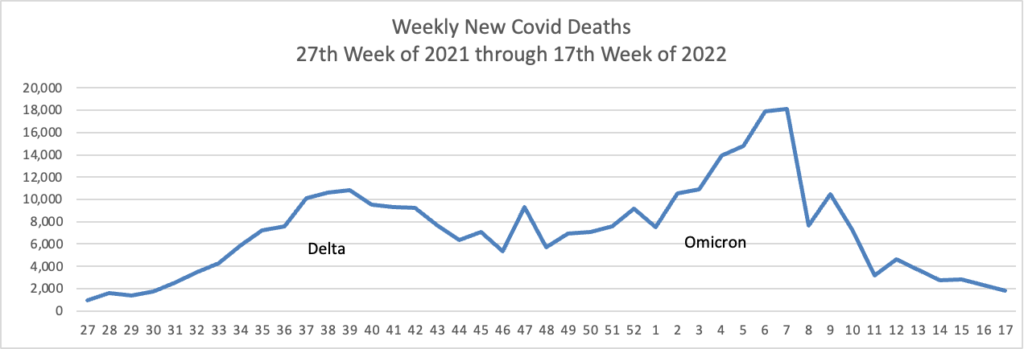
Based on the Centers for Disease Control’s Covid Data Tracker and using Thursday as the first day of the week, here are the FEHBlog’s weekly charts of new Covid cases and deaths from the 27th week of 2021 through the 17th week of 2022:

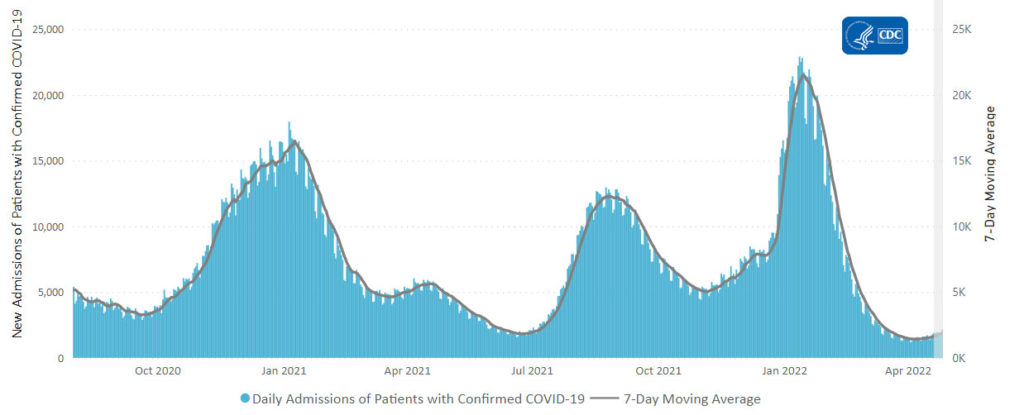
In addition, here’s the CDC’s Chart of Daily Trends in the Number of New COVID-19 Hospital Admissions in the United States:

Can you say endemic?

Below you will find the FEHBlog’s weekly chart of Covid vaccinations distributed and administered from the beginning of the Covid vaccination era in December 2020 to the current week 17.

The CDC’s Covid Data Tracker Weekly Review points out, “This week, the U.S. COVID-19 Vaccination Program marks two milestones: 500 days since the first COVID-19 vaccine was approved for use in the United States, and 100 million first booster doses administered.”

In the New York Times, David Leonhardt reports that the FDA is waiting to receive additional data from Pfizer and Modera [likely next month] to support their emergency use authorizations for Covid vaccines for children between six months and five years. Although the FDA’s preference is to give EUAs to both vaccines simultaneously to provide parents a choice, the agency will not delay a EUA decision on one or the other unnecessarily.

The CDC’s weekly review adds,

Currently, there are 54 (1.68%) counties, districts, or territories with a high COVID-19 Community Level, 256 (7.95%) counties with a medium Community Level, and 2,910 (90.37%) counties with a low Community Level. This represents a slight (0.59%) increase in the number of high-level counties, a small (+1.43%) increase in the number of medium-level counties, and a corresponding (−2.02%) decrease in the number of low-level counties. Seventeen (30.36%) of 56 jurisdictions had no high- or medium-level counties this week.

To check your COVID-19 community level, visit COVID Data Tracker.

From the health savings account front, the Society for Human Resource Management reports

Health savings account (HSA) contribution limits for 2023 are going up significantly in response to the recent inflation surge, the IRS announced April 29, giving employers that sponsor high-deductible health plans (HDHPs) plenty of time to prepare for open enrollment season later this year.

The annual inflation-adjusted limit on HSA contributions for self-only coverage will be $3,850, up from $3,650 in 2022. The HSA contribution limit for family coverage will be $7,750, up from $7,300. The adjustments represent approximately a 5.5 percent increase over 2022 contribution limits, whereas these limits rose by about 1.4 percent between 2021 and 2022.

In Revenue Procedure 2022-24, the IRS confirmed HSA contribution limits effective for calendar year 2023, along with minimum deductible and maximum out-of-pocket expenses for the HDHPs with which HSAs are paired.

Here is that 2023 deductible and OOP max information:

For calendar year 2023, a “high deductible health plan” is defined under § 223(c)(2)(A) as a health plan with an annual deductible that is not less than $1,500 for self-only coverage or $3,000 for family coverage [Self-only: +$100 Family: +200 from 2022], and for which the annual out-of-pocket expenses (deductibles, co-payments, and other amounts, but not premiums) do not exceed $7,500 for self-only coverage or $15,000 for family coverage [Self-only: +$450 Family: +$900 from 2022].

From the Medicare Part D front, Fierce Healthcare reports

CMS is giving Part D plans a little extra time to prepare to funnel price concessions to the member at the point of sale.

The Centers for Medicare & Medicaid Services on Friday finalized a rule with the price concession changes as well as a slew of updates for Medicare Advantage plans.

The agency said in a fact sheet on the regulation that beginning Jan. 1, 2024, it will define the negotiated price for a drug in Part D as the baseline, or lowest possible, payment to a pharmacy to ensure that price concessions are felt at the point of sale by beneficiaries.

“This policy reduces beneficiary out-of-pocket costs and improves price transparency and market competition in the Part D program,” CMS said.

The bell for prescription drug rebates is beginning to toll.

From the healthcare business front, Healthcare Dive tells us

Molina Healthcare in the first quarter recorded its highest COVID-19 costs since the start of the pandemic, CEO Joe Zubretsky said Thursday.

However, those costs were almost entirely offset by members cutting back on healthcare visits, a common trend throughout the pandemic, he said on a call with investors.

After costs peaked in January, they quickly declined in the subsequent months. “When I say [COVID-19 costs] subsided during the quarter, it did so dramatically,” Zubretsky added.   

HR Morning discusses a recent Willis Towers Watson survey on how employers are dealing with rising health care costs. To make healthcare more affordable for employees.

Fifty-five percent said their plan is to improve quality and outcomes to lower overall cost. Adding or enhancing low- or no-cost coverage for specific benefits is the plan for 41%. And 32% will be making changes to employees’ out-of-pocket costs, while 21% said they’ll alter their health plan payroll contributions.

From the preventive services front, the U.S. Preventive Services Task Force made a final grade D recommendation against initiating low-dose aspirin use for the primary prevention of CVD in adults 60 years or older. “For adults aged 40 to 59 years with an estimated 10% or greater 10-year cardiovascular disease (CVD) risk:  The decision to initiate low-dose aspirin use for the primary prevention of CVD in this group should be an individual one.” This is a Grade C recommendation.

Senate passes the Postal Reform Act of 2022

Photo by Michele Orallo on Unsplash

From Capitol Hill, Federal News Network reports

A long-awaited reform bill that would save the Postal Service more than $100 billion (H.R. 3076) is headed to President Joe Biden’s desk.

The Senate on Tuesday passed the Postal Service Reform Act, which would, among other things, eliminate a 2006 mandate from Congress to pre-fund retiree health benefits.

Postmaster General Louis DeJoy supports the bill, as do postal unions and associations, who say it will address USPS’s long-term financial challenges.

The bill will create a Postal Service Health Benefits Program (PSHBP) within the FEHBP effective January 1, 2025. A recently added feature of the bill creates a transitional Open Season in the fall of 2024. Any Postal employee or annuitant who fails to switch to a PSHBP plan will be added to the rolls of their current carrier’s PSHBP plan. However, the non-selecting Postal employees and annuitants whose current carrier is not participating in the PSHBP will wind up on the rolls of the PSHBP option with the lowest premium that is not a high deductible health plan and does not charge membership dues.

Another new feature of the bill requires the Postal Service to create a Health Benefits Education Program in mid-2023. That HBEP will include ACA navigators. It will be interesting to see, for example, whether the ACA Navigators can hold down the number of non-selecting Postal employees and annuitants in the transitional Open Season.

P.S. For fun, the FEHBlog reviewed the summary of H.R. 3076’s earliest antecedent which was S. 1789 from the 112th Congress titled the 21st Century Postal Service Act of 2012. According to the bill’s summary, this first shot also called for an HBEP. The 2022 twist is the ACA navigator feature in H.R. 3076. More accurately, the FEHBlog should describe these folks as ACA-like navigators.

For perspective on this clarification, NPR Shots discusses the good works of patient navigators in the State of Delaware. These folks have been improving the rates of cancer screenings in underserved communities which in turn has lower cancer mortality rates.

Also from Capitol Hill, Roll Call informs us

Congressional leaders spent Tuesday afternoon negotiating potential late add-ons to the fiscal 2022 omnibus spending bill, including cybersecurity legislation and a bipartisan deal to revive lapsed Violence Against Women Act authorities, with an eye on releasing final text later that day. 

“Republicans and Democrats are very, very close to finalizing the agreement,” Senate Majority Leader Charles E. Schumer, D-N.Y., told reporters Tuesday after Democrats’ early afternoon caucus lunch. “I expect there will be text released in a few hours. And we’re working very hard on a few last-minute issues: cyber and VAWA.”

The schedule leaders are eying would have the House vote on the omnibus Wednesday morning and the Senate clear the measure before stopgap funding expires at midnight Friday. GOP objections to a unanimous consent agreement to speed consideration in the Senate could delay final passage into the weekend, lawmakers warned, but both sides expect the process to be complete in time to avoid a partial government shutdown when federal agencies open Monday.

The Hill adds

Lawmakers say they are close to an agreement to provide billions in new coronavirus relief, set to be tied to a massive government funding bill [which step would improve its chances of passage]. 

Congress is expected to include at least $15 billion in response to the Biden administration’s request for new funding for COVID-19 vaccines, treatments and testing.

Also from Capitol Hill, Congressional Research Service released a report on Health Reimbursement Arrangements, a tool which the Internal Revenue Service created in the early 2000s shortly before Congress added high deductible plans with health savings account to the toolbox in the Medicare Modernization Act of 2003. Nevertheless, HRAs remain handy tools for designing employer sponsored health plans such as those in the FEHBP.

From the Omicron front, the Department of Health and Human Services released a fact sheet about the Administration’s new test to treat program which is launching on a limited basis this week. Here’s a link to the fact sheet. It is evident that these sites will not be using a health department standing order to dispense the Covid medication. Instead

Are pharmacists themselves able to prescribe the oral antiviral pills (Paxlovid and Molnupiravir)?

No. The Test to Treat initiative includes sites that have health care providers available to provide timely and thorough assessment and discussion relevant to oral antiviral treatment option(s) , consistent with FDA requirements regarding these drugs. The Test to Treat initiative does not change existing requirements for a qualified health care provider to write the prescription.

NPR Shots offers more information on the program here.

Biden administration officials say [in the fact sheet] they’ll be launching a “one-stop shop” website later this month, where people will be able to find test-to-treat locations, along with sites where they can get free masks, tests and vaccines.

The test to treat program comes at a time when coronavirus cases are falling steeply in the U.S., and the supply of Pfizer’s Paxlovid pill is ramping up. These are good trends, but it’s not a time to be complacent, says Dr. James Hildreth, president and CEO of Meharry Medical College: “The virus is not done with us yet, right? And, if we do have another surge, having a system like this in place could have a huge impact on controlling it.” 

Hildreth says the program holds a lot of promise — so long as it expands its outreach to rural communities, indigenous groups, and other marginalized high-risk people that need it the most.

The National Institutes of Health discusses an NIH funded research finding that the immune response from Covid vaccines improves for months after vaccination.

Govexec tells us “A federal appeals court on Tuesday appeared open to reinstating President Biden’s COVID-19 vaccine mandate, suggesting a lower court’s pause may have been overly broad.” Govexec based its view on the oral argument held before a panel of judges from the U.S. Court of Appeals for the Fifth Circuit in case calling into question the nationwide scope of the injunction created by the district court. The panel should issue its decision later this month.

Fierce Healthcare reports from the inaugural Vive conference being held this week in Miami, Florida. For example

Two key topics have dominated the industry conversation amid the COVID-19 pandemic: health equity and the role of technology.

But these are not distinct entities, insurance executives said Monday at the inaugural ViVE Conference in Miami, and it’s necessary to find the intersection, or “techquity.” It’s critical, they argued, that technology be viewed through an equity lens to ensure that access is fair and that the tools on offer are working for a diverse array of patients.

The national conversation about disparities, however, has helped enshrine equity as a key part of the technology conversation, said U. Michael Currie, senior vice president and chief health equity officer at Optum and UnitedHealth Group, on a panel at the conference.

and

Health tech veteran Jennifer Schneider, M.D., helped build up chronic condition management startup Livongo, then helped lead the company through a massive IPO and the industry’s largest merger with Teladoc.

Schneider and other Livongo veterans are reuniting and taking on their next challenge—improving rural healthcare.

The executive team, including Amar Kendale, former chief product officer at Livongo, and Bimal Shah, M.D., former chief medical officer at Livongo, announced Monday the launch of Homeward, a startup focused on improving access to high-quality, affordable primary and specialty care in rural communities.

Midweek Update

From Capitol Hill —

Today, the Senate invoked cloture on the resolution to continue funding the federal government until March 11 by unanimous consent. Consequently, the new resolution should be approved by Congress tomorrow, which is the day before funding expires under the current resolution.

The House of Representatives has returned the correct version of the Postal Reform Act, H.R. 3076, to the Senate, and the Senate has had the correct version read twice. We will have to wait and see if anything happens with the bill tomorrow.

In the meantime, check out the Congressional Research Service’s February 11, 2022, report on the Postal Reform bill approved by the House, H.R. 3076. In the FEHBlog’s view, a unique feature of the House version compared to earlier versions is that the bill destined to become law creates a transitional Open Season. The Transitional Open Season will auto-enroll those Postal employees and annuitants who failed to transfer over to the PSHBP in the 2024 Open Season for the 2025 plan year. The receiving PSHBP plan will be the lowest premium nationwide PSHBP plan that is not a high deductible plan and does not require dues payments. Also, the House version makes the Postal Service financially responsible for the late Medicare Part B enrollment fees otherwise owed by the Postal annuitants with Part A only who take advantage of a special Part B enrollment period in 2024.

Following up on Robert Califf’s second confirmation as Food and Drug Administrator yesterday, STAT News identified the six major drug approval decisions awaiting him, including Pfizer’s toddler COVID vaccine, the Novovax Covid vaccine, and Alzheimer’s Disease treatments. Good luck, Mr. Califf.

Also among those drug approval decisions awaiting Mr. Califf is a Covid treatment discussed in Bloomberg

After omicron weakened some of the defenses that doctors have against Covid, an experimental treatment being developed by Novartis and a small Swiss biotech partner holds some promise as a new therapy.

Last week, Novartis sought emergency approval from the U.S. Food and Drug Administration for an intravenous drug, called ensovibep, that’s similar in some ways to monoclonal antibody treatments. However, the way it works is significantly different, which might allow it to succeed where antibody therapies fail against omicron.

The compound uses tiny proteins to attack the coronavirus’s spike protein in not just one, but multiple places. That appears to give it a leg up in fighting the virus even as it mutates.

In other federal leadership changes, STAT News adds

President Joe Biden is replacing a top science adviser who resigned under a cloud with two individuals who will split his duties on an interim basis.

Biden is tapping [Alondra Nelson, ]a deputy in the White House science and technology office along with [Dr. Francis Collins] the recently retired director of the National Institutes of Health, according to a personal familiar with the president’s plans.

From the Omicron front, Beckers Hospital Review tells us

The COVID-19 omicron subvariant BA.2, dubbed “stealth omicron,” has spread to at least 74 countries and 47 states across the U.S., according to data from outbreak.info.

Four more updates: 

1. BA.2 is most prevalent in HHS’ region 3, which includes Pennsylvania, West Virginia, Virginia, Delaware and Maryland, according to CDC data.

2. Region 7, which includes Iowa, Kansas, Missouri and Nebraska, had the lowest percentage of BA.2 cases last week, according to CDC data. 

3. BA.2 currently accounts for 3.9 percent of total COVID-19 cases in the U.S., with omicron subvariant BA.1.1 accounting for 73.2 percent of cases, CDC data shows. 

4. A South African study analyzing nearly 100,000 COVID-19 cases found that BA.2 doesn’t cause significantly more severe illness than the original omicron variant, Bloomberg reported Feb. 16.

From the Covid vaccine front, The American Medical Association reports

The New York Times (2/15, Anthes) reports infants born to mothers who “received two doses of an mRNA coronavirus vaccine during pregnancy are less likely to be admitted to the hospital for COVID-19 in the first six months of life, according to a new study from the Centers for Disease Control and Prevention.” The study found that “overall, maternal vaccination was 61% effective at preventing infant hospitalization.”

Reuters (2/15, Mishra, Steenhuysen) reports, “That protection rose to 80% when the mothers were vaccinated 21 weeks through 14 days before delivery.” Meanwhile, the “effectiveness fell to 32% for the babies whose mothers were inoculated earlier during pregnancy.”

The Hill (2/15, Sullivan) reports the study used data “from 20 pediatric hospitals in 17 states, from July 2021 to January 2022.”

From the Covid front, Fierce Healthcare reports

Anthem has launched a new pilot that aims to offer a digital concierge care experience to members recovering from COVID-19.

Through COVID Concierge Care, eligible members can access an app and fill out a questionnaire that tracks their symptoms on a daily basis. They can connect with a clinician via secure, two-way text-based messages in the app or via text or email.

In addition, based on their reported symptoms, members can access evidence-based educational tools and wellness content to help them self-manage their conditions. For example, members can connect with breathing exercise guides to manage stress or health articles about their symptoms.

From the Covid vaccine mandate front, Federal News Network tells us

The Postal Service is laying the groundwork to track the vaccination and testing status of its workforce amid the COVID-19 pandemic, or any future public health emergency.

USPS, however, says it’s only giving notice as it prepares for “potential future contingencies,” and is not, at this time, updating its COVID-19 vaccine or testing requirements, nor is it seeking to collect data on the vaccination status of its workforce.

In healthcare business news, Healthcare Dive informs us

The Department of Justice is preparing a lawsuit to block UnitedHealth from purchasing Change Healthcare, according to a new report, as regulators take a more aggressive stance on checking consolidation in the healthcare industry.

According to Dealreporter, which cited sources familiar with the matter, UnitedHealth and Change are expected to meet with the DOJ soon for a “last rites” meeting on the proposed deal, first announced early last year. Despite UnitedHealth and Change exploring divestitures to assuage antitrust concerns, the DOJ has not found any that would make the deal acceptable, according to Dealreporter’s sourcing.

From the health savings account front, Health Payer Intelligence offers nine best practices for high deductible health plan design based on a recent report from the National Pharmaceutical Council (NPC) and Gallagher.

From the antibiotic overutilization front, AHIP lets us know

A study published in the CDC’s Morbidity and Mortality Weekly Report found 41% of antibiotic prescriptions for Medicare Part D beneficiaries in 2019 were written by just 10% of prescribers. Researchers found nearly half of these high-volume prescribers practiced in southern states, and they had a median antibiotic prescribing rate of 680 per 1,000 beneficiaries, compared with 426 per 1,000 beneficiaries among low-volume prescribers. 

Monday Roundup

Photo by Sven Read on Unsplash

From Capitol Hill we are presented with some surprising developments —

Govexec tells us

Sen. Rick Scott, R-Fla., blocked the Senate from moving forward with the bipartisan 2021 Postal Reform Act, which won overwhelming support last week in the House. Lawmakers in both parties have attempted for years to eliminate much of the agency’s debt and restructure some of its operations and the efforts appeared to finally reach a breakthrough with the successful vote in the lower chamber. The bill has the backing of 14 Republican senators, indicating broad support and votes that will ultimately clear the 60-member support threshold with ease. 

When the House sent the bill to the Senate last week, however, it passed along the wrong version that did not include the most up-to-date text. The House on Friday quickly corrected the error by unanimously approving a measure to send over the correct version. Senate Majority Leader Chuck Schumer, D-N.Y., had already started the process of approving the incorrect bill last week and was hoping to move the House-backed technical correction on Monday with unanimous consent, allowing the chamber to resume consideration of the full bill. 

That is when Sen. Rick Scott, R-Fla., objected, sending the process into chaos. The Senate is slated to recess on Friday and will likely not have time to pass the bill until after it returns in March.  * * *

Scott said on the floor he was concerned the measure had not gone through the committee process on the Senate side and about the funding for a potential increase in Medicare costs. The Congressional Budget Office said in a recent score the measure would save the government $1.5 billion over the next 10 years. Lawmakers have estimated it will save the Postal Service $50 billion over the same period.

The Wall Street Journal reports

Sen. Marsha Blackburn (R., Tenn.) said that she will hold up a bill to keep the government funded until the Biden administration responds to her questions about whether a program intended to help people with substance-abuse disorders could be used for pipes to smoke illicit substances.

Her position injects uncertainty into the government’s ability to avoid a partial shutdown later this week. While a single senator can’t stop legislation, he or she can slow down the process by declining to consent to cutting out procedural hurdles.

The Senate is aiming to pass a three-week government funding bill by Feb. 18, when a current funding bill expires, in order to provide breathing room for negotiators to reach a deal funding the full fiscal year. A Senate Democratic aide said that there isn’t enough time to go through each step in the process with the maximum amount of debate time and still avoid a temporary shutdown.

“All we want to know is how much money they are using for safe-smoking kits? What is in the kits? Where is this money going?” Ms. Blackburn said in an interview. “Once I get an answer, I will lift my hold. I’m just waiting for an answer.”

Roll Call informs us

The Biden administration’s nominee to lead the Food and Drug Administration, Robert Califf, survived a Senate procedural vote, 49-45, on Monday evening with the help of five Republicans.

A confirmation vote on the Senate floor is expected to take place Tuesday, and it’ll likely be a close one. Sens. Susan Collins, R-Maine; Lisa Murkowski, R-Alaska; Mitt Romney, R-Utah; Richard M. Burr, R-N.C.; and Roy Blunt, R-Mo., joined Democrats to help shut off debate on Califf’s nomination.

Califf faced controversy throughout his nomination process from both parties. The former FDA commissioner had to cut deals with multiple lawmakers ahead of the floor vote, trading policy promises for votes. Several Senate Democrats opposed Califf’s nomination, due to his past ties to the pharmaceutical industry and handling of the opioid crisis when he led the FDA during the tail end of the Obama administration.

From the Omicron front, STAT News explains why the COVID vaccines are a “freaking miracle.”

Two years into the Covid-19 pandemic, it’s easy to lament all that has come to pass. The devastating losses. The upending of what we regarded as normal ways of life. The sheer relentlessness of it all.

But let’s stop for a moment and consider something else that may have escaped you: You have witnessed — and you are a beneficiary of — a freaking miracle.

That miracle is the development, testing, manufacturing, and global distribution of Covid vaccines.

How freaking true. It’s worth a read.

From the telehealth front, STAT New also delves into what we know and don’t know about whether telehealth can cut costs. This article gives the FEHBlog an opportunity to express his opinion that hub and spoke telehealth services, like Teladoc, can save costs by offering mental healthcare therapy on a long-term basis. Teletherapy is more accessible than in person therapy and all hub and spoke teletherapists are in-network. What’s not to like?

From the consumer driven health care front, Health Payer Intelligence considers the pros and cons of CDHP products in 2022. There are lots of FEHB CDHP offerings.

Happy Veterans’ Day

Thanks to Justin Casey for sharing their work on Unsplash.

Happy Veterans’ Day! Here’s a link to the OPM Director’s thoughts on this day as posted in OPM’s Medium channel.

Roughly 30 percent of the federal workforce has served our nation in uniform, and at OPM, we are working hard to welcome more. We are the guardians of the competitive hiring process, which includes ensuring that agencies are properly applying the Veterans’ preference rules. Much like in our recently expanded Military Spouse Hiring Authority, we recognize the unique leadership qualities on display in military households. We are eager to honor their contributions and match their skills with the needs of the American people.

From the Open Season advice front, Tammy Flanagan writes about FEHB high deductible health plans (“HDHP”), enrollment in which allows a federal or postal employee to contribute to a health savings account (“HSA”).

In 2022, for each month you are eligible for an HSA, you will receive a premium pass through, which is portion of your monthly health plan premium that is deposited to your HSA each month. You can make additional tax-free contributions to your HSA, as long as total contributions do not exceed $3,650 for an individual and $7,300 for a family.

In many of the FEHB HDHP plans, the premium pass through amount ranges from $75 to $100 per person per month, which can go a long way toward offsetting the high deductibles that are inherent to this kind of plan. There’s no time limit for withdrawing money from an HSA to pay for [healthcare ]expenses.

HSA contributions and related income are never federally taxed as long as the money is used for healthcare expenses. The trick is to grow the funding in an HSA before you hit high out of pocket medical spending for raising a family or in retirement.

It’s also worth noting that the alway informative Reg Jones has been writing about Open Season in FedWeek for the past three weeks.

In related news, Health Payer Intelligence discusses the Medicare Advantage open season also now underway.

Medicare Advantage has seen a lot of growth in recent years and that trend is set to continue into 2022, as evident in the number of plan offerings for the Medicare Advantage 2022 open enrollment season, according to a Kaiser Family Foundation (KFF) issue brief.

“As Medicare Advantage enrollment continues to grow, insurers seem to be responding by offering more plans and choices to the people on Medicare,” the researchers explained. Payers are offering a total of more than 3,800 Medicare Advantage plans in 2022. Nearly nine out of ten of these health plans are Medicare Advantage-prescription drug plans. 

In FSAFeds news, the Internal Revenue Service announced its 2022 inflation adjustments to various and sundry tax matters. Rev. Proc. 2021-45. Of note,

For taxable years beginning in 2022, the dollar limitation under § 125(i) on voluntary employee salary reductions for contributions to health flexible spending arrangements is $2,850. If the cafeteria plan permits the carryover of unused amounts, the maximum carryover amount is $570.

These increases are not automatic, but rather are triggered by employer action to amend the underlying plan.

From the COVID vaccine mandate front —

  • The Safer Federal Workforce Task Force has updated its guidance and FAQs for federal contractors. The best guidance currently available to contractors is the Task Force’s guidance document supplemented by the FAQs.
  • Federal News Network brings us up to date on the federal employee lawsuits challenging the vaccine mandate imposed on them. The Courts have turned away the plaintiffs’ requests for stays / preliminary injunctions on the employee mandate based on failure to meet the high standards for that extraordinary relief.

From the telehealth front, Healthcare Dive tells us that

As the delta variant surged in the third quarter, virtual care giant Amwell saw its urgent care volumes spike, while specialty care and behavioral health visits came in below expectations. That’s a sharp turnaround from the first half of the year, when urgent care volumes, specialty care and behavioral health visits grew together, analysts noted.

Urgent care visits are cheaper, however, so the higher urgent care mix had an unfavorable impact on total revenue per visit. Amwell’s revenue was down less than 1% year over year to $62.2 million, lower than Wall Street expectations though the Boston-based telehealth vendor’s earnings squeaked in slightly above forecasts.

To account for expected decreases in visit volume and the shift in visit-type mix toward urgent care versus specialty due to delta, Amwell lowered its full-year revenue guidance.

Monday Roundup

Photo by Sven Read on Unsplash

From Capitol Hill, the Wall Street Journal reports that the Senate failed to override a filibuster (requiring 60 votes) on a House of Representatives bill including stop gap federal government funding from October 1, 2021, the beginning of the new federal fiscal year, and December 3, 2021.

While lawmakers in both parties negotiated the short-term government funding, Republicans voted against Monday’s procedural motion in a bid to force Democrats to address the debt limit themselves. With 48 in favor and 50 opposed, the legislation fell short of the 60 votes required to advance in the evenly split chamber. * * *

The failure of the procedural vote Monday could prompt Democrats to decouple the short-term spending measure and the debt-limit vote. House Speaker Nancy Pelosi (D., Calif.) suggested last week that Democrats would do so, saying that Congress would pass a stopgap spending measure before the end of the month to keep the government funded.

We shall see.

From the Delta variant front, the New York Times reports that

At the drugstore, a rapid Covid test usually costs less than $20.

Across the country, over a dozen testing sites owned by the start-up company GS Labs regularly bill $380.

There’s a reason they can. When Congress tried to ensure that Americans wouldn’t have to pay for coronavirus testing, it required insurers to pay certain laboratories whatever “cash price” they listed online for the tests, with no limit on what that might be.

GS Labs’s high prices and growing presence — it has performed a half-million rapid tests since the pandemic’s start, and still runs thousands daily — show how the government’s longstanding reluctance to play a role in health prices has hampered its attempt to protect consumers. As a result, Americans could ultimately pay some of the cost of expensive coronavirus tests in the form of higher insurance premiums.

Many health insurers have refused to pay GS Labs’ fees, some contending that the laboratory is price-gouging during a public health crisis. A Blue Cross plan in Missouri has sued GS Labs over its prices, seeking a ruling that would void $10.9 million in outstanding claims.

The FEHBlog disagrees with the journalist’s statement that the government is reluctant to play a role in healthcare prices, see the No Surprises Act, most recently. The FEHBlog further disagrees that the law forces carriers to pay a facially unreasonable price given the web of laws over fraud, waste, and abuse. Certainly though Congress can and should fix this problem its own.

Also Fierce Healthcare informs us that

As schools and businesses weigh their options for tracking COVID-19 cases, UnitedHealth Group’s researchers have developed an online calculator tool these organizations can use to game out potential testing programs.

The free tool allows users to simulate the financial cost as well as the likely number of false positives for several different testing options and frequencies.

For example, if a school in a low-spread area wants to model the cost associated with administering weekly polymerase chain reaction tests, they can input that information to see an estimated per person expense as well as the likely number of infections in a 100-day window.

Cool. This tool also could be useful to project the cost of the vaccination screen program planned for businesses with 100 or more employees.

From the health savings account front, HR Dive tells us that

  • The average individual contribution to health savings accounts fell between 2019 and 2020, while average annual distributions fell to an “all-time low” last year, according to an Employee Benefit Research Institute report published this month.
  • Both trends may have been driven by the pandemic in some way, EBRI said. HSA owners may have reduced contributions as unemployment increased last year, while the decline in both contributions and distributions may have been due to decreased use of healthcare services.
  • HSA owners primarily appear to use their accounts to cover current expenses instead of making contributions in preparation for retirement healthcare expenses, EBRI said. The organization also noted that the average HSA contribution was less than half the maximum allowable contribution for family coverage.

Monday Roundup

Photo by Sven Read on Unsplash

The Hill provides us with the latest on everything that is currently on Congress’s full plate of issues.

From the Delta variant front, the New York Times reports that

The Pfizer-BioNTech coronavirus vaccine has been shown to be safe and highly effective in young children aged 5 to 11 years, the companies announced early Monday morning.

Pfizer and BioNTech plan to apply to the Food and Drug Administration by the end of September for authorization to use the vaccine in these children. If the regulatory review goes as smoothly as it did for older children and adults — it took roughly a month — millions of elementary school students could begin to receive shots around Halloween.

Trial results for children younger than 5 are not expected till the fourth quarter of this year at the earliest, according to Dr. Bill Gruber, a senior vice president at Pfizer and a pediatrician. Results from Moderna’s vaccine trials in children under 12 are also expected around that time, said Dr. Paul Burton, the company’s chief medical officer.

From the M&A front, HCA Healthcare, one of the largest healthcare systems in the U.S., announced this evening that

the signing of a definitive agreement for HCA Healthcare to acquire the operations of Steward Health Care’s five Utah hospitals. HCA Healthcare also entered into an agreement to lease the related real estate from its owner following the expected closing. The hospitals will become part of HCA Healthcare’s Mountain Division, which includes 11 hospitals in Utah, Idaho and Alaska. * * *

Steward Health Care also operates hospitals in Arizona, Texas, Arkansas, Louisiana, Florida, Ohio, Pennsylvania, and Massachusetts. The sale of these facilities to HCA Healthcare will enhance Steward Health Care’s ability to continue growing and reinvesting in other states and locations served by the health system.

Evidently HCA plans to give Intermountain some competition in Utah.

Employee Benefit News offers expert opinions on the pros and cons of healthcare savings account which can only be funded when the individual is enrolled in a high deductible health plan.

From the human resources front

  • The Federal Times informs us that “‘The Office of Personnel Management will temporarily drop several geographic restrictions associated with special hiring authorities for military spouses, according to a regulation published in the Federal Register Sept. 20. * * * ‘It removes limitations — such as a relocation requirement, geographic restrictions, and arbitrary quotas — which caused this authority to be underused until now,’ wrote Rob Shriver, associate director of employee services at OPM, in a Medium blog post. ‘As a result, this new regulation means more military spouses can find their place in the federal workforce, and federal agencies have a larger talent pool of highly-qualified people to hire from.'” The FEHBlog was not aware that OPM has a Medium website.
  • HR Dive reports on the recent Society for Human Resources Management annual conference. The article focuses on a give and take between EEOC commissioners and attendees about vaccination mandates and EEO-1 reporting among other issues.