From the omicron and siblings front, Govexec and Federal News Network recount today’s oral argument before the Fifth Circuit U.S. Court of Appeals over the legality of the Administration’s Covid vaccine mandate on federal employees.
The en banc ruling, expected in the next few weeks, could be the last step after a lengthy court battle that has played out through many fits and starts over the last year. Feds for Medical Freedom has previously said it will take its case to the Supreme Court if the Fifth Circuit rules against it, though the high court may be less inclined to weigh in on the case after it already ruled on two vaccine mandate cases in January. If the mandate is ultimately permitted to stand, individual employees could still wind up in the federal circuit if they take their cases to MSPB and appeal further after an initial decision. The mandate has not been enforced since a U.S. district judge in Texas first enjoined it in January.
In other virus news, the Wall Street Journal offers one of its helpful overview articles titled “What to Know About Polio Symptoms, Vaccines and the Virus’s Spread in New York.”
From the healthcare cost front, HHS’s Agency for Healthcare Quality and Research called attention to a recent agency report about the characteristic “high spenders”:
• In 2019, the top 1 percent of persons ranked by their healthcare expenditures accounted for about 21 percent of total healthcare expenditures, while the bottom 50 percent accounted for only 3 percent. • Hypertension and osteoarthritis/other non-traumatic joint disorders were the most commonly treated conditions among the top 5 percent of spenders. • Persons ages 65 and older and Whites were disproportionately represented in the top spending tiers. • Inpatient hospital care accounted for about 37 percent of spending for persons in the top 5 percent of spenders. • Over three-quarters of aggregate expenses for persons in the top 5 percent of spenders were paid for by private insurance or Medicare.
From the SDOH front, MedCity News reports about “Information as a social determinant: Three ways Google is addressing health inequity: Google announced three updates at the Google Health Equity Summit, including a new video series partnership, improved search features and an expanded program with Fitbit.”
The American Medical Association said its 2023 Current Procedural Terminology code set, released Friday, contains burden-reducing revisions to the codes and guidelines for providers.
The updates to the data-sharing terminology for medical procedures and services are intended to make coding and documentation easier and more flexible, freeing providers from time-wasting administrative tasks that are clinically irrelevant to providing high-quality care to patients, the AMA said.
The modifications follow the 2021 revisions made to the evaluation and management codes for office visit services. They extend to inpatient and observation care services, consultations, emergency department services, nursing facility services, home and residence services and prolonged services.
HHS regulations implementing HIPAA electronic transaction standards require that the CPT be used to code outpatient services.
Yesterday, the FEHBlog discussed a U.S. Court of Appeals for the 11th Circuit opinion issued last Friday narrowing the scope of a nationwide injunction that a federal district court had imposed on the Biden Administration’s federal government contractor mandate.
The executive order is still enjoined in Alabama, Alaska, Arizona, Arkansas, Florida, Georgia, Idaho, Indiana, Iowa, Kansas, Kentucky, Louisiana, Mississippi, Missouri, Montana, Nebraska, New Hampshire, North Dakota, Ohio, South Carolina, South Dakota, Tennessee, Utah, West Virginia and Wyoming as a result of the Friday opinion and the injunctions in the other cases, members of the law firm McGuireWoods noted in a post.
A spokesperson for the Office of Management and Budget told Government Executive on Monday morning the Justice Department is currently reviewing the decision. “At this time, the nationwide injunction remains in effect, and thus agencies should continue not to take any steps to enforce Executive Order 14042.”
The nationwide injunction remains in effect at least until the appellate court issues its mandate to the lower court which typically happens in two weeks.
Also from the Omicron and siblings front, the Wall Street Journal discusses best practices for Covid testing while NPR tells us
The federal government is putting a pause on sending free COVID-19 testing kits to Americans starting in September, due to a lack of funding.
“Ordering through this program will be suspended on Friday, September 2 because Congress hasn’t provided additional funding to replenish the nation’s stockpile of tests,” the ordering website says.
However, the program is still accepting orders before [next Saturday] Sep. 2.
From the No Surprises Act front, Mercer Consulting announced
A new prescription drug reporting mandate, adopted as part of the 2021 Consolidated Appropriations Act (CAA) (Pub. L. No. 116-260), requires group health plans and health insurers to report detailed data about prescription drug pricing (including rebates) and healthcare spending. The first reports are due by Dec. 27, 2022, and annually thereafter. The departments of Labor, Treasury, and Health and Human Services will use the information to prepare a biannual, publicly available report. The departments have issued interim final rules (IFR) detailing the data to report and recently updated submission instructions describing the mechanics of the reporting process. The updated instructions provide important information about reporting wellness services, prescription drug expenses that are covered by the pharmacy benefit manager and more.
Download the 21-page print-friendly article for details on the prescription drug reporting rules and the compliance challenges facing group health plans. This GRIST has been updated to reflect the updated submission instructions.
OPM added FEHB plans to the list of reporting plans and insurers. The initial report on the 2020 plan year is due no later than December 27, 2022.
From the FEHB plan design front, Federal News Network reports
Democratic lawmakers are urging the Office of Personnel Management to follow through on its plans to expand federal employees’ medical coverage to cover infertility diagnoses and treatments.
Sen. Tammy Duckworth (D-Ill.) and Government Operations Subcommittee Chairman Gerry Connolly (D-Va.) urged OPM on Monday to ensure all Federal Employee Health Benefits (FEHB) program carriers provide coverage for assistive reproductive technology (ART), which includes in vitro fertilization (IVF), starting in 2023.
The legislators’ demand strikes the FEHBlog as a day late and a dollar short because FEHB carriers and OPM closed their benefit and rate negotiations earlier this month. OPM did ask carriers in the agency’s 2023 call letter to plan on expanding ART coverage or offering a discounted ART network, among other options.
From the maternal health front, the Department of Health and Human Services announced “investments of over $20 million to improve maternal and infant health and implement the White House Blueprint for Addressing the Maternal Health Crisis – PDF. Funding aims to help reduce disparities in maternal and birth outcomes, expand and diversify the workforce caring for pregnant and postpartum individuals, increase access to obstetrics care in rural communities, and support states in tackling inequities in maternal and infant health.”
From the mental healthcare front, Health Payer Intelligence delves into the resources that AHIP has made available.
Seven strategic themes emerged from the list of ways that payers have helped members manage their mental health needs:
* Helping members find the right providers
* Creating opportunities for care through telehealth, online platforms
* Designing new payment models
* Expanding and educating the mental healthcare workforce
* Offering population-based services
* Supporting caregivers
* Expanding research and awareness
The article expounds on each of these themes.
From the U.S. healthcare business front, Fierce Healthcare reports
Months of inching performance gains were upended in July as the nation’s hospitals logged “some of the worst margins since the beginning of the COVID-19 pandemic,” Kaufman Hall wrote in its latest industry report. * * *
What’s more, seven straight months of negative margins “reversed any gains hospitals saw this year” and has the advisory group forecasting a brutal year for the industry.
“July was a disappointing month for hospitals and put 2022 on pace to be the worst financial year hospitals have experienced in a long time,” Erik Swanson, senior vice president of data and analytics with Kaufman Hall, said in a statement. “Over the past few years, hospitals and health systems have been able to offset some financial hardship with federal support, but those funding sources have dried up, and hospitals’ bottom lines remain in the red.” * * *
The silver lining in Kaufman Hall’s report were total expenses that, although up 7.6% from July 2021, saw a modest 0.4% decline since June. Those savings came squarely among supply and drug expenses as total labor costs and labor expense per adjusted discharge still grew 0.8% and 3.5%, respectively, since June. Increases in full-time employees per adjusted occupied bed “possibly” suggest increased hiring, the group wrote in the report.
From the electronic health record interoperability front, Becker’s Health IT informs us
Judy Faulkner, CEO of Epic, discussed the company’s vision to build a nationwide health IT infrastructure last week at the annual Users Group Meeting while dressed as Amelia Earhart, according to The Cap Times.
Ms. Faulkner has a history of dressing as characters and historical figures for her highly anticipated keynote address at the meeting every year, and this year she chose Ms. Earhart, the iconic female pilot, as a nod to the meeting’s theme: A Night at the Museum. She talked about new technologies and expectations for Epic and its data platform, Cosmos. * * *
“We are building a nationwide health IT infrastructure to connect the different parts of healthcare,” Ms. Faulkner told the crowd.
Epic’s largest competitor in the hospital market, Oracle Cerner, is also on a mission to digitally connect the U.S. healthcare system. Larry Ellison, chair, co-founder and chief technology officer of Oracle, revealed in June the company’s plans to build a unified national healthcare database after acquiring Cerner earlier this year for $28.4 billion. His vision of a national healthcare database includes anonymized data from hospitals, clinics and providers to give real-time information about patients’ health as well as public health statistics.
The Federal Times seeks to project the timeline for implementing the new law requiring the Veterans’ Administration to cover illnesses contracted by Iraq and Afghanistan veterans who were exposed to burn pit smoke while overseas.
The Republicans on the House Ways and Means Committee offer their perspective on the budget reconciliation bill that Senate passed yesterday and the House will take up this Friday.
From the OPM front, the FEHBlog noticed today that its Office of Inspector General (OIG) has posted on its revamped website the OIG’s semi-annual report to Congress for the period ended March 31, 2022. This report is always worth a gander to those who are interested in the FEHB Program.
From the Omicron and siblings front, the Wall Street Journal reports
Parents are having their say about the Covid-19 vaccines for children under 5, and for most, the answer so far is no.
More than a month after the U.S. Centers for Disease Control and Prevention recommended shots for about 17.4 million childrenages 6 months through 4 years, about 4% to 5% of them have received a shot, according to the most recent agency data and population estimates from the American Academy of Pediatrics.
By contrast, the vaccination rate for children 5 to 11 years reached about 18% a month after the CDC first recommended shots last November. The rate now stands at about 38%. * * *
Uptake has varied by state, recent counts from around the U.S. show. In Massachusetts, roughly 40,541 children under 5, about 11% of the state’s population in that age group, have received one dose. In New Jersey, more than 21,000 young children, or 4.6% of the children under 5 in that state, have received one dose.
A lawyer writing on the Society for Human Resource Management advises “employers with workers who test positive for COVID-19 should follow guidance from the Centers for Disease Control and Prevention (CDC), including its guidelines on quarantining and isolation, to minimize safety and legal risks, even though the guidance is somewhat complex.”
From the public health front, the Department of Health and Human Services announced today its Health Resources and Services Administration (HRSA) is
awarding nearly $90 million in American Rescue Plan funding to nearly 1,400 community health centers across the country to advance health equity through better data collection and reporting. On Friday, August 5, President Biden issued a proclamation on National Health Center Week to recognize the vital role health centers play in safeguarding the well-being of Americans and honor the heroic staff who keep these facilities running.
What’s more, the American Hospital Association tells us
[HRSA] today awarded $45.7 million from the American Rescue Plan Act [ARPA]to develop the public health workforce in rural and tribal communities. The grants will help train dental hygienists, medical and dental assistants, doulas and other community health workers; health information technology and telehealth technical support staff; community paramedical workers; and respiratory therapists and care coordinators for patients with long-term COVID-19 effects and chronic medical conditions.
In addition to the ARPA grants, the agency awarded $9.7 million to help hospitals and others establish new medical residency programs in rural communities; $2.9 million to improve health outcomes in rural counties; and nearly $1 million to improve access to care for rural veterans.
From the No Surprises Act front, Healthcare Dive informs us
The Medical Group Management Association, which represents physician practices, is urging the HHS and the CMS to delay enforcing certain requirements of the No Surprises Act to allow providers time to understand and implement the mandates.
In a letter to HHS Secretary Xavier Becerra and CMS Administrator Chiquita Brooks La-Sure, MGMA asked that medical group practices be given six months’ notice before enforcement of additional surprise billing requirements.
The provider group requested the enforcement delay following publication of more anticipated rulemaking including an advanced explanation of benefits, continuity of care protections and provider directory requirements.
The FEHBlog supports the MGMA’s position because Congress goofed in the NSA by not treating the good faith estimate and advance EOB as HIPAA electronic transaction standards.
STAT News discusses the stress that providers and payers are experiencing as they wait for the Labor Department to issue its final rule (following receipt of public comments on its interim final rule) about the NSA’s independent dispute resolution process.
Karuna Therapeutics said Monday that a novel combination pill reduced psychosis and related symptoms experienced by patients with schizophrenia, achieving the main goals of a late-stage clinical trial.
With positive study results in hand, the Boston-based biotech intends to submit a marketing application with the Food and Drug Administration by the middle of next year. If approved, the Karuna drug would usher in the first new class of medicines for the treatment of schizophrenia in decades.
Called KarXT, the Karuna drug targets muscarinic acetylcholine receptors in the brain to reduce psychotic symptoms. Current antipsychotics — which mostly block dopamine receptors — have become blockbuster schizophrenia medicines despite causing troubling side effects like weight gain and somnolence. Peak sales for KarXT could also reach into the billions of dollars, analysts forecast.
Kaiser Permanente posted a thinned operating margin and nearly $1.3 billion net loss during its second quarter “driven largely by investment market conditions,” according to topline financials for the quarter ended June 30 reported Friday evening.
The massive integrated nonprofit health system notched $23.47 billion in total operating revenues, representing a minor 0.9% dip from the second quarter of last year. Total operating expenses inched nearly 0.2% upward year over year, to $23.38 billion.
The result was an operating income of $89 million (0.4% operating margin) during the most recent quarter, down from the prior year’s $349 million (1.5% operating margin).
“Much like the entire health care industry, we continue to address deferred care while navigating COVID-19 surges and associated expenses. Kaiser Permanente’s integrated model of providing both care and coverage enables us to meet these challenges as demonstrated by our moderate increase in year-over-year operating expenses for the second quarter,” EVP and Chief Financial Officer Kathy Lancaster said in a statement accompanying the filing.
Pfizer on Monday said it has agreed to acquire Global Blood Therapeutics for $5.4 billion in a deal that will hand it a recently approved drug for sickle cell disease, as well as two other experimental medicines for the rare blood condition. Under terms of the deal, Pfizer will pay $68.50 in cash per Global Blood share * * *. * * * Pfizer and Global Blood expect the deal, which has been approved by the boards of directors at both companies, to close as early as the fourth quarter, pending the sign off regulators and Global Blood shareholders.
Becker’s Hospital Review is running a series on health information interoperability:
Health data interoperability has long been a goal of health IT executives and policy experts. But it’s 2022 — and the healthcare system doesn’t appear all that close to getting there.
Becker’s spoke to experts from health systems, industry and academia on what it will take to create an open exchange of healthcare information in the U.S.
The first entry in the series is a Q&A with Donna Roach, CIO of University of Utah Health in Salt Lake City
The Senate is on a State work break for the next two weeks which encompasses Independence Day. The House of Representatives will be engaged in Committee business this week through Thursday. Then the House will be on District work break through the end of the following week.
The House Oversight and Reform Committee is holding a hearing tomorrow on an important topic: “Examining the 2022 National Drug Control Strategy and the Federal Response to the Overdose Crisis.”
On Friday, the House Appropriations Committee approved
the fiscal year 2023 Financial Services and General Government bill on a 31 to 22 vote. * * *
The following amendments to the bill were adopted by the full Committee:
Rep. Quigley – The manager’s amendment makes technical and noncontroversial changes to the bill and report. The amendment was adopted by voice vote.
Rep. Stewart #3 – This amendment prohibits the government’s use of cloud computing platforms unless they prevent child exploitation images. The amendment was adopted by voice vote.
A summary of the bill is here. The text of the draft bill is here. The bill report, before the adoption of amendments in full Committee, is here.
This bill includes FEHB and OPM funding.
It occurred to the FEHBlog over the weekend that on Friday he did not explain how the Supreme Court’s Dobbs decision overruling Roe v. Wade impacts the FEHB Program. The short answer in the FEHBlog’s opinion is that it has no impact.
Under the Hyde Amendment whose requirements have been applied to the FEHB via annual appropriations bills for decades, FEHB Program coverage of abortions is limited to abortions in cases of rape, incest, or endangerment of the mother’s life. Federal courts of appeals uniformly have held that the Hyde Amendment preempts more restrictive State abortion limitations. E.g., Planned Parenthood Affiliates v. Engler, 73 F.3d 654 (6th Cir. 1996) (citing precedential authorities).
The BA.4 and BA.5 subvariants are spiking globally because they can spread faster than other circulating variants — mostly BA.2, which caused a surge in cases at the beginning of the year. But so far, the latest Omicron variants seem to be causing fewer deaths and hospitalizations than their older cousins — a sign that growing population immunity is tempering the immediate consequences of COVID-19 surges.
Nature explores what the rise of BA.4 and BA.5 means for the pandemic.
The FEHB agrees that the complete Nature article is worth reading.
A modified booster shot targeting Omicron specifically increased neutralizing antibody levels 13.5 to 19.6 times higher than the current shot in study volunteers a month after administration, depending on the dose, the companies said Saturday. * * *
The Journal adds that the Food and Drug Administration is considering whether to give emergency use authorization to the Omicron-oriented boosters for fall 2022. Based on the Nature article, it appears that Omicron will still be with us then.
Fortune identifies seven things doctors who treat long Covid want people to know.
From the Monkeypox front, Bloomberg Prognosis tells us
The World Health Organization opted against calling the recent monkeypox outbreak a public health emergency of international concern.
The outbreak is “clearly an evolving threat,” the WHO said in a statement Saturday, though it doesn’t constitute an international public health emergency “at this moment.” An emergency committee convened on Thursday to discuss the outbreak.
“What makes the current outbreak especially concerning is the rapid, continuing spread into new countries and regions and the risk of further, sustained transmission into vulnerable populations including people that are immunocompromised, pregnant women and children,” according to the statement. “It requires our collective attention and coordinated action now to stop the further spread of monkeypox virus.”
NPR Shots expresses concern that U.S. testing program for this disease is inadequate.
For many of the [201] confirmed cases, health officials don’t know how the person caught the virus. Those infected haven’t traveled or come into contact with another infected person. That means the virus is spreading in some communities and cities, cryptically.
“The fact that we can’t reconstruct the transmission chain means that we are likely missing a lot of links in that chain,” Jennifer Nuzzo, an epidemiologist at Brown University, says. “And that means that those infected people haven’t had the opportunity to receive medicines to help them recover faster and not develop severe symptoms.
“But it also means that they’re possibly spreading the virus without knowledge of the fact that they’re infected,” she adds.
In other words: “We have no concept of the scale of the monkeypox outbreak in the U.S.,” says biologist Joseph Osmundson at New York University. “
NPR explains that the monkeypox testing process is much too cumbersome and the CDC hopes to have the process streamlined “sometime in July.”
New influenza vaccine effectiveness data presented at the U.S. CDC’s June 22, 2022 meeting of the Advisory Committee on Immunization Practices (ACIP) show flu shots worked better during 2021 – 2022 than initially reported.
Published on June 23, 2022, this ACIP data shows flu shots reduced the risk of influenza illness by about 35% among vaccinated people.
Data from October 4, 2021, through April 30, 2022, showed that flu vaccines reduced people’s risk of mild to moderate flu illness caused by H3N2 flu viruses—the most common flu viruses this season—by about one-third overall. * * *
Also, at the meeting, ACIP voted in favor of a preferential recommendation for certain flu vaccines over others for adults 65 years and older in the United States.
The ACIP voted to preferentially recommend higher-dose flu vaccines (Fluzone High-Dose vaccine and Flublok recombinant vaccine) or adjuvanted flu vaccine (Fluad vaccine) over standard-dose unadjuvanted flu vaccines.
And if one of these vaccines is unavailable at the time of administration, people in this age group should get a standard-dose flu vaccine instead.
From the health information technology front, Health Data Management calls out attention to the following
“In a [very sensible] letter to Department of Health and Human Services Secretary Xavier Becerra, several healthcare standards organizations are calling for streamlining and making more predictable the process for submitting attachments as well as modernizing existing rules to improve patient care and reduce burdens on clinicians.”
“New legal requirements for providers to give an estimated cost of patients’ medical services will be difficult to meet, particularly when multiple organizations are involved in a patient’s care, according to WEDI, the Workgroup on Electronic Data Interchange. Meeting the requirements of the No Surprises Act, which was included as part of a Consolidated Appropriations Act passed late in 2020, will be challenging because there is no standardized process to enable the exchange of cost information among facilities, WEDI notes.”
“While healthcare organizations see the prevailing trend of increasing patient consumerism, the ability to give patients opportunities to schedule their own appointments is lagging. Many organizations have adopted some capabilities for self-scheduling, according to new research from the Center for Connected Medicine (CCM), yet the use of these tools remains low [because] scheduling solutions lack the right algorithms and that organizations lack standardized scheduling templates across appointment types.”
In particular the second bullet strikes a chord with the FEHBlog as he has pointed out that Congress made a huge mistake by failing add the provider’s good faith estimate and the health plan’s advance explanation of benefits to the list of HIPAA standard transactions.
The Senate voted 64 to 34 Tuesday evening to advance an 80-page gun safety bill to strengthen background check requirements for gun buyers under 21, provide funding to states to administer red flag laws and to provide billions of dollars in new federal funding for mental health services. * * *
Senate Majority Leader Schumer (D-N.Y.) said a successful initial procedural vote would set the bill up to pass by the end of the week.
Last week, a House Appropriations subcommittee approved the Fiscal Year 2023 Financial Services and General Government Appropriations bill, which funds OPM and the FEHB Program. The accompanying bill summary points out
Office of Personnel Management (OPM) – The bill includes $448 million, an increase of $75 million above the FY 2022 enacted level, for OPM to manage and provide guidance on Federal human resources and administer Federal retirement and health benefit programs.
Fosters equality for women and men: Eliminates provisions preventing the FEHBP from covering abortion services.
The House Appropriations Committee will mark up this bill at a meeting scheduled for Friday, June 24.
The U.S. Supreme Court today issued a 7-2 decision holding that the Medicare Secondary Payer law does not permit healthcare providers to make disparate impact claims against health plans. This decision protects ERISA and FEHB Program plans against costly litigation. Fierce Healthcare and Health Payer Intelligence also report on the decision.
Most people who have been infected with COVID-19 in the U.S. in the past couple of months likely had the BA.2 or BA.2.12.1 variant, both lineages of the original Omicron strain of SARS-CoV-2.
So if someone was recently infected with a BA.2 lineage, are they mostly protected against reinfection with BA.4 or BA.5?
Probably not, infectious disease experts say.
“It’s expected that there’s probably not much cross-protection between them,” Amesh Adalja, MD, an infectious disease physician at the Johns Hopkins Center for Health Security in Baltimore, told MedPage Today.
The American Hospital Association tells us
More than 1 million prescriptions for the COVID-19 antiviral pills Lagevrio and Paxlovid were dispensed between late December 2021 and May 2022, but dispensing rates were lowest in the most socially and economically disadvantaged communities, according to a study released today by the Centers for Disease Control and Prevention. In a separate study of electronic health records from Kaiser Permanente Southern California over the period, fewer than 1% of patients aged 12 and older who received Paxlovid to treat mild-to-moderate COVID-19 had a COVID-19-related hospitalization or emergency department visit in the next five to 15 days. CDC said the studies “highlight the importance of ensuring access to oral antiviral medicine in treating COVID-19, a key strategy in preventing hospitalization and death.”
Speaking of hospitals, Beckers Hospital Review reports
Healthgrades has recognized 399 hospitals as recipients of its 2022 Outstanding Patient Experience Award, the organization said June 21. This represents the top 15 percent of hospitals in the U.S. for patient experience. * * * Healthgrades has recognized 399 hospitals as recipients of its 2022 Outstanding Patient Experience Award, the organization said June 21. This represents the top 15 percent of hospitals in the U.S. for patient experience. * * * View the full list of recipients here.
From the Rx coverage front —
The Food and Drug Administration released one of its news roundups today.
Per Stat News, a group of researchers writing in the Annals of Internal Pharmacy used Mark Cuban’s online pharmacy pricing to puncture Medicare Part D’s pricing on generic drugs.
Per Fierce Healthcare, CVS Health is expanding its Project Health program to Richmond, Virginia and Las Vegas. “The healthcare giant announced Tuesday that it will hold 72 events dedicated to seniors and children this year. It is also adding four new mobile units in 2022.”
Per Healthcare Dive, Walgreens “has partnered with managed care company Buckeye Health Plan in Ohio to open new Health Corner locations in five of the state’s northeast neighborhoods this summer. * * * About 2.3 million patients will have access to Health Corner services across 60 locations in Ohio, California and New Jersey by the summer’s end, Walgreens said on Tuesday. By the end of this year, Walgreens expects to increase the number of Health Corners from 55 to about 100, including the new Ohio locations.”
From the interoperability and telehealth fronts
Epic, the largest purveyor of electronic health record systems in the U.S., announced “its plan to join a new health information exchange framework to improve health data interoperability across the country. The Trusted Exchange Framework and Common Agreement (TEFCA) will bring information networks together to help ensure that all people benefit from complete, longitudinal health records wherever they receive care. In the future, TEFCA will expand to support use cases beyond clinical care, such as public health.” That’s a big boost for TEFCA, which will serve as the backbone for the nation’s EHR systems.
AHRQ offers research on telehealth for women’s preventive healthcare services.
President Biden will soon nominate Arati Prabhakar, a physicist and former DARPA director, to serve as his next top science adviser, the White House announced on Tuesday.
The new post would be Prabhakar’s third tour as head of a federal science office. She ran DARPA, the high-stakes military research agency, from 2012 to early 2017, and served as director of the National Institute of Standards and Technology in the 1990s.
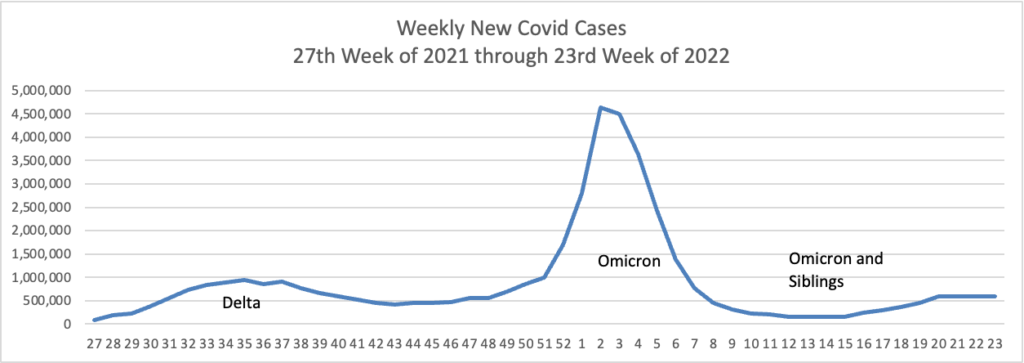
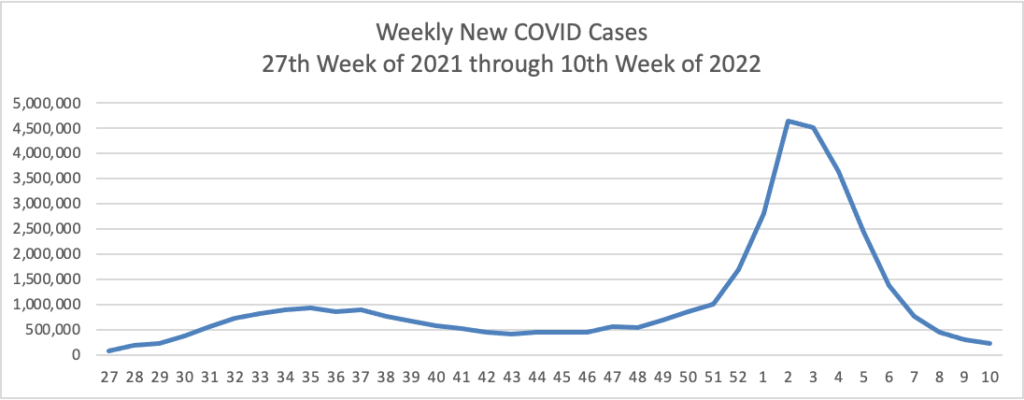
Based on the Centers for Disease Control’s Covid Data Tracker and using Thursday as the first day of the week, here is the FEHBlog’s weekly chart of new Covid cases from the 27th week of 2021 through the 23rd week of 2022.
The CDC’s weekly review of its Covid statistics observes “As of June 8, 2022, the current 7-day moving average of daily new cases (109,032) increased 8.0% compared with the previous 7-day moving average (100,916).”
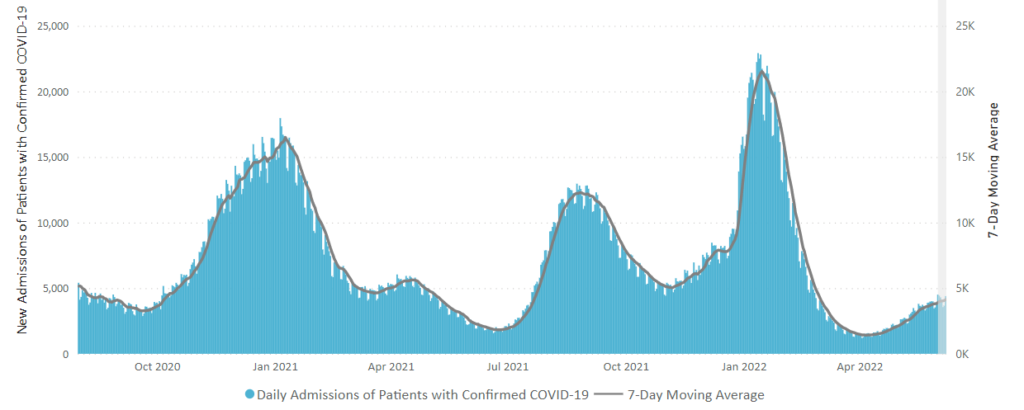
Here’s is the CDC’s latest weekly report of new Covid hospitalizations:
The CDC’s weekly review notes “The current 7-day daily average for June 1–7, 2022, was 4,127. This is an 8.0% increase from the prior 7-day average (3,820) from May 25–31, 2022.”
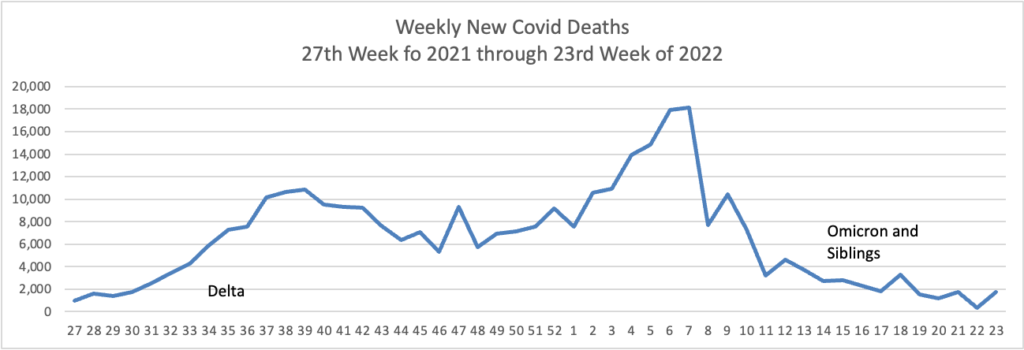
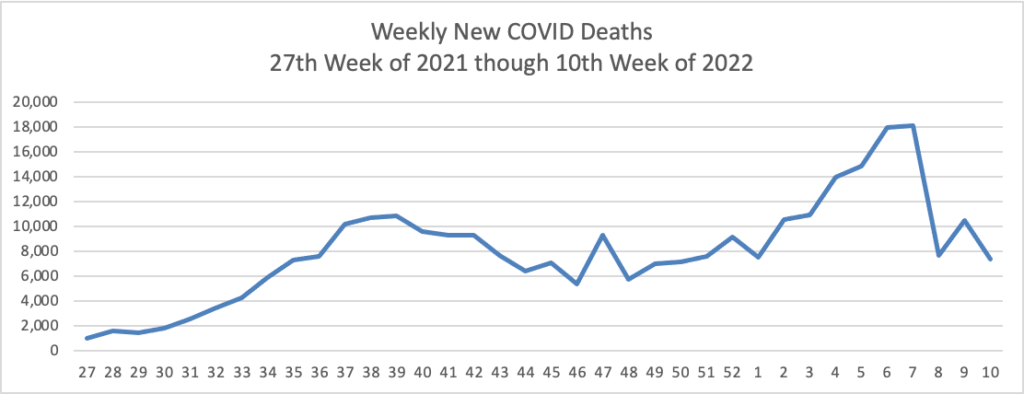
Here’s the FEHBlog’s weekly chart of new Covid deaths over the same period as new cases:
The CDC’s weekly review adds “The current 7-day moving average of new deaths (306) has increased 18.6% compared with the previous 7-day moving average (258).” Over 2/3s of the U.S. population is now fully vaccinated.
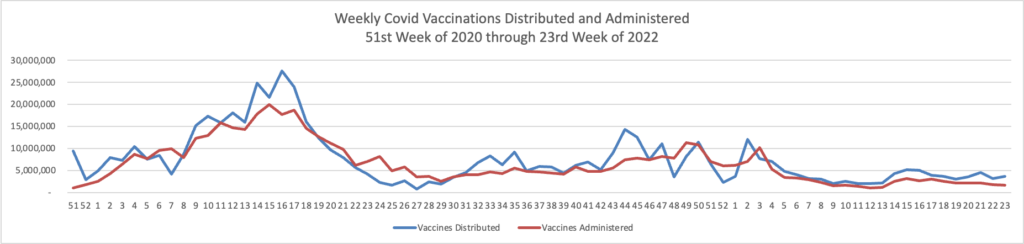
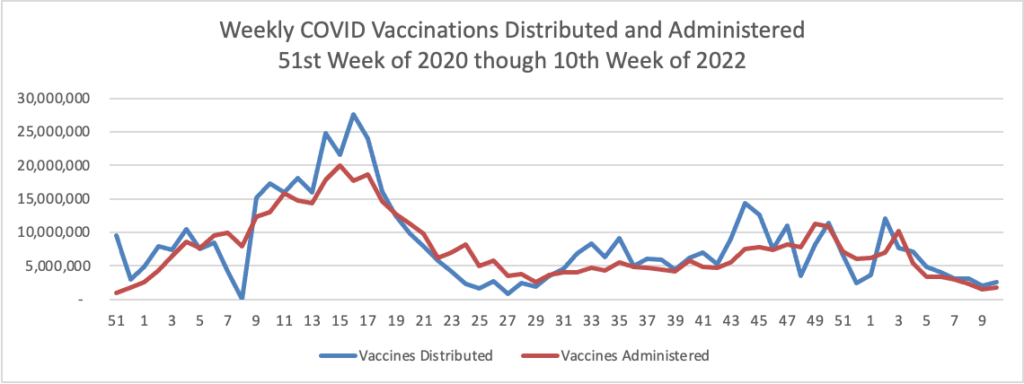
Here’s the FEHBlog weekly chart of Covid vaccinations distributed and administered from the beginning of the vaccination era at the 51st week of 2020 through the 23rd week of 2022:
The CDC’s weekly review states “As of June 8, 2022, the 7-day average number of administered vaccine doses reported (by date of CDC report) to CDC per day was 290,078, a 15.6% decrease from the previous week.”
The American Hospital Administration adds
An initial 10 million doses of COVID-19 vaccine are available for children under age 5 if the Food and Drug Administration authorizes and the Centers for Disease Control and Prevention recommends the Pfizer and Moderna vaccines for children in this age group, Assistant Secretary for Preparedness and Response Dawn O’Connell said yesterday during a White House briefing.
FDA’s vaccine advisory committee will meet June 14-15 and the CDC’s advisory committee June 17-18 to consider whether to authorize and recommend the vaccines for this age group, after which the agencies will issue their respective decisions.
“It will take some time to position these vaccines across the country, and vaccinations can’t begin until CDC has made its decision,” O’Connell said. “But we also know that many parents have been waiting for a long time, so we will be working 24/7 until every dose is shipped and delivered.”
The Administration last week opened pre-ordering of doses for states, tribes, territories and other partners, and estimates that 85% of children under 5 live within 5 miles of a potential vaccination site, she said.
The CDC’s weekly review sums things up as follows:
As of June 9, 2022, there are 314 (9.75%) counties, districts, or territories with a high COVID-19 Community Level, 1,052 (32.67%) counties with a medium Community Level, and 1,854 (57.58%) counties with a low Community Level. This represents a small (+2.20 percentage points) increase in the number of high-level counties, a moderate (+9.57 percentage points) increase in the number of medium-level counties, and a corresponding (−11.77 percentage points) decrease in the number of low-level counties. Fifty-two (100%) of 52 jurisdictions* had high- or medium-level counties this week.
From the unusual viruses front, the American Hospital Association tells us
The Centers for Disease Control and Prevention today reported over 1,300 monkeypox cases globally, including 45 in the United States. While no deaths have been reported and the overall risk to the U.S. public remains low, officials encouraged clinicians to review the CDC’s latest guidance and individuals to talk with their health care provider if they develop symptoms or need to get tested.
According to CDC, monkeypox spreads through direct contact with an infected person’s body fluids, sores or materials that have touched them, such as clothing or linens. It may also spread through respiratory secretions when people have close, face-to-face contact.
Smallpox vaccines are effective at protecting people against monkeypox when given before exposure and may also help prevent the disease or make it less severe. According to CDC, the Strategic National Stockpile currently holds about 72,000 doses of JYNNEOS smallpox vaccine and will soon receive an additional 300,000 doses from the manufacturer. The U.S. also has ordered another 500,000 doses for delivery later this year. In addition, the SNS holds over 100 million doses of an older smallpox vaccine (ACAM2000).
From the electronic health record front, Beckers Hospital News reports
Oracle’s primary mission is improving the complex healthcare system with technology, according to Larry Ellison.
The chair, co-founder and chief technology officer of Oracle said in a June 9 virtual public presentation the company plans to vastly improve care delivery, outcomes and public health policy while also lowering costs. Oracle acquired Cerner in a $28.4 billion transaction earlier this week and has plans to modernize the platform, taking it from a documentation and billing system to a complete source of information about an individual’s healthcare. The EHR would also have virtual care capabilities, be interoperable and expand clinical trial accessibility.
“Together, Cerner and Oracle have all the technology required to build a revolutionary new health management information system in the cloud,” Mr. Ellison said. “That system will deliver much better information to healthcare professionals. Better information will fundamentally transform healthcare.”
Oracle aims to build a unified database for patient information, similar to the unified financial database with credit information, accessible to healthcare providers and public health officials. The database would have anonymized data from hospitals, clinics and providers across the U.S. and provide up-to-the-minute information about patients’ personal health as well as public health statistics, such as the number of people hospitalized with COVID-19 or available hospital beds in a particular state.
“We’re building a system where the health records, all American citizens’ health records, not only exist at the hospital level, but they are all in a unified national healthcare database,” Mr. Ellison said. “The national database solves the data electronic health record fragmentation problem.”
Aim high. Assuming security and privacy challenges can be addressed, such a database could be a public health game changer.
In an Associated Press interview, Jha said Americans’ immune protection from the virus is waning, the virus is adapting to be more contagious and booster doses for most people will be necessary — with the potential for enhanced protection from a new generation of shots.
Epidemiologist David Dowdy of Johns Hopkins’ Bloomberg School of Public Health said that, despite the case increases, hospitalization and death rates overall remain relatively low compared with earlier periods in the pandemic — a reflection of how much immunity there is in the population.
“In some ways, this is encouraging, in that we’re starting to see a divergence between the number of cases and the number of hospitalizations and deaths,” Dowdy said. “But it’s also a little bit discouraging that we’ve been through all this and we’re still seeing a flat line and an uptick in the number of people getting admitted to the hospital and in people dying.”
In the FEHBlog’s view, the coordinator should stop fighting the Delta pandemic by focusing attention on better government distribution of Pfizer’s Paxlovid, which can cure the Omicron if taken timely. Kaiser Health News discusses this continuing and vexing distribution problem.
Unquestionably a need to focus attention on vaccinations and boosters remains essential. Govexec and Kaiser Health News ask why one-third of Americans over 65 have not received the first booster. Nearly all Americans over 65 are fully vaccinated. The article explains
People 65 and older account for about 75% of U.S. covid deaths. And some risk persists, even for seniors who have completed an initial two-dose series of the Moderna or Pfizer vaccine or gotten one dose of the Johnson & Johnson vaccine. Among older people who died of covid in January, 31% had completed a first vaccination round but had not been boosted, according to a KFF analysis of CDC data
FEHB plans are well-positioned to help with this effort, given their demographics.
In other virus news, the American Hospital Association tells us
The Centers for Disease Control and Prevention yesterday updated its testing guidance for clinicians treating children with hepatitis of unknown cause. The agency is investigating 109 potential hepatitis cases of unknown cause in U.S. children since last October, including five deaths. More than 90% of the patients were hospitalized, 14% received liver transplants and more than half had a confirmed adenovirus infection, but officials still don’t know the actual cause of their hepatitis and cautioned that it may take time to assess the evidence and learn more. Potential cases also have been reported in the United Kingdom and other countries.
Following up on last night’s hospital system merger news, Healthcare Dive reports
The Advocate Aurora Health and Atrium Health merger is likely to get a close review from the Federal Trade Commission as the Biden administration has taken a tougher stance on healthcare consolidation, antitrust and legal experts say. * * *
“I don’t think anything of this size in a healthcare transaction today is going to get rubber stamped,” said Bill Horton, a partner at Jones Walker who focuses on healthcare transactions. * * *
“Historically, the FTC concern in hospital and healthcare institution mergers has been the geographic overlap,” Horton said.
Advocate Aurora and Atrium do not have any geographic market overlap. The systems span six separate states through the Midwest and South.
“It doesn’t raise the same red flags, but it doesn’t mean that it gets waved through,” said Leemore Dafny, a Harvard Business School professor and former deputy director of healthcare and antitrust at the FTC.
The FTC is likely to examine whether the two systems negotiate with the same insurers even if they’re in different geographic locations, Dafny said.
From the interoperability front, Health Data Management offers an interesting take on government efforts to meet lofty public health goals for Data Modernization Initiative.
From the mental health care front, and to end on a high note, Health Payer Intelligence informs us
Consumers reported having positive experiences with their employer-sponsored mental and behavioral healthcare coverage during the coronavirus pandemic, a survey conducted on behalf of AHIP discovered.
“Health insurance providers are working every day to support Americans by helping them find the mental health support and counseling they need at a price they can afford,” Matt Eyles, president and chief executive officer of AHIP, said in a press release.
From the FEHB front, the Office of Personnel Management released the 2023 call letter for benefit and rate proposals and the related technical guidance letter.
OPM is to be congratulated for releasing the two letters simultaneously. Historically, OPM has released the call letter weeks or months before the technical guidance letter. As a result, carriers cannot start preparing their benefit and rate proposals, due May 31, until they receive both letters.
From the Omicron (and sibling) front, the American Medical Association informs us
The New York Times (3/15, Mandavilli) reports about “17 million Americans received the Johnson & Johnson Covid vaccine, only to be told later that it was the least protective of the options available in the United States.” However, “new data suggest that the vaccine is now preventing infections, hospitalizations and deaths at least as well as the Pfizer-BioNTech and Moderna vaccines.” The reasons are unclear, “and not all experts are convinced that the vaccine has vindicated itself.” Still, “the accumulating data nonetheless offer considerable reassurance to recipients of the vaccine and, if confirmed, have broad implications for its deployment in parts of the world.”
From the mental health care front, the American Hospital Association tells us
The Substance Abuse and Mental Health Services Administration yesterday released a toolkit to help health care providers and others prepare for the July 16 launch of 988, the new phone number for anyone experiencing suicidal thoughts or a mental health or substance use crisis to speak, text or chat with a trained crisis counselor. Authorized by the National Suicide Hotline Designation Act of 2020, the three-digit number will operate through the National Suicide Prevention Lifeline’s network of over 200 crisis centers.
“In the longer term, our vision is to build a robust crisis care response system across the country that links callers to community-based providers who can deliver a full range of crisis care services, if needed (like mobile crisis teams or stabilization centers),” SAMHSA notes.
To access the toolkit and other suicide prevention resources, visit SAMHSA’s new 988 website.
From the U.S. healthcare front, Healthcare Dive reports
The long-term shift from hospital-based care toward more treatment delivered in the home and ambulatory centers picked up pace during the COVID-19 pandemic and is expected to continue to gain momentum, pressuring revenue growth and margins in the hospital sector, according to new research from Moody’s Investors Service.
Reimbursement changes, risk-sharing, investment in outpatient services including ambulatory surgery centers, advances in drugs and medical devices and greater use of at-home acute care services are among the forces driving the movement away from more expensive hospital inpatient care.
Medicare telehealth visits increased 63-fold during 2020, Moody’s said, citing HHS data. Although hospitals are reporting that telehealth use is receding as more patients return to in-person physician visits, it will likely remain above pre-COVID levels, the ratings agency said.
Kaiser Health News looks at the No Surprises Act from the patient’s perspective. It’s an important article because health plans should help their members keep the new law’s billing protections in perspective.
From the provider of the future front, mHealth Intelligence reports
Though a majority (63 percent) of clinicians worldwide expect most of their consultations to be remote within the next decade, 51 percent believe that telehealth will negatively impact their ability to demonstrate empathy with their patients, a new report revealed.
Developed by Elsevier Health and Ipsos, the Clinician of the Future report includes a quantitative survey, qualitative interviews, and roundtable discussions with nearly 3,000 practicing physicians and nurses worldwide. Of the total number of respondents, 434 were from the US. * * *
Empathy from physicians is becoming increasingly important for patients. A vast majority of clinicians (82 percent) surveyed said that soft skills like listening and displaying empathy have become more critical in the last decade. In the US, 76 percent of clinicians agreed with this statement.
Though the importance of soft skills has grown, the report notes that technical skills will be key in the future.
From the HIMSS Conference in Orlando, Florida, Healthcare Dive holds an interview concerning the FEHBlog leading interoperability innovation of 2022, TEFCA:
Healthcare Dive caught up with Mariann Yeager to talk TEFCA at the HIMSS annual healthcare conference in Orlando on Monday. Yeager is CEO of the Sequoia Project, a nonprofit that was selected in 2019 to serve as the recognized coordinating entity (RCE) charged with developing, updating and maintaining the common agreement and overseeing QHINs.
Yeager shared more details on the timeline of TEFCA implementation, why organizations should join the voluntary framework and how the Sequoia Project and the Office of the National Coordinator for Health IT are at the beginning of a long process of monitoring and modernizing a living document that, given uptake, could shape the future of health data exchange for decades into the future.
“We’re really proud of the work that we’ve done,” Yeager said.
Based on the Centers for Disease Control’s Covid Data Tracker and using Thursday as the first day of the week, here is the FEHBlog’s updated weekly chart of new Covid cases:
Not quite as low as we were in early July but very much moving in the right direction. So is the FEHBlog’s updated weekly chart of new Covid deaths, which is considered a lagging indicator.
The epidemiologists have a keen eye out for new worrisome variants. For example, for other troubling variants, Becker’s Hospital News tells us about a relatively new combination of Delta and Omicron known as Deltacron.
The recombinant variant appears unlikely to spread as easily as delta or omicron, William Lee, PhD, vice president of science at Helix, told USA Today. “We have not seen any change in the epidemiology with this recombinant,” WHO COVID-19 technical lead Maria Van Kerkhove, PhD, said of deltacron during a March 9 media briefing. “We haven’t seen any change in severity. But there are many studies that are underway.”
Here’s the FEHBlog’s weekly chart of Covid vaccinations distributed and administered from the start of the Covid vaccination era in late 2020 until the week ended this past Wednesday.
It is noteworthy that this week, the percentage of Americans aged 18 and older who are fully vaccinated (two doses of mRNA vaccine) cracked 75%. The same cadre is closing in on being 50% boostered. The most at risk, over age 65 cadre is 89% fully vaccinated and 66.7% boostered.
In a study of 1,364 children aged 5-15, two doses of the Pfizer COVID-19 vaccine reduced the risk of omicron infection by 31% in those under 12 and 59% in older children, the Centers for Disease Control and Prevention reported today. CDC said the study reinforces the importance of vaccination to keep children and teens protected from severe disease, noting that another recent study found the vaccine 92%-94% effective against COVID-19 hospitalization in adolescents during the delta surge and 74% effective against hospitalization in younger children during omicron.
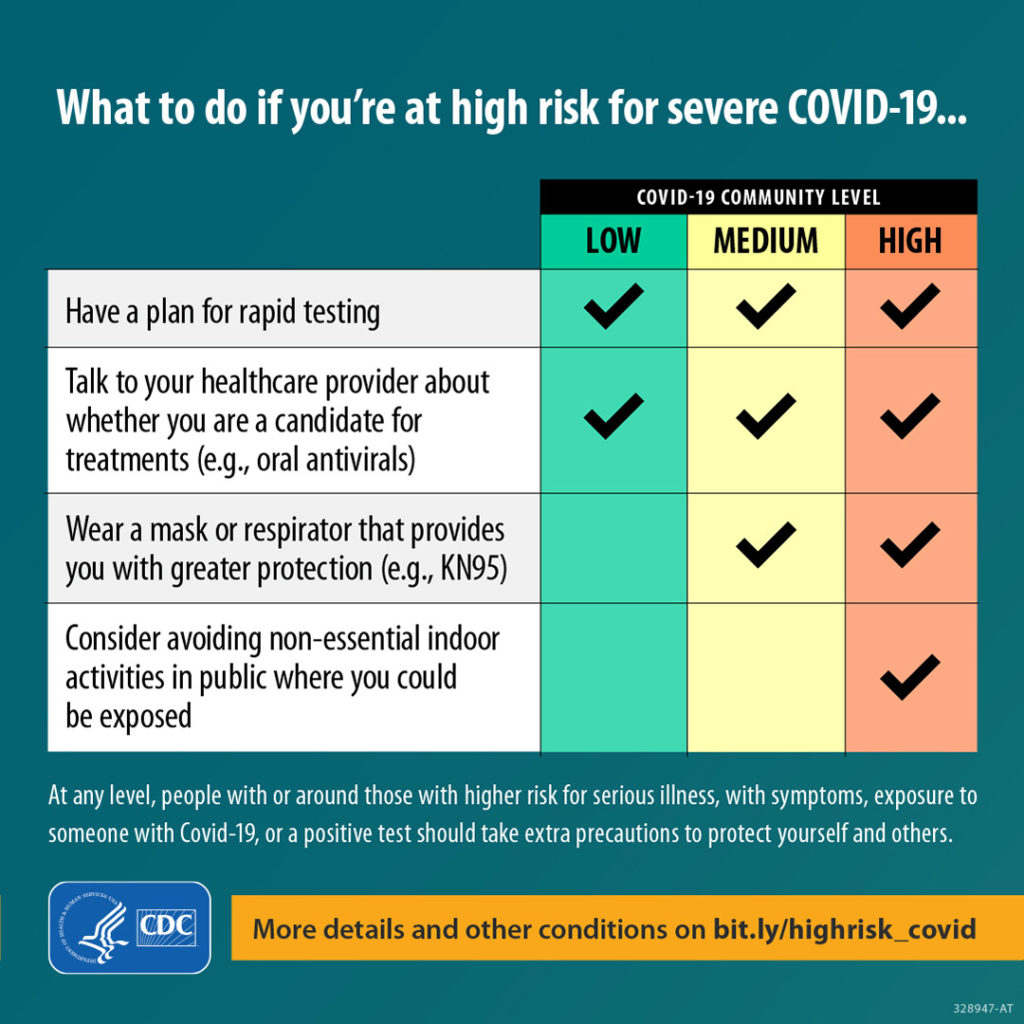
Here’s a link to the CDC’s weekly review of its Covid statistics. This week’s issue focuses on protecting folks at high risk for Covid, such as the immunocompromised.
Who is most likely to become very sick or die from COVID-19? Your chances increase with age and underlying medical conditions like cancer, diabetes, heart conditions, dementia, and obesity, particularly if you’re not up to date on vaccinations. People with weakened immune systems,* some disabilities, some mental health conditions, and some chronic diseases are also at higher risk. A lot of people might not know they’re at risk for severe illness—review the list to find out if you could be.
Here’s a link to the CDC’s weekly Fluview report, which states that flu activity is increasing in “most of the country.” In this regard, the American Medical Association inform us
Healio (3/10, Downey, Gallagher) reports “interim estimates published Thursday in” the CDC’s Morbidity and Mortality Weekly Report “indicate that this season’s influenza vaccine has not been effective.” Based on the data “from more than 3,600 children and adults,” researchers “estimated that the vaccine has been 16% effective against mild or moderate influenza caused by the predominant circulating virus, influenza A(H3N2), with a 95% confidence interval…that suggests vaccination ‘did not significantly reduce the risk of outpatient medically attended illness’ caused by H3N2.”
From Capitol Hill and closing the loop on Thursday’s post, the Senate did pass the fiscal year 2022 omnibus appropriations act Thursday night. Roll Call reports
On a 68-31 vote, the Senate passed the 2,700-page, $1.5 trillion omnibus containing all 12 fiscal 2022 spending bills, $13.6 billion in supplemental appropriations to address the crisis in Ukraine and a lengthy list of unrelated measures fortunate enough to ride on the must-pass vehicle.
From the No Surprises Act front, the FEHBlog had been concerned that the federal regulators were giving up on using the Qualified Payment Amount as a rebuttable presumption in NSA arbitrations which would help tremendously to control out of network benefit and plan legal costs. The FEHBlog therefore was encouraged to find that the federal government has filed a brief with the federal district court for the District of Columbia defending that position in a case raising the same issue. An oral argument on this issue will be heard by District Judge Richard Leon on March 21, 2022, at 3 pm. The FEHBlog will keep an eye on this and the other federal cases raising this issue.
From the electronic health record front, MedCity News interviews the CEO of Epic Systems at the Vive conference. The interview covers interoperability, artificial intelligence and other timely topics.
From the opioid epidemic front, STAT News reports
It was in the mid-2010s, the researchers heard, when “tranq dope” — opioids that contained the veterinary tranquilizer xylazine — took off in Philadelphia. But now, in some places across the U.S., it was appearing in 1 in 5 overdose deaths. A recent study also found the powerful synthetic opioid fentanyl in nearly every xylazine-involved death as well, indicating it wasn’t just the tranquilizer causing these overdoses. Experts are still trying to understand the risks of xylazine, but they’re worried because the drug is not an opioid but acts as a sedative, which can increase the risk of a fatal overdose. It might also make it harder to reverse those overdoses with naloxone, which is designed to work on opioids. STAT’s Andrew Joseph has more on how adulterated — and in turn, increasingly dangerous — the U.S. drug supply has become.
Let’s start today with news from the litigation front —
The Wall Street Journal reports that in advance of the February 27 deadline,
The Justice Department filed an antitrust lawsuit Thursday challenging UnitedHealth Group Inc.’s$13 billion acquisition of health-technology firm Change Healthcare Inc., arguing the tie-up would unlawfully reduce competition in markets for commercial insurance and the processing of claims.
The deal, announced in January 2021, sought to bring a major provider of healthcare clinical and financial services, including the handling of claims, under UnitedHealth’s Optum health-services arm.
The Justice Department filed its lawsuit in federal court in Washington, saying Change provided key industry technologies that are relied upon by UnitedHealth’s health-insurance rivals, making it a hub for competitively sensitive information. If the deal were allowed, UnitedHealth would have access to data that it could potentially use for its own benefit, at the expense of other insurers, the department alleged. The department also argued the deal would reduce head-to-head competition in the businesses of insurance claims transmission and review, because UnitedHealth competes with Change in those areas.
A federal judge in Texas struck down a narrow part of the surprise billing rule that outlines how to resolve payment disputes between payers and providers over out-of-network claims. Wednesday’s ruling is a win for providers who were opposed to the dispute resolution process spelled out by CMS in an interim rule, arguing it favored insurers.
The judge’s ruling essentially tosses out a part of the dispute resolution process that instructs arbiters to begin with the presumption that the qualifying payment amount, or median in-network rate, is the appropriate payment amount for providers.
This is not the final word because the decision, which resulted in a final judgment is appealable to the U.S. Court of Appeals for the Fifth Circuit. A case raising the same issue is currently pending oral argument in the U.S. District Court for the District of Columbia.
Katie Keith, a health law expert at Georgetown University, said the ruling is evidence of how hard doctors groups will fight even relatively modest efforts by Congress to cut health care costs.
The surprise billing action was “one of the few things Congress has tried to do on cost containment,” she said.
Amen to that.
From the Omicron front, Medpage Today provides background on a Centers for Disease Control decision permitting
Extended dosing intervals for Pfizer or Moderna vaccines * * * for certain individuals ages 12 to 64 years, not only to lower the risk of vaccine-associated myocarditis, but to potentially improve vaccine effectiveness, CDC staff said on Thursday.
According to the agency’s new interim guidance, young people ages 12 to 39 may especially benefit from a second mRNA dose 8 weeks after their first dose.
However, the regular 3-week interval for Pfizer and 4-week interval for Moderna is appropriate for patients who are moderately to severely immunocompromised, adults ages 65 and up, those who need rapid protection (such as “during high levels of community transmission”), and children ages 5 to 11.
From the social determinants of health front, HR Dive tells us
Though employers have invested increasingly in a variety of healthcare and healthcare-adjacent benefits, few of these efforts effectively address social determinants of health that can negatively affect patient outcomes, according to a report published this month by the Northeast Business Group on Health.
Social determinants of health include factors such as education access and quality; healthcare access and quality; economic stability; neighborhood and built environment; and social and community factors. Differences in these areas lead to disparities not only in terms of health outcomes, but also in cost management and general employee health and well-being, NEBGH said.
Employers can start addressing social determinants by collecting survey data on employees’ needs and risk factors, per the report. From there, NEBGH recommended that benefits design focus on equitable benefits access, such as evaluating what percentage of pay their health plans comprise at different pay levels. Other strategies cited include improving health literacy, taking advantage of partnerships and improving organizational culture around health and well-being, among others.
From the Rx coverage front, Fierce Healthcare discusses CVS Health’s annual Drug Trend Report.
CVS Caremark kept overall drug trend for clients to 2.4% over the first three quarters of 2021, marking multiple years of single-digit trend in drug price growth.
The pharmacy benefit management arm of CVS Health also kept its specialty drug trend to single digits through the third quarter, at an industry-low 5.8%, according to the company’s annual Drug Trend Report released Thursday. Caremark found that 35.9% of its clients saw negative specialty trend in 2021.
In addition, 65.3% saw specialty trend under 10%, according to the report.
The article explains how CVS Health accomplished this feat.
From the Medicare front, CMS announced a redesign of its Accountable Care Organization model
that better reflects the agency’s vision of creating a health system that achieves equitable outcomes through high quality, affordable, person-centered care. The ACO Realizing Equity, Access, and Community Health (REACH) Model, a redesign of the Global and Professional Direct Contracting (GPDC) Model, addresses stakeholder feedback, participant experience, and Administration priorities, including CMS’ commitment to advancing health equity.
In addition to transitioning the GPDC Model to the ACO REACH Model, CMS is canceling the Geographic Direct Contracting Model (also known as the “Geo Model”) effective immediately. The Geographic Direct Contracting Model, which was announced in December 2020, was paused in March 2021 in response to stakeholder concerns.
Good luck, CMS, with this new model.
We use cookies on our website to give you the most relevant experience by remembering your preferences and repeat visits. By clicking “Accept”, you consent to the use of ALL the cookies.
This website uses cookies to improve your experience while you navigate through the website. Out of these, the cookies that are categorized as necessary are stored on your browser as they are essential for the working of basic functionalities of the website. We also use third-party cookies that help us analyze and understand how you use this website. These cookies will be stored in your browser only with your consent. You also have the option to opt-out of these cookies. But opting out of some of these cookies may affect your browsing experience.
Necessary cookies are absolutely essential for the website to function properly. These cookies ensure basic functionalities and security features of the website, anonymously.
Cookie
Duration
Description
cookielawinfo-checbox-analytics
11 months
This cookie is set by GDPR Cookie Consent plugin. The cookie is used to store the user consent for the cookies in the category "Analytics".
cookielawinfo-checbox-functional
11 months
The cookie is set by GDPR cookie consent to record the user consent for the cookies in the category "Functional".
cookielawinfo-checbox-others
11 months
This cookie is set by GDPR Cookie Consent plugin. The cookie is used to store the user consent for the cookies in the category "Other.
cookielawinfo-checkbox-necessary
11 months
This cookie is set by GDPR Cookie Consent plugin. The cookies is used to store the user consent for the cookies in the category "Necessary".
cookielawinfo-checkbox-performance
11 months
This cookie is set by GDPR Cookie Consent plugin. The cookie is used to store the user consent for the cookies in the category "Performance".
viewed_cookie_policy
11 months
The cookie is set by the GDPR Cookie Consent plugin and is used to store whether or not user has consented to the use of cookies. It does not store any personal data.
Functional cookies help to perform certain functionalities like sharing the content of the website on social media platforms, collect feedbacks, and other third-party features.
Performance cookies are used to understand and analyze the key performance indexes of the website which helps in delivering a better user experience for the visitors.
Analytical cookies are used to understand how visitors interact with the website. These cookies help provide information on metrics the number of visitors, bounce rate, traffic source, etc.
Advertisement cookies are used to provide visitors with relevant ads and marketing campaigns. These cookies track visitors across websites and collect information to provide customized ads.