Midweek Update

Midweek Update

Photo by Piron Guillaume on Unsplash

The Hill reports that “New coronavirus cases in the U.S. have fallen to pre-Thanksgiving levels, the head of the Centers for Disease Control and Prevention (CDC) said Wednesday, and infection rates are continuing to decline. ‘We now appear to be in a consistent downward trajectory’ for both cases and hospital admissions, CDC Director Rochelle Walensky told reporters during a White House COVID-19 briefing.” * * * Walensky cautioned Americans not to let their guard down, especially as variants that likely have increased transmissibility continue to multiply.”

Roll Call informs us that “The Senate broke out of limbo Wednesday, adopting a power-sharing resolution that allows for committees to organize and Democrats to take the [committee] gavels after a month of tenuous and divided control. Majority Leader Charles E. Schumer brought the resolution to the floor Wednesday evening and it was adopted by unanimous consent.”

From the fourth quarter 2020 earnings front, Healthcare Dive lets us know that

  • An uptick in COVID-19 testing and treatment led Humana to report a loss for the fourth quarter of 2020 of $2.07 per share and a pre-tax loss of $458 million, a large swing from a pre-tax income of $593 million during the prior-year period. Analysts had expected an adjusted loss of $2.37 per share, but Humana slightly beat expectations with an adjusted loss of $2.30 per share. The payer said the increase in COVID-19 care experienced during the last two months of the quarter was coupled with a decline in non-COVID-19 utilization after largely returning to normal levels. The decline was about 15% below the normal baseline, executives said during Wednesday’s call with investors. Still, Humana remained in the black for the full year of 2020. It posted pre-tax income of $4.6 billion for the full year, a 33% increase compared with 2019.

and

  • HCA Healthcare beat Wall Street expectations on both earnings and revenue in the fourth quarter of 2020, as high-acuity patients and cost controls made up for a slow recovery in volume during the strongest surge in COVID-19 patients to date. [From HCA’s website: HCA Healthcare is comprised of more than 180 hospitals and 2,000+ sites of care in 21 states and the United Kingdom.] Revenue of $14.3 billion was up almost 6% year over year, while net income of $1.4 billion was up 33% year over year for the for-profit system, according to financial results released Tuesday. HCA released full-year guidance for 2021, and expects to bring in revenue between $53.5 billion and $55.5 billion this year, and adjusted earnings per share of $12.10 to $13.10. HCA stock was up slightly in early morning trading following the release.

In healthcare news

  • The Government Accountability Office recently released a report on public impact of rural hospital closings.

Rural hospitals provide essential health care to rural communities. Yet, over 100 rural hospitals closed from January 2013-February 2020. When rural hospitals closed, people living in areas that received health care from them had to travel farther to get the same health care services—about 20 miles farther for common services like inpatient care. People had to travel even farther—about 40 miles—for less common services like alcohol or drug abuse treatment. Before rural hospitals closed, counties where these hospitals were located had fewer doctors than counties without any closures. The number of doctors further decreased when hospitals closed.

Heal, a company that offers both telemedicine and doctor house calls, has expanded its service to Illinois, Louisiana, North Carolina and South Carolina. In addition to large cities such as Chicago, Heal is targeting rural or low-income areas such as Lafayette, Louisiana, noted Nick Desai, co-founder and CEO of Heal.

“When you look at specific areas where we are expanding, for example, Lafayette, Louisiana, many of these patients do not have other options when it comes to quality healthcare,” Desai told Fierce Healthcare. “That’s why we want to bring Heal to areas like this, ultimately elevating quality of care for patients that might be struggling to pinpoint the right solutions.”

  • The Healthcare Transformation Taskforce calls our attention to the Maternal Health Hub website which The Commonwealth Fund supports and the Task Force manages. Check it out.

Tuesday Tidbits

Photo by Patrick Fore on Unsplash

President Biden announced that his Administration is increasing the weekly COVID-19 vaccine supply released to States, etc., and starting on February 11 to supply partner pharmacies with vaccine to administer the vaccine to customers.

The Society for Human Resource Management brings us to date on OSHA efforts to implement one of the President’s executive orders by issuing “worker safety guidance for coronavirus protection programs on Jan. 29, requiring greater input from employees and enhanced mask protections.”

The Hill provides us with the latest on efforts to pass a sixth COVID-19 relief bill in Congress. Govexec reports that a bicameral, bipartisan push is underway inn Congress to repeal the Postal Service’s unique obligation to refund its employees FEHB coverage in retirement.

In other interesting healthcare news

  • Becker’s Payer Issues reports that “Cigna will no longer require prior authorization for some CT scans of the heart, according to an updated precertification list. The change is effective Feb. 1. * * * In addition, Cigna removed prior authorization for fractional flow reserve-computed tomography. For coverage under the policy, patients must have stable chest pain and an intermediate risk of coronary artery disease. “The favorable policy update shows that Cigna recognizes the use of CTA and FFR-CT as a front-line test which can lead to improved patient outcomes,” Dustin Thomas, MD, chair of the society’s advocacy committee, said in a news release.”
  • Access Management Intelligence informs us that “Ascent Health Services (Ascent Health) is a pharmaceutical group purchasing organization that is part of Evernorth, a subsidiary of Cigna Corporation. Humana has agreed to join Ascent Health in a move that the health insurer says will help drive down its drug costs for its [1.3 million] commercial members. Beginning April 1, Humana will join Ascent Health to give it access to greater discounts from drug makers. Ascent Health manages commercial rebates, the payments that drug makers make to health plans. The agreement covers drug contracting and negotiations for Humana’s commercial business.

Monday Roundup

Photo by Sven Read on Unsplash

Good news on the COVID-19 front —

Bloomberg’s headline story this evening is that

More Americans have received at least one dose of a Covid-19 vaccine than have tested positive for the virus, an early but hopeful milestone in the race to end the pandemic.

As of Monday afternoon, 26.5 million Americans had received one or both doses of the current vaccines, according to data gathered by the Bloomberg Vaccine Tracker. Since the first U.S. patient tested positive outside of Seattle a year ago, 26.2 million people in the country have tested positive for the disease, and 441,000 have died, according to data from Johns Hopkins University.

The U.S. has been administering shots at a faster daily rate than any country in the world, giving about 1.35 million doses a day, according to data gathered by Bloomberg. While the rollout stumbled in its early days, in the six weeks since the first shots went into arms almost 7.8% of Americans have gotten one or more doses, and 1.8% are fully vaccinated.

“It’s worth noting that today, for the first time, the data said that more people were vaccinated than were reported as newly diagnosed cases,” said Paula Cannon, a professor of microbiology at the University of Southern California’s Keck School of Medicine. “That’s worth celebrating. I’m all for that win.

A New York Times columnist earlier today explained

Right now, public discussion of the vaccines is full of warnings about their limitations: They’re not 100 percent effective. Even vaccinated people may be able to spread the virus. And people shouldn’t change their behavior once they get their shots.

These warnings have a basis in truth, just as it’s true that masks are imperfect. But the sum total of the warnings is misleading, as I heard from multiple doctors and epidemiologists last week.

“It’s driving me a little bit crazy,” Dr. Ashish Jha, dean of the Brown School of Public Health, told me.

“We’re underselling the vaccine,” Dr. Aaron Richterman, an infectious-disease specialist at the University of Pennsylvania, said.

“It’s going to save your life — that’s where the emphasis has to be right now,” Dr. Peter Hotez of the Baylor College of Medicine said.

The Moderna and Pfizer vaccines are “essentially 100 percent effective against serious disease,” Dr. Paul Offit, the director of the Vaccine Education Center at Children’s Hospital of Philadelphia, said. “It’s ridiculously encouraging.”

Let’s go.

On the COVID-19 testing front, the Wall Street Journal reports that

The Biden administration said it has reached a $230 million deal with Australian diagnostics company Ellume USA LLC to produce at-home, over-the-counter Covid-19 tests. 

The Food and Drug Administration previously authorized the test. So far, the FDA has cleared three Covid-19 tests that can be processed entirely at home, but Ellume’s is the only one that doesn’t require a prescription. None are widely available at this point. 

The company is expected to produce 19 million tests a month by the end of the year, Andy Slavitt, senior adviser to the White House Covid-19 response team, said Monday. Based on the agreement, 8.5 million tests will be guaranteed to the U.S. government. 

Smart move.

In other news —

  • Roll Call brings us up to date on the COVID-19 relief bill developments on Capitol Hill.
  • Katie Keith helpfully updates us on Affordable Care Act litigation in the Health Affairs blog.
  • Dispatch Health and Humana announced ” an [interesting] agreement to provide Humana members with access to an advanced level of care in the home – to help enhance patients’ experience and health outcomes. These services will be available in Denver, Colo., and Tacoma, Wash., with expansion to additional markets in Texas, Arizona and Nevada planned for later this year. The agreement will provide members living with multiple chronic conditions – such as cellulitis, kidney and urinary tract infections, chronic obstructive pulmonary disease, heart failure and many others – an opportunity to be treated safely at home and thereby avoid hospital visits. Last November, the U.S. Centers for Medicare & Medicaid Services announced a waiver program to allow qualified health care providers to offer acute, hospital-level care in the home. The Dispatch-Humana agreement is believed to be the country’s first program to provide hospital-level care involving a national payer.

In pharmacy C-suite news —

  • Healthcare Dive reports that “Karen Lynch has officially stepped into the CEO role at CVS Health [on February 1, 2021]. Lynch previously served as president of the Aetna business, and was a key figure in directing CVS Health’s COVID-19 response.”
  • AP reported last week that “Walgreens has tapped Starbucks executive Roz Brewer as its new CEO, which will make her the only Black woman leading a Fortune 500 company. Starbucks announced Tuesday January 26 that Brewer was departing after a little more than three years as its chief operating officer. Walgreens later confirmed that Brewer will take over as its CEO on March 15.

Good luck.

Weekend Update

Photo by Clarisse Meyer on Unsplash

Congress continues it floor and committee work this coming week. Committees are in engaged in organizational meetings on both sides of Congress. Senate Committees principally will be engaged in holding hearings on Presidential cabinet nomination.

The House Oversight and Reform Committee, whose jurisdiction includes the FEHBP, holds its organizational meeting tomorrow at 2 pm. The Chair will continue to be Rep. Carolyn Maloney (D NY) and the Ranking Member will be Rep. James Comer (R KY). The party ratio will be 25 Democrats and 20 Republicans.

Meanwhile, Bloomberg reports that

Joe Biden’s presidency began at a choreographed sprint, with a series of executive actions to erase Donald Trump’s legacy and reset the nation’s course. But as his first full week in office came to a close, the new president was discovering the limits of his power.

His administration’s efforts to bolster vaccine production ran into the same hurdles that plagued the Trump administration — bottlenecks both at factories and in clinics — and Biden’s advisers had to clean up after the president said any American would be able to get inoculated by the spring. * * *

[FEHBlog note — Per the CDC’s Vaccinations site, on average 1.3 million doses of COVID-19 vaccine were administered on Friday and Saturday.]

He’s meanwhile encountering familiar roadblocks in Congress, where just four of his cabinet nominees have been confirmed 12 days into his presidency, and he’s found no traction among congressional Republicans for another big stimulus bill. * * *

Ten GOP senators wrote to Biden on Sunday with an alternative proposal for a slimmed-down stimulus bill. The White House says it will review the offer. A smaller plan that passed with bipartisan support would leave Democrats free to pursue more contentious elements using a partisan budget tool.

The Wall Street Journal adds

The offer is the first Republicans have forwarded since Mr. Biden proposed the $1.9 trillion plan, which Republicans have said is too costly and includes unneeded initiatives, and tests whether the Biden administration and Democrats in Congress will seek compromise or try to pass the relief package themselves. Democratic leaders have said they plan to begin a legislative process that would bypass the need for Republican support this week, with the first step coming as soon as Monday.

FEHBlog Public Service Announcement: The Centers for Disease Control on Saturday implemented one of the President’s executive orders by requiring

the wearing of masks by all travelers into, within, or out of the United States, e.g., on airplanes, ships, ferries, trains, subways, buses, taxis, and ride-shares. The mask requirement also applies to travelers in U.S. transportation hubs such as airports and seaports; train, bus, and subway stations; and any other areas that provide transportation.  Transportation operators must require all persons onboard to wear masks when boarding, disembarking, and for the duration of travel. Operators of transportation hubs must require all persons to wear a mask when entering or on the premises of a transportation hub.

This order will be effective on February 2, 2021. For more information on the Order or to view frequently asked questions, visit: https://www.cdc.gov/quarantine/masks/mask-travel-guidance.html

Thursday Miscellany

Photo by Juliane Liebermann on Unsplash

As the FEHBlog mentioned on Sunday, today was healthcare day at the White House. Here are links to the President’s executive order intended to strengthen Medicaid and the Affordable Care Act and the related fact sheet. Health Payer Intelligence explains that

In response to the executive order, the Department of Health and Human Services (HHS) will open a special enrollment period on the federal health insurance marketplace platform. The special enrollment period will last from February 15, 2021 through May 15, 2021.

This move will give the uninsured or underinsured individuals more time to enroll on the Affordable Care Act marketplace. Not only will it open up the federally-facilitated marketplace, but this executive order will also allow state-based marketplaces on the federal platform to have a special enrollment period.

“The President will also direct federal agencies to reconsider rules and other policies that limit Americans’ access to health care, and consider actions that will protect and strengthen that access,” said the fact sheet.

The Wall Street Journal adds “Mr. Biden’s sweeping call to review decisions that could limit access to health care marks the start of a tougher battle that is likely to spur political conflict between his administration and Republicans.”

The FEHBlog did watch the Washington Post’s online Prognosis 2021 today. Dr. Vivek Murthy, the President’s nominee for Surgeon General, commented that the President’s goal of 100,000,000 doses of COVID-19 vaccine in his first 100 days in office / April 30, 2021 is a floor not a ceiling. The ultimate goal of achieving herd immunity “goes beyond” April 30. On January 26 and 27, over 2.65 million doses were administered according to the CDC. Progress is being made.

Prognosis 2021 also featured BCBSA CEO Kim Keck, who discussed the Affordable Care Act. She accurately quipped that the Affordable Care Act should be known as the Access to Care Act as we are still waiting for a law that would reduce healthcare costs.

Prognosis 2021 also included an interview with U.S. Senator and Doctor Bill Cassidy (R La.). He touted the recently enacted No Surprises Act intended to protect patients against out of network surprise billing in emergency care, air ambulance and ancillary care at in-network hospital situations. While this law will be a heavy lift to implement, the FEHBlog does expect it to be effective. Video highlights of Prognosis 2021 are available here.

Speaking of healthcare costs Healthcare Dive reports that “U.S. hospitals lost more than $20 billion from suspending elective surgeries over three months at the beginning of the COVID-19 pandemic’s onset in this country, according to an article published recently in the Annals of Surgery.” Holy smoke.

Patient safety advocate the Leapfrog Group announced

Recognizing Excellence in Diagnosis, a new national initiative to publicly report and recognize hospitals for preventing patient harm due to diagnostic errors. Developed in collaboration with The Society to Improve Diagnosis in Medicine (SIDM) and key experts, the project is funded with a two-year grant of $1.2 million by the Gordon and Betty Moore Foundation. * * *

Joining Leapfrog in leading this effort is SIDM, a nationally recognized organization focused on catalyzing efforts to improve diagnostic quality and safety, as well as convener of the Coalition to Improve Diagnosis, of which Leapfrog is a member. SIDM will develop resources to guide health systems and clinicians on improving diagnostic safety. * * *

Recognizing Excellence in Diagnosis will be conducted over two years. As a first step, the initiative will convene an advisory group of Leapfrog and SIDM representatives, patient and payor stakeholders, and experts in diagnosis and performance analysis. With guidance from the advisory group, the project will identify best practices in diagnosis and put together a roadmap for hospitals and health systems to achieve excellence. SIDM will facilitate the development of training and educational materials to support hospitals and health systems in their adoption of the best practices. In year two, Leapfrog will pilot test a national survey, similar to the annual Leapfrog Hospital Survey, to collect data from up to 100 hospitals and health systems on their adoption of identified best practices. A national report will be issued on the current status of diagnostic safety, best practices for achieving excellence, and strategies for payors and patients to incentivize improvement.

Good luck with this initiative.

Midweek Update

Photo by Manasvita S on Unsplash

A friend of the FEHBlog asked the FEHBlog to share the slide deck from this morning’s White House press briefing on COVID-19. It is chock-a-block full of useful data. Please check it out.

Fierce Pharma reports that following similar news from Moderna:

Pfizer and partner BioNTech are developing booster shots so that their COVID-19 vaccine Comirnaty can protect against new, highly contagious variants, Pfizer CEO Albert Bourla said Tuesday, according to Bloomberg.“Every time a new variant comes up we should be able to test whether or not [our vaccine] is effective,” Bourla was quoted as saying. “Once we discover something that it is not as effective, we will very, very quickly be able to produce a booster dose that will be a small variation to the current vaccine.”

That is the beauty of these mRNA vaccines.

From the complimentary webinar front —

  • The Blue Cross Blue Shield Association and the Washington Post are presenting Prognosis 2021 on Thursday January 28 at noon ET. You can register here.
  • The National Committee for Quality Assurance is discussing the Future of Health Care / Its Presidential Pitch on Tuesday February 9 at 1 pm ET. You can register here.
  • Both webinars are an hour long and the FEHBlog has registered for both of them.

The FEHBlog noticed that Modern Healthcare is tracking the Biden Administration’s regulatory freeze actions on Trump Administration “midnight” healthcare regulations. Here is a list of the frozen Trump Administration rules:

Cutting 340B drug discounts –HHS in December finalized a rule forcing community health centers to pass 340B drug discounts along to their patients, a move the Trump administration hoped would lower out-of-pocket drug costs. It faced staunch opposition from providers and patient advocates, who worried it could hamper access to care and cut already razor-thin operating margins for community health centers.

Status: On pause, Jan. 21. The rule was slated to take effect Jan. 22, but the Biden administration delayed until March 22. The rule could be withdrawn before then.

Covering dialysis treatments — The Trump administration wanted to permanently require dialysis centers to tell patients about their coverage options and premium assistance programs. It was an updated version of an Obama-era rule, which went into effect in January 2017.

Status: On pause, Jan. 26

Increasing oversight on accreditation organizations — CMS has long worried about accrediting organizations’ potential conflicts of interest, as many sell consulting services. The Trump administration was working on a rule to address them.

Status: On pause, Jan. 26

Revising Social Security and Medicare Part A relationship — Under the current rules, a person age 65 or older automatically applies for Part A coverage when they file to collect Social Security benefits. The Trump administration was working on a proposal to allow seniors to collect Social Security retirement benefits if they chose not to accept Medicare coverage for inpatient services.

Status: On pause, Jan. 26

No action has been taken on several other rules, including the prior authorization rule, the international drug pricing rule and the drug rebate restriction rule, none of which apply to the FEHBP. Needless to say industry groups are demanding action.

Healthcare Dive informs us about Blue Cross licensee Anthem’s fourth quarter 2020 earnings announcement —

  • Health insurer Anthem’s profits fell 41% in the fourth quarter of last year, due to a resurgence in care that patients put off earlier in 2020 amid the coronavirus pandemic.
  • Net income dropped to $551 million, compared to $934 million in the fourth quarter of 2019, though revenues were up 16% to $31.5 billion on higher premiums and investment income, beating Wall Street expectations.
  • Enrollment also strengthened in the fourth quarter, following quarter-over-quarter declines in the second and third quarters during the first surge of COVID-19 and subsequent economic recession.

Tuesday Tidbits

Photo by Patrick Fore on Unsplash

The Wall Street Journal has performed a tremendous public service by publishing a state-by-state guide to obtaining a COVID-19 vaccination. The information is current as of yesterday and will be updated weekly.

STAT News reports that Regeneron and Eli Lilly are pleased with progress being made in their respective trials of monoclonal antibody cocktails to treat COVID-19. “George Yancopoulos, Regeneron’s chief scientific officer, said in a statement that even with vaccines available, the antibody will be able help break the chain of infection, and may prove useful for individuals who are immunocompromised or unable to be vaccinated.”

Employee Benefits News offers an interesting story about how employers are confronting the opioid public health emergency.

Health Payer Intelligence discusses Blue Shield of California’s efforts to consolidate and simplify medical billing. What’s more,

[Blue Shield of California] aim[s] to achieve real-time claims settlement. In 2020, Blue Shield of California shortened its claim settlement timeframe from a maximum of 30 days down to six days, but in 2021 the company plans to reduce that timeframe further.

“For us, ‘real-time’ claims settlement means anywhere from three to nine seconds,” [Shayna] Schulz[, senior vice president of transformation and operations at Blue Shield of California] explained.

“We have a proof of concept that we’ve already done where we’ve been able to process one claim—but it starts with one—in nine seconds. We’re highly optimistic that we can rapidly scale this in 2022. And that’s going to be a game-changer for many hospitals.”

Indeed.

Because the FEHBlog cannot forget the SolarWinds backdoor hack, Cyber Scoop lets us know that

Email security firm Mimecast on Tuesday confirmed that the hackers behind the SolarWinds espionage campaign compromised a software certificate the firm uses to secure connections to Microsoft cloud services. The revelation underscores how deeply embedded the suspected Russian hackers have been in major technology companies as part of a campaign that has also breached multiple U.S. federal agencies. * * * Mimecast is one of many big tech firms to be implicated in the hacking campaign, which has also exploited bugged software made by SolarWinds, a Texas-based federal contractor. The attackers have viewed Microsoft’s source code and stolen the red-team tools that security firm FireEye uses to test clients’ defenses.

Finally, STAT News published today the story written by one of its star reporters Sharon Begley about lung cancer contracted by never-smokers.

Cigarette smoking is still the single greatest cause of lung cancer, which is why screening recommendations apply only to current and former smokers and why 84% of U.S. women and 90% of U.S. men with a new diagnosis of lung cancer have ever smoked, according to a study published in December in JAMA Oncology. Still, 12% of U.S. lung cancer patients are never-smokers.

Scientists disagree on whether the absolute number of such patients is increasing, but the proportion who are never-smokers clearly is. Doctors and public health experts have been slow to recognize this trend, however, and now there is growing pressure to understand how never-smokers’ disease differs from that of smokers, and to review whether screening guidelines need revision.

“Since the early 2000s, we have seen what I think is truly an epidemiological shift in lung cancer,” said surgeon Andrew Kaufman of Mount Sinai Hospital in New York, whose program for never-smokers has treated some 3,800 patients in 10 years. “If lung cancer in never-smokers were a separate entity, it would be in the top 10 cancers in the U.S.” for both incidence and mortality.

Ms. Begley was a never-smoker who succumbed to lung cancer on January 16, 2021. RIP.

Monday Roundup

Photo by Sven Read on Unsplash

The FEHBlog ran across this Health and Human Services letter to U.S. Governors thanks to the American Hospital Association’s daily email. It states in pertinent part

We are writing to you today to share more details regarding the public health emergency (PHE) for COVID-19, as declared by the Secretary of Health and Human Services (HHS) under section 319 of the Public Health Service Act (42 U.S.C. §247d). The current public health emergency was renewed effective January 21, 2021, and will be in effect for 90 days. To assure you of our commitment to the ongoing response, we have determined that the PHE will likely remain in place for the entirety of 2021, and when a decision is made to terminate the declaration or let it expire, HHS will provide states with 60 days’ notice prior to termination.

All right then.

FCW reports that President Biden “announced a raft of senior officials to help lead the Office of Personnel Management on Jan. 25. The positions are for appointments that don’t require Senate confirmation.” Consequently the lengthy list does not include the OPM Director and Deputy Director nominees. The acting Director remains Chief Management Officer Kathleen McGettigan.

The Washington Post reports that 50-50 Senate Minority Leader Mitch McConnell is ready to approve the “clean” power sharing agreement offered by Senate Majority Leader Chuck Schumer. Why? Two Democratic Senators strongly voiced opposition to repealing the legislative filibuster.

On the COVID-19 vaccination front

  • President Biden answering press questions yesterday (more detail at the link and the FEHBlog points this out because for what it’s worth it’s his sense too.)

Q   [Josh from Bloomberg] Well, my question was at what date — or, roughly, when do you think anyone who wants [a COVID-19 vaccination] would be able to get it?  Summer? 

THE PRESIDENT:  Oh, I — no, I think it’ll be this spring.  I think we’ll be able to do that this spring.  And — but it’s going to be a logistical challenge that exceeds anything we’ve ever tried in this country, but I think we can do that.

I feel confident that, by summer, we’re going to be well on our way to heading toward herd immunity and increasing the access for people who aren’t on the first — aren’t on the list, all the way going down to children and how we deal with that.  But I feel good about where we’re going, and I think we can get it done. 

  • Govexec.com reports on efforts by the Department of Veterans Affairs and the Postal Service to arrange for vaccinating their essential workforce members.
  • Stat News informs us that “Moderna is studying adding booster doses to its vaccine regimen after finding its Covid-19 vaccine was less potent against a coronavirus variant that was first identified in South Africa, the company said Monday. * * * Nevertheless, [b]oth the Moderna vaccine and the immunization from Pfizer-BioNTech produce such powerful levels of immune protection — generating higher levels of antibodies on average than people who recover from a Covid-19 infection have — that they should be able to withstand some drop in their potency without really losing their ability to guard people from getting sick.”
  • NPR News discloses that “Merck is halting development of its two COVID-19 vaccine candidates, saying that while the drugs seemed to be safe, they didn’t generate enough of an immune response to effectively protect people against the coronavirus. * * * While Merck is shelving both of its vaccine candidates, the company says it will keep working on two therapeutic drugs, including one that aims to protect the body’s respiratory system from the coronavirus’s ravaging effects. Last month, the company signed a deal with the U.S. government agreeing to supply up to 100,000 doses of one of those drugs for about $356 million.

In other healthcare news —

  • Fierce Healthcare reports that Consulting firm ADVI Health reviewed the websites for 20 (PDF) of the largest hospitals in terms of bed size and found that the largest hospitals all posted some type of pricing information online [in response to a federal transparency rule that took effect on January 1, 2021]. But many of the hospitals did not provide healthcare common procedural codes for the services, according to the analysis, which did not list the hospitals. “Many institutions didn’t use the codes, which makes it difficult to make comparisons across facilities,” said Caitlin Sheetz, lead author of the analysis and head of analytics for ADVI.”
  • Fierce Healthcare updates us on that Blue Cross’s new high performance network. “BCBSA said 45 companies have signed on to offer the Blue HPN plan to employees, reaching 55 markets and 340,000 potential members. The plan is the only HPN available in the 10 largest U.S. cities, BCBSA said. Jennifer Atkins, vice president of global network solutions at BCBSA, told Fierce Healthcare that even in its early days, Blue HPN has found success in lowering costs for employers. The HPN plan saved 11% in the total cost of care compared to a traditional PPO, she said.”
  • Fierce Healthcare also informs us that non-profit “Civica Rx announced a plan to build a major manufacturing facility to produce sterile injectable drugs for hospitals, a major step for the organization comprised of health systems such as Mayo and Intermountain. The $124.5 million project is planned for Petersburg, Virginia — just south of Richmond — and is expected to potentially create more than 180 jobs. The 120,000-square-foot manufacturing facility aims to address a major source of shortages for hospitals. Sterile injectable drugs have been a major source of shortages in recent years due in part to fewer companies making the products, according to the Food and Drug Administration.”

Weekend update

Photo by JOSHUA COLEMAN on Unsplash

Both Houses of Congress are engaged in committee and floor business this coming week. The Senate is focused on confirming the President’s cabinet nominations.

Politico reports

As Senate Majority Leader Chuck Schumer and Senate Minority Leader Mitch McConnell negotiate a power sharing agreement for a 50-50 Senate, committee assignments are still up in the air. That means that Republicans like [Sen. Ron] Johnson [R Wisc] are, for now, holding hearings and markups for President Joe Biden’s Cabinet nominees, even though Democrats are in charge of the Senate floor. 

Johnson, who will eventually hand over the top GOP slot to Sen. Rob Portman (R-Ohio), said that his committee will hold a meeting next week on Biden’s pick to lead the Department of Homeland Security, Alejandro Mayorkas. Mayorkas is facing resistance from Republicans and could be stuck in committee if he doesn’t receive enough GOP support.

The Hill reports that President Biden has released a topical daily schedule for the coming week which is full of new Executive Orders. January 28 will be Healthcare Day:

Biden on Thursday will take the highly anticipated action among pro-choice advocates of rescinding the so-called Mexico City policy, which bans the use of U.S. funding for foreign organizations that provide or promote abortions.

The policy, described as a “global gag rule” by reproductive health advocates, was first instated by then-President Reagan, and has been repeatedly rescinded by Democratic presidents and reinstated by Republican presidents in the years since.

Biden will also order a review of the Trump administration’s controversial changes to the Title X family planning program, which required family planning providers participating in the program to stop providing or promoting abortions to remain eligible for funding. 

The president is also slated to sign an executive order aimed at strengthening Medicaid and initiating an open enrollment period under the Affordable Care Act.

Fierce Healthcare reports that “Micky Tripathi, Ph.D., a recognized name in the health tech world, has been tapped as the new national coordinator for health IT under President Joe Biden’s administration. * * * Tripathi will replace the outgoing Don Rucker, M.D., who held the position since April 2017. The Office of the National Coordinator for Health Information Technology (ONC) provides counsel for the development and implementation of a national health information technology framework. * * * An expert on interoperability, privacy, and technology standards, Tripathi most recently served as chief strategy officer at Arcadia Analytics, a population health management solutions company. 

On the COVID-19 vaccination front:

  • The Wall Street Journal offers a very informative article with advice from doctors about what to expect when you have an appointment to receive the COVID-19 vaccine. This is understandably of the Journal’s top five articles.
  • America’s Health Insurance Plans has created a robust website about the COVID-19 vaccines.
  • According to the CDC’s Vaccinations data website, over 4.3 million doses of COVID-19 vaccines were administered in the U.S. on Friday and Saturday.

On the reports front —

Friday Stats and More

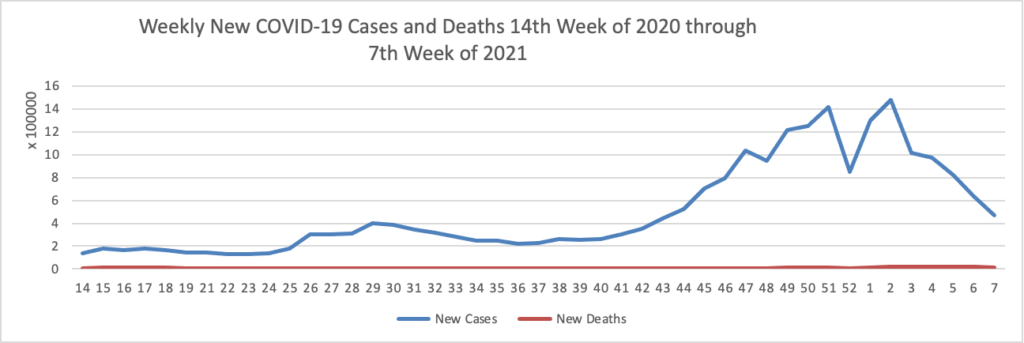
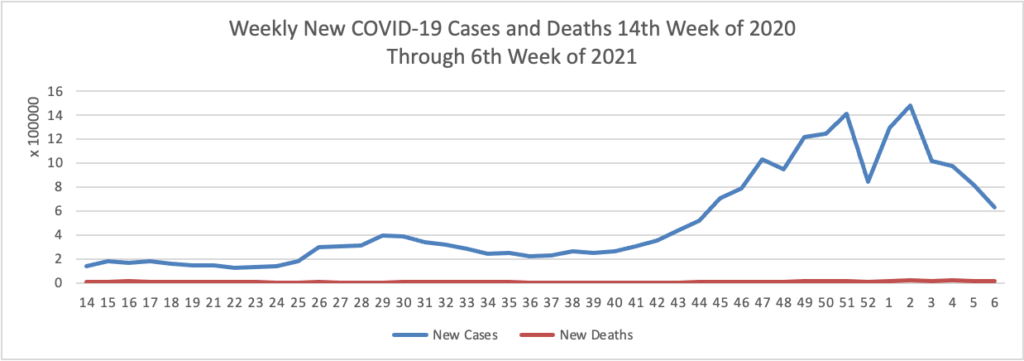
Based on the CDC’s Cases in the U.S. website, here is the FEHBlog’s chart of new weekly COVID-19 cases and deaths over the 14th week of 2020 through third week of this year (beginning April 2, 2020, and ending January 20, 2021; using Thursday as the first day of the week in order to facilitate this weekly update):

and here is the CDC’s latest overall weekly hospitalization rate chart for COVID-19:

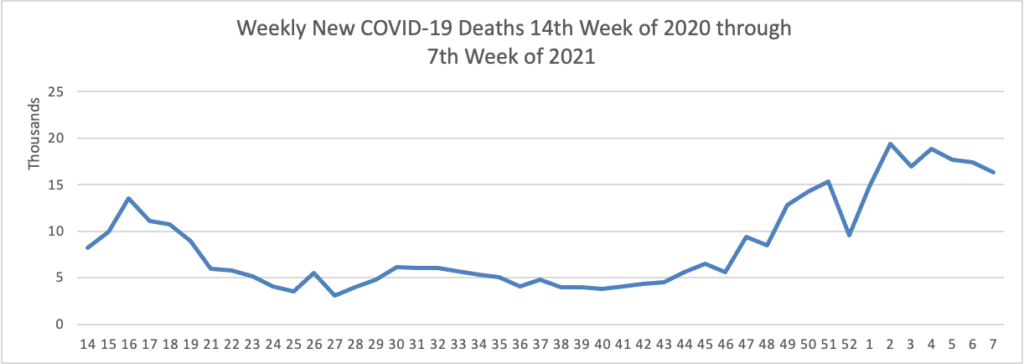
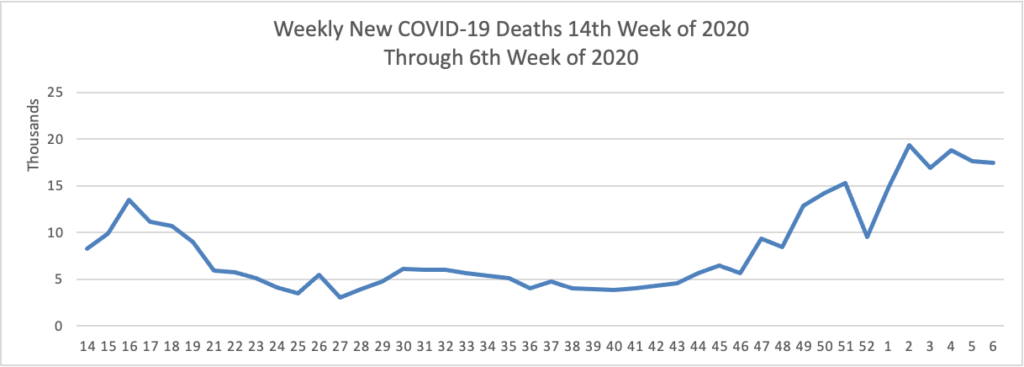
The FEHBlog has noted that the new cases and deaths chart shows a flat line for new weekly deaths  because new cases greatly exceed new deaths. Accordingly here is a chart of new COVID-19 deaths over the period (April 2, 2020, through January 20, 2021):

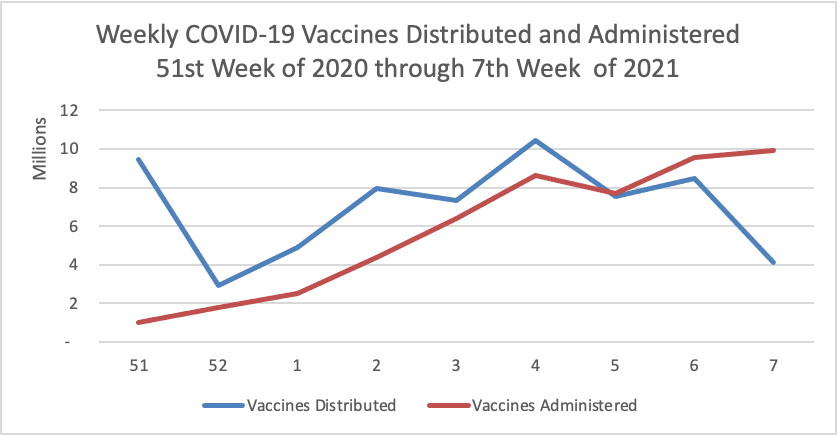
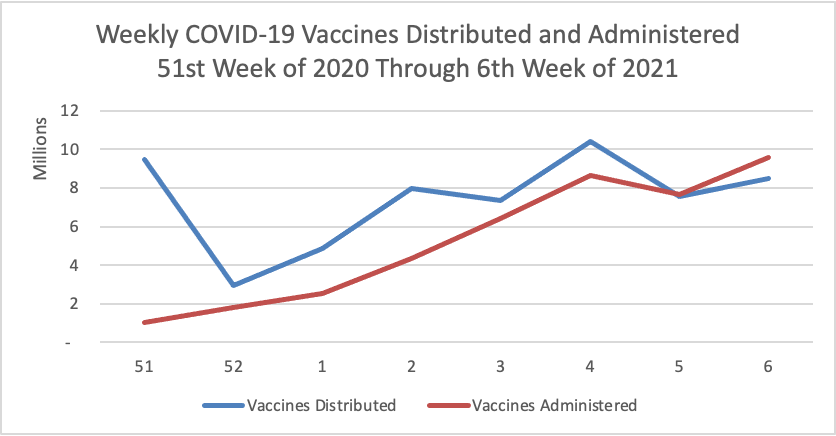
Finally here is a COVID-19 vaccinations chart for the past month which also uses Thursday as the first day of the week:

Here’s more from the COVID-19 vaccine front —

Bloomberg reports

As of Thursday, 940,000 shots a day were administered on average over a seven-day period, according to data from the Bloomberg Vaccine Tracker. The most recent two days topped a million doses.

Anthony Fauci, Biden’s chief medical adviser, said on Thursday that vaccinating 70% to 85% of the country by the end of the summer would enable a return to normalcy. To do so would mean administering 460 million to 560 million doses, since the current vaccines require a first shot followed by a booster. That’s more than double the rate of Biden’s 100-day goal.

The President’s goal cannot be considered a stretch goal and the FEHBlog is not suggesting that he had been doing so. Bloomberg adds

The U.S. spent more than any country in the world to help speed up the development and deployment of [COVID-19] vaccines. It secured more than 1 billion doses from six companies before any of the shots had been approved. For all the criticism that has been directed at the early fumbles of the vaccine rollout, the U.S. still leads the world in shots administered and is fifth in the world on per-capita basis.

The American Hospital Association reports in its daily email about “rare” levels of allergic reactions to the COVID-19 vaccines:

The Centers for Disease Control and Prevention today reported 10 cases of anaphylaxis, a life-threatening allergic reaction, among the more than 4 million people who received a first dose of the Moderna COVID-19 vaccine between Dec. 21, 2020, and Jan. 10, 2021. That’s an estimated 2.5 cases per 1 million doses. Nine cases occurred within 15 minutes of vaccination and one after 30 minutes. All of the individuals received emergency treatment with epinephrine; four were treated in an emergency department and six were hospitalized. All eight for whom follow-up information was available reportedly recovered. On Jan. 6, CDC reported 21 cases of anaphylaxis among the nearly 1.9 million people who received a first dose of the Pfizer COVID-19 vaccine between Dec. 14 and 23. That’s an estimated 11.1 cases per 1 million doses, but still a rare outcome, according to Nancy Messonnier, M.D., director of CDC’s National Center for Immunization and Respiratory Diseases. CDC recommends that locations administering COVID-19 vaccines adhere to its guidance, including screening recipients for contraindications and precautions, implementing recommended post-vaccination observation periods and immediately treating suspected anaphylaxis with intramuscular epinephrine injection.

Bloomberg reports on second dose timing:

People may receive their follow-up doses of the Covid-19 vaccines up to six weeks later if it’s not feasible to get them in the recommended interval, the Centers for Disease Control and Prevention said.

The guidance posted in a Jan. 21 update to the CDC website said a second dose should be administered as close to the recommended schedule as possible, either three weeks for the Pfizer Inc.BioNTech SE vaccine or four weeks for the Moderna Inc. shot.

But if it’s impossible to get the follow-up shot on time, the CDC says people may schedule it as much as six weeks, or 42 days, after their initial dose. There is “limited data on efficacy” of the vaccines beyond that interval, according to the guidance, but if the second dose is administered later “there is no need to restart the series.”

Bloomberg adds

Vaccine supply and the pace of vaccinations could accelerate rapidly when new shots are cleared for use. A vaccine by Johnson & Johnson has enough data to begin analyzing now, and could have results in a week or two, Fauci said this week. The Food and Drug Administration has moved within days to authorize vaccine applications based on early results. 

The U.S. has secured contracts with J&J for enough vaccine to inoculate 100 million people—the same as its agreements with Pfizer and Moderna. Unlike the two vaccines that are currently available in the U.S., J&J’s vaccine requires only one dose — which could accelerate the pace of vaccinations. It also can be stored in standard refrigerators, unlike Pfizer’s vaccine, which requires special freezers to keep temperatures below -94 degrees Fahrenheit.

Two other vaccines, from AstraZeneca Plc and Novavax Inc., have yet to be cleared for use in the U.S. but could add hundreds of millions of additional doses to the effort to stop the pandemic. 

In other encouraging COVID-19 vaccine news, FiercePharma reports that “Americans are back on the COVID-19 vaccine bandwagon. Sixty-nine percent now plan to get a COVID-19 vaccine, close to the previous high of 73% in April, according to the latest data from The Harris Poll.”