On January 7, 2021, the Secretary of Health and Human Services extended the COVID-19 public health emergency for another 90 days from January 21 until April 21, 2020. The COVID-19 testing mandate and emergency use authorizations used for the vaccines hinge on the existence of the public health emergency.
Speaking of which NPR reports that people in the U.S. are beginning to receive the booster doses of the COVID-19 vaccines.
Many health care workers and others at high risk who had the Pfizer shots in mid December lined up for their “booster” shot this week, due to be given 21 days after the initial dose. * * * So far, there don’t appear to be widespread problems with people missing their second dose, but experts say it’s still early and the feasibility of a two-shot mass vaccine effort will be tested in the coming weeks, especially as those who received the Moderna vaccine await their follow up shot, which comes 28 days after the first.
Take a look at the pipelines of Moderna and BioNTech. They include drug trials fortreating cancers of the breast, prostate, skin, pancreas, brain, lung and other tissues, as well as vaccines against everything from influenza to Zika and rabies. The prospects appear good.
Progress, admittedly, has been slow. Part of the explanation [BioNTech founders Drs.] Sahin and Tureci give is that investors in this sector must put up oodles of capital and then wait for more than a decade, first for the trials, then for regulatory approvals. In the past, too few were in the mood.
Covid-19, fingers crossed, may turbo-charge all these processes. The pandemic has led to a grand debut of mRNA vaccines and their definitive proof of concept. Already, there are murmurs about a Nobel Prize for Kariko. Henceforth, mRNA will have no problems getting money, attention or enthusiasm — from investors, regulators and policymakers.
That doesn’t mean the last stretch will be easy. But in this dark hour, it’s permissible to bask in the light that’s dawning
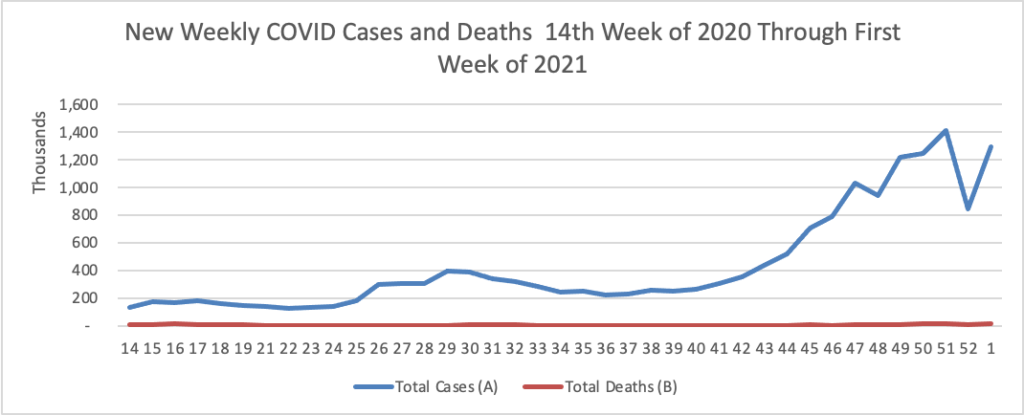
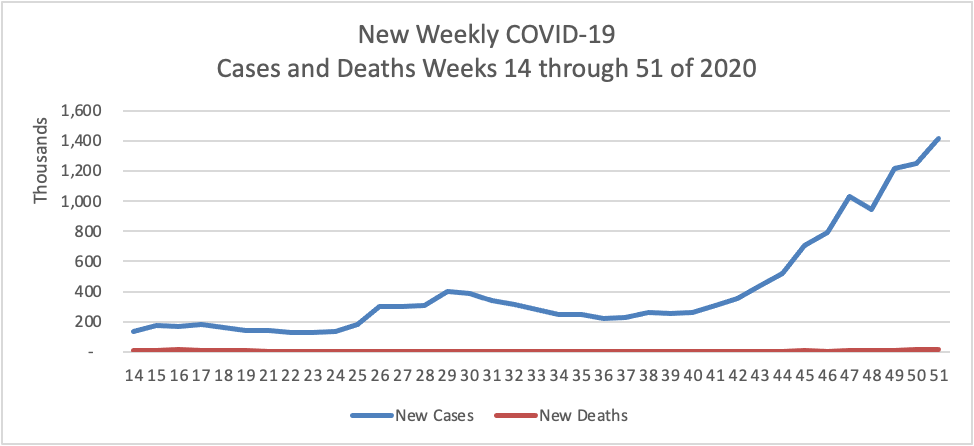
Based on the CDC’s Cases in the U.S. website, here is the FEHBlog’s chart of new weekly COVID-19 cases and deaths over the 14th week of 2020 through 1st week of this year (beginning April 2, 2020, and ending January 6, 2021; using Thursday as the first day of the week in order to facilitate this weekly update):
and here is the CDC’s latest overall weekly hospitalization rate chart for COVID-19:
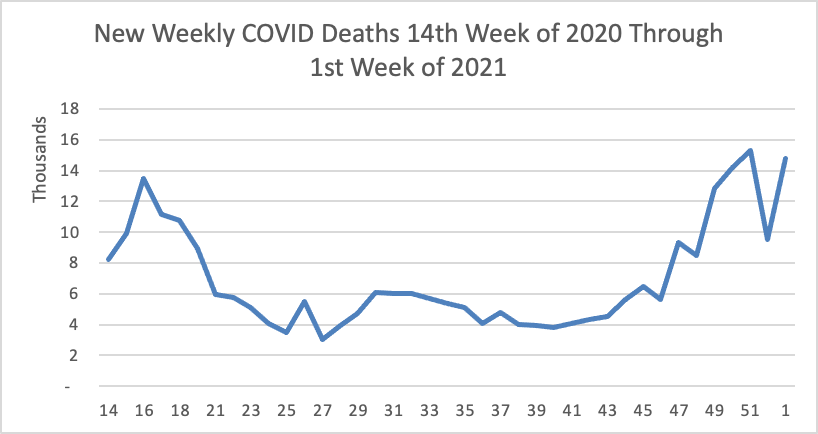
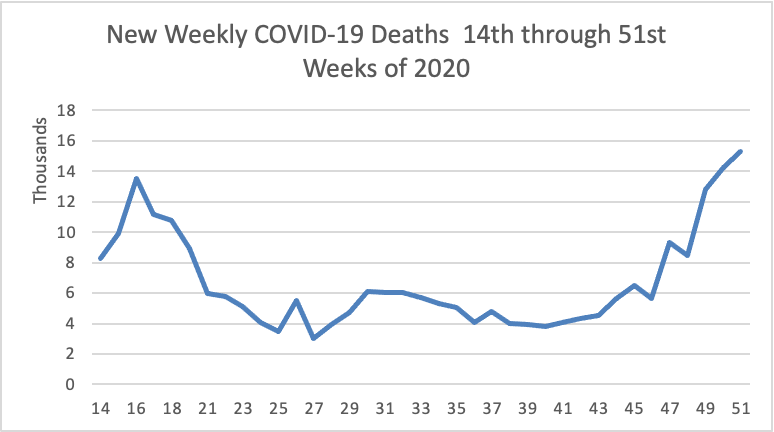
The FEHBlog has noted that the new cases and deaths chart shows a flat line for new weekly deaths because new cases greatly exceed new deaths. Accordingly here is a chart of new COVID-19 deaths over the period April 2, 2020 through January 6, 2021.
Because this week the CDC began to update its COVID-19 vaccinations data on a daily basis the FEHBlog was able to create this vaccines distributed and initially administered over the 51st week of 2020 through the first week of 2021 (December 23, 2020 through January 6, 2021):
Over the past four daily reports, the number of initial COVID vaccines administered increased steadily from 273,209 doses on January 4 to 748,313 doses yesterday. Per the AMA’s Morning Rounds
USA Today (1/6, Weintraub) reports HHS Secretary Alex Azar told governors to vaccinate as many people against SARS-CoV-2 as possible and warned to not let “perfection be the enemy of the good,” referring to priority plans. Azar said that with up to 70% of distributed vaccines still on shelves, states should focus on vaccinating the most people rather than prioritizing certain groups.
Today’s Fluview continues to report that “Seasonal influenza activity in the United States remains lower than usual for this time of year.”
At least half of COVID-19 transmission globally may have been caused by symptom-free infected people unknowingly spreading the virus to others, a study published Thursday by JAMA Network Open found.
In addition, nearly one in four cases of virus spread involves infected people who remain asymptomatic, the researchers estimated.
The findings highlight the importance of public health measures such as social distancing, mask-wearing and hand-washing — even for people who don’t feel sick — in preventing the spread of the virus, they said.
Mercer writes about the most pressing requirement of the Consolidated Appropriations Act – preparing and document comparative analyses to document compliance with the non-quantitative treatment limitations requirements under the federal mental health parity law. Mercer notes that
In case plan sponsors need more motivation to step up compliance efforts, we’re also seeing more litigation against plan sponsors and insurers alleging MHPAEA violations and breach of fiduciary duties under ERISA. In late 2020, in Wit v United Behavioral Health (UBH), a class action lawsuit ended with a decision by a federal court granting the plaintiffs the full extent of relief they requested and requiring UBH to reprocess nearly 67,000 mental health and substance use disorder (MH/SUD) benefit claims that were denied between 2011 and 2017. The federal court held that UBH breached its fiduciary duty to plan participants based on its use of overly restrictive medical necessity guidelines that resulted in the improper denial of more than 67,000 MH/SUD claims. This is just one example of the more than 100 lawsuits filed in the past several years alleging various MHPAEA and ERISA claims review violations relating to exclusions for ABA therapy, coverage for residential and other treatment facilities, medical necessity standards, and other items.
STAT News reports that “Nancy Messonnier, a top federal health official involved in the distribution of Covid-19 vaccines, predicted on Tuesday [in an interview with STAT] that delays in the administration of the shots would improve soon.” (On the bright side, the CDC has begun to update its COVID-19 vaccinations site daily. Around 275,000 initial doses were administered yesterday.) Furthermore
During the discussion Tuesday, Messonnier said she hoped the supply of vaccine would expand greatly in the spring, a time when the shots could be made more widely available to the general public, not just people with certain jobs or health conditions. But making the vaccine is only one step: successfully inoculating the vast majority of the population will require major efforts to educate the public, to build out accessible sites where people can easily get vaccinated, and to ensure individual people show up when it’s their turn to get the shot.
Health Payer Intelligence updates on how three large payers “extended temporary COVID-19 benefits in 2021.” Technically the COVID-19 public health emergency period expires on January 21, 2021, but unquestionably the federal government will extend that period for another 90 days before then.
Under the Affordable Care Act, effective January 1, U.S. Preventive Services Task Force A and B recommendations made two years earlier become eligible for health plan in-network coverage with no member cost-sharing. If you pick out from the USPSTF list those recommendations that received an A or B grade in 2019, you will find ten recommendations that are eligible for “no additional cost” coverage in 2021. Fierce Healthcare provides insights into how health plan members can take advantage of one of those 2019 recommendations -“The USPSTF recommends that clinicians offer preexposure prophylaxis (PrEP) with effective antiretroviral therapy to persons who are at high risk of HIV acquisition.”
On the OPM front, Federal News Network lets us know that
Federal employees who forfeited vacation time in excess of the usual annual leave carryover limit at the end of 2020 may be able to get some of those days back for use later this year, thanks to a policy in the new annual defense authorization law. The Office of Personnel Management on Tuesday issued detailed guidance covering the new annual leave policy and instructed agencies to implement it.
On the mergers and acquisitions front —
Fierce Healthcare reports that “Harvard Pilgrim Health Care and Tufts Health Plan officially combined Jan. 1. The deal, announced in August 2019, comes about a decade after the organizations attempted to merge in 2011. * * * The combined Massachusetts organization will serve 2.4 million members. Both the Tufts and Harvard Pilgrim brands will be in the market for a period of time, the organizations said.”
Healthcare Dive reports that health insurer “Centene has entered into a definitive agreement to acquire Phoenix, Arizona-based Magellan Health for $2.2 billion, or $95 per share, the payer said Monday. Magellan will operate independently under the Centene umbrella. Executives said the combination will result in one of the nation’s largest behavioral health platforms as the two will provide behavioral services to about 41 million members in the U.S. The deal also boosts Centene’s already established footprint in government sponsored health plans with the addition of 5.5 million lives and another 2.2 million to add to its pharmacy benefit management platform.
Govexec.com provides an update on COVID-19 vaccine administration by federal agencies to their employees. A friend of the FEHBlog asked him today whether he knew how long it took for a COVID-19 to provide protection following the injection. Good question. The New York Times reported last week that “The protective effects of vaccines are known to take at least a couple of weeks to kick in.” To wit,
Data from Pfizer’s clinical trials suggests the vaccine might start safeguarding its recipients from disease around one or two weeks after the first injection. A second jab of mRNA, delivered three weeks after the first, helps immune cells commit the virus’s most prominent features to memory, clinching the protective process.
Biopharma Dive reports that “AbbVie raised the list prices of many of its drugs on Jan. 1, while Biogen hiked the price tag of its old multiple sclerosis treatment Tysabri, part of broad, sector-wide increases typically taken at the start of a new year. The hikes could feature in calls for drug pricing legislation as a new Congress and new administration begin work.” Timing is everything.
Here a few loose ends that have been tied up.
According to Healthcare Dive, “Haven, the high-profile, secretive venture to lower healthcare costs backed by Amazon, J.P. Morgan and Berkshire Hathaway, is suspending operations in February after three years, the company announced Monday. Haven caused waves when launched in 2018, with a lineup of notable hires from within the healthcare industry. However, the nonprofit, independent company is now closing with little concrete to show, hinting at the difficulty of reforming the complex insurance system and curbing rising costs in the deeply entrenched healthcare industry. Haven said in a statement on its website that Amazon, J.P. Morgan and Berkshire Hathaway would use the information it gained moving forward and continue working to create programs addressing the health needs of their combined 1.2 million employees. Shares of major U.S. insurers got a bump in Monday trading following the news, with UnitedHealthcare and Humana each climbing more than 2% since noon.”
According to Fierce Healthcare, “New York Life completed its acquisition of Cigna’s group life, accident and disability insurance businesses in a deal valued at $6.3 billion.” Cigna like CVS Health / Aetna has decided to focus its attention on healthcare.
Congress.gov reported today that the Senate has returned to the President his nomination of Craig Leen to be OPM Inspector General because the Senate failed to act on the nomination during the 116th Congress. The President may renew the nomination for the 117th Congress.
Thinking about the OPM Inspector General caused the FEHBlog to check to see whether the latest OPM Inspector General semi-annual report to Congress (period ended September 30, 2020) is online and by golly it has been posted right here. The lead article in the report discusses the impact of the COVID-19 public health emergency on the FEHBP. The management response to the Inspector General’s report is available here.
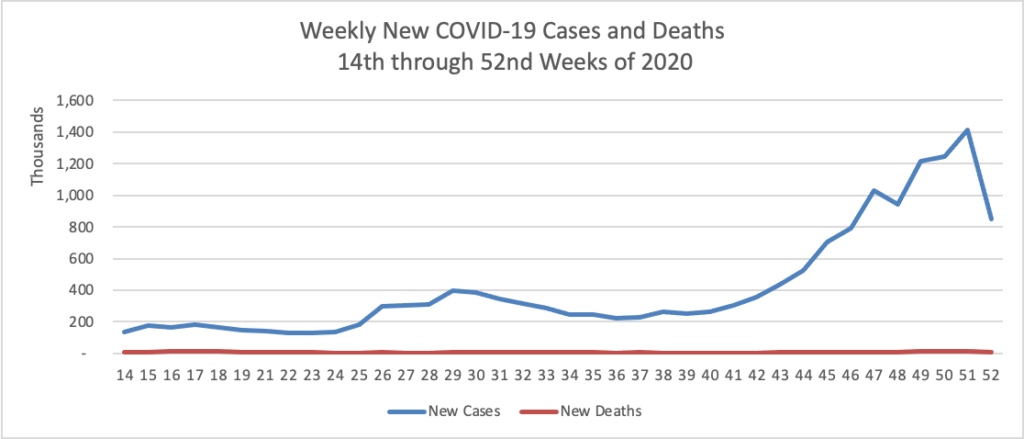
Based on the CDC’s Cases in the U.S. website, here is the FEHBlog’s chart of new weekly COVID-19 cases and deaths over the 14th through 52nd weeks of this year (beginning April 2 and ending December 30; using Thursday as the first day of the week in order to facilitate this weekly update):
and here is the CDC’s latest overall weekly hospitalization rate chart for COVID-19:
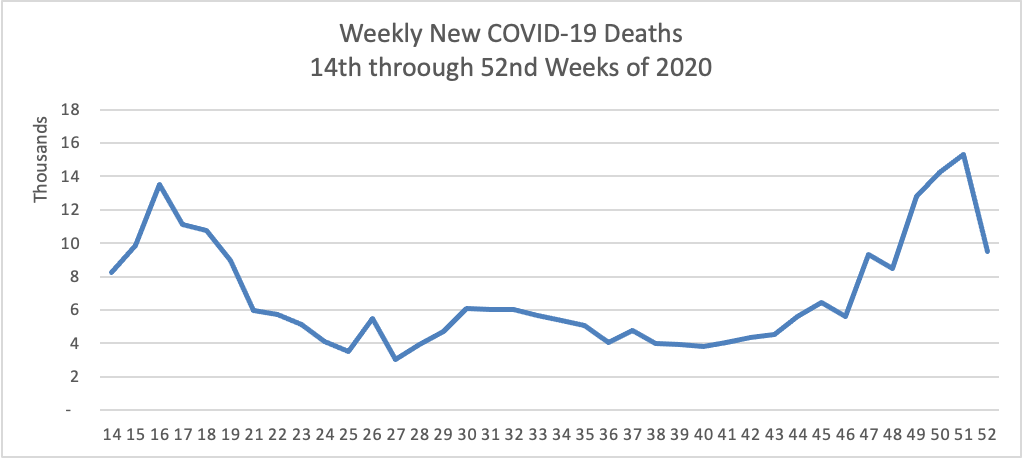
The FEHBlog has noted that the new cases and deaths chart shows a flat line for new weekly deaths because new cases greatly exceed new deaths. Accordingly here is a chart of new COVID-19 deaths over the period (April 2 through December 30):
The CDC’s COVID-19 Vaccine tracker has not been updated since last Wednesday morning At that time roughly 2.8 million initial doses had been administered. The American Hospital Association and the American Medical Association have posted helpful information about the currently available COVID-19 vaccines. The Food and Drug Administration offers a comprehensive year end report.
The CDC’s FluView continues to report that “Seasonal influenza activity in the United States remains lower than usual for this time of year.”
The FEHBlog took a look at a couple of the hospital chain websites and could not find the price information required by the HHS hospital price transparency rule. However, FEP Blue, the largest FEHB plan, announced the availability of their FEP Cost Advisor Tool.
Today is the last day of the 116th Congress. The Wall Street Journal informs us that among the provisions in the Consolidated Appropriations Act, 2021, is the following
Flexible spending accounts. Many workers with FSAs that allow them to use pretax dollars to pay for unreimbursed health expenses (like glasses) or dependent-care expenses (like summer camp) didn’t use all the money in their 2020 accounts because of the pandemic. The IRS had limited ability to ease FSA rules, but Congress has now done so.
Participants in such plans can carry over unused funds from 2020 to 2021 and 2021 to 2022, or for up to 12 months for companies with fiscal years. For dependent-care accounts, the law extends the age limit from 12 to 13 for some carried-over funds. For workers to take advantage of these changes, company plans must often opt into the new rules.
OPM typically does adopt such changes for FSAFeds.
Federal News Network reports that yesterday the Senate joined the House of Representatives in overriding the President’s veto of the FY 2021 National Defense Authorization Act. The Senate did not join the House in approving a $2000 direct stipend COVID relief proposal.
With hours to spare before the new year, President Donald Trump signed an executive order Thursday night implementing a federal pay raise for civilian employees and military members in 2021. Civilian employees will receive a 1% across-the-board federal pay raise in 2021. There are no additional locality pay adjustments this year.
According to the Wall Street Journal, the House of Representatives will be voting tomorrow to override the President’s veto of the National Defense Authorization Act, 2021 (H.R. 6395). Under the Constitution the voting threshold for an override is 2/3s of the body. If the House votes to override, the Senate will hold its vote on Tuesday.
Tomorrow December 28 is the deadline for the President to sign the Consolidated Appropriations Act 2021 (H.R. 133) without an intervening government shutdown. Congress presented the bill to the President for his signature on Christmas Eve. The President has expressed his preference for a $2,000 direct stipend instead of the bill’s $600 stipend and opposition to certain foreign aid appropriations. The Hill reports that “A bipartisan group of lawmakers from both chambers of Congress on Sunday reissued their call for President Trump to sign a nearly $1 trillion COVID-19 relief package [which is part of H.R. 133]— or to immediately veto it.” The House likely will pass a separate bill with the $2000 stipend tomorrow.
P.S. The Wall Street Journal and the Washington Post report Sunday night that the President has signed the Consolidated Appropriations Act into law, thereby releasing COVID-19 relief and avoiding a government shutdown. Tomorrow the FEHBlog will continue his discussion of the Affordable Care Act changes in this law.
Today December 27 is the effective date for health plan coverage of the Pfizer-BioNTech vaccine to plan members under the CARES Act. Precision Vaccinations reports that the Centers for Disease Control released updated guidance on the Pfizer-BioNTech and Moderna mRNA based vaccines over the weekend. The widely used guidance states that
‘Until experts learn more about the protection that COVID-19 vaccinesprovide under real-life conditions, people who decide to get vaccinated should continue to follow all current guidance to protect themselves against COVID-19 after they are vaccinated.’
As of 9 am on December 26, the CDC reported that nearly 2 million first dose of one these vaccine have been administered to subgroup 1a — front-line healthcare workers and nursing home patients.
Govexec reports that frontline postal workers will receive the COVID-19 vaccine in subgroup 1b which currently is in the on deck circle.
The exact timing of the distributions for postal workers and the logistics of delivering the shots remain in flux and will be subject to availability and state plans. States are still in their initial Phase 1a distribution to frontline health care workers and nursing home residents. Unlike several other federal agencies such as the Veterans Affairs Department and Indian Health Service, USPS was not slated to receive its own distribution of doses to vaccinate employees directly. CDC’s advisory group recommended bringing vaccination sites close to workers such as those at the Postal Service to ensure ease of access.
The FEHBlog mentioned hearing a Doctors on Demand medical director talking about the challenge in retaining mental health practitioners to handle the surge in telehealth requests for those services. The FEHBlog noted that this hub and spoke telehealth approach helpfully expands mental health provider networks for plan members.
Fierce Healthcare informs us about a research study concluding
The growth in telehealth [during the public health emergency] was not fueled by COVID-19 concerns but by visits for behavioral health issues and chronic conditions, according to a new study of Doctor On Demand data.
The largest increases in telemedicine visits during the COVID-19 pandemic were attributable to scheduled behavioral health appointments, such as therapy and psychiatry visits, and chronic illness visits, according to a peer-reviewed study published in the Journal of Medical Internet Research this month.
It is the FEHBlog’s hunch that garden variety med surg telehealth visits were conducted via direct connections between doctor and patient rather than via a hub and spoke service like Doctors on Demand. From a quality standpoint, it likely is better for the hub and spoke service to gap fill rather than serve as a primary care provider.
Based on the CDC’s Cases in the U.S. website, here is the FEHBlog’s chart of new weekly COVID-19 cases and deaths over the 14th through 51st weeks of this year (beginning April 2 and ending December 23; using Thursday as the first day of the week in order to facilitate this weekly update):
and here is the CDC’s latest overall weekly hospitalization rate chart for COVID-19:
The FEHBlog has noted that the new cases and deaths chart shows a flat line for new weekly deaths because new cases greatly exceed new deaths. Accordingly here is a chart of new COVID-19 deaths over the period (April 2 through December 23):
The latest CDC FluView will be available on Monday December 28. Next week the FEHBlog will begin to include COVID vaccines in these charts.
The FEHBlog had planned to start reviewing the Affordable Care Act changes in the Consolidated Appropriations Act, 2021, but because the status of that bill unfortunately is in limbo, he instead will note two other Congressionally passed bills that are expected to receive the President’s signature:
The McCarran-Ferguson Act of 1945 “limited the application of [federal] antitrust laws to the business of insurance as long as and to the extent state law regulated the business of insurance. However, if states would not regulate insurance, the Sherman and Clayton Acts, as well the Federal Trade Commission Act still applied.” Needless to say the States with the assistance of the National Association of Insurance Commissioners made sure that the States did not unwittingly create such a regulatory gap. In any event. the McCarran- Ferguson Act continued to apply federal anti-trust law, specifically the Sherman Act of 1896, to prohibit “any agreement to boycott, coerce, or intimidate, or act of boycott, coercion, or intimidation” (15 U.S.C. Sec. 1013).
H.R. 1418 adds to the McCarran- Ferguson Act a further exception for health insurance, dental insurance and limited scope dental benefits. In other words health insurers and dental insurers will be subject to both federal and state laws against restraint of trade. The garden variety exceptions to extension of federal anti-trust law appear quite narrow to the FEHBlog.
“(A) to collect, compile, or disseminate historical loss data; (B) to determine a loss development factor applicable to historical loss data; (C) to perform actuarial services if such contract, combination, or conspiracy does not involve a restraint of trade; or (D) to develop or disseminate a standard insurance policy form.”
Matt Eyles, president of America’s Health Insurance Plans (AHIP), said in a statement about passage of H.R. 1418 that implementation of the bill would add layers of bureaucracy to health insurers and destabilize markets.
“Removal of this exemption adds tremendous administrative costs while delivering absolutely no value for patients and consumers,” Eyles said.
Consumer Reports put out a commentary welcoming passage of H.R. 1418.
“The antitrust exemption has essentially allowed health insurers to act as a monopoly, making demands in lockstep on the terms they will offer consumers and health care providers,” the advocacy organization said in a comment on bill passage. “The resulting squeeze puts pressure on providers to cut corners on service in order to increase the profits the health insurers can extract.”
How much can insurers extract when those profits are strictly regulated by the Affordable Care Act?
This bill, which the FEHBlog previously has mentioned, requires HHS’s Office for Civil Rights to consider whether the covered entity or business associate has adequately demonstrated that it had, for not less than the previous 12 months, recognized security practices in place, when imposing penalties or other remedies for HIPAA Security Rule violations.
The bill defines “Recognized security practices” to mean
the standards, guidelines, best practices, methodologies, procedures, and processes developed under section 2(c)(15) of the National Institute of Standards and Technology Act, the approaches promulgated under section 405(d) of the Cybersecurity Act of 2015, and other programs and processes that address cybersecurity and that are developed, recognized, or promulgated through regulations under other statutory authorities. Such practices shall be determined by the covered entity or business associate, consistent with the HIPAA Security rule (part 160 of title 45 Code of Federal Regulations and subparts A and C of part 164 of such title).
The bill expressly does not create liability for HIPAA covered entities and business associates which decide not to adopt such practices. The bill is retroactive to the effective date of the 21st Century Cures Act of 2016.
In other healthcare legal news:
Reuters reports that on December 23, 2020, a federal district judge in Maryland “blocked a last-minute Trump administration rule aimed at lowering drug prices as of next week. The rule, scheduled to take effect on Jan. 1, would have tied reimbursements for 50 drugs by Medicare, a U.S. government insurance program, to the lowest prices paid by certain other countries. U.S. District Judge Catherine Blake in Maryland ruled that the administration had rushed the rule without giving the public a chance to comment, in violation of federal law.” Case No. 1:20-cv-03531 (D. Md). The temporary restraining order is effective for 14 days.
The American Hospital Association, along with several other organizations, filed an emergency stay of enforcement motion to prevent the Department of Health and Human Services’ hospital price transparency rule from going into effect Jan. 1. The rule requires each hospital operating in the U.S. to make public pricing information, including the prices they negotiate with commercial health insurers. Last week, the Centers for Medicare and Medicaid issued a bulletin announcingits plans to audit a sample of hospitals for compliance with the rule starting in January.
The motion was filed with the U.S. Court of Appeals for the D.C. Circuit in its appeal of a lower court order affirming the legality of this rulemaking (Case No. 20-5193). In its opposition to this motion, the Justice Department observed that
This Court granted plaintiffs’ request for an expedited briefing and argument schedule to “allow the Court to hear and decide this case before” January 1, 2021. Pls. Mot. to Expedite, at 5 (July 3, 2020). The Court is likely to rule on the merits of this appeal imminently, thereby resolving plaintiffs’ legal challenge. Should the Court affirm the district court’s rejection of plaintiffs’ claims, plaintiffs would not be entitled to any relief, including a stay of the agency’s rule. Should the Court agree with plaintiffs’ legal challenge, by contrast, plaintiffs would be entitled to appropriate relief.
The FEHBlog will keep an eye out for this opinion next week.
The FEHBlog is taking a brief holiday hiatus until next Sunday December 27. He will leave you with this encouraging CDC news as of 9 am ET this morning:
COVID-19 Vaccinations in the United States Doses Distributed 9,465,725 People Initiating Vaccination (1st dose received) 1,008,025
Total doses distributed are cumulative counts of COVID-19 vaccine doses recorded as shipped in the Centers for Disease Control and Prevention’s (CDC) Vaccine Tracking System (VTrckS) since December 13, 2020. Cumulative totals reflect data available as of 9:00am ET on the day of reporting.
People initiating vaccination (1st dose received) are cumulative counts of individual COVID-19 vaccine first doses administered as reported to the CDC by state, territorial, and local public health agencies and five federal entities (Bureau of Prisons, Veterans Administration, Department of Defense, Department of State, and Indian Health Services) since December 14, 2020. Cumulative doses administered reflect current data available as of 9:00am ET on the day of reporting.
Doses distributed and people initiating vaccination (1st dose received) are for both Moderna and Pfizer BioNTech COVID-19 vaccine.
Not bad for 12 days since the Pfizer-BioNTech vaccine received the FDA’s emergency use authorization.
The Continuing Appropriations Act, 2021, includes hundreds of pages of amendments to the Affordable Care Act. The premier change is the No Surprises Act which is principally a patient protection measure. NPR lays out this new law’s requirements which take effect for plan years beginning on or after January 1, 2022.
Over the remaining posts of 2020, the FEHBlog will point out other new health plan obligations for 2022 created by this bill, which the President will sign into law within the week. Many of those provisions were drawn from the Senate Health Education and Labor Committee’s S. 1785 from the last Congress. Suffice it to say that 2021 will be very busy year for health plans and their vendors.
Federal News Network discusses how the Continuing Appropriations Act, 2021, impacts federal government agencies and their employees. Of note, the bill
“silent[ly] endorse[s] the president’s 1% across-the-board federal pay raise for civilian employees in 2021;”
“allow[s} those subject to the president’s payroll tax deferral to pay back the deferred taxes — worth 6.2% of their income — throughout the entire year of 2021;”
“appropriates to the Office of Personnel Management $36 million more [in the current federal fiscal year] to make up for the revenue it lost when it transferred the governmentwide security clearance business to the Defense Department,” and
“contains a provision requiring OPM to establish a new occupational series for artificial intelligence positions, or update an existing series to more accurately account for those kinds of skills needed in the federal government.”
On the COVID-19 front, Kaiser Health News helpfully gathers stories about the variant of the COVID-19 virus that recently cropped up in Britain. Fierce Healthcare adds
Moderna * * * said in a statement provided to other media outlets that it expects “that the Moderna vaccine-induced immunity would be protective against the variants recently described in the U.K.,” and that it “will be performing additional tests in the coming weeks to confirm this expectation.”
Pfizer pointed out that when SARS-CoV-2, the virus that causes COVID-19, first emerged a year ago, it was clear there was more than one strain of it, and that it was mutating as it spread. SARS-CoV-2 is an RNA virus, and as such, it has “exceptionally high [mutation] rates” because the enzymes it uses for replication are “prone to errors when making new virus copies,” the company said.
“One of the reasons Pfizer and BioNTech chose to utilize a mRNA platform is because of the potential for the flexibility of the technology in comparison to traditional vaccine technologies,” including the ability to change the RNA sequence in the vaccine, should a strain emerge that’s not covered by the current shot,” Pfizer added.
Both COVID-19 vaccine manufacturers urged public calm.
In October 2020, the FEHBlog noted that Walmart preemptively had sued the federal government over its opioid crisis policy shortcomings. Nevertheless the other shoe dropped today when the federal government sued Walmart in Delaware’s federal court.. According to Justice Department’s press release.
In a civil complaint filed today, the Department of Justice has alleged that Walmart Inc. unlawfully dispensed controlled substances from pharmacies it operated across the country and unlawfully distributed controlled substances to those pharmacies throughout the height of the prescription opioid crisis.
The complaint alleges that this unlawful conduct resulted in hundreds of thousands of violations of the Controlled Substances Act (CSA). The Justice Department seeks civil penalties, which could total in the billions of dollars, and injunctive relief.
Lawmakers raced to put finishing touches on a roughly $900 billion coronavirus aid package, pushing up against a midnight deadline to complete the agreement and pass it through Congress.
With a disagreement on the Federal Reserve’s emergency lending powers settled earlier in the weekend, negotiators on Sunday were finalizing details for the rest of the bill. Senate Majority Leader Mitch McConnell (R., Ky.) said Sunday afternoon that negotiators were hours away from completing the deal. * * *
The emerging agreement is expected to provide $300 a week in enhanced federal unemployment benefits, a $600 direct check to many Americans, as well as aid for schools, vaccine distribution and small businesses. Final votes in the House and Senate could occur as early as Sunday.
Lawmakers raced to put finishing touches on a roughly $900 billion coronavirus aid package, pushing up against a midnight deadline to complete the agreement and pass it through Congress.
With a disagreement on the Federal Reserve’s emergency lending powers settled earlier in the weekend, negotiators on Sunday were finalizing details for the rest of the bill. Senate Majority Leader Mitch McConnell (R., Ky.) said Sunday afternoon that negotiators were hours away from completing the deal. * * *
The emerging agreement is expected to provide $300 a week in enhanced federal unemployment benefits, a $600 direct check to many Americans, as well as aid for schools, vaccine distribution and small businesses. Final votes in the House and Senate could occur as early as Sunday.
The House is expected to vote on a 24-hour extension of government funding Sunday evening, setting up votes on the relief agreement and broader spending bill for Monday. The aid package is tied to a roughly $1.4 trillion annual spending package and Congress has passed a series of temporary spending bills in recent days to keep the government funded while it finished the negotiations.
Significantly, Politico reports that “Congress is set to include a long-elusive ban on “surprise” medical bills as part of a major spending deal lawmakers were working to finalize Sunday evening.”
(P.S. Govexec.com confirms that Congress passed a one day extension of the continuing resolution Sunday night.)
On the COVID-19 front —
The Centers for Disease Control now has a COVID-19 vaccines website which indicates that as of 1 pm today 2,838,225 doses of vaccine have been distributed and 556,208 doses have been administered in the first week.
In accordance with CDC Advisory Committee on Immunization Practices recommendations, the current phase 1A of distribution is directed at healthcare personal and nursing home residents, The Wall Street Journal reports that ACIP today approved phases 1B and 1C as follows:
The next group would include people ages 75 and older, whose hospitalization and death rates are the highest of all age groups. It would also include teachers, factory workers, police and firefighters, grocery store workers and others who are considered essential to the functioning of the economy and at high risk of exposure to Covid-19.
Another group would follow them, comprised of people between the ages of 65 and 74, anyone age 16 or over with a medical condition that puts them at high risk of complications from Covid-19, and other essential workers. They include people who work in transportation and logistics, food service, water and wastewater, and energy sectors.
The ACIP vote was 13-1. State governors are the ultimate decision makers in their states but the FEHBlog understands the governors generally defer to ACIP. As the FEHBlog has noted the vaccines are being directly distributed to federal agencies too.
On the COVID-19 treatment front, the Wall Street Journal reports that
Doctors are treating a new flood of critically ill coronavirus patients with treatments from before the pandemic, to keep more patients alive and send them home sooner.
Last spring, with less known about the disease, doctors often pre-emptively put patients on ventilators or gave powerful sedatives largely abandoned in recent years. The aim was to save the seriously ill and protect hospital staff from Covid-19.
Now hospital treatment for the most critically looks more like it did before the pandemic. Doctors hold off longer before placing patients on ventilators. Patients get less powerful sedatives, with doctors checking more frequently to see if they can halt the drugs entirely and dialing back how much air ventilators push into patients’ lungs with each breath.
“Let us go back to basics,” said Dr. Eduardo Oliveira, executive medical director for critical-care services for AdventHealth Central Florida, which recommends its doctors stick with pre-pandemic guidelines for ventilator use. “The less you deviate from it, the better.”
Advances also include new drugs, most notably steroids, for severely ill patients.
In other healthcare news, Health Payer Intelligence informs us that
Payers may consider promoting ambulatory surgery centers as the ideal site of care for joint replacement surgeries, UnitedHealth Group’s recent research findings suggested.
“Findings from new UnitedHealth Group research underscore the importance of optimizing sites of care to improve patient safety and reduce costs,” the report summarized.
The study analyzed data 2018 and 2019 procedures conducted at Optum’s ambulatory surgery centers. The researchers used low- and medium-severity surgeries to from the baseline and gauge shifts in costs and savings. They used the Ambulatory Surgery Centers Quality Collaboration’s recommended outcome measures to assess quality of care.
On the SolarWinds backdoor hack front, check out this ArsTechnica article:
Of the 18,000 organizations that downloaded a backdoored version of software from SolarWinds, the tiniest of slivers—possibly as small as 0.2 percent—received a follow-on hack that used the backdoor to install a second-stage payload. The largest populations receiving stage two were, in order, tech companies, government agencies, and think tanks/NGOs. The vast majority—80 percent—of these 40 chosen ones were located in the US.
These figures were provided in an update from Microsoft President Brad Smith. Smith also shared some insightful and sobering commentary on the significance of this almost unprecedented attack. His numbers are incomplete, since Microsoft sees only what its Windows Defender app detects. Still, Microsoft sees a lot, so any difference with actual numbers is likely a rounding error.
The FEHBlog had been wondering why not all of the victims of the backdoor hack were breached. It was a conscious decision by the hackers.
We use cookies on our website to give you the most relevant experience by remembering your preferences and repeat visits. By clicking “Accept”, you consent to the use of ALL the cookies.
This website uses cookies to improve your experience while you navigate through the website. Out of these, the cookies that are categorized as necessary are stored on your browser as they are essential for the working of basic functionalities of the website. We also use third-party cookies that help us analyze and understand how you use this website. These cookies will be stored in your browser only with your consent. You also have the option to opt-out of these cookies. But opting out of some of these cookies may affect your browsing experience.
Necessary cookies are absolutely essential for the website to function properly. These cookies ensure basic functionalities and security features of the website, anonymously.
Cookie
Duration
Description
cookielawinfo-checbox-analytics
11 months
This cookie is set by GDPR Cookie Consent plugin. The cookie is used to store the user consent for the cookies in the category "Analytics".
cookielawinfo-checbox-functional
11 months
The cookie is set by GDPR cookie consent to record the user consent for the cookies in the category "Functional".
cookielawinfo-checbox-others
11 months
This cookie is set by GDPR Cookie Consent plugin. The cookie is used to store the user consent for the cookies in the category "Other.
cookielawinfo-checkbox-necessary
11 months
This cookie is set by GDPR Cookie Consent plugin. The cookies is used to store the user consent for the cookies in the category "Necessary".
cookielawinfo-checkbox-performance
11 months
This cookie is set by GDPR Cookie Consent plugin. The cookie is used to store the user consent for the cookies in the category "Performance".
viewed_cookie_policy
11 months
The cookie is set by the GDPR Cookie Consent plugin and is used to store whether or not user has consented to the use of cookies. It does not store any personal data.
Functional cookies help to perform certain functionalities like sharing the content of the website on social media platforms, collect feedbacks, and other third-party features.
Performance cookies are used to understand and analyze the key performance indexes of the website which helps in delivering a better user experience for the visitors.
Analytical cookies are used to understand how visitors interact with the website. These cookies help provide information on metrics the number of visitors, bounce rate, traffic source, etc.
Advertisement cookies are used to provide visitors with relevant ads and marketing campaigns. These cookies track visitors across websites and collect information to provide customized ads.