Monday Roundup

Monday Roundup

Photo by Sven Read on Unsplash

From the COVID vaccination front, the CDC’s COVID Data Tracker indicates that over two-thirds of the U.S. population over five years old in fully vaccinated.

The American Medical Association’s column about “What Doctors Wish Patient Knew” explains

A Kaiser Family Foundation poll found that one-third of parents say they planned to get their children vaccinated right away. Yet other parents are taking a wait-and-see approach to COVID-19 vaccination for kids. But with the Delta-Omicron variant tag team, widespread vaccination is an essential tool for preventing COVID-19 deaths, hospitalizations and illnesses.

To help parents move from that “wait-and-see” mentality and calm their fears, two physicians shared what to know about COVID-19 vaccine safety for children.

Check it out.

From the Omicron treatment front, the Food and Drug Administration announced today that the agency has

revised the authorizations for two monoclonal antibody treatments – bamlanivimab and etesevimab (administered together) and REGEN-COV (casirivimab and imdevimab) [which are made by Eli Lilly & Co. and Regeneron Pharmaceuticals Inc.] – to limit their use to only when the patient is likely to have been infected with or exposed to a variant that is susceptible to these treatments.

Because data show these treatments are highly unlikely to be active against the omicron variant, which is circulating at a very high frequency throughout the United States, these treatments are not authorized for use in any U.S. states, territories, and jurisdictions at this time. In the future, if patients in certain geographic regions are likely to be infected or exposed to a variant that is susceptible to these treatments, then use of these treatments may be authorized in these regions. 

Monoclonal antibodies are laboratory-made proteins that mimic the immune system’s ability to fight off harmful pathogens such as viruses, like SARS-CoV-2. And like other infectious organisms, SARS-CoV-2 can mutate over time, resulting in certain treatments not working against certain variants such as omicron. This is the case with these two treatments for which we’re making changes today. * * *

Importantly, there are several other therapies – Paxlovid, sotrovimab, Veklury (remdesivir), and molnupiravir – that are expected to work against the omicron variant, and that are authorized or approved to treat patients with mild-to-moderate COVID-19 who are at high risk for progression to severe disease, including hospitalization or death. Healthcare providers should consult the NIH panel’s COVID-19 treatment guidelines and assess whether these treatments are right for their patients.

From the COVID vaccination mandate front, Federal News Network reports that

Last week’s court injunction that blocked the Biden Administration’s vaccine requirement for federal employees will put a temporary halt to disciplinary actions in federal agencies. But it won’t be of much help to feds who’d already been disciplined or fired for refusing the vaccine prior to last Friday.

That’s according to new guidance the administration’s Safer Federal Workforce Task Force issued Monday. The four-page document answers some basic questions on exactly how agencies should deal with the federal employee mandate now that a Texas judge has temporarily barred its implementation and enforcement.

Among the nuances: workers who’ve been suspended for failing to comply need to have their suspensions lifted, and new proposals to fire or suspend employees need to be “held in abeyance” for as long as the injunction is in place, the task force said. But agencies don’t need to reverse other disciplinary procedures that have already taken full effect.

From the free OTC tests front, Govexec.com asks

What group is especially vulnerable to the ravages of COVID-19 even if fully vaccinated and boosted? Seniors. And who will have an especially tough time getting free at-home COVID tests under the Biden administration’s plan? Yes, seniors.

As of Jan. 15, private insurers will cover the cost of eight at-home rapid COVID tests each month for their members — for as long as the public health emergency lasts.

Finding the tests will be hard enough, but Medicare beneficiaries face an even bigger hurdle: The administration’s new rule doesn’t apply to them.

It turns out that the laws governing traditional Medicare don’t provide for coverage of self-administered diagnostic tests, which is precisely what the rapid antigen tests are and why they are an important tool for containing the pandemic. * * *

The Medicare program does cover rapid antigen or PCR testing done by a lab without charging beneficiaries, but there’s a hitch: It’s limited to one test per year unless someone has a doctor’s order.

Because the article describes orignal Medicare as exempt, one must assume that Medicare Advantage plans also are offering reimbursement for OTC COVID tests. The original Medicare exemption is a weak cup of tea because no commercial health plans covered OTC testing before the mandate.

From the No Suprises Act front, The American Hospital Association informs us that

The Centers for Medicare & Medicaid Services will host a conference call for health care providers Jan. 26 at 1 p.m. ET on the balance billing provisions of the No Surprises Act. To participate in the Special Open Door Forum, dial 888-455-1397 and reference passcode 5109694. Slides for the call are available here. P

Participants may email questions in advance to Provider_Enforcement@cms.hhs.gov, noting “Questions for 1/26 Open Door Forum” in the subject line. A replay will be available after the call through Jan. 28 by dialing 800-308-7855 and entering the passcode.

The CMS slides are helpful.

From the telehealth front, Fierce Healthcare tells us that

Integrating virtual care can save the healthcare system significant amounts of money, as well as avoid unnecessary visits to the emergency department or urgent care center, according to a new study from Cigna.

The study, conducted alongside its telehealth arm MDLive, found that patients who saw virtual providers also saw 19% fewer visits to the ER or urgent care. In addition, virtual urgent care visits reduced duplication of care by 16% compared to other virtual primary care providers or specialists.

Cigna notes that these reductions in unneeded visits are especially crucial as hospitals face down the current COVID-19 surge, caused by the highly infectious omicron variant. 

Friday Stats and More

Based on the CDC’s Covid Data Tracker and using Thursday as the first day of the week, here is the FEHBlog’s weekly chart of new Covid cases from the 27th week of 2021 through the third week of 2022:

My word, could that be a cresting of the Omicron surge as discussed in this week’s posts?

The FEHBlog’s weekly chart of new Covid deaths has bounced up and down after climbing to just over 10,000 weekly deaths during the Delta surge. .

Last but not least here is the FEHBlog’s weekly chart of new Covid vaccinations distributed and administered from the 51st week of 2020 through the third week of 2022.

Here are links to the CDC’s Covid data tracker weekly review and its weekly Fluview.

In other COVID vaccination news —

  • The Wall Street Journal reports that

Vaccines and booster shots offer superior protection from the Delta and Omicron variants, according to three new studies released by the Centers for Disease Control and Prevention.

The data back up earlier findings supporting booster shots and offer the first comprehensive insight into how vaccines fare against the Omicron variant. In one of the studies published Friday, a CDC analysis found that a third dose of either the vaccine from Pfizer Inc.and BioNTech SE or Moderna Inc. was at least 90% effective against preventing hospitalization from Covid-19 during both the Delta and Omicron periods.

The American Hospital Association adds

According to data from 25 state and local health departments, adults who were unvaccinated against COVID-19 as the omicron variant emerged in December had nearly three times higher risk of infection than adults fully vaccinated against COVID-19 and five times higher risk than adults who had received a booster, the Centers for Disease Control and Prevention reported today. The highest impact of COVID-19 booster doses compared with full vaccination was recorded among persons aged 50 and older. Because of reporting lags, the influence of the omicron variant on COVID-19-associated deaths could not be evaluated by vaccination status in December, the authors note.

The FDA could authorize Pfizer’s COVID-19 vaccine for children under age 5 in the next month, Anthony Fauci, MD, director of the National Institute of Allergy and Infectious Diseases, said Wednesday.

“My hope is that it’s going to be within the next month or so and not much later than that, but I can’t guarantee that because I can’t out-guess the FDA,” he said during an interview with Blue Star Families, a nonprofit group that supports military families.

The younger age group will likely need three vaccine doses, he said, since two shots didn’t provide enough of an immune response during Pfizer’s clinical trials for kids ages 2-4.

In Covid vaccine mandate news, Govexec tells us

A federal court in Texas has issued an injunction against President Biden’s COVID-19 vaccine mandate for the federal workforce, pausing implementation of a requirement for more than 2 million civilian servants. 

The Biden administration has already had sweeping success with the mandate, as most agencies have seen virtually their entire workforces come into compliance. Still, federal offices across the country were just beginning to move forward with suspensions—which could eventually result in firings—for those who did not meet the requirements. Biden issued the mandate by executive order in September.    

Judge Jeffrey Brown, appointed by President Trump to the U.S. Court for the Southern District of Texas, said the case was not about whether individuals should be vaccinated or even about federal power generally. 

“It is instead about whether the president can, with the stroke of a pen and without the input of Congress, require millions of federal employees to undergo a medical procedure as a condition of their employment,” Brown wrote. “That, under the current state of the law as just recently expressed by the Supreme Court, is a bridge too far.” 

The Justice Department has appealed the decision to the U.S. Court of Appeals for the Fifth Circuit. The FEHBlog expects that the Fifth Circuit will lift the stay as soon as this weekend. The Society for Human Resource Management offers a helpful article for employers trying to keep track of the vaccine mandate decisions from the courts.

In other COVID vaccine mandate news, the Labor Department’s Wage and Hour Division announced today that

Employees [who are not exempt from the Fair Labor Standards Act] must be paid for time spent going to, waiting for, and receiving medical attention required by the employer or on the employer’s premises during normal working hours. Therefore, if an employer requires an employee to obtain a COVID-19 vaccine dose, undergo a COVID-19 test, or engage in a COVID-19 related health screening or temperature check during the employee’s normal working hours, the time that the employee spends engaged in the activity is compensable. Employees must be paid for such time during normal working hours, regardless of where the activity occurs. This is true regardless of whether the employer is subject to the OSHA Vaccination and Testing ETS.

In Covid treatment news, the Food and Drug Administration announced today that the agency “took two actions to expand the use of the antiviral drug Veklury (remdesivir) to certain non-hospitalized adults and pediatric patients for the treatment of mild-to-moderate COVID-19 disease. This provides another treatment option to reduce the risk of hospitalization in high-risk patients. Previously, the use of Veklury was limited to patients requiring hospitalization.”

From the Covid OTC testing coverage mandate department, the Kaiser Family Foundation has surveyed the coverage approaches of 13 large health insurers. Don’t blame the insurers on this one because health insurers don’t typically cover OTC products and the government only allow four days to implement the mandate.

From the and more department

  • In telehealth news, mHealth Intelligence tells us that

Telehealth utilization peaked in the first half of 2020 and decreased as the year came to a close, with providers predicting that virtual care use would continue to decline in upcoming years, according to the 2021 Medical Group Telehealth Survey.

AMGA Consulting conducted the survey and gathered responses from 56 medical groups representing more than 38,000 healthcare providers.

The majority of the participants (86 percent) were part of multispecialty groups with primary care, while the remaining were either multispecialty without primary care, primary care, or single-specialty groups. * * *

The survey results suggest that although telehealth use skyrocketed during the COVID-19 pandemic, virtual care may see the most success with patients who prefer the modality over in-person care or whose health concerns can be easily addressed virtually.

The FEHBlog remains a strong proponent of hub and spoke telehealth for mental health care because every televisit is in network.

  • The American Hospital Association informs us that “The Department of Health and Human Services’ Office of the National Coordinator for Health Information Technology seeks comments through March 25 to inform potential future rulemaking on how the ONC Health IT Certification Program could incorporate standards, implementation specifications and certification criteria to reduce the burden of prior authorization.”
  • The Congressional Budget Office released a report titled “The Prices That Commercial Health Insurers and Medicare Pay for Hospitals’ and Physicians’ Services.”

CBO examined potential explanations for why the prices paid by commercial insurers are higher and more variable than those paid by Medicare FFS. CBO’s analysis and literature review suggest the following conclusions:

— Greater market power among providers consistently leads to prices for commercial insurers that are higher than Medicare FFS’s prices and that vary more widely, both among and within areas. Hospitals and physicians’ groups may have market power because they have a dominant share of the market in an area or because an insurer sees them as essential to its network of providers.

— Some of the variation in the prices that commercial insurers pay for hospitals’ and physicians’ services is explained by differences in the prices of inputs needed to deliver those services.

— Higher hospital quality is associated with higher prices paid by commercial insurers, although whether there is a causal link between quality and prices, and the direction of any such link, is not clear.

— The share of providers’ patients who are covered by Medicare and Medicaid is not related to higher prices paid by commercial insurers. That finding suggests that providers do not raise the prices they negotiate with commercial insurers to offset lower prices paid by government programs (a concept known as cost-shifting).

IBM is selling the data and analytics assets of its Watson Health business to a private equity firm as it looks to refocus on its core cloud business.

The sale, which is expected to close in the second quarter this year has been anticipated for quite some time, and comes following the limited success of Watson Health, despite a spate of high-profile acquisitions of health information companies to bolster the enterprise.

Financial terms of the deal were not disclosed.

[F]ederal civilian employees in the U.S. will now be paid at least $15 per hour.

OPM issued a memorandum for heads of Executive departments and agencies that provides implementing guidance for how agencies should adjust pay rates for General Schedule (GS) and Federal Wage System (FWS) employees stationed in the U.S., and how to use administrative authority for other pay systems to lift the pay of federal employees who currently make less than $15 per hour. In total, these changes will impact 67,000 out of 2.2 million federal employees. The largest share of these workers, over 56,000 of them, currently work at the Department of Defense. OPM’s guidance directs agencies to implement these changes by January 30, 2022

  • To tide you over the weekend, here is a link to Healthcare Dive’s Deep Dive on four 2022 key trends for providers and payers.

Thursday Miscellany

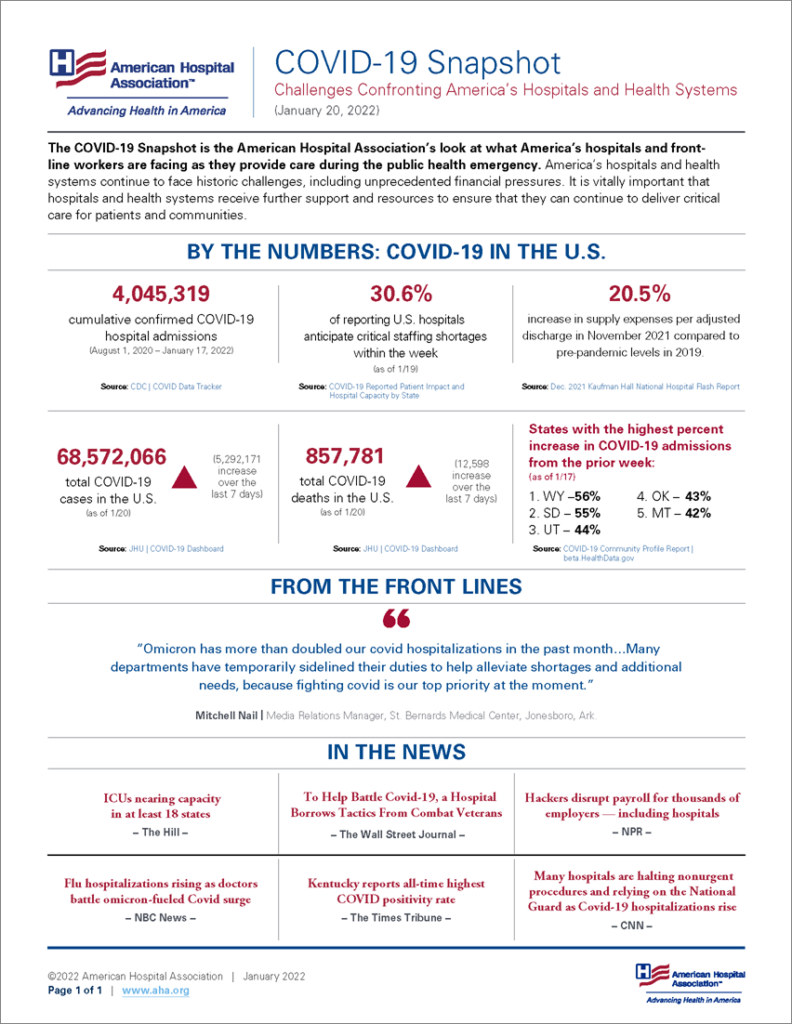
The American Hospital Association released its latest COVID Snapshot today.

Bloomberg adds that

The U.S. hospital-staffing shortage exacerbated by the latest Covid-19 wave is showing signs of easing, but many West Coast and rural states are still seeing the worst of it.

Over the past seven days, about 16.7% of U.S. hospitals have reported critical staffing shortages, down from a recent peak of 18.7% on Jan. 9, according to data from the Department of Health and Human Services. Fewer facilities are reporting shortages in populous New York, Florida and Illinois. 

The numbers are still concerning to state leaders, but are at least returning to the levels seen in October and November, before the omicron spike.

From the Covid treatment front —

The niftiest COVID news that the FEHBlog ran across today is this GoodRx website that provides “Live Updates on How to Find Paxlovid and Molnupiravir,” respectively the Pfizer and Merck Covid pills. Bookmark it.

From the COVID testing front —

SHRM brings us up to date on the unnecessarily rushed rollout of the federal government mandate that health plans cover over the counter Covid tests. Most plans did not have time to create in-network coverage because health plans do not cover OTC drugstor items except when mandated to do so.

From the COVID vaccine mandate front, FedWeek reports that

The impact of the Coronavirus vaccine mandate in terms of turnover in the federal workforce—either voluntary or not—remains largely anecdotal, although the largest agency, DoD has said there have been “no terminations yet.”

“We are still finalizing the guidance to the civilian force in that regard,” a Pentagon spokesman said late last week in a comment that seems to characterize the state of affairs in general.

From the Rx coverage front —

  • Drug Store News reports that

CVS Health is embarking on a collaboration with Uber Health, Uber’s healthcare arm, to provide critical transportation support at no cost to people who need it most when seeking access to medical care, work or educational programs.

The relationship is part of Health Zones, CVS Health’s new initiative that provides concentrated local investments designed to reduce health disparities and advance health equity in high-risk communities across the country. Health Zones is an integrated approach to addressing six key social determinants of health: housing, education, access to food, labor, transportation, and health care access. 

The Health Zones initiative is now active in five markets nationwide: Atlanta, Ga.; Columbus, Ohio; Fresno, Calif.; Hartford, Conn.; and Phoenix, Ariz. with plans to expand into more cities later this year. Working with trusted national and local partners, CVS Health is addressing community health care needs, ensuring at-risk communities have access to resources and opportunities that can help them thrive.

  • Fierce Healthcare tells us that

Mark Cuban Cost Plus Drug Company (MCCPDC) has launched its online pharmacy as part of an ongoing effort to provide consumers with low drug prices. 

The pharmacy claims to offer significant savings, with several prescription drugs reportedly at more than half the cost of the next most affordable option. For instance, leukemia treatment imatinib has a retail price of $9,657 a month, according to MCCPDC, compared to $120 with a common voucher. Its price through the new company, however, is just $47 per month.

The pharmacy’s initial inventory launch consists of 100 generic drugs. 

From the No Suprises Act front, Health Payer Intelligence discusses how the new law is likely to spur collaboration between providers and payers to improve the accuracy of provider directories. The FEHBlog has always thought the providers should post the a notice about the networks in which they participate at their offices and on their websites.

Midweek update

Photo by JOSHUA COLEMAN on Unsplash

In this morning’s New York Times, columnist David Leonhardt writes

Omicron appears to be in retreat, even if the official national data doesn’t yet reflect that reality. Omicron also appears to be mild in a vast majority of cases, especially for the vaccinated. This combination means that the U.S. may be only a few weeks away from the most encouraging Covid situation since early last summer, before the Delta variant emerged.

If that happens — and there is no guarantee it will, as Katherine Wu of The Atlantic explains — it will be time to ask how society can move back toward normalcy and reduce the harsh toll that pandemic isolation has inflicted, particularly on children and disproportionately on low-income children.

When should schools resume all activities? When should offices reopen? When should masks come off? When should asymptomatic people stop interrupting their lives because of a Covid exposure? Above all, when does Covid prevention do more harm — to physical and mental health — than good?

These are tricky questions, and they could often sound inappropriate during the Omicron surge. Now, though, the surge is receding.

Yes, indeed. Helen Branswell, writing in STAT News, offers an array of expert opinions on what could be next on the COVID front.

John Moore, a virologist at Weill Cornell Medical College, said a post-Omicron decrease in transmission “is certainly a plausible scenario,” suggesting it might take until late February or early March for most of the country to get there. But equally possible, he suggested, is that another variant will emerge, with the transmissibility of Omicron but without its reticence to replicate in the deep lungs [like Alpha and Delta did].

“This is where it’s all so freaking difficult. There are scenarios. You don’t know what the future’s going to hold. All these people who say ‘This is what’s going to happen.’ Well, this is what they think might happen, if they’re being honest,” he said.

While the situation remains unsettling, the FEHBlog thinks that Mr. Leonhardt’s thinking is on the right track.

From the masking front, the Wall Street Journal reports that

The Biden administration on Wednesday announced plans to make 400 million N95 masks available for free at pharmacies and community health centers across the country.

The move comes as President Biden has stepped up the federal government’s response to a nationwide surge in Covid-19 cases triggered by the highly transmissible Omicron variant. Some scientists and doctors have said popular single-layer cloth masks may not be sufficient to protect against Omicron and called on the administration to expand access to high-filtration masks such as N95s.

The nonsurgical N95 masks will start to be available at pharmacies and community health centers late next week and the program will be fully up and running by early February, the White House official said. The masks will be sourced from the Strategic National Stockpile, the nation’s safety net of medical-equipment supplies. * * *

Three masks will be available per person, the official said, to ensure broad access. Most of the pharmacies that are part of the federal pharmacy vaccine program will distribute the masks, the official said.

Following up on yesterday’s post on distribution of the Pfizer and Merck Covid pills, the New York Times offers a reporter’s saga of tracking down the Pfizer treatment for her ailing mother.

The fact that the process was so hard for a journalist whose job it is to understand how Paxlovid gets delivered is not encouraging. I worry that many patients or their family would give up when told “no” as many times as I was.

I was also reminded that even a “free” treatment can come with significant costs.

The federal government has bought enough Paxlovid for 20 million Americans, at a cost of about $530 per person, to be distributed free of charge. But I spent $256.54 getting the pills for my mother. I paid $39 for the telemedicine visit with the provider who told my mother that she would need to visit in person. The rest was the Uber fare and tip. Many patients and their families can’t afford that.

President Biden recently called the Pfizer pills a “game changer.” My experience suggests it won’t be quite so simple.

FEHB and other health plans hopefully are looking into helping their members navigate this complicate process.

From the COVID vaccine mandate front, Fierce Healthcare reports

All 50 states are now subject to the Centers for Medicare & Medicaid Services’ (CMS’) healthcare workforce mandate after a federal court tossed Texas’ lawsuit and preliminary injunction contesting the requirement.

Today’s dismissal comes less than a week after the Supreme Court removed a stay of the federal government’s industry-wide vaccine requirement in 24 states that opposed the policy. The Biden administration filed an appeal of Texas’ injunction the following day.

Although CMS’ requirement may now be enforced across the country, the agency has set varying compliance deadlines reflecting whether its initial interim final rule was enjoined in a particular state.

Healthcare Dive adds

Healthcare workers in the 24 states that legally challenged the requirement will now be on a different vaccine deadline than the rest of the nation. For these states, healthcare workers must be fully inoculated by March 15, CMS confirmed with Healthcare Dive.        

But for the healthcare workers in the other 25 states and D.C., which were not a part of the litigation, workers will need to be fully vaccinated by Feb. 28, per CMS.         

From the healthcare business front —

Healthcare Dive tells us that

UnitedHealth reiterated its 2022 enrollment targets for Medicare Advantage on Wednesday, easing recent concerns that rising competition could hamstring future growth in the fruitful market.

The forecast was released along with its fourth-quarter and full-year 2021 results. The Minnetonka, Minnesota-based healthcare behemoth also reported no serious change in utilization trends despite skyrocketing COVID-19 case counts due to the highly infectious omicron variant.

UnitedHealth beat Wall Street expectations on both earnings and revenue in the fourth quarter, with revenue of $73.7 billion, up 13% year over year, thanks in part to the outsized growth of its health services business Optum. Net earnings of $4.2 billion were almost double the $2.4 billion in profit brought in at the same time last year.

Healthcare Dive adds that

Antitrust regulators said Tuesday they are looking to modernize merger guidelines in an effort to crack down on tie-ups amid a flood of merger filings that has more than doubled in the past year.

Leaders of the Federal Trade Commission and Department of Justice are launching a review of the current guidelines that are used to detect and analyze potentially unlawful mergers. Those policing guidelines have not been updated in 12 years, potentially excluding realities of a modern economy, leaders said.

To bring the guidelines up to date, the FTC and DOJ are calling on the public to submit information and new evidence, about the potential effects of mergers so the agencies can ultimately beef up tools to block anticompetitive deals.

From the Rx coverage front —

  • Drug Channels offers five takeaways from the Big Three PBM’s exclusion lists.
  • The Congressional Budget Office released a report titled “Prescription Drugs: Spending, Use, and Prices.”

In general healthcare news —

  • The American Medical Association discusses what drives Black maternal health inquities in the U.S.

Researchers at the University of Wisconsin-Madison have spent years making sure that their meditation app, called the Healthy Minds Program, passes clinical muster and delivers positive outcomes. Designing studies to test the app’s efficacy led Simon Goldberg, an assistant professor at UW, to confront the mountain of thousands of studies of different mobile mental health tools, including apps, text-message based support, and other interventions.

Researchers had taken the time to synthesize some of the studies, but it was hard, even for someone steeped in the science like Goldberg, to draw definitive conclusions about what works and what doesn’t. So Goldberg teamed up with a few other researchers and took a step back to see if they could put order to the work collected in these meta-analyses — a kind of deep meditation on the existing research inspired by UW’s meditation app.

The meta-review, published on Tuesday in PLOS Digital Health, examined 14 meta-analyses that focused specifically on randomized control trials for mental health interventions, including treatments for depression, anxiety, and smoking cessation. In total, the review included 145 trials that enrolled nearly 50,000 patients. The review found universal shortcomings in study design, leading the researchers to write that they “failed to find convincing evidence in support of any mobile phone-based intervention on any outcome.”

Ruh roh.

Tuesday Tidbits

Photo by Patrick Fore on Unsplash

Back in President George W. Bush’s first term, health information professionals were talking about the linking budding health information exchanges with a “national backbone.” That backbone was finally unveiled today and it has been named TEFCA. Hopefully TEFCA will be the answer to nationwide FEHB plan prayers for interoperability.

An Office of National Coordination press release explains,

The Trusted Exchange Framework and Common Agreement is now available. Within the health information technology (health IT) world, few things have been as elusive as a governance framework for nationwide health information exchange. When ONC was formed in 2004, the concept of a nationwide health information network—where your information could be located across the country in a click—was a big picture vision that drove the federal government’s early health IT infrastructure, standards, policy actions, and investments.

What’s followed as a result of two laws (HITECH Act and 21st Century Cures Act) and remarkable continuity across four administrations has been steady growth, maturity, and investment from both the public and private sectors. Most health care providers use electronic health records.1,2,3 Many are connected to and engage in at least one form of electronic health information exchange.4,5,6 And health information networks are now dotted across the US map supporting communities with a wide range of services.7

Today’s milestone marks the beginning of a new era of electronic health information exchange in the US. That world we wanted to see back in 2004—it’s here—and now it’s time to put what we’ve built to use.

Our goals for the Trusted Exchange Framework and Common Agreement (TEFCA) are:

Goal 1: Establish a universal policy and technical floor for nationwide interoperability.

Goal 2: Simplify connectivity for organizations to securely exchange information to improve patient care, enhance the welfare of populations, and generate health care value.

Goal 3: Enable individuals to gather their health care information.

The Trusted Exchange Framework is a set of non-binding principles to facilitate data-sharing among health information networks. The Common Agreement will operationalize simplified electronic health information exchange for many across the US and will provide easier ways for individuals and organizations to securely connect. Most notably, the Common Agreement sets a new baseline for the exchange purposes that need to be supported—a common source of friction across networks today. The Common Agreement includes support for treatment, payment, health care operations, individual access services, public health, and government benefits determination.

The Common Agreement is a new legal contract that ONC’s Recognized Coordinating Entity (RCE), The Sequoia Project, will sign with each Qualified Health Information Network (QHIN). QHINs will then execute certain corresponding policies within their own networks. Published in tandem is the QHIN Technical Framework, which sets the functional and technical requirements that QHINs need to support to make this new connectivity come online. While road-tested production standards are being used at the start, we are also actively working with the RCE to develop a TEFCA Health Level Seven (HL7®) Fast Healthcare Interoperability Resource (FHIR®) Roadmap (TEFCA FHIR Roadmap) to outline how FHIR will also become an established part of TEFCA-based exchange over time.

The FEHBlog is happy that the Biden Administration hit the regulatory accelerator to launch TEFCA in the Administration’s first year in office. Here’s a link to the Sequoia Projects’ TEFCA website which offers a wealth of resources.

From the Omicron front, the Wall Street Journal reports that

Pfizer Inc.’s new Covid-19 pill, Paxlovid, was effective against the Omicron variant in laboratory tests, an encouraging early sign the drug will be an important tool while the strain spreads

Pfizer said Tuesday the drug’s main component, nirmatrelvir, worked in three separate laboratory studies. Patients take two tablets of nirmatrelvir with one tablet of another antiviral called ritonavir twice a day for five days.

The company issued the results by news release. The research hasn’t been published in a peer-reviewed medical journal.

PBS recently posted this helpful article on U.S. distribution plans for the Merck and Pfizer COVID pills. The pills are helping some folks already, but access to the medication seems serendipitous just like access to the COVID vaccines seemed a year ago.

From the OTC testing front, the Federal Government launched its COVIDTest.gov website today. The site appears to be user friendly. Let’s hope it’s holds up better than healthcare.gov did in 2014 when stress tested by the public.

The COVIDtests.gov reminds users that health plans will reimburse the costs of OTC Covid tests, and by golly Blue Cross FEP has an OTC tests coverage page on its website and so does GEHA.

Tuesday’s Tidbits

Photo by Patrick Fore on Unsplash

The Centers for Medicare and Medicaid Services (CMS) announced its proposed national coverage decision for Biogen’s Alzheimers Disease FDA-approved treatment, Aduhelm, today.

The proposed National Coverage Determination would cover Food and Drug Administration (FDA) approved monoclonal antibodies that target amyloid for the treatment of Alzheimer’s disease through coverage with evidence development (CED) – which means that FDA-approved drugs in this class would be covered for people with Medicare only if they are enrolled in qualifying clinical trials. The proposed National Coverage Determination is open to public comment for 30 days.

STAT News sums it up as follows:

Normally, Medicare covers drugs if the FDA approves them. Aduhelm has been different because the agency approved the treatment without a guarantee that patients actually will see slower cognitive decline. The process that led to the drug’s approval is the subject of multiple investigations, following STAT’s reporting that Biogen had an extensive back-channel relationship with the FDA. * * *

Medicare officials don’t require participation in clinical studies for beneficiaries very often — there are only about two dozen other health care products with a similar designation, called a Coverage with Evidence Development (CED), listed on Medicare’s website. Most are for medical devices or diagnostic imaging, and are less restrictive than the policy Medicare announced Tuesday. * * *

Sean Tunis, a principal at Rubix Health who helped develop the CED process during his tenure at the Centers for Medicare and Medicaid Services, said the proposal is almost as restrictive as if Medicare had decided not to cover the drug at all. Medicare, he estimated, would pay for drug costs for perhaps a few thousand patients that enroll in randomized trials over the next three to five years.

The CMS national coverage decision if finalized would help the FEHB Program dodge a bullet because it has many annuitant enrollees without Medicare Part B and for whom the FEHB plan would be the primary Aduhelm payer.

Following up on yesterday’s post about Affordable Care Act FAQ 51 implementing the President’s mandate on health plans to cover over the counter COVID tests, the FEHBlog noticed the fourth FAQ in this section of FAQ 51 which reads as follows:

Q4: When providing coverage of OTC COVID-19 tests, are plans and issuers permitted to address suspected fraud and abuse?

Yes. As stated in FAQs Part 44, Q2, although the FFCRA prohibits medical management of coverage of COVID-19 diagnostic testing, plans and issuers may act to prevent, detect, and address fraud and abuse. Examples of permissible activities include the following:

  • A plan or issuer may take reasonable steps to ensure that an OTC COVID-19 test for which a covered individual seeks coverage under the plan or coverage was purchased for the individual’s own personal use (or use by another participant, beneficiary, or enrollee who is covered under the plan or coverage as a member of the individual’s family), provided that such steps do not create significant barriers for participants, beneficiaries, and enrollees to obtain these tests. For example, a plan or issuer could require an attestation, such as a signature on a brief attestation document, that the OTC COVID-19 test was purchased by the participant, beneficiary, or enrollee for personal use, not for employment purposes, has not been (and will not be) reimbursed by another source, and is not for resale. In contrast, the Departments are of the view that fraud and abuse programs that require an individual to submit multiple documents or involve numerous steps that unduly delay a participant’s, beneficiary’s, or enrollee’s access to, or reimbursement for, OTC COVID-19 tests are not reasonable.
  • A plan or issuer may require reasonable documentation of proof of purchase with a claim for reimbursement for the cost of an OTC COVID-19 test. Examples of such documentation could include the UPC code for the OTC COVID-19 test to verify that the item is one for which coverage is required under section 6001 of FFCRA, and/or a receipt from the seller of the test, documenting the date of purchase and the price of the OTC COVID-19 test.

It occurred to the FEHBlog that FSAFeds the flexible spending account program for federal employees must be reimbursing participants for OTC Covid test kits. In fact the FSAFeds does offer reimbursement for OTC test kits on the condition that the participant furnishes a detailed receipt. For OTC products, FSAFeds generally requires a receipt including Vendor name, Date of purchase, Product name, and Cost. This should be a reasonable documentation standard for FEHB plans to adopt.

Also from the testing front, the Wall Street Journal looks into the reliability of rapid antigen COVID tests sold OTC.

Rapid antigen tests are a useful tool if we are smart about how we use them.

Because the data suggest that rapid tests may be yielding more false negatives at the beginning of an Omicron infection, you’ll have a better chance of getting an accurate result if you wait a day or two after developing symptoms to test, says Katelyn Jetelina, assistant professor of epidemiology at the University of Texas Health Science Center at Houston. If your test is negative, take a second test a day or two later, or get a PCR test if you can. (Easier said than done these days.)

Understand the limitations of rapid tests if you’re considering using them to screen people before gatherings. Rapid tests before a wedding or other large indoor gathering could miss early infections that could be contagious, Dr. [Blythe] Adamson says.

If you have a positive rapid test, you almost definitely have Covid-19, Dr. [Gigi] Gronvall says. False positives are rare, especially when case rates are as high as they are now. You likely don’t need to confirm a positive rapid-test result with a follow-up PCR test, unless an employer or other institution requires it.

In other Omicron news —

  • The Journal also tells us that “U.S. officials on Tuesday ordered 600,000 doses of Covid-19 treatment sotrovimab, the only monoclonal antibody therapy thought to work against the Omicron variant, as a record number of cases puts hospitals under increasing pressure in parts of the U.S. and Europe.  Sotrovimab, made by GlaxoSmithKline PLC and Vir Biotechnology Inc., is now the only Covid-19 monoclonal antibody available for patients in the U.S.”

ACA FAQ 51 also includes reminders to health plans about the wide scope of the ACA’s contraceptive mandate.

From the federal employee COVID vaccination front Federal News Network reports that

The first update by the Safer Federal Workforce task force in more than a month is addressing the challenge of testing employees and contractors who work on-site or with the public on a regular basis for COVID-19, the types of tests that are permitted and who is responsible for paying for said tests.

The crux of the updated and new frequently ask questions is agencies have until Feb. 15 to set up a testing program “for employees who are not fully vaccinated, including due to a pending or approved request for exception or extension from the COVID-19 vaccination requirement for federal employees.”

The task force said the testing program is only for employees who work on-site or interact with the public like safety inspectors, and not for those who work remotely.

Fedweek adds that “A period of waiting is continuing on two major federal workplace issues on which action was expected around now—enforcement of the Coronavirus vaccine mandate and the “reentry” from telework to regular worksites by more employees and for more often.”

From the preventive services department, the Department of Health and Human Services announced today that

Today, the U.S. Department of Health & Human Services (HHS) announced that the Health Resources and Services Administration (HRSA) has updated comprehensive preventive care and screening guidelines for women and for infants, children, and adolescents. Under the Affordable Care Act (ACA), certain group health plans and insurance issuers must provide coverage with no out-of-pocket cost for preventive health services within these HRSA-supported comprehensive guidelines. Among a number of updates, for the first time the guidelines will require such group health plans and insurance plans to provide coverage without a co-pay or deductible for double electric breast pumps.

Fierce Healthcare reports news from the second day of the JPMorgan Healthcare Conference.

From the tidbits department —

  • Last week, the Office of National Coordinator for Health Information Technology announced “the release of the Project US@ (“Project USA”) Technical Specification Final Version 1.0 and thereby completed our one year goal to coordinate the creation of a health care specification that could be used across the industry for representing patient addresses (mailing, physical, billing, etc.). This new “tech spec” will advance the health care industry’s proficiency in recording and managing accurate and consistently formatted patient addresses and support more efficient patient matching and record linkage. As a reminder, among the many data elements that are used in patient matching, research has shown patient address to be one of the most sensitive to standardization and therefore impactful on patient matching, especially at scale. However, patient addresses change frequently, are often entered incorrectly or imprecisely.”

Monday Roundup

Photo by Sven Read on Unsplash

From the Omicron front, the Labor Department’s Employee Benefit Security Administration has released guidance for health plans and the Centers for Medicare and Medicaid Services has released guidance for consumers on the President’s mandate that health plans cover over the counter COVID tests for their members.

Basically, under this mandate guidance, if a health plan offers its members an online program to obtain the OTC Covid tests at no cost (for the test or shipping), then the plan can limit out of network reimbursement of OTC Covid tests to the lesser of the actual price or $12 per test. (Binax and Quickvue include two tests in a package. Consequently the maximum reimbursement for one package would be $24.)  

If a health plan plan does not offer such an online program, then it must reimburse member claims in full. (There is an section in the EBSA guidance on FWA issues.)

The guidance also allows the health plan to limit coverage of OTC Covid tests to eight tests per member / belly button per month.

The mandate takes effect this coming Saturday January 15. That’s not a lot of time for implementation. Also, in this regard, ECRI has issued a report on the usability of COVID at home antigen test kits.

On the COVID vaccine front, Medscape informs us that

The FDA on Friday shortened the time that people who received Moderna’s COVID-19 vaccine need to wait for a booster — from 6 months to 5 months.

That means Americans 18 years old and older who received their second shot of the two-dose Moderna vaccine at least 5 months ago can now get a third dose.

“The country is in the middle of a wave of the highly contagious Omicron variant, which spreads more rapidly than the original SARS-CoV-2 virus and other variants that have emerged,” Peter Marks, MD, director of the FDA’s Center for Biologics Evaluation and Research, said in a statement. * * *

On Friday afternoon, Rochelle Walensky, MD, the director of the CDC, said she also approved of shortening the timeline for the Moderna booster dose, according to CNN. The CDC’s vaccine advisory committee recommended the FDA’s decision, and she signed off on it.

Last Wednesday, the government authorities approved the same six to five month reduction for the Pfizer vaccine.

Medscape adds that

Some Americans with a weakened immune system who face high risks for severe COVID-19 become eligible this week to receive a fourth dose of a coronavirus vaccine.

The CDC endorsed a third dose of the Pfizer or Moderna vaccines for moderately and severely immunocompromised people on Aug. 13, which is considered part of their first immunization series rather than a booster shot.

In October, the CDC said moderately and severely immunocompromised people could receive a booster shot, or a fourth dose of the vaccine, 6 months after their third dose.

But the CDC last week shortened the timeline to 5 months for a booster shot of the Pfizer or Moderna vaccines. That means immunocompromised people could begin signing up for a fourth shot later this week,  The New York Times reported.   

Bloomberg reports that

Pfizer Inc. is developing a hybrid vaccine that combines its original shot with a formulation that shields against the highly transmissible omicron variant, the drug giant’s top executive said. 

While research continues, Pfizer will evaluate the new hybrid formulation against an omicron-specific shot, and determine which is best suited to move forward by March, Chief Executive Officer Albert Bourla said at the JPMorgan Healthcare Conference on Monday. Pfizer will be ready in March to approach U.S. regulators for clearance of the modified vaccine and bring it to market, and it has already begun production, Bourla said.

Speaking of the JPMorgan Healthcare conference, being held this week, Fierce Healthcare offers a full report on other news from that event from earlier today.

Also, the FEHBlog suggests that his readers check out this week’s episode of Econtalk in which host Russ Roberts chats with Wall Street Journal reporter Greg Zuckerman about his recent book on the development of the COVID vaccines.

From the COVID treatment front, Bloomberg reports that

U.S. regulators may decide within a week or two whether to approve a shorter course of Gilead Sciences Inc.’s Covid-19 drug remdesivir that could be used for patients outside the hospital, Chief Executive Officer Daniel O’Day said in an interview.

A five-day course of the infused drug is already a mainstay for hospitalized Covid patients. Gilead has applied for U.S. clearance of a three-day course that could be used in the outpatient setting, after a big trial last year showed it could sharply reduce hospitalizations in at-risk patients. * * * Officials at the U.S. Food and Drug Administration “are working really collaboratively with us, quickly with us,” O’Day said in the interview. “Everything is moving really fast.” * * *

An an infused drug, remdesivir is more complicated to administer than the Pfizer Inc. Covid pill Paxlovid. But Gilead has an abundance of supply on hand, O’Day said in the interview. By contrast, supplies of Pfizer’s drug are limited in the short term as the company ramps up supply. * * *

Meanwhile, O’Day said that Gilead is working hard to develop a chemical cousin of remdesivir that could be given as a pill. That oral drug is about to begin human trials. If it works, it could be combined with other drugs to treat Covid, he said.

In interesting Medicare news, Healthcare Dive explains that

HHS Secretary Xavier Becerra has instructed CMS to reassess its recommendation for Medicare premiums this year after Biogen cut the price for its controversial Alzheimer’s drug Aduhelm in half.

CMS in November published a historic 14.5% hike in monthly premiums for outpatient care in 2022 — the program’s largest premium increase ever. One of the factors regulators cited for the increase was uncertainty over the cost of Aduhelm, a new and pricey drug that has raised eyebrows for unclear effectiveness.

It’s an unusual step for HHS, given the plan year has already begun, and comes just days before a CMS deadline to issue a draft decision that will shape Aduhelm coverage nationwide.

Given Medicare’s shaky financial position, one wonders why the HHS Secretary is interested in turning away additional revenue.

STAT News adds

Biogen cut the price of Aduhelm nearly in half from $56,000 a year to $28,200 in December following disappointing sales, a price some still maintain is higher than necessary. Despite the pharma giant’s high hopes for the drug, other healthcare operators have proved less certain of its efficacy.

A number of health systems have said they wouldn’t prescribe the drug to patients. Meanwhile, most major payers are waiting on CMS to issue a national coverage determination before deciding whether to cover the expensive drug.

CMS is currently hammering out a single, nationwide policy for all amyloid-targeting treatments for Alzheimer’s, which purport to slow dementia by reducing clumps of plaque in the brain. * * *

Another major variable is which patients will be eligible to receive Aduhelm, which is still unknown. Medicare is scheduled to release a draft coverage decision that could make or break the drug’s future by Wednesday. Officials are not supposed to consider a drug’s cost in deciding whether to cover it for Medicare beneficiaries.

The final coverage decision, which is scheduled to be released by April 12, could cause significant changes in how much Aduhelm could cost the Medicare program, depending on how much patient access is restricted by diagnostic test results, which physicians could prescribe the drug or other limitations.

Midweek update

Photo by Josh Mills on Unsplash

From the Omicron front —

  • David Leonhardt, writing in the New York Times, informs us that while the surge of Omicron cases is stressing hospitals, Omicron has created less hospitalizations, milder hospitalizations, and fewer deaths compared to the Delta variant which Omicron replaced.
  • Becker’s Hospital Review reports that “The national surge in COVID-19 cases fueled by the highly transmissible omicron variant may last weeks, rather than months, according to the most recent projections from the COVID-19 Scenario Modeling Hub, a consortium of researchers helping the CDC track the pandemic’s trajectory.”
  • Medscape offers expert opinions on whether the current Omicron surge will hasten the transition from pandemic to endemic. For example —

Whether the current surge will mean the predicted switch to endemic COVID-19 will come sooner, however, “is very hard to predict,” Michael Lin, MD MPH, told Medscape Medical News.

“It’s an open question,” he said, “if another highly transmissible variant will emerge.”

On a positive note, “at this point many more people have received their vaccinations or been infected. And over time, repeated infections have led to milder symptoms,” added Lin, hospital epidemiologist at Rush Medical College in Chicago, Illinois.

“It could end up being a seasonal variant,” he said.

On the COVID vaccine front, AHIP tells us that

Today the Centers for Disease Control’s Advisory Committee on Immunization Practices (ACIP) recommended a single Pfizer-BioNTech COVID-19 vaccine booster dose for persons aged 12-17 years at least 5 months after their primary series, by a vote of 13-1.

The Committee reviewed real-world data from Israel and the CDC showing there are no new safety concerns following a booster in this population, and that adverse events were less common from a 3rd dose as compared to the primary series.

Members of the Committee also stressed the primary focus continues to be vaccination of unvaccinated individuals, and that there is a need to increase education and understanding of the effects of COVID-19 on children and adolescents in order to help parents make informed decisions.

The FDA noted that it continues to review data on children aged 5-11 and will update recommendations when more data is available.

On the COVID testing front, Bloomberg offers a comprehensive look at the state of the Biden Administration’s efforts to improve availability of rapid at home COVID tests. Of note to health plans —

Private insurers will reimburse for at-home tests beginning at some point next week, when a Biden administration rule is set to take effect. That will allow Americans to submit claims, and could spark an initial spike in demand. But it remains to be seen whether people will take advantage of the reimbursement as filing insurance claims can be a time-consuming and tedious task.

In the FEHBlog’s view the Affordable Care Act converted health plans into public utilities. Aside from the wisdom of imposing this public health responsibility on health plans, this approach does not make sense due to the high administrative cost of processing paper claims. It will become a side show.

On the COVID treatment front, STAT News reports that

The Biden administration doubled its order of Covid-19 pills from Pfizer, a move that will modestly increase the limited U.S. supply of the treatment in the short term amid a record-setting surge in coronavirus casesThe New York Times writes. The new order will eventually provide enough pills for an additional 10 million Americans, bringing the government’s total order of the drug to 20 million treatment courses. But they will not all be available right away. Only 35,000 of the additional courses will be delivered this month, and 50,000 more in February, supplementing 350,000 treatment courses that were already expected over the next two months.

From the COVID vaccine mandate front, Govexec reports that the Postal Service has asked the Occupational Health and Safety Administration for “a 120-day extension to implement the [vaccinate or test] rule, saying that would allow enough time to update its systems for record collection and bargain with its unions over the details.”

From the Rx coverage front

  • Reuters reports that “Pfizer Inc  and Germany’s BioNTech SE  will develop an mRNA-based vaccine for viral infection shingles, collaborating for the third time after th success of their COVID-19 vaccine based on the same technology.
  • Healthcare Dive offers its observations on where drug prices are headed this year.
  • Biopharma Dive identifies five Food and Drug Administration approval decisions to watch in the first quarter of 2022.
  • In related news, mHealth Intelligence tells us that

“Researchers from the University of Massachusetts Amherst, Syracuse University and SUNY Upstate Medical University have collaborated to create a wireless sensor designed to prevent opioid relapses and overdoses. * * *

The opioid epidemic has steadily worsened across the country since the late 1990s. In 2019, nearly 50,000 people in the U.S. died from opioid-related overdoses, according to data from the National Institute on Drug Abuse. Further, around 21 to 29 percent of patients prescribed opioids for chronic pain misuse them, the federal data shows.  

To combat this issue, the research team — headed by Tauhidur Rahman, PhD, an assistant professor in the College of Information and Computer Sciences at UMass Amherst and co-director of the MOSAIC Lab — is developing a sensor, which will use machine learning to pinpoint psychophysiological signs in real time and determine whether they are consistent with opioid cravings. Cravings are one of the main drivers behind relapses and overdoses.

If a craving is identified, the sensor providers the user with mindfulness-based interventions. These ultimately could be customized based on the user’s behaviors and clinician input.

“Nothing like this exists today,” Rahman said in the news release. “And we believe that mobile technologies can provide an effective mechanism for people with addiction to monitor their condition and manage their cravings better.”

Cool.

From the OPM front, Govexec reports that

The Office of Personnel Management is set to publish regulations implementing a 2021 law aimed at improving agency accountability for acts of discrimination and whistleblower retaliation against federal workers.

The Elijah E. Cummings Federal Employee Antidiscrimination Act, named for the late lawmaker who led the House Oversight and Reform Committee and signed on Jan. 1, 2021, encourages agencies to take action against federal employees who are found to be responsible for “intentional” acts of discrimination or retaliation, and be more transparent with the public when such incidents are adjudicated.

In a proposed rule set to be published to the Federal Register Thursday, OPM said that [among other new requirements] agencies will be expected to post a notification on their public-facing websites within 90 days of the finalization of any case in which the agency was found to have discriminated or retaliated against a federal employee.

Tuesday Tidbits

Photo by Josh Mills on Unsplash

From the Omicron front, the Wall Street Journal reports that

The Centers for Disease Control and Prevention added to research suggesting the Omicron variant can lead to reinfections that are often accompanied by mild Covid-19 symptoms, as new cases soared across the U.S.

States reported 512,553 cases on Monday—the most for a single day since the start of the pandemic—as states caught up after pausing for the Christmas holiday, according to a Wall Street Journal analysis of data from Johns Hopkins University. The tally lifted the seven-day average of reported cases to 237,061, 15,000 less than the pandemic high recorded about a year ago.

The report for Monday didn’t include North Carolina, South Carolina and Rhode Island, which remained on pause. That gap and more blackouts in reporting during the New Year weekend are expected to muddy the tracking of the full extent of the pandemic’s trajectory until January, when reporting catches up. 

Covid-19 testing was also less prevalent earlier in the pandemic, complicating case-rate comparisons from one surge to another. As with earlier variants, tracking Omicron’s spread in the U.S. has been a challenge for public-health officials. The CDC on Tuesday estimated that Omicron was responsible for 59% of new infections for the week through Dec. 25 and 23% for the week through Dec. 18. Last week, the CDC had estimated Omicron drove some 73% of infections in the week through Dec. 18. The CDC said Tuesday that the latest figures fell within the bounds of its statistical model and that the trend of Omicron’s increasing prevalence among U.S. cases is clear. 

Bloomberg adds

The omicron-fueled U.S. surge in Covid-19 cases appears to be triggering a lower rate of hospitalizations than earlier waves, more evidence that the highly transmissible variant leads to milder symptoms than other strains. 

The seven-day average of new cases hit 206,577 on Sunday, roughly 18% lower than the all-time high recorded on Jan. 11, according to data from the Centers for Disease Control and Prevention. Meanwhile, hospitalizations rose to a seven-day average of 8,964, only half their earlier peak recorded in January. * * *

Even when patients do end up in the hospital with omicron, they appear to spend less time there. However, the increasing numbers of breakthrough infections among vaccinated people may skew hospitalization data, said Jeffrey Morris, professor and director of the biostatistics division at the University of Pennsylvania’s Perelman School of Medicine.

“It appears there is less risk of hospitalized disease across the board, but we have to be a little bit careful about interpreting that,” he said in a phone interview. The rate of hospitalizations and deaths may appear artificially lower because breakthrough cases tend often turn out to be mild, Morris said.

From the Affordable Care Act front, the Department of Health and Human Services issued the first round of 2023 Benefit and Payment Parameter rules today. Here’s a link to the CMS fact sheet which describes big, disruptive proposed changes to the federal and state marketplaces. For example

CMS proposes to require issuers in the FFMs and State-based Marketplaces on the Federal Platform (SBM-FPs) to offer standardized plan options at every product network type, metal level, and throughout every service area that they offer non-standardized options in plan year (PY) 2023. For example, if an issuer offers a non-standardized gold plan in a particular service area, that issuer must also offer a standardized gold plan in that same service area. CMS is not proposing to require issuers to offer standardized plan options at product network types, metal levels, and throughout services areas in which they do not offer non-standardized options. CMS has designed two sets of standardized plan options at each of the bronze, expanded bronze, silver, silver cost-sharing reduction (CSR) variations, gold, and platinum metal levels of coverage, with each set being tailored to the unique cost-sharing laws in different sets of states. CMS also proposes to display these standardized options differentially on HealthCare.gov and to resume enforcement of the existing standardized plan option differential display requirements for web brokers and QHP issuers utilizing a Classic Direct Enrollment or Enhanced Direct Enrollment pathway.

The key aspect of these rules applicable to the FEHB Program is the disclosure of the 2023 limits on in-network cost sharing. The fact sheet explains that

CMS will issue the 2023 benefit year premium adjustment percentage, the maximum annual limitation on cost sharing, reduced maximum annual limitation on cost sharing, and the required contribution percentage (payment parameters) in guidance by January 2022, consistent with policy finalized in the 2022 Payment Notice (86 FR 24140). 

These rules also routine tweak the medical loss ratio rules under which FEHB community rated plans generally operate.

From the No Surprises Act front, the Internal Revenue Service released Rev. Proc. 2022-11. This Rev. Proc. explains that

For an item or service furnished during 2022, the group health plan or group or individual health insurance issuer must calculate the qualifying payment amount by increasing the median contracted rate (as determined in accordance with § 54.9816-6T(b), 29 CFR 2590.716-6(b), and 45 CFR 149.140(b))8 for the same or similar item or service under such plan or coverage, on January 31, 2019, by the combined percentage increase as published by the Department of the Treasury (Treasury Department) and the Internal Revenue Service (IRS) to reflect the percentage increase in the consumer price index for all urban consumers (U.S. city average) (CPI-U) over 2019, such percentage increase over 2020, and such percentage increase over 2021. * * *

This Rev. Proc. provides that combined (2019-2021) CPI-U adjustment for next year which of course begins on Saturday:

For items and services provided on or after January 1, 2022, and before January 1, 2023, the combined percentage increase to adjust the median contracted rate is 1.0648523983.10 Pursuant to this revenue procedure, group health plans and group and individual health insurance issuers may round any resulting qualifying payment amount to the nearest dollar.

Example. A group health plan sponsor calculates a median contracted rate for a service with service code X; the service is not an anesthesia service or air ambulance service. The median contracted rate for service code X is $12,480 as of January 31, 2019. For a service with service code X furnished during 2022, increasing the median contracted rate by the combined percentage increase of 1.0648523983 results in $13,289.36; rounding to the nearest dollar results in a qualifying payment amount of $13,289.

From the upcoming new year department —

  • Fedweek offers advice to federal employees on paycheck changes to expect / confirm in the first paycheck of 2022 which, “[d]epending on the payroll provider, employees typically receive a pay distribution late in the week following the end of a pay period [here January 15] or early in the week subsequent to that.”
  • STAT News again peers into its crystal ball and predicts / discusses three challenges facing hospitals next year: Staffing, federal assistance, and patient capacity. On that last challenge

The bright spot is that the health care system could have another tool in its arsenal to fight Covid-19 in 2022 — antivirals that could reduce hospitalizations even if people become infected. There are some logistical challenges around deploying the pills, as they have to be taken early in the course of the Covid-19 infection. If the United States can capitalize on their potential, the treatments have the potential to relieve the worst of the pressure that 2022 could bring to bear on weary hospitals.

Thursday Stats and More

Happy Festivus, dear readers. Because the FEHBlog won’t be posting on Christmas Eve or Christmas Day, he has moved up the COVID Stats report to today’s post. Therefore, the FEHBlog also wishes you a Merry Christmas

Based on the Centers for Disease Control’s COVID Data Tracker and using Thursday as the first day of the week, here is the FEHBlog’s latest weekly chart of new COVID cases for 2021:

Bloomberg notes that

The omicron variant’s case rate has now exceeded the worst days of the first delta-fueled wave, and more cities and countries are imposing precautions. But there’s more research showing it to be less severe than previous mutations. That said, two doses and a booster of the vaccine most widely used around the world isn’t enough to fight off omicron. China’s Sinovac shot didn’t produce sufficient levels of neutralizing antibodies, research found. Another study however showed a third dose of AstraZeneca’s vaccine, like that of Moderna and Pfizer-BioNTech, significantly boosts protection against the variant. 

Here’s the FEHBlog’s weekly chart of new COVID deaths which has operated within the same range for the past three months:

Finally, here’s the FEHBlog’s weekly chart of new COVID vaccinations distributed and administered from the 51st week of 2020 through the 51st week of 2021:

The number of COVID vaccines, including boosters, topped 500,000,000 today according to the CDC. 71% of Americans aged 12 and older are fully vaccinated and over one third of Americans aged 18 and older are boostered.

David Leonhardt in his New York Times’ Morning column offers an array of convincing statistics showing the importance of being fully vaccinated and boostered against COVID.

STAT News reports that

The Food and Drug Administration on Thursday granted emergency authorization to Merck’s molnupiravir, an antiviral pill shown to reduce hospitalization and death in cases of Covid-19, but only in cases where other FDA-authorized Covid treatments are not accessible or clinically appropriate.

The approval comes a day after the FDA authorized an antiviral pill from Pfizer for much broader use in patients as young as 12. 

“Today’s authorization provides an additional treatment option against the COVID-19 virus in the form of a pill that can be taken orally. Molnupiravir is limited to situations where other FDA-authorized treatments for COVID-19 are inaccessible or are not clinically appropriate and will be a useful treatment option for some patients with COVID-19 at high risk of hospitalization or death,” Patrizia Cavazzoni, director of the FDA’s Center for Drug Evaluation and Research, said in a statement.

A Merck spokesperson said Merck is ready to ship hundreds of thousands of courses of treatment within days of authorization and 1 million courses over the next few weeks in the U.S. Ten million courses are ready to be packaged and distributed worldwide.

Bloomberg adds its perspective on the FDA’s EUAs of COVID pills yesterday and today.

The U.S. has cleared its first two Covid-19 treatment pills. Now comes the hard part: deciding who should get one. Merck’s molnupiravir was authorized Thursday by the Food and Drug Administration for use in some infected adults at high risk of severe illness. The U.S. will soon have 3 million courses of it available. Meanwhile, Pfizer’s Paxlovid, authorized earlier this week, showed stronger clinical trial data. But it will only be available in limited quantities at first, as Pfizer takes months to ramp up manufacturing. Regulators are signaling they prefer Pfizer’s pill, but concede Merck’s drug is better than nothing. Regardless, availability may depend on which state you live inDavid E. Rovella

In the linked article Bloomberg explains that

Just like Covid-19 testing sites and vaccines, Covid-19 treatment pills will be in short supply for months until production can increase.

The federal distribution to states will be based on population, and it will likely be up to doctors to prescribe Pfizer Inc.’s Paxlovid. The National Institutes of Health said it will release recommendations on how to allocate treatments.* * *

“Product will be limited at first and ramp up significantly in the coming months,” the department [of Health and Human Services] said. “An initial 65,000 courses of Paxlovid will be made available for shipment to states and territories and will begin arriving at dispensing sites by the end of December.”

The U.S. will have 265,000 Pfizer courses by the end of January and 10 million courses by July. It will also have 3 million of Merck & Co.’s Covid pill, developed with partner Ridgeback Biotherapeutics LP, by the end of January.

Doctors will be looking for the Merck and Pfizer pills to fill a gap for high-risk patients, who until now have been treated with monoclonal antibody therapies to keep them from needing hospital care.

Some of the most widely used antibody treatments from Eli Lilly & Co. and Regeneron Pharmaceuticals Inc. appear far less effective against omicron than earlier variants because they target regions on the virus’s spike protein that have changed during its evolution.

In No Surprises Act (“NSA”) news —

  • The Centers for Medicare and Medicaid Services released FAQS for out-of-network providers who may be impacted by the NSA which takes effect on January 1, 2022.
  • The FEHBlog has been looking more deeply into the federal independent dispute resolution (“IDR”) process under this law. The IDR process allows an out-of-network provider with claims subject to the NSA to negotiate its payment with the health plan and if unsatisfied bring the payment issue to baseball arbitration using a CMS approved arbitrator. CMS has posted a list of the five currently approved organizations certified to conduct IDR arbitrations. The FEHBlog checked out a couple of these organizations and found out that at least two of them also are CMS approved independent review organizations (“IRO”) which decide health plan claim disputes under the Affordable Care Act. (In the FEHBP OPM acts as the IRO.)
  • The FEHBlog also learned that out-of-network providers who obtain patient consent to waive their NSA rights cannot access the IDR process on that consenting patient’s claims. Health plans will need to be on the lookout for the provider’s notice that the NSA rights waiver has been accepted by the patient / plan member. Here is a link to the consent form. In these cases which the FEHBlog expects to be relative few in number, the plan would pay the out-of-network provider using the ACA emergency care rules or the plan allowance for non-emergency services.
  • Generally only providers, e.g., primary surgeon, lead oncologist, who manage the patient’s care can seek patient consent to waive NSA rights. Ancillary providers, e.g., anesthesiologists, radiologist, pathologists, hospitalists, are locked into using the IDR process. This was a sound decision by the ACA regulators. Kaiser Family Foundation offers a useful compendium of these rules.
  • What’s more, Thompson Reuters reports that

HHS has released instructions for reporting data under a transparency provision included in the Consolidated Appropriations Act, 2021 (CAA , Division BB, Section 204), which requires group health plans and insurers to annually report prescription drug and health care spending, premiums, and enrollment information to the government

OPM has required FEHB carriers to comply with this reporting requirement via OPM’s reporting authority under the FEHB Act, 5 U.S.C. Sec. 8910. This strikes the FEHBlog as a bit of a stretch as Congress did not apply NSA Section 204 to the FEHBP in the NSA law and Section 8910 contemplates carriers providing reports to OPM. When FEHB carriers find themselves obligated to submit reports to HHS, a separate law outside the FEHB Act vests that authority in the other agency, e.g., Section 111 Medicare eligibility reporting to CMS. In any event, the enforcement deadline for the 2020 and 2021 reference year reporting under Section 204 is December 27, 2022.