Thursday Miscellany

Thursday Miscellany

Happy National Women’s Equality Day! Health and Human Services Department leaders offered their views on this occasion.

From the Delta variant front

  • Becker’s Hospital Review tells us that “The FDA has extended the shelf life of Pfizer’s COVID-19 vaccine from six months to nine months, the agency said Aug. 24.  The shot can now be stored at temperatures up to minus-76 degrees Fahrenheit, up from minus-130 degrees Fahrenheit, for up to nine months, up from six months.  The agency said the updated shelf life applies to batches that expired before the extension, as long as they were stored at proper temperatures.” The
  • The Wall Street Journal offers an FAQ article on COVID 19 vaccination boosters.
  • The Society for Human Resource Management discusses employer policies, similar to the federal government’s, which require routine COVID-19 testing for unvaccinated employees.
  • Bloomberg reports that COVID-19 testing has regained popularity to such an extent that “CVS Health Corp. is limiting customers’ purchases of rapid, over-the-counter Covid-19 tests, with a maximum of six packages available online and four in its pharmacies, as the spread of the delta variant spurs demand.  Put in place this week, the limits apply to Abbott Laboratories’s BinaxNOW along with a test from the startup Ellume, according to an email from a CVS spokesperson. Both tests are available without a prescription.” According to the article, Abbott is ramping up its production of these tests.

In employment news, Govexec reports that “the U.S. Postal Service is planning to hire 100,000 employees in 2021, looking to fill vacancies that have contributed to logjams in the mailing agency’s network and widespread delivery delays. * * * The Postal Service is currently seeking drivers, letter carrier assistants, mail handlers, processing clerks and others.”

Health Payer Intelligence informs that

Employers are anticipating that the coronavirus pandemic will continue to have a long-term impact in 2022, particularly in the areas of mental health and chronic disease needs, according to Business Group on Health’s recent 2022 Large Employers’ Health Care Strategy and Plan Design survey. The researchers surveyed 136 large employers in June 2021. These employers provided healthcare coverage for a total of more than 8 million employees and dependents.

That roughly matches the FEHB’s enrollment.

Speaking of mental healthcare

  • Fierce Healthcare tells us about “a recent study by CertaPet, a telehealth company, which analyzed the 50 most populous U.S. cities to find the best and worst places to live for mental health treatment.” According to this survey Denver sits at the top and Dallas rests on the bottom.
  • Healthcare Dive reports that “Meditation and mindfulness startup Headspace and on-demand mental healthcare app Ginger have announced plans to merge into a single company, called Headspace Health, valued at $3 billion, the two companies said Wednesday. The two startups focused on mental health and wellness have each raised more than $200 million in venture funding from investors. As Headspace Health, the two companies will offer support for mental health symptoms from anxiety to depression to more complex diagnoses, selling direct to consumer and to employers and health plans.”

Finally the FEHBlog was surprised to read in the Wall Street Journal that

The U.S. Chamber of Commerce and a Texas affiliate withdrew a suitfiled to block parts of a federal rule requiring insurers and employers to disclose prices they pay for healthcare services and drugs. The withdrawal, in a filing late Wednesday, came after the Biden administration delayed enforcement of provisions of the rule that were the focus of the suit. * * *Daryl Joseffer, senior vice president at the U.S. Chamber Litigation Center, said in a statement that the Biden administration decision “was a positive and constructive response to our lawsuit.” There are still “significant issues” with the rule, he said, and “we’ll continue to monitor the developments, and that includes evaluating whether in the future the Chamber will bring a new lawsuit.” An email sent Friday by the Tyler Area Chamber of Commerce to the U.S. Chamber, viewed by The Wall Street Journal, said it wanted to withdraw from the suit “based on feedback from community leadership.”

PCMA, the prescription benefit manager trade association, continue to pursue its similar lawsuit pending in the D.C. federal court (No. 1:21-cv-02161).

Midweek update

From the Delta variant front, the Safer Federal Workforce group issued updated guidance for federal employees receiving a COVID-19 vaccine. In short, federal agencies should

  • Allow employees to take up to 4 hours of administrative leave to get any COVID-19 dose.
  • Allow employees to take up to 2 days of administrative leave for adverse reactions to any COVID-19 vaccination dose.

Federal News Network informs us that

Nearly one month after the Biden administration first announced plans to adopt a vaccine and testing policy for federal employees and contractors, managers — presumably the ones charged with implementing and enforcing the new program on the ground level — say they’re still looking for answers about how it’ll work. * * *

Guidance has been “minimal” and the planning to date has been “stressful” for managers and supervisors, said Craig Carter, national president of the Federal Managers Association.

Professional associations don’t have exact data and they’re relying on anecdotal conversations with their members about the vaccine. But considering a little more than half of all Americans are fully inoculated against COVID-19 — and the federal workforce is in many ways a representative subset of the American public — they assume roughly 50% of the nation’s 2.1 million federal employees are unvaccinated.

That means agencies may potentially need to test about 1 million federal workers once or twice a week, the associations said.

Few things drive the FEHBlog crazier than the use of the full U.S. population as a COVID-19 vaccination benchmark because people under age 12 cannot be vaccinated at this point. 62.7% of Americans over 18 and 81.3% of Americans over 65 are fully vaccinated according to the CDC website. The FEHBlog therefore expects that at least two thirds of federal employees are fully vaccinated. The percentage should skew higher because as the FEHBlog has noted about 20% of the federl workforce is under a COVID vaccination mandate as opposed to attestation. Nevertheless, testing about 600,000 federal employees once or twice a week is no picnic for federal managers.

The Wall Street Journal reports that

  • U.S. Covid-19 hospitalizations have surpassed 100,000 for the first time since January, nearly doubling since the start of August. While the figure remains below the country’s winter peak, hospitals in some parts of the U.S. are straining under the load, and officials in states including Georgia, Kentucky, Tennessee and Idaho have requested extra personnel and resources.
  • “Federal regulators are likely to approve a Covid-19 booster shot for vaccinated adults starting at least six months after the previous dose rather than the eight-month gap they previously announced, a person familiar with the plans said, as the Biden administration steps up preparations for delivering boosters to the public.”

The Journal also offers its perspective on the lay of the land for COVID-19 tests.

Employee Benefits News tells us that

According to the most recent Mental Health Index by Total Brain and the National Alliance of Healthcare Purchaser Coalitions, feelings of anxiety increased 94% from June to July, and incidences of PTSD have spiked 83% over the past six months.

While employees of all ages are struggling to maintain good mental health, workers aged 40-59 saw the highest increases in stress, anxiety and feelings of negativity, compared to July’s data. These workers cited return to work and back to school plans as the main drivers of their fears.

The average age of a federal employee is close to 50 years old.

From the federal employee benefits front, Reg Jones discusses the pluses and minuses of deferred annuities.

It’s a fact of life that many people work for a number of years in a job and, for one reason or another, leave before they are eligible to retire. What’s different for those who work for the federal government is that during their working time there, deductions have been taken from their pay toward a civil service annuity.

While many who resign from the government ask for a refund of those contributions, some do not (often because they were not even aware that they could). Those who leave their contributions in the fund – especially those who weren’t even aware that they could get a refund – are the people I want to talk to today, as well as any of you who are thinking about resigning from the government before retirement eligibility.

Here’s why: If you leave your contributions in the retirement fund, you will be entitled to a deferred annuity if you meet some fairly minimal requirements [as explained in the article].

In healthcare business news

  • Fierce Healthcare reports that “Hospitals and health systems’ economic recovery hit the brakes in July with mounting COVID-19 admissions, escalating expenses and early evidence that consumers are again postponing elective and outpatient care. Per the latest monthly report from Kaufman Hall, countrywide margins and volumes remained below pre-pandemic numbers but dipped most severely in the South and Midwest, where COVID-19 has had the greatest impact. The firm said it expects these trends to continue in the coming months.”
  • Healthcare Dive tells us that “GuideWell, the parent company of Blue Cross and Blue Shield of Florida, is set to acquire Triple S Management, the Blue Cross Blue Shield Plan and largest insurance carrier in Puerto Rico. The $900 million cash deal will add another company to GuideWell’s portfolio of health-focused subsidiaries. After the deal is complete, Triple S will become a wholly owned subsidiary of GuideWell and will continue to operate under the same brand name and management team, the two companies said Tuesday. The deal is expected to close in the first half of next year and is subject to regulatory approvals.”
  • Fierce Healthcare also reports that “Carbon Health, a primary care provider combining brick-and-mortar clinics with virtual services, bought two separate clinic chains to expand its national primary care footprint. The company bought Southern Arizona Urgent Care’s nine clinics in Tucson, Arizona, and Med7 Urgent Care’s four clinics in Sacramento, California, bringing its total to 83 clinics across 12 states. This acquisition underscores the company’s goal of becoming the largest national healthcare provider, fueled by its recent $350 million funding news.

Tuesday’s Tidbits

Photo by Michele Orallo on Unsplash

From Capitol Hill, Roll Call reports that the House Speaker Nancy Pelosi negotiated a Democrat legislative victory when the House narrowly approved a rule adopting the $3.5 trillion budget blueprint and agreeing to hold a floor vote on the Senate’s bipartisan, $1 trillion infrastructure bill no later than September 27, 2021.

Leadership is hoping to have the reconciliation package, which committees have a Sept. 15 deadline to assemble, ready for floor action around the same time as the infrastructure bill with the goal of passing both by the end of September, House Majority Leader Steny H. Hoyer told reporters on a press call Tuesday afternoon.

How soon the reconciliation package is ready “will dictate to some degree the flow of legislation,” the Maryland Democrat said. “We have not got a hard view on sequencing.”

Federal News Network informs us about three items for federal employees to watch in the bipartisan infrastructure bill.

From the Delta variant front, the American Hospital Association tells us

The Centers for Disease Control and Prevention today released research highlighting two important trends emerging from the COVID-19 pandemic regarding vaccines’ current effectiveness. The first, which looked at breakthrough infections among fully vaccinated front-line health care workers, found that, following the emergence of the SARS-CoV-2 delta variant, there has been a moderate reduction in the effectiveness of COVID-19 vaccines in preventing infection in this group. However, the authors note that “this trend should be interpreted with caution because [vaccine efficacy] might also be declining as time since vaccination increases and because of poor precision in estimates due to limited number of weeks of observation and few infections among participants.” Additionally, the CDC notes that even a sustained two-thirds reduction in infection risk underscores COVID-19 vaccinations’ continued importance and benefits in preventing deaths, hospitalizations and the virus’ spread. 

The second study reviewed SARS-CoV-2 infections in Los Angeles County over the course of nearly three months, starting in May 2021. Researchers found that approximately three out of four cases were among unvaccinated individuals. Additionally, infection and hospitalization rates among unvaccinated persons were 4.9 and 29.2 times more likely, respectively, than those in fully vaccinated persons, with little change when the delta variant took root as the nation’s dominant virus strain.

The Society for Human Resource Management discusses what the FDA’s full approval for the Pfizer vaccine means for employer COVID-19 policies.

The Wall Street Journal informs us that

Johnson & Johnson said [over Tuesday night] that a second dose of its [one dose] Covid-19 vaccine was found in a study to generate a strong immune response, justifying a booster shot after eight months. * * * J&J said researchers found antibody levels increased ninefold among people who received a second dose of its vaccine, compared with one month after they received a first dose. * * *

“We look forward to discussing with public health officials a potential strategy for our Johnson & Johnson Covid-19 vaccine, boosting eight months or longer after the primary single-dose vaccination,” [said] Dr. Mathai Mammen, global head of R&D at Janssen Pharmaceutical Cos. of Johnson & Johnson.

The Biden administration said last week that people ages 18 and older who got the Covid-19 vaccines from Pfizer Inc. or Moderna Inc. should get an extra dose eight months later, reflecting heightened concern over the highly contagious Delta variant and data showing initial immunity to Covid-19 diminishes over time. J&J’s suggested timeline would be in sync with that broader strategy.

Currently boosters are only authorized for immunocompromised people who received two-dose messenger-RNA vaccines. The Food and Drug Administration must authorize extra doses before they can be offered more broadly as recommended by the Biden administration to those 18 and older who received two-dose messenger-RNA vaccines, and it is expected to do so before Sept. 20, when health authorities said messenger-RNA boosters would become available

The CDC’s expert advisory panel on vaccines will meet next week to discuss the Biden administration’s plans for booster shots.

According to the CDC’s website, this virtual ACIP meeting will be held on August 30 and 31.

Finally STAT News reports that

The age at which adults who are overweight or obese should be screened for type 2 diabetes is going down while the prevalence of both forms of the disease is going up among children and adolescents — two developments reported Tuesday that signal a growing burden of these chronic health conditions among Americans.

The U.S. Preventive Services Task Force lowered its recommended age to 35 — down from 40 in its 2015 guidance — to test people with above-normal BMIs for elevated glucose levels that could mean prediabetes or diabetes itself. The new evidence review and recommendations, published in the Journal of the American Medical Association, would make more than 40% of adults eligible for screening, and an estimated one-third will likely meet USPSTF criteria to undertake preventive steps.

Monday Roundup

Photo by Sven Read on Unsplash

From Capitol Hill, Roll Call reports that

Speaker Nancy Pelosi floated a compromise to moderate holdouts Monday that would advance the budget resolution needed to unlock a $3.5 trillion package of aid to families, students and clean energy subsidies in exchange for a guaranteed vote on a separate, $550 billion infrastructure package.

The plan would “deem” the fiscal 2022 budget resolution adopted when the chamber adopts the combined rule for floor debate on the Senate-passed infrastructure bill and voting rights legislation. Pelosi, D-Calif., also committed to a floor vote on the infrastructure bill before Oct. 1, when current surface transportation program authorizations lapse.

The House of Representatives convened at 5 pm ET this evening and went into a recess at 5:30 pm ET for a Democrat member caucus. The House resumed its session with routine business at 6 pm ET and the House recessed again at 8 pm likely for another Democrat member caucus. [Follow-up — Early Tuesday morning the Wall Street Journal reports that “Plans to hold that vote Monday night were [later] abandoned, though, and Mrs. Pelosi said the chamber would vote on the measure on Tuesday as she left the Capitol after midnight.”

From the Delta variant front, Mondays have tended to be a good day for COVID-19 vaccine news. This morning the Food and Drug Administration “approved [for marketing] the first COVID-19 vaccine. The vaccine has been known as the Pfizer-BioNTech COVID-19 Vaccine, and will now be marketed as Comirnaty (koe-mir’-na-tee), for the prevention of COVID-19 disease in individuals 16 years of age and older. The vaccine also continues to be available under emergency use authorization (EUA), including for individuals 12 through 15 years of age and for the administration of a third dose in certain immunocompromised individuals.” This action occurred two weeks before the Labor Day.

The Wall Street Journal reports that

The Food and Drug Administration’s approval was seen by public health officials as a key step to convince hesitant individuals to get the shot and to encourage employers to mandate it. 

“Today I’m calling on more companies in the private sector to step up with vaccine requirements that will reach millions more people,” President Biden said. “I call on you to do that—require it.” * * *

The vaccine is now eligible for off-label prescriptions—or use beyond the approved populations. That could include booster doses, according to the FDA. Prescribing the vaccine off label for children wouldn’t be appropriate as there is no data on proper dosing or safety in youth, said acting FDA Commissioner Janet Woodcock. * * *

Pfizer * * * is now permitted to market the vaccine to doctors, healthcare providers and the general public as it does with other approved products. Pfizer declined to share its marketing and advertising plans but said it seeks to take a thoughtful approach with such communications in hopes of increasing vaccine confidence. 

Pfizer made its FDA marketing approval application last May and Moderna, which produces the other mRNA vaccine, applied for FDA marketing approval in June so Moderna now moves from the on deck circle to at bat.

Federal News Network informs us that “The Pentagon said Monday that it will require service members to receive the COVID-19 vaccine now that the Pfizer vaccine has received full approval. Pentagon spokesman John Kirby said Defense Secretary Lloyd Austin is making good on his vow earlier this month to require the shots once the Food and Drug Administration approved the vaccine. He said guidance is being developed and a timeline will be provided in the coming days.”

Govexec tells us that

During the White House’s daily press briefing, Press Secretary Jen Psaki said that some agencies may roll out requirements that subsets of the federal workforce must be vaccinated, similar to those announced for health care workers at the Veterans Affairs and Health and Human Services departments. Across the federal government, agencies are working to implement President Biden’s requirement that all federal workers and contractors either attest that they have been vaccinated against COVID-19 or submit to a stringent regimen of wearing masks and being tested regularly for the virus.

“I expect there will be more . . . we certainly expect there will be more mandates for factions of federal employees,” Psaki said. “I think you’re looking more at agency-to-agency, or different factions of the government at this point, but expect there will be more on that front.”

In the meantime, federal employee unions have already begun engaging with management at various agencies to negotiate how the Biden administration’s vaccine mandate will be implemented. Matt Biggs, president of the International Federation of Professional and Technical Employees, said that although his union publicly announced its support for the vaccine mandate, it is working to ensure workers’ rights are protected, regardless of whether they elect to be vaccinated.

In other vaccine news, the UPI reports

Most teens and young adults want to get vaccinated against COVID-19, a survey published Friday by JAMA Health Forum found.

About 75% of people ages 14 to 24 years in the United States who responded to the survey, conducted by the University of Michigan’s Institute for Healthcare Policy and Innovation, said they would get the shot, the data showed.

Most agreed with the statement that vaccination was important to “help stop the spread [of the virus], as well as get back to normal as soon as possible,” the researchers said.

Still, about 42% of respondents said they were concerned about COVID-19 vaccine side effects and 12% indicated they worried about the shot’s effectiveness, according to the researchers.

From the health savings account front, Benefits Pro informs us that

Devenir has given another peek into the current state of HSAs with its demographic survey. Among its key findings:

  • As of December 31, 2020, the study estimates there were over 30 million HSAs covering 63 million people in the United States.
  • Nearly 1 in 5 Americans in their 30s had a health savings account by the end of the year.
  • HSAs are just as popular with older Americans: Account holders over 50 years of age held more than $44 billion in their accounts, with an average balance of just over $4300.

The study also found that HSAs are being used in every state in the country, with some states reporting nearly 77% of the privately insured populations being covered by an HSA. See our slideshow above for the states with the highest and lowest numbers of people covered by HSAs, and click here for the full study.” Here’s a link to another interesting Benefits Pro article on HSAs.

From the telehealth front, mHealth Intelligence reports that

The pandemic has proven the value of telehealth to parents, according to a recent survey by Nemours Children’s Health. But it has also highlighted the need to continue emphasizing the value of virtual visits to overcome barriers to care and improve health and wellness.

A survey of more than 2,000 adults conducted earlier this year in conjunction with Amwell found that while 35 percent of parents used telehealth prior to the COVID-19 crisis (based on a 2017 survey), that percentage jumped to 77 percent during the pandemic. In addition, almost 80 percent have accessed pediatric telehealth services, compared to 35 percent before the pandemic.

Overall, the survey reports, more than 60 percent of parents want to continue using connected health services after the pandemic – including almost 30 percent of parents who hadn’t used any telehealth in the past.

“While one might expect that factors such as income or access to technology are barriers to telehealth, this survey underscores how telehealth proved to be a viable solution to expanding access and reducing disparities in providing timely care during COVID-19,” R. Lawrence Moss, MD, president and CEO of Nemours Children’s Health System, said in a press release. “Regulations that were eased during the pandemic need to become permanent to support telehealth access for the long-term. Telehealth can be part of building health equity among people experiencing social, economic and family challenges.”

From the research front, the National Institutes of Health announced the results of a study of pregnant women:

Drinking alcohol and smoking tobacco cigarettes throughout the first trimester of pregnancy is associated with nearly three times the risk of late stillbirth (at 28 or more weeks), compared to women who neither drink or smoke during pregnancy or quit both before the end of the first trimester, according to a study funded by the National Institutes of Health. Although prenatal smoking is known to increase stillbirth risk, the researchers conducted the study to examine how smoking combined with alcohol use might influence the risk. The researchers also confirmed the higher stillbirth risk from alcohol alone, which has been suggested by earlier, less comprehensive studies.

In healthcare business news, Healthcare Dive tells us that

  • “Google is dissolving its health division, Google Health, after three years as the head of the unit, David Feinberg, departs to become CEO of health IT vendor Cerner.
  • “Google is splitting its health projects and teams across several other divisions of the company, according to an Aug. 19 internal memo to employees from Jeff Dean, the head of Google’s research division, obtained by Insider.
  • Alphabet’s Google created the Google Health division in 2018 to bring its health initiatives under a single umbrella. The Mountain View, California-based company remains committed to healthcare and will continue to invest in the space, but the goal of the reshuffling is to put its teams in the areas that make the most sense for its projects, a​ Google spokesperson told Healthcare Dive.”

Finally, the American Medical Association President Gerald E. Harmon, MD, opines on the actions that the medical community needs to take into order for American life expectancy to resume its upward track:

The AMA is committed to vigorous advocacy and broad-based collaboration to help people everywhere live longer, healthier lives. Our longstanding efforts targeting heart disease and type 2 diabetes—two of our country’s most common and most devastating chronic diseases—bring physicians in multiple practice settings and specialties together with patients, community groups, and both public- and private-sector organizations to better treat those struggling with these conditions, and also to prevent at-risk individuals from developing them.

The AMA Opioid Task Force and our Pain Care Task Force work with lawmakers and policymakers to guide their decision-making, to shift the perspective from responding to overdoses to preventing them, and to develop clinical best practices to reverse and eventually end the epidemic of fatal overdoses that worsened once the pandemic began.

Additional AMA efforts target: (1) behavioral health integration and suicide prevention;(2)firearm safety; (3) reducing maternal mortality; (4) eliminating racial and ethnic disparities in health care; (5) ensuring that digital health technology improves patient care and health outcomes, and (6) transforming medical education to ensure physicians are prepared to meet patient needs today and tomorrow.

Weekend update

Photo by Dane Deaner on Unsplash

The Senate remains on its State work break this week while the House of Representatives returns to vote on the Democrat $3.5 trillion budget blueprint and possibly the bipartisan $1 trillion infrastructure bill, both of which have cleared the Senate, among other measures. The Wall Street Journal reports

Dozens of liberal House Democrats have said they would not vote for the infrastructure bill until the broader budget package passes the Senate, in a bid to use their muscle to maintain pressure on centrist Democrats, some of whom have expressed concerns over the size and cost of a $3.5 trillion bill.

“Frankly, if we were to pass the bipartisan [infrastructure] bill first then we lose leverage,” said Rep. Ritchie Torres (D., N.Y.). If the nine centrist Democrats don’t budge, “it’s a recipe for gridlock because I can assure you that members like me have no intention of budging on our position,” Mr. Torres said. The centrist Democrats reiterated their position in a series of coordinated statements on Friday.

Mrs. Pelosi can lose no more than three Democrats on votes expected to be opposed by all Republicans. In an effort to appease the centrists, Mrs. Pelosi has scheduled a vote Monday night that would procedurally advance both the infrastructure bill and the budget framework. Centrists indicated that step was insufficient, since it wouldn’t pass the infrastructure bill. They worry that yoking the two bills together could result in months of delay before the broader $3.5 trillion budget package is ready for a vote.

This will be an interesting vote.

From the Delta variant front, Bloomberg reports that

The roll out of a third dose of Covid vaccine has sparked debate on ethical and political grounds, since a large swath of the human population is yet to receive any inoculation. But the case for boosters on scientific grounds is building.

The reason is delta. The most-infectious coronavirus variant to emerge so far is in a race with the human immune system, and there’s mounting evidence that delta is winning — at least initially. Fully vaccinated individuals infected with the variant have peak virus levels in the upper airways as high as those lacking immunity, a large study from the U.K. showed last week.

That suggests people with delta-induced breakthrough infections also may be capable of transmitting the virus, frustrating efforts to curb the Covid pandemic. Waning antibody levels in some highly vaccinated populations such as Israel have prompted calls to offer boosters to blunt fresh waves of hospitalizations

“The science is the boosters work, and they will definitely help,” said Shane Crotty, a virologist and professor at the La Jolla Institute for Immunology’s Center for Infectious Disease and Vaccine Research in California.

In fully vaccinated, healthy adults, booster shots from Moderna Inc. as well as Pfizer Inc. and its partner BioNTech SE cause antibodies to rebound to peak levels, if not well beyond, Crotty said in a Zoom interview Friday. Those antibodies are also likely to be more durable and adept at fighting a wider range of SARS-CoV-2 strains, he said. That’s especially helpful in fighting delta.

That’s important information.

From the physician compensation front, Fierce Healthcare informs us that

Physician pay barely increased in 2020, while productivity plummeted due to the pandemic, a new survey found. 

According to the latest AMGA medical group compensation and productivity survey, which reached nearly 400 medical groups representing more than 190,000 providers, increases in compensation were modest, while productivity impact was significant. 

“The trends we saw in this year’s survey were the obvious result of flat compensation combined with a decline in volume of services,” AMGA consulting president Fred Horton said in a press release. “Medical groups paid a steep price to retain their physician talent,” the statement went on, noting that the pandemic has emphasized the need for health providers to “reconsider their compensation plans so that they rely less on obligatory annual pay increases and more on incentivizing productivity that rewards valuable outcomes.” 

Transitioning to value-based compensation structures will create more resiliency against “future economic downturns,” he said.

The decline in productivity was driven by canceled elective procedures, diminishing access to health services for certain patients during the year and fear around seeking in-person care due to COVID-19, the group noted in its press release. 

Speaking of value-based compensation, a friend of the FEHBlog called his attention to this Atlantic magazine article about low value surgical care.

In 2017, the journal Plos One published a survey of 2,100 American doctors. Sixty-five percent of the respondents reported that 15 to 30 percent of all medical care was unnecessary, including an estimated 11 percent of all procedures. What’s more, 70 percent of the responding doctors said that they believed profit was a driving factor. “The best way to lower health-care costs in America is to stop doing things we don’t need,” Marty Makary, a professor at Johns Hopkins School of Public Health and a co-author of the Plos One study, told me. Some medical institutions—Kaiser Permanente and the Mayo Clinic among them—no longer link physician pay to the quantity of procedures performed for this reason. * * *

In 2017, the journal Plos One published a survey of 2,100 American doctors. Sixty-five percent of the respondents reported that 15 to 30 percent of all medical care was unnecessary, including an estimated 11 percent of all procedures. What’s more, 70 percent of the responding doctors said that they believed profit was a driving factor. “The best way to lower health-care costs in America is to stop doing things we don’t need,” Marty Makary, a professor at Johns Hopkins School of Public Health and a co-author of the Plos One study, told me. Some medical institutions—Kaiser Permanente and the Mayo Clinic among them—no longer link physician pay to the quantity of procedures performed for this reason.

The legal system acts as a final backstop. Most of the False Claims Act cases filed each year are health-care related, including cases concerning unnecessary surgeries. In 2020, the government recovered $2.2 billion in fraud and abuse via the False Claims Act, $1.8 billion of which was health-care related. Payouts for medical-malpractice claims in the U.S. hover around $4 billion each year. Although the law provides a route for the federal government to recoup costs, it cannot undo the procedures.

The Office of Management and Budget’s Office of Federal Procurement Policy sets policy for government contracts including the OPM contracts that create FEHB plans. Recently the President nominated Biniam Gebre to be OFPP Director, which is subject to Senate confirmation. Federal News Network interviewed former OFPP Directors about the President’s nomination. Check it out.

Friday Stats and More

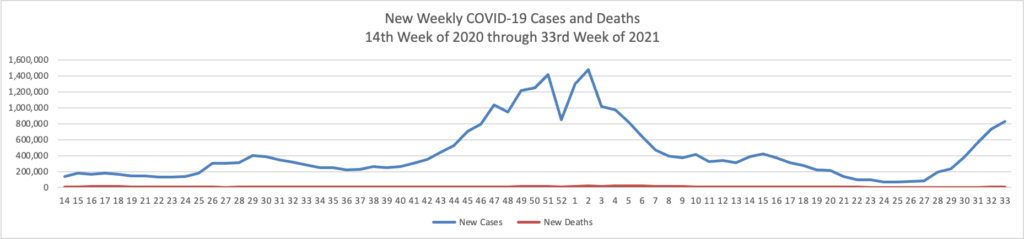
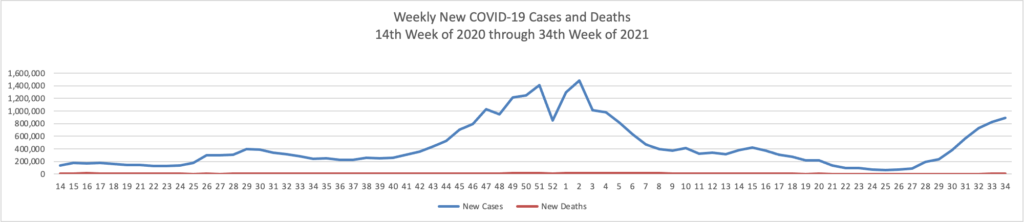
Based on the Centers for Disease Control’s COVID-19 Data Tracker website, here is the FEHBlog’s chart of new weekly COVID-19 cases and deaths over the 14th week of 2020 through 33rd week of this year (beginning April 2, 2020, and ending August 18, 2021); using Thursday as the first day of the week in order to facilitate this weekly update):
and here is the CDC’s latest overall weekly hospitalization rate chart for COVID-19:

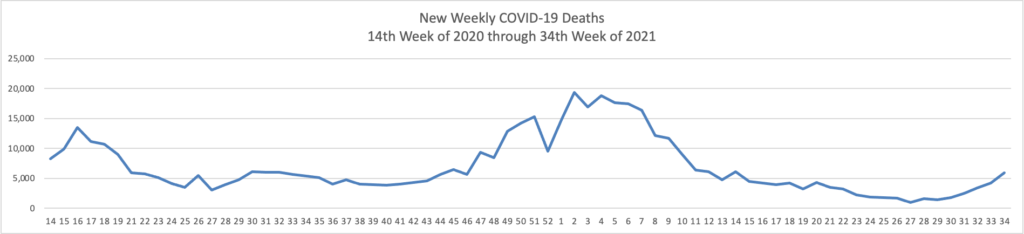
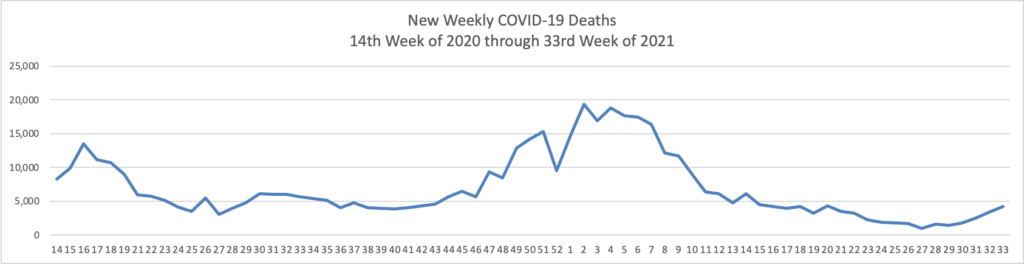
The FEHBlog has noticed that the new cases and deaths chart shows a flat line for new weekly deaths  because new cases significantly exceed new deaths. Accordingly here is a chart of new COVID-19 deaths over the period (April 2, 2020, through August 18, 2021):

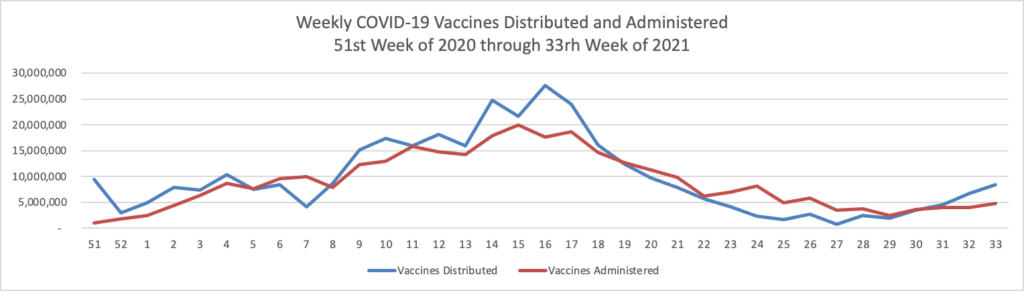
Finally here is a COVID-19 vaccinations chart over the period December 17, 2020, through August 18, 2021, which also uses Thursday as the first day of the week:

Here’s a link to the CDC’s weekly interpretation of its COVID-19 statistics.

Politico reports that “More than one million Americans received a dose of Covid-19 vaccine on Thursday[August 19] , a benchmark the nation has not met in nearly seven weeks amid a resurgence of the coronavirus pandemic.”

HealthDay informs us that

Antibodies generated by COVID-19 vaccines are effective against the Delta variant and other coronavirus variants of concern, new research shows.

The findings may help explain why most vaccinated people have avoided the surge of Delta variant cases sweeping across the United States.

“In face of vaccination, Delta is relatively a wimpy virus,” said study co-author Ali Ellebedy, an associate professor of pathology and immunology at Washington University School of Medicine in St. Louis.

Good to hear.

The Wall Street Journal tells us that

The Food and Drug Administration is expected next week to grant full approval of the Covid-19 vaccine from Pfizer Inc. and partner BioNTech SE, according to people familiar with the planning, an action that could spur more vaccination requirements by employers and encourage more people who are hesitant to get vaccinated. * * *

Once fully approved, the vaccine would be eligible for off-label prescriptions, such as booster doses, according to the FDA. However, analysts said, the critical element for broad boosting is a recommendation from the Advisory Committee on Immunization Practices to the FDA, as physicians often follow ACIP recommendations.

With full approval, Pfizer would likely be permitted to market the vaccine to doctors, providers and the general public as it does with other approved products. The FDA is permitted to restrict such communications with emergency authorization.

The Journal adds that

Of the three authorized vaccines in the U.S., only Pfizer has submitted all the required information to the FDA, according to the companies, and analysts expect it to be the first receive clearance. 

Moderna Inc., whose authorized two-dose shot uses similar mRNA technology as the Pfizer-BioNTech, has said it is still completing rolling data submissions.Johnson & Johnson, whose shot was authorized in February, has said it plans to file for full approval later this year.

Fierce Healthcare reports that Janet Woodcock will not be nominated for a promotion from acting to permanent Food and Drug Commissioner due in large part to Aduhelm fallout.

From the regulatory front

  • After issuing a minimalist Affordable Care Act (“ACA”) FAQ 48 earlier this week, the ACA regulatory departments issued a blockbuster ACA FAQ 49 about payer transparency rule implementation and enforcement delays and answering many No Surprises Act (“NSA”) implementation issues left hanging by the first NSA interim final rule (“IFC”) released July 1.
  • OMB’s Office of Information and Regulatory Affairs (“OIRA”) has scheduled more meetings on the second No Surprises Act IFC which concerns the independent dispute resolution process. Those listening sessions now run late into next week. That means that the IFC won’t be released before the week of August 30 but that still would be about a month before the statutory deadline.
  • The American College of Emergency Physicians and Blue Cross each met with OIRA this past week. Here are links to their supporting letters. BCBSA OIRA IDR 8.17.21.pdf and ACEP EDPMA Pre-IDR Rulemaking Letter (8.10.21).pdf Common sense as expressed in the Blue Cross letter must prevail if the parties want to avoid having the second IFC also create major system changes.
  • The Society for Human Resource Management informs us that “covered employers [such as FEHB plan carriers] now have until Oct. 25 to file their 2019 and 2020 EEO-1 reports, according to a recent announcement from the U.S. Equal Employment Opportunity Commission (EEOC). Although the reporting deadline has been delayed several times during the COVID-19 pandemic, the agency said it will not authorize any more extensions.”

Thursday Miscellany

Photo by Juliane Liebermann on Unsplash

Yesterday’s HHS COVID-19 booster plan for all of the U.S. has generated expert opposition as reported in STAT News and Forbes. From STAT, for example

“I would have preferred that this had been vetted a little bit more,” said Paul Offit, a vaccine expert from Children’s Hospital of Philadelphia, who is on an expert committee that advises the FDA on vaccines. “This just seems to be a declaration without the kind of vetting you would like to have seen.”

Offit thinks boosters may eventually be needed. But he’s not convinced they are needed now. Almost all the evidence to date suggests protection against severe disease is still holding and may well last several years, he said.

“So the notion that we are trying to get ahead of it by boosting after eight months I think is premature,” he said, also arguing that using more doses in the U.S. will inevitably slow vaccination in low-income countries.

Forbes adds

The impending rollout of booster doses in the U.S. could thwart vaccine export and donations to nations which are in desperate need of inoculating their most vulnerable residents, experts worry. “To me it just essentially shows that here is another rich nation that is really prioritizing its own population before thinking about the global response,” says Rupali Limaye, from Johns Hopkins Bloomberg School of Public Health, who studies vaccine inequity and hesitancy.

The FEHBlog hopes that the HHS experts have not gotten too far out in front of their skis on this issue.

In other vaccine news, CVS Health announced today

Flu shots are now available at all CVS Pharmacy and MinuteClinic locations across the country. Both CVS Pharmacy and MinuteClinic, the retail health clinic of CVS Health inside select CVS Pharmacy and Target stores, offer convenient options for people of all ages to get their flu shot, seven days a week with expanded evening and weekend hours.

“Getting your flu shot is a great way to be proactive about your health and the health of your community,” said Angela Patterson, DNP, FNP-BC, NEA-BC, FAANP, Chief Nurse Practitioner Officer, MinuteClinic and Vice President, CVS Health. “It’s an easy way to protect yourself and those around you who may be more vulnerable to serious complications from the flu, such as infants and young children, older adults, and people with certain chronic health conditions.”

In health plan coverage news, Fierce Healthcare informs us that

Most insurers are no longer waiving cost sharing for COVID-19 treatments as healthcare use rebounded from lows exacerbated by the pandemic, a new analysis found.

The analysis, released Thursday from the Kaiser Family Foundation, found 72% of large health plans are no longer providing cost-sharing waivers as of this month. Another 10% of plans expect to phase out the waivers by the end of October. * * *

An earlier analysis from Kaiser found that large group enrollees hospitalized for pneumonia, which requires similar treatment costs to COVID-19, paid out an average $1,300 out-of-pocket.

“Although this is a large amount to most patients, and could be an incentive to get vaccinated, it still only represents a fraction of the cost born to society for these largely preventable hospitalizations,” the analysis said.

In encouraging news, STAT News reports that Michael Segel and Blake Lash, two scientists who work in the lab of CRISPR pioneer Feng Zhang at Boston’s Broad Street Institute, have discovered a new CRISPR related technology. “This new method of delivering different RNA payloads, called SEND, for Selective Endogenous eNcapsidation for cellular Delivery, was reported today in Science. It has the potential to address significant and longstanding limitations to translating powerful gene editing and gene replacement technologies, as well as mRNA — the guts of the most successful Covid-19 vaccines — into broadly useful therapies.” The article concludes “It’s too soon to say whether SEND will ultimately challenge lipid nanoparticles and viral vectors as the dominant methods for delivering gene editing treatments and gene therapies. But it does offer some distinct advantages.” Bravo.

From the miscellany department

  • AHIP’s Blog discusses the rise of social media influencers in healthcare.
  • Fierce Healthcare reports that by closing on its deal to acquire Kindred at Home, Humana has become the largest provider of home healthcare in our country. “Kindred will be folded into the insurer’s Home Solutions business arm and will adopt Humana’s payer-agnostic health services branding, CareWell, under which it will operate as CenterWell Home Health beginning next year.”
  • Healthcare Dive reports that the American Hospital Association has “sent a letter Wednesday to top officials in the White House, HHS, Department of Justice and Federal Trade Commission defending health system M&A and attempting to shift Washington’s rising antitrust focus from providers to commercial health plans.” After all the best defense is a strong offense. But Healthcare Dive adds that “The letter included an updated AHA-funded study on the benefits of hospital mergers, which was previously criticized by outside experts for cherry-picked data, among other methodological weaknesses.”

Midweek Update

From the Delta variant front –

  • In a joint statement, a group of high ranking HHS public health experts explained today that

“We have developed a plan to begin offering [COVID-19 vaccination] booster shots this fall subject to FDA conducting an independent evaluation and determination of the safety and effectiveness of a third dose of the Pfizer and Moderna mRNA vaccines and CDC’s Advisory Committee on Immunization Practices (ACIP) issuing booster dose recommendations based on a thorough review of the evidence. We are prepared to offer booster shots for all Americans beginning the week of September 20 and starting 8 months after an individual’s second dose. At that time, the individuals who were fully vaccinated earliest in the vaccination rollout, including many health care providers, nursing home residents, and other seniors, will likely be eligible for a booster. We would also begin efforts to deliver booster shots directly to residents of long-term care facilities at that time, given the distribution of vaccines to this population early in the vaccine rollout and the continued increased risk that COVID-19 poses to them.

“We also anticipate booster shots will likely be needed for people who received the Johnson & Johnson (J&J) vaccine. Administration of the J&J vaccine did not begin in the U.S. until March 2021, and we expect more data on J&J in the next few weeks. With those data in hand, we will keep the public informed with a timely plan for J&J booster shots as well.”

The FEHBlog will be in line for his third dose of the Pfizer vaccine when the time comes.

  • The Wall Street Journal reports that “Early data from Israel suggests a booster shot of Pfizer Inc.’s Covid-19 vaccine can significantly improve immunity in those aged 60 and above, as the U.S. and other countries plan additional doses to increase protection against the highly infectious Delta variant.”
  • Health Affairs reports on a study suggest”[ing] that the early COVID-19 vaccination campaign was associated with reductions in COVID-19 deaths. As of May 9, 2021, reductions in COVID-19 deaths associated with vaccines had translated to value of statistical life benefit ranging between $625 billion and $1.4 trillion.” The smartest move that the government made was to prioritize the elderly who suffered the most deaths during the pre-vaccination era of COVID-19.

From the federal employee vaccination screening program front, the Safer Federal Workforce task force issued a set of FAQs on COVID-19 testing employees, contractors and visitors who cannot attest to receiving a COVID-19 vaccination. The FEHBlog was pleased to read that the FAQs impose the testing cost on the agencies, not on the FEHB Program, which is the proper legal outcome under the federal CARES Act (unnumbered FAQ 3). Federal News Network makes its own observations on the Testing FAQs here.

In healthcare utilization news, Healthcare Dive reports that

  • More than one in 10 adults ages 16 to 64 said they delayed or went without needed healthcare services due to virus fears in the past 30 days, an April survey from the Urban Institute funded by the Robert Wood Johnson Foundation found. 
  • One in 10 parents delayed seeking care for their children for that reason, according to the report published Wednesday.
  • Hispanic and Black adults, along with adults with lower incomes, reported delaying care at higher rates than other groups. Adults with chronic health problems were also more likely than those without such conditions to say they went without needed care.

It’s worth noting that this survey was conducted during the month that vaccinations became widely available and before the Delta variant broke out.

In other healthcare news

  • Govexec reports that “Officials at the Centers for Disease Control and Prevention announced on Wednesday that the agency is launching a new organization to focus on disease forecasting.  The Center for Forecasting and Outbreak Analytics will be a hub for research and innovation aimed at mitigating the effects of future disease threats. Its launch comes as the federal government continues to fight the coronavirus pandemic and now the rapidly spreading Delta variant. It will build on current modeling efforts at the agency. * * * The center’s initial funding will come from the $1.9 trillion American Rescue Plan enacted in March for coronavirus relief.”
  • The NCQA Blog discusses the hospital at home movement in the U.S. “Humana Home Solutions​ Vice President Dr. Amal Agarwal estimated that up to 35% of Medicare Advantage spending might be addressable at home. As Mayo Clinic Platform President John Halamka explained, hospital at home also “brings the family back into wellness.” This matters because family involvement affects patient satisfaction.” Interestingly the experts explained that hospital at home care is best suited for mid-level acuity patients, not folks who need the ICU or folks who don’t require hospitalization.

Dr. Halamka used an accessible and memorable analogy to outline the long-term possibilities for hospital at home.

He explained that the tractor manufacturing company John Deere transformed itself into a data company by covering its tractors with sensors. The sensors report back information about the weight and volume of crops that customers harvest—soybeans, for example. The predictive value of the information reported to John Deere is so high that the data are now used to forecast soybean prices.

Likewise, Americans are filling their homes and strapping to their bodies millions of behavioral and biometric sensors.

“We are instrumenting homes with sensors to gather patient data that we can use to understand not only that patient’s progression, but aggregating and analyzing that data [to] understand the progression of similar patients,” said Halamka.

Well put, Doctor.

  • In support of extending initiatives like this to rural areas of the country, the Department of Health and Human Services announced today “key investments that will strengthen telehealth services in rural and underserved communities and expand telehealth innovation and quality nationwide. These investments—totaling over $19 million—are being distributed to 36 award recipients,” such as “Telehealth Centers of Excellence (COE) program: $6.5 million is being awarded to 2 organizations to assess telehealth strategies and services to improve health care in rural medically underserved areas that have high chronic disease prevalence and high poverty rates. The Telehealth COEs will be located in academic medical centers and will serve as telehealth incubators to pilot new telehealth services, track outcomes, and publish telehealth research. The COEs will establish an evidence-base for telehealth programs and a framework for future telehealth programs.’

Tuesday’s Tidbits

Photo by Josh Mills on Unsplash

From Capitol Hill, the Wall Street Journal reports that “Top House Democrats said the chamber would move forward with voting on the budget blueprint for a $3.5 trillion healthcare, education and climate package next week, rebuffing demands from a group of centrist Democrats to first vote on a $1 trillion infrastructure bill and urging their caucus to stay unified around President Biden’s agenda” According to the article the centrist Democrats opposed the Speaker’s compromise approach discussed in Sunday’s Post and the much larger Democrat progressive causus pushed hard for this outcome. Speaker Pelosi can only afford to lose three of the nine Democrat centrists as the Republicans are expected to unanimously oppose the budget blueprint.

From the Delta variant front

  • Bloomberg reports that the Southern states continue to experience robust vaccination rates one month after the mid-July low point.
  • The Wall Street Journal informs us that “The Delta variant of the Covid-19 virus appears to be breaking through the protection vaccines provide at a higher rate than previous strains, a Wall Street Journal analysis found, though infections among the fully inoculated remain a tiny fraction of overall cases, and symptoms tend to be milder.”
  • Most significantly the New York Times reports tonight that

The Biden administration has decided that most Americans should get a coronavirus booster vaccination eight months after they received their second shot, and could begin offering third shots as early as the third week of September, according to administration officials familiar with the discussions.

Officials are planning to announce the decision on Wednesday at the White House. Their goal is to let Americans who received the Pfizer-BioNTech or Moderna vaccines know now that they will need additional protection against the Delta variant, which is causing caseloads to surge across much of the nation. But the new policy will depend on the Food and Drug Administration authorizing additional shots.

Recipients of the Johnson & Johnson vaccine, which was authorized as a one-dose regimen, will also most likely require an additional dose, the officials said. But they are waiting for results, expected this month, from a clinical trial that provided participants with two doses. So far, only about 14 million people in the United States have gotten the Johnson & Johnson shot, which the government began offering in March. The first Pfizer and Moderna vaccines were given in December.

The first boosters would probably go to nursing home residents, health care workers and emergency workers, who were the first to be vaccinated last winter. They would likely be followed by other older people, then by the general population. Officials envision giving people the same vaccine they originally received.

On the federal employment front, Federal News Network tells us that OPM is promulgating an interim final rule that will allow agencies to “hire [bachelors degree or graduate] students to a temporary appointment of a year or a term appointment of one-to-four years. Students will work for their agency at the General Schedule 11 level or below while in school. Students who finish their degrees and meet a series of other requirements are eligible for a permanent position at the same agency, OPM said.”

From the federal guidance front

  • The National Law Review informs us that “OSHA’s Revised COVID-19 Guidance [released August 13] Adopts CDC’s Latest Recommendation on Masks for Vaccinated Employees, Advocates for Vaccination, and Suggests Periodic Testing for Unvaccinated Employees.” “Although OSHA disclaims that its recommendations are legally binding on employers, the agency also includes language that signals that failure to adhere to the recommendations could be legally significant for the employer.  Specifically, OSHA prefaces its guidance by stating: “The recommendations are advisory in nature and informational in content and are intended to assist employers in providing a safe and healthful workplace free from recognized hazards that are causing or likely to cause death or serious physical harm.”
  • The tri-agencies issued Affordable Care Act FAQ 48 informing interested parties that in response to litigation they are working on an amending the “2018 final regulations that expanded exemptions for entities with religious or moral objections to the contraceptive coverage requirement to which their health plans would otherwise be subject.” That rulemaking of course will lead to more litigation and so on.

On the drug news front, STAT News reports that

A new study found that the number of adults who used two widely prescribed stimulants nearly doubled in recent years, raising concerns about a potential wave of abuse since both medicines can be highly addictive.

Specifically, an estimated 4.1 million adults reported using amphetamines and methylphenidate in 2018, an increase of nearly 80% from 2013. Measured by total prescriptions, the use of amphetamines rose 119% during that time, while the use of methylphenidate grew about 39%, according to the study, which was published in BMJ Open.

The article warns that this surge could turn into another epidemic.

On the healthcare utilization front, Fierce Healthcare reports that

Hospitals did not experience a major rebound in deferred care in the first part of 2021, foretelling that such care may not be coming back, a new analysis finds.

The analysis from Kaiser Family Foundation and the Epic Health Research Network, released Tuesday, found hospital spending was 4.1% below expected levels in June. It is the latest evidence of how the lingering impact of the pandemic could affect hospital finances, especially as the highly transmissible delta variant is causing new surges in most states.

“Several factors may be contributing to the lower-than-expected number of hospital admissions in early 2021,” the analysis said. “For example, the economic effects of the pandemic may depress the number of people seeking services.”

Researchers explored data from 250 hospitals across 47 states and 112 million patients through April 9, 2021.

Hospital admission rates were nearly 90% of what were expected if the pandemic did not happen, the analysis found.

From the tidbits department

  • Health Day tells us that “A small, new study suggests that getting out of your chair every half hour may help improve your blood sugar levels and your overall health.”
  • Fierce Healthcare informs us that “New York City-based Unite Us announced this morning [August 17] the acquisition of Carrot Health, a consumer data and predictive analytics platform offering engagement insights to payer and provider customers. With its new purchase, the social determinants of health software platform said it will be better positioned to help healthcare organizations identify patients with unmet social needs and connect them to community resources across all 50 states. Unite Us did not disclose the terms of the deal, which has already closed.”
  • In this week’s NIH Director’s blog, Dr. Francis Collins discusses how advanced brain scanning can help guide neurosurgeons.
  • Last but certainly not least the HHS Agency for Healthcare Quality and Research issued a call to action on achieving health equity.

Monday Roundup

Photo by Sven Read on Unsplash

From the Delta variant front —

  • Govexec tells us that last Friday August 13, the Department of Justice issued its internal guidance on employee, on-site contractor, and visitor COVID-19 vaccine attestation program required by the White House. ‘Federal employees, regardless if they are working in person or teleworking, must complete a Certification of Vaccination Form and update it if there is a change in their vaccination status. ‘Employees who are not fully vaccinated will be required to obtain and provide to their supervisor (or component designee) a negative COVID-19 test result, from a test taken within the past three days, each time they enter a department facility or participate in an official meeting or function in another location other than the telework location,’ said the memo. ‘The department is developing a program to facilitate testing for employees.’”
  • The American Medical Association informs us about the reasons why moderately and severely immuno-compromised Americans who compose 2.7% of the population should get an mRNA vaccine booster. “[Food and Drug Administration] Approval of a third dose comes amid growing evidence that people with weakened immune systems do not get adequate protection from the normal two-dose regimen of Pfizer and Moderna COVID-19 vaccines. This makes immunocompromised people especially susceptible to breakthrough COVID-19 infections.”
  • The Wall Street Journal reports that Pfizer and BioNTech are starting to share clinical evidence of the value of a third booster vaccination for a broader swath of the U.S. population administered six months to a year following the first two doses. “Pfizer and BioNTech are also conducting a larger late-stage study evaluating whether a third dose safely provides more protection. The companies said they expect those results shortly and will then submit the data to the FDA. The FDA is considering a broader booster strategy, which the agency could issue in the next few weeks.”

With regard to the other public health emergency, the American Hospital Association points us to it web resources for the addressing opioid epidemic.

In healthcare business news

  • Labcorp has announced the acquisition of “Ovia Health, a digital health platform used by millions of women seeking information and support with family planning, pregnancy and parenting.”
  • CareMax, a “technology-enabled provider of value-based care to seniors, announced [on August 13] it has signed a collaboration agreement with Anthem, a national health benefits company. Through this collaboration, CareMax plans to build medical centers in areas where Anthem will offer a value-based care model to improve patient outcomes. * * * Through this collaboration agreement, CareMax plans to open approximately 50 medical centers with a focus on Indiana, Texas, Kentucky, Wisconsin, Georgia, Connecticut, and Virginia, among others.”

From the studies front

  • The University of Michigan’s Institute for Healthcare Policy and Innovation has released an eye opening study on telehealth. The FEHBlog commends it to his readership.
  • Benefits Pro tells us that “Interest in health savings accounts is on the rise, but there is still a gap in understanding about how HSAs work and how they can be used as a retirement savings tool. According to the Plan Sponsor Council of America’s (PSCA) 2021 HSA Survey, education about HSAs remains a key goal for plan sponsors. * * * The study pointed to a potential missed opportunity for employers to solicit HSA rollovers for newly hired employees, with less than 20 percent indicating they do so.”
  • The National Institutes of Health informs us that “A single two-hour session of a pain management skills class could offer as much benefit as eight sessions of cognitive behavioral therapy (CBT) for patients experiencing chronic low-back pain (CLBP), suggests a study published in JAMA Network Open(link is external). Supported by the National Center for Complementary and Integrative Health (NCCIH) and the National Institute on Drug Abuse, both part of the National Institutes of Health, the study explored whether a compressed intervention could lead to the same benefits as a longer-course of CBT.”
  • STAT News reports that the National Institute for Mental Health’s “Director Joshua Gordon told STAT the agency recognizes that new treatments for depression are needed and that it is funding research to explore the underlying biology beyond the monoamine hypothesis. When it comes to understanding depression, “there are fewer and fewer questions of importance with regard to the monoamine systems,” he said. He noted that in addition to federal funding, many startups and small companies are pursuing new treatments for depression. Currently, almost all patients with depression are first treated with medications called selective serotonin reuptake inhibitors, a class of drugs that includes both Zoloft and Prozac. They increase the amount of the neurotransmitter serotonin in the brain, which controls mood, emotions, and cognition. Serotonin and two other neurotransmitters targeted by some antidepressants, norepinephrine and dopamine, are called monoamines because they contain one chemical group called an amine.” The article also discusses those new treatments, including .