Congress is on a State / District work break this week.
The Supreme Court ended its October 2021 Term last week by recognizing retiring Justice Stephen Breyer and Judge Ketanji Brown Jackson was sworn in as the 104th Associate Justice of the Supreme Court last Thursday, June 30.
From the Omicron and siblings front –
Bloomberg Prognosis reports on New York City’s significant improvements to its test to treat program.
New York City will start offering Pfizer Inc.’s Covid antiviral Paxlovid at “first of its kind” mobile test-to-treat sites across the city, providing immediate treatment for those who test positive for the virus.
Initially [last Thursday June 30], mobile sites will be stationed outside of pharmacies in Inwood, South Ozone Park and the East Bronx, and will expand to 30 locations by the end of July, Manhattan’s Borough President Mark Levine said on Twitter Thursday. People who test positive for Covid and qualify for Paxlovid will be able to get a prescription on-the-spot, which they can take to a nearby pharmacy to pick up the drug. By the end of the summer, officials plan to bypass pharmacies entirely, offering Paxlovid directly through the mobile sites.
“We were the epicenter of the Covid pandemic at the start, but we’re leading the way in prevention and mitigation,” [NYC Mayor Eric] Adams said during the press conference. “What we’re doing here other cities can look at to make a determination of how they want to address Covid.”
Bloomberg adds “Earlier on Thursday, Pfizer asked US regulators for full approval of Paxlovid for people at high risk of developing severe disease, bringing the drugmaker one step closer to securing a formal clearance that would allow it to sell and market the antiviral outside of the public health emergency.”
Don’t throw out that seemingly outdated at-home rapid Covid-19 test just yet. According to an updated list of expiration dates, it may still be good.
The Food and Drug Administration has extended the expiration dates for some authorized at-home, over-the-counter Covid test kits in recent months, meaning some unused tests may still be viable.
Many Americans received free tests from the federal government this year. They also bought their own tests, especially at the height of the first Omicron wave that hit much of the country over the winter.
While the FDA initially marked many at-home Covid-19 kits with a fairly short shelf life, additional data gathered since then from manufacturers has given the agency more insight into how long the tests can be used accurately.
Wishing everyone a happy end of the second quarter 2022.
From Capitol Hill, the American Hospital Association informs us
The House Appropriations Committee today voted 32-24 to approve legislation that would provide $242.1 billion in funding for the departments of Labor, Health and Human Services, and Education in fiscal year 2023, a 13% increase over the prior fiscal year.
According to a committee summary, the bill would provide $124.2 billion for HHS, $15.6 billion more than the FY 2022 enacted level but slightly below the president’s request.
* * *
Notably, the HHS report language would urge the Centers for Medicare & Medicaid Services to evaluate several aspects of the Medicare Advantage program that are important to hospitals and health systems. Specifically, Congress would urge CMS to assess MA enrollees’ access to long-term acute care hospitals, inpatient rehabilitation facilities and substance use services, including by looking at MA plan prior authorization policies and network adequacy. In addition, the report encourages CMS to examine potential MA plan overpayments with a particular focus on risk adjustment.
The full House is expected to consider the bill in July.
Senate Democrats are vetting a new, tweaked version of a drug pricing package as they hurtle toward a September deadline to pass any major reforms.
It’s by no means certain that Congress will pass prescription drug pricing reform as part of a broader domestic policy package being hammered out between Senate Majority Leader Chuck Schumer and moderate Sen. Joe Manchin (D-W.V.), but this week, the chances are looking better than ever. * * *
The new plan looks a lot like the one Democrats settled on last fall — a sweeping overhaul of how the government pays for prescription drugs [which fell short of passage]. There are a few main differences, according to a summary obtained by STAT. The Washington Post first reported the summary. * * *
In the coming days, Senate leadership is planning to ask the Senate’s rules referee to review the policy to see whether it could be passed using a fast-track process known as reconciliation. The original drug pricing plan was never actually vetted by the referee last year, after negotiations soured between the White House and Manchin in December.
Senate Democrats are hoping to finalize tax and climate provisions and put a full bill on the floor as soon as late July, according to a source familiar with the talks. Democrats would have to advance a bill by Sept. 30 to use the reconciliation mechanism, which allows them to advance policy without Republican support.
From the Omicron and siblings front, MedPage Today tells us
“We have advised manufacturers seeking to update their COVID-19 vaccines that they should develop modified vaccines that add an omicron BA.4/5 spike protein component to the current vaccine composition,” Peter Marks, MD, PhD, director of FDA’s Center for Biologics Evaluation and Research, said in a statement. “As we move into the fall and winter, it is critical that we have safe and effective vaccine boosters that can provide protection against circulating and emerging variants to prevent the most severe consequences of COVID-19.”
If all goes according to plan, the modified vaccines could potentially be available in “early to mid-fall,” he said.
The Robert Wood Johnson Foundation calls our attention to the following resource:
The US COVID Atlas, led by University of Chicago with support from RWJF, is a near real-time visualization tool that helps you access current, validated county-level data and spatial analysis to better understand the spread in communities and to bolster planning efforts.
* Identify hotspots in real-time
* Track vaccination rates by region or county
* Locate areas that will soon be affected by the virus
* Connect social, economic, and health indicators for meaningful community context
From the rural health care front, the American Hospital Association informs us
The Centers for Medicare & Medicaid Services today released a proposed rule establishing the conditions of participation for Rural Emergency Hospitals and updating a few requirements for Critical Access Hospitals. The Consolidated Appropriations Act of 2021 established REHs to preserve an emergency presence in communities where rural hospitals could no longer be sustained. By law, REHs can provide emergency services, observation care, and additional medical and health outpatient services. CMS has proposed standards for REHs based largely on the current CAH CoPs and, where appropriate, on outpatient services’ requirements. CMS is seeking input from the rural community on specific proposed REH standards, including the ability of an REH to provide low-risk labor and delivery services and the minimum qualifications for professionals who will provide on call emergency services.
HHS adds
For today’s rule, the comment period closes on August 29, 2022.
The federal government’s latest push for more health care price transparency starts July 1, and it is focused on those who are writing the checks: Health insurance companies and employers that directly pay for their workers’ medical care will have to start posting data on what they pay hospitals, doctors, and other providers.
The law requires all health insurers and self-insured employers (also known as self-funded) to publish machine-readable files with two sets of information: the negotiated prices paid to in-network hospitals and doctors, and the allowed rates paid to out-of-network hospitals and doctors. This data — which has to be on a public website, just like hospitals’ prices — does not reflect what workers pay out-of-pocket for care, but does reflect the premiums that employers and workers pay.
The law also says insurers and employers have to disclose what they pay for prescription drugs. However, that has been punted for now while the federal government mulls “whether this requirement remains appropriate,” according to an April notice.
From the second-quarter earnings front, the Wall Street Journal reports “Walgreens Boots Alliance Inc. is bracing for a recession and life after Covid. The second-biggest U.S. drugstore chain by stores said Thursday that quarterly sales fell and earnings plunged as revenue from Covid-19 vaccinations dried up. The pharmacy chain also paid out a $683 million opioid settlement.”
From Capitol Hill, MedPage Today reports on yesterday’s House Oversight and Reform Committee hearing on the federal response to the drug overdose crisis. Both parties flogged the government agency witnesses. It’s worth reading. This epidemic merits more attention that Covid at this point in the FEHBlog’s view.
Nevertheless, from the Omnicron and siblings front
The easily spread Omicron BA.4 and BA.5 subvariants represent more than half of all U.S. Covid-19 cases, federal estimates showed, ramping up pressure as a spring surge stretches into summer.
The two variants represented a combined 52% of cases for the week ended June 25, according to estimates the Centers for Disease Control and Prevention released on Tuesday. The variants were most prevalent—an estimated 60% of cases—in a five-state region that includes Texas, Oklahoma, Louisiana, Arkansas and New Mexico.
Federal health authorities moved a step closer to authorizing modified Covid-19 booster shots that better target the Omicron variant and could be rolled out by the fall.
Vaccine advisers to the Food and Drug Administration, which includes doctors and public-health specialists, voted 19 to 2 to recommend updating Covid-19 vaccines to target the Omicron variant.
The recommendation, which the FDA doesn’t have to follow but often does, suggests the agency may go ahead and direct vaccine makers Pfizer Inc., its partner BioNTech SE and Moderna Inc. to proceed with plans to roll out modified boosters.
The vote didn’t specify whether the modified boosters should only target Omicron, or target both Omicron and the ancestral strain of the coronavirus, though several committee members said they preferred a dual-target approach.
The vote also didn’t specify whether the modified shots should target more recent subvariants of Omicron now dominant in the U.S. * * *
Many members of the committee said they thought it should target the recent subvariants of Omicron, known as BA.4 and BA.5.
After the vote, Dr. Peter Marks, who heads the FDA’s vaccines division, said he took away from the meeting support for shots that target the ancestral strain as well as BA.4 and BA.5.
The options for a fall booster shot include sticking with current vaccines or using updated, Omicron-targeted vaccines that have shown promise in clinical studies. Another option: Use boosters that target more recent Omicron subvariants, including BA.4 and BA.5, but that haven’t been tested in people.
From the hospital systems front, the American Hospital Association informs us
U.S. hospitals and health systems continued to face difficult financial and operational headwinds in May, according to the latest report by Kaufman Hall, based on data from more than 900 hospitals.
“Nearly halfway through 2022, margins are cumulatively negative,” the report notes. “While some metrics have normalized, hospitals continue to perform below pre-pandemic levels, and there is an uncertain outlook for the rest of the year.”
Hospitals continue to see higher labor costs and fewer hours worked, “a sign of inflation and an indicator that long-standing labor shortages are likely worsened by increased turnover,” the authors said.
In addition, the Lown Institute has released its 2022 rankings of socially responsible hospital systems in the U.S. According to the Institute’s press release,
Sixty-six U.S. hospitals earned the distinction of “most socially responsible” by the Lown Institute, a think tank known for its evidence-based assessments of America’s healthcare providers. To achieve this designation, hospitals earned “A” grades across measures of health equity, value, and outcomes.
Launched in 2020, the Lown Institute Hospitals Index for Social Responsibility draws attention to leading and lagging institutions nationwide, and provides benchmarks for hospitals to measure how well they serve their patients and communities.
A Phase 1 clinical trial of a novel influenza vaccine has begun inoculating healthy adult volunteers at the National Institutes of Health Clinical Center in Bethesda, Maryland. The placebo-controlled trial will test the safety of a candidate vaccine, BPL-1357, and its ability to prompt immune responses. The vaccine candidate was developed by researchers at the National Institute of Allergy and Infectious Diseases (NIAID). The single-site trial can enroll up to 100 people aged 18 to 55 years and is led by NIAID investigator Matthew J. Memoli, M.D. * * *
“With the BPL-1357 vaccine, especially when given intranasally, we are attempting to induce a comprehensive immune response that closely mimics immunity gained following a natural influenza infection,” said Dr. Memoli. “This is very different than nearly all other vaccines for influenza or other respiratory viruses, which focus on inducing immunity to a single viral antigen and often do not induce mucosal immunity.”
“Our study will examine the safety of BPL-1357 and also will allow us to assess the importance of mucosal immunity against flu and whether a strategy of inducing both the cellular and antibody arms of the immune system can provide broader protection against the ever-changing influenza virus,” he added.
For additional information about the trial, visit clinicaltrials.gov and search on the trial identifier NCT05027932.
That’s the question facing orthopedic surgeons and rehab physicians as they learn to work with a new knee replacement that incorporates sensors and processors to send data about how the joint works from deep inside the patient’s body.
It’s one of a growing number of devices sending data to physicians to help them monitor their patients, including continuous glucose monitors and wearables to monitor for heart arrhythmia. With this influx of information, medtech companies are still ironing out how to make the data useful for doctors. * * *
“The talking knee is a reality,” Indiana-based Zimmer Biomet announced at the American Academy of Orthopaedic Surgeons’ conference last year. The company was presenting its new knee-implant extension with an embedded sensor just days after receiving de novo clearance from the Food and Drug Administration.
Now, Zimmer, which developed the device along with California-based Canary Medical, Inc., a company that creates sensors for medical devices, has begun selling the smart knee implant, called Persona IQ. It can measure a patient’s range of motion, step count, stride length, and walking distance from inside the human body. Still, physicians don’t yet know how to use this data to help patients [due to lack of time currently]. * * *
Eventually, sensors will detect problems with implants, help patients adjust their gait or provide data to predict patient outcomes. Meanwhile, competitors are creating systems that use wearable sensors to track patient recovery and hinting at their own plans for sensor-embedded implants.
Bill Hunter, Canary’s founder and chief executive, said in an interview that medical technology companies are already unleashing a wave of sensor-loaded devices in other sectors.
“Having this ability for the device to provide the clinician with actual feedback from inside the body has implications in most every major medical device,” he said. “So I do believe that you will see this showing up in all kinds of different ways.”
Time will tell but the FEHBlog’s money is on the sensor companies. Fascinating article.
From Capitol Hill, Federal News Network discusses the federal employee pay raise angles presented by the House financial service and general appropriations bill which cleared the House Appropriations Committee last Friday. Federal News Network indicates that the bill leaves the door open for the Senate to also accept the President’s proposed 2023 4.6% pay raise for federal employees and the military.
President Joe Biden announced two actions immediately after the ruling: one directing the Department of Health and Human Services to safeguard access to contraception and medication abortion, and another protecting travel for medical appointments.
To those ends,
Govexec tells us that OPM today confirmed that its policy allowing federal employees to apply sick time to travel out of state remains in effect after the high court struck down Roe v. Wade, and
The Department of Health and Human Services (HHS) announced that a meeting was held today between Affordable Care Act regulators, including the HHS and Labor Department Secretaries, and health plan executives to emphasize the importance of full compliance with the ACA’s contraceptive coverage with no cost-sharing mandate when delivered in-network. The ACA regulators also issued a letter to health plans making the same point.
The FEHBlog ran across this NPR Shots article which explains that the Plan B or morning-after pill is considered a contraceptive and not an abortion drug. The Wall Street Journal informs us
Some of the nation’s biggest retailers are rationing over-the-counter emergency contraceptive pills as demand spikes following the Supreme Court ruling overturning a constitutional right to abortion.CVS Health Corp., Walmart Inc., and Rite Aid Corp. were limiting purchases of the pills, which were in short supply or out of stock Monday morning on major retailer websites. CVS and Rite Aid were limiting purchases to three. Walmart had some pills available without limits, but only in cases where they wouldn’t ship until next month. Pills available this week were limited to four or six.
From the Omicron and siblings and monkeypox front
Govexec reports on a U.S. Court of Appeals for the Fifth Circuit decision order rehearing a federal employee vaccine mandate case which upheld the mandate on lack of plaintiffs’ standing to challenge the mandate. The mandate nevertheless has remained on hold while the case winds it way through the appellate court.
USA Today reports on when and how to access the monkeypox vaccine.
a new model aimed at improving cancer care for Medicare patients and lowering health care costs. CMS’ Center for Medicare and Medicaid Innovation (Innovation Center) designed the Enhancing Oncology Model (EOM) to test how to improve health care providers’ ability to deliver care centered around patients, consider patients’ unique needs, and deliver cancer care in a way that will generate the best possible patient outcomes. The model will focus on supporting and learning from cancer patients, caregivers, and cancer survivors, while addressing inequities and providing patients with treatments that address their unique needs.
From the reports and studies department —
The next issue of Health Affairs offers a bevy of articles on Type 2 diabetes and pre-diabetes which are available at this link.
The Congressional Budget Office has made available examples of the work performed by its Health Analysis Division.
HealthDay reports “More than 18 million Americans have now survived cancer, a new report shows. The American Cancer Society (ACS) and the U.S. National Cancer Institute collaborated on the report to estimate cancer prevalence and help public health officials better serve survivors.”
mHealth Intelligence calls our attention to a telehealth-oriented Healthcare Experience Report: 2022 released by Zocdoc. The FEHBlog was pleased to read “Mental health continues to hold a place of dominance in telehealth. In May of 2020, 2021, and 2022, the percentage of mental health visits that occurred virtually was 74 percent, 85 percent, and 87 percent, respectively.” Hub and spoke telehealth, e.g, Teladoc, brings mental health care in-network thereby lowering benefit costs while improving access to care.
The Senate is on a State work break for the next two weeks which encompasses Independence Day. The House of Representatives will be engaged in Committee business this week through Thursday. Then the House will be on District work break through the end of the following week.
The House Oversight and Reform Committee is holding a hearing tomorrow on an important topic: “Examining the 2022 National Drug Control Strategy and the Federal Response to the Overdose Crisis.”
On Friday, the House Appropriations Committee approved
the fiscal year 2023 Financial Services and General Government bill on a 31 to 22 vote. * * *
The following amendments to the bill were adopted by the full Committee:
Rep. Quigley – The manager’s amendment makes technical and noncontroversial changes to the bill and report. The amendment was adopted by voice vote.
Rep. Stewart #3 – This amendment prohibits the government’s use of cloud computing platforms unless they prevent child exploitation images. The amendment was adopted by voice vote.
A summary of the bill is here. The text of the draft bill is here. The bill report, before the adoption of amendments in full Committee, is here.
This bill includes FEHB and OPM funding.
It occurred to the FEHBlog over the weekend that on Friday he did not explain how the Supreme Court’s Dobbs decision overruling Roe v. Wade impacts the FEHB Program. The short answer in the FEHBlog’s opinion is that it has no impact.
Under the Hyde Amendment whose requirements have been applied to the FEHB via annual appropriations bills for decades, FEHB Program coverage of abortions is limited to abortions in cases of rape, incest, or endangerment of the mother’s life. Federal courts of appeals uniformly have held that the Hyde Amendment preempts more restrictive State abortion limitations. E.g., Planned Parenthood Affiliates v. Engler, 73 F.3d 654 (6th Cir. 1996) (citing precedential authorities).
The BA.4 and BA.5 subvariants are spiking globally because they can spread faster than other circulating variants — mostly BA.2, which caused a surge in cases at the beginning of the year. But so far, the latest Omicron variants seem to be causing fewer deaths and hospitalizations than their older cousins — a sign that growing population immunity is tempering the immediate consequences of COVID-19 surges.
Nature explores what the rise of BA.4 and BA.5 means for the pandemic.
The FEHB agrees that the complete Nature article is worth reading.
A modified booster shot targeting Omicron specifically increased neutralizing antibody levels 13.5 to 19.6 times higher than the current shot in study volunteers a month after administration, depending on the dose, the companies said Saturday. * * *
The Journal adds that the Food and Drug Administration is considering whether to give emergency use authorization to the Omicron-oriented boosters for fall 2022. Based on the Nature article, it appears that Omicron will still be with us then.
Fortune identifies seven things doctors who treat long Covid want people to know.
From the Monkeypox front, Bloomberg Prognosis tells us
The World Health Organization opted against calling the recent monkeypox outbreak a public health emergency of international concern.
The outbreak is “clearly an evolving threat,” the WHO said in a statement Saturday, though it doesn’t constitute an international public health emergency “at this moment.” An emergency committee convened on Thursday to discuss the outbreak.
“What makes the current outbreak especially concerning is the rapid, continuing spread into new countries and regions and the risk of further, sustained transmission into vulnerable populations including people that are immunocompromised, pregnant women and children,” according to the statement. “It requires our collective attention and coordinated action now to stop the further spread of monkeypox virus.”
NPR Shots expresses concern that U.S. testing program for this disease is inadequate.
For many of the [201] confirmed cases, health officials don’t know how the person caught the virus. Those infected haven’t traveled or come into contact with another infected person. That means the virus is spreading in some communities and cities, cryptically.
“The fact that we can’t reconstruct the transmission chain means that we are likely missing a lot of links in that chain,” Jennifer Nuzzo, an epidemiologist at Brown University, says. “And that means that those infected people haven’t had the opportunity to receive medicines to help them recover faster and not develop severe symptoms.
“But it also means that they’re possibly spreading the virus without knowledge of the fact that they’re infected,” she adds.
In other words: “We have no concept of the scale of the monkeypox outbreak in the U.S.,” says biologist Joseph Osmundson at New York University. “
NPR explains that the monkeypox testing process is much too cumbersome and the CDC hopes to have the process streamlined “sometime in July.”
New influenza vaccine effectiveness data presented at the U.S. CDC’s June 22, 2022 meeting of the Advisory Committee on Immunization Practices (ACIP) show flu shots worked better during 2021 – 2022 than initially reported.
Published on June 23, 2022, this ACIP data shows flu shots reduced the risk of influenza illness by about 35% among vaccinated people.
Data from October 4, 2021, through April 30, 2022, showed that flu vaccines reduced people’s risk of mild to moderate flu illness caused by H3N2 flu viruses—the most common flu viruses this season—by about one-third overall. * * *
Also, at the meeting, ACIP voted in favor of a preferential recommendation for certain flu vaccines over others for adults 65 years and older in the United States.
The ACIP voted to preferentially recommend higher-dose flu vaccines (Fluzone High-Dose vaccine and Flublok recombinant vaccine) or adjuvanted flu vaccine (Fluad vaccine) over standard-dose unadjuvanted flu vaccines.
And if one of these vaccines is unavailable at the time of administration, people in this age group should get a standard-dose flu vaccine instead.
From the health information technology front, Health Data Management calls out attention to the following
“In a [very sensible] letter to Department of Health and Human Services Secretary Xavier Becerra, several healthcare standards organizations are calling for streamlining and making more predictable the process for submitting attachments as well as modernizing existing rules to improve patient care and reduce burdens on clinicians.”
“New legal requirements for providers to give an estimated cost of patients’ medical services will be difficult to meet, particularly when multiple organizations are involved in a patient’s care, according to WEDI, the Workgroup on Electronic Data Interchange. Meeting the requirements of the No Surprises Act, which was included as part of a Consolidated Appropriations Act passed late in 2020, will be challenging because there is no standardized process to enable the exchange of cost information among facilities, WEDI notes.”
“While healthcare organizations see the prevailing trend of increasing patient consumerism, the ability to give patients opportunities to schedule their own appointments is lagging. Many organizations have adopted some capabilities for self-scheduling, according to new research from the Center for Connected Medicine (CCM), yet the use of these tools remains low [because] scheduling solutions lack the right algorithms and that organizations lack standardized scheduling templates across appointment types.”
In particular the second bullet strikes a chord with the FEHBlog as he has pointed out that Congress made a huge mistake by failing add the provider’s good faith estimate and the health plan’s advance explanation of benefits to the list of HIPAA standard transactions.
Note — Unfortunately, Thursday’s post did not arrive on the E&S website until 9 am ET today, so it did not go out to subscribers this morning. Lo siento. Here is a link to yesterday’s post.
Onto today’s post —
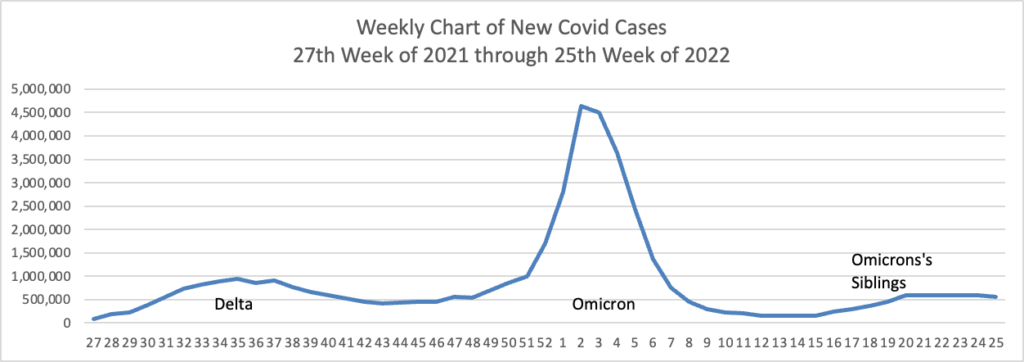
Based on the CDC’s Covid Data Tracker and using Thursday as the first day of the week, here is the FEHBlog’s latest weekly chart of new Covid cases:
The CDC’s weekly review of its Covid statistics states “As of June 22, 2022, the current 7-day moving average of daily new cases (97,430) decreased 5.6% compared with the previous 7-day moving average (103,175).”
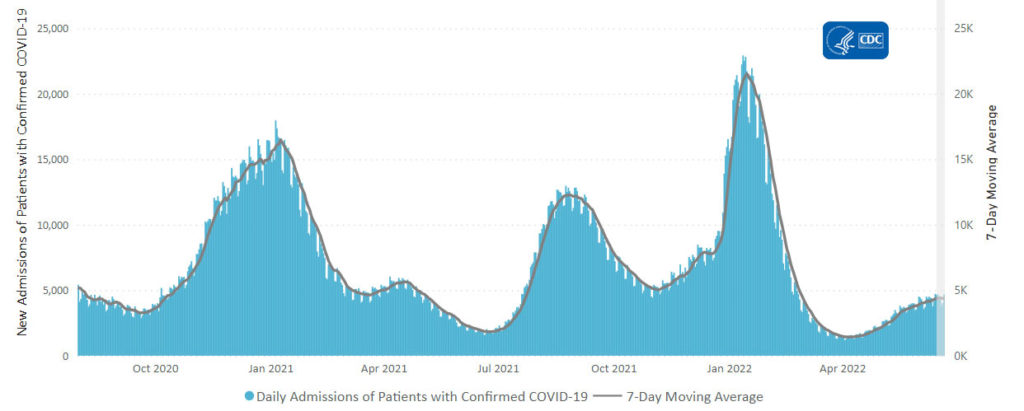
Here’s the CDC’s weekly chart of new Covid hospital admissions:
The CDC’s weekly review states “The current 7-day daily average for June 15–21, 2022, was 4,375. This is a 1.0% increase from the prior 7-day average (4,329) from June 8–14, 2022.”
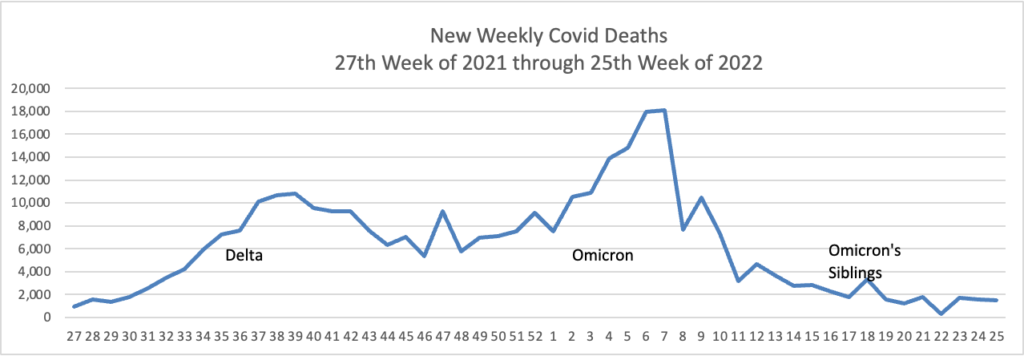
Here is the FEHBlog’s latest weekly chart of new Covid deaths:
The CDC’s weekly review states “The current 7-day moving average of new deaths (255) has decreased 10.4% compared with the previous 7-day moving average (285).”
As of June 23, 2022, there are 391 (12.1%) counties, districts, or territories with a high COVID-19 Community Level, 996 (30.9%) counties with a medium Community Level, and 1,830 (56.8%) counties with a low Community Level. This represents an increase (+1.9 percentage points) in the number of high-level counties, a slight increase (+1.6 percentage points) in the number of medium-level counties, and a corresponding decrease (−3.6 percentage points) in the number of low-level counties. 51 jurisdictions had high- or medium-level counties this week. Rhode Island is the only jurisdiction to have all counties at low Community Level.
The weekly statistics generally are stable and moving in the right direction.
The American Hospital Association adds
The Centers for Disease Control and Prevention last night endorsed Moderna’s COVID-19 vaccine for children aged 6-17, as its advisory committee recommended, creating an alternative to Pfizer’s COVID-19 vaccine for this age group. The Food and Drug Administration authorized the Moderna vaccine for children and adolescents last week.
Before ACA FAQ 50 issued October 4, 2021, the period for covering COVID vaccines with no cost sharing began 15 days after the CDC’s action. The FEHBlog, who is not errorless, thought that FAQ 50 eliminated the 15 day waiting period, but upon further review, FAQ 50 requires immediate no cost sharing coverage of Covid vaccines filing the FDA’s approval, usually an emergency use authorization. The FEHBlog doesn’t think this makes any practical difference because the Covid vaccines aren’t distributed without CDC approval.
From the Capitol Hill, the American Hospital Association provide us with this encouraging news:
The House of Representative today voted 234-193 to pass and send to the President for his signature bipartisan legislation to help reduce gun violence in communities. Approved by the Senate last night, the AHA-supported package includes behavioral health provisions, including funding for school safety resources, school-based supportive services and expanded access to telehealth for mental and behavioral health services.
From the Supreme Court, the Court decided today that the right to an abortion is a matter controlled by state law, not the U.S. Constitution. The Wall Street Journal sums it up as follows “In upholding a Mississippi law banning the procedure after 15 weeks of pregnancy, the court’s conservative majority said the Roe decision was egregiously wrong in recognizing a constitutional right to abortion.” In response
Reproductive health care, including access to birth control and safe and legal abortion care, is an essential part of your health and well-being. While Roe v. Wade was overturned, abortion remains legal in many states, and other reproductive health care services remain protected by law. The U.S. Department of Health and Human Services (HHS) is committed to providing you with accurate and up-to-date information about access to and coverage of reproductive health care and resources. Our goal is to make sure you have appropriate information and support.
Health Payer Intelligence discusses health insurer reaction to the decision. “Payers and healthcare leaders are responding to the Supreme Court’s decision to overturn Roe v Wade, the case which protected abortion rights at the federal level, and while the repercussions remain uncertain many healthcare leaders are voicing their commitment to helping women navigate the impacts.”
The Wall Street Journal discusses employer reaction to the decision. “Businesses with health plans covering abortion now are weighing whether and how to pay for employees to travel to a state where the procedure is legal.”
From the OPM front
Federal News Network reports on OPM Director Karen Ahuja’s press conference held yesterday, the first anniversary of her swearing in as OPM Director.
FedWeek tells us that “OPM has said it is working to improve features for federal employees and annuitants to compare FEHB plans, although it does not project having those improvements in place until late next year—potentially in time for that year’s open season for selecting coverage in 2024.”
From the nicotine front, the Wall Street Journal reports
A federal appeals court on Friday granted Juul Labs Inc. a temporary stay of the Food and Drug Administration’s order for the vaping company to pull its e-cigarettes off the U.S. market.
A panel of judges from the U.S. Court of Appeals for the D.C. Circuit on Friday afternoon granted Juul’s request to delay the FDA’s ban, according to court documents. The temporary stay gives the court time to hear arguments and wasn’t a ruling on the merits of the case, the judges wrote.
Finally, HR Dive brings us a roundup of happenings at this week’s Society for Human Resource Management conference.
The Senate voted 64 to 34 Tuesday evening to advance an 80-page gun safety bill to strengthen background check requirements for gun buyers under 21, provide funding to states to administer red flag laws and to provide billions of dollars in new federal funding for mental health services. * * *
Senate Majority Leader Schumer (D-N.Y.) said a successful initial procedural vote would set the bill up to pass by the end of the week.
Last week, a House Appropriations subcommittee approved the Fiscal Year 2023 Financial Services and General Government Appropriations bill, which funds OPM and the FEHB Program. The accompanying bill summary points out
Office of Personnel Management (OPM) – The bill includes $448 million, an increase of $75 million above the FY 2022 enacted level, for OPM to manage and provide guidance on Federal human resources and administer Federal retirement and health benefit programs.
Fosters equality for women and men: Eliminates provisions preventing the FEHBP from covering abortion services.
The House Appropriations Committee will mark up this bill at a meeting scheduled for Friday, June 24.
The U.S. Supreme Court today issued a 7-2 decision holding that the Medicare Secondary Payer law does not permit healthcare providers to make disparate impact claims against health plans. This decision protects ERISA and FEHB Program plans against costly litigation. Fierce Healthcare and Health Payer Intelligence also report on the decision.
Most people who have been infected with COVID-19 in the U.S. in the past couple of months likely had the BA.2 or BA.2.12.1 variant, both lineages of the original Omicron strain of SARS-CoV-2.
So if someone was recently infected with a BA.2 lineage, are they mostly protected against reinfection with BA.4 or BA.5?
Probably not, infectious disease experts say.
“It’s expected that there’s probably not much cross-protection between them,” Amesh Adalja, MD, an infectious disease physician at the Johns Hopkins Center for Health Security in Baltimore, told MedPage Today.
The American Hospital Association tells us
More than 1 million prescriptions for the COVID-19 antiviral pills Lagevrio and Paxlovid were dispensed between late December 2021 and May 2022, but dispensing rates were lowest in the most socially and economically disadvantaged communities, according to a study released today by the Centers for Disease Control and Prevention. In a separate study of electronic health records from Kaiser Permanente Southern California over the period, fewer than 1% of patients aged 12 and older who received Paxlovid to treat mild-to-moderate COVID-19 had a COVID-19-related hospitalization or emergency department visit in the next five to 15 days. CDC said the studies “highlight the importance of ensuring access to oral antiviral medicine in treating COVID-19, a key strategy in preventing hospitalization and death.”
Speaking of hospitals, Beckers Hospital Review reports
Healthgrades has recognized 399 hospitals as recipients of its 2022 Outstanding Patient Experience Award, the organization said June 21. This represents the top 15 percent of hospitals in the U.S. for patient experience. * * * Healthgrades has recognized 399 hospitals as recipients of its 2022 Outstanding Patient Experience Award, the organization said June 21. This represents the top 15 percent of hospitals in the U.S. for patient experience. * * * View the full list of recipients here.
From the Rx coverage front —
The Food and Drug Administration released one of its news roundups today.
Per Stat News, a group of researchers writing in the Annals of Internal Pharmacy used Mark Cuban’s online pharmacy pricing to puncture Medicare Part D’s pricing on generic drugs.
Per Fierce Healthcare, CVS Health is expanding its Project Health program to Richmond, Virginia and Las Vegas. “The healthcare giant announced Tuesday that it will hold 72 events dedicated to seniors and children this year. It is also adding four new mobile units in 2022.”
Per Healthcare Dive, Walgreens “has partnered with managed care company Buckeye Health Plan in Ohio to open new Health Corner locations in five of the state’s northeast neighborhoods this summer. * * * About 2.3 million patients will have access to Health Corner services across 60 locations in Ohio, California and New Jersey by the summer’s end, Walgreens said on Tuesday. By the end of this year, Walgreens expects to increase the number of Health Corners from 55 to about 100, including the new Ohio locations.”
From the interoperability and telehealth fronts
Epic, the largest purveyor of electronic health record systems in the U.S., announced “its plan to join a new health information exchange framework to improve health data interoperability across the country. The Trusted Exchange Framework and Common Agreement (TEFCA) will bring information networks together to help ensure that all people benefit from complete, longitudinal health records wherever they receive care. In the future, TEFCA will expand to support use cases beyond clinical care, such as public health.” That’s a big boost for TEFCA, which will serve as the backbone for the nation’s EHR systems.
AHRQ offers research on telehealth for women’s preventive healthcare services.
President Biden will soon nominate Arati Prabhakar, a physicist and former DARPA director, to serve as his next top science adviser, the White House announced on Tuesday.
The new post would be Prabhakar’s third tour as head of a federal science office. She ran DARPA, the high-stakes military research agency, from 2012 to early 2017, and served as director of the National Institute of Standards and Technology in the 1990s.
The Washington Post reports “A congressional deal for billions of dollars in additional coronavirus funding appeared all but dead Thursday [June 16] after Senate Republicans accused the White House of being dishonest about the nation’s pandemic funding needs.” The FEHBlog expects we have not heard the end of this issue.
The Centers for Disease Control and Prevention recommended that children as young as 6 months receive newly authorized Covid-19 shots, the final step to making the vaccines available.
On a related note, Precision Vaccinations tells us
The U.S. Centers for Disease Control and Prevention (CDC) reported today the number of pneumonia-related fatalities continues to outpace both COVID-19 and Influenza. * * *
In the USA, common causes of viral pneumonia are influenza, respiratory syncytial virus, and SARS-CoV-2 viruses. A common cause of bacterial pneumonia is Streptococcus pneumoniae.
The good news is pneumonia is a vaccine-preventable disease, and the U.S. FDA has approved two types of pneumococcal vaccines, PCV13, and PPSV23. * * *
Unfortunately, the CDC’s data shows that in 2020, the percentage of adults who received a pneumococcal vaccination was just 25.5%.
FEHB plans may want to focus on this issue given the Program’s demographics.
From the U.S. healthcare front, the American Medical Association provides background on its freshly inaugurated President, Dr. Jack Resneck, Jr., and gives an account of Dr. Resneck’s inaugural address. Good luck, Dr. Resneck.
The Senate on Thursday took a major step toward broadening America’s commitment to take care of sick veterans, passing a bill to offer new health care and tax-free disability benefits to as many as 3.5 million veterans on an 84-14 vote.
Under the legislation written by Veterans’ Affairs Chairman Jon Tester, D-Mont., and ranking member Jerry Moran, R-Kan., the Department of Veterans Affairs would consider a veteran with any of 23 conditions, ranging from brain cancer to hypertension, who was deployed to a combat zone during the wars in Iraq or in Afghanistan automatically eligible for care at government cost, based on the presumption that exposure to toxic chemicals in the war zone caused the ailments.
The House must now pass the revised bill before President Joe Biden can sign it, which seems likely. The legislation largely mirrors, and slightly expands on, a House bill by Veterans’ Affairs Chairman Mark Takano, D-Calif., that passed 256-174 in March. Biden issued a statement at the time saying he supported the measure.
Under current law, veterans who believe toxic exposure during their service caused them to develop a disease can have trouble proving it, even when the linkage is known. So it’s likely that many veterans are denied care and disability benefits they deserve, advocates say. The new law, at a projected cost of $278.5 billion over 10 years, shifts the calculus, meaning the government will now pay for the care of veterans whose sickness is tied to their service, as well as others whose ailments might not be.
Because the federal government employs many veterans, this bill will reduce benefits costs for the FEHB Program once it becomes law.
From the Omicron and siblings front, the Wall Street Journal informs us
Many people are embarking on a summer of vacations, concerts and weddings put off during the height of the pandemic. Covid-19 is still finding ways to disrupt some of those plans.
Covid-19 isn’t causing acute illness and death on the scale it once did, thanks in part to protection built up by vaccines and prior infections. * * *
The U.S. is logging some 100,000 known cases a day, and many more are being detected via at-home tests health departments don’t track. This is a stark difference from a year ago, when U.S. cases sank below 12,000 a day, the lowest level since the first surge, as vaccinations rose and many hoped the virus was in retreat.
The era of 12,000 cases a day was over when Delta and then Omicron arrived and will remain around until Omicron departs.
In a notable move, the Federal Trade Commission put drugmakers and pharmacy benefit managers on notice that the agency will “ramp up enforcement” of any “illegal bribes and rebate schemes” that make it harder for patients to access lower-cost medicines.
The new policy statement noted the FTC plans to scrutinize rebates and assorted fees for signs that these payments are violating antitrust and consumer protection laws. As part of that effort, the agency expects to monitor lawsuits and file its own legal briefs in cases where it can provide assistance in analyzing illegal practices that may raise prescription drug prices.
“Today’s action should put the entire prescription drug industry on notice: when we see illegal rebate practices that foreclose competition and raise prescription drug costs for families, we won’t hesitate to bring our full authorities to bear,” said FTC Chair Lina Khan in a statement. “Protecting Americans from unlawful business practices that are raising drug prices is a top priority for the Commission.”
While the end of Omicron is not in the offing, the end of prescription drug rebates appears to be getting closer. However, the federal government should not put the kibosh on rebates unless the drug manufacturers agree to maintain the economic equities by offering price reductions equivalent to the rebates.
Drugmaker acquisitions of all sizes could receive closer scrutiny in the future if the Federal Trade Commission follows the advice of experts who spoke at a two-day agency meeting on market concentration and anticompetitive conduct.
The experts, mostly economists and other antitrust regulators, warned that some drugmakers have gained unfair market power due to the breadth of their product portfolios, allowing them to negotiate for preferred or even exclusive status on insurers’ coverage lists and thereby squeeze out competitors.
Taken together with the FTC’s plans to investigate the practices of pharmacy benefit managers, the meeting signals the Biden administration may take a tougher line on monopolistic practices in an effort to spark competition and target drug pricing.
From the Food and Drug Administration front, BioPharma Dive notes that
An experimental and closely followed drug for Alzheimer’s disease has failed a key clinical study, dealing yet another blow to the prevailing theory on how to treat a neurodegenerative illness that affects millions of people.
The drug’s developer, Roche, along with Banner Alzheimer’s Institute, the Phoenix-based organization helping lead the study, announced the negative results Thursday. After years following a family believed to be genetically predisposed to the disease, researchers found no significant difference in cognition or the ability to store and retrieve new memories between participants who received the drug and those who got placebo.
The failure is an upset not only to Roche, which hopes to follow its rival Biogen in getting an Alzheimer’s therapy approved for market, but also to the wider Alzheimer’s research field. For years, a protein called beta amyloid has been at the center of efforts to treat the disease. But every drug designed to block this protein, including Biogen’s, has faced setbacks. Roche’s announcement may therefore add to concerns that this protein isn’t the best research target.
In other drug research news, Walgreens announced “the launch of its clinical trial business to redefine the patient experience and increase access and retention in sponsor-led drug development research. Walgreen’s flexible clinical trial model combines the company’s vast foundation of patient insights, partner-enabled health and technology capabilities and in-person and virtual care options to break through barriers to engaging broader and more diverse communities.”
In U.S healthcare news, the American Medical Association completed its annual meeting. The AMA offers highlights from the session here.
Also, the Commonwealth Fund released its 2022 Scorecard on State Health System Performance.
Hawaii and Massachusetts top the 2022 State Scorecard rankings, based on overall performance across 56 measures of health care access and quality, service use and cost, health disparities, and health outcomes during the COVID-19 pandemic in 2020. The lowest-performing states were Mississippi, Oklahoma, and West Virginia.
From 2000-2019 overall life expectancy in the United States increased by 2.3 years, but the increase was not consistent among racial and ethnic groups and by geographic area. In addition, most of these gains were prior to 2010. This is according to a new study funded by the National Institutes of Health that examined trends in life expectancy at the county level. The study was led by researchers at the Institute for Health Metrics and Evaluation at the University of Washington’s School of Medicine, Seattle, in collaboration with researchers from NIH and published on June 16th in The Lancet.
MedCity News reports “Online healthcare marketplace Sesame closed a $27 million Series B funding round on Tuesday, bringing its total funding to $75 million. David Goldhill, CEO of the New York City-based startup, said the company is ‘an Expedia for medical care’ because patients can buy the care they want directly online, without the middleman of an insurance company.”
From the federal employee benefits front, Govexec delves into the impact of cost of living adjustments on federal employee retirement benefits.
The Senate Committee on Health, Education, Labor and Pensions voted Tuesday to send a bill to the Senate that would reauthorize the Food and Drug Administration to collect user fees from device- and drug-makers for the next five years.
A provision would require the FDA to finalize guidance that would create a category of over-the-counter hearing aids within a month of the bill’s passage. The FDA last issued a proposed guidance in October.
Committee Ranking Member Sen. Richard Burr, R-N.C.,questioned on Tuesday whether the FDA should have that expanded authority, despite co-sponsoring legislation that would change how diagnostic tests are regulated, including laboratory-developed tests.
The American Hospital Association (AHA) penned a last-ditch letter to congressional leaders pleading for Medicare sequester cuts slated to take effect July 1 to be halted in light of the financial strain many of the nation’s hospitals are expected to face throughout 2022.
Congress had initially paused the 2% payment cut as part of the CARES Act when the COVID-19 pandemic began to threaten providers’ bottom lines. Sequestration cuts were continually punted downfield until last December, when a bill was signed to resume a 1% cut in April and the full 2% in July.
With half a month to go, AHA Executive Vice President Stacey Hughes warned majority and minority leaders Tuesday that financial relief from the pending cut is necessary for hospitals “to maintain access to care for the patients and communities they serve.”
From the Supreme Court, the American Hospital Association gleefully informs us
The U.S. Supreme Court today ruled unanimously in favor of the AHA and others, reversing a 2020 [U.S.] court of appeals decision upholding the authority of the Department of Health and Human Services to significantly cut payments to certain hospitals that participate in the 340B Drug Pricing Program, and thereby threatening access to care for patients.
The Supreme Court held that “HHS’s 2018 and 2019 reimbursement rates for 340B hospitals were contrary to the statute and unlawful.” Noting that “340B hospitals perform valuable services for low-income and rural communities but have to rely on limited federal funding for support,” the Supreme Court observed that “this case has immense economic consequences, about $1.6 billion annually.”
Despite those serious practical impacts, the Supreme Court concluded that “[u]nder the text and structure of the statute,” the case is “straightforward” as a matter of law: “Because HHS did not conduct a survey of hospitals’ acquisition costs, HHS acted unlawfully by reducing the reimbursement rates for 340B hospitals.”
The panel voted 21 to 0 in a pair of votes on Wednesday in support of expanding access to the vaccines.
The positive recommendations will likely lead soon to expanding the U.S. Covid-19 vaccination campaign to the 19.6 million children from 6 months to under 5 years of age, one of the last groups of people in the U.S. waiting for shots.
The Food and Drug Administration, which doesn’t have to follow the panel’s recommendations but usually does, is expected to authorize the shots within days. Vaccinations could begin as early as June 21, according to the Biden administration.
Moderna Inc. is planning to test its Covid-19 vaccine in babies 3 months to 6 months old, the youngest age group studied to date.
The Cambridge, Mass., company said Wednesday it is in the final stages of planning the study, to be called BabyCove and expected to begin enrolling as many as 700 babies in September.
Pfizer said Tuesday that a much-watched study of its antiviral Paxlovid in patients who have Covid but don’t have risk factors for severe disease failed to show a benefit in speeding alleviation of Covid symptoms, but did seem to prevent doctor’s visits and hospitalizations.
Additionally, because of the small number of hospitalizations overall in the study, it failed to produce a statistically significant finding on whether patients who had previously been vaccinated against Covid were hospitalized less often if they received Paxlovid.
The data in no way invalidate earlier results that show that Paxlovid prevents hospitalizations and saves lives in patients at high risk of severe Covid. But the results, published in a press release, are likely to take time for experts to digest and understand.
From the unusual viruses front, the American Hospital Association explains
The Centers for Disease Control and Prevention yesterday [June 14] updated its guidance to help clinicians evaluate and test patients with relevant history, signs and symptoms for monkeypox. Over 1,800 monkeypox or orthopoxvirus cases have been reported globally this year, including 72 in the United States. According to CDC, the virus does not spread easily between people without close contact, so the risk to the general population remains low.
The World Health Organization plans to change monkeypox’s name next week.
Anthem will officially become Elevance Health on June 28, and, as part of its corporate rebrand, it’s also launching new brands for two of its subsidiaries.
The insurer will consolidate its healthcare services businesses under one umbrella, called Carelon. Carelon is a combination of the word “care” with the suffix “lon,” which means full or complete, representing the company’s ambition to offer an end-to-end care experience.
Carelon will include Anthem’s in-house pharmacy benefit manager Ingenio Rx as well as recent acquisitions such as Beacon Health Options, a behavioral health provider, and myNEXUS, a home healthcare company. Carelon will serve 1 in 3 people in the U.S., according to the announcement.
Humana is moving its pharmacy brands under the CenterWell umbrella.
Humana Pharmacy and Humana Specialty Pharmacy will now operate as CenterWell Pharmacy and CenterWell Specialty Pharmacy, respectively, the insurer announced. Enclara Pharmacia and Humana Pharmacy Solutions, the company’s pharmacy benefit management arm, will maintain their original branding.
“The CenterWell brand symbolizes our ongoing and strong commitment to keeping members, customers and patients at the center of everything we do,” said Scott Greenwell, Humana Pharmacy Solutions president, in a statement.
Morning Consult discusses how CVS Health and Walgreens retained “high customer trust” in 2021.
From the benefit design front, Employee Benefits News offers the case for health savings accounts. The FEHBlog is already sold.
We use cookies on our website to give you the most relevant experience by remembering your preferences and repeat visits. By clicking “Accept”, you consent to the use of ALL the cookies.
This website uses cookies to improve your experience while you navigate through the website. Out of these, the cookies that are categorized as necessary are stored on your browser as they are essential for the working of basic functionalities of the website. We also use third-party cookies that help us analyze and understand how you use this website. These cookies will be stored in your browser only with your consent. You also have the option to opt-out of these cookies. But opting out of some of these cookies may affect your browsing experience.
Necessary cookies are absolutely essential for the website to function properly. These cookies ensure basic functionalities and security features of the website, anonymously.
Cookie
Duration
Description
cookielawinfo-checbox-analytics
11 months
This cookie is set by GDPR Cookie Consent plugin. The cookie is used to store the user consent for the cookies in the category "Analytics".
cookielawinfo-checbox-functional
11 months
The cookie is set by GDPR cookie consent to record the user consent for the cookies in the category "Functional".
cookielawinfo-checbox-others
11 months
This cookie is set by GDPR Cookie Consent plugin. The cookie is used to store the user consent for the cookies in the category "Other.
cookielawinfo-checkbox-necessary
11 months
This cookie is set by GDPR Cookie Consent plugin. The cookies is used to store the user consent for the cookies in the category "Necessary".
cookielawinfo-checkbox-performance
11 months
This cookie is set by GDPR Cookie Consent plugin. The cookie is used to store the user consent for the cookies in the category "Performance".
viewed_cookie_policy
11 months
The cookie is set by the GDPR Cookie Consent plugin and is used to store whether or not user has consented to the use of cookies. It does not store any personal data.
Functional cookies help to perform certain functionalities like sharing the content of the website on social media platforms, collect feedbacks, and other third-party features.
Performance cookies are used to understand and analyze the key performance indexes of the website which helps in delivering a better user experience for the visitors.
Analytical cookies are used to understand how visitors interact with the website. These cookies help provide information on metrics the number of visitors, bounce rate, traffic source, etc.
Advertisement cookies are used to provide visitors with relevant ads and marketing campaigns. These cookies track visitors across websites and collect information to provide customized ads.