Thursday Miscellany

Thursday Miscellany

Photo by Josh Mills on Unsplash

From Capitol Hill, STAT News reports

The Senate Judiciary Committee on Thursday passed legislation to prevent drug companies from gaming the patent system to delay competition from cheaper generics, but members in both parties said they still have concerns about the reforms.

It’s unclear when the bills might advance in either chamber. 

The Congressional Research Service released an analysis of healthcare coverage spending in 2021.

Meanwhile, the Health Affairs Council on Healthcare Spending and Value updates us on the recommendations proposed in its 2018 Road Map for Action.

From the Omicron and siblings front —

The Department of Health and Human Services (HHS) announced that its Secretary Xavier Becerra had given the States 90 days advance notice of the end of the Covid public health emergency on May 11, 2023.

To help you and your communities in your preparations for the end of the COVID-19 PHE, I have attached a fact sheet to this letter that includes information on what will and will not be impacted by the end of the COVID-19 PHE.2 In the coming days, the Centers for Medicare & Medicaid Services (CMS) will also provide additional information, including about the waivers many states and health systems have adopted and how they will be impacted by the end of the COVID-19 PHE. I will share that resource with your team when available.

MedPage Today informs us,

Early treatment with a single dose of pegylated interferon lambda in a highly vaccinated population of COVID-19 outpatients decreased the risk for hospitalization and emergency department (ED) visits lasting more than 6 hours, the phase III TOGETHER trial found.

Among nearly 2,000 participants with acute COVID symptoms and a risk factor for severe illness, 2.7% of those who received pegylated interferon lambda within a week of symptoms required hospitalization or ED visits, as compared with 5.6% of those given placebo (relative risk [RR] 0.49, 95% Bayesian credible interval [CrI] 0.30-0.76), reported Gilmar Reis, MD, PhD, of McMaster University in Hamilton, Ontario, and colleagues.

Results were similar regardless of vaccination status (over 80% were vaccinated), and the treatment effect with the long-acting form of interferon lambda-1 was more pronounced in those who received the subcutaneous injection with 3 days of their symptoms.

From the miscellany department —

HHS released initial guidance for Medicare’s Prescription Drug Inflation Rebate Program created by last year’s Inflation Reduction Act.

Under the Medicare Prescription Drug Inflation Rebate Program, drug companies who raise prices faster than the rate of inflation will be required to pay rebates to the Medicare Trust Fund. Below is a timeline of key dates for implementing the Medicare Prescription Drug Inflation Rebate Program:

  • October 1, 2022: Began the first 12-month period for which drug companies will be required to pay rebates to Medicare for raising prices that outpace inflation on certain Part D drugs.
  • January 1, 2023: Began the first quarterly period for which drug companies will be required to pay rebates for raising prices that outpace inflation on certain Part B drugs.
  • April 1, 2023: People with Traditional Medicare and Medicare Advantage may pay a lower coinsurance for certain Part B drugs with price increases higher than inflation.
  • 2025: CMS intends to send the first invoices to drug companies for the rebates.

The law has a circular aspect because the government needs a much lower general inflation index to get the full bang for the buck from this program. The notice also poses issues for public input.

The International Foundation of Employee Benefit Plans tells us,

The International Foundation has been tracking fertility and family-forming benefits over the past seven years. According to Employee Benefits Survey: 2022 Results, 40% of U.S. organizations currently offer fertility benefits (an increase from 30% in 2020).
Overall:

  • 28% cover fertility medications (8% covered in 2016, 14% in 2018, 24% in 2020)
  • 30% cover in vitro fertilization (IVF) treatments (13% in 2016, 17% in 2018, 24% in 2020)
  • 16% cover genetic testing to determine infertility issues (11% in 2018, 12% in 2020)
  • 17% cover non-IVF fertility treatments (6% in 2016, 11% in 2018, 11% in 2020).

In 2016, only 2% of organizations covered egg harvesting/freezing services. That jumped to 6% in 2018, 10% in 2020 and even higher in 2022, with 14% reporting that they cover the benefit.

Healthcare Dives points out, “National telehealth utilization increased 1.9% month-over-month among the privately insured population in November 2022, following one month of decline, according to a new analysis from Fair Health’s monthly tracker.” The bump is attributable to the tripledemic.

Fierce Healthcare relates, “UnitedHealthcare is rolling out a new wearables-based rewards program for members and their spouses. In UnitedHealthcare Rewards, eligible members can earn up to $1,000 per year by using wearable devices to complete health goals and activities, the insurance giant announced Wednesday.”

Health Payer Intelligence notes that “High deductible health plan (HDHP) enrollment hit a record high in 2021, with nearly six out of ten employer-sponsored health plan members enrolled in a high deductible health plan, according to a ValuePenguin survey.”

Benefits consultant Tammy Flanagan writing in Govexec, explains how federal employees can get the full advantage out of the Thrift Savings Plan, which is part of the Federal Employees Retirement System.

Monday Roundup

Photo by Sven Read on Unsplash

From Capitol Hill, Roll Call offers the House Speaker’s perspective on the debt ceiling negotiation, and the Washington Post does the same for the Senate Majority Leader. The FEHBlog is becoming more optimistic that the debt negotiations will be successful.

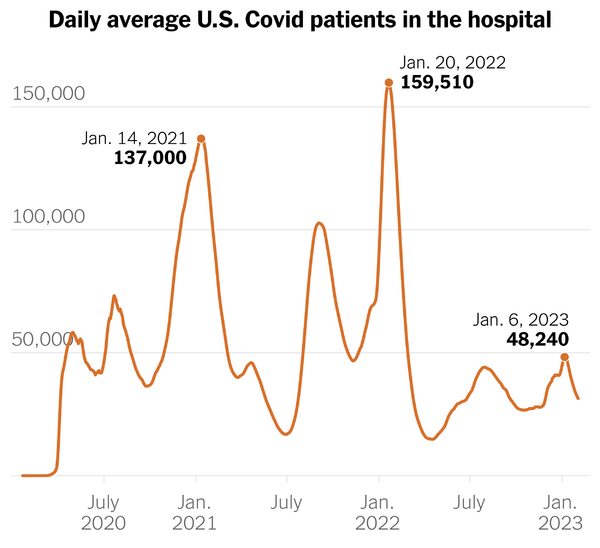
From the Omicron and siblings front, the FEHBlog was pleasantly surprised to see that his favorite Covid columnist David Leonhardt of the New York Times, has returned from his four-month long book leave. In his return column, he lists seven surprises that happened during his leave. Here is the Covid surprise.

A milder Covid winter. In each of the past two winters, the country endured a terrible surge of severe Covid illnesses, but not this winter.

His column includes this chart of COVID hospitalizations.

New York Times February 6, 2023

Mr. Leonhardt explains —

It’s a sign that the virus has become endemic, with immunity from vaccinations and previous infections making the average Covid case less severe. If anything, the best-known Covid statistics on hospitalizations and deaths probably exaggerate its toll, because they count people who had incidental cases. Still, Covid is causing more damage than is necessary — both because many Americans remain unvaccinated and because Covid treatments are being underused, as German Lopez has explained.

Mr. Leonhart’s comment should come as no surprise to FEHBlog readers. Nevertheless, it’s encouraging to read it in the New York Times.

It’s worth noting that the first high peak from the left is Alpha which the Covid vaccines (released in December 2020) helped stem. The middle high point was Delta, and the highest point is Omicron which Paxlovid (released in December 2021) and other treatments helped stem. The public health authorities back in the day discussed a three-legged stool to deter Covid — one leg was immunity, the other was prevention (vaccines, etc.) and the third was treatments, which we did not broadly have until December 2021. What’s more the Omicron siblings have defeated some antiviral treatments but not Paxlovid.

On a related note of interest to care providers, CMS yesterday called attention to its regularly update Current Emergencies website which a chock-a-block full of helpful information.

From the Affordable Care Act and ERISA fronts

  • Fierce Healthcare discusses provider and payer reactions to the ACA’s regulators’ recently closed request for public input on the apprpropriate scope of the ACA’s essential health benefits requirement.
  • The Miller & Chevalier law firm discusses an important 9th Circuit U.S. Court of Appeals decision on remedies available in ERISA claim disputes. The decision favored the ERISA plans and their thir party administrators as well as the objective of health plan cost control.

From the executive personnel front —

  • Fierce Healthcare invites us to meet Express Script’s new president Adam Kautzner.
  • Healthcare Dive introduces us to CVS Health’s senior vice president and chief diversity, equity and inclusion officer Shari Slate.

From the broader U.S. healthcare business front —

The Wall Street Journal reports

CVS Health Corp. is close to an agreement to acquire Oak Street Health Inc.for about $10.5 billion including debt, a deal that would rapidly expand the big healthcare company’s footprint of primary-care doctors with a large network of senior-focused clinics, according to people with knowledge of the matter.

The companies are discussing a price of about $39 a share, the people said. The deal, if it goes through, could be announced as soon as this week, they said. CVS is scheduled to report earnings on Wednesday.

The Journal adds that “Oak Street, which has more than 160 centers across 21 states, focuses on the care of patients enrolled in Medicare” and that the deal would push CVS Health “far deeper” into direct provision of healthcare.

Beckers Payer Issues informs us

Alphabet, the parent company of Google, saw its medical stop-loss insurance business grow “nearly sixfold” last year, tech news site The Verge reported Feb. 2. The business, called Granular, provides medical stop-loss coverage to employers and is a subsidiary of Verily, Alphabet’s life sciences business.

Healthcare Dive tells us

  • Looking at 2,000 U.S. hospitals’ websites, only about a quarter were in full compliance with federal price transparency rules, according to a new analysis from PatientRightsAdvocate.org.
  • The majority of hospitals have some required files posted, but most are incomplete, illegible or do not clearly identify prices both associated with payer and plan, according to the report. Some 6% of the hospitals posted no usable pricing files.
  • This latest report calls out both major for-profit and nonprofit chains across the country for not following the rules, including HCA Healthcare, Tenet, Providence and UPMC, which lacked any compliant hospitals.

From the Rx coverage / drug research front —

BioPharma Dive reports

  • Gilead has secured an expanded U.S. approval for its breast cancer medicine Trodelvy, announcing Friday the Food and Drug Administration cleared the antibody treatment for the most commonly occurring form of the tumor type. 
  • Previously approved only for rarer, “triple-negative” breast tumors, Trodelvy can now be used to treat patients with metastatic breast cancer that’s hormone receptor, or HR, positive, but negative for a protein called HER2. This type of breast cancer accounts for an estimated 70% of all new cases, according to Gilead. 
  • The FDA’s decision is a win for Gilead, which gained Trodelvy when it paid $21 billion to acquire Immunomedics in 2020. But clinical trial results showed the drug’s benefit was modest, and Gilead will face competition from a rival drug sold by AstraZeneca and Daiichi.

The Raleigh NC News and Observer discusses a late stage breast cancer injectable drug that Duke University researchers have converted into an FDA approved pill. “[Duke researcher Donald] McDonnell expects elacestrant, which will be marketed as Orserdu, to completely replace the injectable treatment regimen. Not only is the pill less taxing for patients, clinical trials also found it to be more effective.”

STAT News reports

Japanese drugmaker Eisai reported Monday the first U.S. sales of Leqembi, its treatment for Alzheimer’s disease, although exact numbers were not provided and people taking the drug appear to be paying out of pocket because insurance coverage has not yet been established. * * *

The Food and Drug Administration approved Leqembi on Jan. 6. It costs $26,500 per year and is administered by infusion every two weeks. The drug has the potential to be a commercial blockbuster, but only if Medicare can be convinced to pay for it. Unless Medicare changes the way it pays for drugs like Leqembi, Eisai expects a slow commercial rollout.

“Engagements with payers is steadily ongoing towards insurance coverage,” Eisai said Monday, although no new details about its communications with Medicare were provided. “Several” private insurers were “advancing their formulary discussions” about Leqembi reimbursement, Eisai also said, although specific coverage decisions, if any, were not disclosed Monday.

Happy Groundhog Day

The Hill reflects on the history of Groundhog Day. By the way, “on Thursday, Punxsutawney Phil predicted six more weeks of winter.”

Each year on the first Friday in February, [February 3, 2023], the National Heart, Lung, and Blood Institute, The Heart Truth® and others around the country celebrate National Wear Red Day® to bring greater attention to heart disease as a leading cause of death for Americans and steps people can take to protect their heart. Promote Wear Red Day in your community with resources such as printable stickers, posters, and social media graphics, including customizable ones.

From Capitol Hill, Roll Call tells us that “Senate committees will be able to get to work next week after the Senate adopted resolutions constituting their membership for the 118th Congress before departing Thursday afternoon.”

STAT News interviews the Chair and Ranking Member of the Senate’s Health, Education, Labor and Pensions Committee, Senators Bernie Sanders and Bill Cassidy respectively.

Both senators cited addressing the national shortage of nurses as high on the bipartisan to-do list. The chairman also said he thinks expanding community health centers and improving dental coverage could get both parties’ buy-ins, while Cassidy pointed to mental health care legislation and probing the rollout of efforts to eliminate patients’ surprise medical bills.

Unsurprisingly, however, Sanders’ top priority is slashing drug costs — and he’s banking on voter polling to push GOP members, or at least put them in an uncomfortable spot with constituents. 

From the Medicare front, Health Payer Intelligence provides an overview of reactions to yesterday’s CMS 2024 Medicare Advantage Advance Notice with changes for Medicare Advantage plans and Medicare Part D.

The Kaiser Family Foundation offers a detailed study of prior authorization requests for Medicare Advantage enrollees in 2021. Adverse decisions on prior authorization requests. The number of requests varied by Medicare Advantage carrier. Six percent of all prior authorizations were partially or entirely denied. 11% of prior authorization requests were appealed, and 82% of appeals were decided in the Medicare Advantage enrollee’s favor. What an interesting batch of percentages.

From the U.S. healthcare business front, BioPharma Dive reports

Sales of Eli Lilly’s new diabetes drug Mounjaro grew strongly in the final quarter of 2022, the company reported Thursday, challenging the market position of competing medicines from rival Novo Nordisk. 

Fourth quarter sales totaled $279 million, bringing the total for 2022 to $483 million following the drug’s June launch. The fast sales put Mounjaro, approved to improve blood sugar control in people with Type 2 diabetes, on pace to quickly reach blockbuster status. Studies have shown the drug to have a powerful weight-loss effect as well, supporting Lilly’s current efforts to expand the drug’s approval to include obesity treatment.  * * *

On an earnings call Thursday, Lilly executives said the company is having trouble keeping Mounjaro production high enough to match patient demand. More manufacturing capacity is being added, with a site in North Carolina expected to start production sometime later this year, CFO Anat Ashkenazi said on the call.

Russ Roberts spoke with Dr. Vinay Prasad on this week’s Econtalk episode. The topic is “Pharmaceuticals, the FDA, and the Death of Duty.” During the episode, Dr. Prasad identified Dr. Bernard Fisher as one of his heroes. Dr. Fisher passed away in 2019 at age 101. I had never heard of Dr. Fisher, but his story should be shared.

Healthcare Dive informs us.

Healthcare consumers appear to be increasingly comfortable switching providers when their current one isn’t meeting their needs, according to a report from Accenture. About 30% of patients selected a new provider in 2021 — up from 26% in 2017, the report found. A quarter switched providers in 2021 because they were unhappy with their care — up from 18% in 2017. Switching providers is especially true among younger generations, like Gen Zers and millennials, who were six times more likely to switch providers than older people, according to the report.

From the miscellany department —

  • Health Affairs Forefront delves into the data produced to date by the government’s payer transparency rules.
  • Fierce Healthcare tells us about a recent expansion of CVS Health’s virtual primary care service.
  • Benefit consultant Tammy Flanagan writing in Govexec, follows the path of a federal employee’s retirement application.

Midweek update

From our Nation’s capital, HHS Secretary Xavier Becerra made a statement honoring Black History Month which began today.

The Wall Street Journal reports

President Biden and House Speaker Kevin McCarthy began face-to-face debt-ceiling discussions [today], with the latter expressing cautious optimism that they can come to a deal to avoid the first-ever default of the country’s debt.

The Hill tells us

  • Senate Minority Leader Mitch McConnell (R-Ky.) has pulled Sen. Rick Scott (R-Fla.), who tried to oust him as the Senate’s top Republican in a bruising leadership race, off the powerful Commerce Committee.  
  • McConnell also removed Sen. Mike Lee (R-Utah), who supported Scott’s bid to replace McConnell as leader, from the Commerce panel, which has broad jurisdiction over a swath of federal agencies.  

Speaking of federal agencies, Healthcare Dive informs us

The Federal Trade Commission is penalizing GoodRx for sharing users’ sensitive health information with advertisers, in the agency’s first enforcement action under the Health Breach Notification Rule.

The FTC filed an order with the Department of Justice on Wednesday that would prohibit GoodRx from sharing user health data with third parties for advertising purposes, among other guardrails. GoodRx has also agreed to pay a $1.5 million fine, though the company admitted no wrongdoing. The order needs to be approved by a federal court in order to go into effect.

Also, the President issued a Statement of Administration Policy objecting to Republican legislative efforts to end the national and public health emergencies for the Covid pandemic without further delay. The Statement explains why the White House has opted to end those emergencies on May 11.

In that regard, Health Payer Intelligence notes

CMS announced that there will be a special enrollment period on the Affordable Care Act marketplace for individuals who lose their Medicaid coverage due to the public health emergency unwinding.

“Today, CMS is announcing a Marketplace Special Enrollment Period (SEP) for qualified individuals and their families who lose Medicaid or CHIP coverage due to the end of the continuous enrollment condition, also known as ‘unwinding,’” the FAQ sheet explained.

The special enrollment period will stretch from March 31, 2023 to July 31, 2024. In order to be eligible for the special enrollment period, individuals must be eligible for Affordable Care Act marketplace coverage and must have lost their Medicaid, Children’s Health Insurance Program (CHIP), or Basic Health Program (BHP) coverage.

From the Omicron and siblings front, Beckers Hospital Review points out

The FDA altered its emergency use authorizations on Paxlovid and Lagevrio, two COVID-19 treatments, on Feb. 1 to revoke a requirement for a positive COVID-19 test before a provider can prescribe them. 

“The agency continues to recommend that providers use direct SARS-CoV-2 viral testing to help diagnose COVID-19,” the FDA said in an emailed statement. But, “in rare instances, individuals with a recent known exposure (e.g., a household contact) who develop signs and symptoms consistent with COVID-19 may be diagnosed by their healthcare provider as having COVID-19” even if they test negative.

From the public health front —

  • The Commonwealth Fund issued a report titled “U.S. Health Care from a Global Perspective, 2022: Accelerating Spending, Worsening Outcomes.” The FEHBlog’s perception is quite sunny compared to this gloomy report.
  • The National Institutes of Health is celebrating American Heart Month.
  • The National Cancer Institute offers an interesting newsletter on its work.
  • The Wall Street considers dangerous fungi that are infecting people as a result of climate change.

From the No Surprises Act front, according to Healthcare Dive, the Texas Medical Association has filed a fourth lawsuit concerning the law. This time the TMA objects to the regulators’ entirely appropriate decision to increase the arbitration administration fee from $100 split between the parties to $700 similarly split. The arbitration or IDRE process was being bombarded with arbitration requests from providers. The fee increase will focus more provider attention on the open negotiation period that precedes the arbitration. “The suit also challenges the laws’ restrictions on batching claims, which allows arbitration processes only on claims with the same service code, requiring providers to go through a separate payment dispute process for each claim related to an individual’s care episode, according to the suit.” Quelle domage.

From the U.S. healthcare business front

  • Beckers Payer Issues reports, “Humana posted revenues of nearly $93 billion in 2022 and a net loss of $15 million in the most recent quarter, according to its year-end earnings report published Feb. 1.  The company also appointed Steward Health Care President Sanjay Shetty, MD, to lead its healthcare services business, CenterWell, which includes pharmacy dispensing, provider and home health services. Dr. Shetty will start April 1. In addition, the company promoted its Medicare president, George Renaudin, to president of Medicare and Medicaid, effective immediately.”
  • Beckers Hospital Review examines whether Amazon can disrupt the pharmacy industry.

From the Medicare front, the Centers for Medicare and Medicaid Services released

the Calendar Year (CY) 2024 Advance Notice of Methodological Changes for Medicare Advantage (MA) Capitation Rates and Part C and Part D Payment Policies (the Advance Notice). CMS will accept comments on the CY 2024 Advance Notice through Friday, March 3, 2023. CMS will carefully consider timely comments received before publishing the final Rate Announcement by April 3, 2023.

Monday Roundup

    Photo by Sven Read on Unsplash

    Today was another busy day.

    The biggest surprise is that OPM begun refreshing its website and has revealed its logo.

    U.S. Office of Personnel Management logo
    New OPM Logo

      From the public health front —

      • The Hill reports that the President plans to end the national and public health emergencies for the Covid pandemic on May 11, 2023. Congress took steps to arrange for a soft landing in the Consolidated Appropriations Act 2023, which likely is a factor in reaching this executive decision.
      • Health IT Analytics tells us, “Researchers from New York University (NYU) Grossman School of Medicine and the Robert Wood Johnson Foundation (RWJF) unveiled the Congressional District Health Dashboard (CDHD), an online data tool that provides health data for all 435 US congressional districts and the District of Columbia.” Interesting.
      • The New York Times informs us, “A new report [on maternal health in the U.S.] highlighted the dangers faced by Native American women, who face the greatest risks during and after pregnancy. Native American women were 3.5 times as likely to die during this critical period, compared with white women, the study found.” This rang a bell with the FEHBlog because the FEHB Program included Native American employers who have contracted with OPM for FEHB coverage for their employees. “During and after pregnancy, Black women also faced heightened odds of death that were almost double those of white women, along with a risk of dying specifically from pregnancy complications that was 2.8 times that of white women.” No child should be deprived of a mother due to inadequate healthcare.
      • Yale New Haven Hospital offers insights on heart disease for lay people/patients.
      • Medpage Today discusses recently extended and updated Body Mass Indices (BMIs0 for children and adolescents.
      • LifeSciences Intelligence reports that “In a recent news release, the Emergency Care Research Institute (ECRI) highlighted gaps in communication regarding medical device recalls, noting that these gaps could be a significant threat to patient safety. This commentary was a part of the organization’s Top 10 Health Technology Hazards report.”

      From the Affordable Care Act front, the ACA regulators today promulgated a proposed rule that would create

      a new independent pathway through which individuals enrolled in plans or coverage sponsored or arranged by objecting entities that have not opted for the existing accommodation (including those enrolled in individual health insurance coverage issued by such an objecting entity) could access contraceptive services at no cost. Specifically, these proposed rules would create a mechanism, independent from the employer, group health plan, plan sponsor, institution of higher education, or issuer, through which individuals could obtain contraceptive services at no cost from a willing provider of contraceptive services. This individual contraceptive arrangement would be available to the participant, beneficiary, or enrollee without the objecting entity having to take any action facilitating the coverage to which it objects. Simply put, the action is undertaken by the individual, on behalf of the individual. * * *

      These proposed rules, if finalized, would rescind the moral exemption to covering contraceptive services without cost sharing, while keeping intact the religious exemption and without narrowing its scope or the types of entities or individuals that may claim the religious exemption. These proposed rules would also maintain the optional accommodation for sponsors of group health plans and institutions of higher education arranging student health insurance coverage that qualify for the religious exemption. 

      Here’s a link to the regulator’s fact sheet. This strikes the FEHBlog has a wise solution to this knotty problem.

      From the healthcare business front —

      The American Hospital Association relates

      Last year was the worst financial year for U.S. hospitals and health systems since the start of the COVID-19 pandemic, as growth in expenses outpaced growth in revenues and volumes, according to the latest report on hospital finances from Kaufman Hall. 

      “The increases were driven in part by a competitive labor market, as well as hospitals needing to rely on more expensive contract labor to meet staffing demands,” the report notes. “Increased lengths of stay due to a decline in discharges also negatively affected hospital margins.” 

      Hospitals experienced negative operating margins for most of the year, with approximately half of the nation’s hospitals ending the year in the red. According to the report, hospitals’ expense pressures “are unlikely to recede in 2023.”

      STAT News discusses business focused on improving human longevity.

      Health Payer Intelligence reports

      The US Department of Health and Human Services (HHS) has released a final rule that aims to introduce more oversight into the Medicare Advantage risk adjustment data validation and payment process. * * * Under the finalized rule, CMS will not extrapolate audit findings for payment years 2011 through 2017, the CMS fact sheet stated. CMS will collect non-extrapolated overpayments for plan years 2011 through 2017. Extrapolation will begin with the plan year 2018 risk adjustment data validation audit using any extrapolation technique that is statistically valid. The audits will center on high-risk plans.

      The Wall Street Journal adds “A Centers for Medicare and Medicaid Services official, Deputy Administrator and Center for Program Integrity Director Dara Corrigan, said the estimated recoveries for 2018 would be around $479 million, and the agency projected a total of about $4.7 billion over a decade. The large recoveries wouldn’t actually occur until 2025 and after, however.”

      Will this regulation drive companies out of Medicare Advantage? Time will tell. In the meantime here is a link to HHS’s fact sheet.

      Friday Factoids

      Photo by Sincerely Media on Unsplash

      From Capitol Hill, Fierce Healthcare tells us

      Two top senators have reintroduced legislation that would introduce several reforms to pharmacy benefit managers, including prohibiting clawbacks of pharmacy payments. 

      Sens. Maria Cantwell, D-Washington, and Chuck Grassley, R-Iowa, reintroduced on late Thursday the Pharmacy Benefit Manager Transparency Act and the Prescription Pricing for the People Act. The move shows the lawmakers are not backing down from going after PBMs in the latest Congress. 

      Congress is a piker compared to OPM, which has been successfully “going after PBM’s” for over a decade.

      From the public health front

      • All of the Omicron metrics are trending down. “As of January 25, 2023, there are 118 (3.7%) counties, districts, or territories with a high COVID-19 Community Level, 855 (26.6%) with a medium Community Level, and 2,242 (69.6%) with a low Community Level.”
      • Overall, about 268.9 million people or 81% of the total U.S. population, have had a single dose of Covid vaccine, “About 229.6 million people, or 69.2% of the total U.S. population, have completed a primary series.* More than 41.6 million people, or 19.9% of the eligible U.S. population ages five years and older, have received an updated (bivalent) booster dose.”
      • The CDC’s Weekly FluView again headlines, “Seasonal influenza activity continues to decline across the country.”
      • Turning to our longest-standing public health emergency, the U.S. Drug Enforcement Administration informs us

      Illicitly-used xylazine is most often reported in combinations with two or more substances present, such as fentanyl, cocaine, or heroin, and can increase the potential for these drugs to cause fatal overdoses.

      While scientists have not conducted much research on its effects, anecdotal reports suggest that users experience symptoms similar to those encountered via opioids, namely depression of the central nervous system. More specifically, effects associated with xylazine use include dry mouth, drowsiness, hypertension, respiratory depression, and even coma. Users can develop a physical dependence to xylazine, reporting withdrawal symptoms more serious than from heroin or methadone, such as sharp chest pains and seizures.

      Note: Since xylazine is not an opioid, naloxone does not reverse its effects.

      • The Food and Drug Administration proposed changing from “time-based deferrals to assessing blood donor eligibility using gender-inclusive, individual risk-based questions to reduce the risk of transfusion-transmitted HIV. This proposal is in line with policies in place in countries like the United Kingdom and Canada.”
      • Bloomberg relates, “Americans aren’t exercising enough.  Less than a third of US adults meet suggested benchmarks for aerobic and muscle-building activities set out by health officials, according to a new study released on Thursday.”

      From the Rx coverage front, STAT News reports, “After months of anticipation, the first biosimilar version of Humira will become available next week — a pivotal moment in the long-running debate about whether cheaper copies of pricey biologics can lower soaring U.S. health care costs.” Time will tell.

      From the electronic health records front —

      • MedCity News identifies five ways to inject intelligence into the prior authorization process.
      • Fierce Healthcare points out that

      “A new report from the Georgetown University Center for Children and Families seeks to make several reforms to the Transparency in Coverage rule to ensure the data are more usable and accessible by researchers. The goal is to ensure that the data can be used to help regulators and lawmakers target policies that can boost coverage affordability. 

      “’The good news is that many of the access and usability problems stem from the technical specifications provided by the Centers for Medicare & Medicaid Services [CMS],’ the report said. ‘Most can be fixed through administrative action and better enforcement, with minimum cost burdens for the plans and issuers.’”

      From the U.S. healthcare business front —

      • MedCity News informs us that health insurers continue to receive a C grade from Leapfrog.
      • Fierce Healthcare tells us, “The Minnesota attorney general’s office has formally asked Sanford Health and Fairview Health Services to postpone the March 31 closing date of their proposed merger as it seeks more information on the repercussions of the deal, Chief Deputy Attorney General John Keller said during a public meeting held Wednesday evening. The Midwest nonprofit health systems had announced their 58-hospital merger plans in November, saying at the time that joining together would expand care quality and access across their rural and urban markets. The resulting organization would employ nearly 80,000 people.”
      • Healthcare Dive reports, “In a lawsuit filed Thursday, Cigna alleged that Amy Bricker’s appointment to chief product officer of CVS’s consumer segment places the payer’s trade secrets at risk and violates her noncompete agreement.” 
      • The Wall Street Journal reports that CVS and Walmart pharmacies will follow Walgreen’s lead by reducing their retail pharmacy hours. “CVS, in a recent notice to field leaders, said most of its reduced hours will be during times when there is low patient demand or when a store has only one pharmacist on site, which the company said is a “top pain point,” for its pharmacists.” Walmart will be closing its pharmacy at 7 pm rather than 9 pm.

      Thursday Miscellany

      Photo by Josh Mills on Unsplash

      From Capitol Hill, the Wall Street Journal reports

      Rep. Kevin McCarthy stepped up negotiations with Republican detractors, offering fresh concessions to win support after a third day of House speaker votes yielded no movement toward a winner in the GOP-controlled chamber.

      Mr. McCarthy and some of his detractors appeared to be coalescing around a deal, stepping up the pace of discussions as the House marked its 11th round of votes with no winner, the most since just before the Civil War. While most Republicans backed Mr. McCarthy over three days of tallies, 20 continued to oppose him, and it wasn’t known if enough detractors would potentially change their votes to give Mr. McCarthy the gavel. All Democrats supported their pick, Rep. Hakeem Jeffries of New York. 

      Shortly after 8 p.m., lawmakers voted 219-213 to adjourn until Friday at noon, with Republicans in favor and Democrats opposed.

      Voting is expected to continue into the weekend.

      From the Affordable Care Act front, the FEHBlog discovered today that on December 12, 2022, the Department of Health and Human Services announced the maximum 2024 out-of-pocket limits for in-network care offered by FEHB and other group health plans.

      [T]he 2024 maximum annual limitation on cost sharing is $9,450 for self-only coverage and $18,900 for other than self-only coverage. This represents an approximately 3.8 percent increase above the 2023 parameters of $9,100 for self-only coverage and $18,200 for other than self-only coverage.

      The announcement also covers other ACA topics: the premium adjustment percentage, reduced maximum annual limitation on cost sharing, and required contribution percentage, which apply to marketplace plans.

      From the New Year front —

      • Mercer offers strategic planning guidance for health plan and human resources executives.
      • STAT News identifies three drug pricing issues to watch this year — 1. Inflation Reduction Act implementation; 2. Medicare’s lecanemab coverage decision, and 3. Insulin cost protections.
      • Tammy Flanagan writes in Govexec about Federal “Employee Benefit Changes for 2023; How new pay rates, Social Security earnings limits and other factors could affect your retirement planning.” 
      • Bloomberg Prognosis offers a January guide to weight loss.
        • Healio adds, “More physical activity was associated with a lower risk for type 2 diabetes regardless of age, sex, BMI or sedentary time, according to an analysis published in The Journal of Clinical Endocrinology & Metabolism.”

        From the telehealth front —

        Healthcare Dive tells us

        Teladoc Health announced on Thursday it’s launching a new app allowing users to access its full range of services in one place and under one account.

        The app, which includes primary care, mental health and chronic condition management, is meant to integrate all of Teladoc’s assets in one personalized platform, making care navigation and selection easier for consumers,

        Teladoc Chief Medical Officer Vidya Raman-Tangella told Healthcare Dive. The app is available to a select number of Teladoc’s existing clients this month. Teladoc plans to make the app available to the full market later this year.

        Fierce Healthcare adds “Teladoc’s full suite of services will be available in the Spanish language on the mobile app and the website, marking a critical shift with more than 40 million people in the United States reporting they speak Spanish at home.”

        CMS announced adding “a new telehealth indicator on clinician profile pages on Medicare Care Compare and in the Provider Data Catalog (PDC). The new indicator helps beneficiaries and caregivers more easily find clinicians who provide telehealth services.”

        From the post-Dobbs front, the Hill reports

        Two of the biggest pharmacy chains in the country are planning to seek the certification needed to dispense abortion pills in the states where it is legal, according to spokespeople for the companies.

        The decisions by Walgreens and CVS are likely to provide a boost to a new Food and Drug Administration (FDA) policy announced Tuesday that will allow retail pharmacies to dispense mifepristone from a certified prescriber if they meet certain criteria. 

        Until 2021, mifepristone could only be dispensed in person by a physician. The FDA temporarily lifted that requirement because of the COVID-19 pandemic, and the Biden administration made the change permanent in December 2021, paving the way for doctors to prescribe the drug digitally and then mail the pills to patients.

        Happy New Year 2023

        NPR shares its favorite articles with “actionable, evidence-based strategies for cultivating a healthy body and mind.”

        Fortune Well identifies “six foods and drinks to choose in the New Year to improve mood, energy, and longevity” and discusses the differences between dry January and damp January.

        The American Medical Associations tells us about what doctors wish their patients knew about effective New Years resolutions.

        From Capitol Hill, the Wall Street Journal reports

        A new era of divided government dawns this week as the 118th Congress begins, with Republicans looking to deploy their power with a fragile majority in the House and Democrats doing the same in the Senate.

        The House of Representatives will convene on Tuesday, a date designated by the 20th Amendment of the U.S. Constitution that stipulates Congress should begin each new session at noon on Jan. 3.

        The first order of business will be electing a new Speaker. The last time that the election went beyond one ballot was one hundred years ago, but the streak could be broken tomorrow as Roll Call explains.

        The Senate whose leadership is not changing will hold a routine opening day tomorrow.

        No Congressional Committee hearings will be held this week.

        From the Omicron and siblings front, NBC News and Forbes each offer detailed looks at the latest dominant Omicron variant XBB and XBB 1.5. NBC News states

        “It’s clear that there’s immune evasive properties of XBB,” said Dr. Isaach Bogoch, an infectious disease physician and epidemiologist at the University of Toronto. “That’s been demonstrated both in laboratory studies and seen clinically in cases and hospitalizations.” 

        Given the high level of population immunity in the U.S. — either through infection, vaccination or both — Bogoch and others hope that, even if cases start to rise significantly, there won’t be a dramatic spike in hospitalizations or deaths as seen in previous waves. 

        Antibody studies don’t tell the whole story. Other parts of the immune system can protect against the virus and the Covid vaccines should remain effective at preventing severe illness and death from the virus, evidence suggests.

        From the FEHB front, the Postal Service’s Inspector General released a “primer” on the 2022 Postal Reform Act, which requires a new Postal Service Health Benefits Program to be launched in two years.

        From the Affordable Care Act marketplace, Health Payer Intelligence informs us

        Affordable Care Act (ACA) marketplace enrollment has grown 18 percent from last year, with 11.5 million people signing up for coverage as of December 15, 2022, HHS announced.

        “Unprecedented investments lead to unprecedented results. Under President Biden’s leadership, we have strengthened the Affordable Care Act Marketplace with continued record affordability, robust competition, and historic outreach efforts – and today’s enrollment numbers reflect that,” HHS Secretary Xavier Becerra said in the press release. * * *

        “Thanks to the Inflation Reduction Act, four out of five customers will be able to find a plan for $10 or less. As we head into the new year, there is no greater gift than the peace of mind that comes with having high-quality, affordable health care. There is still time to sign up until January 15 – visit HealthCare.gov today,” Becerra added.

        Midweek update

        Photo by JOSHUA COLEMAN on Unsplash

        Mercer Marsh Benefits presents the top five trends from its 2023 employer-sponsored health plan survey of 225 insurers located in 56 countries:

        1. Per-person medical cost increases are back to pre-pandemic levels. 68% of insurers expect plan sponsors to prioritize improvements. This is even though double-digit medical cost increases are forecast for some markets.
        2. COVID-19 continues to impact the claims experience. 55% of insurers report an increase in the later-stage illness diagnosis due to deferred care.
        3. Plan modernization has begun. To make coverage more inclusive for those who identify as LGBTQ+, one in two insurers have changed or expect to change eligibility requirements and eligible expenses.
        4. The mental health gaps persist. 16% of insurers report not providing plans that cover mental health services (versus 26% in 2022).
        5. Plan management requires greater rigor. More than one in five insurers in Asia are adjusting their medical plan premiums based on an individual’s COVID-19 vaccination status.

        All five main points ring true, but the prime examples for the fourth and fifth points don’t fit the FEHB market.

        The American Medical Association points out six often overlooked steps to better health while Rebecca G. Baker, Ph.D., the director of the NIH HEAL Initiative® looks back at a virtual stakeholder briefing to visit the initiative’s progress in resolving chronic pain and opioid misuse issues and to describe future plans. 

        From the public health front, the New York Times reports about

        a large study published on Tuesday found a surprising trend among adolescents who repeatedly visited the hospital. The patients most likely to reappear in emergency rooms were not patients who harmed themselves, but rather those whose agitation and aggressive behavior proved too much for their caregivers to manage.

        In many cases, repeat visitors had previously received sedatives or other drugs to restrain them when their behavior became disruptive. * * *

        The results suggest that researchers should focus more attention on families whose children have cognitive and behavioral problems, and who may turn to emergency rooms for respite, Dr. [Anna] Cushing [an author of the study] said.

        “I’m not sure we’ve been spending as much time talking about these agitated and behaviorally disregulated patients, at least on a national scale,” she said.

        The JAMA study found that overall visits to pediatric emergency rooms for mental health crises increased 43 percent from 2015 to 2020, rising by 8 percent per year on average, with an increase in emergency visits for every category of mental illness. By comparison, emergency room visits for all medical causes rose by 1.5 percent annually.

        Nearly one-third of visits were related to suicidal ideation or self-harm, and around one-quarter of patients presented with mood disorders, followed by anxiety disorders and impulse control disorders. Around 13 percent of patients made a repeat visit within six months.

        From the telehealth front, Axio informs us

        There are few things more stressful than getting a serious medical diagnosis, but pandemic-era changes in virtual care are prompting more patients to obtain a second opinion without leaving home.

        Why it matters: The telehealth explosion made it easier to get advice from top doctors across the country — and for health systems to grow business beyond their physical footprints and even treat some of the people seeking consultations.

        Case in point: The Clinic, a joint venture between Cleveland Clinic and telehealth giant Amwell, launched in 2020 just before the pandemic began.

        The idea was to pair the Cleveland Clinic brand with Amwell’s virtual tools and its existing connections with private insurers to make it easier for patients to get their records reviewed, said Frank McGillin, CEO of The Clinic.

        In litigation news, Health Payer Intelligence relates

        A United States district court has ruled against Blue Cross Blue Shield of Illinois (BCBSIL), stating that the payer cannot exclude coverage for medically necessary gender-affirming care in its employer-sponsored ERISA health plans.

        Lambda Legal and Sirianni Youtz Spoonemore Hamburger PLLC filed a class action lawsuit against BCBSIL on behalf of a 17-year-old transgender man, CP, and his parents. According to the lawsuit, the payer administered discriminatory exclusions of gender-affirming care, violating the anti-discrimination of the Affordable Care Act (ACA), known as Section 1557. * * *

        The court determined that BCBSIL is a “health program or activity” that receives federal funds and thus cannot discriminate based on race, national origin, sex, age, or disability in its role in administering ERISA health plans.

        From inside the Beltway, Govexec reports

        The White House released a plan on Wednesday for how the Biden administration seeks to foster a more open and accountable government.

        Transparency is something for which many presidential administrations strive, but success can be elusive, as shown during the Obama and Trump presidencies. Nevertheless, the almost-two year old Biden administration unveiled its first and the fifth overall U.S. Open Government National Action Plan, shared exclusively with Government Executive ahead of its release. This builds on many of the Biden administration’s efforts, including the president’s management agenda. 

        Omnibus bill passes

        Per Roll Call, the House of Representatives followed the Senate by passing the Consolidated Apppropriations Act 2023 and the one week further extension of the continuing resolution to December 30, 2023. The 117th Congress has completed its work.

        The Centers for Disease Control will not be published its weekly interpretation of Covid statistics until next year as today and next Friday precede three day weekends.

        The CDC did update its Covid data tracker and Fluview which happens on Thursdays. The new daily Covid cases and deaths for the week ending December 22 averaged approximately 69,600 cases and 420 deaths. “Seasonal influenza activity remains high but is declining in most areas.” As noted in yesterday post, RSV cases appear to have peaked.

        In No Surprises Act news, the Labor Department’s Employee Benefit Administration announced this afternoon

        • Effective January 1, 2023, the administrative cost for holding an arbitration under an independent dispute resolution process will increase from $50 per party to $350 per party. That should tamp down the number of NSA arbitrations.
        • ACA FAQs 56 concerning the NSA prescription drug reporting that health plans, including FEHB plans, are scheduled to submit next Tuesday, December 27, for the 2020 and 2021 plan years. Significantly,

        For the 2020 and 2021 data submissions that are due by December 27, 2022, the Departments will not take enforcement action with respect to any plan or issuer that uses a good faith, reasonable interpretation of the regulations and the Prescription Drug Data Collection (RxDC) Reporting Instructions in making its submission. The Departments are also providing a submission grace period through January 31, 2023, and will not consider a plan or issuer to be out of compliance with these requirements provided that a good faith submission of 2020 and 2021 data is made on or before that date.

        • Initial Report on the Independent Dispute Resolution Process: April 15 – September 30, 2022.

        The FEHBlog will release Cybersecurity Saturday on December 24 and the Holiday weekend update on December 26. Merry Christmas and of course Jingle Bells.