The FEHBlog

Midweek Update

The Wall Street Journal reports this evening that “White House and Democratic negotiators emerged frustrated from their [latest COVID-19 relief bill} meeting Wednesday. White House officials said Democrats were dragging their feet on talks, and Democrats countered that Republicans were thinking too small.” “Absent an agreement [by this Friday, [Treasury Secretary Steven] Mnuchin said, “We’ll have to look at the president taking actions under his executive authority.”

On the vaccine front —

  • Kaiser Health News reports that obese people are less responsive to vaccines than other folks. ” Dr. Timothy Garvey, an endocrinologist and director of diabetes research at the University of Alabama, was among those who stressed that, despite the lingering questions, it’s still safer for obese people to get vaccinated than not. “The influenza vaccine still works in patients with obesity, but just not as well,” Garvey said. “We still want them to get vaccinated.” FEHBP plans typically offer effective coaching problems to help plan members with weight reduction.
  • On the brighter side, the Wall Street Journal reports that “Researchers and companies developing Covid-19 vaccines are taking new steps to tackle a longtime challenge: Those who need the vaccines most urgently, including Black and Latino people, are least likely to participate in clinical trials to determine whether they work safely.” Health plans may be able to offer support here to researchers.

Publicly traded healthcare companies have been report second quarter results recently. Healthcare Dive reports that “All of the nation’s largest insurers, Anthem, Centene, Cigna, Molina, UnitedHealth Group (which operates UnitedHealthcare) and CVS (which owns Aetna), all reported a surge in second quarter profits due to lower medical usage among members.” To the extent that these profits stem from health insurance premiums, the ACA’s requirement that health insurers rebate premium income when they fall below the minimum medical loss ratio threshold (80% for individual coverage and 85% for group coverage) is designed to prevent excess profits.

  • For more details on second quarter results CVS Health and Humana reported today. Becker’s Hospital Review inform us about other major insurer results here.

Forbes advises us that according to a recent study, deferral of care during the great hunkering down in March and April caused a concerning drop in new cancer diagnoses. “This report demonstrates that our initial response to the pandemic of limiting so-called elective screening and diagnostic tests has consequences,” said Craig Bunnell, MD, Dana-Farber Cancer Institute Chief Medical Officer. “The true incidence of these cancers did not drop. The decline clearly represents a delay in making the diagnoses, and delays matter with cancer,” Bunnell added. But physicians are keen to stress that for symptoms that cannot wait such as anything which might indicate cancer, people must not hesitate to seek medical care, despite the pandemic. “We need to safely perform these diagnostic tests and the public needs to not think of them as optional. Their lives could depend on them,” said Bunnell.

How true. Becker’s Hospital Review provides additional perspective on this issue by publishing a Census Bureau ranking of the states by the estimated percentage of deferred care due to the COVID-19 emergency.

Nationwide, 40 percent of Americans are still delaying care, according to a survey from the U.S. Census Bureau. The agency launched its Household Pulse Survey April 23, polling roughly 1 million Americans weekly on how the pandemic is affecting their household. Over the past 12 weeks, the percentage of U.S. adults delaying care has hovered around 40 percent with little fluctuation.

Finally, there was a big healthcare industry transaction announced today. STAT reports that “telemedicine provider Teladoc Health has reached an agreement to buy the diabetes coaching company Livongo in an $18.5 billion deal.” Both companies are publicly traded. The Wall Street Journal explains that

Under the deal, each share of Livongo will be exchanged for 0.5920 shares of Teladoc, plus cash consideration of $11.33 for each Livongo share. Upon completion of the merger, existing Teladoc shareholders will own 58% of the combined company, and existing Livongo shareholders will own 42%. The transaction is expected to close by the end of this year.

Tuesday Tidbits

The Wall Street Journal reports tonight that “White House negotiators said they aim to reach a deal with Democrats on a new coronavirus-relief package by the end of the week, with both sides saying they made progress in talks to bridge differences in unemployment payments and other aid proposals.” It’s hard to believe that a new law will not come out of these talks next week as it is a Presidential and Congressional election year.

The Journal also informs us that

The National Institutes of Health on Tuesday said it is launching wide-ranging studies of potential Covid-19 drugs known as monoclonal antibodies, the synthetic targeted versions of proteins produced by recovered Covid-19 patients.

The potential drugs that emerge from the research could be among the foremost medical treatments to prevent or treat infections with the new coronavirus while the U.S. and world await possible vaccines. Anthony S. Fauci, who heads the NIH institute overseeing the work, said monoclonal antibodies have great potential because they are specifically designed to block the virus from infecting a human cell.

Also on the COVID-19 front, the FEHBlog today ran across this handy CDC site full of varying U.S. map perspectives on the COVID-19 emergency. Check it out.

Promptly following up on the President’s executive order issued yesterday concerning rural healthcare access and telehealth, the Centers for Medicare and Medicaid Services has issued proposed rules that would implement significant aspects of the order. As part of this proposed rules package, CMS issued its proposed 2021 calendar year update to the Medicare Part B physician fee schedule. Here are Fierce Healthcare and Healthcare Dive articles on these actions.

Health Affairs alerts us that “Provider consolidation into vertically integrated health systems increased from 2016 to 2018. More than half of US physicians and 72 percent of hospitals were affiliated with one of 637 health systems in 2018. For-profit and church-operated systems had the largest increases in system size, driven in part by a large number of system mergers and acquisitions.” Check out this statistic — “the share of primary care physicians affiliated with vertically integrated health systems increased from 38 percent to 49 percent, or 11 percentage points, from 2016 to 2018.” This statistic is bound to keep growing as Baby Boomer physicians retire.

Since the NCQA Digital Quality Summit last month, the FEHBlog floated the idea of adding racial, ethnic, and gender identification to the ICD-10 as a way to help identify and address healthcare disparities. He notes that those codes could be added to the Z section of the ICD-10. It’s worth adding that SDOH considerations (which are not the same as racial disparity considerations) are already found in the Z section, e.g. , Z56 , Z59, and Z62 .

Monday Roundup

The Wall Street Journal reports tonight that the Democratic House leadership and the White House are cautiously optimistic about achieving a compromise COVID-19 relief bill this week. The negotiations continue tomorrow.

The FEHBlog listened to the oral argument this afternoon over the Whitman-Walker Clinic’s motion for a preliminary injunction to stay the upcoming effective date of the newly revised HHS rule implementing the ACA’s individual non-discrimination clause, Section 1557. The Court focused the parties’ attention on the Constitutionally required standing of the Clinic and its co-plaintiffs to bring the case and the justiciability of the issue. The Court allowed the government defendants to submit a brief responding to the new case law support that the plaintiffs raised at the oral argument. That brief is due on August 10 a week before the rule takes effect on August 18. Associational standing is a complicated issue.

The President today signed a wide ranging executive order on improving rural health and telehealth access. Speaking of executive orders, Health Payer Intelligence reports that America’s Health Insurance Plan’s recently criticized the President’s recent executive order against pharmacy rebating practices because “Nothing in the proposed rule would require Big Pharma to lower their prices,” the payer organization stated, referring to the rebate rule. “Instead, it undermines competitive negotiations – a misguided approach that makes the problem of out-of-control drug prices worse.” That is indeed the rub.

On the COVID-19 front,

  • Fierce Biotech reports that “Eli Lilly has started a phase 3 trial to evaluate whether its antibody LY-CoV555 stops the residents of nursing homes from developing COVID-19. Lilly has created customized mobile research units to run the clinical trial at nursing homes as the long-term care facilities lack experience running studies.”
  • The FEHBlog’s dogs requested that after all of his compliments to the monkey community last week he should point out that a German study has found that specially trained dogs may be able smell the COVID-19 virus in saliva or other human bodily discharges.

In other healthcare news —

  • Healthcare Finance reports that the second House appropriations minibus appropriations bill passed last Friday includes a provision that would permit the government to fund work on the develop and promulgation of the HIPAA patient identifier rule.
  • Forbes reports that

Health insurer Humana said [last Wednesday July 29] it is investing $100 million in the in-home primary care company, Heal, to bring in-person physician “house calls and one-touch medicine” to seniors in its Medicare Advantage plans. Heal is a fast-growing startup company that offers primary care house calls on-demand and has delivered more than 200,000 home visits in the company’s first five years in eight U.S. markets. Heal’s services also include telemedicine, telepsychology and related digital monitoring services, which Humana says will be key for its elderly health plan subscribers.

  • Health Payer Intelligence informs us today that in reaction to CMS’s decision to open Medicare Advantage to Medicare beneficiaries under age 65 suffering from end stage renal (kidney) disease “Humana will be partnering with a chronic kidney disease management and awareness organization to provide home healthcare and care coordination to Medicare Advantage members. * * * The payer is partnering with REACH Kidney Care, a nonprofit affiliate of Dialysis Clinic, Inc., in order to provide better kidney care services in Alabama, North Carolina, South Carolina, and Tennessee.”

Weekend Update

The House of Representatives has joined the Senate in deciding to conduct legislative and committee business at least through the end of this week as Congress seeks to reach a compromise with the White House on another COVID-19 emergency relief bill.

Govexec.com reports that on Friday July 31 the House passed its second minimus appropriations bill (HR 7617) which includes financial services and general government appropriations for the next government fiscal year that begins on October 1, 2020. Surprisingly, the bill defers to the President on setting the civil service raise for the 2021 calendar year. The President has stated his plan to give the civil service a 1% increase across the board (meaning no increase in locality pay). The military is expected to receive a 3% increase in its pay for 2021.

Tomorrow at 2 pm Eastern, Federal District Court Judge James E. Boasberg will hear oral argument over the Whitman-Walker Clinic’s motion for a preliminary injunction to stay the upcoming effective date for the recently revised Health and Human Services Department final rule implementing the Affordable Care Act’s individual non-discrimination provision, Section 1557. The FEHBlog discovered on Friday that the public can call into listen to the hearing, and he will be doing so (as long as his schedule permits).

In other litigation news, Healthcare Dive reports that the U.S. Court of Appeals for the District of Columbia Circuit handed the American Hospital Association its second recent loss on Friday July 31. The Court upheld an CMS Medicare drug pricing rule affecting hospitals. “The 2-1 ruling overturns a district court decision that HHS overstepped its bounds when it cut the reimbursement rate for a certain category of outpatient drugs by 28.5% for hospitals enrolled in the 340B drug discount program.”

What’s more –

  • Pharmalive.com reports on large scale COVID-19 clinical tests which the National Institutes of Health is supporting. Fingers crossed.
  • NPR Shots discusses the importance of manufacturing transparent masks for protections against COVID-19:

At least one company — ClearMask, based in Baltimore — has gone so far as to seek and earn FDA “clearance” that its mask with a transparent panel is “substantially equivalent” to a medical-grade surgical mask for hospitals and other front-line uses. ClearMask’s founder and CEO Aaron Hsu says it took three years of research and development to develop a clear material that won’t fog up. “For a lot of children communication is nonverbal,” says Hsu. “Being able to see who we’re talking to is fundamental to how we communicate and connect.” [Of course the transparent masks also are helpful to disabled people who rely on lipreading and the elderly.] The company was started in 2017, he says, by four Johns Hopkins University students who identified the need for a niche medical product for deaf people. But now its appeal has gone global.”

  • Healio reports on the American Thoracic Society’s updated guidelines on smoking cessation which rely heavily on Pfizer’s Chantix / varenicline treatment over patches or bupropion. “Clinicians can begin varenicline treatment in tobacco-dependent adults who are not ready to discontinue tobacco use rather than waiting until they are ready to stop (strong recommendation).”

Friday Stats and More

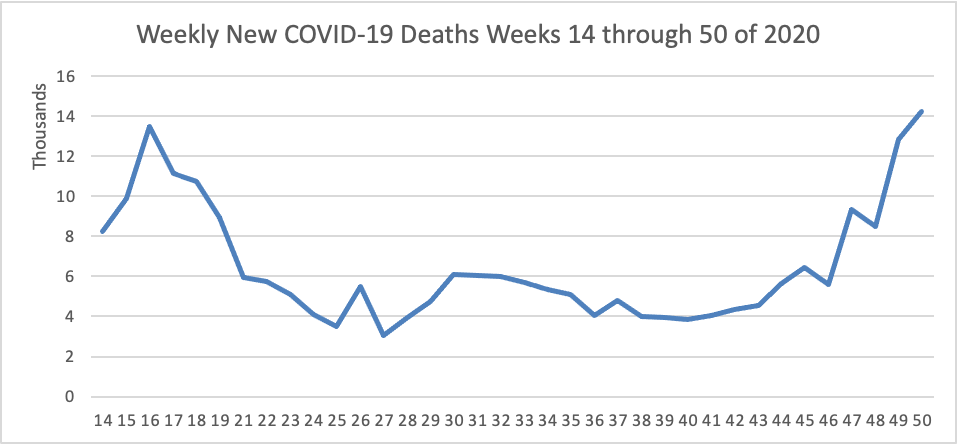
Here you friends. This chart is based on the CDC’s cases in the US statistics running on a Thursday to Wednesday weekly basis from May 14 through July 30:

As of today there have been 4,473,974 COVID-19 cases and 151,499 deaths in our country. Purely for context, in winter’s flu season there were 39 million cases of the flu and 24,000 related deaths again according to the CDC.

Here’s is the latest chart of weekly rates of COVID-19 hospitalizations:

A friend of the FEHBlog shared with him these interesting National Institutes of Health statements on new types of COVID-19 testing and the state of COVID-19 treatments. Also here’s a related HHS update on COVID-19 testing.

Have a good weekend.

Thursday Miscellany

Fierce Biotech reports on other successful double blind studies of COVID-19 vaccines on non-human primates / monkeys. It’s interesting and encouraging that the manufacturers are taking varied approaches to COVID-19 vaccine development. Thanks monkeys.

The Department of Health and Human Services has launched a public service advertising campaign asking COVID-19 survivors to donate plasma for the convalescent plasma treatment nearing FDA emergency authorization. That may be a good initiative for health plans and providers to promote as well.

Bear in mind this Wall Street Journal article reminding COVID-19 survivors that the length of time that the body’s antibodies protects survivors from COVID-19 reinfection is as yet unknown.

USA Today offers a hopeful article about the ongoing development of rapid, inexpensive at-home COVID-19 testing. What’s more, “The XPRIZE, a nonprofit that designs and hosts public competitions, announced Tuesday that it would split a $5 million prize among five winners who can produce a test that delivers results in as little as 15 minutes and costs less than $15.”

HR Dive discusses the impact of recent CDC changes its COVID-19 self quarantine guidelines for non-hospitalized COVID-19 patients on employer return to work policies. As with most COVID-19 personnel issues, it’s complicated.

Midweek Update

FCW.com reports that “The Senior Executives Association, which represents members of the Senior Executive Service and other federal mangers, is looking for sweeping change to the government’s human resources organization and practice.” Here’s a link to a the SEA’s report titled “Transforming the Governance of Federal Human Capital Management.” Of note, check out their recommendation for the OPM group that manages our beloved FEHBP:

The Healthcare and Insurance enrollment function should be assessed to determine if there would be benefits to reengineering and/or outsourcing. The federal government already does this with its vision and dental program (FEDVIP), which is administered by BENEFEDS. Reengineering should, as needed, focus on customer service and cost savings through efficiency. The nation’s largest employers, such as Walmart, outsource their benefits administration, as do most private-sector organizations. Once reengineering is complete, service level agreement and transactional cost ratios should be established. OPM could then explore if it is an appropriate candidate for outsourcing. If it is determined that outsourcing is more effective, OPM should maintain policy oversight and HC data ownership and control.

It’s not the first time that the FEHBlog has heard this recommendation made.

On the innovation front —

  • The FEHBlog was wondering today what was going on with his preferred candidate for COVID-19 treatment, convalescent plasma. Wonder and you shall receive for the Wall Street Journal advises tonight that

The Food and Drug Administration is nearing a decision to authorize emergency use of antibody-rich blood plasma from recovered Covid-19 patients for treating people infected with the coronavirus, people familiar with the matter said. The authorization could come as soon as next week, according to the people, though the agency could also decide to delay a decision. The designation could open the way for faster and wider access to one of the most promising treatments for Covid-19 patients. Only a Gilead Sciences Inc. antiviral drug known as remdesivir [currently] carries the designation.

  • Employee Benefit News informs us that

CVS Health is expanding their voluntary benefits to tackle mental health and anxiety treatment with a new digital offering.

The company added Daylight, an app that uses cognitive behavioral therapy techniques to combat anxiety, to its Point Solutions Management lineup. Both employer clients and CVS employees will have access to the app.

CVS looked to one of its existing partners — Big Health, the makers of the digital sleep benefit, Sleepio — for its newest offering. Daylight uses AI to make personalized recommendations on therapy exercises for users experiencing anxiety and stress.

On the Medicare front —

  • The Centers for Medicare and Medicaid Services announced today that “The average basic Medicare Part D premium will be $30.50 in 2021. The 2021 and 2020 average basic premiums are the second lowest and lowest, respectively, average basic premiums in Part D since 2013. This trend of lower Part D premiums, which have decreased by 12 percent since 2017.” Of course, Medicare Part D covers outpatient prescription drugs.
  • Forbes reports that

Americans who depend on Medicare Part B are accustomed to a yearly cost increase for their coverage. The Senate Republican proposals for a second stimulus package would freeze 2021 Medicare Part B premiums at 2020 levels. Negotiations between Republican and Democratic leaders continue in Congress, with multiple potential provisions for a second stimulus package on the table. Both sides have indicated they would like to pass a new stimulus bill before Congress departs for a month-long break on Aug 7.

In other news —

  • The Department of Health and Human Services (“HHS”) released today the HHS Secretary’s Report on Addressing Surprise Billing. Here’s Healthcare Dive’s take on the report. “HHS on Wednesday prodded Congress to pass legislation that bans surprise medical billing but did not take on stance on the best method to do so or endorse any particular bill.”
  • HHS also released “a new report showing the dramatic utilization trends of telehealth services for primary care delivery in Fee-for-Service (FFS) Medicare in the early days of the coronavirus disease 2019 (COVID-19) pandemic. The report analyzes claims data from January through early June.” Here’s is Healthcare Dive’s take on that report. “Almost half — 43.5% — of all Medicare primary care visits were being conducted through telehealth in April. That’s up from just 0.1% in February.” Wow.
  • Finally, Federal News Network informs us that

Four months after Congress approved a $10 billion loan for the Postal Service under the CARES Act, the Treasury Department and USPS leadership have struck a deal on the terms of that loan. According to the terms of the loan, released by top Democrats in the House and Senate, USPS has agreed to give Treasury access to its biggest negotiated service agreements with industry partners. The Postal Service will have access to the loan to fund operating expenses until March 27, 2022, but Treasury won’t advance any of the funds if USPS has a cash balance of more than $8 billion. In addition, USPS has agreed to give Treasury monthly reports on its cash flow and year-over-year changes in volume for its major lines of business, as well as changes in revenue and expenses.

Tuesday Tidbits

Following up on last Friday’s and Sunday’s posts on the President’s executive orders on drug pricing, here for greater perspective is a link to a Fierce Healthcare article offering the positions of the health insurance and PBM industry trade associations’ positions on the orders. Essential Hospitals lets us know that the text of the fourth international pricing index executive order has not yet been made public.

The Wall Street Journal reports that “Eastman Kodak Co. has won a $765 million government loan under the Defense Production Act, the first of its kind. The purpose: to help expedite domestic production of drugs that can treat a variety of medical conditions and loosen the U.S. reliance on foreign sources. * * * Kodak’s loan has terms similar to a commercial loan and must be repaid over 25 years, [Kodak CEO Jim] Continenza said. He said Kodak will produce “starter materials” and “active pharmaceutical ingredients” used to produce generic medicines. “We have a long, long history in chemical and advanced materials—well over 100 years,” Mr. Continenza said. He added that Kodak’s existing infrastructure allows the company “to get up and running quickly.”

On the COVID-19 front —

  • Federal News Network informs us that

About 4,000 federal employees have filed workers’ compensation claims with the Labor Department due to COVID-19. 60 people have filed death claims. Labor projects COVID-19 claims among federal employees may reach 6,000 in the coming weeks. The department’s inspector general says the division that handles federal employee claims is anticipating a strain in resources due to demand and social distancing mandates. It has alternative staffing plans if COVID-19 compensation claims continue to surge. Labor says it’s accepted over 1,600 federal employees claims so far. Over 2,300 are unadjudicated.

  • The Society for Human Resource Management brings us up to date on the Senate majority’s new $1 trillion COVID-19 relief bill, the HEALS Act.
  • The Center for Medicare and Medicaid Services released “an early snapshot of the impact of the coronavirus disease 2019 (COVID-19) pandemic on the Medicare population. The data shows that older Americans and those with chronic health conditions are at the highest risk for COVID-19 and confirms long-understood disparities in health outcomes for racial and ethnic minority groups and among low-income populations.” A large cadre of the Medicare population of course is also enrolled in the FEHBP so this data is worth a gander.
  • The National Institutes of Health announced the successful results of a double blind study of the Moderna / NIAID COVID-19 vaccine on non-human primates / rhesus macaques. As noted yesterday that vaccine entered phase 3 human trials this week.

In other news —

  • Becker’s Hospital Review identifies the highest ranking hospital in each State as found in U.S. News and World Report.
  • NPR discusses two new studies suggesting that the risk of Alzheimer’s disease can be reduced by taking flu and pneumonia vaccines.
  • HHS’s Office for Civil Rights (“OCR”) which enforces the HIPAA Privacy and Security Rules announced that “Lifespan Health System Affiliated Covered Entity, a non-profit health system based in Rhode Island, has agreed to pay $1,040,000 to the OCR and to implement a corrective action plan to settle potential violations of the Health Insurance Portability and Accountability Act (HIPAA) Privacy and Security Rules related to the theft of an unencrypted laptop [thereby evidently allowing access to protected health information on over 20,000 patients in 2017].

Monday Roundup

The Wall Street Journal reports that

Two of the most advanced experimental coronavirus vaccines entered the pivotal phase of their studies on Monday, with the first subjects receiving doses of vaccines developed by Moderna Inc. and Pfizer Inc.

Researchers evaluating the vaccines plan to enroll 30,000 people in separate last-stage, or phase 3 trials, results of which will determine whether the vaccines protect against symptomatic Covid-19, and whether they should be cleared for widespread use.

Let’s go.

Also on the vaccine front, Healio informs us that the “Influenza vaccination was significantly associated with reduced risks for all-cause death, cardiovascular death, and death from acute myocardial infarction or stroke among adults with diabetes, according to an analysis of registry data.”

The FEHBlog recommends that you listen to, or read the transcript of, this week’s Econtalk podcast in which the host economist Russ Roberts discussed the COVID-19 emergency with Nissam Nicholas Taleb, who is a noted author on the topic of probability. Enlightening.

The American Hospital Association reminds us the July is Minority Mental Health Awareness month by offering a website full of resources. The FEHBlog attended an NCQA Digital Quality Summit breakout session track on racial and ethnic disparities in healthcare last week. Some of the health plan participants spoke up about the difficulty of identifying the racial and ethnic characteristics of their members. That is an important prerequisite to conducting investigations that will lead to solutions. It occurred to the FEHBlog that racial and ethnic characteristics could be added to the ICD-10 code set which would allow coders to spread this information via healthcare claims.

MedPage Today offers a variety of telehealth updates such as the following:

A program that integrated a dedicated team of 24/7 telemedicine clinicians with automated text message check-ins was able to monitor COVID-19 patients at home and quickly support those whose symptoms grew worse, a case study in NEJM Catalyst showed.

Outcomes from the first 3,000 patients invited to participate in the University of Pennsylvania Health System COVID Watch program showed that 83% of confirmed or suspected COVID-19 patients were managed by the automated program; only 17% escalated to needing clinical care, reported Anna Morgan, MD, MSc, of the Perelman School of Medicine at the University of Pennsylvania, and colleagues.

Finally, the Society for Human Resource Management summarizes recent U.S. Labor Department workplace guidance on COVID-19 issues.

Weekend Update

Congress remains in session this week on Capitol Hill for legislative and committee business. The House passed its first appropriations minibus (HR 7608) last week. The FEHBlog expects the House to pass the next minibus (HR 7617) including FEHBP appropriations this coming week. Meanwhile, both Houses continue to work on another COVID-19 relief bill.

On Friday, the federal government filed its opposition to the Whitman-Walker Clinic’s motion for a preliminary injunction to stay the mid August effective date for the Trump Administration’s revised ACA Section 1557 rule. While the FEHBlog expected the government to pull back the rule in order to adjust it for the Supreme Court’s Bostock County decision, the government took the hang out route. The plaintiffs’ reply is due Wednesday July 29 and the oral argument on the motion will be held on Monday August 3 at 2 pm in the U.S. District Court for the District of Columbia. According to Katie Keith’s article on ACA litigation, posted last week, there are several other legal challenges pending against this rule.

The FEHBlog did virtually attend NCQA’s Digital Quality Summit last week. The FEHBlog was probably the only lawyer attending this conference, but the FEHBlog finds health care quality measurement fascinating (just like OPM). However, the FEHBlog just took a look at the speaker’s list and found out that one of the general session speakers is a sister at the bar. What do you know? The FEHBlog remains a firm believer in the FHIR API to facilitate health quality measurement. The FEAHBlog likes the lead in this FHIR website “Integrations don’t need to be complicated.”

In other news

Proponents of alternative payment models hope the pandemic will drive adoption of value-based arrangements down the line, as the financial pressures facing fee-for-service primary care practices have highlighted the shortcomings of paying for volume. There’s a dichotomy between fee-for-service practices, which have been staring at potential financial ruin since March, and those in alternative payment models, [e.g. direct primary care practices“}whose finances are in some ways insulated from the worst of the pandemic’s economic repercussions.

  • Health Payer Intelligence reports that

More than six in ten employers said that they would be partnering with their healthcare payer in the workplace transition back to the office, an Optum survey found. The survey revealed that only 16 percent of employers had achieved a full transition to the worksite. “Although almost all organizations appear committed to completing their transitions by early September, there will be a need for sustained employee well-being support well beyond the 90-day window,” the survey reminded.

  • Here’s a Forbes’s assessment of the President’s four executive orders issued on Friday in an effort to lower prescription drug prices. The international price index executive order is still not found on whitehouse.gov. What’s more, here is Avik Roy’s take on the executive orders.