STAT News offers a portrait of the COVID-19 virus at one year — what scientists know about how it spreads, infects, and sickens. Meanwhile, the AP provides its perspective on today’s first COVID-19 vaccinations, which should be view as a miracle as vaccines normally take at least four years to develop.
Healthcare Dive and Revcycle Intelligence discuss industry reaction to the bipartisan, bicameral surprise billing legislation introduced in Congress last week. The articles make it clear that neither providers nor payers are entirely happy with the legislation and that the legislators’ goal is to attach the bill to this week’s must pass omnibus spending bill (“the omnibus”). It could go.
A friend of the FEHBlog pointed out today another bill that could get attached to the omnibus. Last week the House passed H.R. 7898 which would permit HHS’s Office for Civil Rights to mitigate HIPAA fines and other remedies when the covered entity or business associate has adequately demonstrated that it “had, for not less than the previous 12 months, recognized security practices in place.” “The term ‘recognized security practices’ means the standards, guidelines, best practices, methodologies, procedures, and processes developed under section 2(c)(15) of the National Institute of Standards and Technology Act, the approaches promulgated under section 405(d) of the Cybersecurity Act of 2015, and other programs and processes that address cybersecurity and that are developed, recognized, or promulgated through regulations under other statutory authorities. Such practices shall be determined by the covered entity or business associate, consistent with the HIPAA Security rule (part 160 of title 45 Code of Federal Regulations and subparts A and C of part 164 of such title).” That’s quite reasonable and equitable.
Bloomberg reports today that legislative work on the omnibus itself remains on track. Also the FEHBlog appreciated Bloomberg’s insights into the COVID-19 relief bill which would be the key measure to be attached to the omnibus. What better time than now for Christmas tree legislation” In any event, according to Bloomberg,
[U.S Senator John] Cornyn [R TX] said the $908 billion bipartisan proposal unveiled Monday isn’t likely to go forward by itself but will be used as jumping-off point for the leaders from both parties in both chambers. ”It’s having a positive influence on what will ultimately included,” Cornyn said of the bipartisan proposal.
Forbes provides more background on the status of the COVID-19 relief legislation for those who are interested (as the FEHBlog is).
While the FEHBlog is a subscriber to the WSJ, Bloomberg and STAT News, among others, he does not subscribe to Modern Healthcare. That’s difficult at this time of year because he does get a kick out of their list of the 100 people who have most influence on U.S. healthcare. Fortunately, AHIP provided a list of their members’ executives who made the list. Congratulations to them.
The Federal Benefits Open Season for 2021 ends tomorrow. OPM explains on its website that
The Federal Benefits Open Season ends at 11:59pm Eastern Time on Monday December 14, 2020 for the Federal Employees Dental and Vision Insurance Program (FEDVIP) and the Federal Flexible Spending Account Program (FSAFEDS). Open Season for the Federal Employees Health Benefits Program (FEHB) ends at 11:59pm, in the location of your electronic enrollment system, on Monday December 14, 2020.
Both Houses of Congress have scheduled Committee hearings / meetings and floor voting for this week. The Hill reports that
A bipartisan group of lawmakers is splitting its $908 billion coronavirus relief proposal into two packages as it prepares to release text on Monday.
The plan, confirmed by a source familiar with the talks, will include a $160 billion proposal that ties together the two most controversial elements: more money for state and local governments and protections against coronavirus-related lawsuits.
The second proposal will total $748 billion and include ideas that garner broader support, including another round of Paycheck Protection Program funding for small businesses, unemployment benefits, and more money for vaccine distribution, testing and schools.
Sen. Joe Manchin (D-W.Va.), a member of the group, announced earlier Sunday that it would release text on Monday. “The plan is alive and well, and there is no way we’re going to leave Washington without taking care of the emergency needs of our people,” Manchin said on “Fox News Sunday.” “We’ll have a bill produced for the American people tomorrow, $908 billion.”
Congress is quickly running out of time to cut a big deal on coronavirus relief, with lawmakers having until Friday to pass a government funding bill that will act as the vehicle for any agreement. But the bipartisan group has been negotiating for weeks, including over the weekend, to try to finalize its bill after announcing a framework earlier this month.
A friend of the FEHBlog called to his attention this bipartisan, bicameral surprise billing relief proposal. The House Ways and Means Committee released the bill and the President expressed his support for it on Thursday December 11. It’s certainly not clear to the FEHBlog whether this bill will be dropped into the must pass spending bill later this week as the President suggests.
Amazon has rolled out a new data aggregation and standardization service for healthcare and life sciences organizations, the tech giant announced Tuesday.
The goal of the HIPAA-eligible tool, called Amazon HealthLake, is to make it simpler for healthcare organizations to manipulate, structure and search their data.
In other Amazon news, the e-commerce behemoth has expanded its network of health clinics for employees with four additional locations in the Dallas-Fort Worth area, the company said last week.
Last night, the Food and Drug Administration announced that it has granted emergency use authorization for administering the Pfizer-BioNTech COVID-19 vaccine to people aged 16 and older in our country.
Initial supplies will be limited. Pfizer projects it will deliver 25 million doses to the U.S. this year, including 2.9 million doses the first week. Inoculation requires two doses three weeks apart, so only half that many people will be vaccinated. States will decide where many doses go.
Gen. Gustave Perna, chief operating officer of the federal government’s Operation Warp Speed vaccine effort, said Saturday the initial supplies will be distributed among 636 locations nationwide, with 145 sites expected to get the doses Monday.
Another 425 sites should receive deliveries Tuesday, while the remaining 66 sites are slated to get their supplies Wednesday, Gen. Perna said.
The U.S. government is dividing up the supply among states, territories and jurisdictions based on their adult populations.
First in line will largely be the nation’s 21 million health-care workers such as doctors and nurses treating Covid-19 patients, as well as residents of nursing homes and other long-term care facilities.
The Centers for Disease Control’s Advisory Committee for Immunization Practices (“ACIP”) made this phase 1A distribution recommendation earlier this month. Medscape reports that at a meeting held today,
ACIP voted 11-0, with three recusals, to recommend use of the Pfizer-BioNTech mRNA vaccine in individuals 16 years or older according to the guidelines of the Food and Drug Administration’s (FDA’s) emergency use authorization issued on Friday.
The panel also voted unanimously to include the vaccine in 2021 immunization schedules. All panel members said the recommendation should go hand-in-hand with ACIP’s previous recommendation on December 1 that allocation of the vaccine be phased-in, with health care workers and residents and staff of long-term care facilities in phase 1a, as reported byMedscape Medical News.
Of course, more medical guidance will be forthcoming as the vaccine is rolled out to the general public. To that end,
Peter Marks, MD, PhD, director of the FDA’s Center for Biologic Evaluation and Research (CBER) clarified this in a briefing on December 12, noting that women who are pregnant or lactating can make the decision in consultation with their physician. And, he said, patients with any other history of allergy should be able to safely get the vaccine.
The bottom line is that
Committee members breathed a sigh of relief at the end of the 2-day meeting, saying that although the Pfizer vaccine is not perfect, it represents a scientific milestone and a significant advance against the continuing march of the SARS-CoV-2 pandemic.
“This vaccine and future vaccines do provide a promise for a lot of progress in the future,” said panelist Beth P. Bell, MD, MPH, clinical professor of global health at the University of Washington School of Public Health in Seattle.
Peter Szilagyi, MD, MPH, executive vice-chair and vice-chair for research at the University of California, Los Angeles pediatrics department, said, “I’m really hopeful that this is the beginning of the end of the coronavirus pandemic.”
Thank goodness.
Pursuant to the CARES Act, health plans, including FEHB plans, become obligated to cover administration of this vaccine to its members with no cost sharing fifteen days from now, December 27, 2020.
Based on the CDC’s COVID Data Trackers website, here is the FEHBlog’s chart of new weekly COVID-19 cases and deaths over the 20th through 49th weeks of this year (beginning May 14 and ending December 9; using Thursday as the first day of the week in order to facilitate this weekly update):
and here is the CDC’s latest overall weekly hospitalization rate chart for COVID-19:
It’s interesting that the weekly rate dropped two weeks in a row. Typically the chart would show a one week drop which the FEHBlog discounted.
The FEHBlog has noted that the new cases and deaths chart shows a flat line for new weekly deaths because new cases greatly exceed new deaths. Accordingly here is a chart of new COVID-19 deaths over the same period (May 14 through December 9):
The FEHBlog’s record high for weekly deaths remains 13,504 for the week ended April 22 which we now are approaching.
On the brighter side, the Wall Street Journal reports that
The U.S. Food and Drug Administration said it was finalizing the work needed to clear a Covid-19 vaccine developed byPfizer Inc. and German partner BioNTech SE, after the injection was endorsed by an expert panel. “We could see people getting vaccinated Monday, Tuesday of next week,” Health and Human Services Secretary Alex Azar said on ABC’s “Good Morning America.”
Fierce Healthcare reports that “CVS [Health] is planning to begin administering COVID-19 vaccines in nursing homes beginning on Dec. 21, a top executive told Reuters.”
Govexec.com reports that “Civilian federal personnel are likely to begin receiving COVID-19 vaccinations as soon as Monday, officials said on Friday, though only [healthcare] employees at certain offices will receive the doses directly from their agencies. Govexec.com offered the most details on the Defense Department’s plans which provide a helpful perspective
The Defense Department also anticipates vaccinating 44,000 employees next week, officials said on Wednesday, the vast majority of whom will be health care staff. The Pentagon plans to provide vaccines to both military and civilian staff, though it has not committed to vaccinating to its entire civil service workforce.
“The eligibility we defined in terms of dependents, select contractors, civilian employees, and it’s going to be then how do they match up in terms of the prioritization tiers,” said Tom McCaffery, the assistant secretary of Defense for Health Affairs.
In the initial phase, Defense will target health care workers who are closest to patients, early emergency responders and public security staff. Defense will distribute vaccines to 16 sites in that phase, 13 of which are located within the United States. McCaffery said the department recently held a “virtual tabletop exercise” to go through the first phase “in great detail to ensure seamless distribution and dissemination” of the vaccine. Defense will ultimately be responsible for vaccinating millions of individuals, including active duty personnel, civilian workers, at-risk dependents and some contractors.
All told, Defense maintains 83 sites that have ultra-cold storage, including all 13 of those in the initial distribution.
will purchase an additional 100 million doses of COVID-19 vaccine candidate, called mRNA-1273, from Moderna.
If authorized by the U.S. Food and Drug Administration for emergency use as outlined in agency guidance, doses of the vaccine will begin shipping immediately. The vaccine would be provided at no cost to Americans. Vaccine administration costs for private-sector administration partners will be covered by healthcare payers: private insurance, Medicare or Medicaid, and an HHS program to cover COVID-19 costs for the uninsured which is reimbursing the provider at Medicare rates from the provider relief fund.
Under the agreement, Moderna will leverage its U.S.-based manufacturing capacity to fill, finish and ship vials of mRNA-1273 as the bulk material is produced. The additional doses ordered today provide for continuous delivery through the end of June 2021. This strategy will help meet the anticipated demand for mRNA-1273 and safely accelerate the delivery schedule for all 200 million doses the U.S. government is purchasing.
“Securing another 100 million doses from Moderna by June 2021 further expands our supply of doses across the Operation Warp Speed portfolio of vaccines,” said HHS Secretary Alex Azar. “This new federal purchase can give Americans even greater confidence we will have enough supply to vaccinate all Americans who want it by the second quarter of 2021.”
In other news,
Congress approved the one week long extension of the continuing resolution funding the federal government. The new deadline is December 18 and Federal News Network reports that “Negotiators on a $1.4 trillion catchall spending bill appeared to be moving in a positive direction, said the chairman of the Senate Appropriations Committee, Sen. Richard Shelby, R-Ala.. This bill would serve as a vehicle to carry any year-end virus assistance.” Negotiations over that COVID-19 relief bill continue.
The HHS, the Labor Department, and the Treasury Department (a/k/a the tri-agencies) “announced a final rule that amends the [Affordable Care Act] requirements for grandfathered group health plans and grandfathered group health insurance coverage to preserve their grandfather status.”
The U.S. Supreme Court unanimously rejected an ERISA preemption challenge to an Arkansas state law regulating prescription benefit manager pricing of drugs. Here is Healthcare Dive’s report. This decision will raise healthcare prices in the FEHBlog’s opinion.
Govexec.com reports that President Trump is giving a half day off to federal employees on Christmas Eve.
The FEHBlog’s link to the HHS fact sheet on the proposed HIPAA Privacy Rule changes (posted yesterday) was inoperable until the FEHBlog fixed it tonight. Here’s a link. Have a good weekend.
A panel of outside experts on Thursday recommended the Food and Drug Administration issue an emergency use authorization to the Covid-19 vaccine being developed by Pfizer and BioNTech, a vaccine that appeared to be highly efficacious in a Phase 3 clinical trial.
The 17-4 vote came after a long day in which members of the Vaccines and Related Biological Products Advisory Committee, or VRBPAC, discussed a wide range of issues related to the vaccine, including concerns about vaccinating people with severe allergies and 16- and 17-year-olds, as well as issues regarding vaccination during pregnancy or lactation.
Although the FDA does not have to follow the panel’s recommendation, it is widely expected to do so. The rollout of Covid-19 vaccine could then begin in the United States in a matter of days.
The FEHBlog watched on You Tube a good chunk of the discussion preceding the vote. The FEHBlog was surprised that the motion presented to the Committee would extend the emergency use authorization to 16 and 17 year olds. He thought that the the minimum age would be 18 years old, and the committee members who voted against the bill were pediatricians concerned about the 16 to 17 year olds. Another member who was not a physician argued that the emergency use authorization use authorization should be limited to health care workers and nursing home residents, the initial phases approved by the CDC’s Advisory Committee on Immunization Practices. In any event, the FEHBlog was pleased by the decisive vote. At the close of the virtual committee meeting the Chairman reminded the members that they would be meeting next Thursday December 17 to consider an emergency use authorization for the Modern vaccine.
Speaking of voting, the Senate did not take up today the one week long extension of continuing resolution funding the federal government or the FY 2021 national defense authorization act which the House approved yesterday. The Senate needs to act on the continuing resolution tomorrow. The Wall Street Journal reports that negotiations over another COVID-19 relief bill continue.
A friend of the FEHBlog called to his attention the Department of Health and Human Services website on combatting the COVID-19 virus. It’s quite comprehensive.
In other news today, the HHS Office for Civil Rights, which enforces the HIPAA Privacy and Security Rules, proposed changes to the Privacy Rule.
The proposed changes to the HIPAA Privacy Rule include strengthening individuals’ rights to access their own health information, including electronic information; improving information sharing for care coordination and case management for individuals; facilitating greater family and caregiver involvement in the care of individuals experiencing emergencies or health crises; enhancing flexibilities for disclosures in emergency or threatening circumstances, such as the Opioid and COVID-19 public health emergencies; and reducing administrative burdens on HIPAA covered health care providers and health plans, while continuing to protect individuals’ health information privacy interests.
A friend of the FEHBlog shared this HHS fact sheet on this proposed rule. The proposal has a 60 day comment deadline which will end during the Biden Administration.
HHS’s Centers for Medicare and Medicaid Services proposed new rules to crack down on prior authorization practice by Medicaid, CHIP, and QHP marketplace plans. (Medicare does not permit prior authorization.)
The rule would require payers in Medicaid, CHIP and QHP programs to build application programming interfaces (APIs) to support data exchange and prior authorization. APIs allow two systems, or a payer’s system and a third-party app, to communicate and share data electronically Payers would be required to implement and maintain these APIs using the Health Level 7 (HL7) Fast Healthcare Interoperability Resources (FHIR) standard.
Building on that foundational policy, this rule would require impacted payers to implement and maintain a FHIR-based API to exchange patient data as patients move from one payer to another. In this way, patients who would otherwise not have access to their historic health information would be able to bring their information with them when they move from one payer to another, and would not lose that information simply because they changed payers.
These proposed changes would also allow payers, providers and patients to have access to more information including pending and active prior authorization decisions, potentially allowing for fewer repeat prior authorizations, reducing burden and cost, and ensuring patients have better continuity of care.
The proposals are expected to take effect in January 2023. Good ideas. The pubic comment period ends on January 4, 2021, but the final rule no doubt will be in the hands of the Biden administration. The American Medical Association must be happy though.
In Govexec, benefits consultant Tammy Flanagan discusses FEHBP options for annuitants with primary Medicare A and B coverage. The FEHBlog is always impressed by the creative benefit designs that FEHB plan carriers offer members.
The House on Wednesday [December 9] passed a stopgap funding bill 343-67 that would give lawmakers an additional week to come up with full-year spending legislation and avoid a government shutdown later this month. The continuing resolution would last for one week, setting a new funding deadline of Dec. 18. The Senate must still pass the CR and President Trump must sign it by Friday to avoid a government shutdown, which both are expected to do.
The Wall Street Journal adds that “A flurry of competing proposals for another coronavirus relief package ricocheted around the Capitol Wednesday, as lawmakers hunted for ways to resolve a thorny debate over liability protections that has stymied progress for weeks.” A December 9 fact sheet on the bipartisan proposal was made available today. Check it out.
In Presidential transition news, President-elect Biden announced the following additional healthcare appointments earlier this week:
Vivek Murthy, M.D., for a second tour of duty as surgeon general
Rochelle Walensky, MD, Harvard professor, as CDC director
Marcella Nunez-Smith, MD, Yale Professor, as COVID-19 Equity Task Force Chair
Jeff Zients, Deputy OMB Director for Management in Obama Administration, as Covid-19 czar.
Anthony Fauci, MD, as Coordinator of COVID-19 response and Counselor to the President
Sidebar — Still waiting for FDA Commissioner appointment
Added Cathie McQuiston, AFGE Deputy GC, to the OPM review team
Tomorrow December 10 is the date set for the FDA Vaccines and Related Biological Products Advisory Committee virtual meeting on the Pfizer-BioNTech emergency use authorization application for its COVID-19 vaccine. The CDC’s Advisory Committee on Immunization Practices will meet on Friday December 11 and vote on Sunday December 13 per Reuters. “
Dr. William Schaffner, an infectious disease expert and non-voting member of the CDC’s ACIP, said the gap between the two ACIP meetings will allow the FDA time to draft and issue an emergency use authorization (EUA) before the ACIP vote. That schedule could change, however, if FDA advisers have questions or request more data [tomorrow], he said.
authorized LabCorp’s Pixel COVID-19 Test Home Collection Kit for use by any individual 18 years and older without a prescription. This product, which is authorized as the first COVID-19 direct-to-consumer (non-prescription) test system, allows an individual to self-collect a nasal swab sample at home and then send that sample for testing to LabCorp. Positive or invalid test results are then delivered to the user by phone call from a health care provider. Negative test results are delivered via email or online portal.
This home sample collection kit can be purchased online or in a store without a prescription. It is intended to enable users to access information about their COVID-19 infection status that could aid with determining if self-isolation (quarantine) is appropriate and to assist with health care decisions after discussion with a health care professional.
“This is the first kit for consumers to self-collect a nasal sample for COVID-19 in their home that does not require a prescription,” said Jeff Shuren, M.D., J.D., director of FDA’s Center for Devices and Radiological Health. “While many home collection kits can be prescribed with a simple online questionnaire, this newly authorized direct-to-consumer collection kit removes that step from the process, allowing anyone to collect their sample and send it to the lab for processing.”
Blue Cross and Blue Shield is calling on payers to bolster vaccination rates by expanding access to care, connecting with members through digital platforms, hosting free flu vaccine clinics, and utilizing data to target support for at-risk communities The effort comes in response to a drastic decrease in the number of vaccinations this year, compared with 2019 data.
The Trump administration made a $916 billion coronavirus relief offer to Democrats, opening yet another front in the multi-track effort to reach an agreement in talks that rank-and-file lawmakers have been leading in the final weeks of the year. The proposal, announced in a brief statement by Treasury Secretary Steven Mnuchin, came after Democrats rejected an effort by Senate Majority Leader Mitch McConnell (R., Ky.) to narrow the scope of a coronavirus relief bill by excluding aid for hard-hit state and local governments prioritized by Democrats and liability protections sought by Republicans.
The President’s proposal reportedly includes $600 per person direct payments. The FEHBlog will be surprised if the COVID-19 relief bill negotiations are unsuccessful, but it would be hardly be the first time that Congress surprises the FEHBlog.
Also according the Wall Street Journal, the House of Representatives tonight passed the FY 2021 National Defense Authorization Act by a veto proof 335-78 margin. As the FEHBlog noted last week this bill includes goodies for federal employees. Federal News Network identifies policy winners and losers in this must pass bill which now goes over to the Senate.
Federal News Network columnist Mike Causey touts the FEHBlog’s personal favorite health plan design the high deductible health plan with health savings account (“HSA”). Mr. Causey aptly describes the HSA as a “Roth IRA on steroids” because and HSA is triple tax favored — tax exempt on the way in and out and grows tax free while in the account. The Federal Benefits Open Season ends on Monday December 14.
The FDA has released its internal review documents ahead of the closely watched COVID-19 vaccine advisory committee meeting scheduled for Thursday [December 10] —and they bode well for Pfizer and partner BioNTech’s prospects for securing a quick emergency use authorization (EUA). The FDA meeting briefing, published (PDF) on Tuesday, confirmed the efficacy and safety profile of Pfizer and BioNTech’s BNT162b2, reiterating that the shot was 95% effective at preventing COVID-19 after two doses with no serious safety concerns.
The Moderna vaccines turn before this panel occurs one week later on December 17.
Hospitals are readying for Jan. 1, [2021] when they expect they will have to publicly disclose the negotiated prices they reach with insurers for services performed inside their facilities — barring any intervention from a federal appeals court. [Such intervention in the FEHBlog’s humble opinion, is highly unlikely.]
The policy requires hospitals to share two streams of information. First, hospitals will have to share a machine-readable format of its negotiated prices with every insurer and every insurance product — a sizable pool of information.
Then they will also have to prepare a list of 300 “shoppable services.” A total knee replacement would be a good example. It’s a procedure a consumer likely has time to plan and prepare for, unlike an emergency surgery due to an accident or failing health. The idea is to provide the price information so consumers can shop around for the best deal.
The FEHBlog attended the second day of the American Bar Association’s Washington Health Law Summit (“WLS”). It’s worth noting that every panelist (six or seven in total) who has opined on the outcome of the Supreme Court’s California v. Texas case on the ACA’s constitutionality shares the FEHBlog’s opinion that the Supreme Court will preserve the ACA expect perhaps for the individual mandate which Congress effectively repealed in 2017.
The FEHBlog listened to three hours of discussion about behavioral telehealth and artificial intelligence during the WLS. It turns out that two types of healthcare AI exist admin AI and operational AI. AI can be assistive to the user’s decision making or can yield autonomous decisions. The Food and Drug Administration oversees the AI devices and the operational devices typically are used with imaging procedures. The FDA has approved two autonomous operational AI devices. The radiologists however has doubts about those devices.
The most interesting thing that the FEHBlog heard during this discussion was a remark from a Doctors on Demand speaker that telehealth companies are facing challenges in filling provider slots for psychiatrists and psychologists because of the enormous demand for mental health telemedicine. That’s a good thing. He noted that the explosion in telehealth use in 2020 is principally due to the government permitting a doctor or psychiatrist licensed in state A to treat a telehealth patient in state B.
The other speakers added that healthcare providers were quick to pick up on telehealth due to the licensing flexibilities and Medicare equivalent payments. They expressed their understanding that telehealth changes the personal dynamics between doctors and patients. Patients feels more in charge in a tele heath setting than they do in the office setting, and providers get social determinants of health data from seeing where the patient lives.
Bloomberg reports that “[COVID-19 relief bill] talks over the weekend and on Monday have not made enough progress to release final details yet, according to congressional aides.” “Senate Republican leaders made clear Monday evening that the package must have liability reforms [to protect businesses from COVID-19 lawsuits] that [Senate Majority Leader Mitch] McConnell supports in order for Republicans to consider any state and local aid [which is a Democrat priority]. Accordingly as Forbes reports, “The House [of Representatives] will vote on a one-week stopgap spending bill Wednesday, pushing back a looming December 11 government shutdown deadline to give lawmakers more time to come to an agreement on a new coronavirus relief package.”
The FEHBlog is attending the American Bar Association’s virtual Washington Health Law Summit (“WLS”) which runs from today through Wednesday. (Ermer & Suter is a bronze sponsor.) He heard one of the speakers tout the Health Care Cost Institutes’s Healthy Marketplace Index.
Using nearly 2.5 billion commercial claims from 2013 to 2017, HCCI tracks drivers of health care spending across 124 U.S. cities through the Healthy Marketplace Index (HMI) project. Our full report presents an interactive exploration of each HMI metric and a deep dive into each metro area. Collectively, they comparing how spending drivers varied across and even within cities, as well as over time
HMI is easy to navigate, and the information is on point but somewhat dated. Not bad for free though.
TechRepublic courageously offers seven predictions for how technology will shape healthcare next year. One of the predictions is continued demand for telehealth. One of the WLS speakers sagely commented about the public health importance of mental health services provided by telehealth She noted that while four out of five doctors in medical / surgical practices join health plan networks, only one out of five psychiatrists and psychologists join those networks. Telemedicine makes the in-network psychiatrists and psychologists more widely available. That’s an important consideration.
Another WLS speaker predicted that Congress will pass a big infrastructure bill next year that will include healthcare priorities such as expanding reliable internet access in rural areas of the country in order to facilitate telehealth there.
While the continued climb of COVID-19 cases in the U.S. is pushing many Americans’ resiliency to the limits, there are signs that some are adapting to the challenging circumstances, a new study from Cigna shows.
Daniel Ober, M.D., chief medical officer for Cigna Global Health Benefits, told Fierce Healthcare that because the U.S. never really entered a lull in the pandemic that allowed it to reopen the way some other regions did, many Americans have “adapted somewhat” to life under COVID-19. For example, people who are unwilling to wear masks in public, as is recommended by experts, are largely an exception to the rule, not the norm, he said. “We’re adapting to this new normal and will continue to do so,” he said.
It’s nice to read encouraging news on this first Monday in a while without big COVID-19 vaccine news. The FDA committee considers the Pfizer BioNTech application for emergency use authorization of its COVID-19 vaccine on Thursday.
Congress is in session this week for committee business and floor voting. The big item is the omnibus spending bill which is expected to include the bipartisan COVID-19 relief package. The legislative language for this bill should be released tomorrow if everything remains on track. An omnibus or short term spending measure must be passed by 11:59 pm on December 11. The FEHBlog thought that both Houses of Congress were set to adjourn this week but it turns out that the Senate is scheduled to continue working through December 18.
The Federal Employee Benefits Open Season continues through next Monday December 14, while the Medicare Open Season ends tomorrow December 7. Let’s not forget that December 6 though 12 is the Centers for Disease Control’s (“CDC”) National Flu Vaccination Week.
The press is reporting tonight that President-elect Biden intends to appoint California Attorney General Xaxier Becerra to be his Secretary of Health and Human Services, which is a very powerful position when it comes to healthcare in the U.S. Speaking of healthcare leaders, Fierce Healthcare identifies six health plan executives to watch in 2021.
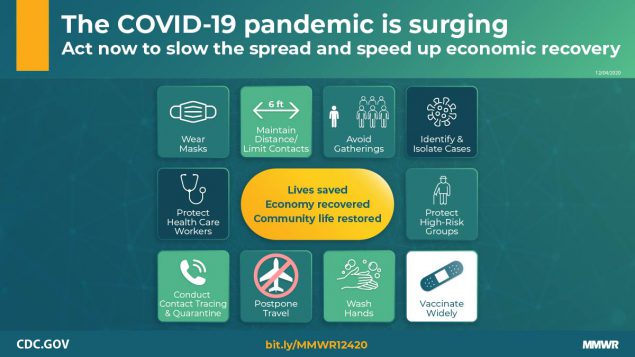
The CDC released updated COVID-19 protection guidance on Friday.
Summary What is already known about this topic?
The United States is experiencing high levels of SARS-CoV-2 transmission.
What is added by this report?
COVID-19 pandemic control requires a multipronged application of evidence-based strategies while improving health equity: universal face mask use, physical distancing, avoiding nonessential indoor spaces, increasing testing, prompt quarantine of exposed persons, safeguarding those at increased risk for severe illness or death, protecting essential workers, postponing travel, enhancing ventilation and hand hygiene, and achieving widespread COVID-19 vaccination coverage.
What are the implications for public health practice?
These combined strategies will protect health care, essential businesses, and schools, bridging to a future with high community coverage of effective vaccines and safe return to more activities in a range of settings.
The FEHBlog ran across a Bloomberg report which adds
Harvard disease expert Willam Hanage says that the science to date points to the primary risk coming from what he calls the three C’s — close contact, closed spaces and crowds. He says in Japan, where they’ve had few Covid-19 deaths, people are advised to avoid these — not just to wear masks in these situations but to limit them or avoid them altogether.
In much better but nevertheless thought provoking news, the Wall Street Journal reports that
Drug development for sickle-cell disease, largely overlooked for decades, is becoming a crowded field: Two papers published Saturday in the New England Journal of Medicine report promising results from studies of experimental therapies, including Crispr gene editing, for the disease.
In addition, Beam Therapeutics Inc. on Saturday presented lab and mouse data at the American Society of Hematology annual meeting to support the safety of another approach to using Crispr gene editing for sickle-cell disease. The company said it hopes to open a trial next year.
The article points that Crispr gene editing is an expensive technology. “What good are new therapies for a disease if many patients suffering with it are unable, or choose not, to access them?” That is an issue for health plans to contemplate now, in the FEHBlog’s opinion.
The FEHBlog took a look at the CDC’s Center for National Health Statistics website today, and he ran across these interesting recent reports
The FEHBlog was surprised by the facts that “Prepregnancy obesity [measured as body mass index of 30 or higher] in the United States rose from 26.1% in 2016 to 29.0% in 2019 and increased steadily for non-Hispanic white, non-Hispanic black, and Hispanic women” and that “In 2019, more than one in four children had one or more visits to an urgent care center or retail health clinic (26.4%) in the past 12 months.” These reports further find that college educated women are less likely to be obese and that insured children are more likely to us retail health clinics.
The prepregnancy obesity report led the FEHBlog to consult OPM’s available statistics on federal employee demographics which date back to 2017. Roughly 52% of federal employees have at least college degree. The FEHBlog also found a May 2020 Pew Research report on Postal Service employee demographics which does discuss Postal employee education levels but does point out that
About six-in-ten of the agency’s employees – including mail carriers, postal clerks, and mail sorters and processors – are non-Hispanic white (57%), compared with 78% of the overall U.S. workforce. Around a quarter (23%) of Postal Service workers are black, 11% are Hispanic and 7% are Asian. In contrast, black Americans make up 13% of the national workforce, Hispanics 17% and Asian Americans 6%.
In 18 states and the District of Columbia, women make up half or more of Postal Service employees. In D.C., 74% of Postal Service workers are women, and women account for around six-in-ten postal workers in Idaho, Alabama and South Dakota. Nationally, slightly fewer than half of postal workers are women (45%), in line with the U.S. workforce.
The Postal Service, as of 2018, employs more than 100,000 military veterans, who make up 16% of its workers nationally. Veterans account for just 5.8% of all employed Americans, according to data for 2019.
The percentage of women Postal employees basically aligns with the percentage of women federal employees. However, the percentage of military veteran Postal Service employees is nearly double the percentage of military veteran federal employees. (The FEHBlog also found this recent, helpful Congressional Research Service report on “Federal Workforce Statistics Sources: OPM and OMB.”)
The FEHBlog points this out because as the COVID-19 public health emergency has ably illustrated race, ethnicity, age and gender, among other demographic factors, impact healthcare and while OPM provides age and gender information to FEHB plans, the agency does not provide race or ethnicity date to those FEHB plans.
Finally the Salt Lake City [UT] Tribune reports that
More than a week after Sanford Health parted ways with its longtime CEO, the health system announced that it has indefinitely suspended merger talks with Utah-based Intermountain Healthcare. Sanford Health and Intermountain Healthcare made the announcement Friday [December 4], saying that with the leadership change, Sanford decided to put merger talks on hold while other organizational needs are addressed.
Intermountain offers an FEHB plan under the SelectHealth name.
Based on the CDC’s Cases in the U.S. website, here is the FEHBlog’s chart of new weekly COVID-19 cases and deaths over the 20th through 48th weeks of this year (beginning May 14 and ending December 2; using Thursday as the first day of the week in order to facilitate this weekly update):
and here is the CDC’s latest overall weekly hospitalization rate chart for COVID-19:
The dip of the right side of this chart always happens and is not indicative of a drop in hospitalizations.
The FEHBlog has noted that the new cases and deaths chart shows a flat line for new weekly deaths because new cases greatly exceed new deaths. Accordingly here is a chart of new COVID-19 deaths over the same period (May 14 through December 2):
This week’s dips on the right sides of the COVID 19 new cases and deaths charts are valid.
It’s worth adding that as of November 28, 2020, the Centers for Disease Control’s Fluview reports that “Seasonal influenza activity in the United States remains lower than usual for this time of year.” If anything proves that people are using masks and social distancing effectively this statistic does. COVID-19 simply is a stronger virus than the flu but it would be bad news to have a twin pandemic.
From the COVID-19 vaccine front, Fierce Healthcare reports that
After a bombshell report Thursday from the Wall Street Journal claiming Pfizer and BioNTech suddenly scaled back distribution targets for their mRNA-based coronavirus vaccine in 2020, the drugmaker said those revised plans were nothing new and, in fact, had been laid out last month. In announcements since, the company has quoted the new numbers. * * *
Pfizer is planning to distribute up to 50 million doses of its shot, dubbed BNT162b2, by the end of the year, a significant cut from the 100 million doses the drugmaker initially intended. Back in November, those plans were revised due to a slower-than-expected manufacturing scale-up and raw material shortages, a Pfizer spokesman said.
Also, on the bright side, “Antibody levels stayed elevated in the 90 days after people received the second dose of Moderna’s COVID-19 vaccine, raising hopes that the prophylactic can provide protection for one year.” Keep hope alive.
From the COVID-19 relief front, the Wall Street Journal reports that “A sharp decline in job growth in November further prodded lawmakers to reach an agreement on coronavirus relief, as negotiators hurried to craft a bill before a government funding deadline at the end of next week. * * * Rank-and-file lawmakers are still negotiating the details of the bipartisan proposal, including the language specifying how to distribute aid to state and local governments and the duration of a legal liability shield for businesses, health-care providers and schools. They are expected to continue crafting the text of the agreement, which also puts money toward schools, vaccine distribution and small business, through the weekend.” It will be telling if the negotiators release legislative language on Monday.
Also from Congress, Federal News Network informs us that
Federal employees who put off travel plans or simply didn’t have the time or flexibility to take time off this year will have a little more leeway with their unused annual leave in 2021. The latest version of the National Defense Authorization Act includes a provision that will allow federal employees to carry over an additional 25% of their annual leave into 2021. Conferees unveiled the details of their agreement for the 2021 NDAA, which is considered must-pass legislation, Thursday evening. * * *
[Also, ]Nearly a year after Congress passed paid parental leave benefits into law for federal employees, lawmakers are poised to correct a few mistakes with the original bill and expand coverage to the entire workforce.
The final NDAA agreement includes a provision that will ensure paid parental leave coverage to workers at the Federal Aviation Administration, non-screener personnel at the Transportation Security Administration and health professionals at the Veterans Health Administration, as well as any other Title 38 employees. Congressional employees, Article I judges, presidential appointees and employees of the District of Columbia courts and Public Defender Service are also covered in the final NDAA provisions.
The provision would go in effect as if they were immediately enacted after the passage of last year’s NDAA, meaning that an FAA or VHA employee expecting a new child on or after Oct. 1 should be entitled to receive paid parental leave benefits.
Finally, the Health and Human Services Department announced today “the creation of a False Claims Act Working Group (Working Group) that enhances its partnership with the Department of Justice (DOJ) and the HHS Office of Inspector General (OIG) to combat fraud and abuse by identifying and focusing resources on those who seek to defraud the American taxpayers. HHS regulates over a third of the United States economy. In 2020, HHS provided over $1.5 trillion in grants and other payments to public and private recipients, including for healthcare items and services. In addition, HHS is one of the largest government contractors, paying over $170 billion in 2020 to thousands of contractors. In combating COVID-19, HHS has administered unprecedented levels of taxpayer support for private individuals and organizations.” OPM and its Inspector General, to their credit, have maintained a similar working group with FEHBP carriers for decades.
We use cookies on our website to give you the most relevant experience by remembering your preferences and repeat visits. By clicking “Accept”, you consent to the use of ALL the cookies.
This website uses cookies to improve your experience while you navigate through the website. Out of these, the cookies that are categorized as necessary are stored on your browser as they are essential for the working of basic functionalities of the website. We also use third-party cookies that help us analyze and understand how you use this website. These cookies will be stored in your browser only with your consent. You also have the option to opt-out of these cookies. But opting out of some of these cookies may affect your browsing experience.
Necessary cookies are absolutely essential for the website to function properly. These cookies ensure basic functionalities and security features of the website, anonymously.
Cookie
Duration
Description
cookielawinfo-checbox-analytics
11 months
This cookie is set by GDPR Cookie Consent plugin. The cookie is used to store the user consent for the cookies in the category "Analytics".
cookielawinfo-checbox-functional
11 months
The cookie is set by GDPR cookie consent to record the user consent for the cookies in the category "Functional".
cookielawinfo-checbox-others
11 months
This cookie is set by GDPR Cookie Consent plugin. The cookie is used to store the user consent for the cookies in the category "Other.
cookielawinfo-checkbox-necessary
11 months
This cookie is set by GDPR Cookie Consent plugin. The cookies is used to store the user consent for the cookies in the category "Necessary".
cookielawinfo-checkbox-performance
11 months
This cookie is set by GDPR Cookie Consent plugin. The cookie is used to store the user consent for the cookies in the category "Performance".
viewed_cookie_policy
11 months
The cookie is set by the GDPR Cookie Consent plugin and is used to store whether or not user has consented to the use of cookies. It does not store any personal data.
Functional cookies help to perform certain functionalities like sharing the content of the website on social media platforms, collect feedbacks, and other third-party features.
Performance cookies are used to understand and analyze the key performance indexes of the website which helps in delivering a better user experience for the visitors.
Analytical cookies are used to understand how visitors interact with the website. These cookies help provide information on metrics the number of visitors, bounce rate, traffic source, etc.
Advertisement cookies are used to provide visitors with relevant ads and marketing campaigns. These cookies track visitors across websites and collect information to provide customized ads.