FEHBlog

Friday Stats and More

Photo by Sincerely Media on Unsplash

Based on the Centers for Disease Control’s Covid Data Tracker, the CDC’s weekly interpretation of those new cases, hospitalizations and death statistics shows across-the-board increases. Welcome winter.

New Cases

As of December 7, 2022, the current 7-day average of weekly new cases (65,569) increased 49.6% compared with the previous 7-day average (43,825). A total of 99,241,649 COVID-19 cases have been reported in the United States as of December 7, 2022.

Variant Proportions

CDC Nowcast projections* for the week ending December 10, 2022, estimate the proportion of lineages designated as Omicron with estimates above 1%: BA.5—and four of its sublineages (BQ.1, BQ.1.1, BF.7, and BA.5.2.6)—BA.4.6, and XBB. XBB is a recombinant of two BA.2 sublineages.

The two predominant Omicron lineages and the two that are increasing this week are BQ.1.1, projected to be 36.8% (95% PI 34.1-39.6%) and BQ.1, projected to be 31.1% (95% PI 29.0-33.4%) nationally. All other lineages (BA.5, BF.7, XBB, BN.1, BA.5.2.6, and BA.4.6) are decreasing in proportion this week compared to last.

New Hospitalizations

The current 7-day daily average for November 30–December 6, 2022, was 4,844. This is a 13.8% increase from the prior 7-day average (4,256) from November 23–29, 2022.

New Deaths

The current 7-day average of new deaths (426) increased 61.7% compared with the previous 7-day average (263). As of December 7, 2022, a total of 1,080,472 COVID-19 deaths have been reported in the United States.

CNN adds,

Hospitals are more full than they’ve been throughout the Covid-19 pandemic, according to a CNN analysis of data from the US Department of Health and Human Services. But as respiratory virus season surges across the US, it’s much more than Covid that’s filling beds this year.

More than 80% of hospital beds are in use nationwide, jumping 8 percentage points in the past two weeks.

Hospitals have been more than 70% full for the vast majority of that time. But they’ve been 80% full at only one other point: in January, during the height of the Omicron surge in the US. Back in January, about a quarter of hospital beds were in use for Covid-19 patients. But now, only about 6% of beds are in use for Covid-19 patients, according to the HHS data.

From the Omicron countermeasures front, the weekly interpretation tells us

As of December 7, 2022, 657.9 million vaccine doses have been administered in the United States. Overall, about 228.6 million people, or 68.9% of the total U.S. population, have completed a primary series.* More than 42.0 million people, or 13.5% of the U.S. population ages 5 years and older, have received an updated (bivalent) booster dose.

Medscape adds, “Getting at least one dose of a COVID-19 vaccine decreases the chances of having symptoms beyond 3 weeks or developing long COVID, a new analysis shows.”

The weekly interpretation usually encourages more Covid vaccinations. This week, the interpretation opens by touting the use of Paxlovid, to wit —

As we enter the holiday season, it’s important to take steps to protect yourself and others from serious illness with COVID-19, including staying up to date on COVID-19 vaccines and promptly talking to your healthcare provider about treatment options if you test positive for COVID-19.

If you have COVID-19 symptoms:

Test : Use a self-test, locate a test site, or find a Test to Treat location.

Talk: If you test positive, talk to a healthcare professional to determine if you are eligible for treatment, even if your symptoms are mild right now.

Treat: Start treatment within five days of developing symptoms.

Note to Readers: Paxlovid is not a replacement for COVID-19 vaccination. COVID-19 vaccination makes you much less likely to get very sick. Still, some vaccinated people, especially those ages 65 years or older or who have other risk factors for severe disease, may benefit from treatment if they get COVID-19. A healthcare provider will help decide which treatment, if any, is right for you.
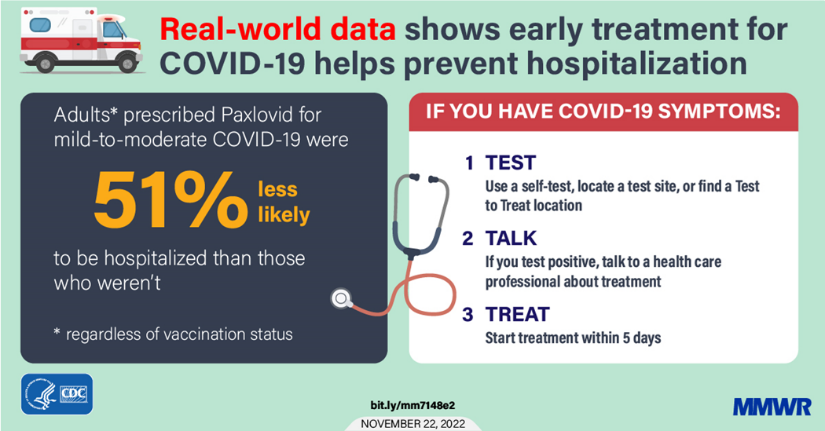
That’s the full picture for most folks. Here’s the “real-world data” link if you are interested. Thank you CDC.

Here are the key points from this week’s CDC FluView:

  • Seasonal influenza activity is high across the country.
  • Of the influenza A viruses detected and subtyped during week 48, 76% have been influenza A(H3N2), and 24% have been influenza A (H1N1).
  • Seven influenza-associated pediatric deaths were reported this week, for a total of 21 pediatric flu deaths reported so far this season.
  • CDC estimates that, so far this season, there have been at least 13 million illnesses, 120,000 hospitalizations, and 7,300 deaths from flu.
  • The cumulative hospitalization rate in the FluSurv-NET system is higher than the rate observed in week 48 during every previous season since 2010-2011.
  • The number of flu hospital admissions reported in the HHS Protect system increased during week 48 compared to week 47.
  • The majority of influenza viruses tested are in the same genetic subclade as and antigenically similar to the influenza viruses included in this season’s influenza vaccine.
  • All viruses collected and evaluated this season have been susceptible to influenza antivirals.
  • An annual flu vaccine is the best way to protect against the flu. Vaccination helps prevent infection and can also prevent serious outcomes in people who get vaccinated but still get sick with the flu.
  • CDC recommends that everyone ages 6 months and older get a flu vaccine annually. Now is a good time to get vaccinated if you haven’t already.
  • There are also prescription flu antiviral drugs that can be used to treat flu illnesses. It’s very important that flu antiviral drugs are started as soon as possible to treat patients who are hospitalized with flu, people who are very sick with flu but who do not need to be hospitalized, and people with flu who are at higher risk of serious flu complications based on their age or health.
  • Multiple respiratory viruses are currently co-circulating with influenza.  Testing is important to determine the appropriate treatment.

From the FEHB front, the FEHBlog was bowled over to discover on reginfo.gov that on November 29, the Office of Personnel Management took a major step forward in implementing the Postal Service Health Benefits Program by submitting a draft interim final rule to OMB’s Office of Information and Regulatory Affairs for its review. This is the final step before the rule is published in the Federal Register. The statutory deadline for so promulgating this rule is April 8, 2023.

From the miscellany department

  • HR Dive discusses a Mercer report on how employers can impact the maternal mortality problem.
    • EBRI offers a useful analysis of telemedicine and its relationship with other healthcare services, enrollee health, and costs.
    • Chain Drug News reports that PCMA, the prescription drug manager trade association, has issued policy recommendations to accelerate patient biosimilar drug use.
    • The Wall Street Journal offers encouraging news about prison programs to resolve inmate addiction issues.

    Two-thirds of people entering prisons and jails have what the Department of Health and Human Services diagnoses as substance-use disorder. For years, the only treatment in all but a handful of detention centers was to detox.

    Some 630 of the roughly 5,000 jails and prisons nationwide now provide medication treatment for opioid use, according to the nonprofit Jail and Prison Opioid Project, up from about 20 in 2015. The drugs include buprenorphine, which tamps cravings for opioids, naloxone, which reverses their effects, and methadone, which eases withdrawal symptoms. Some are taken daily, others can be taken once a month in extended-release versions. The Biden administration said it wants medication available for every drug user in federal custody and at half of state prisons and jails by 2025.


    Thursday Miscellany

    Photo by Josh Mills on Unsplash

    From Capitol Hill, the Wall Street Journal reports

    A top Senate Democrat said that his party planned to introduce an omnibus spending bill Monday, aiming to pressure Republicans to accept a deal or risk an alternative that would freeze government spending at current levels for the full year and cut off the ability to reallocate money in military and other programs.

    Senate Appropriations Committee Chairman Patrick Leahy (D., Vt.) said that the measure would provide military funding at the level Congress is authorizing in its separate defense policy bill—some $858 billion, or roughly a 10% increase—while also paying for what he called a needed increase to nondefense programs.

    “This is a reasonable path forward, and I suggest my Republican friends take it,” Mr. Leahy said. * * *

    If no deal is reached as the end of the year approaches, lawmakers have said they might need to fall back to a so-called continuing resolution, which funds the government at current levels. Various lawmakers have floated stretching funding into early 2023 or for the full fiscal year, which ends in September. 

    The path forward was unclear, as neither House Speaker Nancy Pelosi (D., Calif.) nor Senate Majority Leader Chuck Schumer (D., N.Y.) announced votes on an omnibus bill for next week.

    The Journal adds,

    House lawmakers on Thursday passed a defense policy bill [discussed in yesterday’s FEHBlog post] that authorizes U.S. military leaders to purchase new weapons and increase pay for troops, and lifts a requirement for members of the military to get vaccinated against Covid-19. * * * The legislation is expected to pass the Senate by the end of next week before heading to President Biden’s desk for his signature.

    STAT News tells us

    Key decision makers in Congress are closer than they’ve been in years to revamping the way the government regulates some of the diagnostic tests that patients use to make crucial decisions about their health care [due to the Theranos fiasco].

    If the VALID act passes, the FDA wouldn’t regulate every single clinical test, but only tests considered “high risk” to patients, where the risk to patients of an inaccurate result could cause serious or irreversible harm.

    One example would be a test for breast cancer that could lead a patient to have a mastectomy, Boiani said. Another would be a genetic test that could determine which cancer treatment patients receive, said Jeff Allen, the president and CEO of Friends of Cancer Research.

    From the Federal Employee Benefits Open Season front, Tammy Flanagan writing in Govexec and Drew Friedman writing in Federal News Network offer last minute decision-making tips.

    Investment News provides advice on income adjusted Medicare premium issues.

    Most Medicare beneficiaries will pay the standard Part B premium of $164.90 per month in 2023, down slightly from this year’s monthly premium of $170.10. Medicare Part B covers doctors’ fees and out-patient services. Coupled with a huge 8.7% cost-of-living adjustment in Social Security benefits next year, most retirees will enjoy larger monthly net Social Security benefits after automatic deductions for their Part B premiums in 2023.

    But about 8%, or about 5 million, of the nearly 63 million Medicare beneficiaries will pay more than the standard monthly premium for both Part B and Part D prescription drug plans based on their income. My husband and I are among them.

    For 2023, single beneficiaries with incomes of $97,000 or more and married couples with joint incomes of $194,000 or more pay a Medicare premium surcharge, officially known as an income-related monthly adjustment amount, or IRMAA. The thresholds increased from $91,000 and $182,000, respectively, in 2022, meaning some beneficiaries may avoid IRMAA surcharges altogether in 2023 or pay less than this year due to the inflation adjustments of the income tiers that trigger those surcharges.

    In other health benefits news, Insurance News Net informs us

    The average per-employee cost of employer-sponsored health insurance rose by 3.2% in 2022, according to Mercer’s 2022 National Survey of Employer-Sponsored Health Plans, released today.

    US employers expect a sharper increase of 5.4% in 2023 — and faster cost growth in the years ahead seems likely

     For now, most employers are prioritizing enhancing benefits to attract and retain workers over cost-cutting; enhancements range from adding perks to improving healthcare affordability

     Mental health remains a top concern of employers and employees – and virtual mental healthcare is proving key to improving access to services

    From the Rx development and coverage front, we have three reports from STAT News —

    • Well, this government action didn’t take long. STAT News relates “The Food and Drug Administration announced Thursday it had amended the emergency use authorizations for the updated Moderna and Pfizer-BioNTech Covid-19 boosters, to allow their use in children aged 6 months and older.”
    • Also according to STAT News, “A year ago, the [Purchaser Business Group on Health] coalition created Emsana Health that, in turn, hatched the EmsanaRx pharmacy benefit manager. [Beginning March 1, 2023,] EmsanaRx will run the technology to ensure prescriptions handled by Cuban Cost Plus Drugs are paid and fulfilled, and report all this information back to the [self-funded] employer. In exchange, EmsanaRx will take a flat 1.5% fee for legal, administrative, and data sharing services, but not charge more than $3 for each insurance claim and will pass along any rebates collected.”
    • Finally from STAT News, “Medicare is willing to reevaluate its coverage of Alzheimer’s drugs in light of a new therapy, called lecanemab, that has shown potentially more promising patient data than its controversial predecessor, Aduhelm, according to the official who oversees the program. “I can’t speak to any specifics, but just to say that our door is really open,” Chiquita Brooks-LaSure, administrator for the Centers for Medicare and Medicaid Services, said Thursday at the Milken Institute Future of Health Summit when asked about how the agency will approach lecanemab. “We will look at it as new data comes.”

    From the public health front —

    An outside group [the Reagan Udall Foundation] that was asked to examine problems at the Food and Drug Administration in the wake of an infant formula crisis this year offered a scathing indictment of the agency’s structure and culture and recommended major restructuring, including possibly breaking up the agency so that oversight of the food system gets more attention. * * *

    In a statement, FDA Commissioner Robert M. Califf said he will review the report and make decisions about the future of the agency with input from experts inside and outside the FDA.

    • The Congressional Research Service issued an “In Focus” report on “Regulating Reproductive Health Services After Dobbs v. Jackson Women’s Health Organization.”
    • Health Payer Intelligence tells us

    Overall, major health outcomes measures are trending in a negative direction, according to America’s Health Rankings Annual Report for 2022.

    The Annual Report examines 23 measures to assess health outcomes trends nationwide, including measures for eight chronic conditions. The data for these measures primarily represented 2021 outcomes, but some measures drew from 2018, 2019, 2020, and 2022.

    A Morning Consult online survey conducted in October 2022 informed the results as well as racial and ethnic subpopulation data and a total of 80 national and state measures to assess the state of healthcare in the US.

    Based on the findings, the coronavirus pandemic has continued to have ripple effects on healthcare. The top three major trends in health outcomes are:

    • Increased drug deaths
    • Increased non-medical drug use
    • Increased premature death

    Midweek update

    Photo by Manasvita S on Unsplash

    From Capitol Hill, the Wall Street Journal reports

    Senate Democrats celebrated their win in Georgia giving them 51 seats next year, a result that enhances their power by allowing them to more easily advance President Biden’s nominees while also providing slightly more flexibility on legislation.

    Sen. Raphael Warnock’s win in a runoff election over GOP challenger Herschel Walker comes after two years in which Vice President Kamala Harris provided a tiebreaking vote in the 50-50 Senate. * * *

    Since early 2021, the two parties have been operating under a power-sharing agreement with evenly divided committees, which has prevented Democrats from issuing subpoenas to witnesses without GOP support. When nominees have tied in a committee vote, Democrats have been forced to hold an extra procedural vote to finalize their nomination. The Warnock victory will give Democrats a narrow majority on each panel.

    “It’ll be easier for Democrats to move forward with some of their nominees, particularly in the judiciary, and that makes it more difficult for us,” said Sen. Mitt Romney (R., Utah). 

    Roll Call informs us

    The newly minted defense authorization bill for fiscal 2023 [NDAA], made public Tuesday night, provides a shot in the arm to the U.S. defense budget but bars the military from discharging any more troops who refuse COVID-19 vaccine shots in their arms. * * *

    [This bill has been approved by a House-Senate conference committee.] The House is expected to vote on the NDAA as soon as Thursday and the Senate to soon follow suit, perhaps next week.  

    The bill would authorize a 4.6 percent across the board pay increase for military personnel and civilians. However, House and Senate negotiators removed a House-passed “inflation bonus” of an additional 2.4 percent for troops and Defense Department civilians making less than $45,000 a year. * * *

    Also of note, the bill would ban contractors across the government from using Chinese-made semiconductors, after a lengthy phase-in period, an aide with knowledge of the provision said Tuesday. Many federal contractors and other businesses say they are unclear how they will comply.

     Govexec offers two more insights on the NDAA

    Congressional negotiators on Tuesday night finally revealed a compromise version of the annual defense policy bill with the aim of passing it through both the House and Senate this week. But to some lawmakers, federal employee groups and good government experts’ chagrin, the measure did not include [Insight link] a provision aimed at blocking Republican-led efforts to strip potentially tens of thousands of federal employees of their civil service protections.

    and

    The authorization bill compromise text contains provisions [Insight link] that seek to increase transparency and accountability of investigations into Inspectors Generals [IG] and operations of the Council of Inspectors General on Integrity Efficiency (and its integrity committee, specifically); ensure IGs are only removed for justiciable and compelling reasons (and Congress is notified); and limit who can serve as acting IGs. There are also stipulations for notifying Congress when an agency doesn’t provide requested information or assistance to an IG and providing more training opportunities for IGs. 

    In an effort to address persistent watchdog job vacancies, the bill’s text states: “If the president fails to make a formal nomination for a vacant inspector general position that requires a formal nomination by the president to be filled within the period beginning on the later of the date on which the vacancy occurred or on which a nomination is rejected, withdrawn, or returned, and ending on the day that is 210 days after that date, the president shall communicate, within 30 days after the end of such period and not later than June 1 of each year thereafter, to the appropriate congressional committees.” 

    From the federal employee benefits front —

    FedWeek gives us last minute guidance on the Federal Employee Benefits Open Season that ends next Monday December 12.

    The Wall Street Journal offers ideas for use of flexible spending account dollars. The article make a point that was not on the FEHBlog’s radar screen:

    This year’s December FSA spending crunch could be worse than usual. While you’re meant to empty your FSA every year, during the pandemic the government relented on this rule, allowing FSA savers to roll over what they saved in 2020 and 2021, with some accounts swelling to more than $7,000. 

    That special treatment is set to end in 2022, meaning if you have been accumulating money in your FSA, you may need to empty our account by Dec. 31 or you risk losing it all. “Some people might be in for a rude surprise,” says Spiegel.

    Employers are permitted to give workers a little wiggle room—but not much. Some plans include a rollover provision that allows account holders to carry forward a small portion of their savings, although this amount is limited to $570 for 2022. Other plans may allow a spending grace period of up to 10 weeks.  

    From the infectious disease front —

    • The Wall Street Journal brings us up to date on Omicron treatments.
    • The Hill reports on the state of the flu and RSV surges. “Dr. Andrew Pekosz, a virologist and professor at Johns Hopkins Bloomberg School of Public Health, believes the U.S. is still in the “early stages” of a surge in influenza cases, he told Nexstar. * * * “With RSV we seem to be hitting a plateau,” said Pekosz. “Case numbers have not increased significantly for a couple of weeks, but they’re still at a very high level. So the burden of RSV is still great, but we may be closer to the peak there than we are with flu.”
    • Forbes relates, “A newly discovered immune response inside the nose could explain why respiratory illnesses like RSV, Covid, the common cold and flu thrive in winter, according to research published Tuesday in The Journal of Allergy and Clinical Immunology, a finding that challenges the conventional wisdom that infections spread because people are stuck indoors and signposts ways to develop new treatments.”

    From the Rx development and coverage front

    • MPR informs us “The Food and Drug Administration (FDA) has granted Fast Track designation to PH10 for the treatment of major depressive disorder (MDD). * * * Results showed that treatment with PH10 significantly reduced depressive symptoms as early as 1 week based on the 17-item Hamilton Depression Scale (HAM-D-17) scores compared with placebo (P =.022). The intranasal spray was found to be well tolerated, with no serious adverse events reported.”

    Touted by celebrities, raved about by TikTok users, and advertised by med spas, a new class of drugs for treating diabetes and obesity has exploded in popularity for its weight-loss effects, leading to rippling shortages across several of the medications.

    Amid the surge in demand, Eli Lilly and pharmacies have started to tighten access to the latest of this type of drug, tirzepatide, focusing on giving it to people with type 2 diabetes, the only population it’s authorized for so far. But that’s left another set of patients scrambling — people with clinical obesity who turned to the medication as one of their few options for treatment. * *

    There’s much overlap between the two conditions, said Beverly Tchang, an endocrinologist and assistant professor of clinical medicine at Weill Cornell Medicine. “Obesity can lead to diabetes, diabetes can lead to obesity,” she said. “They’re very much intertwined, and to treat one but not the other seems inequitable.” Tchang treats both types of patients and feels the drug shouldn’t be conserved for one group at the expense of the other.

    From the telehealth front, mHealth Intelligence explains

    FAIR Health’s Monthly Telehealth Regional tracker reported no change in telehealth usage in September compared with August and noted that COVID-19 fell in its rankings on top telehealth diagnoses lists in all regions and at the national level.

    The FAIR Health Monthly Telehealth Regional tracker is a complimentary service that analyzes how telehealth activity and use change monthly by tracking various factors such as claim lines, procedure codes, and diagnostic categories. It represents the privately insured population, including Medicare Advantage but excluding Medicare Fee-for-Service and Medicaid beneficiaries.

    From the public health front —

    • MedPage Today informs us “Drug overdose deaths in pregnancy or the postpartum period increased sharply in the U.S. in recent years, with the rise most pronounced at the start of the COVID-19 pandemic in 2020, researchers reported. * * * Jacob S. Ballon, MD, MPH, of Stanford University in California, noted that the study authors did not provide explanations for why the overdose-related death rate rose sharper among the pregnant and postpartum group during the study period, but said it will likely be the basis for further research. “[It’s] an interesting signal,” said Ballon, who was not involved with the study. “But now what do we do with that to explain it or make some sense of it?”
    • Healthcare Dive tells us
    • Increased delays in discharging patients who require additional care after a hospital stay could slow their recovery, potentially harming health outcomes and quality of life, the American Hospital Association cautioned in a report released Tuesday.
    • The inability to discharge patients is putting additional strain on hospitals operating with thin workforces, and health systems are bearing the cost of care for patients who stay excess days without appropriate reimbursement, the AHA said.
    • The association has urged Congress to help offset the costs of care for patients’ additional days in the hospital by creating a temporary per diem Medicare payment targeted to acute, long-term care, rehabilitation and psychiatric facilities.

    From the U.S. healthcare business front —

    Imagine going into your doctor’s office and facing not a staff of overworked doctors and nurses, but an inviting conversation. A talk with a healthcare professional who has plenty of time, isn’t in a hurry and is ready to listen to a recital of the different aches and pains of your life. Someone with expertise in medications dedicated to making your life easier and healthier. A professional who makes and then hands you a cup of coffee before you even start talking.

    With that conversation–easy, low stress–you can begin a level of trust with your doctor’s office that you might not have had before. And the person listening may, in conjunction with the doctors and nurses, find some better paths to helping you get healthier, even if you suffer from a chronic disease.

    That’s the vision that Fergus Hoban has for the American healthcare system. His company, UpStream, provides integrated services for primary care physicians, both independently and as part of networks or bigger healthcare systems. Centered around a prescribing pharmacist, a team of nurses and other professionals work with doctors to provide better care for Medicare patients while at the same time lowering costs.

    LHC Group and UnitedHealth Group have extended their merger agreement as the feds take a deeper look at the deal.

    The agreement was extended until March 28, 2023, and the two companies now expect the merger to close in the first quarter of 2023, according to a filing with the Securities and Exchange Commission.

    That the insurance giant intended to acquire LHC, a home health provider, was announced in March, and the deal is valued at about $5.4 billion. UnitedHealth said it plans to fold LHC into its Optum subsidiary as part of its provider arm, Optum Health, which is one of the country’s largest employers of physicians.

    LHC Group would add 30,000 employees who provide more than 12 million home health services annually.

    • Health Payer Intelligence also tells us about positive provider and payer reactions to the CMS proposed rule to promote widespread use of electronic prior authorizations. As noted here yesterday, “[t]he proposed rule would require the implementation of Health Level 7 (HL7) Fast Healthcare Interoperability Resources (FHIR) standard Application Programming Interface (API) and mandates that payers have to explain the specific reason behind a prior authorization denial. Expedited prior authorizations will have to occur within 72 hours and non-urgent prior authorizations will have to be turned around in seven calendar days.”

    Tuesday’s Tidbits

    Photo by Patrick Fore on Unsplash

    From the Federal employee benefits front, Fedweek offers year-end benefits and tax guidance to federal and postal employees and annuitants.

    From the medical research and development front,

    STAT News reports, “A consensus may be emerging about how to prescribe the new Alzheimer’s drug lecanemab, according to remarks made by both a critic of other Alzheimer’s medicines and the CEO of the company that developed it.”

    The National Institutes of Health announced

    The protein apolipoprotein E (APOE) plays a key role throughout the body. It helps to transport cholesterol and other fatty molecules, or lipids. The gene that produces APOE comes in a few different varieties. The most common is called APOE3.

    The most notorious is APOE4, which has long been linked to an increased risk of dementia in Alzheimer’s disease. People who inherit one copy of the APOE4 gene have up to a fourfold greater risk of developing Alzheimer’s disease dementia. Inheriting two copies of APOE4 elevates the risk up to twelvefold. But despite years of study, scientists have little understanding of how APOE4 affects the human brain and boosts dementia risk. * * *

    [NIH] Researchers found evidence that the Alzheimer’s-related gene APOE4 disrupts cholesterol management in the brain and weakens insulation around nerve fibers.

    A drug that affects cholesterol led to improved learning and memory in mice with the gene, pointing to a potential new approach for treating dementia in Alzheimer’s disease.

    The Wall Street Journal reports

    New research has bolstered a once-gutsy idea: Bugs in the digestive system may play a role in depression.

    Two studies published Tuesday in the journal Nature Communications found a link between several types of bacteria in the gut and depressive symptoms. Trillions of microorganisms including bacteria, fungi and yeast live in the digestive tract. Research exploring whether they might affect an array of diseases has increased in recent years.

    The new studies, conducted among thousands of people in two cities in the Netherlands, are among the largest to date demonstrating potential associations between gut microbiota and mental health.

    “Ten years ago if you’d said there was something linking depression and the microbiome, you’d be carried out with a straitjacket,” said Jos Bosch, an associate professor of psychology at the University of Amsterdam who co-wrote both studies. “Now absolutely, it’s very clear there’s a link.”

    . . . Researchers who conducted the studies in the Netherlands called their findings a preliminary step toward identifying biological indicators and therapies for depression. The precise relationship between depression and microbes in the gut couldn’t be determined, they said. Depression can cause a person to eat less healthily, Dr. Bosch pointed out, which can lead to changes in the composition of microorganisms in the gut.

    “Causality is a bit up in the air,” he said. 

    From the mental healthcare front, Fierce Healthcare tells us

    While mental health and substance abuse issues have only grown thanks to the pandemic, a bright spot may be forming: The number of providers available to treat these concerns is increasing, a new study shows.

    The United Health Foundation, the philanthropic arm of insurance giant UnitedHealth Group, released its annual “America’s Health Rankings” report and in the analysis found that between 2020 and 2021, the number of people who reported that their mental health was poor in 14 of the last 30 days increased by 11%.

    In 2020, 13.2% reported frequent mental distress, and that rose to 14.7% in 2021, according to the report.

    At the same time, drug-related deaths spiked. The report found that deaths increased by 20% nationwide between 2019 and 2020, reaching 27.9 deaths per 100,000. This is the largest year-over-year increase in more than a decade, according to the report.

    The report also found that disparities within drug deaths increased in tandem. Such deaths increased by 45% among multiracial populations and by 43% among Black populations. Drug-related deaths were highest among American Indian/Alaskan Native populations, occurring at a rate nine times higher than the lowest group, Asian patients.

    However, the analysis found that the supply of mental health providers reached its highest levels since the report was first published in 2017. The number of mental health providers per 100,000 increased by 7% between 2021 and 2022 and has increased by 40% since the 2017 report.

    There are now 305 mental health providers per 100,000, according to the report.

    Health Payer Intelligence adds

    Having one or more outpatient behavioral health treatment (OPBHT) visits was associated with lower healthcare costs among patients with newly diagnosed behavioral health conditions, a JAMA Network Open study found.

    Adults with a behavioral health condition incur 2.8 to 6.2 times greater medical costs than those without one, and nearly a quarter of adults had a behavioral health condition as of 2018. However, behavioral health condition diagnoses are often delayed, and most individuals receive little or no treatment each year.

    From the Rx coverage front, STAT News tells us

    During 2021, drugmakers substantially raised prices on seven widely used medicines without any new clinical evidence to justify the increases, leading patients and health insurers in the U.S. to spend an additional $805 million last year, according to a new report.

    The drug for which spending increased the most due to a price increase was Xifaxan, which is used to treat both irritable bowel syndrome and a complication of cirrhosis. Salix Pharmaceuticals, a unit of Bausch Health, raised the wholesale price by 7.9%. The net price — after rebates and discounts — rose by 12%, most likely because the company offered fewer concessions than previously.

    Consequently, spending for this drug climbed by $174.7 million, according to the report issued by the Institute for Clinical and Economic Review, a nonprofit that assesses the cost effectiveness of medicines. The report noted that the manufacturer disputed the net price and budget impact, which was provided by the SSR Health market research firm, but did not provide corrected estimates.

    Of course, PBM formularies are designed to correct these issues.

    The Wall Street Journal adds

    Emergent BioSolutions Inc., maker of Narcan, a nasal-spray form of naloxone, said Tuesday that the U.S. Food and Drug Administration fast-tracked an application it submitted for an over-the-counter version of its widely used opioid-reversal nasal spray.

    The company said it had been working on the application for several months. Emergent said the FDA’s priority review gives the drug an expected approval date of March 29, 2023, putting it first in line for approval ahead of competitors that have announced their planned foray into the market. 

    The FDA has encouraged pharmaceutical companies to apply for approval for over-the-counter versions of overdose-reversal medications such as Narcan to help confront a swelling overdose crisis from bootleg versions of the powerful opioid fentanyl.

    Last week, FDA Commissioner Robert Califf said naloxone—which binds to opioid receptors to reverse the effects of opioids—should be as ubiquitous as defibrillators.

    From the fraud, waste, and abuse front, mHealth Intelligence reports

    As telehealth use exploded across healthcare programs provided by federal agencies, a report by a watchdog committee shows several program integrity risks linked to telehealth billing, including duplicate billing and ordering unnecessary durable medical equipment or laboratory tests.

    They found that approximately 37 million individuals used telehealth services from March 2020 through February 2021 in the selected programs administered by the six federal agencies. This represents a massive increase from the 3 million individuals in these programs who used telehealth services the year prior.  

    In most programs, telehealth was used primarily to access office visits with a primary care provider or specialist and for behavioral health services, like individual and group therapy and substance use disorder treatment.

    Overall, the agencies spent more than $6.2 billion on telehealth services, with Medicare accounting for the highest expenditure at $5.1 billion, followed by TRICARE and the Federal Employees Health Benefits Program, which together spent $1 billion.

    But the OIGs found several similar program integrity risks associated with billing for telehealth services across multiple programs. These included “upcoding” telehealth visits by billing for visits longer than they lasted, duplicate billing for the same service, ordering unnecessary durable medical equipment, supplies, or laboratory tests, and billing for services inappropriate or ineligible for telehealth.

    From the plan design front, Fierce Healthcare relates

    The Biden administration released a proposal which, if finalized, would mandate Medicare Advantage (MA), Medicaid managed care, Affordable Care Act (ACA) plans and state Medicaid agencies implement electronic prior authorization systems by 2026. 

    The proposed rule, released Tuesday by the Centers for Medicare & Medicaid Services (CMS), will require payers and states to streamline prior authorization processes and improve the electronic exchange of health data by 2026. It also contains incentives for hospitals and physicians to adopt electronic prior authorization.

    “The prior authorization and interoperability proposals we are announcing today would streamline the prior authorization process and promote healthcare data sharing to improve the care experience across providers, patients and caregivers,” CMS Administrator Chiquita Brooks-LaSure said in a statement. 

    It is the revised version of a Trump administration rule originally finalized in late 2020 but withdrawn after concerns about costs and a short deadline. That rule only applied to Medicaid managed care, the Children’s Health Insurance Program and ACA plans, while the new version would apply also to MA plans. 

    Monday Roundup

    Photo by Sven Read on Unsplash

    From Capitol Hill, Roll Call reports the FY 2023 National Defense Authorization Act is expected to rescind the Defense Secretary’s 2021 Covid vaccine mandate for U.S. service members. “Congressional leaders are aiming to introduce the final compromise NDAA version as soon as Tuesday, with House floor action possible later in the week.”

    From the infectious disease front —

    • Bloomberg Prognosis tells about a study confirming the Paxlovid rebounds have been blown out of proportion.
    • Pfizer has asked the Food and Drug Administration for an emergency use authorization applicable to its bivalent Omicron vaccine designed for children at least six months old and not over four years old.
    • The Health and Human Services Secretary has confirmed reported plans to end the mpox public health emergency when the current declaration expires at the end of January 2023. “But we won’t take our foot off the gas – we will continue to monitor the case trends closely and encourage all at-risk individuals to get a free vaccine.”
    • MedPage Today interviews Demetre Daskalakis, MD, MPH, the deputy coordinator of the White House Monkeypox Response Team, about the course of the illness since it erupted in the summer

    Influenza hospitalizations this early in the season are higher than they have been in a decade, according to the CDC, with 14 pediatric deaths reported so far.

    “Since October 1, there have already been at least 8.7 million illnesses, 78,000 hospitalizations, and 4,500 deaths from flu,” said CDC Director Rochelle Walensky, MD, MPH, on a call with reporters on Monday, held in part to kick off National Influenza Vaccination Week. * * *

    This year, influenza vaccines are “well matched to the viruses currently circulating,” she added. The flu shots contain protection for two influenza A and two influenza B virus strains. Of influenza A viruses detected and subtyped this season, 79% have been A(H3N2) and 21% have been A(H1N1).

    The CDC recommends influenza vaccination particularly for children, immunocompromised individuals, pregnant women, and people 65 and over.

    It was not clear if the pediatric deaths reported so far this season involved unvaccinated children, but Fryhofer noted that previous data showed about 80% of influenza deaths occur in unvaccinated persons.

    Pregnant women who get the flu shot also protect their newborns, who are not eligible for vaccination before they are 6 months of age, Fryhofer said. “If you’re not doing it for you, do it for your baby.”

    • For context, here are the flu case and death statistics from the last flu season before Covid struck, October 2019 through March 2020.
    2019 – 2020 Winter CDC Fluview  3/28/20
    Flu Deaths                  24,000 
    Flu Cases             39,000,000 

    The flu is a highly contagious, dangerous disease.

    • NPR Shots offers consumer advice should they counter pharmacy shelves with a low or no supply of anti-fever drugs.

    From the telehealth front, Health Leaders Media tells us

    According to a survey commissioned by America’s Health Insurance Plans, almost 70% used telehealth in the past year because it’s more convenient than in-person care, and almost 80% say telehealth makes it easier to seek out care.

    Almost 50% used telehealth because they were unable to make an in-person appointment, while 24% said they wanted to save money.

    Some 36% used telehealth just once over the past year, while 53% used it between two and five times.

    From the mental healthcare front, Health Payer Intelligence reports

     CareFirst BlueCross BlueShield (CareFirst) is providing community-based organizations with nearly $8 million in grants to help improve behavioral healthcare access and quality for underserved youth.

    The COVID-19 pandemic exacerbated the mental and behavioral health crisis among children, adolescents, and families. In response, CareFirst is investing in 19 community-based organizations in Maryland, Washington, DC, and Northern Virginia.

    “CareFirst recognizes that behavioral health is an essential part of overall health, which includes a continuum of conditions ranging from severe mental health disorders to the emotional, psychological, and social factors that affect a person’s overall wellbeing,” Destiny-Simone Ramjohn, PhD, vice president of community health and social impact at CareFirst, said in the press release.

    Kudos

    From the Rx coverage front, Fierce Healthcare informs us

    Express Scripts, which is part of Cigna’s Evernorth subsidiary, said Monday that it will add biosimilars for Humira to its largest formularies as preferred products available for patients with inflammatory conditions. Like other major PBMs, Express Scripts sees significant potential in biosimilars to help address the massive costs associated with specialty drugs.

    Specialty drugs account for just 2% of prescriptions but drive half of drug spending.

    In October 2021, Express Scripts announced that it would put Semglee, the first Food and Drug Administration-approved interchangeable insulin biosimilar, on its National Preferred Formulary for 2022. The company estimates that this move generated $20 million in savings in the first year.

    From the federal government employee benefits front, Federal News Network relates

    The Office of Personnel Management plans to suspend applications for the Federal Long Term Care Insurance Program for two years beginning Dec. 19, in anticipation of a sizeable rate hike.

    OPM announced the unusual measure last month in the Federal Register, and noted that federal workers who submit their applications by the deadline will still be considered for enrollment. FLTCIP was created in 2002 and assists with health care costs for participants who need help with daily personal functions, or who have a severe cognitive illness, and covers home care, nursing home or assisted living benefits.

    “OPM is suspending applications for coverage in FLTCIP to allow OPM and the FLTCIP carrier to assess the benefit offerings and establish sustainable premium rates that reasonably and equitably reflect the cost of the benefits provided,” the agency wrote.

    The program will continue to operate normally for current enrollees, although they will not be able to apply to increase their coverage. There are currently around 267,000 federal workers and retirees participating in the insurance plan, and OPM typically receives only a few thousand applications to enroll per year.

    The decision to suspend applications for the program came after John Hancock Life and Health Insurance Co., the contractor that administers the program, informed OPM that it is likely that there will a premium increase sometime next year.

    Finally, the Wall Street Journal offers an interesting article about medical research that is “uncovering links between your ‘subjective age’ [as opposed to your chronological age] and your future health and longevity.”

    Weekend update

    Thanks to ACK15 for sharing their work on Unsplash.

    The House of Representatives and the Senate are in session this week for Committee business and floor voting.

    The continuing resolution funding the federal government expires at 11:59 pm on Friday December 16.

    The Federal Employee Benefits Open Season ends at 11:59 pm, in the location of the enrollee’s electronic enrollment system, on Monday, December 12, 2022.

    The Medicare Open Enrollment period ends this Wednesday, December 7.

    From the Rx coverage front, the Wall Street Journal reports on

    • A shortage in the weight loss drug Wegovy, “missing out on hundreds of millions of dollars in sales and squandering a head start before a rival could begin selling a competing product. * * * [Wegovy manufacturer’ Novo lists Wegovy at $1,349 a month. Some commercial insurers cover the drug.” OPM has encouraged FEHB carriers to offer coverage of this drug.
    • A CVS Health effort to improve pharmacy efficiency with “a system [currently being tested] that allows pharmacists to process prescriptions in part remotely, a move it said could improve store working conditions and the experience for customers as the company grapples with a shortage of pharmacists.”

    From the mental healthcare front, Health Payer Intelligence tells us

    Mental healthcare services utilization and network size have grown significantly since 2019 among Blue Cross Blue Shield of Massachusetts (“Blue Cross”) members, according to data from Blue Cross.

    Mental healthcare services utilization grew by 100 percent in the timeframe that Blue Cross examined. At the same time, Blue Cross’s mental healthcare network grew by 46 percent.

    “As the need for mental health services continues to grow, access to convenient and affordable care is critical,” said Andrew Dreyfus, president and chief executive officer of Blue Cross. “By expanding and diversifying our mental health network, we’re ensuring that our members are able to find and receive the high-quality care they need, when they need it.”

    The mental healthcare provider network swelled to a total of 18,000 clinicians. With the growth in utilization, Blue Cross plans to expand its network further. The payer will do this by working with national mental healthcare provider groups as well as expanding its virtual care mental health groups in 2023. * * *

    Blue Cross also shared that the health plan’s reimbursement for telehealth and virtual care services is at parity with in-person services. Receiving reimbursement at parity is not only a controversial issue for telehealth providers but also for mental and behavioral healthcare providers, who do not always receive reimbursement at parity with physical care providers.

    Kudos.

    Also worth reading is this Journal article about a 24-year-old military wife who went through drug addiction hell and came out a new person with help from her family, the Missouri prison where she was housed, and a fellow inmate. The article illustrates the importance of Blue Cross of Massachusett’s efforts to expand mental health coverage and various efforts to reduce drug addiction and overdose deaths.

    From the medical research front, the Wall Street Journal offers an essay about breast cancer written by a medical historian and breast cancer patient Dr. Lindsey Fitzharris. What grabbed the FEHBlog’s eye is the article’s conclusion:

    The cofounders of BioNTech recently announced that vaccines targeting cancer may be available before the end of the decade. Researchers at Duke University are already developing a vaccine that targets mutations commonly arising in people with certain types of advanced breast cancer. Using the same mRNA technology deployed against Covid-19, these types of vaccines would not be administered prophylactically but, rather, used as a treatment to trigger a stronger immune response in patients with locally recurrent or metastatic disease. When it comes to conquering breast cancer, future medical historians will have plenty to write about.

    From the innovation front, Senior Living explains how to use Apple AirPods as hearing aids. MedTech Dive adds

    • Apple AirPods Pro earbuds have the potential to be a hearing aid for adults with mild to moderate hearing loss, according to a paper published in iScience. 
    • Researchers found the earbuds meet four of the five standards for personal sound amplification products and perform comparably to hearing aids in terms of speech perception in quiet environments.
    • The study suggests that some consumer earbuds can function as hearing aids to potentially further lower the cost and address the stigma associated with the technology.

    It’s also worth calling attention to the HHS Agency for Healthcare Quality and Research’s Effective Health Care Program’s website.

    The Effective Health Care (EHC) Program improves the quality of health care by providing the best available evidence on the outcomes, benefits and harms, and appropriateness of drugs, devices, and health care services and by helping health care professionals, patients, policymakers, and health care systems make informed health care decisions. The EHC Program achieves this goal by partnering with research centers, academic institutions, health professional societies, consumer organizations, and other stakeholders to conduct research, evidence synthesis, evidence translation, dissemination, and implementation of research findings.

    Cybersecurity Saturday

    From the cybersecurity policy front —

    Health IT Security reports

    Following reports that patient data was transmitted to Facebook through the use of tracking technology on hospital websitesand within password-protected patient portals, the HHS Office for Civil Rights (OCR) issued a bulletin outlining the dos and don’ts of using tracking tech as a HIPAA-covered entity or business associate.

    Covered entities and business associates using tracking tools such as Google Analytics and Meta Pixel should pay close attention to their obligations under HIPAA, OCR noted.

    Cybersecurity Dive informs us

    The Cyber Safety Review Board is set to examine the Lapsus$ ransomware gang, the U.S. Department of Homeland Security announced Friday. A prolific group, Lapsus$ has targeted a wide range of global companies and government agencies, sometimes with ruthless digital extortion, since late 2021. * * *

    “The CSRB will review how this group has allegedly impacted some of the biggest companies in the world, in some cases with relatively unsophisticated techniques, and determine how we all can build resilience against innovative social engineering tactics and address the role of international partnerships in combating criminal cyber actors,” Mayorkas said Friday during a conference call with reporters. “As cyberthreats continue to evolve, we have to evolve the methods we use to protect ourselves against cybercriminal activity and increase our resilience against future attacks.” * * *

    CSRB Deputy Chair Heather Adkins, VP of security engineering at Google, noted that many of the reported targets of Lapsus$ were considered to have very strong cybersecurity programs. These organizations had followed recommended security controls, and in some cases even advanced controls, but still felt a significant impact from the attacks. 

    Several alleged members of the extortion gang have been arrested, but researchers suspect other affiliates of Lapsus$ remain unaccounted for.

    Healthcare Dive offers an interview with the National Coordinator for Health IT, Mickey Tripathi, about federal health information blocking enforcement.

    From the cybersecurity breaches/vulnerabilities front —

    • Health IT Security summarizes recent breaches suffered by healthcare organizations.
    • ZIP and RAR files have overtaken Office documents as the file most commonly used by cyber criminals to deliver malware, according to an analysis of real-world cyber attacks and data collected from millions of PCs. 
    • The research, based on customer data by HP Wolf Security, found in the period between July and September this year, 42% of attempts at delivering malware attacks used archive file formats, including ZIP and RAR.  
    • That means cyber attacks attempting to exploit ZIP and RAR formats are more common than those which attempt to deliver malware using Microsoft Office documents like Microsoft Word and Microsoft Excel files, which have long been the preferred method of luring victims into downloading malware. 

    From the ransomware front —

    • The Health Sector Cybersecurity Coordination Center shared an updated CISA / FBI alert about a Cuba ransomware actor.
    • The Bleeping Computer released its Week in Ransomware.

    From the cybersecurity defenses front —

    • Venture Beat offers Gartner analysts’ eight cybersecurity predictions for 2023.
    • Health IT Security reports “Connected device security company Ordr published a maturity model to help healthcare organizations evaluate and improve the security of their connected devices. The guide is broken down into five stages of maturity, each with recommended actions and detailed descriptions.”
    • The Wall Street Journal warns “Companies should do a better job of handling internal cybersecurity complaints before they escalate to whistleblowing, which is becoming more common in the cyber field, lawyers and industry veterans said.”

    Friday Stats and More

    Photo by Sincerely Media on Unsplash

    From the Omicron and siblings front, the Centers for Disease Control’s weekly interpretative summary of its Covid statistics explains

    Cases

    As of November 30, 2022, the current 7-day average of weekly new cases (43,300) decreased 1.2% compared with the previous 7-day average (43,837). A total of 98,777,220 COVID-19 cases have been reported in the United States as of December 30, 2022.

    Variant Proportions

    CDC Nowcast projections* for the week ending December 3, 2022, estimate the proportion of lineages designated as Omicron with estimates above 1%: BA.5—and four of its sublineages (BQ.1, BQ.1.1, BF.7, and BA.5.2.6)—BA.4.6,and XBB. XBB is a recombinant of two BA.2 sublineages.

    New Hospital Admissions

    The current 7-day daily average for November 23–29, 2022, was 4,201. This is a 17.6% increase from the prior 7-day average (3,572) from November 16–22, 2022.

    Vaccinations

    As of November 30, 2022, 655.3 million vaccine doses have been administered in the United States. Overall, about 267.3 million people, or 80.5% of the total U.S. population, have received at least one dose of vaccine. About 228.4 million people, or 68.8% of the total U.S. population, have completed a primary series.

    Of those who have completed a primary series, about 114.8 million people have received a booster dose,* and more than 39.7 million people have received an updated (bivalent) booster dose. But 48.3% of the total booster-eligible population has not yet received a booster dose. Learn more about who is eligible.

    Deaths

    The current 7-day average of new deaths (254) decreased 32.4% compared with the previous 7-day average (376). As of November 30, 2022, a total of 1,077,303 Covid-19 deaths have been reported in the United States

    The CDC also released an encouraging report about Paxlovid’s efficacy.

    Summary

    What is already known about this topic?

    Nirmatrelvir-ritonavir (Paxlovid) is an outpatient antiviral medication recommended for adults with mild-to-moderate COVID-19 who have elevated risk of severe illness.

    What is added by this report?

    Among U.S. adults diagnosed with COVID-19, including those with previous infection or vaccination, persons who were prescribed Paxlovid within 5 days of diagnosis had a 51% lower hospitalization rate within 30 days after diagnosis than those who were not prescribed Paxlovid.

    What are the implications for public health practice?

    Paxlovid should be offered to eligible adults irrespective of vaccination status, especially in groups with the highest risk for severe COVID-19 outcomes, such as older adults and those with multiple underlying health conditions.

    Also from the public health front, the CDC’s Fluview tells us

    • Seasonal influenza activity is high and continues to increase across the country.
    • Of influenza A viruses detected and subtyped this season, 79% have been influenza A(H3N2) and 21% have been influenza A(H1N1).
    • Two influenza-associated pediatric deaths were reported this week, for a total of 14 pediatric flu deaths reported so far this season.
    • CDC estimates that, so far this season, there have been at least 8.7 million illnesses, 78,000 hospitalizations, and 4,500 deaths from flu.
    • The cumulative hospitalization rate in the FluSurv-NET system is higher than the rate observed in week 47 during every previous season since 2010-2011.
    • The number of flu hospital admissions reported in the HHS Protect system during week 47 almost doubled compared with week 46.
    • The majority of influenza viruses tested are in the same genetic subclade as and antigenically similar to the influenza viruses included in this season’s influenza vaccine.
    • All viruses collected and evaluated this season have been susceptible to influenza antivirals.
    • An annual flu vaccine is the best way to protect against flu. Vaccination helps prevent infection and can also prevent serious outcomes in people who get vaccinated but still get sick with flu.
    • CDC recommends that everyone ages 6 months and older get a flu vaccine annually. Now is a good time to get vaccinated if you haven’t already.
    • There are also prescription flu antiviral drugs that can be used to treat flu illness; those need to be started as early as possible.

    The Wall Street Journal offers a helpful overview of the tripledemic situation.

    From the Alzheimer’s Disease front —

    STAT News reports

    Scientific meetings about Alzheimer’s disease can be funereal affairs, with researchers from around the world gathering in hopes that the latest in a long line of negative clinical trials might light the path to a long-awaited success.

    This year was different. Nearly 2,000 people showed up to the Clinical Trials in Alzheimer’s Disease meeting, a conference record, to hear about lecanemab, a drug from Eisai and Biogen that appears to have broken the decades-long cycle of disappointment.

    A packed audience repeatedly burst into applause during Eisai’s lecanemab presentation on Tuesday — with onlookers clapping even when they learned that the results had been concurrently published in the New England Journal of Medicine. Supplemental figures don’t usually don’t draw cheers, but the warm reception underscored how overjoyed researchers were to have any kind of success against Alzheimer’s, even a modest one. * * *

    Several researchers compared this moment in Alzheimer’s research to the early days of cancer therapy or HIV treatment — the first drugs aren’t smash hits, but they’re something for scientists and doctors to build on and learn from.

    “It’s not like you’ve won the war with lecanemab,” said Eric Siemers, chief medical officer of Acumen Pharma. “We’ve got a lot of work to do. But this is an inflection point. There’s no question about it.”

    In that regard, BioPharma Dive points out lessons learned from testing a Roche drug similar to lecanermab.

    After one year of treatment, [the Roche drug] gantenerumab reduced amyloid burden in patients only half as well as the trials’ designers had expected based on previous research, said researcher Randall Bateman, a neurology professor at Washington University in St. Louis who helped lead the studies.

    Moreover, around half as many gantenerumab patients as predicted tested negative for amyloid over the course of the trial. Almost none tested negative after one year of treatment, and only around a quarter did after more than two years, researchers revealed.

    Data for lecanemab and donanemab presented at CTAD, meanwhile, showed stronger amyloid clearance, helping boost confidence in those drugs.

    Bateman also pointed to a post-study analysis researchers conducted of Roche’s trials that hinted at better outcomes for trial participants who had higher reductions in amyloid, although this finding wasn’t statistically conclusive.

    Taken together with data from other trials, gantenerumab’s results should help researchers as they try to optimize available therapies and develop new ones, Bateman said.

    “I see this as one of the missing essential pieces of the puzzle of figuring out how to optimally treat along this pathway for amyloid removal,” he said.

    Meanwhile, the New York Times tells us about “A Promising Trial Targets a Genetic Risk for Alzheimer’s
    Preliminary results offer hope that gene therapy can protect people with a version of the brain disease driven by a particular gene variant.”

    From the U.S. healthcare business front, Healthcare Dive reports

    Advocate Aurora Health and Atrium Health announced Friday the two providers have closed their merger deal, becoming the nation’s fifth-largest nonprofit health system by revenue.

    The new system, Advocate Health, will generate revenue of more than $27 billion and operate 67 hospitals and more than 1,000 sites of care in six states. The system expects to treat nearly 6 million patients each year. * * *

    The two systems do not have any geographic overlap, an aspect that has tripped up prior hospital mergers.

    Instead, economists told Healthcare Dive, the FTC is likely to examine insurer overlap in the case of Advocate Health. The combined entity operates in Illinois, Wisconsin, Georgia, North Carolina, South Carolina and Alabama.

    From the federal employment front —

    Govexec informs us

    The Biden administration will allow agencies to hire employees in certain positions on a temporary basis for up to 10 years, more than doubling the current cap limiting the assignments for those workers.

    The Office of Personnel Management issued the rule on Thursday, finalizing a proposal first put forward by the Trump administration. The rule will enable federal agencies to appoint employees in STEM jobs for a decade. OPM said the change would give agencies more flexibility when tackling long-term science, technology, engineering and mathematics projects. Previous regulations required agencies to get special permission from OPM to keep any term employee on staff for longer than four years.

    Viet Tran, an OPM spokesman, said the rule showed the administration’s “commitment to STEM hiring.” He added it would allow for more federal, rather than outsourced, hiring. 

    “With this final rule, agencies have more flexibility and support (and less administrative burden) to hire employees—rather than contractors—for non-permanent STEM positions that agencies expect from the outset to last longer than 4 years but not more than 10 years,” Tran said. “This is another tool to help agencies better compete for talent.”

    As the FEHBlog has explained, federal employees can expect a 4.6% pay raise for 2023 with 4.1% of the increase being distributed across the GS schedule and the remaining 0.5% allocated to locality pay. As it turns out, the Society for Human Resource Management tells us

    Employers in the U.S. plan to boost salaries an average of 4.6 percent in 2023, up from 4.2 percent this year, according to a new study.

    Employers say inflationary pressures and the ongoing challenges of finding and keeping workers are the main reasons for the higher projected increases. Indeed, 3 in 4 of the 1,550 U.S. employers in the latest Salary Budget Planning Report by consultancy WTW say they continue to experience problems attracting and retaining workers. The survey was conducted from Oct. 3 to Nov. 4, 2022.

    From the plan design front, a recent Kaiser Family Foundation report explains the growing use of all sizes of employers to provide retiree health benefits through Medicare Advantage plans.

    This analysis uses data from the 2022 KFF Employer Health Benefits Survey to examine the extent to which large private and non-federal public employers that offer retiree health benefits are turning to Medicare Advantage and why they are making this shift. However, the Survey does not include information about union-administered benefits. For additional information about methods, see Survey Design and Methods.

    Based on the Survey, we find:

    • Half (50%) of large employers offering retiree health benefits to Medicare-age retirees offer coverage to at least some retirees through a contract with a Medicare Advantage plan, nearly double the share in 2017 (26%).
    • About 44% of large employers that offer Medicare Advantage coverage to their retirees do not give retirees a choice in coverage options. 
    • Among larger employers with 1,000 or more workers that offer retiree health benefits through a Medicare Advantage plan, the most commonly cited reason they elected this option was the lower cost.

    FEHB plans also are implementing integrated Medicare Advantage plans as a cost-saving measure.

    From the HHS front, “Today, the U.S. Department of Health and Human Services (HHS) Secretary Xavier Becerra marked the one-year anniversary of HHS’s Overdose Prevention Strategy (Strategy) by announcing the progress the nation has made since the release of the Strategy, showing expanded treatment capacity, lives saved from an overdose, and commitment to long term recovery supports.” Kudos. Here is the fact sheet.

    Thursday Miscellany

    From the Federal Employees Benefit Open Season front, Tammy Flanagan, writing in Govexec, explains the relationship between FEHB and Medicare coverage for the benefit of annuitants over age 65.

    From the OPM front, Govexec and Federal News Network discuss an OPM management report released yesterday that includes more details on OPM’s 2022 Federal Employee Viewpoint Survey.

    From Capitol Hill, Medpage Today informs us that “Telehealth, Mental Health Likely Topics for the New Congress in 2023, Experts Say.” In this regard, today the bipartisan leadership of the Senate Finance Committee “released a [fifth and final mental health parity] discussion draft including policies aimed at improving mental health parity in Medicare and Medicaid and helping to put access to mental health and substance use disorder (SUD) services on par with physical health care. Mental health parity includes a set of laws aimed at ensuring mental and physical health care are covered equally by health insurance. * * * The full text of the discussion draft is available here. A summary of all provisions released by the committee as a part of the bipartisan mental health effort, including mental health parity, is available here.”

    From the Omicron and siblings front —

    Beckers Hospital Review reports

    COVID-19 hospitalizations have ticked up nationwide in recent weeks amid concerns of a potential winter surge, according to data tracked by The New York Times.

    As of Nov. 29, the nation’s daily hospitalization average was 31,125, up 12 percent over the last 14 days. This figure is still down significantly from the more than 800,000 daily hospitalizations recorded during the peak of last winter’s omicron surge. 

    MedPage Today informs us

    People with acute respiratory illness during the pandemic suffered similar levels of poor well-being in the months afterward whether they tested positive for SARS-CoV-2 or not, a registry study showed.

    In a cohort of people who all had initial symptoms suggestive of COVID-19, those who had moderate to severe scores at 3 months on the pain, mood, and other quality-of-life measures on the Patient-Reported Outcomes Measurement Information System (PROMIS) scale were actually less likely to have tested positive for the coronavirus as to have had other causes of illness (39.6% vs 53.5%, P<0.001).

    From the public health front —

    MedPage Today explains how patients can try to distinguish among different respiratory illnesses, including RSV and the flu because at home testing is unavailable.

    Politico Pulse reports

    The Biden administration looks to end its public health emergency declaration for mpox — the virus formerly known as monkeypox until recently — a sign that officials believe they’ve brought the unprecedented outbreak under control, POLITICO’s Adam Cancryn reports.

    Health officials are likely to issue a 60-day notice later this week for winding down the declaration, two people with knowledge of the matter told POLITICO, putting it on track to expire by Jan. 31. The decision isn’t yet final and could still change, the people cautioned. * * *

    Some administration officials see the potential unwinding of the mpox emergency declaration as a test run for eventually ending the yearslong Covid emergency — a more complex challenge — that Biden aides expect to happen at some point next year.

    From the Affordable Care Act and No Surprises Act front

    The American Hospital Association (“AHA”) informs us

    The Centers for Medicare & Medicaid Services seeks public input on topics related to essential health benefits — items and services that all non-grandfathered health plans in the individual and small group markets must cover under the Affordable Care Act. The agency is requesting feedback on how essential health benefits may need to be updated to reflect changes in medical evidence and scientific advancement, address gaps in coverage and health equity, or remove barriers to accessing services. In particular, CMS seeks feedback on essential health benefits related to maternal health, behavioral health and prescription drug coverage. The agency will publish the request for information in the Dec. 2 Federal Register, with comments accepted for 60 days. 

    and

    AHA today urged the Centers for Medicare & Medicaid Services not to establish a national directory of health care providers and services (NDH) at this time.

    “The AHA shares CMS’ goals to improve patient access to provider information and to facilitate health information exchange and data reporting,” the association wrote. “We appreciate the commitment CMS has invested in striving to meet these objectives. However, we are concerned that adding one more provider directory requirement will not support patients in accessing the information they need about their care providers. In fact, adding an additional data source without sufficiently addressing how or why it differs from the myriad provider directories already in existence could further complicate patients’ ability to access accurate information. Meanwhile, such a requirement would add considerable, duplicative burden on providers. Additionally, we have significant reservations about the current state of readiness of the essential technology needed for a centralized data hub such as the NDH.”

    Mercer Consulting offers insights on the prescription drug and healthcare spending reports that health plans must submit to the federal government by December 27. Jingle bells.

    Healthcare Dive reports that the Texas Medical Association has filed another lawsuit challenging different aspect of the independent dispute resolution rule. Haven’t the TMA lawyers heard about the opportunity available under the Federal Rules of Civil Procedure to amend their existing complaint?

    From the Rx coverage front —

    STAT News relates

    The Food and Drug Administration approved the first therapy using bacteria from stool samples to treat a bowel disorder on Wednesday, paving the way for several similar treatments in development.

    The drug, called Rebyota, is given as a one-dose treatment for Clostridium difficile infections, commonly known as C. diff., in which the toxin-producing bacteria disrupts the normal balance in a person’s digestive system. Rebyota is designed to restore balance by introducing good bacteria taken from donor stool samples. 

    “We are delighted that FDA has approved the first fecal microbiome restoration therapy for recurrent C. diff. This is an enormous step forward for the nearly 200,000 people who battle rCDI each year,” ​​said Christian John Lillis, the executive director of the C. diff advocacy organization the Peggy Lillis Foundation. 

    and

    Amgen released detailed data on Thursday suggesting an early-stage drug can induce significant weight loss in patients with obesity, with less frequent dosing than current treatments but a safety profile that remains unclear.

    The results for the molecule, codenamed AMG133, throw Amgen in a long-gestating race with other major drugmakers that burst into the popular press this year.

    Eli Lilly and the diabetes giant Novo Nordisk both market drugs that were recentlyshown to lower body weight by around 15% to 20% after a little over a year. (Lilly’s is currently approved only for diabetes, but it plans to submit for obesity next year.) The injectables have been highly sought after by both obesity specialist physicians, who have long searched in vain for something safe and effective to offer their patients, and celebrities hoping to look svelte in their next appearance.

    From the miscellany department —

    Beckers Hospital Review interviews a Kaiser Permanente expert about their successful use of remotely monitoring patients with diabetes and high blood pressure. The monitors deliver their results to Kaiser Permanente’s electronic health records for 40,000 members. Kudos.

    Beckers also lets us know about large hospital systems that are having a profitable 2022.

    STAT News reports

    Elon Musk’s brain-machine interface company Neuralink aims to put its first implant in a human subject in the next six months, he said during an event Wednesday.

    Musk said the company has been “working hard to be ready for our first human,” and has submitted most of the required paperwork to the Food and Drug Administration to launch a study in humans. The company — which is designing a device to translate the brain’s signals into actions — also announced it will first focus specifically on two applications: restoring human vision, and helping people who can’t move their muscles to control devices like smartphones or even return the ability to move to people with severed spinal cords, Musk said.

    Though it’s starting with certain parts of the brain, Musk said Neuralink’s long-term goal is to create a system that can translate impulses from the entire brain into actions.

    Midweek Update

    From the federal employment front —

    • Govexec discusses the outstanding steps that must be taken before a projected 4.6% federal employee pay raise can take effect next month. The FEHBlog expects those steps to be taken.
    • Reg Jones, writing in FedWeek, reviews the federal retirement process.
    • Federal News Network reports that “Federal employees forced to work without pay during government shutdowns need to be made whole eventually. But the government’s late payments don’t mean those workers are entitled to damages, [the U.S. Court of Appeals for the Federal Circuit] ruled Wednesday.

    From the Omicron and siblings front, the Wall Street Journal informs us

    The Food and Drug Administration said a Covid-19 antibody treatment from Eli Lilly & Co. is no longer authorized for use because it isn’t likely to be effective against certain Omicron offshoots now dominant in the U.S.

    The subvariants, called BQ. 1 and BQ. 1.1, now cause more than half of new Covid-19 cases in the U.S., the FDA said on Wednesday. Yet Lilly’s drug, bebtelovimab, doesn’t retain neutralizing activity against the subvariants, the company said. 

    “Lilly and the FDA agree that it is not medically appropriate, at this time, to treat high-risk patients with mild-to-moderate Covid-19 with bebtelovimab in the U.S.,” Lilly said.

    Bebtelovimab was among the Covid-19 antibody drugs still authorized for use as a treatment for sick patients, after the FDA pulled clearances of others. Roche Holding AG’s Actemra antibody drug is also still in use as a treatment, though it wasn’t developed specifically for Covid-19.

    Evusheld, an antibody drug from AstraZeneca PLC, is still cleared to prevent infections.

    The FDA said other Covid-19 treatments are still expected to retain activity against BQ. 1 and BQ. 1.1, including PfizerInc.’s Paxlovid and Gilead Sciences Inc.’s Veklury.

    In other public health news, STAT News tells us

    With growing concern about the circulation of vaccine-derived polioviruses in the United States, the Centers for Disease Control and Prevention said Wednesday that it would work with select communities across the country to conduct wastewater surveillance for the viruses.

    The launch of the initiative follows the discovery over the summer of vaccine-derived polioviruses circulating in the sewage of a number of counties in and around New York City. That discovery was made after an unvaccinated man in his 20s was partially paralyzed by polioviruses in July. Since then at least 82 genetically linked viruses have been recovered in sewage samples collected from five counties in and around New York.

    The CDC said the work will start in two communities: Oakland County, Mich., and an as-yet-unnamed county in the Philadelphia area. The surveillance may later extend to other parts of the country where polio vaccination rates are low or to locations that have ties to the communities in New York state where polioviruses have been found in wastewater.

    From the U.S healthcare business front —

    Healthcare Dive reports

    Heightened expenses, ongoing staffing shortages and fewer patient discharges have hospitals facing negative margins near the end of the year, according to Kaufman Hall’s monthly national flash report out Wednesday.

    Median operating margins have been in the red for 10 consecutive months and were down 2% in October from September. Median operating margins were down 13% year over year in October, according to the report.

    Total labor expenses rose 3% from September and total expenses rose 1%, while supply and drug expenses did fall slightly during the month.

    In that regard, Beckers Hospital CFO Report relates

    Cleveland Clinic has reported a more than $1 billion loss for the first nine months of 2022 as salaries increase and inflationary pressures mount.

    The 20-hospital health system reported $469.2 million in third quarter net losses, a significant drop from $422.2 million net income last year. Cleveland Clinic’s investment returns were nearly $682 million lower for the third quarter this year than last due to “unfavorable financial markets,” according to the health system’s financial report.

    In contrast, Fierce Healthcare reports

    Highmark Health posted a $268 million net loss through the first nine months of 2022 as multiple headwinds drag its finances.

    Highmark reported $19.5 billion in revenue, up 22% year-over-year, and $594 million in operating gain. The performance of its equity investment portfolio is a key challenge facing the integrated system, as its financial report includes $670 million in unrealized investment impact driven by a decline in the portfolio.

    Saurabh Tripathi, chief financial officer and treasurer of Highmark Health, told Fierce Healthcare that Hihghmark expects to turn that unrealized impact around as the market improves.

    Other major headwinds include ongoing supply chain issues, inflation and high labor costs, particularly at its Allegheny Health Network health system. Strong performance at its health plan arm is helping to bolster AHN as it weathers these challenges that providers nationwide are staring down.

    “This is where the strength of our portfolio comes in,” Tripathi said. “The insurance side is helping offset those pressures.”

    Ah, the benefits of diversification.

    From the medical research and development front,

    • The NIH HEAL Project Initiative’s Director delves into HEAL’s research on preventing opioid addiction.
    • BioPharma Dive examines “What to make of Eisai and Biogen’s latest Alzheimer’s drug data.” Given the FEHB Program’s demographics, FEHB carriers should keep an eye on this drug which is bound to be an expensive hot seller if the manufacturers can overcome the blowback from their Aduhelm failure.