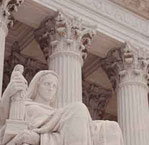
Majestic Supreme Court

Majestic Supreme Court

It turns out that Wall Street Journal columnist Danied Henniger attended the Supreme Court’s oral arguments on Monday, the day before McVeigh was argued. He wrote an engaging column in yesterday’s paper (subscription required) which concluded as follows: “[T]o enter the Supreme Court and encounter the place, the people and its essential purpose is to feel carbon-dated to 1789. Though often maddening, its majesty remains intact.” That is so true. I am so glad that I took my high school age daughter along to see the McVeigh argument on Tuesday (my own little Take your Daughter to Work event). It was impressive.

McVeigh oral argument before the Supreme Court


I had the pleasure of attending the oral argument before the Supreme Court in the McVeigh case (No. 05-200) on April 25 (see my April 22 post). This was only the second or third time that I had witnessed Supreme Court arguments, and this was the very first time that the Supreme Court has interpreted the Federal Employees Health Benefits Act so I will not engage in any prognostication based on the oral argument.

Tony Shelley of Miller & Chevalier, counsel for petitioner Empire Blue Cross, and an attorney for the U.S. Solicitor General’s office, Sri Srinivastan, argued the FEHB Program’s position that federal courts possess jurisdiction over carrrier lawsuits to enforce plan provisions, here the subrogation provision. Both Tony and the Solicitor General’s representative argued the case very well.

The Justices posed many questions to Tony, the Solicitor General’s representative, and McVeigh’s counsel. Chief Justice Roberts, Justice Breyer, Justice Souter, Justice Scalia, and Justice Ginsburg were the most active participants in the argument. The other Justices (with the exception of Justice Thomas) interjected points occasionally. (I am amazed at how well Justice Stevens looks at age 86.) The transcript will be posted in a few weeks at the Supreme Court’s website.

In retrospect, the key exchange from my perspective occurred at the end of the Solicitor General’s presentation when Mr. Srinivastan made the point that ultimately this case concerns money to be reimbursed to the federal treasury. McVeigh’s counsel then began to present his argument and Justice Breyer asked him to distinguish this case from the Supreme Court’s decisions in Clearfield Trust and Kimbell Foods. In Clearfield Trust, the Supreme Court held that “The rights and duties of the United States on commercial paper [in that case an employee paycheck] which it issues are governed by federal rather than local law. When the United States disburses its funds or pays its debts, it is exercising a constitutional function or power federal employee paychecks. ” McVeigh’s counsel was never able to answer this question, and Justice Breyer’s point (which, of course, was made in the Empire Blue Cross and SG briefs) resonanted with other justices, particularly Justice Souter.

I came into the argument with the opinion that the Supreme Court will rule for the Program’s position, and I came out of the Supreme Court holding the same opinion. The decision will be rendered before the end of the Supreme Court’s term in June.

Happy National DNA Day!

Today is National DNA Day, which commemorates the completion of the National Human Genome Mapping Project in April 2003. I wonder whether I will still be alive when someone makes a breakthrough discovery about how to use the genome map to improve/prolong human health. I think that I will, and I was encouraged by a recent article in the Wall Street Journal (subscription required). The article ( New Genetic Tools May Reveal Roots Of Everyday Ills, April 14, 2006, p. A1) explains that
“DNA is composed of repetitions of four chemical building blocks, which are known by the letters A, G, C and T. The full human genome consists of a combination of three billion letters and the code is nearly identical among any two people. However, about 0.1% of the letters commonly vary. Those variations are believed to lie behind many of the differences amongst people — what they look like and how vulnerable they are to particular diseases. “The gene variants are called “snips,” shorthand for single-nucleotide polymorphisms, or SNPs. A few years after Dr. Risch’s 1996 article, government and industry launched a major effort to catalog them. It turned out to be costly and slow. In the most recent phase of the effort, the U.S. government, along with China, Japan and other nations, spent nearly $139 million cataloging how more than one million SNPs varied among several groups, including residents of Nigeria, Tokyo and Beijing, and Americans of European background. “The next step is to compare SNPs from hundreds or thousands of sick individuals with those from healthy people. That will theoretically allow scientists to zero in on genes that underlie disease.”Until recently, this comparison has been a very expensive process but according to the Journal last year two U.S. companies “Affymetrix Inc. of Santa Clara, Calif., and Illumina Inc. of San Diego” each introduced miniature chips that can detect more than 300,000 genetic markers, or SNPs, at once. This development “has spurred a frenzy of” genetic research activity. “The Broad Institute, in Cambridge, Mass., is tackling genetic research that “five years ago you couldn’t do…for $10 billion,” says David Altshuler, a geneticist there.”

The purpose of DNA Day is to encourage young scientists to tackle this project. If there’s any magic bullet for our health care cost problems, this may be it. Let’s keep our fingers crossed and keep rooting for the scientists.

New Medicare Part D Creditable Coverage Guidance

We are approaching the end of the initial Medicare Part D open enrollment period on May 15. In anticipation of that event, CMS released today Creditable Coverage Guidance and Model Notices entities can use when disclosing creditable coverage status to beneficiaries after May 15, 2006.

On April 20, 2006, HHS announced that 30 million Medicare beneficiaries now have prescription drug coverage. 8.1 million voluntarily have enrolled in Medicare Part D prescription drug plan; 5.8 million voluntarily enrolled in a Medicare Part C (Advantage) plan offering a drug benefit, and 5.8 million with dual Medicare/Medicaid eligibility were enrolled automatically in Part D plans. 6.8 million are enrolled in employer sponsored plans receiving the Medicare Part D subsidy, 1.9 million are enrolled in TRICARE for Life, and 1.6 million are enrolled in the FEHB Program.

At the OPM Carrier conference held on April 6, Abby Block, the director of CMS’s Center for Beneficiary Choices, informed the attendees about the following breakdown of Medicare beneficiaries who voluntarily enrolled in Medicare Part D plans:

16% of standalone Rx plan and 5% of Medicare Advantage with Rx plan beneficiaries are enrolled for defined standard coverage (e.g, the $250 deductible, 25% coinsurance, the so-called donut hole, etc.)

46% of standalone Rx plan and 18% of Medicare Advantage with Rx plan beneficiaries are enrolled for basic alternative coverage (actuarially equivalent to standard coverage but offers reduced deductible or first dollar coverage.)

26% of standalone Rx plan and 76% of Medicare Advantage with Rx plan beneficiaries are enrolled for enhanced alternative coverage (higher premium but improved coverage, e.g. reduced donut hole).

12% of standalone Rx plan and 4% of Medicare Advantage with Rx plan beneficiaries are enrolled for actuarially equivalent coverage (tiered coinsurance levels based on the formulary).

Tuesday 4/25 will be a big day for the FEHBA at the Supreme Court

On April 25 at 11 AM, the U.S. Supreme Court will hear oral argument in Empire HealthChoice Assurance Co. v. McVeigh, No. O5-200, on review from the U.S. Court of Appeals for the Second Circuit. This is the first Federal Employees Health Benefits (FEHB) Act interpretation case ever to reach the Supreme Court.

The Supreme Court will consider whether federal question jurisdiction (28 U.S.C. § 1331) exists over a suit by a federal government contract / FEHB plan carrier (in this case Empire) to enforce, on behalf of the United States, a FEHB plan provision, specifically in this case the reimbursement/subrogation provision, that is part of a government contract established pursuant to the FEHB Act, 5 U.S.C. § 8901 et seq. The principal merits briefs are available here.

Anthony Shelley from Miller & Chevalier will argue the case for Empire, and he will split his 30 minutes of argument time with the Solicitor General, who has filed an amicus brief in support of Empire’s position that the plan can sue in federal court to enforce its reimbursement/subrogation provision. That’s a self-evident proposition to me, and I trust that the Supreme Court has taken the case in order to reverse the Second Circuit, which reached a contrary result. The Second Circuit opinion is the outlier here. For example, the Seventh Circuit in the Cruz case reached the result that Blue Cross is advocating before the Supreme Court. I know that Tony will make a great argument, and I wish him well.

FEHB Plans must begin to report on HEDIS standards in 2007

OPM issued a carrier letter today on its new 2007 requirement (described in the call letter) that fee-for-service plans report on certain HEDIS measures. The HEDIS measures concern the extent to which network health providers follow certain procedures. OPM will require the plans to collect data on breast cancer screening, cholesterol management for patients with cardiovascular conditions, and comprehensive diabetes care.

The OPM letter advises that “FEHB carriers will need to follow NCQA’s procedures for HEDIS reporting,including the HEDIS Compliance Audit which can be found on their website. The precise ncqa.com link for the HEDIS program is here and the link for the audit program is here .

In its April 7 press release, NCQA touts this development:“As the nation’s largest employer, the federal government has made a very powerful statement that every American needs good, comparable information about health care quality, regardless of the type of health plan they choose,” said NCQA President Margaret E. O’Kane. “When fee-for-service plans start reporting HEDIS data, for the first time federal workers will be able to determine which plans offer them the greatest value, and help keep their families the healthiest.”

HIT Developments

Dr. David Brailer, who has served as the Nation’s first health information technology czar (technically HHS National Coordinator for Health Information Technology under Executive Order 13335) has resigned after about two years in the position. According to the HHS Press Release, Dr. Brailer now will serve as Vice-Chair of the American Health Information Community , a HHS commission tasked with aiding in the creation of an interoperable health care technology system. Interestingly, Dr. Brailer recently stated that “You can’t impose government solutions on a technically evolving and complex system” like IT, said Brailer, who was participating in a health IT panel. “You can’t legislate good will, more efficient practices or better outcomes” (AHA News, 4/18).

Happy New Year!

The FEHB contracting year always kicks off with the U.S. Office of Personnel Management call letter which was released this year on April 4. The call letter seeks benefit and rate proposals from FEHB plan carriers. The carriers must submit the proposals by the end of May. Ensuing contract negotiations are concluded by mid-August, and then the carriers prepare for the annual Open Season from mid-November to mid-December.

Massachusetts Health Care Reform and the FEHBP

Many of the press reports that I have read about the newly enacted Massachusetts health care reform plan have focused on the individual mandate to purchase health insurance. A Heritage Foundation report, Edmund F. Haislmaier points out that the key component of the reform plan is a “Connector” which will allow consumers a choice of health insurance plans. Small businesses (50 employees or less) would be able to designate the Connector as its group insurance plan. This is very similar to the structure of the Federal Employees Health Benefits Program. In the FEHBP, OPM contracts with health plan carriers that offer their benefit arrangements to federal employees and annuitants. In another Heritage Foundation report, Prof. Regina Herzlinger favorably contrasts the Massachusetts reform with Maryland’s Walmart play or pay mandate.