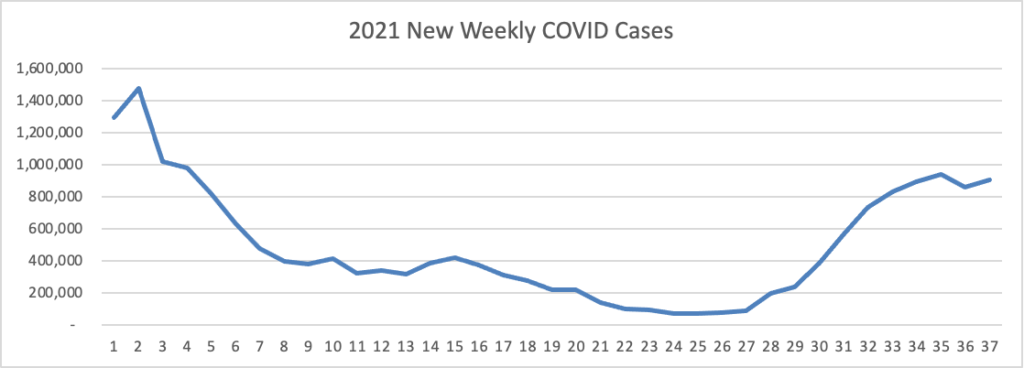
Based on the CDC’s COVID Data Tracker here is the FEHBlog’s chart of new weekly COVID cases for 2021 using Thursday as the first day of the week.
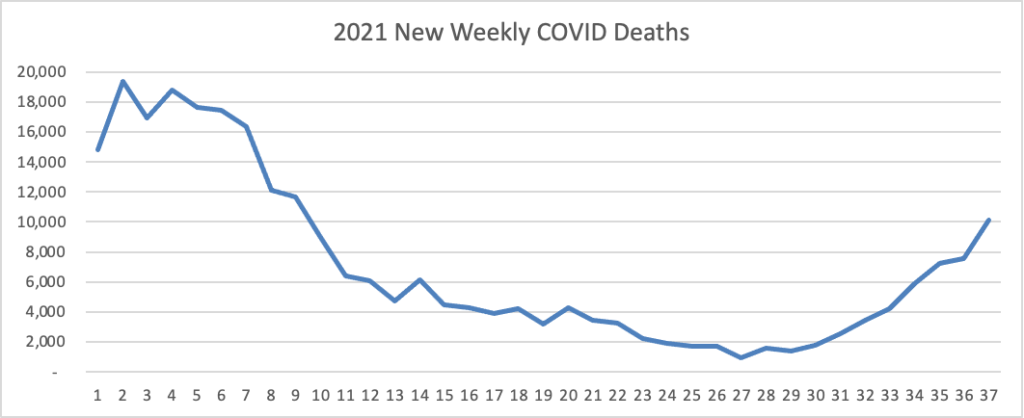
New cases are trending down. Here is a link to weekly COVID hospitalizations and here is the FEHBlog’s chart of new weekly COVID deaths for 2021:
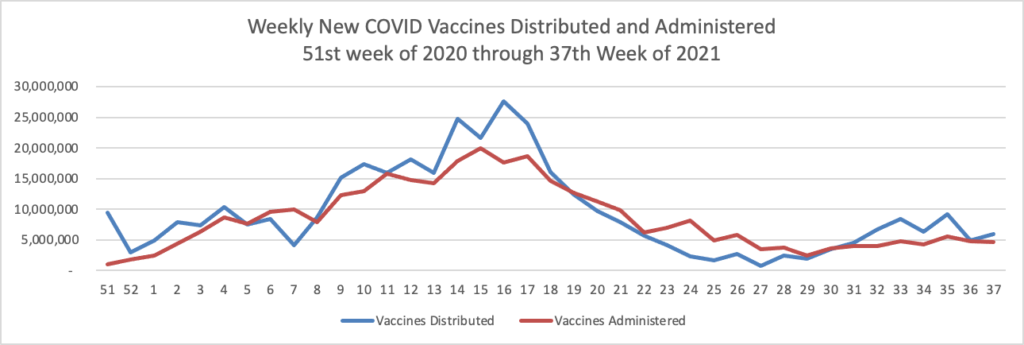
Here is the FEHBlog’s chart of weekly COVID vaccinations distributed and administered over the 51st week of 2020 through the 38th week of 2021 again using Thursday as the first day of the week.
As of today, 64.5% of the U.S population eligible to be vaccinated and 83.1% of the U.S. population over age 65 are fully vaccinated. Here is a link to the CDC’s interpretation of its COVID statistics which happily is released on Fridays.
Following up on the CDC advisory committee’s decision, the CDC Director Rochelle Walensky issued her final decision last night. Here’s a link to MedPage Today’s report on the Director’s decision. The FEHBlog thinks that this Wall Street Journal best sums up the Director’s action:
An FDA outside panel last week hedged by backing boosters only for those over age 65 or at “high risk.” FDA Acting Commissioner Janet Woodcock on Wednesday endorsed this recommendation, but she defined “high risk” broadly to include workers who might have higher Covid exposure.
But experts on a CDC advisory panel on Thursday disagreed with her decision. Some said young, healthy people were at low risk for severe illness, so boosters weren’t necessary. Others worried that recommending boosters broadly would send the message that vaccines didn’t work. But the CDC’s job is to make decisions based on public health costs and benefits, and our guess is that tens of millions who are vaccinated will want booster shots as breakthrough cases increase.
Dr. Walensky overruled the CDC advisers and affirmed Dr. Woodcock’s recommendation, which is broad enough that most people who want a booster should be able to get one. The government will leave individuals to assess their own benefits and risks.
Finally the Safer Federal Workforce Task Force released more guidance today on the President’s executive order directing federal government contractors and subcontractors to implement a vaccine mandate for their employees.
In an audible triggered by yesterday’s decision, the CDC’s Advisory Committee on Immunization Practices considered at today’s meeting the FDA’s approach to COVID-19 boosters. AHIP informs us that
ACIP voted today to recommend a Pfizer-BioNTech COVID-19 vaccine booster dose for:
persons aged 65 and older and long-term care facility residents;
persons aged 50 to 64 with underlying medical conditions; and
persons based on individual benefit and risk who are aged 18 to 49 years with underlying medical conditions.
Following robust discussion about the risks and benefits of each option, ACIP ultimately voted to recommend a Pfizer vaccine booster dose, at least 6 months after the primary series, for persons aged 65 and older and long-term care facility residents (by a vote of 15-0), persons aged 50 to 64 with underlying medical conditions (13-2), and persons based on individual benefit and risk who are aged 18 to 49 years with underlying medical conditions (9-6).
The Committee voted 9-7 against recommending a single Pfizer-BioNTech COVID-19 vaccine booster dose based on individual benefit and risk for persons aged 18-64 years who are in an occupational or institutional setting where the burden of COVID-19 infection and risk of transmission are high based on safety concerns and patient selection.
ACIP only voted on boosters for individuals in each group who had previously received the initial series of the Pfizer vaccine; FDA indicated in its Emergency Use Authorization (EUA) that there was insufficient evidence to consider using a Pfizer booster in patients who received another vaccine in the initial series and thus it was not considered in the ACIP recommendations.
The next step in the health plan coverage process is for the CDC to ratify the ACIP decision. 15 days thereafter federal law requires health plans to cover the Pfizer-BioNTech booster in these scenarios with no member cost sharing in or out of network.
In additional news from that meeting, AHIP tells us that
ACIP also evaluated data on the COVID-19 vaccine in pregnant people and adverse outcomes associated with COVID-19 infection in this population. Data showed there is no indication that vaccines are associated with spontaneous abortion, birth defects, or stillbirths, but that pregnant people who were infected with COVID-19 exhibited increased risk of preeclampsia, preterm birth, NICU admission, and death.
Pregnant women who get mRNA vaccines pass high levels of antibodies to their babies, according to a study published in American Journal of Obstetrics & Gynecology – Maternal Fetal Medicine on Wednesday.
The study — one of the first to measure antibody levels in umbilical cord blood to distinguish whether immunity is from infection or vaccines — found that 36 newborns tested at birth all had antibodies to protect against Covid-19 after their mothers were vaccinated with shots from Pfizer Inc.–BioNTech SE or Moderna Inc.
“We didn’t anticipate that. We expected to see more variability,” said Ashley Roman, an obstetrician at NYU Langone Health System and co-author of the study.
That is certainly good news.
From the health equity front —
The Government Accountability Office issued a health care capsule on this topic. GAO’s “2-page “capsule” draws from several GAO reports to provide examples of these health disparities, such as COVID-19, maternal mortality, chronic health conditions, as well as disparities among veterans. We also offer policy considerations to help the federal government better understand health disparities and promote health equity.”
Only 75 of the 3,000 hospitals ranked by the Lown Institute Hospitals Index scored top marks across all the metrics meant to evaluate social responsibility: equity, value and outcomes, according to a report out Tuesday.
None of the top 20 hospitals from the U.S. News & World Report rankings made the cut to the honor roll, largely because of low grades in equity, Lown Institute said.
The report also ranked states by which had the most socially responsible hospitals. Topping the list were Hawaii, Delaware, Washington D.C., Oregon and Colorado while at the bottom were Kentucky, Kansas, Alabama, Mississippi and Arkansas.
From the human resources front
InsuranceNewsNet informs us that “Almost one in seven Americans has absolutely no plan for their future financial and health care needs, new research suggests. A recent study of 2,000 employed Americans found that only 26% have a one- to four-year plan in place. * * * Conducted by OnePoll on behalf of Bend Financial, the study also discovered * * * more than half felt overwhelmed by the mountain of paperwork surrounding their benefit options.”
To that end, OPM is seeking to improve the FEHB enrollment process, and FedSmith offers the first article of 2021 on the upcoming federal benefits open season. The 2022 government contribution should be released soon according to an OPM benefits administration letter.
On the business front, Beckers Payer Issues reports on senior management changes at Cigna and its Evernorth subsidiary. Among other changes, “Subsidiary Evernorth President and COO Eric Palmer was promoted to company CEO and president. Mr. Palmer will be taking over Jan. 1, 2022 for outgoing CEO Tim Wentworth, who is retiring.”
From Capitol Hill – –
Roll Call reports on Democrat efforts to cobble together the enormous $3.5 trillion budget reconciliation bill so that a House vote on the bill can be held next week. “That ambitious timeframe, if it holds, would line up the multitrillion-dollar reconciliation bill with a vote on a smaller [one trillion] bipartisan infrastructure measure that may otherwise be defeated.”
In better news, from the FEHBlog’s standpoint, the Wall Street Journal tells us that “House Speaker Nancy Pelosi said Congress wouldn’t let government funding expire next week, the first hint that Democratic leaders might decouple the government’s funding from a contentious increase in the debt limit, on the same day that the Biden administration began preparing for a possible partial shutdown.”
From the seat of government, the Wall Street Journal reports that
President Biden pressed lawmakers to reach a consensus on his sweeping social-welfare and climate proposal during a series of meetings at the White House on Wednesday, aiming to settle sharp intraparty differences that threaten to derail his multitrillion-dollar agenda.
During his sit-down with moderate Democrats, lawmakers discussed reducing the size of the $3.5 trillion social-welfare package to below $3 trillion, according to two people familiar with the meeting, while progressives continued to threaten to block passage of a separate, roughly $1 trillion infrastructure bill next week if it comes to the House floor before the social-welfare legislation.
The current federal fiscal year ends on September 30, a week from tomorrow. Before then, the Senate should be taking up the House passed stop gap / debt ceiling relief measure.
From the Delta variant front —
The Food and Drug Administration formally ratified its advisory committee’s decision on the Pfizer-BioNTech booster:
Today, the U.S. Food and Drug Administration amended the emergency use authorization (EUA) for the Pfizer-BioNTech COVID-19 Vaccine to allow for use of a single booster dose, to be administered at least six months after completion of the primary series in:
individuals 65 years of age and older;
individuals 18 through 64 years of age at high risk of severe COVID-19; and
individuals 18 through 64 years of age whose frequent institutional or occupational exposure to SARS-CoV-2 puts them at high risk of serious complications of COVID-19 including severe COVID-19.
Next step in the approval for health plan coverage process is the CDC Advisory Committee on Immunization Practices (“ACIP”) hearing on September 29.
It turns out however, ACIP also is meeting today, and one of its members made news. From the Wall Street Journal
A federal health official said Wednesday there isn’t enough data to support giving a Pfizer Inc. PFE 0.07% booster dose to people who have received other Covid-19 vaccines.
Doran Fink, a deputy director in the Food and Drug Administration’s vaccines division, made the remarks at a meeting of a key vaccine advisory panel that would recommend who should get an additional dose of the vaccine from Pfizer and partner BioNTech SE. * * *
Officials expect to have more information on this in the future. The National Institutes of Health said in June it is studying giving extra Moderna Inc.MRNA 1.54% doses to people who have received Pfizer, Johnson & JohnsonJNJ -0.36% and the Moderna vaccines.
This news article from NPR put a spring the FEHBlog’s step:
Americans may be able to breathe a tentative sigh of relief soon, according to researchers studying the trajectory of the pandemic.
The delta surge appears to be peaking nationally, and cases and deaths will likely decline steadily now through the spring without a significant winter surge, according to a new analysis shared with NPR by a consortium of researchers advising the Centers for Disease Control and Prevention.
For its latest update, which it will release Wednesday, the COVID-19 Scenario Modeling Hub combined nine different mathematical models from different research groups to get an outlook for the pandemic for the next six months.
“Any of us who have been following this closely, given what happened with delta, are going to be really cautious about too much optimism,” says Justin Lessler at the University of North Carolina, who helps run the hub. “But I do think that the trajectory is towards improvement for most of the country,” he says.
The modelers developed four potential scenarios, taking into account whether or not childhood vaccinations take off and whether a more infectious new variant should emerge.
The most likely scenario, says Lessler, is that children do get vaccinated and no super-spreading variant emerges. In that case, the combo model forecasts that new infections would slowly, but fairly continuously, drop from about 140,000 today now to about 9,000 a day by March.
Deaths from COVID-19 would fall from about 1,500 a day now to fewer than 100 a day by March 2022.
In other words, it would be June 2021 again. So many Americans have now had COVID or been vaccinated, it’s hard for the FEHBlog to believe that a new variant could take hold like Delta has. Hope springs eternal for endemic COVID-19, the 21st Century flu.
Speaking of the FDA, from the Aduhelm front, STAT News reports that
Earlier this month, Biogen executives admitted publicly that the launch of Aduhelm, its treatment for Alzheimer’s disease, was going slower than expected. Privately, the company is facing a situation far bleaker than what it has publicly disclosed, forcing Biogen to consider cost-cutting measures, including layoffs.
Just over 100 patients with Alzheimer’s had been infused with Aduhelm as of Sept. 11 — a number that is rising slowly but is drastically below Biogen’s internal projections and Wall Street’s expectation that thousands of patients would be using the drug by now. STAT obtained information about the Aduhelm launch from a person with knowledge of the company’s deliberations.
Hey Biogen why not lower the ridiculously high price that you set for Aduhelm??
Walgreens Boots Alliance will pay $970 million for a majority stake in specialty pharmacy business Shields Health Solutions. Per the terms of the deal, Walgreens would have a 71% stake in the company, and the option to buy the remaining equity interests in the future.
Walgreens first bought a minority stake in Shields in 2019. The Stoughton, Mass.-based company works with hospitals to stand up specialty pharmacy programs. It currently has 70 health system partners, accounting for more than 1 million specialty patients.
Yesterday, the FDA “authorized marketing of software to assist medical professionals who examine body tissues (pathologists) in the detection of areas that are suspicious for cancer as an adjunct (supplement) to the review of digitally-scanned slide images from prostate biopsies (tissue removed from the body). The software, called Paige Prostate, is the first artificial intelligence (AI)-based software designed to identify an area of interest on the prostate biopsy image with the highest likelihood of harboring cancer so it can be reviewed further by the pathologist if the area of concern has not been identified on initial review.” Nifty.
Following up on yesterday’s post on a Kaufman Hall report that COVID-19 is causing hospitals to lose their shirts, MedPage today informs us that
Hospitals billed private insurers an average of $317,810 for a complex COVID-19 hospitalization, according to new data from FAIR Health.
Insurers paid out an average of $98,139 on those claims, which involved intense care like ICU stays or use of a ventilator, according to a press release from the company.
Average charges and payouts for general hospitalizations for COVID-19 were lower, at $74,591 and $33,525, respectively, the company found.
You can count on the private insurers to bail out the hospitals’ losses on Medicare and Medicaid patients.
From the health equity front, Healthcare Dive tells us about a relevant discussion that occurred at an ongoing AHIP conference
Andrew Renda, a VP at Humana who works on population health strategy, echoed the importance of staying local. Humana has more than a dozen population health strategy leads in various markets who liaison with community-based organizations in those areas to determine what methods will work best, he said.
Panelists agreed that the start of a successful social determinants of health program comes with data collection and interpretation.
Renda said creating data ecosystems “becomes foundational for everything else that we do,” and leads to being able to determine the correct, evidence-based interventions.
And any pilot programs should be constructed with scalability in mind, according to the executive.
Humana uses a Centers for Disease Control and Prevention assessment tool that measures the mentally and physically unhealthy days of individuals over a 30-day period as a leading indicator, followed by data on medication adherence and preventive screenings.
“I think one way to look at it is you’ve got to have the right study design to get those requests to justify the bigger investments,” Renda said.
Well put.
Also CNBC reports that “Walmart is partnering with large employers and Grand Rounds and Doctor on Demand on a new initiative called the Black Community Innovation Coalition. The new virtual-care program is aimed at combating health disparities among African American workers that taps into companies’ employee affinity groups. * * * The new program will use Grand Rounds’ health assistance platform to target outreach on specific health needs of African American workers. One of the initial programs they are looking at includes encouraging earlier maternity care for Black female employees * * *.
From the substance use front, the American Medical Association laid out a strategy to end the opioid pandemic based on a report issued today “showing a 44.4 percent decrease in opioid prescribing nationwide in the past decade.” Nevertheless “the nation continues to see increases in overdose mainly due to illicit fentanyl, fentanyl analogs, methamphetamine and cocaine, according to the U.S. Centers for Disease Control and Prevention.” The AMA recommends that the State policymakers
Stop prior authorization for medications to treat opioid use disorder. * * *
Ensure access to affordable, evidence-based care for patients with pain, including opioid therapy when indicated. * * *
Take action to better support harm reduction services such as naloxone and needle and syringe exchange services. These proven harm reduction strategies save lives but are often stigmatized.
Improve the data by collecting adequate, standardized data to identify and treat at-risk populations and better understand the issues facing communities. Effective public health interventions require robust data, and there are too many gaps to implement widespread interventions that work.
Something needs to be done because, for example, the National Institutes of Health reported today that
Overdose deaths involving methamphetamine nearly tripled from 2015 to 2019 among people ages 18-64 in the United States, according to a study by the National Institute on Drug Abuse (NIDA), part of the National Institutes of Health. The number of people who reported using methamphetamine during this time did not increase as steeply, but the analysis found that populations with methamphetamine use disorder have become more diverse. Published today in JAMA Psychiatry, the study suggests that increases in higher-risk patterns of methamphetamine use, such as increases in methamphetamine use disorder, frequent use, and use of other drugs at the same time, may be contributing to the rise in overdose deaths.
“We are in the midst of an overdose crisis in the United States, and this tragic trajectory goes far beyond an opioid epidemic. In addition to heroin, methamphetamine and cocaine are becoming more dangerous due to contamination with highly potent fentanyl, and increases in higher risk use patterns such as multiple substance use and regular use,” said NIDA Director Nora D. Volkow, M.D., one of the authors of the study. “Public health approaches must be tailored to address methamphetamine use across the diverse communities at risk, and particularly for American Indian and Alaska Native communities, who have the highest risk for methamphetamine misuse and are too often underserved.”
From Capitol Hill, Roll Call reports that “The House passed a catchall budget package Tuesday [along party lines] that’s intended to avoid a partial government shutdown and debt limit crisis, but it seems likely to come back for a do-over once the Senate works its will.” The Republicans are objecting to combining the debt limit increase with the stop gap measure because “Treasury has said Congress needs to act sometime next month; Wrightson ICAP, a private investment advisory firm, said this week the drop-dead deadline was likely Oct. 25 or 26.”
Here’s a stunner for you from the Roll Call article:
The bill includes language to temporarily extend how fentanyl — a highly potent opioid — is classified. Fentanyl is responsible for a lion’s share of drug overdose deaths, which have been on the rise during the COVID-19 pandemic. The bill would extend fentanyl’s status as a so-called “Schedule 1” drug until Jan. 28, 2022. Under current law, the drug would lose its status as a drug with a high risk for abuse on Oct. 22.
From the Delta variant front —
According to the American Hospital Association, “Johnson & Johnson today said its phase 3 trial data confirms its vaccine’s durability and provided evidence of a second, booster shot’s effectiveness against COVID-19. The drug maker said that, over the course of its ongoing phase 3 trial, it found no evidence of the vaccine’s reduced effectiveness, which J&J said is 79% for preventing COVID-19-related infections and 81% for preventing COVID-19-related hospitalizations. J&J furthermore found that a booster shot administered 56 days after an initial dose provided 100% protection against severe/critical COVID-19 for at least 14 days post-final vaccination and 94% protection against symptomatic (moderate to severe/critical) COVID-19 in the U.S. Additionally, boosters resulted in antibody levels four to six times higher than those netted from a single dose.”
David Leonhardt in the New York Times understandably criticized federal agencies for dropping the ball on production of rapid COVID tests. “Other countries are awash in Covid tests. The U.S. is not.”
Stefanie Friedhoff, a professor at Brown University’s School of Public Health, recently returned from a visit to Germany and wrote on Twitter about the many benefits of rapid testing that she had seen. A friend’s husband has Parkinson’s disease, and the friend leaves a batch of tests in her hallway for people to take before they enter the home. The day care center where Friedhoff’s sister works has stayed open throughout the pandemic, because the staff and children take frequent tests.
“Imagine what ubiquitous cheap testing could do in the U.S.,” Friedhoff wrote. “It is incomprehensible how the U.S. has failed on testing.”
The FEHBlog recalls writing last year at this time about the importance of a vaccine, rapid testing, and a treatment for recently symptomatic people in order to bring the pandemic to a close. We should be grateful for the vaccines but we wouldn’t be in this much of a fix if we also had rapid testing and earlier treatment options.
The American Hospital Association also reports that
U.S. hospitals will lose an estimated $54 billion in net income this year, even after federal relief funds, as higher labor and other expenses and sicker patients impact their financial health during the ongoing COVID-19 pandemic, according to a report by Kaufman, Hall & Associates released today by the AHA. More than a third of hospitals are expected to end 2021 with negative margins.
“With cases and hospitalizations at elevated levels again due to the rapid spread of the Delta variant, physicians, nurses and other hospital caregivers and personnel are working tirelessly to care for COVID-19 patients and all others who need care,” said AHA President and CEO Rick Pollack. “At the same time, hospitals are experiencing profound headwinds that will continue throughout the rest of 2021.”
Medcity News reports that “The FDA has approved the first biosimilar that references the blockbuster Roche drug Lucentis. The Biogen and Samsung BioLogics joint venture that developed the biologic product have approval to treat three eye conditions that lead to vision loss.” Bravo.
Infants who seemed headed for autism spectrum disorder (ASD) had milder symptoms as toddlers if their caregivers were subject to a social communication intervention when infants were just 1 year of age, a randomized clinical trial found.
Infants whose families participated in the intervention exhibited significantly milder ASD symptoms 12 months later compared to those in the control group. They also had lower odds of being diagnosed with ASD by an independent clinician at age 3 years (6.7% vs 20.5%, OR 0.18, 95% CI 0.00-0.68), according to the study group led by Andrew Whitehouse, PhD, of the University of Western Australia.
Non-career employees at the U.S. Postal Service are significantly more likely to get injured on the job and leave their positions than employees with a permanent status, according to a Sept. 16 Government Accountability Office report.
Employees without permanent status at USPS receive lower pay and fewer benefits than their career counterparts, often under the assumption that they will have a path to a career position in the future. But according to GAO, those non-career employees, of which there are more than 200,000 across the U.S., had 50 percent higher rates of injury than career positions and reported the incidents to the Federal Employees’ Compensation Program 43 percent more often.
Humana leads the industry on customer experience scores and is the only major national payer to land above the industry average, according to a new report from analysts at Forrester.
Forrester polled members of 17 of the largest health plans in the country and found an industry average score of 70.2 on a 100-point scale, which the organization categorizes as an “OK” rating. In 2020, payers averaged 67.5 points, according to the report.
At the top of the list, Humana earned a 74.8 score, dethroning 2020’s top health plan, Florida Blue, which fell to fourth place with a 71.9. Kaiser Permanente’s health plan landed in the second-place slot with a 73.8 score, and Highmark placed third, earning a 72.9.
Rounding out the top five is Blue Cross Blue Shield of Michigan, which rose from a 10th-place ranking in 2020’s report, Forrester found.
The Hill provides us with the latest on everything that is currently on Congress’s full plate of issues.
From the Delta variant front, the New York Times reports that
The Pfizer-BioNTech coronavirus vaccine has been shown to be safe and highly effective in young children aged 5 to 11 years, the companies announced early Monday morning.
Pfizer and BioNTech plan to apply to the Food and Drug Administration by the end of September for authorization to use the vaccine in these children. If the regulatory review goes as smoothly as it did for older children and adults — it took roughly a month — millions of elementary school students could begin to receive shots around Halloween.
Trial results for children younger than 5 are not expected till the fourth quarter of this year at the earliest, according to Dr. Bill Gruber, a senior vice president at Pfizer and a pediatrician. Results from Moderna’s vaccine trials in children under 12 are also expected around that time, said Dr. Paul Burton, the company’s chief medical officer.
From the M&A front, HCA Healthcare, one of the largest healthcare systems in the U.S., announced this evening that
the signing of a definitive agreement for HCA Healthcare to acquire the operations of Steward Health Care’s five Utah hospitals. HCA Healthcare also entered into an agreement to lease the related real estate from its owner following the expected closing. The hospitals will become part of HCA Healthcare’s Mountain Division, which includes 11 hospitals in Utah, Idaho and Alaska. * * *
Steward Health Care also operates hospitals in Arizona, Texas, Arkansas, Louisiana, Florida, Ohio, Pennsylvania, and Massachusetts. The sale of these facilities to HCA Healthcare will enhance Steward Health Care’s ability to continue growing and reinvesting in other states and locations served by the health system.
Evidently HCA plans to give Intermountain some competition in Utah.
Employee Benefit News offers expert opinions on the pros and cons of healthcare savings account which can only be funded when the individual is enrolled in a high deductible health plan.
From the human resources front
The Federal Times informs us that “‘The Office of Personnel Management will temporarily drop several geographic restrictions associated with special hiring authorities for military spouses, according to a regulation published in the Federal Register Sept. 20. * * * ‘It removes limitations — such as a relocation requirement, geographic restrictions, and arbitrary quotas — which caused this authority to be underused until now,’ wrote Rob Shriver, associate director of employee services at OPM, in a Medium blog post. ‘As a result, this new regulation means more military spouses can find their place in the federal workforce, and federal agencies have a larger talent pool of highly-qualified people to hire from.'” The FEHBlog was not aware that OPM has a Medium website.
HR Dive reports on the recent Society for Human Resources Management annual conference. The article focuses on a give and take between EEOC commissioners and attendees about vaccination mandates and EEO-1 reporting among other issues.
From Capitol Hill, the House of Representatives and the Senate will be engaged in Committee business and floor voting this week. Bloomberg brings us up to date on the status of $3.5 trillion budget reconciliation bill which the President and Democrat leaders in Congress have been pushing.
From the Delta variant front, it must be recalled that before health plans become obligated to cover the mRNA booster for immunized folks over age 65 and a broader group of immuno-compromised Americans, fifteen days must pass from the time that the Centers for Disease Control ratifies the FDA’s decision from last Friday. The CDC’s Advisory Committee on Immunization Practice is scheduled to consider this issue on September 29. The press reports on Friday indicated that the CDC is expected to establish the scope of the expanded coverage of immuno-compromised Americans.
On Sunday’s talk shows, Drs. Fauci and Collins, according to the Wall Street Journal, predict that the FDA will approve the mRNA booster for the general population before long. Kaiser Health News discusses how these leading scientists got in front of their skis on the scope of the mRNA booster coverage issue.
Precision Vaccines discusses where Britain and American stand in terms of achieving at least limited herd immunity.
In the USA, new data from the U.S. CDC published by the JAMA Network on September 2, 2021, indicates herd immunity may be achievable soon.
This review is based on blood donations in the U.S. from July 2020 through May 2021, including both natural infection- and vaccine-induced SARS-CoV-2 seroprevalence. This repeated cross-sectional study included over 1.4 million blood donation specimens representing 74% of the US population.
The estimated SARS-CoV-2 seroprevalence weighted for differences between the study sample and general population increased from 3.5% in July 2020 to 20.2% for infection-induced antibodies and 83.3% for combined infection- and vaccine-induced antibodies in May 2021.
The coronavirus seroprevalence differed by age, race, ethnicity, and geographic region of residence, and these differences changed over the course of the study.
Since May 2021, the U.S. CDC has reported significant increases in COVID-19 vaccinations, initial infections, and re-infections. More than 4 million of these cases have been reported in the past few weeks.
These new totals may soon push the USA over the 95% herd immunity goal.
It’s worth noting that Britain is ahead of the U.S. because the Delta variant struck Britain first.
In other updates —
The American Cancer Society has released the 2021 edition of Cancer Facts and Figures.
The American Medical Association provides background of the 2022 changes to the Current Procedure Terminology. The AMA publishes the CPT which is one of the code sets for HIPAA electronic transactions.
Fierce Healthcare reports “The Biden administration has delayed enforcement of payer-to-payer data exchange included in a May 2020 final interoperability rule until future regulations are finalized.” The interoperability rules apply to insurers with HHS contracts, not FEHB carriers.
Health Payer Intelligence informs us that “Healthcare B2B payment transactions have been high in 2021, potentially signaling the importance of electronic payment transfers as the nation emerges from the coronavirus pandemic, according to a report from National Automated Clearing House Association (NACHA).” What’s more “‘This data from Nacha is good news for payers, providers and members,’ said April Todd, senior vice president of CORE and explorations at CAQH. ‘The increase in electronic payment volume likely indicates that people who deferred routine medical appointments due to COVID are now able to get the care they need. And when that care is paid electronically, it is more efficient and cost-effective for the industry.’ Todd’s organization has been tracking the economic impact of transitioning to electronic payment. A CAQH report estimated that the healthcare industry could see $426 million in cost savings by transitioning to electronic payments. Switching to electronic payment for claims submissions could save providers around $2 for each claim. Exact savings can vary based on the type of transaction.”
An unsecured database containing over 61 million records related to fitness trackers and wearables exposed Apple and Fitbit users’ data online.
Researchers with WebsitePlanet and security researcher Jeremiah Fowler discovered a non-password-protected database that contained tens of millions of records belonging to fitness tracking and wearable devices and apps. The unsecured database belonged to GetHealth, which offers a unified solution to access health and wellness data from hundreds of wearables, medical devices and apps, according to a WebsitePlanet report posted Monday.
The cybersecurity team discovered the unsecured database June 30, ZDNet reported. Fowler said he immediately sent a disclosure notice to the company of the security findings. GetHealth responded rapidly, and the system was secured within a matter of hours, ZDNet reported.
“It is unclear how long these records were exposed or who else may have had access to the dataset,” Fowler wrote in the report.
“We are not implying any wrongdoing by GetHealth, their customers or partners. Nor, are we implying that any customer or user data was at risk,” he wrote.
App developers and device operators that collect health data about Americans must alert consumers in the event their personal information is compromised or shared without permission, the Federal Trade Commission ruled Wednesday.
The U.S. consumer protection agency voted 3-2 on a new regulation that is meant to clarify the 2009 Health Notification Rule, which details how companies should tell consumers if their data is improperly shared or breached. The decision Wednesday extends the 2009 rule to cover health apps, fitness trackers and other connected devices that have risen in popularity over the past decade.
From the survey front,
Health IT Security informs us that “Google and Microsoft amassed the most vulnerabilities compared to other major tech companies in the first half of 2021, researchfrom Atlas VPN revealed. During the first half of 2021, Google accumulated 547 registered vulnerabilities. Microsoft followed close behind at 432.” Ruh roh.
CRN discusses the ten biggest cybersecurity risks that business face this year.
The Biden administration is preparing an array of actions, including sanctions, to make it harder for hackers to use digital currency to profit from ransomware attacks, according to people familiar with the matter.
The government hopes to choke off access to a form of payment that has supported a booming criminal industry and a rising national security threat.
The Treasury Department plans to impose the sanctions as soon as next week, the people said, and will issue fresh guidance to businesses on the risks associated with facilitating ransomware payments, including fines and other penalties. Later this year, expected new anti-money-laundering and terror-finance rules will seek to limit the use of cryptocurrency as a payment mechanism in ransomware attacks and other illicit activities.
The actions collectively would represent the most significant attempt yet by the Biden administration to undercut the digital finance ecosystem of traders, exchanges and other elements that cybersecurity experts say has allowed debilitating ransomware attacks to flourish in recent years.
Security Week offers a related report on understanding the cryptocurrency – ransomware connection.
And no Cybersecurity Saturday post would be complete without a link to Bleeping Computer’s The Week in Ransomware. “This week’s biggest news is that soon after REvil returned from its two-month absence, Bitdefender released a master decryptor that allows victims encrypted by REvil before July 13th to recover their files for free.”
Based on data from the Centers for Disease Control’s COVID Data Tracker, here is the FEHBlog’s weekly chart of new COVID cases for 2021:
The CDC observes “After experiencing a brief decline in COVID-19 cases, the United States is once again seeing an increase in cases in most of the country.”
Here’s a link to the CDC’s weekly chart of COVID hospitalizations which shows a drop in the seven day moving average.
Here’s the FEHBlog’s weekly chart of new COVID deaths for 2021:
Finally here is the FEHBlog’s weekly chart of COVID vaccines distributed and administered from the 51st week of 2020 through the 37th week of 2021, ending last Wednesday September 15.
There are 180.6 million fully vaccinated Americans, or 63.6% of the vaccination eligible population (age 12 and older) and 31 million more who are waiting for their second dose.
The Covid-19 vaccine made by Moderna Inc. is more effective at keeping people out of the hospital than those from Pfizer Inc. and partner BioNTech SE or Johnson & Johnson, new research indicates.
In a study published by the Centers for Disease Control and Prevention on Friday, researchers studied more than 3,600 adults who were hospitalized in the U.S. between March and August of 2021. They looked at people who were admitted to 21 hospitals who had at least one Covid-19 symptom and a positive PCR or antigen test, as well as patients who were admitted to a hospital who tested negative for Covid-19. They then compared their vaccination status and which vaccine they received.
The researchers found that the Moderna vaccine’s effectiveness against hospitalization was 93%, compared with 88% for Pfizer-BioNTech’s and 71% for J&J’s. The effectiveness of the Moderna and Pfizer-BioNTech vaccines also seemed to stand up better over time than that of J&J’s vaccine. The Moderna vaccine’s effectiveness against hospitalization dropped to 92% after 120 days, while Pfizer-BioNTech’s dropped to 77%. After just 28 days, the J&J vaccine’s effectiveness fell to 68%.
And the administrative suspense is over, STAT News tells us
An advisory panel to the Food and Drug Administration on Friday recommended against a booster dose of a Covid-19 vaccine for most Americans at this time — a major rebuke to the Biden administration — but voted unanimously to recommend one to Americans who are 65 or older.
The FDA is not required to follow the recommendation of its advisory committees but generally does. If the recommendation is adopted by the FDA and Centers for Disease Control and Prevention, it would put the U.S. policy on a par with countries like the United Kingdom.
After seven hours of deliberation, members of the Vaccines and Related Biological Products Advisory Committee voted 16 to 2 against a proposal to administer a third dose of the vaccine developed by Pfizer and BioNTech to individuals 16 years and older. The vote to recommend a booster to people 65 years and older — as well as people who are at risk of severe Covid — was 18 to 0.
It was not immediately clear who would qualify as high risk; fleshing that out will likely fall to the CDC’s advisory committee, the Advisory Committee on Immunization Practices.
You will be able to knock the FEHBlog down with a feather if acting FDA Commissioner Janet Woodcock overrules the advisory committee given the Aduhelm debacle earlier this year. Also the outcome strikes the FEHBlog as a reasonable Goldilocks solution to the thorny problem.
Speaking of the expensive Alzheimer’s Disease drug Aduhelm, Fierce Pharma reports that
Data collected from a survey of 74 neurologists collected at the start of the month found that at least two thirds of respondents anticipate having at least some patients on Aduhelm by March 2022, according to Spherix Global Insights’ newly launched drug report released on Thursday. That could result in “an estimated brand share substantially higher than that projected back in August,” the report found.
he results indicate increased signs of optimism, according to Spherix, with small increases in the prescriber base and number of new patients compared to the stagnant trends found in the first few months following Aduhelm’s June FDA nod. In Spherix’s mid-July report, only about one fourth (27%) of responding physicians had planned to prescribe Aduhelmin the next few months.
Biogen’s prospects should improve in the coming weeks, Spherix estimates. According to the report, the prescriber base will likely grow by nearly 50% within that time, which could lead to twice the number of new patient initiations when compared with August.
Despite the maelstrom of negative press Biogen’s accelerated FDA nod has garnered, one in seven newly diagnosed patients with the memory-robbing disease are considered potential Aduhelm candidates, Spherix said.
Therefore, Aduhelm’s long-term success “does not appear to be markedly limited by physician willingness to prescribe” the treatment or “clinical determination of patient eligibility.”
In HHS News —
Today, the Biden-Harris Administration announced a $2.1 billion investment to improve infection prevention and control activities across the U.S. public health and healthcare sectors. The Biden-Harris Administration, working through the Centers for Disease Control and Prevention (CDC), is investing American Rescue Plan funding to strengthen and equip state, local, and territorial public health departments and other partner organizations with the resources needed to better fight infections in U.S. healthcare facilities, including COVID-19 and other known and emerging infectious diseases.”
Also today a record breaking third Affordable Care Act notice of benefit and rate parameters notice for 2022 was finalized. Fierce Healthcare tells us that “For 2022, insurers will face an increase in the federally run marketplace user fee rate to 2.75% of their premiums and the state-run exchanges to 2.25%. That is a change from the user fee finalized on Jan. 19 under the Trump administration, which called for a user fee of 2.25% for the federal marketplace and 1.75% for the state-run exchanges. The rule would also extend the open enrollment period by 30 days for ACA signups, with the new deadline on the federally run exchanges being Jan. 15. Open enrollment for the federal exchanges still starts on Nov. 1. * * * CMS is also creating a new special enrollment period that targets low-income individuals through HealthCare.gov. The goal is to target people who could be eligible for boosted subsidies that were included in the American Rescue Plan Act but expire after the 2022 coverage year. Congress is debating whether to extend those subsidies as part of a $3.5 trillion infrastructure package.”
President Biden on Thursday made a nomination to fill the long-vacant position of inspector general at the Office of Personnel Management, a watchdog office that has at times publicly clashed with top management of the federal agency.
Nominee Krista Boyd is chief counsel for oversight and policy on the House Oversight and Reform Committee, which oversees federal workplace matters. Boyd has worked on Capitol Hill for more than two decades with a focus on issues including whistleblower protection, transparency and strengthening the access to agency information for inspectors general and other watchdogs, an announcement said.
Ms. Boyd’s nomination is subject to Senate confirmation.
On the Delta variant front, Govexec.com informs us that
The Biden administration released new guidance on Thursday about implementing the COVID-19 vaccine mandate for federal employees, which says even those on telework or remote work must get vaccinated.
The guidance implements an executive order President Biden issued on September 9 requiring federal employees to get vaccinated against the novel coronavirus, unless they request an exemption. The Safer Federal Workforce Task Force said on Monday that November 22 is the deadline for employees to get fully vaccinated or possibly be subject to progressive discipline. * * *
Postal Service employees are not covered by the mandate, but they will be subject to the forthcoming emergency temporary standard from the Occupational Safety and Health Administration (OSHA) that will require vaccines for companies with 100 or more employees, the senior administration official pointed out. That was another coronavirus measure the president unveiled last week.
“Our workplaces are subject to regulations from the Occupational Safety and Health Administration,” USPS said in a statement on Thursday. “Therefore, we are working closely with our union leadership so that once OSHA’s COVID-19 Vaccination Emergency Temporary Standard is issued we can move quickly to determine its applicability to our employees and how best to implement [it].” * * *
Other topics covered in the update are: who is considered fully vaccinated and the timeline for getting fully vaccinated (depending on which vaccine individuals receive); vaccination dates for those who are starting government service after November 22; what protocols employees should follow before becoming fully vaccinated; and how agencies should collect and maintain documentation of vaccination for employees. Agencies must collection documentation even if employees previously attested to being vaccinated.
The Society for Human Resource Management discusses what to expect from OSHA on the vaccination screening program it is developing for private employers with more than 100 employees.
In mergers and acquisitions news, the Deseret News reports that
Intermountain Healthcare announced Thursday that the organization is merging with SCL Health, a faith-based, nonprofit health care organization based in Colorado.
The two organizations are located in adjacent areas with no geographic overlap, so together they will employ more than 58,000 caregivers, operate 33 hospitals and run 385 clinics across Utah, Idaho, Nevada, Colorado, Montana and Kansas.
SCL Health is a $2.8 billion health network that provides comprehensive, coordinated care in hospitals, clinics, home health, hospice and mental health services across Colorado, Montana and Kansas. It brings eight hospitals and more than 160 physician clinics into the merger. Their hospitals will retain their names and their Catholic identity, directives and values.
The merger, which is subject to regulatory approval, is expected to close early next year.
From the studies front —
The Centers for Disease Control released updated adult obesity prevalence maps for the U.S. yesterday.
The Employee Benefits Research Institute is offering an issues brief on trends in health savings account balances, contributions, distributions and investments and the impact of COVID-19 thereon.
From the reminders front, Fedweek explains the “five year rule” for continuing FEHB and FEGLI coverage into a civil service retirement.
As a rule, you can only continue your FEHB and/or FEGLI coverage into retirement if you are 1) currently enrolled, 2) have been enrolled for at least five years or from your earliest opportunity to enroll, and 3) are retiring on an immediate annuity (including disability).
Further, if you are a FERS employee who is retiring on an immediate annuity but postponing its receipt to a later date to reduce or eliminate the 5 percent per year penalty for retiring under the MRA+10 provision (minimum retirement age—currently 57—with at least 10 but less than 30 years of service), you’ll be able to reenroll in the FEHB program when your annuity begins. Note: If you leave government before being eligible to retire and later apply for a deferred annuity when you have the right combination of age and service, you can’t reenroll in either program.
While there is an automatic waiver of the FEHB five-year rule if you are accepting an offer of early retirement from your agency, no waiver is possible for FEGLI. Nor are waivers of the “currently enrolled” or “retiring on an immediate annuity” requirements available under current law for either program.
As we approach the September 17 of the FDA advisory committee meeting on the COVID-19 booster, the Wall Street Journal reports that
The Food and Drug Administration said vaccines cleared in the U.S. currently provide sufficient protection against severe disease and death from Covid-19 without additional doses, potentially complicating the Biden administration’s deliberations over the need for booster shots.
The FDA released the findings Wednesday in a report analyzing data submitted by Pfizer Inc. and BioNTech SE as part of their request for authorization for their vaccine to be given as a booster shot in people 16 years and older.
An outside panel of scientific advisers will review the FDA report on Friday, along with a companion analysis from Pfizer and other information, as part of a discussion over who needs booster shots and when.
In yesterday’s blog post, National Institutes of Health (NIH) Director Dr. Francis Collins tells us that
There’s no question that vaccines are making a tremendous difference in protecting individuals and whole communities against infection and severe illness from SARS-CoV-2, the coronavirus that causes COVID-19. And now, there’s yet another reason to get the vaccine: in the event of a breakthrough infection, people who are fully vaccinated also are substantially less likely to develop Long COVID Syndrome, which causes brain fog, muscle pain, fatigue, and a constellation of other debilitating symptoms that can last for months after recovery from an initial infection.
These important findings published in The Lancet Infectious Diseases are the latest from the COVID Symptom Study
nearly $470 million to build a national study population of diverse research volunteers and support large-scale studies on the long-term effects of COVID-19. The NIH REsearching COVID to Enhance Recovery (RECOVER) Initiative(link is external) made the parent award to New York University (NYU) Langone Health, New York City, which will make multiple sub-awards to more than 100 researchers at more than 30 institutions and serves as the RECOVER Clinical Science Core. This major new award to NYU Langone supports new studies of COVID-19 survivors and leverages existing long-running large cohort studies with an expansion of their research focus. This combined population of research participants from new and existing cohorts, called a meta-cohort, will comprise the RECOVER Cohort. This funding was supported by the American Rescue Plan.
A company is launching out of Stanford University on Wednesday to tackle one of the most enduring challenges of digitized medicine: How do you apply data from past patients to inform the care of new ones?
The company, named Atropos Health, is seeking to commercialize a consultation service designed to use mountains of existing data to quickly answer a wide range of pressing questions, such as which drug is most effective for certain kinds of cancer patients, or when antibiotics can be safely discontinued in the treatment of a particular infection.
That may seem ho-hum in a world where search engines enable instantaneous information retrieval in so many domains. But the health care industry has failed to harness that power, hamstrung by a lack of quality digital data and wary of the consequences of applying an answer incorrectly to the care of complicated human beings.
Good luck to Atropos.
In other healthcare news
Health Payer Intelligence usefully discusses how payers can cultivate consumer-centered digital innovation. Fierce Health reports on Blue Cross licensee Carefirst’s release of such an innovation. The innovation in this case is “a new virtual primary care practice called CloseKnit. CloseKnit will offer a slew of healthcare services in a virtual-first delivery model, including preventive care, urgent care, behavioral health care, care coordination and insurance navigation. Services are available through an app and are built to be affordable and transparently priced, according to the announcement. In-person care is provided through referrals to local providers.”
The Health Affairs Blog offers its insights into the proposed No Surprises Act rule on air ambulance and broker compensation reporting and HHS’s role in enforcing the new law.
The Department of Health and Human Services announced today that “more than 2.8 million people newly gained access to affordable health care under the Biden-Harris Administration through the 2021 Special Enrollment Period (SEP) on HealthCare.gov and State-based Marketplaces.. With the gains made during the SEP, there are now a record-breaking 12.2 million people enrolled in the federal and state marketplaces.”
Govexec tells us that “The Government Employees Health Association announced last week that federal employees enrolled in their Federal Employees Health Benefits Program insurance plans can receive a $75 credit on their wellness accounts, which are used to pay for health expenses like copays and prescriptions, until Dec. 31. Previously, the deadline to get the first dose of the vaccine was Sept. 6 for the incentive program, although proof of full vaccination was still required by the end of 2021. Now, in order to be eligible for the cash incentive, GEHA enrollees have until Dec. 31 to get their first dose and request the reward.”
We use cookies on our website to give you the most relevant experience by remembering your preferences and repeat visits. By clicking “Accept”, you consent to the use of ALL the cookies.
This website uses cookies to improve your experience while you navigate through the website. Out of these, the cookies that are categorized as necessary are stored on your browser as they are essential for the working of basic functionalities of the website. We also use third-party cookies that help us analyze and understand how you use this website. These cookies will be stored in your browser only with your consent. You also have the option to opt-out of these cookies. But opting out of some of these cookies may affect your browsing experience.
Necessary cookies are absolutely essential for the website to function properly. These cookies ensure basic functionalities and security features of the website, anonymously.
Cookie
Duration
Description
cookielawinfo-checbox-analytics
11 months
This cookie is set by GDPR Cookie Consent plugin. The cookie is used to store the user consent for the cookies in the category "Analytics".
cookielawinfo-checbox-functional
11 months
The cookie is set by GDPR cookie consent to record the user consent for the cookies in the category "Functional".
cookielawinfo-checbox-others
11 months
This cookie is set by GDPR Cookie Consent plugin. The cookie is used to store the user consent for the cookies in the category "Other.
cookielawinfo-checkbox-necessary
11 months
This cookie is set by GDPR Cookie Consent plugin. The cookies is used to store the user consent for the cookies in the category "Necessary".
cookielawinfo-checkbox-performance
11 months
This cookie is set by GDPR Cookie Consent plugin. The cookie is used to store the user consent for the cookies in the category "Performance".
viewed_cookie_policy
11 months
The cookie is set by the GDPR Cookie Consent plugin and is used to store whether or not user has consented to the use of cookies. It does not store any personal data.
Functional cookies help to perform certain functionalities like sharing the content of the website on social media platforms, collect feedbacks, and other third-party features.
Performance cookies are used to understand and analyze the key performance indexes of the website which helps in delivering a better user experience for the visitors.
Analytical cookies are used to understand how visitors interact with the website. These cookies help provide information on metrics the number of visitors, bounce rate, traffic source, etc.
Advertisement cookies are used to provide visitors with relevant ads and marketing campaigns. These cookies track visitors across websites and collect information to provide customized ads.