From the cybersecurity policy front, Cybersecurity Dive informs us
National Cyber Director Chris Inglis will retire from his position Feb. 15, ending a more than four decade career in national security.
Kemba Walden, principal deputy national cyber director and a former legal executive at Microsoft, will become acting director until Biden names a nominee for the post. The NCD post requires Senate confirmation.
From the cyber vulnerabilities front —
The Health Sector Cybersecurity Coordination Center (HC3) issued a PowerPoint presentation titled “2022 Healthcare Cybersecurity Year in Review and a 2023 Look-Ahead.”
HC3 also released its January 2023 Cybersecurity Vulnerability Bulletin.
The Cybersecurity and Infrastructure Agency (CISA) added three known exploited vulnerabilities to its catalog.
The Government Accountability Office produced a report titled “Challenges in Protecting Cyber Critical Infrastructure.”
CISA and the Federal Bureau of Investigation (FBI) released a joint Cybersecurity Advisory, ESXiArgs Ransomware Virtual Machine Recovery Guidance. This advisory describes the ongoing ransomware campaign known as “ESXiArgs.” Malicious cyber actors may be exploiting known vulnerabilities in unpatched and out-of-service or out-of-date versions of VMware ESXi software to gain access to ESXi servers and deploy ESXiArgs ransomware. The ransomware encrypts configuration files on ESXi servers, potentially rendering virtual machines unusable.
As detailed in the advisory, CISA has created and released an ESXiArgs recovery script at https://github.com/cisagov/ESXiArgs-Recover. CISA and FBI encourage organizations that have fallen victim to ESXiArgs ransomware to consider using the script to attempt to recover their files.
CISA, the National Security Agency (NSA), the Federal Bureau of Investigation (FBI), the Department of Health and Human Services (HHS), and Republic of Korea’s Defense Security Agency and National Intelligence Service have released a joint Cybersecurity Advisory (CSA), Ransomware Attacks on Critical Infrastructure Fund DPRK Espionage Activities, to provide information on ransomware activity used by North Korean state-sponsored cyber to target various critical infrastructure sectors, especially Healthcare and Public Health (HPH) Sector organizations.
The authoring agencies urge network defenders to examine their current cybersecurity posture and apply the recommended mitigations in this joint CSA, which include:
Train users to recognize and report phishing attempts.
Enable and enforce phishing-resistant multifactor authentication.
Install and regularly update antivirus and antimalware software on all hosts.
Royal Ransomware is the latest ransomware operation to add support for encrypting Linux devices to its most recent malware variants, specifically targeting VMware ESXi virtual machines.
The new Linux Royal Ransomware variant was discovered by Will Thomas of the Equinix Threat Analysis Center (ETAC), and is executed using the command line.
Cyberscoop considers whether “After the Hive takedown, could the LockBit ransomware crew be the next to fall?”
Here is a link to Bleeping Computers The Week in Ransomware.
The Wall Street Journal offers its quarterly cybersecurity insurance update.
ZDNet reports, “Reddit was hit with a phishing attack. How it responded is a lesson for everyone. A quick and transparent response shows that there’s a correct way to respond to cybersecurity incidents.”
An ISACA expert asks, “How does one fix people?” and answers, “Through governance, processes and planning. Governance, processes and planning are all essential components of effective cybersecurity management.”
New Cases – As of February 8, 2023, the current 7-day average of weekly new cases (40,404) decreased 1.0% compared with the previous 7-day average (40,815).
New Hospitalizations — The current 7-day daily average for February 1–7, 2023, was 3,665. This is an 6.2% decrease from the prior 7-day average (3,907) from January 25–31, 2023.
New Deaths — The current 7-day average of new deaths (453) decreased 9.7% compared with the previous 7-day average (502).
Vaccinations — As of February 8, 2023, 670.3 million vaccine doses have been administered in the United States. Overall, about 229.8 million people, or 69.2% of the total U.S. population, have completed a primary series. About 52.5 million people, or 15.8% of the U.S. population, have received an updated booster dose.
Communities Levels — As of February 9, 2023, there are 91 (2.8%) counties, districts, or territories with a high COVID-19 Community Level, 715 (22.2%) with a medium Community Level, and 2,407 (74.8%) with a low Community Level. Compared with last week, the number of counties, districts, or territories in the high level decreased by 1.2%, in the medium level decreased by 3.2%, and in the low level increased by 4.3%.
The weekly report explains why immunocompromised folks with weakened immune systems should create a Covid action plan.
The CDC’s weekly flu report informs us “Seasonal influenza activity is low nationally.” Nevertheless the CDC adds
CDC reported 9 new flu-related pediatric deaths this week, bringing the total for the season to 106, the highest number of flu deaths in children since the start of the COVID-19 pandemic. Most of these children were not vaccinated. This tragic milestone underscores the importance of vaccinating children against flu. Flu vaccination uptake in children is lower by about 6 percentage points than it was prior to the COVID-19 pandemic. While flu activity has returned to low levels this season, CDC continues to recommend flu vaccination as long as flu viruses are spreading.
During the most recent 10 flu seasons, the number of pediatric flu deaths in a season has ranged from 1 (2020-2021) to 199 (2019-2020). Prior to the pandemic, the record low for pediatric deaths was 37, which was during the 2011-2012 season.
AHIP reports,
The Centers for Disease Control and Prevention (CDC) has added COVID-19 vaccinations for children, adolescents, and adults to its immunization schedule. Adding these vaccines to the schedule formalizes guidance for health care providers and schools.
CDC recommends that healthy children 6 months to 4 years old receive a primary series of two doses of the Moderna or Pfizer-BioNTech monovalent COVID-19 vaccine followed by a third dose of a bivalent vaccine.
CDC recommends that children aged 5 to 12 years receive two doses of the Moderna or Pfizer-BioNTech COVID-19 vaccine followed by a bivalent shot.
CDC recommends children ages 12 and older should get either two doses of the Moderna, Pfizer-BioNTech, or Novavax vaccine, followed by a bivalent booster.
Immunocompromised children should receive three doses of the Moderna or Pfizer-BioNTech COVID-19 vaccine as a primary series instead of two shots, and should receive a bivalent booster.
CDC recommends healthy adults receive a primary COVID-19 vaccination of two doses of the Moderna, Pfizer-BioNTech or Novavax vaccine and a bivalent booster, similar to children. Some adults may choose to receive a Novavax booster instead if they would not like the Moderna or Pfizer-BioNTech shot, or if those boosters are not available.
CDC recommends immunocompromised adults receive either two doses of the Novavax vaccine, or three doses of the Pfizer-BioNTech or Moderna vaccine and a bivalent booster.
CDC also recommends that adults who received the one-dose Johnson & Johnson vaccine receive one booster dose, followed by a bivalent booster.
It’s a new year, which means a new ACIP adult immunization schedule — a valuable resource collating ACIP’s most up-to-date vaccination recommendations.
Here are this year’s five most important changes:
COVID vaccines now front and center
New emphasis on polio vaccination
Inclusion of some nonvaccine products (such as monoclonal antibody products)
Pharmacists group has approved the schedule for the first time
New shared clinical decision-making option for pneumococcal vaccines
From the No Surprises Act front, the American Hospital Association relates
Following a Feb. 6 court decision that vacated nationwide the federal government’s revised independent dispute resolution process for determining payment for out-of-network services under the No Surprises Act, the Centers for Medicare & Medicaid Services today instructed certified IDR entities to hold all payment determinations until the departments of Health and Human Services, Labor, and the Treasury issue further guidance. Certified IDR entities have also been instructed to recall any payment determinations issued after Feb. 6, 2023.
“The Departments are currently reviewing the court’s decision and evaluating current IDR processes, guidance, templates, and systems for updates that will be necessary to comply with the court’s order,” CMS said. “The Departments will provide specific directions to certified IDR entities for resuming the issuance of payment determinations that are consistent with the court’s judgment and order. Certified IDR entities should continue working through other parts of the IDR process, including eligibility determinations, as they wait for additional direction from the Departments.”
The FEHBlog notes that while the court ordered changes to the IDR rule which favor the plaintiffs, the court did not vacate the IDR rule. The FEHBlog does not otherwise doubt the veracity of this report.
From the Rx coverage and research front —
BioPharma Dive reports “Pfizer and partner BioNTech on Friday started the first human trial of a messenger RNA-based vaccine for shingles, believing their shot can be easier to take, and more efficiently produced, than the one available for use [Shingrix].
Medscape alerts us that a new vibrating, drug-free pill to relieve constipation is on the market.
From the healthcare quality front, NCQA puts us on notice that
This year’s HEDIS public comment is open Monday, February 13–Monday, March 13.
We’re seeking advice on:
Revisions to diabetes measures.
Expansion of race and ethnicity stratifications in select HEDIS measures.
Advancing gender-inclusion measurement in two HEDIS measures.
Retirement of several measures.
This year’s public comment will go live at Monday, February 13, 9:00 AM ET.
Kaiser Permanente released its 2022 financial results
Total operating revenues for 2022 were $95.4 billion compared to $93.1 billion in 2021. Total operating expenses were $96.7 billion compared to $92.5 billion in the prior year. There was an operating loss of $1.3 billion for the year compared to operating income of $611 million in 2021. * * *
Strong economic headwinds in the financial markets drove a loss in total other income and expense of $3.2 billion in 2022 compared to a gain of $7.5 billion in 2021. For 2022, there was a net loss of $4.5 billion compared to net income of $8.1 billion in 2021.
Capital spending totaled $3.5 billion, consistent with the $3.5 billion spent the prior year. During 2022, Kaiser Permanente opened 4 new medical offices. Kaiser Permanente now has 737 medical offices, 39 owned hospitals, and 43 retail and employee clinics.
“Clinical staff shortages, COVID-19 care and testing, higher costs of goods and services, and deferred care drove Kaiser Permanente’s expenses beyond revenue,” said chair and chief executive officer Greg A. Adams. “Rather than pull back amid financial pressures, we made the decision to continue our long-term and strategic investments in care and service improvements while carefully managing resources. Our staff and physicians worked hard to meet our members’ needs and I am grateful for their outstanding contributions.”
Major for-profit hospital chain Tenet Healthcare is projecting growth in 2023 thanks to less reliance on contract labor and growth in its surgery subsidiary.
The chain announced in its earnings release that it generated $102 million in profits with $4.9 billion in net revenue for the fourth quarter of 2022. It also released the full year financial guidance for 2023, projecting adjusted earnings before interest, taxes, depreciation and amortization (EBITDA) to be $3.16 to $3.36 billion.
“Our momentum going into 2023 positions us for continued growth as we remain focused on expanding our industry-leading ambulatory business and investing in technology, innovation and talent,” said CEO Saum Sutaria in a statement.
Beckers Hospital Review identifies six considerations related to the fact that 43% of rural hospitals are in the red.
Reuters reports “AstraZeneca (AZN.L) on Thursday said it was poised to grow in 2023 and beyond, banking on its burgeoning line-up of cancer, metabolic and rare disease drugs to pick up the pace from dwindling COVID product sales.”
The Senate Judiciary Committee on Thursday passed legislation to prevent drug companies from gaming the patent system to delay competition from cheaper generics, but members in both parties said they still have concerns about the reforms.
It’s unclear when the bills might advance in either chamber.
The Congressional Research Service released an analysis of healthcare coverage spending in 2021.
The Department of Health and Human Services (HHS) announced that its Secretary Xavier Becerra had given the States 90 days advance notice of the end of the Covid public health emergency on May 11, 2023.
To help you and your communities in your preparations for the end of the COVID-19 PHE, I have attached a fact sheet to this letter that includes information on what will and will not be impacted by the end of the COVID-19 PHE.2 In the coming days, the Centers for Medicare & Medicaid Services (CMS) will also provide additional information, including about the waivers many states and health systems have adopted and how they will be impacted by the end of the COVID-19 PHE. I will share that resource with your team when available.
Early treatment with a single dose of pegylated interferon lambda in a highly vaccinated population of COVID-19 outpatients decreased the risk for hospitalization and emergency department (ED) visits lasting more than 6 hours, the phase III TOGETHER trial found.
Among nearly 2,000 participants with acute COVID symptoms and a risk factor for severe illness, 2.7% of those who received pegylated interferon lambda within a week of symptoms required hospitalization or ED visits, as compared with 5.6% of those given placebo (relative risk [RR] 0.49, 95% Bayesian credible interval [CrI] 0.30-0.76), reported Gilmar Reis, MD, PhD, of McMaster University in Hamilton, Ontario, and colleagues.
Results were similar regardless of vaccination status (over 80% were vaccinated), and the treatment effect with the long-acting form of interferon lambda-1 was more pronounced in those who received the subcutaneous injection with 3 days of their symptoms.
From the miscellany department —
HHS released initial guidance for Medicare’s Prescription Drug Inflation Rebate Program created by last year’s Inflation Reduction Act.
Under the Medicare Prescription Drug Inflation Rebate Program, drug companies who raise prices faster than the rate of inflation will be required to pay rebates to the Medicare Trust Fund. Below is a timeline of key dates for implementing the Medicare Prescription Drug Inflation Rebate Program:
October 1, 2022: Began the first 12-month period for which drug companies will be required to pay rebates to Medicare for raising prices that outpace inflation on certain Part D drugs.
January 1, 2023: Began the first quarterly period for which drug companies will be required to pay rebates for raising prices that outpace inflation on certain Part B drugs.
April 1, 2023: People with Traditional Medicare and Medicare Advantage may pay a lower coinsurance for certain Part B drugs with price increases higher than inflation.
2025: CMS intends to send the first invoices to drug companies for the rebates.
The law has a circular aspect because the government needs a much lower general inflation index to get the full bang for the buck from this program. The notice also poses issues for public input.
The International Foundation of Employee Benefit Plans tells us,
The International Foundation has been tracking fertility and family-forming benefits over the past seven years. According toEmployee Benefits Survey: 2022 Results, 40% of U.S. organizations currently offer fertility benefits (an increase from 30% in 2020). Overall:
28% cover fertility medications (8% covered in 2016, 14% in 2018, 24% in 2020)
30% cover in vitro fertilization (IVF) treatments (13% in 2016, 17% in 2018, 24% in 2020)
16% cover genetic testing to determine infertility issues (11% in 2018, 12% in 2020)
17% cover non-IVF fertility treatments (6% in 2016, 11% in 2018, 11% in 2020).
In 2016, only 2% of organizations covered egg harvesting/freezing services. That jumped to 6% in 2018, 10% in 2020 and even higher in 2022, with 14% reporting that they cover the benefit.
Healthcare Dives points out, “National telehealth utilization increased 1.9% month-over-month among the privately insured population in November 2022, following one month of decline, according to a new analysis from Fair Health’s monthly tracker.” The bump is attributable to the tripledemic.
Fierce Healthcare relates, “UnitedHealthcare is rolling out a new wearables-based rewards program for members and their spouses. In UnitedHealthcare Rewards, eligible members can earn up to $1,000 per year by using wearable devices to complete health goals and activities, the insurance giant announced Wednesday.”
Health Payer Intelligence notes that “High deductible health plan (HDHP) enrollment hit a record high in 2021, with nearly six out of ten employer-sponsored health plan members enrolled in a high deductible health plan, according to a ValuePenguin survey.”
Benefits consultant Tammy Flanagan writing in Govexec, explains how federal employees can get the full advantage out of the Thrift Savings Plan, which is part of the Federal Employees Retirement System.
Becker’s Hospital Review and Fierce Healthcare report on the President’s State of the Union address from a healthcare standpoint. At the same time, the Society for Human Resources management does the same for workplace policies.
The federal budget deficit is widening rapidly, according to the latest estimates by the Congressional Budget Office, raising the risk of the Treasury running out of cash earlier than expected amid a debt-ceiling standoff.
The excess of spending over receipts totaled $459 billion for the first four months of the fiscal year, which started Oct. 1, according to CBO estimates released on Wednesday. That’s a $200 billion increase over the same period a year earlier. * * *
Among the causes of the drop in revenue, the CBO noted that the Treasury is no longer receiving as much from the Federal Reserve, which is now paying out more in interest to commercial banks on the reserves they park at the Fed.
Corporate-tax revenue has also dipped, while individual income-tax refunds rose, the CBO also said. Meantime, spending on areas including Social Security, Medicare and Medicaid have jumped over the fiscal year through January, the agency said.
From the U.S. healthcare business front —
CVS Health announced “strong fourth quarter and full-year 2022 results” and “entering into a definitive agreement under which CVS Health will acquire [primary care provider] Oak Street Health in an all-cash transaction at $39 per share, representing an enterprise value of approximately $10.6 billion.” As the Sopranos would say that’s a lot of boxes of ziti.
In a statement, the companies said they expect the transaction to close this year, subject to closing conditions. However, it will likely face regulatory scrutiny. One antitrust advocacy group is already opposing the deal. * * *
In addition, CVS is still trying to close its $8 billion buy of home health provider Signify Health. The deal, which CVS said it expects to close in the first half of 2023, is under Department of Justice review, and a new buy could threaten that process, bankers told Axios. * * *
The Food and Drug Administration Friday cleared for commercial distribution a test to diagnose multiple respiratory viral and bacterial infections in respiratory specimens from patients with suspected COVID-19 or other respiratory infections. The BioFire SPOTFIRE Respiratory Panel is the first COVID-19 test cleared with a Clinical Laboratory Improvement Amendments waiver, meaning any laboratory with at least a CLIA certificate of waiver can perform the test.
“We believe the BioFire Spotfire solution is a real game changer in patient care, allowing physicians to give patients an accurate and rapid diagnosis, using only one test, during the actual patient visit,” Pierre Boulud, chief operating officer, clinical operations at BioMérieux, said in a statement. “Our syndromic offer[ing] will cover most patient care settings in the US, expanding our business coverage and opportunities dramatically.”
According to BioMérieux’s website, the Spotfire R Panel uses a nasopharyngeal swab sample to detect as many as 15 targets including SARS-CoV-2, the cause of COVID-19. Other viral targets include influenza A and B virus, parainfluenza virus, respiratory syncytial virus (RSV), human rhinovirus, human metapneumovirus, seasonal coronavirus, and adenovirus. Bacterial targets include Bordetella pertussis, B. parapertussis, Chlamydia pneumoniae, and Mycoplasma pneumoniae. The panel’s full commercial launch in the US is expected in April.
One of the nation’s largest healthcare insurers has changed its policy for a new and in-demand ALS medicine, deciding not to cover it due to “a lack of clinical efficacy data.”
Cigna considers the medicine, called Relyvrio, to be “experimental, investigational or unproven” and now won’t cover it for the treatment of ALS, or amyotrophic lateral sclerosis. Relyvrio was developed by the Massachusetts-based biotechnology company Amylyx Pharmaceuticals, and approved by the Food and Drug Administration last September.
At the time of the FDA action, the New York Times reported
A new medication for A.L.S., the devastating neurological disorder that causes paralysis and death, will have a list price of $158,000 a year, its manufacturer disclosed Friday.
The treatment, to be marketed as Relyvrio, is a combination of two existing drugs and will be available to patients in the United States in about four to six weeks, according to officials of the company, Amylyx Pharmaceuticals.
Relyvrio was approved by the Food and Drug Administration on Thursday, even though the agency’s analysis concluded there was not yet sufficient evidence that the medication could help patients live longer or slow the rate at which they lose functions like muscle control, speaking or breathing without assistance.
The F.D.A. decided to greenlight the drug instead of waiting until 2024 for results of a large clinical trial partly because the treatment is considered to be safe. The agency said that although the evidence of effectiveness was uncertain, “given the serious and life-threatening nature of A.L.S. and the substantial unmet need, this level of uncertainty is acceptable in this instance.”
Amylyx officials predicted that most patients would pay little or nothing for the treatment because the company expects insurers, both private and public, to cover it. Amylyx plans to provide it free to uninsured patients experiencing financial hardship.
Still, the list price is much higher than that recommended by the Institute for Clinical and Economic Review, a nonprofit organization that evaluates the value of medicines. In a statement, the group’s chief medical officer, Dr. David Rind, said that while “there are clear benefits to patients with a rapidly fatal disease to have early access to a safe therapy,” his organization had concluded that “an annual price of $9,100 to $30,700 would be reasonable if the therapy actually works.”
Dr. Rind added that “while awaiting proof, we believe that patients would benefit from a price closer to the price of production of Relyvrio rather than a price more than five times higher than the top of a value-based range.”
From Washington, DC, the Society for Human Resource Management tells us that Labor Secretary Marty Walsh will be leaving his position to become head of the National Hockey League (NHL) Players’ Association, according to news reports.
In other regulatory news, Health Payer Intelligence reports
The Alliance of Community Health Plans (ACHP) was among around 50 organizations—including AHIP and Blue Cross Blue Shield Association—to sign a letter to HHS that supported fully aligning the substance use disorder patient data requirements in the Coronavirus Aid, Relief, and Economic Security Act (CARES Act) with the Health Insurance Portability and Accountability Act (HIPAA).
The group noted that the proposed rule falls short of this goal.
Also, the Office of National Coordinator of Health IT announced that “On Monday, February 13, HHS will recognize the first set of applicant organizations that are approved for onboarding as Qualified Health Information Networks (QHINs) under TEFCA.” The ongoing launch of TEFCA, which will serve as a backbone for the country’s electronic health record systems, is exciting.
From the Omicron and siblings front —
The Kaiser Family Foundation’s Covid Vaccine Monitor informs us “nearly four in ten households (38%) were affected by this winter’s” tripledemic. The flu affected the largest share of households (27%), followed by Covid (15%) and RSV (10%). “At the same time, almost three years into the COVID-19 pandemic, most of the public says they are “not too” or “not at all” worried about getting seriously ill from the virus (69%), though 31% still say they are worried.”
The Food and Drug Administration offers step-by-step guidance on reporting Covid test results to public health authorities.
From the public health front,
MedPage Today and the New York Times offer opinion pieces on why experts are concerned about the spread of avian flu to humans.
Health Affairs discusses an interesting study finding: “A high prevalence of mental health diagnoses in adults alongside ongoing shortages of mental health specialists and expansion of the patient-centered medical home has increased the involvement of primary care clinicians in treating mental health concerns.”
McKinsey and Company offer the following interview: “McKinsey Global Publishing’s Eleni Kostopoulos chats with Alex Jadad and Tamen Jadad-Garcia about their new book, Healthy No Matter What: How Humans Are Hardwired to Adapt (Penguin Random House, January 2023). Dr. Jadad created the widely popular Jadad scale for assessing clinical trials. Now, he’s combining his medical expertise with his daughter’s health entrepreneurship to explore what it truly means to be ‘healthy’.”
From the No Surprises Act front, Becker’s Payer Issues reports on a February 6, 2023, opinion from the Eastern District of Texas striking down certain provisions of the latest independent dispute resolution rule. Judge Kernodle considers those stricken provisions to conflict with the statute by placing too much emphasis on one of six factors that the law allows the arbitrator to consider: the health plan’s qualified payment amount. The FEHBlog doubts that this decision will immediately impact the IDR process, which continues to be quite bogged down. Providers should emphasize resolving billing disputes during the initial open negotiation period. Regardless, the plaintiff Texas Medical Association has two more NSA issues pending before the good Judge.
From the fraud, waste, and abuse front, the Justice Department announced that False Claims Act settlements and judgments exceeded $2 billion in fiscal year 2022. “[H]ealth care fraud remained a leading source of False Claims Act settlements and judgments.”
From the U.S. healthcare business front
Fierce Healthcare tells us that Health insurer Centene announced its fourth-quarter 2022 financial results today.
Medcity Today relates, “The U.S. healthcare system spent $60 billion on administrative tasks last year, which is about $18 billion more than it spent in 2021, according to a new report from the Council for Affordable Quality Healthcare (CAQH).” The report attributed the increase to a labor shortage and greater utilization of healthcare services in 2022.
The Drug Channels blog assesses biosimilar challenges to Humira.
From Capitol Hill, Roll Call offers the House Speaker’s perspective on the debt ceiling negotiation, and the Washington Post does the same for the Senate Majority Leader. The FEHBlog is becoming more optimistic that the debt negotiations will be successful.
From the Omicron and siblings front, the FEHBlog was pleasantly surprised to see that his favorite Covid columnist David Leonhardt of the New York Times, has returned from his four-month long book leave. In his return column, he lists seven surprises that happened during his leave. Here is the Covid surprise.
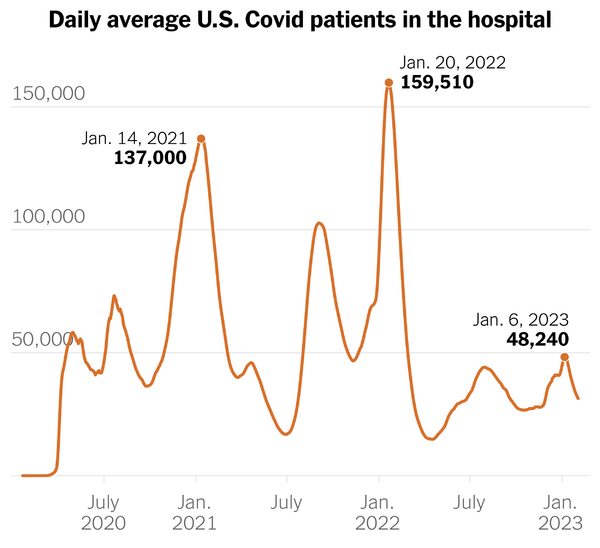
A milder Covid winter. In each of the past two winters, the country endured a terrible surge of severe Covid illnesses, but not this winter.
His column includes this chart of COVID hospitalizations.
New York Times February 6, 2023
Mr. Leonhardt explains —
It’s a sign that the virus has become endemic, with immunity from vaccinations and previous infections making the average Covid case less severe. If anything, the best-known Covid statistics on hospitalizations and deaths probably exaggerate its toll, because they count people who had incidental cases. Still, Covid is causing more damage than is necessary — both because many Americans remain unvaccinated and because Covid treatments are being underused, as German Lopez has explained.
Mr. Leonhart’s comment should come as no surprise to FEHBlog readers. Nevertheless, it’s encouraging to read it in the New York Times.
It’s worth noting that the first high peak from the left is Alpha which the Covid vaccines (released in December 2020) helped stem. The middle high point was Delta, and the highest point is Omicron which Paxlovid (released in December 2021) and other treatments helped stem. The public health authorities back in the day discussed a three-legged stool to deter Covid — one leg was immunity, the other was prevention (vaccines, etc.) and the third was treatments, which we did not broadly have until December 2021. What’s more the Omicron siblings have defeated some antiviral treatments but not Paxlovid.
On a related note of interest to care providers, CMS yesterday called attention to its regularly update Current Emergencies website which a chock-a-block full of helpful information.
From the Affordable Care Act and ERISA fronts
Fierce Healthcare discusses provider and payer reactions to the ACA’s regulators’ recently closed request for public input on the apprpropriate scope of the ACA’s essential health benefits requirement.
The Miller & Chevalier law firm discusses an important 9th Circuit U.S. Court of Appeals decision on remedies available in ERISA claim disputes. The decision favored the ERISA plans and their thir party administrators as well as the objective of health plan cost control.
From the executive personnel front —
Fierce Healthcare invites us to meet Express Script’s new president Adam Kautzner.
Healthcare Dive introduces us to CVS Health’s senior vice president and chief diversity, equity and inclusion officer Shari Slate.
CVS Health Corp. is close to an agreement to acquire Oak Street Health Inc.for about $10.5 billion including debt, a deal that would rapidly expand the big healthcare company’s footprint of primary-care doctors with a large network of senior-focused clinics, according to people with knowledge of the matter.
The companies are discussing a price of about $39 a share, the people said. The deal, if it goes through, could be announced as soon as this week, they said. CVS is scheduled to report earnings on Wednesday.
The Journal adds that “Oak Street, which has more than 160 centers across 21 states, focuses on the care of patients enrolled in Medicare” and that the deal would push CVS Health “far deeper” into direct provision of healthcare.
Alphabet, the parent company of Google, saw its medical stop-loss insurance business grow “nearly sixfold” last year, tech news site The Verge reported Feb. 2. The business, called Granular, provides medical stop-loss coverage to employers and is a subsidiary of Verily, Alphabet’s life sciences business.
Looking at 2,000 U.S. hospitals’ websites, only about a quarter were in full compliance with federal price transparency rules, according to a new analysis from PatientRightsAdvocate.org.
The majority of hospitals have some required files posted, but most are incomplete, illegible or do not clearly identify prices both associated with payer and plan, according to the report. Some 6% of the hospitals posted no usable pricing files.
This latest report calls out both major for-profit and nonprofit chains across the country for not following the rules, including HCA Healthcare, Tenet, Providence and UPMC, which lacked any compliant hospitals.
Gilead has secured an expanded U.S. approval for its breast cancer medicine Trodelvy, announcing Friday the Food and Drug Administration cleared the antibody treatment for the most commonly occurring form of the tumor type.
Previously approved only for rarer, “triple-negative” breast tumors, Trodelvy can now be used to treat patients with metastatic breast cancer that’s hormone receptor, or HR, positive, but negative for a protein called HER2. This type of breast cancer accounts for an estimated 70% of all new cases, according to Gilead.
The Raleigh NC News and Observer discusses a late stage breast cancer injectable drug that Duke University researchers have converted into an FDA approved pill. “[Duke researcher Donald] McDonnell expects elacestrant, which will be marketed as Orserdu, to completely replace the injectable treatment regimen. Not only is the pill less taxing for patients, clinical trials also found it to be more effective.”
Japanese drugmaker Eisai reported Monday the first U.S. sales of Leqembi, its treatment for Alzheimer’s disease, although exact numbers were not provided and people taking the drug appear to be paying out of pocket because insurance coverage has not yet been established. * * *
The Food and Drug Administration approved Leqembi on Jan. 6. It costs $26,500 per year and is administered by infusion every two weeks. The drug has the potential to be a commercial blockbuster, but only if Medicare can be convinced to pay for it. Unless Medicare changes the way it pays for drugs like Leqembi, Eisai expects a slow commercial rollout.
“Engagements with payers is steadily ongoing towards insurance coverage,” Eisai said Monday, although no new details about its communications with Medicare were provided. “Several” private insurers were “advancing their formulary discussions” about Leqembi reimbursement, Eisai also said, although specific coverage decisions, if any, were not disclosed Monday.
Following up on the May 11 end of the Covid public health emergency decision, CNBC informs us that the federal government’s free vaccine supply with be exhausted in “early fall,” likely October.
Vaccine pricing in the early fall
Moderna CEO Stephane Bancel told CNBC last month that the company is preparing to sell the vaccines on the private market as early as this fall. Pfizer CEO Albert Bourla told investors during the company’s earnings call this week that he is preparing for the vaccines to go commercial in the second half of the year.
Pfizer and Moderna have said they are considering hiking the price of the vaccines to somewhere around $110 to $130 per dose once the U.S. government pulls out of the vaccine program.
Paxlovid pricing and available supply
Pfizer has not announced how much the antiviral will cost once it goes commercial. The federal government is paying about $530 for a five-day treatment course. It’s unclear how much patients will have to pay out of pocket and how much of the price insurance will cover.
Dawn O’Connell, who heads the federal office responsible for the U.S. stockpile, said last August that the Health and Human Services Department expected to run out of Paxlovid by mid-2023.
[Dr. Ashish] Jha [the Omicron czar] said on Tuesday that there are still millions of doses of Paxlovid and omicron boosters in the U.S. stockpile. “They will continue to be available for free to all Americans who need them,” Jha said of the remaining federal supply.
From the public health front —
NPR Shots reflects on the end of the 2021-2022 tripledemic. The FEHBlog was pleasantly surprised that the Omicron X.BB surge was manageable even after the flu and RSV surges faded. In the FEHBlog’s layman’s view as a grandfather, the RSV surge was an unavoidable one-time event. The silver lining in that particular cloud is that a single-shot vaccine against RSV for infants appears on the horizon. The flu, like Omicron, will be with us for the foreseeable future.
The New York Times Magazine featured a thought-provoking article on menopause.
Fortune Well discusses available and future cancer vaccines.
From the cybersecurity front, Health IT Security interviewed Senator Mark Warner (D Va) “about the healthcare cybersecurity challenges discussed in his recent policy options paper and how he plans to address them.”
The healthcare sector will likely remain an enticing target for threat actors in the coming years, but a more streamlined approach to tackling cyber risk at the federal level is urgently needed. Warner shed light on this issue by first addressing the current patchwork of cyber leadership within the federal government.
“There are four different cabinet secretaries and sixteen different federal agencies that touch on healthcare,” Warner pointed out.
Even within HHS, agencies such as the Office for Civil Rights (OCR), the Office of the National Coordinator for Health Information Technology (ONC), and the Health Sector Cybersecurity Coordination Center (HC3) all have varying levels of oversight and expertise.
The question now, Warner explained, is “how do you put somebody in charge, or at least in charge of coordinating, so that you can take a holistic approach?”
This role would ideally help HHS “speak with one voice regarding cybersecurity in [healthcare],” the policy options paper stated, facilitating communication and collaboration between HHS and other entities such as the Cybersecurity and Infrastructure Security Agency (CISA).
The rising threat of flawed software will get even worse, as common vulnerabilities and exposures (CVEs) will average more than 1,900 per month, according to a report released Wednesday by insurance provider Coalition.
The monthly total will include 270 high-severity and 155 critical vulnerabilities, which often give attackers the ability to remotely take control of computer systems.
The San Francisco-based company said 94% of organizations scanned in 2022 had at least one unencrypted service that was exposed to the internet.
A total of 98% of organizations worldwide have integrations with at least one third-party vendor that has been breached in the last two years, according to a report released Wednesday from SecurityScorecard and the Cyentia Institute.
Third-party vendors are five times more likely to exhibit poor security, the report found. Half of organizations have indirect links to at least 200 fourth-party vendors that have suffered prior breaches.
The information services sector maintained on average 25 vendor relationships, which is the largest number of any sector and more than double the overall average of third-party vendors, which was 10. Healthcare averaged 15.5 vendors and the financial services industry averaged the lowest number, with 6.5. * * *
A separate report from Black Kite shows attacks on 63 vendor organizations during 2022 impacted almost 300 companies. On average, there were 4.7 impacted companies per vendor in 2022, compared with 2.5 per vendor in 2021.
The most common vector of these attacks was unauthorized network access, accounting for 40% of the incidents, according to Black Kite.
While the exact method of access is not usually disclosed or immediately known, unauthorized network access often is due to phishing, stolen credentials or vulnerabilities in access control, according to Bob Maley, CSO at Black Kite.
On a related note, an ISACA expert considers trends in cyberattacks.
Looking deeper into the crystal ball, Security Week discusses
The arrival of cryptanalytically-relevant quantum computers (CRQCs) that will herald the cryptopocalypse will be much sooner – possibly less than a decade.
At that point our existing PKI-protected data will become accessible as plaintext to anybody; and the ‘harvest now, decrypt later’ process will be complete. This is known as the cryptopocalypse. It is important to note that all PKI-encrypted data that has already been harvested by adversaries is already lost. We can do nothing about the past; we can only attempt to protect the future.
Beckers Health IT informed us on February 1, 2023:
More U.S. hospitals and health systems have reported that their websites went down this week after a cyberattack that Russian hacking group Killnet claimed responsibility for.
Becker’sreported Jan. 31 on 17 hospitals and health systems that were affected. These six organizations were also reportedly hit, according to newsreports and tech company BetterCyber:
1. Banner Health (Phoenix)
2. Boulder City (Nev.) Hospital
3. CHA Hollywood Presbyterian Medical Center (Los Angeles)
On January 30, 2023, the Heath Sector Cybersecurity Coordination Center (HC3) released an analyst note on this threat. The next day, HC3 issued a sector alert about “Multiple Vulnerabilities in OpenEMR Electronic Health Records System.”
Three vulnerabilities were identified in an older version of OpenEMR, a popular electronic health records system, which can allow for a cyberattacker to access sensitive information and even compromise the entire system. The prevalence of ransomware attacks and data breaches impacting the health sector make these vulnerabilities especially important. These vulnerabilities were fixed in newer versions of OpeEMR, and therefore upgrading to the most recent version will fully patch them.
On a related note, Cyberscoop points out, “ChatGPT isn’t a malware-writing savant, and much of the hype around it obscures just how much expertise is required to output quality code.”
From the cyber breach front, last Thursday, the HHS Office for Civil Rights announced a HIPAA Security Rule alleged violation settlement with Banner Health,
a nonprofit health system headquartered in Phoenix, Arizona, to resolve a data breach resulting from a hacking incident by a threat actor in 2016 which disclosed the protected health information of 2.81 million consumers. The settlement is regarding the Health Insurance Portability and Accountability Act (HIPAA) Security Rule which works to help protect health information and data from cybersecurity attacks. The potential violations specifically include: the lack of an analysis to determine risks and vulnerabilities to electronic protected health information across the organization, insufficient monitoring of its health information systems’ activity to protect against a cyber-attack, failure to implement an authentication process to safeguard its electronic protected health information, and failure to have security measures in place to protect electronic protected health information from unauthorized access when it was being transmitted electronically. As a result, Banner Health paid $1,250,000 to OCR and agreed to implement a corrective action plan, which identifies steps Banner Health will take to resolve these potential violations of the HIPAA Security Rule and protect the security of electronic patient health information.
From the ransomware front, all the FEHBlog has this week (do we really need more?) is Bleeping Computer’s The Week in Ransomware.
While the week started slowly, it turned into a big ransomware mess, with attacks striking a big blow at businesses running VMware ESXi servers.
The attacks started Friday morning, with threat actors targeting unpatched VMware ESXi servers with a new ransomware variant dubbed ESXiArgs.
What makes this attack so devastating is that many companies operate much of their server infrastructure on VMware ESXi, allowing the encryption of one device to encrypt multiple servers simultaneously.
The good news is that some admins have been able to recover their servers by rebuilding disks from flat files, but some have reported being unable to do so as those files were also encrypted.
According to the CDC’s Weekly Interpretative Report on its Covid Data Tracker, Omicron cases, hospitalizations, and deaths continued to trend down last week while community-level statistics improved. The CDC report leads with an analysis of Omicron variants. Only 4% of U.S. counties have a high level of Covid infections based on the CDC’s Communities approach.
The CDC’s weekly Fluview continues its string of reports that “Seasonal influenza activity continues to decline across the country.”
“The CDC warned of a multistate outbreak of an extensively drug-resistant strain of Pseudomonas aeruginosa linked to various brands of artificial tear drops.
“An investigation identified artificial tears as a common exposure for many patients. Patients reported using over 10 different brands of artificial tears; EzriCare Artificial Tears, an over-the-counter product, was most common.
“Pending additional guidance from the CDC and FDA, “patients and healthcare providers should immediately discontinue using EzriCare Artificial Tears,” the CDC said in an advisory to its Health Alert Network.”
From the health plan design front, the FEHBlog has run across helpful articles from the Kaiser Family Foundation, the Advisory Board, and Forbes on the impact of the May 11, 2023, end of the Covid national and public health emergency. From a health plan standpoint, the biggest considerations are the end of (a) out-of-network testing and vaccine mandates and (b) the mandate to provide free rapid covid tests. Sometime in 2023, the federal government’s funding for Covid vaccines and Paxlovid will be exhausted, and health plans will need to pick up the slack.
The Office of Personnel Management’s own Federal Employee Benefits Surveys, cumulatively covering hundreds of thousands of feds, have consistently reinforced this point—showing around 80% or more of feds identify strong benefits programs (led by federal retirement annuities, the Thrift Savings Plan and Federal Employees Health Benefits insurance programs) as a major part of why they stick with their jobs.
The Employee Benefit Research Institute recently published a new report exploring such issues—one zeroing in on what makes a job “sticky” for employees, covering data and anecdotal evidence on private- and public-sector employment over the last 40 years.
Craig Copeland, EBRI’s director of Wealth Benefits Research parsed these findings for Government Executive and affirmed that attractive federal benefits remain crucial in helping agencies retain feds.
“Yes, it is still clear that public sector employees—including feds—are more likely to stay at their job longer than other sectors, at least up until recent years,” Copeland told Government Executive. “The defined benefits plans that public sector jobs usually provide typically are an important part of the reason that public sector employees stay longer—as well as because of the overall typically better benefits offered to public sector employees when compared with the average private sector employee.”
However, Copeland said that it’s hard to say if these long-term trends—the popularity of strong benefits and the stickiness of the public-sector jobs that offer them—persist among the growing younger slice of feds.
The American Health Association (AHA) went bananas over the Justice Department’s unexpected withdrawal of aging antitrust guidance that favors the healthcare industry. Fierce Healthcare also discusses DOJ’s action
Also, from the AHA
Alabama hospitals lost $1.5 billion since the beginning of the pandemic, despite receiving federal COVID-19 relief funds. At the same time, costs increased $2.6 billion, leaving over half of the state’s hospitals currently operating in the red, Kaufman Hall reports.
Indiana hospitals have lost $1.2 billion since 2019, with expenses for labor, medical supplies, drugs and other purchased services up by $3.2 billion, leaving many of the state’s hospitals with negative operating margins, according to a Kaufman Hall analysis.
The American Hospital Association’s 2023 legislative strategy is unveiled in a Politico article.
The Hill reflects on the history of Groundhog Day. By the way, “on Thursday, Punxsutawney Phil predicted six more weeks of winter.”
Each year on the first Friday in February, [February 3, 2023], the National Heart, Lung, and Blood Institute, The Heart Truth® and others around the country celebrate National Wear Red Day® to bring greater attention to heart disease as a leading cause of death for Americans and steps people can take to protect their heart. Promote Wear Red Day in your community with resources such as printable stickers, posters, and social media graphics, including customizable ones.
From Capitol Hill, Roll Call tells us that “Senate committees will be able to get to work next week after the Senate adopted resolutions constituting their membership for the 118th Congress before departing Thursday afternoon.”
STAT News interviews the Chair and Ranking Member of the Senate’s Health, Education, Labor and Pensions Committee, Senators Bernie Sanders and Bill Cassidy respectively.
Both senators cited addressing the national shortage of nurses as high on the bipartisan to-do list. The chairman also said he thinks expanding community health centers and improving dental coverage could get both parties’ buy-ins, while Cassidy pointed to mental health care legislation and probing the rollout of efforts to eliminate patients’ surprise medical bills.
Unsurprisingly, however, Sanders’ top priority is slashing drug costs — and he’s banking on voter polling to push GOP members, or at least put them in an uncomfortable spot with constituents.
From the Medicare front, Health Payer Intelligence provides an overview of reactions to yesterday’s CMS 2024 Medicare Advantage Advance Notice with changes for Medicare Advantage plans and Medicare Part D.
The Kaiser Family Foundation offers a detailed study of prior authorization requests for Medicare Advantage enrollees in 2021. Adverse decisions on prior authorization requests. The number of requests varied by Medicare Advantage carrier. Six percent of all prior authorizations were partially or entirely denied. 11% of prior authorization requests were appealed, and 82% of appeals were decided in the Medicare Advantage enrollee’s favor. What an interesting batch of percentages.
From the U.S. healthcare business front, BioPharma Dive reports
Sales of Eli Lilly’s new diabetes drug Mounjaro grew strongly in the final quarter of 2022, the company reported Thursday, challenging the market position of competing medicines from rival Novo Nordisk.
Fourth quarter sales totaled $279 million, bringing the total for 2022 to $483 million following the drug’s June launch. The fast sales put Mounjaro, approved to improve blood sugar control in people with Type 2 diabetes, on pace to quickly reach blockbuster status. Studies have shown the drug to have a powerful weight-loss effect as well, supporting Lilly’s current efforts to expand the drug’s approval to include obesity treatment. * * *
On an earnings call Thursday, Lilly executives said the company is having trouble keeping Mounjaro production high enough to match patient demand. More manufacturing capacity is being added, with a site in North Carolina expected to start production sometime later this year, CFO Anat Ashkenazi said on the call.
Russ Roberts spoke with Dr. Vinay Prasad on this week’s Econtalk episode. The topic is “Pharmaceuticals, the FDA, and the Death of Duty.” During the episode, Dr. Prasad identified Dr. Bernard Fisher as one of his heroes. Dr. Fisher passed away in 2019 at age 101. I had never heard of Dr. Fisher, but his story should be shared.
Healthcare consumers appear to be increasingly comfortable switching providers when their current one isn’t meeting their needs, according to a report from Accenture. About 30% of patients selected a new provider in 2021 — up from 26% in 2017, the report found. A quarter switched providers in 2021 because they were unhappy with their care — up from 18% in 2017. Switching providers is especially true among younger generations, like Gen Zers and millennials, who were six times more likely to switch providers than older people, according to the report.
From the miscellany department —
Health Affairs Forefront delves into the data produced to date by the government’s payer transparency rules.
Fierce Healthcare tells us about a recent expansion of CVS Health’s virtual primary care service.
Benefit consultant Tammy Flanagan writing in Govexec, follows the path of a federal employee’s retirement application.
We use cookies on our website to give you the most relevant experience by remembering your preferences and repeat visits. By clicking “Accept”, you consent to the use of ALL the cookies.
This website uses cookies to improve your experience while you navigate through the website. Out of these, the cookies that are categorized as necessary are stored on your browser as they are essential for the working of basic functionalities of the website. We also use third-party cookies that help us analyze and understand how you use this website. These cookies will be stored in your browser only with your consent. You also have the option to opt-out of these cookies. But opting out of some of these cookies may affect your browsing experience.
Necessary cookies are absolutely essential for the website to function properly. These cookies ensure basic functionalities and security features of the website, anonymously.
Cookie
Duration
Description
cookielawinfo-checbox-analytics
11 months
This cookie is set by GDPR Cookie Consent plugin. The cookie is used to store the user consent for the cookies in the category "Analytics".
cookielawinfo-checbox-functional
11 months
The cookie is set by GDPR cookie consent to record the user consent for the cookies in the category "Functional".
cookielawinfo-checbox-others
11 months
This cookie is set by GDPR Cookie Consent plugin. The cookie is used to store the user consent for the cookies in the category "Other.
cookielawinfo-checkbox-necessary
11 months
This cookie is set by GDPR Cookie Consent plugin. The cookies is used to store the user consent for the cookies in the category "Necessary".
cookielawinfo-checkbox-performance
11 months
This cookie is set by GDPR Cookie Consent plugin. The cookie is used to store the user consent for the cookies in the category "Performance".
viewed_cookie_policy
11 months
The cookie is set by the GDPR Cookie Consent plugin and is used to store whether or not user has consented to the use of cookies. It does not store any personal data.
Functional cookies help to perform certain functionalities like sharing the content of the website on social media platforms, collect feedbacks, and other third-party features.
Performance cookies are used to understand and analyze the key performance indexes of the website which helps in delivering a better user experience for the visitors.
Analytical cookies are used to understand how visitors interact with the website. These cookies help provide information on metrics the number of visitors, bounce rate, traffic source, etc.
Advertisement cookies are used to provide visitors with relevant ads and marketing campaigns. These cookies track visitors across websites and collect information to provide customized ads.