TGIF

TGIF

The FEHBlog is about to hit the road with his family for fun filled weekend in Connecticut so he only has time to discuss one item and it’s enouraging. 

Reuters reports that the Food and Drug Administration has accepted an application for a  bio-similar drug.

U.S. regulators have accepted an application by Sandoz – the generics arm of Novartis – seeking approval for a copycat version of Amgen’s drug Neupogen, or filgrastim, for patients with low white blood cell counts.
The Food and Drug Administration’s decision to accept the filing under a new pathway for so-called biosimilar drugs marks a milestone in the rollout of cheaper copies of injectable biotech medicines in the United States.
Sandoz said on Thursday that overcoming the first hurdle in the approval process was an important step in increasing U.S. patient access to such treatments.
The generics company already sells a biosimilar version of Amgen’s drug in more than 40 other countries, but the United States has been slower than other markets to establish a regulatory framework for biosimilars.

Better late than never as the saying goes.

Midweek update

Gilead Sciences just came out with its second quarter earnings. Sovaldi sales totalled almost $3.5 billion in the second quarter or around $5.75 billion for the first six months of 2014. The Wall Street Journal reported earlier this week that the prescription drug manufacturers are engage in “unusual” patent litigation / tong wars with Gilead over Sovaldi. CVS officials discuss Gilead’s “unsustainable” pricing policy here.

Speaking of health care costs. Fierce Healthcare reports on a investment bank survey finding that hospital inpatient volumes trend slightly up (0.4%) in the second quarter of 2014, after several years of downward trends. “Researchers attribute the uptick to a combination of the improving economy, the implementation of the Affordable Care Act and patients waiting as long as possible for procedures, compounding demand.”

Yesterday, the U.S. Court of Appeals for the D.C. Circuit ruled that the Affordable Care Act (ACA) does not permit the federal government to pay subsidies to participants in the federal exchanges, only to those in state established exchanges or market places. . The U.S. Court of Appeals for the Fourth Circuit ruled the other way, affirming the Obama Administration’s position.

Employee Benefit News reports that a couple of leading benefits lawyers are predicting that these conflicting decisions could lead the federal government to delay the employer mandate for another year. Evidently the impetus for this prediction is that the employer mandate falls by the wayside if subsidies cannot be paid in the 36 states that use the federal exchanges. Talk about water torture.

The FEHBlog heard a law professor yesterday remark that it would not be a particularly heavy lift for states in the federal exchange to create their own exchanges in the wake of a Supreme Court decision siding with the DC Circuit. In that regard, Maryland is picking up the pieces of its hopelessly broken state exchange and switching to Connecticut’s exchange technology.

Of course, we don’t even know at this point whether the Supreme Court will take the case because there is a high likelihood that the entire bench of active DC Circuit judges (7 Democratic President appointees and 4 Republican appointees) will reverse the panel decision en banc leaving no split in the circuits. The Supreme Court still could take the case, but the lack of circuit split reduces the urgency to do so.

In other legal news, the Hill reports that on Monday the U.S. District Court for the Eastern District of Wisconsin dismissed Sen. Ron Johnson (R Wisc) challenge to OPM’s decision to provide a FEHBP government contribution to members of Congress and their official staffs who have transitioned from the FEHBP to the DC SHOP program, which is part of the ACA’s health insurance market place.  The Hill explains that

The judge dismissed the argument that, without a court challenge, there would be no other way to fix the regulation. Lawmakers can cite the regulation on the campaign trail to sway elections, the judge said, or Congress could use some of its other powers to rein in the executive.
“The Congress itself is surely not helpless to rein in the executive: It has spending authority, investigative powers, and it even wields the blunt instrument of impeachment,” the judge wrote.

Weekend update

The FEHBlog enjoyed the afternoon at Nats Park watching Jason Werth hit a walk off double to win the game over the Milwaukee Brewers. The Nationals pointed out during the President’s race that today is the 45th anniversary of the Apollo 11 moon landing. Federal News Radio has a photo collage of that historic space flight.

Congress is in session this week. Here’s a link to the week in review up on Capitol Hill.

The WSJ Pharmalot blog discusses another very expensive specialty drug called Kalydeco which treats cystic fibrosis. The drug’s manufacturer Vertex Pharmaceuticals charges around $300,000 a year for the drug. Arkansas Medicaid is requiring Medicare beneficiaries suffering from this disease to try less expensive drugs before resorting to Kalydeco. A 14 year old girl with cystic fibrosis, which is a rare genetic disease, is suing the Medicaid Program. Vertex claims that its hands are tied by the Medicaid rules — no special treatment for this girl. Note that if Vertex lowers the cost of the drug for Medicaid, it will wind up lowering the cost of all payers because Medicaid pricing is the floor price for brand name drugs.

The drug manufacturer’s trade association Phrma defends these unconscionable pricing policies here.

The shift from managing a condition to being able to cure it has already occurred for hepatitis C patients. The disease affects nearly three million Americans today who face high medical costs if the infection is left untreated. New and forthcoming treatments have sparked controversy with their high price tag of approximately $1,000 per pill. When considering the $600,000 bill for a liver transplant or the $85 billion combined annual medical costs for all hepatitis C patients projected by 2034, however, the cost doesn’t seem so off base. Additionally, solely looking at the cost of the medicine, fails to account for the invaluable increase in lifespan and quality of life that patients gain from these innovative new medicines.

Why Phrma’s argument is facially appealing, the bottom line is that Gilead Sciences which makes the Sovaldi Hepatitis C drug recovered its research and development costs from the first quarter of Sovaldi sales — over $2 billion according to the NY Times.  The drug manufacturers need to come to their senses fast.  With this attitude there will never be cost savings from medical advances. Gilead reports its second quarter 2014 earnings on Wednesday July 23.

TGIF

Following up on Wednesday’s post about the House passage of the financial services and general government appropriations bill, Federal News Radio points out that

The bill is silent on the issue of a federal pay raise, but that’s
actually good news for federal employees. In the absence of specific legislative
language, President Barack Obama has the authority to order a pay raise for
federal workers. In his fiscal 2015 budget proposal, Obama signaled his intention
to award federal employees a 1 percent pay raise. 

The White House has expressed opposition to this House bill because it would slash funding to the IRS.

The Congressional Budget Office issued a report on the causes of projected growth in spending for Social Security and Major Health Programs, which is worth a look. CBO projects that

the anticipated growth is expected to come from the government’s major health care programs (Medicare, Medicaid, the Children’s Health Insurance Program, and subsidies offered through [the ACA’s] health insurance exchanges): CBO projects that, under current law, total outlays for those programs, net of Medicare premiums and certain other offsetting receipts, would grow much faster than the overall economy, increasing from just below 5 percent of GDP now to 8 percent in 2039.

Speaking of the ACA, the ACA regulators just issued FAQ XX which concerns the Supreme Court’s Hobby Lobby decision.  An FEHBP angle of this issue is that Congress has allowed faith based FEHB plans to opt out of contraceptive coverage since it implemented a contraceptive coverage mandate for the FEHBP in the late 1990s.

Leapfrog Group released a Castlight analysis of its annual hospital survey for 2013 which was loaded with good news:

More hospitals are adopting computerized physician order entry (CPOE) to reduce medication errors, with 616 hospitals fully meeting Leapfrog’s standard, a 65 percent increase from 2012. But some problems with performance of the systems persist, such as failure to alert on potentially fatal medication errors.
• Dramatic improvement in areas of maternity care – especially in reducing early elective deliveries, with the average rate of early elective deliveries declining from 11.2 percent in 2012 to 4.6 percent in 2013. However, too many high-risk babies are being delivered at hospitals that aren’t optimally equipped to care for them. In 2013, less than 24 percent of hospitals fully met Leapfrog’s high-risk delivery standard, a decline from 37 percent in 2011.
• Surprisingly high variance in predicted survival rates for high-risk procedures across hospitals, as well as in hospital-acquired injury and infection rates. For example, the predicted mortality rate varies five-fold for esophagectomies; six-fold for abdominal aortic aneurysm (AAA) repair; and 131 out of 1,302 reporting hospitals have hospital-acquired injury rates of over one in 1,000, which is considered alarmingly high.
• Better compliance with ICU physician staffing standards, shown to decrease mortality by as much as 40 percent. Notably, 41.7 percent of reporting hospitals fully meet this standard in 2013, compared to 39 percent in 2012.
• Strong adoption of Leapfrog’s Never Events policy, with 80 percent of hospitals committing to abide by Leapfrog’s five principles when a Never Event occurs in their facility. 

OPM has encouraged FEHB plans to undertake efforts to support reduction of early elective deliveries and never events.

Midweek update

The House has been debating this week the appropriations bill for the financial services and general government operations (HR 5160), and this afternoon the House passed the bill in a vote along party lines. This is the bill that funds the Office of Personnel Management and the FEHBP. 

On Monday, the Congressional Budget Office released its report on the Senate Postal Service reform bill, S. 1486. That bill would establish a Postal Service health plan within the FEHBP. This new plan would have mandatory integration with Medicare Parts B and D for annuitants. CBO projects that this approach will save the Postal Service $1 billion over 10 years.

The Commonwealth Fund has created an initiative looking at ways to improve provider incentive programs. The “initiative recognizes that a wide range of factors influence providers’ choices, beyond financial rewards or penalties, including intrinsic motivation and medical professionalism, organizational influences, and policy.” An example of a non-financial reward is

Leveraging providers’ innate desire to do a better job. Psychological research also demonstrates that nonmonetary motivators, such as peer comparisons, may strengthen people’s inherent desire to perform well. The introduction of quality report cards for cardiac surgeons across Pennsylvania had a four times larger effect on surgeons’ performance than profit incentives.

Speaking of quality report cards, U.S. News and World Report has released its 2014-15 Best Hospital rankings according to the Fierce Healthcare website. The rankings include an Honor Roll of the top 10 hospitals. The closest top 10 hospital to Washington DC is Johns Hopkins in Baltimore. Johns Hopkins health system has taken over a number of suburban DC hospitals in Maryland and Virginia.

Finally, the Seattle Times reports on health plan efforts to expand coverage of telehealth services. The article discusses the debate over the proper form and role of telemedicine.

It’s a debate that has included the American Medical Association (AMA), which last month offered new guidelines to shape telemedicine’s development; state licensing boards that agreed on their own draft policy in April; five of the nation’s top publicly traded health insurers; and a small group of closely held telemedicine companies convinced their time has come as concerns about medical cost and access rise.
The discussion promises to escalate as patients become increasingly sophisticated in their online pursuits, delays in making doctor appointments grow longer, and the cost of services provided by medical centers increases.
“More and more patients are comfortable seeing a physician online,” said Jonathan Linkous, CEO of the American Telemedicine Association.
“It’s an adoption process. They understand it, and use it,” Linkous said.

Weekend update

Congress is again in session this week. Here’s a link to the last week in Congress report which the FEHBlog finds helpful. 

Last week, the Blue Cross Blue Shield Association published a report on its operations headlining that

Blue Cross and Blue Shield (BCBS) companies across the nation are spending more than $65 billion a year—about one in five medical claim dollars—in programs that provide incentives for better health outcomes for patients while reducing costly duplication and waste in care delivery. 

The New York Times discussed the report in an article explaining that

Aetna, Cigna and UnitedHealth Group, among others, are also all exploring similar ways of rewarding doctors and hospitals, but the move by the Blue Cross plans is significant because of their size in so many markets. The association estimates the plans have arrangements with 215,000 physicians affecting more than 24 million members, including some in Medicare Advantage plans.
The experiments include paying for care delivered in a medical home, which is not a place, but rather a model where patients are closely followed and their care is coordinated. In its program, Horizon Blue Cross Blue Shield of New Jersey pays a primary care doctor roughly $5 per patient a month to manage a patient’s care. The doctor can earn an additional $11 a month per patient by meeting certain quality and efficiency goals. A practice with 1,000 patients could make an extra $60,000 to $192,000 a year.

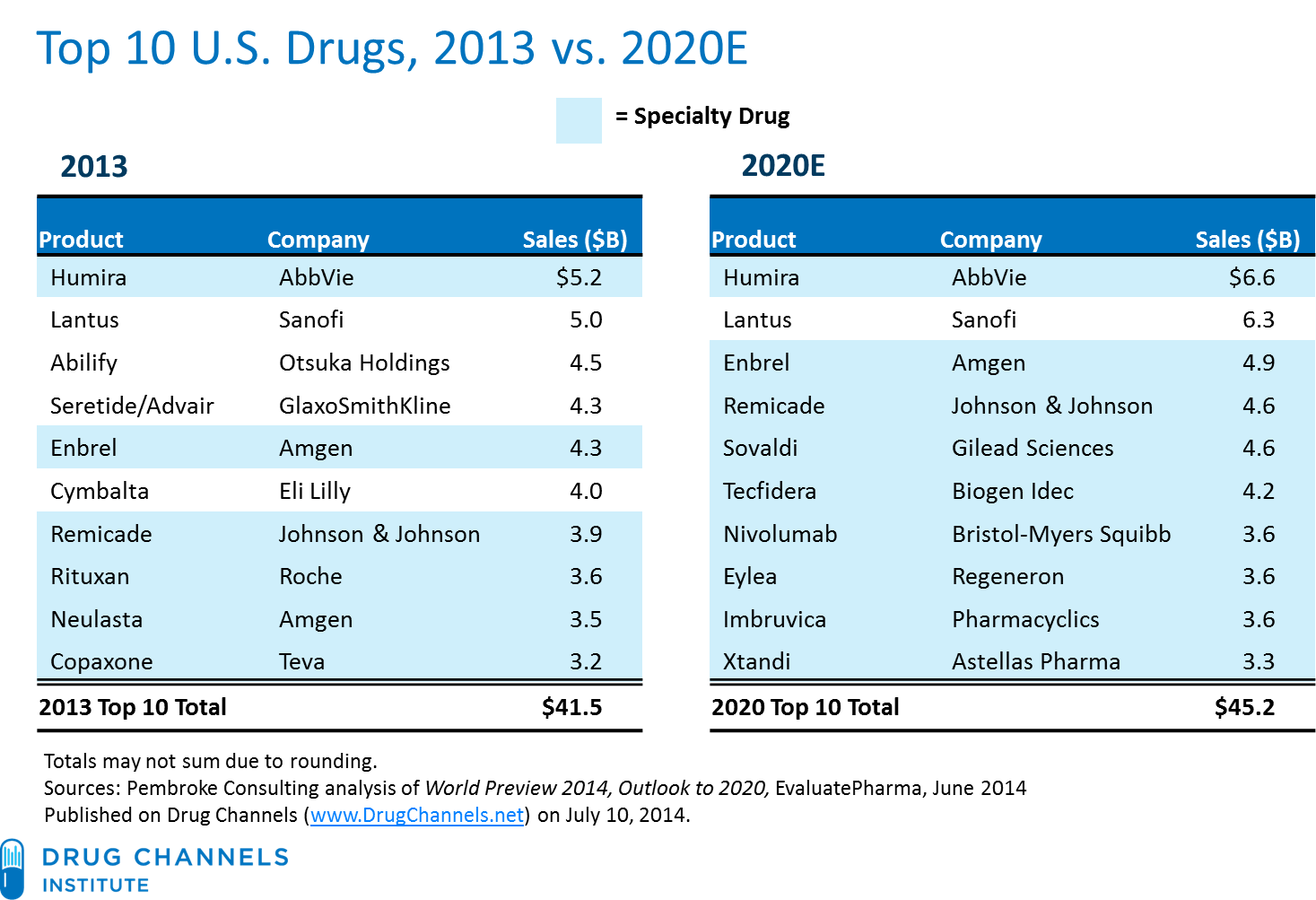
Drug Channels compares the top selling U.S. drugs in 2013 with EvaluatePharma’s projection of top selling U.S. in 2020. The blog adds that

The number of specialty drugs in the top 10 keeps rising. In 2020, 9 of the 10 best-selling drugs by revenue are projected to be specialty drugs, compared with 3 drugs in 2010 and 6 in 2013. EvaluatePharma predicts that AbbVie’s Humira [an arthritis specialty drug] will stay on top. You might be surprised at the Solvadi forecast.  One oddity: EvaluatePharma doesn’t expect biosimilars to do much harm to 2020’s top drugs.

Sovaldi, the Hepatitis C specialty drug, is projected to be the the fifth best selling drug in 2020 with $4.6 billion in sales.

Finally, yesterday’s Wall Street Journal reported that Bill Gates and Warren Buffett share the opinion that the best book about business is Business Adventures by John Brooks which was written in the 1960s.

It’s certainly true that many of the particulars of business have changed. But the fundamentals have not. Brooks’s deeper insights about business are just as relevant today as they were back then. In terms of its longevity, “Business Adventures” stands alongside Benjamin Graham’s “The Intelligent Investor,” the 1949 book that Warren says is the best book on investing that he has ever read.

The article states that the book is out of print. But Amazon must have been clued into the article because paper and Kindle versions of the book are available on Amazon.com. The FEHBlog has downloaded his copy, and the book is fun reading.

TGIF

Let’s start out with a little appointment news. The Federal Times reports that yesterday the Senate confirmed former Housing and Urban Development Secretary Shaun Donovan to be the new Director of the Office of Management and Budget. Mr.Donovan replaces Sylvia Mathews Burwell who is not HHS Secretary.  OMB basically runs the federal bureaucracy. Federal News Radio reports that the President has nominated OMB Senior Advisor Anna Rung to be the next Administrator of the Office of Federal Procurement Policy within OMB. OFFP is in charge of federal contracting which impacts the FEHBP because all FEHB plans are created by federal contracts. Finally, HHS Secretary Burwell has appointed Jocelyn Samuels to be head of the HHS Office for Civil Rights. Ms. Samuels replaces Leon Rodriguez. Both Ms. Samuels and Mr. Rodriguez came to OCR from the Justice Department’s Civil Rights Division. OCR is responsible for enforcing the HIPAA Privacy and Security Rules.

The Wall Street Journal’s Pharmalot blog reports that the European Union and two U.S. Senators are putting new pressure on Gilead to lower the astronomical price of its Hepatitis C drug, Sovaldi.  As the FEHBlog has noted, Gildead’s brazen pricing policy has emboldened other drug manufacturers to raise prices, even in relatively sleepy markets like vaccines and generic drugs that have been on the generic market for many years.

Finally, Forbes lists the ten most expensive cities for healthcare in the U.S.  The Forbe report is based on a Castlight Health study of most and least expensive U.S. cities for common healthcare procedures. Here’s a link the Castlight’s interactive map.

Midweek update

OPM released three reports stemming from its 2013 federal employees benefits survey — a general report on survey results, a report on tobacco use, and a report on health and wellness programs. The Washington Post and Govexec.com featured articles on these reports. The FEHBP and the federal retirement program received the highest marks from the survey participants.

The FEHBlog recently noted articles on rising vaccine costs. The New York Times reported yesterday that even certain generic drug prices have been rising sharply.  “Dr. Aaron Kesselheim, a professor of health economics at the Harvard School of Public Health, noted, “’Studies show it is not until you have four or five generics in the market that the prices really are down.’” Pricing problems occur when competition drops off.

By late 2013, a number of generic manufacturers had largely stopped producing and distributing digoxin, then a cheap medicine whose use had declined, leaving only two companies dominant in the market. Both businesses — the Lannett Company and Global Pharmaceuticals, a division of Impax Laboratories — are small companies whose bottom line can rise and fall on the sales of a single drug.
Then this January, the Swiss manufacturer Covis began selling an “authorized generic.” Such medicines are made according to the specific formula of the company that makes the branded drug and holds the original patent (GlaxoSmithKline in the case of digoxin), and tend to be more expensive than a typical generic.
In late 2013, one of the companies began a price increase, and the others soon followed, records show. “It’s quite difficult to pinpoint who was the catalyst, but we are seeing a big step up,” said Anthony Raeside, an analyst at EvaluatePharma.

Reuters reports on a UnitedHealthcare study that applied an upfront bundled payment approach to oncologists. The bundled payment approach controlled the doctor’s charges, but oncology drug prices continued to skyrocket.  “It was not clear if the chemotherapy costs rose because drug prices rose or because doctors administered more treatments.” In any event, that result was surprising to the insurer.

Speaking of cancer treatments, Employee Benefit News reports on a new product that MolecularHealth is making available to self insured employers.

The core of the program, called MolecularHealth Corporate Oncology Program For Employers, or COPE, is the company’s TreatmentMAP process. Through TreatmentMAP, cancer tumors are analyzed to determine their genes and biomarkers and the program then creates an actionable report for the treating physician to get the patient “on the best treatment for them at that time with their particular disease,” explains Housman. “And if a treatment is not available, work with them to find what clinical trial options are available with that particular disease. So it’s really personalized to that patient’s particular tumor.” Safety and efficacy data of the suggested therapies is also incorporated into the treatment map, which carries a list price of $5,000.

Modern Healthcare reports that the Centers for Medicare and Medicaid Services recently released a monster proposed rule concerning Medicare Part B payments for doctors’ service in 2015. The proposed rule includes a significant expansion of Medicare Part B coverage of telehealth services.

Added to the list of [Medicare Part B] covered telehealth services by the proposal are annual wellness visits, both for an initial visit, and for subsequent visits, if they include a personalized prevention plan of service.
It also proposed to add to the list telehealth sessions for psychoanalysis, family psychotherapy, both with and without the patient being present; and for “prolonged service in the office or other outpatient setting requiring direct patient contact beyond the usual service.”
The CMS rulemakers also propose to allow payments for telehealth services afforded to patients in “rural census tracts” even if those tracks are within metropolitan statistical areas. Census tracts are composed of smaller census blocks and block groups and have on average about 4,000 inhabitants. Populations of the 388 MSAs in the U.S. and Puerto Rico vary widely, from about 50,000 to nearly 20 million inhabitants. 

Health Data Management reports that FAIR Health, the non-profit that helps health plans set out of network pricing, has offered details on the use of its online consumer healthcare cost lookup system.

Finally, Fierce Health Finance reports that for profit hospital chains like Tenet and HCA are aggressively entering the urgent care center business in order to compete with the pharmacy chains.  


Weekend update

The FEHBlog hopes that everyone enjoyed the long holiday weekend. The FEHBlog certainly did. 

Congress returns to Washington this week.  The Arizona Republic projects that Congress has about 30 days remaining before the election to take legislative action.

The Washington Post published a primer for health care investors today that was quite informative. On Thursday, the FEHBlog linked to a Beckers Hospital Review projection of non-profit hospital revenues for 2014. The Post adds that

[R]oughly 80 percent of hospitals are still nonprofit, according to the American Hospital Association. But those who want to invest increasingly need to choose mega hospital networks as more hospitals merge to cope with the higher costs. Eighty-five hospitals and health systems merged or were acquired in 2013 — up from the 50 deals in 2009, according to Irving Levin Associates, a health research firm. In all, 283 hospitals changed hands last year, the firm’s Lisa Phillips says.

The Dallas Forth Worth Healthcare Daily published an interesting interview with Cigna’s regional CEO, LaMonte Thomas. Here’s the punchline:

What do you see the future of the company and the role of the insurer going forward?
I think as healthcare continuously evolves, the role that we’ll play is conveners: Conveners of the stakeholders as we continue to evolve and continue to grow and adjust as we learn more amid technology changes. There will be different access to information, to resources as the medical field evolves. So we’ll be conveners for employers, for hospital systems, and for those that are consuming healthcare.
We’ll provide and continue to provide coaching, we’ll continue to provide management and medical management services that we provide today. I don’t think that model changes much. For us at Cigna, since most of our business is self-funded, we’ll be serving greater resources for employers to help them in their efforts to continue to push their employees closer to the physician.
Our role for the physician is to provide data and resources to make it easy and helpful for both of those parties as they move closer together. In an ideal situation, if there’s risk and you’re paid on results rather than activity, then you’re incentivized to guide that person to the high quality place for the most cost efficient. You’re incentivized to write prescriptions for generics instead of name brand. So that role as navigator and transparency goes closer and closer to the physician, more so than companies like Cigna or other companies out there building models around transparency.
So you’ll be more of an intermediary between the two.
Absolutely, with us getting away from the middle of that relationship.

NCQA announced last weeks its 2015 changes to the HEDIS quality measures that are applied to health providers and plans, including FEHB plans.  Here’s one sensible change that the FEHBlog noticed:

Plan All-Cause Readmissions: To improve this measure’s accuracy, NCQA revised it to allow readmissions to serve as potential index admissions and added an exclusion for planned readmissions.  

Finally the FEHBlog got a big kick out of a letter that a Florida doctor sent to the Wall Street Journal in response to its editorial about the Supreme Court’s Hobby Lobby decision last week:

What has corrupted the debate over this issue is that we have abandoned the principle of individual responsibility and have transformed the idea of medical insurance into a concept of free medical care.

Amen, Dr. Stanley Spatz.


Happy 4th of July Weekend

The FEHBlog is certainly glad that he vacationed on the Outer Banks last week and not this week. Here’s the hurricane that is now looming over that coast.

In response to the FEHBlog’s recent report that OPM has given FEHB plans its approval to cover gender reassignment surgery, a reader inquired when federal and postal employees and annuitants will learn which plans will be offering that coverage for 2015. FEHB plans typically disclose their benefit packages in mid to late September when OPM announces the next year’s government contribution amount.  The FEHBlog expects that LGBT publications will gather that information for their readers.

In furtherance of the FEHBlog’s point that the ACA’s mandate to provide “free” preventive care has raised costs for everyone, the WSJ’s Pharmalot blog reports that the ACA mandate has given a boost to vaccine prices.

One example is Prevnar 13, which prevents diseases caused by pneumococcal bacteria, and requires multiple shots priced at $136 each, with every child in the U.S. required to get four doses before entering school. The Prevnar line generated $4 billion in revenue last year. Michael Haydock of the Datamonitor Healthcare consulting firm, tells the [New York] Times “it’s expensive in part because it’s a very effective vaccine and also because they’re exploiting their monopoly.”

Although the vaccine has not changed, the cost has risen an average of 6 percent each year since its 2010 FDA approval, the Times writes. “You have to make back your investment and pay your shareholders, but at what point do you say, ‘Look, you’ve had your steak, gravy and potatoes and this is enough?’” Steven Black, a vaccine expert at Cincinnati’s Children Hospital, tells the paper. He was on the government panel that recommended children get an earlier Prevnar 7 version.

That blog also reports that several prescription benefit managers, in particular Express Scripts, have begun excluding an assortment of ointments, creams, and powders that compounding pharmacies use to make topical treatments.

For instance, the average cost for each prescription rose to $1,100 from $90, and for about a dozen such medications, the actual cost jumped by more than 1,000%. Consequently, the amount spent by its clients for compounded drugs increased to roughly $171 million in this year’s first quarter, up from $28 million during the comparable period in 2012.

“It’s an issue of waste,” says Glen Stettin, senior vice president for clinical, research and new solutions. “For nearly all of these products, there’s already a commercial preparation already available – a generic or brand-name product approved by FDA. And there is no evidence to support their use at all.”

Touche.

It’s nice to read other publications supporting your point of view. The RxObserver joins the FEHBlog on the bandwagon demanding that the Food and Drug Administration finally create a regulatory pathway for biosimilar drugs.

The European Union first established a clear biosimilars pathway in 2004.   Biosimilars are available in 27 industrialized nations – including Japan, Germany, the United Kingdom, France, and Canada – but have been effectively denied to American patients through a combination of bad policy and brand pharma-initiated roadblocks.  Express Scripts, a large pharmacy benefit manager, recently projected that biosimilars could yield $250 billion in savings by 2024 alone if the top 11 biosimilars candidates came to market.

And the Hill is reporting that at a recent conference a  Cal Berkeley economics professor James Robinson endorsed reference pricing.

Finally Becker’s Hospital Review provides a list of the top 50 non-profit hospitals ranked based on gross revenues. The winner is the University of Pittsburgh Medical Center with over $12 billion in revenue. The Pittsburgh Post Gazette reports that on settlement of a long standing dispute between UPMC and the local Blue Cross carrier Highmark.

Have a great weekend.