Midweek update

Midweek update

The Washington Post reports that the Obama Administration does not plan to publicly blame, or retaliate, against China for the OPM breaches.

“We have chosen not to make any official assertions about attribution at this point,” said a senior administration official, despite the widely held conviction that Beijing was responsible. The official cited factors including concern that making a public case against China could require exposing details of the United States’ own espionage and cyberspace capabilities.

The government evidently is more willing to sanction economic cyberespionage. Given our country’s history, this seems odd to the FEHBlog. So let’s turn to a few health benefits items.

According to Modern Healthcare, Medicare has decided to test allowing hospices to provide both curative and palliative care to terminally ill patients.

The Medicare Care Choices Model, established by the Affordable Care Act, waives the requirement that terminally ill patients must end curative treatment such as chemotherapy to qualify for Medicare hospice coverage. The model, which will run [at 140 facilities] through 2020, will test [beginning in January 2016] whether the expanded benefits will convince more patients to enter hospice and whether it improves care, enhances patient satisfaction, and reduces costs.

Christmas came early for hospices this year.

Modern Healthcare also reports that

The Institute for Clinical and Economic Review will begin releasing reports that will compare clinical effectiveness of [emerging] drugs, compare prices and their potential impact on the U.S. healthcare system and economy. The agency will then set a value-based benchmark for pricing.  * * *

The first ICER evaluations- which will focus on [pricey] PCSK9 inhibitors for cholesterol and a new Novartis heart failure drug called Entresto – are expected the first week of September. Pearson says future evaluations will be closely timed with new therapies that are in the pipeline for approval for by the Food and Drug Administration, as insurers and others must make decisions about clinical use and coverage relatively soon after approval.

This sounds helpful.

And speaking of helpful ongoing projects, Science Daily reminds us that the Choosing Wisely campaign is continuing its good work of identifying medical procedures that evidently have passed their sell by date.  The latest batch of procedures were identified by neonatologists.

Weekend update

The FEHBlog is not from the generation which takes pictures of food. However, he was moved to take a picture of this rainbow over a hotel in Chesapeake VA as a hopeful premonition for this week’s vacation.  

Time of course marches on. The FEHBlog got a message from Facebook that a page he likes changed over the weekend from Katherine Archuleta to Beth Cobert. Imagine that. 
What’s perhaps more shocking is that the FEHBlog missed an OPM data breach hearing on Capitol Hill last week. Last Wednesday, the Interior Department which housed the breached servers for OPM was up for a grilling by the House Oversight and Government Reform Committee.  Here’s a link to the Nextgov report.  The article suggests that Interior dodged a bullet because its files were “unscathed” by the breach. The FEHBlog doesn’t think that you can dodge a bullet when the gun is not pointed at you. Whoever “exfiltrated” the OPM files was not interested in Smokey Bear’s personnel file, which is available on the internet in any event. 
But seriously folks, Modern Healthcare reports on the results of its annual survey of physician compensation. 

Many healthcare organizations are struggling to find what Travis Singleton, senior vice president at Merritt Hawkins & Associates, refers to as the “Goldilocks zone” on physician compensation—striking the right balance between incentivizing productivity and rewarding quality. “Like it or not our system is still very much one that rewards procedural-based medicine and does not favor diagnostic medicine,” Singleton said. As long as that continues, “specialists will be the big winners when it comes to compensation overall.” 

TGIF

The Week in Congress has a wrap-up on this week’s activities on Capitol Hill.  Congress is in session until August 6 at which point it will take its August recess.

This was the first week that the interim OPM Director Beth Cobert was on the job. Govexec.com reports on her first week in office which of course have focused on the cyber breaches. The Military Times reports that the House Armed Services Committee plans to hold a hearing on OPM’s data breaches after the August recess.

In a heart warming report, the Wall Street Journal tells us that Gilead Sciences “is limiting enrollment to its patient assistance program for hepatitis C drugs, which helps people obtain the [blockbuster and horrendously expensive] Sovaldi and Harvoni treatments when they lack sufficient insurance coverage or the financial wherewithal to get the medicines otherwise.” Why? you ask. To put financial pressure on health plans to expand coverage of Gilead’s drugs __

“This is a way of applying more pressure on payers to expand their coverage criteria,” says Roger Longman of Real Endpoints, a research firm that tracks reimbursement issues.
Meanwhile, Randy Vogenberg, a partner at Access Market Intelligence, a consulting firm that specializes in managed care, says “unfortunately, such a strategy places the patient in the middle as the pawn.”

Nice move.

Midweek update

The Blue Cross Blue Shield Association announced today that 

all Blue Cross and Blue Shield (BCBS) companies will make identity protection services available to their customers nationwide beginning on or before January 1, 2016.  The new services will provide heightened safeguards in the event of fraudulent use of personal and financial information for the millions of Americans that BCBS companies serve. The new offering will be made available on an opt-in basis to all eligible* members for as long as they have a Blue Cross and Blue Shield health insurance policy in effect.

More information is available here. Last week, OPM announced that it is taking the same approach:

In the coming months, the Administration will work with Federal employee representatives and other stakeholders to develop a proposal for the types of credit and identity theft monitoring services that should be provided to all Federal employees in the future – regardless of whether they have been affected by this incident – to ensure their personal information is always protected.

The FEHBlog thinks that this approach makes a lot of sense and he expects to see similar businesses government agencies follow.

Modern Healthcare reports that a newly formed coalition of businesses and insurers called Alliance to Fight the Forty is planning to lobby Congress to repeal the 40% excise tax on high cost health plans that takes effect under the Affordable Care Act in 2018. For a law called Affordable it sure did create a lot of taxes and the FEHBlog has not seen the other lobbying group such as Stop the Health Insurer Tax (another counterproductive levy) have much success to date but have at it.

Fierce Healthcare reports that two consumer groups have created surgeon rating websites — Surgeon Ratings.Org. and Surgeon Scorecard

ERIC provides an overview of the general aspects of the final ACA preventive services rule that was released on Friday. The regulators consolidated their sub-regulatory FAQ guidance on non-contraceptive issues into the final rule. No surprises.  .

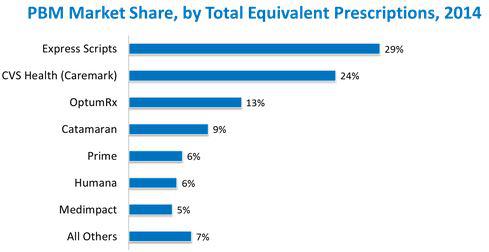
Finally Seeking Alpha has an article which provides the current lay of the land in the PBM world with this fascinating chart from the Pharmacy Benefit Management Institute: 


Weekend update

Federal News Radio provides a useful compendium of Congressional and federal employee union leaders to Friday’s news that OMB Deputy Director Beth Cobert is replacing Katherine Archuleta, on an interim basis, as OPM Director following Ms. Archuleta’s resignation.  The FEHBlog wants to share with you the reactions of the Congressman who first called for Ms. Archuleta’s resignation at a hearing last month, Rep. Ted Lieu (D Calif):

I appreciate Katherine Archuleta’s service to our nation.  With today’s news, it’s clear that OPM along with the rest of the federal government must immediately turn a page and make cyber security a top, urgent priority.  I came to Congress to find solutions to the foremost challenges facing our nation and I look forward to working with the Administration and the new Director at OPM to improve our cyber security.  The massive security clearance breach also shows that OPM is not the proper agency to protect the crown jewels of American intelligence.  OPM was never designed to be an intelligence or national security agency.  We should not be trying to fit a square into a round hole.  That’s why Congressman Steve Russell [(R. Okla.)] and I are working on legislation to move the security clearance system out of OPM.

and Rep. Will Hurd (R Tex.) who chairs of the Information Technology Subcommittee of the House Oversight and Government Reform Committee (Reps. Lieu and Russell sit on this subcommittee):

It’s too late for the 21 million Americans who had their personal information compromised due to her lack of action. Many of us in Congress have called on Director Archuleta to step down on multiple occasions and I believe that resigning is the right thing for her to do. The President should appoint a new director who truly understands the digital challenges we face and has the right experience to take the steps necessary to ensure we’re ready for the next cyber-attack.  These recent incidents should serve as a wake-up call to Congress that we must move swiftly to improve our cyber posture. The House has passed two information-sharing bills in this Congress. It’s time for the Senate to act and send these bills to President Obama’s desk.

Hear, hear.

Congress is in session again this coming week.  Here is a link to the Week in Congress which summarizes last week’s activities. The big news was Friday’s passage of the 21st Century Cures Act (HR 6) by a wide bipartisan majority in the House of Representatives. The bill’s objective is to reduce statutory and regulatory obstacles to medical breakthroughs.  The bill provides mandatory funding to the Food and Drug Administration and the National Institutes of Health. Modern Healthcare’s report on the House action is here.  That publication explains:

The Senate is working on legislation that’s similar to the Cures Act, according to a staffer with the Health, Education, Labor and Pensions Committee. The committee has held four hearings over the past year on drug and device innovation and plans to generate a bill by the end of the year.  Sen. Patty Murray (D-Wash.), the HELP Committee’s ranking member, praised the House for Friday’s vote and said she looks forward to working on legislation aimed at medical innovation with the leaders of the Energy and Commerce Committee, which drafted the Cures Act.

Here is a link to the Obama Administration’s policy statement on the House bill.
Speaking of medical breakthroughs, here’s a link to an AIS article discussing how a specialty pharmacy called Burmans has discovered that a sizeable subclass of patients with Hepatitis C may be cured with an eight week course of Gilead Science’s Harvoni drug, rather than the typical twelve weeks.  

Paul Urick, president of Managed Markets & Industry Relations at Burmans. notes that “Burmans has been working hard to identify patients who may receive eight weeks of treatment in order to produce best clinical outcomes while saving patients and health insurers money. Each eight-week treatment cycle would cost $63,000 on a Wholesale Acquisition Cost [i.e., WAC] basis and save 33% per patient, or $31,500, versus 12-week treatment cycles.” “This is a great opportunity to make a difference to patients,” and it’s great for payers as well, he says.

Good work.

TGIF

The Washington Post reports this afternoon that

Office of Personnel Management Director Katherine Archuleta resigned under pressure on Friday, a day after Obama administration officials announced that two major breaches last year of U.S. government databases holding personnel records and security-clearance files exposed sensitive information about at least 22.1 million people.”  

The report further explains that

The White House announced that Beth Cobert, deputy director for management at the Office of Management and Budget, will take over the personnel agency in an acting role until President Obama appoints a permanent replacement. OPM has not had a deputy director since 2011; the president’s nominee for the  No.2  job [retired Navy Admiral Earl L. Gay] has been held up in Congress for many months.

Here is Ms. Cobert’s CV from the White House OMB website:

Beth Cobert is the Deputy Director for Management. She was confirmed on October 16, 2013. Cobert previously served nearly thirty years at McKinsey & Company as a Director and Senior Partner. During her tenure, she worked with corporate, not-for-profit and government entities on key strategic, operational and organizational issues across a range of sectors, including financial services, health care, legal services, real estate, telecommunications, and philanthropies. She led major projects to generate performance improvements through process streamlining, enhanced customer service, improved deployment of technology, more effective marketing programs and strengthened organizational effectiveness. Within McKinsey, Cobert held multiple leadership roles in people management including recruiting, training, development and performance management of staff. She has been a champion for professional development and initiatives to support women’s advancement to leadership positions. Cobert also previously served as a board member and chair of the United Way of the Bay Area and as a member of the Stanford Graduate School of Business Advisory Council. Cobert received a bachelor’s degree in economics from Princeton University and a master’s degree in business administration from Stanford University. She and her husband Adam Cioth have two children. 

Quite a resume.

Fierce Health Payer reports today that Cigna and Anthem now are making progress on their merger negotiations after a hiccup in those negotiations occurred a couple of weeks ago.

On the regulatory front, CMS issued a proposed rule Wednesday on Medicare Part B payments to physicians for 2016. This is the first Part B rule released since Congress repealed and replaced the sustainable rate of growth formula earlier this year. “Through the proposed rule, CMS is beginning implementation of the new payment system for physicians and other practitioners, the Merit-Based Incentive Payment System (MIPS), required by the legislation.” It appears quite complicated like everything in Medicare.  CMS must have made the hospitals’ day yesterday by announcing a new bundled payment pilot for hip and knee replacement surgeries.

Under this proposed model, the hospital in which the hip or knee replacement takes place would be accountable for the costs and quality of care from the time of the surgery through 90 days after—what’s called an “episode” of care.
Depending on the hospital’s quality and cost performance during the episode, the hospital would either earn a financial reward or be required to repay Medicare for a portion of the costs. This payment would give hospitals an incentive to work with physicians, home health agencies, and nursing facilities to make sure beneficiaries receive the coordinated care they need with the goal of reducing avoidable hospitalizations and complications. Hospitals would have additional tools – such as spending and utilization data and sharing of best practices – to improve the effectiveness of care coordination.
By “bundling” these payments, hospitals and physicians have an incentive to work together to deliver more effective and efficient care.  This model would be in 75 geographic areas throughout the country and most hospitals in those regions would be required participate. 

The ACA regulators today announced a final rule on the ACA mandate for women’s preventive health care which must delight religious employers.

OPM has been pressing FEHB plans to help reduce hospital readmissions.  Fierce Healthcare reports that the leading causes of readmissions are heart attacks, congestive heart failure, and flying somewhat below the radar screen sepsis.

For 30-day readmissions, sepsis accounted for 20.4 percent of cases. The rates for congestive heart failure were 23.6 percent and for heart attacks, 17.7 percent. UCLA estimated the annual cost of sepsis-related readmissions in California during the study period was $500 million, whereas congestive heart failure accounted for $229 million and heart attacks cost the system $142 million.  “Sepsis is a leading contributor to excess healthcare costs due to hospital readmissions,” the researchers concluded. “Interventions at clinical and policy levels should prioritize identifying effective strategies to reduce sepsis readmissions.”

On a related note, the Leapfrog Group released the results of its annual hospital transparency survey

Key findings from this report include:

Never events policy compliance remains low. The rate of hospitals meeting Leapfrog’s standard has remained at 79 percent from 2012 to 2014, meaning one in five hospitals won’t commit to apologizing to the patient and waiving all costs associated with the event if a Never Event, such as a foreign object left in after surgery or an air embolism, occurs at their facility.
Rates of certain hospital-acquired conditions remain a problem. One in six Leapfrog reporting hospitals have higher infection rates than expected for central line infections (CLABSIs) and one in ten perform poorly in preventing catheter-associated urinary tract infections (CAUTIs).
Hospitals are struggling to comply with safe practices. Urban hospitals continue to outperform rural hospitals: about 20% more urban hospitals met Leapfrog’s standard for safe practices and showed greater year-over-year improvement in meeting the requirements.
More hospitals with intensive care units are complying with Leapfrog’s ICU Physician Staffing standard. Studies show that meeting the standard can reduce ICU mortality by 40%.

Have a good weekend.
 

.

Mid-week update

Right now, a House Science, Space, and Technology subcommittee is holding a hearing on the OPM data breach. The subcommittee issued this helpful overview of the situation.  The Federal Times reports that the National Treasury Employees Union has joined AFGE in filing a lawsuit over the OPM data breach. The article explains

While other suits — like the one filed by AFGE — are based on alleged violations of the Privacy Act, the NTEU suit makes the case that OPM’s failure to secure personal information violated employee’s constitutional right to privacy.  NTEU lawyers noted the Privacy Act requires plaintiffs to meet a higher standard, such as proving damages occurred and that the violation was willful and intentional.  “Our approach isn’t really focused on recouping damages,” said NTEU general counsel Greg O’Duden. “We are looking for a court injunction that will cure the source of the problem; that will ensure that OPM gets its act together and institutes appropriate security measures.”

Fierce Health Payer has this useful update on state of health insurer mergers and acquisitions.

The American Medical Association has raised the white flag over the ICD-10 battlefield.  On Monday, the AMA and the Centers for Medicare and Medicaid Services issued a joint press release offering doctors an ICD-10 transition plan. The AMA explains that the transition plan addresses

  • Claim denials. For the first year ICD-10 is in place, Medicare claims will not be denied solely based on the specificity of the diagnosis codes as long as they are from the appropriate family of ICD-10 codes.This means that Medicare will not deny payment for these unintentional errors as practices become accustomed to ICD-10 coding. In addition, Medicare claims will not be audited based on the specificity of the diagnosis codes as long as they are from the appropriate family of codes. This transition period will give physicians and their practice teams time to get up to speed on the more complicated code set. Both Medicare Administrative Contractors and Recovery Audit Contractors will be required to follow this policy.
  • One of the commenters on the AMA website asked what does a family of codes mean? Another commenter replied “Family of codes means if you submit a claim with diabetes type 2 and is should have been DM 2 with diabetic retinopathy, they are not going to stop payment because you used a less specific code in the “diabetes family”
  • Quality-reporting penalties. Similar to claim denials, CMS will not subject physicians to penalties for the Physician Quality Reporting System, the value-based payment modifier or meaningful use based on the specificity of diagnosis codes as long as they use a code from the correct ICD-10 family of codes. In addition, penalties will not be applied if CMS experiences difficulties calculating quality scores for these programs as a result of ICD-10 implementation.
  • Payment disruptions. If Medicare contractors are unable to process claims as a result of problems with ICD-10, CMS will authorize advance payments to physicians.
  • Navigating transition problems. CMS has said it will establish a communication center to monitor issues and resolve them as quickly as possible. This will include an “ICD-10 ombudsman” devoted to triaging physician issues.

CMS explained in the joint press release that it otherwise is sticking to its single coding policy — “the Medicare claims processing systems will not have the capability to accept ICD-9 codes for dates of services after September 30, 2015, nor will they be able to accept claims for both ICD-9 and ICD-10 codes.”

If  non-Medicare carriers want to adopt the transition plan approach to claim denials,, there won’t be a lot of time to reprogram claims systems to accommodate the change before October 1.

Health Affairs has a great post about CalPERS use of reference pricing with joint replacement surgeries. According to the post,

With reference pricing, the health care purchaser places a limit on what it will contribute towards payment for a particular procedure, assuring that the selected payment limit allows appropriate access for patients. The payment limit typically is the median or some other mid-point in the distribution of prices in the local market. Consumers who select a provider that charges less than the purchaser’s limit receive standard coverage, with minimal cost sharing. Consumers who select a provider charging above the contribution limit must pay the entire difference.

The post further explains

The application of reference pricing to inpatient orthopedic surgery led to significant price reductions from some of the hospitals whose initial prices were above the CalPERS payment limit. These price reductions have increased; the number of California hospitals charging prices below the CalPERS reference limit ($30,000) rose from 46 in 2011 to 72 in 2015.
It should be emphasized that reference pricing has caused actual price reductions, not merely slowdowns in the rate of price growth. This is the way markets are supposed to work.
Reductions in prices contribute to affordability of care. In the first two years after implementation, reference pricing saved CalPERS $2.8 million for joint replacement surgery, $1.3 million for cataract surgery, $7.0 million for colonoscopy, and $2.3 million for arthroscopy.

The post suggests that reference pricing does not adversely affect health service quality and is best used when patients can price shop for services, such as joint replacements.

Finally, the FEHBlog nearly fell out of his chair when he read that a recently enacted federal law that used increased IRS penalties as a pay go. Lockton consulting explains that

These increased penalties apply to [the ACA reporting forms the 1095-B and 1095-C] and other information returns and filings, such as W-2s, and are effective for reporting required to be filed or furnished after 2015. For example, the increased penalties would apply to the first year’s filings under the ACA, which relate to 2015, but are due in early 2016.
The general penalty for failure to file a required information return with the IRS (which is subject to reduction, waiver or increase for various reasons) will increase from $100 per return to $250 per return.
The cap on the total amount of penalties for such failures during a calendar year will increase from $1,500,000 to $3,000,000.
If a failure relates to both an information return (e.g., a Form 1095-C required to be filed with the IRS) and a payee statement (e.g., that same Form 1095-C required to be furnished to the individual), these penalties are doubled.
If a failure is caused by intentional disregard, the new $250 penalty noted above is doubled to $500 for each failure, and no cap applies to limit the amount of penalties that can be applied with respect to that calendar year.
As you consider these increases, keep in mind that these do not affect the IRS’s enforcement policy for the first year of ACA filing. Specifically, the IRS will not penalize employers “that can show they make good faith efforts to comply with the [ACA] reporting requirements.” So, we still have the “good faith efforts” standard, but the penalties that will apply if that standard is not met are much more severe.

Wonderful.

Weekend Update

The FEHBlog trusts that everyone has been enjoying the holiday weekend. Congress returns to Capitol Hill tomorrow and it’s another week, another OPM data breach hearing. One Tuesday July 8 at 2 pm, the Subcommittees on Research and Technology and on Oversight of the House Committee on Science, Space, and Technology will hold a hearing titled “Is the OPM Data Breach the Tip of the Iceberg?” Let’s hope not. 

Federal News Radio reports that OPM is offering federal agencies guidance on their employee health and wellness programs. Wouldn’t it be helpful and perhaps even lower the cost curve a little if OPM coordinated the health and wellness programs that federal agencies and FEHB plans offer?

Last week, CMS proposed changes to the Medicare Hospital Outpatient Prospective Payment System (OPPS) and Ambulatory Surgical Center (ASC) Payment System policy changes, quality provisions, and payment rates for the next calendar year.  Modern Healthcare reports that

For 2016, the agency proposes a 0.2% cut to outpatient prospective payment system (OPPS) rates.  While those changes might seem small, approximately 3,800 hospitals and 60 community mental health centers are paid under the OPPS and the decrease means they’ll collectively receive an estimated $43 million less than they got in 2015.
On the flip side, ambulatory surgical centers will get a modest 1.1% bump.
That will result in the 5,300 ASCs currently being reimbursed by Medicare getting an estimated $186 million more than what they got this year.  Both proposals were immediately criticized by provider trade groups.

Shocker.


Happy Fourth of July Weekend

Well the M&A dam broke today as Aetna announced overnight that it is acquiring Humana for $34.1 billion (cash and Aetna stock).  Both Aetna and Humana participate in our beloved FEHB Program, but Aetna reportedly acquired Humana for its successful Medicare Advantage business. According to Aetna’s press release:

The combination of Aetna and Humana:
Builds on each company’s respective efforts to provide innovative, technology-driven products, services and solutions to build healthier populations, promote higher quality health care at lower cost, and offer greater transparency and convenience for consumers.
Increases Aetna’s Medicare Advantage membership to 4.4 million and improves Aetna’s ability to serve members and their providers with cutting-edge technology and best practices.
Brings together two companies with leading percentages of membership in Medicare plans rated four stars or higher.
Creates a leading health care services and pharmacy benefit franchise, serving members who use over 600 million prescriptions annually.
Strengthens care management capabilities by taking the best-of-breed provider solutions, including robust offerings of patient-centered provider services, clinical intelligence, value-based reimbursement models, data integration and analytics solutions from both companies.
Brings together two companies with longstanding commitments to promoting wellness, health, and access to high-quality health care for everyone, while supporting the communities in which they serve.

Impressive. The combined company would be the second largest health insurer after United Healthcare. The Wall Street Journal reports that

Both chief executives said they are confident the transaction will be approved, citing complimentary, rather than overlapping strengths—Aetna in commercial selling, and Humana in Medicare. Antitrust reviews are “never totally predictable, but we believe it’s very manageable,” Aetna CEO Mark Bertolini said.  

The Journal further explains that

A takeover approach for Humana earlier this year thrust the biggest health-insurance companies into a five-way merger frenzy. Cigna Corp. and Aetna were vying to buy Humana, while fielding takeover approaches of their own. Cigna and Anthem Inc. have rekindled talks after Cigna earlier rejected a public takeover bid of $184 a share from Anthem, its larger rival, and UnitedHealth Group Inc. earlier approached Aetna.
Meantime, Medicaid-focused Centene Corp. said Thursday that it agreed to buy Health Net Inc., in a deal worth about $6.3 billion.  The consolidation momentum in the health-insurance industry is being fed by a desire to diversify and cut costs, amid a landscape changed by the Affordable Care Act. 

Mr. Toad’s wild ride.

July 1

Well, half of 2015 has already flown by and we find ourselves three months away from the ICD-10 coding set compliance date. The codes are used to identify patient diagnoses and hospital procedures. Muy imporanto for health plans.  The systemic change blows up the number of codes exponentially.  CMS, which regulates the HIPAA transaction and code sets, is cheering on the start of the new system. The doctors are freaking out. The health plans, which are legally bound to implement the massive change, are concerned that Congress may require them to manage two coding systems during a transition period.

Under HIPAA’s original “if you build it they must come” system, health plans must comply with the changes; doctors only have to comply if they engage in electronic transactions. Five years after HIPAA was enacted Congress changed the Medicare law to require medical practices to submit Medicare claims electronically. That’s what is causing doctors to freak out. CMS is saying that it will not pay Medicare claims with dates of service on or after October 1 unless the claim uses the ICD-10 codes. Health plans understandably are following CMS’s lead.

Health Analytics reports that the lobbyists are fighting up on Capitol Hill over this issue, and it may come down to the wire. HIPAA was enacted to facilitate electronic claims transactions and this coding change does little if anything to push that ball forward. The change is touted as a boon to public health analysts. A train wreck may be coming. It won’t be as dramatic as the healthcare.gov catastrophe in October 2014, but it could be bad. The FEHBlog is not optimistic.

The FEHBlog noted on Monday the interesting development that a federal union AFGE has sued OPM and an OPM contractor over the data breach. As this Nextgov article accurately reports,  these data breach lawsuits don’t have a great track record in court because of the inherent difficulty in proving sizeable data breach damages. Here, however, there is an unprecedented twist — the breach of the SF-86 background check forms. Those affected people unfortunately may have an easier time proving sizeable damages but the FEHBlog is not certain that these unique circumstances can be adjudicated in a class action. It’s not a simple case. Time will tell.

Also it’s worth noting this Federal Times report that the government is warning federal employees and annuitants about spear phishing scams related to the OPM breach.  Take care.