From the Affordable Care Act front, the International Foundation of Employee Benefit Plans explains
The Internal Revenue Service (IRS) issued final regulations on affordability of employer coverage for family members of employees.
The final regulations under section 36B of the Internal Revenue Code (Code):
* Amend the regulations regarding eligibility for the premium tax credit (PTC) to provide that affordability of employer-sponsored minimum essential coverage (employer coverage) for family members of an employee is determined based on the employee’s share of the cost of covering the employee and those family members, not the cost of covering only the employee;
* Add a minimum value rule for family members of employees based on the benefits provided to the family members; and
* Affect taxpayers who enroll, or enroll a family member, in individual health insurance coverage through a Health Insurance Exchange (Exchange) and who may be allowed a PTC for the coverage.
The final regulations are effective 60 days after publication in the Federal Register.
IRS issued Notice 2022-41 in conjunction with regulations under section 36B.
The notice expands the application of the permitted change-in-status rules for health coverage under a section 125 cafeteria plan (cafeteria plan). In particular, the notice addresses the situation in which, during a period of coverage (typically a plan year), a cafeteria plan participant may wish to revoke the employee’s election under the cafeteria plan for other than-self-only (family) coverage under a group health plan (other than a flexible spending arrangement (FSA)) in order to allow one or more family members to enroll in a Qualified Health Plan (QHP) through a Health Insurance Exchange (Exchange) in the individual market.
Under the notice, the employee will be able to elect out of family coverage and into self-only coverage (or family coverage including one or more already-covered related individuals) under that health plan prospectively during a period of coverage, provided specific conditions are satisfied.
The Department of the Treasury and IRS intend to modify the Income Tax Regulations under section 125 of the Code consistent with the provisions of the notice.
Taxpayers may rely on the guidance in the notice for plan amendments allowing elections effective on or after January 1, 2023.
These rules are intended to fix the so-called “family glitch” in the ACA. Responsibility for implementing this rule in the FEHB Program falls on the employer, here OPM. More to follow on Wednesday because the FEHBlog needs to understand this change better.
Speaking of ACA changes, the U.S. Preventive Task Force gave a B grade to a modified description of its recommendation for primary care physicians to screen asymptomatic adolescents aged 12 to 18 for major depressive disorder and suicide risk. The USPSTF also expanded its new B grade anxiety screening recommendation for adults to asymptomatic adolescents and children aged 8 to 18.
Access to and availability of mental health providers must be expanded as well. Healthcare IT News reports on “how telehealth can help curb the mental health staffing shortage. A physician and virtual care expert discusses how demand for behavioral health services is increasing and what telemedicine can do to meet these needs. He shows how the tech can help serve vulnerable populations.”
In the U.S healthcare business news, Healthcare Dive informs us
Walgreens is buying the remaining 45% stake in post-acute and home care services provider CareCentrix for roughly $392 million, the pharmacy giant said Tuesday.
Walgreens acquired a 55% majority stake in CareCentrix, which coordinates home care for health plans, patients and medical providers, for $330 million in a deal that closed earlier this year.
The Illinois-based retailer has said the buy will expand its reach in the health sector, especially in the fast-growing areas of primary.
Congress remains on the campaign trail this coming.
The Medicare Open Enrollment period begins on Saturday, October 15. The New York Times adds
Social Security will soon announce the largest inflation adjustment to benefits in four decades — a welcome development for millions of older Americans struggling to keep up with fast-rising living costs.
The cost-of-living adjustment for 2023 is likely to be around 8.7 percent, based on the latest government inflation figures. The final COLA, as the adjustment is known, will be released Thursday, when the federal government announces inflation figures for September. Medicare enrollees can anticipate some additional good news: The standard Part B premium, which is typically deducted from Social Security benefits, will decline next year.
The COLA, one of Social Security’s most valuable features, will give a significant boost to more than 70 million Americans next year. While retirement comes to mind when most people think about Social Security, the program plays a much broader role in providing economic security.
In August, the program paid benefits to 52.5 million people over age 65, but younger beneficiaries — survivors of insured workers and recipients of disability benefits and Supplemental Security Income, the program for very low income people — added 17.9 million people to the total, according to Social Security Administration data.
The Federal Times discusses the upcoming open enrollment for the Federal Employee Dental and Vision Programs.
Twelve dental carriers provide 23 dental plan options available across the program. Seven dental carriers offer fourteen nationwide dental plan options available to all potential enrollees. Five vision carriers provide 10 nationwide vision plan options available to all potential enrollees.
The FEHB, FEDVIP, and FSAFeds Programs share the same open enrollment season, which this year will run from November 14 to December 12.
The health insurance marketplace open enrollment period begins on November 1, 2022, and ends on January 23, 2023.
From the public health front —
The New York Times discusses why Americans need a flu shot. As to timing
Immunity against the flu tends to wane over the course of a season. You have higher protection a couple of weeks after receiving the shot, compared with four or five months later, so it is a good idea to schedule your vaccine appointment close to the beginning of flu season, and not too early, Dr. Martin said. “I tend to get vaccinated in October so my antibodies are ramped up by the time holiday travel begins,” she said.
Some people wait longer, until November or December, especially if they are keeping a close eye on cases. But experts agree that it is important to receive the vaccine before cases start to surge. Your body needs at least two weeks after the shot to ramp up its defenses against the flu. People who are more susceptible to severe flu — especially older adults, pregnant women and very young children — should not delay their shots.
MedPage Today reports “Long COVID Persists in People With Symptomatic SARS-CoV-2 Infection — At one year, 15% of long COVID patients had ongoing cognitive or respiratory problems or fatigue.” Fierce Healthcare delves into health plan coverage of this tricky disease.
The New York Times offers expert opinions about various aspects of monkeypox.
From the healthcare personnel front, Healthcare Dive reports
Effective Oct. 17, [Amar] Desai who [currently is President and Chief Executive Officer, Optum Pacific West] will lead CVS’ newly created health care delivery division, overseeing implementation of CVS’ health services and care delivery strategy, according to a release from the Woonsocket, Rhode Island-based company. That includes CVS’ clinical delivery strategy in retail health, chronic disease management and behavioral health.
The division will work to link different aspects of CVS’ portfolio to develop payer-agnostic products and services, according to CEO Karen Lynch.
Good luck, Mr. Desai.
From the medical research front —
STAT News tells us about a large “gold-standard” European study concluding that colonoscopies are not all they have been cracked up to be in the U.S.
The trial’s primary analysis found that colonoscopy only cut colon cancer risk by roughly a fifth, far below past estimates of the test’s efficacy, and didn’t provide any significant reduction in colon cancer mortality. Gastroenterologists, including Bretthauer, reacted to the trial’s results with a mixture of shock, disappointment, and even some mild disbelief.
It’s the first randomized trial showing outcomes of exposing people to colonoscopy screening versus no colonoscopy. And I think we were all expecting colonoscopy to do better,” said Samir Gupta, a gastroenterologist at the University of California, San Diego and the VA who didn’t work on the trial. And, he said, it raises an uncomfortable question for doctors. “Maybe colonoscopy isn’t as good as we always thought it is.”
He stressed that the study does not invalidate colonoscopies as a useful screening tool. Colonoscopies are still a good test, Gupta said, but it may be time to reevaluate their standing as the gold standard of colon cancer screens. “This study provides clear data,” he said, “that it’s not as simple as saying, ‘Colonoscopy is the most sensitive test, and therefore it is the best.’ It still prevented cancers.”
The study has not shattered the FEHBlog’s confidence in the procedure, but it’s worth discussing the study with your physician down the line.
Bloomberg prognosis reports, “AstraZeneca Plc’s nasal spray vaccine failed to elicit a strong immune response to Covid-19 in a [small] early trial, a blow to the U.K. drU.K. giant’s ambitions for developing an alternative approach to preventing the disease.”
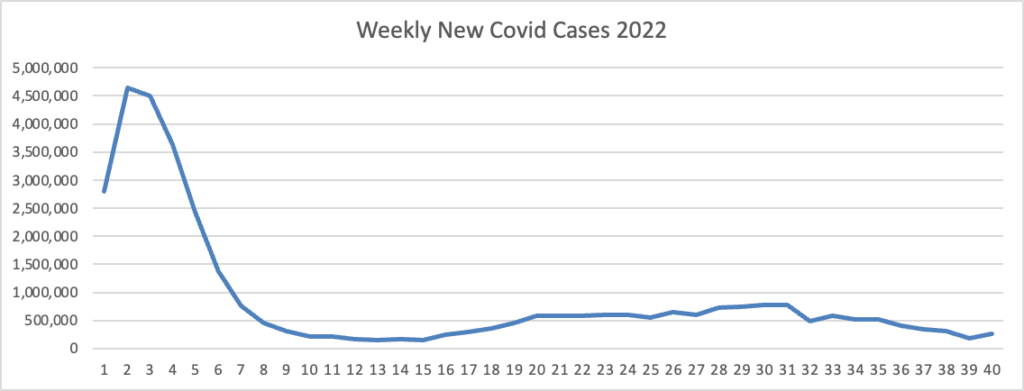
Based on the Centers for Disease Control’s Covid Data Tracker and using Thursday as the first day of the week, here is the FEHBlog’s latest weekly chart of new Covid cases.
The CDC’s Covid Data Tracker Weekly Review was not issued today because Monday is a federal holiday.
The Covid Weekly Tracker tells us that the daily average of new Covid hospital admissions is 3,35.
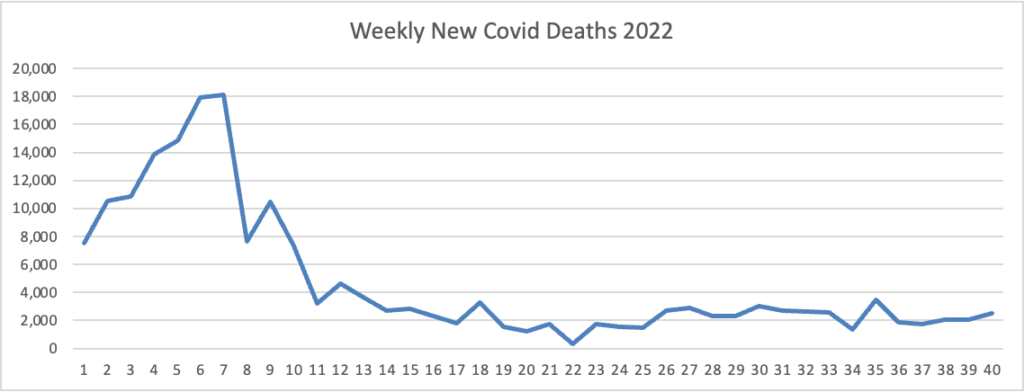
Here is the FEHBlog’s latest weekly chart of new Covid deaths.
New York Times columnist David Leonhardt, who is going on a book tour that ends in late January 2023, reports
“A large chunk of deaths are preventable right now with Paxlovid alone,” Dr. Ashish Jha, the White House Covid response coordinator, told me. He predicted that if every American 50 and above with Covid received a course of either Paxlovid or a treatment known as monoclonal antibodies, daily deaths might fall to about 50 per day, from about 400 per day in recent months. * * *
A recent analysis of about 568,000 patients by Epic Research found that 0.016 percent of Covid patients over 50 who received Paxlovid died. The death rate for patients who did not get the drug was more than four times higher, or 0.070 percent. And yet the Epic data showed that only about 25 percent of patients eligible to receive Paxlovid actually did, even though the drug is widely available and free for patients.
Perhaps the most shocking statistic about Paxlovid’s underuse — and Jha used the word “shocking” when describing it to me — is that a smaller share of 80-year-olds with Covid in the U.S. is now receiving the drug than 45-year-olds with Covid, according to data he has seen. Many doctors are evidently worried about side effects or rebound cases among their more vulnerable patients.
Even in rebound cases, however, symptoms tend to be milder than they would have been without Paxlovid. After Dr. Anthony Fauci, another White House adviser, who’s 81, contracted Covid in June and then took Paxlovid, he experienced a rebound — and also believed that the drug kept him out of the hospital.
“Medicine is about weighing costs and benefits,” Wachter said. “The recommendation should be clear and unambiguous for people at high risk: The benefits of the drug outweigh the downsides.”
A Merck pill used to combat Covid-19 failed to demonstrate it can lower the risk of hospitalization compared with a placebo among adults at a higher risk from the disease, according to the results of a large study conducted in the U.K.
The preliminary results of the randomized trial, which involved more than 25,000 participants, showed that taking molnupiravir did speed time to recovery by about six days, which means that patients did get some relief. Otherwise, though, the study failed to reach an outcome that had been used late last year by regulators — such as those in the U.S. and U.K. — to authorize the medicine to thwart the pandemic.
The findings also contradict the results of a much smaller study conducted by Merck and its partner, Ridgeback Therapeutics, which found a lower risk of hospitalization or death in high-risk patients by roughly 30%, after initially showing a 50% lower risk. Unlike the latest trial, which is called Panoramic, the Merck trial called Move-Out excluded patients who had been vaccinated against the coronavirus.
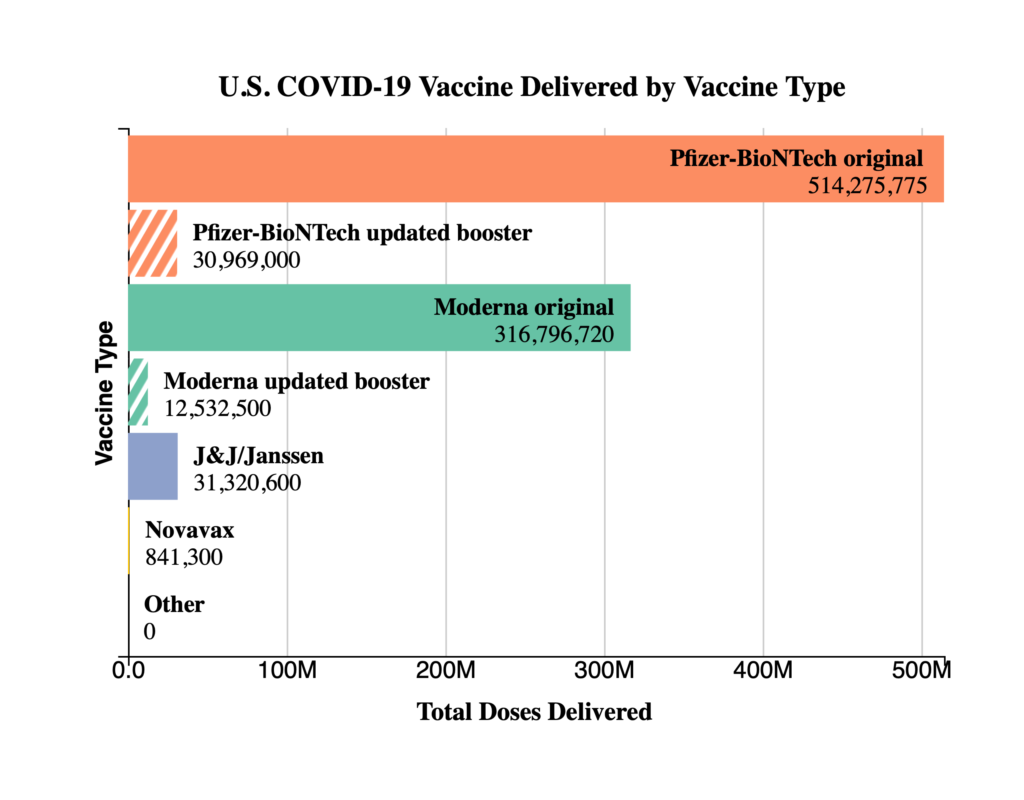
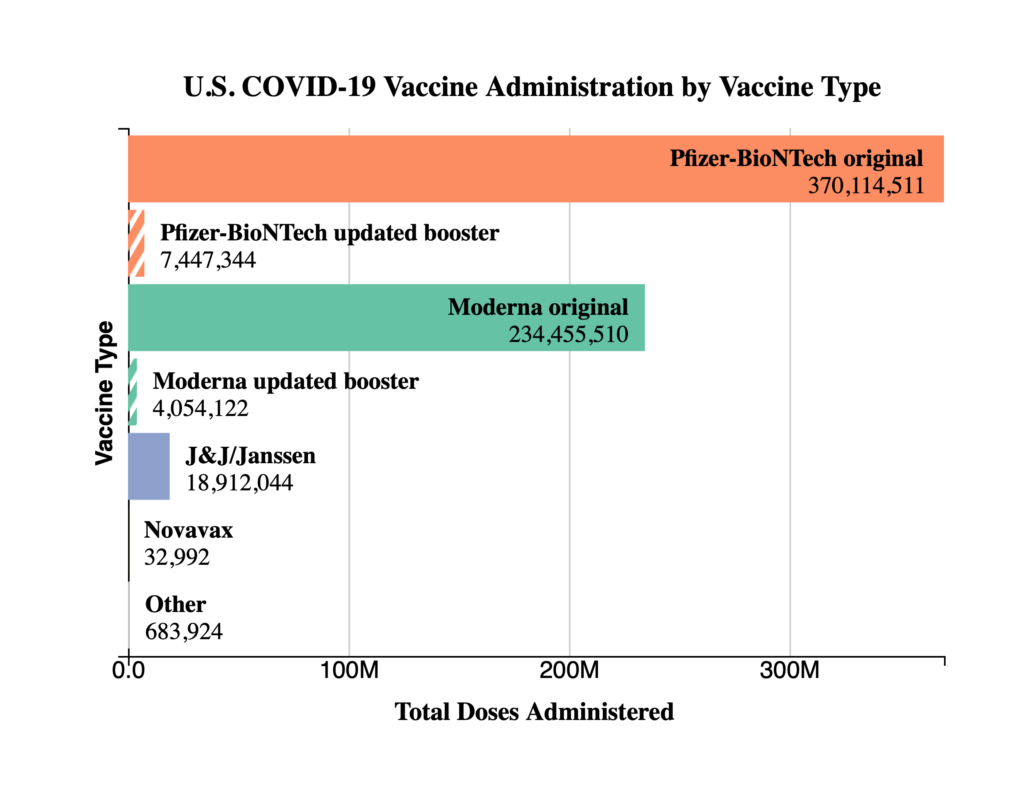
Here is the FEHBlog’s chart of Covid vaccinations distributed and administered from the beginning of the Covid vaccination era in December 2020 through the 40th week of 2022:
In addition, here are two related CDC charts.
The American Hospital Association adds
COVID-19 vaccinations are associated with over 650,000 fewer hospitalizations and 300,000 fewer deaths in the Medicare population through December 2021, saving an estimated $16 billion in direct medical costs, the Department of Health and Human Services reported today.
“This report reaffirms what we have said all along: COVID-19 vaccines save lives and prevent hospitalizations,” said HHS Secretary Xavier Becerra. “We now have updated COVID vaccines designed to protect you against the Omicron strain of COVID that makes up almost all COVID cases in the U.S. … Over 90 percent of Americans live within 5 miles of where they can access these vaccines for free. I urge everyone eligible to get an updated COVID vaccine to protect yourself ahead of the fall and winter.”
Govexec tells us The Office of Personnel Management on Thursday announced that it authorized paid leave for federal workers to obtain the latest round of boosters for the COVID-19 vaccine.
From the FEHB front, Health Payer Intelligence reviews 2023 Blue Cross FEP benefit changes and makes other Open Season observations.
In OPM news, the GSA announced that its Technology Modernization Fund will be investing in OPM’s website.
OPM.gov Modernization
It can be challenging for federal employees, job seekers, and HR professionals to navigate OPM.gov’s 20,000 pages to find what they need. With a $6 million TMF investment, OPM will update both the technology behind and the content on the OPM.gov website. This will allow OPM to implement an updated and more secure Content Management System (CMS) hosted on OPM’s cloud environment, ensuring that users have intuitive and accessible web tools.
“A user-friendly website plays a critical role in OPM’s mission to communicate the federal government’s policies, services, and benefits more clearly and effectively,” saidOPM Director Kiran Ahuja. “This investment will improve the government’s ability to recruit job seekers, supply the federal workforce with relevant career-related information, and make it easier for public servants to manage their benefits.”
Hope springs eternal.
From the mental healthcare front, Fierce Healthcare informs us
A mental health crisis besets young adults in the United States to such an extent that more than a third (35%) of individuals ages 18 through 29 years old said that they could not work nor engage in other activities of daily living, according to a new survey by the Kaiser Family Foundation (KFF) and CNN.
Meanwhile, 90% of all Americans believe that the country faces a mental health crisis.
Age 30 seems to be the cutoff separating severe crisis caused by mental health problems, and conditions not as dire. For instance, 34% of those 18 through 29 consider their mental health to be “only fair” or “poor”; 19% of those 30 and over feel that way. Fifty-two percent of young adults said that they’d always or often felt anxious in the last year, while 28% of older adults felt that way.
A third of young adults felt depressed (33%) or lonely (32%) in the last year; for older adults it was 18% for both depressed and lonely.
These survey figures, particularly the first one, are hard to believe, but undoubtedly our country needs more mental health therapists and better treatments.
From the Rx coverage front, the Food and Drug Administration announced that the agency has
approved Boostrix (Tetanus Toxoid, Reduced Diphtheria Toxoid and Acellular Pertussis Vaccine, Adsorbed [Tdap]) for immunization during the third trimester of pregnancy to prevent pertussis, commonly known as whooping cough, in infants younger than two months of age.
“Pertussis disease is a highly contagious respiratory illness affecting all age groups. However, babies are at highest risk for getting pertussis and having serious complications from it,” said Peter Marks, M.D., Ph.D., director of the FDA’s Center for Biologics Evaluation and Research. “While vaccination is the best method for providing protection, infants younger than two months of age are too young to be protected by the childhood pertussis vaccine series. This is the first vaccine approved specifically for use during pregnancy to prevent a disease in young infants whose mothers are vaccinated during pregnancy.”
Pertussis is a common respiratory disease in the United States, resulting in frequent outbreaks. It is also called whooping cough because of the “whooping” sound that someone makes when gasping for air after a fit of coughing. Most serious pertussis cases, hospitalizations and deaths occur in infants younger than two months of age who are too young to be protected by the childhood pertussis vaccine series. According to the Centers for Disease Control and Prevention (CDC), 4.2% of the total cases of pertussis reported in the United States in 2021 were in infants younger than 6 months of age and approximately 31% required hospitalization. When the Boostrix vaccine is given during pregnancy, it boosts antibodies in the mother, which are transferred to the developing baby.
Good news.
From the healthcare business front, Fierce Healthcare reports
Yale New Haven Health has signed an agreement to acquire two Connecticut health systems, Waterbury HEALTH and Eastern Connecticut Health Network), from Prospect Medical Holdings.
The deal would give Connecticut’s largest health system the businesses, real estate, physician clinic operations and outpatient services of three hospitals: 357-bed Waterbury Hospital, 249-bed Manchester Memorial Hospital and 102-bed Rockville General Hospital. Also included are Prospect Provider Group of Connecticut and Visiting Nurse and Health Services of Connecticut, according to a release.
From the OPM front, Federal News Network reports on the Senate Homeland Security and Governmental Affairs September 29, 2022, confirmation hearing for Robert Shriver, whom the President has nominated to serve as OPM Deputy Director.
From the Fourth Quarter 2022 front
STAT News provides “The Q4 health tech tracker: 17 key industry events and milestones to watch.”
The Society for Human Resource Management offers “4th Quarter 2022 ‘Quick Hits’ for Plan Sponsors.” This quick hit grabbed the FEHBlog’s attention:
Making a splash across the headlines was the Inflation Reduction Act of 2022(IRA), which President Biden signed on Aug. 16, 2022. The 273 pages of text make sweeping changes. However, few will affect employer-sponsored benefit plans, and most of those will have only indirect effects.
One change that does directly affect a High Deductible Health Plan (HDHP) is the exception added to Section 223 of the Internal Revenue Code effective for plan years beginning after Dec. 31, 2022, to enable HDHPs to cover the cost of insulin without first meeting the deductible. This first dollar coverage for insulin will protect Health Savings Account (HSA) eligibility for those who require an insulin regimen. Employers should determine if their plan requires an amendment to implement this change.
On a related note, TRI-AD calls to our attention the “2022 FSA relief provisions will no longer apply in 2023.”
From the public health front —
The American Hospital Association informs us that “Increasing bivalent COVID-19 booster vaccinations this year to 2020-2021 flu vaccination rates could prevent an additional 75,000 deaths and 745,000 hospitalizations and avert $44 billion in medical costs over the next six months, researchers estimate in a Commonwealth Fund blog post. Increasing COVID-19 booster coverage to 80% of eligible Americans aged five and older this year could prevent about 90,000 deaths and over 936,000 hospitalizations and avert $56 billion in medical costs, they add.”
CNBC reports
* The CDC, in a report, said monkeypox could spread indefinitely at a low level in the U.S.
* Monkeypox is unlikely to be eliminated from the U.S. in the near future, according to the CDC.
* The outbreak is slowing as the availability of vaccines have increased and people have become more aware of how to avoid infection.
The New York Times gives us a briefing and advice on the upcoming flu season.
Beckers Hospital Review discusses patient safety wins obtained this year by five health systems.
From the innovations front, the American Hospital Association tells us
The Centers for Medicare & Medicaid Services seeks comments through Dec. 6 on creating a National Directory of Healthcare Providers and Services to help patients locate providers and compare health plan networks, and reduce directory maintenance burden on providers and payers.
CMS seeks feedback on the concept and potential benefits; provider types and data elements to include; the technical framework for a national directory; priorities for a possible phased implementation; and prerequisites and actions CMS should consider to address potential challenges and risks.
From the Federal Employee Benefits Open Season front, OPM released its Open Season press announcement today. Its lede is
Thousands of Enrollees Are Leaving Valuable Savings on the Table During Open Season Enrollees should use Open Season as a period to conduct a wellness or financial check-up and reassess their health needs and coverage
Among other guidance, OPM recommends
Below we’ve provided sample questions to help you assess how you can utilize Open Season to review your benefits and needs to make an informed decision on coverage:
What are my and/or my family’s expected health care needs for 2023?
* Questions while reviewing your FEHB plan: Am I expecting a new baby? Do I need surgery? Will my medication need change? Does my plan provide a pharmacy mail order option for prescriptions?
* Questions while reviewing FEDVIP: Do I want coverage for my routine dental care? Will I need a crown or root canal? Does my child need braces? Do I need glasses and/or contact lenses? Am I considering laser vision correction surgery?
* Questions while reviewing FSAFEDS: Do I have out-of-pocket expenses I need to consider, such as deductibles, copays, day care, elder care, or over-the-counter drugs and medicines? Do I have medical expenses that may not be covered by my FEHB plan? Do I plan to send my children (under 13) to in-home care or summer camp?
OPM does not mention the availability of the FEHB plan’s summary of benefits and coverage (“SBC”), an Affordable Care Act requirement. The FEHBlog recalls visiting friends in Denver who were preparing for their employers’ open season by comparing these short but comprehensive SBCs. For example, the SBCs include a broken-out estimate of the plan’s cost-sharing for having a baby, receiving diabetes treatment for a year, and fixing a broken bone. In addition, the federal government consumer tested the SBCs.
FEHB plans update their SBCs annually in advance of Open Season and post them on their websites, usually on the page with forms and brochures.
The Washington Post has an article on the 2023 Open Season, and Federal News Network offers “a few” other expert views on the 2023 Open Season. Fierce Healthcare adds
Open enrollment is coming soon, and foremost on everybody’s mind as these windows draw nearer is just how much health insurance will cost, according to a survey by Gravie and Wakefield Research.
“Consumers are concerned about the high costs of health coverage impacting their access to healthcare, increasing medical debt and the lack of mental health coverage,” according to a press release from the two companies.
The CDC revised its “up to date” COVID-19 vaccination term Sept. 30 to include the primary series and the recently authorized omicron-targeting booster. * * *
The CDC’s website still deems people who are not immunocompromised as “fully vaccinated” two weeks after their second dose of Moderna or Pfizer’s series or two weeks after receiving J&J’s COVID-19 vaccine.
[However, last Friday’s] decision could update the “fully vaccinated” term that experts have urged regulators to update.
HealthLeaders Media reports “Treating COVID-19 patients with Paxlovid significantly reduces hospitalizations and deaths, according to a recent large-scale study by Epic Research.”
AstraZeneca’s Covid-19 pre-exposure prophylactic Evusheld has managed to remain relevant for immunocompromised and other patients when many of its therapeutic peers haven’t with each new Omicron subvariant.
But that win streak may slowly come to a close as the FDA told healthcare providers on Monday that one of the emerging subvariants, BA.4.6, renders Evusheld almost completely useless.
Nationally, BA.4.6 currently makes up about 13% of new cases, compared to just 1% of cases at the beginning of July, according to the CDC. But in some regions, like in Iowa, Missouri, Kansas and Nebraska, the BA.4.6 subvariant makes up more than 20% of all Covid-19 cases.
David Leonhardt writing in the New York Times Morning column discusses “A Public Health Success Story; We revisit the subject of Covid and racial inequities”. Check it out.
The NIH Directors Blog considers “Understanding Long-Term COVID-19 Symptoms and Enhancing Recovery.”
From the mental healthcare front, MedPage Today reports
Suicide risk was higher in people recently diagnosed with dementia, especially younger patients, a case-control study in England showed.
Compared with people who didn’t have dementia, suicides rose in people who received a dementia diagnosis in the past 3 months (adjusted OR 2.47, 95% CI 1.49-4.09), according to Danah Alothman, BMBCh, MPH, of the University of Nottingham in England, and colleagues.
For people under age 65, suicide risk within 3 months of diagnosis was 6.69 times (95% CI 1.49-30.12) higher than in patients without dementia, the researchers reported in JAMA Neurology
From the U.S. healthcare business front, Bloomberg reports on giant drug manufacturer Pfizer’s future
Pfizer Inc. emerged from the Covid-19 pandemic as the world’s most visible drugmaker, but its success has left investors impatient for an encore.
The windfall from the pharmaceutical giant’s Covid vaccine almost doubled its revenue in just one year. And now the shot, coupled with Pfizer’s Covid antiviral pill, is poised to make up more than half of its expected $100 billion of sales in 2022. That’s left Pfizer flush with cash — $28 billion it could spend on the kinds of deals that for decades fueled its growth into an American colossus.
The pressure is clearly on for Pfizer to show that the muscle it built during the pandemic won’t atrophy. Big Pharma companies don’t normally double revenue so quickly, and nobody expects that kind of growth to continue. But one thing’s clear: Pfizer can’t go back to the sluggish path it was on for years.
The American Hospital Association informs us
Operating margins for U.S. hospitals and health systems were down 24% in August compared to a year ago, driven in large part by a 7.2% increase in labor expenses, according to data from over 900 hospitals reported yesterday by Kaufman Hall.
“Nine months into a challenging year, margins have fluctuated wildly,” the report notes. “Although most metrics improved from July to August, organizations are still operating with negative margins and well below pre-pandemic levels.”
From the Medicare front, the American Hospital Association adds
Effective Oct. 1 for five years, the Centers for Medicare & Medicaid Services will pay average sales price plus 8%, rather than ASP plus 6%, for biosimilars whose average sales price does not exceed the price of the reference biological product. The payment increase was included in the Inflation Reduction Act of 2022. For new biosimilars that qualify, the five-year period will begin on the first day of the calendar quarter for which ASP payment for that biosimilar begins under Medicare Part B.
From the electronic health records front, STAT News reports
Epic Systems has revamped its widely criticized sepsis prediction model in a bid to improve its accuracy and make its alerts more meaningful to clinicians trying to snuff out the deadly condition.
Corporate documents obtained by STAT show that Epic is now recommending that its model be trained on a hospital’s own data before clinical use, a major shift aimed at ensuring its predictions are relevant to the actual patient population a hospital treats. The documents also indicate Epic is changing its definition of sepsis onset to a more commonly accepted standard and reducing its reliance on clinician orders for antibiotics as a way to flag the condition.
The changes follow the publication of a series of investigations by STAT that found an earlier version of Epic’s tool resulted in high rates of false alarms at some hospitals and failed to reliably flag sepsis in advance. One of the investigations found that the model’s use of antibiotics as a prediction variable was particularly problematic, resulting in late alarms to physicians who had already recognized the condition and taken action to treat it.
Fierce Healthcare looks into “How Google, Mayo Clinic and Kaiser Permanente tackle AI bias and thorny data privacy problems.”
From the telehealth front, Healthcare Dive reports
Telehealth utilization varied by region from June to July of 2022 and rose 1.9% nationally, according to Fair Health’s monthly tracker data out Monday.
In the West, Midwest and South, telehealth utilization rose 5.7%, 2.5% and 4.9%, respectively, from June to July. In the Northeast, telehealth use fell 3.3% during that period.
Mental health conditions remained the top diagnoses nationally, and psychiatrists also delivered more virtual care in some regions.
From the Federal Employee Benefits Open Season front, the FEHBlog has noticed that OPM expanded the number of FEHB and FEDVIP public use files available on its website. “The purpose of the OPM FEHB and FEDVIP Plan and Benefits Information (PBI) Public Use Files (PUFs) is to provide information to the public on FEHB and FEDVIP plans, including information on rates and benefits.” Check it out.
The FEHBlog also has noticed that many FEHB plans promptly posted Open Season information on their websites. In particular, the three largest FEHB carriers, Blue Cross FEP, GEHA, and Kaiser Permanente have done so. That’s a heavy, yet helpful, lift so kudos to the carriers.
From the public health front
The New York Times brings us up to date on the polio vaccination campaign in New York State.
The specter of polio becoming endemic in America again was once unthinkable. But as state public health officials embark on an urgent campaign to get more people vaccinated, the low rates among preschoolers in some pockets are evidence of both the challenges they face and the threat to the state’s youngest children — the very age group among whom polio is most likely to spread.
This gap stems from the fact that the polio vaccine is required for school admission.
A bipartisan group of lawmakers has proposed legislation to help create drugs that can fight drug-resistant pathogens as the treatments for life-threatening problems from respiratory infections to sepsis stop working.
But a classic end-of-year congressional quagmire — a tight calendar, a heated election season, fights over spending, and inertia — threatens to stymie progress before the end of the year.
Fingers crossed for passage in the lame duck session.
The National Institutes of Health released its monthly NIH News in Health, which is worth a click.
Fierce Healthcare relates “Francisco Partners, an investment firm, signed a definitive agreement to acquire bSwift from CVS Health.” The acquistion agreement is expected to close by year end and “bSwift will continue to partner with CVS Health and its subsidiary Aetna, an insurance provider, by sharing benefits solutions with its employees and clients.”
From the telehealth front, we have another positive survey report from mHealth Intelligence. “ccording to new research findings from the JD Power 2022 US Telehealth Satisfaction Study, telehealth has become more than a temporary replacement for in-person care due to high consumer preference and its role in expanding access to mental health treatment.”
From the Monday miscellany front —
BioPharma Dive identifies five Food and Drug Administration decisions to watch out for this quarter. “The regulator could soon approve medicines from Apellis, Gilead and GSK, as well as decide on whether to pull a controversial preterm birth drug from the market.”
The Office of National Coordinator for Health Information Technology issued eight information blocking regulatory reminders for October 6, the end of the phase in period for that rule.
Medscape reports on an HHS Office of Inspector General report criticizing the efficiency of the FDA’s accelerated drug approval program.
In granting accelerated approvals, the FDA sets timelines for drugmakers to carry out confirmatory trials. But these target dates are often missed. OIG staff evaluated 104 cases of accelerated approvals for which confirmatory trials have not been completed and found that as of May 5, 2022, 35 drug studies had missed their original target completion dates. * * *
In its report, the OIG staff offered a deep look at the four drugs in which confirmatory trials were furthest past their original completion deadlines:
* Mafenide acetate (Sulfamylon), a topical antimicrobial treatment for burns that was approved in 1998. The trial is 140 months past its original deadline.
* Midodrine hydrochloride (Proamatine), a treatment for postural hypotension that was approved in 1996. The trial is 85 months past its original deadline.
* Pralatrexate (Folotyn), a treatment for T-cell lymphoma that was approved in 2009. The trial is 72 months past its original deadline.
Federal employees and retirees will spend an average of 8.7% more on their health insurance premiums in 2023, a figure that marks the highest cost increase in more than a decade.
On average, federal employees enrolled in “self-only” plans will pay an additional $8.11 per bi-weekly pay period, while feds in “self plus one” insurance plans will pay $20.34 more per pay period. Federal workers enrolled in family coverage will pay an average of $20.87 more per pay period in 2023.
For the Federal Employees Dental and Vision Insurance Program, the average premium for dental plans will increase by 0.21%, while the overall average premium for vision coverage will decrease by 0.41%.
If you follow the FEHBlog’s U.S. healthcare cost posts, you know that this FEHB premium increase is in line with what other large employers are experiencing. As readers know, the 8.7% average increase assumes no one changes plans in Open Season. The FEHBlog thinks that OPM emphasizes this number to encourage federal employees and annuitants to shop for lower-priced coverage.
From the Omicron and siblings front, here is the CDC’s weekly interpretative summary of its Covid statistics, which the FEHBlog continues to track.
As of September 28, 2022, the current 7-day moving average of daily new cases (47,112) decreased 13.1% compared with the previous 7-day moving average (54,202).
CDC Nowcast projections* for the week ending October 1, 2022, estimate that the combined national proportion of lineages designated as Omicron will continue to be 100%. There are five sublineages designated as Omicron: BA.5, BA.4.6, BF.7, BA.2.75, and BA.4. The predominant Omicron lineage is BA.5, projected to be 81.3% (95% PI 79.6-83.0%).
The current 7-day daily average for September 21–27, 2022, was 3,733. This is a 7.4% decrease from the prior 7-day average (4,029) from September 14–20, 2022.
The current 7-day moving average of new deaths (344) decreased 6.7% compared with the previous 7-day moving average (368).
As of September 28, 2022, 619.8 million vaccine doses have been administered in the United States. Overall, about 264.1 million people, or 79.5% of the total U.S. population, have received at least one dose of vaccine. About 225.3 million people, or 67.9% of the total U.S. population, have completed a primary series.
Of those who have completed a primary series, about 110.0 million people have received a booster dose,* and more than 7.5 million people have received an updated (bivalent) booster dose. But 49.8% of the total booster-eligible population has not yet received a booster dose.
The House cleared a temporary spending bill needed to avoid a partial government shutdown ahead of Friday night’s deadline, giving lawmakers a reprieve until after the midterm elections when they’ll need to figure out a longer-term funding plan for the fiscal year ending Sept. 30, 2023.
The measured passed on a 230-201, mostly party-line vote and will now be sent to President Joe Biden’s desk where he’s expected to sign it later on Friday. The Senate passed the measure Thursday, 72-25, after that chamber resolved some last-minute holds.
The extension is through December 16, 2023.
Pension and Investments Online reports “More than 14 months after her nomination, the Senate on Thursday confirmed Lisa M. Gomez as assistant secretary of labor for the Employee Benefits Security Administration in a 49-36 vote.” EBSA is one of the Affordable Care Act and No Surprises Act regulators, which impacts FEHB. Good luck.
From the U.S. healthcare business front, Healthcare Dive informs us that the Justice Department has not appealed a September 19, 2022, federal district court rejecting the federal government’s challenge to United Healthcare’s acquisition of Change Healthcare.
[T]he DOJ could still appeal the UnitedHealth-Change ruling. Its earlier deal reached with UnitedHealth doesn’t prevent DOJ from appealing.
“In any challenge to a merger, it is always beneficial for those challenging it to seek to have the merger enjoined before the matter actually closes,” Jim Burns, a partner at Williams Mullen and chair of its Antitrust and Trade Regulation Practice Group, told Healthcare Dive.
But all signs indicate that the DOJ has decided not to appeal, a former government official with antitrust expertise told Healthcare Dive.
To alleviate other antitrust concerns, UnitedHealth agreed to divest ClaimsXten to private equity group TPG Capital.
From Capitol Hill, the American Hospital Association reports
The Senate today voted 72-25 to pass and send to the House a continuing resolution that would extend current federal funding levels for health care and other programs through Dec. 16. Current government funding expires at midnight Sept. 30.
The legislation also would extend through Dec. 16 two expiring programs that help maintain access to care in rural communities: the Medicare-dependent Hospital and enhanced Low-volume Adjustment programs. AHA will continue to advocate for long-term extension of these programs. Among other provisions, the continuing resolution would reauthorize the Food and Drug Administration’s user fee programs, and provide emergency funding for Ukraine and disaster assistance.
A proposal dealing with energy-permitting plans was dropped from the measure on Tuesday, speeding passage of the legislation. The House is expected to pass the measure by Friday.
The House voted 220-205 today to pass legislation to hold employer-based health plans more accountable for improper denials of mental health and substance use benefits. The Mental Health Matters Act (H.R.7780) would give the Department of Labor more authority to enforce plan requirements under the Mental Health Parity and Addiction Equity Act and Employee Retirement Income Security Act, ban forced arbitration agreements when plans improperly deny benefits and ensure a fair standard of review by the courts. The bill also would provide grants to develop, recruit and retain school-based mental health professionals and link schools with local mental health systems, among other provisions.
Fierce Healthcare provides more color on this troubling bill.
The ERISA Industry Committee (ERIC)—which represents large employer plan sponsors—wrote a letter Monday to all House members calling for them to oppose (PDF) the Mental Health Matters Act when it comes up for a vote later this week. The letter comes as Congress is considering how to improve pay parity between behavioral and physical health amid reports of some insurers not following requirements in the Affordable Care Act.
“This bill includes provisions that weaponize the Department of Labor (DOL) to sue employers rather than helping them come into compliance,” the letter said. * * *
[I]t remains unclear whether the Senate will take it up. The Senate Finance Committee is considering action to tackle pay parity but so far has not released any legislation. Chairman Ron Wyden, D-Oregon, previously told Fierce Healthcare that he is still working on legislation to tackle the issue, including taking aim at “ghost networks” where providers listed in directories don’t take new patients.
The Senate Finance Committee released a bipartisan-supported discussion draft bill that aims to increase mental health access and improve mental health workforce shortages.
The draft bill proposes to fill the gap in mental healthcare worker shortages by funding training for 400 additional Medicare Graduate Medical Education psychiatric slots for residencies per year beginning Oct. 1, 2024. Over a decade, 4,000 psychiatric residencies would be supported by the funding, according to the bill.
The Senate’s focus on access to care makes much more sense than the House’s punitive approach, particularly considering the unnecessary complexity of the federal mental health parity law.
From the Omicron and siblings front, MedPage Today discusses nasally administered Covid vaccines now under development. “The idea is that mucosal vaccines could bolster immunity at these viral entry points, stopping the pathogen from implanting, multiplying, and transporting itself throughout the body.” Finger crossed.
The Food and Drug Administration approved a new medicine for ALS from Amylyx Pharmaceuticals on Thursday, providing a desperately-needed new treatment option for a devastating disease.
The medicine, to be sold as Relyvrio, is not a cure for ALS but proved to moderately slow the progression of the neurological disease, which causes the destruction of neurons in the brain and spinal cord, resulting in weakened muscles, paralysis, and death.
Amylyx did not immediately disclose how much it will charge for Relyvrio. “Amylyx’s goal is that every person who is eligible for Relyvrio will have access as quickly and efficiently as possible,” the company’s co-CEOs said in a statement, “as we know people with ALS and their families have no time to wait.”
The FDA approved bevacizumab-adcd for the treatment of six cancer types, according to a press release from the biosimilar’s manufacturer.
Bevacizumab-adcd (Vegzelma, Celltrion USA), a biosimilar to bevacizumab (Avastin, Genentech), is a recombinant humanized monoclonal antibody that binds to vascular endothelial growth factor (VEGF) and prohibits it from binding to VEGFR-1 and VEGFR-2 on the surface of endothelial cells.
FDA approved bevacizumab-adcd for metastatic colorectal cancer; recurrent or metastatic nonsquamous non-small cell lung cancer; metastatic renal cell carcinoma; recurrent glioblastoma; persistent, recurrent or metastatic cervical cancer; and epithelial ovarian, fallopian tube or primary peritoneal cancer.
After a steep drop in its stock price and with mounting competition from rivals, genomics giant Illumina on Thursday launched a new line of high-powered DNA sequencers, ratcheting up the race to read genetic information accurately and cheaply.
The new instruments, dubbed the NovaSeq X Series, can churn out up to 20,000 human genomes in a year, 2.5 times the max output of the company’s current machines, executives announced. The cost of generating this data has dropped, too, from about $5 per billion DNA bases on Illumina’s last line of high-end sequencers to as low as $2 on the new products.
That will bring the cost of reading a whole human genome on the company’s equipment from about $600 to $200, which could help make sequencing more mainstream in everyday medicine. While the price of sequencing isn’t the only obstacle to using genomics to improve human health, it remains a major factor.
Intriguing.
From the Medicare front, the Centers for Medicare and Medicaid Services (CMS) announced 2023 Medicare Advantage plan and Part D prescription drug plan premiums in advance of the Medicare Open Enrollment, which runs from October 15 through December 7, 2022.
The projected average premium for 2023 Medicare Advantage plans is $18 per month, a decline of nearly 8% from the 2022 average premium of $19.52. Medicare Advantage plans will continue to offer a wide range of supplemental benefits in 2023, including eyewear, hearing aids, preventive and comprehensive dental benefits, access to meals (for a limited duration), over-the-counter items, and fitness benefits.
[T]he average basic monthly premium for standard Part D coverage is projected to be $31.50, compared to $32.08 in 2022.
From the telehealth front, the Wall Street Journal reports a tragic story —
Cerebral treated a 17-Year-Old without His parents’ consent. They found out the day he died. Telehealth startup didn’t use software to flag minors, according to employees and documents; company says it complies with state rules and the case is an outlier.
Anthony Kroll signed up for Cerebral in December and uploaded his Missouri intermediate driver’s license showing he was 17. Missouri law prohibits clinicians from providing mental-health treatment to people under 18 without parental consent.
Anthony told a Cerebral clinician he had suicidal thoughts, and she prescribed him an antidepressant that carries a warning label for adolescents, according to medical records reviewed by the Journal. Cerebral didn’t notify his family.
His parents, Wendi and Todd Kroll, said they didn’t know their son was suicidal or was seeking mental-health treatment. “I had no idea he was even on [medication] until the day he died,” Mrs. Kroll said, adding that she found the pill bottle at their home a few hours before her son died by suicide.
A Cerebral spokesman said Anthony misrepresented his age, the company regrets he received care without parental consent, and the treatment he received was appropriate. “This case is an unfortunate outlier,” the spokesman said. “Any loss of life is tragic, and we extend our deepest condolences to the family.”
From the miscellany department
The GAO released a report titled “Artificial Intelligence in Health Care: Benefits and Challenges of Machine Learning Technologies for Medical Diagnostics.” ” Machine learning technologies can help identify hidden or complex patterns in diagnostic data to detect diseases earlier and improve treatments. We identified such technologies in use and development, including some that improve their own accuracy by learning from new data. But developing and adopting these technologies has challenges, such as the need to demonstrate real-world performance in diverse clinical settings.”
Agencies may soon get some more specific guidance on how best to implement President Joe Biden’s sweeping executive order on diversity, equity, inclusion and accessibility in the federal workforce.
The Chief Diversity Officers Executive Council, a governmentwide panel composed of agencies’ chief diversity officers and led by the Office of Personnel Management, held its first-ever meeting on Sept. 29.
“This has been a really long time coming,” OPM Director Kiran Ahuja said in an exclusive interview with Federal News Network.
From Capitol Hill, the Hill catches us up on the news surrounding the continuing resolution funding the federal government through December 16. The CR remains on track to be signed into law by the weekend. Here are links to the Senate Appropriations Committees’ text of the continuing resolution, which is a substitute for HR and a section-by-section bill summary.
From the Omicron and siblings front, David Leonhardt, writing in his Morning column for the New York Times, answers current questions about Covid vaccinations and boosters.
Japanese ophthalmology specialist Santen has earned an FDA approval for its eye drops. The U.S. regulator has signed off on Santen’s Omlonti to reduce elevated intraocular pressure (IOP) in patients with glaucoma or ocular hypertension. Santen developed the drug, otherwise known as omidenepag isopropyl ophthalmic solution, along with another century-old Japanese firm, UBE Industries of Tokyo.
As a selective prostaglandin EP2 receptor agonist, Omlonti provides patients with primary open-angle glaucoma or ocular hypertension—both of which can cause blindness—a treatment with a unique mechanism of action, Santen said.
“This approval is an important milestone in our ambition to tackle unmet needs in eye health,” Peter Sallstig, the chief medical officer of Santen, said in a release.
Known as Eybelis in Japan, the drops won approval there in 2018. On top of that, five more countries in Asia sanctioned the treatment last year. It is Santen’s first glaucoma offering in the U.S. Approximately 3 million people in the U.S. and 76 million worldwide have the two conditions, with numbers increasing as the global population ages, Santen said.
In other FDA developments, the agency today announced
proposed updated criteria for when foods can be labeled with the nutrient content claim “healthy” on their packaging. This proposed rule would align the definition of the “healthy” claim with current nutrition science, the updated Nutrition Facts label and the current Dietary Guidelines for Americans.
More than 80% of people in the U.S. aren’t eating enough vegetables, fruit and dairy. And most people consume too much added sugars, saturated fat and sodium. The proposed rule is part of the agency’s ongoing commitment to helping consumers improve nutrition and dietary patterns to help reduce the burden of chronic disease and advance health equity.
From the healthcare technology front, Fierce Healthcare tells us
Cigna is launching a new concierge care platform that aims to harness both the strengths of its health plan and its sister company, Evernorth.
The new offering, called Pathwell, integrates Evernorth’s data analytics, clinical expertise and digital solutions with the medical benefits and network of its health plan with the goal of providing a personalized, comprehensive care experience for members who are managing high-cost conditions. Pathwell will first target patients with musculoskeletal conditions and patients who take injectable or infused biologic drugs.
The Cigna team expects to build Pathwell out to other conditions in the future. The solution is now available in many U.S. commercial plans and will grow over the course of 2023.
Shawna Dodds, vice president of product development at Cigna, told Fierce Healthcare that combining the powers of the health plan and Evernorth allows the insurer to offer the choices members need to take charge of managing their own conditions.
“It’s combining the strategic assets that exist across those two companies to really bring the integrated experience to the consumer,” she said.
From the drug research front, STAT News warns that the positive trial results on Biogen’s new Alzheimer’s drug are not a reason by itself to pop the Champagne bottles.
The trumpeting from the companies Eisai and Biogen relied on data that showed that people receiving the therapy, lecanemab, saw a slower decline versus those on a placebo. That finding was based on a .45-point difference between the groups on an 18-point scale called the Clinical Dementia Rating sum of boxes, amounting to a 27% reduction in the rate of cognitive decline.
But translating what that statistical gobbledygook could mean for patients living with Alzheimer’s is a different challenge, one that physicians will have to navigate as they weigh whether to prescribe the treatment (presuming it wins regulatory approval) and for which patients.
The clinical significance of the trial data — as opposed to the statistical significance, which was proven by the study — will continue to be debated among neurologists and geriatricians as lecanemab moves through the regulatory approval process and into doctors’ offices. Insurers could also weigh in, assessing how widely they’re willing to cover the treatment and for which patients based on what kind of perceptible outcomes they think the data point to.
After all, what people want from any Alzheimer’s therapy is not measured by some “sum of boxes” or questionnaire but by the details of an individual life. Would this mean they could keep driving or working? Could they keep taking the dog for a walk without their family worrying about them getting lost? Could they hold on to the knowledge of who those family members are — and who they themselves are — for longer?
Mia Yang, a geriatrician at Wake Forest, noted that the impact of a .45-point difference on the scale depended on where someone was. Someone with a CDR score of 0.5, for example, might have some memory problems but could still keep up with daily activities. Someone with a score of 1, however, might start encountering some functional losses.
A half-point difference wouldn’t mean much for someone with more advanced Alzheimer’s, Yang said.
“I’m cautiously optimistic that it could be potentially meaningful for those folks who are in the mild stage,” Yang said about lecanemab. Indeed, the trial focused on people with early-stage Alzheimer’s.
From the US healthcare business front, Beckers Hospital CFO Report explores why nine hospitals closed this year. “From cash flow and staffing challenges to dwindling patient volumes, many factors lead hospitals to shut down.”
From the federal employee benefits front, Reg Jones, writing in Fedweek, discusses the Federal Employee Group Life Insurance Program known as FEGLI.
From Capitol Hill, the Wall Street Journal reports
Sen. Joe Manchin (D., W.Va..) on Tuesday threw in the towel on including his contentious proposal to speed up permitting of energy projects in a must-pass funding bill, clearing the way for the Senate to advance the legislation needed to keep the government open.
With the permitting language out, the Senate voted 72 to 23 to advance the stopgap bill, which would extend current government funding levels until Dec. 16 and prevent a partial shutdown this weekend, when the fiscal year ends. The bill now moves to final passage in the Senate and will also need approval in the House, which returns Wednesday, before heading to President Biden’s desk. * * *
The resolution would also reauthorize the Food and Drug Administration’s user-fee agreements for prescription drugs, generic drugs and medical devices, preserving their access to U.S. patients. The legislation has to pass by the end of September to avoid funding gaps for the FDA.
From the monkeypox front, STAT News reports that responding to the disease is stretching thin the resources of public health clinics serving the LGBTQ+ communities.
Today was filled with surprises.
The Centers for Medicare and Medicaid Services beat OPM to the punch by announcing 2023 Medicare Part B premiums before OPM announced 2023 FEHB and FEDVIP premiums. “The standard monthly premium for Medicare Part B enrollees will be $164.90 for 2023, a decrease of $5.20 from $170.10 in 2022. The annual deductible for all Medicare Part B beneficiaries is $226 in 2023, a decrease of $7 from the annual deductible of $233 in 2022.”
BioPharma Dive reports “In a surprise result, Alzheimer’s drug from Eisai and Biogen shows benefit in a large trial; The drug, called lecanemab, met the study’s main and secondary goals, reducing clinical decline [by 27%] over 18 months compared to a placebo.” The announcement’s timing is exquisite because, for 2022, CMS jacked up the Medicare premiums in anticipation of massive costs from what turned out to be a failed Alzheimer’s drug, Aduhelm, also from Biogen. The popping of the Aduhelm balloon resulted in the Medicare Part B premium and deductible decreases for 2023. FEHB carriers need to keep an eye on this drug’s progress because FEHB plans have large cadres of annuitants with Part A but not Part B due to IRMAA.
From the No Surprises Act front, the American Hospital Association reports
The AHA, American Medical Association and Medical Group Management Association today urged the Centers for Medicare & Medicaid Services not to include a convening/co-provider framework when implementing the Advanced Explanation of Benefits and insured good faith estimate provisions under the No Surprises Act. The groups urged the agency to instead allow each billing provider to submit their own good faith estimate to the health plan to create an AEOB; and to leverage existing provider and health plan workflows, standards and technologies for claim submission and adjudication to support accurate AEOBs for patients.
“Our organizations appreciate the opportunity to work with CMS on the No Surprises Act’s price transparency provisions implementation, and we are committed to working closely with our members to ensure that they have the information and tools to successfully implement the new requirements,” the letter adds. “Additionally, we remain committed to ensuring that patients have access to complete and accurate out-of-pocket cost information for scheduled care and working with you to develop efficient methods of delivering this information.”
This sensible idea would align the GFI with regular EOBs, thereby facilitating the use of electronic claims technology.
From the benefit design front, Fierce Healthcare reports
Walmart, the largest employer in the U.S., is teaming up with fertility startup Kindbody to offer benefits under its insurance plan that will help its workers expand their families.
Walmart Associates and their dependents who are enrolled in a self-insured Walmart medical plan will now have access to Kindbody’s services including fertility assessments and education, fertility preservation, genetic testing, in vitro fertilization (IVF) and intrauterine insemination (IUI).
Walmart’s employees will have access to more than 30 state-of-the-art Kindbody clinics across the U.S., including a new clinic and IVF lab in Rogers, Arkansas that will provide comprehensive virtual, at-home and in-clinic care. The new facility is expected to open later this year.
The expanded services build on Walmart’s Center of Excellence (COE) model, which provides benefit support and coverage for certain heart, spine and joint surgeries and cancer treatments.
“Providing access to high-quality health care is very important to us, and we’ve heard from our associates that improved access to fertility, surrogacy and adoption support is a priority for them and their families,” said Kim Lupo, senior vice president, Walmart Global Total Rewards in a statement. “Through Kindbody, Walmart associates in every corner of the country will have access to a variety of services to aid in their family-planning journey.
From the studies/research department
Beckers Payer Issues informs us, “Alabama, Hawaii, Florida, New York and New Jersey are the states with the highest incidences of low-value care, a new study published in Health Affairs found.”
The National Institutes of Health (NIH) announced “a new program to better understand the function of every human gene and generate a catalog of the molecular and cellular consequences of inactivating each gene. The Molecular Phenotypes of Null Alleles in Cells (MorPhiC) program, managed by the National Human Genome Research Institute, aims to systematically investigate the function of each gene through multiple phases that will each build upon the work of the previous.” Wow.
NIH also tells us, “People with opioid use disorder who received telehealth services during the COVID-19 pandemic were more likely to stay on their medications and less likely to overdose. The findings support continuing the expanded telehealth access that began during the pandemic.”
From the tidbits department
The US Preventive Services Task Force today reaffirmed an A grade recommendation for screening for syphilis infection in asymptomatic, nonpregnant adolescents and adults who are at increased risk for infection. The initial recommendation for this screening was made in 2016.
Beckers Health IT explores the significant business benefits of United Healthcare’s recent antitrust litigation victory, which allows UHC’s acquisition of change healthcare to proceed.
The American Hospital Association, along with a coalition of other healthcare organizations, wants the HHS to postpone an information blocking deadline slated to start Oct. 6, according to a Monday letter sent to Secretary Xavier Becerra.
By that date, providers, health IT developers and others must start sharing all electronic protected health information in a designated record,effectively prohibiting entities from information blocking.
The groups warn they’re not prepared to meet the deadline and are struggling to interpret a clear definition of electronic health information or technical infrastructure to support secure exchanges, according to the release.
We use cookies on our website to give you the most relevant experience by remembering your preferences and repeat visits. By clicking “Accept”, you consent to the use of ALL the cookies.
This website uses cookies to improve your experience while you navigate through the website. Out of these, the cookies that are categorized as necessary are stored on your browser as they are essential for the working of basic functionalities of the website. We also use third-party cookies that help us analyze and understand how you use this website. These cookies will be stored in your browser only with your consent. You also have the option to opt-out of these cookies. But opting out of some of these cookies may affect your browsing experience.
Necessary cookies are absolutely essential for the website to function properly. These cookies ensure basic functionalities and security features of the website, anonymously.
Cookie
Duration
Description
cookielawinfo-checbox-analytics
11 months
This cookie is set by GDPR Cookie Consent plugin. The cookie is used to store the user consent for the cookies in the category "Analytics".
cookielawinfo-checbox-functional
11 months
The cookie is set by GDPR cookie consent to record the user consent for the cookies in the category "Functional".
cookielawinfo-checbox-others
11 months
This cookie is set by GDPR Cookie Consent plugin. The cookie is used to store the user consent for the cookies in the category "Other.
cookielawinfo-checkbox-necessary
11 months
This cookie is set by GDPR Cookie Consent plugin. The cookies is used to store the user consent for the cookies in the category "Necessary".
cookielawinfo-checkbox-performance
11 months
This cookie is set by GDPR Cookie Consent plugin. The cookie is used to store the user consent for the cookies in the category "Performance".
viewed_cookie_policy
11 months
The cookie is set by the GDPR Cookie Consent plugin and is used to store whether or not user has consented to the use of cookies. It does not store any personal data.
Functional cookies help to perform certain functionalities like sharing the content of the website on social media platforms, collect feedbacks, and other third-party features.
Performance cookies are used to understand and analyze the key performance indexes of the website which helps in delivering a better user experience for the visitors.
Analytical cookies are used to understand how visitors interact with the website. These cookies help provide information on metrics the number of visitors, bounce rate, traffic source, etc.
Advertisement cookies are used to provide visitors with relevant ads and marketing campaigns. These cookies track visitors across websites and collect information to provide customized ads.