Monday Roundup

Monday Roundup

In federal personnel news —

  • Politico reports that earlier today the Senate confirmed acting Office of Management and Budget Director Russell Vought to be permanent OMB Director.
  • Federal News Radio reports that the President intends to nominate John Gibbs to be permanent Director of the Office of Personnel Management. Mr. Gibbs “currently serves as the acting assistant secretary for community planning and development at the U.S. Department of Housing and Urban Development.

It’s worth noting that the Presidential inauguration will occur six months from today.

On the COVID-19 front —

  • The Wall Street Journal reports that “The prospects of successfully developing a coronavirus vaccine as soon as this year were buoyed Monday when three of the world’s leading candidates reported positive early trial data. Vaccines being developed by University of Oxford researchers and AstraZeneca PLC; PfizerInc. and German partner BioNTech BNTX 3.46% SE; and China’s CanSino Biologics all reported fresh updates showing their shots generated immune responses and were safe to use.
  • Fierce Biotech reports that a double blind human patient study of U.K. manufacturer Synairgen’s inhaled COVID-19 treatment against a placebo produced encouraging results. “The [preliminary] data showed those who were given SNG001 [a nebulizer interferon beta protein] had a 79% lower risk of developing severe disease compared to placebo * * * with patients who got that drug also more than twice as likely to recover from COVID-19 than those on a dummy med.” Synairgen’s press release advises that “‘Further analysis will be conducted over the coming weeks and reported in due course.”

Fingers remain crossed for the vaccines and the new treatment.

Health IT Analytics discusses how “geographic data has helped leaders better understand where to allocate population health resources during the COVID-19 pandemic.” Given the mantra that all healthcare is local, it only makes sense that geographic data should be helpful for this purpose. For example,

To better understand where to direct resources, researchers at NYU Grossman School of Medicine recently developed a city-oriented COVID Local Risk Index. The tool calculates COVID-19 risk down to the hyperlocal, neighborhood level by relying on key health, economic, and social data at the census tract level. The index also allows for comparison of COVID-19 risk across other cities and between neighborhoods.

Well done.

Weekend update

The House and the Senate will be in session on Capitol Hill for the next two weeks. The House will begin a district work break at the end of July while the Senate will continue in session until August 5. Congress will be out of session for the remainder of August for the political conventions. It will be interesting to see whether another COVID-19 relief bill emerges over the next three week legislative period.

Speaking of COVID-19, Govexec.com estimates that 19,000 federal employees and 20,000 members of the U.S. military have tested positive for COVID-19. That’s roughly 1% of the total number of federal employees and military members and 1% of the total number of COVID-19 cases in the U.S. That’s encouraging given the fact that many federal employees, e.g., the Postal Service, law enforcement, as well as military members have not been hunkered down during the emergency. Thanks to all of you for your service.

The FEHBlog subscribes to the Washington Post’s Optimist email and today’s lead article caught his attention — “Need some good news about covid-19? Here are six reasons for optimism.” The writer who directs the Health Buildings Program at Harvard’s public health schools discusses six trends that the FEHBlog has been following to one extent of another. It’s helpful to read them summarized here.

The FEHBlog looks forward to virtually attending the National Committee for Quality Assurance’s Digital Quality Summit this coming Wednesday and Thursday. The FEHBlog will share a few tidbits with his readership.

In last Friday’s post, the FEHBlog mentioned the key roles that hospitals and other healthcare providers including “pharma” and the prescription benefit managers plus the government play in responding to the COVID-19 emergency. It occurred to the FEHBlog over the weekend that his readers may wonder where health plans fit into this mix.

Health plans need to keep on keeping on, as they have done, by paying claims and helping members navigate the healthcare system, among other things. That’s an important responsibility. In my experience, FEHB plans have not missed a beat during the emergency, and the FEHBlog is proud to serve many of them.

Friday Stats and More

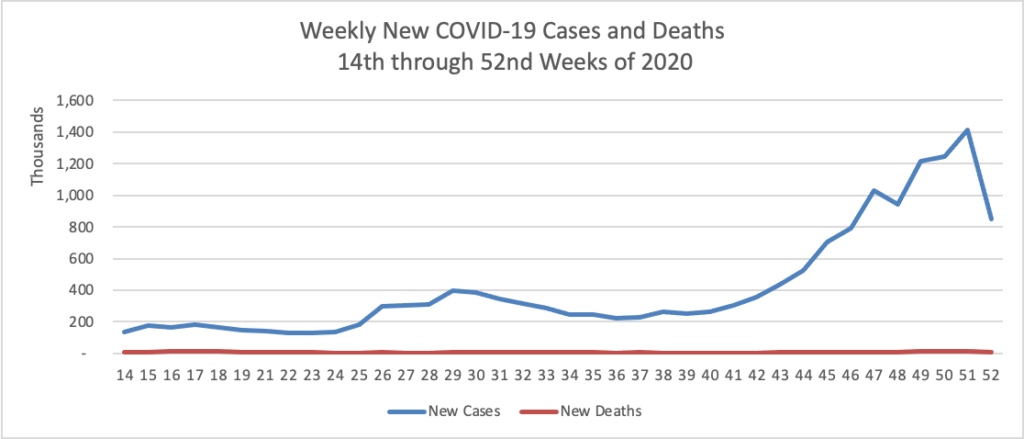
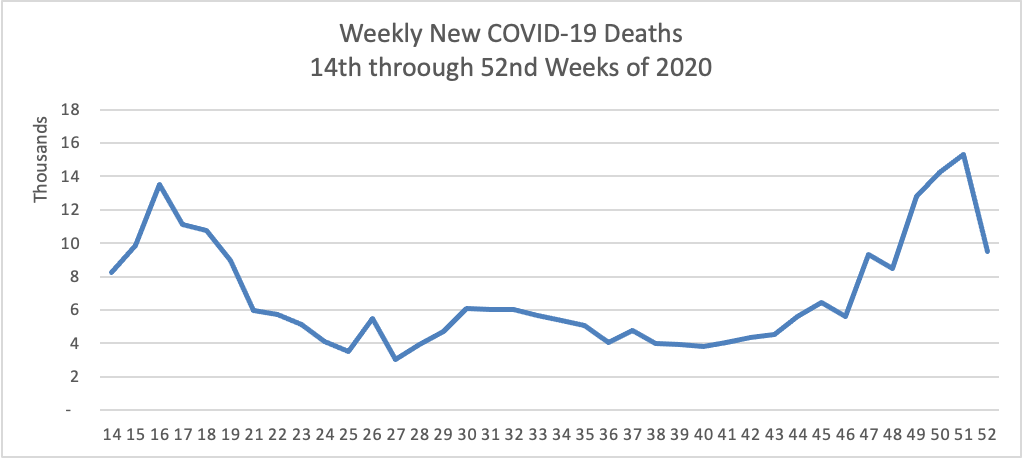
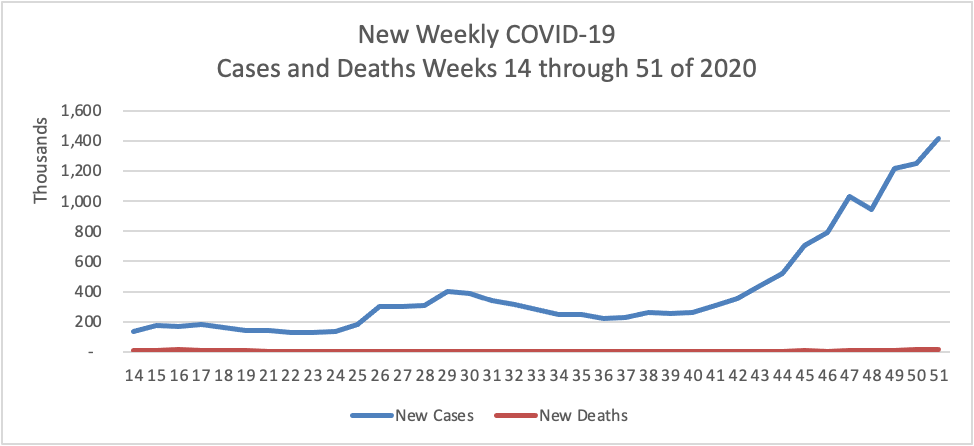
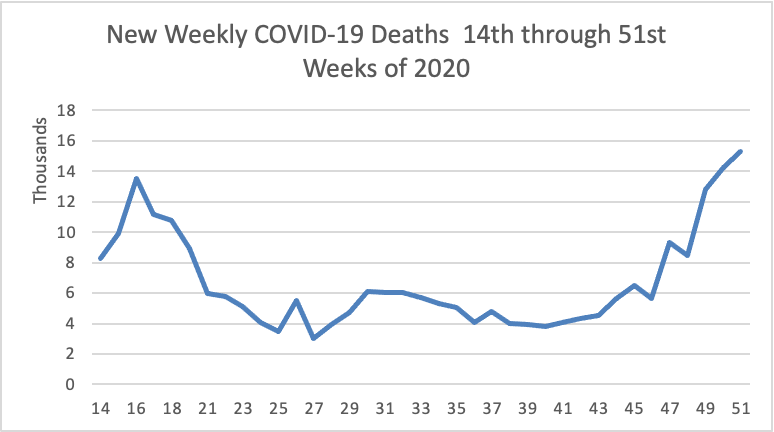
For the third week in a row, new COVID-19 cases have topped 300,000 (nearly 1 million in total) while the number of new deaths remains relatively low and stable (12,000 in sum over the past three weeks) according to the CDC’s cases in the U.S. website which the FEHBlog tracks.

Axios echos the FEHBlog’s sentiment that the medical profession to its credit has learned how to treat COVID-19. That is what you would expect in 2020. Hopefully the government is doing a good job providing healthcare resources to hot spot areas in order to facilitate treatment. In that regard, HHS announced today that “it will begin distributing $10 billion in a second round of high impact COVID-19 area funding to hospitals starting next week.”

In our FEHBP world —

  • Federal News Network reports that OPM has issued new proposed rules to address enrollment problems that arose during the long government shutdown in the winter of 2018-19. Hopefully we won’t encounter another one of those unfortunate events again, but it is better to be safe than sorry. Several of the new flexibilities are already law thanks to a law that Congress passed in 2019.
  • OPM also released today a revised SF 2809 FEHB enrollment form. The form is a handy reference for FEHB enrollment rules. It’s not used as often as it was pre-internet and smart phones.

Finally, the Trump Administration enjoyed two victories in the U.S. Court of Appeals for the D.C. Circuit today. As Healthcare Dive reports

  • The Court of Appeals affirmed a lower court decision upholding the Administration’s short term duration health plan rule. The FEHBlog sees no harm in giving consumers greater choice of health care coverage after Congress zeroed out the individual mandate.
  • The Court of Appeals reversed a lower court decision and thereby upheld the Administration’s Medicare “site neutrality” rule that “reduced some payments to off-campus hospital outpatient departments to make them consistent with other outpatient payments.” The court reasoned that

“Reducing the payment rate for a particular OPPS service readily qualifies, in common parlance, as a ‘method for controlling unnecessary increases in the volume’ of that service,” according to the opinion. “The lower the reimbursement rate for a service, the less the incentive to provide it, all else being equal. Reducing the reimbursement rate thus is naturally suited to addressing unnecessary increases in the overall volume of a service provided by hospitals.”

Makes perfect sense to the FEHBlog.

Midweek update

There have been many ups and downs during the COVID-19 emergency. The one effort consistently making sure but steady progress is the COVID-19 vaccine development process. In today’s news from Fierce Healthcare

  • “AstraZeneca and the University of Oxford are set to share “positive news” on their COVID-19 vaccine soon, according to a leading U.K. journalist. The update, which could come as soon as tomorrow, may shed light on how the front-runner vaccine fared in early clinical trials.”
  • “Moderna and its partners in the federal government are just now gearing up for a late-stage COVID-19 vaccine trial set to launch later this month, but at the same time, the mRNA biotech is prepping a supply of doses for quick shipment if the shot gets an FDA go-ahead.”

In this regard, the FEHBlog has noted his addiction to the Econtalk podcast. This week the host Stanford economics professor Russ Roberts dropped this pearl of wisdom in the course of his conversation with a gaming company CEO:

It’s taken me a long time, Josh, but I’ve finally figured out that sometimes something that people are really excited about doesn’t happen. Driverless cars. Four years ago I thought , ‘By 2020 they’re going to be here for sure. AI [Artificial Intelligence], ‘Yeah, soon they won’t even–,’ you fill in the blank. A lot of these things turn out to be harder than they were thought to be. And of course, part of the reason for that is that the people who’ve spent the money to take the chances on it have an incentive to overstate the hype. It’s just part of the natural human experience.

And of course there are also the lawyers telling the entrepreneurs to tone it down. Hopefully the COVID-19 vaccine for which we are all excited will be a near term success. Knock on wood.

In telemedicine news —

  • The Health Affairs Blog features a detailed CMS Administrator Seema Verma article on the topic. She concludes “During these unprecedented times, telemedicine has proven to be a lifeline for health care providers and patients. The rapid adoption of telemedicine among providers and patients has shown that telehealth is here to stay. CMS remains committed to ensuring that the government supports innovation in telehealth that leverages modern technology to enhance patient experience, providing more accessible care.”
  • Health Payer Intelligence reports that

As payers lean more heavily on remote care, consumers stressed the need for greater convenience in care delivery and prefer to turn to telehealth and digital solutions, in part, as the answer, according to a recent CVS Health study. CVS Health fielded the survey in March 2020 and garnered 1,000 respondents. It drew particularly from twelve major cities and targeted African American and Hispanic participants. An additional survey covered 400 providers.

What a happy coincidence!

Finally, Healthcare Dive informs us about UnitedHealth Groups’s second quarter 2020 earnings report.

Payer arm UnitedHealthcare, the largest commercial health insurer in the U.S., brought in $49.1 million in revenue, up just 1% year over year. But its medical loss ratio, a marker of how much an insurer spends on patient care, plummeted to 70.2% in the quarter ended June 30, compared to 83.1% same time last year, due to temporary deferral of care amid the pandemic.

The question of course is when will the bounce back occur?

Midweek Update

A House of Representatives appropriations subcommittee approved by voice vote today the bill funding financial services and general government for the 2021 fiscal year. That bill encompasses OPM and the FEHBP. Yesterday’s FEHBlog post discussed the relevant substance of the bill considered today. The bill now moves onto full appropriations committee consideration.

Fierce Healthcare reports that “Healthcare leaders and health IT groups are calling on Congress to repeal a section of the law that prevents the U.S. Department of Health and Human Services (HHS) from working with the private sector to develop a nationwide patient identification strategy.” The advocates are pointing to the COVID-19 emergency as another reason for taking this sensible action. ” Amid the COVID-19 pandemic, contact tracing efforts are hampered without accurate demographic information that correctly identifies the right patient.”

Also, on the COVID-19 front, the National Institutes of Health (“NIH”) announced today that “The National Institute of Allergy and Infectious Diseases (NIAID), part of the NIH, has established a new clinical trials network that aims to enroll thousands of volunteers in large-scale clinical trials testing a variety of investigational vaccines and monoclonal antibodies intended to protect people from COVID-19.”

The Wall Street Journal reports that

Drugmaker Emergent Biosolutions Inc. plans to work with Mount Sinai Health System in New York City to test whether a drug derived from the blood plasma of recovered Covid-19 patients can prevent infections in doctors, nurses and military forces. The proposed study, which the partners announced Wednesday, would add to efforts evaluating the coronavirus-fighting potential of experimental drugs made from plasma donated by recovered patients. If the drug proves to work safely, it could help protect health-care workers and other people working in essential jobs who are at high risk of infection until a vaccine is ready and perhaps even after.

On the general U.S. healthcare front Healthcare Dive reports that

Walgreens on Wednesday announced plans to open up to 700 primary care clinics across the country over the next five years in partnership with medical services provider VillageMD, and “hundreds more” after that. As part of the agreement, Walgreens will invest $1 billion in equity and convertible debt in Chicago-based VillageMD over the next three years, including a $250 million equity investment Wednesday. VillageMD will use 80% of the funds to pay for opening the clinics, called Village Medical at Walgreens, and integrate digitally with Walgreens.

and that

Walmart will now sell health insurance policies directly to its customers, a spokesperson told Healthcare Dive, confirming speculation sparked by job postings from the retailer for Medicare sales managers and insurance agents, first reported by the Arkansas Democrat Gazette. Analysts with SVB Leerlink said the move underscores the attractiveness of this market and the likelihood of increased competition over time, while Walmart’s reach across U.S. consumers — including seniors — has the potential to drive up volume for Medicare plans.

What’s more, Health Payer Intelligence discusses why some health plans seek out seriously ill members to wit “By developing a greater understanding of seriously ill populations, payers and policymakers can more accurately target their population health management strategies.”

And a Forbes columnist criticizes government telehealth parity mandates. The column provides an interesting perspective on the telehealth craze. As the FEHBlog’s late grandmother frequently advised “moderation in all things.”

Last but not least, FedWeek explores the OPM Federal Employees Benefits Survey to understand why some federal employees don’t enroll in our beloved FEHBP.

the survey found that of those not enrolled [roughly 19% of the surveyed population], 90 percent are obtaining health care through some other program, most commonly through a spouse’s employment and most commonly through the military TRICARE program. “Less than one percent of respondents said that they are not enrolled in FEHB and do not have health insurance because they do not think there is a need,” OPM said.

A Suggestion

While enjoying the Fourth of July weekend with perhaps a favorite beverage, listen to or read the transcript of the Econtalk podcast in which the host Russ Roberts interviews Vivian Lee, MD, about her book on healthcare reform called The Long Fix. Ms. Lee was CEO of the University of Utah health system and she currently is an executive with Alphabet’s Verily Life Sciences. Very informative. Happy Fourth of July to all.

Monday Roundup

Modern Healthcare reports tonight that

HHS spokesperson Michael Caputo on Monday tweeted that HHS intends to extend the COVID-19 public health emergency that is set to expire on July 25. The extension would prolong the emergency designation by 90 days. Several payment policies and regulatory adjustments are attached to the public health emergency, so the extension is welcome news for healthcare providers.

The Centers for Disease Control released updated guidance on the use of cloth face coverings during the COVID-19 emergency.

Cloth face coverings are recommended as a simple barrier to help prevent respiratory droplets from traveling into the air and onto other people when the person wearing the cloth face covering coughs, sneezes, talks, or raises their voice. This is called source control. This recommendation is based on what we know about the role respiratory droplets play in the spread of the virus that causes COVID-19, paired with emerging evidence from clinical and laboratory studies that shows cloth face coverings reduce the spray of droplets when worn over the nose and mouth. COVID-19 spreads mainly among people who are in close contact with one another (within about 6 feet), so the use of cloth face coverings is particularly important in settings where people are close to each other or where social distancing is difficult to maintain.

Healthcare Dive alerts us that

Gilead will charge between $2,340 and $3,120 for a typical course of treatment with its COVID-19 drug remdesivir, which has been shown to speed the recovery of patients hospitalized with the infectious disease.

The drug’s price will depend on whether patients are covered by government insurance or commercial health plans. Gilead will offer remdesivir to governments in developed countries at a price of $390 per vial. In the U.S., private insurers will pay $520 per vial. 

Most patients will be treated for five days, using six vials, Gilead said in announcing its much anticipated pricing decision Monday. If treatment stretches to 10 days — initially the standard treatment course — remdesivir’s cost would rise to $5,720 for patients who are commercially insured. 

The announced prices are in line with expert predictions.

MedCity News discusses Walmart’s new health clinics.

The company rolled out two Walmart Health clinics this month, in Loganville, Georgia and Springdale, Arkansas.

These aren’t your usual walk-in clinics that might serve as a quick place to get vaccinated or get a cold checked out. Rather, they’re more like a one-stop shop for healthcare, with primary care, urgent care, diagnostics, x-rays, behavioral health and dental care.

Walmart Health’s other big differentiator: A primary care appointment costs just $40. For children? $20.

Weekend Update

The House and Senate will be conducting legislative and committee business this week preceding the Fourth of July holiday. Of note, on Tuesday at 10 am the Senate Health Education Labor and Pensions Committee will hold a hearing on ways to return to work and school safely following the great hunkering down.

The Supreme Court has thirteen more opinions to release before its summer break. The Court is expected to release opinions on Monday, Tuesday, and Wednesday this week, all at 10 am.

On the COVID-19 front —

  • Fierce Healthcare discusses how the Walgreen’s Pharmacy chain has leveraged its partnership with Microsoft and other technology companies to better respond to the COVID-19 emergency.
  • A few weeks ago, the Journal podcast offered a fascinating show on the Hertz bankruptcy. It’s worth a 17 minute long listen. The story highlights how a strong balance sheet helps companies weather storms like the COVID-19 emergency. Becker’s Hospital Review identifies 14 well known health systems in this favorable situation, including Kaiser Permanente. It’s not an exclusive list.
  • Healthcare Dive reports on the significant adverse financial impact that the COVID-19 emergency has had on primary care practices in the U.S. Surprisingly that article does not note that these practices have been eligible for Payroll Protection loans and federal grants. The government deserves credit for trying to soften the blow to this critical sector of our health care system. Tuesday June 30 is the deadline for applying for a PPP loan.

On the human nature front, the Wall Street Journal reports that COVID-19 first responders have been relaxing by playing a boardgame called Pandemic.

Friday Stats and More

According to the CDC’s COVID-19 cases in the U.S. website, which the FEHBlog tracks, over the past seven weeks the numbers of new COVID-19 cases had taken a downward path for the first four weeks and then has turned up for the past three weeks. New deaths saw steady weekly reductions over the same time span until this week when there was a slight upturn. The COVID-19 hospitalization rates continue to trend down.

Week endingNew CasesNew Deaths
May 15297,5818,856
May 22159,4968,160
May 29142,2107,561
June 5142,2896,353
June 12153,3715,850
June 19161,2894,865
June 26199,2525,270

In other healthcare news —

  • Health Payer Intelligence reports that the CDC “estimates that 90 percent of national healthcare spending goes toward chronic disease management and mental healthcare, which means that strong mental health and chronic disease prevention strategies can help reduce payer spending. The CDC has named the eight most expensive chronic diseases in the US. The good news for payers is that most of these can be prevented to some degree. By being aware of preventive care strategies for these eight chronic conditions, payers can actively reduce their healthcare spending and support positive patient outcomes.”
  • The Commonwealth Fund and the Healthcare Transformation Task Force have created a Maternal Health Hub.

In federal agency news

  • Govexec.com informs us about the President’s executive order, issued today, requiring federal “agencies to increase the use of skill assessments and interviews with subject matter experts to determine an applicant’s qualifications, rather than simply looking at educational achievements. Degree requirements will not go away entirely, and certain positions—such as those in medical, legal and certain technical fields—will still require advanced degrees. The goal of the order, Trump administration officials said on Friday, is to create a broader pool of potential federal employees and a more equitable hiring process.”
  • Federal News Network reports that “The Postal Service expects to withstand the financial impact of the coronavirus impact better than it anticipated a few months ago, but warns that it could still run out of cash before the end of 2021 without long-term reform from Congress.”

Thursday Miscellany

Robert Redfield, MD, the Director of the Centers for Disease Control gave a press conference on the COVID-19 emergency today as discussed in this STAT News article.

“I’m asking people to recognize that we’re in a different situation today than we were in March, in April, where the virus was being disproportionately recognized in older individuals with significant comorbidities and was causing significant hospitalizations and deaths,” he said.

“Today we’re seeing more virus. It’s in younger individuals. Fewer of those individuals are requiring the hospitalizations and having a fatal outcome. But that is not to minimize it.”

But Redfield went on to note that descriptions of the state of the pandemic in the country can be misleading, with maps that show where transmission is high suggesting much of the nation is experiencing high levels of spread. In reality, he said, about 110 or 120 counties in the country currently have significant transmission. There are more than 3,100 counties in the United States.

The CDC also released updated guidance identifying categories of people who are most at risk for severe illness by contracting COVID-19.

The Washington Post reports that drug manufacturers are increasing production of the flu vaccine for the next flu season. “Getting a flu shot does not protect against the coronavirus, but disease experts said reducing episodes of flu could prove pivotal in freeing up space in hospitals and medical offices to deal with covid-19, the disease caused by the coronavirus.”

Healthcare Dive informs us that pediatric visits are lagging in the recent doctors office visit rebound following the great hunkering down. “[O]ver the past week, visits to some specialists have returned to normal, including dermatology and rheumatology. However, pediatric practices are among the hardest hit and have seen the greatest decline in visits when comparing specialties . . .”

Health Payer Intelligence discusses CVS Health’s new service called “Return Ready.” It’s “a COVID-19 testing strategy for employers whose workforces are returning to the workplace and academic populations returning to campus.” Timely. Here’s a link to current Equal Employment Opportunity Commission guidance on employer compliance with the Americans with Disabilities Act and the Rehabilitation Act in COVID-19 related matters. .

The Society for Human Resource Management provides observations about how the the Supreme Court’s recent ruling holding that Title VII’s sex discrimination protections extend to sexual orientation and gender identity situations affects employer sponsored health coverage.