Tuesday’s Tidbits

Tuesday’s Tidbits

Photo by Patrick Fore on Unsplash

Bloomberg reports that “President Joe Biden said [today] he wants all American adults eligible for a coronavirus vaccine by April 19, two weeks earlier than his previous goal. All but two states are already set to meet that goal, with Oregon and Hawaii having planned to open up vaccines to all non-minors on May 1.”

Yesterday, the Centers for Disease Control (“CDC”) released a report finding that “The principal mode by which people are infected with SARS-CoV-2 (the virus that causes COVID-19) is through exposure to respiratory droplets carrying infectious virus. It is possible for people to be infected through contact with contaminated surfaces or objects (fomites), but the risk is generally considered to be low.” As this BBC News article illustrates, last Spring we were quite worried about contracting COVID-19 from contaminated surfaces. In any event, thank heavens that we have the vaccines.

Federal News Network reports that front line federal employee access to the COVID-19 vaccine depends upon their employing agency.

If you are a federal employee working in the field, like Food and Drug Administration inspectors, Forest Service rangers or Custom and Border Protection officers, getting a COVID-19 vaccine from your agency isn’t a sure thing.

The Department of Homeland Security is making an all-out effort to vaccinate all 300,000 employees.

Other agencies like the Agriculture Department or the IRS are asking employees to take a path through their state and local governments.

This inconsistent application of agency support for “frontline” workers to receive one of the three inoculations has the potential to create a have and have nots among agencies.

Hopefully as the COVID-19 vaccine supply continues to expand and access restrictions are removed, these unfortunate quirks in the process will be ironed out quickly.

In other healthcare related tidbits

  • On April 12, the CDC will be sponsoring its decennial meeting on healthcare associated infections.
  • The Food and Drug Administration released a COVID-19 update today. The FEHBlog wonders when the FDA will take up granting full marketing approval for the Pfizer and Moderna vaccines and when AstraZeneca will file an emergency use authorization with the FDA for its COVID-19 vaccine. Those steps take us closer to ironing out the process quirks.
  • MedPage Today reports that

A personalized, hands-on care strategy for patients struggling with addiction was effective at reducing hospital readmission, a randomized trial found. In a comparison of hospitalized adults with substance use disorder involving opioids, cocaine, or alcohol, those who received Navigation Services to Avoid Rehospitalization (NavSTAR) care saw far better outcomes than those who simply received treatment as usual, according to Jan Gryczynski, PhD, of the Friends Research Institute in Baltimore, and colleagues.

  • Health Payer Intelligence informs us that

A digital therapeutic weight loss program led to major medical cost savings, according to a Rally Health Inc. study that points to wellness programs as cost-effective strategies to tackle the obesity epidemic. The study published in Obesity examined program data over a three-year period to analyze medical cost trends for those participating in Rally Health’s Real Appeal weight loss intervention program.

Researchers compared medical costs for a group of participants in the digital therapeutic wellness program with costs for a control group of non-participants. The control group was selected to match the intervention group in terms of health risk, baseline medical costs, age, gender, geographic region, and chronic conditions.

The study found that the wellness programming resulted in significant weight loss. There was an average weight loss of 3 percent for 4,790 program participants who attended at least one session over a 52-week period. In addition to providing positive member outcomes, the wellness program lowered medical expenditures significantly. Costs for the intervention cohort were 12 percent less than costs for the control group. What’s more, the savings of the wellness program cohort were 2.3 times more than program costs, marking significant return on investment.

  • Adam Fein reports in his Drug Channels blog that

The drug channel is consolidating, both vertically and horizontally. For evidence, look no further than Drug Channels Institute’s estimates of pharmacy benefit manager (PBM) market share, which are shown in the chart below. For 2020, DCI estimates that the three biggest PBMs [CVS Health (including Caremark and Aetna), the Express Scripts business of Cigna, and the OptumRx business of UnitedHealth Group] accounted for more than three-quarters of total equivalent prescription claims. * * * This concentration helps plan sponsors and payers, which can maximize their negotiating leverage by combining their prescription volumes within a small number of PBMs. 

Monday Roundup

Photo by Sven Read on Unsplash

The Wall Street Journal offers an interesting story about how many patients with long or long haul COVID-19 (about 10% of total case) wind up receiving cognitive rehabilitation.

Cognitive problems are some of the most persistent and common long-term symptoms that people struggle with months after getting Covid. Patients report short-term memory problems, slow processing speeds, poor word recall and difficulty multitasking. To help them, doctors at medical centers including Mayo Clinic, Yale and Johns Hopkins are starting to refer some patients to cognitive rehabilitation more typically used for patients with concussions and other traumatic brain injuries. 

AHIP presents an interview with Kim Lauersdorf, Vice President of Marketing at EmblemHealth, about crafting communications about vaccinations, including the COVID-19 vaccines.

What should health care organizations take away from the study, what are some next steps to help drive vaccine adoption and acceptance?

Lauersdorf: As health care professionals, we need to accept responsibility when communicating to our base and know that if we are not intentional of the language we use, the voices we amplify, and the methodologies we use to get our messages out, we will perpetuate greater health disparity.

First, it’s clear that terminology matters. The widely used term “shot”, for example, evokes significant negative connotations across all populations, but specifically in low-income, younger, and Black communities. Clinically, it evokes needles, injection, and pain. Non-clinically, it evokes violence. Continued usage of the term will drive continued disparity in vaccine adoption.

Second, we must amplify trusted voices. People, across the board, trust their primary care providers above all other messengers. To take this even further, people have more trust in primary care providers who look like them or come from their same communities.

In addition, word of mouth—especially from trusted sources—is as important today as it ever was. Even more so, as we are each dealing with a worldwide crisis, coupled with a large scale, new, possible way out of it. We have to understand that this is all new territory that this generation has never experienced before. That too fosters hesitation.

Third, we must use multiple channels to get our messages out. While there has been an increase in digital health adoption, as seen through rising telehealth usage, we have to know that many of our communities still don’t have reliable Internet access or access to certain technology. We have to get our message to all of those we serve to ensure vaccine adoption doesn’t perpetuate existing health disparities.

The American Hospital Association reports on five takeaways from a maternal / mental healthcare conference. Here’s one of them:

Technology alone will not be enough.

The COVID-19 pandemic has proven how crucial technology is for health care delivery. Telehealth improves access to OB/GYNs, doulas, lactation consultants and specialists. Remote patient monitoring, chat and text-based navigation services, and apps have provided additional ways to support and coordinate care. 

Yet, speakers acknowledged technology alone will not be enough. Melissa Hanna, founder and CEO of Mahmee, which delivers data-driven care coordination and personalized support to new moms, shared “technology will not be the end all be all solution” to our challenges in maternal health. She also shared, “this is always going to be about care, and it’s plenty of people working together to center the experiences of mothers, and be there in a proactive way to guide, support and advocate.” 

We have seen firsthand that a combined approach of offering health care services through technology and human connection can drive better outcomes for mothers. Mayo Clinic developed the OB Nest program to optimize prenatal care for low-risk expectant mothers. The program uses a combination of in-person and telehealth prenatal visits, home monitoring, and a social media community that allows patients to share their experiences with other mothers. It also has dedicated nurses that help with patient education and serve as a resource for mothers throughout the program. This combination has provided pregnant moms with more autonomy in their prenatal care. 
 

In other benefit news

  • Fierce Healthcare reports that Verizon has jumped into the telehealth market with an offering directed at providers of care.

Many hospitals and health clinics have adopted video conferencing services during the pandemic for providing patient care. BlueJeans Telehealth, which launched Monday, was designed from the ground up for healthcare organizations to simplify the virtual experience and offer greater access to care, Verizon executives said in a press release.

  • Employee Benefit News informs us that

Benefitfocus, a cloud-based software solutions provider for healthcare and benefits administration, published a report on the current state of employee benefits. The research provides insight into employee enrollment behavior for the last four years, and takes a closer look at how 2020 impacted employee benefits.

The EBN article offers an interview with Benefitfocus’s director of consumer advocacy.

Finally former NTEU President Robert Tobias presents in Govexec.com his thoughts on the National Academy of Public Administration’s recent report on the future of OPM.

Friday Stats and More

Based on the Centers for Disease Control’s COVID-19 Data Tracker website, here is the FEHBlog’s chart of new weekly COVID-19 cases and deaths over the 14th week of 2020 through 13th week of this year (beginning April 2, 2020, and ending March 31, 2021; using Thursday as the first day of the week in order to facilitate this weekly update):

and here is the CDC’s latest overall weekly hospitalization rate chart for COVID-19:

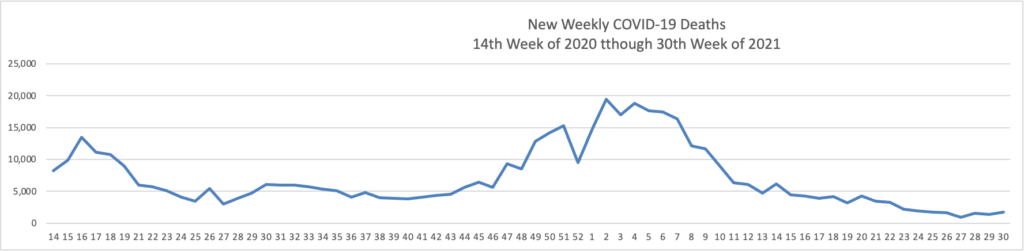
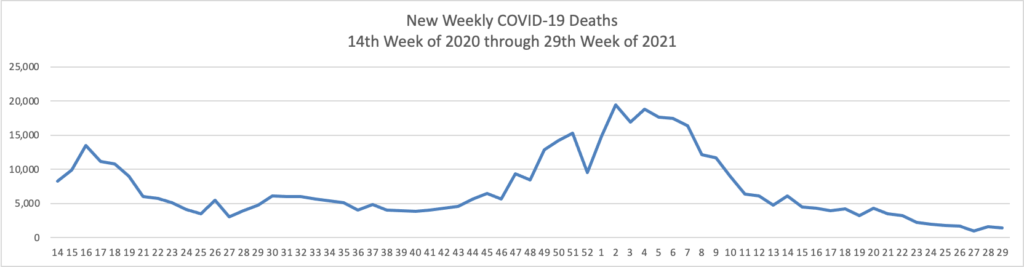
The FEHBlog has noticed that the new cases and deaths chart shows a flat line for new weekly deaths  because new cases greatly exceed new deaths. Accordingly here is a chart of new COVID-19 deaths over the one year period (April 2, 2020 through March 31, 2021):

Finally here is a COVID-19 vaccinations chart over the period December 17, 2020, through March 31, 2021, which also uses Thursday as the first day of the week:

Bloomberg reported this afternoon that

More than 101 million people in the U.S. have received a first dose of a Covid-19 vaccine, or about 31% of the population.

Less than four months into the U.S. vaccination effort, coverage is best in people 65 years or older, with 74% of the group getting at least one dose and 54% completing vaccination, according to figures published by the Centers for Disease Control and Prevention and compiled by the Bloomberg Vaccine Tracker.

On Friday, the U.S. set a one-day record for vaccine doses reported administered, adding almost 4 million. On average, the U.S. is administering close to 3 million shots a day as of Friday’s update, also a record.

In other COVID-19 vaccination news

  • Fierce Pharm reports that Johnson & Johnson which offers a one dose vaccine has joined the two dose vaccine manufacturers Pfizer and Moderna in its vaccine on adolescents aged 12-17.
  • The Society for Human Resource Management informs us that

The following measures may increase vaccine acceptance in the workforce, according to the CDC:

1. Train interested staff to become COVID-19 vaccination ambassadors who will speak confidently and honestly, relaying personal stories about the vaccine to fellow co-workers and addressing any of their concerns.

2. Employ all available communication tools when promoting the COVID-19 vaccine to staff, including social media, internal communication channels, and posters or signs around the workplace.

3. Hold a virtual town hall where leadership, respected local medical experts and staff share their COVID-19 vaccine experiences and other vaccine facts and answer audience questions. Use experts to communicate to staff when talking about the COVID-19 vaccine. Ensure the experts present facts about the vaccine, including the risks.

4. Consider giving employees paid time off to get the vaccine and offering paid sick leave for employees who have adverse reactions.

5. Have workplace leadership take the COVID-19 vaccine, capture their experience using video or photo, and share the experience with staff.

  • In this regard, Govexec.com reports that

Next week, the Health and Human Services Department plans to open a vaccination site for federal employees in the National Capital Region.

A source familiar with the plans told Government Executive on Friday that the site will be in Gaithersburg, Maryland. “The site will provide COVID vaccinations to federal, essential, critical infrastructure workers,” said the source. Federal agencies will determine eligibility based on “job duties and [the Cybersecurity and Infrastructure Security Agency’s] guidance on the essential, critical infrastructure workforce,” which includes 24 agencies.  

The source was unsure at the moment on how many vaccine doses will be available or how many employees will be able to receive them. Employees will be notified starting Friday, April 2, the source said.

In health benefits news —

  • The Labor Department’s Employee Benefits Security Administration released ACA FAQ 45 today. FAQ 45 provides compliance guidance on Section 203 of Division BB of the Consolidated Appropriates Act 2021. Section 203 requires health plans, including FEHB plans, to prepare and keep current written analyses demonstrating compliance with the non-quantitative treatment limitations requirements of the federal mental health parity law and implementing regulations.
  • Fierce Healthcare explains how Optumcare successfully expanded the use of at home colon cancer screenings during the pandemic.

OptumCare used data analytics to flag the patients at risk for colon cancer and then reached out to them about the home test kits. While the kits included an information letter to describe the process, the clinical team also followed up four times by phone to check in with them.

If the testing results were positive or abnormal, the patient’s physician or care team would reach out directly to explain what the results meant and schedule them for future appointments to ensure care was coordinated throughout the process.

Frank said OptumCare saw a 5% higher return rate under the expanded program than in previous years, and the increased engagement drove interest in expanding other home health options such as home testing for blood glucose among diabetic patients.

  • Fierce Healthcare also informs us that

The American Medical Association innovation subsidiary Health2047 has spun off a company that uses personalized medicine to fight obesity. Phenomix Sciences is a phenotype testing company that carries out the AMA’s mission to confront chronic diseases such as obesity.

Phenomix uses a blood test called MyPhenome that it has licensed from the Mayo Clinic to allow doctors to prescribe individualized therapies. MyPhenome measures DNA as well as a person’s metabolites and hormones. These biomarkers make up a person’s phenotype, according to Phenomix.

The company’s blood-based test uses phenotype-driven multi-omics technology to predict responses to obesity interventions that the Food and Drug Administration (FDA) has approved. A multi-omics test is important because testing for obesity involves multiple factors, including genetics, metabolomics and environmental aspects, according to Phenomix CEO Mark Bagnall.

Because patients respond differently to obesity treatment, the Phenomix founders turned to AI to personalize this treatment. AI can personalize a multi-omics obesity test and analyze single-nucleotide polymorphisms, metabolites and hormones that correspond with a certain obesity phenotype, according to Bagnall.

AI can help identify a specific obesity phenotype so patients can receive the right treatment.

“[We] demonstrated in several clinical studies that knowing a patient’s phenotype doubles the likelihood of weight loss and doubles the amount of weight lost,” Bagnall said.  

Midweek Update

Photo by Manasvita S on Unsplash

The FEHBlog noticed today that OPM has posted the agenda for its annual FEHB Carrier Conference which AHIP co-hosts. While the agenda includes many hot topics, the FEHBlog is surprised that new FEHB Act Section 8902(p) / the No Surprises Act is not highlighted on the agenda.

From the COVID-19 front —

  • The Centers for Disease Control’s daily report on COVID-19 vaccinations in the U.S. reports that that over 150 million doses have been delivered.
  • Pfizer and BioNTech announced that “in [study] participants aged 12-15 years old, [their two dose COVID-19 vaccine] BNT162b2 demonstrated 100% efficacy and robust antibody responses, exceeding those reported in trial of vaccinated 16-25 year old participants in an earlier analysis, and was well tolerated. The companies plan to submit these data to the U.S. Food and Drug Administration (FDA) and the European Medicines Agency (EMA) as soon as possible to request expansion of the Emergency Use Authorization (EUA) and EU Conditional Marketing Authorization for BNT162b2.” This is good news for the next school year. Testing on younger children continues.
  • The Wall Street Journal reports that “Pregnant women who get the coronavirus vaccine pass their antibodies on to their newborns, recent studies suggest, a promising sign that babies can acquire from their mothers some protection against Covid-19. At least three studies have found that women who received either the Pfizer Inc. –BioNTech SE vaccine or the Moderna Inc. shots during pregnancy had coronavirus antibodies in their umbilical-cord blood. That indicates the women’s babies got the antibodies, too. * * * Pregnant women are at higher risk of a severe case of Covid-19 and of preterm delivery if they are infected. The studies’ findings, though preliminary, suggest women could safely protect themselves and their newborns by getting vaccinated.
  • Health Payer Intelligence explains “How Payers Are Involved in Boosting COVID-19 Vaccine Confidence — Payers are targeting coronavirus vaccine confidence through collaborations, marketing tools, and incentive programs.”
  • The National Institutes of Health announced that “The Centers for Disease Control and Prevention (CDC), in collaboration with NIH, has launched an innovative community health initiative called “Say Yes! COVID Test” starting in Pitt County, North Carolina, and coming soon to Chattanooga/Hamilton County, Tennessee. As many as 160,000 residents across the two communities will have access to free, rapid antigen tests that they can administer themselves to use three times a week for one month. NIH will provide the tests (also called a home-test or at-home test) and evaluate the effectiveness of the initiative, which aims to determine if frequent self-administered COVID-19 testing helps residents reduce community transmission of SARS-CoV-2, the virus that causes COVID-19 disease.”

And from the survey front —

  • The International Foundation of Employee Benefit Plans released its “2020 Employee Benefits Survey [which] provides benchmarking data on their health care offerings, covered dependents, plan funding, dental and orthodontia benefits, prescription drug offerings and other benefits.”
  • Becker’s Hospital Review identifies two dozen health care facilities that offer care to long haul COVID-19 patients.

Tuesday Tidbits

Happy National Doctors’ Day “It is a day to celebrate the contribution of physicians who serve our country by caring for its’ citizens.”

The American Hospital Association reports that

Anticipating possible congressional action to extend the moratorium on the 2% sequester cut to all Medicare payments, the Centers for Medicare & Medicaid Services today said it has instructed Medicare administrative contractors to hold all claims with dates of service on or after April 1, 2021, for a short period. The MACs will automatically reprocess any claims paid with the reduction applied if necessary, the agency said. 
  
The Senate last week passed a bill that, among other health care provisions, would eliminate the 2% cut to all Medicare payments, known as sequestration, until the end of 2021. The House is expected to take up the Senate-passed bill the week of April 13 when it returns to Washington D.C.

Bloomberg News informs us that

The World Health Organization’s chief said a mission to study the origins of the coronavirus in China was too quick to dismiss the theory of a lab leak, with the U.S. and other governments joining in criticism of the investigation.

WHO Director-General Tedros Adhanom Ghebreyesus said the probe didn’t adequately analyze the possibility of a lab accident before deciding it’s most likely the pathogen spread from bats to humans via another animal. In a briefing to member countries Tuesday, he said he is ready to deploy additional missions involving specialist experts.

“Although the team has concluded that a laboratory leak is the least likely hypothesis, this requires further investigation,” Tedros said in a statement. The WHO chief has consistently said all lines of inquiry are open, but Tuesday’s comments mark the first time he’s speculated about the possibility of an accidental escape.

The American Medical Association offers a podcast in which Christopher J.L. Murray, MD, director of the Institute for Health Metrics and Evaluation at the University of Washington offers his perspective on the future course of COVID-19 in the U.S. this year.

A physician and health economist whose career has focused on improving health globally by improving health evidence, Dr. Murray outlined these three challenges to making herd immunity a reality and preventing another wave of illness this fall or winter:

Vaccines will not be as effective at preventing infection from the SARS-Co-V-2 B.1.351 variant that emerged in South Africa or the P.1 variant that emerged in Brazil, or future variants.

Not enough individuals will receive the vaccine to achieve herd immunity.

Those who had previous COVID-19 infections from one variant may not have protection from being reinfected with a new variant.

When vaccines were approved, everyone thought the U.S. would get to herd immunity by late summer or the fall because the number of people who have been vaccinated combined with the 20% of Americans who had already been infected and had immunity would push America to the level needed for herd immunity, preventing another wave next winter, Dr. Murray said.

“But if it turns out there isn’t cross-variant immunity, then the only way to get to the point where you don’t have a third wave next winter is through vaccination,” he said.

In related news, Kaiser Health News reports that “A new poll of attitudes toward covid vaccinations shows Americans are growing more enthusiastic about being vaccinated, with the most positive change in the past month occurring among Black Americans.”

Closing tidbits —

  • Fierce Healthcare identifies the Centers for Medicare and Medicaid Services “payment models the Biden administration has pulled for review or delayed.”
  • Health Payer Intelligence discusses large insurer platforms designed to help their self-funded customers coordinate their health benefit offerings.

Monday Roundup

Photo by Sven Read on Unsplash

Bloomberg reports that the United States is on pace to administer three million doses of COVID-19 vaccine daily as supplies increase and states widen eligibility.

The Wall Street Journal adds that

Covid-19 vaccines from Moderna Inc. and from Pfizer Inc. and partner BioNTech SE are highly effective in preventing infections in real-world conditions, federal health officials said, further evidence that vaccinations can slow the spread of the virus.

The vaccines were 90% effective at reducing the risk of infection two weeks after a second dose, according to a study of nearly 4,000 healthcare workers, first responders and other essential workers published by the U.S. Centers for Disease Control and Prevention on Monday.

In addition, the data indicated the vaccines can reduce the risk of coronavirus infections whether or not they cause symptoms, the CDC said.

As of today, 49.2% of the U.S. population over age 65 is fully vaccinated against COVID-19, and 72.8% of that population has received at least one dose of the COVID-19 vaccine. What’s more, the Department of Health and Human Services announced issuing grants to help public agencies bring this age group and disabled people as close as possible to 100% vaccinated. “Older adults are more likely to have a severe illness, be hospitalized, or die from COVID-19; adults 65 and older account for 8 of every 10 COVID-19-related deaths. People with disabilities also often are at increased risk; in fact, a recent study found that intellectual disability is the greatest risk factor after age.” 

In relevant business news —

  • Healthcare Dive reports that “The U.S. Department of Justice is embarking on a deeper review of UnitedHealth Group’s $13 billion acquisition of data analytics company Change Healthcare following entreaties from powerful hospital lobby the American Hospital Association over anticompetitive concerns.”
  • The Society for Human Resource Management shares HR professional views on how the pandemic has changed the workplace over the past year. The FEHBlog particularly likes this one :

“We definitely learned that it’s not enough to just set people loose in a work-from-home environment. This isn’t about trusting employees to do their work unsupervised, either. We have complete trust in our employees, and this was never brought into question. The problem is that people have different proficiencies with tech and different abilities to work without guidance.”
—Carter Seuthe, CEO of Credit Summit, based in Austin, Texas  

Weekend update

Photo by Tomasz Filipek on Unsplash

The House and Senate are on district/state work breaks until April 13.

From the COVID-19 herd immunity front —

The FEHBlog always looks forward to the lead article in the Wall Street Journal’s weekend review section. Yesterday’s thought provoking article was headlined “Herd Immunity Won’t Save Us—but We Can Still Beat Covid-19 — Innovative contact tracing and just-in-time vaccination can get the pandemic under control—and prepare us for the next one.” The article, which was written by a group of epidemiologists, focuses on the worldwide eradication of smallpox which was quite an achievement in 1980 roughly 175 years after the smallpox vaccine was first administered. The article discusses the importance of the vaccine being able to prevent the disease in an infected, asymptomatic person which was the case with smallpox which had a 12 day incubation period.

Wikipedia notes

The 1947 New York City smallpox outbreak occurred in March 1947 and was declared ended on April 24, 1947. The outbreak marked two milestones for America. First, it was the largest mass vaccination effort ever conducted for smallpox in America, and second, it marked the last outbreak of smallpox in America. Within three weeks of the discovery of the outbreak, the U.S. Public Health Service, in conjunction with New York City health officials, had procured the smallpox vaccine and inoculated over 6,350,000 adults and children.[1]Of that number, 5,000,000 had been vaccinated within the first two weeks. The rapid response was credited with limiting the outbreak to 12 people, 10 of whom recovered, while 2 died.

The Wall Street Journal article explains that the COVID-19 vaccines also allow for just-in-time vaccinations:

Despite the rapid onset of viral infection (an average of 6 days after exposure, with a range of 2-14 days), Johnson & Johnson has reported success in preventing moderate to severe disease as early as 7 days after the administration of its single-dose vaccine. In a real-world study in Israel, the Pfizer vaccine also prevented severe disease soon after a single dose.

It is not too late to find, isolate and vaccinate those who do not yet have Covid-19 but are most likely to get it. It is not too late to use just-in-time vaccination to stop outbreaks in midcourse and prevent the spread of infection.

The Wall Street Journal in another herd immunity article reminds us that

“We definitely need to get kids vaccinated if we want to be as close to normal as we can,” said Octavio Ramilo, chief of infectious diseases at Nationwide Children’s Hospital, in Ohio. As governments push to move past the pandemic, vaccinating children is emerging as a key obstacle, along with initially limited supplies of vaccines.

Vaccines probably won’t be ready for use in younger children until early 2022, health experts said, in part because researchers need to test lower doses.

“The dose is not such a big leap to go from adults to teens,” said Katherine Luzuriaga, a pediatric infectious disease physician and the lead investigator of Moderna’s adolescent trial at the University of Massachusetts Medical School site. “Once we start going into the younger age groups, there’s a bit more work to determine the appropriate doses.”

As mentioned in Friday’s post, Pfizer and Moderna are testing on children. Vaccinating older high schoolers and college age kids which already is possible as the Pfizer vaccine is approved for persons over age 16 and the other two vaccines are available to persons over 18.

The FEHBlog believes that we should stay the current vaccination course until supply exceeds immediate demand likely in the next quarter of the year.

Vaccinating those at most risk of severe illness and death has been the first priority of vaccination drives. In most countries, that has meant giving priority to elderly citizens and those with conditions that heighten their risk of severe Covid-19.

The rate of hospitalization is 35 times as high, and the death rate is 1,100 times as high, among people 65 to 74 years old infected with Covid-19, compared with children ages 5 to 17, according to the U.S. Centers for Disease Control and Prevention

Health authorities say children don’t need to be vaccinated to start resuming certain activities like in-person learning at schools that are taking precautionary measures. Some experts caution against focusing too heavily on a specific herd immunity target, as building up population-level protection is an incremental process.

From the medical innovation front (non-COVID) —

  • Yesterday the Food and Drug Administration announced that marketing approval for

Abecma (idecabtagene vicleucel), a cell-based gene therapy to treat adult patients with multiple myeloma who have not responded to, or whose disease has returned after, at least four prior lines (different types) of therapy. Abecma is the first cell-based gene therapy approved by the FDA for the treatment of multiple myeloma.

“The FDA remains committed to advancing novel treatment options for areas of unmet patient need,” said Peter Marks, M.D., Ph.D., director of the FDA’s Center for Biologics Evaluation and Research. “While there is no cure for multiple myeloma, the long-term outlook can vary based on the individual’s age and the stage of the condition at the time of diagnosis. Today’s approval provides a new treatment option for patients who have this uncommon type of cancer.”

  • On Friday the FDA announced other hopeful news

The U.S. Food and Drug Administration approved the first in the world non-surgical heart valve to treat pediatric and adult patients with a native or surgically-repaired right ventricular outflow tract (RVOT), the part of the heart that carries blood out of the right ventricle to the lungs. The device is designed for patients who have severe pulmonary valve regurgitation (blood leaking backward into the right lower chamber of the heart), a condition that often results from congenital heart disease (CHD). The device, called the Harmony Transcatheter Pulmonary Valve (TPV) System, is intended to improve blood flow to the lungs in patients with severe pulmonary valve regurgitation without open-heart surgery, which is the current standard of care. The use of the Harmony valve may delay the time before a patient needs additional open-heart surgery. It can also potentially reduce the total number of open-heart surgeries required over an individual’s lifetime.

CHDs affect nearly 1% of―or about 40,000―births per year in the United States.

Friday Stats and More

Based on the Centers for Disease Control’s COVID-19 Data Tracker website, here is the FEHBlog’s chart of new weekly COVID-19 cases and deaths over the 14th week of 2020 through 12th week of this year (beginning April 2, 2020, and ending March 24, 2021; using Thursday as the first day of the week in order to facilitate this weekly update):

and here is the CDC’s latest overall weekly hospitalization rate chart for COVID-19:

The FEHBlog has noticed that the new cases and deaths chart shows a flat line for new weekly deaths  because new cases greatly exceed new deaths. Accordingly here is a chart of new COVID-19 deaths over the period (April 2, 2020, through March 24, 2021):

Finally here is a COVID-19 vaccinations chart for the past three months which also uses Thursday as the first day of the week:

The charts continue to look pretty good. As of today 34.6% of the U.S. population over 18 years old has received at least one dose of the COVID-19 vaccine and 46% of the U.S. population over 65 years old is fully vaccinated.

STAT News reports that

Pfizer and BioNTech said Thursday they are beginning a study aimed at showing their Covid-19 vaccine can be used in children as young as 6 months.

The study follows the launch of a separate and ongoing trial in children ages 12 to 15, which was fully enrolled in January. That study could lead to results by the end of the first half of the year, depending on the data, and then to an emergency use authorization. That will depend on the Food and Drug Administration and the Centers for Disease Control and Prevention. The vaccine already has an EUA for people 16 and older.

“The FDA, if it sees fit to do this, could, grant an EUA and get them into children in that age group by the fall, provided the CDC also agrees and that that should be the vaccine they receive,” said William Gruber, Pfizer’s senior vice president of vaccine clinical research and development.

Moderna began a similar study of their vaccine on children from age 6 months to 12 years old on March 16.

STAT News also offers “A user’s guide: How to talk to those hesitant about the Covid-19 vaccine.” Here’s one good idea:

Have a conversation

Don’t lecture your family and friends, and don’t assume you know what their concerns are. Make sure to listen.

“Try to address their concerns, not what you assume are their concerns,” said Jorge Moreno, an internist and assistant professor at the Yale University School of Medicine. While you may be thinking people are ensnared in the darkest of conspiracy theories, many may have concerns that are much simpler to address. For Moreno, who even had to convince his mother the vaccine was safe, many questions he’s received have centered around side effects, and whether they might make people too sick to work. A Carnegie Mellon University survey released this week showed 70% of vaccine-hesitant people were concerned about side effects.

“Let people know it’s OK to have questions and that having concerns is legitimate,” added Reed Tuckson, the former public health commissioner for Washington, D.C., and a founding member of the Black Coalition Against Covid, which co-developed a campaign called “The Conversation” to provide Black families credible vaccine information. “Letting people have a safe space to have this conversation is essential,” he said. “Wagging your finger against someone is not very useful.”

From the tax front:

  • The Internal Revenue Service recently announced that “amounts paid for personal protection equipment, such as masks, hand sanitizer and sanitizing wipes, for the primary purpose of preventing the spread of the Coronavirus Disease 2019 (COVID-19 PPE) are treated as amounts paid for medical care under § 213(d) of the Internal Revenue Code (Code). * * * Group health plans, including health FSAs and HRAs, under the terms of which expenses for COVID-19 PPE may not be reimbursed, may be amended pursuant to this announcement to provide for reimbursements of expenses for COVID-19 PPE incurred for any period beginning on or after January 1, 2020, and such an amendment will not be treated as causing a failure of any reimbursement to be excludable from income under § 105(b) or as causing a § 125 cafeteria plan to fail to meet the requirements of § 125.”
  • What’s more, Spotlight on Benefits explains how the IRS has clarified Pandemic-Related Relief for Dependent Care FSAs.

In healthcare business news, Healthcare Dive explains why being a hospital chief financial officer is a particularly tough job during the pandemic. Also Fierce Healthcare discusses a CIGNA telehealth study finding that

while virtual visits for other types of services declined after the initial COVID-19 spike, virtual visits for behavioral health remained in high demand. In April 2020, virtual visits made up about 50% of claims for non-behavioral health services and declined over the course of the year to account for nearly 25% today.

“Virtual behavioral health care is not only a way to access mental health services in the wake of social distancing, but it also allows us the option to pursue treatment in the privacy and comfort of our own homes,” Lustig said.

By contrast, in April, 66% of office visits for behavioral health were conducted virtually, and it’s remained largely flat since.

Behavioral telehealth users also reported higher productivity at work, according to the survey. These patients reported a 45% decrease in sick days, compared to a 28% decrease in miss workdays among patients who did not use telehealth.

That’s good news for the spoke and hub telehealth companies and for health plans and consumers because the spoke and hub telehealth network therapists are in-network.

Thursday Miscellany

Photo by Juliane Liebermann on Unsplash

From Capitol Hill, the American Hospital Association gleefully reports that “The Senate today passed by 90-2 vote a bill that, among other health care provisions, would eliminate the 2% across-the-board cut to all Medicare payments, known as sequestration, until the end of 2021. To pay for the change, the bill, which was introduced by Sens. Jeanne Shaheen, D-N.H., and Susan Collins, R-Maine, would increase the fiscal year 2030 sequester cuts. The House is expected to take up the Senate-passed bill when it the week of April 13 when it returns to Washington D.C.”

The U.S. Office of Personnel Management announced six political appointments to the agency which do not require Senate confirmation. Good luck to them.

From the COVID-19 front, the Wall Street Journal observes

In many ways, AstraZeneca, which developed the vaccine in partnership with the University of Oxford, is delivering on its main promises. More than 70 countries, including the U.K. and much of the rest of Europe, have found the shot safe and effective. Although it isn’t a big player in vaccines, AstraZeneca helped make an experimental shot ready for mass use in less than a year. The company has built a manufacturing and distribution network that is delivering doses to the world’s poorest. Unlike most of its big competitors with vaccines or vaccine candidates, it has promised to do all this at no profit. The vaccine has been crucial to the U.K. drive that boasts one of the world’s best per-capita vaccination rates.

But at crucial moments, company executives have fumbled communications with governments, regulators and the public. That has left a reputational cloud over the vaccine effort—an effort that Dr. Soriot has said reflects the company’s desire to play a leading role in battling the pandemic.

The reverse — good public relations by a bad actor — would be a much worse situation. The FEHBlog hopes that the Food and Drug Administration does not delay emergency use authorization for the AstraZeneca vaccine.

Also from the COVID-19 front today, the Centers for Medicare and Medicaid Services issued a fact sheet on the value of monoclonal antibodies (mAb) treatment for high risk Covid-19 positive patients.

mAb treatment for COVID-19 is different from a COVID-19 vaccine. A vaccine triggers your body’s natural immune response, but can take weeks to develop enough antibodies and prevent some kinds of infection. Some vaccines for COVID-19 require two shots, so your body can develop its own immune response to the disease. But if you already have the virus, mAb treatment gives your body the antibodies it needs to protect itself.

That is positive news.

In miscellaneous healthcare news —

Anthem is planning to acquire myNEXUS, a company that manages home-based nursing services for insurers.

According to the announcement, myNEXUS provides support to 1.7 million Medicare Advantage members across 20 states. The company’s platform largely automates the visit and authorization, getting care to the member faster, they said.

MyNEXUS uses a digital analytics tool in tandem with a team of more than 250 clinicians to plan and optimize home care, the companies said. In addition, it works with a nationwide network of providers and nursing agencies for local care.

  • Healio reports that at “the Renal Physicians Association annual meeting, representatives from three companies [led by CVS Health] shared their approach to the changing paradigm of kidney care and emphasized the shift to value-based models that center on the patient.”
  • America’s Health Insurance Plans announced that

Electronic prior authorization (ePA) can significantly reduce the time between a request for prior authorization and a decision and the time to a patient receiving care.  These were two of the top findings from an initiative launched by America’s Health Insurance Plans (AHIP) to better understand the impact of ePA on the prior authorization process.

“Prior authorization is an important tool in helping patients receive safe, effective, clinically appropriate care,” said Kate Berry, Senior Vice President of Clinical Affairs at AHIP.  “We are always looking for ways to enhance the patient and provider experience, and electronic prior authorization is an example.  Today’s analysis provides a blueprint for how to leverage electronic tools to improve prior authorization.”

AHIP launched the Fast Prior Authorization Technology Highway—or Fast PATH—to better understand how electronic prior authorization could impact the process for patients and providers. Six health insurance providers—Blue Shield of California, Cambia Health Solutions, Cigna, Florida Blue, Humana, and WellCare (now Centene)—that collectively cover over 50 million Americans participated in the project, with Availity and Surescripts serving as the technology partners.

Bravo.

  • Health Payer Intelligence informs us that “Payers should prepare for the payer price transparency rule to go into effect by building clear communication paths with members, reassessing their contracting processes, and asking themselves a couple of key questions, according to a report from PricewaterhouseCoopers’s Health Research Institute (HRI).” Check it out.

Midweek update

Photo by Manasvita S on Unsplash

From Capitol Hill, STAT News reports that Senate leaders have reached an agreement to extend a Medicare pay bump for health care providers through 2021, a major lobbying win for hospitals.”

The Wall Street Journal reports two Senate confirmations in healthcare positions:

The Senate [today] confirmed Dr. Rachel Levine as assistant health secretary, making her the first openly transgender federal official approved by the Senate.

The vote was 52 to 48, largely along party lines, with GOP Sens. Lisa Murkowski of Alaska and Susan Collins of Maine joining all 50 Democrats.

The pediatrician and former Pennsylvania secretary of health helped steer the state’s response to Covid-19. She has also worked to increase awareness of equity issues that the LGBT community faces and is a professor of pediatrics and psychiatry at Penn State College of Medicine. 

and

Yesterday, the Senate approved Vivek Murthy, President Biden’s pick for surgeon general, by a 57-to-43 vote, marking his second stint in the post, which he held from 2014 through 2017. Dr. Murthy, who was co-chairman of Mr. Biden’s Covid-19 advisory board, has said he would use his position to provide science-based guidelines for ending the coronavirus pandemic.

From the COVID vaccine front, Medscape informs us that

White House officials said at a briefing Wednesday they are still anticipating updated vaccine data from AstraZeneca, after federal officials called Tuesday’s release of interim phase 3 data from the company “outdated information.”

“Right now, AstraZeneca is getting back with the Data and Safety Monitoring Board and will likely come out with an updated statement,” said Anthony Fauci, MD, a top COVID-19 official and chief of the National Institute of Allergy and Infectious Diseases, the agency that complained to the pharmaceutical company that their current information was “incomplete.”

Andy Slavitt, senior White House adviser for COVID-19 response, added: “Our takeaway is the importance of transparency and trust…. I would urge us not to focus on the process of the last couple days, but instead to focus on what really matters, which is what happens when these applications for these candidates are submitted to the FDA.”

FLASH — The Washington Post reported at 10:30 pm Wednesday night that

An updated company analysis of the coronavirus vaccine developed by AstraZeneca and the University of Oxford showed that the two-shot regimen was robustly effective — 76 percent at preventing symptomatic illness — according to a news release from the drugmaker late Wednesday.

The finding, only slightly lower than results announced days earlier, underscores that the vaccine being widely used by many countries appears to be a powerful tool to help end the pandemic. No severe cases of illness were reported in study volunteers who received the vaccine. Among people 65 and older, the vaccine was 85 percent effective, the company reported.

Yesterday, the FEHBlog watched a Wall Street Journal interview with Mr. Slavitt as part of the WSJ’s Health Forum. The FEHBlog really enjoyed this WSJ video featuring reporter Joanna Stern with a COVID vaccine hunter from New Jersey. It’s certainly worth five and half minutes of your day.

HR Dive reports that

Employers should offer paid sick leave to employees with “signs and symptoms” following COVID-19 vaccination, according to guidance updated March 16 by the Centers for Disease Control and Prevention.

Employers should consider on-site vaccination programs if they have a large workforce with predictable schedules and enough space to run a clinic that meets social distancing requirements, CDC said. Employers that choose to offer vaccinations should record each offer and employees’ decisions. Employers should consider off-site vaccination if they are a small- or medium-sized organization lacking the resources to host a vaccination clinic, it said.

The agency also said that whether an employer may require COVID-19 vaccinations is a matter of state or other applicable law but noted that exemptions may apply: Medical exemptions for people who are at risk for an adverse reaction because of an allergy to one of the components used in the vaccine or a medical condition; and religious exemptions for people who reject being vaccinated because of their religious beliefs.

In healthcare business news, Fierce Healthcare lets us know that

Uber is ramping up its prescription delivery business by teaming up with software company ScriptDrop. The ride-share giant will be the default delivery service for ScriptDrop pharmacies in 37 states and will eventually expand to others.

ScriptDrop works with some of the top grocery chains, pharmacy chains and health systems in the U.S., including Albertsons, Jewel-Osco, Safeway and Vons. Through the tie-up with Uber, those pharmacies will be able to leverage the company’s technology to deliver more prescriptions to more customers.

From the report front, the FEHBlog noticed

Finally March 22 to 28, 2021, is National Drug and Alcohol Facts Week. “Held since 2010, NDAFW brings teens and scientific experts together to discuss the scientific facts about drugs, as well as their potential health effects on teen bodies and brains. ”