Postal Reform Update and More

Postal Reform Update and More

The Washington Post reports today that

A bipartisan group of senators [led by the Chair and Ranking Member of the Senate Homeland Security and Governmental Affairs Committee] introduced legislation Wednesday to lift significant financial burdens off the ailing U.S. Postal Service while tightening accountability requirements for mail delivery, a major stride for an agency that has tussled with its balance sheet and reputation for the better part of a year. The bill, identical to a version that has advanced in the House [H.R. 3706], would repeal $5 billion a year in mandatory retiree health-care expenses and require future postal retirees to enroll in Medicare[ via a Postal Service Health Benefits Program (“PSHBP’) within the FEHB Program]. Advocates say the measures would save the agency $30 billion over the next decade.

FedSmith recapitulates the key aspects of the PSHBP provisions in the House bill for us. FedSmith also helpfully shares NARFE’s comments on the House bill. However, FedSmith concludes that “What is not mentioned in the [House] bill, but a possibility that could impact the rest of the federal workforce is the possibility that this “reform” package could become just the first step in removing federal retirees from the FEHB.”

With all due respect to FedSmith, OPM, and presumably Congress, knows full well that removing retirees from the FEHB would discourage federal employees from opting for long term employment with the government. Currently, if a federal employee has at least five years of FEHB coverage preceding their civil service retirement, they carry FEHB coverage into retirement with the full government contribution.

FEHB coverage tops any Medicare supplement plan out there by a long shot. What’s more the dirty little secret of Medicare is that federal law does not prohibit Medicare supplement plans to impose pre-existing condition limitations on prospective members except when an individual becomes first eligible for Medicare. (Only four northeast states prohibit that practice.) For example, the FEHBlog lives in Maryland which allows Medicare supplement plans to impose pre-existing condition limitations. If the FEHBlog had picked a Medicare Advantage plan initially and later wanted to switch to traditional Medicare, his selection of Medicare supplement plans would be limited particularly he had encountered health problems.

In any event, annuitants with primary Medicare coverage are good FEHB risks who help control premiums for everyone. For those reasons, the FEHBlog does not foresee annuitants being removed from the FEHB. He would like to see OPM permit FEHB carriers to offer Medicare Part D prescription drug plan integration in their “traditional” plans because that Part D integration and not the Part A and B integration will generate the greatest savings for the PSHBP carriers. Congress already opened the door the FEHB integration with Medicare Part D In the Medicare Modernization Act of 2003 which created Part D.

Here are some other nuggets of interest:

  • Reg Jones continues his series on federal employee benefits in FedWeek. This week’s article concerns opportunities to enroll in or change coverage in federal employee benefit programs upon marriage.
  • The National Committee for Quality Assurance takes us on a trip along the road to health equity.
  • Healthcare Dive reports that “CommonSpirit Health and Essentia Health have called off a deal for Essentia to acquire 14 CommonSpirit facilities in North Dakota and Minnesota, the two Catholic systems announced Tuesday.”


Tuesday’s Tidbits

Photo by Patrick Fore on Unsplash

Over 275 million doses of the COVID-19 vaccines have been administered in the United States and 47.5% of the U.S population has received at least one dose of COVID-19 vaccine ,and 37.5% of the total U.S. population has been fully vaccinated. The Wall Street Journal reports today that

Covid-19 vaccines are showing up in unlikely places—on public transportation, at churches and in factories. Shots are also being offered in restaurants, casinos and ballparks. These pop-up locations represent a bid by health advocates and community leaders to reach a group of unvaccinated individuals less likely to make headlines: the ambivalent.

From the American Medical Association front

  • The AMA continues to rail against health insurer requests for prior authorizations.
  • In contrast the AMA is now a fan of telehealth as long as health insurers pay adequately for it.

“Here are the top five services physicians surveyed say they want to offer after the COVID-19 pandemic has ended, along with the percentage who said they wanted to continue each service:

  • Chronic disease management—73%.
  • Medical management—64%.
  • Care coordination—60%.
  • Preventative care—53%.
  • Hospital or emergency department follow-up—48%.

“Physicians also identified what they anticipate to be the barriers to maintaining telehealth after the public health emergency. No. 1 on that list? About 73% of physicians worry there will be low—or no—payment.”

STAT News reports that the House Oversight and Reform Committee bludgeoned prescription drug manufacturer Abbvie’s CEO over its pricing practices particularly for its blockbuster drug Humira during a hearing held today.

Three powerful Democrats wrote to the Federal Trade Commission Tuesday urging them to investigate whether drug maker AbbVie violated the law in trying to keep cheaper versions of its blockbuster drug Humira off the market.

The surprise announcement came in the first minutes of a Tuesday hearing held by the House Oversight Committee investigating the company’s pricing practices. AbbVie’s CEO Richard Gonzalez is testifying.

“I sent a letter to the FTC today … asking for a formal inquiry into whether AbbVie’s anticompetitive practices violated the law,” said the committee’s chair, Rep. Carolyn Maloney (D-N.Y.). The letter was also signed by the chair of the House Judiciary Committee, Rep. Jerrold Nadler (D-N.Y), and the chair of that committee’s antitrust subcommittee, Rep. David Cicilline (D-R.I.).

From the tidbit front

  • The Internal Revenue Service released guidance for employers on the American Rescue Plan’s subsidization of COBRA continuation coverage for employees who lose their health coverage due to an involuntary termination or reduction in hours.
  • The Department of Health and Human Services announced that its “Substance Abuse and Mental Health Services Administration (SAMHSA) is distributing $3 billion in American Rescue Plan funding — the largest aggregate amount of funding to date for its mental health and substance use block grant programs. The Community Mental Health Services Block Grant (MHBG) Program and Substance Abuse Prevention and Treatment Block Grant Program (SABG) will disperse $1.5 billion each to states and territories (with the latter also awarding money to a tribe). This follows the March announcement of supplemental funding of nearly $2.5 billion for these programs.”
  • The U.S. Preventive Services Task Force released a new final recommendation that persons aged 45 through 49 should receive screening for colorectal cancer. This supplements USPSTF’s current recommendation that persons aged 50 to 75 received this testing. The new recommendation will become a mandate on FEHB carriers and other group health plans to provide in-network coverage with no member cost sharing for this service for the lower aged cadre beginning January 1, 2023.
  • In 2019 the FEHBlog heard a hospital system executive vociferously object to Medicare’s new site neutrality policy under which Medicare pays the same rate whether the service is rendered inpatient or outpatient. It occurred to the FEHBlog that this site neutrality rule may lower healthcare costs. Needless to say, a trade association lawsuit challenged the rule, and the government won before the U.S. Court of Appeals for the D.C. Circuit. Healthcare Dive reports that Justice Department is opposing the American Hospital Association’s petition for U.S. Supreme Court review of the D.C. Circuit ruling.

Monday Roundup

Photo by Sven Read on Unsplash

A bevy of encouraging articles from the COVID-19 vaccination front today.

The Wall Street Journal reports that the “Covid-19 Vaccine works, even if side effects differ for all, doctors say.
Age and other factors may play a role, but scientists say the shots provide immunity, including in the absence of fatigue, chills or other symptoms.” Of note,

Age appears to be a factor in determining who experiences side effects. People over age 65 are less likely than younger people to experience side effects. Older adults tend to have less robust immune responses to vaccines.

Vanderbilt’s Dr. Edwards said women appear to be more likely than men to experience the side effects, which may be related to hormonal or weight differences.

The Food and Drug Administration says age, sex and general health likely influence the occurrence and severity of common side effects in the first couple of days after vaccination. Side effects don’t correlate with the effectiveness of a vaccine in an individual, an FDA spokeswoman said. 

Some doctors say heredity may also play a role. “I am sure that our genes at some level determine differences in these responses,” Paul Offit, director of the vaccine education center at Children’s Hospital of Philadelphia, said of varying levels of symptoms following vaccination.

David Leonhardt helpfully provides in the New York Times an updated COVID-19 guide for four different types of families.

CNN informs us that “A new Axios/Ipsos poll finds that 67% of American adults have either gotten a Covid-19 vaccine or will get it as soon as possible. The same poll shows on a separate question that 75% of respondents said they either had gotten the vaccine or were likely to get it. Both of these were all-time highs in Ipsos polling.”

To sum up, the Wall Street Journal points out

“There’s no question that the average age of hospitalization has gone way down,” said Joan Boomsma, chief medical officer for MaineHealth, the largest healthcare provider in Maine. Dr. Boomsma said that in January, the average age of those hospitalized was around 65. That figure fell to 58 in March, and again to 50 in April.

“It’s not that we never saw younger people—in fact we saw roughly the same, or comparable numbers of them when they’re in their 40s and even 30s,” she said. “What does seem to be different now is that those who are being hospitalized, are really very ill,” Dr. Boomsma said, adding that it’s unclear why.

“I think the real story here is that vaccines work,” she said. “We’re seeing fewer hospitalizations in the older age groups, and the only patients we’re seeing in the ICU now are those who are not vaccinated.”

In other COVID-19 news, Federal News Network reports that

Agencies are lifting mask requirements for fully-vaccinated federal employees, contractors and visitors after the Centers for Disease Control and Prevention announced changes to its national mask guidance last week.

Masks are no longer required for fully vaccinated federal employees, on-site contractors and visitors inside federal buildings, the Office of Management and Budget told agencies in an email last week.

Employees who are at least two weeks past their second COVID-19 vaccine dose no longer need to wear masks inside federal buildings. Those who are not fully vaccinated should continue to wear their masks, OMB said.

“For now, this change related to masking is the only change to federal workplace COVID-19 safety guidance — maximum telework and workplace occupancy limits remain in place — but we will continue to update based on public health guidance,” the OMB email reads.

In other healthcare new, MedCity News informs us about how providers, payers and startups are all looking for key pieces to solve the maternal care puzzle in our country.

Startups are focused on reducing care gaps through expanding access to prenatal services and connecting them to women of color, so they have a community to support them through their pregnancy. Digital health startups for women are gaining steam, receiving $388 million in funding in 2018. Within this landscape, fertility and pregnancy/motherhood represent two key segments. 

Mainstream providers, on the other hand, are employing clinical tools to predict potential delivery complications and partnering with community-based organizations to provide wraparound care. 

But it’s going to take more than just innovative care strategies to truly make a difference. Policymakers must also get involved and implement regulations that can have a huge impact, like extending Medicaid coverage from 60 days to one year post-partum and setting up a data collection mechanism to gather race-related information on maternal outcomes.

Weekend update

FEHBlog opening note — The FEHBlog goofed by posting this May 7 COVID-19 charts in the May 14 Friday Stats and More post. The FEHBlog corrected his error on Saturday after the Friday post email went out. You can check out the website if you want to see the May 14 charts which are encouraging. In contrast, check out the Wall Street Journal’s charts on the COVID-19 situation in India which is still struggling with virus. Whereas 37% of the U.S. population is fully vaccinated, less than 5% of the much larger and younger Indian population has reached that status. In this regard, the Rome (N.Y.) Sentinel offers an Excellus Blue Cross consulting pharmacist’s valuable guidance on why people in the age 18 to 34 bracket should received the COVID vaccination.

Q: Katie [Abbott, Pharm.D.], you are in that age group. Why did you choose to get vaccinated? 

I trust the science behind the vaccines and believe they will help bring us back to how life was before the pandemic.

Q: Some, or most cases of COVID-19 in younger people are not severe. Why would a younger person get vaccinated if younger people aren’t really dying from COVID-19?

The younger population may not be seeing as many severe cases or deaths, but they are still at high risk of long COVID. Long COVID is when those who have recovered from COVID-19 experience lasting effects, including a range of symptoms such as fatigue, brain fog, chest pain, shortness of breath, cough, joint or muscle pain, depression, anxiety, and so much more. Long COVID can develop weeks or months after infection. It can happen to anyone who has had COVID, even if they had mild or no symptoms. Getting the vaccine remains a safe way to protect yourself, along with your community, family members, and those who cannot be vaccinated.

Returning to the regular weekend update, both Congress will be in session this week for Committee work and House and Senate floor votes. The House Oversight and Reform Committee will hold its third recent hearing on prescription drug costs on Tuesday morning. It’s worth noting that although the House Oversight and Reform Committee approved the Postal Reform bill (HR 3076) last week, the House Energy and Commerce and Ways and Means Committees also have jurisdiction over the bill. So we don’t know right now, when the bill may reach the House floor.

In OPM news, the Federal Times reports that

In anticipation of more employees returning to the office and in the spirit of May’s Mental Health Awareness Month, the Office of Personnel Management issued a tip sheet for agency human resource staff to better support employees at a vulnerable time. * * * In addition to communicating with employees about the usual resources available to them – such as the Employee Assistance Program and mental health treatments offered through Federal Employee Health Benefit plans – OPM encouraged agency work-life coordinators and HR professionals to be as communicative as possible about office safety procedures and available work schedule adjustments to ease any potential employee anxiety.

In other healthcare news,

  • mHealth Intelligence discusses the work of University of West Virginia researchers who are seeking to determine the best mix of in-person and virtual care. “With telehealth use skyrocketing over the past year and a half due to the coronavirus pandemic, some have wondered if there’s a limit to its effectiveness. Is there a certain number of virtual visits that a patient – especially one with a chronic condition – should get, after which the technology outlasts its value? The answer, according the researchers at the University of West Virginia, is … uncertain.” While that outcome is surprising to the FEHBlog, the researchers have gone back to the drawing board.
  • Fierce Healthcare reports that “GoodRx, a telehealth and drug-pricing comparison software company, acquired competitor RxSaver for $50 million in cash. The company closed the deal in late April, GoodRx reported during its first-quarter 2021 earnings call Thursday. RxSaver, which was owned by Vericast Corp., the payment and marketing company controlled by billionaire Ronald Perelman, operates a price comparison platform to provide discount offerings through partnerships with pharmacy benefit managers (PBMs). The acquisition will expand GoodRx’s business capabilities and consumer reach, particularly with respect to its prescription offering, the company said in its first-quarter 2021 earnings report.”
  • Health Payer Intelligence informs us that ” To help combat racial care disparities in communities of color, Blue Shield of California (Blue Shield) provided $300,000 to 12 different nonprofit organizations in California that promote the mental health and well-being of youths in their communities.   This act supports the health equity strategy of Blue Cross Blue Shield Association (BCBSA), Blue Shield’s parent company, as it seeks to improve racial care disparities by collaborating with local community leaders. By contributing $25,000 to each organization, Blue Shield is providing opportunities for youths of color that can improve their mental health.”
  •  Healthcare Dive reports that “Piedmont Healthcare signed a non-binding letter of intent to acquire Augusta, Georgia-based University Health Care System, which operates three hospitals as well as skilled nursing facilities and urgent care clinics along Georgia’s eastern border with South Carolina. * * * Just last week, the 11-hospital system announced plans to buy four additional hospitals from HCA Healthcare for $950 million. The sale is expected to close in the third quarter of this year. The hospitals in the HCA deal circle the outskirts of the Atlanta region. * * * Altogether, the two most recent deals would give Piedmont a total of 18 hospitals in Georgia, in addition to more ancillary services.” Healthcare Dive adds that the two deals are likely to face regulatory scrutiny.

Thursday Miscellany

Thanks to Aaron Burden for sharing their work on Unsplash.

The FEHBlog enjoyed watching a love-fest of a Congressional business meeting this morning when the House Oversight and Reform Committee approved the Postal Reform Act, HR 3076, by a voice vote. Govexec reports on the proceedings and adds that the Senate has confirmed two Postal Service Board of Governors nominees. OPM Director nominee Kiran Ahuja had her confirmation hearing on the same day as these new Postal Governors. Her nomination should be considered on the Senate floor soon.

From the COVID-19 front

  • Bloomberg reports that ““Anyone who is fully vaccinated can participate in indoor or outdoor activities, large or small, without wearing a mask or physical distancing,” said CDC Director Rochelle Walensky. “If you are fully vaccinated [two weeks after two doses], you can start doing the things that you had stopped doing because of the pandemic. We have all longed for this moment when we can get back to some sense of normalcy.” Of course, “the CDC guidance spelled out ample exceptions, however, that signal the era of masks isn’t over yet. The agency still recommends fully vaccinated people wear masks on “all planes, buses, trains and other forms of public transportation,” as well as in health care settings, correctional facilities, homeless shelters, and where required by state and local governments, or businesses.”
  • Fierce Healthcare informs us that large pharmacy chains such as CVS Health, Rite Aide and Walgreen’s, are scheduling Pfizer vaccine appointments for young adolescents ages 12-15 following issuance of FDA and CDC approval over the last week.
  • Kaiser Health News reports that “Hispanics who have yet to receive a covid shot are about twice as likely as non-Hispanic whites or Blacks to say they’d like to get vaccinated as soon as possible, according to a survey released Thursday. The findings hint at fixable, though difficult, vaccine access problems for the population. One-third of unvaccinated Hispanics say they want the shots, compared with 17% of Blacks and 16% of whites, according to the survey released Thursday by KFF.” As of today, 59% of Americans over age 18 have received at least one dose of a COVID vaccine.
  • The Wall Street Journal reports that “Prominent scientists are calling for a deeper investigation into the origin of Covid-19, including the possibility that a laboratory accident released the new coronavirus that caused the pandemic. In a letter published Thursday in the journal Science, an international group of 18 biologists, immunologists and other scientists criticized the findings of a report released in March by a World Health Organization-led team into the pandemic’s origin and called for a more extensive evaluation of the two leading hypotheses: that the pandemic virus entered the human population and began spreading after escaping from a lab or after jumping to humans from infected animals.”
  • Govexec tells us that “The OPM Office of the Inspector General published a report analyzing the agency’s response to the coronavirus pandemic, finding officials fell short in a number of areas. In addition to failing to adequately inform employees of COVID-19 “incidents,” the agency failed to adequately document post-incident workplace cleaning or cleaning of “high contact” areas of its Washington, D.C., headquarters. The inspector general also said the agency needed more signage regarding social distancing and other ways to mitigate spread of the disease.” Who hasn’t fallen short at some point during these extraordinary circumstances? (Fortune Magazine suggests that New Zealand Prime Minister Jacinda Adern may be the exception that proves the rule.)

In other public health news,

  • The Centers for Disease Control offers the public a pre-diabetes risk test.
  • Health Payer Intelligence reports that “In response to the coronavirus pandemic’s influence on moms’ and caregivers’ stress levels, CVS Health and Aetna are taking steps to prioritize the mental well-being of individuals in these groups.” Bravo.

In healthcare business news, Healthcare Dive informs us that

  • Telehealth giant Amwell saw a rise in revenue and visits in the first quarter, but its growth is decelerating from 2020, bolstering market fears about the sustainability of the virtual care boom.
  • In quarterly results released aftermarket Wednesday, the Boston-based telehealth vendor beat Wall Street expectations on earnings but missed on revenue. Its topline was $57.6 million, up 7% year over year, spurred by subscription and digital revenue growth. In comparison, Amwell notched 34% year-over-year growth in the fourth quarter.
  • Similarly, Amwell’s total visits of 1.6 million were up 121% year over year, paling in comparison to the 351% growth seen in the fourth quarter.

Also from Healthcare Dive

  • Kaiser Permanente and Mayo Clinic are investing $100 million in a hospital-at-home company as the COVID-19 pandemic accelerates the push toward care settings outside a hospital’s four walls.
  • The investment is in Boston-based Medically Home, which has a virtual and physical delivery model allowing providers to shift acute care typically administered in a hospital to a patient’s home. Its software platform, called Cesia Continuum, integrates communications and monitoring for care teams.
  • The partnership will allow patients to be treated at home for infusions and conditions like cancer, infections and COVID-19, according to the companies’ announcement Thursday.

Tuesday’s Tidbits

Photo by Patrick Fore on Unsplash

The FEHBlog had been wondering what was going on with the Postal Reform bill that includes a new Postal Service Health Benefits Program. It turns out that the House Oversight and Reform Committee plans to mark up the latest draft of that bill on Thursday morning. The FEHBlog plans to tune in for this meeting.

In health equity developments —

  • The Wall Street Journal reports that “Ride-sharing companies Uber Technologies Inc. and Lyft Inc. will make all rides to and from vaccination sites free until July 4 under a new partnership with the White House. * * * While the companies were already providing free or discounted rides in some circumstances, the rides will now be free to anyone in the U.S. who is going to a vaccination site to get the shot, and Lyft and Uber will promote the rides to and from tens of thousands of vaccination sites through their apps. The feature will launch in the next two weeks and run until July 4.”
  • Health Leaders Media informs us about Horizon Blue Cross’s ongoing efforts to advance health equity in New Jersey in cooperation with healthcare and community organizations as well as solid data.
  • The American Medical Association released a “strategic plan to embed racial justice and advance health equity.” “With the input of many both inside and outside of AMA, this strategic plan serves as a three-year roadmap to plant the initial seeds for action and accountability to embed racial justice and advance health equity for years to come.”

In regulatory developments –

  • Professor Katie Keith in the Health Affairs blog provides background on yesterday HHS decision to “interpret Section 1557 and Title IX, which prohibit discrimination on the basis of sex, to include discrimination on the basis of sexual orientation and gender identity.”
  • Fierce Healthcare reports that “The Centers for Medicare & Medicaid Services has sent its first wave of warning letters out to hospitals breaking federal rules requiring them to disclose payer-negotiated prices, a spokesperson for the agency confirmed.”
  • Healthcare Dives discusses healthcare organization comments to HHS’s Office for Civil Rights on its proposed rule that would make generally helpful adjustments to the HIPAA Privacy Rule, in the FEHBlog’s opinion.

Miscellaneous tidbits —

  • Reg Jones discusses the Federal Employees Group Life Insurance Program in FedWeek.
  • The Society for Human Resources Management writes about “Supporting Mental Health in the Post-Pandemic Workplace.”
  • Health Payer Intelligence discusses Blue Cross of North Carolina’s successful effort to consolidate member experience data from across the company to boost member satisfaction.

Monday Roundup

Photo by Sven Read on Unsplash

Happy National Hospital Week.

Per a Food and Drug Administration press release,

Today, the U.S. Food and Drug Administration expanded the emergency use authorization (EUA) for the Pfizer-BioNTech COVID-19 Vaccine for the prevention of coronavirus disease 2019 (COVID-19) caused by severe acute respiratory syndrome coronavirus 2 (SARS-CoV-2) to include adolescents 12 through 15 years of age. The FDA amended the EUA originally issued on Dec. 11, 2020 for administration in individuals 16 years of age and older.

The FDA has updated the Fact Sheets for Healthcare Providers Administering the Vaccine (Vaccination Providers) and for Recipients and Caregivers with information to reflect the use of the vaccine in the adolescent population, including the benefits and risks of the Pfizer-BioNTech COVID-19 Vaccine.

The CDC will take up the matter on Wednesday and assuming that CDC approval is given, then health plans will become obligated to cover the full cost of administering the vaccine to this new age group fifteen days later.

The Wall Street Journal adds FAQs:

Do we need to vaccinate children?

Yes, according to most infectious-disease experts. Children can and do get sick from Covid-19, though research shows they typically experience milder cases and are much less likely than adults and the elderly to be hospitalized or die from the virus. As of late March, more than 3.4 million children had been infected with Covid-19, according to the American Academy of Pediatrics, including nearly 14,000 hospitalizations and 279 deaths. The emergence of more-contagious variants, including the B.1.1.7 variant that was first identified in the U.K. and is now dominant in the U.S., appears to be sending younger patients to the hospital with a higher frequency, making vaccines in young adults and adolescents all the more urgent, some doctors and scientists say. In addition, scientists say children need to be vaccinated to achieve the communitywide, or herd, immunity that renders spread of the virus unlikely. “Vaccines give us the opportunity to really turn the tide on this pandemic, and children and teens really need to be a part of that strategy,” said Lisa Costello, a pediatrician and president of the West Virginia chapter of the American Academy of Pediatrics.

Monday continues to be a good day for COVID-19 vaccine news.

In other news —

  • Healthcare Dive reports that “Kaiser Permanente generated a profit of $2 billion in the first quarter of 2021, the integrated health system reported Friday, bouncing back from a staggering $1.1 billion loss in the first quarter of last year, largely tied to investment losses amid the stock market slide spurred by the COVID-19 pandemic.”
  • The Internal Revenue Service announced 2022 inflation adjustments for (a) minimum deductibles and maximum out of pocket cost sharing in high deductible health plans (“HDHP”) associated with health savings accounts {“HSA”) and (b) maximum health savings account contributions. The Journal of Accountancy explains

The annual limitation on deductions under Sec. 223(b)(2)(A) for an HSA with self-only coverage is $3,650, an increase of $50 over 2021; the corresponding amount for family coverage is $7,300, up $100 from 2021. Sec. 223(b)(3) allows an additional $1,000 annual contribution for individuals age 55 or older before the end of the tax year.

The high-deductible health plan (HDHP) that must accompany an HSA also has inflation adjustments, for its minimum plan deductible amount and its maximum annual out-of-pocket limitation. The deductible for 2022 must be at least $1,400 for self-only and $2,800 for family coverage, both the same as for 2021. The out-of-pocket maximums are $7,050 for self-only coverage and $14,100 for family coverage, increases of $50 and $100, respectively, from 2021.

  • The Department of Health and Human Services overruled the Trump Administration’s narrow interpretation of sex discrimination for purposes of the Affordable Care Act’s individual non-discrimination provision known as Section 1557. “Consistent with the Supreme Court’s decision in Bostock and Title IX, beginning today, [HHS’s Office for Civil Rights] will interpret and enforce Section 1557’s prohibition on discrimination on the basis of sex to include: (1) discrimination on the basis of sexual orientation; and (2) discrimination on the basis of gender identity. This interpretation will guide OCR in processing complaints and conducting investigations, but does not itself determine the outcome in any particular case or set of facts. In enforcing Section 1557, as stated above, OCR will comply with the Religious Freedom Restoration Act, 42 U.S.C. § 2000bb et seq., and all other legal requirements.
  • Federal News Network reports that “Few aspects of federal retirement seem to be trending down more than a year after the pandemic first hit the U.S. According to numbers released by the Office of Personnel Management, new claims, processed claims, processing times and the overall claims backlog were all higher in April 2021 than April 2020.” 
  • Fierce Healthcare informs us that “COVID-19 has only worsened social isolation, but [Blue Cross licensee] Anthem is addressing senior’s loneliness through a “wrap-around” program that encourages them to reach out. Through Member Connect, seniors are assigned a social care partner, who assists with connecting them to community services to address their social needs. They also have a phone pal, a volunteer Anthem associate who reaches out to them weekly. Many members (78%) said they either agreed or strongly agreed that participating in the program led to more meaningful connections with people. In addition, 66% said they are happy or very happy when taking into account all facets of their life in the past seven days.”

Weekend update

Photo by Michele Orallo on Unsplash

Happy Mothers’ Day.

Congress will be engaged in Committee business and floor votes for the next two weeks. The Hill reports on what we can expect from Congress in the near term.

From the COVID-19 front, Bloomberg informs us that

The share of U.S. hospital beds occupied by Covid-19 patients fell to 5.37%, the lowest since Oct. 5, according to the U.S. Department of Health & Human Services. Michigan had the biggest percentage of beds occupied by Covid patients at 13.3% followed by Maryland at 10.8%, according to the latest HHS data, which reflect the situation on Thursday. Florida had 3,504 hospitalized Covid patients, the most of any state, followed by Texas with 3,080.

The U.S. added fewer than 35,000 cases on Saturday, sending the seven-day rolling average of new infections to the lowest since the end of September. While reporting often lags on weekends, the data collected by Johns Hopkins University and Bloomberg is the latest sign that the pandemic in America is easing.

Another 625 people nationwide died of Covid-19, bringing the toll to more than 581,000 since the outbreak began. Detroit and New York City had the most deaths per capita among major metro areas in the week through Wednesday, according to a Centers for Disease Control and Prevention report dated May 6.

According to the CDC’s website, nearly 7.5 million doses of COVID-19 vaccine were administered over the past three days. Approximately 43% of the U.S. population over age 18 and 71% of that population over age 65 is fully vaccinated against COVID-19. All of these facts are clearly related.

Govexec reports on the Postal Service’s first quarter 2021 financial results.

USPS lost just $82 million in the second quarter of fiscal 2021, a marked improvement over the same quarter the previous year. When excluding inflationary adjustments to the agency’s workers’ compensation liabilities that are outside of management’s control, however, the agency experienced $1.7 billion in losses from January through March compared to $1.9 billion in that period of fiscal 2020. 

Total revenue jumped 6% over the same period last year, led by a 34% spike in package business. The shift from regular mail—where plummeting volume persisted—to packages continued to add costs to the postal system, as packages entail additional personnel and transportation costs. * * *

The Postal Service’s costs jumped by 4% in the most recent quarter, which management attributed to package delivery and paid leave related to the pandemic. The agency’s total net loss of $82 million was down from $4.5 billion in the same period last year. 

Joe Corbett, the USPS chief financial officer, speculated the agency would break even by fiscal 2023 or fiscal 2024, provided DeJoy’s plan is implemented. USPS is relying in large part on Congress to pass reforms that would remove much of its liabilities for retiree health care costs from its balance sheets.  

Fredric Rolando, president of the National Association of Letters Carriers, said the postal revenue increases demonstrate those retiree health care reforms are the primary change needed.  The uptick in business drives home “how much the American people and their businesses rely on the essential work of the Postal Service,” Rolando said

If the the Postal Service’s healthcare reforms would save money and the Medicare Part D integration would create a gusher of savings, why not just apply those reforms across the entire FEHB which would avoid the additional administrative cost of creating a new Postal Service Health Benefits Program within the FEHB Program?

Friday Stats and More

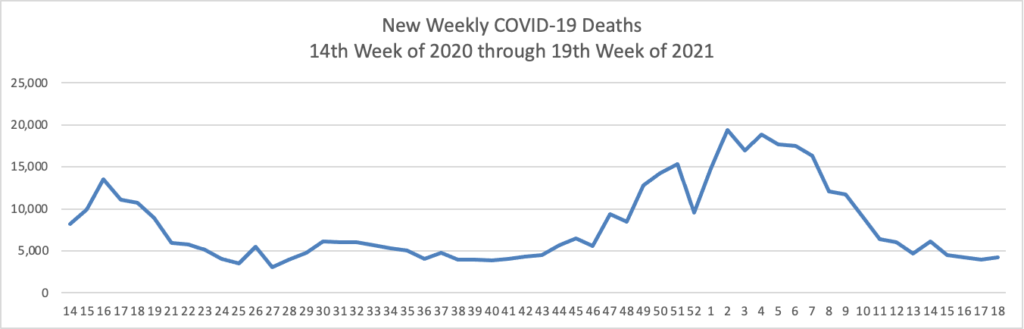
Based on the Centers for Disease Control’s COVID-19 Data Tracker website, here is the FEHBlog’s chart of new weekly COVID-19 cases and deaths over the 14th week of 2020 through 18th week of this year (beginning April 2, 2020, and ending May 5, 2021; using Thursday as the first day of the week in order to facilitate this weekly update):

and here is the CDC’s latest overall weekly hospitalization rate chart for COVID-19:

The FEHBlog has noticed that the new cases and deaths chart shows a flat line for new weekly deaths  because new cases greatly exceed new deaths. Accordingly here is a chart of new COVID-19 deaths over the period (April 2, 2020, through May 5, 2021):

The Wall Street Journal observes and the charts evidence that

The U.S. may finally have turned a corner in the Covid-19 pandemic, according to epidemiologists and public-health officials.

Newly reported coronavirus cases have declined for three straight weeks, and the seven-day average of Covid-19 PCR tests that returned positive is hovering around 4%, one of its lowest points in the pandemic. Hospitalizations have been declining and reported deaths have fallen every week since late March.

The decrease in nearly every key metric comes as the U.S. meets a benchmark in its vaccination campaign. More than 40% of the adult population is now fully vaccinated, which many public-health experts say is an important thresholdwhere vaccinations gain the upper hand over the virus.

Here is a weekly COVID-19 vaccinations chart over the period December 17, 2020, through May 5, 2021, which also uses Thursday as the first day of the week:

The Centers for Disease Control observes

Following a rapid acceleration in vaccination rates, we are now seeing U.S. vaccination progress slow. This is not surprising considering the prior focus on vaccinating people at increased risk. Also, people eager to be immunized when they became eligible may have already secured their vaccine in line with increased supply. While more than 8 in 10 people 65 years and older have received at least one dose of vaccine, only around 1 in 3 people ages 18-29 have. All age groups currently eligible for the vaccine can benefit from the protection it provides themselves and others, especially as more states are easing prevention measures

Also from the COVID-19 vaccination front:

  • The Society for Human Resources Management provides helpful guidance to employers on how to help achieve herd immunity.
  • The CDC’s Advisory Committee on Immunization Practices will vote on Wednesday May 12 on whether to extend Pfizer’s emergency use application for its COVID-19 vaccine to children ages 12-15.
  • The Wall Street Journal reports that “AstraZeneca PLC could skip asking the Food and Drug Administration for emergency-use authorization for its Covid-19 vaccine, according to people familiar with the matter—and instead pursue the more time-intensive application for a full-fledged license to sell the shot.”
  • Law professor Richard Epstein weighs in on the hot topic of “Intellectual Property and the COVID-19 vaccines.”

From the healthcare business front

  • Healthcare Dive reports on Cigna’s 1st quarter 2021 results. The health insurer “beat Wall Street expectations in the quarter, and increased its forecast for the full year, signaling optimism for the remainder of 2021 despite the ongoing uncertainty.”
  • Fierce Healthcare reviews several health insurers’ first quarter 2021 results.

In other news —

  • The FEHBlog understands why according to Becker’s Payer Issues, 95% of insurers “are worried about meeting No Surprises Act requirements by [the January 1, 2022] deadline. Congress created an overcomplicated law. Hopefully the regulators can straighten it out in time.
  • The American Hospital Association questions the Lown Institute report on low value hospital care that the FEHBlog mentioned earlier this week.
  • Health Payer Intelligence brings us up to date on electronic attachments to HIPAA standard claims transactions, the one HIPAA requirement that HHS has not been able to tackle successfully.
  • Strangely, a British website helpfully summarizes the path of Kiran Ahuja to become OPM Director. “At her hearing, Ahuja said: “I believe people are, and should be, at the centre of all policy decisions, and… I would carry forward this guiding principle while working in service to the American public.” It remains to be seen whether the Senate, in a time of division, accepts that Ahuja can be the unifier the US public service needs.” My bet remains on confirmation.

Thursday Miscellany

Photo by Juliane Liebermann on Unsplash

Today is the first day of National Nurse’s Week. The well-deserved celebration begins each year on May 6th and ends on May 12th, Florence Nightingale’s birthday. What a marvelous profession.

Meanwhile Healthcare Dive reports that

  • Last year marked a historic shift in the organization of medicine, with fewer than half of U.S. doctors working in a private practice, according to the latest American Medical Association Physician Practice Benchmark Survey. And among those private practices that continue to operate, many are trending toward a larger size.
  • According to the report, 50.2% of physicians were employees, up from 47.4% in 2018 and 41.8% in 2012. The proportion of doctors working in a private practice was 49.1% last year.
  • Hospitals are one of the largest employers of physicians, with the proportion increasing nearly 50% between 2012 and last year. And with the vast majority of doctors under the age of 40 now employees rather than employers, it suggests the trend will continue over the long term.

The Raleigh (NC) News-Observer reports that

CVS [Health] announced Wednesday it’s joining the list of pharmacies offering people the coronavirus vaccine without requiring an appointment, spokesperson Matt Blanchette told McClatchy News. Same-day scheduling as soon as one hour ahead of time is also available.  Walk-ins are available at 8,300 CVS locations across the country, Blanchette said. The company has more than 9,900 locations across 49 states, Washington, D.C., and Puerto Rico. 

The New York Times adds that “Chains like Walmart, Walgreens, Safeway and Stop & Shop have said that they are now offering vaccines to walk-in clients at some locations or in mobile clinics. Other pharmacies preceded the president’s announcement. Rite Aid said that it would accommodate walk-ins on a limited basis last week, for example.” Let’s go.

Forbes reports that Pfizer-Biontech and Moderna will apply for full FDA marketing approval of their respective COVID-19 vaccines later this month.

The FDA authorized the Moderna vaccine under an EUA on Dec. 18, after granting the same authorization to the Pfizer Covid-19 vaccine. The FDA can grant emergency use authorizations when a panel of experts determine the “known and potential benefits outweigh the known and potential risks,” and when the secretary of Health and Human Services determines a health crisis deems emergency use of unapproved products “appropriate.” Pfizer announced Monday it would file for full FDA approval, and it’s likely Johnson & Johnson, manufacturers of the only other Covid-19 vaccine authorized for emergency use in the U.S., will file for full FDA approval as well. Emergency use authorizations can be revoked when public health crises subside, and FDA approval would allow companies, like Moderna and Pfizer, to directly market their vaccines to consumers. 

FLASH: Politico reports that Pfizer/BioNTech applied for full FDA approval on Friday May 7.

Errata: The FEHBlog included in a post last month an erroneous report that Moderna had filed for FDA approval. He had understood that the application was overdue. Whoops.

Forbes further informs us

Moderna announced Wednesday its booster shot showed a positive immune response against the Covid-19 variants found in South Africa and Brazil. Moderna is testing booster shots in individuals who already received their two-dose Moderna vaccine regimen. [Moderna CEO Stephane] Bancel has said he expects booster shots will be necessary, and Pfizer CEO Albert Bourla said it’s “likely” vaccinated individuals will need a booster within a year of being fully vaccinated. 

From the healthcare business front —

  • According to the Wall Street JournalWalmart Inc. said Thursday it purchased telehealth provider MeMD and plans to offer nationwide virtual healthcare services, another sign of the retail behemoth’s healthcare ambitions. The acquisition will allow Walmart to expand its Walmart Health service around the country, the company said. The retail giant didn’t disclose the financial details of the transaction.
  • The Journal further reports that ‘The MeMD deal opens another front in which Walmart and Amazon will compete, as Amazon recently announced plans to provide its telehealth service, Amazon Care, to its nearly 1 million U.S. employees by summer. Amazon Care, which now serves company workers in Washington state, will also be offered to other employers.” STAT News informs us that “Amazon Care signed its first enterprise customer this week, a significant milestone as the virtual-first health care platform looks to expand its footprint. The client, Precor, is a fitness business that was recently acquired by fitness technology company Peloton for $420 million in cash. Although small financially, the deal is a significant opener for Care.”
  • Healthcare Dive adds that “Nearly two out of three healthcare leaders say they’re currently prioritizing investment in telehealth as the pandemic continues, but that could change over the next few years, when investing in artificial intelligence shoots up the list of priorities, according to a new report from health tech giant Philips.”