Thanks to ACK15 for sharing their work on Unsplash.
This coming week, the U.S. House of Representatives will engage in Committee business and the Senate will engage in both Committee business and the Senate will engage in Committee business and floor voting. Roll Call explains that “President Joe Biden told House Democrats on Friday to hold off on his bipartisan infrastructure bill until they reach agreement on a scaled-back partisan tax and spending package funding the rest of his economic agenda.”
The U.S. Supreme Court opens its October 2021 term tomorrow. Two Affordable Care Act Section 1557 (individual non-discrimination law) cases will be argued this calendar quarter.
On the Delta variant front, the Wall Street Journal reports that
The cost of similar Covid-19 treatments can vary by tens of thousands of dollars a patient, even within the same hospital, according to a Wall Street Journal analysis of pricing data that indicates pandemic care hasn’t escaped the complex economics of the U.S. health system.
One kind of patient, with a type of severe respiratory condition that is common among those admitted with Covid-19, is an example of the wide range. The rates for these patients usually spanned from less than $11,000 to more than $43,000, the analysis found, but some prices could be far higher, depending on the severity of the case.
The Office of Personnel Management on Friday offered up more details on how agencies might approach disciplinary action against employees who fail to comply with the Biden administration’s recent federal vaccine mandate.
Because employees aren’t considered fully vaccinated until two weeks after receiving a single-shot series or the second dose of a two-shot series, they must get the vaccine by Nov. 8 to comply with the federal mandate.
Therefore, agencies can begin the disciplinary process for employees who are unvaccinated by Nov. 8 on the following day, Nov. 9, OPM Director Kiran Ahuja said Friday in a new memo.
On the No Surprises Act front, Prof. Katie Keith and her colleagues delves into the details of the second interim final rule on the NSA which concerns the independent dispute resolution process.
On the newly opened Federal Benefits Open Season front, the FEHBlog notes that Blue Cross FEP and Kaiser Permanente have posted information about 2022 benefits on their respective websites. Here’s a belated link to OPM’s announcement of 2022 premiums from last Thursday.
Average Medicare Advantage premium rates are dropping 10% to $19 a month next year as nearly 30 million people are expected to be enrolled in the program, an increase of about 2.6 million from this year, CMS said in a Thursday press release.
Cigna and UnitedHealthcare are expanding their MA footprints. Cigna is going into three new states and increasing its geographic coverage by 30%. UnitedHealthcare is entering 276 new counties, giving it access to 94% of Medicare members.
Analysts at Cowen said in a note Friday that after reviewing benefits for the three largest plans from top insurers, it saw stability to modest improvements. That indicates conservative bids among the uncertainty of the COVID-19 pandemic.
Open enrollment for Medicare runs from Oct. 15 to Dec. 7.
Using the CDC’s COVID Data Tracker and Wednesday as the last day of the week, here is the FEHBlog’s latest weekly chart of weekly COVID cases for 2021 through the 39th week (September 29, 2021):
Here is a link to the CDC’s weekly new hospitalization chart which also is trending down:
Here is the FEHBlog’s latest weekly chart of new COVID deaths this year:
Medscape notes that “COVID-19 deaths are beginning to plateau in the US, adding another promising sign that the latest coronavirus surge has peaked. The 7-day average of daily deaths has hovered around 2000 for more than a week and dropped below 1900 on Thursday. The trend follows a 2-month climb in deaths as the Delta variant hit unvaccinated populations, particularly in Arkansas, Florida, and Louisiana. * * * COVID-19 cases began to level off nationally in early September, and hospitalizations and deaths have followed a similar trend several weeks later.”
Here is the FEHBlog’s latest weekly chart of COVID vaccinations distributed and administered in 2021:
The CDC reports that as of today 65% of the eligible U.S population (over age 12) and 84% of the U.S population over age 65 is fully vaccinated. The CDC COVID Data tracker now is displaying booster administration. For example, 6% of the fully vaccinated population over age 65 has received a booster.
Health Leaders Media reports on stakeholder reaction to the No Surprises Act interim final rule on the independent dispute resolution process. AHIP’s President Matt Eyles remarked that the final rule
“signals a strong commitment to consumer affordability and lower healthcare spending through an independent dispute resolution process that should encourage more providers to join health plan networks.”
“We are particularly encouraged to see the rules conform to the intent of the No Surprises Act and direct that arbitration awards must begin with a presumption that the appropriate out-of-network reimbursement is the qualified payment amount,” Eyles said.
“This is the right approach to encourage hospitals, health care providers, and health insurance providers to work together and negotiate in good faith. It will also ensure that arbitration does not result in unnecessary premium increases for businesses and hardworking American families.”
The FEHBlog’s take is that the interim final rule protects consumers while controlling the cost of care. After all, the surprise was not receiving out of network care; rather the suprise was the eye popping bill.
Today, the Departments of Health and Human Services, Labor, and Health and Human Services, and OPM issued the second interim final rule on No Surprises Act (“NSA”) implementation. This rule concerns the independent dispute resolution (“IDR”) process. The process is intended to resolve disputes that arise when an out-of-network provider is dissatisfied with the qualifying payment amount (“QPA”) from the health plan pursuant to the NSA.
The IDR process timeline is as follows:
Independent Dispute Resolution Action
Timeline
Initiate 30-business-day open negotiation period
30 business days, starting on the day of initial payment or notice of denial of payment
Initiate independent dispute resolution process following failed open negotiation
4 business days, starting the business day after the open negotiation period ends
Mutual agreement on certified independent dispute resolution entity selection
3 business days after the independent dispute resolution initiation date
Departments select certified independent dispute resolution entity in the case of no conflict-free selection by parties
6 business days after the independent dispute resolution initiation date
Submit payment offers and additional information to certified independent dispute resolution entity
10 business days after the date of certified independent dispute resolution entity selection
Payment determination made
30 business days after the date of certified independent dispute resolution entity selection
Payment submitted to the applicable party
30 business days after the payment determination
The NSA IDR process uses the so-called baseball arbitration approach under which the decision maker selects one of the parties proposals rather than craft an independent approach as judges do. The requirements description accompanying the final rule explains
Basically this instructs the health plan to make a proposal close to, if not equal to, the QPA. Then the burden of proof for a higher amount is necessarily placed on the provider. The FEHBlog’s hunch is supported by the following American Hospital Association (“AHA”) statement from the provider side:
AHA Executive Vice President Stacey Hughes said, “The No Surprises Act was an important step forward in protecting patients from surprise medical bills. Hospitals and health systems strongly support these protections and the balanced approach Congress chose to resolve disputes. Disappointingly, the Administration’s rule has moved away from Congressional intent and brought new life to harmful proposals that Congress deliberately rejected. Today’s rule is a windfall for insurers. The rule unfairly favors insurers to the detriment of hospitals and physicians who actually care for patients. These consumer protections need to be implemented in the right way, and this misses the mark.”
AHA staff are reviewing the rule. Watch for a Special Bulletin tomorrow with additional details.
On the bright side for providers, it appears that the IDR process allows the health plan no opportunity to make a low ball proposal to the decision maker. However, it’s the FEHBlog’s view that the devil remains in the details of this lengthy rule and no one should underestimate the ingenuity of lawyers on either side in these novel legal situations. Finally, the apparently simple approach that the regulators took will facilitate implementing the principal feature of the No Surprises Act on January 1, 2022.
President Joe Biden signed a stopgap funding measure Thursday with hours to spare before federal agencies would otherwise have to start shutting down.
The continuing resolution gives lawmakers and the White House nine more weeks to reach agreement on spending levels and negotiate a dozen fiscal 2022 appropriations bills. * * *
The stopgap bill extends federal agencies’ current spending rates, with some exceptions known as “anomalies,” through Dec. 3, as well as certain expiring program authorizations like the National Flood Insurance Program’s ability to sell new policies and renew existing ones.
The measure provides $28.6 billion to address natural disasters like Hurricane Ida which slammed into the Gulf Coast earlier this month, and $6.3 billion to provide resettlement assistance for Afghan refugees fleeing the Taliban. Another $2.5 billion goes toward care and shelter for undocumented migrant children who crossed the border alone while the government reviews their status.
Telehealth usage was four timeshigherthan a year ago, but the industry and patients are still grappling with growing pains including service limitations, difficulty accessing appointments and inconsistent care, a survey from J.D. Power found.
From 2020 to 2021, overall satisfaction with both direct-to-consumer and payer-sponsored telehealth services declined, according to the survey. Patients frequently cited limited services, lack of awareness of costs and confusing technology requirements.
Among direct-to-consumer brands, Teladoc ranked highest for telehealth satisfaction, followed by MDLive. Among payer-sponsored telehealth services, UnitedHealthcare ranked the highest, followed by Humana and Kaiser Foundation Health Plan, both in a tie for second, the survey found.
Despite the wide-ranging expansion of telehealth in the past year, there is still a broad swath of the U.S. population it has largely failed to reach: the 57 million people in rural parts of the country.
Even now, as employers rush to add virtual care to their benefits, many telehealth companies have avoided rural areas. Several acknowledged to STAT that most of their users remain in urban and suburban areas, and they’ve made far less progress than they’d like to in reaching rural patients. The companies recognize they face an uphill battle. Beyond the foundational barrier of broadband access, providers must contend with questions about reimbursement rates, strict rules on interstate licensing, and a hazy road map without clear inroads for reaching rural patients and providers.
“Honestly, as much as our mission statement fits well with rural health care, we haven’t really made enough progress to date around this work,” Brad Younggren, the chief medical officer of telehealth company 98point6, told STAT.
As it is Thursday from the miscellany department
Recycle Intelligence discusses “Lessons learned from Aetna, Cleveland Clinic’s Joint ACO Mode / Leaders from Aetna and Cleveland Clinic reflect on the first year of their joint ACO and health plan and share how others can deliver value-based care to their local markets.” Check it out.
Scientists have unveiled new maps of the protein networks underlying different types of cancer, offering a potentially clearer way to see what’s driving the disease and to find therapeutic targets.
Sequencing the genetic information of tumors can provide a trove of data about the mutations contained in those cancer cells. Some of those mutations help doctors figure out the best way to treat a patient, but others remain more of a mystery than a clear instruction manual. Many are exceedingly rare, or there are so many mutations it’s not clear what’s fueling the cancer.
In a quest to come up with more practical and actionable tools, experts have been looking beyond the genes. Instead, they’re mapping out the proteins the genes encode and the interactions among those proteins in hopes of getting a clearer view of cancer-propelling pathways. And in a series of paperspublished Thursday in the journal Science, a team of researchers outlined those “protein-protein interaction” maps for certain cancers and explain how charting those landscapes and others like them could reveal insights about patients’ prognoses, point to drugs to try for particular patients, and perhaps identify targets for new therapies.
STAT News also seeks to predict what will become of the COVID pandemic this coming winter. The article hopefully concludes
Barney Graham, who led the vaccine design work that laid the foundation for many of the current Covid vaccines, is hopeful, though, that in Delta the virus has hit a sweet spot that will eventually undermine it.
“I’m hoping the virus has gotten itself to a point where it’s basically trapped now,” said Graham, who was deputy director of the NIH’s Vaccine Research Center until his retirement at the end of August. “That it can’t get any better at transmission, and any adaptation it makes in the immune response is going to make it less transmissible.”
Laboratory studies show that Merck & Co’s (MRK.N) experimental oral COVID-19 antiviral drug, molnupiravir, is likely to be effective against known variants of the coronavirus, including the dominant, highly transmissible Delta, the company said on Wednesday.
Since molnupiravir does not target the spike protein of the virus – the target of all current COVID-19 vaccines – which defines the differences between the variants, the drug should be equally effective as the virus continues to evolve, said Jay Grobler, head of infectious disease and vaccines at Merck.
Molnupiravir instead targets the viral polymerase, an enzyme needed for the virus to make copies of itself. It is designed to work by introducing errors into the genetic code of the virus.
Data shows that the drug is most effective when given early in the course of infection, Merck said.
What’s more, the Merck drug is administered in pill form.
OPM Headquarters a/k/a the Theodore Roosevelt Building
OPM, as promised, announced 2022 FEHB and FEDVIP premiums before the end of September. Here are links to the OPM website for 2022 FEHB plan premiums and its website for 2022 FEDVIP plan premiums. In addition, here are links to related articles from the Washington Post, GovExec, Federal News Network, FedWeek, and the Federal Times which offered a separate article on FEDVIP.
The Washington Post summed it up as follows: “Premiums for federal employees will rise by 3.8 percent on average in 2022, the second straight year of moderate increases despite the coronavirus pandemic, the government announced Wednesday.” That’s a credit to OPM and the carriers as well as this competitive program. Also as OPM usually explains, the average increase is shown before the Open Season results when federal and postal employees and annuitants can elect lower premium plans from Nov. 8 through Dec. 13.
From Capitol Hill, the Wall Street Journal reports this evening that
Party leaders are racing to unify Democrats around changes to a separate $3.5 trillion healthcare, education and climate package, which progressives want to see advance as a condition of supporting the infrastructure bill in the narrowly divided House. Speaker Nancy Pelosi (D., Calif.) so far has stuck to her plan to bring the infrastructure bill up for a vote Thursday, saying she was taking it “one hour at a time,” though she opened the door to further delay if talks don’t progress. * * *
The Thursday deadline for the infrastructure vote is one of several scheduling crunches Democrats face in the coming days. They are also rushing to pass a stand-alone measure extending government funding, currently set to expire on Friday at 12:01 a.m., through Dec. 3. Republicans and Democrats in the Senate were nearing an agreement to pass the spending patch Thursday before sending it to the House.
From the Delta variant front, STAT News tells us that “People who’ve received a third dose of a Covid-19 vaccine are reporting rates of side effects similar to those after the second dose, according to data released Tuesday by the Centers for Disease Control and Prevention.”
From the No Surprises Act front, OMB’s Office of Information and Regulatory Affairs has concluded its review of the second interim final rule which concerns the independent dispute resolution process. This means that the regulators can timely release information on the rule this week, if not the entire rule itself.
From the health equity front, Fierce Healthcare reports that “CVS Caremark is expanding its health equity efforts, setting goals that specifically target diseases that disproportionately impact patients of color, such as HIV and sickle cell disease.”
In other healthcare news
HHS’s Agency for Healthcare Quality and Research reminds us that today is ‘World Heart Day — an observance that aims to improve how we understand, prevent, and manage the disease.” AHRQ describe its efforts to improve heart health.
Healthcare Dive without grinding an axe informs us that
U.S. health insurance markets have become increasingly concentrated over the past half decade, according to a new report from the American Medical Association, which argues payer M&A results in rising costs and fewer care options for patients, but largely excludes the impact of provider consolidation in driving those trends.
Almost three-fourths of metropolitan statistical areas were highly concentrated in 2020 according to federal guidelines used by the Department of Justice andFederal Trade Commission, up from 71% in 2014. Of markets that were already highly concentrated in 2014, 54% become more concentrated as of last year, while 26% of markets that were not highly concentrated become so by 2020, the AMA said.
The medical association’s study is the latest salvo in a messaging war between provider and payer lobbies as they work to shift the blame for rapidly rising medical costs in the U.S.
The National Institutes of Health reports on the efforts of its “Helping to End Addiction Long-termSM Initiative, or NIH HEAL InitiativeSM, is an aggressive, trans-agency effort to speed scientific solutions to stem the national opioid public health crisis.”
From Capitol Hill, the Wall Street Journal reports that on Tuesday the Senate Republicans refused to give unanimous consent to the Democrat effort to solve the debt ceiling issue without Republican support. Secretary of the Treasury Yellen advised Congress yesterday that she expects that current emergency measures used since August 1 to deal with the debt ceiling problem would soon be exhausted and “the government would be unable to pay all of its bills on time starting Oct. 18 unless Congress acts.” That of course is an unprecedented situation. The FEHBlog finds it interesting that the Congressional Democrat leadership has not lead with the bipartisan crafted continuing appropriation bill instead of the debt ceiling bill because the federal fiscal year ends on Thursday.
From the Delta variant front
The National Institutes of Health Director summarizes where we stand on the COVID-19 booster effort in his weekly blog post. The FEHBlog who has received two doses of the Pfizer vaccine over six months ago checked a major retail pharmacy chain site to see whether the booster is readily available and he found that it is which happily is a stark difference from last winters efforts to find the initial doses.
Regulatory clearance of the Pfizer Inc.and BioNTech SEvaccine for young children may not come until November, according to a person familiar with the matter, after the companies said they won’t ask for the green light for a few weeks.
The companies said Tuesday they provided U.S. health regulators with data from a recent study of their vaccine in children 5 to 11 years old. They said they would file an application asking the Food and Drug Administration to authorize use in the coming weeks, though they had previously targeted submitting the application as early as the end of September.
The Kaiser Family Foundation released an interesting survey on the current public response to COVID. As of today, according to the CDC, just over 75% of Americans eligible to receive the vaccine (ages 12 and older) have receive at least one dose.
As of Tuesday, hospitalizations in the U.S. are down 16% over the past two weeks, according to the 14-day average from data compiled by The New York Times.
The U.S. reached a turning point in this year’s summer surge earlier this month, according to the seven-day averages. The average hospitalizations reached a peak on Sept. 3, started to decline the next day and have been trending down ever since, according to data compiled by the Times.
In the tidbits department
The Department of Health and Human Services announced awarding “nearly $1 billion in American Rescue Plan funding to nearly 1,300 Health Resources and Services Administration (HRSA) Health Center Program-funded health centers in all 50 states, the District of Columbia, and the U.S. territories to support major health care construction and renovation projects. These awards will strengthen our primary health care infrastructure and advance health equity and health outcomes in medically underserved communities, including through projects that support COVID-19 testing, treatment, and vaccination. The awards were made through the Health Resources and Services Administration.”
Health Payer Intelligence discusses a Manatt Health report on episode based care.
HHS also announced “the appointment of Lisa J. Pino as Director of the Office for Civil Rights (“OCR”). OCR is the HHS agency which enforces the HIPAA Privacy and Security Rules among other things. As it is a small world, Ms. Pino previously was “Senior Counselor [at Homeland Security] and drove the 2015 U.S. cyber breach mitigation of 4 million federal personnel and 22 million surrogate profiles, the largest hack in federal history, by renegotiating 700 vendor procurements and establishing new cybersecurity regulatory protections.”
The U.S. House of Representatives and Senate continue to be engaged in Committee business and floor voting this week which should be a humdinger on Capitol Hill. The Wall Street Journal sums the situation up as follows:
Congress Heads Into Tumultuous Week Pressured by Converging Deadlines Government shutdown, debt ceiling loom as Democratic leaders plan votes on multitrillion-dollar spending ambitions
The Supreme Court prepares for the opening of its October 2021 term on October 4. Amy Howe informs us
The Supreme Court announced on Tuesday that oral arguments will follow a slightly different plan when the justices return to the courtroom for in-person arguments next month. Instead of reverting entirely to the traditional “free for all” format for asking questions, the justices will adopt a hybrid approach that sets aside time for the justices to take turns asking questions, just as they did when hearing oral arguments by telephone during the pandemic. The change appears to increase the chances that Justice Clarence Thomas, who was rarely heard in the courtroom but was an active participant in remote arguments, will continue to participate when in-person arguments resume.
How collegial.
We also can look forward to the Departments of Health and Human Services, Labor, and Treasury as well as OPM issuing the second big No Surprises Act interim final rule this week. The statutory deadline for releasing this rule concerning the independent dispute resolution process is Friday October 1.
From the Delta variant front
Both CVS Health and Walgreen’s have announced that their multitude of pharmacies are offering the Pfizer booster to all eligible folks.
If you noticed the articles recently reporting that the number of COVID-19 deaths in America exceeds the 1918 flu pandemic, check out this Health Affairs blog article from last April debunking this apples to oranges comparison.
In any event check out this Health Payer Intelligence article on three strategies for sustaining payer innovation momentum post-pandemic. “The coronavirus pandemic resulted in accelerated payer innovation and payers can continue that momentum by identifying opportunities, involving members, and using data effectively.”
In an audible triggered by yesterday’s decision, the CDC’s Advisory Committee on Immunization Practices considered at today’s meeting the FDA’s approach to COVID-19 boosters. AHIP informs us that
ACIP voted today to recommend a Pfizer-BioNTech COVID-19 vaccine booster dose for:
persons aged 65 and older and long-term care facility residents;
persons aged 50 to 64 with underlying medical conditions; and
persons based on individual benefit and risk who are aged 18 to 49 years with underlying medical conditions.
Following robust discussion about the risks and benefits of each option, ACIP ultimately voted to recommend a Pfizer vaccine booster dose, at least 6 months after the primary series, for persons aged 65 and older and long-term care facility residents (by a vote of 15-0), persons aged 50 to 64 with underlying medical conditions (13-2), and persons based on individual benefit and risk who are aged 18 to 49 years with underlying medical conditions (9-6).
The Committee voted 9-7 against recommending a single Pfizer-BioNTech COVID-19 vaccine booster dose based on individual benefit and risk for persons aged 18-64 years who are in an occupational or institutional setting where the burden of COVID-19 infection and risk of transmission are high based on safety concerns and patient selection.
ACIP only voted on boosters for individuals in each group who had previously received the initial series of the Pfizer vaccine; FDA indicated in its Emergency Use Authorization (EUA) that there was insufficient evidence to consider using a Pfizer booster in patients who received another vaccine in the initial series and thus it was not considered in the ACIP recommendations.
The next step in the health plan coverage process is for the CDC to ratify the ACIP decision. 15 days thereafter federal law requires health plans to cover the Pfizer-BioNTech booster in these scenarios with no member cost sharing in or out of network.
In additional news from that meeting, AHIP tells us that
ACIP also evaluated data on the COVID-19 vaccine in pregnant people and adverse outcomes associated with COVID-19 infection in this population. Data showed there is no indication that vaccines are associated with spontaneous abortion, birth defects, or stillbirths, but that pregnant people who were infected with COVID-19 exhibited increased risk of preeclampsia, preterm birth, NICU admission, and death.
Pregnant women who get mRNA vaccines pass high levels of antibodies to their babies, according to a study published in American Journal of Obstetrics & Gynecology – Maternal Fetal Medicine on Wednesday.
The study — one of the first to measure antibody levels in umbilical cord blood to distinguish whether immunity is from infection or vaccines — found that 36 newborns tested at birth all had antibodies to protect against Covid-19 after their mothers were vaccinated with shots from Pfizer Inc.–BioNTech SE or Moderna Inc.
“We didn’t anticipate that. We expected to see more variability,” said Ashley Roman, an obstetrician at NYU Langone Health System and co-author of the study.
That is certainly good news.
From the health equity front —
The Government Accountability Office issued a health care capsule on this topic. GAO’s “2-page “capsule” draws from several GAO reports to provide examples of these health disparities, such as COVID-19, maternal mortality, chronic health conditions, as well as disparities among veterans. We also offer policy considerations to help the federal government better understand health disparities and promote health equity.”
Only 75 of the 3,000 hospitals ranked by the Lown Institute Hospitals Index scored top marks across all the metrics meant to evaluate social responsibility: equity, value and outcomes, according to a report out Tuesday.
None of the top 20 hospitals from the U.S. News & World Report rankings made the cut to the honor roll, largely because of low grades in equity, Lown Institute said.
The report also ranked states by which had the most socially responsible hospitals. Topping the list were Hawaii, Delaware, Washington D.C., Oregon and Colorado while at the bottom were Kentucky, Kansas, Alabama, Mississippi and Arkansas.
From the human resources front
InsuranceNewsNet informs us that “Almost one in seven Americans has absolutely no plan for their future financial and health care needs, new research suggests. A recent study of 2,000 employed Americans found that only 26% have a one- to four-year plan in place. * * * Conducted by OnePoll on behalf of Bend Financial, the study also discovered * * * more than half felt overwhelmed by the mountain of paperwork surrounding their benefit options.”
To that end, OPM is seeking to improve the FEHB enrollment process, and FedSmith offers the first article of 2021 on the upcoming federal benefits open season. The 2022 government contribution should be released soon according to an OPM benefits administration letter.
On the business front, Beckers Payer Issues reports on senior management changes at Cigna and its Evernorth subsidiary. Among other changes, “Subsidiary Evernorth President and COO Eric Palmer was promoted to company CEO and president. Mr. Palmer will be taking over Jan. 1, 2022 for outgoing CEO Tim Wentworth, who is retiring.”
From Capitol Hill – –
Roll Call reports on Democrat efforts to cobble together the enormous $3.5 trillion budget reconciliation bill so that a House vote on the bill can be held next week. “That ambitious timeframe, if it holds, would line up the multitrillion-dollar reconciliation bill with a vote on a smaller [one trillion] bipartisan infrastructure measure that may otherwise be defeated.”
In better news, from the FEHBlog’s standpoint, the Wall Street Journal tells us that “House Speaker Nancy Pelosi said Congress wouldn’t let government funding expire next week, the first hint that Democratic leaders might decouple the government’s funding from a contentious increase in the debt limit, on the same day that the Biden administration began preparing for a possible partial shutdown.”
From Capitol Hill, Roll Call reports that “The House passed a catchall budget package Tuesday [along party lines] that’s intended to avoid a partial government shutdown and debt limit crisis, but it seems likely to come back for a do-over once the Senate works its will.” The Republicans are objecting to combining the debt limit increase with the stop gap measure because “Treasury has said Congress needs to act sometime next month; Wrightson ICAP, a private investment advisory firm, said this week the drop-dead deadline was likely Oct. 25 or 26.”
Here’s a stunner for you from the Roll Call article:
The bill includes language to temporarily extend how fentanyl — a highly potent opioid — is classified. Fentanyl is responsible for a lion’s share of drug overdose deaths, which have been on the rise during the COVID-19 pandemic. The bill would extend fentanyl’s status as a so-called “Schedule 1” drug until Jan. 28, 2022. Under current law, the drug would lose its status as a drug with a high risk for abuse on Oct. 22.
From the Delta variant front —
According to the American Hospital Association, “Johnson & Johnson today said its phase 3 trial data confirms its vaccine’s durability and provided evidence of a second, booster shot’s effectiveness against COVID-19. The drug maker said that, over the course of its ongoing phase 3 trial, it found no evidence of the vaccine’s reduced effectiveness, which J&J said is 79% for preventing COVID-19-related infections and 81% for preventing COVID-19-related hospitalizations. J&J furthermore found that a booster shot administered 56 days after an initial dose provided 100% protection against severe/critical COVID-19 for at least 14 days post-final vaccination and 94% protection against symptomatic (moderate to severe/critical) COVID-19 in the U.S. Additionally, boosters resulted in antibody levels four to six times higher than those netted from a single dose.”
David Leonhardt in the New York Times understandably criticized federal agencies for dropping the ball on production of rapid COVID tests. “Other countries are awash in Covid tests. The U.S. is not.”
Stefanie Friedhoff, a professor at Brown University’s School of Public Health, recently returned from a visit to Germany and wrote on Twitter about the many benefits of rapid testing that she had seen. A friend’s husband has Parkinson’s disease, and the friend leaves a batch of tests in her hallway for people to take before they enter the home. The day care center where Friedhoff’s sister works has stayed open throughout the pandemic, because the staff and children take frequent tests.
“Imagine what ubiquitous cheap testing could do in the U.S.,” Friedhoff wrote. “It is incomprehensible how the U.S. has failed on testing.”
The FEHBlog recalls writing last year at this time about the importance of a vaccine, rapid testing, and a treatment for recently symptomatic people in order to bring the pandemic to a close. We should be grateful for the vaccines but we wouldn’t be in this much of a fix if we also had rapid testing and earlier treatment options.
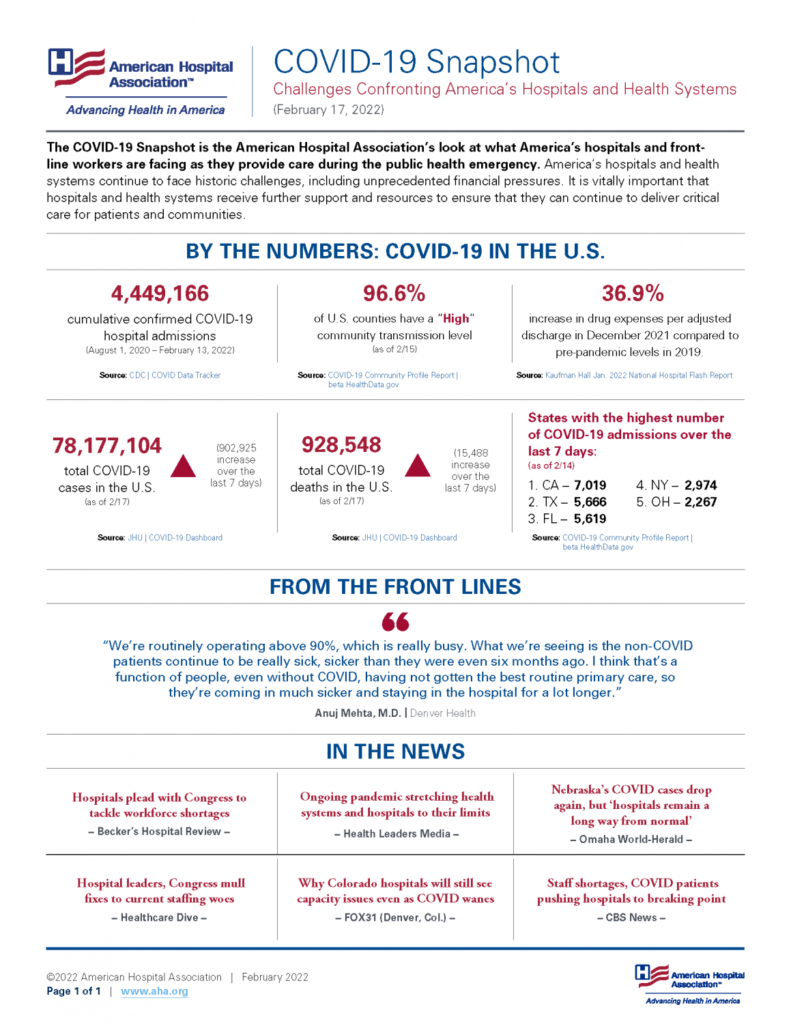
The American Hospital Association also reports that
U.S. hospitals will lose an estimated $54 billion in net income this year, even after federal relief funds, as higher labor and other expenses and sicker patients impact their financial health during the ongoing COVID-19 pandemic, according to a report by Kaufman, Hall & Associates released today by the AHA. More than a third of hospitals are expected to end 2021 with negative margins.
“With cases and hospitalizations at elevated levels again due to the rapid spread of the Delta variant, physicians, nurses and other hospital caregivers and personnel are working tirelessly to care for COVID-19 patients and all others who need care,” said AHA President and CEO Rick Pollack. “At the same time, hospitals are experiencing profound headwinds that will continue throughout the rest of 2021.”
Medcity News reports that “The FDA has approved the first biosimilar that references the blockbuster Roche drug Lucentis. The Biogen and Samsung BioLogics joint venture that developed the biologic product have approval to treat three eye conditions that lead to vision loss.” Bravo.
Infants who seemed headed for autism spectrum disorder (ASD) had milder symptoms as toddlers if their caregivers were subject to a social communication intervention when infants were just 1 year of age, a randomized clinical trial found.
Infants whose families participated in the intervention exhibited significantly milder ASD symptoms 12 months later compared to those in the control group. They also had lower odds of being diagnosed with ASD by an independent clinician at age 3 years (6.7% vs 20.5%, OR 0.18, 95% CI 0.00-0.68), according to the study group led by Andrew Whitehouse, PhD, of the University of Western Australia.
Non-career employees at the U.S. Postal Service are significantly more likely to get injured on the job and leave their positions than employees with a permanent status, according to a Sept. 16 Government Accountability Office report.
Employees without permanent status at USPS receive lower pay and fewer benefits than their career counterparts, often under the assumption that they will have a path to a career position in the future. But according to GAO, those non-career employees, of which there are more than 200,000 across the U.S., had 50 percent higher rates of injury than career positions and reported the incidents to the Federal Employees’ Compensation Program 43 percent more often.
Humana leads the industry on customer experience scores and is the only major national payer to land above the industry average, according to a new report from analysts at Forrester.
Forrester polled members of 17 of the largest health plans in the country and found an industry average score of 70.2 on a 100-point scale, which the organization categorizes as an “OK” rating. In 2020, payers averaged 67.5 points, according to the report.
At the top of the list, Humana earned a 74.8 score, dethroning 2020’s top health plan, Florida Blue, which fell to fourth place with a 71.9. Kaiser Permanente’s health plan landed in the second-place slot with a 73.8 score, and Highmark placed third, earning a 72.9.
Rounding out the top five is Blue Cross Blue Shield of Michigan, which rose from a 10th-place ranking in 2020’s report, Forrester found.
The Hill provides us with the latest on everything that is currently on Congress’s full plate of issues.
From the Delta variant front, the New York Times reports that
The Pfizer-BioNTech coronavirus vaccine has been shown to be safe and highly effective in young children aged 5 to 11 years, the companies announced early Monday morning.
Pfizer and BioNTech plan to apply to the Food and Drug Administration by the end of September for authorization to use the vaccine in these children. If the regulatory review goes as smoothly as it did for older children and adults — it took roughly a month — millions of elementary school students could begin to receive shots around Halloween.
Trial results for children younger than 5 are not expected till the fourth quarter of this year at the earliest, according to Dr. Bill Gruber, a senior vice president at Pfizer and a pediatrician. Results from Moderna’s vaccine trials in children under 12 are also expected around that time, said Dr. Paul Burton, the company’s chief medical officer.
From the M&A front, HCA Healthcare, one of the largest healthcare systems in the U.S., announced this evening that
the signing of a definitive agreement for HCA Healthcare to acquire the operations of Steward Health Care’s five Utah hospitals. HCA Healthcare also entered into an agreement to lease the related real estate from its owner following the expected closing. The hospitals will become part of HCA Healthcare’s Mountain Division, which includes 11 hospitals in Utah, Idaho and Alaska. * * *
Steward Health Care also operates hospitals in Arizona, Texas, Arkansas, Louisiana, Florida, Ohio, Pennsylvania, and Massachusetts. The sale of these facilities to HCA Healthcare will enhance Steward Health Care’s ability to continue growing and reinvesting in other states and locations served by the health system.
Evidently HCA plans to give Intermountain some competition in Utah.
Employee Benefit News offers expert opinions on the pros and cons of healthcare savings account which can only be funded when the individual is enrolled in a high deductible health plan.
From the human resources front
The Federal Times informs us that “‘The Office of Personnel Management will temporarily drop several geographic restrictions associated with special hiring authorities for military spouses, according to a regulation published in the Federal Register Sept. 20. * * * ‘It removes limitations — such as a relocation requirement, geographic restrictions, and arbitrary quotas — which caused this authority to be underused until now,’ wrote Rob Shriver, associate director of employee services at OPM, in a Medium blog post. ‘As a result, this new regulation means more military spouses can find their place in the federal workforce, and federal agencies have a larger talent pool of highly-qualified people to hire from.'” The FEHBlog was not aware that OPM has a Medium website.
HR Dive reports on the recent Society for Human Resources Management annual conference. The article focuses on a give and take between EEOC commissioners and attendees about vaccination mandates and EEO-1 reporting among other issues.
From Capitol Hill, the House of Representatives and the Senate will be engaged in Committee business and floor voting this week. Bloomberg brings us up to date on the status of $3.5 trillion budget reconciliation bill which the President and Democrat leaders in Congress have been pushing.
From the Delta variant front, it must be recalled that before health plans become obligated to cover the mRNA booster for immunized folks over age 65 and a broader group of immuno-compromised Americans, fifteen days must pass from the time that the Centers for Disease Control ratifies the FDA’s decision from last Friday. The CDC’s Advisory Committee on Immunization Practice is scheduled to consider this issue on September 29. The press reports on Friday indicated that the CDC is expected to establish the scope of the expanded coverage of immuno-compromised Americans.
On Sunday’s talk shows, Drs. Fauci and Collins, according to the Wall Street Journal, predict that the FDA will approve the mRNA booster for the general population before long. Kaiser Health News discusses how these leading scientists got in front of their skis on the scope of the mRNA booster coverage issue.
Precision Vaccines discusses where Britain and American stand in terms of achieving at least limited herd immunity.
In the USA, new data from the U.S. CDC published by the JAMA Network on September 2, 2021, indicates herd immunity may be achievable soon.
This review is based on blood donations in the U.S. from July 2020 through May 2021, including both natural infection- and vaccine-induced SARS-CoV-2 seroprevalence. This repeated cross-sectional study included over 1.4 million blood donation specimens representing 74% of the US population.
The estimated SARS-CoV-2 seroprevalence weighted for differences between the study sample and general population increased from 3.5% in July 2020 to 20.2% for infection-induced antibodies and 83.3% for combined infection- and vaccine-induced antibodies in May 2021.
The coronavirus seroprevalence differed by age, race, ethnicity, and geographic region of residence, and these differences changed over the course of the study.
Since May 2021, the U.S. CDC has reported significant increases in COVID-19 vaccinations, initial infections, and re-infections. More than 4 million of these cases have been reported in the past few weeks.
These new totals may soon push the USA over the 95% herd immunity goal.
It’s worth noting that Britain is ahead of the U.S. because the Delta variant struck Britain first.
In other updates —
The American Cancer Society has released the 2021 edition of Cancer Facts and Figures.
The American Medical Association provides background of the 2022 changes to the Current Procedure Terminology. The AMA publishes the CPT which is one of the code sets for HIPAA electronic transactions.
Fierce Healthcare reports “The Biden administration has delayed enforcement of payer-to-payer data exchange included in a May 2020 final interoperability rule until future regulations are finalized.” The interoperability rules apply to insurers with HHS contracts, not FEHB carriers.
Health Payer Intelligence informs us that “Healthcare B2B payment transactions have been high in 2021, potentially signaling the importance of electronic payment transfers as the nation emerges from the coronavirus pandemic, according to a report from National Automated Clearing House Association (NACHA).” What’s more “‘This data from Nacha is good news for payers, providers and members,’ said April Todd, senior vice president of CORE and explorations at CAQH. ‘The increase in electronic payment volume likely indicates that people who deferred routine medical appointments due to COVID are now able to get the care they need. And when that care is paid electronically, it is more efficient and cost-effective for the industry.’ Todd’s organization has been tracking the economic impact of transitioning to electronic payment. A CAQH report estimated that the healthcare industry could see $426 million in cost savings by transitioning to electronic payments. Switching to electronic payment for claims submissions could save providers around $2 for each claim. Exact savings can vary based on the type of transaction.”
We use cookies on our website to give you the most relevant experience by remembering your preferences and repeat visits. By clicking “Accept”, you consent to the use of ALL the cookies.
This website uses cookies to improve your experience while you navigate through the website. Out of these, the cookies that are categorized as necessary are stored on your browser as they are essential for the working of basic functionalities of the website. We also use third-party cookies that help us analyze and understand how you use this website. These cookies will be stored in your browser only with your consent. You also have the option to opt-out of these cookies. But opting out of some of these cookies may affect your browsing experience.
Necessary cookies are absolutely essential for the website to function properly. These cookies ensure basic functionalities and security features of the website, anonymously.
Cookie
Duration
Description
cookielawinfo-checbox-analytics
11 months
This cookie is set by GDPR Cookie Consent plugin. The cookie is used to store the user consent for the cookies in the category "Analytics".
cookielawinfo-checbox-functional
11 months
The cookie is set by GDPR cookie consent to record the user consent for the cookies in the category "Functional".
cookielawinfo-checbox-others
11 months
This cookie is set by GDPR Cookie Consent plugin. The cookie is used to store the user consent for the cookies in the category "Other.
cookielawinfo-checkbox-necessary
11 months
This cookie is set by GDPR Cookie Consent plugin. The cookies is used to store the user consent for the cookies in the category "Necessary".
cookielawinfo-checkbox-performance
11 months
This cookie is set by GDPR Cookie Consent plugin. The cookie is used to store the user consent for the cookies in the category "Performance".
viewed_cookie_policy
11 months
The cookie is set by the GDPR Cookie Consent plugin and is used to store whether or not user has consented to the use of cookies. It does not store any personal data.
Functional cookies help to perform certain functionalities like sharing the content of the website on social media platforms, collect feedbacks, and other third-party features.
Performance cookies are used to understand and analyze the key performance indexes of the website which helps in delivering a better user experience for the visitors.
Analytical cookies are used to understand how visitors interact with the website. These cookies help provide information on metrics the number of visitors, bounce rate, traffic source, etc.
Advertisement cookies are used to provide visitors with relevant ads and marketing campaigns. These cookies track visitors across websites and collect information to provide customized ads.