Weekend update

Weekend update

Photo by Jessica Delp on Unsplash

Congress has lowered the curtain on the first session of the current two year long Congress, the 117th in our Nation’s history.

Roll Call reports that

Sen. Joe Manchin III said on Sunday that he can’t support the sweeping social safety net and climate change package that President Joe Biden and Democratic leaders have made their top legislative priority.

The West Virginia Democrat’s opposition is likely the final nail in the massive $2 trillion-plus “Build Back Better” legislation given the Senate’s 50-50 split, unless extensive changes are made that would result in key provisions being scuttled.

“I can’t vote for it and I cannot vote to continue with this piece of legislation,” Manchin told “Fox News Sunday.” “I just can’t. I’ve tried everything humanly possible.  I can’t get there … This is a ‘no.’ “

Of course, the legislative struggle over the BBB bill is not over but at least we should enjoy a peaceful holiday period.

From the Omicron front, Bloomberg reports that

Lockdowns in the U.S. will likely not be necessary even as Covid-19 cases increase, according to President Joe Biden’s top medical adviser, Anthony Fauci. Even so, many hospitals may be strained as the omicron variant spreads, especially in regions with lower levels of vaccination, he said. 

New York City Mayor Bill de Blasio called on the federal government to step up supplies of tests and treatments to the city amid a spike in infections caused by the omicron variant. New York state broke a record for new infections for the third consecutive day.

From the COVID mandate challenge front —

Since last Wednesday

  • The Fifth Circuit U.S. Court of Appeals lifted the nationwide stay on the CMS healthcare provider COVID vaccine mandate, but left the stay in place for 24 states which had obtained their own stays. The federal government has asked the U.S. Supreme Court to lift the stays applicable to those 24 states. The Supreme Court has allowed the respondent states until December 30, 2021, to respond to the federal government’s motion.
  • The American Hospital Association (“AHA”) reports in the wake of the Court action that “CMS’s website states that CMS “has suspended activities related to the implementation and enforcement of [the mandate] pending future developments in the litigation.” AHA has confirmed with CMS that this statement applies nationwide and remains accurate even after the Fifth Circuit’s order staying the nationwide effect of the Louisiana district court’s preliminary injunction. 
  • The Sixth Circuit U.S. Court of Appeals lifted the nationwide stay on the OSHA ETS COVID vaccination screening program. The State of Georgia has asked the U.S. Supreme Court to reinstate the stay.
  • The American Hospital Association reports again in the wake of the Court action that “OSHA has announced that it is ‘exercising enforcement discretion with respect to the compliance dates of the’ mandate. OSHA states that ‘it will not issue citations for noncompliance with any requirements of the [mandate] before January 10 and will not issue citations for noncompliance with the [mandate’s] testing requirements before February 9, so long as an employer is exercising reasonable, good faith efforts to come into compliance with the standard.’ OSHA has also promised to ‘work closely with the regulated community to provide compliance assistance.’”
  • The Eleventh Circuit U.S. Court of Appeals upheld the nationwide stay on the government contractor mandate. The federal government is expected to ask the Supreme Court to lift this stay tomorrow.
  • It certainly appears that all three mandate issues will be presented to the Supreme Court simultaneously. 

In Affordable Care Act news, CMS announced on Friday that

Health insurers have provided approximately $2 billion in rebates for the 2020 reporting year to an estimated 9.8 million consumers, the Centers for Medicare & Medicaid Services (CMS) is announcing today. Insurers were generally required to provide such rebates and notice of any rebates owed to consumers no later than September 30, 2021. Rebate payments can be provided in the form of a premium credit, lump-sum check, or, if a consumer paid the premium using a credit card or direct debit, by lump-sum reimbursement to the account used to pay the premium.

CMS released a list today of all insurers owing Medical Ratio Loss (MLR) rebates for the 2020 reporting year, with total amounts by state and market. The CMS market breakdown estimate includes approximately 4.8 million consumers in the individual market and 5 million employees in the group market (this represents 2.6 million employees in the small group market, and 2.4 million employees in the large group market). 

Today’s release also includes the Public Use Files (PUFs) containing the data from all health insurers’ final MLR filings for the 2020 reporting year. 

For more information visit: https://www.cms.gov/CCIIO/Programs-and-Initiatives/Health-Insurance-Market-Reforms/Medical-Loss-Ratio

Link to PUFs here: https://www.cms.gov/CCIIO/Resources/Data-Resources/mlr

If federal employee compensation news, Govexec tells us that

[Last] week, the President’s Pay Agent, which is made up of Labor Secretary Marty Walsh, Acting Office of Management and Budget Director Shalanda Young and Office of Personnel Management Director Kiran Ahuja, issued its annual report ahead of President Biden’s executive order finalizing an average 2.7% pay raise in 2022. The pay agent declined to issue waivers based on a locality’s number of authorized positions, but approved Carroll County’s addition to the Davenport, Iowa, locality pay area due to the fact that it recently has met the 2,500 employee threshold.

Friday Stats and More

Based on the Centers for Disease Control’s COVID data tracker and using Thursday as the first day of the week, here is the FEHBlog’s weekly chart of new COVID cases for 2021:

STAT News reports today that Omicron may give Delta a run for its money.

As the Omicron variant snowballs in South Africa and widens its inroads in Europe, evidence is mounting that it can outcompete the highly transmissible Delta variant — a potential warning signal for the United States.

The Wall Street Journal adds that

The U.K. is emerging as a testing ground in the battle for dominance between the new Omicron variant of the coronavirus and Delta, the earlier strain that is currently driving most infections in the U.S. and Europe.

How Britain fares against Omicron will offer clues to the U.S. and the rest of the industrialized world about how the variant behaves in a highly vaccinated population, how sick those who are infected get and if its dozens of mutations have given Omicron enough of an advantage on the evolutionary ladder to starve Delta of the hosts it needs to stay on top.

The CDC’s weekly new COVID hospitalizations chart up week to week from 6.500 to 7,500 which is 54% below the number of new hospitalizations in January 2020. The Wall Street Journal adds that

As the pandemic heads into its third year, doctors are screening more effectively for these clots and improving treatment regimens, marking a significant medical advance alongside the vaccines and antiviral pills under review for Covid-19 that get the most attention.

Even before test results come in, doctors may sometimes treat patients with a high dose of anticoagulants if they suspect blood clots, often termed thrombosis, said Michael Streiff, a clot specialist at Johns Hopkins University.

“The incidence of thrombosis was very high in the beginning but has declined over time. I think this is due to better supportive care,” Dr. Streiff said.

Still, some doctors say there’s much to be done to improve outcomes further. Recent studies are helping to define more precise treatment protocols for clots.

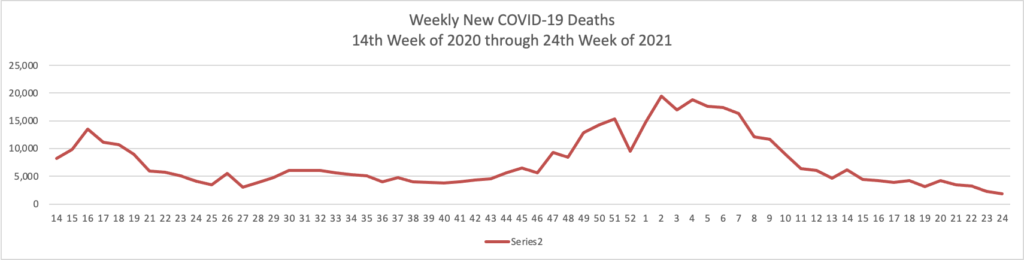
Here’s the FEHBlog weekly chart of new COVID deaths for 2021:

The Wall Street Journal notes that

The Omicron variant of Covid-19 has so far caused mostly mild cases of Covid-19 in a small group of largely vaccinated people in the U.S., federal data show.

Among at least 43 people infected with the variant in 25 states in recent days, there has been one hospitalization and no deaths so far, the Centers for Disease Control and Prevention said Friday.

Out of 43 cases identified between Dec. 1 and Dec. 8, nearly 80% of the people infected with Omicron were fully vaccinated, according to CDC data, and one-third had received a booster shot. Fourteen percent of the people had a previous Covid-19 infection. Patients most commonly reported mild symptoms like cough, fatigue, congestion or runny nose, the CDC said. Nearly 60% of cases were in people 18 to 39 years old.

The report is an early piece of the picture scientists are working to assemble on Omicron’s infectiousness and virulencerelative to other variants.

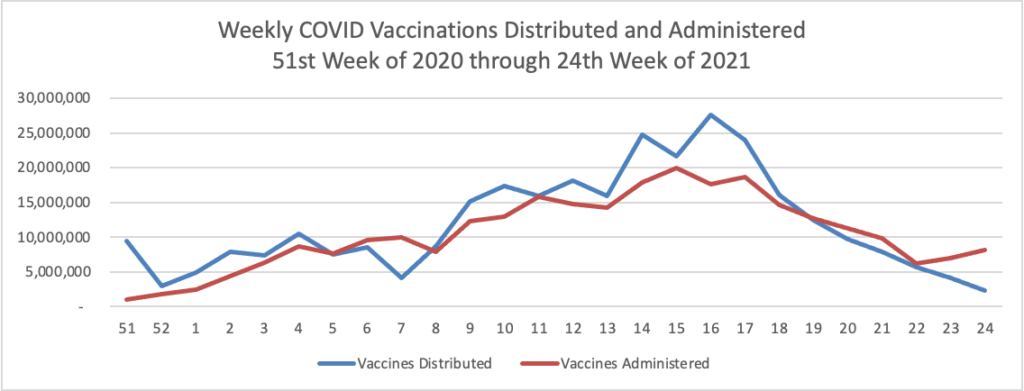
Here’s the FEHBlog’s weekly chart of new COVID vaccinations administered and distributed from the 51st week of 2020 through the 49th week of 2021:

This past week was the first week since June 2021 that administered vaccinations topped 10 million. Slightly over 50% of the U.S. population over 65 is boostered according to the CDC.

Here is a link to the CDC’s weekly interpretation of its COVID statistics which urges all Americans aged 16 and older to get boostered.

From the flu front, the CDC reports that seasonal flu activity remains low but continues to increase. The CDC encourages Americans to fight the flu by getting vaccinated, engage in preventative measures, and take flu antiviral drugs if your doctor prescribes them. We are about a month away from the CDC giving the same advice about COVID.

From the Capitol Hill front, FedWeek informs us that

Congress is moving toward passing a compromise version of the annual DoD authorization bill (S-1605) containing a number of provisions affecting personnel policies government-wide, including two new weeks of paid leave for federal employees on the death of a son or daughter.

The new “parental bereavement leave” replaces a House provision that would have expanded the authority for federal employees to take paid time rather than unpaid time for parental purposes covered by the Family and Medical Leave Act. The Senate version had not included any provision on parental leave.

The compromise provision uses the same definitions for children as under the FMLA; rules likely will be needed to define the policy, including the effective date.

The bill also: extends long-running authorities for all agencies to pay certain special allowances to employees working in areas of active military operations; requires OPM to perform a study of allowances for employees working in remote areas; and orders OPM to establish or update occupational series in the fields of software development, software engineering, data science, and data management.

However, the final version drops House language to require OPM to redefine locality pay areas for wage grade employees so that they align with the areas used for the GS system. Currently, in some cases wage grade employees receive smaller raises than GS employees at the same location. The bill however encourages OPM to address that issue. 

From the judicial front

  • The Society for Human Resource Management brings us up to date on oral arguments before the U.S. Supreme Court this week on human resources and employee benefit issues.
  • The Coalition against Surprise Billing blasted the American Medical Association and the American Hospital Association for bringing a lawsuit against the independent dispute resolution regulations under the No Surprises Act.

From the healthcare business front —

New York-based Hydrogen Health, a joint venture between Anthem, investment firm Blackstone and digital primary care company K Health, is launching its virtual primary care offerings nationwide, the provider announced Dec. 9. 

Anthem and its partners formed Hydrogen Health in April 2021 to leverage artificial intelligence to drive down healthcare costs in both employer and consumer markets. The joint venture offers employers and insurers text and video-based digital primary care, and taps K Health’s artificial intelligence to personalize that care. 

Hydrogen Health shared that since its initial launch with Anthem, its customers now include multiple Fortune 500 companies and other large employers. 

Moving into 2022, the plan anticipates it will expand the conditions it can diagnose and manage and grow its membership by 10 million — all digitally, according to the announcement. 

  • Healthcare Dive reports that on CVS Health’s investors day held yesterday.

— CVS Health plans to ramp up its acquisitions of physician practices and clinics as it continues to pursue its primary care strategy and races with other retail pharmacies to build out medical networks.

— The Woonsocket, Rhode Island-based healthcare behemoth already operates a network of MinuteClinics, urgent care locations staffed by nurse practitioners. But CVS wants to broaden its care delivery strategy into a primary care model, including “physician-led primary care centers with integrated virtual and home assets,” CVS EVP and president of pharmacy services Alan Lotvin said Thursday at CVS’ investor day.

— CVS plans to add a few hundred primary care centers to its network of MinuteClinics, drugstores and health-focused HealthHUB locations launched a few years ago, as it moves from an episodic to more longitudinal approach to care, Lotvin said. CVS also wants to eventually add more specialty services to compete as the retail healthcare market becomes increasingly saturated.

From the benefit design front, Health Payer Intelligence informs us that “Employing personalized, in-home chronic disease management services can have a significant impact on spending for seniors with chronic conditions, a study from Avalere found.”

Patients with quadriplegia saw the highest healthcare spending difference in total cost of care after receiving home healthcare. The group that received the home healthcare solution spent $12,807. In contrast, the group that did not receive in-home chronic disease management support spent nearly $30,000 more, with average spending of $42,709.

The condition that ranked lowest in the top ten chronic conditions was intestinal obstruction or perforation. But even for this condition, patients with the intervention spent on average $17,738 less than their counterparts.

Despite the major differences in total cost of care between the two groups, the group that received the targeted home healthcare intervention did not display drastic differences between healthcare spending levels before and after implementing the intervention.

Weekend update

Photo by Tomasz Filipek on Unsplash

The U.S. House of Representatives and Senate continue to be engaged in Committee business and floor voting this week which should be a humdinger on Capitol Hill. The Wall Street Journal sums the situation up as follows:

Congress Heads Into Tumultuous Week Pressured by Converging Deadlines
Government shutdown, debt ceiling loom as Democratic leaders plan votes on multitrillion-dollar spending ambitions

The Supreme Court prepares for the opening of its October 2021 term on October 4. Amy Howe informs us

The Supreme Court announced on Tuesday that oral arguments will follow a slightly different plan when the justices return to the courtroom for in-person arguments next month. Instead of reverting entirely to the traditional “free for all” format for asking questions, the justices will adopt a hybrid approach that sets aside time for the justices to take turns asking questions, just as they did when hearing oral arguments by telephone during the pandemic. The change appears to increase the chances that Justice Clarence Thomas, who was rarely heard in the courtroom but was an active participant in remote arguments, will continue to participate when in-person arguments resume.

How collegial.

We also can look forward to the Departments of Health and Human Services, Labor, and Treasury as well as OPM issuing the second big No Surprises Act interim final rule this week. The statutory deadline for releasing this rule concerning the independent dispute resolution process is Friday October 1.

From the Delta variant front

  • Both CVS Health and Walgreen’s have announced that their multitude of pharmacies are offering the Pfizer booster to all eligible folks.
  • If you noticed the articles recently reporting that the number of COVID-19 deaths in America exceeds the 1918 flu pandemic, check out this Health Affairs blog article from last April debunking this apples to oranges comparison.

In any event check out this Health Payer Intelligence article on three strategies for sustaining payer innovation momentum post-pandemic. “The coronavirus pandemic resulted in accelerated payer innovation and payers can continue that momentum by identifying opportunities, involving members, and using data effectively.”

Friday Stats and More

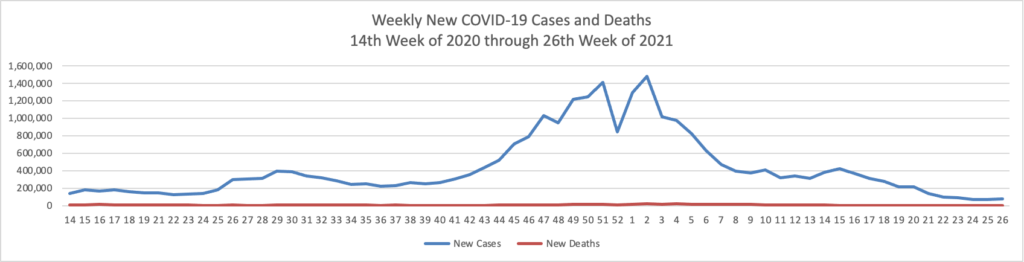
Based on the Centers for Disease Control’s (“CDC”) improved COVID-19 Data Tracker website, here is the FEHBlog’s chart of new weekly COVID-19 cases and deaths over the 14th week of 2020 through 26th week of this year (beginning April 2, 2020, and ending June 30, 2021; using Thursday as the first day of the week in order to facilitate this weekly update):

and here is the CDC’s latest overall weekly hospitalization rate chart for COVID-19:

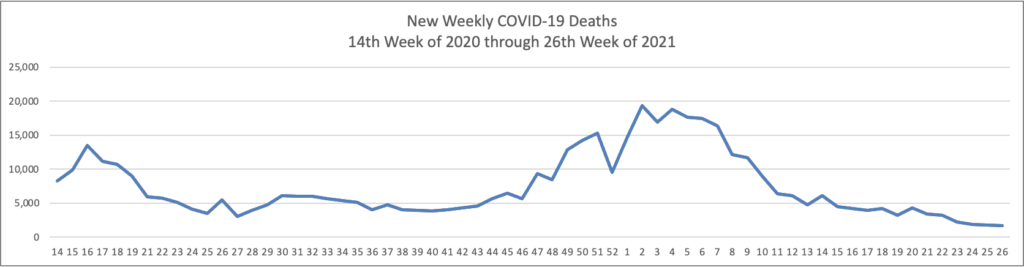
The FEHBlog has noticed that the new cases and deaths chart shows a flat line for new weekly deaths  because new cases significantly exceed new deaths. Accordingly here is a chart of new COVID-19 deaths over the period (April 2, 2020, through June 30, 2022):

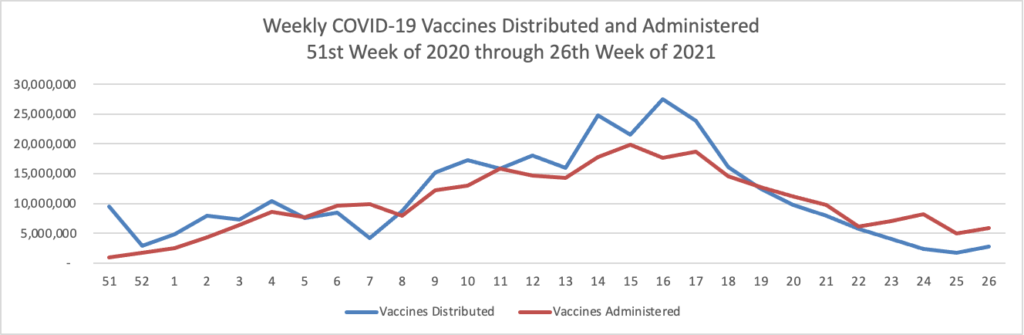
Finally here is a COVID-19 vaccinations chart over the period December 17, 2020, through June 30, 2022 which also uses Thursday as the first day of the week:

In its weekly COVID-19 update the CDC reminds us that

The emergence and spread of variants also have the potential to chip away at our nation’s progress to end this pandemic. On June 15, 2021, CDC announced classification of the SARS-CoV-2 variant B.1.617.2 (Delta) as a variant of concern because it spreads more easily. The spread of the more transmissible B.1.617.2 variant combined with the U.S. population that remains unvaccinated leaves many people at risk of infection. With B.1.617.2 now spreading across the country and infecting people worldwide, it’s more important than ever that all eligible people get vaccinated as soon as possible.

The COVID-19 vaccines authorized for use in the United States offer protection against all known variants, including the B.1.617.2 variant. Getting vaccinated will protect you and the people you love. COVID-19 vaccines are free and available for everyone ages 12 and up. They are nearly 100% effective against severe disease and death, meaning nearly every death due to COVID-19 is preventable. No matter your age, or your health history, until you’re fully vaccinated*—you are at risk of infection. By getting vaccinated and encouraging those around you to do the same, you can safely engage in activities you enjoyed prior to the COVID-19 pandemic. Get vaccinated, help others get vaccinated, and use prevention measures if not fully vaccinated so we can all celebrate our freedom from the virus.

Also from the COVID-19 front Becker’s Payer Issues reports that

The Vaccine Community Connectors program, which was launched by AHIP and the Blue Cross Blue Shield Association, has helped vaccinate more than 2 million people over 65 against COVID-19 in under 100 days, according to a July 1 news release.

More than 50 health insurers are now participating in the program, which was initiated to expand vaccination efforts of people in low-income communities.

“The most vulnerable people in our country have suffered disproportionately from the COVID-19 crisis, which is why we have been working side-by-side with industry partners to help millions of vulnerable Americans get vaccinated against the virus,” BCBSA CEO Kim Keck said in the statement.

Bravo! Health Payer Intelligence reports on how employers can best assist the nationwide vaccination campaign.

Seventy-three percent of workers whose employers encouraged them to receive the coronavirus vaccine had at least one vaccine shot. Additionally, 75 percent of those who received paid time off to get the vaccine have gotten at least one shot.

In contrast, only four in ten of those whose employers did not encourage employees to get vaccinated had received a coronavirus vaccine shot. Similarly, half of those whose employers did not provide paid time off to get the vaccine reported that they had received the coronavirus vaccine.

These distinctions remained true regardless of variations in race, age, ethnicity, income, and even regardless of whether the individual identified as Republican or Democrat.

In the more news category:

  • The U.S. Supreme Court today added two healthcare cases to its October 2021 docket. According to Law360, the Court “agreed to review whether the federal government lawfully cut billions of dollars from reimbursements for drugs bought through a discount program for hospitals in low-income areas, as well as a reimbursement calculation for hospitals that serve a high amount of low-income individuals.”
  • Benefits Pro reports that “Under pressure to rein in skyrocketing prescription drug costs, states are targeting companies that serve as conduits for drug manufacturers, health insurers and pharmacies. More than 100 separate bills regulating those companies, known as pharmacy benefit managers, have been introduced in 42 states this year, according to the National Academy for State Health Policy, which crafts model legislation on the topic. The flood of bills comes after a U.S. Supreme Court ruling late last year backed Arkansas’ right to enforce rules on the companies. At least 12 of the states have adopted new oversight laws. But it’s not yet clear how much money consumers will save immediately, if at all.” The source of the cost problem is not the PBMs who work with health plans to control costs. The PBMs vastly expanded prescription drug coverage for Americans. The sources of the cost problem are the manufacturers and wholesales. All these new state law simply adds more costs to the drug distribution process in the FEHBlog’s view.
  • Becker’s Payer Issues explains how the BCBSA chief innovation officer seeks to transform healthcare one step at a time. Good luck to her. The FEHBlog loves her title.

Monday Roundup

Photo by Sven Read on Unsplash

Bloomberg has released its latest COVID-19 resilience ranking.

Almost a year and a half into the pandemic, the best and worst places to be in the Covid-19 era are increasingly defined by one thing: normalization.

The biggest vaccination drive in history is enabling parts of the globe to abolish mask mandates, relax restrictions and dismantle border curbs, making the magnitude of reopening key to quality of life. Taming cases and deaths was once paramount, along with ensuring a robust health-care system. Now, the ability to essentially turn back the clock and return to pre-pandemic times is taking on an even greater significance.

Central to that is an economy’s openness to the world, and that’s why we’ve introduced a new element—Reopening Progress—to Bloomberg’s Covid Resilience Ranking. Two new metrics capture the ease of moving in and out of a place and how much air travel has recovered, alongside our 10 other measures tracking mortality rates to infection counts, freedom of movement to economic growth.

This pivot has ushered in dramatic changes to the ranks. The U.S. is now No. 1, with its fast and expansive vaccine rollout, dominated by the highly effective Messenger RNA shots, stemming what was once the world’s worst outbreak.

The U.S. Supreme Court today according to Fierce Healthcare

declined to hear an appeal of a lower court decision upholding the Department of Health and Human Services’ (HHS’) site-neutral payments policy.

The appeal was requested by the American Hospital Association (AHA) in February as part of a multiyear legal battle challenging HHS’ authority to bring Medicare payments to off-campus clinics in line with independent physician practices. The AHA’s bid was supported by a long list of other provider industry stakeholders.

By taking a pass on the case, the top court has now paved the way for HHS to move forward with the 2019 Outpatient Prospective Payment System rule—a policy the agency has said would have saved the Centers for Medicare & Medicaid Services roughly $800 million in payments to outpatient departments during 2020. * * *

HHS’ rule aims to remove payment disparities where hospital-affiliated clinics receive more Medicare reimbursement than physicians’ offices providing the same services. Researchers have suggested over the years that these disparities have played a part in provider consolidation.

Also today the Department of Health and Human Services released a third notice of Affordable Care Act Benefit and Payment Parameters as a proposed rule. Fierce Healthcare informs us that the proposed rule would set the ACA’s open season at an expanded November 1 through January 15 and also would allow exchanges to offer special enrollment periods for low income customers who may benefit from the American Rescue Plan’s expanded premium credits. Health Payer Intelligence discusses two impacts from the current ongoing special ACA open enrollment period which runs until August 15.

In other round up items

  • The ICD-10 Monitor tells us that the Centers for Disease Control released new ICD-10-CM codes for federal fiscal year 2022 which include 19 new social determinants of health codes in the “Z” chapter. Many of these new “Z” codes are attributable to the Gravity Project which is an HL7 FHIR accelerator organization.
  • The Wall Street Journal discusses what doctors want their patients to know about the new Alzheimer’s disease drug Aduhelm. For example, “The treatment would work over years, not weeks or months. Dr. [Paul] Aisen estimates that patients with mild cognitive impairment, which is often a precursor to dementia, might get an extra year or two before they start losing their ability to function independently.”
  • Fierce Healthcare reports that

Future demand for healthcare services will be relatively flat to declining, with little to no effect from the COVID-19 pandemic, according to a new forecast report.

At the same time, hospitals and health systems are facing increasing competition from consumer businesses such as Amazon and Walmart, retail behemoths that are rapidly expanding the supply of healthcare services.

The implications of softening demand and increasing supply suggest that pricing trends are ultimately unsustainable for healthcare providers, according to a new report from health system analytics company Trilliant Health.

The company’s analysis, based on 70 billion medical claims across 309 million patient visits, contradicts the commonly held belief that the demand for healthcare services nationwide is rising, according to Sanjula Jain, Ph.D., senior vice president of market strategy and chief research officer at Trilliant Health.

Time will tell.

Weekend update

The Senate has left town for a two week long State work break while the House of Representatives will continue Committee business and floor voting through Thursday July 1. The House Appropriations Committee will mark up that fiscal year 2022 financial services and general government appropriations bill on Tuesday morning, June 29. The Federal Times reports on that process here.

The U.S. Supreme Court is expected to wrap up its October 2020 term this week.

Last Friday, President Biden issued an executive order on “Diversity, Equity, Inclusion, and Accessibility in the Federal Workforce.” Here’s a link to the accompanying fact sheet. The new OPM Director will play a key role in implementing this executive order which makes one specific mention of the FEHB Program:

Sec. 11 (c) To ensure that LGBTQ+ employees (including their beneficiaries and their eligible dependents), as well as LGBTQ+ beneficiaries and LGBTQ+ eligible dependents of all Federal employees, have equitable access to healthcare and health insurance coverage:
(i) the Director of OPM shall take actions to promote equitable healthcare coverage and services for enrolled LGBTQ+ employees (including their beneficiaries and their eligible dependents), LGBTQ+ beneficiaries, and LGBTQ+ eligible dependents, including coverage of comprehensive gender-affirming care, through the Federal Employees Health Benefits Program; * * *

The 2022 OPM technical guidance for benefit and rate proposals clearly anticipated this directive.

On the COVID-19 front

  • The Hill informs us that public health experts are wondering when the Food and Drug Administration will give full approval to the mRNA COVID-19 vaccines, given the fact that a sizable cadre of unvaccinated folks have expressed concern about emergency use authorization status of those vaccine.
  • The Wall Street Journal reports that “In the coronavirus pandemic, a wave of mental-health crises has grown into a tsunami, flooding an already taxed system of care. As the country appears to be emerging from the worst of the Covid-19 crisis, emergency departments say they are overwhelmed by patients who deferred or couldn’t access outpatient treatment, or whose symptoms intensified or went undiagnosed during the lockdowns.”

On the new Alzheimer’s drug / Aduhelm front, STAT News offers

  • a calculator to estimate the cost of Aduhelm to Medicare depending upon utilization. “Estimates of how many seniors on Medicare will actually take Aduhelm, which has a list price of $56,000 [annually], vary wildly. Some experts have guessed at relatively low patient interest, around 500,000 people. Biogen, the company behind the drug, has put its target population far higher, around 1 million to 2 million people. But technically, since the FDA approved the drug for every Alzheimer’s patient, not just those with early-onset disease, the number could skyrocket toward 5.8 million, the number of adults over 65 with Alzheimer’s.”
  • a report that “The top House Democrats on two powerful committees on Friday announced an investigation into the approval and pricing of Biogen’s controversial Alzheimer’s drug, Aduhelm. Both Biogen and the Food and Drug Administration will be under the microscope, House Committee on Oversight and Reform Chair Carolyn Maloney (D-N.Y.) and Energy and Commerce Chair Frank Pallone (D-N.J.) said. “We have serious concerns about the steep price of Biogen’s new Alzheimer’s drug Aduhelm and the process that led to its approval despite questions about the drug’s clinical benefit,” the chairs said in a joint statement.

Weekend update

Thanks to Alexandr Hovhannisyan for sharing their work on Unsplash.

Happy Fathers’ Day and First Day of Summer.

Both Houses of Congress remain in session for Committee business and floor voting this week. Among the scheduled hearings for this week, the Senate Health Education Labor and Pensions Committee will hold a hearing on Tuesday morning to “examine vaccines, focusing on America’s shot at ending the COVID-19 pandemic.”

Speaking of which, Kaiser Health News reports on a June 10, 2021, FDA advisory committee meeting on pediatric COVID-19 vaccines. Here’s a link to the FDA’s briefing document.

Amy Howe who writes on the U.S. Supreme Court discusses the decisions that the Court is expected to issue over the remainder of this month and possibly early July. There are many interesting issues at stake but none of them relate to the FEHB Program.

STAT News offers an encouraging op-ed from two physicians who think that the pandemic has caused people to be more engaged with their healthcare. Hope springs eternal.

Friday Stats and More

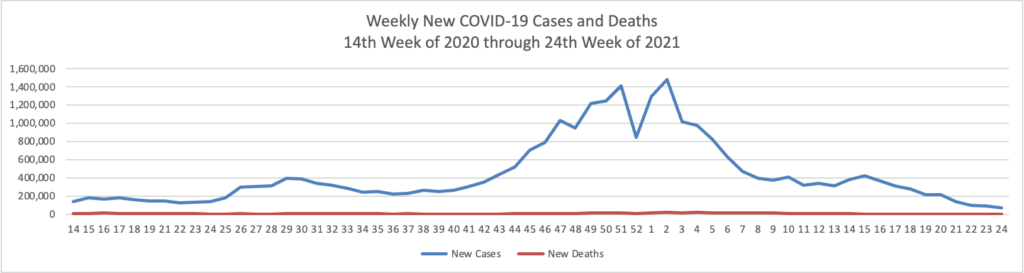
Based on the Centers for Disease Control’s COVID-19 Data Tracker website, here is the FEHBlog’s chart of new weekly COVID-19 cases and deaths over the 14th week of 2020 through 24th week of this year (beginning April 2, 2020, and ending June 16, 2021; using Thursday as the first day of the week in order to facilitate this weekly update):

and here is the CDC’s latest overall weekly hospitalization rate chart for COVID-19:

The FEHBlog has noticed that the new cases and deaths chart shows a flat line for new weekly deaths because new cases materially exceed new deaths. Accordingly here is a chart of new COVID-19 deaths over the period (April 2, 2020, through June 16, 2021):

Finally here is a COVID-19 vaccinations chart over the period December 17, 2020, through June 16, 2021 (six months) which also uses Thursday as the first day of the week:

Bloomberg reports that

President Joe Biden urged unvaccinated Americans to get inoculated from coronavirus, warning that the highly transmissible delta variant of the virus could cause more deaths. “Even while we are making incredible progress [as reflected above], it remains a serious and deadly threat,” Biden said Friday during a White House event to celebrate 300 million doses of vaccine administered during the first 150 days of his administration.“The data is clear: If you are unvaccinated, you’re at risk of getting seriously ill, or dying, or spreading it.” A large swath of Americans — particularly in the politically conservative South — have declined shots despite warnings from health authorities that the virus remains a threat.”

in other COVID-19 news

  • Medscape informs us that “While the investigation into cases of myocarditis possibly associated with COVID vaccines proceeds, the American Heart Association (AHA)/American Stroke Association (ASA) continue to urge everyone who is eligible for the vaccine to get it without delay. ‘We remain confident that the benefits of vaccination far exceed the very unusual risks,’ the leadership of the AHA/ASA said in a statement issued June 12. ‘The risks of COVID-19 infection include its potentially fatal consequences and the potential long-term health effects that are still revealing themselves, including lingering consequences affecting the heart, brain, vascular system, and other organs after infection,’ they point out. Late last week, the Centers for Disease Control and Prevention (CDC) alerted healthcare providers that the COVID-19 Vaccine Safety Technical Work Group (VaST) of the Advisory Committee on Immunization Practices (ACIP) will meet June 18 to review cases of myocarditis reported in adolescents and young adults after they received a COVID-19 vaccine manufactured by Pfizer–BioNTech or Moderna.
  • MedPage Today reports that “During the American Medical Association (AMA) House of Delegates annual meeting, members debated whether natural immunity or previous infection with SARS-CoV-2 was sufficient for the merit of immunity credentials.” The House of Delegate voted against treating natural immunity as equivalent to vaccination. “Multiple delegates pointed out that using natural immunity in lieu of vaccination would pit the AMA’s recommendations against those of the CDC.” Nevertheless as the Mayo Clinic points out, natural immunity helps us achieve some level of herd immunity. It needs to be considered with vaccinations for that purpose.

If you want more details on yesterday’s Affordable Care Act decision from the U.S. Supreme Court, check out Prof. Katie Keith’s post in the Health Affairs blog.

Beckers Hospital News lists seven Fortune 500 health insurers by membership. Health Payer Intelligence discusses the latest sustainability report from the company that tops this list, UnitedHealth Group.

On this Juneteenth holiday, Fierce Health tells us about how “healthcare executives call on President Biden to take ‘innovative, bold’ steps to tackle health equity using AI, big data.”

“It’s not a lack of data—we have so much data in this country now, in our healthcare systems and our EHRs and our patient registration systems,” Cole said. “The data is there but the analytics capability of that—what to do with that data—is something that we’re continuing to work on every day.”

Cole and John Lumpkin, M.D., president of the Blue Cross and Blue Shield of North Carolina Foundation, said both of their organizations have been reworking their collection and organization of race, ethnicity, gender identity and other related data tied to health inequity—a change that “should be a very simple thing to do” but requires an internal data system overhaul, Lumpkin said.

Still, executives said the finish line of those efforts is worthwhile. Incorporating SDOH data can yield substantial health and costs benefits at the individual and population levels, they said.

The Wall Street Journal reports on the rising fortunes of the country’s major pharmacy chains, CVS Health and Walgreens.

In health system merger news —

  • Healthcare Dive informs us that “Beaumont Health and Spectrum Health are looking to merge in a deal that would result in Michigan’s biggest health system with 22 hospitals and 64,000 employees across the state, with combined annual revenue of almost $13 billion. Executives of the two systems announced Thursday they have signed a letter of intent to explore creating a joint health system. The deal would include Spectrum’s Michigan-based health insurance plan, Priority Health, which has 1.2 million customers.”
  • Fierce Healthcare reports that “Southern health systems Ochsner Health and Rush Health Systems have announced plans for a merger they expect to be completed about halfway through 2022. The deal follows a 2019 strategic partnership between the two nonprofit providers and comes hot on the heels of Louisiana-based Ochsner’s merger with Lafayette General Health, which closed in October 2020 and grew the system to 35 hospitals. Rush, which has seven hospitals and more than 30 clinics in eastern Mississippi and western Alabama, will be rebranded as Ochsner Rush Health should the merger receive regulatory approval.”
  • Healthcare Dive also tells us that “Tenet, a major U.S. health system, has agreed to sell five hospitals in the Miami-Dade area for $1.1 billion to Steward Health Care System, a physician-owned hospital operator and health network. The deal also includes the hospitals’ associated physician practices. Dallas-based Steward has agreed to continue using Tenet’s revenue cycle management firm, Conifer Health Solutions, following the completion of the deal, which is expected to close in the third quarter. Further underscoring Tenet’s strategic focus, the sale will not include Tenet’s ambulatory surgery centers in Florida. Tenet will hold onto those assets as its ambulatory business becomes a bigger focus for the legacy hospital operator.”

Thursday Miscellany

U.S. Supreme Court building, Wash. DC

At long last, the U.S. Supreme Court issued its opinion today in the third case reaching the Court on the issue of the constitutionality of the Affordable Care Act (“ACA”). In an opinion written by Justice Breyer and joined by the Chief Justice and four other Justices, the Court ruled in short as follows:

As originally enacted in 2010, the Patient Protection and Affordable Care Act required most Americans to obtain minimum essential health insurance coverage. The Act also imposed a monetary penalty, scaled according to in- come, upon individuals who failed to do so. In 2017, Con- gress effectively nullified the penalty by setting its amount at $0. See Tax Cuts and Jobs Act of 2017, Pub. L. 115–97, §11081, 131 Stat. 2092 (codified in 26 U. S. C. §5000A(c)).

Texas and 17 other States brought this lawsuit against the United States and federal officials. They were later joined by two individuals (Neill Hurley and John Nantz). The plaintiffs claim that without the penalty the Act’s minimum essential coverage requirement is unconstitutional. Specifically, they say neither the Commerce Clause nor the  Tax Clause (nor any other enumerated power) grants Congress the power to enact it. See U. S. Const., Art. I, §8. They also argue that the minimum essential coverage re- quirement is not severable from the rest of the Act. Hence, they believe the Act as a whole is invalid. * * *

[W]e conclude that the plaintiffs in this suit failed to show a concrete, particularized injury fairly traceable to the defendants’ conduct in enforcing the specific statutory provision they attack as unconstitutional. They have failed to show that they have standing to attack as unconstitutional the Act’s minimum essential coverage provision. Therefore, we reverse the Fifth Circuit’s judgment in respect to standing, vacate the judgment, and remand the case with instructions to dismiss.

Justice Thomas filed a concurring opinion, and Justice Alito, joined by Justice Gorsuch, filed a dissenting opinion. The FEHBlog confidently can state that he predicted this favorable outcome for the ACA. It always has been clear to the FEHBlog that the Supreme Court took the case to kill the lawsuit, not the law.

The Senate will take up Kiran Ahuja’s nomination to be OPM Director when it resumes floor business on Monday June 21. If Ms. Ahuja’s nomination is not confirmed next week, the Senate will be away from our Nation’s capital for two weeks for the Independence Day holiday.

Reg Jones’ latest column in FedWeek concerns federal employee survivor benefits in the case of a post-retirement marriage.

In federal employment news, Federal News Network reports that President Joe Biden signed the Juneteenth National Independence Day Act this afternoon, establishing June 19 as a federal holiday. Most federal employees will have tomorrow, June 18 off for observance as June 19 falls on a Saturday this year, the Office of Personnel Management said. * * * Nearly every state already recognizes Juneteenth as a holiday, but it now becomes the first federal holiday created since Martin Luther King Jr. Day was established in 1983.”

In COVID-19 news and this should come as no surprise, Medscape informs us that “More than half of unvaccinated Americans would prefer to get a COVID-19 vaccination at their doctors’ office, according to the results of a new national survey. * * * The preference to be vaccinated in a medical office was three to five times higher among unvaccinated Americans than were other strategies such as vaccinations at retail pharmacies or drug stores, community health centers, public health clinics, drive-up clinics, and large public vaccination sites.” As of today, 65% of Americans over age 18, and 87% of Americans over age 65, have had at least one dose of a COVID-19 vaccination.

In a burst of closing miscellany —

  • Kaiser Health News tells us that ” The pandemic-caused recession and a federal requirement that states keep Medicaid beneficiaries enrolled until the national emergency ends swelled the pool of people in the program by more than 9 million over the past year, according to a report released Thursday. The latest figures show Medicaid enrollment grew from 71.3 million in February 2020, when the pandemic was beginning in the U.S., to 80.5 million in January, according to a KFF analysis of federal data.”
  • Health Payer Intelligence informs us that “Medicare Advantage plans may better address racial care disparities than fee-for-service Medicare, according to the second in a series of reports that ATI Advisory has prepared for Better Medicare Alliance (BMA) in 2021. “With over 26.5 million beneficiaries enrolled in Medicare Advantage today, this report shows that minority beneficiaries are a driving force behind these enrollment gains; turning to Medicare Advantage to meet their health and social needs. When policymakers stand up for Medicare Advantage, they stand up for these seniors, too,” Allyson Y. Schwartz, president and chief executive officer of the Better Medicare Alliance, said in the press release. Around half of all Black Medicare beneficiaries and 53 percent of Latinx Medicare beneficiaries are in a Medicare Advantage plan, the report found. In contrast, only 34 percent of White beneficiaries and 31 percent of those who identified as “Other” races were enrolled in a Medicare Advantage plan.”
  • STAT News reports that “ovarian cancer, which kills about 15,000 Americans every year, has historically been one of the thornier cancers to treat. Only in the last few years has a new class of potent drugs, called PARP inhibitors, started to change that. But even with these promising new treatments, too often, tenacious tumors come roaring back. So there’s a need for yet newer drugs that can overcome any resistance the cancer evolves. According to research published Thursday, scientists might have found one. And it’s not actually a new drug at all. In fact, it’s been sitting, retired, in a drug library for decades. “While evaluating mechanisms of PARP inhibitor resistance over the last few years we came across this drug, novobiocin, which curiously enough, is an antibiotic,” said Alan D’Andrea, director of the Susan F. Smith Center for Women’s Cancers at the Dana-Farber Cancer Institute and co-author of the new study.” Encouraging.
  • “The U.S. Food and Drug Administration today approved a nasal antihistamine for nonprescription use through a process called a partial prescription to nonprescription switch. The FDA approved Astepro (azelastine hydrochloride nasal spray, 0.15%) for seasonal and perennial allergic rhinitis—commonly known as allergies—for adults and children six years of age and older.  ‘Seasonal and perennial allergies affect millions of Americans every year, causing them to experience symptoms of nasal congestion, runny nose, sneezing and more,” said Theresa M. Michele, M.D., director of the office of nonprescription drugs in the FDA’s Center for Drug Evaluation and Research. “Today’s approval provides individuals an option for a safe and effective nasal antihistamine without requiring the assistance of a healthcare provider.’”

Memorial Day Weekend update

Thanks to Justin Casey for sharing their work on Unsplash.

Congress is on a State / district work break this coming week. The Supreme Court has over thirty cases to decide, including the latest Affordable Care Act constitutionality case, before adjourning for the summer in late June / early July.

The federal employee news organizations have highlighted portions of the President’s fiscal year 2022 budget proposal which was released last Friday.

  • The Federal Times reports that “President Joe Biden’s fiscal year 2022 budget anticipates a more than 50,000 full-time-equivalent employee increase to the federal payrolls next year, as part of concerted efforts to attract young and expert workers to federal service. * * * ‘The Federal workforce continues to become older on average. Almost 30 percent (635,397) of employees are older than 55, while 8.1 percent (176,805) of employees are younger than 30. By comparison, in the private sector, 23 percent of the workforce is younger than 30. Every single agency has fewer employees younger than 30 today than they had in 2010,’ the budget proposal’s analytical perspectives state.
  • Govexec informs us that “President Biden on Friday formally proposed an average 2.7% pay increase for federal civilian employees in 2022 as part of his fiscal 2022 budget proposal. * * * It was unclear Friday how Biden’s proposal would be divvied up between an across-the-board boost to basic pay and increases in locality pay. In recent years, pay raise provisions have included a 0.5% average increase in locality pay, although it was frozen at 2020 levels this year. * * * The proposal also marks a return to the principle of pay parity between the civilian and military workforce, as service members would also receive a 2.7% pay raise in 2022. 

Federal News Network offers three brief stories on the U.S. Postal Service

The Postal Service sent its first reduction in force notices to non-union management employees Friday [no indication of how many notices were sent out], and is planning to set higher prices on its mail products well above the rate of inflation [first class stamp would increase by 5% from 55 cents to 58 cents].

The Senate, meanwhile, voted [by unanimous consent] to confirm [Anton Hajjar] President Joe Biden’s third nominee to serve on the USPS Board of Governors. The board is now fully staffed for the first time since 2010, and will help the agency get its 10-year reform plan off the ground.

Thus the Senate has confirmed all three of the President’s Postal Governor nominees who shared a confirmation hearing with OPM Director Kiran Ahuja while Ms. Ahuja waits for a confirmation vote.

In healthcare news —

  • Bloomberg tells us that “The U.S. reported the lowest level of infection since the early days of the pandemic and welcomed back sports fans to stadiums. The Indianapolis 500 was run before 135,000 fans, the largest crowd for a sporting event since the pandemic began [but 1/3 of capacity].  * * * The world needs the cooperation of the Chinese government to trace the origins of Covid-19 and prevent future pandemic threats, two leading U.S. disease experts said Sunday.
  • NPR reports that “For children in particular, the risk of serious consequences from COVID-19 is the same magnitude as the risk they face from the flu, she says. But many parents seem more worried about the new and less familiar disease. * * * [E]xperts urge parents to try not to worry too much.
  • Because many FEHB plans provide hypertensive members with at home blood pressure monitor, the FEHBlog wants to share the American Medical Association’s views on what doctors wish their patients knew about home blood pressure measurement.

Finally, the FEHBlog’s eyes were drawn to the weekend Wall Street Journal’s Heard on the Street column which discusses the efforts of Walmart and Amazon to enter the healthcare business.