Midweek Update

Midweek Update

Photo by Manasvita S on Unsplash

From the COVID-19 front

  • The Wall Street Journal reports that “The highly transmissible Delta variant has become the dominant strain of the Covid-19 virus circulating in the U.S., according to federal data. It is spreading rapidly as communities loosen pandemic restrictions and officials struggle to reach unvaccinated people. The Delta variant, also known as B.1.617.2, made up 51.7% of Covid-19 infections in the two weeks ended July 3, according to genetic sequences from positive Covid-19 tests submitted to the U.S. Centers for Disease Control and Prevention.”
  • The Journal adds that “Covid-19 vaccines available in the U.S. protect against the Delta variant, but the virus is of great risk to people who aren’t vaccinated, according to public-health and infectious-disease experts. * * * Warm weather is helping to keep numbers of new cases down, and infections are likely to rise again in the fall, said Dr. Paul Sax, clinical director of the Division of Infectious Diseases at Brigham and Women’s Hospital in Boston. ‘Last summer we got a little bit overconfident,’ he said. ‘I don’t want us to make the same mistake again this time. We need to push as hard as we can to get as many people vaccinated as possible.’”
  • AHIP updates us on the progress made by its Vaccination Community Connectors program. “The COVID-19 pandemic has been a fundamental part of Americans’ lives for 15 months and counting. America cannot afford to lose any more time in achieving community immunity. Public-private partnerships have helped to support our communities through the crisis this far. By extending those partnerships through secure sharing of data about who has been immunized, we can better target every outreach and connection to put an end to the pandemic and get back to the moments we all miss. For more information, read our white paper with Blue Cross Blue Shield Association (BCBSA) and the Association for Community Affiliated Plans (ACAP).”
  • The FEHBlog noticed today that the OPM Inspector General has posted his semi-annual report to Congress for the period ended April 30, 2021, and OPM’s management response thereto. The Inspector General’s report includes an update of his earlier assessment of the pandemic’s impact on the FEHB Program. With all due respect, the FEHBlog finds the OIG’s assessment unnecessarily pessimistic but it’s for the readers to form their own opinions.

From the innovation front

  • Fierce Pharma reports that “Many pursuits have been put on hold during the coronavirus pandemic. But biopharmaceutical innovation isn’t one of them. In 2020, the FDA approved 53 new drugs, the second-most in a single year, after 2018’s bounty of 59. And the momentum has continued through the first half of 2021. With the FDA endorsing its 29th novel drug on June 30, the industry was slightly ahead of last year’s pace. * * * n terms of treatment areas, it is of little surprise that oncology accounts for 12 of this year’s approvals. That figure represents 44% of all new drug approvals this year, an even higher rate than in 2020 when 20 of 53 new drugs were in the oncology class. * * * The FDA’s roundups of 2021’s novel drug approvals can be found here and here.”
  • Employee Benefit News informs us that “Employers have a new tool in their arsenal to help employees reach a healthier weight and reduce their healthcare costs. DayTwo, a precision medicine company, has released new outcomes from its employer and health plan nutrition programs, to tackle high-risk and high-cost metabolic conditions, like obesity, Type 2 diabetes and pre-diabetes. The program provides users with a microbiome screening, which measures how the body digests food, in order to offer AI-powered nutritional plans tailored to their needs. After one year, employees who used the DayTwo program lost an average of 19 pounds and reduced their body mass index by 3.3 points, according to a release. The program is meant to reduce the reliance on medication and help employees with obesity and Type 2 diabetes lose weight naturally.”
  • mHealthIntelligence tells us that “While many healthcare providers are just now getting into the remote patient monitoring arena, Ochsner Health has scaled its platform to a national level, and is now monitoring more than 20,000 people in health plans across the country. And still, says Julie Henry chief operating officer for the New Orleans-based health system’s digital medicine department, ‘we’re learning lessons each and every day.’ That’s one of the guiding principles behind a connected health service that is seeing immense growth in the wake of the coronavirus pandemic, which has pushed many health systems to shift healthcare services from the hospital to the home. It’s a work in progress for everyone, from those deploying the technology to those paying for it. And there isn’t a hospital, clinic or practice out there that isn’t learning something new.”

In other healthcare news

  • The Federal Register announced today the last Thursday’s No Surprises Act interim final rule will be published in the July 13 issue. Publication triggers the sixty day public comment period which should end on Monday September 13 (as the 60 day period ends on Saturday September 11.)
  • Beckers Hospital Review reports that “Amazon Care, the e-commerce giant’s new healthcare venture, has approached several big health insurers in an effort to expand coverage of its services, Insider reported July 7.  The healthcare venture reportedly talked to Aetna, Premera Blue Cross and Blue Cross Blue Shield of Massachusetts, according to people familiar with the discussions.”

Tuesday’s Tidbits

Photo by Patrick Fore on Unsplash

From the COVID-19 front

  • The Hill informs us that “President Biden on Tuesday pleaded with Americans to get vaccinated against COVID-19 as the White House signaled a shift toward grassroots tactics to reach those who have yet to get a shot.” Here is a link to the President’s full remarks.
  • NPR Shots offers a daily look at each state’s progress in vaccinating its residents.

From the hospital pricing transparency front —

  • The Wall Street Journal explains how it has been analyzing the pricing data that federal law required hospitals to make publicly available on January 1, 2021. “The Journal reviewed hospital pricing disclosures collected by Turquoise Health Co., a startup that has been gathering the data from hospital websites since the regulations went into effect.” The Turquoise Health website is worth a gander.
  • NPR Shots also analyzed the newly available hospital pricing data. “While it’s still an unanswered question about whether price transparency will lead to overall lower prices, KHN took a dive into the initial trove of data to see what it reveals. Here are five takeaways from the newly public data and tips for how you might be able to use it to your benefit: 1) As expected prices are all over the map; 2. Patients can look up information but the info is incomplete; 3. Third party firms like Turquoise Health are trying to make searching prices simpler and cash in; 4. Consumers can use the data to negotiate with hospitals when paying cash, and 5. Hospitals are not fully on board currently.

In the tidbits department —

  • Today, the Centers for Medicare and Medicaid Services announced Dr. Meena Seshamani, M.D., Ph.D. [formerly with MedStar Health] as Deputy Administrator and Director of Center for Medicare. She started her work today.
  • Fierce Healthcare reports “The United Health Foundation, the philanthropic arm of the UnitedHealth Group, released its America’s Health Rankings Health Disparities Report last week, and the healthcare giant found a number of disparities worsened in the 2017 to 2019 time frame. While the data come from before the pandemic, experts say they offer a baseline that can be used to address critical public health needs. For example, adults who did not graduate high school had a rate of frequent mental distress that was 123% higher than people with a college degree. Females had a 70% higher rate of depression than males, according to the report.”

  • NPR Shots discusses how an “obesity drug’s [Wegovy] promise now hinges on insurance coverage.”

In clinical trials, weekly injections of semaglutide — or Wegovy, as it’s been branded — helped people drop an average of 15% of their body weight. That’s an average of about 34 pounds over 16 months, before their weight plateaued, a far greater weight loss, obesity specialists say, than achieved with other drugs on the market. At least as important, Wegovy raised none of the alarm bells with the FDA or obesity doctors that it might trigger serious side effects of the sort some people experienced by taking fen-phen or other previous medical treatments for obesity.

But with a price tag for Wegovy of $1,000 to $1,500 a month, a big question remains: Will insurers cover its significant cost for the millions who might benefit? * * *

Insurance coverage, it turns out, is a giant question — not just with Wegovy but with obesity drugs in general. Some private insurers do include some prescription obesity drugs in the list of medicines they’ll cover; it’s too early to tell whether Wegovy will make those lists. Many doctors and patients are optimistic, because it is a higher dose of an existing diabetes medication called Ozempic, which insurers often cover.

A few select state Medicaid programs will cover medications that treat obesity in some circumstances. But, significantly, Medicare does not cover obesity drugs — and many private insurers typically follow Medicare’s lead.

Yet the demand for a good treatment is there, says Dr. Fatima Cody Stanford, a leading obesity researcher at Harvard. She was not involved in conducting the Wegovy clinical trial but closely followed it. “I’m excited about it,” she says, because of the dramatic weight loss.

The drug acts on the brain so people eat less and store less of what they eat. That helps address the excess weight as well as helping with related diseases of the liver or heart, for example.

  • The FEHBlog enjoys book recommendations and so he lapped up STAT’s list of “the 36 best books and podcasts on health and science to check out this summer. Among them, this one particularly caught the FEHBlog’s attention as he has enjoyed reading this author’s output and the topic is intriguing: The Code Breaker: Jennifer Doudna, Gene Editing, and the Future of the Human Race By Walter Issacson I recommend it because this captivating book provided clear and accessible explanations of the scientific discovery of CRISPR-Cas9 and its remarkable power as a gene editing tool, interwoven with the complex human stories of Jennifer Doudna and her relationships with the many other accomplished scientists who brought it all together.— Anthony Fauci, director of the National Institute of Allergy and Infectious Diseases

No Surprises Thursday

Photo by Josh Mills on Unsplash

The federal regulators, including the Office of Personnel Management, achieved their statutory deadline today for issuing the first round of No Surprises Act implementing rules. Here’s the regulators’ output, compliments of the Labor Department:

There is no doubt in the FEHBlog’s mind that the regulators did a fine job of making a silk purse out of sow’s ear / the poorly drafted statute. This rule will help carriers and providers meet the January 1, 2022, launch date. This law, if properly implemented, and signs are looking good now, will protect consumers from surprise medical bills, which was clearly Congress’s objective, but without creating an IT nightmare.

The regulators plan a second round of No Surprises Act rules for October 1, 2021. The second round will focus on the independent dispute resolution process.

From the COVID-19 front —

  • The New York Times reports that “The Johnson & Johnson coronavirus vaccine is effective against the highly contagious Delta variant, even eight months after inoculation, the company reported on Thursday — a finding that should reassure the 11 million Americans who have gotten the shot. The vaccine showed a small drop in potency against the variant, compared with its effectiveness against the original virus, the company said. But the vaccine was more effective against the Delta variant than the Beta variant, first identified in South Africa — the pattern also seen with mRNA vaccines.”
  • Medscape informs us that “The White House on Thursday announced it will send “strike teams” to 1000 counties where the COVID-19 Delta variant is spreading rapidly. The teams will be made up of health and logistics experts from several federal agencies and will conduct coronavirus testing, distribute medicines designed to fight the virus, and boost local and state efforts to increase vaccinations.”

In Thursday Miscellany —

  • GoodRx is tracking prescription drug manufacturer price changes which typically are made effecting January 1 and July 1.
  • The Centers for Medicare and Medicaid Services “is proposing actions that aim to close health equity gaps by providing Medicare patients battling End-Stage Renal Disease (ESRD) with greater access to care, through the ESRD Prospective Payment System (PPS) annual rulemaking. This proposed rule would update ESRD PPS payment rates, make changes to the ESRD Quality Incentive Program (QIP), and modify the ESRD Treatment Choices (ETC) Model.  The proposed changes to the ETC Model policies would aim to encourage dialysis providers to decrease disparities in rates of home dialysis and kidney transplants among ESRD patients with lower socioeconomic status, making the model the agency’s first CMS Innovation Center model to directly address health equity.”
  • The Aetna Foundation and U.S. News and World Report released their 2021 healthiest U.S. communities rankings this week.

2021 Healthiest Communities- Top 10

*See the full rankings here

Top 10 Counties

  1. Los Alamos County, New Mexico
  2. Douglas County, Colorado
  3. Falls Church, Virginia
  4. Loudoun County, Virginia
  5. Broomfield County, Colorado
  6. San Miguel County, Colorado
  7. Pitkin County, Colorado
  8. Howard County, Maryland
  9. Morgan County, Utah
  10. Routt County, Colorado

2021 Key Measures

Top 5 Communities for Health Outcomes

  1. San Juan County, Washington
  2. Marin County, California
  3. Carver County, Minnesota
  4. Stevens County, Minnesota
  5. Hunterdon County, New Jersey

Top 5 Communities for Access to Health Care

  1. Olmsted County, Minnesota
  2. Montour County, Pennsylvania
  3. Suffolk County, Massachusetts
  4. Johnson County, Iowa
  5. Perry County, Kentucky

Top 5 Communities for Mental Health

  1. Honolulu County, Hawaii
  2. Pitkin County, Colorado
  3. Fairfax County, Virginia
  4. Santa Clara County, California
  5. San Mateo, California

Midweek Update

Photo by Manasvita S on Unsplash

In news from our Nation’s capital

  • Yesterday the House Appropriations Committee approved for House floor consideration the Fiscal Year 2022 Financial Services and General Government appropriations bill which includes OPM and FEHB Program funding. The vote was 33-24. Govexec adds that the Committee action “endorses President Biden’s proposal to give civilian federal employees an average 2.7% pay raise in 2022, despite efforts by some Democrats to provide a bigger increase.”
  • Amy Howe informs us that tomorrow will be the last day of the U.S. Supreme Court’s October 2020 term and the two remaining decisions are politically significant.
  • The Society for Human Resource Management reports that ​”The Equal Employment Opportunity Commission (EEOC) has extended the deadline for filing the EEO-1 form from July 19 to Aug. 23. Businesses with 100 or more employees and some federal contractors with at least 50 employees must submit an annual EEO-1 form, which asks for information from the previous year about the number of employees who worked for the business, sorted by job category, race, ethnicity and gender. The EEOC did not collect such data in 2020 due to the coronavirus crisis. Covered employers now have until the new deadline to submit both their 2019 and 2020 data.”
  • The Office of Management and Budget’s Office of Information and Regulatory Affairs has completed its work on HHS’s first interim final rule on implementing the No Surprises Act. Next step will be the Federal Register’s public inspection list.

From the COVID-19 front

  • The Centers for Disease Control has improved its COVID-19 data tracker website. Check out this fascinating new chart on the value of the COVID-19 vaccines.
  • The Wall Street Journal reports that “People who became infected with Covid-19 after getting a messenger RNA vaccine [Pfizer or Moderna] carried less virus and had shorter cases than unvaccinated people who became infected, a study by government health researchers found. * * * “Even when people get vaccinated and did get infected, they were less likely to have an illness that causes a fever,” said Mark Thompson, an epidemiologist at the U.S. Centers for Disease Control and Prevention who helped lead the study.”
  • The American Hospital Association informs us that “The Moderna COVID-19 vaccine produces neutralizing antibody titers against the Delta variant, although fewer than against the ancestral strain of the virus, the company announced yesterday. * * * “These new data are encouraging and reinforce our belief that the Moderna COVID-19 Vaccine should remain protective against newly detected variants,” said CEO Stéphane Bancel.

From the Aduhelm front, STAT News tells us that
A majority of U.S. physicians disagree with the Food and Drug Administration’s approval of the Alzheimer’s drug from Biogen (BIIB) and believe the medicine should not be routinely used, according to a new survey from STAT and Medscape. Nearly two-thirds of the 200 primary care physicians and neurologists polled find the trial data unclear when it comes to benefits and risks of the drug. Consequently, only a small minority of these doctors think the medicine should be given to patients with early-onset Alzheimer’s.

The controversial new Alzheimer’s drug would only be cost effective if priced between $3,000 and $8,400, an 85% to 95% discount off the $56,000 list price, due to “insufficient” evidence the drug benefits patients, STAT says, citing a revised analysis. The assessment by the Institute for Clinical and Economic Review is very similar to an evaluation issued a month ago, before the FDA approved the medicine and issued a broad label. But Biogen has pledged to promote the drug only to a more specific patient population and the FDA is requiring fewer costly MRI scans to monitor patient safety.

With regard to the physician survey and with all due respect to that fine profession, the FEHBlog expects that the “If you build it they will come” principle could apply to Aduhelm.

In other healthcare news

  • Barron’s reports that “The nation’s largest retailer is now selling the first private-label insulin at prices more than 50% lower than brand names of the diabetes drug, which can cost thousands of dollars a year. Walmart pharmacies began filling prescriptions this week for the discount chain’s ReliOn NovoLog brand of insulin in vials and injector pens. The drug, made by major supplier Novo Nordisk (NVO), will be available by mid-July at the company’s Sam’s Club wholesale stores. “We know many people with diabetes struggle to manage the financial burden of this condition, and we are focused on helping by providing affordable solutions,” Cheryl Pegus, executive vice president of Walmart Health & Wellness, announced Tuesday.” 
  • Medscape informs us that “Families with private health insurance pay around $3,000 for newborn delivery and hospitalization, while adding neonatal intensive care can push the bill closer to $5,000, based on a retrospective look at almost 400,000 episodes. The findings suggest that privately insured families need prenatal financial counseling, as well as screening for financial hardship after delivery, reported lead author Kao-Ping Chua, MD, PhD, assistant professor and health policy researcher in the department of pediatrics and the Susan B. Meister Child Health Evaluation and Research Center at the University of Michigan, Ann Arbor, and colleagues. “Concern is growing regarding the high and rising financial burden of childbirth for privately insured families,” the investigators wrote in Pediatrics.”  Health plans may want to take a gander at their own members out of pocket spending on maternity care.
  • Employee Benefit News inquires whether a “subscription model can fix primary care.” The subscription model is offered by direct primary care companies like One Medical. According to the EBN article,

The appeal of these companies has grown as employers increasingly seek to address a shortage of high-quality primary care and reduce spending on the health of their workforce, said Ellen Kelsay, CEO and president of the Business Group on Health, which represents large employers.

Studies show a strong correlation between access to primary care and lower spending on expensive medical services such as ER visits, surgeries and hospital admissions. Yet in the United States, primary care accounts for only around 5% to 7% of total health spending, compared with 14% in the 36 member nations of the Organization for Economic Cooperation and Development.

The big bet of One Medical and companies like it is that greater spending on primary care will fatten their bottom lines while reducing overall health costs for their clients. [One Medical works with health plans as well as self-funded employers and patients.]

Monday Roundup

Photo by Sven Read on Unsplash

Bloomberg has released its latest COVID-19 resilience ranking.

Almost a year and a half into the pandemic, the best and worst places to be in the Covid-19 era are increasingly defined by one thing: normalization.

The biggest vaccination drive in history is enabling parts of the globe to abolish mask mandates, relax restrictions and dismantle border curbs, making the magnitude of reopening key to quality of life. Taming cases and deaths was once paramount, along with ensuring a robust health-care system. Now, the ability to essentially turn back the clock and return to pre-pandemic times is taking on an even greater significance.

Central to that is an economy’s openness to the world, and that’s why we’ve introduced a new element—Reopening Progress—to Bloomberg’s Covid Resilience Ranking. Two new metrics capture the ease of moving in and out of a place and how much air travel has recovered, alongside our 10 other measures tracking mortality rates to infection counts, freedom of movement to economic growth.

This pivot has ushered in dramatic changes to the ranks. The U.S. is now No. 1, with its fast and expansive vaccine rollout, dominated by the highly effective Messenger RNA shots, stemming what was once the world’s worst outbreak.

The U.S. Supreme Court today according to Fierce Healthcare

declined to hear an appeal of a lower court decision upholding the Department of Health and Human Services’ (HHS’) site-neutral payments policy.

The appeal was requested by the American Hospital Association (AHA) in February as part of a multiyear legal battle challenging HHS’ authority to bring Medicare payments to off-campus clinics in line with independent physician practices. The AHA’s bid was supported by a long list of other provider industry stakeholders.

By taking a pass on the case, the top court has now paved the way for HHS to move forward with the 2019 Outpatient Prospective Payment System rule—a policy the agency has said would have saved the Centers for Medicare & Medicaid Services roughly $800 million in payments to outpatient departments during 2020. * * *

HHS’ rule aims to remove payment disparities where hospital-affiliated clinics receive more Medicare reimbursement than physicians’ offices providing the same services. Researchers have suggested over the years that these disparities have played a part in provider consolidation.

Also today the Department of Health and Human Services released a third notice of Affordable Care Act Benefit and Payment Parameters as a proposed rule. Fierce Healthcare informs us that the proposed rule would set the ACA’s open season at an expanded November 1 through January 15 and also would allow exchanges to offer special enrollment periods for low income customers who may benefit from the American Rescue Plan’s expanded premium credits. Health Payer Intelligence discusses two impacts from the current ongoing special ACA open enrollment period which runs until August 15.

In other round up items

  • The ICD-10 Monitor tells us that the Centers for Disease Control released new ICD-10-CM codes for federal fiscal year 2022 which include 19 new social determinants of health codes in the “Z” chapter. Many of these new “Z” codes are attributable to the Gravity Project which is an HL7 FHIR accelerator organization.
  • The Wall Street Journal discusses what doctors want their patients to know about the new Alzheimer’s disease drug Aduhelm. For example, “The treatment would work over years, not weeks or months. Dr. [Paul] Aisen estimates that patients with mild cognitive impairment, which is often a precursor to dementia, might get an extra year or two before they start losing their ability to function independently.”
  • Fierce Healthcare reports that

Future demand for healthcare services will be relatively flat to declining, with little to no effect from the COVID-19 pandemic, according to a new forecast report.

At the same time, hospitals and health systems are facing increasing competition from consumer businesses such as Amazon and Walmart, retail behemoths that are rapidly expanding the supply of healthcare services.

The implications of softening demand and increasing supply suggest that pricing trends are ultimately unsustainable for healthcare providers, according to a new report from health system analytics company Trilliant Health.

The company’s analysis, based on 70 billion medical claims across 309 million patient visits, contradicts the commonly held belief that the demand for healthcare services nationwide is rising, according to Sanjula Jain, Ph.D., senior vice president of market strategy and chief research officer at Trilliant Health.

Time will tell.

Welcome Director Ahuja

OPM Headquarters a/k/a the Theodore Roosevelt Building

OPM’s new Director Kiran Ahuja was sworn in today. Here is a link to the OPM press release on the festivities.

Health Payer Intelligence informs us that “The Alliance of Community Health Plans (ACHP) has proposed a number of recommendations to improve the Federal Employees Health Benefits (FEHB) program’s plan comparison tool in order to boost quality and enrollment, according to a recent issue brief.” ACHP’s action is timely because OPM has been focusing attention on the plan comparison tool in consultation with interested carriers and presumably other stakeholders.

According to a Committee press release, “The House Appropriations Subcommittee on Financial Services and General Government today approved by voice vote its fiscal year 2022 bill. [This is the bill that funds OPM and the FEHB.] For fiscal year 2022, the draft bill includes $29.1 billion in funding, an increase of $4.8 billion over 2021.” 

Sen. Chuck Grassley (R Iowa) announced

Sen. Chuck Grassley (R-Iowa) today joined Senate Majority Whip Dick Durbin (D-Ill.) Sen. Angus King (I-Maine) to introduce the Drug-price Transparency for Competition (DTC) Act, a bill that would require price disclosures on advertisements for prescription drugs, in order to empower patients and reduce spending on medications. Last week, the Government Accountability Office (GAO) released a report – requested by Durbin and Grassley – which found direct-to-consumer (DTC) advertisements of prescription drugs contribute to an enormous amount of Medicare costs. Specifically, the DTC Act would require DTC advertisements for prescription drugs and biological products to include a disclosure of the list price, so that patients can make informed choices when inundated with drug commercials. 

Speaking of drug prices, let’s take a look at recent news on the new Alzheimer’s Disease drug, Aduhelm.

  • Yesterday, Biogen issued a bulleted defense of its pricing, which is $56,000 annually per patient. STAT News points out “For families and physicians grappling with the historic approval this month of the controversial Alzheimer’s drug Aduhelm, there’s no shortage of unanswered questions. But a critical one has largely been overlooked: Once patients start taking the medication, how will they know when it’s time to stop? “We don’t have any guidance on how long to give this medication to someone who doesn’t experience adverse events,” said William Mantyh, a behavioral neurologist at M Health Fairview University of Minnesota Medical Center. “With a drug like aducanumab where the upfront demonstrated efficacy is up in the air, it really makes it hard for a clinician to figure out when to stop the drug based on a patient’s clinical symptoms.”
  • Axios interviewed AHIP CEO Matt Eyles on Aduhelm pricing. In response to an Axios question on acceptable pricing, Mr. Eyles responded that “The best information we have is what [the Institute for Clinical and Economic Review] puts out.” ICER stated on June 7 that “At the ICER public meeting on aducanumab on July 15, 2021, we will tackle important questions [about Aduhem] with all stakeholders at the table. We will also address the question of fair pricing for a drug that now seems likely to become one of the top selling drugs in the history of the United States. ICER’s preliminary draft report calculated a fair annual price to lie between $2,500-$8,300. Even in our most optimistic cost-effectiveness scenario — which ignores the contradictions within the two pivotal trials and presumes that only the positive trial captures the true benefits of treatment — aducanumab’s health gains would support an annual price between $11,100-$23,100. The list price of $56,000 per year announced today by the drug maker far exceeds even this optimistic scenario. Our report notes that only a hypothetical drug that halts dementia entirely would merit this pricing level. The evidence on aducanumab suggests that, at best, the drug is not nearly this effective. Nonetheless, even at the lower range of the estimated number of eligible patients, at this price the drug maker would stand to receive well in excess of $50 billion per year even while waiting for evidence to confirm that patients receive actual benefits from treatment.
  • The Wall Street Journal reports that “Eli Lilly & Co. plans to submit its Alzheimer’s drug for market clearance under an expedited review this year, in a sign that regulators are encouraging development of treatments for the disease after a recent approval. Lilly said Thursday that the U.S. Food and Drug Administration had designated the company’s experimental Alzheimer’s drug, called donanemab, for the agency’s accelerated approval process. The FDA decision comes after the agency cleared Biogen Inc.’s Aduhelm, the first Alzheimer’s therapy to receive approval in nearly two decades but one that has drawn criticism from doctors and researchers skeptical the drug works. * * * Donanemab performed better in a trial than Biogen’s drug did in its trials, and health insurers and patients would probably prefer it over Aduhelm, J.P. Morgan analyst Chris Schott said in a note to investors.“Donanemab’s approval would be a major blow to Aduhelm’s commercial prospects,” Brian Skorney, a Robert W. Baird & Co. analyst, said in a research note. “We think it would make zero sense for FDA to approve Aduhelm, but not donanemab.” Ah, competition.

In other drug pricing news, Fierce Healthcare tells us that

Cigna is launching a new program that aims to incentivize eligible members to switch to biosimilar drugs.

Under the new Shared Savings Program, members will be offered a one-time $500 debit card for healthcare services or medications if they make the decision to switch to a biosimilar, according to an announcement provided first to Fierce Healthcare.

The program will be made available first to [approximately 7,000] eligible patients taking Remicade, a brand-name biologic that treats a number of inflammatory conditions such as Crohn’s disease and psoriasis. Remicade infusion costs can vary, but Cigna claims data suggest the average regimen costs $30,000 per year, with expenses growing depending on the site of administration.

Two biosimilars for the drug, Avsola and Inflectra, will be moved to the insurer’s preferred tier in July. Eligible customers and their providers will be notified by Cigna about their eligibility to participate in the Shared Savings Program in the coming weeks, the insurer said.

In COVID-19 news —

  • Fierce Biotech reports that “The FDA green-lit its first antibody test that doesn’t use blood samples to check for evidence of a COVID-19 infection and instead relies on simple, painless mouth swabs. Developed by Diabetomics, the rapid, lateral-flow diagnostic received an agency emergency authorization allowing it to be used at the point of care for adults and children. Designed to deliver a result within 15 minutes, the CovAb test also does not require any additional hardware or instruments. When administered at least 15 days after the onset of symptoms, when the body’s antibody response reaches higher levels, the test demonstrated a false-negative rate of less than 3% and a false-positive rate of nearly 1%, according to the company.” 
  • The New York Times reports that the Baltimore Maryland factory that had been producing the single dose Johnson & Johnson COVID-19 vaccine remains shuttered which Congress investigates its owner Emergent Biosolutions.
  • The NIH Director’s blog informs us about new NIH research on how Immunity generated from COVID-19 vaccines differs from an Infection. “The good news so far is that, unlike the situation for the common cold, we have now developed multiple COVID-19 vaccines. The evidence continues to suggest that acquired immunity from vaccines still offers substantial protection against the new variants now circulating around the globe. The hope is that acquired immunity from the vaccines will indeed produce long-lasting protection against SARS-CoV-2 and bring an end to the pandemic. These new findings point encouragingly in that direction. They also serve as an important reminder to roll up your sleeve for the vaccine if you haven’t already done so, whether or not you’ve had COVID-19. Our best hope of winning this contest with the virus is to get as many people immunized now as possible. That will save lives, and reduce the likelihood of even more variants appearing that might evade protection from the current vaccines.” Amen to that.

In a bit of Thursday miscellany

  • Patient Engagement reports that “Optum is bringing healthcare right into Utah’s backyard, rolling out a new Optum Mobile Health Clinic to improve care access for individuals in Optum Care Network Utah. The mobile health clinic, a 45-foot-long vehicle with two private exam rooms, a waiting room, and an imaging lab, is set to address the leading care access barriers experienced by Utahns.” Well done.
  • A friend of the FEHBlog called his attention to the NIH report on an engaging study suggesting scientists may need to rethink which genes control aging.

New OPM Director plus Tuesday’s Tidbits

OPM Headquarters a/k/a the Theodore Roosevelt Building

The Senate narrowly confirmed Kiran Ahuja to be Office of Personnel Management Director this afternoon. Here’s the Senate play by play from the Senate Press Gallery website.

1:37 p.m. Cloture was invoked on the Ahuja nomination, 51-50. Vice President Harris broke the tie.

2:26 p.m. Senator Peters spoke in support of the Ahuja nomination.

2:30 p.m. The Senate began a vote on confirmation of Executive Calendar #107 Kiran Arjandas Ahuja to be Director of the Office of Personnel Management for a term of four years.

3:26 p.m. By a vote of 51-50, the Senate confirmed Executive Calendar #107 Kiran Arjandas Ahuja to be Director of the Office of Personnel Management for a term of 4 years. The Vice President cast the tie breaking vote. 

Here is a link to Ms. Ahuja’s Wikipedia page. Here are links to the Federal Times, Govexec and Federal News Network reports on this event. The FEHBlog wishes Ms. Ahuja good luck.

The Senate Health Education Labor and Pensions Committee held a hearing on COVID-19 vaccination efforts today. Here is a link to the Sen. Patty Murray’s (D Wash) statement on the hearing. Sen. Murray is the Committee chair.

In this regard, the Wall Street Journal reports that

The White House said the U.S. will fall short of President Biden’s goal for 70% of the adult population to receive at least one coronavirus vaccine dose by July 4.

Mr. Biden had set the goal in early May, with an aim for a return to normalcy to mark the Independence Day holiday. White House Covid-19 coordinator Jeffrey Zients said Tuesday the target had been met for those age 30 and over but not for the overall eligible population.

Mr. Zients said it would take a few extra weeks to reach the president’s target and cited a reluctance to get the vaccine among people between the ages of 18 and 26 as one of the challenges facing the country.

“The reality is many younger Americans have felt like Covid-19 is not something that impacts them and they have been less eager to get the shot,” Mr. Zients said.

On Thursday, June 24, at 10 am, the Financial Services and General Government Subcommittee of the House Appropriations Committee will markup the fiscal year 2022 appropriations bill that includes OPM and FEHB appropriations. Here’s a link to a Fedweek article on the markup.

STAT News offers a couple of sobering articles, one on antibiotic resistance and the other on health equity concerns

  • According to a new STAT Report an estimated 700,000 people die annually from antimicrobial resistance, a number that could rise to 10 million by 2050, according to a World Health Organization report issued in 2019. In the U.S. alone, there are more than 2.8 million antibiotic-resistant infections and 35,000 deaths from those infections each year, according to data from the Centers for Disease Control and Prevention. A number of issues have fueled resistance and stunted development of new antibiotics. And while there are various efforts underway to address those challenges, creating incentives to change the trajectory of antibiotic resistance takes commitment and imagination. There are several experiments under way that aim to spur development of new products while still ensuring profit. In the U.K. and Sweden, pilot programs are testing a pull incentive, which involves a subscription-style business model in which a government offers upfront payments to drug makers in exchange for unlimited access to their antibiotics. The idea is to enable drug companies to recover their costs and make an appropriate profit without having to sell large volumes of antibiotics. Last week, U.S. lawmakers re-introduced legislation to create a similar mechanism.
  • [Researchers have identified]232 counties in the mainland U.S. where men aged 49 and under are at unusually high risk of dying from colorectal cancer, according to a study published last year in the American Journal of Cancer Research. The researchers also found that compared with white men, Black men in these hot spots who have colorectal cancer are more likely to be diagnosed with advanced stages of the disease and less likely to survive it. * * * [S]ince the 1990s, even as colorectal cancer rates have declined for people 50 and older, they have more than doubled among American adults under 50, according to the National Cancer Institute. By 2030, predicts a study published in April, colorectal cancer will be the leading cause of cancer-related deaths in people aged 20 to 49. The reason behind the rise remains a mystery. “We don’t know where this is coming from,” said Charles R. Rogers, an assistant professor of public health at the University of Utah School of Medicine and lead author of the hot spots study. “Just like we don’t really know why Black people have the highest chance of getting and dying from it.” The article explains how researches like Professor Rogers are shedding light on the cause of this inequity by studying the hot spots, among other things.

In brighter Tuesday Tidbits

  • The Patient Centered Outcomes Research Institute funded by health plan premiums is seeking public comment on its national health priorities. The public comment period runs from June 28 through August 27.
  • Fierce Healthcare reports that “Five Blues plans are teaming up to invest in a new pharmacy solutions venture called Evio. Blue Cross Blue Shield of Massachusetts, Blue Cross Blue Shield of Michigan, Blue Shield of California, Highmark Health and Independence Blue Cross are backing Evio, according to an announcement released Tuesday. The new company aims to establish outcomes-based arrangements with drugmakers, especially for high-cost therapies. In addition, Evio aims to collect and provide real-world evidence for medications to ensure the right product is getting to the right patient.” Makes sense to the FEHBlog.
  • Fierce Healthcare also informs us that “Amazon Web Services wants to help incubate early-stage digital health companies that can collaborate with the tech giant’s healthcare customers and partners. Amazon’s cloud division launched a healthcare accelerator to boost startups’ growth in cloud technologies and enable early-stage companies to tap into AWS’ technical and commercial expertise. The program will focus on technologies such as remote patient monitoring, data analytics, patient engagement, voice technology and virtual care, according to a blog post from Sandy Carter, vice president of worldwide public sector partners and programs at AWS.”

Friday Stats and More

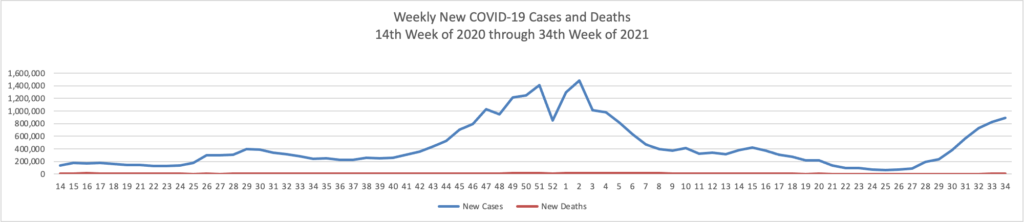
Based on the Centers for Disease Control’s COVID-19 Data Tracker website, here is the FEHBlog’s chart of new weekly COVID-19 cases and deaths over the 14th week of 2020 through 24th week of this year (beginning April 2, 2020, and ending June 16, 2021; using Thursday as the first day of the week in order to facilitate this weekly update):

and here is the CDC’s latest overall weekly hospitalization rate chart for COVID-19:

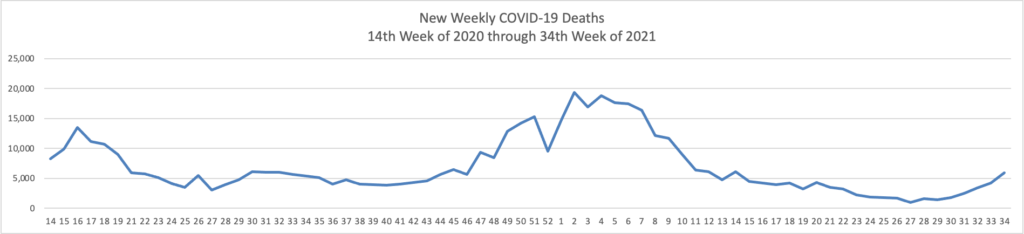
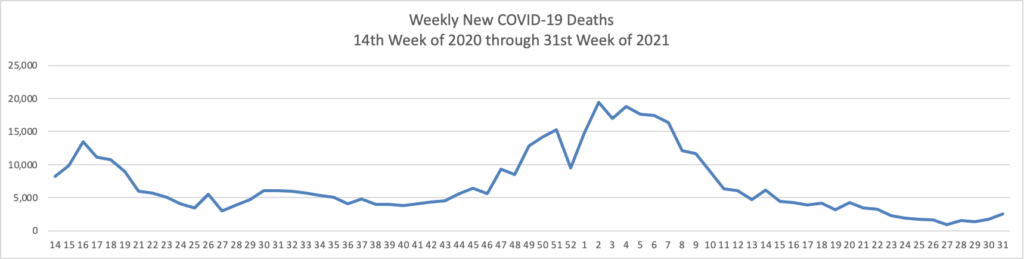
The FEHBlog has noticed that the new cases and deaths chart shows a flat line for new weekly deaths because new cases materially exceed new deaths. Accordingly here is a chart of new COVID-19 deaths over the period (April 2, 2020, through June 16, 2021):

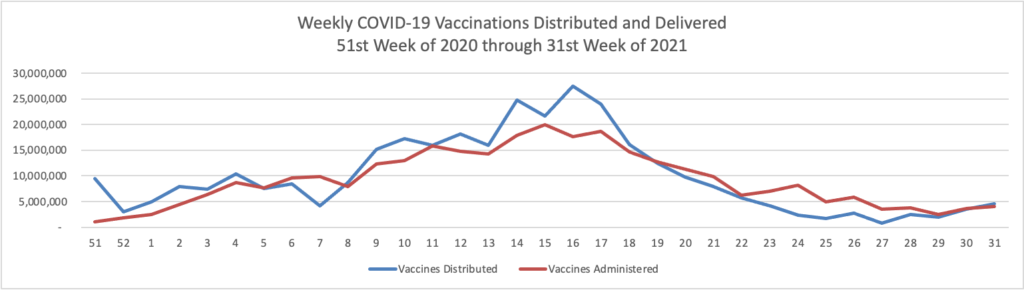
Finally here is a COVID-19 vaccinations chart over the period December 17, 2020, through June 16, 2021 (six months) which also uses Thursday as the first day of the week:

Bloomberg reports that

President Joe Biden urged unvaccinated Americans to get inoculated from coronavirus, warning that the highly transmissible delta variant of the virus could cause more deaths. “Even while we are making incredible progress [as reflected above], it remains a serious and deadly threat,” Biden said Friday during a White House event to celebrate 300 million doses of vaccine administered during the first 150 days of his administration.“The data is clear: If you are unvaccinated, you’re at risk of getting seriously ill, or dying, or spreading it.” A large swath of Americans — particularly in the politically conservative South — have declined shots despite warnings from health authorities that the virus remains a threat.”

in other COVID-19 news

  • Medscape informs us that “While the investigation into cases of myocarditis possibly associated with COVID vaccines proceeds, the American Heart Association (AHA)/American Stroke Association (ASA) continue to urge everyone who is eligible for the vaccine to get it without delay. ‘We remain confident that the benefits of vaccination far exceed the very unusual risks,’ the leadership of the AHA/ASA said in a statement issued June 12. ‘The risks of COVID-19 infection include its potentially fatal consequences and the potential long-term health effects that are still revealing themselves, including lingering consequences affecting the heart, brain, vascular system, and other organs after infection,’ they point out. Late last week, the Centers for Disease Control and Prevention (CDC) alerted healthcare providers that the COVID-19 Vaccine Safety Technical Work Group (VaST) of the Advisory Committee on Immunization Practices (ACIP) will meet June 18 to review cases of myocarditis reported in adolescents and young adults after they received a COVID-19 vaccine manufactured by Pfizer–BioNTech or Moderna.
  • MedPage Today reports that “During the American Medical Association (AMA) House of Delegates annual meeting, members debated whether natural immunity or previous infection with SARS-CoV-2 was sufficient for the merit of immunity credentials.” The House of Delegate voted against treating natural immunity as equivalent to vaccination. “Multiple delegates pointed out that using natural immunity in lieu of vaccination would pit the AMA’s recommendations against those of the CDC.” Nevertheless as the Mayo Clinic points out, natural immunity helps us achieve some level of herd immunity. It needs to be considered with vaccinations for that purpose.

If you want more details on yesterday’s Affordable Care Act decision from the U.S. Supreme Court, check out Prof. Katie Keith’s post in the Health Affairs blog.

Beckers Hospital News lists seven Fortune 500 health insurers by membership. Health Payer Intelligence discusses the latest sustainability report from the company that tops this list, UnitedHealth Group.

On this Juneteenth holiday, Fierce Health tells us about how “healthcare executives call on President Biden to take ‘innovative, bold’ steps to tackle health equity using AI, big data.”

“It’s not a lack of data—we have so much data in this country now, in our healthcare systems and our EHRs and our patient registration systems,” Cole said. “The data is there but the analytics capability of that—what to do with that data—is something that we’re continuing to work on every day.”

Cole and John Lumpkin, M.D., president of the Blue Cross and Blue Shield of North Carolina Foundation, said both of their organizations have been reworking their collection and organization of race, ethnicity, gender identity and other related data tied to health inequity—a change that “should be a very simple thing to do” but requires an internal data system overhaul, Lumpkin said.

Still, executives said the finish line of those efforts is worthwhile. Incorporating SDOH data can yield substantial health and costs benefits at the individual and population levels, they said.

The Wall Street Journal reports on the rising fortunes of the country’s major pharmacy chains, CVS Health and Walgreens.

In health system merger news —

  • Healthcare Dive informs us that “Beaumont Health and Spectrum Health are looking to merge in a deal that would result in Michigan’s biggest health system with 22 hospitals and 64,000 employees across the state, with combined annual revenue of almost $13 billion. Executives of the two systems announced Thursday they have signed a letter of intent to explore creating a joint health system. The deal would include Spectrum’s Michigan-based health insurance plan, Priority Health, which has 1.2 million customers.”
  • Fierce Healthcare reports that “Southern health systems Ochsner Health and Rush Health Systems have announced plans for a merger they expect to be completed about halfway through 2022. The deal follows a 2019 strategic partnership between the two nonprofit providers and comes hot on the heels of Louisiana-based Ochsner’s merger with Lafayette General Health, which closed in October 2020 and grew the system to 35 hospitals. Rush, which has seven hospitals and more than 30 clinics in eastern Mississippi and western Alabama, will be rebranded as Ochsner Rush Health should the merger receive regulatory approval.”
  • Healthcare Dive also tells us that “Tenet, a major U.S. health system, has agreed to sell five hospitals in the Miami-Dade area for $1.1 billion to Steward Health Care System, a physician-owned hospital operator and health network. The deal also includes the hospitals’ associated physician practices. Dallas-based Steward has agreed to continue using Tenet’s revenue cycle management firm, Conifer Health Solutions, following the completion of the deal, which is expected to close in the third quarter. Further underscoring Tenet’s strategic focus, the sale will not include Tenet’s ambulatory surgery centers in Florida. Tenet will hold onto those assets as its ambulatory business becomes a bigger focus for the legacy hospital operator.”

Midweek Update

Photo by Dane Deaner on Unsplash

The Senate took no action on Kiran Ahuja’s nomination to be OPM Director today as Senators Booker and Peters remain out of pocket due to family illnesses.

On the hospital front —

  • The Advisory Board informs us about U.S. News and World Reports most recent rankings of children’s hospitals.
  • Axios reports that “Some of the hospitals with the highest revenue in the country also have some of the highest prices, charging an average of 10 times more than the actual cost of the care they deliver, according to new research by Johns Hopkins University provided exclusively to Axios.”

On the mental healthcare front, we have two articles on start- up companies from Katie Jennings in Forbes. One concerns Burlingame, Calif.-based Lyra Health and the other concerns “Lifestance Health Group, one of the nation’s largest outpatient mental health providers.” Check them out.

On the prescription drug front —

  • Healthcare Dive reports that “Anthem, one of the biggest U.S. payers, has joined an initiative to create low-cost generic drugs for hospital and retail pharmacies. The initiative CivicaScript, a subsidiary of hospital-owned nonprofit drugmaker Civica Rx, plans to initially develop and manufacture six to 10 common but pricey generic medicines that don’t have enough market competition to drive down cost, officials said Wednesday. The first generics could be available as early as 2022.”
  • Fierce Pharma informs us that “Antibody treatments have shown little success in helping COVID-19 patients with  severe disease. But a large [UK] study of hospitalized patients reveals that Regeneron’s antibody cocktail can reduce the chance of death in patients who haven’t produced their own antibody responses to the disease.”
  • STAT News interviews the Alzheimer Association’s CEO about the newly approved drug Aduhelm.

In miscellaneous news

  • The Wall Street Journal reportsApple Inc. Chief Executive Tim Cook has said the company’s greatest contribution to mankind will be in health. So far, some Apple initiatives aimed at broadly disrupting the healthcare sector have struggled to gain traction, according to people familiar with them and documents reviewed by The Wall Street Journal.”
  • Healthcare Dive tells us that “A University of Pennsylvania study that tracked Medicare claims for about 1.35 million beneficiaries who had joint replacement surgery found that hospitals participating in bundled payment programs spent less on the hip and knee joint procedures than hospitals receiving traditional fee-for-service payments. Spending, however, did not differ between hospitals that voluntarily joined bundling programs and those whose involvement was mandatory, according to the findings, which were published in a JAMA research letter. The results failed to validate assumptions that voluntary participants tend to achieve greater savings because they choose programs for the opportunity to reduce spending. The findings come as the head of the Center for Medicare and Medicaid Innovation, Elizabeth Fowler, suggested the agency would look to shift away from voluntary arrangements in favor of more mandatory models.”
  • Fierce Healthcare informs us that “The Centers for Disease Control and Prevention (CDC) released new interim guidance late Monday for healthcare providers treating patients with post-COVID conditions—an umbrella term the agency is using to capture a wide range of physical and mental health issues that sometimes persist four or more weeks after an individual’s COVID-19 infection. Sometimes referred to as “long COVID,” the conditions can present among COVID-19 patients regardless of whether they were symptomatic during their acute infection, the agency wrote in the guidance.”

Monday Roundup

Thanks to Aaron Burden for sharing their work on Unsplash.

Happy Flag Day!

According to the U.S. Senate Press Gallery, sometime after 11:30 am tomorrow morning, the Senate will hold a cloture vote on Kiran Ahuja’s nomination to be OPM Director. If the cloture vote receives majority approval (assuming a quorum exists), then the Senate will vote to confirm Ms. Ahuja’s nomination sometime after 2:30 pm tomorrow.

From the COVID-19 front

  • MedPage Today reports that “While experience so far with COVID vaccines shows that some are associated with very rare, early side effects, experts say they have confidence about the long-term safety of these vaccines. That’s because past experience shows that severe side effects from vaccines most often appear within a time frame of about 6 weeks after vaccination, according to Paul Offit, MD, director of the Vaccine Education Center at Children’s Hospital of Philadelphia and a member of the FDA’s Vaccines and Related Biological Products Advisory Committee (VRBPAC).”
  • Bloomberg reports that “Covid-19 vaccines from Pfizer Inc. and AstraZeneca Plc are highly effective after two doses at preventing hospitalization of those infected with the delta variant, underscoring the urgency in getting people fully protected, according to health authorities in England.” David Leonhardt adds in the New York Times that

The news about Covid-19 has been mostly positive in the U.S. over recent months. The vaccines continue to work well against every variant, and the number of Americans who have gotten a shot continues to rise.

But the U.S. still faces two problems. First, the pace of vaccinations has slowed, and a substantial share of Americans — close to one third — remains hesitant about getting a shot. These unvaccinated Americans will remain vulnerable to Covid outbreaks and to serious symptoms, or even death.

Second, the Delta variant — which appears to be both more contagious and more severe than earlier versions of the virus — is spreading rapidly within the U.S., after having first been identified in India. It now accounts for about 10 percent of cases, according to Dr. Scott Gottlieb, a former F.D.A. commissioner. * * *

“The Delta variant is by far the most contagious variant of this virus we have seen in the entire pandemic,” Dr. Ashish Jha saidyesterday. “The good news is the data suggests that, if you’ve been fully vaccinated, you remain protected, that the vaccines hold up.”

The clearest place to see this pattern is Britain, where the Delta variant has spread widely and where the vaccination rate is high. In Britain, there is “still no sign of increase in deaths, well after the strain has become dominant,” as Dr. Eric Topol of the Scripps Research Translational Institute noted.

Vaccine maker Novavax said Monday its shot was highly effective against COVID-19 and also protected against variants in a large, late-stage study in the US and Mexico.

The vaccine was about 90 percent effective overall and preliminary data showed it was safe, the company said.

While demand for COVID-19 shots in the US has dropped off dramatically, the need for more vaccines around the world remains critical. The Novavax vaccine, which is easy to store and transport, is expected to play an important role in boosting vaccine supplies in the developing world.

That help is still months away, however. The company says it plans to seek authorization for the shots in the US, Europe and elsewhere by the end of September and be able to produce up to 100 million doses a month by then.

  • The Department Health and Human Services announced that it has “awarded $125 million to support 14 nonprofit private or public organizations to reach underserved communities in all 50 states plus the District of Columbia, Puerto Rico, Guam and the Freely Associated States to develop and support a community-based workforce that will engage in locally tailored efforts to build vaccine confidence and bolster COVID-19 vaccinations in underserved communities.”

Fierce Healthcare reports that

Following its acquisition of MDLive and the approval of new drugs in the market, Cigna’s Evernorth is expanding its care management program for weight loss.

The Weight Management Care Value program initially launched under Express Scripts as part of its slate of SafeGuardRx programs. Now, the company is harnessing the capabilities of other assets under its umbrella to broaden the program.

Members who enroll in the program will have access to new therapies like Novo Nordisk’s Wegovy, when clinically appropriate and prescribed by their doctor, as well as virtual care options provided by MDLive.

Here are two more OPM rule makings that were listed in OPM’s semi annual regulatory agenda that was released last Friday June 11

  • OPM has in store for us a new proposed rule on FEHB Enrollment and Changes in Enrollment “The Office of Personnel Management (OPM) proposes to amend title 5 part 890 of the Code of Federal Regulations governing the Federal Employees Health Benefits (FEHB) Program to allow OPM to make improvements and clarifications to the FEHB Program’s enrollment rules and processes, including centralizing certain health benefits enrollment functions. Currently, enrollment is administered by an enrollee’s employing agency or retirement system. This rule would allow OPM to leverage necessary IT functionality in order to conduct certain enrollment functions and collect information necessary to administer FEHB enrollments with greater efficiency and in alignment with the best practices of employer-sponsored insurance programs. In addition, OPM is proposing a process that would allow an employing office or OPM to decrease an individual’s enrollment type from self plus one or self and family to self only when there is only an enrollee and no family member.”
  • OPM plans to issue an interim final rule extending FEHB coverage to Tribal employees at 297 grant schools in accordance with the Consolidated Appropriations Act. This action suggests that the extension will take effect for the next Federal Benefits Open Season