The FEHBlog noticed today that OPM has posted the agenda for its annual FEHB Carrier Conference which AHIP co-hosts. While the agenda includes many hot topics, the FEHBlog is surprised that new FEHB Act Section 8902(p) / the No Surprises Act is not highlighted on the agenda.
From the COVID-19 front —
The Centers for Disease Control’s daily report on COVID-19 vaccinations in the U.S. reports that that over 150 million doses have been delivered.
Pfizer and BioNTech announced that “in [study] participants aged 12-15 years old, [their two dose COVID-19 vaccine] BNT162b2 demonstrated 100% efficacy and robust antibody responses, exceeding those reported in trial of vaccinated 16-25 year old participants in an earlier analysis, and was well tolerated. The companies plan to submit these data to the U.S. Food and Drug Administration (FDA) and the European Medicines Agency (EMA) as soon as possible to request expansion of the Emergency Use Authorization (EUA) and EU Conditional Marketing Authorization for BNT162b2.” This is good news for the next school year. Testing on younger children continues.
The Wall Street Journal reports that “Pregnant women who get the coronavirus vaccine pass their antibodies on to their newborns, recent studies suggest, a promising sign that babies can acquire from their mothers some protection against Covid-19. At least three studies have found that women who received either the Pfizer Inc. –BioNTech SE vaccine or the Moderna Inc. shots during pregnancy had coronavirus antibodies in their umbilical-cord blood. That indicates the women’s babies got the antibodies, too. * * * Pregnant women are at higher risk of a severe case of Covid-19 and of preterm delivery if they are infected. The studies’ findings, though preliminary, suggest women could safely protect themselves and their newborns by getting vaccinated.
Health Payer Intelligence explains “How Payers Are Involved in Boosting COVID-19 Vaccine Confidence — Payers are targeting coronavirus vaccine confidence through collaborations, marketing tools, and incentive programs.”
The National Institutes of Health announced that “The Centers for Disease Control and Prevention (CDC), in collaboration with NIH, has launched an innovative community health initiative called “Say Yes! COVID Test” starting in Pitt County, North Carolina, and coming soon to Chattanooga/Hamilton County, Tennessee. As many as 160,000 residents across the two communities will have access to free, rapid antigen tests that they can administer themselves to use three times a week for one month. NIH will provide the tests (also called a home-test or at-home test) and evaluate the effectiveness of the initiative, which aims to determine if frequent self-administered COVID-19 testing helps residents reduce community transmission of SARS-CoV-2, the virus that causes COVID-19 disease.”
And from the survey front —
The International Foundation of Employee Benefit Plans released its “2020 Employee Benefits Survey [which] provides benchmarking data on their health care offerings, covered dependents, plan funding, dental and orthodontia benefits, prescription drug offerings and other benefits.”
Becker’s Hospital Review identifies two dozen health care facilities that offer care to long haul COVID-19 patients.
From Capitol Hill, the American Hospital Association gleefully reports that “The Senate today passed by 90-2 vote a bill that, among other health care provisions, would eliminate the 2% across-the-board cut to all Medicare payments, known as sequestration, until the end of 2021. To pay for the change, the bill, which was introduced by Sens. Jeanne Shaheen, D-N.H., and Susan Collins, R-Maine, would increase the fiscal year 2030 sequester cuts. The House is expected to take up the Senate-passed bill when it the week of April 13 when it returns to Washington D.C.”
The U.S. Office of Personnel Management announced six political appointments to the agency which do not require Senate confirmation. Good luck to them.
From the COVID-19 front, the Wall Street Journal observes
In many ways, AstraZeneca, which developed the vaccine in partnership with the University of Oxford, is delivering on its main promises. More than 70 countries, including the U.K. and much of the rest of Europe, have found the shot safe and effective. Although it isn’t a big player in vaccines, AstraZeneca helped make an experimental shot ready for mass use in less than a year. The company has built a manufacturing and distribution network that is delivering doses to the world’s poorest. Unlike most of its big competitors with vaccines or vaccine candidates, it has promised to do all this at no profit. The vaccine has been crucial to the U.K. drive that boasts one of the world’s best per-capita vaccination rates.
But at crucial moments, company executives have fumbled communications with governments, regulators and the public. That has left a reputational cloud over the vaccine effort—an effort that Dr. Soriot has said reflects the company’s desire to play a leading role in battling the pandemic.
The reverse — good public relations by a bad actor — would be a much worse situation. The FEHBlog hopes that the Food and Drug Administration does not delay emergency use authorization for the AstraZeneca vaccine.
Also from the COVID-19 front today, the Centers for Medicare and Medicaid Services issued a fact sheet on the value of monoclonal antibodies (mAb) treatment for high risk Covid-19 positive patients.
mAb treatment for COVID-19 is different from a COVID-19 vaccine. A vaccine triggers your body’s natural immune response, but can take weeks to develop enough antibodies and prevent some kinds of infection. Some vaccines for COVID-19 require two shots, so your body can develop its own immune response to the disease. But if you already have the virus, mAb treatment gives your body the antibodies it needs to protect itself.
Anthem is planning to acquire myNEXUS, a company that manages home-based nursing services for insurers.
According to the announcement, myNEXUS provides support to 1.7 million Medicare Advantage members across 20 states. The company’s platform largely automates the visit and authorization, getting care to the member faster, they said.
MyNEXUS uses a digital analytics tool in tandem with a team of more than 250 clinicians to plan and optimize home care, the companies said. In addition, it works with a nationwide network of providers and nursing agencies for local care.
Healio reports that at “the Renal Physicians Association annual meeting, representatives from three companies [led by CVS Health] shared their approach to the changing paradigm of kidney care and emphasized the shift to value-based models that center on the patient.”
Electronic prior authorization (ePA) can significantly reduce the time between a request for prior authorization and a decision and the time to a patient receiving care. These were two of the top findings from an initiative launched by America’s Health Insurance Plans (AHIP) to better understand the impact of ePA on the prior authorization process.
“Prior authorization is an important tool in helping patients receive safe, effective, clinically appropriate care,” said Kate Berry, Senior Vice President of Clinical Affairs at AHIP. “We are always looking for ways to enhance the patient and provider experience, and electronic prior authorization is an example. Today’s analysis provides a blueprint for how to leverage electronic tools to improve prior authorization.”
AHIP launched the Fast Prior Authorization Technology Highway—or Fast PATH—to better understand how electronic prior authorization could impact the process for patients and providers. Six health insurance providers—Blue Shield of California, Cambia Health Solutions, Cigna, Florida Blue, Humana, and WellCare (now Centene)—that collectively cover over 50 million Americans participated in the project, with Availity and Surescripts serving as the technology partners.
Bravo.
Health Payer Intelligence informs us that “Payers should prepare for the payer price transparency rule to go into effect by building clear communication paths with members, reassessing their contracting processes, and asking themselves a couple of key questions, according to a report from PricewaterhouseCoopers’s Health Research Institute (HRI).” Check it out.
The big news today is Astra Zeneca’s announcement that its two dose COVID-19 vaccine “demonstrated statistically significant vaccine efficacy of 79% at preventing symptomatic COVID-19 and 100% efficacy at preventing severe disease and hospitalisation.
This interim safety and efficacy analysis was based on 32,449 participants accruing 141 symptomatic cases of COVID-19. The trial had a 2:1 randomisation of vaccine to placebo.
Vaccine efficacy was consistent across ethnicity and age. Notably, in participants aged 65 years and over, vaccine efficacy was 80%.
The vaccine was well tolerated, and the independent data safety monitoring board (DSMB) identified no safety concerns related to the vaccine. The DSMB conducted a specific review of thrombotic events, as well as cerebral venous sinus thrombosis (CVST) with the assistance of an independent neurologist. The DSMB found no increased risk of thrombosis or events characterised by thrombosis among the 21,583 participants receiving at least one dose of the vaccine. The specific search for CVST found no events in this trial.
Ann Falsey, Professor of Medicine, University of Rochester School of Medicine, US, and co-lead Principal Investigator for the trial, said: “These findings reconfirm previous results observed in AZD1222 trials across all adult populations but it’s exciting to see similar efficacy results in people over 65 for the first time. This analysis validates the AstraZeneca COVID-19 vaccine as a much-needed additional vaccination option, offering confidence that adults of all ages can benefit from protection against the virus.”
Mene Pangalos, Executive Vice President, BioPharmaceuticals R&D, said: “These results add to the growing body of evidence that shows this vaccine is well tolerated and highly effective against all severities of COVID-19 and across all age groups. We are confident this vaccine can play an important role in protecting millions of people worldwide against this lethal virus. We are preparing to submit these findings to the US Food and Drug Administration and for the rollout of millions of doses across America should the vaccine be granted US Emergency Use Authorization [EUA”].”
Typically these trial result announcements have been made a week or two submission of the EUA application to the FDA and then the FDA takes two to three weeks to approve the application. Consequently, it appears that a fourth COVID-19 vaccine will be online in mid-to-late April.
AstraZeneca Plc may have released outdated information about its Covid-19 vaccine trial, giving an “incomplete” view of the efficacy of the shot, said the leading U.S. agency on infectious diseases.
The Data and Safety Monitoring Board, charged with ensuring the safety and accuracy of AstraZeneca’s vaccine trial, has expressed concerns to the National Institute for Allergy and Infectious Diseases that the information released about the testing results included outdated information.
This “may have provided an incomplete view of the efficacy data,” the agency said in a statement early Tuesday, without elaborating.
“We urge the company to work with the DSMB to review the efficacy data and ensure the most accurate, up-to-date efficacy data be made public as quickly as possible,” said the group headed by Anthony Fauci, the top U.S. infectious disease official.
Astra Zeneca needs this news like it needed a hole in the head as one of the FEHBlog’s grandmothers would say.
The Centers for Disease Control offers guidance on how to talk about COVID-19 vaccines with friends and family. The FEHBlog’s general advice is simply get it. The key consideration is that all three available vaccines as well as the Astra Zeneca vaccine have 100% efficacy on preventing severe hospitalization or death from COVID-19.
The Hill reports that the Senate confirmed by a 68-29 vote the President’s nomination of Boston Mayor Marty Walsh to be Secretary of Labor. This is an important position with respect to the Affordable Care Act and ERISA as well as labor affairs.
The CMS interoperability rule addresses admission, discharge, and transfer (ADT) notifications. Providers need to fulfill a CMS condition of participation that will require all healthcare facilities to send outbound event notifications by May 2021.
All healthcare facilities must send direct electronic notifications to a patient’s provider once the patient is admitted, discharged, or transferred from another facility.
Health information exchanges are in a prime position to help prepare their clients accordingly.
This is a nifty idea, but why not give electronic notice to the health plan too?
In its latest call letter for FEHB carrier benefit and rate proposals, OPM encouraged carriers to pay attention to controlling low value care. Health Payer Intelligence discusses a relevant JAMA Open Network study finding that “there are at least 13 areas of low-value care in which Medicare Advantage and Medicare alike are not reducing healthcare spending,” among them, “antibiotics for acute upper respiratory infection, antibiotics for influenza, anxiolytic, sedative, or hypnotic medication, benzodiazepine for depression, an opioid for headache, an opioid for back pain, nonsteroidal anti-inflammatory drug (NSAID) for hypertension, heart failure, or kidney disease, radiograph for back pain, and MRI or CT for back pain or for headaches.”
From the healthcare innovation front —
Health IT Analytics informs us that “Statistical suicide risk prediction models could be implemented cost-effectively in healthcare organizations and may help save many lives each year, according to a study published in JAMA Psychiatry.”
mHealth Intelligence reports that “Researchers at the University of Cincinnati are developing a small drone, that, equipped with telehealth tools, can enter a house to facilitate virtual visits, drop off or pick up supplies, even survey living conditions.”
From the “Big Bowl of Wrong” front, the Wall Street Journal reports that “Hospitals that have published their previously confidential prices to comply with a new federal rule have also blocked that information from web searches with special coding embedded on their websites, according to a Wall Street Journal examination.” Yet, nn the bright side “After the Journal approached hospitals about its findings, the search-blocking code was removed from sites including those of HCA, Penn Medicine and Beaumont, and of South Dakota-based Avera Health, Tennessee-based Ballad Health, Maine’s Northern Light Health and Gundersen Health System in Wisconsin.” Good job Journal.
Congress in a recent appropriations law sought a report from the National Academy for Public Administration on the Trump Administration’s proposal to break up the Office of Personnel Management. The Federal Times reports that “A better federal workforce policy will require the Office of Personnel Management to become a more independent and authoritative agency, rather than being broken apart into other departments, a long-awaited National Academy for Public Administration study determined March 17. ”
“We strongly recommend that a central personnel agency continue to exist, and that organization is an independent, enterprise-wide human capital agency and a steward of the merit system principles,” said Terry Gerton, president and CEO of NAPA, said at a press briefing on the report. “But that organization, OPM as we know it today, really needs to build its staff capacity, encourage innovation and adopt a more data-driven, accountable and forward-looking capital management approach.”
In other federal agency news, the Federal News Network informs us that
The IRS is moving this year’s April 15 tax filing season deadline back to May 17, citing ongoing challenges from the COVID-19 pandemic. IRS Commissioner Chuck Rettig said in a statement Wednesday that the new deadline would give the public more time to take stock of their finances, while also giving agency employees more time to implement new responsibilities under the American Rescue Plan.
The Department of Health and Human Services announced today that the agency
will invest $10 billion from the American Rescue Plan to ramp up screening testing to help schools reopen, $2.25 billion to scale up testing in underserved populations, and provide new guidance on asymptomatic screening testing in schools, workplaces, and congregate settings. These measures are part of President Biden’s strategy to increase COVID-19 testing nationwide as vaccinations increase.
“COVID-19 testing is critical to saving lives and restoring economic activity,” said HHS Acting Secretary Norris Cochran. “As part of the Biden Administration’s National Strategy, HHS will continue to expand our capacity to get testing to the individuals and the places that need it most, so we can prevent transmission of the virus and defeat the pandemic.”
The U.S. Preventive Services Task Force announced yesterday a proposed B grade recommendation “on screening for prediabetes and type 2 diabetes. The Task Force recommends screening adults between ages 35 to 70 years old who are overweight or obese for prediabetes and diabetes.” The current minimum age for this screening recommendation is 40 years old. NBC News reports that
We know the rates of prediabetes and diabetes are increasing in people who are younger,” said Dr. Chien-Wen Tseng, a task force member and a professor of family medicine at the University of Hawaii’s John A. Burns School of Medicine. “Our main reason for dropping the age is to match the screening with where the problem is: If diabetes and prediabetes are occurring at a younger age, then we should be screening at a younger age.”
The Affordable Care Act requires health plans to cover USPSTF A and B recommended preventive services without member cost sharing when an eligible member receives the service in-network. If the USPSTF finalizes this recommendation later in 2021, then the ACA health plan coverage mandate for this screening would expand to people in the age 35 to 40 age group in 2023. Here is a link to background on the USPSTF’s sixteen members.
Amazon is expanding its virtual care pilot program, Amazon Care, to employees and outside companies nationwide beginning this summer in a major evolution of its telehealth initiative, as the COVID-19 pandemic continues to drive unprecedented demand for virtual care.
Amazon will also offer its on-demand primary care service to other Washington state-based companies and plans to expand its in-person service to Washington, D.C., Baltimore and other cities in the following months, the e-commercebehemoth announced Wednesday.
Employee Benefit News offers a Chief Financial Offer’s advice on health savings account funding.
The Senate Homeland Security and Governmental Affairs Committee will be holding a hearing on “Understanding and Responding to the SolarWinds Supply Chain Attack: The Federal Perspective” on Thursday March 18.
Speaking of which, Bleeping Computer reports that as of March 11, 2021 “CISA officials said that, so far, there is no evidence of US federal civilian agencies compromised during ongoing attacks targeting Microsoft Exchange servers. This statement is based on information collected by federal agencies following an emergency directive issued by the US Cybersecurity and Infrastructure Security Agency (CISA) one week ago.”
Following up on this story, Cyberscoop reports that
Suspected Chinese government-linked hackers were the first to allegedly exploit the Microsoft vulnerabilities. As soon as the company released a fix for the bugs, though, taking the issue public, a range of other hacking groups also appeared to try leveraging the flaws. At least ten different advanced threat groups are working to exploit the vulnerabilities now, according to ESET research, while other hackers have stolen email data and others have tried to generate financial revenue.
But with such a large list of victims — 30,000 organizations in the U.S. alone, according to some estimates — and so many attackers trying to leverage the flaws, there is little hope for cybersecurity professionals and affected entities to keep up with the sheer volume of exploits and attackers pummeling them, analysts say. In addition to patching the holes in Microsoft technology, organizations should also be working to evict hackers from their networks, and remain on alert for data theft, credential theft and other potentially damaging follow-up attacks. Security analysts also are warning that the flaws could open the pathway for ransomware attacks, meaning that if organizations fail to act now, it could cost them later.
Here is a link to the latest CISA remedial guidance on the Microsoft vulnerabilities.
Over the last several days, Allison Nixon, the chief research officer at cybersecurity consulting firm Unit 221B, rounded up her team to develop a website that would help alert organizations if they’ve been comprised.
The Unit 221B website is designed so users can search to see if they are using compromised Exchange servers with Outlook Web Access (OWA) enabled. Users can go to the site, which launched Tuesday, directly from their Exchange server, which will allow Unit 221B to check their IP address against their victim list. Victims will then be alerted if they are compromised and if the attackers loaded webshells, a malicious tool used to establish a foothold inside targets, Nixon says.
Creating a data backup is one of the most crucial steps that organizations can take right now to protect themselves, Nixon said. Organizations that don’t make a backup of their servers but that do get hit with a ransomware attack, in which hackers lock up their machines and extort them for money, run the risk of losing their businesses entirely, Nixon warned. “It doesn’t matter if they don’t have a regular backup program, or they don’t have a fancy IT team — they just need to take a copy of their servers … put it on a hard drive, put it it in a safe: A one-time thing this week,” Nixon said.
In federal personnel news, Nextgov informs us that the U.S. Office of Personnel Managements chief information officer (CIO) Clare Martorana has been named the federal government’s CIO. Congratulations to her. OPM Principal Deputy CIO Guy Cavallo will serve as acting CIO until a permanent replacement is named, an OPM spokesperson told Nextgov.
The President signed the American Rescue Plan (H.R. 1319) into law today.
Mercer provides a useful overview of the provisions of the law affecting employers. The COBRA subsidy discussed in the article does not apply to the temporary continuation coverage applicable to federal and postal employees. The COBRA subsidy in any event is only available to employees who lost health coverage due to involuntary termination of employment or reduction in hours.
On the bright side, the new law “increases the income exclusion for employer-provided dependent care assistance programs — for example, employee pretax contributions to dependent care FSAs — from $5,000 to $10,500 (and from $2,500 to $5,250 for a married individual filing a separate return) for 2021.” The FEHBlog expects that OPM will adopt this FSA change because the dependent care FSA is fully funded by the employee with no insurance risk to the employer.
Katie Keith in Health Affairs digs into the law’s financial support for the Affordable Care Act marketplace and its beneficiaries.
From the COVID front —
The White House has announced that the Biden administration will seek to “make every adult in the U.S. eligible for vaccination no later than May 1.” This fact sheet explains that steps that will be taken to make good on that plan. The FEHBlog believes that this is an achievable goal.
David Leonhardt in the New York Times offers an interesting take on herd immunity from COVID-19. He explains that
Herd immunity is more like a light dimmer. The more people develop immunity — either from having been infected or from being vaccinated — the less easily the virus will spread.
Nearly 30 percent of Americans have now had the virus, according to Youyang Gu, a data scientist. (That includes many people who have never taken a Covid test.) About 18 percent have received at least one vaccine shot. There is some overlap between these two groups, which means that about 40 percent of Americans now have some protection from Covid.
Had these people been exposed to the virus a year ago, they could have become infected — and then spread Covid to others. Today, many are protected.
What’s more Mr. Leonhardt’s first dose of vaccination figure (18%) reflects the total U.S. population. However the vaccines generally are available only to people over 18 years of age. The Centers for Disease Control reports today that 25.1% of that population has received at least one dose of a COVID-19 vaccine. The FEHBlog nearly fell off his share today when he noticed a new statistic on the CDC site showing that 62.4% of the U.S. population over age 65 has received at least one dose of a COVID-19 vaccine. That’s great news.
In legislative / regulatory news —
Healthcare Dive reports that Xavier Becerra will soon receive a Senate floor vote on his nomination to serve as Secretary of Health and Human Services.
Govexec reports that “Postmaster General Louis DeJoy will soon request a $40 billion investment into the cash-strapped U.S. Postal Service for organizational and workforce improvements, saying the money will help address longstanding challenges the mailing agency faces. The funds would go toward infrastructure updates such as larger facilities and new package sortation equipment, DeJoy told a panel of the House Appropriations Committee on Thursday [March 11], and reducing turnover in the USPS workforce.”
Healthcare Dive also discusses hospital pricing information that has been gleaned from the online reports required by the federal government’s hospital pricing transparency rule. It’s not pretty.
Congress is session this week for committee and floor business. On Tuesday morning the House Energy and Commerce Committee will hold a hearing on “The Future of Telehealth: How COVID-19 is Changing the Delivery of Virtual Care”
The task of passing a coronavirus relief package now rests with the Senate, where Democrats must grapple with emerging divisions over some components of the plan, including a minimum-wage increase. The House early Saturday morning passed [largely along party lines] President Biden’s $1.9 trillion package, which would fund vaccine distribution, enhance and extend federal unemployment benefits, and send direct checks of $1,400 to many Americans and $350 billion to state and local governments.
As mentioned in last Thursday’s post, the Democrat leadership in Congress is trying to figure out a way for the Senate to pass the entire bill under budget reconciliation which requires all fifty Democrat senators plus the Vice President. The $15 minimum wage provision found in the House bill remains a wild card in the Senate.
The President officially sent Kiran Ahuja’s nomination to be OPM Director to the Senate last Wednesday. Federal News Network forecasts six “challenges” that Ms. Ahuja will need to address once confirmed.
In most excellent news, the Food and Drug Administration gave emergency use authorization to the single dose Johnson and Johnson vaccine yesterday and the Centers for Disease Control seconded this action today. This means that health plans, including FEHB plans, become liable for reimbursing administration costs for the Johnson and Johnson vaccine without member cost sharing in 15 days / March 15, 2021. Per CNN with the blessing of these two agencies
[T]he federal government may then begin distributing the 3.9 million available doses of the vaccine, perhaps as soon as Monday.”I just want to state explicitly how very grateful I am that we now have three highly effective vaccines,” said ACIP member Dr. Matthew Daley of the Institute for Health Research with Kaiser Permanente Colorado.
The company has pledged to have 20 million doses available by the end of March and 100 million doses by summer.The vaccine, made by Johnson & Johnson’s Janssen vaccine arm, can be kept at regular refrigerator temperatures, which experts said would make it much easier to distribute than vaccines made by Moderna and Pfizer/BioNTech.
The Wall Street Journal sums it up for us as follows:
The pandemic has opened a new era for vaccines developed with gene-based technologies, techniques that have long stumped scientists and pharmaceutical companies, suggesting the possibility of future protection against a range of infectious disease.
Johnson & Johnson’s Covid-19 vaccine, which was authorized Saturday for use in the U.S., is at the vanguard of a class of shots designed to mobilize a person’s immune defenses against the disease. It will be the first Covid-19 vaccine administered in the U.S. that uses viral-vector technology, which employs an engineered cold virus to ferry coronavirus-fighting genetic code to the body’s cells.
J&J’s vaccine is the third to be authorized in the U.S. after ones from Pfizer Inc. and its partner, BioNTech SE,and Moderna Inc. In a late-stage trial, J&J’s single-shot vaccine was 66% effective in preventing moderate to severe cases of the disease that has killed more than 500,000 people in the U.S. and about 2.5 million world-wide.
“This is one of those giant leap moments for us. These are fundamental shifts in how we will build vaccines for the future,” said C. Buddy Creech, director of Vanderbilt University’s vaccine research program. “I think this really ushers in a golden age of vaccinology.”
By the way the Centers for Disease Control has created its own COVID-19 vaccine finder website. According to the CDC’s COVID-19 data tracker website, currently nearly 20% of the eligible U.S. population has received at least one dose of the vaccine and 10% have received both doses.
Finally, the Choosing Wisely campaign is offering a information and a webinar that address one of the points in OPM’s recent call letter for 2022 benefit and rate proposals from carriers:
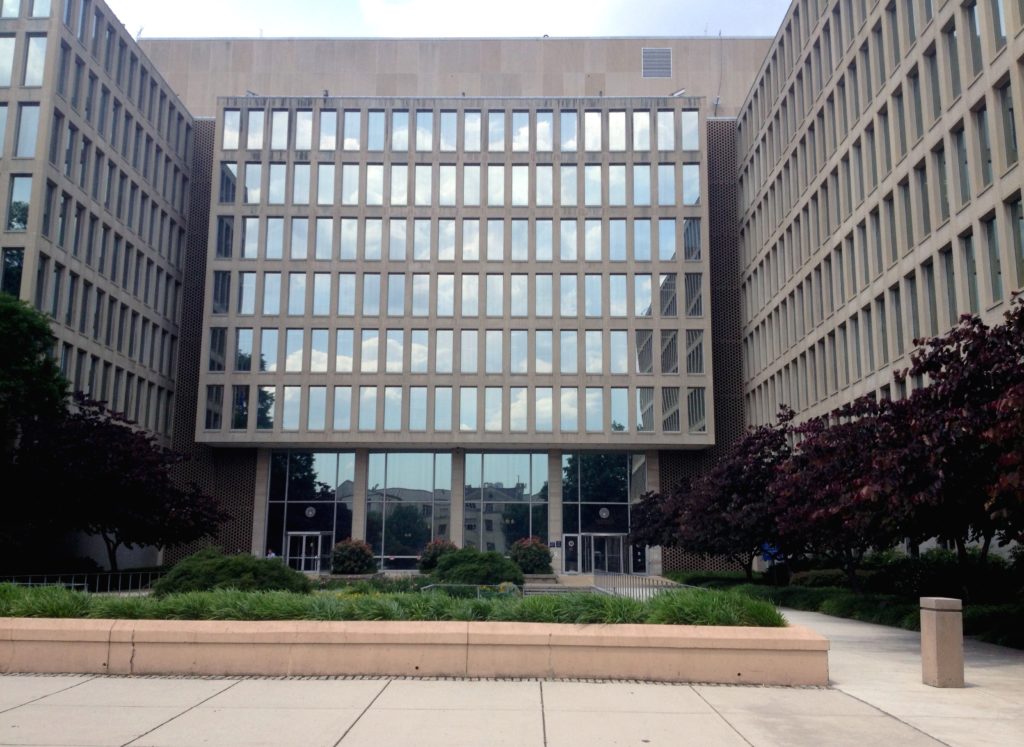
OPM Headquarters a/k/a the Theodore Roosevelt Building
The Federal Times, Govexec, and Federal News Network all report on today’s announcement that the President is nominating Kiran Ahuja to be OPM Director. Ms. Ahuja led the President’s transition review team lead for the agency. “Ahuja has over 20 years of public service and philanthropy experience. She’s currently the CEO of Philanthropy Northwest, and she spent several years as a career civil rights attorney at the Justice Department.” Her nomination is subject to Senate confirmation. In due course, the President also is expected to nominate an OPM Deputy Director and an OPM Inspector General.
Healthcare Dive reports on the first confirmation hearing for the President’s nominee for Secretary of Health and Human Services, Xavier Becerra. Mr. Becerra “told senators on the health committee Tuesday morning he would continue work he did as California attorney general to combat anticompetitive practices in healthcare and go after providers that ‘unfairly jack up prices on patients.'” According to the report, Mr. “Becerra will be back in the hot seat Wednesday for his second confirmation hearing, this one in front of the Senate Finance Committee. That will be the committee voting on whether to send his nomination to the full Senate for a vote.”
Tomorrow, the Senate Homeland Security and Governmental Affairs Committee at 10 am and the Senate Budget Committee at noon each will hold a business meeting on whether to advance to the Senate floor the President’s nomination of Neera Tanden to be Director of the Office of Management and Budget.
Tomorrow at 10 AM, the House Oversight and Reform Committee will hold a hearing on “Legislative Proposals to Put the Postal Service on Sustainable Financial Footing.” The Committee Staff explains in a memorandum,
the Committee will hold a hybrid hearing to review legislative proposals to place the Postal Service on a more sustainable financial footing. The Committee will consider a discussion draft that includes several provisions to relieve the financial burdens under which the Postal Service is currently operating and to enhance transparency regarding performance. That draft is being circulated with this memo. The discussion draft includes provisions on Medicare integration [for Postal annuitants participating along with Postal employees in a separate program within the FEHB] , repealing a requirement for the Postal Service to pre-fund retiree health care, and service performance standards.”
Earlier today, the Oversight and Investigations Subcommittee of the House Energy and Commerce Committee held a hearing on the availability of COVID-19 vaccinations. The hearing featured testimony from executives at the companies manufacturing those vaccines. Fierce Healthcare reports that “Pfizer, Moderna and Johnson & Johnson execs say [at the hearing] they’re working all the angles on increasing COVID-19 vaccine production and expect to amp up weekly deliveries by tens of millions by the end of March.”
In that regard, a friend of the FEHBlog pointed him to this NIH Director’s blog entry released today
For the millions of Americans now eligible to receive the Pfizer or Moderna COVID-19 vaccines, it’s recommended that everyone get two shots. The first dose of these mRNA vaccines trains the immune system to recognize and attack the spike protein on the surface of SARS-CoV-2, the virus that causes COVID-19. The second dose, administered a few weeks later, boosts antibody levels to afford even better protection. People who’ve recovered from COVID-19 also should definitely get vaccinated to maximize protection against possible re-infection. But, because they already have some natural immunity, would just one shot do the trick? Or do they still need two?
A small, NIH-supported study, published as a pre-print on medRxiv, offers some early data on this important question [1]. The findings show that immune response to the first vaccine dose in a person who’s already had COVID-19 is equal to, or in some cases better, than the response to the second dose in a person who hasn’t had COVID-19. While much more research is needed—and I am definitely not suggesting a change in the current recommendations right now—the results raise the possibility that one dose might be enough for someone who’s been infected with SARS-CoV-2 and already generated antibodies against the virus.
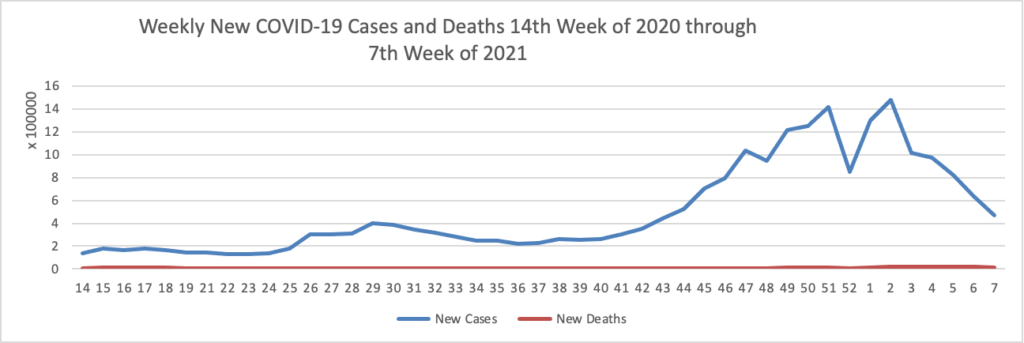
Based on the Centers for Disease Control’s COVID-19 Case Tracker website, here is the FEHBlog’s chart of new weekly COVID-19 cases and deaths over the 14th week of 2020 through the 7th week of this year (beginning April 2, 2020 and ending February 17, 2021; using Thursday as the first day of the week in order to facilitate this weekly update):
and here is the CDC’s latest overall weekly hospitalization rate chart for COVID-19:
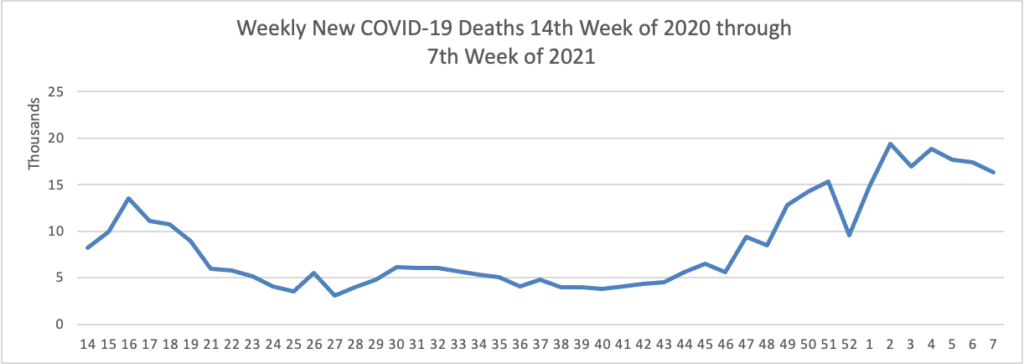
The FEHBlog has noticed that the new cases and deaths chart shows a flat line for new weekly deaths because new cases greatly exceed new deaths. Accordingly here is a chart of new COVID-19 deaths, which is a lagging indicator, over the period (April 2, 2020 through February 17, 2021):
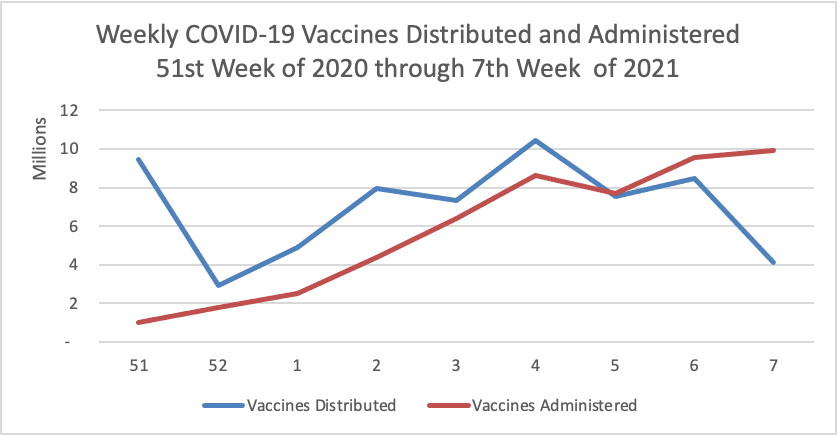
Finally here is a COVID-19 vaccinations chart for the past month which also uses Thursday as the first day of the week:
Efforts to vaccinate the world’s population against Covid-19 got a boost Friday after research showed that some vaccines provide strong, one-dose protection, and that one of the vaccines can now be stored in normal freezers instead of ultra-cold ones.
The vaccine developed by Pfizer Inc. and BioNTech SE generates robust immunity after one dose, according to new research out of Israel, and further data showed that the University of Oxford and AstraZeneca PLC vaccine similarly prevented Covid-19 when doses were spaced three months apart.
The findings could boost arguments in favor of delaying the second dose of the two-shot vaccine, as the U.K. has done. They could also have substantial implications on vaccine policy and distribution around the world, simplifying the logistics of distribution.
Pfizer and BioNTech said they have asked U.S. regulators to allow their vaccine to be stored and transported at temperatures consistent with standard freezing, around minus 20 Celsius, following successful internal stability testing. Similar filings were being prepared in other countries.
Should Pfizer’s request be granted by regulators, it would mean its vaccine would vastly expand access in rural regions around the world, as well as pharmacies and physician offices, according to industry experts and officials.
The New York Times has a great article on combatting COVID-19 alarmism and the Society for Human Resource Management discusses the uncertain legal state of employer offers of COVID-19 vaccination incentives to their employees in an effort to overcome vaccine reluctance.
In federal personnel news –
OPM announced to FEHB carriers today the promotion of Laurie Bodenheimer to Associate Director, Healthcare and Insurance. Ms. Bodenheimer has served as acting Director of Healthcare and Insurance for the past two and half years. The FEHBlog notes that under federal law, 5 U.S.C. § 1102(d)
There may be within the Office of Personnel Management not more than 5 Associate Directors, as determined from time to time by the Director. Each Associate Director shall be appointed by the Director.
So congratulations Laurie for your well deserved appointment.
Fierce Healthcare reports that “President Joe Biden has chosen Obama administration veteran Liz Fowler to lead the Center for Medicare and Medicaid Innovation (CMMI), which has authority to shape key payment models, according to a report in Politico.” This powerful position does not require Senate confirmation.
OPM Headquarters a/k/a the Theodore Roosevelt Building
Happy OPM Call Letter Day. The call letter is OPM’s call for 2022 benefit and rate proposals from FEHB carriers. Here’s the letter’s summary:
OPM maintains its focus on improving quality and affordability in the FEHB Program, as well as supporting the Biden Administration’s priority focus on health care access and equity. We expect FEHB Carriers to continueto offer forward-thinking proposals that focus onthe strategicprioritiesdescribed in this Call Letter. Our quality initiatives for the 2022 plan year relate to the COVID-19 pandemic, mental health and substance use disorder services, opioids, and prior authorizations for prescription drugs. We also remain focused on enhancements to price and quality transparency, as well as addressing surprise billing and low-value care. We are encouraging FEHB Carriers to expand coverage of certain medical foods for those affected by Inborn Errors of Metabolism (IEM), and to cover fertility preservation related to infertility caused by medical treatment (iatrogenic infertility).
The FEHBlog has provided links to topics that he does not routinely cover. The proposals are due on May 31, 2021. Good luck carriers.
On the COVID-19 front, MedScape encouragingly reports that
Researchers know by now the available COVID-19 vaccines prevent people from getting COVID around 95% of the time. But the million-dollar question remains: Are people less likely to spread the illness after they get the vaccine? According to preliminary data, the odds are good.
“The looming question is, if the person who’s been vaccinated gets infected, does that person have the capability to transmit it to another person,” Anthony Fauci, MD, the White House COVID-19 Response Team’s chief medical adviser, said during a White House briefing Wednesday. “Some studies are pointing in a very favorable direction.”
Fauci cited studies from Spain and Israel published this month, showing the amount of viral load — or the amount of the COVID-19 virus in someone’s body — is significantly lower if someone gets infected after they’ve been vaccinated, compared with people who get infected and didn’t have the vaccine. Lower viral load means much lower chances of passing the virus to someone else, Fauci says.
“There’s a direct correlation with viral load and transmission,” he says. “In other words, higher viral load, higher transmissibility; lower viral load, very low transmissibility.”
Also, the Department of Health and Human Services announced today “new actions to expand COVID-19 testing capacity across the country. These actions will improve the availability of tests, including for schools and underserved populations; increase domestic manufacturing of tests and testing supplies; and better prepare the nation for the threat of variants by rapidly increasing virus genome sequencing.”
From Capitol Hill, this Congressional Budget Office report to the House Ways and Means Committee on the COVID-19 budget reconciliation bill provides a useful overview of the healthcare and employee benefit proposals in the bill. The Speaker intends to pass the $1.9 trillion relief measure by the end of this month.
Health Payer Intelligence discusses a recent Health Affairs article positing that “whether care is affordable for members depends on more than just pricing; affordability is also tied to how clustered healthcare events—and, by extension, healthcare spending—are in a single year.”
The conclusion of this study has clear implications for payers. When members skip care due to affordability, they miss key preventive care services which can result in higher healthcare spending downstream in the members’ healthcare journeys. During the pandemic, payers have waived primary care costs in order to incentivize members to continue receiving care for this very reason. The researchers called on payers, employers, and lawmakers to explore methods for spreading members’ healthcare costs out over time [e.g. monthly deductibles rather than annual deductibles, low copays for essential medicines like insulin].
As we reach the end of the 4th Quarter 2020 financial reporting season, Healthcare Dive summarizes the reports from major health insurers.
We use cookies on our website to give you the most relevant experience by remembering your preferences and repeat visits. By clicking “Accept”, you consent to the use of ALL the cookies.
This website uses cookies to improve your experience while you navigate through the website. Out of these, the cookies that are categorized as necessary are stored on your browser as they are essential for the working of basic functionalities of the website. We also use third-party cookies that help us analyze and understand how you use this website. These cookies will be stored in your browser only with your consent. You also have the option to opt-out of these cookies. But opting out of some of these cookies may affect your browsing experience.
Necessary cookies are absolutely essential for the website to function properly. These cookies ensure basic functionalities and security features of the website, anonymously.
Cookie
Duration
Description
cookielawinfo-checbox-analytics
11 months
This cookie is set by GDPR Cookie Consent plugin. The cookie is used to store the user consent for the cookies in the category "Analytics".
cookielawinfo-checbox-functional
11 months
The cookie is set by GDPR cookie consent to record the user consent for the cookies in the category "Functional".
cookielawinfo-checbox-others
11 months
This cookie is set by GDPR Cookie Consent plugin. The cookie is used to store the user consent for the cookies in the category "Other.
cookielawinfo-checkbox-necessary
11 months
This cookie is set by GDPR Cookie Consent plugin. The cookies is used to store the user consent for the cookies in the category "Necessary".
cookielawinfo-checkbox-performance
11 months
This cookie is set by GDPR Cookie Consent plugin. The cookie is used to store the user consent for the cookies in the category "Performance".
viewed_cookie_policy
11 months
The cookie is set by the GDPR Cookie Consent plugin and is used to store whether or not user has consented to the use of cookies. It does not store any personal data.
Functional cookies help to perform certain functionalities like sharing the content of the website on social media platforms, collect feedbacks, and other third-party features.
Performance cookies are used to understand and analyze the key performance indexes of the website which helps in delivering a better user experience for the visitors.
Analytical cookies are used to understand how visitors interact with the website. These cookies help provide information on metrics the number of visitors, bounce rate, traffic source, etc.
Advertisement cookies are used to provide visitors with relevant ads and marketing campaigns. These cookies track visitors across websites and collect information to provide customized ads.