From the Omicron and siblings front, the Wall Street Journal reports
The Biden administration has completed plans for a fall Covid-19 booster campaign that would launch in September with 175 million updated vaccine doses provided to states, pharmacies and other vaccination sites.
The administration is procuring the doses, which drugmakers are updating to target the newest versions of the virus. The administration has also informed states, pharmacies and other entities they can begin preordering now through the end of August, according to the administration’s fall vaccination planning guide.
Vaccines would be shipped immediately following an expected authorization by federal drug regulators, who still must review and sign off on the shots, and recommendations from the Centers for Disease Control and Prevention, which still must review the data and sign off on administering the shots.
Administration officials have expressed hope that the boosters would help head off a wave of serious illnesses and deaths in the fall and winter, when cases often increase as more people gather indoors.
Due to the 2021-22 Delta and original Omicron variants, I gave up on expecting herd immunity from Covid. However, MedPage Today points out that those perilous Covid surges combined with vaccinations and treatments like Paxlovid create herd safety from hospitalizations and deaths. We should build up vaccination levels, but the vaccination marketing campaign should be built on a sensible theory like herd safety and not on 2020-like hysteria.
From the No Surprises Act front, Fierce Healthcare offers provider and payer opinions on the final independent dispute resolution rule. Last Spring, CMS dethroned the Qualifying Payment Amount from its commanding position in the baseball arbitration process. That aspect of the final rule is not a change in current practice. The FEHBlog senses that the No Surprises Act is working well.
Today, the Office of Personnel Management posted its first FAQs on the Postal Service Health Benefits Program which will launch in January 2025.
From the medical research front, BioPharma Dive reports
Over the last decade, drugs based on multiple RNA technologies, known as RNA interference and antisense oligonucleotides, have made it to market. Yet, it took a historic pandemic to thrust RNA into the global spotlight. Equipped with new tools, scientists are now exploring how other types can be used to make therapies that last longer and treat, as well as prevent, more diseases.
At least 10 biotechnology startups are developing next-generation RNA drugs. Though years of research lie ahead, these companies have already raised hundreds of millions of dollars from venture capitalists, large pharmaceutical firms and other investment groups.
If their work pans out, it could provide new treatments for cancer, rare diseases, and chronic illnesses that affect organs, the nervous system and the immune system.
The article provides an overview of these RNA drug development efforts.
From the tidbits department —
MedPage Today reports that “For higher-risk adults without prior cardiovascular disease (CVD) events, the U.S. Preventive Services Task Force (USPSTF) continues to broadly recommend statins for primary prevention while differing from other American guidelines in certain key aspects. * * * Despite being consistent with the USPSTF’s 2016 recommendations on the subject, the latest update takes away language about the preferred low-to-moderate dosing of statins in people with no history of CVD. This could be attributed to a lack of data, as a review of the literature showed most statin trials tested a moderate-intensity statin.”
Axios reports “Life expectancy in the U.S. fell in all 50 states and the District of Columbia from 2019 to 2020 and fell nationally by 1.8 years, according to new Centers for Disease Control and Prevention data published Tuesday. The big picture: The decline nationally and in states was mostly due to the COVID-19 pandemic and increases in unintentional injuries, specifically drug overdose deaths.
The National Institutes of Health announced that “Poverty, combined with other types of adversity in early childhood, is associated with greater chances of premature death in adulthood, compared to other adverse childhood experiences, according to a study of more than 46,000 people by researchers at the National Institutes of Health.”
The NIH Director’s Blog features a fascinating description of the inside of the “amazing” human brain.
The HHS Office of Civil Rights reached a settlement with dermatology practice over an alleged HIPAA Privacy Rule violation for improper disposal of protected health information.
The Federal Times seeks to project the timeline for implementing the new law requiring the Veterans’ Administration to cover illnesses contracted by Iraq and Afghanistan veterans who were exposed to burn pit smoke while overseas.
The Republicans on the House Ways and Means Committee offer their perspective on the budget reconciliation bill that Senate passed yesterday and the House will take up this Friday.
From the OPM front, the FEHBlog noticed today that its Office of Inspector General (OIG) has posted on its revamped website the OIG’s semi-annual report to Congress for the period ended March 31, 2022. This report is always worth a gander to those who are interested in the FEHB Program.
From the Omicron and siblings front, the Wall Street Journal reports
Parents are having their say about the Covid-19 vaccines for children under 5, and for most, the answer so far is no.
More than a month after the U.S. Centers for Disease Control and Prevention recommended shots for about 17.4 million childrenages 6 months through 4 years, about 4% to 5% of them have received a shot, according to the most recent agency data and population estimates from the American Academy of Pediatrics.
By contrast, the vaccination rate for children 5 to 11 years reached about 18% a month after the CDC first recommended shots last November. The rate now stands at about 38%. * * *
Uptake has varied by state, recent counts from around the U.S. show. In Massachusetts, roughly 40,541 children under 5, about 11% of the state’s population in that age group, have received one dose. In New Jersey, more than 21,000 young children, or 4.6% of the children under 5 in that state, have received one dose.
A lawyer writing on the Society for Human Resource Management advises “employers with workers who test positive for COVID-19 should follow guidance from the Centers for Disease Control and Prevention (CDC), including its guidelines on quarantining and isolation, to minimize safety and legal risks, even though the guidance is somewhat complex.”
From the public health front, the Department of Health and Human Services announced today its Health Resources and Services Administration (HRSA) is
awarding nearly $90 million in American Rescue Plan funding to nearly 1,400 community health centers across the country to advance health equity through better data collection and reporting. On Friday, August 5, President Biden issued a proclamation on National Health Center Week to recognize the vital role health centers play in safeguarding the well-being of Americans and honor the heroic staff who keep these facilities running.
What’s more, the American Hospital Association tells us
[HRSA] today awarded $45.7 million from the American Rescue Plan Act [ARPA]to develop the public health workforce in rural and tribal communities. The grants will help train dental hygienists, medical and dental assistants, doulas and other community health workers; health information technology and telehealth technical support staff; community paramedical workers; and respiratory therapists and care coordinators for patients with long-term COVID-19 effects and chronic medical conditions.
In addition to the ARPA grants, the agency awarded $9.7 million to help hospitals and others establish new medical residency programs in rural communities; $2.9 million to improve health outcomes in rural counties; and nearly $1 million to improve access to care for rural veterans.
From the No Surprises Act front, Healthcare Dive informs us
The Medical Group Management Association, which represents physician practices, is urging the HHS and the CMS to delay enforcing certain requirements of the No Surprises Act to allow providers time to understand and implement the mandates.
In a letter to HHS Secretary Xavier Becerra and CMS Administrator Chiquita Brooks La-Sure, MGMA asked that medical group practices be given six months’ notice before enforcement of additional surprise billing requirements.
The provider group requested the enforcement delay following publication of more anticipated rulemaking including an advanced explanation of benefits, continuity of care protections and provider directory requirements.
The FEHBlog supports the MGMA’s position because Congress goofed in the NSA by not treating the good faith estimate and advance EOB as HIPAA electronic transaction standards.
STAT News discusses the stress that providers and payers are experiencing as they wait for the Labor Department to issue its final rule (following receipt of public comments on its interim final rule) about the NSA’s independent dispute resolution process.
Karuna Therapeutics said Monday that a novel combination pill reduced psychosis and related symptoms experienced by patients with schizophrenia, achieving the main goals of a late-stage clinical trial.
With positive study results in hand, the Boston-based biotech intends to submit a marketing application with the Food and Drug Administration by the middle of next year. If approved, the Karuna drug would usher in the first new class of medicines for the treatment of schizophrenia in decades.
Called KarXT, the Karuna drug targets muscarinic acetylcholine receptors in the brain to reduce psychotic symptoms. Current antipsychotics — which mostly block dopamine receptors — have become blockbuster schizophrenia medicines despite causing troubling side effects like weight gain and somnolence. Peak sales for KarXT could also reach into the billions of dollars, analysts forecast.
Kaiser Permanente posted a thinned operating margin and nearly $1.3 billion net loss during its second quarter “driven largely by investment market conditions,” according to topline financials for the quarter ended June 30 reported Friday evening.
The massive integrated nonprofit health system notched $23.47 billion in total operating revenues, representing a minor 0.9% dip from the second quarter of last year. Total operating expenses inched nearly 0.2% upward year over year, to $23.38 billion.
The result was an operating income of $89 million (0.4% operating margin) during the most recent quarter, down from the prior year’s $349 million (1.5% operating margin).
“Much like the entire health care industry, we continue to address deferred care while navigating COVID-19 surges and associated expenses. Kaiser Permanente’s integrated model of providing both care and coverage enables us to meet these challenges as demonstrated by our moderate increase in year-over-year operating expenses for the second quarter,” EVP and Chief Financial Officer Kathy Lancaster said in a statement accompanying the filing.
Pfizer on Monday said it has agreed to acquire Global Blood Therapeutics for $5.4 billion in a deal that will hand it a recently approved drug for sickle cell disease, as well as two other experimental medicines for the rare blood condition. Under terms of the deal, Pfizer will pay $68.50 in cash per Global Blood share * * *. * * * Pfizer and Global Blood expect the deal, which has been approved by the boards of directors at both companies, to close as early as the fourth quarter, pending the sign off regulators and Global Blood shareholders.
Becker’s Hospital Review is running a series on health information interoperability:
Health data interoperability has long been a goal of health IT executives and policy experts. But it’s 2022 — and the healthcare system doesn’t appear all that close to getting there.
Becker’s spoke to experts from health systems, industry and academia on what it will take to create an open exchange of healthcare information in the U.S.
The first entry in the series is a Q&A with Donna Roach, CIO of University of Utah Health in Salt Lake City
Democrats may need to make some changes to the tax portion of their budget reconciliation package to earn the support of Arizona Sen. Kyrsten Sinema, including possible removal of a tax increase on investment fund managers and softening a new minimum tax on the biggest corporations.
The bill could also undergo other tweaks as Senate Parliamentarian Elizabeth MacDonough continues her review of the bill. Changes to the prescription drug pricing provisions are already in the works, but many pieces of the package have yet to go through the formal “Byrd bath” to determine whether the language complies with budget rules.
Despite all the work still underway, several Democratic senators said they anticipated voting on the motion to proceed to the reconciliation package as soon as Thursday and beginning the “vote-a-rama” process, in which senators can offer unlimited amendments to the measure, as soon as this weekend.
“As soon as possible, but don’t count on going home on the weekend,” Michigan Sen. Debbie Stabenow, a member of Democratic leadership, said. “We’re probably going to be here all weekend, so get lots of sleep.
The Office of Personnel Management is getting a second in command.
President Joe Biden nominated Rob Shriver to be the OPM deputy director on Aug. 3. * * *
Shriver is a political appointee already, having been the associate director for employee services since January 2021.
If confirmed by the Senate, Shriver would be OPM’s first deputy director since Michael Rigas, who held the job from March 2018 to January 2021, but worked in other administration positions from March 2020 until January 2021.
[Israeli] Hospital workers who got a fourth dose of Pfizer Inc.’s messenger RNA vaccine were far less likely to get Covid than triple-vaccinated peers in a study.
The findings published Tuesday in the American Medical Association’s open access journal are the latest to confirm the benefits of a second booster against breakthrough infections caused by omicron. The study’s authors pointed to an extra dose as a tool to prevent medical staff shortages and spare health systems in times of strain. * * *
Doctors, nurses and other health-care workers who got a fourth mRNA shot in January showed a 7% rate of breakthrough infections. Those with three doses — the third having been administered by the end of September — saw an infection rate of 20%.
The Department of Health and Human Services released two reports on long Covid to support patients and further research.
From the monkeypox front
Beckers Hospital Review explains that the Centers for Disease Control have released isolation guidance “as cases near 6,000.”
The New York Times delves into various aspects of the disease, including what people can do the stay safe.
CVS Health raised its full-year guidance in its second quarter earnings report despite a $77 million decrease in adjusted operating income primarily due to declines in its retail segment.
The company’s Aetna subsidiary boosted earnings with reported gains of 922,000 covered lives compared to the second quarter of last year and growth in all product lines contributing to a nearly 11% rise in revenues year over year.
Adjusted operating income was 9.1% lower in its retail division compared to the year prior due to a decrease in coronavirus vaccinations, “continued pharmacy reimbursement pressure” and the lack of an antitrust legal settlement gain that was recorded in the second quarter last year, according to the earnings report. * * *
In its race to add more primary care services, the executive team further teased acquisition plans, with [CVS Health CEO Karen] Lynch adding that the company could take the “next step on this journey” by the end of this year.
“We can’t be in … primary care without M&A. We’ve been very clear about that,” Lynch said.
[Larry] McGrath [CVS Health senior vice president of business development and investor relations] added that the company has been active in evaluating a wide range of assets around the care delivery space. CVS also signaled that it could potentially pursue multiple acquisitions, adding that there was “no one and done asset” in the market.
Gilead’s cell therapy business outperformed Wall Street expectations during the second quarter. The unit — which currently consists of two products, Yescarta and Tecartus, used to treat various blood cancers — generated $368 million in the three-month period, an increase of 68% year over year, earnings numbers released Tuesday show.
Key to that growth was a recent, first-of-its-kind approval from the Food and Drug Administration. In April, the agency cleared Yescarta as a so-called second line therapy for large B-cell lymphoma that resists or returns within a year of initial treatment with chemoimmunotherapy. Before, Yescarta was used only when patients either relapsed after or hadn’t responded to at least two other kinds of therapies.
CivicaScript’s first product is hitting the market.
The public benefits company and sister to Civica Rx is making its first generic available: 250-mg abiraterone acetate tablets. The drug is used in combination with the steroid medication prednisone as a treatment for prostate cancer that has spread to other parts in the body.
CivicaScript will make the drug available to pharmacies at $160 per bottle of 120 tablets, a typical one-month supply. The company suggests pharmacies sell it to patients at no more than $171 for each bottle. This price is about $3,000 less per month than the average cost for people enrolled in Medicare Part D, which is the largest portion of patients with this type of cancer.
Using CivicaScript’s abiraterone will lead to significant savings for patients both in the deductible phase and in the Part D “donut hole,” where they face the highest out-of-pocket costs, the company said in an announcement (PDF). * * *
“We’re proud the first lower-cost generic drug of our partnership with CivicaScript is entering the market,” said Kim Keck, president and CEO of BCBSA. “This is an important milestone in our shared commitment to help make prescription drugs more affordable for millions of Americans. No one should have to face breaking the bank from buying a life-saving medication.”
From the Affordable Care front, Prof. Katie Keith takes a deep dive into last week’s ACA FAQ 54 on mandated contraceptive coverage under that law.
A survey of nearly 2,500 U.S. healthcare consumers by PYMNTS.com offered more proof that this remains a barrier to consumer trust of the healthcareThe survey revealed that many consumers continue to under budget for their health care –probably because most have little idea about the cost of various procedures and appointments. * * *
For instance, nearly 20% of those surveyed said they “experienced financial distress due to health care costs because they spent more than they could afford in the past 12 months.” A quarter of respondents who said their advance notice cost estimates were accurate said they still spent more than they could really afford. Not surprisingly, 43% of those who received inaccurate cost estimates said they spent more than they could afford. system. PYMNTS.com, a provider of data, news and insights on innovation in payments and the payment-related, conducted the survey to learn how many respondents fell into the unexpectedly high and inaccurate estimate category, and what the outcome for them was in the aftermath. * * *
Regular exercise, regardless of intensity level, appears to slow cognitive decline in sedentary older adults with mild cognitive impairment (MCI), new research from the largest study of its kind suggests.
Topline results from the EXERT trial showed patients with MCI who participated regularly in either aerobic exercise or stretching/balance/range-of-motion exercises maintained stable global cognitive function over 12 months of follow-up — with no differences between the two types of exercise.
“We’re excited about these findings, because these types of exercises that we’re seeing can protect against cognitive decline are accessible to everyone and therefore scalable to the public,” study investigator Laura Baker, PhD, Wake Forest University School of Medicine, Winston-Salem, North Carolina, said at a press briefing.
The topline results were presented at the Alzheimer’s Association International Conference (AAIC) 2022.
From Capitol Hill, the Wall Street Journal reports that the Senate majority’s leadership is rallying the caucus to pass the Schumer – Manchin compromise reconciliation bill that would address climate and healthcare concerns while raising taxes. The goal is for the Senate to pass the bill next week which immediately precedes the Senate’s August recess.
A day after Sen. Joe Manchin (D-W.Va.) stunned Washington by endorsing hundreds of billions of dollars for President Biden’s domestic agenda, House Democrats are rallying behind the nascent package as a crucial — if incomplete — strategy for tackling the climate crisis and easing working class economic strains.
Both articles discuss the flies remain in the reconciliation ointment.
The odds that Congress would increase the average 4.6% pay raise planned for federal employees in 2023 got a little longer Thursday, after Senate appropriators revealed that they would effectively endorse President Biden’s pay increase proposal.” The Senate Appropriations Committee on Thursday revealed all of their initial versions of fiscal 2023 spending bills, including the package governing financial services and general government, which is the vehicle by which Congress weighs in on federal employee compensation. That bill makes no mention of changes to career federal employees’ pay, effectively endorsing the pay raise plan offered by Biden in his fiscal 2023 budget proposal.
Here is a link to the Senate Appropriations Committee’s press release unveiling those bills. What caught the FEHBlog’s eye is the statement in the press release that the Senate appropriations bills, like the House appropriations bills, do not include the Hyde amendments limiting federal funding of abortions to cases of rape, incest, or endangerment of the mother’s life. That tectonic change would draw the FEHBP into the post-Dobbs controversy.
From the Affordable Care Act front, Prof. Katie Keith does her usual outstanding job breaking down the proposed ACA Section 1557 individual non-discrimination rule in Health Affairs Forefront. In the FEHBlog’s view, the rule is unnecessarily complicated. It is the FEHBlog’s understanding that this HHS rule would not apply to FEHBP and that HHS would refer Section 1557 complaints involving FEHB plans to OPM. As the preamble points out, Section 1557 is a law that doesn’t need an implementing rule. Nevertheless, HHS recommends that other agencies with programs covered by Section 1557 adopt their own implementing rule using the HHS rule as a template.
The ACA regulators issued a 13-page long ACA FAQ 54 describing in detail the ACA rule requirements under which health plans must cover contraceptive drugs and services for women without cost sharing.
Melanie Fontes Rainer is now acting director of HHS’ Office of Civil Rights. Fontes Rainer will replace Lisa Pino, who oversaw rulemaking related to patient safety, reproductive rights and other healthcare issues and issued policy regarding health equity, long COVID and firearm injury and death prevention, the agency said in an emailed statement.
From the federal employee benefits front, Fedweek explains the circumstances under which survivors of federal employees (as opposed to federal annuitants) are eligible for federal survivor benefits.
If you are an employee who was married when you die and you had at least 18 months of creditable civilian service, your spouse will be entitled to a survivor annuity. * * * f you were enrolled in either the self plus one or self and family options of the Federal Employees Health Benefits program when you died, the person(s) on your enrollment could continue that coverage. If you weren’t enrolled in the program (or were enrolled but in the self only option), any otherwise eligible survivors would be out of luck.
From the Omicron and siblings front, the American Medical Association offers a helpful Q&A on Covid boosters.
From the monkeypox front, Reuters makes two reports
The United States has the capacity to conduct 60,000-80,000 tests for monkeypox virus per week, Health and Human Services Secretary Xavier Becerra said on Thursday. When the monkeypox outbreak began, the U.S. was able to conduct only 6,000 tests per week, Becerra told reporters during a telephone briefing.
The U.S. Centers for Disease Control and Prevention (CDC) said on Wednesday it plans to make the rapidly spreading monkeypox disease a nationally notifiable condition. The designation, which is set to take effect on Aug. 1, updates criteria for reporting of data on cases by states to the agency and would allow the agency to monitor and respond to monkeypox even after the current outbreak recedes, the CDC said.
From the U.S. healthcare business front —
The American Hospital Association issued a report attacking the commercial health insurance industry, which in the FEHBlog’s view is akin to strangling the golden goose.
Teladoc beat Wall Street expectations for revenue in the second quarter, with a topline of $592 million, up 18% year over year. Chronic care membership came in higher than analysts expected, while member utilization improved year over year.
But “all eyes” are on the vendor’s guidance for the rest of the year, which implies a third-quarter miss and a steep ramp-up for earnings in the fourth quarter, SVB Securities analyst Stephanie Davis wrote in a note on the results.
Telehealth giant Teladoc is bracing for disappointing earnings this year as it faces headwinds that could also thwart competitors struggling to turn a profit — including increasingly frugal employers delaying or dropping contracts for virtual care.
“The challenge that we’re seeing is in these times of economic uncertainty, all purchases are just getting a significantly higher level of scrutiny,” CEO Jason Gorevic said in an earnings call Wednesday.
Gorevic also noted that declining yield on advertising suggests that individual patients may start spending less on direct-to-consumer services like BetterHelp, the company’s mental health care offering. Those hurdles aren’t unique to Teladoc. Competitors like Amwell and Talkspace could also have to grapple with cutbacks.
Healthcare Dive also delves into Amazon’s planned acquisition of One Medical. “The deal fast-tracks Amazon’s ambitions in healthcare, while giving One Medical a cushion in today’s tricky economic environment.”
Yesterday, the FEHB wrote about the hospitals receiving five stars from Medicare. Today Becker’s Hospital Review lists the 192 hospitals receiving a single start from that program.
Finally STAT News lists the 41 best books and podcasts on health and science to check out this Summer.
From the Omicron and siblings front, STAT News reports
The Biden administration is preparing a sweeping initiative to develop a next generation of Covid-19 immunizations that would thwart future coronavirus variants and dramatically reduce rates of coronavirus infection or transmission, building on current shots whose impact has been mainly to prevent serious illness and death, the White House told STAT.
To kick off the effort, the White House is gathering key federal officials, top scientists, and pharmaceutical executives including representatives of Pfizer and Moderna for a Tuesday “summit” to discuss the new technologies and lay out a road map for developing them.
“These are vaccines that are going to be far more durable, that are going to provide far longer-lasting protection, no matter what the virus does or how it evolves,” Ashish Jha, the White House Covid-19 response coordinator, said in an interview. “If we can drive down infections by 90% … Covid really begins to fade into the background, and becomes just one more respiratory illness that we have to deal with.”
Here’s hoping. Curiously, the federal government did not start this effort last year when Delta was raging.
The Centers for Disease Control posted an information sheet on the Novovax vaccine. The FEHBlog was surprised to read “Novavax COVID-19 vaccine is not authorized for use as a booster dose.” The FEHBlog had read months ago that the Novovax vaccine would make a dandy booster to a series of mRNA shots.
People who reported sore throats, headaches, and hair loss soon after testing positive for COVID-19 may be more likely to have lingering symptoms months later, according to a recent study published in Scientific Reports.
Researchers have been trying to determine who faces a higher risk for developing long COVID, with symptoms that can last for weeks, months, or years after the initial infection. So far, the condition has been reported in both children and adults, healthy people, those with preexisting conditions, and a range of patients with mild to severe COVID-19.
“These people are not able to do necessarily all the activities they would want to do, not able to fully work and take care of their families,” Eileen Crimmins, PhD, the senior study author and a demographer at the University of Southern California’s Leonard Davis School of Gerontology, told theLos Angeles Times.
“That’s an aspect of this disease that needs to be recognized because it’s not really as benign as some people think,” she said. “Even people who have relatively few symptoms to start with can end up with long COVID.”
From the Affordable Care Act front, the Department of Health and Human Services released today a proposed third version (Obama, Trump, Biden) version of a rule implementing Section 1557, the individual non-discrimination provision of the Affordable Care Act. Here are links to the proposed rule and the Department’s fact sheet. The law needs an implementing rule because its wording is garbled. The FEHBlog didn’t think he would ever see a more complicated rule than the Obama Administration’s 2016 rule, but at least at first glance, it appears that the Biden Administration has cleared that high bar. Later this week, the FEHBlog will offer his take on the extent of the rule’s application to the FEHBP. The public comment period will be 60 days long once the proposed rule is published in the Federal Register.
The Wall Street Journal has launched an investigative journalism campaign against certain large charitable hospitals.
Nonprofit hospitals get billions of dollars in tax breaks in exchange for providing support to their communities. A Wall Street Journal analysis shows they are often not particularly generous.
These charitable organizations, which comprise the majority of hospitals in the U.S., wrote off in aggregate 2.3% of their patient revenue on financial aid for patients’ medical bills. Their for-profit competitors, a category including publicly traded giants such as HCA Healthcare Inc., wrote off 3.4%, the Journal found in an analysis of the most-recent annual reports hospitals file with the federal government.
Among nonprofits with the smallest shares of patient revenue going toward charity care—well under 1%—were high-profile institutions including the biggest hospitals of California’s Stanford Medicine and Louisiana’s Ochsner Health systems. At Avera Health, a major hospital system in South Dakota, charity care was roughly half of 1% of patient revenue across all its 18 hospitals.
You get the gist. These Journal investigations usually attract attention on Capitol Hill.
From the public health front, the Washington Post discusses the meaning of a pre-diabetes diagnosis to the over 65 crowd.
More than 26 million people 65 and older have prediabetes, according to the Centers for Disease Control and Prevention. How concerned should they be about progressing to diabetes?
Not very, some experts say. Prediabetes — a term that refers to above-normal but not extremely high blood sugar levels — isn’t a disease, and it doesn’t imply that older adults who have it will inevitably develop Type 2 diabetes, they say.
“For most older patients, the chance of progressing from prediabetes to diabetes is not that high,” said Robert Lash, the chief medical officer of the Endocrine Society. “Yet labeling people with prediabetes may make them worried and anxious.”
Other experts believe it is important to identify prediabetes, especially if doing so inspires older adults to add more physical activity, lose weight and eat healthier diets to help bring their blood sugar under control.
Based on personal experience, the FEHBlog finds himself supporting “the other experts.”
From the OPM / FEHB front —
OPM today issues a fact sheet on the steps being taken to implement the President’s June 2021 Executive Order on increasing diversity, equity, and inclusion in the federal workforce.
FedSmith has an article encouraging federal annuitants to take look this Open Season at FEHB plans which offer an integrated Medicare Advantage. The number of those plans has been growing over the past two Open Seasons and the FEHBlog anticipates the number will continue to grow this coming Open Season.
From the telehealth front, mHealth Intelligence points out
The benefits of breastfeeding are well-documented. Breast milk is a comprehensive source of infant nutrition, can help stave off some short-and long-term illnesses, and enables babies to gain valuable antibodies from their mothers, according to the Centers for Disease Control and Prevention. Further, breastfeeding can reduce the mother’s risk of developing several conditions, including breast and ovarian cancer and type 2 diabetes.
Though a majority of babies are breastfed initially, there appears to be a drop-off at the six-month mark, and rates continue to decline from there. In total, about 84 percent of babies were breastfed in 2018, but only 57 percent were breastfed at six months and 35 percent at 12 months, according to CDC data.
To support breastfeeding, the five-hospital Trinity Health of New England system joined forces with Nest Collaborative last month to launch a telehealth program.
The telehealth-enabled breastfeeding support program, launched at the end of June, connects pregnant women and new mothers to a nationwide network of lactation consultants.
“Nest Collaborative’s [lactation consultants] help families reach their breastfeeding goals and assist them in making informed decisions about infant feeding options,” said Judith Nowlin, CEO of Nest Collaborative, in an email.
The House Energy and Commerce Committee voted Wednesday [July 20] to advance sweeping privacy legislation with strong bipartisan support.
The American Data and Privacy Protection Act (ADPPA) [H.R. 8152] could see a full floor vote as early as next week, moving forward what would become the nation’s first comprehensive privacy law.
But some lawmakers and privacy experts are now alarmed the legislation may not address some of the most pressing issues related to consumer privacy — reining the massive growth in data brokers that buy and sell the public’s information and curbing potential abuse of commercial data such as reproductive health information. * * *
The American Data Privacy Protection Act isn’t the only potential mechanism for Congress to crack down on data brokers or the abuse of their services. For instance, [Sen. Ron] Wyden’s bipartisan and bicameral The Fourth Amendment Is Not For Sale Act [S. 1265 and H.R. 2738] would prohibit law enforcement from purchasing data that would otherwise require a warrant. House Judiciary leaders called for a markup of the bill at a hearing on Tuesday [July 19].
Several House Energy and Commerce Committee members made clear Wednesday that they would like to see additional discussion before giving the bill their support for a full floor vote. And even if it gets to the Senate, the bill faces strong resistance from Senate Commerce Chair Maria Cantwell, D. Wash., who has previously said she would not bring the bill for markup.
From the cyber breaches front, Health IT Security informs us
Fortified Health Security’s mid-year report on the state of healthcare cybersecurity observed slight shifts in healthcare data breach trends in the first half of 2022. The HHS Office for Civil Rights data breach portal showed that there have been 337 healthcare data breaches impacting more than 500 individuals each in the first half of this year, signifying a slight decrease from 368 at this time last year.
“While the number of healthcare cybersecurity reported breaches has leveled off after meteoric rises over the past several years, hospitals and health systems still cannot breathe a sigh of relief,” the report stated.
“The percentage of healthcare breaches attributed to malicious activity rose more than 5 percentage points in the first six months of 2022 to account for nearly 80 [percent] of all reported incidents.”
Plaintiffs’ lawyers representing a class of millions of federal employees in a data-breach lawsuit against the U.S. [Office of Personnel Management] asked a Washington, D.C., judge on Thursday to award more than $8.5 million in legal fees for their work securing a $63 million settlement.
The class attorneys at San Francisco-based Girard Sharp, working with 14 other firms, said in a court filing that the “novelty and complexity” of the litigation, which began in 2015, justified the requested fee. * * *
Threat actors are likely exploiting a critical vulnerability that surfaced in a pair of Confluence support apps after a hardcoded default password was leaked, Atlassian warned customers in an advisory update on Thursday [July 21].
The culprit, a default password for admin control on Atlassian’s Questions for Confluence app, allows attackers to gain access to unpatched servers. Atlassian released a patch for the vulnerability and advised all organizations running affected Confluence systems to update the app, disable or delete the default “disabledsystemuser” admin account.
The Cybersecurity and Infrastructure Security Agency Friday [July 22] issued an advisory to alert customers to the latest vulnerability impacting Confluence. “An attacker could exploit this vulnerability to obtain sensitive information,” the agency said.
HHS’s Healthsector Cybersecurity Coordination Center (HC3) shared a PowerPoint presentation on Web Application Attacks in Healthcare.
Affiliates of the LockBit ransomware group are infiltrating on-premises servers to spread malware on targeted networks, according to new research from Broadcom’s threat hunting team at Symantec.
Threat analysts observed a threat actor operating on a victim’s enterprise network with remote desktop protocol access for several weeks before it dropped and executed the LockBit ransomware. This type of sustained and undetected access allows attackers to conduct reconnaissance and identify weaknesses on networks before deploying payloads.
Attackers operating LockBit ransomware can leverage group policy management to spread the malware through a network, run commands and encrypt many machines almost simultaneously, Symantec’s researchers said.
Typically, when it comes to ransomware, researcher and cybersecurity companies scramble after attacks to understand the origin of the malware that infected systems and locked crucial data.
But researchers with Censys, a firm that indexes devices connected to the internet, said Thursday they’ve flipped the typical script and found what appears to be a ransomware command and control network capable of launching attacks, including one host located in the U.S.
Matt Lembright, Censys’ director of federal applications and author of the report, told CyberScoop that they came across the network after running a search through the company’s data for the top 1,000 software products currently observable on Russian hosts. After seeing Metasploit — penetration testing software frequently used for legitimate purposes — on just nine hosts out of more than 7.4 million, the team did some additional digging.
The team eventually found two Russian-based hosts containing a combination of Acunetix, a web vulnerability tester, and DeimosC2, a command and control tool to use on compromised machines after exploitation.
The American Hospital Association reports
The Justice Department has recovered about $500,000 in ransom that a Kansas hospital and Colorado medical provider paid to state-sponsored North Korean hackers, the agency announced yesterday [July 19].
“Thanks to rapid reporting and cooperation from a victim, the FBI and Justice Department prosecutors have disrupted the activities of a North Korean state-sponsored group deploying ransomware known as ‘Maui,’” said Deputy Attorney General Lisa O. Monaco yesterday at the International Conference on Cyber Security. “Not only did this allow us to recover their ransom payment as well as a ransom paid by previously unknown victims, but we were also able to identify a previously unidentified ransomware strain.”
Federal agencies this month recommended U.S. health care organizations take certain actions to protect against the Maui ransomware threat. [See July 9 Cybersecurity Saturday post.]
And, of course, what would we do without Bleeping Computer’s The Week in Ransomware – headlined “Attacks Abound.”
Drafted by the Health Information Management Working Group, the Cloud Security Alliance (CSA) released new guidance on third-party risk management in healthcare.
Threat actors are increasingly using third-party business associates as easier entry points into customer networks. Once inside the network, the malicious hackers may be able to access sensitive health data, encrypt files, and deploy ransomware on organizations that the associate does business with.
Cybersecurity Dive discusses public-private efforts to build the cybersecurity workforce.
Cyberseek research shows there are more than 700,000 open cybersecurity jobs in the U.S. and organizations face serious challenges in finding a diverse pool of workers. There is also heightened pressure to defend against a recent surge in malicious cyber activity.
A range of government agencies, private sector companies and nonprofit organizations have made commitments to recruit, train and encourage potential employees to pursue careers in cybersecurity.
Organizations are also making an effort to better train students in math, science and related fields to better prepare the workforce of the future.
In that regard, the article points out five programs to develop cybersecurity talent. What’s more, Govexec reports
Kiran Ahuja, director of the Office of Personnel Management, told lawmakers on Thursday [July 21] that her agency wants “to work with Congress to develop a governmentwide cyber workforce plan that puts agencies on equal footing in competing for cyber talent.”
Special cyber hiring and pay authorities at the Department of Homeland Authority create competition for talent among government agencies – something that needs to be addressed, she said along with Jason Miller, deputy director for management at the Office of Management and Budget.
“Congress passed a particular cyber talent program for DHS that has now become sort of … the king of programs within the federal government and other agencies are having to compete with that,” said Ahuja during a hearing of the House Oversight and Reform Committee’s Government Operations subcommittee.
Finally, Security Boulevard offers “defense against ransomware” tips.
From Capitol Hill, Federal News Network discusses the federal employee pay raise angles presented by the House financial service and general appropriations bill which cleared the House Appropriations Committee last Friday. Federal News Network indicates that the bill leaves the door open for the Senate to also accept the President’s proposed 2023 4.6% pay raise for federal employees and the military.
President Joe Biden announced two actions immediately after the ruling: one directing the Department of Health and Human Services to safeguard access to contraception and medication abortion, and another protecting travel for medical appointments.
To those ends,
Govexec tells us that OPM today confirmed that its policy allowing federal employees to apply sick time to travel out of state remains in effect after the high court struck down Roe v. Wade, and
The Department of Health and Human Services (HHS) announced that a meeting was held today between Affordable Care Act regulators, including the HHS and Labor Department Secretaries, and health plan executives to emphasize the importance of full compliance with the ACA’s contraceptive coverage with no cost-sharing mandate when delivered in-network. The ACA regulators also issued a letter to health plans making the same point.
The FEHBlog ran across this NPR Shots article which explains that the Plan B or morning-after pill is considered a contraceptive and not an abortion drug. The Wall Street Journal informs us
Some of the nation’s biggest retailers are rationing over-the-counter emergency contraceptive pills as demand spikes following the Supreme Court ruling overturning a constitutional right to abortion.CVS Health Corp., Walmart Inc., and Rite Aid Corp. were limiting purchases of the pills, which were in short supply or out of stock Monday morning on major retailer websites. CVS and Rite Aid were limiting purchases to three. Walmart had some pills available without limits, but only in cases where they wouldn’t ship until next month. Pills available this week were limited to four or six.
From the Omicron and siblings and monkeypox front
Govexec reports on a U.S. Court of Appeals for the Fifth Circuit decision order rehearing a federal employee vaccine mandate case which upheld the mandate on lack of plaintiffs’ standing to challenge the mandate. The mandate nevertheless has remained on hold while the case winds it way through the appellate court.
USA Today reports on when and how to access the monkeypox vaccine.
a new model aimed at improving cancer care for Medicare patients and lowering health care costs. CMS’ Center for Medicare and Medicaid Innovation (Innovation Center) designed the Enhancing Oncology Model (EOM) to test how to improve health care providers’ ability to deliver care centered around patients, consider patients’ unique needs, and deliver cancer care in a way that will generate the best possible patient outcomes. The model will focus on supporting and learning from cancer patients, caregivers, and cancer survivors, while addressing inequities and providing patients with treatments that address their unique needs.
From the reports and studies department —
The next issue of Health Affairs offers a bevy of articles on Type 2 diabetes and pre-diabetes which are available at this link.
The Congressional Budget Office has made available examples of the work performed by its Health Analysis Division.
HealthDay reports “More than 18 million Americans have now survived cancer, a new report shows. The American Cancer Society (ACS) and the U.S. National Cancer Institute collaborated on the report to estimate cancer prevalence and help public health officials better serve survivors.”
mHealth Intelligence calls our attention to a telehealth-oriented Healthcare Experience Report: 2022 released by Zocdoc. The FEHBlog was pleased to read “Mental health continues to hold a place of dominance in telehealth. In May of 2020, 2021, and 2022, the percentage of mental health visits that occurred virtually was 74 percent, 85 percent, and 87 percent, respectively.” Hub and spoke telehealth, e.g, Teladoc, brings mental health care in-network thereby lowering benefit costs while improving access to care.
Note — Unfortunately, Thursday’s post did not arrive on the E&S website until 9 am ET today, so it did not go out to subscribers this morning. Lo siento. Here is a link to yesterday’s post.
Onto today’s post —
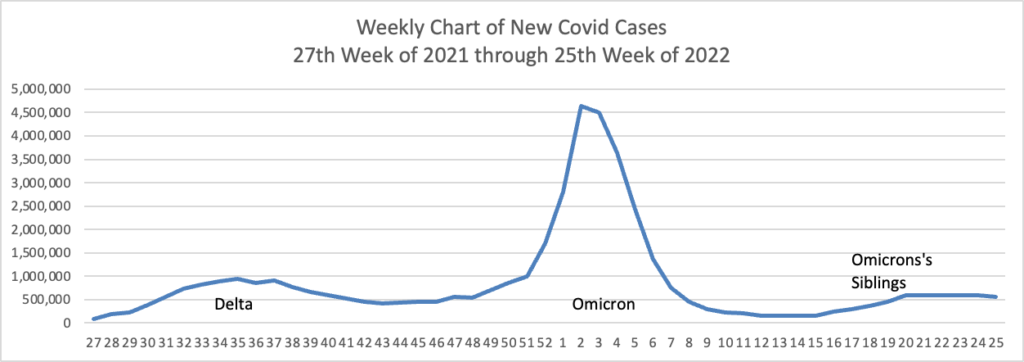
Based on the CDC’s Covid Data Tracker and using Thursday as the first day of the week, here is the FEHBlog’s latest weekly chart of new Covid cases:
The CDC’s weekly review of its Covid statistics states “As of June 22, 2022, the current 7-day moving average of daily new cases (97,430) decreased 5.6% compared with the previous 7-day moving average (103,175).”
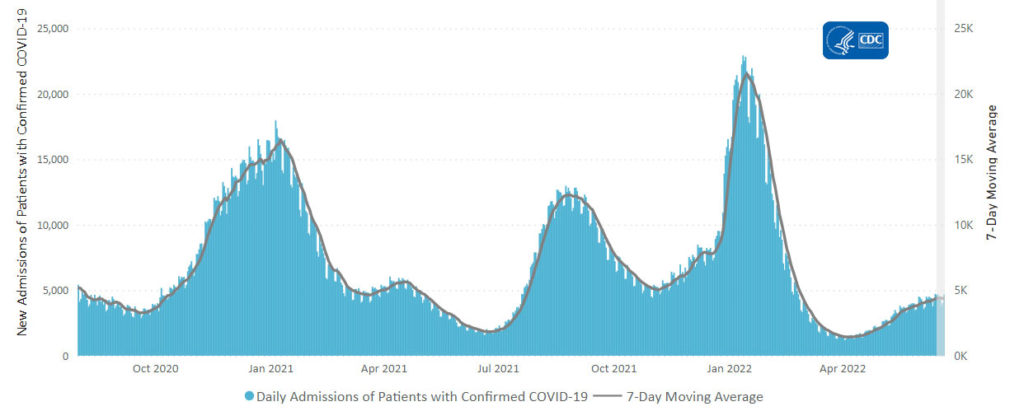
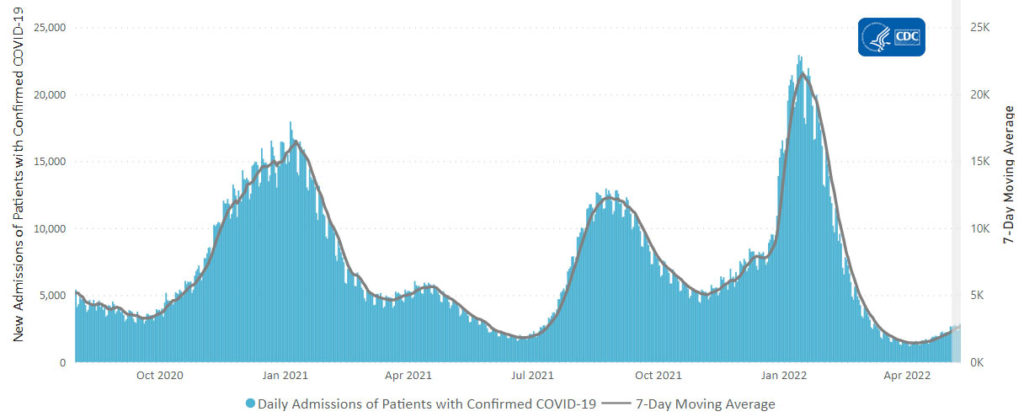
Here’s the CDC’s weekly chart of new Covid hospital admissions:
The CDC’s weekly review states “The current 7-day daily average for June 15–21, 2022, was 4,375. This is a 1.0% increase from the prior 7-day average (4,329) from June 8–14, 2022.”
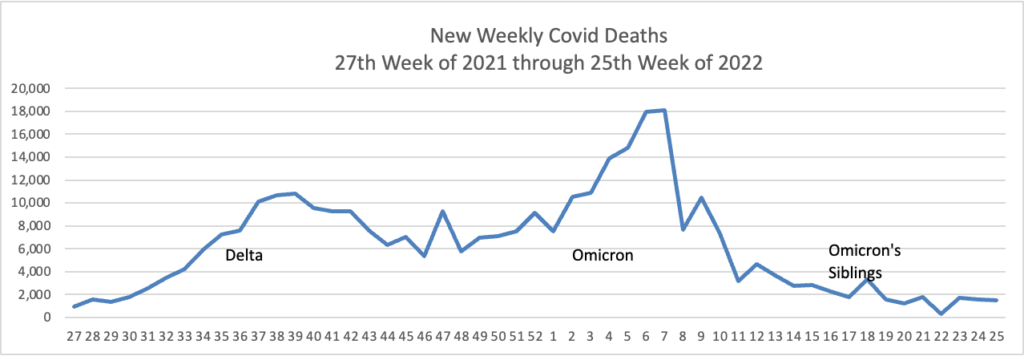
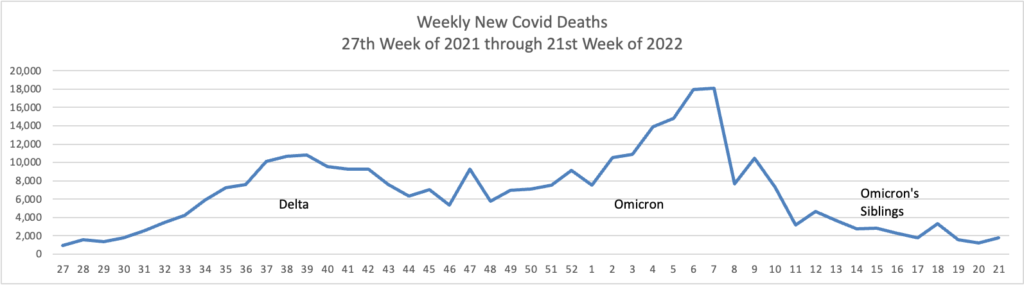
Here is the FEHBlog’s latest weekly chart of new Covid deaths:
The CDC’s weekly review states “The current 7-day moving average of new deaths (255) has decreased 10.4% compared with the previous 7-day moving average (285).”
As of June 23, 2022, there are 391 (12.1%) counties, districts, or territories with a high COVID-19 Community Level, 996 (30.9%) counties with a medium Community Level, and 1,830 (56.8%) counties with a low Community Level. This represents an increase (+1.9 percentage points) in the number of high-level counties, a slight increase (+1.6 percentage points) in the number of medium-level counties, and a corresponding decrease (−3.6 percentage points) in the number of low-level counties. 51 jurisdictions had high- or medium-level counties this week. Rhode Island is the only jurisdiction to have all counties at low Community Level.
The weekly statistics generally are stable and moving in the right direction.
The American Hospital Association adds
The Centers for Disease Control and Prevention last night endorsed Moderna’s COVID-19 vaccine for children aged 6-17, as its advisory committee recommended, creating an alternative to Pfizer’s COVID-19 vaccine for this age group. The Food and Drug Administration authorized the Moderna vaccine for children and adolescents last week.
Before ACA FAQ 50 issued October 4, 2021, the period for covering COVID vaccines with no cost sharing began 15 days after the CDC’s action. The FEHBlog, who is not errorless, thought that FAQ 50 eliminated the 15 day waiting period, but upon further review, FAQ 50 requires immediate no cost sharing coverage of Covid vaccines filing the FDA’s approval, usually an emergency use authorization. The FEHBlog doesn’t think this makes any practical difference because the Covid vaccines aren’t distributed without CDC approval.
From the Capitol Hill, the American Hospital Association provide us with this encouraging news:
The House of Representative today voted 234-193 to pass and send to the President for his signature bipartisan legislation to help reduce gun violence in communities. Approved by the Senate last night, the AHA-supported package includes behavioral health provisions, including funding for school safety resources, school-based supportive services and expanded access to telehealth for mental and behavioral health services.
From the Supreme Court, the Court decided today that the right to an abortion is a matter controlled by state law, not the U.S. Constitution. The Wall Street Journal sums it up as follows “In upholding a Mississippi law banning the procedure after 15 weeks of pregnancy, the court’s conservative majority said the Roe decision was egregiously wrong in recognizing a constitutional right to abortion.” In response
Reproductive health care, including access to birth control and safe and legal abortion care, is an essential part of your health and well-being. While Roe v. Wade was overturned, abortion remains legal in many states, and other reproductive health care services remain protected by law. The U.S. Department of Health and Human Services (HHS) is committed to providing you with accurate and up-to-date information about access to and coverage of reproductive health care and resources. Our goal is to make sure you have appropriate information and support.
Health Payer Intelligence discusses health insurer reaction to the decision. “Payers and healthcare leaders are responding to the Supreme Court’s decision to overturn Roe v Wade, the case which protected abortion rights at the federal level, and while the repercussions remain uncertain many healthcare leaders are voicing their commitment to helping women navigate the impacts.”
The Wall Street Journal discusses employer reaction to the decision. “Businesses with health plans covering abortion now are weighing whether and how to pay for employees to travel to a state where the procedure is legal.”
From the OPM front
Federal News Network reports on OPM Director Karen Ahuja’s press conference held yesterday, the first anniversary of her swearing in as OPM Director.
FedWeek tells us that “OPM has said it is working to improve features for federal employees and annuitants to compare FEHB plans, although it does not project having those improvements in place until late next year—potentially in time for that year’s open season for selecting coverage in 2024.”
From the nicotine front, the Wall Street Journal reports
A federal appeals court on Friday granted Juul Labs Inc. a temporary stay of the Food and Drug Administration’s order for the vaping company to pull its e-cigarettes off the U.S. market.
A panel of judges from the U.S. Court of Appeals for the D.C. Circuit on Friday afternoon granted Juul’s request to delay the FDA’s ban, according to court documents. The temporary stay gives the court time to hear arguments and wasn’t a ruling on the merits of the case, the judges wrote.
Finally, HR Dive brings us a roundup of happenings at this week’s Society for Human Resource Management conference.
OPM Headquarters a/k/a the Theodore Roosevelt Building
U.S. Office of Personnel Management Director Kiran Ahuja celebrated her first year in office today. Here are links to an OPM press release and a Govexec account of Director Ahuja’s press conference.
The press release identifies her “major accomplishments with respect to the FEHB Program as
Providing health benefits that are responsive to employee needs
All Federal Employee Health Benefits (FEHB) carriers provide telehealth services ensuring access to health providers during the pandemic and on an ongoing basis going forward. In a 2021 survey, 43% of FEHB enrollees report using telehealth benefits and use was greatest among those with mental health or behavioral health concerns.
In accordance with EO 14035, which directed OPM to promote equitable healthcare coverage and services for enrolled LGBTQ+ employees and their covered family members through the FEHB Program, OPM prioritized and strongly encouraged FEHB Carriers to provide gender-affirming care benefits consistent with standards published by recognized medical experts.
Advisers to the Centers for Disease Control and Prevention (ACIP) backed use of Moderna Inc.’s Covid-19 vaccine in children ages 6 to 17 years.
Children in the age group already have access to Covid-19 vaccines made by Pfizer Inc. and its partner BioNTech SE. The advisers recommended on Thursday that Moderna’s shot should also be made available to that age range, in a pair of 15-0 votes.
The advisers’ endorsement follows the Food and Drug Administration’s authorization of the shots last week. It is one of the last steps before the Moderna shot would be more broadly available in doctors’ offices, pharmacies and vaccine clinics.
Other news reports indicate that CDC Director Walensky is expected to endorse this recommendation late Thursday or Friday.
A fourth dose, or second booster, of Pfizer/BioNTech’s COVID-19 vaccine (Comirnaty) protected seniors living in long-term care from the most severe outcomes during the Omicron wave, despite showing a more limited effect against infection, according to prospective data from Israel.
Among over 40,000 residents, effectiveness of a fourth dose (versus a third given at least 4 months prior) was 64% and 67% against hospitalizations for either mild/moderate or severe illness, respectively, and 72% against COVID-19-related deaths, reported Khitam Muhsen, PhD, of Tel Aviv University in Israel.
From the conference front, Fierce Healthcare offers the following articles on this week’s AHIP conference:
SDOH — “As the healthcare industry grapples with health inequities and disparities across the country, health insurers are well-positioned to lead the charge, experts said Wednesday.”
Biosimilars — “[I]t is important to note that while the competition generated by these new launches can help lower payer costs—depending on pricing and available discounts—biosimilars may not necessarily be the lowest cost option in all therapeutic categories.”
Behavioral health — “As the team at Cigna’s Evernorth builds its strategy around behavioral health, it’s focusing on a key throughline: simplicity.”
From the Rx coverage front —
The Senate Commerce Committee announced clearing for Senate floor consideration the Committee leadership’s PBM transparency bill (S 4293). The vote in favor of floor consideration was 19-9. Fierce Healthcare offers an article on the Committee’s action.
STAT News reports on a bipartisan Senate proposal to control insulin prices by locking in current manufacturer profits. “David Mitchell, founder of Patients for Affordable Drugs, a patient advocacy group that doesn’t accept funds from the pharmaceutical industry, called the bill “disappointing,” and said it would just shift costs to patients in other ways. ‘It’s pharma’s preferred solution to drug pricing,’ Mitchell said.”
STAT News also tells us that “In response to rising prices for medicines, public and private payers increasingly rely on assessments of cost-effectiveness to justify coverage. But a new examination finds that such studies sponsored by drug companies were often biased in favor of setting higher prices for their medicines.” The study was published in the BMJ.
The FDA released an “Action Plan for Rare Neurodegenerative Diseases, Including ALS “(also known as Lou Gehrig’s Disease).
In other vaccine news, AHIP informs us that
ACIP additionally voted [today[ to recommend adults aged 65 and older preferentially receive any one of the following higher dose or adjuvanted influenza vaccines: quadrivalent high-dose inactivated influenza vaccine (HD-IIV4), quadrivalent recombinant influenza vaccine (RIV4), or quadrivalent adjuvanted inactivated influenza vaccine (aIIV4); however there is no preference between these three vaccines.
The Committee also recommended that pneumococcal vaccine PCV15 may be used as an option to PCV13 for children aged under 19 years according to currently recommended PCV13 dosing and schedule. ACIP voted that Priorix (GSK) be used, as an option, to prevent measles, mumps, and rubella, in accordance with currently recommended schedules and off-label uses
Overall rates of human papillomavirus (HPV) vaccination among adolescents increased by nearly 20% over a 5-year period, according to survey data.
Among teens ages 13 to 17, overall HPV vaccine coverage increased from 56.1% in 2015 to 75.4% in 2020, and rates for those completing the full vaccine series jumped from 40.3% to 59.3%, respectively, reported Peng-jun Lu, MD, PhD, of the CDC in Atlanta, and colleagues
“CDC’s latest data show that HPV vaccination coverage among adolescents is increasing, which is important to prevent HPV infections that can lead to several cancers in both females and males,” Lu told MedPage Today.
The authors also noted that a doctor’s recommendation was correlated with greater willingness to receive the vaccine. Of those who were advised to get vaccinated, 80.7% received vaccination compared with 51.7% who were given no such advice. These findings mirrored another study, which found that provider recommendations boosted HPV vaccination rates among kids ages 11 to 12.
Well-child visits were also associated with higher rates of vaccination. Among kids ages 11 to 12, 80.3% who had a visit were vaccinated compared with 64.8% who did not have a visit.
From the nicotine front, the New York Times reports
The Food and Drug Administration on Thursday ordered Juul to stop selling e-cigarettes on the U.S. market, a profoundly damaging blow to a once-popular company whose brand was blamed for the teenage vaping crisis. The order affects all of Juul’s products on the U.S. market, the overwhelming source of the company’s sales.
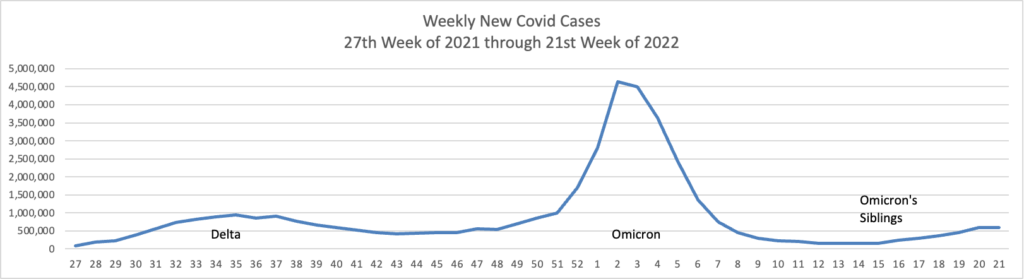
Based on the CDC’s Covid Data Tracker, and using Thursday as the first day of the week, here is the FEHBlog’s weekly chart of new Covid cases from the 27th week of 2021 through the 21st week of 2022:
Reliable estimates of case counts are particularly relevant with the U.S. in the midst of yet another Covid-19 wave. By official case counts, it is a modest wave, at roughly 110,000 infections a day, according to the CDC. That is smaller than the 165,000 daily cases reported during the Delta wave, or the 250,000 a day during the 2020-21 winter.
But estimates of the true number of infections, correcting for undercounting, suggest the U.S. might be experiencing the second-largest wave of Covid-19 infections since the pandemic began.
Here’s the CDC’s weekly chart of new Covid hospitalizations.
Hospitalization numbers also aren’t a perfect gauge. Someone can break a leg and test positive in the emergency room for a mild case of Covid-19. That case becomes a confirmed coronavirus hospitalization—and a strain on the hospital’s bed counts and personal-protective-equipment supplies—but not necessarily a severe case.
In Massachusetts, hospitals have begun reporting whether Covid-19 is the primary reason someone is in the hospital—and in January about 50% of cases were. It is hard to pinpoint how similar Massachusetts would be to other states, but it offers a further example of how better counting could improve assessment of the pandemic.
Here’s the FEHBlog weekly chart of new Covid deaths again from the 27th week of 2021 through the 21st week of 2022:
Covid-19 deaths in the U.S. are hovering near the lowest levels since the pandemic hit, showing how a population with built-up immune protection is less at risk of severe outcomes even as another wave of infections flows through the country.
The nearly 300 deaths reported daily are again more concentrated among older people, underscoring hazards for the more vulnerable while the overall population appears less at risk.
Particularly vulnerable people, such as those who are older and immunocompromised, will likely always have some risk of death from a Covid-19 infection, doctors and public-health experts said. Increasing booster rates and access to treatments, in addition to taking certain precautions, can help lower the threat presented by the virus, they said.
White House officials said on Thursday that they were introducing new models for distributing Paxlovid, the Covid-19 oral medication made by Pfizer, in an effort to get the treatment to more people and keep coronavirus death rates relatively low even as cases increase.
The federal government will start reimbursing a clinic in Providence, R.I., for evaluating patients who test positive and immediately prescribing Paxlovid to those eligible for it — the first of what the White House said would be a series of federally supported sites, with others set to open in New York and Illinois. Federal workers are also being sent to state-run testing sites in Minnesota, transforming them into “test-to-treat” locations, the White House said.
“Fundamentally, what we’re trying to do is get to a point where Covid deaths are largely preventable, and I think we’re pretty close to there,” Dr. Ashish K. Jha, the White House Covid-19 response coordinator, said in an interview Wednesday evening. “Deaths from this disease really should become increasingly rare.”
STAT News offers an interesting look into how scientists assess the level of Covid resistance to Paxlovid.
Resistance is the hobgoblin of antiviral medicine, even with antivirals as effective as Paxlovid. After doctors deployed nearly every new virus-killing infusion or pill in history, strains popped up — either immediately or eventually — with machinery warped in just the right way to evade the threat.
Exactly how much of a problem resistance will be for Paxlovid is complicated. In some patients, the coronavirus will inevitably find ways to evade the pill, as it did prior Covid-19 drugs.
“If there is anything we know about viruses and antiviral drugs is that eventually we will see some sort of resistance,” Andrew Pavia, chief of pediatric infectious diseases at University of Utah Health, said in an email.
What’s less clear, Pavia and other experts say, is whether any resistant variants will spread widely. The coronavirus may have particular difficulty getting around Paxlovid compared to other drugs because patients take it for only five days and because it targets a protein the virus can’t easily change. Any mutation or modification the virus makes may impair its ability to replicate or survive.
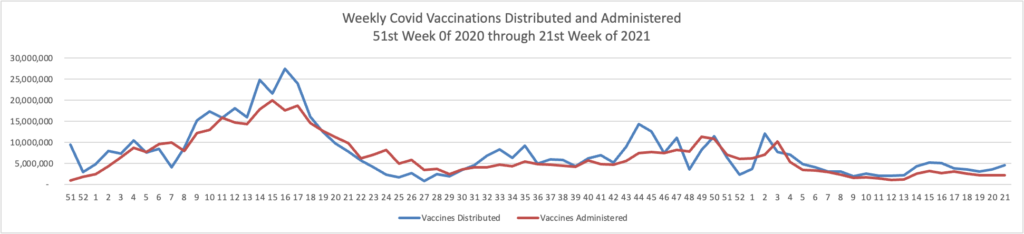
Here’s the FEHBlog weekly chart of Covid vaccinations distributed and administered
The CDC’s weekly review of its Covid statistic tells us
People who are up to date on vaccines have much lower risk of serious illness and death from COVID-19 compared with people who are unvaccinated. CDC’s COVID Data Tracker shows that in March 2022, adults ages 18 years and older who were unvaccinated were about 5 times more likely to be hospitalized with COVID-19 than those who were up to date. In the same month, people ages 12 years and older and unvaccinated were 17 timesmore likely to die of COVID-19 than those who were up to date.
COVID-19 vaccines available in the United States are effective at protecting people from getting seriously ill, being hospitalized, and even dying—especially people who are boosted. As with other diseases, you are protected best from COVID-19 when you stay up to date with recommended vaccines. Find a vaccine provider near you.
As of May 19, 2022, there are 301 (9.35%) counties, districts, or territories with a high COVID-19 Community Level, 477 (14.81%) counties with a medium Community Level, and 2,442 (75.84%) counties with a low Community Level. This represents a moderate (+5.10 percentage points) increase in the number of high-level counties, a slight (−0.74 percentage points) decrease in the number of medium-level counties, and a corresponding (−5.84 percentage points) decrease in the number of low-level counties. Five (9.62%) of 52 jurisdictions had no high- or medium-level counties this week.
the Centers for Medicare & Medicaid Services (CMS) released a report that recommends cost savings from lower-than-expected Medicare Part B spending be passed along to people with Medicare Part B coverage in the calculation of the 2023 Part B premium. Earlier this year, Department of Health and Human Services (HHS) Secretary Xavier Becerra instructed CMS to reassess the 2022 Part B premium amount in response to a price reduction for Aduhelm™, a monoclonal antibody directed against amyloid for use in treating Alzheimer’s disease. Given the information available today, it is expected that the 2023 premium will be lower than 2022. The final determination will be made later this fall.
This CMS decision is quite sensible, in the FEHBlog’s view.
On a related FEHB note, FedSmith discusses the pros and cons of enrolling in Medicare Part B when you are a federal or Postal annuitant with FEHB coverage in retirement as well.
From the telehealth front, mHealth Intelligence reports
Called CVS Health Virtual Primary Care, the digital care platform will provide healthcare consumers with an array of care services, including primary care, on-demand care, chronic condition management, and mental health services. Consumers will also be able to choose their healthcare setting from various retail, community-based, virtual, and at-home care options.
“We’re meeting people where they are on their healthcare journey and providing care that is more convenient and easier to access,” said Creagh Milford, DO, vice president, enterprise virtual care at CVS Health, in the news release.
The new benefit will launch on January 1, 2023.
From the Rx coverage front, Formulary Watch reveals that
The Institute for Clinical and Economic Review (ICER) has released the protocol for its second annual review of insurance company policies to assess fair access to prescription drugs. ICER will evaluate whether 15 large U.S. commercial payers, the two largest state health exchange plans, and the Department of Veterans Affairs have formularies and procedures that provide appropriate access to the prescription drugs reviewed by ICER in 2020. These drugs include those that treat patients with cystic fibrosis, hemophilia A, migraine, sickle cell disease, and ulcerative colitis.
The analysis is expected to be completed in November 2022.
From the studies front, the Centers for Disease Control issued its 2021 Diabetes Report Card this week. Here are the highlights
* After almost 2 decades of continual increases, the incidence of newly diagnosed cases of diabetes in the United States decreased from 9.3 per 1,000 adults in 2009 to 5.9 per 1,000 adults in 2019.
* Prevalence of prediabetes among US adults remained steady from 2005–2008 to 2017–2020. However, notification of prediabetes status nearly tripled (from 6.5% to 17.4%).
* American Indian or Alaska Native, non-Hispanic Black, Hispanic, and non-Hispanic Asian people are more likely to be diagnosed with diabetes than non-Hispanic White people (14.5%, 12.1%, 11.8%, 9.5%, and 7.4%, respectively).
* During the COVID-19 pandemic, diabetes emerged as an underlying condition that increases the chance of severe illness. Nearly 4 in 10 adults who died from COVID-19 in the United States also had diabetes.
We use cookies on our website to give you the most relevant experience by remembering your preferences and repeat visits. By clicking “Accept”, you consent to the use of ALL the cookies.
This website uses cookies to improve your experience while you navigate through the website. Out of these, the cookies that are categorized as necessary are stored on your browser as they are essential for the working of basic functionalities of the website. We also use third-party cookies that help us analyze and understand how you use this website. These cookies will be stored in your browser only with your consent. You also have the option to opt-out of these cookies. But opting out of some of these cookies may affect your browsing experience.
Necessary cookies are absolutely essential for the website to function properly. These cookies ensure basic functionalities and security features of the website, anonymously.
Cookie
Duration
Description
cookielawinfo-checbox-analytics
11 months
This cookie is set by GDPR Cookie Consent plugin. The cookie is used to store the user consent for the cookies in the category "Analytics".
cookielawinfo-checbox-functional
11 months
The cookie is set by GDPR cookie consent to record the user consent for the cookies in the category "Functional".
cookielawinfo-checbox-others
11 months
This cookie is set by GDPR Cookie Consent plugin. The cookie is used to store the user consent for the cookies in the category "Other.
cookielawinfo-checkbox-necessary
11 months
This cookie is set by GDPR Cookie Consent plugin. The cookies is used to store the user consent for the cookies in the category "Necessary".
cookielawinfo-checkbox-performance
11 months
This cookie is set by GDPR Cookie Consent plugin. The cookie is used to store the user consent for the cookies in the category "Performance".
viewed_cookie_policy
11 months
The cookie is set by the GDPR Cookie Consent plugin and is used to store whether or not user has consented to the use of cookies. It does not store any personal data.
Functional cookies help to perform certain functionalities like sharing the content of the website on social media platforms, collect feedbacks, and other third-party features.
Performance cookies are used to understand and analyze the key performance indexes of the website which helps in delivering a better user experience for the visitors.
Analytical cookies are used to understand how visitors interact with the website. These cookies help provide information on metrics the number of visitors, bounce rate, traffic source, etc.
Advertisement cookies are used to provide visitors with relevant ads and marketing campaigns. These cookies track visitors across websites and collect information to provide customized ads.