Congress will be in session this week for Committee and floor business.
The No Surprises Act’s RxDC reporting deadline is this Tuesday, January 31, for the 2020 and 2021 reporting years. RxBenefits informs us, “Optum, Caremark, and Express Scripts have finalized their submission files and confirmed that all submissions would be completed before January 31, 2023, if not already filed.”
From the public health front —
NPR Shots explains why your kids are germ vectors, albeit adorable ones.
Fortune Wells reports that “Researchers at the Institute of Psychiatry, Psychology & Neuroscience at King’s College London have developed a blood-based test that can detect Alzheimer’s disease up to 3.5 years before a clinical diagnosis.” This test would help people decide whether they need the new Biogen/Eisai drug assuming Medicare approves it.
Fortune Well also points out how employers can reduce workplace stress.
Kaiser Family Foundation provides us with recent upbeat data on long Covid.
Congress is back in our Nation’s capitol this week. The House is considering legislative business but is not holding hearings. The Senate is holding hearings and floor votes.
A deeply divided Congress will return to work this week, pushing ahead with partisan priorities in the Senate and House while also gearing up for a fight over how lawmakers will address raising the debt ceiling before a potential default later this year.
The Senate, narrowly controlled by Democrats as it opens its new session, is expected to focus primarily on confirming President Biden’s executive and judicial nominees in the coming weeks. Immigration is emerging as one area of possible compromise after a group led by Sen. Kyrsten Sinema (I., Ariz.) and Sen. John Cornyn (R., Texas) co-hosted a bipartisan delegation of senators to the Texas and Arizona borders during the January recess.
House Republicans, back from a weeklong break, will dive into investigations focused on Mr. Biden, his family and his administration, starting with a hearing on border security early next month that will feature testimony from border patrol agents.
The American Medical Association outlines its wish list for improvements in the Medicare payment system.
From the Omicron and siblings front
The American Medical Association tells us about what doctors wish their patients knew about Covid reinfections. Oddly the article does not mention the availability of Paxlovid treatment.
Medscape informs folks over age 65 about what they need to know about taking Paxlovid.
The message from infectious disease experts and geriatricians is clear: Seek treatment with antiviral therapy, which remains effective against new covid variants.
The therapy of first choice, experts said, is Paxlovid, an antiviral treatment for people with mild to moderate covid at high risk of becoming seriously ill from the virus. All adults 65 and up fall in that category. If people can’t tolerate the medication — potential complications with other drugs need to be carefully evaluated by a medical provider — two alternatives are available.
The upshot is the older Americans and immunocompromised American should create a treatment plan in consultation with their primary care providers before Omicron shows up at the door.
NPR offers us an update on the state of rapid Covid testing
As the COVID-19 pandemic enters its fourth year, a negative result on a little plastic at-home test feels a bit less comforting than it once did.
Still, you dutifully swab your nostrils before dinner parties, wait 15 minutes for the all-clear and then text the host “negative!” before leaving your KN95 mask at home.
It feels like the right thing to do, right?
The virus has mutated and then mutated again, with the tests offering at least some sense of control as the Greek letters pile up. But some experts caution against putting too much faith in a negative result.
A so-called “super strain” of gonorrhea—against which many types of antibiotics are less effective or not effective at all—has been identified in the U.S. for the first time, health officials said Thursday, [January 19] raising further concern that a post-antibiotic era is approaching.
The case, identified in Massachusetts, was successfully treated with ceftriaxone, an antibiotic recommended to treat the disease, state health officials said in a news release. A higher-than-recommended dose wasn’t required to clear the infection, a state public health spokesperson tells Fortune, though the U.S. Centers for Disease Control and Prevention recently doubled the recommended dose.
The newly identified strain showed reduced susceptibility to three types of antibiotics and resistance to an additional three, including penicillin. It marks the first U.S. case in which all recommended drugs were less effective or completely ineffective, the state health department said in a Thursday bulletin to clinicians.
The case serves as “an important reminder that strains of gonorrhea in the U.S. are becoming less responsive to a limited arsenal of antibiotics,” health officials said in a statement.
The U.S. is experiencing “a rising epidemic of sexually transmitted disease,” Dr. Georges Benjamin, executive director of the American Public Health Association, tells Fortune, with some experts referring to the issue as a “hidden epidemic.”
No bueno.
From the mental health care front
NPR Shots discusses when patients can opt for chat therapy from a free chatbot., e.g., Wysa .
Bloomberg Prognosis calls our attention to a dementia quiz.
Most cases of dementia aren’t linked to lifestyle. But in as many as four in 10 cases, external risk factors — everything from educational level, brain injury and hearing loss to excessive drinking and smoking — may play a role, a report by The Lancet Commission found in 2020. This week, Alzheimer’s Research UK, a charity that funds science and education about dementia, launched an online quiz that draws on that study to help people zero in on what they could change in their own lives to help improve the health of their brains.
“Much of this is about helping people understand that they can be empowered to affect their risk of Alzheimer’s disease,” Paul Matthews, director of the UK Dementia Research Institute at Imperial College London, said in a briefing hosted by the Science Media Centre. “We need to give people the knowledge to make these choices.”
For what it’s worth, The FEHBlog took the quiz which is offered by the British Alzheimers Disease Association. The FEHBlog found it worthwhile.
The weekly rate of emergency department visits and hospitalizations for flu, COVID-19 and respiratory syncytial virus peaked in early December, new CDC data shows.
ED visits for flu, RSV and COVID-19 peaked the week ending Dec. 3, hitting a weekly total of 235,850 before falling through December and the first half of January. The nation’s current weekly total was 72,119 as of Jan. 14, according to the ED dashboard. The dashboard uses information from the CDC’s National Syndromic Surveillance Program, which receives data from 73 percent of the nation’s EDs.
The combined hospitalization rate for flu, RSV and COVID-19 peaked at 22.5 admissions per 100,000 in the week ending Dec. 3. This figure now sits at 9.4 per 100,000 for the week ending Jan. 7, though the CDC said reporting delays may affect the most recent week’s data.
RSV hospitalizations peaked in mid-November, while flu hospitalizations peaked in early December, CDC data shows. COVID-19 admissions also appear to be leveling off nationwide, even as the highly transmissible omicron subvariant XBB.1.5 gains prevalence. This trend suggests the U.S. will see more of a COVID-19 “bump” this winter versus a full-fledged surge, experts told The New York Times.
The CDC’s weekly interpretative review of its Covid stats focuses on these new dashboards this week. The agency’s weekly Fluview report informs us “Seasonal influenza activity continues to decline across the country.”
A recent climb in hospitalizations and Covid-19 wastewater readings—two key metrics for spotting trends—appears to have stalled following the quick rise of the Omicron XBB.1.5 subvariant. The U.S. was gripped in significantly more deadly waves at this point in the last two winters, though currently there are still hundreds of deaths reported each day. * * *
At least for now, it appears unlikely new variants are going to cause as substantial illnesses and deaths as the virus did early on and in the prior winter waves, said Jay Varma, a physician and epidemiologist who directs Weill Cornell Medicine’s Center for Pandemic Prevention and Response in New York City. He cautioned that more severe mutations could still emerge. “We seem to have settled into somewhat of a detente with the virus,” he said.
Although the FEHBlog will continue to track Omicron and siblings developments, he has decided to replace Friday Stats and More with Friday Factoids.
Public health officials have said for some time that use of Paxlovid, approved under an FDA emergency use authorization (EUA) in December 2021, remains far below the proportion of Americans who could potentially benefit from the therapy.
What’s driving the lackluster uptake remains unknown, so Medscape Medical News took a deeper dive into the challenges surrounding Paxlovid prescribing.
Older Americans remain one of the groups at highest risk for COVID-19 adverse outcomes, including hospitalization and severe illness. However, the survey found that providers also remain reluctant to prescribe Paxlovid in this population for multiple reasons. * * *
The survey found that almost half of patients were on a medication that is contraindicated with Paxlovid and that could not be discontinued (44%). Another finding was that almost the same proportion were on a medication that is contraindicated with Paxlovid, but the risk of discontinuing that medication was too high (41%). Also, the researchers found some patients were on a medication that could interact with Paxlovid, but it was unclear how to manage the interaction (29%).
[Medscape medical editor in chief Dr. Eric Topol said that doctors, in some cases, may be overly concerned about the drug interactions. “There’s a straightforward workaround strategy for nearly all the drug interactions — most commonly statins — which can easily be stopped for 5 days,” he said.
Another concern preventing Paxlovid prescription is renal impairment, the survey reveals. More than one third of respondents, 37%, said they did not prescribe the protease inhibitor combination because of concerns over this condition, which can lower how efficiently medications are cleared by the body.
Fewer emergency department (ED) visits end with a prescription for opioids, CDC survey data showed.
The percentage of ED visits with an opioid prescribed at discharge fell from 12.2% in 2017-2018 to 8.1% in 2019-2020, reported Loredana Santo, MD, MPH, and Susan Schappert, MA, of the National Center for Health Statistics in Hyattsville, Maryland, in NCHS Data Briefopens in a new tab or window.
The rate of prescribing at discharge also dropped: in 2019-2020, opioids were prescribed at 36.4 ED visits per 1,000 adults, lower than 50.5 per 1,000 in 2017-2018. The decline was similar for both men and women.
In U.S. healthcare business news —
Cigna points out the value of integrated health plans a/k/a health plans without carveouts.
A study released today by Cigna (NYSE: CI), a global health service company, finds that triple integration of medical, pharmacy and behavioral benefits resulted in lower health care costs for employers. Conducted by Aon plcThis link will open in a new tab., a leading global professional services firm, the Value of Integration StudyThis link will open in a new tab. [PDF] shows that Cigna’s integrated employer clients saved $148 per member per year in 2021.
Using a similar study method, Cigna then evaluated the financial impact of engaging employees to participate in health improvement programs, such as wellness coaching. The results show even greater client savings for Cigna integrated employer clients, exceeding $1,400 per member per year.
In addition, Cigna found that when individuals with specific high-cost conditions and therapies were enrolled in a triple-integrated health plan and needed specialty medicines, the savings for the health plan were:
Nearly $9,000 per member per year, increasing to more than $11,000 per member when the specialty drug is for an inflammatory condition like rheumatoid arthritis; and
Almost $17,500 per year for members who took specialty drugs and have a confirmed depression diagnosis.
Medpage Today reports, “Switching to [employer-sponsored] high-deductible health plans (HDHPs) spelled trouble when it came to diabetes complications, a retrospective cohort study found.” The report studies health savings account (HSA) – eligible HDHPs versus traditional low-deductible plans. The FEHBlog doesn’t understand why the HSAs don’t balance out the two types of coverage. The article doesn’t compute.
STAT News relates, “More than a dozen of the country’s large not-for-profit hospital systems descended on this year’s J.P. Morgan Healthcare Conference with a subtle but clear message for bankers and municipal investors: Higher costs in 2022 slowed them down, but they are adamant about increasing revenue by expanding their footprints and hiking prices.” Charming.
A new behavioral health solution launched this week aims to make it easier for insurers to connect members with tools that may benefit their mental health care.
Lucet represents the combination of New Directions Behavioral Health and Tridiuum and is a spinout from the Blues network, where its core product cut its teeth. Lucet’s Navigate & Connect platform harnesses a large team of care navigators with an advanced technology stack that allows insurers to better optimize care and access for members.
Shana Hoffman, president and CEO of Lucet, told Fierce Healthcare that the platform enables faster connections to appointments and helps cut through the noise on which solutions a plan may want to bring into the fold.
“What we’re bringing to the market is really an operating system platform for health plans that allows them to reliably connect members to care,” Hoffman said.
Health Affairs Forefront analyzes “The Fair Price For One-Time Treatments; How Can We Overcome Existing Market Price Distortions?” Check it out.
From our Nation’s capital, the Wall Street Journal reports
The Treasury Department began taking special measures to keep paying the government’s bills on Thursday as the U.S. bumped up against its borrowing limit, kicking off a potentially lengthy and difficult debate in Congress over raising the debt ceiling.
With the federal government constrained by the roughly $31.4 trillion debt limit, the Treasury Department began deploying so-called extraordinary measures. Those accounting maneuvers, which include suspending investments for certain government accounts, will allow the Treasury to keep paying obligations to bondholders, Social Security recipients and others until at least early June, the department said last week.
That gives lawmakers on Capitol Hill and the Biden administration roughly five months to pass legislation raising or suspending the debt limit. In a letter to congressional leaders on Thursday, Treasury Secretary Janet Yellen said there was “considerable uncertainty” about how long extraordinary measures can last.
“I respectfully urge Congress to act promptly to protect the full faith and credit of the United States,” Ms. Yellen said.
From the OPM front, OPM issued “Guidance on Increasing Opportunities for Federal Internships, Fellowships, and Other Early Career Programs” and, according to MeriTalk, held a “virtual job fair organized today by Tech to Gov in partnership with the Office of Personnel Management (OPM) is targeting a wide range of Federal government technology and related positions as part of the government’s goal to restock its tech ranks amid a slowdown in hiring by the private sector.” As daily reports of layoffs at tech companies have been appearing in the news, OPM’s timing for the job fair is opportune.
Today, benefits expert Tammy Flanagan completed her three Govexec columns on federal employee and annuitant benefit changes for this year.
From the Omicron and siblings front,
MedPage Today tells us, “Real-World Data Support Bivalent COVID-19 Boosters in Older Adults — Study from Israel showa ed high level of protection in people 65 and up.” MedPage Today’s medical editor in chief Dr. Jeremy Faust comments
[T]he Israeli data really helps us understand that for 65-years-olds and over, getting a bivalent booster is going to protect against hospitalization. We don’t know how long that’s going to last, and that’s the key. If it turns out that the bivalent booster ends up having a much longer tail of effectiveness than the monovalent did, that’ll be good news, but it’ll depend upon what variants are circulating and other factors, but we are watching that.
The European Union’s drug regulator has not identified any safety signals in the region related to U.S. drugmaker Pfizer Inc (PFE.N) and German partner BioNTech’s updated COVID-19 shot, the agency said on Wednesday.
On Friday, the U.S. Food and Drug Administration and the Centres for Disease Control and Prevention said that a safety monitoring system had flagged that the shot could possibly be linked to a type of brain stroke in older adults, according to preliminary data.
The FDA’s Vaccines and Related Biological Products Advisory Committee will consider this safety issue at a meeting on January 26.
Also from the FDA front, the Wall Street Journal informs us
The setback could delay a potential commercial introduction of the highly anticipated drug by at least several months, if the Food and Drug Administration eventually decides to approve it. * * *
Lilly had been hoping for an accelerated FDA approval of donanemab early this year. Now, a midyear filing of a standard drug application means an FDA decision could be pushed back into 2024, based on typical FDA timelines of taking six to 10 months to review new drug applications.
In an online survey last November of 1,200 U.S. adults previously vaccinated against COVID-19, 62% had not yet received a bivalent booster dose, most often because they did not know they were eligible or the booster was available, or believed they were immune against infection, the Centers for Disease Control and Prevention reported today. After viewing information about eligibility and availability, over two-thirds of them planned to get a bivalent booster and 29% reported receiving the booster in a follow-up survey in December. To help increase bivalent booster coverage, the report recommends using evidence-based strategies to inform patients about booster recommendations and waning immunity.
From the No Surprises Act front, Healthcare Dive points out
Many Americans are still exposed to the potential for a surprise medical bill from an out-of-network ambulance ride, a research report published in Health Affairs found. About 28% of emergency trips in a ground ambulance resulted in a potential surprise bill, according to the research that analyzed commercial insurance claims.
About 85% of emergency transports were deemed out of network between 2014 and 2017, researchers found. But two-thirds of those trips are paid in full by insurers, eliminating the risk of a surprise bill.
The report shows the difference in pricing by ground ambulance ownership and how that affects patients’ financial exposure. * * *
Given the high prevalence for a potential surprise bill, protections like those afforded to consumers in the No Surprises Act may be necessary for both emergency and non-emergency transports, the authors said.
The FEHBlog is puzzled by the author’s extension of NSA protection to non-emergency transports, which the consumer should have time to manage. Congress should not overload the NSA system.
From the telehealth front, Healthcare Dive reports
Private insurers paid roughly the same for telehealth and in-person visits during the early days of the COVID-19 pandemic as virtual care surged, according to new research from the Kaiser Family Foundation.
Though it’s unclear how payment rates might have changed over the past two years, the findings call into question the argument that telehealth is saving the healthcare system money, researchers said.
However, researchers said that perks of telehealth included expanded access and convenience — cost benefits of which were not factored into the study.
UnitedHealthcare is rolling out a new virtual behavioral health coaching program backed by Optum.
The offering is available as of Jan. 1 for 5 million fully insured members, and self-insured employers can purchase the program as an employer benefit. Through the program, adults with symptoms of mild depression, stress and anxiety can access support for their mental health needs through virtual modules as well as one-on-one video conferences, phone calls or messaging with coaches. * * *
Members who use virtual coaching can connect with a dedicated behavioral health coach for a 30-minute weekly audio or video call and can chat with their coach using in-app messaging between sessions.
The program lasts eight weeks, and each member will complete an assessment at the onset to identify their individual needs. Coaches use cognitive behavioral therapy techniques to assist the patient in crafting an action plan that is personalized to them.
The largest employer of physicians in the United States is not HCA, the VA, or Kaiser Permanente — it’s UnitedHealth Group’s Optum.
With at least 60,000 employed or aligned physicians across 2,000 locations in 2023, Optum has cemented itself at the forefront of the quickly changing healthcare delivery landscape. For comparison, Bloomberg reported in 2021 that Ascension employs or is affiliated with 49,000 physicians, HCA has 47,000 and Kaiser has 24,000.
Given that the Affordable Care Act limits health insurers, but not healthcare providers, profits, UHC made a smart move, in the FEHBlog’s opinion.
In a bid to blunt competition and address rising drug costs, Sanofi is offering a warranty that will cover the cost for any hospital if a specific medicine fails to work, marking only the second time a major pharmaceutical company has taken such a step.
In this instance, Sanofi designed a warranty program for its Cablivi medication, which is used to treat aTTP, a rare, life-threatening autoimmune blood disorder that is considered a medical emergency. The cost will be refunded for up to six doses for patients who fail to initially respond or up to 12 doses for patients whose condition worsens.
The move comes after Pfizer began offering warranties for two of its medicines, the first of which debuted in August 2021. At the time, the Pfizer effort was the first of its kind in the pharmaceutical industry. Unlike the Sanofi warranty, however, the Pfizer programs offer refunds to patients — not hospitals — if the medicines fail to work sufficiently.
Although the approaches vary, both companies are signaling their interest in differentiating themselves from competitors, not just responding to complaints about the rising cost of medicines, according to Emad Samad, president of Octaviant Financial, a firm that is promoting the use of warranties in the pharmaceutical industry.
How would these warranties redound to the benefit of third party payers?
From the miscellany front
Cigna offers a paper about “Digging into the Unique Drivers and Healthy Behaviors That Impact Vitality.”
The U.S. Preventive Services Task Force released a chart of its most impactful 2022 recommendations.
Fierce Healthcare reports, “The number of providers serving as [Medicare] accountable care organizations increased slightly this year thanks to the start of a new advanced model and a slew of reforms meant to reverse a slide in participation.”
Mercer Consulting digs into “must do” valued based care strategies.
The MIT Technology Review considers the prospect of gene editing for the masses using CRISPR 3.0
STAT News discusses the “hot mess” of legal issues associated with the FDA’s recent decision to make abortion drugs available at pharmacies.
From the public health front, the Wall Street Journal reports
The cancer mortality rate in the U.S. has dropped by a third in the past three decades, a report showed, but an increase in advanced prostate cancer diagnoses threatens to reverse some hard-won gains.
The American Cancer Society said Thursday that changes in preventive measures and screening in the past decade drove important trends in U.S. cancer incidence and outcomes. Cervical cancer rates dropped 65% from 2012 to 2019 among women in their early 20s after a generation of young women were vaccinated against human papillomavirus, or HPV, for the first time.
But a decline in the use of a controversial test for prostate cancer likely led to more men getting diagnosed at later stages, the report found, with the highest incidence and mortality among Black men. The ACS said it would invest in research on prostate cancer and programs to boost access to quality screening and treatment.
“There’s a significant call to arms,”said Karen Knudsen, ACS’s chief executive officer. “We are not catching these cancers early when we have an opportunity to cure men of prostate cancer.”
The report was published in the journal CA: A Cancer Journal for Clinicians. The authors at ACS analyzed federal and state cancer registries for data on cancer rates through 2019 and federal mortality data through 2020, the report said.
From the Omicron and siblings front, Bloomberg Prognosis tells us
The effects of long Covid tend to resolve within a year of mild infection, with vaccinated people at lower risk of breathing difficulties compared with unvaccinated people, according to a study.
Researchers examined the health records of almost 2 million people in Israel who tested for Covid-19 over a 19-month period. Over 70 long Covid conditions were analyzed within a group of infected and matched uninfected members. They also compared conditions in vaccinated versus unvaccinated people.
Their study published in the BMJ medical journal found most symptoms that developed after a mild infection lingered for several months, but returned to normal within a year.
“The long Covid phenomenon has been feared and discussed since the beginning of the pandemic,” the researchers wrote. “This nationwide dataset of patients with mild Covid-19 suggests that mild disease does not lead to serious or chronic long term morbidity.”
Previous studies have indicated that vaccination tends to lead to milder cases of Covid infection and long Covid
Medicare officials have taken a step toward making a cutting-edge cancer treatment called CAR-T cell therapy available in doctor offices, in anticipation of the procedure being used for increasingly common cancer types.
CAR-T is a relatively new medical procedure that uses a person’s own cells to fight their cancer, and it offers hope of a cure for those who have run out of options. It’s a complex procedure with a lot of serious side effects that must be closely monitored, so it’s typically provided at hospitals in the inpatient setting, sometimes outpatient, and almost never in doctor offices.
There are multiple barriers to offering CAR-T cell therapies in doctor offices, according to James Essell, medical director of the Blood Cancer Center at OHC and chair of cellular therapy for the US Oncology Network, a large network of independent doctors that includes OHC. Insurers restrict coverage to facilities that specialize in the procedure, and it’s financially risky for practices. Treating a few patients would require a practice to shell out well more than $1 million for the drugs alone, and the process of getting paid is arduous and not guaranteed, Essell said. * * *
Since the first CAR-T drug, Novartis’ Kymriah, was approved in 2017, the procedure has primarily been available at major academic hospitals. That puts the treatments out of reach for patients who don’t live near those facilities. Essell said less than 20% of patients who are eligible for the treatments are able to get them. Physician practices could help make the treatment available to the other 80%.
“You really need to get this out of the university centers to allow more patients to receive this care,” he said.
Mercer Consulting discusses strategies for providing access to and managing the cost of highly expensive gene therapies.
The second half of 2022 was marked by significant activity in the gene therapy market, with several landmark FDA approvals, including Hemgenix, a $3.5M gene therapy indicated for treatment of Hemophilia B. With this hefty price tag, Hemgenix wins the title of most expensive drug in the world, knocking down the previous title holder, the $2.1M gene therapy called Zolgensma, indicated for spinal muscular atrophy. * * *
As Hemgenix and other high-cost gene therapies enter the market, employers should create a long-term comprehensive approach to managing these therapies from a clinical and cost perspective by exploring a broad spectrum of strategies. A key first step in tailoring strategies specific to your plan involves assessing the likelihood of these claims occurring in your plan’s population; ideally, such assessments should be conducted on a regular basis as the member population changes. Once you get a better understanding of your unique population and the potential risk for these claims, inventory and evaluate available vendor strategies for gaps and opportunities. This step may include reviewing your medical carrier’s utilization management programs, network strategy, and care management programs, checking for availability of outcomes-based reimbursement and other payment models, and exploring alternative approaches to funding these claims. Lastly, as the market continues to evolve, regularly engage with your medical and pharmacy vendor on availability of new strategies.
The Centers for Medicare & Medicaid Services yesterday released a memo and timeline outlining how it will approach implementing the Inflation Reduction Act’s Medicare Drug Price Negotiation Program, which will negotiate prices with drug makers for certain high-cost, sole-source drugs and apply them beginning in 2026. According to the memo, CMS plans to actively engage hospitals and other stakeholders in the policymaking process.
From the medical research front, the National Institutes of Health discusses an ongoing study on the use of deep brain stimulation to treat severe opioid addiction.
From the litigation front, a divided panel of the U.S. Court of Appeals for the Sixth Circuit today upheld a lower court’s preliminary injunction of the federal government’s government contractor mandate but similar to the approach taken by the 5th Circuit limited the scope of the protection of the injunction to the plaintiffs, here the States of Kentucky, Ohio, and Tennessee. For more information, here’s the Volokh Conspiracy article on the decision. The 5th, 6th, and 11th Circuits have all ruled against the government contractor mandate, which the Safer Federal Workforce Task Force has put on ice.
From Capitol Hill, the Wall Street Journal reports
Kevin McCarthy and his allies launched a new round of talks late Wednesday with a small but stubborn band of conservative holdouts who have blocked his bid for House speaker, as Republicans sought a path forward following a second day of votes without a winner.
Mr. McCarthy didn’t reach the majority in of three votes on Wednesday, deepening doubts about whether he would ever be able to bring enough Republicans to his side and fueling talk of alternatives.
Twenty GOP lawmakers remained opposed, along with all Democrats, blocking the California Republican from getting the necessary majority of the full House. After the sixth vote, the House adjourned and reconvened at 8 p.m. [at which point the House voted 216 to 214 to call it a day and convene at noon on Thursday.]
A flurry of meetings were taking place by early evening with Republicans shuttling between offices. In one major concession, a McCarthy-aligned super PAC, the Congressional Leadership Fund, agreed to stop picking candidates in primaries where the seat is expected to stay in Republican hands.
From the Omicron and siblings front, we have a man bites dog story.
First Nature informs us that “COVID drug Paxlovid was hailed as a game-changer. What happened? Insufficient investment and fears about rebound and side effects are driving dowthe n use of a lifesaving antiviral.” The FEHBlog, who has had four Covid vaccinations, points his finger at the government for promoting vaccinations, which, while helpful for older and immunocompromised folks don’t prevent the illness yet, over Paxlovid, a treatment for virtually everyone.
A new antiviral pill for Covid was found to be as effective as Paxlovid at curbing mild to moderate illness among people at high risk of severe disease in a Phase 3 trial in China.
The results, published Wednesday in The New England Journal of Medicine, suggest that the treatment had fewer side effects than Paxlovid, the go-to antiviral for high-risk patients. Around 67% of people who took the experimental pill, called VV116, reported side effects, compared to to 77% who took Paxlovid.
The new pill was also less likely than Paxlovid to cause unexpected side effects due to reactions with other medications, such as those for insomnia, seizures or high blood pressure.
“You have a medication that looks to be just as good as Paxlovid, but less cumbersome,” said Dr. Panagis Galiatsatos, an assistant professor of medicine at Johns Hopkins Medicine in Baltimore.
VV116 is similar to the antiviral remdesivir, which the Food and Drug Administration has approved as an IV infusion. But the team behind the new drug — pharma companies Junshi Biosciences and Vigonvita Life Science — tweaked the formula so that the body can absorb it in pill form, said Dr. Peter Gulick, an associate professor of medicine at Michigan State University. Gilead Sciences, which developed remdesivir, is testing a similar oral version of its drug.
From the Rx coverage front —
STAT News reports “Walgreens plans to seek certification to begin providing abortion pills under new Food and Drug Administration rules that allow the drugs to be distributed by retail pharmacies, the company told STAT on Wednesday.” P.S. FEHB plans can only cover abortion drugs when abortion is necessary to save the life of the pregnant woman, or if the pregnancy arises from incest or rape.
For 2022, brand-name drugs’ net prices dropped for an unprecedented fifth consecutive year. What’s more, after adjusting for overall inflation, brand-name drug net prices plunged by almost 9%.
The factors behind declining drug prices will remain in the coming years—and become even stronger due to forthcoming changes in Medicare and Medicaid. Employers, health plans, and PBMs will determine whether patients will share in this ongoing deflation.
Insulin costs vary based on insurance coverage type and coverage types that lead to high healthcare spending can force patients to ration their insulin supplies, a report from the US Department of Health and Human Services (HHS) Office of the Assistant Secretary for Planning and Evaluation (ASPE) uncovered.
Healthcare spending for individuals who have diabetes—including diabetes treatment, comorbidities, preventive care, and more—amounted to approximately $446 billion total in 2019. Drug costs, including spending on insulin, were responsible for nearly a third of that amount (32 percent).
Insulin users, who tend to be in a more severe stage of the disease, contributed 46 percent of the healthcare spending total among patients with diabetes. Average healthcare spending across the population of insulin users is 4.3 times higher than for non-institutionalized Americans. * * *
Medicare beneficiaries had the highest total out-of-pocket healthcare spending for the drug when compared to privately insured and uninsured individuals’ costs. Medicaid out-of-pocket healthcare spending on insulin was low and hard to estimate.
Most insulin users have either Medicare coverage (52 percent) or private insurance (33 percent). The remainder was covered by Medicaid or reported being uninsured.
It’s worth adding that Medicare covers insulin under Medicare Part B, not Part D.
From the U.S healthcare front —
The American Hospital Association relates “U.S. hospitals and health systems continued to experience negative operating margins through November 2022, Kaufman Hall reported today. Median operating margins were down 44% so far this year compared with 2021, as high labor and other costs continued to outpace revenues, according to data from over 900 hospitals.”
BioPharma Dive reports “Moderna said Wednesday it will pay $85 million to buy OriCiro Genomics, describing the company’s tools as “best in class” for the synthesis of plasmid DNA.”
From the telehealth front
The Agency for Healthcare Quality and Research released a report on the use of telehealth during the Covid era.
The Society for Human Resource Management reminds us “Employers [sponsoring health plans including FEHB plans] will have the option to provide pre-deductible coverage of telehealth services for people with high-deductible health plans for another two years [through December 31, 2024].
From the No Surprises Act front, Health Dive digs into the recent CMS report on first-year experience with the NSA’s arbitration process.
The report from regulators provides insight on how the arbitration system is faring so far. It helps paint a picture of how frequently the portal is being used and the types of services payers and providers found themselves fighting over. It also shows what providers have initiated the most disputes.
The vast majority of disputes originated from emergency room visits.
About 81% of disputes (excluding air ambulance services) started in the emergency room.
The entities that initiated the most [arbitrations] were mainly physician staffing and revenue cycle management firms, including TeamHealth and Envision Healthcare, private equity backed practices that staff emergency rooms around the country. As a business strategy, the two work out of network, which can lead to surprise billing if the hospital remains in network, according to a prior study from Yale researchers.
The 10 groups that submitted the most disputes accounted for 75% of all the disputes involving out-of-network emergency services and non-emergency items.
From the public health front, “the U.S. Department of Health and Human Services’ (HHS) Substance Abuse and Mental Health Services Administration (SAMHSA) released the results of its annual National Survey on Drug Use and Health (NSDUH), which shows how people living in America reported about their experience with mental health conditions, substance use, and pursuit of treatment in 2021. The 2021 NSDUH national report includes selected estimates by race, ethnicity, and age group. It is the most comprehensive report on substance use and mental health indicators that SAMHSA has released to date.” This HHS announcement summarizes the survey’s findings.
From the OPM front, Federal News Network reports on OPM’s plans to refresh its website, which in the FEHBlog’s opinion can’t come soon enough. “Aside from overhauling its main website, OPM is also planning to make more updates to its retirement services. It’s the area of the agency that encompasses the most legacy — or outdated — technology in all of OPM, [an OPM spokesperson] said. Bravo.
A bloc of [twenty] Republican opponents Tuesday kept Kevin McCarthy from becoming speaker on three ballots, and the House adjourned to come back on Wednesday and try again to pick a leader.
McCarthy, R-Calif., had told his colleagues as the day began he would not back down, and his supporters said there would be repeated votes. After three votes, the last of which saw McCarthy lose one of his earlier supporters, a motion from McCarthy ally Tom Cole of Oklahoma to adjourn until noon Wednesday was adopted by voice vote.
The history-making chaos in the House drew most of the attention Tuesday, but longtime senators were making history of their own.
Sen. Patty Murray, D-Wash., was elected as the first woman to serve in the constitutional office of president pro tempore, while Senate Minority Leader Mitch McConnell eclipsed Montana Democratic Sen. Mike Mansfield’s record for length of service as a party floor leader. * * *
And not to be outdone, [Sen. Chuck] Schumer had some history of his own, becoming the longest serving senator from the state of New York.
The nation’s health agencies already have a long to-do list for 2023.
Top officials have promised reforms in the food, drug, and public health departments as frustrations mount over the federal response to Covid-19 and last year’s widespread baby formula shortages. Biden administration appointees are racing to fix pandemic-exposed cracks in the systems for mental health care, addiction treatment, and health coverage, even as millions of people are likely to be kicked out of Medicaid, the federal program serving low-income people with few resources. There’s still no one leading the National Institutes of Health.
And while Congress delivered many of the president’s requests in the end-of-year spending package last month, it also dropped several provisions that would have given federal health regulators more authority.
From the New Years predictions front, STAT News informs us
For almost three years, hospitals and health insurers have been riding the waves of the Covid-19 pandemic. Even though they can better predict what lies ahead in 2023, there remain several big unknowns. STAT’s business reporters will be paying attention to three trends in particular: the end of the public health emergency, how hospital price hikes will affect people’s paychecks, and Medicare Advantage’s explosive growth.
From the pricing transparency front, Kaiser Health News reminds us that
As of Jan. 1, health insurers and employers that offer health plans [including FEHB plans] must provide online calculators for patients to get detailed estimates of what they will owe — taking into account deductibles and copayments — for a range of services and drugs. * * *
So how will it work?
Patients, knowing they need a specific treatment, drug, or medical service, first log on to the cost estimator on a website offered through their insurer or, for some, their employer. Next, they can search for the care they need by billing code, which many patients may not have; or by a general description, like “repair of knee joint,” or “MRI of abdomen.” They can also enter a hospital’s or physician’s name or the dosage amount of a drug for which they are seeking price information.
Not all drugs or services will be available in the first year of the tools’ rollout, but the required 500-item list covers a wide swath of medical services, from acne surgery to X-rays.
Once the information is entered, the calculators are supposed to produce real-time estimates of a patient’s out-of-pocket cost.
Starting in 2024, the requirement on insurers expands to include all drugs and services.
This requirement was created by the 2020 Transparency in Coverage Rule issued under the 21st Century Cures Act and the 2021 No Surprises Act.
According to the recent report by the OIG investigating instances of incorrect co-surgery and assistant-at-surgery modifier usage, 69 of 100 sampled procedural services did not meet federal requirements.
An additional review of 127 corresponding services found that 49% were noncompliant with federal requirements, as well.
The OIG reviewed a randomly selected sample of 100 services rendered by Part B providers between 2017 and 2019 with certain CPT procedural codes and a Medicare Physician Fee Schedule (MPFS) co-surgery indicator of 1 or 2. The reviewed procedures included spinal fusions, knee replacements, and endovascular repairs, among others.
That’s a big bowl of wrong.
From the pricing reforms front, Fierce Healthcare relates
Physician group practices participating in the Bundled Payments for Care Improvement (BPCI) Initiative garnered cost savings for the top five conditions that require medical intervention but did not save money for the top five surgical procedures.
On the other hand, hospitals participating in the BPCI initiative saved money for both categories, according to a study in JAMA Health Forum.
Researchers at the University of Pennsylvania said their findings underscore the “suitability of hospitals to bundled payment models, specifically highlighting their relative advantage over group practices in achieving cost and potential quality outcomes for medical conditions.”
From the Rx coverage front —
Biopharma Dive offers us a look back at the FDA’s drug approvals in 2022 — “The agency’s main review office cleared 37 new medicines last year, its lowest total since 2016 and well below 2021’s mark of 50.” — and a look forward at ten clinical trials to watch in the first half of 2023 — “Highly anticipated study results are expected in Alzheimer’s, obesity and Huntington’s disease, while a pair of high-priced acquisitions could be put to the test.”
STAT News has questions stemming from the recent Congressional investigative report on the Aduhelm fiasco.
The New York Times reports “For the first time, retail pharmacies, from corner drugstores to major chains like CVS and Walgreens, will be allowed to offer abortion pills in the United States under a regulatory change made Tuesday by the Food and Drug Administration. The action could significantly expand access to abortion through medication. * * * Whether large pharmacy chains and local drugstores would opt to make the pills available was not immediately clear Tuesday. A spokesman for Walgreens, Fraser Engerman, said: “We are going to review the F.D.A.’s decision.”
The Wall Street Journal adds “Most abortions in the U.S. happen via the pill, according to the Guttmacher Institute. Several organizations that mail abortion pills, sometimes to women in states with abortion bans, have seen shipments increase since the Supreme Court’s latest abortion decision. * * * Also on Tuesday, the Justice Department issued an opinion saying that abortion pills can be sent through the U.S. mail, as long as the sender doesn’t intend them to be used unlawfully. The U.S. Postal Service and the Department of Health and Human Services had asked the Justice Department to clarify an 1873 law, which had been invoked by Mississippi’s attorney general in a lawsuit last year, that prohibits mailing items that can be used to produce abortions.”
From the mental healthcare front, the American Hospital Association places a spotlight on children and adolescent care.
Leaders in Congress have reached a sweeping deal to ease Medicare pay cuts to doctors, make major changes to post-pandemic Medicaid policy, and to help prepare for future pandemics.
Lawmakers are aiming to pass a health care policy package along with legislation to fund the federal government by Friday. The details of the omnibus spending package were confirmed by two lobbyists and two congressional aides.
The bill’s text is not yet finalized, and the deal is still subject to changes.
Details may be found in the article.
Following up on last Friday’s post on emergency medical care, MedPage Today counters
The New York Timesreported last week that a newly released federal government study believes that up to 250,000 people die in the U.S. annually due to misdiagnoses made in emergency rooms.
However, in a large document obtained by Inside Medicine that is not yet public, one expert contributing to an internal review of the report prior to its publication found a “fatal flaw” in the methodology behind some of the most crucial and eye-catching findings. Other major concerns were brought up by other reviewers and technical experts, which the study authors did not fully address prior to the release of the report. The technical expert concerned about the “fatal flaw” wrote that results were, “Headline grabbing, yes, but this is at best gravely misleading, given the concerns….”
Emergency medicine organizations have already pointed out major problems in the report. One thing not yet pointed out is that the magnitude of the findings fail every whiff test imaginable. If the findings of the report were somehow to be true, that would mean that 8.6% of all deaths in the U.S. — that is, 250,000 out of 2.9 million deaths (2019, the last pre-pandemic year) — are caused by mistakes and misses in ERs. That’s preposterous, on its face. * * *
This report seems unfamiliar with the idea that what we seek in medicine is net benefit. This report counts only the misses, but none of the saves ERs routinely make by following evidence-based medicine developed by emergency physicians, cardiologists, neurologists, and other experts working together. This report seems to think that abiding by the principle of balancing risks and harms is somehow synonymous with medical error. * * *
Nearly 40% of Americans struggle to understand their medical bills, a recent survey showed. But the respondents also shared a few ways providers and insurers could step in to make bills less confusing.
The survey was released Friday by AKASA, an AI developer for healthcare operations. It was conducted online in March by YouGov and included responses from 2,026 U.S. adults. * * *
How can providers and insurers help? Survey respondents shared several ways:
About 27% said it would be beneficial to receive a call from the physician’s office or hospital staff before the medical procedure, explaining terms of payments and the payment plans available.
Another 12% said they’d like an online calculator that can show cost ranges for procedures.
About 11% said it would be helpful to receive an email from their insurer that walks through the bill after they receive care.
About 9% said they’d like the payer to call and walk them through the bill.
Another 9% said they want access to live online customer service through their health plan’s website.
Additionally, 8% want a call from the physician’s office or hospital staff that explains the bill after receiving services.
From the Rx coverage front, STAT News discusses current prescription drug shortages.
Medicines to lower fevers, clear congestion and ease aches and pains are in high demand this winter as the U.S. is experiencing a surge in pediatric cases of RSV, influenza and Covid-19. Parents and caregivers are struggling to find over-the-counter fever reducers such as acetaminophen (Tylenol) or ibuprofen (Motrin, Advil) as well as amoxicillin, an antibiotic prescribed to treat common childhood ailments such as ear or upper respiratory infections. Both CVS Health Corp. and Walgreens Boots Alliance Inc. announced they have imposed purchase limits on children’s cold and flu medicines. * * *
Manufacturers are producing at full capacity [in contrast to the baby formula shortage] and directing inventory to where it is most needed, the Consumer Healthcare Products Association, which represents producers of over-the-counter medications. “However, we understand it might be frustrating for parents to quickly locate these products from their usual pharmacy or retailer due to intermittent out-of-stocks,” the group said. A spokeswoman for Johnson & Johnson, whose brands include pain relievers Tylenol and Motrin, said that while some products might be less readily available, the company isn’t experiencing widespread shortages of children’s Tylenol or Motrin.
From the mental health care front —
The Department of Health and Human Services announced “the annual release of the Department’s National Plan to Address Alzheimer’s Disease: 2022 Update – PDF. Through the National Plan, HHS and its federal partners work to improve the trajectory of Alzheimer’s disease and related dementias (ADRD) research, support people living with dementia and their caregivers, and encourage action to reduce risk factors.”
HR Dive explains how employers can help resolve the “unspoken crisis” in men’s mental health.
From the fraud, waste, and abuse front, Fierce Healthcare reports
In a development in what’s being billed as one of the largest healthcare fraud schemes ever, a federal grand jury [on November 14] convicted the owner of a laboratory that performs sophisticated genetic tests of bilking Medicare out of hundreds of millions of dollars.
The crime involved telemarketers allegedly lying to Medicare recipients by ensuring them that they were covered for expensive genetic cancer tests, according to the Department of Justice (DOJ). * * *
The convicted individual—Minal Patel, 44, of Atlanta, the owner of LabSolutions LLC—personally pocketed $27 million of the $187 million that the scheme raked in from Medicare from July 2016 through August 2019.
Patient brokers, call centers and telemedicine companies also allegedly cashed in, as Patel paid them kickbacks and bribes after the Medicare beneficiaries agreed to take the tests, DOJ said. The patient brokers allegedly obtained signed doctors’ orders recommending the tests from telemedicine companies. Patel made the patient brokers sign contracts that misleadingly stated that the brokers were performing legitimate advertising services for LabSolutions.
At last week’s ABA Health Law Section Washington Health Law Summit, the FEHBlog learned about a recent federal anti-health care fraud law called the Eliminating Kickbacks in Recovery Act (“EKRA”). The law is directed at patient brokers, laboratories etc. in situations involving, for example, opioid misuse or this one. EKRA criminalizes fraud against private sector health plans as well as the federal treasury. Here’s a law firm’s article about EKRA if you are interested.
From the U.S. healthcare business front, Fierce Healthcare informs us
Two South [New] Jersey hospitals have signed a letter of intent to merge into a system of more than 10,000 employees and over $2.2 billion in annual revenues.
Camden, New Jersey-based Cooper University Health Care and Cape May Court House, New Jersey-based Cape Regional Health System said in a Wednesday announcement they’ll be working toward a definitive merger agreement in March and then regulatory approvals that “could take until the first quarter of 2024.”
Should the agreement come to pass, the joined system would comprise 900 licensed beds across the organizations’ two flagship hospitals, six urgent care centers and over 130 ambulatory locations across eight counties.
From the federal employment front, Federal News Network relates
Leaders in the Biden administration called for “major reforms” to the federal pay system, building on a not-so-new conversation around issues with the compensation system for much of the federal workforce.
The current structure for determining pay for the 1.5 million federal employees on the General Schedule is inherently flawed, the President’s Pay Agent said in its annual report to the president.
“As has been noted in earlier pay agent reports and discussed in other venues, we believe there is a need to consider major legislative reforms of the white-collar federal pay system, which continues to utilize a process requiring a single percentage adjustment in the pay of all white-collar civilian federal employees in each locality pay area without regard to the differing labor markets for major occupational groups,” the pay agent said in the Dec. 19 report. “The current pay comparison methodology used in the locality pay program ignores the fact that non-federal pay in a local labor market may be very different between different occupational groups. As currently applied, locality payments in a local labor market may leave some mission-critical occupations significantly underpaid while overpaying others.”
The pay agent, composed of Office of Personnel Management Director Kiran Ahuja, Labor Secretary Marty Walsh and Office of Management and Budget Director Shalanda Young, issued its annual report ahead of the planned 4.6% pay raisefor the federal workforce in 2023.
Lawmakers will return to the Capitol this week with a singular focus of passing a sweeping bipartisan spending bill to avert a shutdown and fund the government through September, despite opposition from many House Republicans.
The massive bill is expected to total around $1.7 trillion and could be released as early as Monday. It would fund government agencies and programs and allow those agencies to distribute grants and contracts to the private sector.
Because it is the last piece of legislation that Congress will pass in this session, lawmakers have spent weeks lobbying to attach other bills, including funding for Ukraine, changes to tax policy and a measure to update how Congress deals with disputes over certifying presidential-election results. * * *
The Senate is expected to vote on the bill first. Senate Minority Leader Mitch McConnell (R., Ky.) has been part of the negotiations and set a deadline of Thursday to reach a deal—a day before the money runs out—but he said his patience was limited and that he wouldn’t allow talks to stretch past Christmas.
From the Omicron and siblings front, NPR Shots provides insights on Paxlovid.
The Centers for Disease Control and Prevention recommends treatment for patients at risk of severe disease, hospitalization and death, which includes anyone who’s 50 and older (risk increases with age), people who are unvaccinated and people with certain medical conditions, such as obesity, chronic lung disease, heart disease or a weakened immune system.
But exceptions can be made. A colleague who is under 50 told her doctor she was feeling worse each day after her positive COVID test and had a history of pneumonia. The doctor wrote a Paxlovid prescription. * * *
[In addition to you doctor or pharmacist, t]he federal government has a “Test to Treat” locator to see where you can be tested for free and, if you test positive and are eligible, leave with the drug. Spots include community health centers and some pharmacies.
Pharmacies may also send the pills to your home for prescriptions the doctor calls in. Walgreens just announced free Paxlovid delivery via Door Dash and UberEATS; CVS will send it the same day for a fee. * * *
Since Paxlovid has to be taken within five days of symptoms starting to work, you might contact your doctor’s office to find out what steps to take if you test positive and think you need the drug. * * *
Paxlovid is the best option for reducing the risk of severe disease. The last monoclonal antibody treatment for COVID-19 lost its FDA authorization last month because it is ineffective against currently circulating variants. That leaves Paxlovid; remdesivir, which requires an outpatient infusion over three days at a hospital or treatment center; and molnupiravir [the other pill], which studies put at only 30% effective in treating the virus. In addition, some doctors are treating immunocompromised patients with convalescent plasma.
Bloomberg Prognosis discusses expiration dates on at-home Covid tests.
The Food and Drug Administration has extended the shelf-lives of 14 brands of tests. Consumers can look up their specific brand and even the lot number to see the correct expiration dates. Brands including iHealth, from a subsidiary of Andon Health in China, Abbott Laboratories’ BinaxNow and ACON Labs Inc.’s Flowfex now last up to 12 months, 15 months and 21 months, respectively. The FDA advises against using at-home Covid tests past their expiration date.
Health plans and Medicare continue to provide at-home Covid tests at no cost, and the federal government resumes mailing out free at-home Covid tests tomorrow.
Implementing a telehealth navigator program helped improve video visit attendance, providing clinics with a positive financial return, according to a new study published in JAMA Network Open.
The COVID-19 pandemic dramatically drove up the use of telehealth. Like many other healthcare provider organizations, Boston-based Beth Israel Deaconess Medical Center implemented and scaled telehealth visits. But they found that technical issues could hamper video visits, prompting some video visits to be converted into audio-only visits via the telephone, according to the study authors.
The medical center implemented a patient navigator pilot program to reduce barriers to video visit attendance. Through the program, a patient navigator contacted patients one day before their video visit appointment to provide technical support. The navigator went through the steps required for the patient to connect to their visit and addressed frequently asked questions.
Remote treatment of mental-health problems surged in the pandemic, as in-person treatment became difficult while pandemic-driven isolation increased anxiety and depression.
Digital mental-health companies plunged in, promising to provide millions with access to high-quality care by video, phone, and messaging.
Many of the businesses, however, put a premium on growth. Investor-backed, they deployed classic Silicon Valley tactics such as spending heavily on advertising and expansion while often using contractors instead of employees to control costs. A strategy designed for mundane businesses such as food delivery, the formula can be badly suited to the sensitive activity of treating mental-health problems.
No bueno. The article is focused on stand-alone telemental health services.
In the spirit of the Season, Bloomberg Prognosis tackles the question of “Eggnog Made With Raw Eggs Safe.”
“Eggnog may be safely made at home by using egg substitutes, whole, liquid or pasteurized eggs,” Darin Detwiler, a food-safety expert at Northeastern University, says. “These products need no further cooking to kill harmful bacteria.”
Pasteurized eggs are gently heated in their shells to a high-enough temperature to kill any bacteria without cooking the egg. They are pretty widely available, though the texture isn’t always exactly the same as an unpasteurized egg.
If you are making eggnog the old-fashioned way, Detwiler has some advice for that, too.
“Cook the egg mixture to 160℉ and refrigerate it quickly in several small containers,” he says. “Then it will cool quickly.”
Based on the Centers for Disease Control’s Covid Data Tracker, the CDC’s weekly interpretation of those new cases, hospitalizations and death statistics shows across-the-board increases. Welcome winter.
New Cases
As of December 7, 2022, the current 7-day average of weekly new cases (65,569) increased 49.6% compared with the previous 7-day average (43,825). A total of 99,241,649 COVID-19 cases have been reported in the United States as of December 7, 2022.
Variant Proportions
CDC Nowcast projections* for the week ending December 10, 2022, estimate the proportion of lineages designated as Omicron with estimates above 1%: BA.5—and four of its sublineages (BQ.1, BQ.1.1, BF.7, and BA.5.2.6)—BA.4.6, and XBB. XBB is a recombinant of two BA.2 sublineages.
The two predominant Omicron lineages and the two that are increasing this week are BQ.1.1, projected to be 36.8% (95% PI 34.1-39.6%) and BQ.1, projected to be 31.1% (95% PI 29.0-33.4%) nationally. All other lineages (BA.5, BF.7, XBB, BN.1, BA.5.2.6, and BA.4.6) are decreasing in proportion this week compared to last.
New Hospitalizations
The current 7-day daily average for November 30–December 6, 2022, was 4,844. This is a 13.8% increase from the prior 7-day average (4,256) from November 23–29, 2022.
New Deaths
The current 7-day average of new deaths (426) increased 61.7% compared with the previous 7-day average (263). As of December 7, 2022, a total of 1,080,472 COVID-19 deaths have been reported in the United States.
Hospitals are more full than they’ve been throughout the Covid-19 pandemic, according to a CNN analysis of data from the US Department of Health and Human Services. But as respiratory virus season surges across the US, it’s much more than Covid that’s filling beds this year.
More than 80% of hospital beds are in use nationwide, jumping 8 percentage points in the past two weeks.
Hospitals have been more than 70% full for the vast majority of that time. But they’ve been 80% full at only one other point: in January, during the height of the Omicron surge in the US. Back in January, about a quarter of hospital beds were in use for Covid-19 patients. But now, only about 6% of beds are in use for Covid-19 patients, according to the HHS data.
From the Omicron countermeasures front, the weekly interpretation tells us
As of December 7, 2022, 657.9 million vaccine doses have been administered in the United States. Overall, about 228.6 million people, or 68.9% of the total U.S. population, have completed a primary series.* More than 42.0 million people, or 13.5% of the U.S. population ages 5 years and older, have received an updated (bivalent) booster dose.
Medscape adds, “Getting at least one dose of a COVID-19 vaccine decreases the chances of having symptoms beyond 3 weeks or developing long COVID, a new analysis shows.”
The weekly interpretation usually encourages more Covid vaccinations. This week, the interpretation opens by touting the use of Paxlovid, to wit —
As we enter the holiday season, it’s important to take steps to protect yourself and others from serious illness with COVID-19, including staying up to date on COVID-19 vaccines and promptly talking to your healthcare provider about treatment options if you test positive for COVID-19.
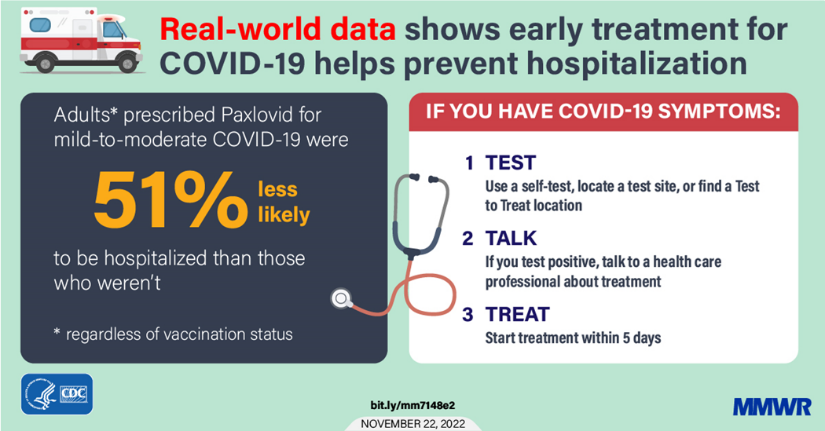
If you have COVID-19 symptoms:
Test : Use a self-test, locate a test site, or find a Test to Treat location.
Talk: If you test positive, talk to a healthcare professional to determine if you are eligible for treatment, even if your symptoms are mild right now.
Treat: Start treatment within five days of developing symptoms.
Note to Readers: Paxlovid is not a replacement for COVID-19 vaccination. COVID-19 vaccination makes you much less likely to get very sick. Still, some vaccinated people, especially those ages 65 years or older or who have other risk factors for severe disease, may benefit from treatment if they get COVID-19. A healthcare provider will help decide which treatment, if any, is right for you.
That’s the full picture for most folks. Here’s the “real-world data” link if you are interested. Thank you CDC.
Here are the key points from this week’s CDC FluView:
Seasonal influenza activity is high across the country.
Of the influenza A viruses detected and subtyped during week 48, 76% have been influenza A(H3N2), and 24% have been influenza A (H1N1).
Seven influenza-associated pediatric deaths were reported this week, for a total of 21 pediatric flu deaths reported so far this season.
CDC estimates that, so far this season, there have been at least 13 million illnesses, 120,000 hospitalizations, and 7,300 deaths from flu.
The cumulative hospitalization rate in the FluSurv-NET system is higher than the rate observed in week 48 during every previous season since 2010-2011.
The number of flu hospital admissions reported in the HHS Protect system increased during week 48 compared to week 47.
The majority of influenza viruses tested are in the same genetic subclade as and antigenically similar to the influenza viruses included in this season’s influenza vaccine.
All viruses collected and evaluated this season have been susceptible to influenza antivirals.
An annual flu vaccine is the best way to protect against the flu. Vaccination helps prevent infection and can also prevent serious outcomes in people who get vaccinated but still get sick with the flu.
CDC recommends that everyone ages 6 months and older get a flu vaccine annually. Now is a good time to get vaccinated if you haven’t already.
There are also prescription flu antiviral drugs that can be used to treat flu illnesses. It’s very important that flu antiviral drugs are started as soon as possible to treat patients who are hospitalized with flu, people who are very sick with flu but who do not need to be hospitalized, and people with flu who are at higher risk of serious flu complications based on their age or health.
Multiple respiratory viruses are currently co-circulating with influenza. Testing is important to determine the appropriate treatment.
From the FEHB front, the FEHBlog was bowled over to discover on reginfo.gov that on November 29, the Office of Personnel Management took a major step forward in implementing the Postal Service Health Benefits Program by submitting a draft interim final rule to OMB’s Office of Information and Regulatory Affairs for its review. This is the final step before the rule is published in the Federal Register. The statutory deadline for so promulgating this rule is April 8, 2023.
From the miscellany department
HR Dive discusses a Mercer report on how employers can impact the maternal mortality problem.
EBRI offers a useful analysis of telemedicine and its relationship with other healthcare services, enrollee health, and costs.
Chain Drug News reports that PCMA, the prescription drug manager trade association, has issued policy recommendations to accelerate patient biosimilar drug use.
The Wall Street Journal offers encouraging news about prison programs to resolve inmate addiction issues.
Two-thirds of people entering prisons and jails have what the Department of Health and Human Services diagnoses as substance-use disorder. For years, the only treatment in all but a handful of detention centers was to detox.
Some 630 of the roughly 5,000 jails and prisons nationwide now provide medication treatment for opioid use, according to the nonprofit Jail and Prison Opioid Project, up from about 20 in 2015. The drugs include buprenorphine, which tamps cravings for opioids, naloxone, which reverses their effects, and methadone, which eases withdrawal symptoms. Some are taken daily, others can be taken once a month in extended-release versions. The Biden administration said it wants medication available for every drug user in federal custody and at half of state prisons and jails by 2025.
We use cookies on our website to give you the most relevant experience by remembering your preferences and repeat visits. By clicking “Accept”, you consent to the use of ALL the cookies.
This website uses cookies to improve your experience while you navigate through the website. Out of these, the cookies that are categorized as necessary are stored on your browser as they are essential for the working of basic functionalities of the website. We also use third-party cookies that help us analyze and understand how you use this website. These cookies will be stored in your browser only with your consent. You also have the option to opt-out of these cookies. But opting out of some of these cookies may affect your browsing experience.
Necessary cookies are absolutely essential for the website to function properly. These cookies ensure basic functionalities and security features of the website, anonymously.
Cookie
Duration
Description
cookielawinfo-checbox-analytics
11 months
This cookie is set by GDPR Cookie Consent plugin. The cookie is used to store the user consent for the cookies in the category "Analytics".
cookielawinfo-checbox-functional
11 months
The cookie is set by GDPR cookie consent to record the user consent for the cookies in the category "Functional".
cookielawinfo-checbox-others
11 months
This cookie is set by GDPR Cookie Consent plugin. The cookie is used to store the user consent for the cookies in the category "Other.
cookielawinfo-checkbox-necessary
11 months
This cookie is set by GDPR Cookie Consent plugin. The cookies is used to store the user consent for the cookies in the category "Necessary".
cookielawinfo-checkbox-performance
11 months
This cookie is set by GDPR Cookie Consent plugin. The cookie is used to store the user consent for the cookies in the category "Performance".
viewed_cookie_policy
11 months
The cookie is set by the GDPR Cookie Consent plugin and is used to store whether or not user has consented to the use of cookies. It does not store any personal data.
Functional cookies help to perform certain functionalities like sharing the content of the website on social media platforms, collect feedbacks, and other third-party features.
Performance cookies are used to understand and analyze the key performance indexes of the website which helps in delivering a better user experience for the visitors.
Analytical cookies are used to understand how visitors interact with the website. These cookies help provide information on metrics the number of visitors, bounce rate, traffic source, etc.
Advertisement cookies are used to provide visitors with relevant ads and marketing campaigns. These cookies track visitors across websites and collect information to provide customized ads.