
Midweek Update

Midweek Update

From the Delta variant front –

  • In a joint statement, a group of high ranking HHS public health experts explained today that

“We have developed a plan to begin offering [COVID-19 vaccination] booster shots this fall subject to FDA conducting an independent evaluation and determination of the safety and effectiveness of a third dose of the Pfizer and Moderna mRNA vaccines and CDC’s Advisory Committee on Immunization Practices (ACIP) issuing booster dose recommendations based on a thorough review of the evidence. We are prepared to offer booster shots for all Americans beginning the week of September 20 and starting 8 months after an individual’s second dose. At that time, the individuals who were fully vaccinated earliest in the vaccination rollout, including many health care providers, nursing home residents, and other seniors, will likely be eligible for a booster. We would also begin efforts to deliver booster shots directly to residents of long-term care facilities at that time, given the distribution of vaccines to this population early in the vaccine rollout and the continued increased risk that COVID-19 poses to them.

“We also anticipate booster shots will likely be needed for people who received the Johnson & Johnson (J&J) vaccine. Administration of the J&J vaccine did not begin in the U.S. until March 2021, and we expect more data on J&J in the next few weeks. With those data in hand, we will keep the public informed with a timely plan for J&J booster shots as well.”

The FEHBlog will be in line for his third dose of the Pfizer vaccine when the time comes.

  • The Wall Street Journal reports that “Early data from Israel suggests a booster shot of Pfizer Inc.’s Covid-19 vaccine can significantly improve immunity in those aged 60 and above, as the U.S. and other countries plan additional doses to increase protection against the highly infectious Delta variant.”
  • Health Affairs reports on a study suggest”[ing] that the early COVID-19 vaccination campaign was associated with reductions in COVID-19 deaths. As of May 9, 2021, reductions in COVID-19 deaths associated with vaccines had translated to value of statistical life benefit ranging between $625 billion and $1.4 trillion.” The smartest move that the government made was to prioritize the elderly who suffered the most deaths during the pre-vaccination era of COVID-19.

From the federal employee vaccination screening program front, the Safer Federal Workforce task force issued a set of FAQs on COVID-19 testing employees, contractors and visitors who cannot attest to receiving a COVID-19 vaccination. The FEHBlog was pleased to read that the FAQs impose the testing cost on the agencies, not on the FEHB Program, which is the proper legal outcome under the federal CARES Act (unnumbered FAQ 3). Federal News Network makes its own observations on the Testing FAQs here.

In healthcare utilization news, Healthcare Dive reports that

  • More than one in 10 adults ages 16 to 64 said they delayed or went without needed healthcare services due to virus fears in the past 30 days, an April survey from the Urban Institute funded by the Robert Wood Johnson Foundation found. 
  • One in 10 parents delayed seeking care for their children for that reason, according to the report published Wednesday.
  • Hispanic and Black adults, along with adults with lower incomes, reported delaying care at higher rates than other groups. Adults with chronic health problems were also more likely than those without such conditions to say they went without needed care.

It’s worth noting that this survey was conducted during the month that vaccinations became widely available and before the Delta variant broke out.

In other healthcare news

  • Govexec reports that “Officials at the Centers for Disease Control and Prevention announced on Wednesday that the agency is launching a new organization to focus on disease forecasting.  The Center for Forecasting and Outbreak Analytics will be a hub for research and innovation aimed at mitigating the effects of future disease threats. Its launch comes as the federal government continues to fight the coronavirus pandemic and now the rapidly spreading Delta variant. It will build on current modeling efforts at the agency. * * * The center’s initial funding will come from the $1.9 trillion American Rescue Plan enacted in March for coronavirus relief.”
  • The NCQA Blog discusses the hospital at home movement in the U.S. “Humana Home Solutions​ Vice President Dr. Amal Agarwal estimated that up to 35% of Medicare Advantage spending might be addressable at home. As Mayo Clinic Platform President John Halamka explained, hospital at home also “brings the family back into wellness.” This matters because family involvement affects patient satisfaction.” Interestingly the experts explained that hospital at home care is best suited for mid-level acuity patients, not folks who need the ICU or folks who don’t require hospitalization.

Dr. Halamka used an accessible and memorable analogy to outline the long-term possibilities for hospital at home.

He explained that the tractor manufacturing company John Deere transformed itself into a data company by covering its tractors with sensors. The sensors report back information about the weight and volume of crops that customers harvest—soybeans, for example. The predictive value of the information reported to John Deere is so high that the data are now used to forecast soybean prices.

Likewise, Americans are filling their homes and strapping to their bodies millions of behavioral and biometric sensors.

“We are instrumenting homes with sensors to gather patient data that we can use to understand not only that patient’s progression, but aggregating and analyzing that data [to] understand the progression of similar patients,” said Halamka.

Well put, Doctor.

  • In support of extending initiatives like this to rural areas of the country, the Department of Health and Human Services announced today “key investments that will strengthen telehealth services in rural and underserved communities and expand telehealth innovation and quality nationwide. These investments—totaling over $19 million—are being distributed to 36 award recipients,” such as “Telehealth Centers of Excellence (COE) program: $6.5 million is being awarded to 2 organizations to assess telehealth strategies and services to improve health care in rural medically underserved areas that have high chronic disease prevalence and high poverty rates. The Telehealth COEs will be located in academic medical centers and will serve as telehealth incubators to pilot new telehealth services, track outcomes, and publish telehealth research. The COEs will establish an evidence-base for telehealth programs and a framework for future telehealth programs.’


Weekend update

Photo by Dane Deaner on Unsplash

The House of Representatives and the Senate remain on District / State work breaks this week. Of course the Congressional staff never rests. The Wall Street Journal reports that “House Speaker Nancy Pelosi (D., Calif.) on Sunday asked a top committee [the House Rules Committee] to look at moving forward on a $1 trillion bipartisan infrastructure bill along with the $3.5 trillion budget framework in an effort to balance the demands of her party’s ideological factions.” Fierce Healthcare identifies three major healthcare policy areas in the budget framework which healthcare lobbyists are watching carefully.

On the Delta variant front

  • The Wall Street Journal informs us that “Hospitalizations of Covid-19 patients in their 30s have hit a new record, U.S. government data show, a sign of the toll that the highly contagious Delta variant is taking among the unvaccinated.”
  • The message about the inportance of being vaccinated appears to be breaking through to the reluctant. Bloomberg tells us that “The U.S. reported almost 1 million Covid-19 vaccine doses on Saturday, the most for a single day since early July, reflecting a faster pace of inoculation as the delta variant spreads.” Nearly 60% of the vaccine eligible U.S. population (at least 12 years old) is fully vaccinated.

On the healthcare business front, Fierce Healthcare tells us that

UnitedHealth Group and Change Healthcare have entered into a timing agreement with the Department of Justice for their planned $8 billion merger.

In late March, DOJ made a second request for additional details and documentary information related to the merger. Under the timing agreement, which was reached on Aug. 7, UnitedHealth and Change agree to not “consummate” their merger before 120 days have passed since the two certified their compliance with the agency’s request.

The exception is if they receive written confirmation from DOJ that it has completed its investigation in that window, according to a Securities and Exchange Commission filing from Change Healthcare.

As we all know, timing is everything.

On the federal retirement front, Federal News Network reports

Federal retirements in July saw a big jump compared to last year, but the average processing time has swelled to nearly three months.

OPM received 8,922 retirement claims last month, compared to 6,819 claims in July 2020 — a 30.8% increase. Processed claims, meanwhile, only saw a 4.5% increase from 6,620 in July 2020 to 6,920 last month.

The latest numbers show that 2021 is generally seeing far more federal retirements than in 2020, when the pandemic reached its height. With the exception of January and February, every month this year has had year-over-year increases ranging from 10.8% to 47.2%.

Most notably, the 22% increase in federal retirements from June to July has led to a growing claims backlog. The inventory of claims ballooned from 24,999 in June to 27,001 in July, reversing the backlog’s downward trend after its peak in March.

Congress created two extremely complicated federal retirement programs. In the FEHBlog’s view, it’s up to those busy Congressional staffers to streamline the programs in order to facilitate automated claims processing.

Tuesday’s Tidbits

Photo by Patrick Fore on Unsplash

The Wall Street Journal reports

The Senate passed a roughly $1 trillion infrastructure package with broad bipartisan support Tuesday, advancing a central piece of President Biden’s economic agenda that would amount to one of the most substantial federal investments in roads, bridges and rail in decades.

With 19 Republicans including Senate Minority Leader Mitch McConnell (R., Ky.) joining all 50 Democrats to pass the bill 69 to 30, the legislation sailed through the Senate. The bill will face a more complicated path in the House, where Democrats have yoked the fate of the infrastructure effort to the passage of a broad $3.5 trillion antipoverty and climate effort. 

Professor Katie Keith in the Health Affairs blog discusses the Administration’s health policy objectives in the budget reconciliation bill that the Senate is now taking up. “Vice President Harris emphasized the need for Congress to build on these [Affordable Care Act special enrollment period] coverage gains by 1) extending the American Rescue Plan Act subsidy enhancements; 2) closing the Medicaid coverage gap; 3) expanding Medicare to include dental, vision, and hearing coverage; and 4) lowering prescription drug costs.”

Becker’s Hospital review tells us how COVID-19 vaccination rates have changed in the states for the week ended August 9. The rates in 40 states lead by Mississippi (and the District of Columbia) are up and only 10 states are down.

STAT News informs us that

As the world amasses experience with Covid-19 vaccines, something we should have known from the start is coming into sharp focus.

Vaccines that are injected into arm muscles aren’t likely to be able to protect our nasal passages from marauding SARS-CoV-2 viruses for very long, even if they are doing a terrific job protecting lungs from the virus. If we want vaccines that protect our upper respiratory tracts, we may need products that are administered in the nose — intranasal vaccines.

Can they be made? Probably. Will they do what we want them to do, if they are made? Possibly. Is there still room for this type of next-generation product, given the record number of Covid vaccines that have already been put into use? Potentially. Will it be difficult to get them through development? Likely.

In this regard the National Institutes of Health reports on a successful animal study of a COVID-19 intranasal vaccine based on the Oxford / Astra Zeneca model. What’s more, “[a] clinical trial at the University of Oxford is now testing intranasal vaccination in human volunteers.”

Fierce Healthcare is running a daily HIMSS21 roundup from the conference being held in Las Vegas this week.

Reg Jones writes in FedWeek about FEHB coverage for adult children of federal employees and annuitants who are incapable of self support. This is a rather unique feature of the Program.

Finally the Wall Street Journal reports that

The U.S. Postal Service plans to charge more for packages shipped during the holidays, including those sent by individuals, to offset the rising cost of deliveries at the busiest time of the year.

The agency on Tuesday proposed adding surcharges on most packages shipped domestically between Oct. 3 and Dec. 26, saying the fees would apply to both commercial and retail customers. That means it won’t just be Amazon.com Inc.,Target Corp. TGT 0.63% and other big holiday shippers paying higher-than-normal rates; it will also cost more to ship a box of cookies to grandma.

The agency said the added fees, ranging from 25 cents for smaller packages to $5 for heavier items traveling longer distances, are in line with broader industry practices to charge more during the holiday season.

Friday Stats and More

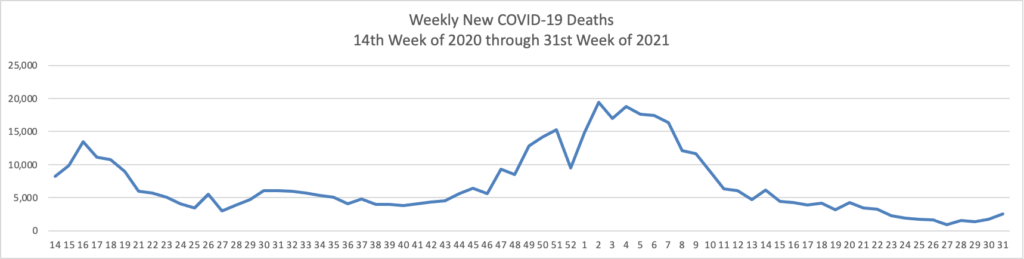
Based on the Centers for Disease Control’s COVID-19 Data Tracker website, here is the FEHBlog’s chart of new weekly COVID-19 cases and deaths over the 14th week of 2020 through 31st week of this year (beginning April 2, 2020, and ending August 4, 2021; using Thursday as the first day of the week in order to facilitate this weekly update):

and here is the CDC’s latest overall weekly hospitalization rate chart for COVID-19:

The FEHBlog has noticed that the new cases and deaths chart shows a flat line for new weekly deaths  because new cases significantly exceed new deaths. Accordingly here is a chart of new COVID-19 deaths over the period (April 2, 2020, through August 4, 2021):

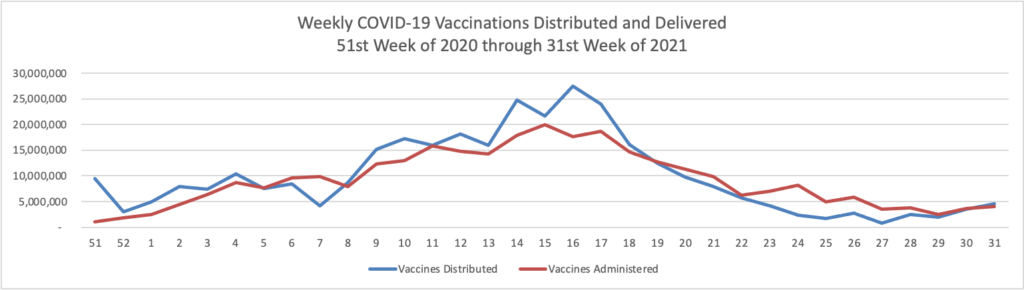
Finally here is a COVID-19 vaccinations chart over the period December 17, 2020, through August 24, 2021, which also uses Thursday as the first day of the week:

While COVID-19 cases are soaring, the number of deaths remains stable thanks to the high vaccination rates for Americans over age 65. It is also encouraging that the number of administered vaccinations also is increasing.

In other Delta variant news:

  • Surprisingly, according to STAT News, “with nearly 20% of all U.S. Covid cases last week recorded in children, the American Academy of Pediatrics and 11 other organizations put out a consensus statement this week calling on providers conducting sports physicals to ask about children’s Covid vaccination status and to use it as an opportunity to administer a vaccine, if possible.”
  • Fierce Pharma tells us that “In a trial of nearly 480,000 healthcare workers in South Africa, Johnson & Johnson‘s one-dose vaccine helped prevent severe disease from the Delta variant, Bloomberg reports. The trial is the first piece of large-scale evidence that shows the shot works against the variant, the news service stated. In fact, Glenda Gray, one of the leaders of the work, said the vaccine may provide better protection against Delta than the Beta variant.”
  • MedPage Today reports that “Unvaccinated adults who were previously infected with COVID-19 were twice as likely to be reinfected as those previously infected but also fully vaccinated, researchers found. A case-control study in Kentucky found a more than two times higher risk of COVID-19 cases among unvaccinated adults with prior infection compared with their fully vaccinated counterparts (OR 2.34, 95% CI 1.58-3.47), reported Alyson Cavanaugh, PhD, of the CDC, and colleagues, writing in an early edition of the Morbidity and Mortality Weekly Report.“
  • In related news Precision Vaccines tells us that “The World Health Organization (WHO) issued Influenza Update N° 399 on August 2, 2021, saying, ‘Globally, despite continued or even increased testing for influenza in some countries, influenza activity remained at lower levels than expected for this time of the year.'”

From the No Surprises Act (“NSA”) front, the FEHBlog discovered today that last Tuesday the tri-agencies and OPM submitted their second NSA interim final rule, which concerns the independent dispute resolution process, to OMB’s Office of Information and Regulatory Affairs for final review. OIRA already has two listening sessions concerning this rule making on its calendar. This indicates that the second interim final rule will be made public in early September, rather than on its October 1, 2021, due date.

From the federal employee front

  • Govexec brings us up to date on the development of the President’s mandatory vaccination program for federal employees. “The Safer Federal Workforce Task Force—a group President Biden created by executive order that is led by the White House, General Services Administration and Office of Management and Budget—confirmed in new guidance agencies would not initially ask for proof of vaccination, but they could follow up for documentation if they receive “a good faith allegation that strongly suggests” an employee lied on their attestation form. Those “certification of vaccination” forms will soon go out via email to all federal employees, with an Office of Management and Budget official saying that process will begin next week.  While agencies will initially rely on the honor system as it begins asking employees for their vaccination status, the administration made clear there could be consequences for lying.”
  • Govexec also discusses how Medicare Advantage plans are being integrated into FEHB plans. The trend started with HMOs and the APWU Health Plan picked it up for this year. Expect more plans to follow suit for 2022.  

In more news

  • Earlier this week, the FEHBlog noted a Reuters report that the Justice Department is preparing to file suit to block Optum’s acquisition of Change Healthcare. Fierce Healthcare reports today au contraire that “Change Healthcare President and CEO Neil de Crescenzo said Thursday he’s pleased with the company’s progress on regulatory review of its pending deal with Optum and is moving forward with plans for a successful integration. ‘We look forward to continuing to work diligently in coordination with UHG (UnitedHealth Group) to provide the necessary information requested by the DOJ (Department of Justice) and completing the transaction.'” Time will tell.
  • Medcity News informs us that “GoodRx struck a partnership with medication data giant Surescripts that would let healthcare providers access cash price information on medications. Arlington, Virginia-based Surescripts dominates the e-prescribing market, offering technology that routes clinicians’ electronic prescriptions directly to pharmacies. It’s owned by CVS Health and Express Scripts, and nearly 2 billion prescriptions were delivered through its software last year.”
  • mHealth Intelligence tells us that “While the pandemic prompted an unprecedented surge in telehealth to address healthcare needs, it also highlighted the gap between those who can access care and those who can’t. Now health systems, community health organizations, non-profits and philanthropic groups are moving to address those gaps with programs that use telehealth to extend care to those who can’t access or afford it. They’re fueling a surge in connected health charities and projects targeting the social determinants of health. Among those groups is Beam Up, an organization launched by telehealth company Beam Healthcare to address gaps in access to health food, quality education and healthcare services. Executives see a need for these services not only in other countries – a partnership with Tyto Care is equipping a handful of orphanages in Mexico with telemedicine technology – but in cities and rural regions across the United States.

Midweek Update

It turns out that OPM Director Kiran Ahuja held her first virtual press conference this morning.

  • The Federal Times discusses her conversation with reporters about implementing the President’s vaccination mandate and piloting an online retirement application for federal employees.
  • Federal News Network and FCW paint with broader brushes about Ms. Ahuja’s goals and challenges.

The FEHBlog noticed today that the OPM senior staff bios on its website provide a good picture of Director Ahuja’s team.

On the Delta variant front

  • Kaiser Health News makes a convincing economic agreement for receiving a COVID-19 vaccination.
  • The New York Times reports that “With a new surge of coronavirus infections ripping through much of the United States, the Food and Drug Administration has accelerated its timetable to fully approve Pfizer-BioNTech’s coronavirus vaccine, aiming to complete the process by the start of next month, people familiar with the effort said. President Biden said last week that he expected a fully approved vaccine in early fall. But the F.D.A.’s unofficial deadline is Labor Day or sooner, according to multiple people familiar with the plan. The agency said in a statement that its leaders recognized that approval might inspire more public confidence and had “taken an all-hands-on-deck approach” to the work.”

On the 2nd quarter financial reports front, Healthcare Dive reports that

Returning utilization of health services and higher-than-expected COVID-19 care costs drove CVS Health’s net income in the second quarter down 7% year over year to $2.8 billion, the healthcare behemoth reported Wednesday.

The payer business, which includes Aetna, reported a medical loss ratio of 84.1%, up significantly from 70.3% the same time last year. The hike in MLR, which was higher than both internal and analyst forecasts, is especially acute compared to the second quarter of 2020, which saw a severe dip in utilization as COVID-19 lockdowns and elective procedure restrictions kicked into gear.

However, CVS beat Wall Street expectations for both earnings and revenue, with topline of $72.6 billion, up 11% year over year, driven mostly by growth in government products. The Woonsocket, Rhode Island-based company raised its full-year guidance following the results.

In legal news, Business Insurance informs us that “The U.S. Department of Justice is weighing a possible lawsuit to block UnitedHealth Group’s (UNH.N) nearly $8 billion deal to acquire health care analytics and technology vendor Change Healthcare (CHNG.O), the Information reported on Tuesday.”

From the federal employee benefits front, Reg Jones tells us in FedWeek that “One valuable feature of the Federal Long Term Care Insurance Program is its more generous rules regarding coverage in retirement, as compared with the FEHB health insurance and FEGLI life insurance programs.” Of course, the greater flexibility may be explained by the facts that FEHB and FEGLI coverage are government funded while FLTCIP is fully member funded. Still it’s useful information.

In other mid-week news

  • The Center for Medicare and Medicaid Innovation released its 2020 report to Congress today.
  • STAT News tells us that “For all the explosive controversy over the approval of the first treatment for Alzheimer’s disease in nearly 20 years, hardly any patients have actually gotten it yet. The drug’s eye-popping, $56,000 annual price and questionable benefit to patients have been a shock to the bureaucracy that makes the health care system run — and that’s having a clear effect on uptake. Some analysts estimated last month that fewer than 100 patients were dosed in the first weeks after the therapy was approved, though availability will likely ramp up over the coming months.”
  • Health Payer Intelligence discusses “five ways payers have tackled mental, hehavioral Healthcare in 2021. As the coronavirus pandemic becomes more manageable and vaccination rates increase nationwide, payers are channeling funds into mental and behavioral healthcare programs.” That’s a sound focus of attention.

Tuesday’s Tidbits

Photo by Patrick Fore on Unsplash

From the Delta Variant front —

Federal News Network reports that

The White House is strongly considering requiring federal employees to show proof they’ve been vaccinated against the coronavirus or otherwise submit to regular testing and wear a mask — a potentially major shift in policy that reflects growing concerns about the spread of the more infectious delta variant.https://www.cdc.gov/coronavirus/2019-ncov/vaccines/fully-vaccinated.html

The possible vaccine mandate for federal employees — regardless of the rate of transmission in their area — is one option under consideration by the Biden administration, according to a person familiar with the plans who spoke on condition of anonymity to discuss deliberations that have yet to be made public. The White House is expected to announce its final decision after completing a policy review this week.

Govexec adds that “Federal law does not prohibit public and private entities from mandating coronavirus vaccines, even though those vaccines do not yet have full authorization from the Food and Drug Administration, according to a legal opinion from the Justice Department posted on Monday.”

Other press reports indicate that the President may announce his decision this Thursday, and in the FEHBlog’s view if he approves this action, many private sector employers in and outside of healthcare will follow suit.

The Centers for Disease Control recommended today that “To maximize protection from the Delta variant and prevent possibly spreading it to others, [vaccinated Americans should] wear a mask indoors in public if you are in an area of substantial or high transmission.” It turns out the Washington DC is an area of substantial transmission. Bloomberg adds that “It’s not just Arkansas and Louisiana, where the delta variant has been raging, that are affected by the Centers for Disease Control and Prevention’s new recommendation for vaccinated people to mask indoors in some parts of the country. Most major U.S. urban areas also fall under the scope of the advisory.”

In today’s Tidbits —

  • Beckers Hospital Review informs us that U.S. News and World Report has issued its annual U.S. hospital rankings with the Mayo Clinic claiming the top spot “for the sixth consecutive year.” Becker’s also comments on the new health equity section found in those rankings.
  • The Congressional Research Service has released a report on the No Surprises Act which it describes as an “Overview of Federal Consumer Protections and Payment for Out-of-Network Services.”
  • The HHS Agency for Healthcare Research and Quality has issued a report providing and “Overview of Clinical Conditions With Frequent and Costly Hospital Readmissions by Payer, 2018.”
  • Becker’s Payer Issues discusses a Forbes interview with Liz Fowler, who is director of the Center for Medicare and Medicaid Innovation at HHS. “Here are four conclusions CMMI has drawn over a decade of experimentation, according to Forbes: (1) Voluntary initiatives narrowed participation as only providers who saw financial gain opted in; (2) Separate alternative payment models and multiple bundles for specialty groups leads to fragmentation, taking away from value-based care. (3) Initiatives like per-member per-month payments only temporarily work, but don’t sustain new practices once phased out, and (4) In benchmarking, models need to leverage retrospective benchmarks or prospective ones with guardrails to ensure accuracy and feasibility of approaches.”
  • Medcity News offers an interesting account of how certain hospital got the pricing transparency job done correctly.
  • Fierce Health tells us that Blue Cross licensee “Anthem is investing nearly $90 million in affordable housing across Indiana. The $87.9 million investment will fund 1,139 affordable apartment units, townhomes and single-family homes across 11 communities in the state, Anthem announced on Saturday. The initiative was unveiled at a ribbon-cutting for a recently completed complex in Culver, a six-building, 48-unit complex.” Well done.
  • Healthcare Dive reports that health insurer Centene reported a $353 million dollar loss for the second quarter of 2021 as members returned to the doctors’ offices. “There was a “broad return to the doctor’s office” in March and April, CFO Drew Asher said, but Centene had expected the slight downtick in May utilization to persist. That did not happen. Instead, utilization increased again in June.”
  • 401k Specialist informs us that the President has nominated New York City attorney Lisa M. Gomez to be Assistant Secretary of Labor for Employee Benefits. “The Senate-confirmed position oversees the Labor Department’s Employee Benefits Security Administration (EBSA), tasked with regulation and enforcement of private-sector retirement and health plans.” Ms. Gomez is also an FEHB lawyer and an esteemed colleague of the FEHBlog. She deserves a swift Senate confirmation for this important post.

Midweek update

At the top of FEHB news today is the release of the Congressional Budget Office’s report on the Postal Service Health Benefit (“PSHB”) Program provisions of the Postal Reform bill.

CBO expects that PSHB premiums would be lower than those for FEHB plans because Medicare would cover most of the health care costs for Medicare-eligible enrollees in PSHB plans. CBO estimates that USPS spending on health insurance premiums for active workers and their dependents would decrease by roughly $2.5 billion over the 2021-2031 period; those amounts are recorded as off-budget. CBO also estimates that federal spending for health insurance premiums for USPS annuitants and their dependents would decrease by $2.5 billion over that same period; those amounts are recorded as on-budget. * * *

FEHB premiums would rise slightly after those enrollees moved to the PSHB program, CBO expects. Over time, as USPS workers and annuitants enroll in a PSHB plan rather than in an FEHB plan, CBO expects that FEHB premiums would decrease because non-USPS enrollees in FEHB would have lower expected health care costs, on average, than enrollees joining the PSHB program. The federal government’s share of payments for health insurance premiums for non-USPS annuitants is recorded as on-budget direct spending. CBO estimates that spending for such annuitants would decrease by $61 million over the 2021-2031 period.

CBO also explains that the PSHB savings results from a cost shift to Medicare. Because FEHB and PSHB premiums are calculated for a combined risk pool of plan members, the Medicare savings will redound to the benefit of the Postal Service and all of the PSHB members. The lower premiums will encourage enrollment in the PSHB.

If OPM simply allowed all FEHB plans to integrate their prescription drug benefits with Medicare Part D (known as Part D EGWPs), then FEHB plan members and federal and postal employers, all of whom pay Medicare taxes, will receive lower premiums, thereby avoiding the unnecessary balkanization of the FEHB. The decision is OPM’s to make as Congress in 2003 expressly permitted FEHB plans to adopt Part D EGWPs.

In related new, CalPERS Board of Administration, which manages the the California state employees health benefit program, “approved health plan premiums for calendar year 2022, at an overall premium increase of 4.86%.” This suggests that we are in store for a sizable FEHB premium increase for 2022.

As the FEHBlog mentioned yesterday, he has been attending the NCQA’s virtual Digital Quality Summit which has been focusing on health equity, a worthy goal. During last year’s virtual DQS, the FEHBlog came up with the idea of adding the Census Bureau’s racial and ethnic identifiers to the ICD-10 code set which would allow health care providers to readily share that important data with health plans. Today the FEHBlog pushed the idea forward with the patient centered track. Time will tell.

Similarly, Govexec informs us that “Top diversity officials at four major agencies said on Tuesday that obtaining and using better data will be crucial to advancing diversity, equity, inclusion and accessibility in the federal workforce.”

In sad news, the Washington Post reports that

Deaths from drug overdoses soared to more than 93,000 last year, a staggering record that reflects the coronavirus pandemic’s toll on efforts to quell the crisis and the continued spread of the synthetic opioid fentanyl in the illegal narcotic supply, the government reported Wednesday. The death toll jumped by more than 21,000, or nearly 30 percent, from 2019, according to provisional data released by the National Center for Health Statistics, eclipsing the record set that year.

The Post adds

There are some signs that the Biden administration and Congress are preparing to renew efforts to address what was the nation’s most serious public health crisis before the pandemic. President Biden on Tuesday nominated former West Virginia public health official Rahul Gupta to be his drug czar. Gupta has cited the shift from in-person care during the pandemic as one of the contributors to increased addiction-related public health problems.

In prescription drug news

  • The Drug Channels blog discusses 2020 PBM drug trend reports. Top line: “[D]rug spending continues to grow more slowly than every other part of the U.S. healthcare system. Spending growth at CVS and Express Scripts was somewhat higher in 2020 compared to the 2019 figures, due primarily to faster utilization growth.”
  • The Boston Globe reports that “At least half-a-dozen private health insurers in some of the nation’s largest states are balking at covering Biogen’s controversial drug for Alzheimer’s disease, saying it is an experimental and unproven treatment despite being approved by the federal government one month ago. Six affiliates of Blue Cross and Blue Shield in Florida, New York, Michigan, North Carolina, and Pennsylvania indicated in policies posted online they will not cover the Cambridge biotech’s drug, Aduhelm, because they consider it ‘investigational’ or ‘experimental’ or because “a clinical benefit has not been established.” Aduhelm, which is priced at $56,000 a year, is intended to slow cognitive decline in patients with early Alzheimer’s symptoms, regardless of their age. * * * James Chambers, an associate professor of medicine at the Tufts Medical Center Institute for Clinical Research and Health Policy Studies, said that insurers have occasionally opted not to cover expensive specialty medicines for rare diseases, but that he’s never seen firms refuse to pay for an approved drug that could be prescribed to millions of people. ‘This is unprecedented,’ said Chambers, who has spent seven years studying how private insurers decide which drugs to cover. ‘Maybe it’s not entirely surprising given the controversy surrounding the drug’s approval, but it’s not something I’ve seen before.’” The FEHBlog expects that this is a prudent shot across the manufacturer’s bow. The FEHBlog is amazed that Biogen has not yet backed off on the $56,000 price annually per patient. In a STAT News interview, the acting FDA Commissioner Janet Woodcock remarked “The accelerated approval was based on very solid grounds,” she said. “I do believe that will play out over time, as people see that was a very appropriate use of that authority and the right thing to do for patients.”
  • Bloomberg reports on a recent Senate hearing on drug prices. Topics included patent reform and pay for delay deals.

In other news

  • The federal government’s principal healthcare fraud and abuse report for the last federal fiscal year was released. “During Fiscal Year (FY) 2020, the Federal Government won or negotiated more than $1.8 billion in health care fraud judgments and settlements,2 in addition to other health care administrative impositions. Because of these efforts, as well as those of preceding years, almost $3.1 billion was returned to the Federal Government or paid to private persons in FY 2020. * * * In FY 2020, the Department of Justice (DOJ) opened 1,148 new criminal health care fraud investigations. Federal prosecutors filed criminal charges in 412 cases involving 679 defendants. A total of 440 defendants were convicted of health care fraud related crimes during the year. Also, in FY 2020, DOJ opened 1,079 new civil health care fraud investigations and had 1,498 civil health care fraud matters pending at the end of the fiscal year. Federal Bureau of Investigation (FBI) investigative efforts resulted in over 407 operational disruptions of criminal fraud organizations and the dismantlement of the criminal hierarchy of more than 101 health care fraud criminal enterprises.”
  • Becker’s Hospital Review tells us about the telehealth provisions of the CMS proposed 2022 Medicare Part B physician payment rule which would preserve the status quo through 2023.

Weekend update

The Senate has left town for a two week long State work break while the House of Representatives will continue Committee business and floor voting through Thursday July 1. The House Appropriations Committee will mark up that fiscal year 2022 financial services and general government appropriations bill on Tuesday morning, June 29. The Federal Times reports on that process here.

The U.S. Supreme Court is expected to wrap up its October 2020 term this week.

Last Friday, President Biden issued an executive order on “Diversity, Equity, Inclusion, and Accessibility in the Federal Workforce.” Here’s a link to the accompanying fact sheet. The new OPM Director will play a key role in implementing this executive order which makes one specific mention of the FEHB Program:

Sec. 11 (c) To ensure that LGBTQ+ employees (including their beneficiaries and their eligible dependents), as well as LGBTQ+ beneficiaries and LGBTQ+ eligible dependents of all Federal employees, have equitable access to healthcare and health insurance coverage:
(i) the Director of OPM shall take actions to promote equitable healthcare coverage and services for enrolled LGBTQ+ employees (including their beneficiaries and their eligible dependents), LGBTQ+ beneficiaries, and LGBTQ+ eligible dependents, including coverage of comprehensive gender-affirming care, through the Federal Employees Health Benefits Program; * * *

The 2022 OPM technical guidance for benefit and rate proposals clearly anticipated this directive.

On the COVID-19 front

  • The Hill informs us that public health experts are wondering when the Food and Drug Administration will give full approval to the mRNA COVID-19 vaccines, given the fact that a sizable cadre of unvaccinated folks have expressed concern about emergency use authorization status of those vaccine.
  • The Wall Street Journal reports that “In the coronavirus pandemic, a wave of mental-health crises has grown into a tsunami, flooding an already taxed system of care. As the country appears to be emerging from the worst of the Covid-19 crisis, emergency departments say they are overwhelmed by patients who deferred or couldn’t access outpatient treatment, or whose symptoms intensified or went undiagnosed during the lockdowns.”

On the new Alzheimer’s drug / Aduhelm front, STAT News offers

  • a calculator to estimate the cost of Aduhelm to Medicare depending upon utilization. “Estimates of how many seniors on Medicare will actually take Aduhelm, which has a list price of $56,000 [annually], vary wildly. Some experts have guessed at relatively low patient interest, around 500,000 people. Biogen, the company behind the drug, has put its target population far higher, around 1 million to 2 million people. But technically, since the FDA approved the drug for every Alzheimer’s patient, not just those with early-onset disease, the number could skyrocket toward 5.8 million, the number of adults over 65 with Alzheimer’s.”
  • a report that “The top House Democrats on two powerful committees on Friday announced an investigation into the approval and pricing of Biogen’s controversial Alzheimer’s drug, Aduhelm. Both Biogen and the Food and Drug Administration will be under the microscope, House Committee on Oversight and Reform Chair Carolyn Maloney (D-N.Y.) and Energy and Commerce Chair Frank Pallone (D-N.J.) said. “We have serious concerns about the steep price of Biogen’s new Alzheimer’s drug Aduhelm and the process that led to its approval despite questions about the drug’s clinical benefit,” the chairs said in a joint statement.

Welcome Director Ahuja

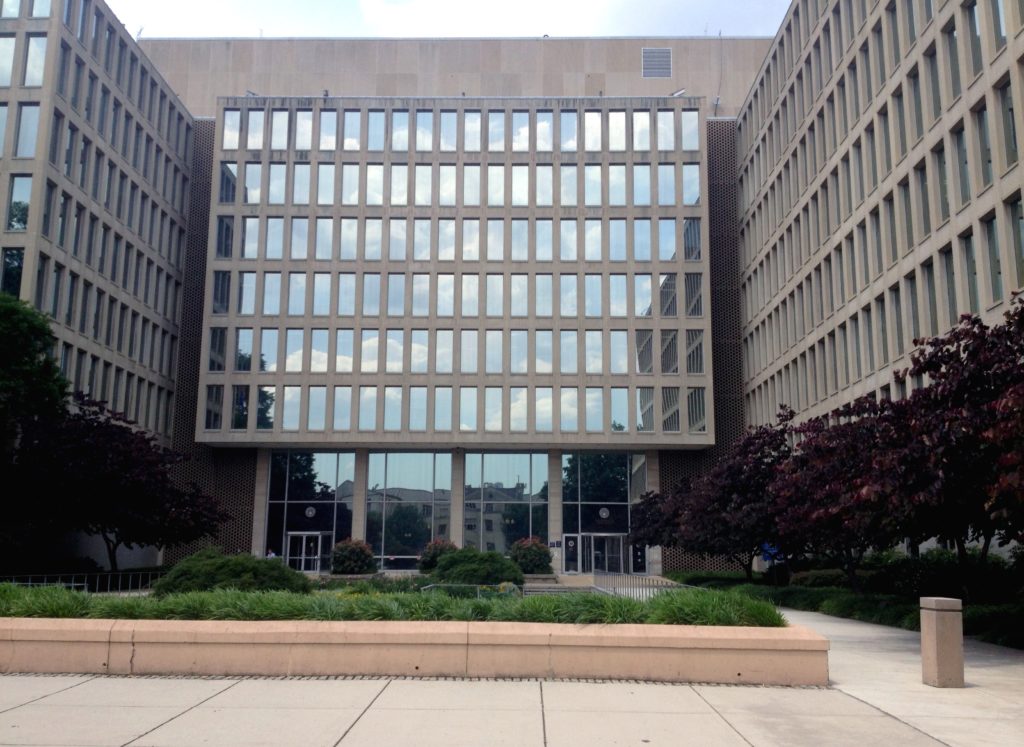
OPM Headquarters a/k/a the Theodore Roosevelt Building

OPM’s new Director Kiran Ahuja was sworn in today. Here is a link to the OPM press release on the festivities.

Health Payer Intelligence informs us that “The Alliance of Community Health Plans (ACHP) has proposed a number of recommendations to improve the Federal Employees Health Benefits (FEHB) program’s plan comparison tool in order to boost quality and enrollment, according to a recent issue brief.” ACHP’s action is timely because OPM has been focusing attention on the plan comparison tool in consultation with interested carriers and presumably other stakeholders.

According to a Committee press release, “The House Appropriations Subcommittee on Financial Services and General Government today approved by voice vote its fiscal year 2022 bill. [This is the bill that funds OPM and the FEHB.] For fiscal year 2022, the draft bill includes $29.1 billion in funding, an increase of $4.8 billion over 2021.” 

Sen. Chuck Grassley (R Iowa) announced

Sen. Chuck Grassley (R-Iowa) today joined Senate Majority Whip Dick Durbin (D-Ill.) Sen. Angus King (I-Maine) to introduce the Drug-price Transparency for Competition (DTC) Act, a bill that would require price disclosures on advertisements for prescription drugs, in order to empower patients and reduce spending on medications. Last week, the Government Accountability Office (GAO) released a report – requested by Durbin and Grassley – which found direct-to-consumer (DTC) advertisements of prescription drugs contribute to an enormous amount of Medicare costs. Specifically, the DTC Act would require DTC advertisements for prescription drugs and biological products to include a disclosure of the list price, so that patients can make informed choices when inundated with drug commercials. 

Speaking of drug prices, let’s take a look at recent news on the new Alzheimer’s Disease drug, Aduhelm.

  • Yesterday, Biogen issued a bulleted defense of its pricing, which is $56,000 annually per patient. STAT News points out “For families and physicians grappling with the historic approval this month of the controversial Alzheimer’s drug Aduhelm, there’s no shortage of unanswered questions. But a critical one has largely been overlooked: Once patients start taking the medication, how will they know when it’s time to stop? “We don’t have any guidance on how long to give this medication to someone who doesn’t experience adverse events,” said William Mantyh, a behavioral neurologist at M Health Fairview University of Minnesota Medical Center. “With a drug like aducanumab where the upfront demonstrated efficacy is up in the air, it really makes it hard for a clinician to figure out when to stop the drug based on a patient’s clinical symptoms.”
  • Axios interviewed AHIP CEO Matt Eyles on Aduhelm pricing. In response to an Axios question on acceptable pricing, Mr. Eyles responded that “The best information we have is what [the Institute for Clinical and Economic Review] puts out.” ICER stated on June 7 that “At the ICER public meeting on aducanumab on July 15, 2021, we will tackle important questions [about Aduhem] with all stakeholders at the table. We will also address the question of fair pricing for a drug that now seems likely to become one of the top selling drugs in the history of the United States. ICER’s preliminary draft report calculated a fair annual price to lie between $2,500-$8,300. Even in our most optimistic cost-effectiveness scenario — which ignores the contradictions within the two pivotal trials and presumes that only the positive trial captures the true benefits of treatment — aducanumab’s health gains would support an annual price between $11,100-$23,100. The list price of $56,000 per year announced today by the drug maker far exceeds even this optimistic scenario. Our report notes that only a hypothetical drug that halts dementia entirely would merit this pricing level. The evidence on aducanumab suggests that, at best, the drug is not nearly this effective. Nonetheless, even at the lower range of the estimated number of eligible patients, at this price the drug maker would stand to receive well in excess of $50 billion per year even while waiting for evidence to confirm that patients receive actual benefits from treatment.
  • The Wall Street Journal reports that “Eli Lilly & Co. plans to submit its Alzheimer’s drug for market clearance under an expedited review this year, in a sign that regulators are encouraging development of treatments for the disease after a recent approval. Lilly said Thursday that the U.S. Food and Drug Administration had designated the company’s experimental Alzheimer’s drug, called donanemab, for the agency’s accelerated approval process. The FDA decision comes after the agency cleared Biogen Inc.’s Aduhelm, the first Alzheimer’s therapy to receive approval in nearly two decades but one that has drawn criticism from doctors and researchers skeptical the drug works. * * * Donanemab performed better in a trial than Biogen’s drug did in its trials, and health insurers and patients would probably prefer it over Aduhelm, J.P. Morgan analyst Chris Schott said in a note to investors.“Donanemab’s approval would be a major blow to Aduhelm’s commercial prospects,” Brian Skorney, a Robert W. Baird & Co. analyst, said in a research note. “We think it would make zero sense for FDA to approve Aduhelm, but not donanemab.” Ah, competition.

In other drug pricing news, Fierce Healthcare tells us that

Cigna is launching a new program that aims to incentivize eligible members to switch to biosimilar drugs.

Under the new Shared Savings Program, members will be offered a one-time $500 debit card for healthcare services or medications if they make the decision to switch to a biosimilar, according to an announcement provided first to Fierce Healthcare.

The program will be made available first to [approximately 7,000] eligible patients taking Remicade, a brand-name biologic that treats a number of inflammatory conditions such as Crohn’s disease and psoriasis. Remicade infusion costs can vary, but Cigna claims data suggest the average regimen costs $30,000 per year, with expenses growing depending on the site of administration.

Two biosimilars for the drug, Avsola and Inflectra, will be moved to the insurer’s preferred tier in July. Eligible customers and their providers will be notified by Cigna about their eligibility to participate in the Shared Savings Program in the coming weeks, the insurer said.

In COVID-19 news —

  • Fierce Biotech reports that “The FDA green-lit its first antibody test that doesn’t use blood samples to check for evidence of a COVID-19 infection and instead relies on simple, painless mouth swabs. Developed by Diabetomics, the rapid, lateral-flow diagnostic received an agency emergency authorization allowing it to be used at the point of care for adults and children. Designed to deliver a result within 15 minutes, the CovAb test also does not require any additional hardware or instruments. When administered at least 15 days after the onset of symptoms, when the body’s antibody response reaches higher levels, the test demonstrated a false-negative rate of less than 3% and a false-positive rate of nearly 1%, according to the company.” 
  • The New York Times reports that the Baltimore Maryland factory that had been producing the single dose Johnson & Johnson COVID-19 vaccine remains shuttered which Congress investigates its owner Emergent Biosolutions.
  • The NIH Director’s blog informs us about new NIH research on how Immunity generated from COVID-19 vaccines differs from an Infection. “The good news so far is that, unlike the situation for the common cold, we have now developed multiple COVID-19 vaccines. The evidence continues to suggest that acquired immunity from vaccines still offers substantial protection against the new variants now circulating around the globe. The hope is that acquired immunity from the vaccines will indeed produce long-lasting protection against SARS-CoV-2 and bring an end to the pandemic. These new findings point encouragingly in that direction. They also serve as an important reminder to roll up your sleeve for the vaccine if you haven’t already done so, whether or not you’ve had COVID-19. Our best hope of winning this contest with the virus is to get as many people immunized now as possible. That will save lives, and reduce the likelihood of even more variants appearing that might evade protection from the current vaccines.” Amen to that.

In a bit of Thursday miscellany

  • Patient Engagement reports that “Optum is bringing healthcare right into Utah’s backyard, rolling out a new Optum Mobile Health Clinic to improve care access for individuals in Optum Care Network Utah. The mobile health clinic, a 45-foot-long vehicle with two private exam rooms, a waiting room, and an imaging lab, is set to address the leading care access barriers experienced by Utahns.” Well done.
  • A friend of the FEHBlog called his attention to the NIH report on an engaging study suggesting scientists may need to rethink which genes control aging.

Thursday Miscellany

U.S. Supreme Court building, Wash. DC

At long last, the U.S. Supreme Court issued its opinion today in the third case reaching the Court on the issue of the constitutionality of the Affordable Care Act (“ACA”). In an opinion written by Justice Breyer and joined by the Chief Justice and four other Justices, the Court ruled in short as follows:

As originally enacted in 2010, the Patient Protection and Affordable Care Act required most Americans to obtain minimum essential health insurance coverage. The Act also imposed a monetary penalty, scaled according to in- come, upon individuals who failed to do so. In 2017, Con- gress effectively nullified the penalty by setting its amount at $0. See Tax Cuts and Jobs Act of 2017, Pub. L. 115–97, §11081, 131 Stat. 2092 (codified in 26 U. S. C. §5000A(c)).

Texas and 17 other States brought this lawsuit against the United States and federal officials. They were later joined by two individuals (Neill Hurley and John Nantz). The plaintiffs claim that without the penalty the Act’s minimum essential coverage requirement is unconstitutional. Specifically, they say neither the Commerce Clause nor the  Tax Clause (nor any other enumerated power) grants Congress the power to enact it. See U. S. Const., Art. I, §8. They also argue that the minimum essential coverage re- quirement is not severable from the rest of the Act. Hence, they believe the Act as a whole is invalid. * * *

[W]e conclude that the plaintiffs in this suit failed to show a concrete, particularized injury fairly traceable to the defendants’ conduct in enforcing the specific statutory provision they attack as unconstitutional. They have failed to show that they have standing to attack as unconstitutional the Act’s minimum essential coverage provision. Therefore, we reverse the Fifth Circuit’s judgment in respect to standing, vacate the judgment, and remand the case with instructions to dismiss.

Justice Thomas filed a concurring opinion, and Justice Alito, joined by Justice Gorsuch, filed a dissenting opinion. The FEHBlog confidently can state that he predicted this favorable outcome for the ACA. It always has been clear to the FEHBlog that the Supreme Court took the case to kill the lawsuit, not the law.

The Senate will take up Kiran Ahuja’s nomination to be OPM Director when it resumes floor business on Monday June 21. If Ms. Ahuja’s nomination is not confirmed next week, the Senate will be away from our Nation’s capital for two weeks for the Independence Day holiday.

Reg Jones’ latest column in FedWeek concerns federal employee survivor benefits in the case of a post-retirement marriage.

In federal employment news, Federal News Network reports that President Joe Biden signed the Juneteenth National Independence Day Act this afternoon, establishing June 19 as a federal holiday. Most federal employees will have tomorrow, June 18 off for observance as June 19 falls on a Saturday this year, the Office of Personnel Management said. * * * Nearly every state already recognizes Juneteenth as a holiday, but it now becomes the first federal holiday created since Martin Luther King Jr. Day was established in 1983.”

In COVID-19 news and this should come as no surprise, Medscape informs us that “More than half of unvaccinated Americans would prefer to get a COVID-19 vaccination at their doctors’ office, according to the results of a new national survey. * * * The preference to be vaccinated in a medical office was three to five times higher among unvaccinated Americans than were other strategies such as vaccinations at retail pharmacies or drug stores, community health centers, public health clinics, drive-up clinics, and large public vaccination sites.” As of today, 65% of Americans over age 18, and 87% of Americans over age 65, have had at least one dose of a COVID-19 vaccination.

In a burst of closing miscellany —

  • Kaiser Health News tells us that ” The pandemic-caused recession and a federal requirement that states keep Medicaid beneficiaries enrolled until the national emergency ends swelled the pool of people in the program by more than 9 million over the past year, according to a report released Thursday. The latest figures show Medicaid enrollment grew from 71.3 million in February 2020, when the pandemic was beginning in the U.S., to 80.5 million in January, according to a KFF analysis of federal data.”
  • Health Payer Intelligence informs us that “Medicare Advantage plans may better address racial care disparities than fee-for-service Medicare, according to the second in a series of reports that ATI Advisory has prepared for Better Medicare Alliance (BMA) in 2021. “With over 26.5 million beneficiaries enrolled in Medicare Advantage today, this report shows that minority beneficiaries are a driving force behind these enrollment gains; turning to Medicare Advantage to meet their health and social needs. When policymakers stand up for Medicare Advantage, they stand up for these seniors, too,” Allyson Y. Schwartz, president and chief executive officer of the Better Medicare Alliance, said in the press release. Around half of all Black Medicare beneficiaries and 53 percent of Latinx Medicare beneficiaries are in a Medicare Advantage plan, the report found. In contrast, only 34 percent of White beneficiaries and 31 percent of those who identified as “Other” races were enrolled in a Medicare Advantage plan.”
  • STAT News reports that “ovarian cancer, which kills about 15,000 Americans every year, has historically been one of the thornier cancers to treat. Only in the last few years has a new class of potent drugs, called PARP inhibitors, started to change that. But even with these promising new treatments, too often, tenacious tumors come roaring back. So there’s a need for yet newer drugs that can overcome any resistance the cancer evolves. According to research published Thursday, scientists might have found one. And it’s not actually a new drug at all. In fact, it’s been sitting, retired, in a drug library for decades. “While evaluating mechanisms of PARP inhibitor resistance over the last few years we came across this drug, novobiocin, which curiously enough, is an antibiotic,” said Alan D’Andrea, director of the Susan F. Smith Center for Women’s Cancers at the Dana-Farber Cancer Institute and co-author of the new study.” Encouraging.
  • “The U.S. Food and Drug Administration today approved a nasal antihistamine for nonprescription use through a process called a partial prescription to nonprescription switch. The FDA approved Astepro (azelastine hydrochloride nasal spray, 0.15%) for seasonal and perennial allergic rhinitis—commonly known as allergies—for adults and children six years of age and older.  ‘Seasonal and perennial allergies affect millions of Americans every year, causing them to experience symptoms of nasal congestion, runny nose, sneezing and more,” said Theresa M. Michele, M.D., director of the office of nonprescription drugs in the FDA’s Center for Drug Evaluation and Research. “Today’s approval provides individuals an option for a safe and effective nasal antihistamine without requiring the assistance of a healthcare provider.’”