Weekend update

Weekend update

Photo by JOSHUA COLEMAN on Unsplash

Both the House of Representatives and the Senate are attending to committee and floor business this coming week. The House is expected to vote on the $1.9 trillion COVID-19 relief budget reconciliation bill this week. The Hill provides access to the text of the “mammoth” legislation here.

From the COVID-19 front —

  • On Friday February 26, “[t]he [Food and Drug Administration’s (FDA) Vaccines and Related Biological Products Advisory] committee will meet in open session to discuss [emergency use authorization] EUA of the [single dose] Janssen Biotech Inc. [a/k/a Johnson & Johnson] COVID-19 Vaccine for active immunization to prevent COVID-19 caused by SARS-CoV-2 in individuals 18 years and older.” This committee’s meetings on the Pfizer and Moderna vaccines were held on Thursdays, and the FDA EUA approval was issued within 48 hours after those meetings. The only turmoil was in the Pfizer hearing because Pfizer sought and received EUA for people beginning at age 16. That was a helpful move in terms of getting colleges back open in the fall.
  • Medicity News reports that the FDA late last week approved consumer purchase of the Everywell COVID-19 test without a prescription. “Users swab their nose and send in the sample, which is then processed at one of Everlywell’s partner labs. It takes one to two days to get results from the rt-PCR test. If users have a positive or an undetermined result, they’re contacted by a clinician. On Everlywell’s website, tests are priced at $109 — generally more costly than most antigen test alternatives. The company also plans to partner with retailers to sell it over the counter.”
  • NPR Shots now offers a website for COVID-19 vaccine hunters.
  • The Kaiser Family Foundation offers a COVID-19 vaccine site that covers a number of significant topics, including vaccine hesitancy, distribution, and messaging.

In other healthcare news, Kaiser Health News reports that

The federal government has penalized 774 hospitals for having the highest rates of patient infections or other potentially avoidable medical complications. Those hospitals, which include some of the nation’s marquee medical centers, will lose 1% of their Medicare payments over 12 months.

The penalties, based on patients who stayed in the hospitals anytime between mid-2017 and 2019, before the pandemic, are not related to covid-19. They were levied under a program created by the Affordable Care Act that uses the threat of losing Medicare money to motivate hospitals to protect patients from harm. * * *

“The all-or-none penalty is unlike any other in Medicare’s programs,” said Dr. Karl Bilimoria, vice president for quality at Northwestern Medicine, whose flagship Northwestern Memorial Hospital in Chicago was penalized this year. He said Northwestern takes the penalty seriously because of the amount of money at stake, “but, at the same time, we know that we will have some trouble with some of the measures because we do a really good job identifying” complications.

Other renowned hospitals penalized this year include Ronald Reagan UCLA Medical Center and Cedars-Sinai Medical Center in Los Angeles; UCSF Medical Center in San Francisco; Beth Israel Deaconess Medical Center and Tufts Medical Center in Boston; NewYork-Presbyterian Hospital in New York; UPMC Presbyterian Shadyside in Pittsburgh; and Vanderbilt University Medical Center in Nashville, Tennessee.

There were 2,430 hospitals not penalized because their patient complication rates were not among the top quarter. An additional 2,057 hospitals were automatically excluded from the program, either because they solely served children, veterans or psychiatric patients, or because they have special status as a “critical access hospital” for lack of nearby alternatives for people needing inpatient care.

Friday Stats and More

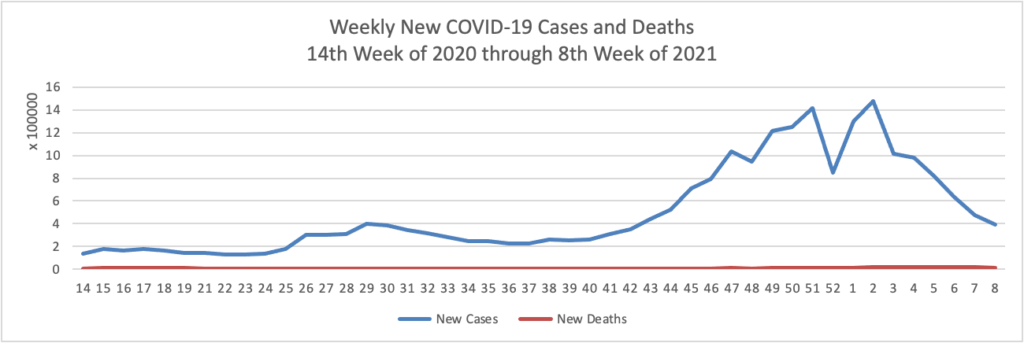
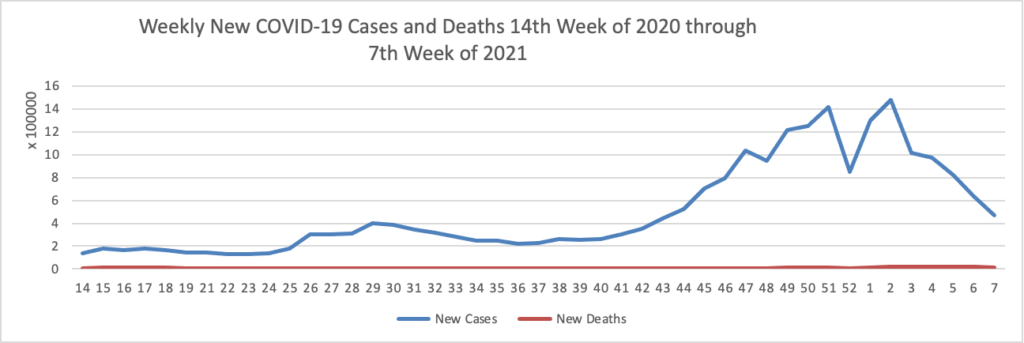
Based on the Centers for Disease Control’s COVID-19 Case Tracker website, here is the FEHBlog’s chart of new weekly COVID-19 cases and deaths over the 14th week of 2020 through the 7th week of this year (beginning April 2, 2020 and ending February 17, 2021; using Thursday as the first day of the week in order to facilitate this weekly update):

and here is the CDC’s latest overall weekly hospitalization rate chart for COVID-19:

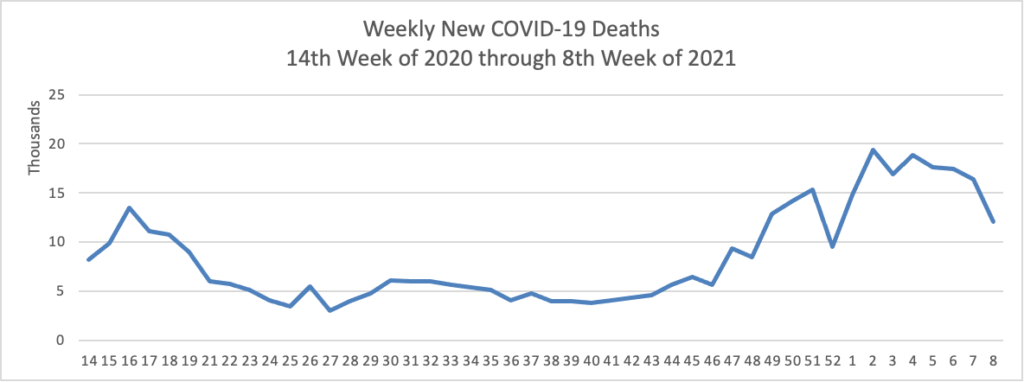
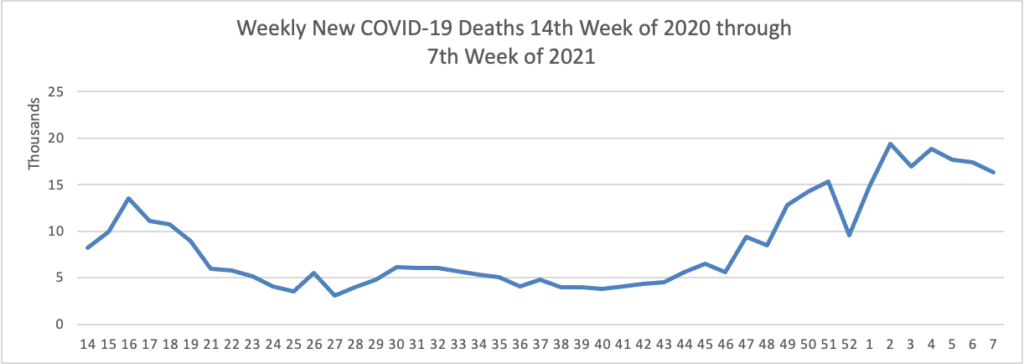
The FEHBlog has noticed that the new cases and deaths chart shows a flat line for new weekly deaths  because new cases greatly exceed new deaths. Accordingly here is a chart of new COVID-19 deaths, which is a lagging indicator, over the period (April 2, 2020 through February 17, 2021):

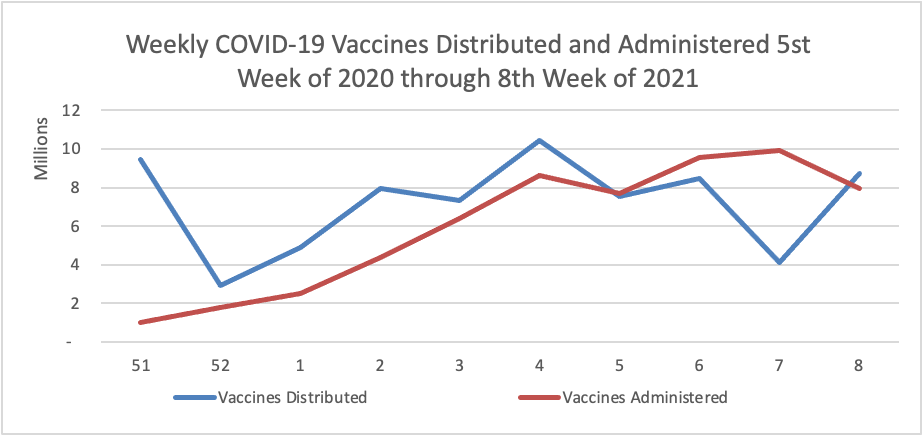
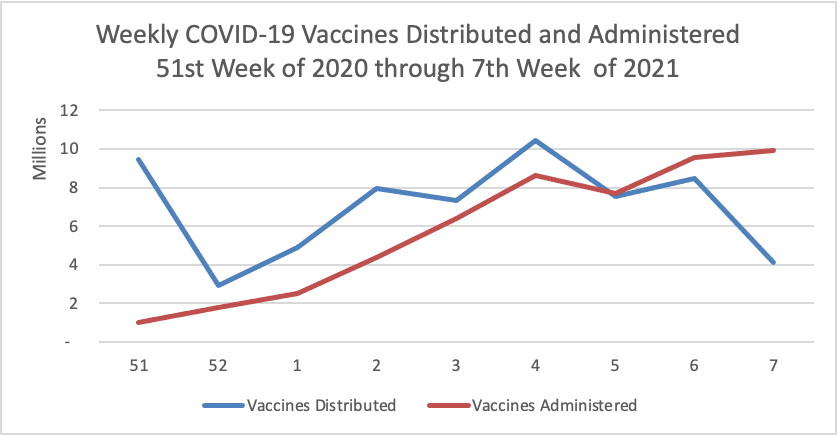
Finally here is a COVID-19 vaccinations chart for the past month which also uses Thursday as the first day of the week:

The Wall Street Journal reports tonight that

Efforts to vaccinate the world’s population against Covid-19 got a boost Friday after research showed that some vaccines provide strong, one-dose protection, and that one of the vaccines can now be stored in normal freezers instead of ultra-cold ones.

The vaccine developed by Pfizer Inc. and BioNTech SE generates robust immunity after one dose, according to new research out of Israel, and further data showed that the University of Oxford and AstraZeneca PLC vaccine similarly prevented Covid-19 when doses were spaced three months apart.

The findings could boost arguments in favor of delaying the second dose of the two-shot vaccine, as the U.K. has done. They could also have substantial implications on vaccine policy and distribution around the world, simplifying the logistics of distribution.

Pfizer and BioNTech said they have asked U.S. regulators to allow their vaccine to be stored and transported at temperatures consistent with standard freezing, around minus 20 Celsius, following successful internal stability testing. Similar filings were being prepared in other countries. 

Should Pfizer’s request be granted by regulators, it would mean its vaccine would vastly expand access in rural regions around the world, as well as pharmacies and physician offices, according to industry experts and officials.

The New York Times has a great article on combatting COVID-19 alarmism and the Society for Human Resource Management discusses the uncertain legal state of employer offers of COVID-19 vaccination incentives to their employees in an effort to overcome vaccine reluctance.

In federal personnel news –

  • OPM announced to FEHB carriers today the promotion of Laurie Bodenheimer to Associate Director, Healthcare and Insurance. Ms. Bodenheimer has served as acting Director of Healthcare and Insurance for the past two and half years. The FEHBlog notes that under federal law, 5 U.S.C. § 1102(d)

There may be within the Office of Personnel Management not more than 5 Associate Directors, as determined from time to time by the Director. Each Associate Director shall be appointed by the Director.

So congratulations Laurie for your well deserved appointment.

  • Fierce Healthcare reports that “President Joe Biden has chosen Obama administration veteran Liz Fowler to lead the Center for Medicare and Medicaid Innovation (CMMI), which has authority to shape key payment models, according to a report in Politico.” This powerful position does not require Senate confirmation.

Thursday Miscellany

Photo by Juliane Liebermann on Unsplash

In a welcome spurt of cautious optimism, Bloomberg reports this evening

The U.S. vaccine supply is poised to double in the coming weeks and months, according to an analysis by Bloomberg, allowing a broad expansion of doses administered across the country. * * * A review of drugmakers’ public statements and their supply deals suggests that the number of vaccines delivered should rise to almost 20 million a week in March, more than 25 million a week in April and May, and over 30 million a week June. By summer, it would be enough to give 4.5 million shots a day.  * * * The analysis assumes drugmakers will meet their new delivery targets — not a guarantee in a year-old pandemic where much has gone wrong.

The FEHBlog’s bet, for what it’s worth, is that Bloomberg’s analysis proves correct.

The urgency of rapid COVID-19 vaccine distribution is reinforced by the Centers for Disease Control’s report today that U.S. life expectancy dropped by one year during the first six months of last year.

For perspective, take a look at the American Medical Association’s interview of John Barry, the author of the Great Influenza. To wit –

In 1918, people didn’t buy the government’s take on the pandemic. They saw what was happening. The disease was much more virulent, killing between 50 million and 100 million people. That would be between 225–450 million people today after adjusting for population. In Philadelphia, Barry said, priests would drive horse-drawn carts down the street calling for people to bring out their dead.

Mr. Barry urges truth telling by all parties holding public trust. By the way, the Great Influenza is fascinating reading.

In regulatory news —

  • Fierce Healthcare informs us that “President Joe Biden has chosen Chiquita Brooks-LaSure to lead the Centers for Medicare & Medicaid Services (CMS), according to a report in The Washington Post.” This post requires Senate confirmation.
  • The National Law Journal reports that “The U.S. Equal Employment Opportunity Commission (EEOC) announced last Friday that it was withdrawing two proposed rules regarding the incentives employers can provide their employees as part of a wellness program without violating the Americans with Disabilities Act (ADA) or Genetic Information Nondiscrimination Act (GINA). Originally, the proposed rules had stated that, for the most part, employers could offer only “de minimis” incentives for employees participating in a wellness program—incentives that potentially could apply to employees receiving a coronavirus (COVID-19) vaccine. With the withdrawal of those rules, employers have little guidance in terms of what incentives, if any, they may offer employees”
  • The Health and Human Services Inspector General announced a court ordered delay in effective date of the Trump Administrations’ rule banning prescription drug rebates in Medicare Part D (but not the FEHBP) to January 1, 2023.
  • The Internal Revenue Service issued guidance implementing the following cafeteria plan changes created by the Consolidated Appropriations Act, 2021. The new law

Provides flexibility with respect to carryovers of unused amounts from the 2020 and 2021 plan years;

Extends the permissible period for incurring claims for plan years ending in 2020 and 2021;

Provides a special rule regarding post-termination reimbursements from health FSAs during plan years 2020 and 2021;

Provides a special claims period and carryover rule for dependent care assistance programs when a dependent “ages out” during the COVID-19 public health emergency; and

Allows certain mid-year election changes for health FSAs and dependent care assistance programs for plan years ending in 2021.

This notice also provides additional relief with respect to mid-year elections for plan years ending in 2021. 

OPM Call Letter Released

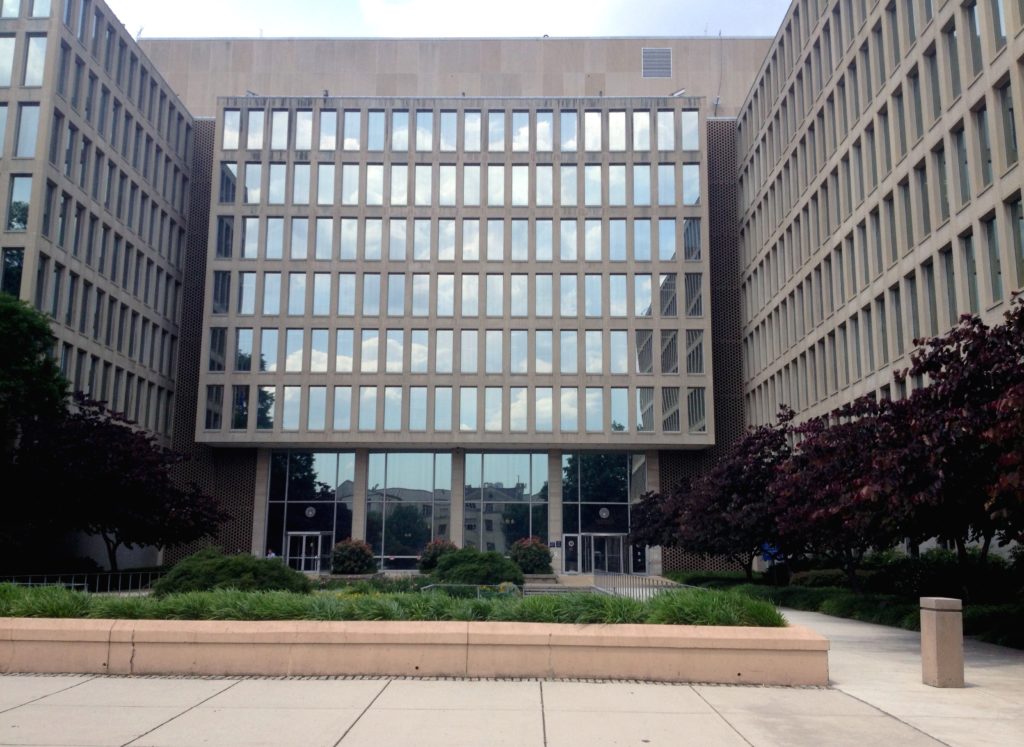
OPM Headquarters a/k/a the Theodore Roosevelt Building

Happy OPM Call Letter Day. The call letter is OPM’s call for 2022 benefit and rate proposals from FEHB carriers. Here’s the letter’s summary:

OPM maintains its focus on improving quality and affordability in the FEHB Program, as well as supporting the Biden Administration’s priority focus on health care access and equity. We expect FEHB Carriers to continueto offer forward-thinking proposals that focus onthe strategicprioritiesdescribed in this Call Letter. Our quality initiatives for the 2022 plan year relate to the COVID-19 pandemic, mental health and substance use disorder services, opioids, and prior authorizations for prescription drugs. We also remain focused on enhancements to price and quality transparency, as well as addressing surprise billing and low-value care. We are encouraging FEHB Carriers to expand coverage of certain medical foods for those affected by Inborn Errors of Metabolism (IEM), and to cover fertility preservation related to infertility caused by medical treatment (iatrogenic infertility).

The FEHBlog has provided links to topics that he does not routinely cover. The proposals are due on May 31, 2021. Good luck carriers.

On the COVID-19 front, MedScape encouragingly reports that

Researchers know by now the available COVID-19 vaccines prevent people from getting COVID around 95% of the time. But the million-dollar question remains: Are people less likely to spread the illness after they get the vaccine? According to preliminary data, the odds are good.

“The looming question is, if the person who’s been vaccinated gets infected, does that person have the capability to transmit it to another person,” Anthony Fauci, MD, the White House COVID-19 Response Team’s chief medical adviser, said during a White House briefing Wednesday. “Some studies are pointing in a very favorable direction.”

Fauci cited studies from Spain and Israel published this month, showing the amount of viral load — or the amount of the COVID-19 virus in someone’s body — is significantly lower if someone gets infected after they’ve been vaccinated, compared with people who get infected and didn’t have the vaccine. Lower viral load means much lower chances of passing the virus to someone else, Fauci says.

“There’s a direct correlation with viral load and transmission,” he says. “In other words, higher viral load, higher transmissibility; lower viral load, very low transmissibility.”

Also, the Department of Health and Human Services announced today “new actions to expand COVID-19 testing capacity across the country. These actions will improve the availability of tests, including for schools and underserved populations; increase domestic manufacturing of tests and testing supplies; and better prepare the nation for the threat of variants by rapidly increasing virus genome sequencing.”

From Capitol Hill, this Congressional Budget Office report to the House Ways and Means Committee on the COVID-19 budget reconciliation bill provides a useful overview of the healthcare and employee benefit proposals in the bill. The Speaker intends to pass the $1.9 trillion relief measure by the end of this month.

Health Payer Intelligence discusses a recent Health Affairs article positing that “whether care is affordable for members depends on more than just pricing; affordability is also tied to how clustered healthcare events—and, by extension, healthcare spending—are in a single year.”

The conclusion of this study has clear implications for payers. When members skip care due to affordability, they miss key preventive care services which can result in higher healthcare spending downstream in the members’ healthcare journeys. During the pandemic, payers have waived primary care costs in order to incentivize members to continue receiving care for this very reason. The researchers called on payers, employers, and lawmakers to explore methods for spreading members’ healthcare costs out over time [e.g. monthly deductibles rather than annual deductibles, low copays for essential medicines like insulin].

As we reach the end of the 4th Quarter 2020 financial reporting season, Healthcare Dive summarizes the reports from major health insurers.

Tuesday Tidbits

Photo by Patrick Fore on Unsplash

Happy Mardi Gras!

As the FEHBlog has noted, the FEHB Program has unique demographics compared to other employer sponsored health plans because the federal government offers generous FEHB annuitant coverage to its employees. FEHB enrollment is roughly 52% active employees and 48% annuitants. The average age of federal and postal employees is late forties and the FEHBlog understands that average age of an FEHB enrollee is sixty. (OPM offers detailed demographic statistics on its workforce but not on its retirement system members. No complaints, just stating a fact.)

Today HHS’s Agency of Healthcare Research and Quality issued a fascinating report titled “Concentration of Healthcare Expenditures and Selected Characteristics of High Spenders, U.S. Civilian Noninstitutionalized Population, 2018.” Here are the report’s highlights:

  • In 2018, the top 1 percent of persons ranked by their healthcare expenditures accounted for about 21 percent of total healthcare expenditures, while the bottom 50 percent accounted for only about 3 percent.
  • Persons ages 65 and older and whites were disproportionately represented in the top spending tiers.
  • Inpatient hospital care accounted for 36 percent of spending for persons in the top 5 percent of the spending distribution.
  • About three-quarters of aggregate expenses for persons in the top 5 percent of spenders were paid for by private insurance or Medicare.

In 2018, the top 1 percent of persons ranked by their healthcare expenditures accounted for 21 percent of total healthcare expenditures (100 minus 79 percent; figure 1), with an annual mean expenditure of $127,284 (figure 2). The group within the top 1 percent is defined as persons who spent $72,212 or more during the year. Cut points for additional percentile groups are shown in table 1 [immediately below]. The top 5 percent of the population accounted for 48.3 percent of total expenditures (100 minus 51.7 percent), with an annual mean expenditure of $58,609. The bottom 50 percent accounted for only 3.2 percent of total healthcare expenditures. Every person in this group spent less than $1,317 during the year (table 1), with an average annual expenditure of $384 (figure 2).

Percentile of population2018 Expenditure
Top 1%$72,212 or more
Top 5%$26,355 or more
Top 10%$14,651 or more
Top 30%$3,776 or more
Bottom 50% Less than $1,317

But given the FEHB’s demographics, this figure particularly caught the FEHBlog’s eye:

Figure 4: Percentage of persons by age group and percentile of spending, 2018

Age groupOverall percentageBottom 50%Top 50%Top 10%Top 5%
0–1722.630.614.56.45.8
18–4435.243.227.320.818.9
45–6425.420.130.733.436.3
65+16.86.027.539.439.0

It is a credit to OPM and the FEHB carriers that they are able to hold premiums rather stable.

On the COVID-19 vaccination front —

  • NPR updates us with encouraging COVID-19 vaccination distribution statistics.
  • Federal News Network tells us that “The Biden administration’s Safer Federal Workforce Task Force has new details on how agencies should handle [COVID-19 vaccination] leave, labor unions and mask mandates during the ongoing pandemic.”
  • The Centers for Disease Control now offers guidance on how to arrange COVID-19 vaccinations for home-bound individuals.

Healthcare Dive reports on CVS Health’s fourth quarter 2020 earnings report. The headline is that CVS Health’s payer arm Aetna plans to return to the Affordable Care Act marketplace for 2022.

CVS’ fourth quarter revenue of $69.6 billion, up 4% year over year, was mostly due to growth in the benefits segment. Healthcare benefits reported quarterly revenue of $19.1 billion, up 11% year over year, driven primarily by membership growth in Medicaid and Medicare products and partially offset by a drop in commercial membership and COVID-19 costs.

As of the end of 2020, CVS covered 23.4 million lives. Despite fluctuating membership and utilization due to COVID-19 over the course of last year, overall utilization in the fourth quarter was generally back to normal, executives said. The company’s medical loss ratio, a marker of how much it’s reinvesting in patient care, was 86.7% in the quarter, compared to 85.7% same time last year.

JDSupra includes this employment law article titled “Employees Starting to Receive the COVID-19 Vaccine – Now What?” which is worth a gander in the FEHBlog’s opinion.

Happy Presidents’ Day

Mount Rushmore

It turns out that MountVernon.org takes offense at the use of the designation Presidents’s Day because the official federal holiday is Washington’s Birthday. The FEHBlog expects that it would be a bigger deal if George Washington had not been our first President.

On the COVID-19 vaccine front —

  • The Wall Street Journal reports that

A study by Clalit, Israel’s largest healthcare provider, showed a 94% drop in symptomatic Covid-19 infections among 600,000 people who received two doses of Pfizer’s vaccine.

The vaccinated group was also 92% less likely to develop severe illness from the disease, according to the study. It compared 600,000 people who got the vaccine with a group of the same size and similar medical histories that didn’t.

Clalit said the study, which was carried out with a team from Harvard University, included 430,000 people who were between 16 and 59 years of age, and 170,000 who were over 60. It was the first of its kind to show such a high level of efficacy for Pfizer’s vaccine for those aged 70 and higher due to the limited scope of the clinical trials.

  • Federal News Network reports that “To date, the Pentagon vaccinated a little more than 800,000 employees. Since Dec. 14, DoD received about one million doses and delivered about 996,000 of them to military installations. DoD spokesman John Kirby said Thursday [February 11] on a call with reporters that the efficiency rate of delivered vaccines to getting them in arms is around 82%.”

The U.S. Postal Service has also reached out to employees, alerting them that they should be eligible for vaccine doses once their states get to the Phase 1B, essential worker stage. In a message to workers last month, USPS encouraged its staff to seek the vaccine by any means available. They cautioned their employees against waiting to get a shot through their workplace. Still, behind the scenes postal management is working with states and other jurisdictions receiving vaccine distributions to set up mass vaccination events at their large plants. To date [last Friday February 12], however, the agency has announced no such plans and employees have voiced frustrations with the lack of communication and sense that they have been left to their own devices. A USPS spokesman recently told Government Executive it was working toward a “standardized priority opportunity” for its workers in conjunction with federal, state and local stakeholders.

In other news —

  • The special enrollment period for the ACA marketplace began today for “consumers in the 36 states that use the HealthCare.gov platform * * * and will continue through Saturday, May 15. At least 13 States plus the District of Columbia, which operate their own Marketplace platforms, have decided to offer a similar opportunity.” USA Today provides more information on the state marketplaces.
  • Health Payer Intelligence discusses at length “How Payer Forecasting Is Shifting Towards Real-Time Data Analytics.”
  • Employee Benefit News discusses the following four workplace policies that employer should be re-evaluating in 2021 —
  • Human Resources policies and procedures
  • Risk management – measurement, management and mitigation
  • Training, education and development
  • Workplace culture

Weekend update

Photo by JOSHUA COLEMAN on Unsplash

Happy Valentines Day.

In the coming week, the Senate is on a State work period and the House of Representatives remains engaged in committee work. Fierce Healthcare reports that last Thursday

The House Ways and Means Committee voted 24-18 along party lines Thursday to approve a section of a $1.9 trillion COVID-19 relief package that includes the [two year long Affordable Care Act] subsidy boost. * * * [Also [t]he House Energy and Commerce Committee released legislation aimed at expanding Medicaid coverage and eligibility. * * * The legislation now moves to the House Budget Committee, which will roll it into the final package and send to the House floor [later this month].

On the COVID-19 vaccination front —

Students as young as first grade [age 6] might be able to get vaccinated against COVID-19 by September, White House chief medical adviser Dr. Anthony Fauci predicted in an interview published by ProPublica on Thursday.

Fauci cited clinical trials now underway in the U.S. from vaccine developers Pfizer and Moderna to test the safety and efficacy of the doses in children. He had said previously that the Food and Drug Administration might allow for vaccinations in American children “by the time we get to the late spring and early summer.” 

  • The Wall Street Journal reports that

Walmart Inc., the U.S.’s largest retailer and private employer, is set to become one of the biggest distributors of the Covid-19 vaccine as the federal government enlists retail pharmacies to accelerate what has been a choppy rollout.

Last week, 21 retail chains and pharmacy networks started administering those doses, including CVS, Walgreens, Kroger and grocers in all 50 states. The government initially plans to give around a million doses a week directly to pharmacies. Around 200,000 of those are going to Walmart, a spokeswoman said.

That is in part because out of the roughly 5,000 U.S. stores under the company’s Walmart and Sam’s Club banners, about 4,000 are located in what the federal government defines as medically underserved areas.

  • The Washington Post informs us about volunteer COVID-19 vaccine hunter who are helping the elderly get their protection. Bravo.
  • According to the CDC’s COVID-19 vaccine tracker, over six million doses COVID-19 vaccines were administered from February 11 through February 13. 38,292,270 Americans have receive their first dose and another 14,077,440 have received both doses of either the Pfizer or the Moderna vaccine. We are likely only two weeks away from the single dose Johnson & Johnson vaccine joining this portfolio.

Friday Stats and More

Image result for abraham lincoln birthday

Happy Lincoln’s Birthday.

Based on the Centers for Disease Control’s COVID-19 Case Tracker website, here is the FEHBlog’s chart of new weekly COVID-19 cases and deaths over the 14th week of 2020 through the 6th week of this year (beginning April 2, 2021, and ending February 10, 2021; using Thursday as the first day of the week in order to facilitate this weekly update):

and here is the CDC’s latest overall weekly hospitalization rate chart for COVID-19:

The FEHBlog has noticed that the new cases and deaths chart shows a flat line for new weekly deaths because new cases greatly exceed new deaths. Accordingly here is a chart of new weekly COVID-19 deaths over the period April 2, 2020, through February 10, 2021):

Finally here is a COVID-19 vaccinations chart from December 17, 2020, through February 10, 2021, which also uses Thursday as the first day of the week:

The Wall Street Journal sums it up well for this week :

U.S. Covid-19 deaths [a lagging indicator] appear to finally be slowing, following a broad and steep decline in both newly reported cases and hospitalizations in recent weeks.

While daily deaths remain near record highs, the average number of coronavirus-related fatalities has broadly fallen in recent days, dropping from a seven-day average of 3,172 on Feb. 1 to 2,765 on Wednesday, according to a Wall Street Journal analysis of Johns Hopkins University data.

Vaccinations, meanwhile, appear to be increasing, with about two million shots administered Thursday, according to a Wall Street Journal analysis of data from the Centers for Disease Control and Prevention.

In other vaccination news —

  • Medpage Today informs us about CDC changes to its adult and children vaccination recommendations which were released yesterday.
  • HR Dive reports that

The Society for Human Resource Management and 41 other business groups including the U.S. Chamber of Commerce have asked the U.S. Equal Employment Opportunity Commission (EEOC) to clarify “the extent to which employers may offer employees incentives to vaccinate.”

In a Feb. 1 letter to EEOC Chair Charlotte Burrows HR Dive obtained from the HR Policy Association, a signee, the groups wrote that incentives may aid in coronavirus vaccine distribution. But many employers are concerned about the liability they could create in offering such incentives, the letter said.

The signees asked EEOC to clarify how they might offer vaccination incentives without infringing upon the boundaries established by the Americans with Disabilities Act and other laws enforced by the agency. Specifically, the groups requested that the agency issue guidance that defines “what qualifies as a permissible incentive as broadly as possible.” An EEOC spokesperson said the agency appreciates “input from all stakeholders and will review the letter carefully.”

From the seeking public comment front —

  • The National Committee for Quality Assurance is seeking “feedback on proposed new measures, changes to existing measures and proposed measures for retirement. Public comment is now open for HEDIS® Measurement Year 2022.” The public comment deadline is March 11, 2021.
  • HHS’s Agency for Healthcare Research and Quality “encourage [interested parties] to review the draft report [titled “Strategies to Improve Patient Safety: Draft Report to Congress for Public Comment and Review by the National Academy of Medicine”] and send comments to PSQIA.RC@ahrq.hhs.gov no later than Feb. 16. We’ll review feedback in developing a final report for Congress later this year.” That’s not much time as the notice was posted today.

Thursday Miscellany

Photo by Juliane Liebermann on Unsplash

Today the Department of Health and Human Services (“HHS”) announced that

HHS and Department of Defense (DOD) have purchased an additional 100 million doses of COVID-19 vaccines from both Pfizer Inc. and Moderna Inc. to help meet demand for COVID-19 vaccines in the United States. The orders placed today bring the vaccine purchased by the U.S. government from these two companies to a total of 600 million doses, enough to vaccinate 300 million people. Each company is delivering 300 million doses in regular increments through the end of July 2021. Each company will leverage U.S.-based manufacturing capacity to fill, finish and ship vials as the bulk material is produced.”

The current U.S. population is 333 million and roughly 60 million of those people under age 16 and therefore currently are ineligible for either vaccine. Consequently the government has purchased more than enough of these two vaccines to vaccinate the entire eligible population with both doses. What’s more, 34 million Americans (10% of the entire U.S. population) already has received the first dose of one of these vaccines and another 11 million have received both doses. Also the Johnson and Johnson single dose vaccine should be available early next month. It’s becoming a matter of logistics.

The Wall Street Journal which was the first paper to legally crack into Medicare pricing records has now figured out how to find transparent hospital pricing required by the new HHS rule.

Mayo Clinic offers a search interface at https://costestimator.mayoclinic.org/. The nonprofit hasn’t posted a file covering all of its negotiated rates and says it is working to have one online by this spring.

The hospital chain Sutter Health, on the other hand, is offering downloadable data for all of its hospitals on a single webpage labeled “Healthcare Cost Transparency,” here: https://www.sutterhealth.org/for-patients/healthcare-cost-transparency

Efforts to pull together and standardize data from many hospitals are emerging. Turquoise Health Co. has scoured the websites of every known hospital in the country—more than 6,000 providers—and found disclosures that at least partially meet the requirements for 1,700 hospitals, according to Chris Severn, a co-founder of the company. Consumers can search the data on Turquoise’s website at https://turquoise.health/

“This data was hard to find but it’s incredibly useful and, overall, a large amount of the industry has complied,” Mr. Severn said. “This is a huge step towards cost-informed decision making in health care.”

The American Hospital Association points out that

Leading health providers have come together in unprecedented fashion to unite around the goal of improving the lives of those they serve through data insights. Health provider innovators AdventHealth, Advocate Aurora Health, Baptist Health of Northeast Florida, Bon Secours Mercy Health, CommonSpirit Health, Hawaii Pacific HealthHenry Ford Health SystemMemorial Hermann Health SystemNorthwell Health, Novant Health, Providence health system, Sentara Healthcare, Tenet Health, and Trinity Health have formed Truveta, a new company with a vision to save lives with data. 

Through structuring, normalizing, and de-identifying data from these health providers, a new data platform will be built, with careful protection of patient privacy and security. This new platform, using the power of AI and machine learning, will enable unprecedented insights as providers are able to learn from each other with statistically significant scale and representation of diverse populations. 

Together, these 14 health providers care for tens of millions of patients and operate thousands of care facilities across 40 states. The health providers will govern Truveta’s ethical pursuit of insights from this unprecedented de-identified data set. 

Interesting.

Also the Blue Cross Blue Shield Association announced that

Today, a broad coalition of health care and employer groups called for achieving universal health coverage by expanding financial assistance to consumers, bolstering enrollment and outreach efforts, and taking additional steps to protect those who have lost or are at risk of losing employer-based coverage because of the economic downturn caused by the COVID-19 pandemic. 

The Affordable Coverage Coalition encompasses groups representing the nation’s doctors, hospitals, employers and health insurance providers that collectively serve hundreds of millions of American patients, consumers and employers. The joint commitment by such a broad array of interests is a significant milestone on the path toward universal coverage, which has remained an elusive goal within the U.S. healthcare system. 

The organizations support the following steps to make health coverage more accessible and affordable: 

Protect Americans who have lost or are at risk of losing employer-provided health coverage from becoming uninsured. 

Make Affordable Care Act (ACA) premium tax credits and cost-sharing reductions more generous, and expand eligibility for them. 

Establish an insurance affordability fund to support any unexpected high costs for caring for those with serious health conditions or to otherwise lower premiums or cost-sharing for ACA marketplace enrollees. 

Restore federal funding for outreach and enrollment programs. 

Automatically enroll and renew individuals eligible for Medicaid and premium-free ACA marketplace plans. 

Provide incentives for additional states to expand Medicaid, in order to close the low-income coverage gap. 

Good luck. (Not to be confused with the Council for Affordable Health Coverage which appears to have similar goals.)

Midweek update

Photo by Manasvita S on Unsplash

From Capitol Hill —

  • Katie Keith helpfully provides more detail on the healthcare provisions found in the draft House of Representative’s COVID-19 relief budget reconciliation bill.
  • Govexec.com reports on the federal employee related provisions of the same draft bill.
  • FedSmith informs that “Some Members of Congress are asking the Office of Personnel Management to give federal employees administrative leave for any time they spend getting vaccinated for COVID-19. The letter was sent to OPM by Reps. Don Beyer (D-VA), Eleanor Holmes Norton (D-DC), Gerald E. Connolly (D-VA), Anthony Brown (D-MD), Jamie Raskin (D-MD), David Trone (D-MD), and Jennifer Wexton (D-VA). They state in the letter that mandating that federal agencies provide administrative leave to federal employees is necessary to fight the pandemic. “…it is imperative that the federal government take every possible step to encourage federal employees to receive the vaccine, including providing them with the administrative time to do so,” reads the letter.”
  • Politico reports on Office of Management and Budget Director nominee’s confirmation hearing this morning before the Senate Budget Committee.
  • The Brookings Institute released a report with recommendations on making Capitol Hill a better place to the work. This recommendation caught the FEHBlog’s eye:

Since 2014, members and certain congressional staff have been required to use Washington, D.C.’s small-business marketplace established by the Affordable Care Act to obtain insurance, rather than having their health benefits provided via the Federal Employees Health Benefits Program that insures other federal employees. As the HSCMC’s final report noted, “The transition to the D.C. exchange has been particularly challenging for some district-based staff as finding local health providers who accept patients covered by the D.C. exchange is difficult.” The HSCMC recommended that Congress eliminate this setup, allowing both D.C.- and district-based staff to either enroll in standard federal health plans or to use their relevant local marketplace to purchase coverage.

OPM could implement the “local marketplace” fix via regulation. An interim regulation would be nice as the federal ACA marketplace is about to reopen for three months.

While on the topic of the Affordable Care Act, the Biden Administration’s Justice Department filed a very sensible letter today with the U.S. Supreme Court regarding the California v. Texas case concerning the ACA’s constitutionality. It states that it is now the Justice Department’s position that zeroing out the individual mandate did not render the ACA unconstitutional. “[T]he 2017 amendment preserved the choice between lawful options and simply eliminated any financial or negative legal consequence from choosing not to enroll in health coverage.” How true.

From the COVID-19 front —

  • MedCity News reports that “An Eli Lilly therapy comprised of two antibodies given together has been awarded FDA emergency authorization for treating Covid-19, providing yet another option for patients diagnosed with the disease. The decision comes two weeks after Indianapolis-based Lilly reported clinical trial data showing that given together, the antibodies bamlanivimab and etesevimab reduced Covid-19 patients’ risk of hospitalization and death by 70 percent. The FDA authorization, issued late Tuesday, covers adults and children 12 and older with mild-to-moderate Covid-19 whose cases are at high risk of progressing to severe disease. The authorization also includes patients 65 and older who have certain chronic medical conditions.

New data from the Blue Cross and Blue Shield Association (BCBSA) take a look at just how much COVID-19 cases are costing insurers.

BCBSA studied more than 90,000 confirmed cases of the novel coronavirus pulled from a diverse selection of its membership. The group found COVID-19 cases treated in an outpatient setting cost between $500 and $1,000 per member on average, with the average age of patients seeking such care being 34.

When members were hospitalized with the virus, however, costs were 45 times higher than for cases treated on an outpatient basis. For members who needed a stay in the intensive care unit, costs jumped another 2.5 times compared to other hospitalizations, BCBSA found. The average age for members hospitalized with COVID-19, including in the ICU, was 54, according to the analysis.

  • The Wall Street Journal tonight adds more detail to yesterday’s report on the World Health Organization of the spread of COVID-19 in China.

About 90 people were hospitalized with Covid-19-like symptoms in central China in the two months before the disease was first identified in Wuhan in late 2019, according to World Health Organization investigators, who said they pressed Beijing to allow further testing to determine whether the new virus was spreading earlier than previously known. * * * If the 90 cases included Covid-19 infections, it could help explain suspected coronavirus cases that researchers believe occurred in Europe and possibly the U.S. in November and December 2019. * * * The U.S. said Tuesday it saw no potential origin other than in China and wanted to examine the underlying data from the WHO’s four-week mission.

Finally, Health Payer Intelligence provides its perspective on fourth quarter financial reports from health insurers. “Payers anticipate that increased membership, lower utilization, potentially a higher federal medical assistance percentage, and other factors could offset healthcare spending as it returns to normal levels.”