Tuesday’s Tidbits

Tuesday’s Tidbits

Photo by Patrick Fore on Unsplash

The Wall Street Journal reports

The Biden administration said it would begin reallocating some Covid-19 vaccine doses to states with higher demand for shots and direct pharmacies to offer walk-in vaccinations, as the president aims to get 70% of the adult population at least one dose by July 4.

President Biden said Tuesday he also wants 160 million U.S. adults to have the full course of the vaccine by that point, which he said would mean administering about 100 million shots over the next 60 days. The U.S. administered about 220 million shots in Mr. Biden’s first 100 days, but the pace of vaccinations has fallen in recent weeks, according to the Centers for Disease Control and Prevention. Roughly 56% of U.S. adults had received at least one dose as of Monday, according to the CDC.

Also from the COVID-19 front, the NIH Director Dr. Francis Collins offers a real world look at COVID-19 vaccines versus variants.

Healthcare Dive reports

  • CVS Health beat Wall Street expectations for earnings and revenue in the first quarter, reporting a topline of $69.1 billion, up 3.5% year over year due to growth across all major businesses.
  • The diversified healthcare behemoth brought in net income of $2.2 billion, compared to $2 billion at the same time last year in financial results released premarket Tuesday. 
  • Following the quarter, which saw a strong financial showing from all major U.S. payers, CVS raised its full-year earnings guidance, noting it expects normal utilization throughout 2021 and minimal effects from the COVID-19 pandemic. However, management did warn vaccine hesitancy could slightly hamper expected earnings growth.

In related CVS news —

  • NPR Shots informs us about how CVS Health is adding mental health therapists to its Minute Clinics and Health Hubs.
  • Drug Channels places CVS Specialty at the top of its list of top 15 specialty pharmacies.

In other healthcare business news

  • STAT News informs us that “Although the pharmaceutical industry argues that wholesale prices do not accurately reflect prescription drug costs, a new study finds that rising wholesale prices have, in fact, led to higher out-of-pocket expenses for roughly half of insured patients.” Shocking.
  • The Wall Street Journal reports that “Pfizer Inc. raised this year’s sales forecast for its Covid-19 vaccine to about $26 billion, a 73% increase that reflects the shot’s growing role in a long-term global vaccination campaign.” Thanks Pfizer.
  • Health Payer Intelligence reports

Gross margins and medical loss ratios from 2020 may confirm that payer profitability increased during the coronavirus pandemic, according to a brief from Kaiser Family Foundation.

The researchers leveraged data from the National Association of Insurance Commissioners (NAIC) to observe the pandemic’s effects on the profitability of four health insurance markets: Medicare Advantage, Medicaid managed care, the individual health insurance marketplace, and the fully-insured group health insurance marketplace.

“By the end of 2020, gross margins per member per month across these four markets remained relatively high and medical loss ratios were relatively low or flat compared to recent years,” the researchers discerned. “These findings suggest that many insurers remained profitable through 2020.”

Here are some additional healthcare tidbits —

  • The Lown Institute announced that “Every 80 seconds, a hospital in the U.S. delivers a low-value test or procedure to an older adult, putting hundreds of thousands at risk of harm, according to a new analysis from the Lown Institute, a health care think tank. The Institute today released a ranking of over 3,100 U.S. hospitals that examines success at avoiding the use of tests and procedures that offer little to no clinical benefit.”
  • The Congressional News Service released a helpful report titled “A Comparison of Tax-Advantaged Accounts for Health Care Expenses.”
  • The Department of Health and Human Services announced “the availability of nearly $1 billion to strengthen COVID-19 response efforts and increase vaccinations in rural communities. As part of the Biden Administration’s commitment to expanding access to vaccines and ensuring equity in the COVID-19 response, the Health Resources and Services Administration, a part of HHS, will increase the number of vaccines sent to rural communities, expand testing and other COVID-19 prevention services, and work to increase vaccine confidence by empowering trusted local voices with additional funding for outreach efforts in underserved communities.”

Last but not least here are some federal employment tidbits —

  • The Office of Personnel Management reminds us that “Each year Federal Executive Boards (FEBs) across the nation recognize federal employees who have made exceptional contributions in their community or the advancement of their agency’s mission. This year, OPM and the Partnership for Public Service are highlighting more than 300 awards winners from FY2020 and FY2021. To learn more about these recipients and their exemplary accomplishments, visit the FEB awards site.  
  • Federal News Network reports that “Union leaders say staffing shortages are stretching their agencies thin.”
  • Govexec reports that “Some U.S. Postal Service employees will receive layoff notifications later this month, the mailing agency told workers in a memorandum this week. * * * USPS declined to specify how many positions would be eliminated, but said it aims to offer impacted workers opportunities for reassignment.”


Monday Roundup

Photo by Sven Read on Unsplash

The Office of Personnel Management reminds us that this is Public Service Recognition Week. “Celebrated annually during the first week of May since 1985, Public Service Recognition Week (PSRW) (external link) is time set aside to honor the men and women who serve our nation as federal, state, county and local government employees.”

From the COVID-19 front:

The Food and Drug Administration is preparing to authorize use of the Pfizer-BioNTech Covid-19 vaccine in adolescents 12 to 15 years old by early next week, according to federal officials familiar with the agency’s plans, opening up the nation’s vaccination campaign to millions more Americans.

The news is highly anticipated: Eager parents have been counting down the weeks since Pfizer announced results from its trial in adolescents, showing the vaccine is at least as effective in that age group as it is in adults. Vaccinating children is also key to raising the level of immunity in the population and bringing down the numbers of hospitalizations and deaths.

The authorization could come as early as late this week, according to the federal officials, who did not give their names because they weren’t authorized to speak publicly. If it is granted, the Centers for Disease Control and Prevention’s vaccine advisory panel will likely meet the following day to review the clinical trial data and make recommendations for the vaccine’s use in adolescents.

  •  The Wall Street Journal informs us

Everyone who was desperate for a vaccine has gotten a shot, said Alexandra Simon, the California director of vaccines for Curative, a Covid-19 testing and health-services company administering vaccines across the country. The company is now seeing people with access issues, including questions about insurance or identification, and fears about being unable to take care of children because of side effects. Many people, she said, simply can’t take time off. Others only want an appointment on Thursday or Friday, or prefer a site with the vaccine from Pfizer Inc. and BioNTech SE, said Curative’s chief information officer, Isaac Turner.

But the fact that supply now exceeds immediate demand means getting vaccinated is a much easier process. That message may be getting across because over 3.3 million doses of COVID-19 vaccine were administered Sunday per the CDC.

  • The Wall Street Journal also hopefully reports that “The next generation of Covid-19 vaccines in development could come as a pill or a nasal spray and be easier to store and transport than the current handful of shots that form the backbone of the world-wide vaccination effort.”

Good advice from the American Medical Association (“AMA”)

  • The AMA offers six lifestyle changes that can prevent heart disease.
  • The AMA also recommends eight keys to ending the drug overdose crisis.

In healthcare business news, the Wall Street Journal reports that

The Blue Cross Blue Shield Association said it dropped a rule that limited competition among its member insurers, moving to implement a key aspect of an antitrust settlement the companies reached last year with customers. * * *

Previously, the rule was that two-thirds of a Blue licensee’s national net revenue from health plans and related services must stem from Blue-branded business.

The Blue Cross Blue Shield Association includes 35 insurers, each of which typically hold exclusive rights to the Blue Cross and Blue Shield brands within a certain territory, a setup that would remain intact under the antitrust settlement.

However, lifting the revenue cap could allow the Blue insurers to compete more against one another by expanding their non-Blue businesses, experts said. Dropping the limit “certainly should increase competition,” said Tim Greaney, a professor at the University of California Hastings College of the Law, though he said it isn’t clear how quickly it would have an effect.

Following up on a couple of items from Friday’s post:

  • The FEHBlog mentioned that a company called ClosedLoop.ai had won a million dollar healthcare artificial intelligence prize from the federal government. The FEHBlog couldn’t figure out what the prize winning invention did. STAT News tells us that ClosedLoop.ai “bested 300 rivals with a system capable of forecasting adverse health events by crunching an array of data on patients.” Nifty.
  • The FEHBlog also pulled the key tidbit from the 457 page long HHS second notice of 2022 benefit and payment parameters. Katie Keith in the Health Affairs blog provides much more detail for all those interested.

Weekend Update

Photo by Michele Orallo on Unsplash

This coming week, the House of Representatives is engaged in Committee business and the Senate is on a State work break.

From the COVID front, Bloomberg reports on a UK study finding that taking only one dose of the Pfizer OK may be sufficient for a person who has survived a COVID-19 infection but not for others.

The study appears to contrast with other research that has suggested the first dose of Pfizer’s shot provides a strong level of protection against Covid, including some variants. That’s in part because it examined the level of people’s immune responses, rather than real-world infection levels.

Still, the findings offer a warning for countries like the U.K., where the majority of vaccinated people have had only a single dose of inoculations like Pfizer’s that require two shots to offer full protection.

In other vaccination news, Precision Vaccinations explains that

The HPV vaccine was designed to prevent reproductive warts and cancers caused by the most common sexually transmitted infection in the United States. The FDA approved the vaccine for women in 2006 and expanded it to men in 2009.

Preventing cervical cancer was the primary focus at that time, so girls and women were more likely to hear about it from their pediatricians or OBGYNs. 

Yet oropharyngeal cancer, which occurs in the throat, tonsils, and back of the tongue, has now surpassed cervical cancer as the leading cancer caused by HPV.

Data indicates 80% of those diagnosed with oropharyngeal cancer are men.

“I don’t think that a lot of people, providers, and patients, are aware that this vaccine is a cancer-prevention vaccine for men as well as women,” Chen says. “But HPV-associated oropharyngeal cancer can impact anyone.”

“And there’s no good screening for it, which makes vaccination even more important.”

With respect to general preventive services, Fierce Healthcare informs us that

CVS Health is expanding its program to offer no-cost, community-based screenings to 14 more markets.

Project Health, which is now in its sixteenth year, offers a slew of free biometric screenings at CVS Pharmacy locations, including blood pressure, glucose levels and cholesterol. Patients can then meet with a nurse practitioner, who can provide additional guidance and referrals for treatment if needed.

New markets include Birmingham, Alabama; Phoenix; Jacksonville, Orlando and Tallahassee, Florida; Baton Rouge and New Orleans, Louisiana; Jackson, Mississippi; Charlotte, North Carolina; Cleveland, Ohio; Charleston and Columbia, South Carolina; and Knoxville and Memphis, Tennessee, CVS said in announcement provided first to Fierce Healthcare.

The program is also launching four new mobile units, CVS said, and anticipates providing 1,700 screening events across its 32 markets by the end of the year.

From the relevant history front, the Wall Street Journal’s Saturday Essay compares the 1957-58 flu pandemic with our current COVID-19 pandemic. In both cases, a rapidly developed vaccine was made available to the public.

From 1948 to 1957, Maurice Hilleman—born in Miles City, Mont., in 1919—was chief of the Department of Respiratory Diseases at the Army Medical Center (now the Walter Reed Army Institute of Research).

Early in his career, Hilleman had discovered the genetic changes that occur when the influenza virus mutates, known as “shift and drift.” It was this work that enabled him to recognize, when reading reports in the press of “glassy-eyed children” in Hong Kong, that the outbreak had the potential to become a disastrous pandemic. He and a colleague worked nine 14-hour days to confirm that this was a new and potentially deadly strain of flu.

Speed was of the essence, as in 2020. Hilleman was able to work directly with vaccine manufacturers, bypassing “the bureaucratic red tape,” as he put it. The Public Health Service released the first cultures of the Asian influenza virus to manufacturers even before Hilleman had finished his analysis. By the late summer, six companies were producing his vaccine.

It has become commonplace to describe the speed with which vaccines were devised for Covid-19 as unprecedented. But it was not. The first New York Times report of the outbreak in Hong Kong—three paragraphs on page 3—was on April 17, 1957. By July 26, little more than three months later, doctors at Fort Ord, Calif., began to inoculate recruits to the military.

Wait there’s more, according to his 2005 obituary, Dr. Hilleman invented vaccines for measles, mumps, rubella, Hepatitis A, Hepatitis B and pneumonia.

In closing here is an interesting Bloomberg interview with Shahid Jameel, director, Trivedi School of Biosciences, Ashoka University, which is located in the state of Haryana, India. The interview concerns the COVID-19 crisis in that country.

BG: What’s the biggest challenge now?

SJ: To bring things under control, you want to vaccinate more people on a daily basis than the number of new infections. Remember that a person who gets the first shot today will get the second shot in four to six weeks, and will need two more weeks to develop full immunity. So somebody who starts vaccination today will take two months to develop protective immunity.

This means the vaccination drive has to be sustained over months, many more doses daily than cases. Only then can we reverse the surge.

BG: Is the supply of vaccines sufficient to maintain that pace?

SJ: One of the critical errors we made was in vaccine procurement. In January, the government ordered only 11 million doses [from Serum Institute located in India]. Between Serum Institute and Bharat Biotech, we can currently produce roughly 90-100 million doses in a month. But they also have exports commitments, especially to the WHO’s COVAX program. 

Meanwhile, India has begun to accept vaccine registration from anyone aged 18 or older. In total, we’re talking about 800 million people, or 1.6 billion doses. It’s going to be a struggle.

The BBC offers more background on the Indian crisis. Needless to say, the world needs to help India.

Friday Stats and More

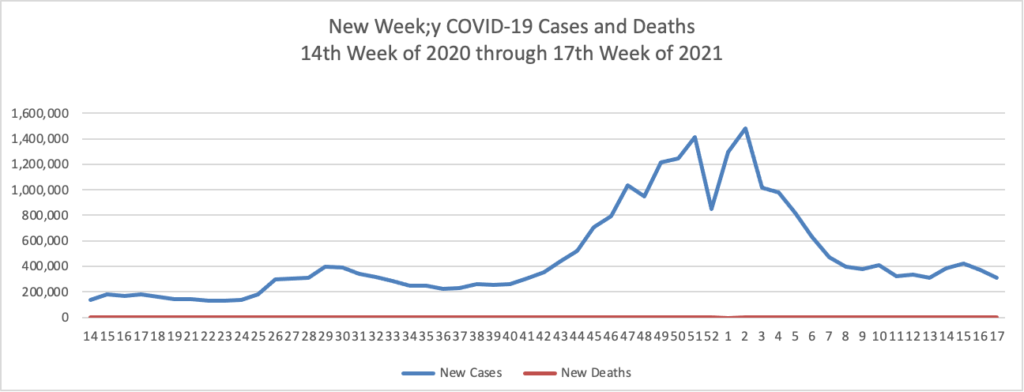
Based on the Centers for Disease Control’s COVID-19 Data Tracker website, here is the FEHBlog’s chart of new weekly COVID-19 cases and deaths over the 14th week of 2020 through 17th week of this year (beginning April 2, 2020, and ending April 28, 2021; using Thursday as the first day of the week in order to facilitate this weekly update):

and here is the CDC’s latest overall weekly hospitalization rate chart for COVID-19:

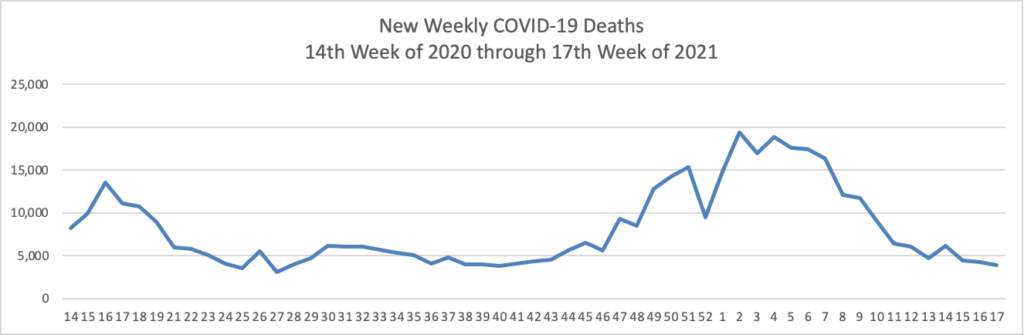
The FEHBlog has noticed that the new cases and deaths chart shows a flat line for new weekly deaths  because new cases greatly exceed new deaths. Accordingly here is a chart of new COVID-19 deaths over the period (April 2, 2020, through April 28, 2021):

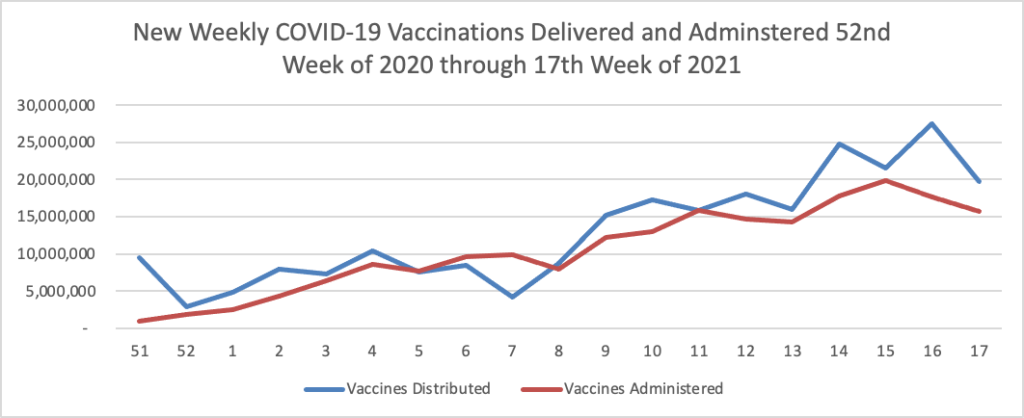
Finally here is a COVID-19 vaccinations chart over the period December 17, 2020, through April 28, 2021 which also uses Thursday as the first day of the week:

As of yesterday, 39% of the U.S. population over age 18 and 68.8% of those over age 65 have been fully vaccinated. The Centers for Medicare & Medicaid Services Office of Minority Health will host a May 13 webinar on building COVID-19 vaccine confidence. Register for the 12 p.m. ET webinar here. The FEHBlog already has done so.

The American Hospital Association reports that “The Centers for Medicare & Medicaid Services today released a second final notice of benefit and payment parameters to implement standards governing health insurance issuers and marketplaces for 2022 that were not finalized in the Jan. 19 final rule. CMS chose not to finalize the proposed premium adjustment percentage and instead finalized a lower percentage, resulting in lower maximum out-of-pocket costs for consumers ($8,700 for individuals and $17,400 for families) than originally proposed.” These are the 2022 out of pocket maximums on in-network cost sharing that apply to FEHB plans. Here’s a link to the HHS press release which promises even more guidance down the road.

The Centers for Medicare and Medicaid Services announced the winner and runner-up in its healthcare artificial intelligence competition today. “Out of more than 300 initial entries, ClosedLoop.ai was chosen as the grand prize winner and will receive up to $1 million in prize money. Based in Austin, Texas, the company is a leader in developing healthcare data science solutions. Challenge Runner-Up Geisinger, a non-profit healthcare system based in Danville, Pennsylvania [and the carrier of an FEHB plan], will receive up to $230,000 in prize money.” Congratulations.


Thursday Miscellany

Photo by Mel on Unsplash

Today the U.S. Office of Personnel Management released guidance to federal agencies on American Rescue Plan Act “provisions authorizing emergency paid leave (EPL) for covered Federal employees in specified qualifying circumstances through special funds.” The Federal News Network offers information on how federal employees can apply for EPL.

From the COVID-19 front, the Wall Street Journal reports that Astra-Zeneca now expects to file an emergency use application for its COVID-19 vaccine with the Food and Drug Administration in the middle of next month.

“One especially time-consuming task has been compiling British data from almost four months of vaccinations in the U.K., including efficacy, virus-transmission and safety statistics, people close to the process say. That has added to the complexity of AstraZeneca’s submission and is expected to lengthen any FDA review. Other shots that the FDA has authorized had large-scale human trial data but little or none from real-world rollouts outside of controlled studies.”

No good deed, etc.

From the patients safety front, the Leapfrog Group released its Spring 2021 hospital safety grades yesterday. The two hospitals closest in proximity to the FEHBlog’s residence are graded A and B. Beckers Hospital Review helpfully points out the 27 hospitals with straight A scores and F scores. Meanwhile, Healthcare Finance reports that

The Centers for Medicare and Medicaid Services on Wednesday released the overall hospital quality star ratings that now include new methodology in five measure groups.

CMS rated over 4,500 hospitals from one to five stars, with five representing the highest quality rating.

Of 4,586 hospitals, 13.5%, or 455 hospitals, received five stars; 988 received four stars; 1,018 received three stars; 690 received two stars; and 204 received one star.

For more than a quarter of hospitals, 1,181, no information was available.

This compares to January 2020 data, when of the 5,340 hospitals listed, 396 received five stars; 1,132 received four stars; 1,108 got three stars; 710 received two stars; and 226 got one star. Another 1,761 had no rating information available.

Furthermore, the Centers for Disease Control released a new study setting a “Baseline to Measure Quality of Antibiotic Prescribing in U.S. Hospitals.”

Since 2015, when the prescribing data were collected, CDC has been working diligently with partners like the American Hospital Association and others to implement stewardship efforts and programs in acute care.

CDC will continue building on this progress and important work in the coming years as a part of the newly released Combating Antibiotic-Resistant Bacteria National Action Plan. Good luck with that effort.

In healthcare business news:

  • Healthcare Dive informs us that ” Virtual care powerhouse Teladoc reported a wider-than-expected net loss in the first quarter, but beat Wall Street estimates on revenue with a topline of $454 million, up 151% year over year, driven by growth in specialty offerings and multi-product contracts. * * * CEO Jason Gorevic contended he is unworried about mounting competition in the lucrative telehealth space, banking the company’s heft and variety of clinical services will fend off entrenched rivals and new entrants like Amazon.”
  • Fierce Healthcare advises “Do not expect the Biden administration to pull away from price transparency even though the administration wants to pull a requirement for hospitals to post Medicare Advantage rates, experts say. The proposal included in a hospital inpatient payment rule released late Tuesday is more aimed at easing administrative burdens for hospitals still struggling due to the pandemic, several experts said. “The repeal of this requirement more falls into the bucket of easing hospitals’ burden as opposed to the agency’s stance on hospital price transparency,” said Caitlin Sheetz, head of analytics and a director for the consulting firm ADVI, in an interview with Fierce Healthcare.
  • Fierce Healthcare also reports that “Anthem has completed its acquisition of home health benefits manager MyNEXUS, the insurer announced Thursday morning. MyNEXUS offers comprehensive home-based nursing management to health insurers, providing integrated clinical services to some 1.7 million Medicare Advantage beneficiaries in 20 states. The company’s platforms largely automate the visit and authorization, which allows members to access care more quickly, according to the announcement. MyNEXUS will be folded into Anthem’s Diversified business group.”

In benefit design news, Health Payer Intelligence offers a thoughtful article describing key considerations for implementing diabetes management programs.

Midweek Update

Photo by Mark Tegethoff on Unsplash

Govexec reports that at the Senate Homeland Security and Governmental Affairs Committee’s business meeting today, the Committee advanced to the Senate floor the nominations of Kiran Ahuja to be OPM Director along party lines and the three nominations of Postal Service Governors with bipartisan margins. The FEHBlog expects these nominations to be brought to the Senate floor next month.

From the COVID-19 front:

  • The Wall Street Journal informs us that “Vaccines appear to be starting to curb new Covid-19 infections in the U.S., a breakthrough that could help people return to more normal activities as infection worries fade, public-health officials say. By Tuesday, 37.3% of U.S. adults were fully vaccinated against Covid-19, with about 2.7 million shots each day. * * * With the U.S. recently averaging at least 50,000 new daily cases, the pandemic is far from over. But the U.S. is nearing a nationwide benchmark of having 40% of adults fully vaccinated, which many public-health experts call an important threshold where vaccinations gain an upper hand over the coronavirus, based on the experience from further-along nations such as Israel.”
  • Today the Centers for Disease Control released a report on the mRNA vaccines. Here are the highlights which support the Journal’s report particularly as over 2/3s of Americans over age 65 are fully vaccinated.

Clinical trials suggest high efficacy for COVID-19 vaccines, but evaluation of vaccine effectiveness against severe outcomes in real-world settings and in populations at high risk, including older adults, is needed.

What is added by this report?

In a multistate network of U.S. hospitals during January–March 2021, receipt of Pfizer-BioNTech or Moderna COVID-19 vaccines was 94% effective against COVID-19 hospitalization among fully vaccinated adults and 64% effective among partially vaccinated adults aged ≥65 years.

What are the implications for public health practice?

SARS-CoV-2 vaccines significantly reduce the risk for COVID-19–associated hospitalization in older adults and, in turn, might lead to commensurate reductions in post-COVID conditions and deaths.

  • The Wall Street Journal also reports that “Covid-19 tests for people to use to get quick results at home are finally becoming available to buy at pharmacies and retailers. Yet an obstacle might stand in the way of regular use: cost. * * * The U.S. Food and Drug Administration recently cleared over-the-counter sales of two of these rapid at-home screening tests, one from Abbott Laboratories and another from Quidel Corp. 

Major pharmacies recently said they plan to sell a two-pack of Abbott’s test for nearly $24, while Walmart says it will charge just under $20. The price for Quidel’s test hasn’t been released, though Quidel has indicated it will be less than $30 for a pair.

“Twenty-five dollars for a Covid test, I think most people would pay that once. But would they pay it every week or every two weeks?” says Zoe McLaren, a health economist and an associate professor in the School of Public Policy at the University of Maryland, Baltimore County. “It’s not designed to be a one-time cost.”

Dr. McLaren and medical-testing experts expressed hope that prices would drop if more companies get clearance to sell paper-strip tests. * * * Public-health authorities say they are glad to see the tests in stores, and the tests will be valuable tools for checking symptoms or for specific occasions, such as traveling or visiting relatives.

From the Medicare front

  • The Centers for Medicare and Medicaid Services released yesterday a proposed fiscal year 2022 Medicare Part A inpatient prospective payment system rule. “The proposed increase in operating payment rates for general acute care hospitals paid under the IPPS that successfully participate in the Hospital Inpatient Quality Reporting (IQR) Program and are meaningful electronic health record (EHR) users is approximately 2.8 percent. This reflects the projected hospital market basket update of 2.5 percent reduced by a 0.2 percentage point productivity adjustment and increased by a 0.5 percentage point adjustment required by legislation.”
  • Healthcare Dive provides its perspective on the proposal which evidently was well received by the hospital industry. “[T]he American Hospital Association applaud[ed] the provision that removes the requirement that hospitals report privately negotiated rates with Medicare Advantage payers on Medicare cost reports and another that repeals market-based weight methodology for determining payments.”

On the FEHB front

  • FedSmith advises that “Federal employees facing a future with children aging out of TRICARE should consider enrolling in an FEHB policy. This is because FEHB plans provide coverage for children in the family option up to age 26. Additionally, the family FEHB premium for the employee, spouse, and children may be less than the cost of the TYA option for one individual. FEHB employees who are eligible for TRICARE and interested in having their children covered in an FEHB plan have to enroll during Open Season. Federal employees with TRICARE also need to enroll in a plan at least a year ahead of retirement for the FEHB plan to be continue in retirement.” Interesting.

On the artificial intelligence front, Forbes lists its top 50 AI companies to watch. Enjoy.

Tuesday’s Tidbits

Photo by Patrick Fore on Unsplash

Govexec reports that “the Senate voted 81-13 on Tuesday to confirm Jason Miller to be deputy director for management for the Office of Management and Budget. Miller is a former Obama administration economic adviser and most recently a nonresident senior fellow at the Brookings Institution and CEO of the Greater Washington Partnership, a nonprofit civic alliance.”

Julie Appleby of Kaiser Health News writes on the gradual rollback of COVID-19 treatment coverage with no member cost sharing in 2021.

Anthem, for example, stopped them at the end of January. UnitedHealth, another of the nation’s largest insurers, began rolling back waivers in the fall, finishing up by the end of March. Deductible-free inpatient treatment for covid through Aetna expired Feb. 28.

A few insurers continue to forgo patient cost-sharing in some types of policies. Humana, for example, has left the cost-sharing waiver in place for Medicare Advantage members, but dropped it on Jan. 1 for those in job-based group plans.

Not all are making the changes.

For example, Premera Blue Cross in Washington and Sharp Health Plan in California have extended treatment cost waivers through June. Kaiser Permanente said it is keeping its program in place for members diagnosed with covid and has not set an end date. Meanwhile, UPMC in Pittsburgh planned to continue to waive all copayments and deductibles for in-network treatment through April 20.

 Healthcare Dive reports

U.S. hospitals continue to struggle under the ongoing weight of the pandemic and its financial pressure, reporting a mixed performance in March, according to a new report from Kaufman Hall.

Volumes continued to decline, while revenues and expenses generally rose compared to the same time last year. Margins increased on both a year-to-date and year-over-year basis, but that’s largely due to measuring performance this year with last March, when hospitals were hit hard by the effects of state lockdowns and a pause in non-essential procedures, the consultancy said.

Researchers expect continued margin and revenue gains in the next few months, especially in comparison to record-poor performance in the first few months last year. Some gains are due to returning patient volumes, but the report warns the impacts of COVID-19 on providers are far from over.

Here is a link to today’s Centers for Disease Control’s “Interim Public Health Recommendations for Fully Vaccinated People.” The AP reports that “Some experts portrayed the relaxed guidance as a reward and a motivator for more people to get vaccinated — a message President Joe Biden sounded, too.” The FEHBlog honestly see the new guidance as too complicated and he will maintain his current mask wearing practices for a couple more months.

From the government contracting front

  • Here is a link to the President’s executive order raising the minimum wage on federal contracts for services and construction to $15 per hour. FEHB contracts do not fall into these classifications in the FEHBlog’s opinion.
  • The Equal Employment Opportunity Commission is revving up the EEO-1 reporting process. “The EEO-1 Component 1 report is a mandatory annual data collection that requires all private sector employers with 100 or more employees, and federal contractors with 50 or more employees meeting certain criteria, to submit demographic workforce data, including data by race/ethnicity, sex and job categories. * * * After delaying the opening of the 2019 EEO-1 Component 1 data collection because of the COVID-19 public health emergency, the EEOC has announced that the 2019 and 2020 EEO-1 Component 1 data collection is NOW OPEN.  Eligible employers have until Monday, July 19, 2021 to submit two years of data.”

Weekend update

Photo by Thought Catalog on Unsplash

Both of Houses of Congress are engaged in Committee business this week. The Senate Homeland Security and Governmental Affairs Committee will meet Wednesday morning to consider moving Kiran Ahuja’s OPM Director nomination to the Senate floor. The Senate will be engaged in floor business this week. Among other business items, the Senate will consider confirming Jason Miller to be OMB Deputy Director for Management. The President will address a joint session of Congress on Wednesday night.

From the COVID-19 front —

According to the CDC, over 1/3 of Americans over age 18 and over 2/3s of Americans over 65 are fully vaccinated against COVID-19. Bloomberg reports that “in the next few weeks, what the vaccine campaign is going to look like is going to change dramatically. The Biden administration is pursuing a strategy of abundance, which the White House has referred to as an “overwhelm the problem” approach. That means that there will likely still be widespread shipping of vaccines to pharmacies and health centers, inoculation clinics and mobile vaccine resources. But what’s likely to disappear are lines and scarcity.”

The FEHBlog has been looking for news that Pfizer and Moderna have applied for full Food and Drug Administration marketing approval for their vaccines. A San Diego television station reports on the implications of full marketing approval for these vaccines.

Companies want full approval for several reasons. Once the pandemic is no longer officially designated as an emergency, only fully approved products can remain on the market. And the stamp of approval from the FDA carries valuable credibility, [Dr. Sidney] Wolfe [co-founder of Public Citizen’s Health Research Group] said. “Aside from what benefit for marketing it does in this country, it will clearly have an international benefit,” he said.

The FEHBlog also understands that full marketing approval would allows the companies to distribute the vaccines directly to physicians’ offices.

Typically it takes the FDA about six months to review a licensure application for a high-priority drug. Pfizer said it expects to apply in the first half of 2021, and it expects a decision from the FDA in the second half of the year.

Another news source indicates that Moderna recently filed its licensure application with the FDA.

Good Housekeeping offers a timeline for when children will receive COVID-19 vaccines. Pfizer has applied to extend its COVID-19 vaccine’s emergency use authorization to people aged 12 to 15. However, the FEHBlog sees no FDA advisory committee scheduled to consider this request as yet.

From the artificial intelligence and telehealth fronts, the Wall Street Journal reports that

  • A journalist writes on her experience with telehealth over the past year.

For me, both in-person conversations and remote conversations have their unique advantages and disadvantages. Sometimes, eye contact or hands-on care is just what I need to feel confident in my doctor’s diagnosis or advice. But other times, there’s nothing like leveling the playing field with video or phone chat to make everything feel a bit more intimate and safer. One of the lessons we’ve learned from a year of remote everything is that in-person interactions have strengths that virtual conversations can’t quite match, and vice versa. Healthcare may be one more area where the future is hybrid.

It’s a reminder that health plans should focus their telehealth efforts on mental health services because people are comfortable with it and it extends the plan’s network.

  • In the other article three experts weigh in on whether artificial intelligence can replace human mental health therapists. Of course, the answer to that question is no. Nevertheless the experts’ responses on exciting uses of artificial intelligence in the mental health field is interesting, e.g., “In the near term, I am most excited about using AI to augment or guide therapists, such as giving feedback after the session or even providing tools to support self-reflection.” and

We can generate a vast amount of data about the brain from genetics, neuroimaging, cognitive assessments and now even smartphone signals. We can utilize AI to find patterns that may help us unlock why people develop mental illness, who responds best to certain treatments and who may need help immediately. Using new data combined with AI will likely help us unlock the potential of creating new personalized and even preventive treatments.

Encouraging.

From the federal employment front, the Federal Times informs us that “Even during the worst global pandemic of the century, increased demands on public jobs and a radical shift to predominantly remote work, federal employees are confident in their agencies’ ability to keep them safe and recognize their hard work, according to results of the [OPM] 2020 Federal Employee Viewpoint Survey.” Bravo.

Friday Stats and More

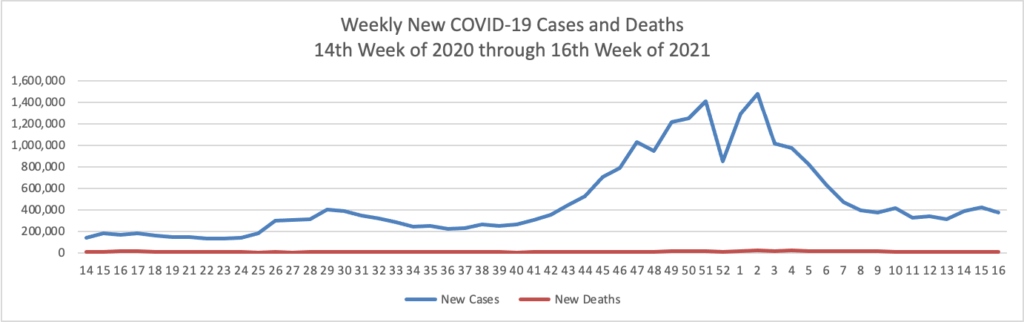
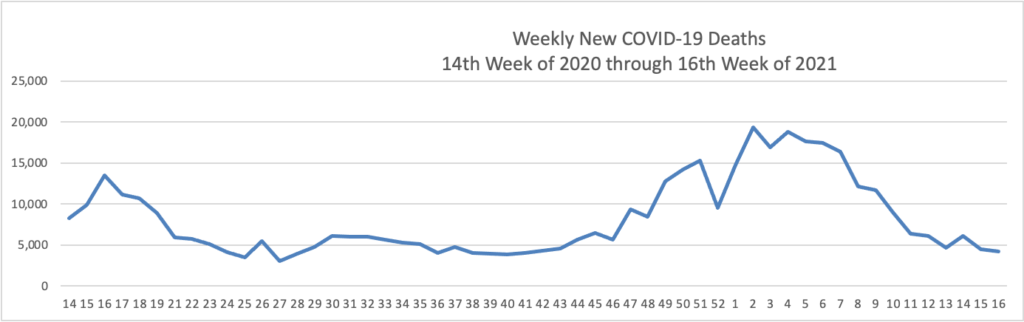
Based on the Centers for Disease Control’s COVID-19 Data Tracker website, here is the FEHBlog’s chart of new weekly COVID-19 cases and deaths over the 14th week of 2020 through 16th week of this year (beginning April 2, 2020, and ending April 21, 2021; using Thursday as the first day of the week in order to facilitate this weekly update):

and here is the CDC’s latest overall weekly hospitalization rate chart for COVID-19:

The FEHBlog has noticed that the new cases and deaths chart shows a flat line for new weekly deaths  because new cases greatly exceed new deaths. Accordingly here is a chart of new COVID-19 deaths over the period (April 2, 2020, through April 21, 2021):

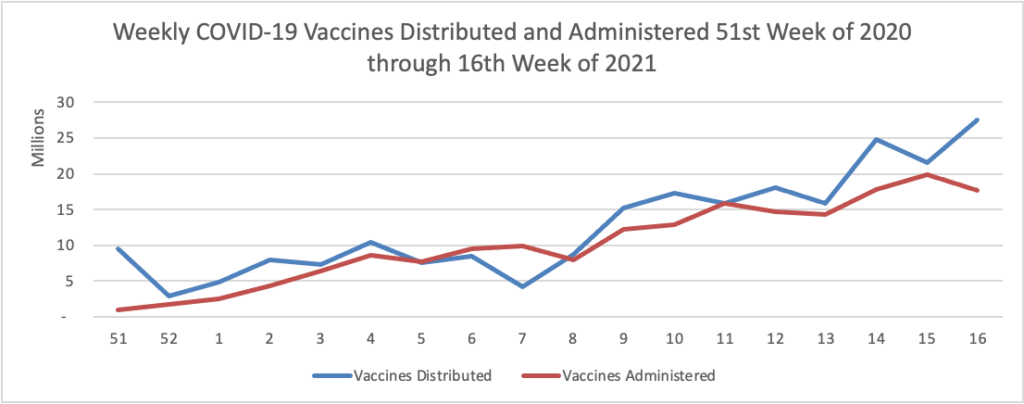
Finally here is a COVID-19 vaccinations chart over the period December 17, 2020, through April 21, 2021 which also uses Thursday as the first day of the week:

The Hill reports this evening that

Johnson & Johnson coronavirus vaccinations should resume immediately, federal regulators said Friday.

The approval follows a recommendation from a federal advisory panel that the shot’s benefits outweigh its risks. 

States could start administering the shots in hours, if not days. There are about 9.5 million doses of the vaccine sitting on shelves across the country that could be deployed immediately.

The Food and Drug Administration (FDA) and Centers for Disease Control and Prevention (CDC), which had jointly recommended a nationwide pause 10 days ago, accepted the recommendation from CDC’s Advisory Committee on Immunization Practices.

The panel wants the FDA to add a warning label intended to make providers aware of the risk of a rare complication involving blood clots in women under the age of 50. 

Johnson & Johnson has already negotiated warning label language with FDA, a company official told the panel.

Medscape adds that “The recommended pause on April 13 in the rollout of the Janssen/Johnson and Johnson vaccine has not substantially deflated confidence in COVID-19 immunization, a new poll reveals.” Let’s go.

From Capitol Hill, Healthcare Dive reports that “The Senate Finance Committee split upon party lines in a Thursday vote on the nomination of Chiquita Brooks-LaSure, President Joe Biden’s pick to head the powerful agency overseeing Medicare and Medicaid, voting 14-14 to move to a full Senate vote without a recommendation for confirmation.” The FEHBlog expects that Ms. Brooks-LaSure will be confirmed next week.

Speaking of health equity, Econtalk currently features a fascinating discussion between host Russ Roberts, who recently became President of Jerusalem’s Shalem College, and Washington University Sociology Professor Mark Rank  “on the nature of poverty and the challenge of ending or reducing it.”

Fierce Healthcare offers interviews with healthcare experts on telehealth regulation and health equity.

Beckers points out how UnitedHealthcare plans to make Optum a $100 billion business and how Anthem’s IngenioRx PBM business keeps growing.

OPM Director Hearing / End of the Carrier Conference / Thursday Miscellany

The virtual OPM AHIP FEHB Carrier Conference ended today. For a good chunk of the conference, Kiran Ahuja, the President’s nominee for OPM Director contemporaneously had her confirmation hearing before the Senate Homeland and Government Security Committee. Here are the Federal Times, Govexec , and Federal News Network articles on that hearing which reportedly went smoothly for the nominee.

At the carrier conference today, the FEHBlog learned about the many things including the following:

  • The Blue Cross Blue Shield Association has released a strategy to help bring about healthcare equity. “The strategy is centered around improving racial health disparities in maternal health, behavioral health, diabetes, and cardiovascular conditions [by] “measuring racial health disparities, forming community and clinical partnerships, scaling effective programs, and influencing local and federal policy decisions.”
  • The American Pharmacists Association has produced a report on promising practices for pharmacist engagement in tobacco cessation interventions. 
  • OPM now has a list of documentation that enrollees must furnish to the employing office or the FEHB carrier to verify family member eligibility in FEHB.

Thanks OPM and AHIP for a great conference.

In Thursday Miscellany —

  • As promised here is a link to the Internal Revenue Service guidance making “tax credits [available to certain employers] for providing paid leave to employees who take time off related to COVID-19 vaccinations.
  • The AP reports on encouraging “new data reassuring for COVID-19 vaccination in pregnancy.”
  • The Secretary of Health and Human Services has extended the COVID-19 public health emergency for another 90 days from yesterday.
  • The American Hospital Association is touting Hospital-at-Home Innovation During COVID-19 and Beyond. “What was once a small but mighty contingent of health care systems providing “hospital-at-home” care before the pandemic has grown into a larger movement. With this model, hospitals across the country are “admitting” patients to their own homes for acute care with excellent results. As highlighted in AHA’s recent issue brief on hospital-at-home, patients receiving this care have a 20% reduction in mortality, were three times less likely to be admitted to an emergency department than usual care patients and have higher satisfaction with their care. And these results are achieved at a 25% lower cost of care.”
  • Fierce Healthcare reports that [Blue Cross licensee] Highmark Health and ChristianaCare are launching a new joint venture that aims to harness data to accelerate value-based, equitable care. The joint company, which has yet to be named, will take advantage of the strengths of both companies to drive toward more accessible and affordable care. Karen Hanlon, chief operating officer at Highmark Health, said on a call with reporters Wednesday that the venture aims to disrupt the traditional dynamic between payers and providers for greater collaboration.” Here’s hoping.
  • AHIMA reports that the ICD-10 coding authorities are considering releasing new codes for October 1, 2021 (as usual) and April 1, 2022 (special supplement.)