Friday Stats and More

Friday Stats and More

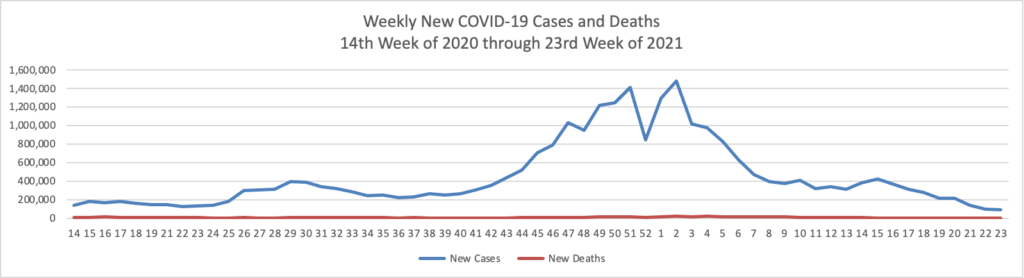
Based on the Centers for Disease Control’s COVID-19 Data Tracker website, here is the FEHBlog’s chart of new weekly COVID-19 cases and deaths over the 14th week of 2020 through 23rd week of this year (beginning April 2, 2020, and ending June 9, 2021; using Thursday as the first day of the week in order to facilitate this weekly update):
and here is the CDC’s latest overall weekly hospitalization rate chart for COVID-19:

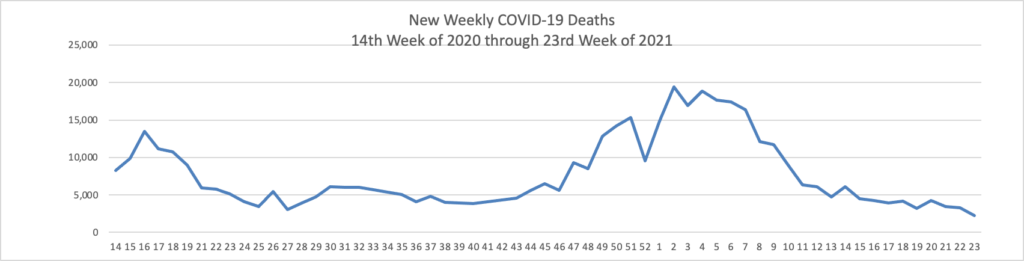
The FEHBlog has noticed that the new cases and deaths chart shows a flat line for new weekly deaths  because new cases significantly exceed new deaths. Accordingly here is a chart of new COVID-19 deaths over the period (April 2, 2020, through June 9, 2020):
Finally here is a COVID-19 vaccinations chart over the period December 17, 2020, through June 9, 2021, which also uses Thursday as the first day of the week:
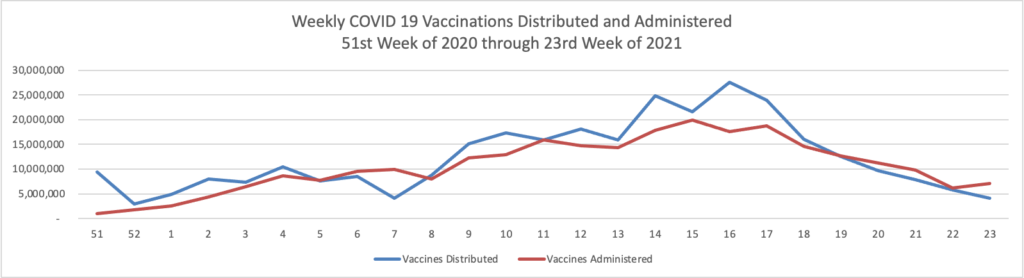
All signs continue to look up. 50% of the American population over 12 years old is fully vaccinated per the CDC.

In COVID-19 news, the Food and Drug Administration announced the latest actions stemming from its ongoing investigation of the problematic Emergent Biosolutions Baltimore factory that had been manufacturing the Johnson & Johnson one dose COVID-19 vaccine:

[The FDA] is authorizing for use, under the emergency use authorization (EUA) for the Janssen COVID-19 vaccine, two batches of vaccine drug substance manufactured at the Emergent BioSolutions facility in Baltimore. Before making this decision, the FDA conducted a thorough review of facility records and the results of quality testing performed by the manufacturer. Based on this review and considering the current COVID-19 public health emergency, the FDA concluded these batches are suitable for use. While the FDA is not yet ready to include the Emergent BioSolutions plant in the Janssen EUA as an authorized manufacturing facility, the agency continues to work through issues there with Janssen and Emergent BioSolutions management. * * *

The FDA has determined several other batches are not suitable for use, but additional batches are still under review and the agency will keep the public informed as those reviews are completed.

Per Fierce Healthcare, the New York Times is reporting that the unsuitable batches total 60 million vaccine doses. Yikes.

HR DIve reports

Most employers “no longer need to take steps to protect their workers from COVID-19 exposure in any workplace, or well-defined portions of a workplace, where all employees are fully vaccinated,” the Occupational Safety and Health Administration said in guidance updated Thursday.

The agency also published an emergency temporary standard for U.S. healthcare employers. Employers included in the emergency temporary standard’s definition must develop and implement a plan to protect employees from COVID-19 in the workplace, and they must designate one or more workplace COVID-19 safety coordinators to implement and monitor their plans. The document also lays out requirements for patient screening and management, personal protective equipment and physical distancing, among other subjects.

OSHA’s updated guidance for all industries, meanwhile, encourages employers to grant paid time off for employees to get vaccinated. Employers also should implement physical distancing for unvaccinated and other at-risk workers in communal work areas, including limiting the number of such workers in one place at any given time.

In other healthcare news

  • Precision Vaccines informs us about an Avalere Heath study finding that non-COVID immunizations among adolescents and adults were significant down last year.
  • The American Medical Association discusses five ways healthcare must change for the post-pandemic world.
  • Becker’s Hospital Review tells us that

Cleveland Clinic, IBM, Aetna and Anthem have partnered to form a blockchain health firm, called Avaneer Health.

The Chicago-based healthcare company will aim to use blockchain capabilities to make healthcare more efficient and reduce administrative costs, according to a June 9 news release.

Five things to know:

Avaneer Health will be formed as a standalone business with significant investments from its founders: Aetna, Anthem, Cleveland Clinic, Health Care Service Corporation, IBM, The PNC Financial Services and Norfolk, Va.-based Sentara Healthcare.

Avaneer Health is a member-based open network supporting utilities developed for the healthcare industry. It is expected to improve healthcare by removing administrative barriers and alleviate inefficiencies in cross-party transactions that slow down care delivery.

The incoming CEO will be Stuart Hanson, former managing director and senior healthcare industry executive at JPMorgan Chase. He will take the helm in August.

The company will be built on blockchain technology to ensure privacy and reduce costs of data exchange.

Finally, the Biden Administration released its Spring 2021 semi-annual regulatory agenda.

The Unified Agenda provides uniform reporting of data on regulatory and deregulatory activities under development throughout the Federal Government, covering approximately 60 departments, agencies, and commissions. Each edition of the Unified Agenda includes regulatory agendas from all Federal entities that currently have regulations under development or review. Agencies of the United States Congress are not included. Fall editions of the Unified Agenda include The The Regulatory Plan, which presents agency statements of regulatory priorities and additional information about the most significant regulatory activities planned for the coming year. 

The FEHBlog will be discussing the OPM agenda in next week’s posts.

In this week’s Econtalk podcast episode, the host Russ Roberts holds a conversation with author Ian Leslie about his book Conflicted. “Leslie argues that, far from being a negative thing, conflict is often the essential ingredient that helps us get to the right answer or best solution. Because some of our best thinking comes in collaboration with others, learning how to disagree civilly when our views conflict is the key to productive conversation in business and in marriage.” Outstanding.

Thursday Miscellany

Photo by Juliane Liebermann on Unsplash

From the COVID-19 front

  • Sobering news from the Wall Street Journal that “It took less than six months for the globe to record more than 1.88 million Covid-19 deaths this year, according to a Wall Street Journal analysis of data collected by Johns Hopkins University. The university’s count for 2021 edged just ahead of the 2020 death toll on Thursday. These numbers underscore how unevenly the pandemic spread around the globe, often hitting poorer nations later, but before they had access to the vaccines that have benefited Europe and the U.S. * * * Vastly different vaccination rates have sharpened the global divide. Only 2% of people in Africa and just over 6% in Asia have received at least one dose of vaccine, according to Our World in Data. That compares with 22% in South America, more than 40% in the European Union and more than half in the U.S. * * * World leaders are due to discuss their response to the pandemic when they gather in Cornwall, in southwestern England, on Friday.” David Leonhardt sheds light on the vaccinating the world in the New York Times. The bottom line is as he points out: “A rapid global vaccination program — combined with natural immunity in people who have already had Covid — could create the same virtuous cycle that’s underway in the U.S., Britain and other countries: A decline in cases feeds on itself, as there are fewer infected people able to spread the virus to others. And by prioritizing older people for shots, countries can cause deaths to decline even more sharply than cases.”
  • To that end, here in the U.S., Moderna “has requested an emergency use authorization (EUA) for its [two dose, mRNA] COVID-19 vaccine in adolescents [ages 12-17] with the U.S. Food and Drug Administration (FDA). Pfizer’s two dose, mRNA vaccine already is being administered to adolescents in this age group.
  • Johnson & Johnson announced that “the U.S. Food & Drug Administration (FDA) has authorized an extension of the shelf life for the Johnson & Johnson single-shot COVID-19 vaccine from 3 months to 4.5 months.” Absent this science based extension, large surplus of unused doses of this vaccine would have begun to expire later this month.  The Wall Street Journal adds that the federal government continues to suspend shipments of new doses of the single dose vaccine, evidently to allow the surplus to deplete.
  • Fierce Healthcare reports on Kaiser Permanente’s efforts to boost the COVID-19 vaccination numbers. As of today, 64% of Americans over age 18 have received at least one dose and over 75% of Americans over age 65 are fully vaccinated.

In big healthcare legal news, a friend of the FEHBlog pointed out to him today that yesterday the Department of Health and Human Services submitted its interim final rule on No Surprise Billing Act implementation rule to the Office of Management and Budget’s Office of Information and Regulatory Affairs for final review before publication in the Federal Register.

AGENCY: HHS-CMS RIN: 0938-AU63Status: Pending Review
TITLE:Requirements Related to Surprise Billing; Part I (CMS-9909)
STAGE: Interim Final Rule ECONOMICALLY SIGNIFICANT: Yes 
RECEIVED DATE: 06/08/2021LEGAL DEADLINE: Statutory  

In other healthcare and healthcare business news:

  • Healthcare Dive informs us that “UnitedHealthcare, the biggest private payer in the U.S., is delaying a controversial policy that could retroactively deny emergency room bills it deems non-emergent — potentially saddling patients with costly medical bills — following intense backlash from patient advocates and hospital groups. ‘Based on feedback from our provider partners and discussions with medical societies, we have decided to delay the implementation of our emergency department policy until at least the end of the national public health emergency period,’ UnitedHealthcare tweeted on Thursday.
  • Health Payer Intelligence identifies four payers that have embraced value based contracting with healthcare providers in the first half of 2021.
  • STAT News reports on what’s ahead for Biogen’s new Alzheimer’s Disease drug. The article concludes “Despite the controversies, Mark Miller, the former executive director of the Medicare Payment Advisory Commission, thinks Aduhelm will be widely used and make billions for Biogen. Infusion centers used for cancer patients and others can accommodate Aduhelm patients, said Miller, now the executive vice president at the Arnold Ventures philanthropy. Doctors will make good money providing the drug. Most Medicare patients have supplemental coverage that will pick up the 20 percent copay. ‘There’s not a lot of friction here to say, “Don’t do this,’ he said.”
  • STAT News also tells us that “The treatment known as CAR-T, in which white blood cells are genetically modified to attack blood cancer, is one of the most exciting and expensive in medicine. But it has not been directly compared to standard treatments in a randomized trial — until now. Bristol Myers Squibb said Thursday that its CAR-T, Breyanzi, prevented the return of large B-cell lymphoma better than the standard of care treatment, which includes a chemotherapy regimen and a stem cell transplant, in which bone marrow cells are replaced to try to cure blood cancer. The news was released in a terse press release that does not include any details about how the therapy performed. But if the results hold up when published in a medical journal or presented at a medical meeting, they would represent a big step forward for CAR-T therapy.”
  • The American Medical Association offers a blueprint for controlling blood pressure.
  • NIH Director Dr. Francis Collins in his blog interviews U.S. Surgeon General Vivek Murthy on fighting the ongoing opioid epidemic.

In federal employment news, Federal News Network reports that

The Biden administration has lifted the 25% occupancy limit at federal buildings, though agencies must still jump through several hoops before bringing more employees back for in-person work.

The Office of Management and Budget, along with the Office of Personnel Management and General Services Administration, on Thursday issued detailed guidance on the administration’s approach for reopening agency offices during the pandemic — and offered a highly-anticipated glimpse at their approach for telework, remote work and other workforce flexibilities in a post-pandemic world.

Midweek Update

Mark Gongloff in Bloomberg opinion lays out the global COVID-19 situation quite clearly

Former FDA chief Scott Gottlieb, a sensible observer throughout this disaster, tells Michael R. Strain he sees Covid-19 becoming like the flu, both in its seasonality and fatality rate. He figures Americans will be fully back to work and school by the fall and then face a new Covid wave in the winter. But with widespread vaccinations, it shouldn’t be worse than a bad flu season. Sounds kind of nice. 

But in the developing world, vaccinations are lagging badly, giving the disease too many chances to evolve. The scariness of India’s “delta” variant may be overhyped, but it seems both more transmissible and severe than others, writes Sam Fazeli. Vaccines are effective against it. But it could make Covid more tiger-like again for unvaccinated Americans and Brits, including young people.

So developed countries must get far more serious about vaccinating the rest of the world to stem further deaths, mutations and economic damage. President Joe Biden promising to give the world 500 million Pfizer doses is a great start, but it’s only a start. 

Former U.K. Prime Minister Gordon Brown writes this Friday’s G-7 meeting is a chance for countries to commit to more such concrete action and spending. The world’s biggest countries must pony up to the best of their ability, as they have with other emergencies. 

Also from the COVID-19 front

  • The Centers for Medicare and Medicaid Services announced today that

While many Medicare beneficiaries can receive a COVID-19 vaccine at a retail pharmacy, their physician’s office, or a mass vaccination site, some beneficiaries have great difficulty leaving their homes or face a taxing effort getting around their communities easily to access vaccination in these settings. To better serve this group, Medicare is incentivizing providers and will pay an additional $35 per dose for COVID-19 vaccine administration in a beneficiary’s home, increasing the total payment amount for at-home vaccination from approximately $40 to approximately $75 per vaccine dose. For a two-dose vaccine, this results in a total payment of approximately $150 for the administration of both doses, or approximately $70 more than the current rate.

  • The Department of Health and Human Services announced that

The U.S. government will procure approximately 1.7 million courses of an investigational antiviral treatment, molnupiravir (MK-4482), for COVID-19 from Merck, pending emergency use authorization (EUA) or approval from the U.S. Food and Drug Administration (FDA).

Molnupiravir (MK-4482) is designed to induce viral genome copying errors to prevent the virus from replicating in the human body, and evidence to date from clinical trials in patients with COVID-19 suggests that molnupiravir may reduce replication of the SAR-CoV-2 virus.

This treatment is being evaluated in an ongoing Phase 3 trial for its potential to reduce the risk of hospitalization or death in non-hospitalized patients who have symptoms for five days or less and are at high risk for severe illness. The trial plans to enroll a total of 1,850 patients globally with final data expected in the fall of 2021.

  • FedSmith offers more details on Blue Cross Federal Employee Program (FEP)’s announcement that it will offer a $50 wellness incentive to FEP members over age 18 who are fully vaccinated against COVID-19. Notably, “FedSmith has been advised that eligible members who have already been vaccinated for COVID-19 can also take advantage of this program and receive the $50 on their MyBlue Wellness Card. These individuals will also have to submit evidence of their COVID-19 vaccination record.”

From the general healthcare front

  • PriceWaterhouseCoopers (PwC) released its Health Research Institute’s 2022 projection of medical cost trend.

PwC’s Health Research Institute (HRI) is projecting a 6.5% medical cost trend in 2022, slightly lower than the 7% medical cost trend in 2021 and slightly higher than it was between 2016 and 2020. Healthcare spending is expected to return to pre-pandemic baselines with some adjustments to account for the pandemic’s persistent effects.

HRI defines medical cost trend as the projected percentage increase in the cost to treat patients from one year to the next, assuming benefits remain the same. Typically, spending data from the prior year is used as an input in the projection. For 2021 and 2022, the medical cost trend is the projected percentage increase over the prior year’s spending, with the effects of the pandemic removed from the prior year’s spending.

  • Not surprisingly, the American Hospital Association sent a letter to UnitedHealthcare stating in pertinent part that

America’s hospitals and health systems are deeply concerned by UnitedHealthcare’s (UHC) recent policy announcement [recently mentioned in the FEHBlog] to allow for the retroactive denial of coverage for emergency-level care in facilities. This policy would put patients’ health and wellbeing in jeopardy, and we urge you to reverse the policy immediately.

The AHA contends that UHC’s policy violates the Affordable Care Act’s requirement that heath plans adjudicate emergency care claims using a prudent layperson standards. The FEHBlog expects that UHC has taken this legal requirement into account. The FEHBlog will continue to follow this matter.

  • mHealth Intelligence reports that “New research out of the University of California Davis finds that telehealth treatments for people with non-urgent mental health needs can be delivered via an asynchronous (store-and-forward) platform just as well as through an audio-visual platform.” This approach could make the delivery of mental healthcare more efficient.
  • According to a company press release, “Datavant, the leader in helping healthcare organizations securely connect their data, and Ciox Health, the leader in clinical data exchange, today announced that they have signed a definitive agreement to merge the two companies in a transaction valued at $7.0 billion. The combined entity, to be named Datavant, will be the nation’s largest health data ecosystem, enabling patients, providers, payers, health data analytics companies, patient-facing applications, government agencies, and life science companies to securely exchange their patient-level data. “The fragmentation of health data is one of the single greatest challenges facing the healthcare system today,” said Pete McCabe, CEO of Ciox Health. “Each of us has many dozens of interactions with the healthcare system over the course of our lives, and that information is retained in siloed databases across disparate institutions. Every informed patient decision and every major analytical question in healthcare requires the ability to pull that information from across the health data ecosystem while protecting patient privacy. We are thrilled to join forces with the Datavant team to connect health data to improve patient outcomes. Together we are well positioned to navigate the technical, operational, legal, and regulatory challenges to doing so, and are committed to acting as a neutral connectivity solution for our many customers and partners.”
  • The National Committee for Quality Assurance answers questions about the use of electronic clinical data in HEDIS reporting. For example,

Q: How does administrative reporting relate to ECDS reporting?

A: Administrative claims are considered a key data source for ECDS reporting if the data can also be made available to a member’s care team. It is one of the four major data categories for ECDS reporting. The ECDS reporting method expands the types of data permitted for HEDIS® reporting by allowing the use of structured data from electronic health records, health information exchanges and clinical registries, and case management systems in addition to administrative claims.

Q: Is NCQA going to phase out the hybrid method of data collection from HEDIS?

A: NCQA is actively assessing the appropriateness of removing the hybrid reporting method from select HEDIS measures as other data sources improve.

Tuesday’s Tidbits

Photo by Patrick Fore on Unsplash

The Blue Cross Blue Shield Association announced today that

the Blue Cross and Blue Shield (BCBS) Government-wide Service Benefit Plan, also known as the Federal Employee Program® (FEP®) announced it will launch a COVID-19 Vaccination Incentive Program starting Friday, June 11, 2021, to encourage members to get vaccinated against COVID-19 and help meet President Biden’s goal of having at least 70% of the U.S. adult population receive one or more vaccinations for COVID-19 by July 4, 2021.

Eligible members – those over the age of 18 with an FEP MyBlue® account – will receive $50 on their MyBlue Wellness Card when they provide official documentation of their COVID-19 vaccination record. Members can use these incentive funds to purchase qualified medical expenses. FEP is the first Federal Employees Health Benefit program to offer a vaccination incentive like this to its members.

In other COVID-19 news —

  • The Wall Street Journal reports that

Pfizer and partner BioNTech SE said Tuesday that they have begun testing their vaccine in children under 12 years old in a pivotal study. If the results prove positive, Pfizer said it would ask U.S. health regulators in September to expand use to some of the younger children.

Meantime, Moderna Chief Executive Stephane Bancel said results of testing Moderna’s vaccine in children as young as five years could become available by the fall, which if positive could lead to regulatory authorization of its use in the younger age group.

  • Dr. Marty Makary writes in a Journal op-ed that “The news about the U.S. Covid pandemic is even better than you’ve heard. Some 80% to 85% of American adults are immune to the virus: More than 64% have received at least one vaccine dose and, of those who haven’t, roughly half have natural immunity from prior infection. There’s ample scientific evidence that natural immunity is effective and durable, and public-health leaders should pay it heed.”

Hospitals, state health departments and the federal government are racing to decide how to use up millions of Johnson & Johnson’s vaccine doses that are set to expire this month.

The prospect of so many doses going to waste in the U.S. when developing nations are desperate for shots would add pressure on the Biden administration to share stockpiled vaccines. But there are few practical solutions to administering them quickly in the U.S. or distributing them in time to foreign countries, according to those involved in the vaccination drive.

The stockpile is, in part, an unintended consequence of the U.S.’s decision in April to temporarily suspend administration of J&J doses to assess a rare blood-clot risk. The pause forced states and providers to cancel large blocks of appointmentsthat were never rescheduled, leaving a surplus of supply, and in some areas increasing hesitancy over the J&J vaccine’s safety, according to industry officials. * * *

The issue of expiring doses is the latest setback for J&J’s Covid-19 vaccine effort. An accident at a contract manufacturer’s plant led to the contamination of material that could have yielded up to 15 million doses and led to a halt in production of the J&J vaccine there.

This serious Johnson & Johnson one dose COVID-19 vaccine distribution problem impairs efforts to vaccinate people like the unhoused who are unlikely to return for a second dose of the mRNA vaccine.

Following up on yesterday’s news about Food and Drug Administration of an Alzheimer’s Disease drug, the Wall Street Journal offers a medical specialist’s observations on this terrible disease. Also Fierce Healthcare informs us that Biogen has “unveiled collaborations with CVS Health, Cigna to boost access to its Alzheimer’s drug.”

The Washington Post informs us that

Senate Republicans are blocking a quick confirmation for President Biden’s nominee to lead the federal personnel agency, targeting her past emphasis on the concept of systemic racism known as “critical race theory” that has become a lightning rod for conservatives.

Republicans also are pushing back on Kiran Ahuja’s support for abortion rights at a time when a long-standing ban on federal funding for the procedure — known as the Hyde Amendment — has emerged as a renewed flash point for the right because of Biden’s support for overturning it.

The delay on Ahuja’s nomination is being led by Sen. Josh Hawley (R-Mo.), although several Republicans objected to a quick confirmation vote for her, according to senior Democratic and GOP officials. The move will force Senate Majority Leader Charles E. Schumer (D-N.Y.) to go through procedural hurdles on the Senate floor, rather than move quickly with a pro forma vote that is more common for nominees to lower-profile posts.

In the tidbits department —

The majority of the average healthcare premium dollar goes toward prescription drugs and outpatient and inpatient hospital costs, according to AHIP’s most recent research.

AHIP looked at 30 commercial health insurance providers’ financial statements between 2016 and 2018 to get the breakdown of how payers were spending members’ premiums. The data included spending by employer-provided coverage and coverage that individuals can purchase on the healthcare market.

The biggest chunk of the healthcare dollar went towards prescription drugs, with 21.5 cents dedicated to payments for outpatient prescription medications and prescription medications administered in a physician’s office or clinic.

Prescription drugs are closely followed by spending on outpatient hospital and inpatient hospital services, both around 19 cents while medical services come in at 12 cents.

  • Healthcare Dive informs us that yesterday “Apple unveiled new health features aimed at patient-doctor data exchange.” Moreover, “Apple is launching new mobility capabilities for its iPhone. Using information from its motion sensors, the phone can now collect data on someone’s balance, stability and coordination by measuring stride length and timing, and warn them they might be at risk for a harmful fall if they’re walking unsteadily. Usually, fall risk is assessed by a provider using a questionnaire and in-person exam.” The new features will be available on Apple devices in the fall of this year.
  • According to a Department of Health and Human Services press release, “The White House, the U.S. Department of Health and Human Services (HHS) Office of the Assistant Secretary for Preparedness and Response (ASPR) and the U.S. Food and Drug Administration (FDA) today released a series of policy recommendations to address the vulnerabilities in U.S. pharmaceutical supply chains. Led by FDA and ASPR, the White House report – PDF and its recommendations have been accepted by President Biden.”

“To secure the supply chain, the report’s recommendations center on four pillars:

  1. Boosting local production and fostering international cooperation;
  2. Promoting research and development that establishes innovative manufacturing processes and production technologies to strengthen supply chain resilience;
  3. Creating robust quality management maturity to ensure consistent and reliable drug manufacturing and quality performance, and
  4. Leveraging data to improve supply chain resilience.”

Monday Roundup

Photo by Sven Read on Unsplash

The Food and Drug Administration (“FDA”) announced today that the agency has “approved Aduhelm (aducanumab) for the treatment of Alzheimer’s, a debilitating disease affecting 6.2 million Americans. Aduhelm was approved using the accelerated approval pathway, which can be used for a drug for a serious or life-threatening illness that provides a meaningful therapeutic advantage over existing treatments. Accelerated approval can be based on the drug’s effect on a surrogate endpoint that is reasonably likely to predict a clinical benefit to patients, with a required post-approval trial to verify that the drug provides the expected clinical benefit. 

“Under the accelerated approval provisions, which provide patients suffering from the disease earlier access to the treatment, the FDA is requiring the company, Biogen, to conduct a new randomized, controlled clinical trial to verify the drug’s clinical benefit. If the trial fails to verify clinical benefit, the FDA may initiate proceedings to withdraw approval of the drug.”

The Wall Street Journal adds

Biogen priced the newly approved drug higher than analysts expected. The company said it would charge about $56,000 a year per patient.

A preliminary analysis conducted by the Institute for Clinical and Economic Review, a nonprofit research and advisory group, said the drug could be cost-effective at a per-patient price of $2,500 to $8,300 a year.

Alzheimer’s is a progressive degenerative disease that slowly robs people of their memory and the ability to care for themselves.

About six million people suffer from Alzheimer’s in the U.S. Of those, as many as 1.4 million could be eligible to take Aduhelm, according to estimates by Cigna.

What’s more, according to the Journal,

Cigna will likely cover the drug for people who match the patients studied in Biogen’s clinical trials—those with early-stage Alzheimer’s and amyloid buildup in their brains—said Steve Miller, Cigna’s chief clinical officer.

Most Alzheimer’s patients are covered by Medicare, and their out-of-pocket costs could be significant, depending on their coverage, because of so-called coinsurance payments that require patients to cover a percentage of certain health costs, Dr. Miller said.

“The out-of-pocket testing costs could be a real barrier for those patients who lack the financial means,” said Dr. Miller.

Cigna estimates that patients with traditional Medicare insurance could be on the hook for more than $10,000 a year in coinsurance and copayments for the drug and amyloid testing, Dr. Miller said. Additional costs for people with supplemental Medigap insurance or commercial coverage through Medicare Advantage could reach up to $4,000 annually.

Dr. Miller said patients may be eligible for financial assistance to cover the extra costs through nonprofit foundations, which are often funded by drugmakers.

Healthcare Dive offers a comprehensive article about the new drug that is not behind a paywall.

From the COVID-19 front

  • David Leonhardt in the New York Times reports on his takeaways from Britain’s recent, modest rise in new COVID-19 cases:

One, vaccines are still the most effective way, by far, to defeat this terrible pandemic. Nothing matters more than the speed at which shots go into arms — in Britain, in the U.S. and especially in poorer countries, where vaccination rates are still low.

Two, behavior restrictions can still play a role in the interim. If hospitalizations or deaths in Britain rise over the next two weeks, there will be a strong argument for pushing back the full reopening of activities. And that has obvious implications for the U.S., too. Restricting indoor activities for unvaccinated people is particularly important.

Three, caseloads are no longer as important a measure as they used to be. Before the vaccines were available, more cases inevitably meant more hospitalizations and deaths. Now, the connection is more uncertain. As a recent Times story put it, paraphrasing British scientists, “upticks in new infections are tolerable so long as the vast majority do not lead to serious illness or death.”

  • The Society for Human Resource Management discusses stepped-up employer efforts to encourage COVID-19 vaccinations and reduce employee tensions over COVID-19 masks and vaccination in the workplace.
  • Medscape offers suggestions for healthcare providers and possible health plans on how to target COVID-19 vaccine hesitancy.
  • The Massachusetts Institute of Technology’s Pandemic Technology Project reports on best community practices in closing COVID-19 vaccination gaps.

From the OPM front

  • Govexec informs us that OPM “on Monday moved to finalize new regulations making it easier for federal agencies to bring back former employees at a higher salary than when they left government. Currently, federal agencies have the authority to rehire former federal workers outside the competitive hiring process, but they can only offer them positions at the same pay grade they held before they left federal service. Under a final rule set to be published in the Federal Register Tuesday, effective July 8, agencies will be able to use that process to rehire former federal workers at higher salaries than when they left government, accounting for the experience and skills they gained through education and the private sector.”
  • Federal News Network informs us that “Federal retirement activity slowed across the board last month, from new claims to backlogged cases and even the time it takes to process them. The latest numbers from the Office of Personnel Management showed that 7,684 new claims were filed in May compared to 9,414 in April — an 18.4% decrease month over month but a 15.6% increase from the same time a year ago. The number of claims processed also dropped to 8,451 in May versus 11,396. That’s a 25.8% decline month other month, although April was unusually high for processed claims when compared to historical monthly totals. May’s processed claims were about even year over year. The retirement backlog decreased from 25,386 claims in April to 24,619 claims in May, but that represented a 35.4% increase from May 2020. In January of this year, the backlog, which has not met it’s goal of 13,000 claims for more than a year and a half, peaked at 26,968 claims and has slowly inched back down.” It’s the FEHBlog’s understanding that OPM’s issues stem from an unnecessarily complex federal retirement system that only Congress can fix.

In other news

  • Beckers Hospital Review reports that “Walmart Health’s primary care medical group has filed paperwork to expand virtual care in 16 more states, Insider reported June 7.”
  • Healthcare Dive informs us that even before the new information blocking rule’s effective date, “the majority of hospitals have allowed patients to view and download their health information via their own patient portal [in recent year] . However, hospitals allowing patients to use third-party apps to see their data increased sharply from 2018 to 2019, according to a new report from the federal agency that regulates U.S. health IT.”

Weekend update

The Senate will resume Committee work and floor voting this coming week while the House of Representatives will be limited to Committee business.

From the COVID-19 front

  • Bloomberg reports that “U.S. hospitalizations continue to fall, with 3.17% of beds occupied by Covid-19 patients on June 4, according to the U.S. Department of Health and Human Services. That percentage dropped from 3.67% on May 28 and is the lowest since March 14, 2020.”
  • The Advisory Board informs us its June 4, 2021, COVID-19 Roundup that “The World Health Organization (WHO) on Monday announced variants of the coronavirus will now be named after letters of the Greek alphabet, to simplify the variants’ names and avoid names that can be stigmatizing to a country. According to the new naming system, the variant B.1.1.7, which was first discovered in the United Kingdom, will now be called Alpha; the B.1.351 variant first discovered in South Africa will be called Beta; and the B.1.617.2 variant first discovered in India will be called Delta. Once all 24 letters of the Greek alphabet have been used, WHO said it will announce another naming system.”

Kaiser Health News tells us that

The Food and Drug Administration’s decision next week whether to approve the first treatment for Alzheimer’s disease highlights a deep division over the drug’s benefits as well as criticism about the integrity of the FDA approval process.

The agency said it will decide by June 7 the fate of Biogen’s drug aducanumab, despite a near-unanimous rejection of the product by an FDA advisory committee of outside experts in November. Doubts were raised when, in 2019, Biogen halted two large clinical trials of the drug after determining it wouldn’t reach its targets for efficacy. But the drugmaker later revised that assessment, stating that one trial showed the drug reduced the decline in patients’ cognitive and functional ability by 22%.

Some FDA scientists in November joined with the company to present a document praising the intravenous drug. But other FDA officials and many outside experts say the evidence for the drug is shaky at best and that another large clinical trial is needed. A consumer advocacy group has called for a federal investigation into the FDA’s handling of the approval process for the product.

A lot is riding on the drug for Biogen. It is projected to carry a $50,000-a-year price tag and would be worth billions of dollars in revenue to the Cambridge, Massachusetts, company.

The Department of Health and Human Services, last Friday, released

a new report that shows 31 million Americans have health coverage through the Affordable Care Act – a record.  The report also shows that there have been reductions in uninsurance rates in every state in the country since the law’s coverage expansions took effect. People served by the health Marketplaces and Medicaid expansion have reached record highs.  

The data shows those individuals currently enrolled in health coverage through the Health Insurance Marketplaces and Medicaid expansion under the ACA, including 11.3 million people enrolled in the ACA Marketplace plans as of February 2021 and 14.8 million newly-eligible people enrolled in Medicaid through the ACA’s expansion of eligibility to adults as of December 2020. 

In addition, there are one million people enrolled in the ACA’s Basic Health Program, and nearly four million previously-eligible adult Medicaid enrollees who gained coverage under expansion due to the ACA’s enhanced outreach, streamlined applications, and increased federal funding under the ACA. Today’s report shows the important role the ACA has played in providing coverage to millions of Americans nationwide.

The report also shows that between 2010 and 2016, the number of nonelderly uninsured adults decreased by 41 percent, falling from 48.2 million to 28.2 million. All 50 states and the District of Columbia have experienced reductions in their uninsured rates since the implementation of the ACA, with states that expanded Medicaid experiencing the largest reduction in their uninsured rate. California, Kentucky, New York, Oregon, Rhode Island, Washington, and West Virginia have reduced their uninsured rate by at least half from 2013 to 2019 through enrollment in Marketplace coverage and expansion of Medicaid to adult populations. To date, 37 states and the District of Columbia have expanded Medicaid to cover adults under the ACA. 

Healthcare Dive reports that

  • The nation’s largest commercial insurer is taking a closer look at whether visits to the emergency room by some of its members are necessary. Starting July 1, UnitedHealthcare will evaluate ER claims using a number of factors to determine if the visit was truly an emergency for its fully insured commercial members across many states, according to a provider bulletin
  • If UnitedHealthcare finds the visit was a non-emergency, the visit will be “subject to no coverage or limited coverage,” the provider alert states.
  • However, a statement provided to Healthcare Dive said the insurer will reimburse for non-emergency care according to the member’s benefit plan. In other words, the amount paid by UnitedHealthcare may be less if deemed a non-emergency.    

For what it’s worth, this plan designed to control healthcare resources makes sense to the FEHBlog.

Last week, the FEHBlog noted that OPM had a settled a lawsuit in the National Federation for the Blind alleged that the agency’s website was not adequately accessible to visually impaired FEHB members. To place the settlement in context, the FEHB calls attention to this NextGov article reporting that

Federal websites are not as accessible for those with disabilities as the law mandates they should be, according to a report released Thursday by the Information Technology and Innovation Foundation.

The report tested the 72 most popular federal websites and used a combination of automated tests and qualitative assessments to assess their compliance with Section 508 of the Rehabilitation Act. The law requires the General Services Administration to ensure federal websites are accessible to people with disabilities, including federal employees and the public.

According to the report, 30% of the most popular federal websites did not follow modern web accessibility standards on their homepages, and 48% failed a standard test on at least one of their three most popular web pages.

The report finds that

Overall, our assessments reveal a large amount of variation in how agencies are meeting Section 508 requirements. Some agencies that have a large footprint—such as the Internal Revenue Service, the Census Bureau, the Department of Defense, and the Department of Education’s office of Federal Student Aid—scored low in our accessibility test of their websites, indicating that people with disabilities may have difficulty accessing essential government services or information about these services online. * * *

Notably, the White House and the Centers for Disease Control and Prevention earned a perfect score in our accessibility test of all three of their pages, and also performed well in our qualitative assessment. The Biden administration has committed to adhering to WCAG 2.1 Level AA criteria on the White House website—a step above Section 508’s requirements, which use WCAG 2.0.19

Friday Stats and More

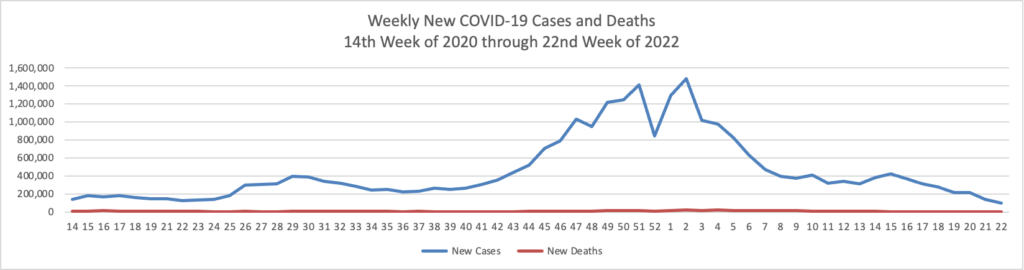
Based on the Centers for Disease Control’s COVID-19 Data Tracker website, here is the FEHBlog’s chart of new weekly COVID-19 cases and deaths over the 14th week of 2020 through 22nd week of this year (beginning April 2, 2020, and ending June 2, 2021; using Thursday as the first day of the week in order to facilitate this weekly update):

and here is the CDC’s latest overall weekly hospitalization rate chart for COVID-19:

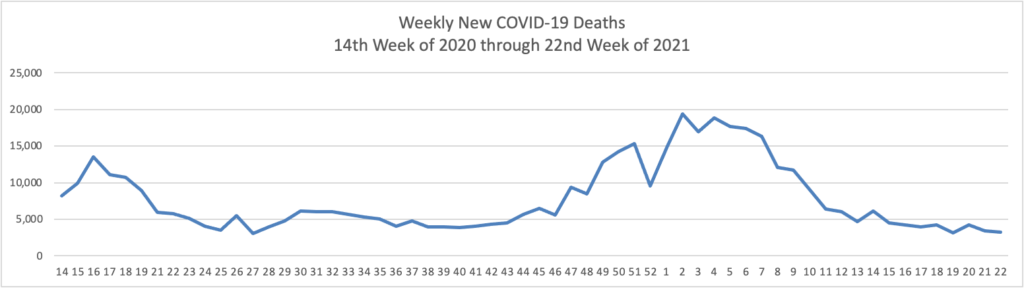
The FEHBlog has noticed that the new cases and deaths chart shows a flat line for new weekly deaths  because new cases significantly exceed new deaths. Accordingly here is a chart of new COVID-19 deaths over the period (April 2, 2020, through June 2, 2021):

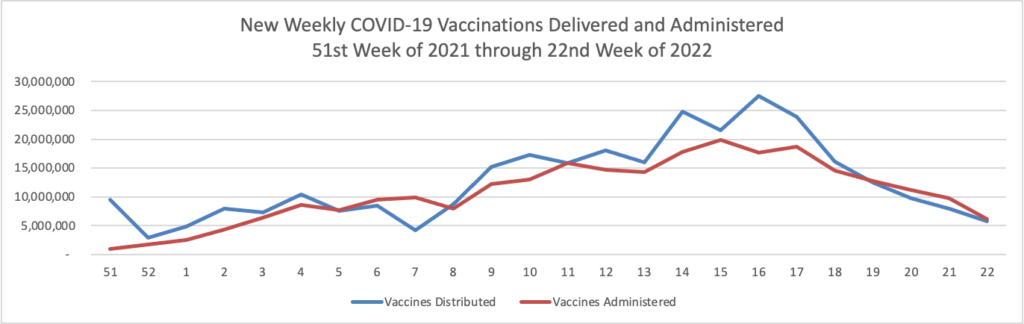
Finally here is a COVID-19 vaccinations chart over the period December 17, 2020, through June 2, 2021 which also uses Thursday as the first day of the week:

In this week’s COVID-19 update, the CDC advises

With summer upon us, many adolescents are looking forward to returning to activities they may have missed last summer, including travel, hanging out with friends, work, and summer campVaccinating adolescents is an important step toward stopping the spread of COVID-19. As of June 3, 2021, more than 5.9 million adolescents ages 12-17 years have received at least one dose of a COVID-19 vaccine. Fully vaccinated adolescents are at low risk of symptomatic or severe infection and are less likely to transmit COVID-19 to others. If you or someone you know is considering adolescent vaccination, talk with your pediatrician or healthcare provider about the benefits of vaccination. To find a vaccine provider near you, visit vaccines.gov.

In other new

  • The tri-agencies which administer the Affordable Care Act issued FAQ 46 today which reminds interested that the Biden Administration lowered the in-network out-of-pocket maximum limit for 2022 that the Trump Administration had proposed. As the FEHBlog reported in early May 2021, the maximum annual limitation on [in-network] cost sharing for the 2022 plan year will be $8,700 for self- only coverage, and $17,400 for other than self-only coverage.”
  • Fierce Pharma reports that “Friday brought news that the FDA has made Regeneron’s monoclonal antibody cocktail [to treat COVID-19] more user friendly, allowing it to be administered by subcutaneous injection in addition to its original administration form of intravenous infusion. The agency also approved a lower dose of the Regeneron drug, 1200 mg, allowing the company and officials to stretch available supply.”
  • The American Medical Association informs us about “Ochsner’s Connected MOM (Maternity Online Monitoring) initiative, which uses digital health tools to offer expectant mothers a convenient way to safely manage their pregnancy in collaboration with their physicians.” Oschner, of course, is a major health system serving New Orleans, LA, and environs.
  • HR Dive tells us about the types of incentives that employers are offering to encourage employees to get COVID-19 vaccinations. “Adam Sencenbaugh, partner at Haynes and Boone, said he has seen several creative forms of incentives from clients, ranging from paid time off to raffles. That mirrors reports of what other employers have done to incentivize vaccination, with ideas including direct payments and transportation provided to those receiving a vaccine. “We have yet to have a client ask us about a program that would be coercive in that respect,” Sencenbaugh added. “It’s been something that, if done appropriately, can even boost morale.”

Thursday Miscellany

Photo by Juliane Liebermann on Unsplash

President Biden today announced a strategy for sharing “at least 80 million U.S. [COVID 19] vaccine doses globally by the end of June.

On the U.S. COVID-19 vaccination front

  • David Leonhardt reports in the New York Times that

When the C.D.C. reversed its Covid-19 guidelines last month and said that vaccinated Americans rarely needed to wear masks, it caused both anxiety and uncertainty.

Many people worried that the change would cause unvaccinated people to shed their masks and create a surge of new cases. On the flip side, a more optimistic outcome also seemed possible: that the potential to live mostly mask-free would inspire some vaccine-hesitant Americans to get their shots.

Almost three weeks after the change, we can begin to get some answers by looking at the data. So far, it suggests that the optimists were better prognosticators than the pessimists.

  • HR Dive informs us that “Vaccine mandates are not a consideration for 83% of employers responding to law firm Fisher Phillips’ recent pulse survey. That figure is up from January, when the firm recorded 64% of respondents saying they would not impose a vaccine requirement. At that time, 27% of employers said they had yet to decide if they would mandate vaccinations. “Most employers — 75% — said they are encouraging workers to get their vaccines, the May 25 survey results revealed.”

Fortune Magazine released its Fortune 500 and sitting in the top 10 are four healthcare companies (CVS Health (4), United Health Group (5), McKesson (7) and AmerisourceBergen (8). For the second year in a row the top two companies are Walmart and Amazon, both of which are attempting to break into the healthcare market.

In his latest FedWeek column, Reg Jones discusses continuing FEHB coverage of unmarried children of enrollees beyond age 26 provided the child is incapable of self-support. “The term “incapable of self support” generally means that the child earns less than the equivalent of GS-5, step 1 [$30,414 in 2021]. However, this is not a hard and fast rule. In making a decision, consideration is given to the child’s earnings and condition or prognosis.”

From the Centers for Medicare and Medicaid Services front:

  • Kaiser Health News reports that expanding health insurance coverage is the top priority of the newly installed CMS Administrator, Chiquita Brooks-Lasure.
  • Healthcare Dive tells us that Elizabeth Fowler, head of the Center for Medicare and Medicaid Innovation, said that CMMI’s ongoing strategy review has resulted in more conscious choices in where it should invest, which includes pivoting away from voluntary models. “Voluntary models are subject to risk selection, which has a negative impact on the ability to generate system-level savings. Providers that aren’t generating the extra revenue tend to exit the program, and those that are tend to stay,” Fowler, now on her third month at the job, said at a Health Affairs briefing. “So we are exploring more mandatory models.”
  • Fierce Healthcare informs us that Congress wants CMMI to be more transparent in its spending. A bipartisan letter “said CMMI’s authorizing statute, which was part of the Affordable Care Act, calls for the center to gather input from interested parties. However, this requirement has often been shunted aside by the center and rarely observed.”

Medcity News reports that the Labor Department’s top health benefits law enforcement priority is compliance with the federal mental health parity law.

To uphold the law and ensure parity in coverage, the labor department has two strategies in place, [Secretary of Labor] Walsh said.

The department’s Employee Benefits Security Administration agency has created a task force that focuses on enforcement of the act, he said. The task force is reviewing its inventory of case files, looking to identify potential violations and send out requests to payers for data on parity analyses, which they are required to maintain to show their compliance with the law.

Further, the Department of Labor, along with other government agencies involved in this work such as the Department of Health and Human Services and Internal Revenue Service, is providing regular reports to Congress on their findings and enforcement actions, Walsh said. This can help inform legislation on insurance coverage moving forward.

Govexec provides the latest Postal Service news, including a confirmed report that the FBI is investigating Postmaster General DeJoy “for allegations that he illegally pressured employees at his former company to donate to Republican candidates while promising to later reimburse them through bonuses.”

The Wall Street Journal reports today that

A drug sold by AstraZeneca PLC and Merck & Co. reduced the recurrence of breast cancer in women with an early but aggressive form of the disease, a long-running [blinded] international study found. The finding, which on Thursday was published online by the New England Journal of Medicine and released at a major cancer-research meeting, marked the latest advance in cancer treatments targeting the genetic traits of tumors. It could expand the arsenal of weapons against a hereditary form of breast cancer. The result also helps validate the pharmaceutical industry’s investment in a pricey new class of drugs that target cancer cells, known as PARP inhibitors.  * * *

PARP inhibitors work by blocking cancer cells from relying on a survival tactic: the ability to repair their own DNA after their DNA is damaged naturally or by other drug treatments. This, in turn, contributes to cancer-cell death.

Health regulators have approved these types of drugs in recent years to treat ovarian, breast, prostate and pancreatic cancers. The drugs have been found to be particularly useful against cancers associated with harmful mutations in genes known as BRCA1 and BRCA2. Women with these hereditary mutations have a higher risk of developing breast cancer, and often at a younger age than is typical. The BRCA mutations account for about 5% of the estimated 281,000 cases of breast cancer diagnosed annually in the U.S.

Midweek Update

President Biden announced today that June will be a month of action to encourage COVID-19 vaccinations in the U.S. The President has set a goal of 70% of adult Americans having received at least one dose of a COVID-19 vaccine by Independence Day. As of today we are 62.9% according to the CDC. The fact sheet on the announcement lists many private-public efforts underway to provide convenient access to and incentivize people receive the COVID-19 vaccine.

The FEHBlog ran across today a CDC COVID-19 vaccine hesitancy map of our country. The New York Times adds that

A recent Kaiser Family Foundation poll found that about a third of unvaccinated adults were unsure whether insurance covered the new vaccine and were concerned they might need to pay for the shot. The concern was especially pronounced among Hispanic and Black survey respondents.

“The conversations we have are like: ‘Yes, I know it’s good. Yes, I want it, but I don’t have insurance,’” said Ilan Shapiro, medical director of AltaMed, a community health network in Southern California that serves a large Hispanic population. “We’re trying to make sure everyone knows it’s free.”

The confusion may represent a lack of information, or skepticism that a bill won’t follow a visit to the doctor. Liz Hamel, director of survey research at Kaiser, said it could reflect people’s experience with the health system: “People may have heard it’s available for free, but not believe it.”

The FEHBlog is concerned that, notwithstanding encouraging press accounts last week, the Food and Drug Administration and Emergent Biosolutions have not yet reached an agreement allowing Emergent to resume manufacturing the one dose Johnson & Johnson vaccine at its Baltimore, MD plant. Kaiser Health News projects no shipments of the one dose vaccine next week (June 7). It seems to the FEHBlog that the one dose vaccine is best suited for pop-up vaccination sites. Hopefully, distribution will resume soon.

Yesterday the FDA issued

safety communication to warn the public to stop using the Lepu Medical Technology SARS-CoV-2 Antigen Rapid Test Kit and the Leccurate SARS-CoV-2 Antibody Rapid Test Kit (Colloidal Gold Immunochromatography) because the FDA has serious concerns about the performance of the tests and believes there is likely a high risk of false results when using these tests. Neither test has been authorized, cleared, or approved by the FDA. The FDA has identified this issue as a class I recall, which is the most serious type of recall. The FDA is aware that these unauthorized tests were distributed to pharmacies to be sold for at-home testing by consumers, as well as offered for sale directly to consumers.

Importantly, HealthDay reports that COVID-19 does not pose a threat to the safety of the United States’ blood supply under existing donor screening guidelines, researchers report.

In FEHB news, the National Federation for the Blind announced on May 19 that

Under a consent decree entered in federal court in the Northern District of Illinois last week [May 13], the federal Office of Personnel Management (OPM) has agreed to take steps to ensure that health benefit information is accessible to blind federal employees, retirees, and other plan participants.

The consent decree resolves a lawsuit brought in 2019 by Jamal Mazrui, a retired blind federal employee, and the National Federation of the Blind, America’s civil rights organization of the blind.

Among other steps, OPM will ensure that health-benefit information on opm.gov is accessible and will notify all providers of federal employee health benefits that they must make their own federal employee benefits websites and mobile apps accessible or face potential consequences to their contracts.

For more details, here’s a link to consent decree which advises FEHB plan carriers to expect an OPM carrier letter on the settlement this month. With regard to timing the consent decree states (pp. 8 – 9) that

The carrier letter will utilize a phased-in approach, instructing carriers to either submit a certification that the Carrier FEHB Electronic Content on their websites and mobile applications is conformant with WCAG 2.0 AA or submit work plans pursuant to which (in the absence of any relevant legal exception(s)), logins, secure messaging, Explanations of Benefits, and ID cards would be conformant with WCAG Requirements by January 1, 2023, with a requirement of full conformance of the carrier’s Carrier FEHB Electronic Content with WCAG 2.0 AA on their mobile applications and their websites by January 1, 2024.

America’s Health Insurance Plans (AHIP) has “announced a refreshed brand and updated mission that better aligns with its work, goals, and commitments. Moving forward, the industry trade association will go simply by AHIP. The organization has also unveiled a new logo, conveying a more modern, more inclusive and even more active AHIP, along with a new tagline: Guiding Greater Health. AHIP believes that health insurance providers play a critical role in making health care better and coverage more affordable and accessible for everyone. Its new mission and brand reflect AHIP’s commitment to innovation, solutions, equity and delivering results for every patient in every community.” Good luck.

In an encouraging medical test development, MedPage Today reports that

A simple blood test, coupled with brief memory tests, showed who will develop Alzheimer’s disease in the future with a high degree of accuracy.

Combining plasma phosphorylated tau (p-tau), APOE genotype, and scores from 10-minute executive function and memory tests predicted Alzheimer’s disease onset within 2 to 6 years among people with memory complaints with 90% certainty, reported Oskar Hansson, MD, PhD, and Sebastian Palmqvist, MD, PhD, both at Lund University in Sweden, and colleagues.

When dementia experts examined the same patients, they were about 71% accurate, the researchers noted in Nature Medicine. * * *

As of now, it’s been tested only on patients who have been examined in memory clinics, he added. “Our hope is that it will also be validated for use in primary healthcare as well as in developing countries with limited resources.”

The Society for Human Resource Management points out four take aways from last week’s EEOC guidance to employers about COVID-19 vaccination inquiries and incentives.

Tuesday’s Tidbits

Photo by Patrick Fore on Unsplash

Today is the deadline for submission of 2022 FEHB benefit and rate proposals to OPM. Also on the federal employment front, Federal News Network reports that

Agencies have until July 19 to submit employee and contractor reentry plans to the Office of Management and Budget, the Biden administration said Tuesday.

Agencies must finalize their plans for both reopening offices and setting post-reentry procedures and policies by that date, the Safer Federal Workforce Task Force, in collaboration with OMB, the Office of Personnel Management and the General Services Administration, said in an email.

Those final plans will build on draft reentry plans, which agencies are supposed to submit to OMB by June 18.

Agencies can, in phases, bring more employees and contractors back to their work sites after completing their final reentry plans, satisfying collective bargaining obligations and giving the workforce advanced notice, the task force said.

According to the CDC, over 50% of the total U.S. population has received at least one dose of a COVID-19 vaccine.

Also from the COVID-19 vaccination front

  • Moderna announced today that “it has initiated the rolling submission process with the U.S. Food and Drug Administration for a Biologics License Application (BLA) for the licensure of its mRNA COVID-19 Vaccine to prevent COVID-19 in individuals 18 years of age and older.” Pfizer took the same FDA approval step with its mRNA COVID-19 vaccine a few weeks ago. This FDA approval process likely will take several months.
  • The Centers for Medicare and Medicaid Services released an informational bulletin on COVID-19 vaccinations for adolescents. While directed at the Medicaid program, the bulletin is filled with useful information for everyone. What’s more, the American Medical Association offers its view on what doctors wish parents knew about these vaccines.
  • The National Institutes of Health Director, Dr. Francis Collins, explains on this blog that “Studies confirm COVID-19 mRNA vaccines [are] safe, effective for pregnant women.” “Overall, both studies show that COVID-19 mRNA vaccines are safe and effective in pregnancy, with the potential to benefit both mother and baby. Pregnant women also are more likely than women who aren’t pregnant to become severely ill should they become infected with this devastating coronavirus. While pregnant women are urged to consult with their obstetrician about vaccination, growing evidence suggests that the best way for women during pregnancy or while breastfeeding to protect themselves and their families against COVID-19 is to roll up their sleeves and get either one of the mRNA vaccines now authorized for emergency use.”

MedPage Today in an op-ed adds that “policymakers should include natural immunity as determined by an accurate and reliable antibody test or the documentation of prior infection (previous positive PCR or antigen test), as evidence of immunity equal to that of vaccination. That immunity should be given the same societal status as vaccine-inducted immunity.” (FEHBlog supplement — At least at this early stage when it’s not clear whether a booster is required.) The CDC should give more attention to this cadre.

From the flu vaccine front, the National Institutes for Health announced that “A first-in-human, Phase 1 trial assessing the safety and immunogenicity of an investigational nanoparticle influenza vaccine designed to provide long-lasting protection against multiple flu virus strains has begun at the National Institutes of Health Clinical Center in Bethesda, Maryland.” Wild.

In other good news, Health Payer Intelligence reports that “Member satisfaction has improved significantly among commercial health plans, JD Power’s 2021 commercial member health plan study found. “The past year has proven without a doubt that effective use of digital channels has the power to increase customer engagement, build trust and promote brand advocacy,” said James Beem, managing director of global healthcare intelligence at J.D. Power.“While many plans are showing tremendous progress by delivering for their members during a highly volatile and stressful period, they still have a long way to go when it comes to delivering consistently strong levels of customer engagement across all segments of their member populations.”

Regarding the President’s Fiscal Year 2022 Budget proposal

  • Govexec informs us that “President Biden ends trend of [federal employee] benefit-cutting budgets, but new Federal Workforce Initiatives are still being developed. Most of the workforce provisions outlined in the president’s first budget submission are vague references to policies that will be part of the forthcoming president’s management agenda.”
  • Becker’s Hospital Review offers seven takeaways on the budget proposal for healthcare executives.
  • Forbes Magazine predicts that President “Biden’s answer to the [looming] Medicare Trust Fund Insolvency is hidden In his Budget Proposal.” The answer, by the way, is to pay Medicare Part A from the general treasury like the other parts.

In other crystal ball articles

  • The Journal of AHIMA discusses how this health informatics organization is preparing for the post-pandemic world.
  • Healio predicts how primary care providers will use telehealth in the new normal. The answer is quite a bit. “Thirty-five percent of adults in the United States who were surveyed said they would consider leaving their primary care physician for qualified physicians providing on-demand telehealth services. This percentage was even higher — 50% — among Generation Z and millennials, according to the data. Older adults also expressed interest in telehealth services, with 48% of respondents aged 65 years and older reporting that they will likely continue to use telehealth after the COVID-19 pandemic.”