Monday Round-up

Monday Round-up

Photo by Sven Read on Unsplash

Yesterday, the FEHBlog discussed a U.S. Court of Appeals for the 11th Circuit opinion issued last Friday narrowing the scope of a nationwide injunction that a federal district court had imposed on the Biden Administration’s federal government contractor mandate.

Govexec adds today that

The executive order is still enjoined in Alabama, Alaska, Arizona, Arkansas, Florida, Georgia, Idaho, Indiana, Iowa, Kansas, Kentucky, Louisiana, Mississippi, Missouri, Montana, Nebraska, New Hampshire, North Dakota, Ohio, South Carolina, South Dakota, Tennessee, Utah, West Virginia and Wyoming as a result of the Friday opinion and the injunctions in the other cases, members of the law firm McGuireWoods noted in a post

A spokesperson for the Office of Management and Budget told Government Executive on Monday morning the Justice Department is currently reviewing the decision. “At this time, the nationwide injunction remains in effect, and thus agencies should continue not to take any steps to enforce Executive Order 14042.” 

The nationwide injunction remains in effect at least until the appellate court issues its mandate to the lower court which typically happens in two weeks.

Also from the Omicron and siblings front, the Wall Street Journal discusses best practices for Covid testing while NPR tells us

The federal government is putting a pause on sending free COVID-19 testing kits to Americans starting in September, due to a lack of funding. 

“Ordering through this program will be suspended on Friday, September 2 because Congress hasn’t provided additional funding to replenish the nation’s stockpile of tests,” the ordering website says. 

However, the program is still accepting orders before [next Saturday] Sep. 2. 

From the No Surprises Act front, Mercer Consulting announced

A new prescription drug reporting mandate, adopted as part of the 2021 Consolidated Appropriations Act (CAA) (Pub. L. No. 116-260), requires group health plans and health insurers to report detailed data about prescription drug pricing (including rebates) and healthcare spending. The first reports are due by Dec. 27, 2022, and annually thereafter. The departments of Labor, Treasury, and Health and Human Services will use the information to prepare a biannual, publicly available report. The departments have issued interim final rules (IFR) detailing the data to report and recently updated submission instructions describing the mechanics of the reporting process. The updated instructions provide important information about reporting wellness services, prescription drug expenses that are covered by the pharmacy benefit manager and more.

Download PDF of this article

Click here

Download the 21-page print-friendly article for details on the prescription drug reporting rules and the compliance challenges facing group health plans. This GRIST has been updated to reflect the updated submission instructions.

OPM added FEHB plans to the list of reporting plans and insurers. The initial report on the 2020 plan year is due no later than December 27, 2022.

From the FEHB plan design front, Federal News Network reports

Democratic lawmakers are urging the Office of Personnel Management to follow through on its plans to expand federal employees’ medical coverage to cover infertility diagnoses and treatments.

Sen. Tammy Duckworth (D-Ill.) and Government Operations Subcommittee Chairman Gerry Connolly (D-Va.) urged OPM on Monday to ensure all Federal Employee Health Benefits (FEHB) program carriers provide coverage for assistive reproductive technology (ART), which includes in vitro fertilization (IVF), starting in 2023.

The legislators’ demand strikes the FEHBlog as a day late and a dollar short because FEHB carriers and OPM closed their benefit and rate negotiations earlier this month. OPM did ask carriers in the agency’s 2023 call letter to plan on expanding ART coverage or offering a discounted ART network, among other options.

From the maternal health front, the Department of Health and Human Services announced “investments of over $20 million to improve maternal and infant health and implement the White House Blueprint for Addressing the Maternal Health Crisis – PDF. Funding aims to help reduce disparities in maternal and birth outcomes, expand and diversify the workforce caring for pregnant and postpartum individuals, increase access to obstetrics care in rural communities, and support states in tackling inequities in maternal and infant health.”

From the mental healthcare front, Health Payer Intelligence delves into the resources that AHIP has made available.

Seven strategic themes emerged from the list of ways that payers have helped members manage their mental health needs:

* Helping members find the right providers

* Creating opportunities for care through telehealth, online platforms

* Designing new payment models

* Expanding and educating the mental healthcare workforce

* Offering population-based services

* Supporting caregivers

* Expanding research and awareness

The article expounds on each of these themes.

From the U.S. healthcare business front, Fierce Healthcare reports

Months of inching performance gains were upended in July as the nation’s hospitals logged “some of the worst margins since the beginning of the COVID-19 pandemic,” Kaufman Hall wrote in its latest industry report. * * *

What’s more, seven straight months of negative margins “reversed any gains hospitals saw this year” and has the advisory group forecasting a brutal year for the industry.

“July was a disappointing month for hospitals and put 2022 on pace to be the worst financial year hospitals have experienced in a long time,” Erik Swanson, senior vice president of data and analytics with Kaufman Hall, said in a statement. “Over the past few years, hospitals and health systems have been able to offset some financial hardship with federal support, but those funding sources have dried up, and hospitals’ bottom lines remain in the red.” * * *

The silver lining in Kaufman Hall’s report were total expenses that, although up 7.6% from July 2021, saw a modest 0.4% decline since June. Those savings came squarely among supply and drug expenses as total labor costs and labor expense per adjusted discharge still grew 0.8% and 3.5%, respectively, since June. Increases in full-time employees per adjusted occupied bed “possibly” suggest increased hiring, the group wrote in the report.

From the electronic health record interoperability front, Becker’s Health IT informs us

Judy Faulkner, CEO of Epic, discussed the company’s vision to build a nationwide health IT infrastructure last week at the annual Users Group Meeting while dressed as Amelia Earhart, according to The Cap Times

Ms. Faulkner has a history of dressing as characters and historical figures for her highly anticipated keynote address at the meeting every year, and this year she chose Ms. Earhart, the iconic female pilot, as a nod to the meeting’s theme: A Night at the Museum. She talked about new technologies and expectations for Epic and its data platform, Cosmos. * * *

“We are building a nationwide health IT infrastructure to connect the different parts of healthcare,” Ms. Faulkner told the crowd.

Epic’s largest competitor in the hospital market, Oracle Cerner, is also on a mission to digitally connect the U.S. healthcare system. Larry Ellison, chair, co-founder and chief technology officer of Oracle, revealed in June the company’s plans to build a unified national healthcare database after acquiring Cerner earlier this year for $28.4 billion. His vision of a national healthcare database includes anonymized data from hospitals, clinics and providers to give real-time information about patients’ health as well as public health statistics.

Weekend Update

Mount Rushmore
Mount Rushmore

Congress’s State / District work break ends next Monday Labor Day.

From the Omicron and siblings front, Federal News Network tells us that last Friday the U.S. Court of Appeals for the Eleventh Circuit, which is based in Atlanta, issued a ruling on the federal government’s appeal of a district court preliminary injunction of the Biden Administration’s Covid vaccination mandate on federal government contractors.

The three-judge panel’s majority found that a narrower injunction to block the mandate would have been warranted, and that once the case is fully litigated, the plaintiffs are at least “reasonably” likely to win their claim that the president can’t use his authority under procurement law to mandate vaccines for contractors.

But the court found Georgia District Court Judge Stan Baker went too far by applying the injunction nationwide during the case’s earliest stages last December. Instead, the court ruled, the injunction can only apply to the handful of parties who actually sued. * * *

In this case, that means the government is barred from enforcing the mandate against members of the Associated Builders and Contractors (ABC), and state agencies from seven states that were part of the same suit: Georgia, Alabama, Idaho, Kansas, South Carolina, Utah and West Virginia. * * *

The administration completely suspended enforcement of the contractor mandate right after Judge Baker’s decision last December, and hasn’t yet said how it will respond to the new ruling partially lifting his injunction. A spokesman for the Office of Management and Budget did not immediately respond to an inquiry Friday evening.

From the healthcare cost front, Fierce Healthcare informs us

Healthcare price increases during the past year pale in comparison to those seen across the rest of the economy, suggesting that the healthcare sector has so far been spared from the full impact of 2022’s rapid inflation.

Healthcare’s upward price movement has so far been led by hospitals and nursing homes as opposed to other medical care spend, per an analysis of Bureau of Labor Statistics data released Wednesday.

Policy analysts affiliated with the Kaiser Family Foundation and the Peterson Center on Healthcare wrote that those quicker increases are likely a reflection of staff shortages and rising average wages and are likely to continue “unless hospitals can find ways to operate with fewer staff.”

With health prices often set in advance by the Centers for Medicare & Medicaid Services or private insurance contracting, however, the analysts wrote that “the relatively high rate of inflation seen in the rest of the economy may eventually translate to higher prices for medical care. This may lead to steeper premium increases in the coming years.”

In post-Dobb’s news, the Department of Health and Human Services brings us up to date on the steps that the Biden Administration has taken to protect access to abortion services. Most recently,

Secretary Xavier Becerra and Centers for Medicare & Medicaid Services (CMS) Administrator Chiquita Brooks-LaSure issued a letter to U.S. governors inviting them to work with CMS and apply for Medicaid 1115 waivers to provide increased access to care for women from states where reproductive rights are under attack and women may be denied medical care. The letter also underscored that current or proposed abortion restriction laws do not negate providers’ responsibilities to comply with federal laws protecting access to emergency health care. Also today, HHS issued a report and plan of action in response to the Dobbs v. Jackson Women’s Health Organization Supreme Court decision. 

From the mental healthcare front, NPR brings us inside the operations of 988 call centers in Pennsylvania.

The 2020 law enacting the 988 number also allows states to pass legislation to add a small fee to cell phone bills as a permanent source of funds for 988 and associated mental health services. So far, only four states have done so, and only two more have proposed legislation.

Pennsylvania is not one of those states, and doesn’t have any other funding plan implemented. That worries Kevin Boozel, who heads the County Commissioners Association of Pennsylvania.

“This is life or death,” Boozel says. “And you can’t halfway do it.”

He pointed out that Pennsylvania has decided to hold back on publicizing the new 988 number until next year. The fear is that too many calls could flood the system, and counties need more time to set up funding, hire workers and build capacity for things like those mobile crisis teams.

Challenges aside, In Centre County, Herr McCann emphasizes that calling the hotline works. In most cases, just talking with someone is enough to defuse a crisis.

“When they have someone who is empathetic and who listens, that connection helps them,” she said. That lets people know that “it isn’t hopeless. There is hope out there. There is help out there.”

From the health benefit plan design front, Fierce Healthcare reports

Bicycle Health, a virtual provider for opioid use disorder treatment, has announced it is now part of Cigna Evernorth’s behavioral health network.

The startup’s services will now be available to all Evernorth and Cigna health plan customers in the 24 states where Bicycle Health operates. The potential reach is millions of patients, the company told Fierce Healthcare without disclosing additional details. 

In Postal Service news, Govexec reports

More than 200 post offices and other U.S. Postal Service facilities are set to shed some of their operations as soon as this year as the mailing agency seeks to consolidate those functions at larger buildings, according to documents shared by management. 

The changes will mean letter carriers no longer go to their local facility to pick up mail for their route, instead traveling farther distances after starting at a consolidated location. The impacted post offices will still conduct their retail operations, but many of the back-end functions will be stripped away and relocated. They are connected to an initial 10 buildings that USPS previously announced it was standing up in previously closed facilities, as well as an additional 11 centers. 

Most post offices around the country operate as delivery units, meaning mail carriers go to them to pick up mail and packages for their routes before bringing them to homes and businesses. Postmaster General Louis DeJoy has repeatedly decried this model, saying it is inefficient and can lead to as many as dozens of such units in one metropolitan area. Instead, he is looking to open “sorting and delivery centers” around the country, as well as larger mega-centers, that can take on more work in less space. Letter carriers will have to travel farther to take mail to its final destination, but DeJoy said it will save costs on the contracted trucks that USPS hires to bring mail between various facilities.

The impacted sites are located in Georgia, New York, Texas, Florida, Michigan, Pennsylvania, Ohio, Kansas, Maryland, Massachusetts, West Virginia, Kentucky, Washington, North Carolina, Indiana and Arkansas. The initial consolidations are expected to begin as soon as next month. 

Friday Stats and More

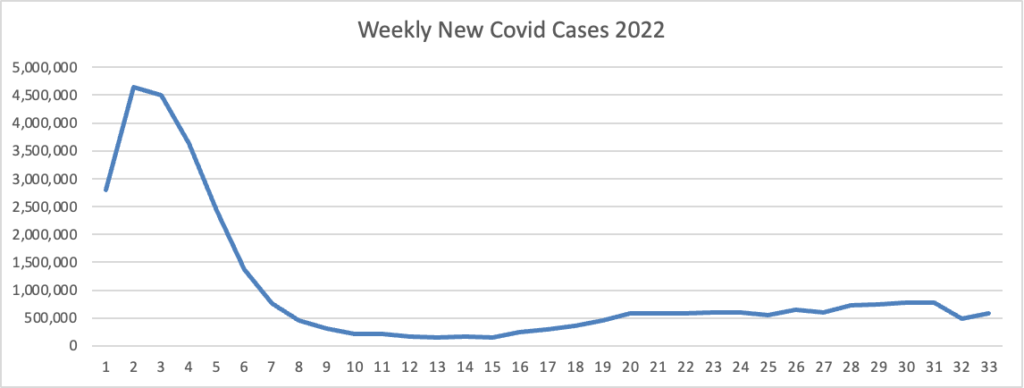
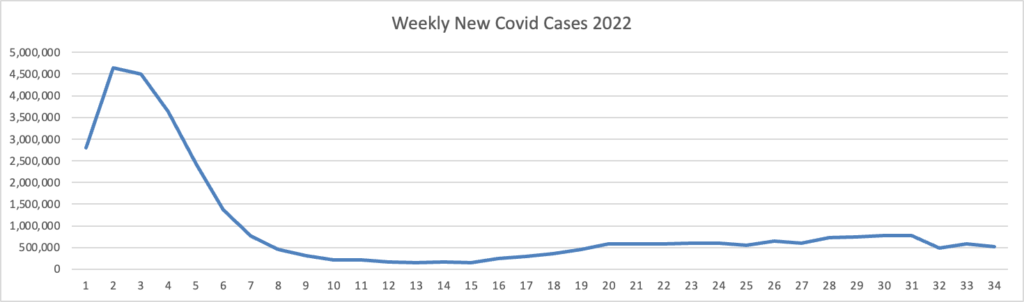
Based on the Centers for Disease Control’s Covid Data Tracker and using Thursday as the first day of the week, here is the FEHBlog’s latest weekly chart of new Covid cases for this year.

On the left side of the chart are the peak and downslope of the original Omincron strain, and what a peak it was. On the right side of the chart is the Omicron sibling’s plateau.

The CDC’s weekly review of its Covid statistics adds

As of August 24, 2022, the current 7-day moving average of daily new cases (90,676) decreased 6.7% compared with the previous 7-day moving average (97,184). * * *

CDC Nowcast projections* for the week ending August 27, 2022, estimate that the combined national proportion of lineages designated as Omicron will continue to be 100% with the predominant Omicron lineage being BA.5, projected at 88.7% (95% PI 87.3-89.8%).

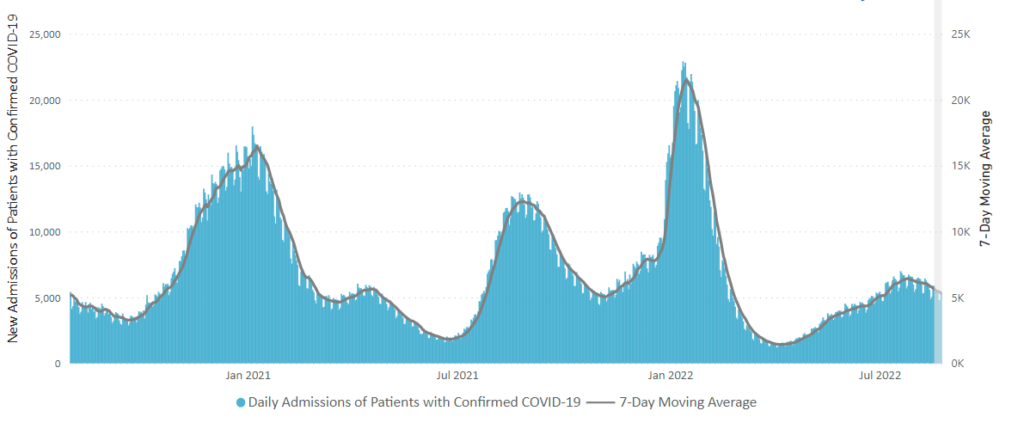
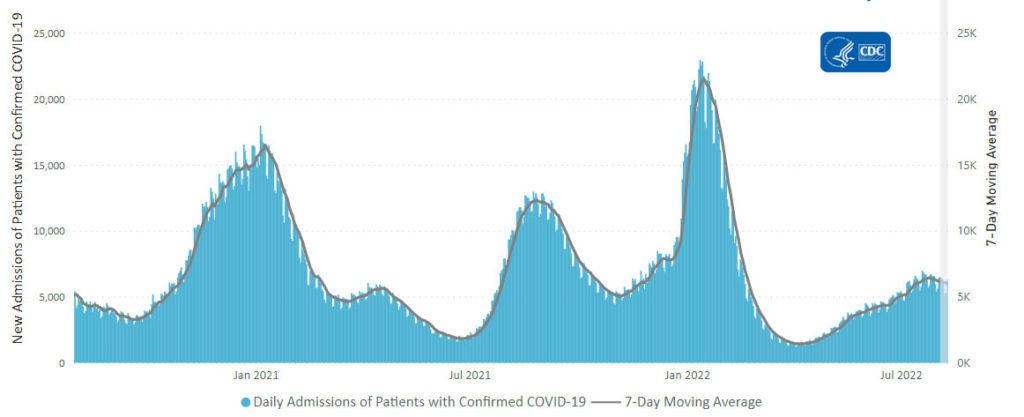
Here’s the CDC’s latest chart of daily trends in new Covid hospitalizations:

The CDC’s weekly review adds “The current 7-day daily average for August 17–23, 2022, was 5,314. This is a 6.6% decrease from the prior 7-day average (5,687) from August 10–16, 2022.” That converts to a very low percentage of new Covid cases.

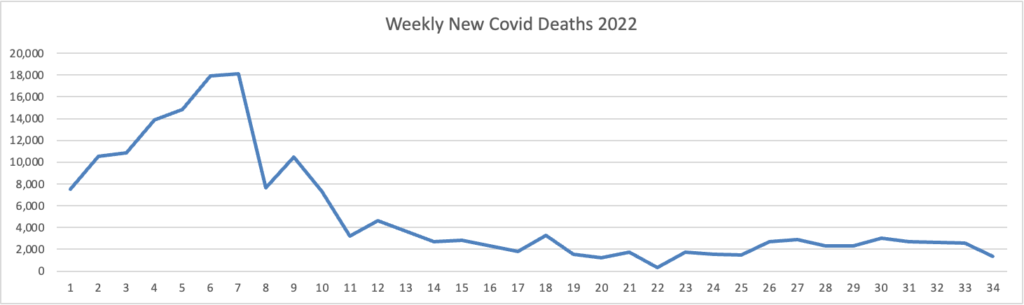
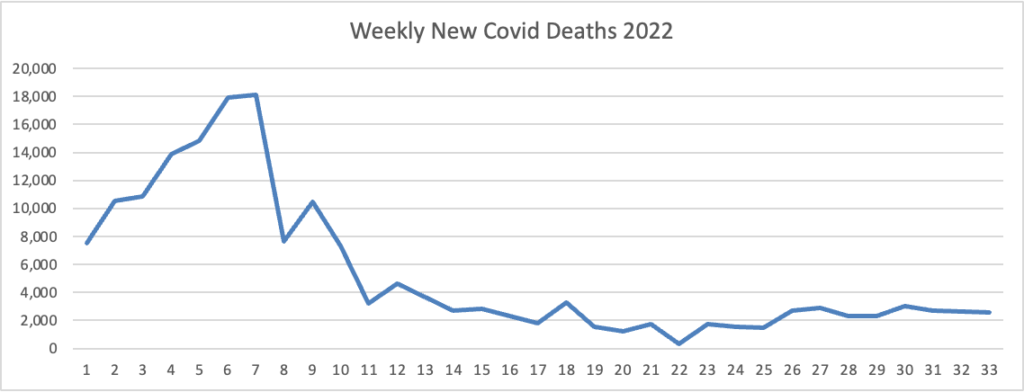
Here is the FEHBlog latest weekly chart of new Covid deaths for 2022:

Omicron is on the left, and Omicron’s siblings are on the right. The CDC’s weekly review adds “The current 7-day moving average of new deaths (390) has decreased 11.6% compared with the previous 7-day moving average (441).”

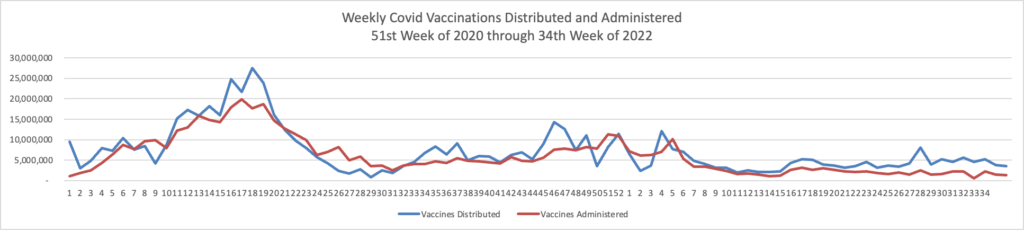
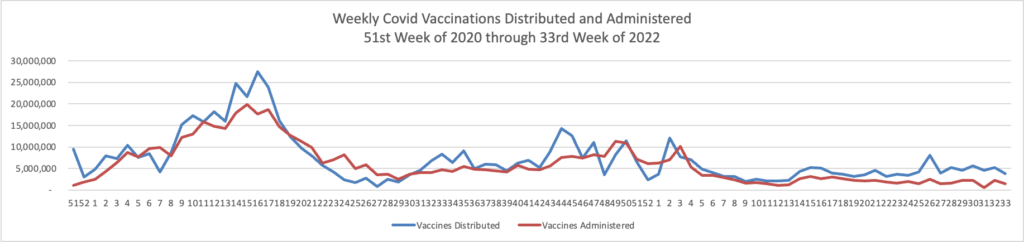
Contributing to the current low Covid death rate are the Covid vaccines, and here is the FEHBlog’s weekly chart of Covid vaccinations distributed and administered from the beginning of the Covid vaccination era in the 51st week of 2020 through the 34th week of 2022:

The CDC’s weekly review adds

As of August 24, 2022, 608.9 million vaccine doses have been administered in the United States. Overall, about 262.6 million people, or 79.1% of the total U.S. population, have received at least one dose of vaccine. About 223.9 million people, or 67.4% of the total U.S. population, have been fully vaccinated.

In other Covid news

  • Medscape reports “Long COVID Mimics Other Post-Viral Conditions.” That’s reassuring.
  • Medscape also tells us that a major weak spot on the Omicron variants which could lead to effective treatments.

In Covid-related legal news, STAT News informs us

It’s the stuff that headline writers’ dreams are made of: Moderna is suing Pfizer and BioNTech over their Covid vaccines.

As someone who has written dozens of catchy headlines about patent suits and read hundreds more, let me offer a bit of advice: Take several deep breaths. Most likely, this is less dramatic than it seems.

The reality of patent litigation in the pharmaceutical industry is that it proceeds at a glacial pace. And it rarely results in products being pulled from the market (Moderna isn’t even asking for that!) or for payments or royalties so significant that they dramatically change the profitability of a product. These lawsuits, though, can involve sums large enough that they make a financial difference to investors.

Time will tell.

From the monkeypox front, the New York Times reports

Monkeypox cases are declining in New York City and globally as more people get vaccinated and as they change their sexual behavior in response to the outbreak, health officials said this week.

New York City on Thursday reported that 2,885 monkeypox cases had been identified in the city since the first case in the city was identified in May. In mid-August, about 50 new monkeypox cases were being detected each day, a drop from the 70 or so new daily cases emerging in late July and early August, according to city data. * * *

Monkeypox infections are also declining in parts of California and in Europe, which at one point had 90 percent of the world’s cases. The World Health Organization on Thursday reported that monkeypox cases globally dropped 21 percent last week. But the overall trend masked rising cases in other parts of the world, including Latin America and Africa.

In New York, Dr. Vasan attributed the decline to the city’s efforts to get tens of thousands of people vaccinated; the city has administered 69,311 doses of the vaccine, according to city data.

In Medicare news, Fierce Healthcare tells us

More than 28 million people are in a Medicare Advantage (MA) plan in 2022, with the program accounting for nearly half of all Medicare beneficiaries, a new analysis finds. 

The analysis, released Thursday by the Kaiser Family Foundation, also showed how spending on MA, especially on quality bonuses, has surged to take up more than half of all federal Medicare spending. The findings underscore the widespread interest in the insurance industry on the MA marketplace, which has grown more lucrative in recent years. 

Kaiser found that the share of eligible Medicare beneficiaries who chose an MA plan has more than doubled since 2007, growing from 19% that year to 48% in 2022. An earlier projection from the Congressional Budget Office projected that the percentage of Medicare beneficiaries in MA will swell to 61% by 2032.

From the substance use disorder front, Health IT Analytics reports

A new study by Epic Research and the University of Maryland’s Center for Substance Abuse Research (CESAR) shows that only 5 percent of drug overdose patients admitted to the emergency department are tested for fentanyl and synthetic opioids, despite these drugs being the leading cause of death for Americans 18 to 45 years.

The Centers for Disease Control and Prevention (CDC) report that synthetic opioids are currently the main driver of drug overdose deaths, which increased by 31 percent from 2019 to 2020. Opioids were involved in 75 percent of all drug overdose deaths in 2020, and 82.3 percent of all opioid overdose deaths involved synthetic opioids.

That is confounding.

From the coding front, Becker’s Hospital CFO Review points out the top 10 states with the highest coding rates for social determinants of health diagnoses. The FEHBlog suspects that these states have the most reliable coders.

Thursday Miscellany

Photo by Josh Mills on Unsplash

From the omicron and siblings front, MedPage Today provides us with good news.

Older patients treated with nirmatrelvir boosted by ritonavir (Paxlovid) for COVID-19 had lower rates of hospitalization and death compared with those not treated with the antiviral during the Omicron wave, according to an observational retrospective cohort study from Israel.

Among patients ages 65 and older, the rate of hospitalization due to COVID was 14.7 cases per 100,000 person-days for the 2,484 patients who received nirmatrelvir compared with 58.9 cases per 100,000 person-days for the 40,337 untreated patients (adjusted HR 0.27, 95% CI 0.15-0.49), reported Ronen Arbel, PhD, of Clalit Health Services in Tel Aviv, and colleagues.

Death occurred in two nirmatrelvir-treated patients and in 158 untreated patients (aHR 0.21, 95% CI 0.05-0.82), they said in the New England Journal of Medicine.

Herd safety, indeed.

From the Rx research and development front, NBC News reports

Two doses of psilocybin pills, along with psychotherapy, helped people with alcohol use disorder reduce drinking for at least eight months after their first treatments, results from the largest clinical trial of its kind show. 

During the eight-month trial, 93 men and women ages 25 to 65 were chosen to receive either two psilocybin doses or antihistamine pills, which the researchers used as a placebo. They all also participated in 12 psychotherapy sessions.

All of the volunteers were averaging seven alcoholic drinks at a time before the trial. 

More than 80% of those who were given the psychedelic treatment had drastically reduced their drinking eight months after the study started, compared to just over 50% in the antihistamine control group, according to results published Wednesday in JAMA Psychiatry. At the end of the trial, half of those who received psilocybin had quit drinking altogether, compared to about one-quarter of those who were given the antihistamine.

STAT News reports

A vaccine Pfizer is developing protected older adults against the respiratory syncytial virus, or RSV, which is a common cause of hospitalization and death in the U.S., the company said Thursday.

The experimental vaccine, known as RSVpreF, is considered a key product in Pfizer’s pipeline of experimental drugs. Right now drug companies are close to launching several different products against RSV, focused on protecting both older adults and infants.

BioPharma Dive tells us

BioMarin, a California-based biotechnology company, said Wednesday that its gene therapy for hemophilia has been cleared for market by European regulators, marking a first-of-its-kind approval.

The therapy, known as Roctavian, was given conditional marketing authorization as a treatment for certain patients with hemophilia A, the more common version of the rare bleeding disorder. Specifically, Roctavian is to be used in adults with “severe” disease — hallmarked by exceedingly low levels of a blood-clotting protein called Factor VIII — who don’t have a history of developing antibodies that attack this protein.

With approval in hand, BioMarin is now working to secure reimbursement across the European Commission’s various member states. Jeff Ajer, the company’s chief commercial officer, said on a conference call Thursday that the plan is to immediately launch Roctavian in Germany, followed by France. The company expects Roctavian’s list price in Europe to be “around” 1.5 million euros, or roughly $1.5 million, net of all discounts, he said. 

Ajer added that BioMarin expects to disclose the specific European list price in October, a number that will be in-line but lower than the comparable net price in the U.S.

From the mental healthcare front —

Fierce Healthcare tells us

Employers view long-term mental health as the key healthcare issue coming out of COVID-19, according to a new survey.

Nearly half (44%) of employers surveyed by the Business Group on Health said they have seen this trend in their workforces, and another 44% expect to see worsening mental health in the future. Most (85%) said they anticipate enhanced mental health benefits launched under the pandemic to continue.

Mental health conditions also ranked sixth on the survey’s list of conditions driving healthcare costs, with 17% of those surveyed saying it was a major driver. This is a marked increase from 9% in 2020 and 14% in 2021.

Brenna Shebel, vice president of the Business Group on Health, said during a briefing with reports Tuesday that many employers are tackling mental health challenges “at all different angles.”

Forbes adds

AHIP, which stands for America’s Health Insurance Plans, issued a statement and “advocacy vision” at a time its member health plans are looking beyond paying and coordinating just medical care but also integrating behavioral health care into benefit plans for their government, commercial and employer clients. * * * Further details of the policy proposals and commitments can be found here.

From the U.S. healthcare business front, we learn about financial results for two health systems involved with the FEHB Program.

Becker’s Hospital Review reports that ” Intermountain Healthcare [based in Utah and serves surrounding states] saw its revenues increase in the first half of this year, and its merger with SCL Health fueled a significant increase in net income, according to recently released financial documents. The financial documents are the first Intermountain has filed since completing a merger with Broomfield, Colo.-based SCL Health in April. 

Beckers Hospital CFO Report tells us, “UPMC reported higher revenue in the first half of this year than in the same period of 2021, but the Pittsburgh-based health system’s operating income declined year over year, according to financial documents released Aug. 23. * * * “Throughout 2022, the continued effect of COVID-19, along with conditions in the labor and supply markets have resulted in cost growth in employment, staffing and other operating expenses in excess of revenue growth,” UPMC management wrote in the financial filing.”

Finally STAT News delves into why so many large healthcare companies are interested in Signify Health. Quite simply,

The bidding war over Signify Health — a health technology business that could fetch multibillion-dollar offers from Amazon, CVS, and UnitedHealth Group — is not about its dazzling software or a blockbuster AI algorithm.

The crush of corporate interest, experts said, stems from something much bigger: the opportunity to move medical services back into the home. In-home care is quickly becoming the biggest battlefield in America’s biggest business, with a huge array of companies seeking to move health care outside the institutional walls that have confined it for much of the last century.

Signify Health is among those at the forefront of the quest. The Texas-based company, founded in 2017 as the result of a merger, has built its business around delivering highly detailed assessments of patients by visiting with them in their bedrooms and living rooms, creating better visibility — and clearer data — about their lives and health status.

Midweek Update

Photo by Manasvita S on Unsplash

From the Omicron and unusual viruses front —

BioPharma Dive reports

Moderna has joined Pfizer in asking the Food and Drug Administration for emergency authorization of a new COVID-19 booster shot adapted to the virus strains now dominant in the U.S.

The biotech’s reformulated shot targets both the original coronavirus strain and the BA.4/BA.5 omicron subvariants. BA.5 now accounts for almost 90% of cases in the U.S., with versions of BA.4 making up almost all of the rest, according to estimates from the Centers for Disease Control and Prevention.

Moderna and Pfizer have been working closely with the FDA to design boosters that can better fend off COVID-19, particularly as immunity wanes in people who were last vaccinated many months ago. On Monday, Pfizer announced it had finished its application. Moderna followed a day later.

The Wall Street Journal discusses monkeypox’s symptoms, vaccines and how it spreads:

[I]nfectious-disease experts say patterns of transmission in this outbreak have been consistent with the need for close contact, rather than airborne spread. If the virus could easily spread through airborne transmission, they say many more cases outside the LGBT community would be expected. * * *

Most monkeypox cases in the U.S. have been mild, though some patients have experienced moderate to severe disease with symptoms such as extreme pain and high fevers and have had to be hospitalized. * * *

Most monkeypox cases in the U.S. and globally have, to date, been among men who have sex with men. The CDC released data finding the outbreak is concentrated among men who have had sex with several men. Public-health experts say the current risk to the general population is low.

“At this moment in terms of acquiring monkeypox, I wouldn’t change my behavior,” said Dr. Chin-Hong, noting that the calculation would be markedly different for someone in an at-risk group.

Though a handful of children in the U.S. have contracted monkeypox, infectious-disease experts say the risk to most children is very low.

In other public health news

  • Becker’s Payer Issues tells us “Cancer has overtaken musculoskeletal conditions as large employers’ biggest driver of healthcare costs, according to Business Group on Health’s ‘2023 Large Employers’ Health Care Strategy and Plan Design Survey.’ Business Group on Health surveyed 135 employers across various sectors that together cover more than 18 million people between May 31 and July 13, according to the August 23 report.”
  • Becker’s Hospital Review ranks the states by average life expectancy.

In judicial news —

  • The FEHBlog checked the court docket in the Change Healthcare antitrust case today, and he discovered that the defense rested in the bench trial on August 15, and the Court has scheduled closing arguments for September 8. The bench trial, in this case, pending in the U.S. District Court for the District of Columbia, began on August 1.
  • The Wall Street Journal reports this evening.

A federal judge blocked Idaho from enforcing its near-total abortion ban in certain emergency situations, an early victory for the Justice Department in a case it filed this month.

U.S. District Judge B. Lynn Winmill on Wednesday issued a preliminary injunction that prevents the state from enforcing its ban in emergency circumstances where doctors and hospitals deem an abortion is necessary to avoid placing the health of a pregnant patient in serious jeopardy. * * *

The ruling was one of two initial tests for Biden administration efforts to require abortion access for emergencies in states that have moved to heavily restrict the procedure. A separate ruling from Texas, issued late Tuesday, went against the administration.

In that case, a federal judge in Lubbock ruled that hospitals and doctors for now aren’t required to abide by the administration’s guidance requiring emergency abortion care.

The next stop is the federal appellate courts in both cases.

In U.S. healthcare business news —

Fierce Healthcare informs us

Three years after it began piloting a primary care service for its employees that blended telehealth and in-person medical services, Amazon plans to cease operations of its Amazon Care service.

Amazon announced Wednesday afternoon that it would end Amazon Care operations after December 31. In an email to Amazon Health Services employees, Neil Lindsay, senior vice president of Amazon Health Services, said Amazon Care wasn’t a sustainable, long-term solution for its enterprise customers.

Amazon provided a copy of the email to Fierce Healthcare.

The decision only impacts Amazon Care and Care Medical teams and not Amazon’s other healthcare services. 

CEO Andy Jassy has made health care a priority, naming Amazon Care as an example of “iterative innovation” in his first letter to shareholders earlier this year. In July, the company announced plans to buy concierge primary care provider One Medical in a deal valued at approximately $3.9 billion.

If the One Medical deal goes through, it would significantly expand Amazon’s foothold in the nearly $4 trillion healthcare market, specifically in the competitive primary care market.

One Medical markets itself as a membership-based, tech-integrated, consumer-focused primary care platform. The company operates 188 offices in 29 markets. At the end of March, One Medical had 767,000 members.

The deal also gives Amazon rapid access to the lucrative employer market as One Medical works with 8,000 companies.

This news suggests to the FEHBlog that Amazon is confident that the One Medical acquisition will close.

Kaiser Health News offers an enlightening story on unregulated dietary supplements.

Dietary supplements, which include a broad range of vitamins, herbs, and minerals, are regulated by the FDA. However, they are classified as food and don’t undergo the rigorous scientific and safety testing the government requires of prescription drugs and over-the-counter medicines.

Lawmakers aren’t proposing to put supplements into the same category as pharmaceuticals, but some say they are alarmed that neither the FDA nor the industry knows how many dietary supplements are out there — making it almost impossible for the government to oversee them and punish bad actors.

The FDA estimates 40,000 to 80,000 supplement products are on the market in the U.S., and industry surveys estimate 80% of Americans use them.

Tuesday Tidbits

Photo by Patrick Fore on Unsplash

From the Omicron and siblings front, the Wall Street Journal reports

The Biden administration has completed plans for a fall Covid-19 booster campaign that would launch in September with 175 million updated vaccine doses provided to states, pharmacies and other vaccination sites.

The administration is procuring the doses, which drugmakers are updating to target the newest versions of the virus. The administration has also informed states, pharmacies and other entities they can begin preordering now through the end of August, according to the administration’s fall vaccination planning guide.

Vaccines would be shipped immediately following an expected authorization by federal drug regulators, who still must review and sign off on the shots, and recommendations from the Centers for Disease Control and Prevention, which still must review the data and sign off on administering the shots. 

Administration officials have expressed hope that the boosters would help head off a wave of serious illnesses and deaths in the fall and winter, when cases often increase as more people gather indoors.

Due to the 2021-22 Delta and original Omicron variants, I gave up on expecting herd immunity from Covid. However, MedPage Today points out that those perilous Covid surges combined with vaccinations and treatments like Paxlovid create herd safety from hospitalizations and deaths. We should build up vaccination levels, but the vaccination marketing campaign should be built on a sensible theory like herd safety and not on 2020-like hysteria.

From the No Surprises Act front, Fierce Healthcare offers provider and payer opinions on the final independent dispute resolution rule. Last Spring, CMS dethroned the Qualifying Payment Amount from its commanding position in the baseball arbitration process. That aspect of the final rule is not a change in current practice. The FEHBlog senses that the No Surprises Act is working well.

Today, the Office of Personnel Management posted its first FAQs on the Postal Service Health Benefits Program which will launch in January 2025.

From the medical research front, BioPharma Dive reports

Over the last decade, drugs based on multiple RNA technologies, known as RNA interference and antisense oligonucleotides, have made it to market. Yet, it took a historic pandemic to thrust RNA into the global spotlight. Equipped with new tools, scientists are now exploring how other types can be used to make therapies that last longer and treat, as well as prevent, more diseases.

At least 10 biotechnology startups are developing next-generation RNA drugs. Though years of research lie ahead, these companies have already raised hundreds of millions of dollars from venture capitalists, large pharmaceutical firms and other investment groups.

If their work pans out, it could provide new treatments for cancer, rare diseases, and chronic illnesses that affect organs, the nervous system and the immune system.

The article provides an overview of these RNA drug development efforts.

From the tidbits department —

  • MedPage Today reports that “For higher-risk adults without prior cardiovascular disease (CVD) events, the U.S. Preventive Services Task Force (USPSTF) continues to broadly recommend statins for primary prevention while differing from other American guidelines in certain key aspects. * * * Despite being consistent with the USPSTF’s 2016 recommendations on the subject, the latest update takes away language about the preferred low-to-moderate dosing of statins in people with no history of CVD. This could be attributed to a lack of data, as a review of the literature showed most statin trials tested a moderate-intensity statin.”
  • Axios reports “Life expectancy in the U.S. fell in all 50 states and the District of Columbia from 2019 to 2020 and fell nationally by 1.8 years, according to new Centers for Disease Control and Prevention data published Tuesday. The big picture: The decline nationally and in states was mostly due to the COVID-19 pandemic and increases in unintentional injuries, specifically drug overdose deaths.
  • The National Institutes of Health announced that “Poverty, combined with other types of adversity in early childhood, is associated with greater chances of premature death in adulthood, compared to other adverse childhood experiences, according to a study of more than 46,000 people by researchers at the National Institutes of Health.”
  • The NIH Director’s Blog features a fascinating description of the inside of the “amazing” human brain.
  • The HHS Office of Civil Rights reached a settlement with dermatology practice over an alleged HIPAA Privacy Rule violation for improper disposal of protected health information.

Monday Roundup

Photo by Sven Read on Unsplash

From the Omicron and unusual viruses front —

STAT News reports

Pfizer and BioNTech said Monday that they have asked the Food and Drug Administration to authorize a new booster shot targeted at the Omicron BA.4/BA.5 strain of the coronavirus that causes Covid-19, the first step in a process that could lead to more effective booster shots.

Notably, in the same press release, the companies said that a clinical study investigating the safety, tolerability, and immunogenicity of the vaccine, which also includes the original Covid strain, is expected to start this month, meaning data would not be available for the FDA to consider.

The application to authorize the vaccine without new clinical trial data is part of a bold and potentially controversial gambit by the U.S. and its advisers to try and get ahead of the fast-mutating coronavirus, SARS-CoV-2. But it’s one that could also have a big payoff.

The Pharmacy Times tells us

Officials with the FDA have granted an expanded Emergency Use Authorization (EUA) to Novavax for its COVID-19 vaccine, adjuvanted for adolescents 12 through 17 years of age, according to a press release. The announcement marks the first protein-based COVID-19 vaccine authorized in the United States for this patient population.

The expanded EUA allows for a 2-dose primary series for active immunization to prevent COVID-19 caused by SARS-CoV-2 in adolescents. Doses are now available and primary series immunizations for adolescents can begin once the CDC releases a policy recommendation.

Will the next Novovax approval from the FDA be for a booster?

Medpage Today points to a study suggesting a connection between myocarditis in children and long Covid.

The Wall Street Journal adds

Officials in New York are urging pediatricians and parents to bring patients up to date on polio shots, as evidence suggests the infectious and potentially debilitating poliovirus was present in the state as early as April. 

Health officials said they have sent alerts to healthcare providers, hung fliers in houses of worship, grocery stores and summer camps, and talked with community leaders to boost polio vaccination rates in the greater New York City area. Some places including Rockland and Orange counties have polio vaccination rates around 60% among eligible children, compared with a national rate of around 93%, according to federal data. 

Polio is particularly insidious, health officials and other public-health experts said, because the majority of cases occur in people who never develop symptoms but can still spread the virus. That silent spread can cause meningitis or paralysis in someone unvaccinated against the disease. 

In other public health news, STAT News informs us

Anthony Fauci, the top U.S. infectious diseases official for decades and a leading researcher on crises from HIV to Covid-19, announced Monday that he would be stepping down from his positions in December.

Fauci, 81, has led the National Institute of Allergy and Infectious Diseases for 38 years, serving a line of presidents from both parties since the Reagan administration. He has also served as President Biden’s chief medical adviser since Biden took office. While Fauci has telegraphed that he was planning on leaving those roles in a matter of months, Monday’s announcement makes it official.

But Fauci, known as a tireless workhorse, said he would not be retiring. “After more than 50 years of government service, I plan to pursue the next phase of my career while I still have so much energy and passion for my field,” he said. “I want to use what I have learned as NIAID Director to continue to advance science and public health and to inspire and mentor the next generation of scientific leaders as they help prepare the world to face future infectious disease threats.”

From the U.S. healthcare business front, Bloomberg reports

Signify Health Inc. soared the most since its shares started trading last year as UnitedHealth Group Inc.Amazon.com Inc.CVS Health Corp. and Option Care Health Inc. competed to acquire the home-health technology and services provider, according to people familiar with the matter. 

UnitedHealth has submitted the highest bid in excess of $30 a share, while Amazon’s offer is close behind, the people said, asking not to be identified as the discussions are private. Signify is holding a board meeting Monday to discuss the bids, the people said. * * *

Final bids are expected Sept. 6, but a deal could come earlier if any of the parties preempt the sales process, the people said.  * * *

Through its software and services, Signify aims to help clients — payers like health plans, government programs and employers — shift to value-based payment plans. It’s backed by private equity firm New Mountain Capital, which formed the company in 2017, according to the firm’s website. 

That is quite a big business rumble.

From the No Surprises Act front, Prof. Katie Keith and her colleagues wrote two articles on last Friday’s “final, final” independent dispute resolution rule — one concerns its impact on IDR arbitrations and the other on miscellaneous topics.

From the mental healthcare front, Health Payer Intelligence lets us know that “Payers are working toward achieving broader access to mental healthcare and behavioral healthcare services by reimbursing at higher rates and supporting primary care” according to a recent AHIP survey.

Nearly eight in ten health plans had boosted behavioral healthcare workers’ reimbursement rates (78 percent). Additionally, 83 percent of payers had attracted and retained a diverse population of behavioral healthcare providers.

Substance abuse care is becoming more accessible, the survey found. Specifically, more providers have become eligible to offer medication-assisted therapy (MAT). This population has expended 114 percent over the course of three years.

Nearly three-quarters of health plans (72 percent) support behavioral healthcare training for primary care providers. The same share supported primary care providers by helping them find behavioral healthcare specialist referral partners.

Payers have also offered primary care providers the opportunity to call behavioral healthcare specialists via telehealth or telephone in order to consult them on a patient’s condition. More than half of the health plans (56 percent) provide this option. This method has been used in pediatric psychiatry to solve members’ challenges in connecting with specialists.

Health plans reported a couple of main ways that they try to connect members with mental healthcare services. Many plans do this by supporting patient navigation (83 percent). For example, health plans might connect members with community-based organizations that can address their social determinants of health needs. 

Additionally, more than eight in ten health plans said they help members secure behavioral healthcare visits. Follow-up on inpatient care and emergency room visits is often part of health plans’ efforts to connect members with mental health services as well. Seventy-eight percent of the plans leveraged specialized case managers to perform this function.

From the medical research and development front —

Biopharma Dive informs us

Gilead’s long-acting HIV shot Sunlenca is now cleared for sale in Europe, marking the first marketing authorization for a treatment the California biotechnology company hopes can be used broadly as a standard therapy and preventive regimen.

The decision by the European Commission, announced Monday, authorizes Sunlenca for patients whose current treatment regimen can no longer keep their infection at bay. Sunlenca, previously called lenacapavir, will be added to other antiviral drugs to boost patients’ immune response and reduce levels of virus in the body.

Gilead is still waiting on a regulatory decision in the U.S., where it has been delayed by manufacturing issues. An approval by the Food and Drug Administration’s December deadline could put the drug on track to reach sales that RBC Capital Markets analysts estimate will climb as high as $4 billion a year.

The Wall Street Journal reports

Zapping the brain with weak electrical currents that mimic normal neural activity can boost memory in healthy older adults, at least over the short term, researchers said in a study published Monday in the journal Nature Neuroscience.

Electrical stimulation of the brain as a potential tool for enhancing memory is a growing field of research, with experiments showing that the ability to recall memories depends upon synchronized activity between different brain regions.

The new research, conducted on people over age 65, “adds to the growing evidence that noninvasive stimulation mimicking the rhythmic brain activity that supports cognition can improve memory” in this population, said Joel Voss, a University of Chicago professor of neurology who wasn’t involved in the research.

Weekend update

Thanks to Aaron Burden for sharing their work on Unsplash.

Congress is on a State / District work break again this week.

The FEHBlog performed his weekly review of the FEHBlog this weekend, and he discovered that last Friday’s post on the new No Surprises Act regulation duplicated the closing paragraph. Lo Siento. The missing paragraph concerned the ACA regulators’ 28-page long ACA FAQ 55 on those new rules.

Several of the FAQs reiterate information from the interim final rules issued in July and October 2021. (Reiteration can a helpful teaching tool.) The FAQs which caught the FEHBlog’s eye were FAQs 5, 8, 10, 13, 14, 15, 17, and 19 (quite important). The last two FAQs 23 and 23 concern the transparency in coverage rule. All of these FAQs are relevant to FEHB plans.

Here’s a link to a Fierce Healthcare article on the new rules.

From the omicron and unusual viruses front —

The Wall Street Journal reports

The U.K. last week became the first country to clear a modified Covid-19 vaccine targeting the Omicron variant, and other countries including Canada and Australia might soon follow.

But in the U.S., modified Covid-19 booster shots are unlikely to be cleared for several more weeks because health authorities decided in late June they wanted modified vaccines to target different Omicron subvariants than those rolling out in other countries.

As a result, the makers of the leading Covid-19 vaccines—Moderna Inc. and Pfizer Inc. with its partner BioNTech SE—got a later start producing the new shots that are planned for the U.S. 

This posed logistical challenges because companies needed to secure different starter material and switch over production lines. Now they are racing to manufacture tens of millions of retooled vaccines that could be used in a fall booster campaign, one that could start in September or October.

The modified vaccines could become available by mid-September, Ashish Jha, the White House Covid-19 response coordinator, said Thursday during an online presentation hosted by the U.S. Chamber of Commerce. 

The effort is a new test of the plug-and-play potential of the gene-based, messenger RNA technology used in the shots from Pfizer and Moderna.

Fingers crossed.

On Friday, the U.S. Office of Personnel Management distributed this FEHB Carrier Letter about long Covid. Today, MedPage Today offers an expert medical interview about the immune signature of that disease.

NPR Shots and Wall Street Journal columnist Allysia Finley discuss the Biden Administration’s problems in dealing with the monkeypox virus. Ms. Finley notes

Monkeypox, first identified in lab animals in 1958, is a close relative of smallpox, though it is less lethal and contagious. Periodic outbreaks have occurred in Central and West Africa, where the virus is endemic and spreads among wild animals. Humans can catch it through direct contact with the skin lesions of an infected animal or person.

A small U.S. outbreak in 2003 was linked to rodents imported from Ghana by an exotic pet dealer. The virus infected 71 Americans but was quickly contained with the help of the smallpox vaccine. No one died.

The outbreak, coupled with growing concerns about bioterrorism, prompted Washington to seek a safer, more effective vaccine against smallpox and monkeypox. 

The federal government reserved over 1 million frozen doses of the preferred smallpox vaccine stored in Denmark but the manufacturer could not start delivering them until after the Food and Drug Administration finished a review of the Danish facility in late July. That delay resulted in the problem discussed in NPR Shots.

The Wall Street Journal offers articles on “What to Know About Polio Symptoms, Vaccines and the Virus’s Spread in New York” and “Am I Protected Against Polio? Here’s What to Know About the Vaccine.”

From the Rx coverage front, BioPharma Dive reports

The Food and Drug Administration on Friday approved a new depression drug from Axsome Therapeutics, one year after putting the treatment in regulatory limbo.

The regulator cleared Axsome’s treatment, an oral drug to be sold as Auvelity, for adults with major depressive disorder. Axsome expects to begin selling the drug in the U.S. in the fourth quarter.

Auvelity consists of bupropion, the active ingredient in GSK’s depression drug Wellbutrin, and dextromethorphan, which is best known for its use as a cough medicine. The dextromethorphan acts on a neurotransmitter, NMDA, that controls mood, while bupropion boosts the amount of dextromethorphan available in the body.

Together, the two components are meant to produce an antidepressant effect faster than standard treatments, which can take weeks or months to show an impact.

STAT News adds

Auvelity * * * is the first pill of its kind approved for major depressive disorder. Spravato, a nasal spray marketed by Johnson & Johnson and approved in 2019, works similarly.

Axsome did not immediately disclose how much Auvelity will cost, saying on a conference call with analysts that it expects to announce a price in the coming weeks. The company will set a price “that ensures broad access for patients and that takes into account the value supported by the innovation Auvelity brings to patients with MDD,” Axsome Executive Vice President Lori Englebert said.

From the U.S. healthcare business front, the Wall Street Journal reports

Amazon.com Inc. is among the bidders for healthcare company Signify Health Inc., joining other heavy hitters vying in an auction for the home-health services provider, according to people familiar with the matter.

Signify is for sale in an auction that could value it at more than $8 billion, the people said. Bids are due around Labor Day, according to people, but it is always possible an eager bidder could strike a deal before then.

CVS Health Corp. is also among the suitors, The Wall Street Journal previously reported, as the drugstore and insurance giant looks to expand in home-health services. UnitedHealth Group Inc. and another corporate buyer are also circling the company, according to the people.

There is no guarantee any of them will reach a deal for Signify, which has been exploring strategic alternatives. The healthcare company has a market value of roughly $5 billion, boosted since the Journal first reported on the possibility of a deal early this month.

From the miscellany front

  • Fortune Well informs us “A global study published this week in The Lancet assessed 34 risk factors for cancer, and found that “modifiable risk factors” accounted for 44.4% of all cancer deaths in 2019—and 42% of disability-adjusted life years (DALYS), defined as the combination of years lost from disability and from premature mortality, according to the World Health Organization.  The highest risk factors globally were largely behavioral, including smoking, followed by alcohol use, then high body-mass-index (BMI). Risk factors varied by region, and for areas with a low socio-demographic index (SDI) alcohol, unsafe sex, and smoking were the most common risk factors attributed to cancer DALYS.”
  • Health Payer Intelligence points out that “Elevance Health, Aetna, and Cigna health plans have launched various social determinants of health initiatives to improve members’ quality of care.”

Friday Stats and More

Based on the Centers for Disease Control’s (“CDC”) Covid Data Tracker and using Thursday as the first day of the week, here is the FEHBlog’s latest weekly chart of new Covid cases for 2022.

Omicron reigned from before Week 1 through Week 15. Its siblings began to take over in week 15 and still reign.

The CDC’s weekly review of its Covid statistics adds

As of August 17, 2022, the current 7-day moving average of daily new cases (95,652) decreased 9.9% compared with the previous 7-day moving average (106,116).

CDC Nowcast projections* for the week ending August 20, 2022, estimate that the combined national proportion of lineages designated as Omicron will continue to be 100% with the predominant Omicron lineage being BA.5, projected at 88.9% (95% PI 87.6-90.1%).

Here’s the CDC’s latest daily trends chart of new Covid admissions

The CDC’s weekly review adds, “The current 7-day daily average for August 10–16, 2022, was 5,690. This is a 6.1% decrease from the prior 7-day average (6,059) from August 3–9, 2022.”

Here is the FEHBlog’s weekly chart of new Covid deaths, which like new Covid cases, has plateaued for months but is trending down somewhat.

The CDC’s weekly review adds, “The current 7-day moving average of new deaths (394) has decreased 10.7% compared with the previous 7-day moving average (442).”

Here is the FEHBlog’s weekly chart of Covid vaccinations distributed and administered over the Covid vaccination era, which began in the 51st week of 2022.

The CDC’s weekly review adds,

As of August 17, 2022, 607.6 million vaccine doses have been administered in the United States. Overall, about 262.3 million people, or 79.0% of the total U.S. population, have received at least one dose of vaccine. About 223.7 million people, or 67.4% of the total U.S. population, have been fully vaccinated.

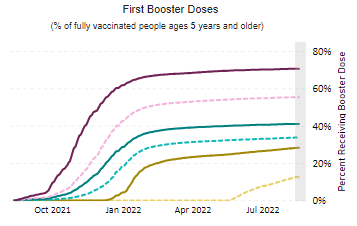
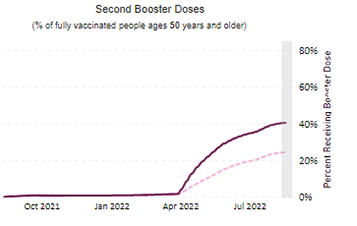
The CDC’s weekly chart includes this charts on the administration of the first and second boosters:

Medpage Today offers Physicians Address Parents’ Concerns on COVID Vaccines in Young Kids, and the New York Times provides expert medical opinions on whether to delay the fourth dose of vaccine for the bivalent vaccine in the fall.

To sum up, the CDC’s weekly review leads off with a discussion of how to stay safe from Covid in school and reminds us the check the Communities tracker, which honestly has not turned out to be that informative in the aggregate:

To check your COVID-19 Community Level, visit COVID Data Tracker. To learn which prevention measures are recommended based on your COVID-19 Community Level, visit COVID-19 Community Level and COVID-19 Prevention.

Friday’s big, late-breaking news is the Affordable Care Act’s regulators’ release of the final No Surprises Act Independent Dispute Resolution rule following provider and court objections to the interim final rule with comments.

The departments continue to work to implement and put into effect the Jan. 1, 2022, consumer protection law to help curb surprise billing for medical care. Today’s final rules will make certain medical claims payment processes more transparent for providers and clarify the process for providers and health insurance companies to resolve their disputes. * * *

In addition to issuing the final rules, the departments are issuing [28 pages of Frequently Asked Questions Part 55 with guidance on implementing the requirements of the No Surprises Act, including those related to surprise billing protections, open negotiation and the federal IDR process.

Also available:

Thursday Miscellany

Photo by Josh Mills on Unsplash

From Capitol Hill, Federal News Network identifies five federal workforce items on Congress’s to-do list.

From the omicron and siblings front, the Wall Street Journal reports

The Biden administration is planning for an end to its practice of paying for Covid-19 shots and treatments, shifting more control of pricing and coverage to the healthcare industry in ways that could generate sales for companies—and costs for consumers—for years to come. * * *

Shifting payments for Covid-19 drugs and vaccines to the commercial market is expected to take months, an HHS spokesman said.  * * *

Switching vaccine purchasing to the commercial market would mean that each insurer and pharmacy benefit manager would be negotiating with drug manufacturers and prices would likely be higher than what the federal government has paid, said Larry Levitt, executive vice president for health policy at the Kaiser Family Foundation. Insurers would have to start paying for the vaccines, he said, likely raising premiums.

MedPage Today informs us

More than 2 years after patients started reporting long-lasting symptoms after acute SARS-CoV-2 infection, the U.S. announced its national long COVID plan.

The National Research Action Plan on Long COVID aims to improve prevention, diagnosis, and treatment for long COVID, which currently affects up to 23 million people in the U.S., about 1 million of whom may be out of the workforce at any given time because of the condition, according to Admiral Rachel Levine, MD, HHS assistant secretary for health. * * *

Long COVID advocates expressed mixed opinions. Hannah Davis, co-founder of the Patient-Led Research Collaborative, noted the fact that “there’s going to be an [Office of Long COVID Research and Practice] is pretty amazing.”

But Davis voiced concerns about the scarcity of prevention efforts addressed by the plan. “I think there’s still a feeling like we can get through this without minimizing cases, but we really need to be focused on prevention as well,” she said.

Diana Berrent, founder of Survivor Corps, told MedPage Today that the administration “nailed the institutional challenge of long COVID” but also thought the plan was insufficient.

“Millions of Americans, young and old, are suffering the aftermath of COVID and need immediate relief from their pain,” Berrent said. “An established office in HHS is a welcome step but nothing short of actual treatments and therapeutics will do the trick.”

From the monkeypox front, Becker’s Hospital Review provides a state-by-state breakdown of monkeypox cases, and MedPage Today reports

The Biden administration is making an additional 1.8 million doses of the Jynneos monkeypox vaccine available beginning Monday, and will be targeting certain large events — such as gay pride marches that attract many LGBTQIA participants — as sites for monkeypox vaccination and outreach, administration officials said Thursday.

From the healthcare costs front, Healthcare Dive reports

U.S. employers will pay 6.5% more on average for employee healthcare coverage in 2023 compared to this year, according to an Aon report out Thursday.

The latest predicted rise, while a jump from the 3.7% growth in employer costs between 2021 and 2022, is still far below the 9.1% Consumer Price Index, a figure reflecting inflation. 

Inflation typically hits healthcare costs later than other goods and services due to the multi-year nature of contracts between providers and insurers, but impacts will become more prevalent over the year, according to the report.

Speaking of higher costs, Fierce Healthcare discusses Moody’s report on how an economic downturn would impact health plans.

From the post-Dobbs front, the FEHBlog ran across this Congressional Research Service FAQs on Federal Resources for Reproductive Health.

From the No Surprises Act front, the American Hospital Association informs us “The Centers for Medicare & Medicaid Services has launched a new webpage with resources and guidance related to the dispute resolution process under the No Surprises Act, including guidance for disputing parties and a walkthrough of the federal portal. CMS also has added functionality to the portal for initiating disputes, including a button to upload supporting documents at initiation.”

From the miscellany department —

  • Fierce Healthcare discusses J.D. Powers’ annual study of Medicare Advantage plans. “[T]he analysts found members’ general satisfaction is up from 2021 and is higher than satisfaction reported by people in employer-sponsored plans. However, while members said they’re happy with access to preventive and routine care, coverage of mental health and substance abuse treatment is lacking.”
  • STAT News calls our attention to “a new Pew-funded report, by researchers at George Washington University, the federal government can expand methadone access without approval from Congress.” According to the article, “When it comes to fighting opioid addiction, there’s no tool more effective than methadone. Doctors have been prescribing the drug since the 1960s, and patients who use it are far less likely to experience an overdose.”