
Weekend update

Weekend update

In commemoration of the President’s Day holiday tomorrow, Congress is on a local work break this week and will be back in session on February 28.

From the Omicron front, the New York Times offers an interactive article seeking to uncover the mysteries of “Long Covid.”

The accuracy of Bloomberg’s welcome report on the growing availability of Pfizer’s Paxlovid and Merck’s molnupiravir Covid pills is evidenced by the Wall Street Journal’s report that pharmacists are demanding more money to dispense those pills. Why?

Pharmacists say Paxlovid and molnupiravir prescriptions typically take more than 30 minutes to fill, longer than other drugs. They say they must often gather the medical history of new customers and then make sure they aren’t taking any other drugs that the Covid-19 pills can’t be used with safely.

Pharmacists also say they have to spend substantial time counseling patients on taking the pills.

Here’s where it stands.

The National Community Pharmacists Association trade group has urged the Centers for Medicare and Medicaid Services to recommend a fee similar to the $40 that Medicare pays pharmacies administering Covid-19 vaccines.

The National Association of Chain Drug Stores, which represents pharmacies including Kroger Co. and Walgreens Boots Alliance Inc., also supports a CMS recommendation, though it isn’t specifying an amount. The figure could help pressure all commercial and government health plans to increase how much they are paying, said Sara Roszak, senior vice president for health and wellness strategy and policy for the industry group.

Benefit managers will likely revise fees, but are looking for the government to provide more direction on what the fees should be, said JC Scott, chief executive of the Pharmaceutical Care Management Association, the trade group for pharmacy-benefit managers.

The Wall Street Journal also reports

U.S. health regulators are looking at potentially authorizing a fourth dose of a Covid-19 vaccine in the fall, according to people familiar with the matter. 

The planning is still in early stages, and authorization would depend on ongoing studies establishing that a fourth dose would shore up people’s molecular defenses that waned after their first booster and reduce their risk of symptomatic and severe disease, the people said.

The Food and Drug Administration, however, has begun reviewing data so it can make a decision, the people said.

The thinking among regulators is that the agency would look at authorizing a second booster dose of the messenger RNA vaccines from Pfizer Inc. and partner BioNTech SE and from Moderna Inc., one of the people said.

Among the issues that need to be resolved, the person said, are whether the second booster should be authorized for all adults or particular age groups, and whether it should target the Omicron variant or be formulated differently. Whether the fourth booster could ultimately be the start of an annual Covid-19 vaccination is also under consideration.

It strikes the FEHBlog that this would be a good occasion for the Centers for Disease Control to position this evaluation as part of their effort to refocus Covid from pandemic to endemic status. An epidemiologist writing in STAT News explains

I’m not confident about how the pandemic endgame will play out. While I do think the most likely future scenario for SARS-CoV-2 is that it will become endemic, the other more worrisome scenarios I describe here are within the realm of possibility: a mutant that produces a different disease, a new recombinant virus, or a variant that exploits immunity. And these scenarios are not mutually exclusive. A new SARS-CoV-2 recombinant virus containing animal coronavirus genes might well cause altered disease.

After two years, why not position the country for the most likely scenario?
Thursday Miscellany

From Capitol Hill, Govexec reports that “The Senate on Thursday cleared 65-27 a three-week stopgap bill to avoid a government shutdown, sending the measure to President Biden with just one day before the deadline.”

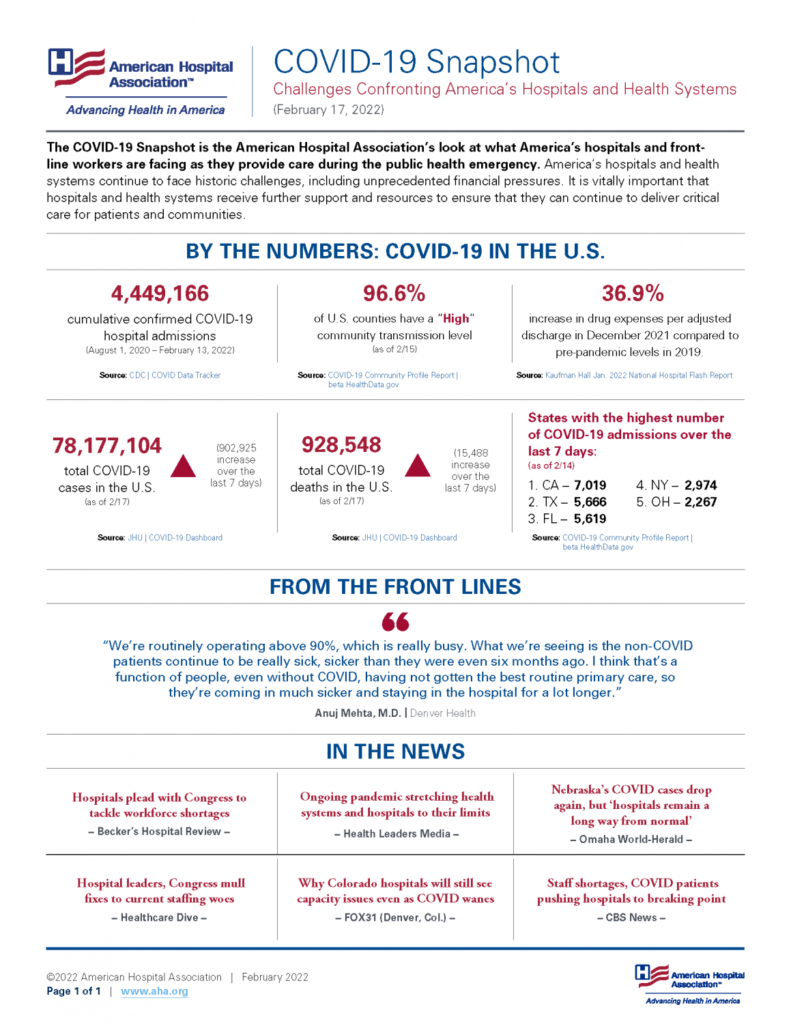
From the Omicron front, the American Hospital Association provides us with its most recent Covid snapshot

From the Covid treatment front, The American Medical Association reports

Efforts to boost production of [Covid] therapeutics are underway, a Food and Drug Administration (FDA) official said during an episode of the AMA-sponsored webinar series, “COVID-19: What Physicians Need to Know.” 

Recommended usage in therapeutics is an important step in counseling patients and providing the most timely and relevant information about defeating this virus, said AMA President Gerald E. Harmon, MD, who moderated the webinar. Physicians facing supply issues of hard-to-get antivirals such as Paxlovid (PDF) also want to know about the timeline of any new antivirals or antibody treatments, he said.

For doctors and other health professionals, “it’s been a very difficult winter and it’s not over yet,” acknowledged John Farley, MD, MPH, director of FDA’s Office of Infectious Diseases in the Center for Drug Evaluation and Research’s Office of New Drugs. Monitoring the situation with these drugs is a complex process that involves FDA, the Centers for Disease Control and Prevention and several branches of government, he added.

Distribution of therapeutics should improve over time. However, at least for the combination of antiviral nirmatrelvir and ritonavir tablets marketed as Paxlovid, “we have a period of continued short supply ahead,” said Dr. Farley, who joined two other FDA experts to discuss the efficacy of the treatments.

In the FEHBlog’s view, Pfizer’s Paxlovid appears to offer the best opportunity for lowering Covid hospital admissions which have been a major cost for health plans over the past year which has seen three major Covid surges.

Speaking of innovations, Cleveland.com tells us

The next generation of mRNA vaccines, as well as treatments for type 2 diabetes and postpartum depression are among the innovations that earned spots on the Cleveland Clinic’s Top 10 Medical Innovations for 2022.

The list of breakthrough technologies, chosen by a committee of Clinic experts, was announced Wednesday.

These medical advancements have the potential to transform healthcare in the coming year, the Clinic said. The committee considered technologies developed by the Clinic as well as other research centers.

From the Federal Trade Commission front, Healthcare Dive reports

The Federal Trade Commission will not launch a study into pharmacy benefit managers’ pricing and contractual practices after a 2-2 vote at a Thursday meeting. The measure needed a simple majority to commence the investigation, which would have compelled large PBMs to turn over information and documents to the agency.

The two commissioners appointed by former President Donald Trump, Noah Phillips and Christine Wilson, voted against the study after raising concerns about its design and whether the current draft asks the proper questions for the answers the agency is seeking. Phillips also complained about receiving a “substantially revised” draft from staff “just hours” before the meeting.

FTC Chair Lina Khan said she was disappointed with Thursday’s vote, and said this is an area the agency has “a real moral imperative” to act upon.

From the Rx coverage front, Fierce Healthcare informs us

Optum has launched a new solution for specialty drugs that aims to lower costs and improve care management for people with complex conditions.

Specialty Fusion arms payers and providers with real-time insights into which specialty therapies are the most effective for the patient at the lowest cost. The platform leads to quicker treatment approvals for patients as well as a similar experience for providers at the point of care, Optum said in an announcement.

Internal analysis of the solution suggests it can drive cost savings of 17%.

From the healthcare business front, Healthcare Dive notes

Pharmacy giant Walgreens and value-based medical network VillageMD are on pace to open more than 200 co-branded primary care practices by the end of the year.

On Wednesday, the companies opened their first clinic in a new Florida market, Jacksonville, bringing their total markets in the state up to three, including Orlando and Tampa. Walgreens and VillageMD plan to open five new Village Medical at Walgreens primary care practices in total in the Jacksonville area through this summer.

With the Jacksonville openings, Walgreens and VillageMD have now opened more than 80 primary care practices across 12 markets in Arizona, Florida, Texas, Kentucky and Indiana.

Last but not least FedWeek explains how to guard against losing FEHB coverage in retirement.

Midweek Update

From Capitol Hill —

Today, the Senate invoked cloture on the resolution to continue funding the federal government until March 11 by unanimous consent. Consequently, the new resolution should be approved by Congress tomorrow, which is the day before funding expires under the current resolution.

The House of Representatives has returned the correct version of the Postal Reform Act, H.R. 3076, to the Senate, and the Senate has had the correct version read twice. We will have to wait and see if anything happens with the bill tomorrow.

In the meantime, check out the Congressional Research Service’s February 11, 2022, report on the Postal Reform bill approved by the House, H.R. 3076. In the FEHBlog’s view, a unique feature of the House version compared to earlier versions is that the bill destined to become law creates a transitional Open Season. The Transitional Open Season will auto-enroll those Postal employees and annuitants who failed to transfer over to the PSHBP in the 2024 Open Season for the 2025 plan year. The receiving PSHBP plan will be the lowest premium nationwide PSHBP plan that is not a high deductible plan and does not require dues payments. Also, the House version makes the Postal Service financially responsible for the late Medicare Part B enrollment fees otherwise owed by the Postal annuitants with Part A only who take advantage of a special Part B enrollment period in 2024.

Following up on Robert Califf’s second confirmation as Food and Drug Administrator yesterday, STAT News identified the six major drug approval decisions awaiting him, including Pfizer’s toddler COVID vaccine, the Novovax Covid vaccine, and Alzheimer’s Disease treatments. Good luck, Mr. Califf.

Also among those drug approval decisions awaiting Mr. Califf is a Covid treatment discussed in Bloomberg

After omicron weakened some of the defenses that doctors have against Covid, an experimental treatment being developed by Novartis and a small Swiss biotech partner holds some promise as a new therapy.

Last week, Novartis sought emergency approval from the U.S. Food and Drug Administration for an intravenous drug, called ensovibep, that’s similar in some ways to monoclonal antibody treatments. However, the way it works is significantly different, which might allow it to succeed where antibody therapies fail against omicron.

The compound uses tiny proteins to attack the coronavirus’s spike protein in not just one, but multiple places. That appears to give it a leg up in fighting the virus even as it mutates.

In other federal leadership changes, STAT News adds

President Joe Biden is replacing a top science adviser who resigned under a cloud with two individuals who will split his duties on an interim basis.

Biden is tapping [Alondra Nelson, ]a deputy in the White House science and technology office along with [Dr. Francis Collins] the recently retired director of the National Institutes of Health, according to a personal familiar with the president’s plans.

From the Omicron front, Beckers Hospital Review tells us

The COVID-19 omicron subvariant BA.2, dubbed “stealth omicron,” has spread to at least 74 countries and 47 states across the U.S., according to data from outbreak.info.

Four more updates: 

1. BA.2 is most prevalent in HHS’ region 3, which includes Pennsylvania, West Virginia, Virginia, Delaware and Maryland, according to CDC data.

2. Region 7, which includes Iowa, Kansas, Missouri and Nebraska, had the lowest percentage of BA.2 cases last week, according to CDC data. 

3. BA.2 currently accounts for 3.9 percent of total COVID-19 cases in the U.S., with omicron subvariant BA.1.1 accounting for 73.2 percent of cases, CDC data shows. 

4. A South African study analyzing nearly 100,000 COVID-19 cases found that BA.2 doesn’t cause significantly more severe illness than the original omicron variant, Bloomberg reported Feb. 16.

From the Covid vaccine front, The American Medical Association reports

The New York Times (2/15, Anthes) reports infants born to mothers who “received two doses of an mRNA coronavirus vaccine during pregnancy are less likely to be admitted to the hospital for COVID-19 in the first six months of life, according to a new study from the Centers for Disease Control and Prevention.” The study found that “overall, maternal vaccination was 61% effective at preventing infant hospitalization.”

Reuters (2/15, Mishra, Steenhuysen) reports, “That protection rose to 80% when the mothers were vaccinated 21 weeks through 14 days before delivery.” Meanwhile, the “effectiveness fell to 32% for the babies whose mothers were inoculated earlier during pregnancy.”

The Hill (2/15, Sullivan) reports the study used data “from 20 pediatric hospitals in 17 states, from July 2021 to January 2022.”

From the Covid front, Fierce Healthcare reports

Anthem has launched a new pilot that aims to offer a digital concierge care experience to members recovering from COVID-19.

Through COVID Concierge Care, eligible members can access an app and fill out a questionnaire that tracks their symptoms on a daily basis. They can connect with a clinician via secure, two-way text-based messages in the app or via text or email.

In addition, based on their reported symptoms, members can access evidence-based educational tools and wellness content to help them self-manage their conditions. For example, members can connect with breathing exercise guides to manage stress or health articles about their symptoms.

From the Covid vaccine mandate front, Federal News Network tells us

The Postal Service is laying the groundwork to track the vaccination and testing status of its workforce amid the COVID-19 pandemic, or any future public health emergency.

USPS, however, says it’s only giving notice as it prepares for “potential future contingencies,” and is not, at this time, updating its COVID-19 vaccine or testing requirements, nor is it seeking to collect data on the vaccination status of its workforce.

In healthcare business news, Healthcare Dive informs us

The Department of Justice is preparing a lawsuit to block UnitedHealth from purchasing Change Healthcare, according to a new report, as regulators take a more aggressive stance on checking consolidation in the healthcare industry.

According to Dealreporter, which cited sources familiar with the matter, UnitedHealth and Change are expected to meet with the DOJ soon for a “last rites” meeting on the proposed deal, first announced early last year. Despite UnitedHealth and Change exploring divestitures to assuage antitrust concerns, the DOJ has not found any that would make the deal acceptable, according to Dealreporter’s sourcing.

From the health savings account front, Health Payer Intelligence offers nine best practices for high deductible health plan design based on a recent report from the National Pharmaceutical Council (NPC) and Gallagher.

From the antibiotic overutilization front, AHIP lets us know

A study published in the CDC’s Morbidity and Mortality Weekly Report found 41% of antibiotic prescriptions for Medicare Part D beneficiaries in 2019 were written by just 10% of prescribers. Researchers found nearly half of these high-volume prescribers practiced in southern states, and they had a median antibiotic prescribing rate of 680 per 1,000 beneficiaries, compared with 426 per 1,000 beneficiaries among low-volume prescribers. 

Friday Stats and More

Based on the CDC’s Covid Data Tracker and using Thursday as the first day of the week, here is the FEHBlog’s latest chart of weekly new Covid cases from the 27th week of 2021 through the 6th week of 2022.

The chart shows a steep drop in Covid cases this year. Yet, according to the CDC, the rate of Omicron transmission remains high across our country. The CDC also reports

The current 7-day daily average for February 2–February 8, 2022, was 12,099 [new Covid hospitalizations]. This is a 25.4% decrease from the prior 7-day average (16,212) from January 26–February 1, 2022.

For the reasons explained in this Medscape article, the weekly count of Covid deaths continues to increase.

Finally, here is the FEHBlog’s chart of weekly Covid vaccinations distributed and administered.

New vaccinations, including boosters, have run under four million weekly for the past two weeks.

Here is a link to the CDC’s weekly review of its Covid statistics. The CDC’s critical observation is as follows:

COVID Data Tracker shows that as of February 10, 2022, about 213.4 million people, or 64.3% percent of the total U.S. population, have received a primary series of a COVID-19 vaccine.

However, only about half of those eligible to receive a booster dose have done so. Everyone ages 12 years and older should get a booster shot after they have completed their COVID-19 vaccine primary series. Omicron is extremely contagious, and even though overall severity is lower, the high volume of hospitalizations has strained the healthcare system. Being up to date with vaccination, in coordination with other key prevention strategies, is critical for preventing severe illness from COVID-19 and for reducing the likelihood of new variants from emerging. Find a vaccine provider and get your booster dose as soon as you can.

CDC’s Fluview adds “Sporadic influenza activity continues across the country.” The 2021 and 2002 winters have featured many Covid infections, but not that many flu infections.

The Wall Street Journal reports

U.S. drug regulators authorized the use of a new Covid-19 antibody drug from Eli Lilly & Co. that retains effectiveness against the Omicron variant of the virus, filling a void after authorities stopped distributing some older antibody drugs that lost effectiveness against the strain.

The Food and Drug Administration on Friday cleared the drug, bebtelovimab, for the treatment of mild to moderate Covid-19 in nonhospitalized individuals 12 and older who are at high risk of getting severely sick. The drug is intended for people who can’t get access to alternative Covid-19 treatments, or for whom those treatments aren’t appropriate.

Yesterday, the Biden administration announced the purchase of 600,000 courses of this drug.

From the Covid vaccine front, the Journal further reports that the Food and Drug delayed consideration of granting emergency use authorization to the Pfizer BioNTech Covid vaccine for children ages six months through four years.

The FDA had been considering a request by the companies to clear the use of two doses of the vaccine. The agency was then going to look at expanding the authorization to a third dose, should the study show it works safely.

The new move [to consider all three dose at one time] will delay the rollout of the shot for children younger than 5, the last age group without access to vaccination.

Pfizer and BioNTech said they expect results on whether three doses of the vaccine works safely in early April. Researchers are collecting more data, including from more children in the study who have become infected as more time has passed.

The FEHBlog, who has young grandchildren, honestly does not understand why the government has been pushing so hard to vaccinate this age group.

From the opioid epidemic front, the American Medical Association informs us

The New York Times (2/10, Hoffman) reports that on Thursday, the CDC “proposed new guidelines for prescribing opioid[s]…that remove its previous recommended ceilings on doses for chronic pain patients and instead encourage doctors to use their best judgment.” Although they are “still in draft form, the 12 recommendations…are the first comprehensive revisions of the agency’s opioid prescribing guidelines since 2016,” and “they walk a fine line between embracing the need for doctors to prescribe opioids to alleviate some cases of severe pain while guarding against exposing patients to the well-documented perils of opioids.”

The AP (2/10, Stobbe) reports that the proposed changes are “contained in a 229-page draft update in the Federal Register,” and “the CDC will consider comments before finalizing the updated guidance.”

The Washington Post (2/10, Bernstein) reports that in a statement, AMA Board of Trustees Chair Bobby Mukkamala, M.D., said, “for nearly six years, the AMA has urged the CDC to reconsider its problematic guideline on opioid prescriptions that proved devastating for patients with pain. The CDC’s new draft guideline – if followed by policymakers, health insurance companies and pharmacy chains – provides a path to remove arbitrary prescribing thresholds, restore balance and support comprehensive, compassionate care.”

From the quality metrics front, NCQA released its proposed HEDIS and CAHPS changes for the 2023 measurement year today. NCQA is proposing to retire the CAHPS flu vaccination measure, which currently is included in OPM’s set of QCR measures used in the Plan Performance Assessment program. NCQA’s public comment period on the proposed changes closes on March 11.

From the Rx coverage front, STAT News tells us

In a move hailed by pharmacies, the U.S. Federal Trade Commission plans to vote later this month on whether to examine pharmacy benefits managers and how their controversial practices affect independent and specialty pharmacy operations.

The agency disclosed the planned Feb. 17 vote in a brief notice that specified interest in the “competitive impact of contractual provisions and reimbursement adjustments, and other practices affecting drug prices,” but did not provide any further detail. An FTC spokesperson wrote us that additional information will not be released until the upcoming meeting.

The FEHBlog will keep an eye on this vote.

From the Aduhelm front, Health Payer Intelligence discusses AHIP’s comments supporting CMS’s decision to provide very limited coverage of this drug in Medicare.

From the healthcare business front, Fierce Healthcare reports

Kaiser Permanente [the third largest carrier in the FEHB Program] reported $3 billion in net income for the second quarter of the year as membership in its health plan remains steady.

The health system and insurer posted total operating revenues of $23.7 billion against total operating expenses of $23.3 billion. The revenue was slightly above the $22.1 billion it earned in the second quarter of 2020.

Kaiser noted in its earnings statement Friday that favorable financial market conditions resulted in $3 billion in net income, compared with $4.5 billion for the second quarter of 2020.

“The COVID-19 health threat is not over, and we will continue to focus our resources on providing needed care for our patients and increasing vaccination rates to protect the health and safety of our workforce, members and the communities we serve,” said Kaiser CEO Greg Adams in a statement.

If you have time over the Super Bowl weekend, listen to or read Econtalk host Russ Robert’s discussion with macroeconomist John Taylor about inflation. Mr. Taylor created the Taylor Rule “that prescribes a value for the federal funds rate—the short-term interest rate targeted by the Federal Open Market Committee (FOMC)—based on the values of inflation and economic slack such as the output gap or unemployment gap.”

Monday Roundup

Photo by Sven Read on Unsplash

From Capitol Hill —

Roll Call reports that

House Democrats introduced a government funding stopgap Monday that would extend current spending levels through March 11 as appropriators continue to negotiate topline spending levels for a fiscal 2022 omnibus bill. 

The move would buy Congress an extra three weeks to complete work on an overdue omnibus package for the fiscal year that began last October. The government is currently operating on a continuing resolution that expires on Feb. 18.

Per the Roll Call article, Congress expects to meet the March 11 deadline with a consolidated appropriations bill for the current government fiscal year.

Reuters reports that the House also will vote on the Postal Reform bill (HR 3706) tomorrow. Here is a link to the House Rules Committee website describing the actions that the Rules Committee took on HR 3706 today to line up a vote for tomorrow.

From the Omicron front —

According to the CDC’s COVID Data Tracker, as of today, 90 million out of 213 fully vaccinated Americans (42%) have received a Covid booster. In his New York Times column this morning, David Leonhardt writes that the relatively slow adoption of boosters is not a function purely of skepticism. Rather

The vaccinated-but-unboosted more closely resemble the country as a whole. Millions of Americans who have already received two vaccine shots — eagerly, in many cases — have not yet received a follow-up. The unboosted include many Republicans, Democrats and independents and span racial groups. * * *

The most urgent problem involves the unboosted elderly. (About 14 percent of Americans over 65 eligible for a booster had not received one as of mid-January, according to Kaiser.) But some younger adults are also getting sick as their vaccine immunity wears off.

A recent study from Israel, published in The New England Journal of Medicine, was clarifying. For both the elderly and people between 40 and 59, severe illness and death were notably lower among the boosted than the merely vaccinated. For adults younger than 40, serious illness was rare in both groups — but even rarer among the boosted: Of the almost two million vaccinated people ages 16 to 39 in the study, 26 of the unboosted got severely ill, compared with only one boosted person.

“Boosters reduce hospitalization across all ages,” Dr. Eric Topol of Scripps Research has said. As Dr. Leana Wen wrote in The Washington Post, “The evidence is clear that it is at least a three-dose vaccine

Mr. Leonhardt places responsibility for the booster gap on the fragmented U.S. health system and the failure of government experts to make themselves understood to the American people. Health plans may want to lend a hand here.

The National Institutes of Health informed us

Pregnant women with COVID-19 appear to be at greater risk for common pregnancy complications — in addition to health risks from the virus — than pregnant women without COVID-19, suggests a study funded by the National Institutes of Health.

The study, which included nearly 2,400 pregnant women infected with SARS-CoV-2, found that those with moderate to severe infection were more likely to have a cesarean delivery, to deliver preterm, to die around the time of birth, or to experience serious illness from hypertensive disorders of pregnancy, postpartum hemorrhage, or from infection other than SARS-CoV-2. They were also more likely to lose the pregnancy or to have an infant die during the newborn period. Mild or asymptomatic infection was not associated with increased pregnancy risks.

“The findings underscore the need for women of child-bearing age and pregnant individuals to be vaccinated and to take other precautions against becoming infected with SARS-CoV-2,” said Diana Bianchi, M.D., director of NIH’s Eunice Kennedy Shriver National Institute of Child Health and Human Development (NICHD), which funded the study. “This is the best way to protect pregnant women and their babies.”

The American Hospital Association offers six tips for health care leaders looking to build vaccine confidence among pregnant women.

The Wall Street Journal reports today

Drugmaker Shionogi & Co. said it plans to seek approval this month to sell its Covid-19 treatment pill in Japan after the company found that in human trials the pill had strong virus-fighting ability compared with Pfizer Inc.’s Paxlovid. 

Shionogi acknowledged that studies of its drug are much smaller than Pfizer’s and have yet to prove effectiveness in preventing serious Covid-19 cases. Pfizer said its final-stage trial, which included more than 2,000 patients, showed Paxlovid cut the risk of hospitalization or death by 89% if patients took the pill within three days of diagnosis. 

Still, Shionogi said it believed its trials to date, covering about 400 mostly Japanese patients, would offer sufficient evidence to seek approval in Japan, where the Pfizer drug is expected to be approved shortly, but is likely to be in limited supply. Shionogi said its trial found the pill, code-named S-217622, neutralized the virus quickly and didn’t cause serious or lasting side effects. 

The more, the merrier.

In other news, Fierce Healthcare tells us

CVS Health is teaming up with Medable to access and engage around clinical trials at select MinuteClinics, the healthcare giant announced Monday.

CVS Health Clinical Trial Services, a new arm at the company launched last May, will harness Medable’s software platform to deliver clinical trials with a focus on accessibility and retention to enhance the effectiveness of research, according to the announcement.

The companies note that while clinical trials are crucially important to test the efficacy of innovative pharmaceuticals, less than 4% of Americans actually participate in them. In addition, 30% of participants drop out before trials are completed, and 80% of studies are unable to make enrollment deadlines.

Tony Clapsis, general manager and senior vice president of CVS Health Clinical Trial Services, said in a statement that CVS has the ability to make a significant impact on outreach about trials to underrepresented people as more than 40% of vulnerable populations live within five miles of one of its pharmacies.

Smart move.

STAT News reports

  • “Some of the nation’s most influential doctors and public health groups are orchestrating a mad-dash effort to convince senators to confirm Robert Califf, President Biden’s pick to lead the Food and Drug Administration. * * * The pressure campaign comes amid growing signs that Califf’s nomination is in serious trouble. Five Democrats in the Senate have already expressed serious concerns with Califf’s nomination and at least 10 more are still undecided about his candidacy. Quite a few Republicans in the chamber also have concerns. ‘It’s … the ‘break glass in case of emergency’ moment,’ said one patient advocate, who noted that many advocacy groups had, until recently, thought Califf would sail through his confirmation process easily.”

and

  • “When President Biden tapped Eric Lander as White House science adviser in January 2021, he tasked the renowned genomics researcher with “reinvigorating” American science. Following Lander’s stunning resignation on Monday evening, however, the question is no longer whether he’ll reinvigorate the U.S. scientific enterprise. It’s whether he’s derailed it. Lander resigned after an all-staff apology for abusive workplace behavior, which Politico first reported. In an email, Lander admitted speaking in a “disrespectful and demeaning way,” acknowledging he had failed to set a “respectful tone” for the office and that his actions reflected poorly on the administration.”

Let’s hope Lander didn’t derail efforts like the Cancer Moonshot.

Friday Stats and More

Based on the Centers for Disease Control’s Covid Data Tracker and using Thursday as the first day of the week, here is the FEHBlog’s chart of weekly new Covid cases from the 27th week of 2021 through the 5th week of this year:

The Omicron surge is subsiding. The CDC’s weekly interpretation of its COVID statistics indicates that

COVID-19 cases and hospitalizations are continuing to decline across the United States. As of February 2, 2022, cases are down 53.1% from their peak on January 15. However, community transmission is still high nationwide.

Unfortunately Covid-related deaths, a lagging indicator, continue to rise:

Here’s the FEHBlog’s chart of weekly Covid vaccinations administered and distributed from the 51st week of 2020 through the 5th week of 2022.

The pace of COVID vaccinations is slowing again. 212.5 million out of 303 million Americans (net of 23.6 million children under 5 years old) are fully vaccinated and of that cadre, 89.3 million have been boostered.

The American Medical Association offers seven reasons why parents should get their kids ages 5 to 11 vaccinated against Covid.

Also today the CDC’s Advisory Committee on Vaccination Practices unanimously ratified the FDA’s decision to award full marketing approval to the Moderna mRNA vaccine Spikevax for use with adults age 18 and older.

For the hardcore Covid statistics folks check out this tidbit from the CDC’s weekly interpretative report

Wastewater (sewage) surveillance is a promising tool for tracking the spread of SARS-CoV-2, the virus that causes COVID-19. Many people with COVID-19 shed the virus in their feces, so testing wastewater can help us find COVID-19 in communities. Wastewater testing has been successfully used as a method for detection of other diseases, such as polio. Wastewater surveillance results can provide an early warning of increasing COVID-19 cases and help communities prepare.

On February 3, 2022, COVID Data Tracker released a Wastewater Surveillance tab, which tracks SARS-CoV-2 levels in sewage at more than 400 testing sites across the country. This marks the first time CDC’s wastewater surveillance data is available for download. See “A Closer Look” below for more information about this method of data collection.

From the Covid testing mandate front, the Affordable Care Act regulators issued ACA FAQ 52 late this afternoon. The regulators use this FAQ to provide helpful clarifications to the mandate. Check it out.

From the Covid treatment front, Medscape tells us that

A little more than a month after receiving FDA authorization, Merck has delivered 1.4 million courses of its COVID-19 antiviral pill in the United States and expects to deliver its total commitment of 3.1 million treatment courses soon, company CEO Rob Davis said on CNBC.

Merck has also shipped 4 million courses of the pill, molnupiravir, to 25 nations across the world, he said.

“We’ve shown that molnupiravir works against Omicron, which is important against that variant,” Davis said Thursday morning. “And obviously we’ll have to see how this plays out and what is the initial uptake, but right now we feel we’re off to a good start.”

The CDC’s weekly Fluview report summarizes the flu situation as follows: “Influenza activity has decreased in recent weeks, but sporadic activity continues across the country.”

From the Postal reform front, Federal News Network reports that

The Postal Service’s best shot at a long-term legislative reform in recent years is finally moving ahead in Congress next week.

The House expects to vote on the Postal Service Reform Act next week. The House Oversight and Reform Committee approved the legislation last May.

Notably, the most recent version of the bill now has the support of the National Active and Retired Federal Employees (NARFE), which raised significant concerns about an earlier version.

NARFE, in a letter of support Friday, said an earlier version of the bill contained “onerous provisions” that could have increased health insurance premiums for all non-postal federal employees and retires.

The earlier version of the bill, the association added, would have also required current postal retirees to pay additional premiums for mostly duplicative health insurance coverage through Medicare.

Moreover, this afternoon, the Congressional Budget Office released its report on the House Rules Committee Print 117-32 for H.R. 3076, the Postal Service Reform Act of 2022. The FEHBlog does not see any showstoppers in that CBO report. The House Rules Committee has scheduled a hearing on this bill for Monday at 2 pm ET. You can read the current version of the bill here.

Finally, Healthcare Dive reports that

Congress appears poised to work on a bipartisan mental health and substance misuse package this year, following a series of hearings this week stressing the need to boost the workforce, insurer benefits and telehealth access.

Legislators also seemed to support giving federal departments more power to force health insurers to comply with parity laws, following a report in late January finding widespread inequities between mental and medical benefits in the U.S. that sent physician groups up in arms.

That, dear readers, is a big bowl of wrong because the outrage stems from the “non-quantitative treatment limit” mental health parity standard set by the Obama era regulation, not the original law. That standard, in the FEHBlog’s view, is amorphous. The FEHBlog favors mental health parity but please Congress don’t make the standard impossible to achieve consistently. Keep it simple.

Thursday Miscellany

Photo by Juliane Liebermann on Unsplash

From Capitol Hill, Roll Call reports that Congress is not making much progress toward replacing the current continuing resolution funding the federal government with an omnibus bill resolving FY 2022 appropriations. The deadline for Congressional action is February 18. It is starting to look like Congress is headed toward passing another short-term continuing resolution according to the article. Time will tell.

From the Covid testing front, the Biden administration announced today that Medicare will begin direct coverage of over-the-counter Covid tests in the early Spring of this year.

Health Payer Intelligence informs us that America’s Health Insurance Plans wrote a statement to Congress describing the numerous administrative problems created by the “free” Covid test coverage mandates that started nearly two years ago with the CARES Act.

MedPage Today tells us about a human challenge study of the Covid incubation period conducted in London which found that the Covid incubation is only two rather than five days after exposure. Instead the symptoms tend to peak at five days and the virus remains detectable 10 days after exposure.

The Institute for Clinical and Economical Review released a draft assessment of outpatient treatments for Covid including the Pfizer and Merck pills, an intravenously administered recombinant monoclonal antibody (Sotrovimab), and an off-label use of an obsessive-compulsive SSRI drug (Fluvoxamine) for which researchers are seeking an emergency use authorization for Covid. The draft conclusion is that

Our analyses suggest that each outpatient intervention produces improved clinical outcomes. At their current prices, each intervention is estimated to meet standard cost-effectiveness levels in the US health care system, even under a scenario with a lower hospitalization risk that may reflect the current Omicron wave. The cost-effectiveness findings are primarily driven by a treatment’s ability to reduce hospitalization and the baseline probability of hospitalization.

From the No Surprises Act front, the Labor Department helpfully released a transcript of the January 19, 2022, listening session regarding provider nondiscrimination under Section 2706(a) of the Public Health Service Act. The NSA requires the ACA regulators to issue implementing rules for this law which has been in force since 2014.

Also, Kaiser Health News discusses mental health therapist concerns about the good faith pricing estimate for healthcare services that the NSA applies across the board. The law also requires health plans to issue advance explanations of benefits in response to a good faith estimate from a provider. The FEHBlog will never understand why Congress failed to direct HHS to create HIPAA standard transactions for the GFE and the AEOB. In any event, providers and health plans await implementing rules from the ACA regulators.

From the Rx coverage front, Biopharma Dive provide us with two insights

  1. “Biogen recorded $1 million in revenue from its new treatment for Alzheimer’s disease in the last quarter of 2021, offering the latest evidence that the drug, which came to market with multi-billion dollar sales expectations, continues to struggle commercially.”
  2. “AbbVie may soon face competition for its top-selling eye drug Restasis after the Food and Drug Administration on Wednesday approved a generic version.”

From the healthcare business front, Fierce Healthcare fills us in on Cigna’s fourth quarter 2021 financial report.

Tuesday’s Tidbits

Photo by Patrick Fore on Unsplash

The FEHBlog nearly fell off his office chair when he noticed a Govexec headline this afternoon reading “The House finally plans to vote on Postal reform [HR 3706] next week. The long sought after bill could make it to the President’s desk by the end of the month.” This Postal reform saga has been going on for over a decade.

The Postal reform act (HR 3706) would relieve the Postal Service of the obligation to prefund the cost of FEHB coverage in retirement for its employees. The bill also would create a Postal Service Health Benefits Program (“PSHBP”) within the FEHB Program. The PSHBP would tightly integrate Medicare annuitant coverage with primary Medicare A, B, and D. Medicare Part A (hospital care) is premium free while Medicare Part B (medical care) and Part D (prescription drugs) charge premiums.

OPM encourages Medicare age annuitants to pick up Part B but it prohibits FEHB carriers from using integrated Part D arrangements knowsn as EGWPs even though every other U.S. employer that provides drug coverage to its retirees uses a Part D EGWP or takes the retiree drug subsidy. What’s more Congress in the Medicare Modernization Act of 2003 expressly authorized FEHB plans to use Medicare EGWPs. Go figure.

In any event, all enrollee costs are included in FEHB risk pools which is an important feature of the FEHB Plan and its constituent PSHBP. The cost of Medicare Prime annuitants in the PSHBP will be much lower than those in legacy FEHB, and Medicare Prime annuitants are a signficant cadre of enrollment, PSHBP premiums will be noticeably lower than legacy FEHB premiums.

The CBO has projected that 3/5s of the Medicare integration savings for the PSHBP will come from the Part D EGWPs. The FEHBlog looks forward to the day later this decade when OPM finally permits legacy FEHB carriers to offer Medicare Part D EGWPs.

From the Covid vaccine front —

  • Pfizer and BioNTech have a submitted an emergency use authorization request for an mRNA Covid vaccine for little children aged six months through four years. The FDA and CDC are likely to approve the application by the end of February according to Medscape.

Novavax announced Monday that it has formally submitted a request to the FDA for emergency use authorization of its COVID-19 vaccine for ages 18 and older.

The request includes results from two large clinical trials that showed an overall efficacy of about 90% and a “reassuring safety profile,” the company said.

“We believe our vaccine offers a differentiated option built on a well-understood protein-based vaccine platform that can be an alternative to the portfolio of available vaccines to help fight the COVID-19 pandemic,” Stanley Erck, the president and CEO of Novavax, said in the statement.

From the COVID treatment front, the Wall Street Journal reports that providers are having difficulty obtaining the drugs need to treat Omicron because the treatments typically are available under emergency use authorizations and each State makes its own decison on how to distribute EUA treatments. On the brighter side,

Antiviral-pill manufacturers are ramping up production to meet demand. Supplies of Pfizer Inc.’s Paxlovid are expected to increase in the spring, according to Pfizer and state officials. Merck & Co., which manufactures molnupiravir with partner Ridgeback Biotherapeutics LP, said it has delivered two million courses to the U.S. and will deliver the rest of the 3.1 million courses under its contract by the end of this week.

From the healthcare cost front, Healthcare Dive reports that

The omicron variant walloped hospitals in the final month of 2021, driving up both adjusted patient volumes and expenses as the number of COVID-19 cases surged to new highs for the pandemic, according to Kaufman Hall’s latest flash report.

Patient days rose nearly 4% in December compared to November, while emergency department visits jumped more than 7% as patients came in with COVID-19 symptoms. Omicron’s rapid spread drove a 98% jump in COVID-19 hospitalizations over the course of the month, Kaufman Hall said, citing Centers for Disease Control and Prevention data.

The second full year of the pandemic was marked by an increase in severely ill patients requiring longer hospital stays compared to the first year, the report also found.

From the No Surprises Act front, Healthcare Dive examines healthcare provider association legal challenges to the federal regulators’ use as the qualifying payment amount in NSA arbitrations. The FEHBlog has described those cases now pending in federal district courts in Texas and Washington DC as exercises in futility. For example,

Since the qualifying payment amount represents the median in-network rate, it by definition means that half of providers are below the QPA and half are above, according to Chris Garmon, a professor at University of Missouri – Kansas City, who has studied surprise billing. Not all providers are set to see payments decline and some may even see them increase if the QPA is used, he said.

The good professor overlooks the fact that in 2021 out of network doctors caring for patient at in-network facilities were reimbursed at out-of-network rates typically two or perhaps three times the Medicare RBRVS reimbursement. For that reason, the FEHBlog expects that in most cases the QPA will be noticeably higher than pre-NSA reimbursements. Time will tell, but the regulators’ approach is reasonable, and patient advocacy groups have been supporting the regulators in these cases.

From the mental health parity front, Health Payer Intelligence compares provider and payer reactions to the government’s recent report to Congress on payer compliance with complex federal health parity act rules.

From the healthcare business front, Fierce Healthcare tells us that

GuideWell, the parent company of Blue Cross and Blue Shield of Florida, has closed its acquisition of Triple-S Management Corporation, a Puerto Rico-based health services company.

The deal was first announced in September.

GuideWell acquired all shares of Triple-S at $36 per share in cash, according to an announcement from the company. Triple-S will now operate under its existing branding as a wholly owned subsidiary of GuideWell.

From the FDA front, check out this FDA news roundup.

From Capitol Hill, Govexec reports on OMB acting director’s Shalonda Young’s confirmation hearings to be the Presidentially nominated OMB director. Ms. Young appears on her way to confirmation.

Weekend update

Both Houses of Congress are in session this week for Committee business and floor voting.

The FEHBlog notes that the President’s nominee for Office of Management and Budget, acting Director Shalonda Young, and her designated replacement to serve as Deputy OMB Director, Nani Coloretti, will be attending their Senate confirmation hearings this week.

The current continuing resolution funding the federal goverment expires on February 18, 2022. The Hill reports that

Congressional negotiators are in danger of missing the Feb. 18 deadline for passing an omnibus package of the annual appropriations for fiscal 2022.

A shutdown is unlikely, but members of the Senate Appropriations Committee from both parties warn that if negotiators blow through the mid-February deadline, it increases the likelihood that Biden will have to settle for a yearlong stopgap funding measure to keep the government open.

At this point the budget ball is in the Senate’s hands. The Hill further states

Spokespeople for the two senior negotiators [at the Senate] declined to comment in detail on the talks.  

“The negotiations are ongoing, and it remains the chairman’s goal to complete those negotiations by Feb. 18,” said Jay Tilton, a spokesman for Leahy.  

Blair Taylor, a spokeswoman for Shelby, said, “We are working diligently to create a product that is palatable to everyone — bills that can advance through Congress and be signed into law by the president.”  

From the Omicron front, the Wall Street Journal reports that

The Omicron variant spreads so quickly and generally causes such a mild form of illness among vaccinated populations that countries are tolerating greater Covid-19 outbreaks, willingly letting infections balloon to levels that not long ago would have been treated as public-health crises.

From different starting points, authorities in North America, Europe, and the Asia-Pacific are moving in the same direction, offering a glimpse into a future in which Covid-19 becomes accepted as a fact of everyday life, like seasonal flu.

Health officials everywhere, many for the first time, are forgoing some of the sharpest tools they have to combat Omicron—even as infections soar. They are accepting the virus-like never before to minimize disruptions to economies, education, and everyday life.

At the moment, deaths and hospitalizations are at highs in many countries, and in some, hospitals are overwhelmed. But they are a much lower percentage of total cases than earlier waves. Vaccines have made the disease less deadly, and treatments hold a greater promise of recovery for those who are infected and get seriously ill.

That improving outlook, coupled with the reality that the measures taken to contain earlier surges of the virus don’t work as well against the more-contagious Omicron, is informing the decision by policymakers to abandon restrictive steps aimed at containment amid growing public fatigue over restrictions.

On a related note, Bloomberg tells us that

The omicron subvariant, BA.2, appears to be more contagious but data so far doesn’t show it’s more dangerous or that it evades protection from vaccines, said Scott Gottlieb, the former commissioner of the U.S. Food and Drug Administration. 

At worst, the strain could slow down the decline in omicron infections in the U.S., Gottlieb, a Pfizer Inc. board member, said on CBS’s “Face the Nation.” The subvariant has been found in small numbers in about half of U.S. states. 

“I don’t think it really changes the narrative,” he said. “I don’t think this is going to create a huge wave of infection.”

From the Covid pill front, ABC News informs us that “Promising COVID-19 antiviral pill, Paxlovid, in scarce supply, as doctors, patients compete for access.”

[Due to manufacturing issues,] [t]he current plan calls for 265,000 courses of treatment in January, gradually ramping up to 10 million by the end of June and 20 million by the end of September.

[However, s]carcity isn’t the only problem. Doctors and pharmacists told ABC News the process of obtaining the drug is opaque, even arbitrary.

In Nevada, for example, Paxlovid primarily goes to long-term care facilities like nursing homes. But in neighboring California, state officials use a complex formula that factors in rising case numbers with other risk factors. In the District of Columbia, a few Safeway grocery stores are the primary distributors, although city health officials have asked doctors to give priority to high-risk individuals.

Bloomberg adds that

New York City will provide free antiviral pills, home-delivered, to people who test positive and are at higher risk from Covid-19, Mayor Eric Adams announced on Sunday.  * * * Both oral anti-viral medications approved by the U.S. Food and Drug Administration — paxlovid from Pfizer Inc. and molnupiravir from Merck Inc. — will be available though in limited quantities, according the a City Hall press release. They will be delivered in partnership with Alto Pharmacy. 

Thursday Miscellany

From the Omicron front, MedPage Today reports that

While a large meta-analysis of studies on convalescent plasma use early in the pandemic turned up no survival advantage for the typical patient hospitalized for COVID-19, researchers have mined the dataset to predict who may benefit.

Eva Petkova, PhD, of NYU Grossman School of Medicine in New York City, and colleagues devised a simple and freely available tool called the Convalescent Plasma Benefit Index Calculator that allows doctors to input certain patient criteria to determine if their patient may benefit from convalescent plasma (age, oxygen need, blood type, and history of either diabetes, heart disease, or pulmonary disease).

Note: The FEHBlog has been intrigued by convalescent plasma treatments since reading John Barry’s The Great Influenza in early 2020. The FEHBlog currently is reading Gregory Zuckerman’s A Shot to Save the World which is equally fascinating.

The Wall Street Journal’s personal technology reporter Joanna Stern reviews the latest in at home Covid testing.

It’s Friday and you’ve got a scratchy throat and a mild headache. Time to play “Cold? Covid? Or Just Crazy?”—the only game more popular than Wordle

Or you could open up your medicine cabinet and power-on a small white box. Swab your nose with a Lego-like stick, then slide that into the illuminated gadget. About 20 minutes later, your iPhone buzzes: “COVID-19 Positive.”

The future? Nope, it’s already here. For the past few weeks, I’ve been testing the Cue Health Monitoring system and the Detect Covid-19 Test, two systems from health-tech startups that put lab-like molecular testing right on your bathroom counter. No driving to the testing center. No waiting in line. No anticipating the results for days.

* * *

Molecular tests’ biggest benefit: They can spot Covid earlier—anywhere from 6 hours to two days, depending on the variant and other factors. Dr. Mina, who previously served as an adviser to Detect, said they’re good “if you’re really symptomatic and you definitely want to know, ‘Is this Covid?’ ”

However, if you’re using a test to determine whether you can safely go out into the world—back to work, back to school—the cheaper rapid antigen test would be best. “The problem with a molecular test is that it’s so sensitive that it may detect dead fragments and not live virus,” said Peter Chin-Hong, an infectious-disease specialist at the University of California, San Francisco.

Ms. Stern also explains in the article that the molecular test cost singificantly more than the rapid antigen tests.

Bloomberg released its latest Covid resilence ranking for 53 countries around the world.

The Covid Resilience Ranking is a monthly snapshot of where the virus is being handled the most effectively with the least social and economic upheaval. Drawing on 12 data indicators spanning virus containment, quality of healthcare, vaccination coverage, overall mortality and progress toward restarting travel, it captures how the world’s biggest 53 economies are responding to the same once-in-a-generation threat.

The United Arab Emirates and Saudi Arabia rank one and two. The U.S. ranks 23 down 11 ranks since last month. The FEHBlog recalls that last Spring before Delta hit us, the U.S. ranked number 1 in this index. How the mighty have fallen.

From the No Suprises front

  • The Affordable Care Act regulators today released 37 pages of helpful guidance about the No Suprises Act’s new federal independent dispute resolution process.
  • Healthcare Leaders tells us that “The U.S. Department of Health and Human Services (HHS), Office of Inspector General, plans to conduct a nationwide audit to determine whether hospitals that received Provider Relief Funding complied with the billing requirements for COVID patients. This requirement stipulates that those hospitals must not pursue out-of-pocket payments from COVID patients whose bill exceeded “what the patients otherwise would have been required to pay” for in-network care. This audit will be based on the various federal Covid relief acts, not the No Surprises Act

From the Affordable Care Act front, the FEHBlog diligently has been on the lookout for the HHS announcement of 2023 out-of pocket cost-sharing limits for in-network care. The 2023 ACA Notice of Benefit and Payment Parameters released December 28, 2021, advised that the announcement would be released in January. The regulators must have meant that future announcements would be released beginning in January 2024 because the FEHBlog discovered yesterday that the 2023 announcement was released on December 28, 2021.

The announcement reads in pertinent part that

Under 45 CFR 156.130(a)(2), for the 2023 calendar year, cost-sharing for self-only coverage may not exceed the dollar limit for calendar year 2014 increased by an amount equal to the product of that amount and the premium adjustment percentage for 2023. For other than self-only coverage, the limit is twice the dollar limit for self-only coverage. Under § 156.130(d), these amounts must be rounded down to the next lowest multiple of $50. Using the premium adjustment percentage for 2023 of 1.4408219719, and the 2014 maximum annual limitation on cost-sharing of $6,350 for self-only coverage, which was published by the Internal Revenue Service on May 2, 2013, the 2023 maximum annual limitation on cost-sharing is $9,100 for self-only coverage and $18,200 for other than self-only coverage. This represents an approximately 4.6 percent increase above the 2022 parameters of $8,700 for self-only coverage and $17,400 for other than self-only coverage.

And there you are, dear readers.

From the healthcare business front, Healthcare Dive informs us that

— HCA [Healthcare] announced plans to build five new hospitals in Texas in response to the growing population there, executives said Thursday during a call with investors.   

— The hospitals will serve as primary- and secondary-type hospitals with basic inpatient and outpatient services that will refer patients needing higher-acuity services to HCA’s other campuses. These new hospitals will be smaller facilities with about 50 to 75 beds, executives said Thursday.

— The new hospitals will be located in the areas of Dallas Fort-Worth, Houston, San Antonio, and Austin.

Fierce Healthcare adds

Nashville, Tenn.-based HCA Healthcare saw its revenue and profit grow year over year in the fourth quarter of 2021. 

The 182-hospital system reported revenue of $15.1 billion in the fourth quarter of last year, up from $14.3 billion in the same period of 2020. The for-profit hospital operator said same-facility admissions, emergency room visits and outpatient surgeries increased year over year, while inpatient surgeries declined. 

After factoring in expenses and nonoperating items, HCA’s net income in the fourth quarter of 2021 totaled $1.8 billion, up from $1.4 billion in the same quarter a year earlier. 

From the telehealth front, Fierce Healthcare reports that

As telehealth companies increasingly turn to chronic care management, Cigna’s MDLive is launching its own remote patient monitoring program.

The digital-first program will allow patients with chronic conditions to track biometrics like blood pressure and glucose levels, recording daily health information that they can review with MDLive providers during their visits.

* * *

Cigna expanded access to MDLive’s network of virtual primary care providers to all members of the insurer’s employer plans beginning January 2022.

The new patient health monitoring program will be available to all health plan clients of MDLive.