Monday Roundup

Monday Roundup

Photo by Sven Read on Unsplash

On the OPM front, Govexec informs us that

The Office of Personnel Management on Monday announced that it agrees with the vast majority of recommendations posed by a recent study on the future of the agency and is incorporating much of that report’s findings into its strategic plan and budget requests.

In March, the National Academy of Public Administration released its long-awaited report on how to modernize OPM * * * .

OPM said that many of NAPA’s recommendations have already been incorporated into the agency’s fiscal 2022-2026 strategic plan and will be used as the agency develops its fiscal 2023 budget request, which is due to the Office of Management and Budget in October. The new strategic plan will not be public until February 2023, coinciding with the release of President Biden’s fiscal 2023 budget proposal.

In a statement, OPM Director Kiran Ahuja said she will ensure the agency is focused on implementing policies that reaffirmed OPM as a strong and independent leader in governmental human resources.

Good luck with that effort. It seems like yesterday that OPM released its last five year strategic plan.

On the Delta variant front, The Wall Street Journal reports today that

A surge in Covid-19 deaths caused by the highly contagious Delta variant is hitting working-age people hard while highlighting the risks for people who remain unvaccinated.

Federal data show Covid-19 deaths among people under 55 have roughly matched highs near 1,800 a week set during last winter’s surge. These data show weekly tallies for overall Covid-19 deaths, meanwhile, remain well under half of the pandemic peak near 26,000 reached in January. * * *

Older Americans still account for the most Covid-19 deaths, but their higher vaccination rates have helped hold down the numbers. About 54% of the overall U.S. population and 63% of eligible people ages 12 and above are fully vaccinated, while the average among nursing homes is 84% for their residents, federal data show.

On the COVID vaccination front —

  • David Leonhardt in the New York Times offers helpful information for folks who have received the one dose Johnson & Johnson vaccine.
  • Medscape tells us that “Pfizer’s COVID-19 vaccine could be authorized for ages 5-11 by the end of October, according to Reuters.”

On the Biden Administration’s vaccine mandate front —

Federal News Network reports that

Federal employees have until Nov. 22 to be fully vaccinated in accordance with the president’s new mandate, the Biden administration said Monday.

The Safer Federal Workforce Task Force, led by the White  House COVID-19 Response Team, the Office of Personnel Management and General Services Administration, offered up a few more details on what agencies and employees should expect from the president’s new vaccine executive order.

“Federal executive branch employees must be fully vaccinated, except in limited circumstances where an employee is legally entitled to a reasonable accommodation,” the task force said in a series of updated “model safety principles” released Monday. “Agencies must work expeditiously so that their employees are fully vaccinated as quickly as possible and by no later than Nov. 22, 2021.”

The task force said it’s preparing additional guidance on how agencies should implement the president’s new executive order and will issue it “soon.”

Govexec tells us that “The U.S. Postal Service is not committing to implementing any COVID-19 vaccine mandate—full or partial—for its workforce, with an agency spokesman saying officials will first need to see the fine print of new requirements President Biden has issued.”

On the health equity front —

  • Healthcare Finance News reports that seventeen national healthcare organizations sent a letter “urging Department of Health and Human Services Secretary Xavier Becerra to move forward on alternative payment models as part of its strategy to achieve health equity. [T]he groups [letter] underscored how APMs routinely leverage multidisciplinary approaches to care, assess social risk, partner with community organizations to increase access to nonmedical services and leverage data to improve disparities in patient outcomes.”
  • Health IT Analytics discusses the value including social determinants of health data in artificial intelligence applications. “According to New York University researchers, machine learning can accurately predict cardiovascular disease and guide physicians to select treatment options. However, by factoring social determinants of health into the equation, providers can better serve diverse groups.”

In other healthcare news —

  • HHS’s “Substance Abuse and Mental Health Services Administration (SAMHSA) is awarding more than $123 million in funding through six grant programs to provide multifaceted support to communities and health care providers as the Nation continues to combat the overdose epidemic.”

Policymakers have introduced proposals to combat high and rising hospital prices, but focusing on high-concentration markets likely misses the mark.

The majority of high-price hospitals are active in markets that meet federal definitions of low or moderate concentration, according to a recently published commercial claims review.

As such, price regulation policy proposals that specifically target concentrated hospital markets would only impact a minority of hospitals charging the highest prices for their services, Harvard-affiliated researchers wrote in Health Affairs.

Policymakers would instead be more effective if they focused their interventions directly on limiting high provider prices without regard to a hospital’s surrounding market, researchers wrote.

“Policymakers could start with modest approaches, such as capping the highest prices, tracking outcomes and gradually pushing the caps downward, and monitoring trade-offs between savings and any unintended consequences for access or quality,” they wrote.

Weekend Update

Photo by Dane Deaner on Unsplash

The U.S. House of Representative both will be engaged in committee work through Wednesday this week until Yom Kippur begins on Wednesday evening. The Senate also will be engaged in floor voting for the same period. Committee work principally will focus on the details of the $3.5 trillion budget reconciliation bill and a related Plan B measures including a stopgap extension of federal funding past September 30 and addressing the debt ceiling.

On the Delta variant front

The Wall Street Journal explains that epidemiologists no long think that COVID-19 can be eradicated. We have a good shot at the virus becoming endemic / a routine treatable illness.

When or even whether Covid-19 settles into that status depends on how many more people get vaccinated and how soon, said Adolfo Garcia-Sastre, director of the Global Health and Emerging Pathogens Institute at the Icahn School of Medicine at Mount Sinai in New York.

For Covid-19 to become mild, most people will need some immunity, which studies have shown reduces the severity of the disease. Infections provide some immunity, but at risk of severe illness, death and further spread of the virus, compared with vaccines. People could become vulnerable to SARS-CoV-2 if that immunity erodes or is weak, or if the virus mutates.

“The more people who are vaccinated, the less problems there are going to be,” Dr. Garcia-Sastre said.

The Journal’s Numbers columnist explains why COVID-19 vaccination boosters will be necessary.

“We’re fortunate with tetanus, diphtheria, measles and vaccinia,” Dr. [Mark] Slifka [from the Oregon Health & Science University] said. “We have identified what the threshold of protection is. You track antibody decline over time, and if you know the threshold of protection, you can calculate durability of protection. With Covid, we don’t know.”

Complicating things further, viruses and bacteria that mutate to escape the body’s immune response are harder to control.

Measles, mumps, rubella and chickenpox hardly mutate at all, but at least eight variants of SARS-CoV-2, the virus that causes Covid-19, have been found, according to the British Medical Journal.  

“It does make it more complicated for the vaccine to work,” Dr. Slifka said. “You’re chasing multiple targets over time. Flu also mutates. With flu, we’ve adjusted by making a new flu vaccine each year that as closely as possible matches the new strain of flu.”

The FDA’s Vaccines Advisory Committee meets on the topic of COVID-19 boosters this Friday September 17. The CDC’s Advisory Committee on Immunization Practices has scheduled a complementary meeting for September 29.

The FEHBlog ran across this interesting WebMD article titled “Monoclonal Antibodies vs. Vaccines vs. COVID-19: What to Know.” “‘As hospitalizations go up nationwide, we have a therapy here that can mitigate that,’ says William Fales, MD, medical director of the Michigan Department of Health and Human Services Division of EMS and Trauma. Getting monoclonal antibodies is one of ‘the best things you can do once you’re positive.’” However, the vaccine’s protection against COVID-19 has a much longer duration than this treatment. “There are two authorized uses for monoclonal antibodies: To treat or stop COVID-19’s progression in a high-risk person who tests positive, and to prevent COVID-19 in a high-risk person who’s been exposed.” The treatment is administered while hospitalized or while outpatient at an infusion center.

In RX news, Managed Healthcare Executive reports

The FDA has approved 30 biosimilars and 21 have been launched. But it won’t be till biosimilars for some of the more widely prescribed biologics are on the market before biosimilars really start to have a major impact on American healthcare and its cost, according to a top-ranking executive at OptumRx.

“We’re still a few years away from the point at which the most widely-utilized … products in the U.S. today will be available as biosimilars,” Savitha Vivian, senior vice president of clinical and formulary Services for OptumRx, said in an interview with Managed Healthcare Executive®. “And that’s really what we’re looking for, because that’s going to enable a more sizable and impactful bottom-line savings.”

Ms. Vivian expects Humira to hit the bio-similar market in 2023.

“Another significant biosimilar launch that is still two to three years away from one for Novo Nordisk’s insulin aspart injection (Novolog), a “highly utilized medication, especially in the outpatient setting,” noted Vivian.Biosimilars for Genentech’s Actemra (tocilizumab), a medication for rheumatoid arthritis and other forms of arthritis, and Stelara (ustekinumab), Janssen’s immunosuppressive drug for plaque psoriasis and psoriatic arthritis, are also two or three years away.”

Patient and provider comfort with biosimilars is still a “critical barrier” to the adoption of biosimilars, she said.

Switching therapies in patients who are stable on the biosimilar’s reference product to the biosimilar is not typically recommended, according to Vivian. “So from a clinical perspective, we need to be cautious in implementing strategies that force these types of switching.”Instead, she said, “what we really need is data showing that there’s really no additional risk from switching therapies in these hard-to-treat or hard-to-control chronic diseases. That’s going to really increase the confidence for prescribers to start using biosimilars in … those stable patients.”

Another barrier is a lack of interchangeability in biosimilars, with notable exception of Semglee (insulin glargine-yfgn), which was FDA-approved as biosimilar to, and interchangeable with Lantus (insulin glargine) this summer. In order to demonstrate interchangeability, studies must show there is no additional risk or reduced efficacy if a patient switches back and forth between the interchangeable biosimilar and the reference product.

Friday Stats and More

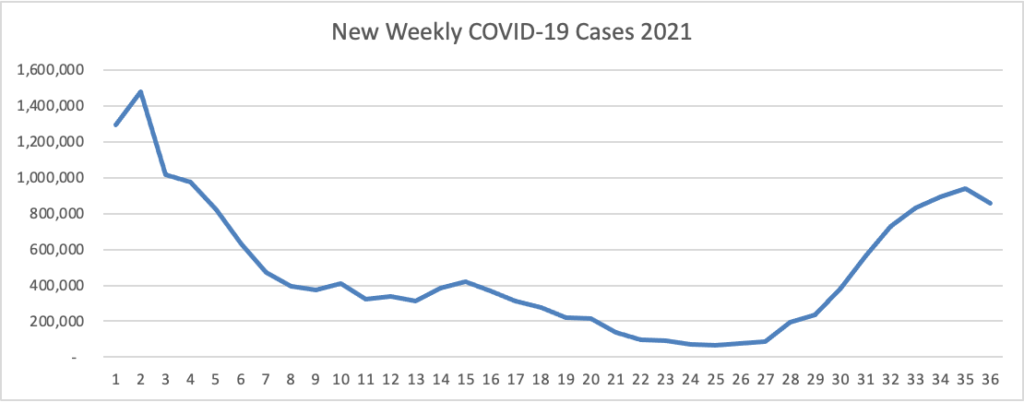
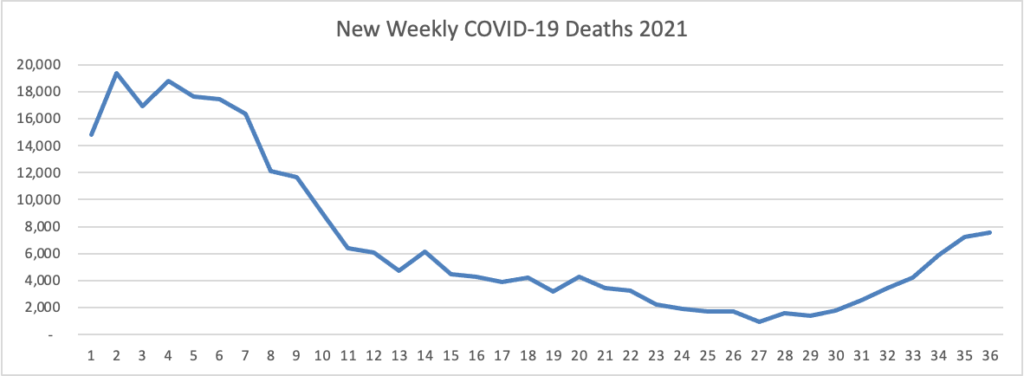
Based on the Centers for Disease Control (CDC) constantly improving COVID data tracker website, here are charts of new weekly COVID-19 cases and deaths using Thursday as the first day of the week. As you can see, new cases trended down last week. Per the CDC, “The current 7-day moving average of daily new cases (136,558) decreased 12.7% compared with the previous 7-day moving average (156,341).” Moreover, “The current 7-day moving average of new deaths (1,077) has decreased 11.3% compared with the previous 7-day moving average (1,214).”

Here are links to the COVID hospitalization statistics and the CDC’s weekly interpretation of its COVID data. Per the CDC, “The current 7-day daily average for September 1–September7, 2021, was 11,754 This is a 4.1% decrease from the prior 7-day average (12,251) from August 25–August 31, 2021.”

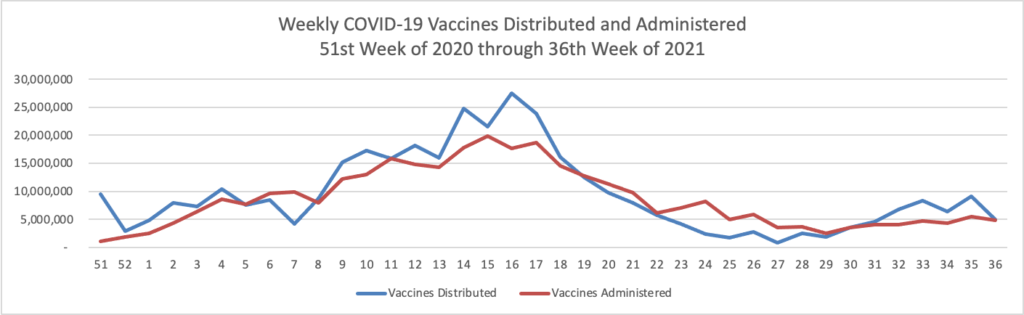
Here is chart of weekly COVID vaccines distributed and administered from the time administration began last December through the 36th week of this year (ending September 8, 2021):

New vaccinations have levelled out at a rate of roughly 5 million per week for the past two months. Per the CDC, “As of September 9, 2021, 92.6% of people ages 65 years or older have received at least one dose of vaccine and 82.2% are fully vaccinated. Over three-quarters (75.3%) of people ages 18 years or older have received at least one dose of vaccine and 64.5% are fully vaccinated. For people ages 12 years or older, 73.4% have received at least one dose of vaccine and 62.5% are fully vaccinated.”

The Food and Drug Administration today released this bulletin about the status of making available a COVID vaccine for young children.

The FDA is working around the clock to support the process for making COVID-19 vaccines available for children. As outlined above, this process is complex and relies on robust manufacturer trials and data, and while we cannot offer a specific date or timeline for when it may be completed for the various manufacturers’ vaccine candidates, we can assure the public we are working as expeditiously as possible to meet this critical public health need and we very much hope to have pediatric COVID-19 vaccines available in the coming months.

The New York Times reports

Federal health officials released new data showing that unvaccinated Americans are 11 times as likely as vaccinated people to die of Covid-19.

Three large studies, published on Friday by the Centers for Disease Control and Prevention, also highlighted the effectiveness of the shots at preventing infection and hospitalizations with the virus.

The research underscored a deep conviction among scientists that vaccine hesitancy and refusal have prolonged the pandemic. The administration’s new plan should stem the flood of infections and return the country to some semblance of normalcy in the long term, several experts said in interviews.

With respect to the President’s vaccination mandates, Gov Exec tells us that

The U.S. Postal Service is not committing to implementing any COVID-19 vaccine mandate—full or partial—for its workforce, with an agency spokesman saying officials will first need to see the fine print of new requirements President Biden has issued. 

Biden’s executive order mandating the vaccines for the federal workforce took a somewhat narrow definition of agencies that carved out USPS, which employs more than 640,000 people. The president on Thursday also announced the Labor Department would put forward a rule directing all employers with more than 100 workers to require their staff to either be vaccinated or submit to weekly COVID-19 testing. USPS said on Friday it was still determining whether the rule would apply to the agency.

From the No Surprises Act front, HHS has issued its proposed rule implementing the Consolidated Appropriations Act 2021 Division BB provisions on air ambulance reporting, health insurer / plan broker compensation reporting and HHS enforcement of the law. Here is a link to a fact sheet on the proposal. The public comment deadline is October 18.

HHS also announced today that its “Health Resources and Services Administration (HRSA), is making $25.5 billion in new funding available for health care providers affected by the COVID-19 pandemic. This funding includes $8.5 billion in American Rescue Plan (ARP) resources for providers who serve rural Medicaid, Children’s Health Insurance Program (CHIP), or Medicare patients, and an additional $17 billion for Provider Relief Fund (PRF) Phase 4 for a broad range of providers who can document revenue loss and expenses associated with the pandemic.” The American Hospital Association was pleased with the news.

Federal News Network has interviewed many current and former federal employees about their memories of September 11, 2001. Check it out as the interviews include two OPM officials. Of course, never forget.

Tuesday’s Tidbits

Photo by Patrick Fore on Unsplash

On the Delta variant front and acccording to the CDC’s COVID Data Tracker, the United States reached two data points today — the number of COVID cases now exceeds 40 million and the percentage of Americans aged 18 and over who have received at least one dose of a COVID-19 vaccine reached 75%.

At the end of 2020, the number of cases according to the CDC stood at 20 million. In his blog, National Institutes of Health Director Francis Collins discusses a recent Nature study estimating that “the true number of [COVID] infections by the end of 2020 at more than 100 million [1]. That’s equal to just under a third of the U.S. population of 328 million. This revised number shows just how rapidly this novel coronavirus spread through the country last year. It also brings home just how timely the vaccines have been—and continue to be in 2021—to protect our nation’s health in this time of pandemic.” It also suggests to the FEHBlog that we may to closer to effective herd immunity in some areas of the U.S. than generally thought.

Also David Leonhardt in today’s New York Times tells us about another way to look at the situation.

The C.D.C. reported a terrifying fact in July: Vaccinated people with the Delta variant of the Covid virus carried roughly the same viral load in their noses and throats as unvaccinated people.

The news seemed to suggest that even the vaccinated were highly vulnerable to getting infected and passing the virus to others. Sure enough, stories about vaccinated people getting Covid — so-called breakthrough infections — were all around this summer: at a party in Provincetown, Mass.; among the Chicago Cubs; on Capitol Hill. Delta seemed as if it might be changing everything.

In recent weeks, however, more data has become available, and it suggests that the true picture is less alarming. Yes, Delta has increased the chances of getting Covid for almost everyone. But if you’re vaccinated, a Covid infection is still uncommon, and those high viral loads are not as worrisome as they initially sounded.

How small are the chances of the average vaccinated American contracting Covid? Probably about one in 5,000 per day, and even lower for people who take precautions or live in a highly vaccinated community. * * *

I will confess to one bit of hesitation about walking you through the data on breakthrough infections: It’s not clear how much we should be worrying about them. For the vaccinated, Covid resembles the flu and usually a mild one. Society does not grind to a halt over the flu.

In Britain, many people have become comfortable with the current Covid risks. The vaccines make serious illness rare in adults, and the risks to young children are so low that Britain may never recommend that most receive the vaccine. Letting the virus continue to dominate life, on the other hand, has large costs.

“There’s a feeling that finally we can breathe; we can start trying to get back what we’ve lost,” Devi Sridhar, the head of the global public health program at the University of Edinburgh, told The Times.

Well put, Mr. Leonhardt, as usual.

From the federal employee benefits front, OPM posted on the Federal Register website today a notice of changes to Federal Group Life Insurance premium rates for “Employee Basic Insurance, Option A (most age bands), Option B (most age bands), Option C (most age bands), and Post-Retirement Basic Insurance. These rates will be effective the first pay period beginning on or after October 1, 2021.”

From the tidbits department

  • Federal News Network reports that “The White House is proposing billions of dollars in supplemental funding for disaster relief and other programs, which it’s asking Congress to attach to a short-term continuing resolution that will be critical toward avoiding a government shutdown at the end of the month. ‘With the end of the fiscal year rapidly approaching, it’s clear that Congress will need to pass a short term continuing resolution to provide more time for the fiscal 2022 process to unfold,’ Shalanda Young, the Office of Management and Budget’s acting director, said Tuesday in a blog post.” 
  • Fierce Healthcare informs us that “The American Medical Association [“AMA”] released updates to its medical codes for 2022 with many tied to new technology services and the administration of COVID-19 vaccines. The AMA made 405 changes in the 2022 Current Procedural Terminology code set, including 249 new codes, 63 deletions and 93 revisions. The changes will take effect Jan. 1. ” The CPT is recognized as a HIPAA electronic transaction code set.
  • AP News reports that “Four companies in the drug industry said Saturday that enough states had agreed to a settlement of lawsuits over the opioid crisis for them to move ahead with the $26 billion deal. An announcement from the three largest U.S. drug distribution companies and a confirmation from drugmaker Johnson & Johnson, which had previously announced that it would move ahead, came Saturday. That was the deadline for the companies to decide whether there was enough buy-in to continue the settlement plan. * * * Together, the settlements are likely to represent the biggest piece of a string of settlements between companies in the drug industry and state and local governments over the addiction and overdose epidemic in the U.S.”
  • Healthcare Dive tells us that “The use of telehealth for patient visits seems to have leveled off at 20% or fewer of all appointments, more than a year and a half after COVID-19 first spurred an unprecedented jump in utilization, according to a new survey from KLAS Research and the Center for Connected Medicine.”
  • The AMA discusses “what doctors wish patients knew about a prediabetes diagnosis,” which of course is a fairly common diagnosis in our country.
  • The Wall Street Journal continues its series on the Future of Everything in healthcare with an article about sensor studded smart clothes. “From a prescription bra that signals cardiac arrest to a mosquito-proof textile, startups and scientists are developing garments for healthier living.”

Friday Stats and More

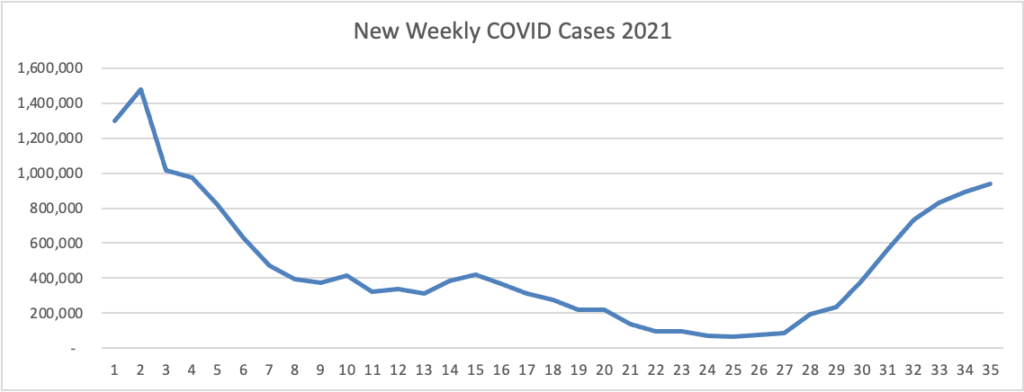
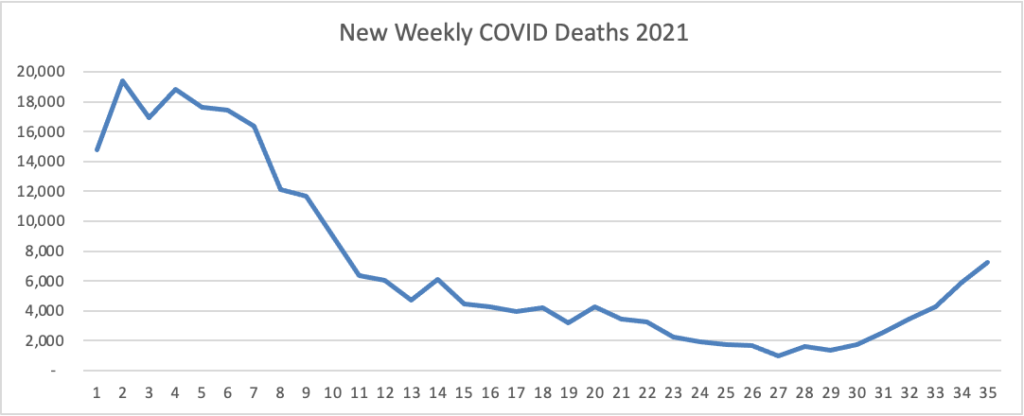
FEHBlog readers, hold onto your hats. The FEHBlog has changed the COVID-19 charts presentations which he had been using since April 11, 2020. He has broken out new weekly COVID-19 cases and deaths into completely separate charts which display only information for 2021. This allows you to appreciate the dramatic vaccination driven plunge in cases and deaths that occurred in the spring of this year and the Delta variant driven surge in cases and to a lesser extent deaths that have occurred since the beginning of July. And hopefully before long we will see a final plunge without another surge.

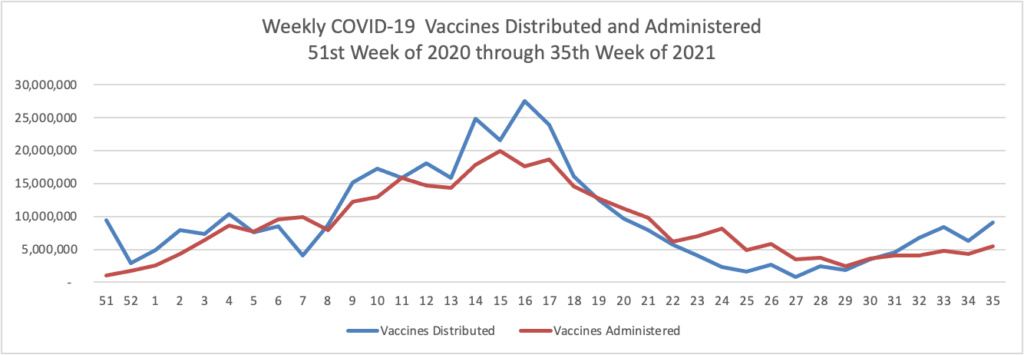
Here’s the usual chart of vaccinations administered and distributed on a weekly basis since mid-December 2020 through this past Wednesday, September 1.

The presentation change was prompted by the David Leonhardt column which the FEHBlog discussed mid-week and this blurb written by John Tozzi that appeared in one of the many Bloomberg emails that show up in the FEHBlog’s email box during the day.

Rewind to mid-March of last year. There was a feeling that a few weeks of sheltering at home, combined with aggressive testing, tracing and isolation, would contain the epidemic in the U.S., much as aggressive actions in China and South Korea had.

That turned out to be wrong, of course. Many experts overestimated Americans’ tolerance for mitigation measures and underestimated the virus’s stealth and persistence. Non-pharmaceutical interventions wouldn’t save us. The only way to end the pandemic was a vaccine.

This spring, with millions of shots administered each day in the U.S., there was hope that the inoculation campaign would put Covid mostly behind us — at least ending the surges that threatened to overwhelm hospitals. But again we were too optimistic about the willingness of Americans to get immunized and failed to account for the resilience of the virus and its variants. * * *

As a nation, the U.S. hasn’t put Covid behind us. The public health emergency formally declared almost 18 months ago remains in place. In its early weeks, it felt like one. Now the state of emergency feels perhaps less urgent but permanent. And that requires a cognitive shift.

But that shouldn’t mean complacency. Most Covid deaths are now preventable, and we should try to prevent them. * * * In places like the U.S., with abundant access to vaccines, we have more power than ever to shape the future course of the pandemic. The question is how we will use it. 

Very well put, Mr. Tozzi.

Also from the Delta variant front, here are a link to the CDC’s COVID-19 hospitalizations chart and a link to the CDC’s COVID Data Tracker Weekly Review which conveniently is issued on Friday afternoons.

Yesterday, the FEHBlog called attention to reports that the Food and Drug Administration wants to scale back the Administration’s COVID vaccination booster campaign set to launch on September 20, contingent upon necessary FDA and CDC approvals. The New York Times today writes at length on this matter. The FEHBlog personally has no problem with the system working.

Federal News Network reports that ‘More details are trickling out from the Biden administration about its vaccine and testing policy for federal employees and contractors. ‘Agencies should not ask federal employees to provide proof of their vaccination status, the Safer Federal Workforce Task Force said in a series of frequently asked questions updated Friday.

Here’s that new FAQ (there were several other new FAQs):

Q: Should agencies request documentation to verify an employee’s vaccination status?

A: Agencies should not request documentation to verify an employee’s vaccination status. If the agency receives a good faith allegation that strongly suggests that an employee made a false statement on the Certification of Vaccination form, the agency may request documentation as part of its investigation into the alleged false statement. If an employee who has attested to being vaccinated exhibits symptoms of COVID-19 illness, the agency should apply its safety protocols, but this is not an appropriate reason to request documentation to verify an employee’s vaccination status.

Federal News Network adds that

The administration’s latest guidance comes as the Government Managers Coalition, a group of five associations that represents federal supervisors, has asked the administration for more guidance and support to implement the new vaccine and testing policy.

“Agencies often interpret OPM guidance in different ways, as each organization views the guidance through different organizational structures and programmatic lenses and lexicons,” the coalition wrote Thursday in a letter to the Safer Federal Workforce Task Force. “This is confusing and problematic for our members who lack central, authoritative guidance.”

The coalition, which includes the Senior Executives Association, Federal Managers Association, Professional Managers Association, Federal Aviation Administration Managers Association and the National Council of Social Security Management Associations, reiterated many of the concerns they expressed to Federal News Network last week.

STAT News informs us that

The Biden administration on Friday unveiled a sweeping new biosecurity plan, outlining a $65 billion proposal to remake the nation’s pandemic preparedness infrastructure in the wake of Covid-19.

The new spending would represent one of the largest investments in public health in American history: During a press briefing, Eric Lander, the White House science adviser, likened the proposal to the Apollo program of the late 1960s.

The immense funding boost would target programs aimed at developing and manufacturing vaccines, treatments, and tests more quickly. It would also provide new money for laboratory capacity, viral detection mechanisms, and early warning systems.

Please Dr. Lander build flexibility and an appreciation of unknown factors in your plans.

Here comes Open Season

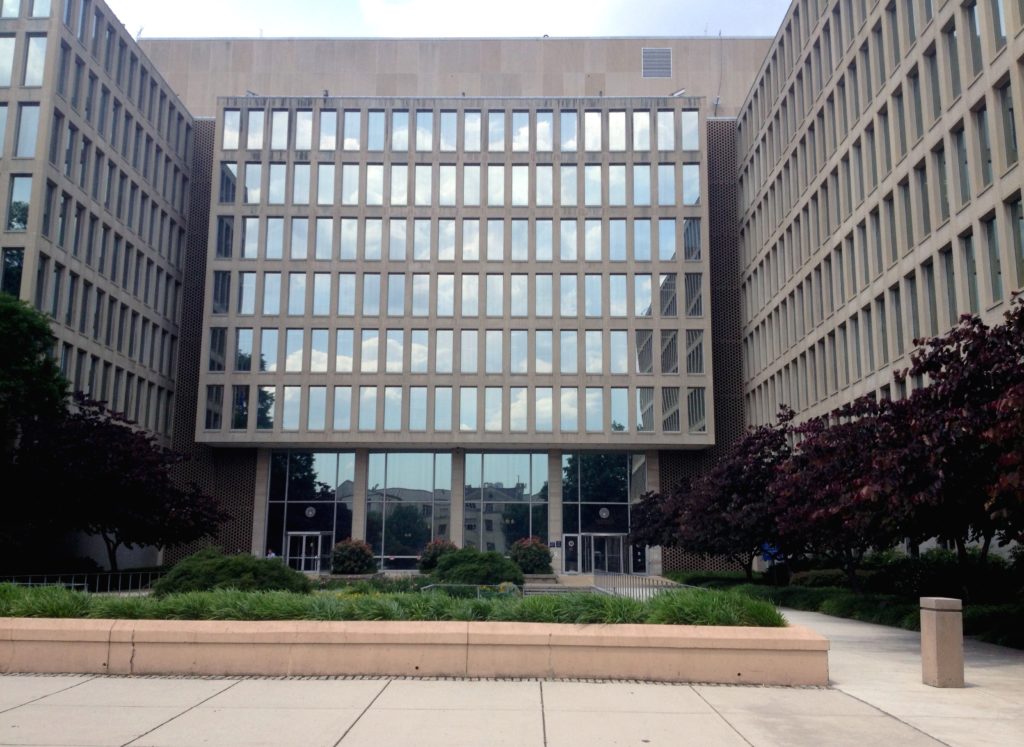
OPM Headquarters a/k/a the Theodore Roosevelt Building

Today OPM issued its first notice about the Federal Benefits Open Season which will run this year from Monday November 8 through Monday December 13.

[Benefits Administration Letter] BAL 21-401 provides guidance on the upcoming Federal Benefits Open Season for the Federal Flexible Spending Account Program (FSAFEDS), Federal Employees Dental and Vision Insurance Program (FEDVIP) and the Federal Employees Health Benefits (FEHB) Program. Attached to this BAL is a sample email and “Circle Round Your Benefits” flyer. This BAL and the attachments will be posted on our website at www.opm.gov/retirement-services/publications-forms/benefits-administration-letters/.

The BAL makes a couple of points worth noting and includes a timeline which also is partially excerpted below:

Employees find Open Season fairs a valuable resource for getting Open Season information. Due to COVID-19, we strongly encourage you to assess how in-person benefit fairs will be impacted. Consider other ways to provide information to employees such as virtual events, webcasts, or webinars. Many health plans host virtual events to provide information about Open Season to their enrollees and others. You may contact health plans for ideas and suggestions on providing information. 

2022 rates announced and posted on OPM website Late September 
BAL 21-403 Significant Plan Changes Anticipated Issue Date: Early-to Mid-October 
Open Season information posted on OPM website Early November 

From the Delta variant front

The Washington Post informs us that

The Food and Drug Administration has scheduled a key meeting on coronavirus boosters with its outside advisers for Sept. 17 — just a few days before the Biden administration’s planned starting date for an extra-shot campaign.

The session, which will be public, could add much-needed clarity and transparency to a decision-making process that some people have criticized as confusing. But it also could fuel more controversy over an administration position some experts regard as premature.

Of course, the Biden administration could reduce the time pressure by postponing its “plan starting date.”

On a related note, The Wall Street Journal reports that

The Food and Drug Administration is considering whether to authorize a lower dose of Moderna Inc.’s Covid-19 vaccine for boosters than the dose given in the first two shots, people familiar with the deliberations said. 

Moderna said Wednesday it is asking the FDA to authorize a 50 microgram dose, half the dosage of the first two shots. Some in the government are leaning toward authorizing the 100 microgram dose, the people said, because of concerns a lower-dose booster might not offer a durable enough boost to counter fast-changing variants of Covid-19.

No final decision has been made, the people said, as the FDA is still reviewing data from studies that tested boosters using the different doses. People who have seen the data said both doses produce a strong immune response.

Presumably a smaller dose would reduce side effects.

CNBC brings us up to date on the other COVID-19 variants of concerns besides Delta.

The CDC is monitoring four variants “of concern,” including delta, which was first detected in India and is the most prevalent variant currently circulating in the U.S.; alpha, first detected in the U.K.; beta, first detected in South Africa, and gamma, first detected in Brazil. A variant of concern is generally defined as a mutated strain that’s either more contagious, more deadly or more resistant to current vaccines and treatments.

It’s also keeping a close watch on four other variants of interest — including lambda, first identified in Peru [and presumably mu, first identified in Columbia] — that have caused outbreaks in multiple countries and have genetic changes that could make them more dangerous than other strains.

Also from the FEHB front —

Fedweek offers short but accurate guidance about OPM’s FEHB disputed claims review process.

Health Payer Intelligence informs us that “The Alliance of Community Health Plans (ACHP) is urging the federal government to take action and lower prescription drug prices with a set of recommended actions.” In addition to recommendations for Medicare Part D and the biosimilar market, ACHP makes broader recommendations such as

Targeting drug companies’ unjustifiable raising of drug prices. At the beginning of 2021, 735 drugs prices increased up to 10 percent without reason. Prescription drug prices often increase faster than the inflation rate, therefore ACHP recommended that drug manufacturers should have to provide rebates for drug price increase above the inflation rate. Drug companies should also have to follow a price transparency rule that would require manufacturers to report and justify price increases, ACHP stated.

The federal government [should] encourage the use of transparent fee-based pharmacy benefit managers (PBMs). Traditional PBMs are typically not transparent about rebates, which can encourage high-cost drug use, whereas transparent fee-based PBMs pass rebates and discounts onto payers and earn revenue through a clear administrative fee.

ACHP may be interested to know that OPM imposed a strict regime of transparent pricing on experience rated FEHB plans ten years ago. Transparent pricing, which OPM continues to fine tune, facilitates OPM audits of PBMs but does not generate substantial new savings for carriers. Instead, transparent pricing shifts PBM fees from a share of rebates and such to “a clear administrative fee” at levels which simply were not charged before 2011. It is important to add that in 2010 OPM also mandated that experience rated carriers rebid their PBM contracts triennially and those market competitions have generated substantial new savings for carriers. Also as the FEHBlog has mentioned, if OPM were to allow FEHB carriers to offer Medicare Part D EGWPs, as Congress authorized in 2003, the resulting savings, in the FEHBlog’s estimation, would generate blockbuster new savings that would actually lower FEHB premiums.

From the miscellany department —

  • MedPage Today tells us that “The FDA approved the injectable, long-acting atypical antipsychotic paliperidone palmitate (Invega Hafyera), a twice-yearly treatment for schizophrenia in adults who have been adequately treated with the 1- or 3-month versions of paliperidone palmitate, Janssen announced.
  • OPM released weather leave guidance today according to Govexec.
  • Healthcare Dive reports that “Four out of six infections routinely tracked at U.S. hospitals rose significantly during the COVID-19 pandemic, according to a Centers for Disease Control and Prevention data analysis published in the journal of the Society for Healthcare Epidemiology of America on Thursday. From 2019 to 2020, major increases were observed in central-line associated bloodstream infections, catheter-associated urinary tract infections, ventilator-associated events and antibiotic resistant staph infections, according to the report.”

Midweek update

Photo by Piron Guillaume on Unsplash

In addition to being Wednesday, today is September 1 which marks the beginning of at least three healthcare related observances”

  • Each September, the American Medical Association’s (AMA) Women Physicians Section (WPS) honors physicians who have offered their time, wisdom and support to advance women with careers in medicine.
  • September is Sepsis Awareness Month. Here is a link to the Center for Disease Control’s Sepsis awareness page.
  • September is also National Recovery Month. The AMA identifies four ways that the Biden Administration can reduce the number of drug overdose deaths.

From the Delta variant front

The FEHBlog’s favorite newspaper columnist is David Leonhardt who writes a morning column for the New York Times. Mr. Leonhardt raises questions often on the FEHBlog’s mind after exploring the question with experts.This morning he pondered whether

the Delta-fueled Covid-19 surge in the U.S. finally peaked?

The number of new daily U.S. cases has risen less over the past week than at any point since June. * * *

Since the pandemic began, Covid has often followed a regular — if mysterious — cycle. In one country after another, the number of new cases has often surged for roughly two months before starting to fall. The Delta variant, despite its intense contagiousness, has followed this pattern. * * *

In the U.S., the start of the school year could similarly spark outbreaks this month. The country will need to wait a few more weeks to know. In the meantime, one strategy continues to be more effective than any other in beating back the pandemic: “Vaccine, vaccine, vaccine,” as [University of Minnesota epidemiologist Michael] Osterholm says. Or as [Johns Hopkins epidemiologist Jennifer] Nuzzo puts it, “Our top goal has to be first shots in arms.”

Hope springs eternal.

Regading increasing the number of vaccinations, Bloomberg reports today that

Vaccine mandates are set to get more common in the workplace. 

A majority of U.S. employers — 52% — are planning or considering requirements for a Covid-19 shot by the end of the year, according to a survey released Wednesday by consultant Willis Towers Watson. That’s more than double the 21% of companies polled that currently have some form of mandate. 

The options vary, ranging from a strict order for all employees to limiting access to certain areas to inoculated workers. About 14% of respondents also said they are weighing a health-care surcharge for people who choose not to get the vaccine, while 1% are planning to impose one, according to the survey of 961 employers, conducted Aug. 18-25.

Also Fierce Biotech explores what’s next in the mRNA pipeline. Principally for the two COVID mRNA vaccine companies with large war chests

Moderna executives tout the company’s pipeline often—so we’ll be brief here. A cytomegalovirus candidate is the furthest along in the company’s prophylactic vaccine program, while other mid-stage assets include a personalized cancer vaccine and a localized regenerative therapeutic for the heart condition myocardial ischemia.

BioNTech, meanwhile, has dozens of assets in development for a host of common conditions: malaria, tuberculosis and even certain allergies. But where the German biotech is really making a mark is in oncology, where dozens of vaccines and therapeutics are in development. Just one is in phase 2: the Roche-partnered melanoma therapy BNT122. That drug is combined with Merck & Co.’s blockbuster Keytruda to treat metastatic melanoma in a study conducted with Roche’s Genentech.

The article also discusses where other large drug manufacturers stand in the developing market.

From the bankruptcy front, the Wall Street Journal reports that

OxyContin maker Purdue Pharma LP won court approval of a $4.5 billion bankruptcy settlement that shields its owners, members of the Sackler family, from lawsuits accusing them of contributing to the nation’s opioid epidemic in exchange for providing funding to combat the crisis.

Judge Robert Drain of the U.S. Bankruptcy Court in White Plains, N.Y., said Wednesday he will confirm a restructuring plan that will transform Purdue into a public benefit company and settle civil lawsuits filed by governments and opioid victims against the drugmaker and its owners. 

The ruling can be appealed by the handful of federal and state authorities that opposed Purdue’s bankruptcy-exit plan and argued at trial that the settlement structure is unconstitutional and the Sacklers aren’t contributing enough of their wealth. Purdue’s family owners collected more than $10 billion from the company between 2008 and 2017, about half of which went to taxes or was reinvested in the business.

From the miscellany front

  • Homeland Security Today informs us that “The Biden Administration, in a collaboration between the General Services Administration, the White House Office of Management and Budget, the Office of Personnel Management, the Cybersecurity and Infrastructure Security Agency, and the White House Office of Science and Technology Policy, announced the U.S. Digital Corps, a new two-year fellowship that will recruit early-career technologists to contribute to high-impact efforts across the federal government. This program will work to advance the Administration priorities of coronavirus response, economic recovery, cybersecurity, and streamlining government services.” Best of luck with this initiative.
  • The Washington Post reports that “Childhood obesity rose significantly during the pandemic,according to a new study. The greatest change was among children ages 5 to 11, who gained an average of more than five pounds, adjusted for height, according to the study published in Journal of the American Medical Association (JAMA) Network. For the average 5-year-old (about 40 pounds), that’s a 12.5 percent weight gain. For the average 11-year-old (about 82 pounds), it’s a 6 percent weight gain, according to the study. Before the pandemic, about 36 percent of 5- to 11-year-olds were considered overweight or obese, and that increased to 45.7 percent. ‘Significant weight gain occurred during the covid-19 pandemic among youths in Kaiser Permanente Southern California, especially among the youngest children,’ the study concluded. ‘These findings, if generalizable to the U.S., suggest an increase in pediatric obesity due to the pandemic.’” No bueno.
  • Employee Benefits News offers an engaging article titled “Affordable ways to help your employees tend to their mental health.

Tuesday Tidbits

Photo by Patrick Fore on Unsplash

From the Delta variant front —

Medscape reports on yesterday’s CDC Advisory Committee on Immunization Practices meeting:

“Vaccines remain effective in preventing hospitalization and severe disease but might be less effective in preventing infection or milder symptomatic illness,” Sara Oliver, MD, the CDC scientist who presented the information [about the mRNA vaccines], told the committee.

In a new data analysis released by the CDC on Sunday, unvaccinated adults were 17 times more likely to be hospitalized than vaccinated adults. Hospitalization rates were higher for unvaccinated people in all age groups.

Among the fully vaccinated, people who were hospitalized were much older, more likely to be nursing home residents and more likely to have three or more underlying medical conditions. Nearly a third had immunosuppressive conditions.

Healthcare Dive tells us that

The U.S. government will resume distribution of Eli Lilly’s COVID-19 antibody drug combination in a number of states, HHS said Friday, as cases and hospitalizations in the U.S. are driven higher by the spread of the delta variant.The decision comes roughly two months after administration of Lilly’s therapy was halted by U.S. officials due to concerns of reduced efficacy against coronavirus infections stemming from the beta and gamma variants. Those are now much less prevalent compared with delta, which laboratory testing has shown remains susceptible to treatment with the dual-antibody therapy, HHS said.

Fierce Pharma reports that

Last week’s FDA approval of Pfizer’s Comirnaty vaccine boosted consumer confidence among both vaccinated and unvaccinated people.

A Harris Poll survey over the weekend found that 80% of Americans who were aware of the approval now have more confidence in it. Even more encouraging? Almost half (49%) of unvaccinated people who heard about the approval said they will “probably” or “definitely” get vaccinated.

Overall awareness of the Pfizer approval was high—79% of those surveyed by The Harris Poll were aware of the FDA thumbs-up.

From the telehealth front, Kaiser Health News discusses re-emerging state law barriers to telehealth. “’The whole challenge is to ensure maximum access to health while assuring quality,’said Barak Richman, a Duke University law professor, who said laws and policies haven’t been updated to reflect new technological realities partly because state boards want to hang onto their authority.” The article provides an overview of options available to doctors and state boards.

From the miscellany front

  • Beckers Hospital Review unveils six big ideas in health innovation. For example, Jason Joseph. Senior Vice President and Chief Digital and Information Officer at Spectrum Health (Grand Rapids, Mich.). As we innovate, we are forcing hidden barriers into the light via experimentation. We saw so many of these barriers uncovered within health care, such as lack of connectivity, digital competency, and the need for comprehensive managed workflow. We have shined a spotlight on how much of healthcare relies on people and inconsistent manual processes to get through the system. That needs to change, and that also requires changing a leader’s traditional mindset.
  • The Agency for Healthcare Quality and Research is offering a toolkit to help healthcare providers and possible health plans get patients and members engaged with the diagnosis process.

The toolkit contains two strategies, Be The Expert On You and 60 Seconds To Improve Diagnostic Safety. When paired together, these strategies enhance communication and information sharing within the patient-provider encounter to improve diagnostic safety. Each strategy contains practical materials to support adoption of the strategy within office-based practices.

Be The Expert On You is a patient-facing strategy that prepares patients and their families to tell their personal health stories in a clear, concise way. Research suggests that 79 percent of diagnostic errors are related to the patient-clinician encounter and up to 56 percent of these errors are related to miscommunication during the encounter. Environmental scan findings show that inviting patients to share their entire health story, uninterrupted, and in a way that gives clinicians the information they need can reduce diagnostic errors.

60 Seconds To Improve Diagnostic Safety prepares providers to practice deep and reflective listening for one minute at the start of a patient-encounter. Research suggests that patients are interrupted by their providers in the first 11 to 18 seconds of telling their diagnostic story. Diagnostic safety can be improved when a provider allows a patient to tell his or her health story without interruption for one minute, and then asks questions to deepen understanding.

  • Not every innovative idea makes sense to implement though. The President and Democrat leadership in Congress want the Centers for Medicare Services to “negotiate” drug prices for Medicare Part D plans. Regulatory Focus informs us that “A new drug development model released by the Congressional Budget Office (CBO) estimates a Medicare drug pricing bill like the one proposed by Democrats in the US House of Representatives could result in between 21 and 59 fewer drugs brought to market over the next three decades.”

Monday Roundup

Photo by Sven Read on Unsplash

From the Delta variant front, the CDC’s Advisory Committee on Immunization Practices met today. It turns out that the principal topic at the meeting was reviewing the Food and Drug Administration’s final marketing approval for the Pfizer-BioNTech COVID-19 vaccine. ACIP ratified that decision, which was a foregone conclusion.

The Wall Street Journal adds

Health experts advising the U.S. government on vaccines expressed initial support for giving booster shots to people vaccinated against Covid-19, starting with healthcare workers, nursing-home residents and others immunized earliest.

Members of the Advisory Committee on Immunization Practices, or ACIP, on Monday indicated their agreement with the Biden administration’s plans to offer the extra doses. Yet they said the priority should remain increasing vaccinations of unvaccinated people, and that boosters shouldn’t distract or impede from doing that.

When giving boosters, some panel members added, the priority should be preventing severe disease in people at highest risk of becoming sick with Covid-19, as opposed to preventing infections.

For more information, here’s a link to the presentation slides for today’s ACIP meeting.

OPM helpfully sent FEHB plan carriers the following standard guidance to FEHB carriers today about Hurricane Ida:

Due to Hurricane Ida impacting the Gulf Coast and connecting states, we remind you that under Section 2.2 BENEFITS PROVIDED, you are authorized, “To pay for or provide a health service or supply in an individual case which does not come within the specific benefits provisions of the contract, if the Carrier determines the benefit is within the intent of the contract, and the Carrier determines that the provision of such benefit is in the best interest of the Federal Employees Health Benefits Program.”

If you decide to apply Section 2.2, we ask that you demonstrate maximum flexibility, including the following:

·         Relax certain provisions such as pre-certification requirements that the plan must be notified within 2 business days of an emergency admission.

·         Relax requirements about notification and levels of benefit payment if victims are taken to non-plan and/or non-PPO hospitals or other treatment centers.

·         Allow certain FEHB members to get additional supplies of medications as backup, if necessary.

·         Though charges for work-related injuries sustained by Federal workers are payable by the Office of Workers’ Compensation Programs (OWCP), we are encouraging FEHB plans to provide immediate payment and seek subsequent reimbursement from OWCP.

Today, the Department of Health and Human Services announced the establishment an Office of Climate Change and Health Equity. The Wall Street Journal notes that “The new office is likely to spur initiatives touching on many aspects of healthcare, HHS officials announced Monday. It is expected to offer protections for populations most at risk—including the elderly, minorities, rural communities and children, and the office could eventually compel hospitals and other care facilities to reduce carbon emissions.”

STAT News identifies three trends divined from research on telehealth utilization by Medicare beneficiaries during the COVID-19 pandemic. The FEHBlog’s attention was drawn to this trend:

Telemedicine use has not varied substantially by race and ethnicity. Many commenters * * * have expressed concern that telemedicine will widen disparities of care. Surprisingly, this has not by borne out by the data. Through the end of 2020, we observed no substantive differences in the proportion of beneficiaries using telemedicine by race and ethnicity: 51% of non-Latino white beneficiaries, 55% of Black beneficiaries, and 56% for both Latino and Asian beneficiaries.

This pattern may in part reflect the fact that people of color are more likely to live in urban areas, where the use of telemedicine is higher. Beneficiaries living in large metropolitan counties were substantially more likely to use telemedicine than those living in rural areas.

STAT News also offers a fascinating peak inside Pfizer’s Pearl River (NY) Research Center where a “team of “variant hunters,” as they call themselves, race to track changes in the fast-mutating SARS-CoV-2. A “virus farmer” grows the latest variants so researchers can test how they fare against the vaccine. And a colleague known as the “graphing unicorn” converts the data into intelligible results overnight.” Extraordinary.

Friday Stats and More

Based on the Centers for Disease Control’s COVID-19 Data Tracker website, here is the FEHBlog’s chart of new weekly COVID-19 cases and deaths over the 14th week of 2020 through 34th week of this year (beginning April 2, 2020, and ending August 25, 2021; using Thursday as the first day of the week in order to facilitate this weekly update):

and here is the CDC’s latest overall weekly hospitalization rate chart for COVID-19:

The FEHBlog has noticed that the new cases and deaths chart shows a flat line for new weekly deaths  because new cases significantly exceed new deaths. Accordingly here is a chart of new COVID-19 deaths over the period (April 2, 2020, through August 25, 2021):

Finally here is a COVID-19 vaccinations chart over the period December 17, 2020, through August 25, 2021, which also uses Thursday as the first day of the week:

The cases, hospitalizations, and death charts move continue to move in the wrong direction. New vaccinations remain steady as people recognize that the Delta variant is more aggressive than the 2020 wave. If there is any bright side it is that the elderly (age 65 and older) who are at the greatest risk of death from COVID-19 are the most vaccinated group in the U.S. with 81.5% fully vaccinated and another 10% at the first dose stage.

For more stats, here’s a link to the CDC’s weekly interpretative review. “As of August 26, 2021, 203 million people in the United States have received at least one dose of a COVID-19 vaccine. 172 million people are fully vaccinated. That’s 60.8% of the eligible population (12 years and older). * * * COVID-19 vaccines remain the most powerful tool we have against COVID-19, making it critical that all people get vaccinated as soon as they are eligible. To find a vaccine provider near you, visit vaccines.gov or your state or local public health department.”

The CDC also issued its 2021-22 flu season vaccination recommendations today.

Routine annual influenza vaccination is recommended for all persons aged ≥6 months who do not have contraindications. * * * Balancing considerations regarding the unpredictability of timing of onset of the influenza season and concerns that vaccine-induced immunity might wane over the course of a season, particularly for older adults, vaccination is recommended to be offered by the end of October. * * * Children aged 6 months through 8 years who require 2 doses (i.e., children in this age group who have never received influenza vaccine or who have not previously received a lifetime total of ≥2 doses; see Children Aged 6 Months Through 8 Years) should receive their first dose as soon as possible after the vaccine becomes available to allow the second dose (which must be administered ≥4 weeks later) to be received, ideally, by the end of October. Children of any age who require only 1 dose for the season should also ideally be vaccinated by the end of October; vaccination of these children may occur as soon as vaccine is available because there is less evidence to suggest that early vaccination is associated with waning immunity among children compared with adults.

Also from the Delta variant front

  • The Numbers columnist in the Wall Street Journal reports that “Medical studies often use thousands of volunteers. But sometimes good things come in small packages—like a handful of people willing to contract a deadly virus. Researchers in the U.K. have deliberately infected 30 volunteers with the virus that causes Covid-19, in the first human challenge study of the disease. Infecting the volunteers—who are healthy, unvaccinated and range in age from 18 to 30—will allow the scientists to observe in real time how the virus attacks the body and, from the moment of exposure, how the immune system responds. * * * [In contrast to a large clinical study involving the use of placebo] a human challenge study of a relatively small number of participants offers precise answers to specific questions, often related to immune response. Today, human challenges conducted under the supervision of institutional review boards are routinely used to research diseases such as influenza, malaria, cholera, salmonella, shigellosis and norovirus.”
  • The Journal also reports that British scientists are making progress in carefully growing the Delta variant for use in these human challenges. The U.S. is not conducting human challenges involving COVID-19 at this time.
  • The Journal also informs us that “U.S. intelligence agencies are unable to determine conclusively how the Covid-19 pandemic emerged, a summary of a classified report released Friday said.” The article concludes “In a July 27 letter to Mr. Biden, the Democratic and Republican leaders of the Senator Foreign Relations and Intelligence committees urged the president to carry on with the investigation until the intelligence community had reached conclusions on the origin of the pandemic with a high degree of confidence. The letter urged that the inquiry examine what U.S. government funding was provided to the Wuhan Institute of Virology for advanced virus research.”

In other news —

  • The Federal Times reports that “Federal employees will get a total 2.7 percent pay raise in 2022, as President Joe Biden informed Congress Aug. 27 that he intends to exercise his authority to determine federal pay rates during a state of emergency.” The increase will breaks down into a 2.2% general increase and a 0.5% locality pay increase.
  • Fierce Healthcare tells us that “OptumRx has released its quarterly look at the drug pipeline, and two of the therapies highlighted in the report target fairly common conditions. Finerenone, or the brand name Kerendia, was approved by the Food and Drug Administration on July 9. The drug treats chronic kidney disease and type 2 diabetes. Some 26.8 million Americans have been diagnosed with diabetes, and one in three eventually develop some kind of kidney disease. Bill Dreitlein, senior director of pipeline and drug surveillance at OptumRx, told Fierce Healthcare that the drug will be entering a market where many patients are already treated by low-cost therapies. “With the entrance of this drug, some patients are going to shift from a low-cost treatment to a higher-cost treatment,” he said. The other drugs highlighted in the report are: (1) Atogepant, which is pending a brand name, a drug that treats episodic and chronic migraines; (2) Odevixibat, or the brand name Bylvay, which treats progressive familial intrahepatic cholestasis, a liver disease, and (3) Maralixibat, which also has yet to set a brand name, treats Alagille Syndrome, a rare genetic disease of the liver.
  • Healthcare Dive informs us that “COVID-19 hospitalizations continue to rise as coronavirus cases surge across the U.S. This once again puts pressure on hospital operations and will likely put downward pressure on nonprofit hospital margins, according to a new report from Fitch Ratings. In some areas, hospitalizations are higher than they were during previous surges.”