Congress is back on Capitol Hill this week for floor voting and Committee business. Roll Call notes
Lawmakers return next week for a busy June, with Senate Republicans tested by politically wrought gun talks and President Joe Biden dealing with a spate of crises and headaches.
The Hill identifies the five “looming disputes” out of 33 pending disputes that the Supreme Court is expected to decide this month which typically is the last month of its October 2021 Term. Although not found among the Hill’s cases, here’s a Medicare secondary payer act case that has not been decided yet and could impact FEHBP.
Issue(s): (1) Whether a group health plan that provides uniform reimbursement of all dialysis treatments observe the prohibition provided by the Medicare Secondary Payer Act that group health plans may not “take into account” the fact that a plan participant with end stage renal disease is eligible for Medicare benefits; (2) whether a plan that provides the same dialysis benefits to all plan participants, and reimburses dialysis providers uniformly regardless of whether the patient has end stage renal disease, observe the prohibition under the Medicare Secondary Payer Act that a group health plan also may not “differentiate” between individuals with end stage renal disease and others “in the benefits it provides”; and (3) whether the Medicare Secondary Payer Act is a coordination-of-benefits measure designed to protect Medicare, not an antidiscrimination law designed to protect certain providers from alleged disparate impact of uniform treatment.
The Western U.S. region, which includes mountain and coastal states, has recently eclipsed the Northeast to have the nation’s highest rate of known cases per 100,000 people, a Wall Street Journal analysis of CDC data shows. Recent increases in parts of the West come amid declines in the Northeast.
NPR Shots provides more background on the Novovax Covid vaccine that the FDA advisory committee will consider for emergency use authorization this Tuesday. NPR Shots adds
The federal government is trying to decide what kind of booster people should get in the fall to try to blunt the severity of a possible new wave of infections next winter. The panel of FDA advisers will meet late this month to consider which strains of the coronavirus should be targeted by updated vaccines.
From the mental health coverage front, the American Hospital Association released a TrendWatch about the pandemic’s adverse impact on mental health. Also, Healthcare Dive informs us that while telehealth use dropped in February and March 2022, according to a Fair Health study,
Teletherapy continued to remain robust, snagging the top procedure spot for telehealth visits in March and representing 26% of virtual claim lines, the report noted. Mental health conditions claimed 65% of diagnoses across all regions. Likewise, social workers remained the most popular specialty in telehealth claims for the second month in a row.
From the value-based care front, Health Payer Intelligence discusses how payers can move providers away from fee-for-service contracts to value-based contracts. It’s worth a read.
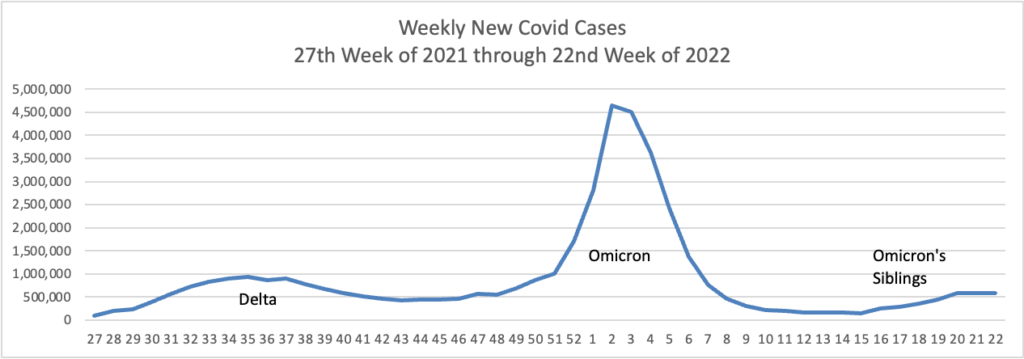
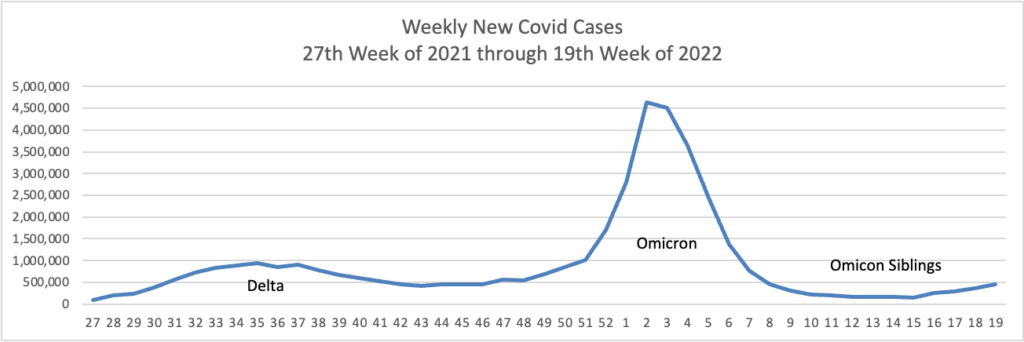
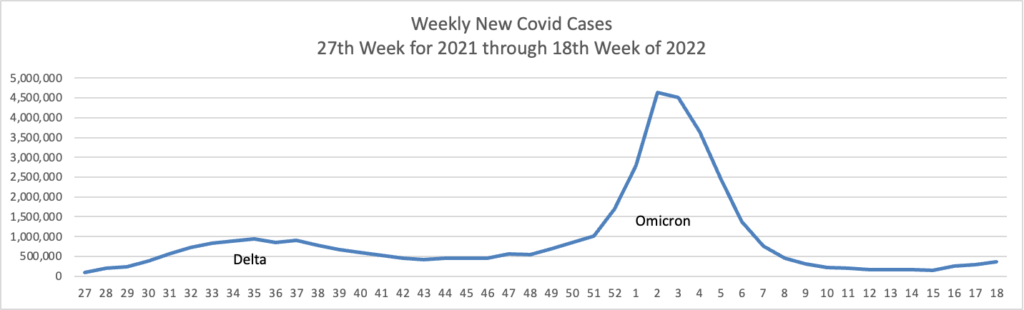
Based on the Centers for Disease Control’s Covid Data Tracker and using Thursday as the first day of the month, here is the FEHBlog’s weekly chart of new Covid cases from the 27th week of 2021 through the 22nd week of 2022:
The CDC’s weekly review of its Covid statistics explains “As of June 1, 2022, the current 7-day moving average of daily new cases (100,684) decreased 8.5% compared with the previous 7-day moving average (110,081).”
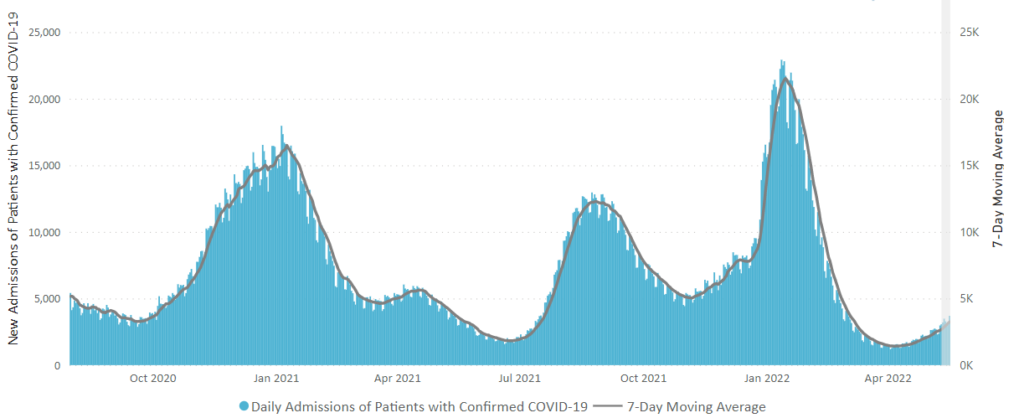
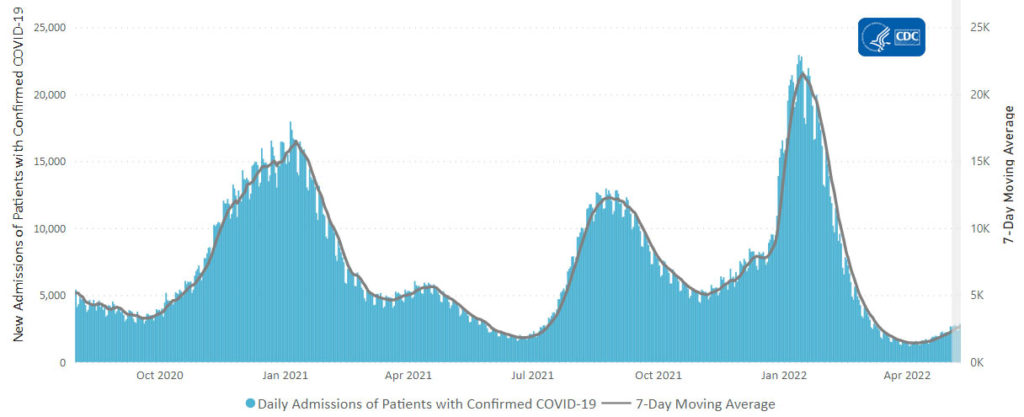
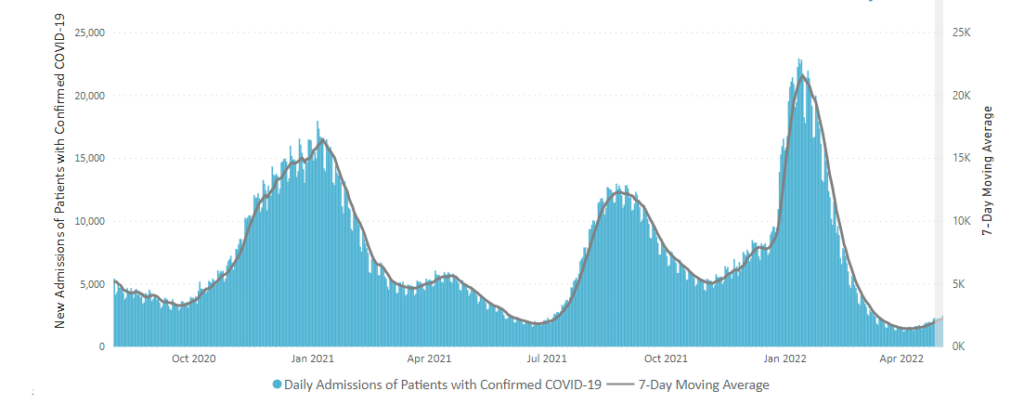
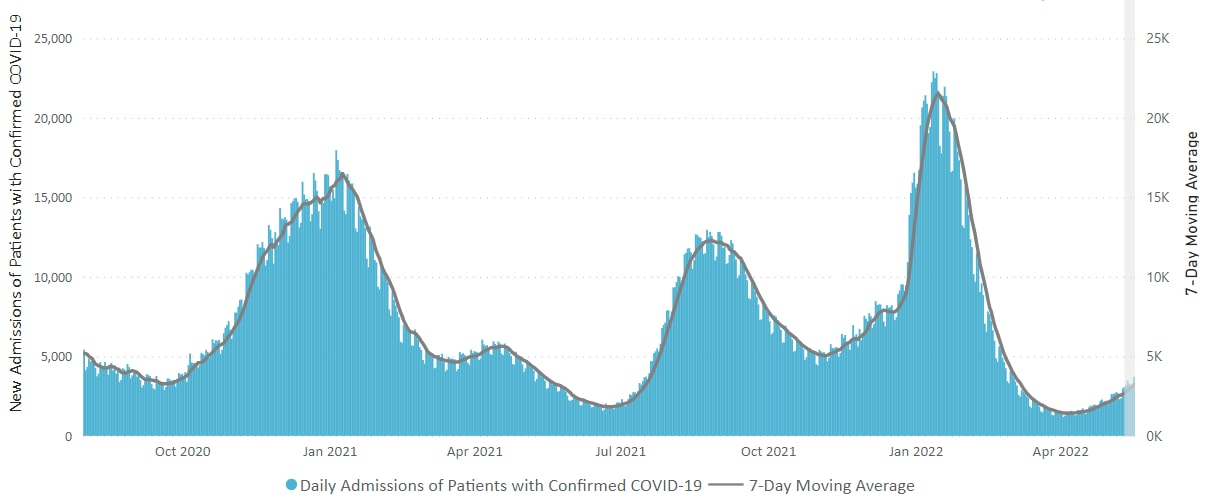
Here’s the CDC’s current chart of new Covid hospitalizations:
The CDC’s weekly statistical review notes that “The current 7-day daily average [of new Covid hospitalizations] for May 25–31, 2022, was 3,789. This is a 4.7% increase from the prior 7-day average (3,619) from May 18–24, 2022.
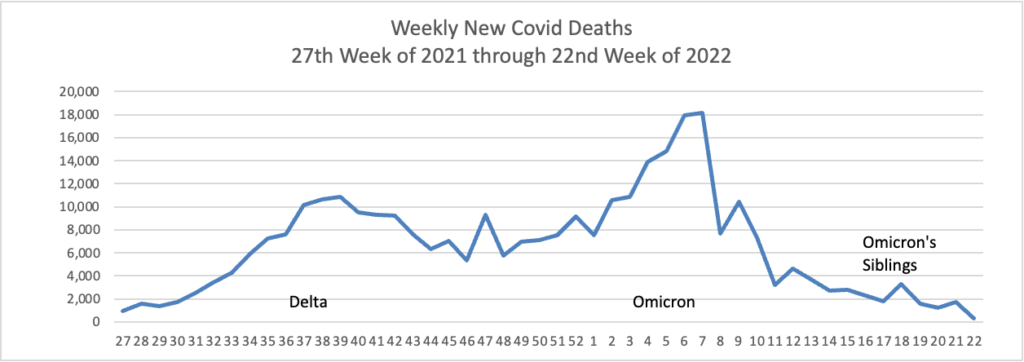
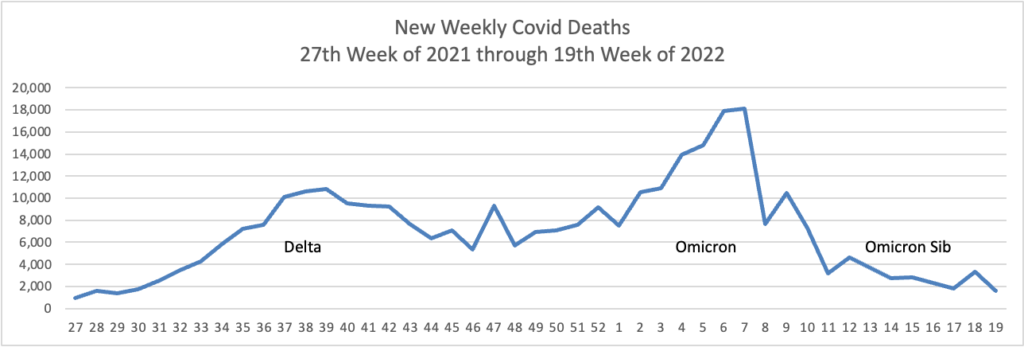
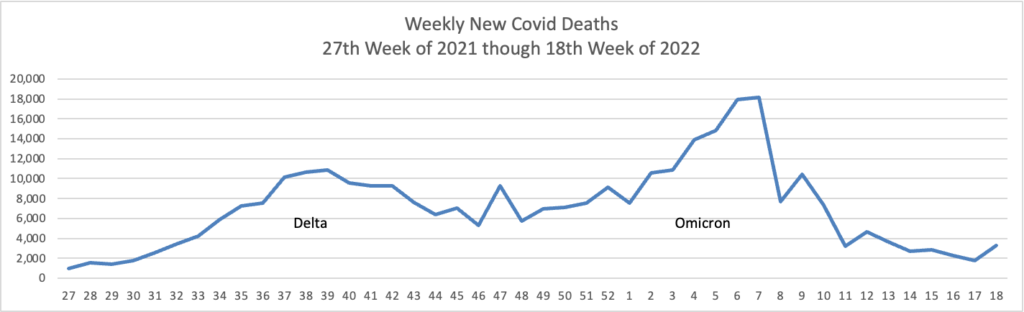
Here’s the FEHBlog’s weekly chart of new Covid deaths from the 27th week of 2021 through the 22nd week of 2022:
The CDC’s weekly statistical review adds “The current 7-day moving average of new deaths (244) has decreased 23.1% compared with the previous 7-day moving average (318).”
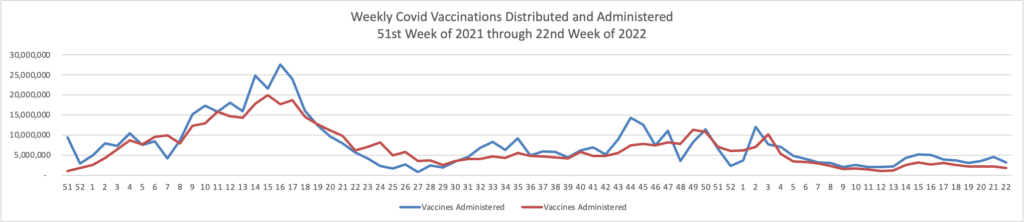
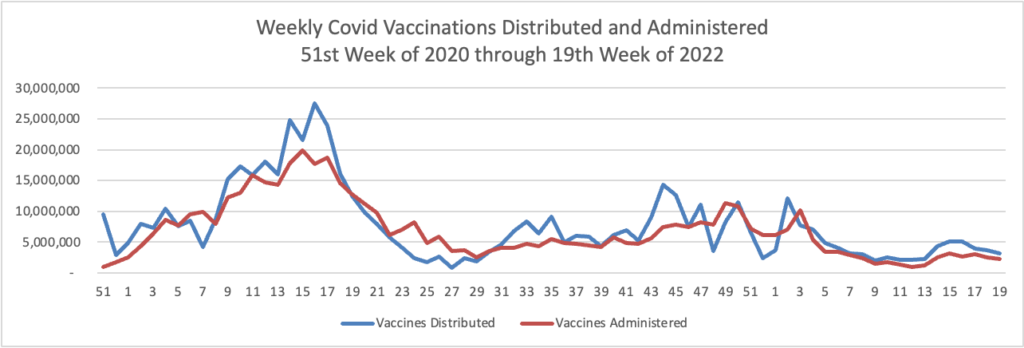
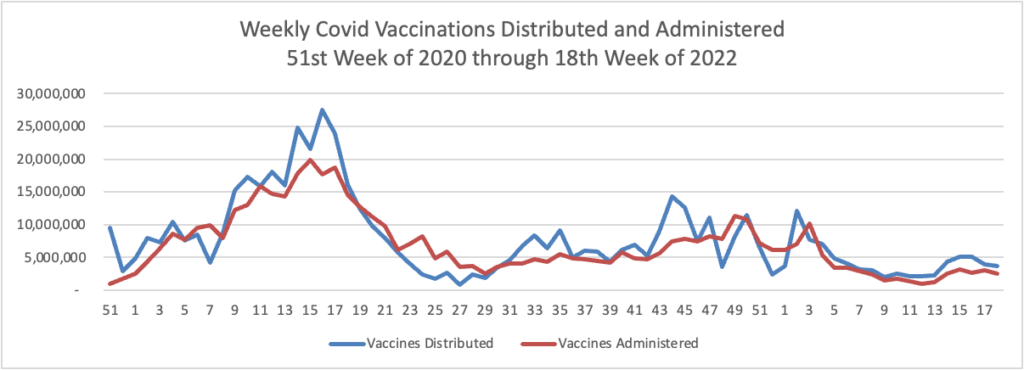
Here’s the FEHBlog’s weekly chart of Covid vaccinations distributed and administered from the beginning of the vaccination era in December 2020 through the 22nd week of 2022.
Overall, about 258.7 million people, about 221.4 million people, or 66.7% of the total U.S. population, have been fully vaccinated.* Of those fully vaccinated, about 103.5 million people have received a booster dose,** but 49.0% of the total booster-eligible population has not yet received a booster dose. As of June 1, 2022, the 7-day average number of administered vaccine doses reported (by date of CDC report) to CDC per day was 343,662, a 9.5% decrease from the previous week.
As of June 2, 2022, there are 240 (7.45%) counties, districts, or territories with a high COVID-19 Community Level, 733 (22.76%) counties with a medium Community Level, and 2,247 (69.78%) counties with a low Community Level. This represents a slight (−0.53 percentage points) decrease in the number of high-level counties, a small (+1.37 percentage points) increase in the number of medium-level counties, and a corresponding (−0.84 percentage points) decrease in the number of low-level counties. Fifty-one (98.1%) of 52 jurisdictions had high- or medium-level counties this week.
Novavax Inc.’s vaccine was 90% effective at preventing Covid-19 in its pivotal trial, but the performance came before the emergence of the Omicron variant that has eluded vaccines more than earlier strains, U.S. health regulators said.
The Food and Drug Administration also expressed concern Friday that six people developed heart-inflammation conditions known as myocarditis and pericarditis, out of about 40,000 people who had taken Novavax’s vaccine during various studies.
The agency released its evaluation of Novavax’s Covid-19 vaccine ahead of a meeting of outside advisers who are scheduled to discuss next week whether the agency should recommend authorization of the shot.
The FDA staff’s appraisal suggests the vaccine could face a tough round of questioning from advisers weighing the shot’s uncertain efficacy against Omicron with potential heart risks.
This suggests an unfortunate outcome. The Novovax vaccine was developed using a traditional approach may be acceptable to the vaccine inquisitive.
In healthcare business news
Health Leaders Media informs us “Health insurers are not holding up their end of the bargain on mutually accepted prior authorization reforms, according to a new physician survey by the AMA.” The FEHBlog is growing concerned that the AMA is winning the prior authorization war.
Fierce Healthcare tells us “Optum has invested heavily in building out its provider enterprise. But executives at UnitedHealth Group say it’s still early days for the endeavor.”
Healthcare Dive reports “The Federal Trade Commission is suing to block two separate hospital mergers, the agency said Thursday. The FTC has sued to block HCA Healthcare’s acquisition of Steward Health Care System, alleging that the deal would reduce competition in Utah and ultimately raise prices. In another suit, the FTC is moving to block RWJBarnabas Health from acquiring Saint Peter’s Healthcare in New Jersey, alleging ‘overwhelming evidence’ that the deal would harm patients in the form of less choice and higher prices.”
The Healthcare Dive article adds
The FTC has now challenged numerous hospital deals this year following its latest action.
Rhode Island’s two largest health systems abandoned plans to merge in February about a week after the FTC sued to block the deal.
New Jersey’s largest health system, Hackensack Meridian Health, lost its appeal challenging the FTC’s move to prevent a tie-up with Englewood Hospital, one of the last independent hospitals in the area.
Bristol Myers Squibb is buying biotech Turning Point Therapeutics, announcing Friday a $4.1 billion deal that will give the pharmaceutical company an experimental drug that targets mutations found in lung cancer and other solid tumors.
The deal values Turning Point at $76 a share, more than double the $34.16 at which shares closed on Thursday and four times the biotech’s $18 initial public offering price in 2019. Yet the buyout price is well below the company’s peak of $133 a share in February 2021, which gave it a market value of $6.6 billion.
The company’s lead drug, called repotrectinib, has advanced through Phase 2 testing in lung cancer patients whose tumors harbor a mutation called ROS1. Repotrectinib would compete against Roche’s Rozlytrek, if approved. Bristol Myers expects to gain Food and Drug Administration clearance in the second half of 2023.
As the industry puts a focus on mental health coming out of COVID-19, a new study suggests that loneliness may be a key place to start.
Research from Cigna and Morning Consult finds that more than half (58%) of U.S. adults would be considered lonely. This is on par with pre-pandemic research, which found that 61% of adults are lonely, and made for a seven percentage point increase from 2018.
Loneliness and mental health issues are closely linked, according to the study. Adults with mental health concerns were twice as likely to feel lonely compared to those with strong mental health. The study also found that minorities and younger people were also more likely to be dealing with loneliness.
Three-quarters (75%) of Hispanic adults and 68% of Black adults are classified as lonely, according to the study, figures both substantially higher than the rate of loneliness in the general population. Seventy-nine percent of adults aged 18 to 24 said they feel lonely, compared to 41% of seniors aged 66 and over.
The FEHBlog wishes his readers a weekend full of family and friendship.
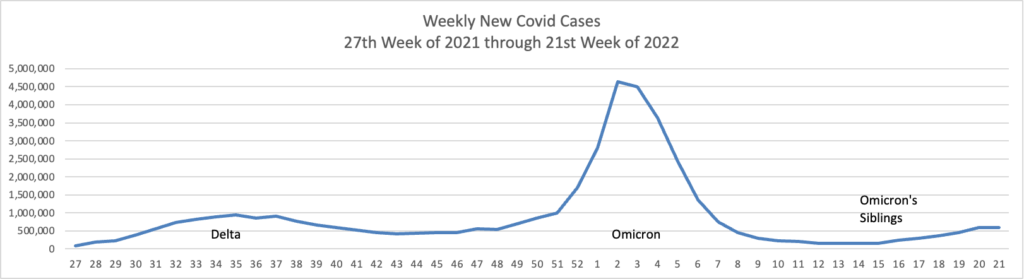
Based on the CDC’s Covid Data Tracker, and using Thursday as the first day of the week, here is the FEHBlog’s weekly chart of new Covid cases from the 27th week of 2021 through the 21st week of 2022:
Reliable estimates of case counts are particularly relevant with the U.S. in the midst of yet another Covid-19 wave. By official case counts, it is a modest wave, at roughly 110,000 infections a day, according to the CDC. That is smaller than the 165,000 daily cases reported during the Delta wave, or the 250,000 a day during the 2020-21 winter.
But estimates of the true number of infections, correcting for undercounting, suggest the U.S. might be experiencing the second-largest wave of Covid-19 infections since the pandemic began.
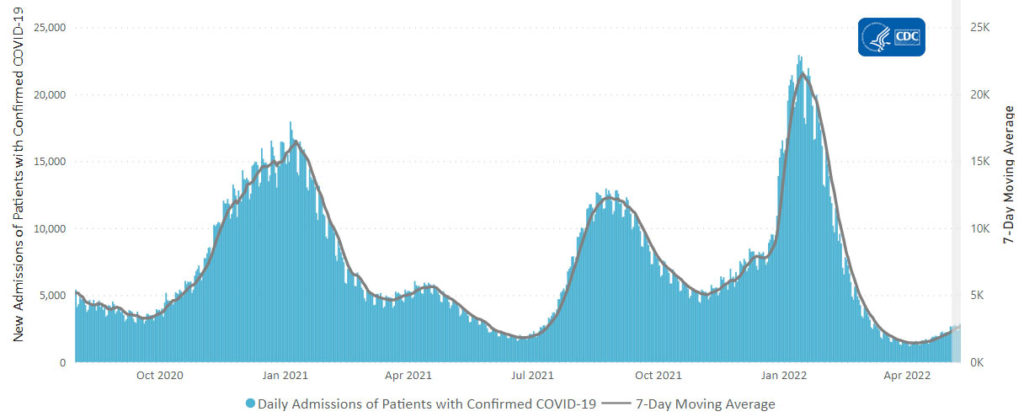
Here’s the CDC’s weekly chart of new Covid hospitalizations.
Hospitalization numbers also aren’t a perfect gauge. Someone can break a leg and test positive in the emergency room for a mild case of Covid-19. That case becomes a confirmed coronavirus hospitalization—and a strain on the hospital’s bed counts and personal-protective-equipment supplies—but not necessarily a severe case.
In Massachusetts, hospitals have begun reporting whether Covid-19 is the primary reason someone is in the hospital—and in January about 50% of cases were. It is hard to pinpoint how similar Massachusetts would be to other states, but it offers a further example of how better counting could improve assessment of the pandemic.
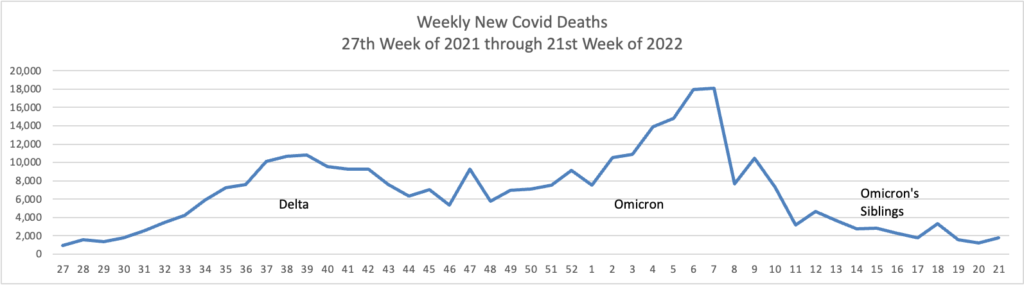
Here’s the FEHBlog weekly chart of new Covid deaths again from the 27th week of 2021 through the 21st week of 2022:
Covid-19 deaths in the U.S. are hovering near the lowest levels since the pandemic hit, showing how a population with built-up immune protection is less at risk of severe outcomes even as another wave of infections flows through the country.
The nearly 300 deaths reported daily are again more concentrated among older people, underscoring hazards for the more vulnerable while the overall population appears less at risk.
Particularly vulnerable people, such as those who are older and immunocompromised, will likely always have some risk of death from a Covid-19 infection, doctors and public-health experts said. Increasing booster rates and access to treatments, in addition to taking certain precautions, can help lower the threat presented by the virus, they said.
White House officials said on Thursday that they were introducing new models for distributing Paxlovid, the Covid-19 oral medication made by Pfizer, in an effort to get the treatment to more people and keep coronavirus death rates relatively low even as cases increase.
The federal government will start reimbursing a clinic in Providence, R.I., for evaluating patients who test positive and immediately prescribing Paxlovid to those eligible for it — the first of what the White House said would be a series of federally supported sites, with others set to open in New York and Illinois. Federal workers are also being sent to state-run testing sites in Minnesota, transforming them into “test-to-treat” locations, the White House said.
“Fundamentally, what we’re trying to do is get to a point where Covid deaths are largely preventable, and I think we’re pretty close to there,” Dr. Ashish K. Jha, the White House Covid-19 response coordinator, said in an interview Wednesday evening. “Deaths from this disease really should become increasingly rare.”
STAT News offers an interesting look into how scientists assess the level of Covid resistance to Paxlovid.
Resistance is the hobgoblin of antiviral medicine, even with antivirals as effective as Paxlovid. After doctors deployed nearly every new virus-killing infusion or pill in history, strains popped up — either immediately or eventually — with machinery warped in just the right way to evade the threat.
Exactly how much of a problem resistance will be for Paxlovid is complicated. In some patients, the coronavirus will inevitably find ways to evade the pill, as it did prior Covid-19 drugs.
“If there is anything we know about viruses and antiviral drugs is that eventually we will see some sort of resistance,” Andrew Pavia, chief of pediatric infectious diseases at University of Utah Health, said in an email.
What’s less clear, Pavia and other experts say, is whether any resistant variants will spread widely. The coronavirus may have particular difficulty getting around Paxlovid compared to other drugs because patients take it for only five days and because it targets a protein the virus can’t easily change. Any mutation or modification the virus makes may impair its ability to replicate or survive.
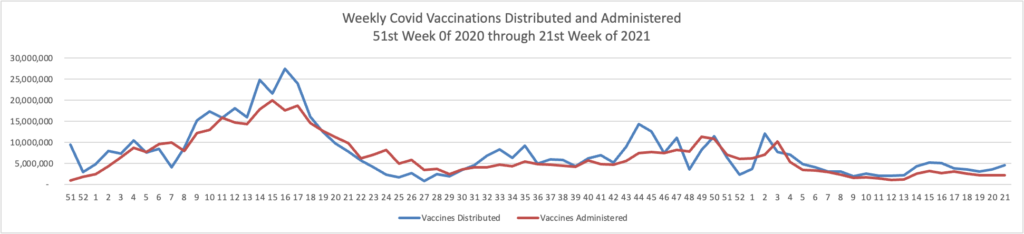
Here’s the FEHBlog weekly chart of Covid vaccinations distributed and administered
The CDC’s weekly review of its Covid statistic tells us
People who are up to date on vaccines have much lower risk of serious illness and death from COVID-19 compared with people who are unvaccinated. CDC’s COVID Data Tracker shows that in March 2022, adults ages 18 years and older who were unvaccinated were about 5 times more likely to be hospitalized with COVID-19 than those who were up to date. In the same month, people ages 12 years and older and unvaccinated were 17 timesmore likely to die of COVID-19 than those who were up to date.
COVID-19 vaccines available in the United States are effective at protecting people from getting seriously ill, being hospitalized, and even dying—especially people who are boosted. As with other diseases, you are protected best from COVID-19 when you stay up to date with recommended vaccines. Find a vaccine provider near you.
As of May 19, 2022, there are 301 (9.35%) counties, districts, or territories with a high COVID-19 Community Level, 477 (14.81%) counties with a medium Community Level, and 2,442 (75.84%) counties with a low Community Level. This represents a moderate (+5.10 percentage points) increase in the number of high-level counties, a slight (−0.74 percentage points) decrease in the number of medium-level counties, and a corresponding (−5.84 percentage points) decrease in the number of low-level counties. Five (9.62%) of 52 jurisdictions had no high- or medium-level counties this week.
the Centers for Medicare & Medicaid Services (CMS) released a report that recommends cost savings from lower-than-expected Medicare Part B spending be passed along to people with Medicare Part B coverage in the calculation of the 2023 Part B premium. Earlier this year, Department of Health and Human Services (HHS) Secretary Xavier Becerra instructed CMS to reassess the 2022 Part B premium amount in response to a price reduction for Aduhelm™, a monoclonal antibody directed against amyloid for use in treating Alzheimer’s disease. Given the information available today, it is expected that the 2023 premium will be lower than 2022. The final determination will be made later this fall.
This CMS decision is quite sensible, in the FEHBlog’s view.
On a related FEHB note, FedSmith discusses the pros and cons of enrolling in Medicare Part B when you are a federal or Postal annuitant with FEHB coverage in retirement as well.
From the telehealth front, mHealth Intelligence reports
Called CVS Health Virtual Primary Care, the digital care platform will provide healthcare consumers with an array of care services, including primary care, on-demand care, chronic condition management, and mental health services. Consumers will also be able to choose their healthcare setting from various retail, community-based, virtual, and at-home care options.
“We’re meeting people where they are on their healthcare journey and providing care that is more convenient and easier to access,” said Creagh Milford, DO, vice president, enterprise virtual care at CVS Health, in the news release.
The new benefit will launch on January 1, 2023.
From the Rx coverage front, Formulary Watch reveals that
The Institute for Clinical and Economic Review (ICER) has released the protocol for its second annual review of insurance company policies to assess fair access to prescription drugs. ICER will evaluate whether 15 large U.S. commercial payers, the two largest state health exchange plans, and the Department of Veterans Affairs have formularies and procedures that provide appropriate access to the prescription drugs reviewed by ICER in 2020. These drugs include those that treat patients with cystic fibrosis, hemophilia A, migraine, sickle cell disease, and ulcerative colitis.
The analysis is expected to be completed in November 2022.
From the studies front, the Centers for Disease Control issued its 2021 Diabetes Report Card this week. Here are the highlights
* After almost 2 decades of continual increases, the incidence of newly diagnosed cases of diabetes in the United States decreased from 9.3 per 1,000 adults in 2009 to 5.9 per 1,000 adults in 2019.
* Prevalence of prediabetes among US adults remained steady from 2005–2008 to 2017–2020. However, notification of prediabetes status nearly tripled (from 6.5% to 17.4%).
* American Indian or Alaska Native, non-Hispanic Black, Hispanic, and non-Hispanic Asian people are more likely to be diagnosed with diabetes than non-Hispanic White people (14.5%, 12.1%, 11.8%, 9.5%, and 7.4%, respectively).
* During the COVID-19 pandemic, diabetes emerged as an underlying condition that increases the chance of severe illness. Nearly 4 in 10 adults who died from COVID-19 in the United States also had diabetes.
New bipartisan legislation introduced in the Senate aims to empower the Federal Trade Commission (FTC) to crack down on pharmacy benefit manager practices such as spread pricing.
The legislation, introduced Tuesday, comes as the PBM industry faces other areas of reform, including a proposed rule to get rid of clawback fees PBMs can charge pharmacies after the drug is dispensed.
Lawmakers said federal agencies need more power, though, to rein in PBM practices.
From the No Surprises Act (“NSA”) front, AHIP and the Blue Cross Association inform us
A recent survey and analysis conducted by AHIP and the Blue Cross Blue Shield Association (BCBSA) found that in the first two months of 2022, the NSA prevented more than 2,000,000 potential surprise medical bills across all commercially insured patients. If only a fraction of these claims are ultimately disputed through IDR, it would still far exceed the government’s estimate. Should the trend hold, more than 12,000,000 surprise bills will be avoided in 2022 due to the NSA.
The law is working to protect millions of consumers from costly surprise bills and yet several hospital and provider organizations have filed lawsuits challenging the NSA regulations and legislation in order to increase their own profits at patients’ expense. Recent polling conducted by Morning Consult on behalf of the Coalition Against Surprise Medical Billing found that 8 in 10 voters, after learning about the NSA, are concerned that lawsuits from physician and hospital organizations could delay or overturn the patient protections in the Act.
The findings of the AHIP-BCBSA survey are important to demonstrate how many consumers have already benefitted from the NSA and to underscore the extent of total claims that could be impacted if the IDR process is not a predictable process with payment amounts that trend towards market rates.
That’s great news.
In public health news, the American Hospital Association tells us ‘
U.S. births rose 1% in 2021 to about 3.7 million, the first increase since 2014, according to preliminary data released today by the Centers for Disease Control and Prevention. Birth rates declined for women aged 15-24 and rose for women aged 25-49. The cesarean delivery rate rose 0.3 percentage point to 32.1%, while the preterm birth rate rose 4% to 10.48%, the highest rate since 2007, CDC said.
From the Omicron and siblings front
Reuters reports “The U.S. Food and Drug Administration set June 14-15 as the new meeting date to review Moderna Inc’s emergency authorization request for its COVID-19 vaccine for children aged 6 months to 5 years and Pfizer Inc’s vaccine for those aged 6 months through 4 years.”
Precision Vaccines tells us “The U.S. Centers for Disease Control and Prevention (CDC) issued today Health Alert Network Health Advisory CDCHAN-00467 to update healthcare providers, public health departments, and the public on the potential for recurrence of COVID-19 or “COVID-19 Rebound.” COVID-19 Rebound cases have been reported to occur between two and 8 days after initial recovery. They are characterized by a recurrence of COVID-19 symptoms or a new positive viral test after testing negative. A brief return of symptoms may be part of the natural history of SARS-CoV-2 (the beta coronavirus that causes COVID-19) infection in some persons, independent of treatment with Paxlovid and regardless of vaccination status.” STAT News offers a more detailed article on this topic for those interested.
Officials for the Centers for Disease Control and Prevention (CDC) on Monday said the agency is releasing doses of a smallpox vaccine in response to the few recent cases of monkeypox that have been detected in the U.S. Jennifer McQuiston, the deputy director for the CDC’s Division of High Consequence Pathogens and Pathology, said during a press briefing that more than a thousand doses of the Jynneos smallpox vaccine are currently available in the U.S., with more doses expected to become available as production ramps up. * * * The vaccines will be designated for people who are most likely to benefit from them, McQuiston said, including those who are known to have had close contact with monkeypox patients, health care workers and people who would be at high risk of developing a severe case of the disease.
From the healthcare business front, Beckers Hospital News identifies Walmart’s 18 Centers of Excellence in the U.S.
Fortune reports “The U.S. is experiencing a sixth wave of COVID, with over 90,000 confirmed new cases a day and a 20% increase in hospitalizations over the past two weeks. The actual number of new cases per day likely sits at a half-million or more, “far greater than any of the U.S. prior waves, except Omicron,” writes Dr. Eric Topol, the executive vice president of Scripps Research and a professor of molecular medicine, in a recent blog post on the maps.” It’s hard to argue against this point.
Bloomberg Prognosis offers a useful Q&A on when you can back to life after a case of Omicron. Here is a link to the CDC’s guidelines on isolation and quarantine due to Omicron.
The FEHBlog noticed that 75% of the American population age 12 and older is fully vaccinated against Covid.
The American Medical Association discusses how Covid telemonitoring sets the model for other acute conditions.
From the Aduhelm front, the Wall Street Journal reports
The commercial failure of Biogen Inc.’s drug Aduhelm is putting new focus on the state of research into the causes of Alzheimer’s disease.
“If you cut the brain open and amyloid plaque is absent, Alzheimer’s was not the cause of disease,” said Jeffrey Cummings, director of the Chambers-Grundy Center for Transformative Neuroscience at the University of Nevada, Las Vegas.
But research into the benefits of targeting amyloid in Alzheimer’s patients has been mixed. There are more questions than answers about the role amyloid plays in the development of the disease, neurologists say.
“Alzheimer’s is a complex disease. It’s unlikely that a single mechanism is contributing to it,” said Maria Carillo, the Alzheimer’s Association’s chief science officer. * * *
More than 140 drugs are in the pipeline as potential Alzheimer’s treatments, including drugs that target tau and microglia function, according to a survey of registered clinical trials in the U.S. Three other amyloid-targeting monoclonal antibodies, which are in the same class as Aduhelm, are in development. One, called lecanemab, was submitted this month by co-developers Biogen and Japan-based Eisai Co. to the Food and Drug Administration for potential approval.
Time will tell.
From the preventive care wellness front —
Medscape reports an “alarming increase in esophageal cancers in middle-aged adults. The study’s author, Bashar Qumseya, MD, MPH, recommends that people with multiple risk factors for these cancers, i.e., obesity, diet, and gastroesophageal reflux disease, should undergo an endoscopy at the time of their first colonoscopy at age 45.
The American Medical Association identifies steps that patients can follow to reverse pre-diabetes.
The FEHBlog just discovered that the Weekend Update did not go out on Monday morning. So here are Monday’s items that normally would have been posted in the Monday Roundup —
Three doses of Pfizer and BioNTech’s COVID-19 vaccine met the Food and Drug Administration’s bar for success in a trial studying the shot in children younger than 5 years old, the companies said Monday. The FDA has tentatively scheduled a meeting of outside advisers to review the data in three weeks.
The agency delayed review of the vaccine in the youngest children earlier this year after a December review of data indicated a two-shot series didn’t spur an immune response that was likely to protect against disease. When Pfizer and BioNTech disclosed that data, they announced plans to test immune response and efficacy after three shots.
The announcement comes days after U.S. officials warned of a new surge of COVID-19 cases as mask mandates have been lifted and while immunity from vaccination and previous infections wanes. The FDA has granted emergency use authorization for as many as four shots of Pfizer and BioNTech’s vaccine — an initial two-dose series followed by two periodic boosters — for adults at least 50 years old.
Reuters adds U.S. “Health officials are considering extending the eligibility for a second COVID-19 vaccine booster dose to people under 50 amid a steady rise in cases, with the United States seeing a threefold increase over the past month.”
Bloomberg Prognosis recommends carrying around a portable carbon dioxide monitor to help prevent Covid or at least remind you to mask up and / or move along:
Carbon-dioxide monitors can assess how Covid-risky a space is because they help tell you whether you’re breathing in clean air. They measure the concentration of carbon dioxide, which people exhale when they breathe, along with other things like, potentially, virus particles. The more well-ventilated a space, the lower the reading on my monitor’s screen — meaning not only less carbon dioxide but also less of the stuff like Covid that might make people sick.
One place I didn’t expect this to be an issue was airplanes, because you hear so much about their top-of-the-line air quality systems. But in fact, some of the highest carbon dioxide readings on my travels were taken on flights, specifically during the boarding process.
It turns out that during boarding and deplaning, air systems aren’t typically running. Those periods are risky because people are mingling more than they do during a flight, says Joe Allen, an associate professor at the Harvard T.H. Chan School of Public Health who carries around his own CO2 monitor.
“We’ve been warning about this,” Allen says.
Fresh air is important for our health in ways that go well beyond Covid, but it’s also largely invisible. Carbon-dioxide monitors can change that.
What will they think of next?
The FEHBlog confesses that he took his eye off the flu virus this year. Beckers Hospital Review informs us “The CDC estimates there have been at least 6.7 million flu illnesses, 69,000 hospitalizations and 4,200 flu-related deaths so far this season.”
In other virus news, Reuters reports “Infection with adenovirus, a common childhood virus, is the leading hypothesis for recent cases of severe hepatitis of unknown origin in children that have led to at least six deaths, U.S. health officials said on Friday [May 20]. Furthermore,
The Centers for Disease Control and Prevention (CDC) said it is continuing to investigate whether 180 cases identified in 36 states and territories since last October represent an increase in the rate of pediatric hepatitis or whether an existing pattern has been revealed though improved detection.
From the mental healthcare front, Fierce Healthcare tells us
Mental health concerns are on the rise among teens, and the impact on parents and families is an unmet need employers could address, new data from Cigna’s Evernorth show.
The pandemic has significantly worsened mental health among teens and young adults, with 25% experiencing depressive symptoms and 20% experiencing anxiety symptoms, a JAMA study shows. About 80% of the 1,000 parents included in Cigna’s survey said their children are struggling with their mental health.
Nearly one-fifth (18%) of parents say their child’s needs are negatively impacting their job performance and productivity, according to the survey. In addition, 55% said they do not have enough support from their employer, and 1 in 7 said they were forced to leave or stay out of the workforce to manage their teenager’s needs.
“I think there’s going to be a long tail for these kids and also their family members,” Stuart Lustig, M.D., national medical executive for behavioral health at Evernorth, told Fierce Healthcare. “I think we’re in this for the long haul.”
Based on the CDC’s Covid Data Tracker and using Thursday as the first day of the week, here is the FEHBlog’s weekly chart of new Covid cases from the 27th week of 2021 through the 19th week of 2022.
The CDC’s weekly review of its Covid statistics notes
As of May 11, 2022, the current 7-day moving average of daily new cases (84,778) increased 30.7% compared with the previous 7-day moving average (64,863). A total of 82,087,117 COVID-19 cases have been reported in the United States as of May 11, 2022.
Here’s the CDC’s weekly chart of new Covid hospitalizations
The CDC’s weekly review of Covid hospitalization notes, “The current 7-day daily average for May 4–10, 2022, was 2,629. This is a 17.5% increase from the prior 7-day average (2,238) from April 27–May 3, 2022.”
Here’s the FEHBlog’s weekly chart of new Covid deaths from the 27th week of 2021 through the 19th week of 2022:
The CDC’s weekly review notes “The current 7-day moving average of new deaths (273) has decreased 15.4% compared with the previous 7-day moving average (322). As of May 11, 2022, 996,376 COVID-19 deaths have been reported in the United States.”
Finally, here is the FEHBlog’s weekly chart of Covid vaccinations distributed and administered from the beginning of the Covid vaccination era through the 19th week of 2022.
Per the CDC’s weekly review, “As of May 11, 2022, the 7-day average number of administered vaccine doses reported (by date of CDC report) to CDC per day was 390,306, an 11.1% decrease from the previous week.”
76% of the U.S. population aged 18 and older are fully vaccinated against Covid, and 50% of that cadre has received the first booster. Likewise, 90% of the U.S. population aged 65 and older is fully vaccinated, and 70% of that cadre has received the first booster. There is work still to be done but the public health community and the U.S citizenry deserves credit for these accomplishments.
To wrap up this week’s Covid stats, let’s include the CDC’s latest Communities report:
As of May 12, 2022, there are 137 (4.25%) counties, districts, or territories with a high COVID-19 Community Level, 453 (14.07%) counties with a medium Community Level, and 2,630 (81.68%) counties with a low Community Level. This represents a small (+1.77 percentage points) increase in the number of high-level counties, a moderate (+4.10 percentage points) increase in the number of medium-level counties, and a corresponding (−5.87 percentage points) decrease in the number of low-level counties. Eight (15.38%) of 52 jurisdictions had no high- or medium-level counties this week.
NPR Shots offers a valuable article describing three ways to get the Paxlovid pill if diagnosed with Covid. The key takeaway from the FEHBlog’s perspective is the need to have a primary care provider in your life.
For those with health insurance and access to their primary care providers or health care team, you can make an in-person or telehealth appointment to get tested (or share your positive test results), assessed for risks and medications and, if eligible, obtain a prescription for the pills.
Having a provider that knows your medical history, as well as the details of your current situation, can be very helpful, says Dr. Ulrika Wigert, a family medicine physician at CentraCare in Sauk Center, Minnesota. “Did you test the first day [of symptoms]? Did you test the second day? How sick were you when you tested?” And, if you’re starting to feel better by the time you get the medication, do the benefits of taking the medication outweigh any risks? “Having a provider help navigate that on the individual patient basis” can help guide you through an appropriate course of care, she says.
STAT News addresses three burning questions about the future of prescribing drugs using telehealth services (not for a PCP visit).
Research by Lori Uscher-Pines, a senior policy researcher at RAND, suggests that providers are starting to prescribe buprenorphine — a controlled substance used to treat opioid use disorder — without in-person visits. But they’re typically more comfortable continuing the prescriptions virtually for patients they’ve already met, compared to taking on new patients virtually.
Still, “very few studies of medication treatment for opioid use disorder via telehealth have shown safety or diversion concerns,” she said. And she noted that one recent study suggested that relaxed restrictions have improved treatment retention for opioid use disorder patients.
Telehealth prescription could help patients in regions with acute clinician shortages — especially of mental health providers — obtain critical medication.
“A key question going forward is how to strike a balance between increasing access to important medications on the one hand and limiting the potential for misuse on the other,” Uscher-Pines said.
In the past, federal and state regulations have required clinicians to frequently examine patients in-person to guard against misuse, addiction, or fraud. “But are there other ways to accomplish this, perhaps ways that actually leverage telehealth rather than restrict it?” she asked.
A better system might involve hybrid care: In-person exams for certain types of prescriptions blended with virtual follow-ups, for instance. But Schwamm cautioned against over-regulating telehealth prescriptions, given that clinical guidelines evolve faster than federal and state policies typically do.
“Whenever you put these kinds of restrictions in place, you are restricting access to care,” he said. “Do we need to require, and is it good medical practice, to require by regulation that the person come in-person? I would argue that we just don’t know.”
In an Associated Press interview, Jha said Americans’ immune protection from the virus is waning, the virus is adapting to be more contagious and booster doses for most people will be necessary — with the potential for enhanced protection from a new generation of shots.
Epidemiologist David Dowdy of Johns Hopkins’ Bloomberg School of Public Health said that, despite the case increases, hospitalization and death rates overall remain relatively low compared with earlier periods in the pandemic — a reflection of how much immunity there is in the population.
“In some ways, this is encouraging, in that we’re starting to see a divergence between the number of cases and the number of hospitalizations and deaths,” Dowdy said. “But it’s also a little bit discouraging that we’ve been through all this and we’re still seeing a flat line and an uptick in the number of people getting admitted to the hospital and in people dying.”
In the FEHBlog’s view, the coordinator should stop fighting the Delta pandemic by focusing attention on better government distribution of Pfizer’s Paxlovid, which can cure the Omicron if taken timely. Kaiser Health News discusses this continuing and vexing distribution problem.
Unquestionably a need to focus attention on vaccinations and boosters remains essential. Govexec and Kaiser Health News ask why one-third of Americans over 65 have not received the first booster. Nearly all Americans over 65 are fully vaccinated. The article explains
People 65 and older account for about 75% of U.S. covid deaths. And some risk persists, even for seniors who have completed an initial two-dose series of the Moderna or Pfizer vaccine or gotten one dose of the Johnson & Johnson vaccine. Among older people who died of covid in January, 31% had completed a first vaccination round but had not been boosted, according to a KFF analysis of CDC data
FEHB plans are well-positioned to help with this effort, given their demographics.
In other virus news, the American Hospital Association tells us
The Centers for Disease Control and Prevention yesterday updated its testing guidance for clinicians treating children with hepatitis of unknown cause. The agency is investigating 109 potential hepatitis cases of unknown cause in U.S. children since last October, including five deaths. More than 90% of the patients were hospitalized, 14% received liver transplants and more than half had a confirmed adenovirus infection, but officials still don’t know the actual cause of their hepatitis and cautioned that it may take time to assess the evidence and learn more. Potential cases also have been reported in the United Kingdom and other countries.
Following up on last night’s hospital system merger news, Healthcare Dive reports
The Advocate Aurora Health and Atrium Health merger is likely to get a close review from the Federal Trade Commission as the Biden administration has taken a tougher stance on healthcare consolidation, antitrust and legal experts say. * * *
“I don’t think anything of this size in a healthcare transaction today is going to get rubber stamped,” said Bill Horton, a partner at Jones Walker who focuses on healthcare transactions. * * *
“Historically, the FTC concern in hospital and healthcare institution mergers has been the geographic overlap,” Horton said.
Advocate Aurora and Atrium do not have any geographic market overlap. The systems span six separate states through the Midwest and South.
“It doesn’t raise the same red flags, but it doesn’t mean that it gets waved through,” said Leemore Dafny, a Harvard Business School professor and former deputy director of healthcare and antitrust at the FTC.
The FTC is likely to examine whether the two systems negotiate with the same insurers even if they’re in different geographic locations, Dafny said.
From the interoperability front, Health Data Management offers an interesting take on government efforts to meet lofty public health goals for Data Modernization Initiative.
From the mental health care front, and to end on a high note, Health Payer Intelligence informs us
Consumers reported having positive experiences with their employer-sponsored mental and behavioral healthcare coverage during the coronavirus pandemic, a survey conducted on behalf of AHIP discovered.
“Health insurance providers are working every day to support Americans by helping them find the mental health support and counseling they need at a price they can afford,” Matt Eyles, president and chief executive officer of AHIP, said in a press release.
Based on the CDC’s Covid Data Tracker and using Thursday as the first day of the week, here’s the FEHBlog’s weekly chart of new Covid cases displayed from the 27th week of 2021 through the 18th week of 2022.
The CDC reports in its latest weekly review that “The current 7-day daily average of new Covid hospital admissions for April 27–May 3, 2022, was 2,219. This is a 16.6% increase from the prior 7-day average (1,903) from April 20–26, 2022.
Here’s the FEHBlog’s latest weekly chart of new Covid deaths display from the 27th week of 2021 through the 18th week of 2022.
COVID-19 cases and hospitalizations are on the rise in the United States. Although deaths continue to decrease, the United States is expected to reach 1 million deaths soon. * * *
As of May 5, 2022, there are 78 (2.42%) counties, districts, or territories with a high COVID-19 Community Level, 316 (9.81%) counties with a medium Community Level, and 2,826 (87.76%) counties with a low Community Level. This represents a slight (0.75 percentage points) increase in the number of high-level counties, a small (+1.86 percentage points) increase in the number of medium-level counties, and a corresponding (−2.61 percentage points) decrease in the number of low-level counties. Sixteen (28.57%) of 56 jurisdictions had no high- or medium-level counties this week.
Here’s the FEHBlog’s weekly chart of Covid vaccinations distributed and administered from the inception of the vaccination program until this 18th week of 2021.
Nearly 75% of the U.S. population aged 12 and older are fully vaccinated and nearly 50% of the U.S. population aged 18 and older have received a booster.
The White House could run out of Covid-19 vaccines if it moves forward with plans to encourage all adults to get a second Covid-19 vaccine booster dose by roughly Sept. 1, according to a tranche of budget documents sent to Congress that have not previously been made public.
In other CDC news, the American Hospital Association informs us
The Centers for Disease Control and Prevention is investigating 109 potential hepatitis cases of unknown cause in U.S. children since last October, including five deaths. More than 90% of the patients were hospitalized, 14% received liver transplants and more than half had a confirmed adenovirus infection, but officials still don’t know the actual cause of their hepatitis and cautioned that it may take time to assess the evidence and learn more. CDC alerted clinicians to the first cases last month.
To date, 25 states and territories have reported potential cases: Alabama, Arizona, California, Colorado, Delaware, Florida, Georgia, Idaho, Illinois, Indiana, Louisiana, Michigan, Minnesota, Missouri, North Carolina, North Dakota, Nebraska, New York, Ohio, Pennsylvania, Puerto Rico, Tennessee, Texas, Washington and Wisconsin.
The US Food and Drug Administration (FDA) has cleared the first in vitro diagnostic to aid in the early detection of Alzheimer’s disease (AD).
The Lumipulse G β-Amyloid Ratio 1-42/1-40 (Fujirebio Diagnostics) test detects amyloid plaques associated with AD in adults age 55 or older who are under investigation for AD and other causes of cognitive decline.
“The availability of an in vitro diagnostic test that can potentially eliminate the need for time-consuming and expensive [positron emission tomography (PET)] scans is great news for individuals and families concerned with the possibility of an Alzheimer’s disease diagnosis,” Jeff Shuren, MD, JD, director of the FDA’s Center for Devices and Radiological Health, said in a statement.
“With the Lumipulse test, there is a new option that can typically be completed the same day and can give doctors the same information regarding brain amyloid status, without the radiation risk, to help determine if a patient’s cognitive impairment is due to Alzheimer’s disease,” he added.
From the healthcare business front, Beckers Payer Issues informs us
Cigna reported over $44 billion in total revenues in the first quarter, with the strongest growth in the company’s Evernorth business. Projected revenues at year end stand at $177 billion, according to the company’s earnings report released May 6.
“We’ve had a strong start to the year as we advance our growth strategy and support the health and well-being of our clients and customers,” Chair and CEO David Cordani said. “We’re taking decisive steps forward with innovation, new partnerships and re-investing in our company so we can achieve greater impact for the customers and communities we’re privileged to serve.”
Driven mainly by nonoperating losses, Oakland, Calif.-based Kaiser Permanente recorded a net loss of $961 million in the first quarter of 2022, down from a net income of $2 billion in the same quarter in 2021, according to financial data released May 6.
For the quarter ending March 31, Kaiser reported total operating revenue of $24.2 billion, up from $23.2 billion the year prior. Tom Meier, corporate treasurer of Kaiser Permanente, said the revenue increase was attributed to several factors, including growth of its health plan.
Kaiser also saw its expenses increase significantly in the first quarter of 2022 to $24.3 billion, up 9.5 percent from the same quarter last year. Mr. Meier said the health system incurred about $1.4 billion in costs from COVID-19, including $900 million for the cost of care, $550 million for testing and $50 million for vaccinations.
USPS saw a net loss of $639 million in the period between Jan. 1 and March 31, up from $82 million in the same period last year. The Postal Service Reform Act was not enshrined into law until after the second quarter of fiscal 2022, meaning the relief it will provide by eliminating the requirement that the Postal Service prefund health care costs for future retirees was not reflected in the financial results. USPS grew revenue in the quarter by about $900 million, a 5% increase from the same period in 2021. Volume grew by about 3%.
Postmaster General Louis DeJoy expects the Postal Service will need to keep raising prices on its monopoly mail products for the foreseeable future, as part of a 10-year reform plan to improve its long-term financial health.
DeJoy said Thursday said the mailing industry needs to be prepared for USPS to raise prices on its market-dominant products “at an uncomfortable rate,” until it reaches a point where the agency is on track to be self-sustaining in the long term.
As we approach Mothers’ Day this weekend, the American Hospital Association tells us
The Health Resources and Services Administration will launch May 8 a toll-free hotline for expecting and new mothers experiencing mental health challenges, where trained counselors will provide brief interventions and referrals to community-based and telehealth providers as needed. Callers also will receive evidence-based information and referrals to support groups and other community resources.
“Today, we are creating a safe space for expecting and new moms who are experiencing maternal depression, anxiety or other mental health concerns to have confidential conversations and get the support they need,” said HRSA Administrator Carole Johnson. “Moms can call or text 1-833-9-HELP4MOMS and connect with a counselor at no charge. We are going to continue to grow our investments in this resource, as we know it’s what women need.”
Several bipartisan senators are clamoring for more transparency into how pharmacy benefit managers conduct their business, potentially foreshadowing action on legislation to require new disclosures for the industry.
A subcommittee of the Senate Commerce Committee held a hearing Thursday on PBMs and their role in the pharmaceutical marketplace. Senators claimed there is an absence of competition in the industry and potential conflicts of interest.
“PBMs are not the only cause of drug price inflation and excessive pricing, but they are integral to this system,” said Sen. Richard Blumenthal, D-Connecticut, the subcommittee’s chairman. “They are part of an increasingly integrated, uncompetitive system involving PBMs owned or owning insurers and constraining pharmacies in the amount of information that they give to consumers. That is one slice of a broken system.”
Members of the healthcare industry are once again pressuring Congress to remove what they say is a major pain point in their operations and in the delivery of patient care: the ban on a nationwide unique patient identifier.
Almost 120 health IT groups, EHR vendors, hospitals, physicians and health insurers sent letters on Wednesday to House and Senate appropriators urging them to remove decades-old rider language in a 2023 appropriations bill that prevents the HHS from spending federal dollars to create or adopt a UPI standard.
Signees, including payer lobby AHIP, software companies Cerner and Epic, and health systems Banner Health and Intermountain, called the ban “archaic” in the letters. However, regulators have noted a UPI is unlikely to be a silver bullet against the nation’s patient matching problem.
The patient identifier strikes the FEHBlog as a key to interoperability as well as improving patient safety. Fund it, Congress!
From the Omicron and siblings front, Medpage Today reports
Use of Johnson and Johnson’s (J&J) COVID-19 vaccine should only be limited to certain adults, the FDA said on Thursday.
Due to an updated analysis of the rare cases of thrombosis with thrombocytopenia syndrome (TTS), which typically occur 1 to 2 weeks after vaccination, use of the J&J vaccine should be restricted to those for whom mRNA vaccines are “not accessible or clinically appropriate,” or who would not get vaccinated if not for the J&J vaccine, the agency said.
It’s unfortunate that the only one-shot vaccine, which helped public health authorities reach underserved communities, is now knocked down for the mandatory eight count.
From the healthcare innovations front, Fierce Healthcare informs us
UnitedHealthcare has partnered with Kaia Health on a new virtual physical therapy program.
The program aims to offer 24/7, on-demand exercise feedback to eligible members with musculoskeletal conditions, the health insurance giant said. Members who are recovering from surgery or an injury will be asked to complete an assessment of current issues and will be referred to the program based on that assessment.
Eligible members will then be able to download Kaia’s app to access its physical therapy tools, which use artificial intelligence to support patients through physical therapy exercise and monitor progress.
Cigna is launching a new provider consult service that aims to improve outcomes for patients with cancer.
The program, backed by the capabilities of the insurer’s Evernorth subsidiary, allows community oncologists to connect with cancer subspecialty experts at centers designated by the National Cancer Institute (NCI). These connections will allow patients to benefit from the latest innovations in cancer care while also keeping their care close to home, Cigna said.
In a pilot, community oncologists had their treatment plans reviewed by experts and in 40% of cases reviewed, patients were recommended alternative tests or treatment based on new advancements in research.
Also a ZDNet reporter discusses his experience of wearing a continuous glucose monitor for 40 days.
I learned a lot about my body and how it reacts, and that’s information I can and do still use on a daily basis even if I don’t have an app yelling at me. Since I stopped wearing the Signos and getting insight, I’ve stuck to a healthier diet and routine exercise.
Good read.
From the healthcare business front, Healthcare Dive tells us
Centene said Thursday it has inked separate agreements to sell two of its pharmacy businesses in deals totaling $2.8 billion.
The payer plans to sell Magellan Rx to Prime Therapeutics and Pantherx to The Vistria Group, General Atlantic and Nautic Partners.
The deals are subject to regulatory approval. Magellan Rx is expected to close in the fourth quarter while Pantherx is anticipated to close in the next two to four months.
Thursday’s news builds on Centene’s plan to sell off non-core assets as it looks to sharpen its focus on its main [health insurance] business.
From the federal employment front, Govexec identifies the agencies who scored best and worst on the key employee morale questions of the recently released OPM 2021 Federal Employee Viewpoint Survey.
The National Science Foundation, Federal Energy Regulatory Commission, General Services Administration and the Pension Benefit Guaranty Corporation each landed in the top five on questions related to employees’ job satisfaction, senior leaders’ ability to motivate the workforce, and whether employees believe their agency will use Federal Employee Viewpoint Survey results to improve the workplace.
On the other hand, four agencies found themselves consistently near the bottom on these same questions. The Homeland Security Department, Social Security Administration, as well as the Justice and State departments all found themselves in the bottom five of at least two of these three questions.
COVID-19 vaccinations prevented an estimated 107,000 Medicare hospitalizations between January and May 2021, resulting in $2.6 billion in savings for Medicare and Medicare Advantage plans, according to a new report by the Department of Health and Human Services. The report estimates the impact of COVID-19 vaccination during a five-month period shortly after the first vaccine was authorized and recommended for health care workers and elderly people in long-term care facilities. Future analyses will examine hospitalizations prevented by vaccination during the delta and omicron waves, HHS said.
“Paxlovid does what it has to do: it reduces the viral load,” Chief Executive Officer Albert Bourla said in an interview. “Then your body is supposed to do the job.” But for unknown reasons, the CEO said, some patients aren’t able to clear the virus with the first course of treatment.
In cases where virus levels do rebound, Bourla said, “then you give a second course, like you do with antibiotics, and that’s it.”
As noted in the article, the fly in the ointment is that the FDA emergency use authorization does not expressly approve a second course of the medication.
From the Rx coverage front
MedCity News reports on Bristol Myers Squibb’s (BMS) NEX-T program to improve CAR-T treatments.
The company has described NEX-T as changes to manufacturing driven by the translational insights it has gleaned from treating thousands of patients with its CAR T therapies. In addition to a faster turnaround time, the strategy is intended to reduce the costs of the overall process.
One of the key goals for the next-generation of cell therapies is treating solid tumors.
Another strategy that BMS is pursuing is going after two targets with a single therapy, reducing the risk that a tumor escapes from the treatment
Looking at the flip side of this coin, Forbes reports
Health plans and pharmacy benefit managers (PBMs) that manage drug costs speaking at this year’s Asembia Specialty Pharmacy Summit in Las Vegas say specialty drugs now account for 50% or greater of the total prescription spending they manage. In some cases, employer clients are seeing specialty costs account for 60% or even greater of their total drug spending.
“It really is frightening for our clients,” Lucille Accetta, senior vice president of pharmacy benefit management and specialty product development at CVS Health told hundreds of attendees at the Asembia event, which runs through Thursday and drew more than 5,000 people from the healthcare industry. “We have to be the best purchaser for our clients.” * * *
To reign in the costs of prescription drugs while maintaining access to life-saving treatments, health plans and pharmacies say they are more closely monitoring patients as soon as they are on the drug, said Rina Shah, group vice president of pharmacy operations and services at Walgreens.
The Forbes article adds
Abarca Health [is] an independent PBM that manages more than $5 billion in drug costs annually for more than four million Americans has executives at this week’s Asembia meeting talking up its efforts to better manage specialty pharmacy costs.
The company’s Assura solution launched earlier this year “guarantees the net cost of drugs, including specialty medications, by offering an annual fixed per script cost for a health plan’s entire population,” Abarca said in announcing the new pricing solution earlier this year. The guarantee, Abarca CEO Jason Borschow says, is adjusted each year based on drug benefit coverage changes.
Even as COVID-19’s benefit waned, new plan members across multiple product lines helped drive CVS to $2.3 billion in profit in the first quarter, slightly higher than the $2.2 billion brought in at the same time last year.
In results published Wednesday, the company beat Wall Street expectations on earnings and revenue, with a topline of $76.8 billion, up 11% year over year.
Fierce Healthcare explains how CVS has shifted from a retail to a digital marketing focus.
Moderna Inc. MRNA 5.81% said that its first-quarter revenue and profit tripled from a year earlier on higher sales of its Covid-19 vaccine and that a fall booster-shot campaign could drive continued sales gains.
The biotechnology company’s revenue topped $6 billion in the period ended March 31, beating analyst expectations and rising from $1.94 billion a year earlier, driven almost entirely by sales of its messenger RN
Moderna Inc. MRNA 5.81% said that its first-quarter revenue and profit tripled from a year earlier on higher sales of its Covid-19 vaccine and that a fall booster-shot campaign could drive continued sales gains.
The biotechnology company’s revenue topped $6 billion in the period ended March 31, beating analyst expectations and rising from $1.94 billion a year earlier, driven almost entirely by sales of its messenger RNA-based vaccine, branded as Spikevax. * * *
From the health risks front, MedPage Today explains that
Seven risk factors, some modifiable and some not, accounted for the vast majority of risk for first-time acute myocardial infarction (MI) in young adults, according to a case-control study.
The seven factors — diabetes, depression, hypertension, smoking, family history of premature MI, low household income, and hypercholesterolemia — were responsible for 83.9% of the total acute MI risk in young women and 85.1% of the risk in young men, reported Harlan Krumholz, MD, SM, of Yale New Haven Hospital in New Haven, Connecticut, and colleagues.
Older adults who obtain a flu shot are less likely to suffer a heart attack or stroke and are at lower risk for death from heart-related health events in the year after getting vaccinated, an analysis published Friday found.
Just under 4% of older adults vaccinated against the seasonal virus experienced a “cardiovascular event” within the next year compared to just over 5% of those who did not receive the shot, data published Friday by JAMA Network Open showed.
From the meetings department,
HHS provides a readout of a high-level meeting among Labor Department, health insurance and business executives “to discuss compliance with the Mental Health Parity and Addiction Equity Act, adequacy of in-network providers and mental health and substance use disorder treatment during the pandemic, as the nation observes Mental Health Awareness Month.”
The National Committee for Quality Assurance reviews the presentations at last week’s Quality Talks conference.
From the federal employee benefits front, FedWeek discusses OPM’s planned improvement to processing retirement applications as unveiled in the Fiscal Year 2023 budget document. Processing federal retirement benefits will be a heavy lift for OPM until Congress simplifies the pension calculation.
We use cookies on our website to give you the most relevant experience by remembering your preferences and repeat visits. By clicking “Accept”, you consent to the use of ALL the cookies.
This website uses cookies to improve your experience while you navigate through the website. Out of these, the cookies that are categorized as necessary are stored on your browser as they are essential for the working of basic functionalities of the website. We also use third-party cookies that help us analyze and understand how you use this website. These cookies will be stored in your browser only with your consent. You also have the option to opt-out of these cookies. But opting out of some of these cookies may affect your browsing experience.
Necessary cookies are absolutely essential for the website to function properly. These cookies ensure basic functionalities and security features of the website, anonymously.
Cookie
Duration
Description
cookielawinfo-checbox-analytics
11 months
This cookie is set by GDPR Cookie Consent plugin. The cookie is used to store the user consent for the cookies in the category "Analytics".
cookielawinfo-checbox-functional
11 months
The cookie is set by GDPR cookie consent to record the user consent for the cookies in the category "Functional".
cookielawinfo-checbox-others
11 months
This cookie is set by GDPR Cookie Consent plugin. The cookie is used to store the user consent for the cookies in the category "Other.
cookielawinfo-checkbox-necessary
11 months
This cookie is set by GDPR Cookie Consent plugin. The cookies is used to store the user consent for the cookies in the category "Necessary".
cookielawinfo-checkbox-performance
11 months
This cookie is set by GDPR Cookie Consent plugin. The cookie is used to store the user consent for the cookies in the category "Performance".
viewed_cookie_policy
11 months
The cookie is set by the GDPR Cookie Consent plugin and is used to store whether or not user has consented to the use of cookies. It does not store any personal data.
Functional cookies help to perform certain functionalities like sharing the content of the website on social media platforms, collect feedbacks, and other third-party features.
Performance cookies are used to understand and analyze the key performance indexes of the website which helps in delivering a better user experience for the visitors.
Analytical cookies are used to understand how visitors interact with the website. These cookies help provide information on metrics the number of visitors, bounce rate, traffic source, etc.
Advertisement cookies are used to provide visitors with relevant ads and marketing campaigns. These cookies track visitors across websites and collect information to provide customized ads.